Category: First Time Home Buyers

  • 7 Tips For First-Time Home Buyers

    7 Tips For First-Time Home Buyers

    Purchasing property in Malaysia can be complicated and perplexing, particularly for first-time buyers. Yet, if you are prepared and knowledgeable, you may go through the process easily and assuredly.

    Here are some tips for first-time home buyers in Malaysia.

    1. Property Ownership

    settle my loan early credit card loan house loan opportunity cost car loan

    One of the important tips for first-time home buyers is to know the many forms of property ownership. Malaysia has three: leasehold, freehold, and Bumiputera quota. Properties with a leasehold duration of up to 99 years are often less expensive than those with freeholds.

    Freehold homes cost more and have an unrestricted tenure. For ethnic Malays and other indigenous communities, quota-Bumiputera properties are set aside.

    Read: Housing Loan In Malaysia: What Is Debt Service Ratio (DSR) And How To Calculate DSR?

    2. Know Your Property Market

    Get knowledgeable about the property market. It is crucial to comprehend the market’s circumstances before making a purchase. Find out the costs of nearby properties similar to yours and the level of interest in those properties.

    To better grasp the market, you can also speak with property agents, registered real estate negotiators or property developers.

    Read: Property Investment: Make Money via Capital Gain & Rental Yield

    3. Loan Pre-Approval

    Next on tips for first-time home buyers is to obtain a loan pre-approval: If you intend to use a loan to pay for your property purchase (which most people are), it’s a good idea to get pre-approved a loan before beginning your search.

    This can help you decide how much you can pay on a property and provide you leverage when dealing with vendors.

    Read: 3 Important Steps For Your Mortgage Application

    4. Understand the Legal Process

    One should know and understand the legal process before buying a property. The legal procedure for purchasing property in Malaysia might be complicated, so it’s important to understand all the processes.

    This includes the ownership transfer, stamp duty and additional legal costs. Having a lawyer at your side will be very helpful throughout the procedure.

    Read: Investing In Property With A Holistic Perspective Using This 3-Step Process

    5. Property Inspection

    Number five on the tips for first-time home buyers, we need to inspect a property, particularly if it’s a sub-sale property. Make sure you conduct a property inspection before making an offer. It’s better to have a professional inspect the house before making an offer.

    This will ensure there aren’t any flaws or problems that aren’t obvious now but could later cause complications in terms of safety or money in your pocket!

    Read: 5 Reasons Why You Shouldn’t Pay Off House Loan Early

    6. Ready To Spend More Money!

    You should be ready! There are additional charges to consider in addition to the property’s purchase price, such as legal fees, stamp duty, and other ancillary costs. Make sure to budget for these fees in advance.

    If you are buying a sub-sale or auction property, be aware that repairing or renovating may take a lot of money.

    Read: How To Save 50% Of Your Housing Loan Interest In Half The Time, And Get Your Dream Car For Free

    7. Be Patient!

    One of the final tips for first-time home buyers is to be patient. Take your time, research, and consider all your possibilities before deciding.

    Remember! Property loan is one of the largest loans with the longest tenure one has in life!

    Buying property in Malaysia can be difficult and complex, but with a little information and planning, you can go through it confidently and smoothly.

    Understanding the various types of property ownership, being familiar with the real estate market, obtaining a loan pre-approval, being aware of the legal process, obtaining a property inspection, being ready for additional fees, and exercising patience are all key.

    Once you know these tips for first-time home buyers, you’ll have no trouble choosing your ideal property in Malaysia if you keep these suggestions in mind.


    Read: Is Malaysia Property Still Worth To Invest In?

  • How To Save 50% Of Your Housing Loan Interest In Half The Time, And Get Your Dream Car For Free

    How To Save 50% Of Your Housing Loan Interest In Half The Time, And Get Your Dream Car For Free

    I approached one of my couple clients, Chris (the husband & not his real name) and I told them that I was helping my other clients plan financially, I ask them whether they would like me to help them. Here is how the conversation about saving on housing loan interest went.

    “Would you like to buy an AUDI TT for free after you settle your housing loan?”

    They were very curious and our conversation went on like this. (This is an article I wrote in 2015 and is re-posted & re-edited.)

    How to buy an AUDI TT for free after you settle your housing loan?

    Chris: “Are you trying to sell me insurance or unit trust?”

    Me: “Neither”

    Chris: “I’m itching to buy an Audi TT & I’m not sure if this is a good time”

    Me: “I could help you buy your AUDI TT for free after I help you settled your housing loan”

    Chris: “How is it possible?”

    Me: “Let me show you”

    Chris: ‘Sure or not? I’m quite skeptical’

    Read: Save RM1 Million On Your Own Or Do It By Buying A Property?

    How To Save 50% Of Your Housing Loan Interest In Half The Time

    This was their situation:

    1. Property purchase price RM2.5 Million (semi-D in Petaling Jaya area)
    2. Loan Interest Rate was 4.4%
    3. Loan Tenure (no of years to repay back the loan) was 35 years (420 months)
    4. Loan Installment is RM10,471/month
    5. Total Interest Paid for the whole duration was RM2,147,808

    After implementing my advice:

    1. Total Interest Paid is RM 1,068,815, which is a 50% reduction in interest paid.
    2. They finish paying off their loan in 19 years and 2 months (230 months), which is 45% earlier (15 years and 10 months OR 190 months).
    3. He could buy 3 new AUDI TT worth RM285,000 with the interest savings. (Of course, AUDI TT’s price would have gone up, but still, if he did not apply this strategy, imagine the 3 AUDI TTs the bank managers would have driven off with)

    Can you guess what did I suggest to him to do?

    1. Save an additional instalment of RM4,000/month into his housing loan
    2. Ensure their Debt Payment Ratio is still on a Healthy Level (<35%)
    3. Ensure their Total Saving Ratio is Healthy (>33%) & their net worth is still growing

    This was what I suggested to him

    Because they are ‘SAVERS’ (people who like to save money in their bank account), they could channel some of their monthly savings into paying off their housing loans.

    But one has to take note to maintain a balanced lifestyle of not over-saving as you do not want to lose out on any investment opportunity.  Here, it shows how big of a difference it makes over time.

    1. Save an extra of RM4,000/month on their housing loan, making the instalment RM14,471/month. Here you can deposit the extra RM4,000 into a Current Account facility provided by most Malaysian banks by now, which can be used to withdraw later (in the event of emergency)

    2. Currently their Debt Payment Ratio is only 27% & they can commit up to 35%. Debt Payment Ratio measures how much income is used to pay ALL Loans (housing loan + car loan + personal loan & etc) divided by your NET INCOME (Your Gross Salary net off EPF, Socso, EIS & PCB). Since they don’t have any car loan, personal loan or any other loan, then all their funds can be channeled to the housing loan.

    3. By doing (1), they are able to save  almost RM 56,551/year in housing loan interest (Total savings on housing loan interest = RM1,078,993)

    4. The amazing thing of ‘Saving’ the extra RM 4,000/month actually improves their networth. You don’t actually ‘spend’ it, here is how it works

    (Net worth is assumed that Current Market Value of the property grow at 4% per annum)

    5. Interestingly, RM 3,731.25 of your RM 4,000 goes directly to pay off your principal. So it seems like you were force saving in your bank account, is just a different account call loan account

    Read: Double-Up Your Property Investment With These Rules!

    Save on housing loan interest, he calls off his purchase and postpones his booking

    After I have shown them the above, he called off his purchase of his Audi TT & redirect his savings to clear off his housing loan interest. Postponing his purchase after he settled off his housing loan first, he is convinced the savings from the housing loan interest will be able to buy him a free Audi TT.

    *Do take note that you should only do this for a property that you live in. For property investment, you may not want to use this strategy. Talk to your financial planner or a professional first before taking action.

    *DISCLAIMER – All strategies listed here are not a recommendation nor advise. The article is written purely for the purpose of education and journaling only. The content of this article is an expression of my opinion and should not be taken as professional advise. If you are seeking professional advise, please consult me personally . You should do your own research and/or seek expert’s advice when overcoming your debt circumstances.

    Read: 10 Ways to Spot Property Investment in Malaysia – A Property Investment Guide

    About the Author

    Ka Hoe is a Licensed Financial Planner having a “Financial Adviser Representative” (FAR) with Bank Negara and “Capital Market Service Representative License (CMSRL) – Financial Planner” with Securities Commission. He is also the Founder of J Advisory, a Personal Finance Academy that helps struggling Malaysians elevate their financial well-being with proven tools, systems and strategies. For more real-world case studies, you can reach me at my blog – https://jadvisory.asia/

  • Clear Signs You Need To Refinance Your Home Mortgage Loan

    Clear Signs You Need To Refinance Your Home Mortgage Loan

    Home loans and home loan applications may be complicated, with changing interest rates, bank policies, and government regulations. These and other factors lead to constant movement in what a lender can and can’t accept. As a result, countless Australians reach a point where they must shift lenders to take advantage of a better mortgage available elsewhere.

    “Refinancing is tricky and time-consuming. Thus, it’s important to determine whether or not this choice is viable for you. Refinancing your mortgage is a big financial choice you’ll have to make. If done correctly, it can save you a fortune in the long haul.” says Shane Perry of Max funding—Australia’s leading second mortgage loan provider.

    If you’re trapped in the same situation, take a closer look at these five tell-tale indicators that you need to refinance your home mortgage loan:

    1.  Low Rates On Offer

    People refinance their mortgages for various factors, one of which is the availability of low-interest rates. Interest rates fluctuate a lot, so don’t pay too much attention to everyday fluctuations. When considering refinancing, it’s a good idea to keep an eye on the trends. Similarly, it’s critical to compare your current mortgage interest rate to the rates offered by mortgage lenders.

    2. Your House Is Now Worth More Money

    Secondly, you may choose to refinance if you’ve made significant renovations or improvements or the value of the homes in your neighbourhood has increased. Also, you may consider refinancing, particularly when you have a massive personal debt such as credit card, personal loans, etc., that you’d want to combine to payout or consolidate.

    However, note that if your house’s assessed value improves, your home equity will likely rise, giving you greater borrowing capacity.

    3. Your Income Or Credit Has Improved

    Your income and credit score mainly determine the interest rate on your mortgage.  Refinancing can help you get a better rate if you’ve earned additional income or your credit score increased after closing your mortgage.

    4. Your Arm (Adjustable Rate Mortgage) And Mortgage Interest Rates Are Increasing

    The combination of an ARM with rising mortgage interest rates is not a desirable match since it may substantially raise the total cost of your house when rates increase. If you find yourself in this situation, you should consider refinancing and switching to a fixed-rate mortgage.

    5. You Want To Remodel Your Home

    People who consider refinancing and get cash out often do so for various reasons. Home equity loans let homeowners borrow money against the value of their houses. You can spend the money to remodel your property and make changes to enhance its long-term worth.

    Is Home Mortgage Refinancing Right For You?

    Mortgage refinancing, along with many other financial transactions, is complicated and needs careful analysis by homeowners seriously considering it. Consider the signs listed above and connect with a trustworthy lender to get immediate answers to your questions. This will assist you in deciding whether or not refinancing is suitable for you.

  • What Will Happen if You Don’t Pay Your Maintenance Bills?

    What Will Happen if You Don’t Pay Your Maintenance Bills?

    With prices of landed properties being way beyond what an average home buyer can afford in city areas like Kuala Lumpur and Penang, living in apartments or strata homes will be the norm for the future generation of urban homeowners.

    ‘Pay thy maintenance bills’. This is mentioned in one of the ‘sacred text’ better known as “Strata Management Act”, where it decrees that all strata home owners have to pay their maintenance fee.

    So, what’s a maintenance fee, you ask? It is the fee that would be collected from the owners within the strata development to be used for repair, maintenances, security and upkeep work of the common property.

    Consider this scenario: You have not paid your maintenance fees for the past six months and the management has been calling you day and night but they have not taken any action against you. You would think that you are invincible since all they can do is to annoy you with phone calls or email reminders. 

    You thought that the Joint Management Body (JMB) or Management Corporation (MC) (collectively known as the Management) is toothless and unable to do anything to you or your property.

    Think again! Let me shed some lights on what can happen to you if you continue to ignore the payment of your maintenance bills.

    1. Block Your Access to Shared Facilities

    The Management is legally able to restrict your rights to using the shared facilities such as gyms, swimming pools and clubhouses. Not only that, they are also allowed to evict you from said facilities if you’re ever caught using them.

    But for some, this may not be a problem as you don’t use these facilities anyway. So what else can they do to you?

    2. Send You Legal Letter of Demand

    maintenance bills

    There is no minimum amount of outstanding fees needed to send a lawyer’s letter of demand. As long as the legal notice remains unpaid after 14 days, the Management can proceed to bring the matter to court which may cost you even more money or may even land you in jail.

    3. Disable Your Access Pass Card

    While they may not be able to chase you out of your dwelling in the interim of any court order, they do however have the right to disable your access pass. This may compel you to enter the compound as a visitor and the inconvenience of registering as a visitor each time you come home.

    4. Blacklist Your Name on the CCRIS and CTOS

    maintenance blacklist

    Although you can bear some of the inconveniences, it may hurt you financially when your name appeared as a defaulter in your CCRIS and CTOS credit reports.

    Both CCRIS and CTOS show your credit payment ability and all of your financial commitments, which are used by financial institutions to determine your credit worthiness. This would affect your opportunity of getting better financial deals in terms of the quantum and interest rates when applying for a loan or a credit card.

    5. Having Guards Following You to Your Doorstep

    Still not convinced? If you still have not paid for your maintenance fee, the Management has the right to have a security guard follow you around, that is, to your doorstep when you arrive and to your designated car park when you leave the place. This is to prevent you from using any of the shared facilities when you are in the compound.

    6. Auction Your Personal Belongings

    maintenance furniture

    I bet you weren’t expecting this. You haven’t paid your maintenance fee in the past 10 months, and they cannot force you out of your house, and despite making matters difficult for you, you were able to live with the hassle.

    Now what if I tell you that by law, they are able to get a warrant to go into your house to take your personal belongings such as your laptop, computer, furniture and even clothes to be auctioned off to pay off your maintenance debt!

    In a bid to get defaulters to pay their maintenance fees, the Management can get a warrant to raid and seize the moveable items from their properties with the help from the Commissioner of Building (COB) and the government.

    The message is clear – pay your maintenance bills. While some JMB/MC may be quite forgiving and take a more passive approach on delinquent tenants, there are the more aggressive ones who would not hesitate to take such actions.

    Living in a community requires each one to play their role to ensure that the whole community benefits. Remember, maintenance fee will always be part of the deal when buying into a stratified development to take care of the development’s common property and services.

    Delays in paying your maintenance bills in timely manner will cost you more with interest charges and late payment fee. Therefore, as part of your financial plan, take into consideration this monthly obligation once you have committed to purchasing a strata title home.

    About the Author

    Chan Ai Cheng is the General Manager of S.K Brothers Realty (M) Sdn. Bhd.


  • 3 Important Steps For Your Mortgage Application

    3 Important Steps For Your Mortgage Application

    Food for thought: If one day your friend wants to borrow RM1mil to replace mortgage from you to purchase a house and promises to pay you back via monthly instalments for the next 35 years, how would you react? Personally, my top priority would be to take stringent steps to ensure that I would be able to get my money back.

    This applies to the banks too when one applies for a loan especially your mortgage. Here’s a quick summary of the process in three simple, sure-fire steps:

    Step 1: Your Profile Matters

    mortgage

    Ever wonder why the application forms have so many fields to fill, none of which are related to the property you want financing for? This is because each and every field in the forms give a score towards your eligibility. This scoring is called an “application score”.

    The place you live, your marriage status, your occupation and so on will give you points. The higher the points, the better your score and the higher your chance of getting your loan approved. So, remember: do not ask someone to fill your forms for you or leave them blank because this will affect your score.

    Step 2: Get your Income Recognized for Credit Rating

    mortgage bank

    How much you earn matters to the bank. You need to make sure all your income can be recognised by the bank with proper documentation. On top of that, how much you earn and your income sources are important too.

    Some banks will only recognise a certain percentage of your income especially when that income source is not fixed like commissions and incentives. For example, some banks will recognise only 80% of a commission and some banks will recognise only 50%. You will need to ask the banker how much will be recognised because each and every bank will have a different method of recognising income.

    This income will be used to compute your debt service ratio (DSR). This is to check whether or not you can afford the loan. DSR is your existing commitment plus new commitment over your net income after deductions from EPF, PCB, SOSCO and EIS. Most banks will reject your loan if your DSR percentage is more than 70% of your net income and every bank will have a different cut-off for DSR. Do ask the banks what their cut-off rates are to ensure they approve your loan.

    Read : Housing Loan In Malaysia: What Is Debt Service Ratio (DSR) And How To Calculate DSR?

    We need to be disciplined in keeping good records with the banks. When you borrow, you need to pay your loans on time. Bad records will be recorded in CCRIS and CTOS which banks will review.  Once it has been deemed that you have a bad record, your application will be rejected.

    Step 3: The Right One Will Get the Job Done

    Bankers, lawyers, agents and sales representative are all key players in your property purchase journey. It is advisable that you engage the person who is committed and can guide you. A simple rule is that if they can explain to you all the terms and conditions about your property purchase agreements, then he is experienced and can help you make better decisions.

    That being said, it is very important for you to equip yourself with the right knowledge by asking all the crucial questions about the loan.

    About the Author

    Gary Chua is the Chief Executive Officer of Smart Financing Co.

  • Should I Take Out My EPF To Settle My Housing Loan?

    Should I Take Out My EPF To Settle My Housing Loan?

    I saw a news today regarding housing loan, and there are many netizens comment that they took their Employees Provident Fund (EPF) money to settle their housing loan earlier.

    Is it a wise decision to take out EPF money to settle housing loan earlier?

    Here is an example:

    Housing loan amount: RM199,000
    Interest rate: 3.15%p.a.
    Loan tenure: 25 years
    Outstanding balance at the end of 15th year: RM98,635.60

    Based on the information above, if I would like to do early settlement, I have to take out RM98,635.60 from EPF to settle off my housing loan at the end of 15th year (180th month).

    According to the calculation shown below, I can save a total of RM16,477.72 interest for early settlement.

    However, I could have made a potential of RM62,031.40 dividend if I leave the RM98,635.60 at EPF with expected 5% annual return (expected return based on past performance) for 10 years.

    I might be earning additional RM45,553.68 (RM62,031.40 – RM16,477.72) dividend if I do not take out my EPF to settle off my housing loan earlier.

    Hope that this simple calculation can solve the doubt of everyone who is planning to take out the EPF to do early settlement.

    Yet, I received some queries regarding the high housing loan interest rate of about 4%-5% in 20 to 35 years back, is it worth to take out the EPF to settle their housing loan when the rate increases back to 5%?

    Based on EPF historical performance, the time where the housing loan interest rate is at about 5%, the EPF dividend is about 7%-8%. Despite the historical performance does not guarantee future performance, but it can always serve as a guide for us before making our financial decision.

    About the Author

    Angel Chan is a Licensed Financial Planner attached to UOB Kay Hian Wealth Advisors Sdn Bhd. Besides providing comprehensive financial advisory to her clients, she is also committed to educate the public about the correct financial management mindset and methodology through article, YouTube video and Financial Management Workshop conducted by her and the team. Do reach out to her for more information.

    FB page: https://www.facebook.com/angelchan.financialplanner

    FB page: https://www.facebook.com/profinance.my

    YouTube channel: https://www.youtube.com/channel/UCf5f7O3vuOhnwy_wflDuuKA

    Smart Finance: https://smartfinance.my/planners/chan-aun-kei-rfp

    To book a free 1-hour consultation with Angel Chan: https://forms.gle/8Ur46Dox9T6g3yKS8

  • Going Global With The Property Investment Life Cycle

    Going Global With The Property Investment Life Cycle

    Over a long time of observing and interviewing many established developers, high-profile bankers, ultra-high net-worth investors, successful entrepreneurs and private equity firms, I would like to share with you a market proven real estate investment strategy that I call Property Investment Life Cycle or PILC.

    With the skyrocketing house prices since 2010 in Malaysia, common investors have stampeded into property investment to ride the wave of fortune. Indeed, property investment is always one of the favorite options for high net-worth individuals to preserve their wealth and is arguably the safest asset class of all.

    Delving into the fundamentals of property, I noticed that PILC is very similar to the human life cycle – people are born, grow up, age, and cease living. It makes no difference when it comes to property development and the property investment cycle. By adding value to a property according to different stages of its life cycle, investors can enjoy continuous profit regardless of the market condition. 

    Property Investment Life Cycle

    The following are the six key stages in PILC and how you can reap significant return in these stages: 

    1. Land Acquisition

    Property investment life cycle

    Buying land is usually significantly less costly while it is undeveloped compared to land that has usable construction structure. To put it clearly, the land is the raw material of any property development. Thus the saying – the best investment on earth is earth. Land is always a scarce resource as it is non-produce-able.

    Hence, developers are constantly on the lookout to increase their land banks. Acquiring the right type of land such as agriculture, industrial, residential, commercial, and many more with the right size of density, plot ratio, type of usage and development, individual unit size will ultimately decide the potential value of the land. 

    Getting a housing or any loan in Malaysia? Worth a read Housing Loan In Malaysia: What Is Debt Service Ratio (DSR) And How To Calculate DSR?

    2. Development

    property investment

    Where property is “born” –  this is the real crown jewel among the six stages as it contributes the biggest profit-making ratio within a short period in the PILC. Traditionally, developers acquire a parcel of land (or sometimes have a joint-venture with the land owner) and build multiple units on the same title.

    Upon construction completion, the developers will market the end units to the public at a premium. Due to the high barrier of entry, huge capital and expertise involved, only large corporations and conglomerates are able to participate in this lucrative segment. However, by deploying the joint-development strategy a common investor can now invest together and earn like a developer as well. 

    3. Management

    Property investment

    With an eye to enjoying constant property value appreciation, good property management always plays a pivotal role. Once a property is constructed, it needs both building management and tenants’ management to keep it in top-notch condition and attract quality tenants.

    However, for some common investors, management is a nightmare in the journey of property investment while for an experienced investor, there are a lot of hidden gems in managing a property.

    On the other hand, some special purpose property management strategies are able to reap high profit margin compared to the ordinary property investment. For example, Airbnb, co-working spaces, commercial car parks, student hostels, short stay accommodations are some proven strategies in property management. 

    4. Renovation

    Renovation is like adding the soul into the body. It grants new functionality and enhances the appearance of a property. This strategy is one of the investors’ favourite as it can drive high profit within a short period of time.

    In fact, there are many buildings in disrepair due to negligence of the owners. To shake the dust off the owner’s feet, they are willing to let go the property at a discounted price. By picking up these properties, you will attain profit by renovating the property and reselling it to the market at a better price. 

    5. Refurbishment

    Property investment life cycle

    When an ageing property, especially heritage buildings in some countries, is occupied over some years, it may experience rundown, be severely damaged and may not be in liveable condition anymore. The deterioration of the abandoned building sometimes go beyond renovation works. This type of building requires a large fund for refurbishment.

    Due to the reason that some property owners do not have the financial capacity to refurbish the building, these buildings can be purchased much lower than the market value. It can then be refurbished to a new design, providing new life to the historical building. 

    6. Redevelopment

    When experiencing special events e.g. natural disasters such as an earthquake, volcanic eruption, fire, or change of market demand, the accelerated depreciation of the property value makes redevelopment a sensible decision.

    Through redevelopment, existing buildings are fully or partially demolished and a new building is constructed. At this final stage of the PILC strategy, the said piece of land is given a new life to meet the local demand and thus boost the value of the property. 

    As mentioned in one of the famous quotes of The Art of War by Sun Tzu

    If you know your enemy and know yourself, you need not fear the result of a hundred battles. If you know yourself but not the enemy, for every victory gained you will also suffer a defeat. If you know neither the enemy nor yourself, you will succumb in every battle. 

    In short, if you plan to invest in any country, you need to understand its background including its economy, politics, risks and other important considerations that may ease your forthcoming investing journey.

    What we invest in our time defines who we are.

    About the Author

    Max Shangkar is group CEO of Max Capital Management Holding Ltd and an expert in global project management consultancy. He is also the author of the best-selling book Investment Strategies for Global Real Estate.

    He propounded the market-proven investment strategies of Property Investment Life Cycle and Business Investment Life Cycle that educated over 6,000 Global Investment Community members to invest in property projects and businesses in over 10 countries.

  • How to Calculate The Internal Rate of Return for Property Investments

    How to Calculate The Internal Rate of Return for Property Investments

    Let’s use the following example of a 1,500 sq ft fully furnished, two-bedroom, three-bathroom apartment in Mont Kiara valued at RM1 million, with rental at RM4,000 per month and a RM500 monthly management fee. We also assume that for 5 years, the property is perpetually rented. The rental yield is [(4000-500) x 12]/1,000,000 or 4.2%.

    While this is simple enough math, it doesn’t take into account appreciating (or depreciating!) property. Nor does it take into account the upfront costs you probably paid to renovate the home for it to be competitively rented out. And what about those annual taxes? Or that one-month agent fee you paid?

    Going over the variables for this exercise, we get:

    (A) Initial outlay – including legal fees, down payment and booking fees = -RM150,000

    (B) Monthly loan payments = -RM3,800

    (C) Upfront renovation works = -RM50,000

    (D) Monthly management fee =  -RM500

    (E) Monthly rental income = RM4000

    (F) Taxes and property insurance = -RM1000

    (G) Hypothetical net selling price of the property in year 5, minus RPGT and marketing/selling costs (eg. agency and lawyer fees) = RM1,100,000

    (H) Hypothetical remainder of loan outstanding on the property in year 5 = RM790,000

    Step 1: Calculate net inflow or outflow for each year

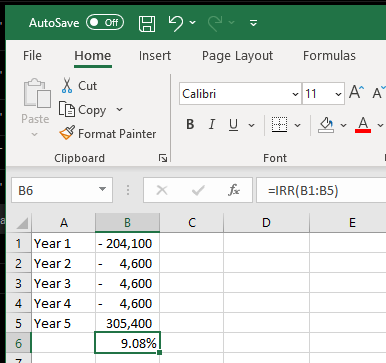
    Let’s put the values below in Column B, next to the corresponding years in Column A.

    Year 1 = A + (B x 12) + C + (D x 12) + (E x 11) + F (don’t forget the one month agency fee!)

    Year 2 = (B x 12) + (D x 12) + (E x 12) + F

    Year 3 = (B x 12) + (D x 12) + (E x 12) + F

    Year 4 = (B x 12) + (D x 12) + (E x 12) + F

    Year 5 = (B x 12) + (D x 12) + (E x 12) + F + G – H

    Step 2: Input the formula for IRR in Excel

    In cell B6, input =IRR(B1:B5) to select the values of the cash movements in Step 1 above.

    input rate formula table for internal rate of return irr property investment

    This should result in an IRR of 9.08%.

    Summary

    In short, the internal rate of return is an annualised investment return which is directly comparable to other asset class returns. For example, if a share at the end of one year gives you 14%, inclusive of capital gains of the stock as well as dividends, then this number becomes immediately comparable to the IRR of the property.

    The trick here is to be realistic and be honest with yourself. After all, there’s no point cheating in comforting yourself that these property investments are “paying for themselves”. Using ratios and numbers such as IRR enables astute property investors to make logical decisions on what represents a good or not-so-good investment decision.

    Click here to read the full article about how to spot property investment opportunities in Malaysia.

    About the author

    Rozanna Rashid is a Licensed Financial Planner (CFP, IFP) and holds an MSc in Real Estate Economics & Finance from the London School of Economics & Political Science. Her background is in corporate banking and Islamic finance and she can be contacted at rozanna@alpine-advisory.com.

  • MRTA vs MLTA: Which Mortgage Life Insurance to Pick

    MRTA vs MLTA: Which Mortgage Life Insurance to Pick

    Most millennials are taught from a young age that owning a property, especially their own home, should be one of their life goals.

    This leads to them saving up diligently from the day they enter the workforce with the dream of owning a property someday, either for their own stay or investment purposes.

    However, you should remember that getting the keys to your own property is not an endgame.

    Having signed the mortgage loan agreement, most will assume the best and expect to live until the loan is fully paid off.

    But in the unfortunate event that you are no longer around to pay off the loan, it is important to ensure that you leave behind an “ASSET” and not a “DEBT” for your loved ones. On top of that, you have to distinguish what is the difference between MRTA vs MLTA.

    Why Should I Have Mortgage Insurance?

    These days, most mortgage tenures range from 30 to 35 years.

    This is a very long time and should unforeseen circumstances like pre-mature death, disability or serious illnesses occur, your joint-borrower or next of kin (spouse, parents, children etc.) will need to continue servicing this debt until it is fully repaid. In other words, your debt has become their liability.

    Therefore, it’s important to have mortgage insurance to protect against these risks even if the property is meant for investment purposes.

    Some may argue that if the property is bought as an investment, it’s not necessary to have mortgage insurance as the property can be sold should the unforeseen happen. However, you must remember that the property market is cyclical in nature.

    What if tragedy strikes during a crisis or market downturn? Your next of kin may need to sell the property at distressed prices and suffer financial losses from the sale just to pay off your outstanding loan.

    So in order to safeguard against these risks, it is very important to have mortgage insurance and also a will to smoothen the process for distribution of your estate.

    The two most common mortgage insurances are MLTA (Mortgage Level Term Assurance) and MRTA (Mortgage Reducing Term Assurance).

    The Difference between MLTA and MRTA

    Generally, an MLTA offers not only protection for the amount of outstanding loan, but also functions as savings since the amount insured will be consistent throughout the duration of the loan.

    If nothing happens at the end of the loan tenure, you will receive back the total premium that was paid over the years. On the other hand, an MRTA covers the money owed to the bank from the loan.

    The coverage decreases over time and if nothing happens at the end of the loan tenure, you won’t get any money back.

    As for the protection coverage, both MLTA and MRTA offer basic life coverage (Death or Total Permanent Disability) with the option to include critical illness coverage depending on your needs.

    For MLTA, you can appoint anyone as your beneficiary whereas for MRTA, the sole beneficiary is the bank.

    In addition, MLTA is also transferable which means you can sell off a property and replace it with another property under the same MLTA.

    Even if you refinance your loan, you do not need to replace it with a new MLTA. For MRTA, it is non-transferable as it is tied to your loan with the bank.  

    In terms of cost, an MRTA is more affordable. The premium for MRTA is paid as a lump sum and can usually be bundled into the mortgage loan.

    As for MLTA, you can choose to pay your premiums on a monthly, quarterly, semi-annual, or annual basis.

    So What Should I Do?

    In most cases, the banks will typically offer you mortgage insurance (MRTA) together with the loan.

    However, it is not compulsory for you to take up this mortgage insurance from the bank so don’t feel pressured into getting it.

    Instead, seek consultation with your financial planner to discuss which option is best suited for you.

    About the author

    Billy Teoh (RFP) is a licenced financial planner, and can be contacted at billy.teoh@ipp.com.my.