Category: How-Tos

  • 3 Tips on Property Investment for Beginners

    Very recently, I’ve been shopping around for property for my own stay. This reminds me of the time I looked for my first property investment over five years ago. I’m still holding on to that property at a loss – both in cash flow and unrealised capital losses.

    As a friend once said, things that happen to us could either be a blessing or a lesson.

    This loss-making investment has given me three very important lessons that I hold close to my heart when it comes to property purchases.

    1. Avoid new developments

    As a professional real estate lawyer friend once told me, “Buy certainty when you are looking at investment property”.

    The allure of a new development is apparent – minimal to no upfront costs (i.e. affordable), a lot of incentives, looks new and nice, etc.

    However, every new development that we buy into is a bet. A bet that the developer will not fail, a bet that the future market is bright so that the value goes up, a bet that it has a market for good rentals.

    When I bought mine, it was going to take three years to finish building. It was a mixed development that was supposed to come with a mall right in the middle (the second mall in that area). But, it didn’t happen.

    The (prominent) developer decided to take out the mall from the development, SECRETLY! I only found out about it after it was completed in three years.

    The mall just disappeared from the plan altogether as if it never existed.

    Furthermore, more high-density properties started to pop up around that development. Causing supply to skyrocket around that place. Naturally, the value of my property dropped significantly.

    As a result, I’ll be avoiding all new developments, even for my own stay. Nothing’s stopping them from delivering the property to you hastily or taking forever to fix the defects in the property.

    Or building up the commercial space, which they promise will be vibrant, but end up becoming a dead place with only a few tenants.

    Rather than buying something so uncertain, it would be better to buy into an existing property, where I can clearly evaluate how good or bad the place actually is.

    2. It’s all about the maths

    From the get-go, it’s all about the calculations when it comes to property investment. I got suckered in by the sales pitch for my first property and being a newbie then I didn’t do my own calculations.

    The obvious part is that the rental income has to be higher than the mortgage payments and management fees.

    The not-so-obvious part is the indirect costs – agent fees, maintenance fees, assessment tax, income tax, etc. These will eat into the income and hence reduce the net income that we would get.

    Which means, we’d require a bigger margin in order to cover all these costs so that it’s profitable in the end.

    For example:

    – Mortgage + management fees = RM1,500
    – Rental Income = RM1,700
    – Indirect costs = RM140 (RM1,700 / 12 being the agent’s first month fee) + RM200 (miscellaneous fees)
    – Loss = RM140 per month (= RM1,700 – RM1,500 – RM140 – RM200)

    Don’t hope for capital gains because it’s uncertain. Ask anyone who bought a new property five years ago at the peak of property prices. Most, if not all, are suffering from capital losses now.

    Get the profit maths right before any investment. If it’s cash flow negative, forget it. It’ll be a pain somewhere down the road.

    The saying of, “at least partially it’s being paid by someone” or “It’s breaking even!” is nonsense at best. Nobody enters an investment to break even!

    3. Property investment is semi-passive

    When we talk about property investment income, mostly we talk about renting out to tenants to collect rental income. The passive income part is when tenants pay rentals on time throughout the tenancy.

    That’s about it.

    There is a whole other side of property investment, which demands active participation. Some examples:

    – Getting a tenant in involves liaising with the property agents on and off (every month it’s not tenanted is a loss to the P&L)
    – In between tenancy, there is a period where the property needs to be “cleaned up” and ready for the next tenant. The degree of work (and costs) required depends on how well the previous tenant took care of the place
    – Tenants with issues can create headaches during their tenancy. This could be delayed payments, pests, broken things, etc. We won’t know any of these for sure until the start of the tenancy

    Some investors, especially those with a big portfolio of properties tend to engage property managers to manage the portfolio to get the headache off their minds.

    This will bring down the returns but at least it’s converted into a mostly passive income portfolio. However, for most of us, this can take up significant brain juice, time, and effort to handle.

    However, it’s all good as long as the profits from the investment better justify the effort required. Refer to lesson no. 2.

    Closing thoughts

    My first property was a headache. Students are potentially one of the worst tenants ever, in my experience.

    In contrast to my trading and other investments, I’d rather put in more of my efforts there. The rewards in property can be huge, no doubt, but it isn’t one that I prefer.

    It might be obvious for many but hope this reaches those of you who are looking into your first property for investment. It may help you in your journey!

    About the Author

    This article was originally published at betweenthemoney.com, a personal finance website by Jason Loh that focuses on money matters and investment topics for Malaysians

  • Explaining Financial Planning through Football

    When we talk about the concept of financial planning, many people may think that it’s very complex and comprehensive, and may require a lot of information such as total income, overall expenses, liabilities, value of personal assets, investment assets and so on. While this is undeniable, to help you achieve your financial goal, this data can’t be ignored. However, it can also be as simple as ABC – let’s use football as an analogy to relate it to your asset allocation.

    What is asset allocation? 

    In layman’s terms, asset allocation is an investment strategy that diversifies money into different kinds of asset classes. It aims to balance the risks and optimise the returns. In order to have good asset allocation, a financial planner will distribute the capital into various asset classes with different levels of risk and return, so each will behave differently over time. Since each person has different kinds of goals, risk tolerance, and investment horizons, a financial planner will analyse his/her financial characteristics and apportion a portfolio’s assets that’s suitable for him/her.

    How to allocate assets? 

    As mentioned earlier, we’ll use football as an analogy to break down the best way to allocate assets. There are 11 players that make up a team that plays the game, which consists of a goalkeeper, defenders, midfielders and strikers. All of them are unique and have their own role to play. The same analogy also can be applied to our financial planning. Each financial tool represents a football player with an important role to play in personal financial planning. As we always say, don’t put all your eggs into one basket, hence you must diversify the risk and purpose by using different financial tools.

    Goalkeeper: Emergency funds

    The goalkeeper is the one standing at the last line of defence to make sure that the team won’t lose. His main job is to block shots from the opposing team to avoid giving up a goal. In the context of financial planning, who are our goalkeepers? Insurance and emergency funds probably fit the criteria.

    Insurance protects you from financial risks by transferring the risk to insurance companies, while emergency funds are used to overcome unpredictable events like unemployment or sudden loss of income. However, many people don’t pay serious attention to this and even procrastinate on insurance and emergency funds. This results in them being financially vulnerable to unpredictable crises ahead. 

    Defenders: Capital guarantees

    Apart from goalkeepers, the next line of defence are the defenders. Their main purpose is to offer protection to the goalkeeper and goal, and also preventing the opposition team from creating goal-scoring opportunities. 

    In the context of financial planning, these financial instruments are designed to provide stability for your funds, with capital guarantee often the priority. Examples of these financial instruments include fixed deposits, money market funds, your Employment Provident Fund (EPF), and bonds, which provides you with a stable income and principal guarantees for your investment.

    Midfielders: Collective investment vehicles

    Midfielders are positioned between attack and defence. These players act as the road maps, determining the direction of the play. They have the flexibility to be either attackingly aggressive or more defensive when needed, depending on the situation. Collective investment vehicles make great midfielders because these financial tools possess a diverse set of characteristics thanks to interventions from professional fund managers. 

    Strikers: Profit-making machines

    Lionel Messi, Cristiano Ronaldo, Harry Kane, Robert Lewandowski – these are examples of world-famous strikers. Their fame is thanks to the goals that they score, often resulting in their team going on to secure victory. In investments, the striker’s main goal is to score for profits! 

    Take your private businesses for example, which will generate income for you. You’re likely to spend a lot of time, capital, and energy on your business due to the potential it has to give you the best returns. However, if you fail to have a backup plan and blindly chase profits, when unpredictable events occur, it may be hard for you to rise again. Examples of investments or financial tools which play the role of a striker include equities, derivatives, and leveraged real properties.

    In a football game, there are 11 players on each team, but aside from the players, there’s still another important role that can’t be ignored. Without a coach giving instructions, there is no game plan for the team.

    Coach – Financial planners

    This is the 12th man in the game. Although he’s on the sidelines, he also plays an important role. Without the coach, can you imagine how the players can win the game? In the same situation, without players, do you think that the coach can win the game? In financial planning, the role of coach is often played by a financial planner.

    He/she will advise you based on your financial goals, risk tolerance, and investment horizon. This information is important as your financial planner will analyse and determine the best course of action based on your unique situation. This results in a very specific financial plan which is tailored just for you.

    The way of allocating assets can make a huge difference when it comes to seeking financial freedom. In the long road of a financial journey, you are likely to undergo many challenges in life such as economic cycles of market expansions, peaks, contractions, and troughs from time to time. Going through the four stages of an economic cycle requires great emotional management and smart financial strategies. So, it’s highly recommended for you to engage a licensed financial planner and approved financial adviser to ensure your financial well-being ahead.

    About the author

    Teoh Shoon Yee (FAR CMSRL RFP BIBM) is a FA Manager, Licensed Financial Planner and Bank Negara Approved Financial Adviser Representative with approximately nine years of experience in financial services. She is well versed in holistic, independent and unbiased approach with a pleasant and friendly personality. She can be contacted at ShoonYee.Teoh@yesfinancial.co

  • How to Start Personal Investment Planning

    “Tell me about the best investment plan!”

    “I heard my friend talking about XYZ investment, do you think it’s good?”

    These are just two examples of commonly asked questions on investment.

    Yes, I get it. You don’t want to lose out on the “best” investment deals in town.

    However, before you start investing, do ensure that you have built a solid financial foundation for yourself.

    So how do you know which one is the best investment for you?

    All financial solutions are designed for a target audience. The best investment is simply the one that suits you in the following three areas combined:

    1. Investment goal
    2. Investment time horizon and risk profile
    3. Investment vehicle

    As everyone is unique, there’s no doubt that an investment plan should be 100% tailored to your situation.

    Blindly taking recommendations from friends (who don’t understand your financial situation) could be detrimental to your finances.

    It’s just like self-medicating without a proper diagnosis from a health professional, but in this case, you’re putting your financial health at risk!

    Investment goals

    “Begin with the end in mind.” – Stephen Covey (Author of 7 Habits of Highly Effective People)

    It’s important to know what you’re trying to achieve, because without a clear goal, how do you plan for it?

    Take a moment to think.

    What is your goal in investing?

    – To build up emergency funds
    – To buy a dream house
    – To provide for children’s education
    – To further studies
    – To migrate overseas
    – To support family
    – To prepare retirement funds
    – To start a business
    – Others

    Why is this goal important for you? (Your why)

    – To prepare for unexpected expenses
    – To set up a family
    – To have peace of mind
    – To have freedom / choices
    – To have a comfortable retirement life
    – Others

    Finding out your why in investment is crucial, because it drives and guides you towards the future/ bigger picture that you are seeking to create.

    Investment time horizon and risk profile

    Once you have defined your investment goal, the next thing to work on is your investment time horizon and risk profile with regards to investing.

    Your investment horizon:

    When do you need this money?

    – Short-term (1-2 years)
    – Mid-term (3-5 years)
    – Long-term (more than 5 years)

    To define your risk profile, you may ask yourself some questions:

    1. How do you feel about a 20% loss in your investment?
    2. What is a decent investment return for you?
    3. What will you do during a market crash (sell off investment, buy more or do nothing)?

    Investment vehicle

    Lastly, what kind of investment vehicle suits you? Undoubtedly, suitable investment tools should fulfil your defined investment goals, risk profile and time horizon.

    Investment tools come with three fundamentals: capital preservation, liquidity, and returns.

    There’s always a trade off in any investment tool in terms of capital preservation, liquidity and return. Just like life, we can’t have everything we want. We have to give up something in order to get something else.

    If you want capital preservation and high liquidity in your investment, you will have to accept that returns will be low.

    If you want good returns and liquidity in your investment, you will have to accept that there will be absence of capital preservation.

    If you want capital preservation and a good return on your investment, you will need to give up liquidity.

    As you can see from above, there is no single investment that can give you capital preservation, high liquidity and high return at the same time. If you encounter one, there’s a good chance that it’s a scam – please do check with Bank Negara Malaysia on said investment!

    Let’s use an example on finding the right investment for you. Assume that you have defined the following:

    If your goal is to save up for an emergency fund, your investment vehicle should come with capital preservation (keeping your saved money free from volatile or fluctuating markets) and high liquidity (you need access to your money as soon as possible for unexpected events). 

    So, suitable investments for building your emergency fund can include:

    1. Bank – high-interest saving account
    2. Bank – fixed deposit
    3. Fixed unit price unit trust fund

    Please note that bank high interest saving account/ saving account and fixed deposit are protected by PIDM but unit trust funds are not protected by PIDM.

    You may repeat the steps discussed above to design your best investment plan that’s tailored specifically to your needs.

    All in all, there is no single best investment plan, because the best one is the one suits you the most! You have to define what you want, what you like and have a plan that you are comfortable with.

    It’s incredibly dangerous to just follow the crowd and invest blindly, because that means you’re jeopardising your financial future.

    If you feel lost when planning your financial future, you may consider investing in a financial professional.

    A financial professional would not only develop a roadmap for you, but will also provide advice as unexpected financial issues arise in your life and bring you nearer to your financial goals.   

    About the author

    Kuah Soo Yee is a Licensed Financial Planner (CFP) who is passionate about helping people make sound financial decisions and achieve their financial goals, and recently launched her own app. She can be contacted at soo.yee@ipp.com.my

  • Understanding Your Money Blocks

    Reflecting on my childhood, I remember we were given a book to write down our money spending during school – Buku Wang Saku. We also had to listen to a talk about how to manage our money. I remember only writing in it for a week and there was no follow-up after that. 

    That was almost 20 years ago, yet we’re still here talking about the same issue of money management, poverty and struggling to manage finances. We all subconsciously learn about money as children, with concepts that are good or bad depending on what we hear from our family, society, and even things we pick up from watching television or the news. Therefore, as we grow older, we form these money stories in our heads and couple them with our subconscious beliefs around money that influences our behaviour as adults.  

    It baffles me that even after 20 years, I’m still struggling with the same subject. I started reflecting on managing my money and how I sometimes unintentionally sabotage myself. Now I know that this was due to deep, unresolved money blocks. 

    What are money blocks? 

    Money blocks are negative subconscious beliefs about money that limit you from achieving your conscious desires. The main reason why it’s so hard to implement behavioural change is the part of the brain that is used. When watching a motivational video or reading a self-help book, we’re calm and composed to act better. But when we’re about to go shopping or have lunch, we kind of lose our mind, even though you promised yourself to manage your finances better after reading that self-help book you picked up before.  

    We keep going through this same pattern because of our brain’s subconscious and conscious compartments. For the first five years of our life, our brain is in the theta wave stage, whereby it’s in a sponge mode to absorb everything and anything. We take everything literally and learn how to be a person. These first, vital five years are when we learn all the emotions and feelings that surround us, which results in the formation of habits. 

    We learn all this from the adults that surround us. We observe their behaviours and mimic them as we grow older. We are very habitual human beings, and with that, we tend to keep close to feelings that we are familiar with, that is, the similar, regular cycle we’re programmed to react to. We tend to react the same way as we’re taught in the first few years of our lives, with all of this formed early on when we have no conscious control. These habits are then carried towards adulthood. 

    The conscious part of the brain only starts to develop later in life. So as a child, we unconsciously absorb all things wholeheartedly with no filter, including the good and the bad that cannot be told apart. We form most of our beliefs before the age of 5. Therefore, most days we operate solely out of habit and are on autopilot when we come across familiar situations.  

    When we try to learn a new habit, this is when the conscious part of the brain works. When we’re aware of patterns and want to change bad habits, but are faced with a specific situation that needs an immediate response, previous habits that are hardwired begin to react. This results in the nervous system reverting to existing patterns in the subconscious based on programming, long before our conscious brain can grasp and take control of the situation. Suddenly, you may see yourself falling back to the same lousy money habits even though you know this isn’t a good thing. 

    To have control over this is to make yourself conscious of situations that trigger you relapse into bad money habits. Take a breather and question yourself, before making a conscious decision. The recurring pattern from your past robs you of strength to make better financial decisions. If you can make a conscious decision to create new habits around your triggers and to change that narrative, you’ll be able to change past thought patterns!

    “Money is 80% behaviour, 20% knowledge.”- Dave Ramsey. 

    Although I have a degree in Islamic Financial Planning, I still struggle with my money blocks. Most of the time, financial planning focuses on numbers and figures but not the human thought process; I wish I was taught this back in university. Even with an abundance of education around managing our finances as a nation, there are still people falling back to their old habits and sabotaging their finances. I believe what’s stopping them is the deeply ingrained habits they grew up has made it hard to break the pattern. 

    Some common negative beliefs I learned:

    1. I don’t have the skill to make more money 
    2. Money is evil and rich people are mean and greedy 
    3. I can’t keep a lot of money or else I’ll lose it
    4. Witnessing parents fighting about money 
    5. I have to work hard to make money
    6. You’ll get sick easier if you work for money 
    7. When I am rich, there will be poor people suffering 
    8. There is not enough money for everybody, including me 
    9. A lot of things need to be sacrificed to gain wealth
    10. I have to know someone to be able to gain more wealth

    We tend to fall into this pattern of these messages, thus creating a wrong impression about money. These money beliefs tend to stay in our way and form our habits until we decide to identify them and heal consciously. 

    How to know if you have money blocks? 

    Everyone has them regardless of their financial upbringing. One way to tell is that you’re aware of money, but you’re not getting any results and constantly battle the same issues. Another indicator is that you know how to manage your finances, but you keep sabotaging your success. 

    This is what I’m currently experiencing. I have the knowledge to manage my finances well and I know how every decision I make influences my finances, yet I keep making the same bad decisions that trip me up. 

    Create an action plan 

    The only way to reset your money blocks is to identify your beliefs around money. Write in a journal and answer these questions: 

    1. What are my money beliefs, how did my family view money, and how was I culturally brought up around the subject of money? 
    2. What are your biggest fears around money? 
    3. If you are blessed with an abundance of wealth, how will you use it to help others? 

    “Self-sabotage is like a game of mental tug-of-war. It’s the conscious mind versus the subconscious mind where the subconscious mind always eventually wins.” – Bo Bennett

    Break that pattern 

    When we were growing up, the fears that adults subconsciously placed upon children helped them cope with their money concerns. However, when they didn’t heal from their subconscious fear, it tended to be passed down to their kids.

    In reality, we control how we can benefit and help others when we have an abundance of money. We’re all born with potential, and it’s our birthright to reach for the stars. We form our blueprint with the words used, and the mind tends to interpret it into reality. Our mind is meant to protect us from harm so it starts creating a scenario to defend ourselves. Re-write a better script around your many beliefs. It’s a process, one that never really ends. 

    I’ve been working on my money blocks and it is still a work in progress. I hope you enjoy diving into your thought patterns and enjoy the journey!

    About the author

    Nurul Yahi has a background in Business Administration majoring in Islamic Financial Planning. She’s a financial enthusiast and you can find her at dearduit.com. You can also find Nurul on TwitterInstagram and Facebook.

  • How to Calculate The Internal Rate of Return for Property Investments

    How to Calculate The Internal Rate of Return for Property Investments

    Let’s use the following example of a 1,500 sq ft fully furnished, two-bedroom, three-bathroom apartment in Mont Kiara valued at RM1 million, with rental at RM4,000 per month and a RM500 monthly management fee. We also assume that for 5 years, the property is perpetually rented. The rental yield is [(4000-500) x 12]/1,000,000 or 4.2%.

    While this is simple enough math, it doesn’t take into account appreciating (or depreciating!) property. Nor does it take into account the upfront costs you probably paid to renovate the home for it to be competitively rented out. And what about those annual taxes? Or that one-month agent fee you paid?

    Going over the variables for this exercise, we get:

    (A) Initial outlay – including legal fees, down payment and booking fees = -RM150,000

    (B) Monthly loan payments = -RM3,800

    (C) Upfront renovation works = -RM50,000

    (D) Monthly management fee =  -RM500

    (E) Monthly rental income = RM4000

    (F) Taxes and property insurance = -RM1000

    (G) Hypothetical net selling price of the property in year 5, minus RPGT and marketing/selling costs (eg. agency and lawyer fees) = RM1,100,000

    (H) Hypothetical remainder of loan outstanding on the property in year 5 = RM790,000

    Step 1: Calculate net inflow or outflow for each year

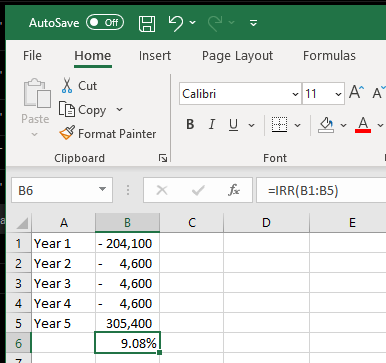
    Let’s put the values below in Column B, next to the corresponding years in Column A.

    Year 1 = A + (B x 12) + C + (D x 12) + (E x 11) + F (don’t forget the one month agency fee!)

    Year 2 = (B x 12) + (D x 12) + (E x 12) + F

    Year 3 = (B x 12) + (D x 12) + (E x 12) + F

    Year 4 = (B x 12) + (D x 12) + (E x 12) + F

    Year 5 = (B x 12) + (D x 12) + (E x 12) + F + G – H

    Step 2: Input the formula for IRR in Excel

    In cell B6, input =IRR(B1:B5) to select the values of the cash movements in Step 1 above.

    input rate formula table for internal rate of return irr property investment

    This should result in an IRR of 9.08%.

    Summary

    In short, the internal rate of return is an annualised investment return which is directly comparable to other asset class returns. For example, if a share at the end of one year gives you 14%, inclusive of capital gains of the stock as well as dividends, then this number becomes immediately comparable to the IRR of the property.

    The trick here is to be realistic and be honest with yourself. After all, there’s no point cheating in comforting yourself that these property investments are “paying for themselves”. Using ratios and numbers such as IRR enables astute property investors to make logical decisions on what represents a good or not-so-good investment decision.

    Click here to read the full article about how to spot property investment opportunities in Malaysia.

    About the author

    Rozanna Rashid is a Licensed Financial Planner (CFP, IFP) and holds an MSc in Real Estate Economics & Finance from the London School of Economics & Political Science. Her background is in corporate banking and Islamic finance and she can be contacted at rozanna@alpine-advisory.com.

  • How to Set Financial Goals for Your Future

    How to Set Financial Goals for Your Future

    Much has been said and written about the sorry state general of financial literacy among people, both local and globally. According to financial literacy platform Multiply, almost 70% of Malaysians are in need of financial literacy support.

    “Financial planning” seems to be a popular catchphrase in recent years. The 7th of October is even recognised as “World Financial Planning Day”, which began four years ago. The purpose? To raise awareness about the importance of financial planning.

    If I used the term financial planning with my grandparents, they would say “Don’t worry so much, just work hard and be honest in your trade”. This shows how the concept of Financial Planning is fairly modern, with such an ideology being so foreign back in those days. Chances are, if you asked someone who is in their 60s or 70s today what financial planning means, there’s a high chance they’ll say it’s having insurance!

    However, financial planning is the process of developing strategies to help people manage their financial affairs to meet life goals. What constitutes a good financial plan? First and foremost, it involves taking stock of your assets, liabilities, investments, income, expenses and cash flow. The next part is important because it involves knowing the right strategies in order to achieve future goals. It also helps to break down goals according to priority and affordability. It then requires constant monitoring because we know circumstances in life will change – for both good or bad.

    Financial planning is clearly not as simple as signing up for a product. It’s a commitment to yourself and your family to ensure that your financial goals are achieved. In my observation and dealings with clients, I have found that the challenges in developing and sticking to a financial plan are summed up below (the list is not exhaustive):

    • Lack of priority – due to busyness at work and family commitments. The fear of the unknown future can be very daunting and it is easy to sweep this aside
    • Rising consumerism – shopping and spending is extremely easy. You can purchase literally anything in the world online and get it delivered to your doorstep. If left unchecked, would there be funds in the event of an emergency, let alone savings for the future?
    • Escalating prices of real estate – one of the social issues that the government is trying to tackle is the issue of affordable housing
    • Low interest rates – At the point of writing, the Overnight Policy Rate (OPR) rate is 1.75% which translates to Bank fixed deposits of 1.6% to 1.9% per annum
    • Salary vs inflation – not on par with rising cost of living

    All these seem to indicate that the younger generation is already at a disadvantage in achieving the same levels of success compared to their parents. For example, if your parents could afford to send you overseas when you were in university, can you confidently say you will be able to do the same for your children today?

    Having a financial plan is akin to being prepared for battle. You will know your limitations, ability to optimise your resources and your odds of winning.

    In the case of an investment portfolio, the more you spend time monitoring, the more invested you will be. For example, if you exercise daily, you’ll be much more conscious of your lifestyle, choice of food and calorie intake. The same can be said for a financial plan when you monitor it on a regular basis, which will lead to you becoming wired to make more informed financial decisions.

    Too much focus on any one area such as savings, investments, or insurance, may adversely affect the balance of your financial plan. The topic of investments alone is so vast, with plenty of choices available today, and is often confusing for consumers. Each platform has its pros and cons and it’s easy to get distracted by the whole process and only see things from that one perspective. Having a macro view is important and most consumers are not trained to do that.

    Let me give you an example. It’s highly possible to have false confidence knowing you invested in a portfolio that is performing at 15% per annum. However, if the amount invested was RM10,000, and even IF this portfolio could consistently perform for the next 10 years at 15%, the future value is only RM45,000. In the larger scheme of things, is that total of RM45,000 a meaningful solution in terms of the end goal to fund a child’s tertiary education and/or your retirement? Investment should be a means to an end, not the end in itself. Successful investment requires time, strategy and consistent positive returns to be favourable.

    There’s also the danger of neglecting risk management. An employee or an entrepreneur’s greatest asset is their ability to earn and also their potential future earnings. This asset can be severely affected due to a major health crisis. Have you considered income replacement in your financial plan? Most companies would have decent employment benefits that would cover you in the event of death and hospitalisation. However what happens if an employee is unable to contribute 100% to his/her job due to a health condition? Will your employer be happy to retain such an individual?

    In summary:

    • Work hard and smart in your trade
    • Manage potential risks that could happen in your working years
    • Look for opportunities to invest (in products/services registered with the Securities Commission Malaysia)
    • Monitor your financial plan and goals diligently
    • Seek out a Licensed Financial Planner to get a second opinion on your finances
    • Develop an estate plan as an act of love to your loved ones/charities

    With proper monitoring and guidance, you can be on the right track to achieve your financial goals.

    About the Author

    Kam Teik Guan is a Licensed Financial Planner, and can be contacted at kam.teik.guan@ipp.com.my.

  • The Importance Of Building An Emergency Fund

    The Importance Of Building An Emergency Fund

    As we start this new year, there’s a lot of hope that 2021 will be a better year than 2020, and that our lives will resume some form of normalcy since the start of the Covid-19 pandemic. We’d all like to go around our daily lives in the way we were able to previously.

    Unfortunately, 2021 has started to unfold in a similar pattern to 2020, but we should remain optimistic and hope for the best. As with any new year, it’s a great time to set goals and have a fresh start. I believe many of us will have new year resolutions this season, some of which will revolve around finances.

    For many people, financial freedom, being debt free or cash rich is often on their goals or resolution list, but how many are able to achieve it? There’s a popular adage often attributed to Benjamin Franklin, the father of time management ” Failing to plan is planning to fail.” Many of us draft a new year resolution list but without proper planning, and setting goals, timeframe, and deadlines to meet, one will never achieve their plan.

    When Malaysia went into our first Movement Control Order (MCO) in March 2020, many Malaysians found themselves in financial difficulty as they were not prepared to face salary cuts, reduced working hours or even losing their jobs due to the economic shutdown. News has also been circulating of those who just managed to restart their businesses or get new jobs going back to square one as a result of MCO 2.0 due to the rising Covid-19 daily positive cases, currently at the four digit mark.

    Due to the uncertainty of such times, it’s important to reflect on where you are and where you want to be, as life altering events usually result in people taking a hard look at themselves to reform and transform. No doubt the pandemic has impacted many people in more ways than one, with saving habits being one of them. If you’ve planned your financials appropriately and have a sufficient emergency fund in place, you’d at least be able to support yourself and be less stressed in such times. One of the things that Covid-19 has taught us besides resilience and adaptability, is the importance of proper financial planning and having sufficient savings.

    The purpose of an emergency fund is to cushion the blow should unexpected events occur, such as medical bills, retrenchment, business closure, home emergencies home or car repairs. You’ll have peace of mind and less money worries if you know you have sufficient funds to tide you through difficult times. In addition, you’ll also have more confidence to save money for other financial goals such as retirement or your children’s education if you have an emergency fund in the first place.

    How Much is Sufficient for an Emergency Fund?

    Your emergency fund should cover at least 3-6 months’ worth of essential expenses. Of course, you can save for more than six months; some people have up to 12 months of savings or more! It depends on:

    • Family size – are you single, a breadwinner, or in a dual-earner family i.e. you or your husband/wife works?
    • How closely your job is tied to economic changes
    • Financial responsibility

    Essential expenses are bills that you can’t stop paying such as food, utilities, household essentials, rental or mortgage repayment, car repayment, insurance and medication. Gym passes, entertainment expenses, or Starbucks coffee aren’t essential expenses.

    Six months of fixed expenses is the guideline, but it’s acceptable to save more but be warned that keeping excessive funds in your bank account only is also not advisable as the money doesn’t generate additional returns for you and will be slowly eroded by inflation.

    How to Start an Emergency Fund?

    As with all other things in life, start with a small realistic goal. Determine an amount that you’re comfortable to set aside every month, for e.g. RM200. It doesn’t matter if you start small as long as it’s realistic and you can move forward. Once you have accomplished this, set a new savings goal that will require more effort e.g. RM500, slowly add to it until you have accumulated one month’s worth of expenses. Your ultimate goal will be to reach 3-6 months of your fixed expenses.

    Where Should I Keep My Emergency Fund?

    An emergency fund is all about keeping it safe. Hence, there’s no specific investment tool to keep your emergency fund, as long as it is safe, liquid and easy to access. Most people will prefer to save in a savings account or fixed deposit (FD).

    The reason for putting these funds into a safe investment tool is because if the money is in high-risk investments, there’s a risk that you could lose all the money. For example, saving an emergency fund of RM15,000 earning 2% interest in fixed deposits gives you RM300. If you were to invest in the stock market and can generate 8% annually, that’s RM1,200. While an extra RM900 may be significant to you, it isn’t guaranteed as you could lose all the capital you invested in the stock market if market conditions are unfavourable.

    Hence, don’t be greedy and just leave your emergency fund in a fixed deposit or savings account as the goal is liquidity, not high returns.

    Life can be unpredictable so it’s important to put aside a small amount of cash each month to cushion the blow of emergencies in difficult times. Many people strive for high-risk investments where they take on unnecessary risk to earn more money but are left with no basic savings. For those who don’t have this habit, start building your emergency fund from now. Learn from the past and don’t procrastinate. Once sufficient emergency funds are set up, it’s time to aim for your next financial goal, which can be for the short, medium or long term, depending on your life goals and/or values.

    About the author

    Yit Wei Yeing is a registered financial planner. She can be contacted at wyyit@genexus.com.my.

  • How to: Plan for Your Children’s Education Fund

    How to: Plan for Your Children’s Education Fund

    Among the Chinese, there is a saying: “再穷也不能穷教育”, which translates to: “Education shouldn’t be sacrificed even if we’re poor”.

    Parents believe that when their children are educated, they can secure a higher income and get better opportunities in life, allowing them to contribute back to the family and society in various aspects.

    Just like any investment, time can be your friend or your worst enemy. If you’re a parent with young children, why not start preparing the best angpao you can give your children now?

    To start planning for your children’s education fund, you should:

    1. Estimate the Cost of Education

    When estimating the cost of education, consider the following factors:

    • The type of studies your child may pursue.
    • Will you send your child to attend a local or an overseas university?
    • How much is the basic cost of living should your child attend an overseas university?

    Information on the fee structure and the overall cost of living are readily accessible on the internet. You can refer to this website to learn more about the fees and cost of education in Malaysia.

    However, bear in mind that these factors may change over time. Review the plan at least once a year to keep yourself updated on the latest developments and be sure to get the information from various sources to ensure that the cost of education and overall cost of living falls within a similar range.

    2. Understand Your Current Financial Position

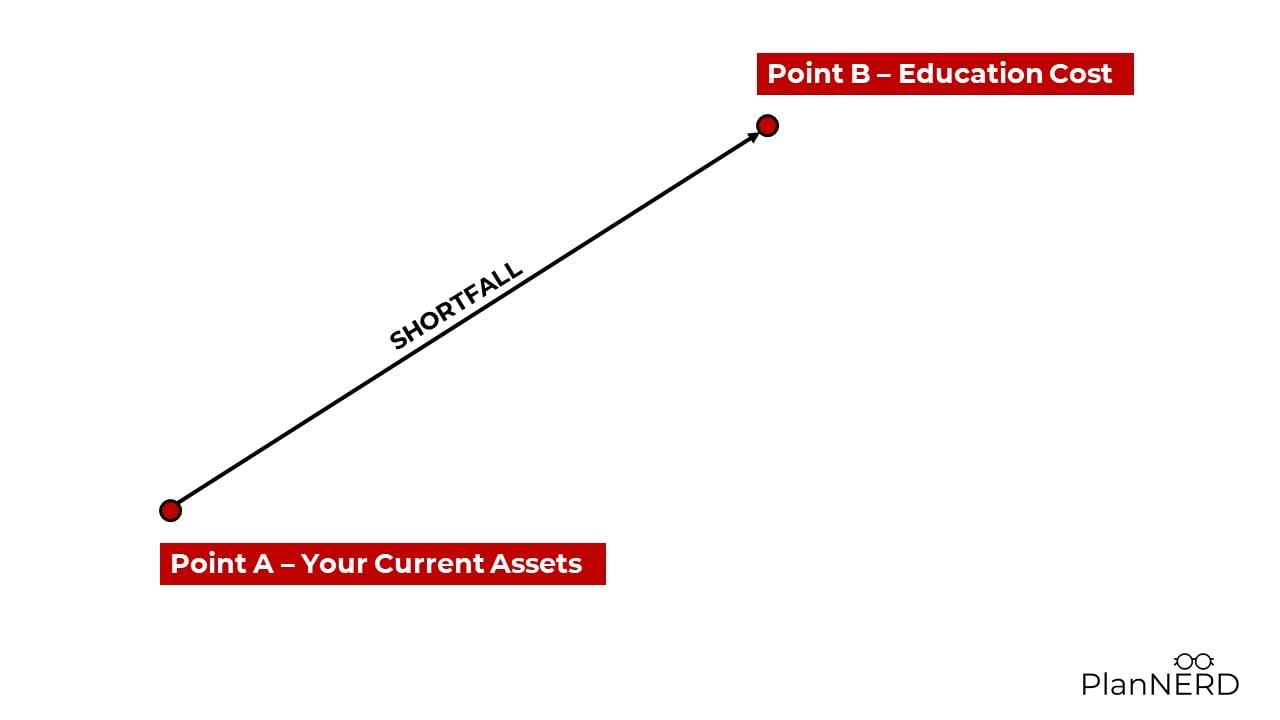
    current financial position graphic - children's education planning

    Now you know how much is needed to reach point B (cost of education), to calculate how much you need to set aside every month to cover the shortfall, you’ll also need to know how much you currently have – point A.

    Most people store their wealth in cash, properties, and other types of investments. You should ask yourself; what portion of the above-mentioned assets can be allocated for your children’s education?

    For example, you may want to allocate 10% to 20% of your cash for the sole purpose of funding your children’s education. If you have investment properties, you may also designate a property to be sold once your child reaches 18 years old. Some may even have endowment policies with insurance companies that may mature in 20 years.

    The key is to write down a list of assets that you will dedicate to its sole purpose of being your children’s education fund.

    3. Determine the Amount to Cover the Shortfall for Your Children’s Education

    In this step, we’ll use a free financial calculator to easily calculate how much you need to save/invest for your children’s education. You can access the calculator here.

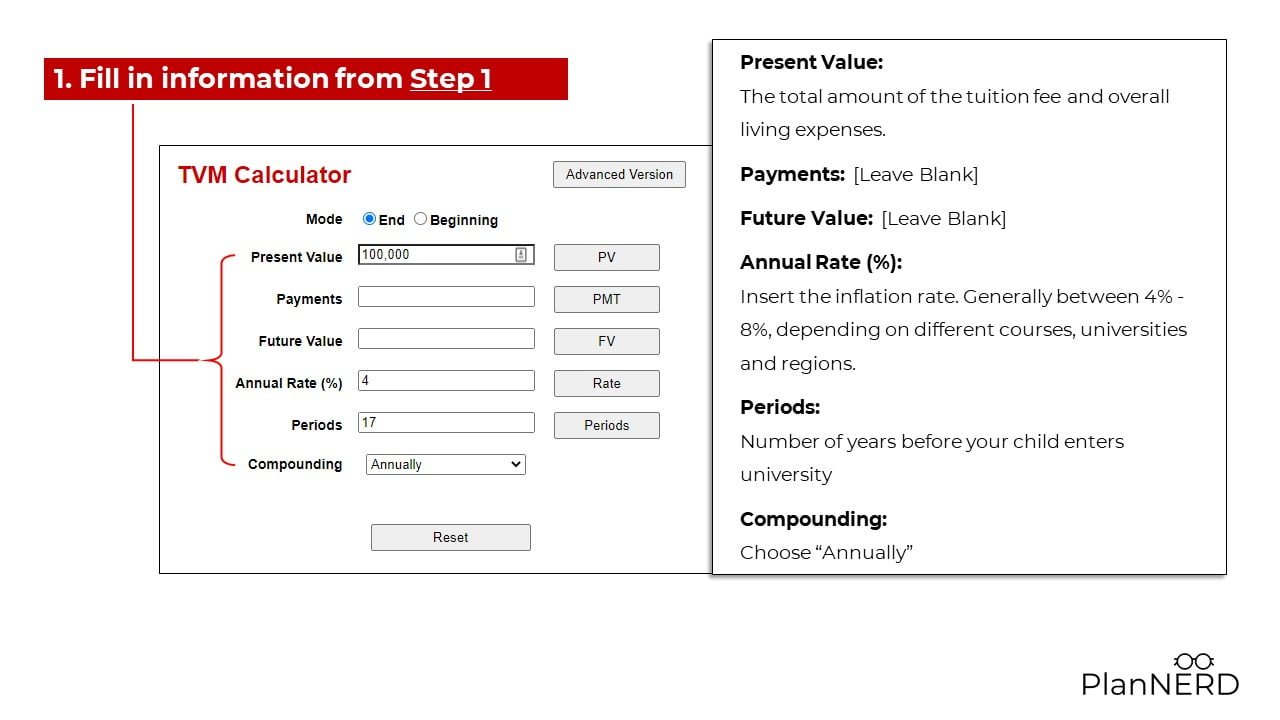
    (i) Enter the following field with the information you had prepared in Step 1 above.

    Step 2 for FV calculations - children's education planning

    (ii) Click on ‘FV’

    step 2 for FV calculation- children's education planning

    The amount in the FUTURE VALUE box is the future value of the education cost that you entered.

    In this case, the cost of education today is RM100,000. However, with an inflation of 4% for the next 17 years, the cost of education will increase to RM194,790.05 when your child is ready to enter university.

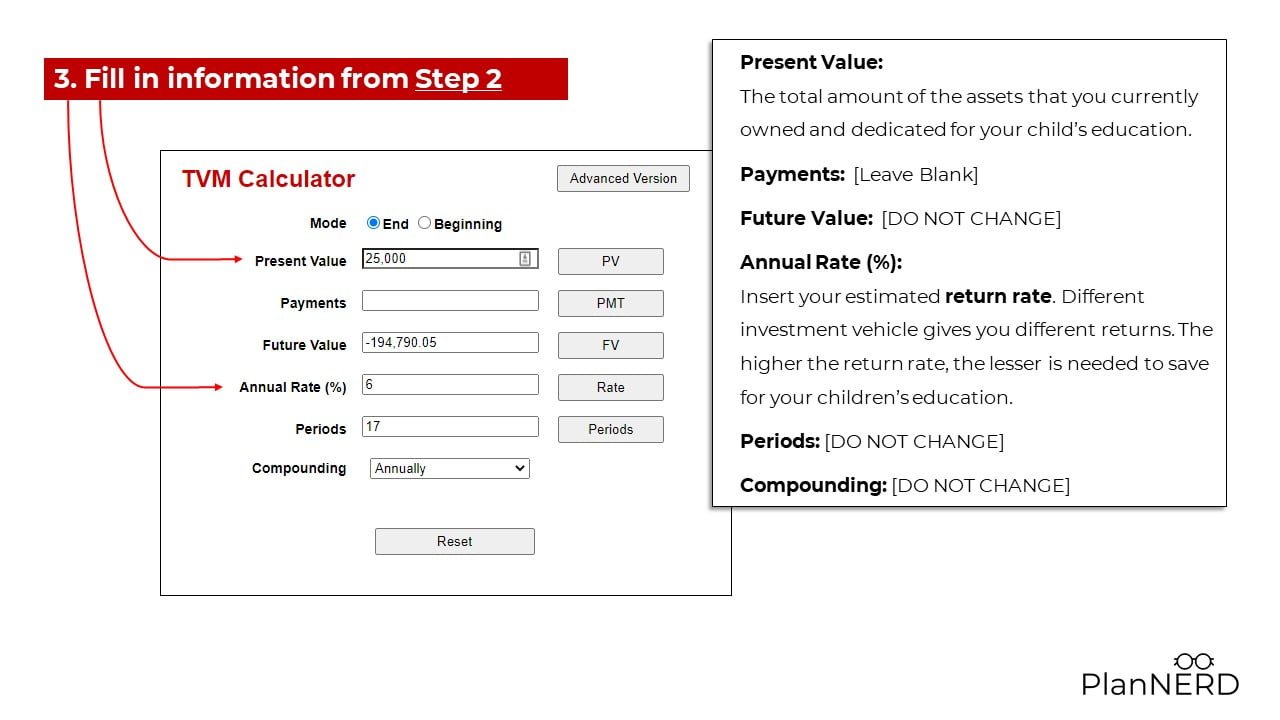
    (iii) Update the ‘Present Value’ and ‘Annual Rate’ field

    present value and annual fee table - children's education planning

    Next, you’ll need to calculate how much more is needed to cover the shortfall.

    Using the same example above, assume that you have RM25,000 now and you believe that you can achieve an average of 6% return rate for the next 17 years, update the Present Value and Annual Rate (%) column.

    (NOTE: do not refresh the website or change any other information.)

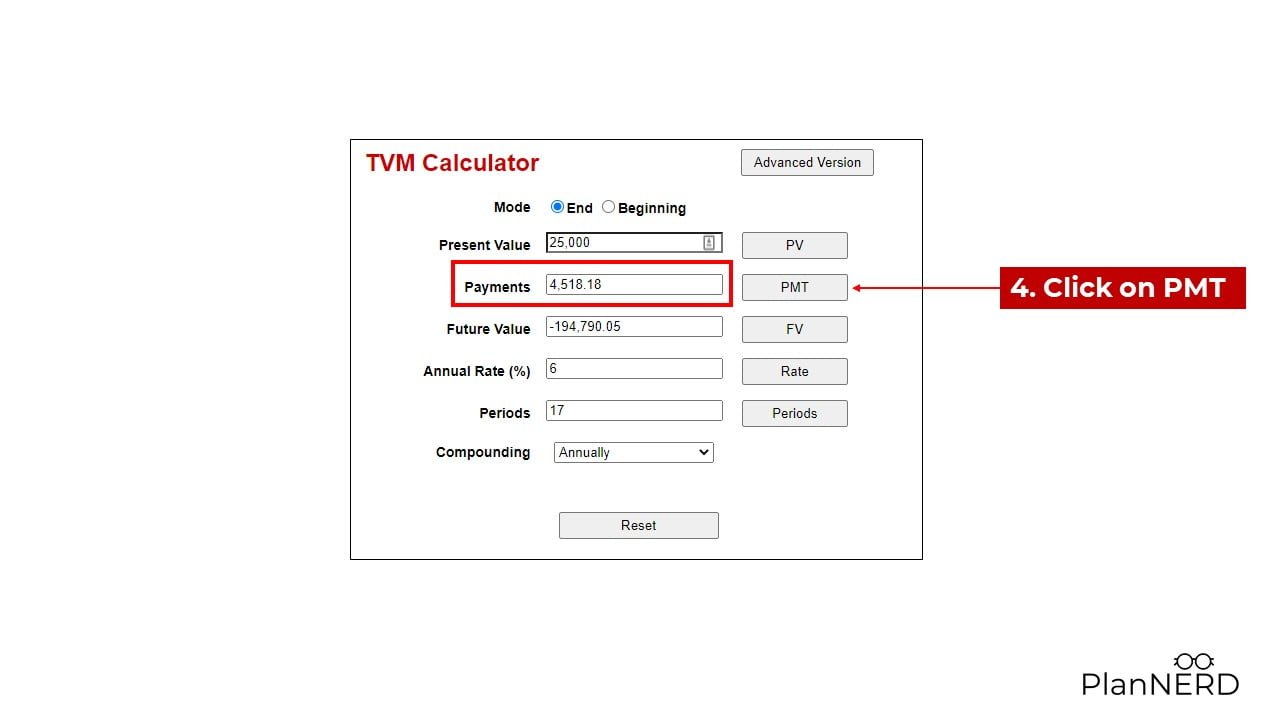
    (iv) Click on ‘PMT’

    pmt table to show the calculation flow under children's education planning

    The last step is to click on “PMT” to calculate the amount needed to save/invest every year to cover the shortfall in your children’s education fund.

    In this example, you will need to save RM4,518.18 every year, or roughly RM400 every month (with a return rate of 6%) to send your child to a private university in Malaysia in 17 years.

    4. Choosing the Correct Financial Vehicle

    There are plenty of choices when it comes to choosing an investment vehicle. However, we all know that most investment journeys aren’t going to be smooth sailing all the time, therefore it is very important to follow these three rules of investing:

    Preserve your investment capital

    One important rule that’s applicable in investing for children’s education is to preserve your investment capital. Sometimes, we can allocate a small portion of our portfolio to invest in high-risk investments. However, you don’t want to do that with your children’s education portfolio.

    For example, in order to recover from a 10% loss on an investment, you’ll need to have an 11% gain to return to the original capital position, a 25% loss would require a 33% gain to break even, and so on and so forth.

    There is no such thing as the best investment

    In short, what’s good for me may not necessarily be good for you. Having said that, when it comes to investing for your children’s education, you may want to pay some attention to PTPTN’s National Education Saving Scheme (SSPN). Parents saving money into SSPN-I can enjoy tax relief of up to RM8,000 per year.

    Keep your eyes on the prize

    Lastly, keep your eyes on the prize. Always remember your why. Constantly review your investment strategy to ensure that you don’t receive any unfavourable surprises when your children are approaching the age to register for tertiary education.

    5. Avoid Common Education Planning Pitfalls

    Ignoring retirement planning

    If you’re unable to cover the shortfall as calculated earlier, there are other ways to ensure that your children will receive a decent education, such as applying for an education loan from PTPTN or applying for a local public university.

    However, there are fewer options available if you can’t cover the shortfall in your retirement planning.

    Trusting the wrong ‘advisor’

    Many fraudulent “advisors” use the element of fear and greed in parents to convince them to invest in their unregulated investment products. Should you need the help of a third party in the education planning process, please ensure that you engage a licensed representative.

    Not reviewing savings and investments

    I may sound like a broken record by now but reviewing your investments and portfolio at least once a year is very important. If needed, you should also rebalance your portfolio to ensure they meet the objective of providing X amount of money Y years later.

    Conclusion

    Saving for your children’s education is a long-term goal that may seem like a huge commitment at first. With a carefully planned strategy, and making time your friend instead of your enemy eases the process significantly. No matter how much or little the amount is, start today. The earlier you start, the better the compounding effect will be, because:

    “Compound interest is the eighth wonder of the world. He who understands it, earns it; he who doesn’t, pays it.”

    This article was originally published at planNERD.

    About the author 

    Marshall Wong is a licensed financial planner, and can be contacted through his website or marshallwong@fa.my.

  • Should I Adopt Dollar Cost Averaging?

    Should I Adopt Dollar Cost Averaging?

    There are multiple ways to invest, with one of the more passive ways recommended by many is dollar cost averaging.

    “Dollar-cost averaging (DCA) is an investment strategy in which an investor divides up the total amount to be invested across periodic purchases of a target asset in an effort to reduce the impact of volatility on the overall purchase. The purchases occur regardless of the asset’s price and at regular intervals; in effect, this strategy removes much of the detailed work of attempting to time the market in order to make purchases of equities at the best prices.” – Investopedia

    At the core of the fancy lingo used above, it means you put a fixed amount daily/monthly/yearly into a certain investment so that you average out your buy-in price.

    Think of it like gardening where you need to tend to the plants regularly and conscientiously in hopes that it will grow well.

    Dollar-cost Averaging Illustration

    For example, let’s say you’re buying into a Real Estate Investment Trust (REIT) counter on any market in Malaysia. Why? Because in most cases, it gives you steady dividends and that’s why it’s a good place to exercise dollar cost averaging.

    Assume that you allocate RM500 per month to contribute to REIT 1. Every month you diligently buy up RM500 worth of shares in REIT 1.

    I want to present two scenarios here.

    If the prices go up monthly by 10 sen:

      Amount Invested Cumulative Investment Price Investment Value % Gain
    Month 1 500 500 1 500
    Month 2 500 1,000 1.10 1,050 5%
    Month 3 500 1,500 1.20 1,646 10%
    Month 4 500 2,000 1.30 2,283 14%
    Month 5 500 2,500 1.40 2,958 18%
    Month 6 500 3,000 1.50 3,670 22%

    If the prices go down monthly by 10 sen:

      Amount Invested Cumulative Investment Price Investment Value % Loss
    Month 1 500 500 1 500
    Month 2 500 1,000 0.90 950 5%
    Month 3 500 1,500 0.80 1,345 10%
    Month 4 500 2,000 0.70 1,677 16%
    Month 5 500 2,500 0.60 1,937 23%
    Month 6 500 3,000 0.50 2,114 30%

    Can you see the effect it has?

    Pros and Cons of Dollar Cost Averaging

    As you can see in the illustration above, with a 50% increase/decrease in the stock price by month six, the total returns/losses are reduced.

    Yes, it’s a double-edged sword. You minimise your potential losses and hopefully when it rebounds, you’ll get more returns. However, you also lose the full upside if the stock goes up in price.

    The other potential risk here is that in most dollar cost averaging mechanisms, you set a fixed time in a month to invest that sum, such as the start or end of the month, when your salary is in etc. The issue here is that you could also be unlucky in that every time it’s time to invest, it’s at the higher price point for the month. That’s not fantastic but luck does play a part.

    Then why do people recommend dollar cost averaging? If I were to guess, it’s because it gives people the “sense of calmness” that you don’t need to worry about the market’s ups and downs and just need to periodically invest a sum like clockwork.

    I must add on that this was also popularised by mutual funds. At least, that’s where I heard this method being used the most, but I’m sceptical as they’re partially motivated by the sales charge.

    Which brings me to… the case of commissions that we’re paying for any investments (depending on the amount). By doing a monthly dollar cost averaging investment, we’re technically paying 12 times a year at the highest commission rate (in most cases due to smaller investment size).

    With that said, I do think there are uses for dollar cost averaging.

    What Do I Use Dollar Cost Averaging On?

    My journey on dollar cost averaging began with mutual funds. I’ve tried dollar cost averaging via direct debit on mutual funds a long time ago. The market was going up monthly and hence my cost was averaging up. Then one fine day the market decided to take a dip. That’s when I realised that the amount I’ve invested thus far actually suffered a much bigger loss due to my average cost being higher. Hence, I stopped doing dollar cost averaging.

    Another asset that I’ve used dollar cost averaging on is bond funds via robo-advisors because their prices rarely fluctuate too much, but currently the only other investment asset that I practice dollar cost averaging on is gold.

    Averaging Down vs Dollar Cost Averaging

    What I prefer is to use the concept of “averaging down” in my investments.

    I can’t control how the market moves and whether the prices will go up or down after I invest. What I can control is how and when I invest.

    My approach is to always keep a basket of potential stocks in my watchlist. With this shortlist of stocks, I can then monitor where prices are heading. Rather than investing into a stock or any asset when the prices are up, I’d only invest when the prices fall to a target price.

    When investing in a stock or asset, it’s possible that the price will fall below the invested prices. This is where averaging down shines as it takes on the benefit of dollar cost averaging to minimise losses and amplifies the profits via more investment in the particular asset. This is on the assumption that you’re investing in a fundamentally strong asset whereby prices will eventually turn around. However, it could take years in some cases, so patience is needed.

    If prices are above my invested price, then I’d only think about when to realise that investment into profits. I’d seldom add on unless there is a particularly compelling reason to do so and would rather scour my watchlist for other stocks to invest in instead.

    This approach is obviously not too relevant for short term traders but can be beneficial to the long term investors.

    But how about non-stock related investments?

    Modified Dollar Cost Averaging

    For assets such as robo-advisors, bond funds and gold, I do recommend the use of some form of dollar cost averaging. However, I’d keep the monthly amount small.

    Upfront I will invest a lump sum amount and when prices fall substantially, I’ll average down again with a lump sum amount. Hence, I keep a close eye on the prices of these investments and have a ready cash pile to go in when prices are right.

    This is my take on dollar cost averaging. I don’t use a straight up dollar cost averaging strategy as I believe with some active management, I can reap more benefits from my investments.

    About the author

    This article was originally published at betweenthemoney.com, a personal finance website by Jason Loh that focuses on money matters and investment topics for Malaysians

  • Cultivating Healthy Financial Literacy for Kids

    Cultivating Healthy Financial Literacy for Kids

    “I wish I knew about this earlier. Why were we not taught this at school?” Thus begins the lack of education and awareness of financial literacy in kids.

    Whenever I discuss financial planning and other sub-topics with clients and prospects, this is the most common thing I hear. 

    Have you ever thought about how great it’d be if good money management skills were nurtured in our young ones? And how it’d be even better if we’re prepared to face the challenges in handling money from young? 

    One of the best skills that parents can teach children from a young age is smart money habits. It’s important to impart good knowledge and attitude in handling money during the early years as it’ll shape their attitude towards money as adults.

    Undeniably, this will largely be influenced by parents, peers as well as the media. If their foundation is strong, they’ll be able to rationalise the idea of money and become financially savvy in the future once they become adults.

    However, it’s getting tougher to teach kids about the value of money since we’re firmly in the cashless era now. More and more people are no longer used to paying for things in cash, with more online transactions and card payments used.

    Thus, kids do not see physical money transactions when their parents and people around them purchase goods and services. In addition, with the easy availability of credit today, the need to be able to manage money is even more important.

    So how can we start teaching our kids about good money management?

    1. Start Them Young

    Parents can teach their kids from as early as three years old. Kids at this young age learn through observations so for a start, parents can teach the concept of money by exchanging it for food or toys, which is likely to be their primary interest at such an age.

    2. Value of Money

    For kindergarteners and school-going children, you can start to teach them about the value of money. This is to prepare them since they will need to purchase their own food when at school. At this age, parents must be more involved by instilling confidence in their kids. 

    For instance, get your kids to approach the cashier and pay when making purchases, while you observe.

    To assist when they’re paying to ensure that they can calculate the money to give and balance to receive.

    Provide them with a fixed allowance and rationalise with them by suggesting substitutes if the item they choose is more than what’s budgeted. As a result, you’re also teaching them that not everything can be purchased, and we should spend within our means.

    3. Include Your Kids in Conversations

    When your children are in their teenage years, do include them in conversations when making money decisions.

    You may ask for their opinions and discuss the advantages and disadvantages, repercussions, and rationalisation behind making decisions with regards to financial decisions like buying a car, a television, a phone etc. 

    You can also discuss with them their aspirations for college and the cost it entails. This is important as they will learn that it’s okay and safe to talk about money with someone that they trust i.e. family members.

    In addition, they will feel involved and should develop a sense of responsibility towards money as their opinion is heard.

    As a result, they’ll have more understanding and familiarity about how money works and how better to manage debts.

    4. The 3 Jars System

    Parents should provide a consistent allowance to school-going kids so they can practice handling money and learn how to manage their allowance.

    One of the ways to inculcate a healthy financial mindset is to set up jars that signify a percentage of their money eg. 70% for spending, 20% for savings and 10% for charity or donation. 

    At the end of each quarter, bring your kids to the bank to save the money accumulated and bring them to the charity of their choice to share some of their savings.

    Consequently, you are teaching your kids about sharing with the less fortunate, how to save for their future, and budgeting for spending on what they need and want.

    5. Paint the Picture that Things Can Go Wrong, Sometimes

    Kids should know that sometimes, things will not be in our favour and it’s not always rainbows and butterflies.

    Parents may share with their kids if they’re facing money difficulties and some compromises or sacrifices need to be made by the family. At times like this, where the economy is not as good, most people face pay cuts, unpaid salaries, and even retrenchment. 

    Thus, it is best to layout the expenses that can be dropped temporarily, for example, extra classes like piano, art, taekwondo, swimming etc.

    Do involve the kids in the discussion where some expenses need to be cut off as this will affect them, physically and mentally. Explain to them what needs to be prioritised for the time being.

    In this way, you also teach them that when things don’t go your way, you’ll need to have a mitigation plan in place without sacrificing what truly matters.

    6. Be a Good Example

    Parents should always portray a good attitude towards money in front of children. Avoid quarrelling about money due to overwhelming debts or spending lavishly above your means.

    Talk about money from positive angles and paint money as a tool that can help us achieve what we desire eg. education in the university of choice, to live comfortably within our means, and the freedom to work towards what we want to acquire with peace of mind. 

    Children learn about money from observing you. Thus, parents need to learn how to speak the right money language and develop the right money attitude and skills.

    Children will absorb these money habits from their observation and listening while growing up.

    Your beliefs become your thoughts,

    Your thoughts become your words,

    Your words become your actions,

    Your actions become your habits,

    Your habits become your values,

    Your values become your destiny.

    A famous quote from Mahatma Gandhi

    Kids that are taught good money management skills will have a better chance of making sound financial decisions and not getting into money troubles when becoming adults.

    They’ll also be better prepared to face any challenges in the future.

    As parents, we should discuss openly with kids and share our financial mistakes so that they won’t repeat them in the future (touch wood!).

    Nonetheless, in order to cultivate a healthy financial mindset in our children, we should also equip ourselves with the right skills, knowledge and good money management!

    About the Author 

    Fateen Binti Rosli (IFP) is a Licensed Financial Planner. Her expertise is in holistic financial planning that includes health care planning, children education planning, retirement planning, wealth accumulation and cash flow management. She can be contacted at fateen@wealthvantage.com.my