Category: Personal Finance

  • 5 Things You Will Get From The Estate Planning Malaysia Academy

    5 Things You Will Get From The Estate Planning Malaysia Academy

    Estate planning is the process of anticipating and arranging, during a person’s life, for the management and disposal of that person’s estate during the person’s life, in the event he or she becomes incapacitated or dies. Estate planning involves determining how an individual’s assets will be preserved, managed, and distributed after death.

    Assets that could make up an individual’s estate include houses, cars, stocks, artwork, digital assets, life insurance, pensions, and debt. Individuals have various reasons for planning an estate, such as preserving family wealth, providing for a surviving spouse and children, funding children’s or grandchildren’s education, or leaving their legacy behind to a charitable cause.

    Smart Investor recently got an early access to Estate Planning Malaysia Online Practice Academy that was just launched to the public. But before we begin, let’s look at what it is all about shall we?

    What Is Estate Planning Malaysia Online Practice Academy?

    It is a video-based learning that you can learn at your own pace. There’s also a section where you can read articles that was published on Smart Investor’s website as well.

    All-in, there’s 7 modules with 80 lessons contained in the platform.

    SECTION 1: Weekly Zoom LIVE Tutorials with experienced estate planner, Lee Khee Chuan

    SECTION 2: FAQs: Frequently Asked Questions with short answers (Questions asked by Certified Financial Planner@ CFP students and Participants in Estate Planning talks)

    SECTION 3: Estate Planning Sales/Advisory Process

    SECTION 4: Topical Discussions in CFP Module 2 Lectures (Insurance & Estate Planning)

    SECTION 5: Estate Planning Awareness Talks by Sifu Lee (recorded & presented by Lee Khee Chuan)

    SECTION 6: Estate Planning Avatar Short Videos

    SECTION 7: Smart Investor Articles Previously Published

    The number of contents will increase over time, so that’s a bonus.

    Here are 5 things that you will get from the Estate Planning Malaysia Online Practice Academy.

    1. Integrated Approach To Estate Planning Course

    For the first time in Malaysia, insurance agents, will-writers/estate planners/legacy planners, and CFP/RFP students/graduates who want to acquire practice knowledge of Integrated Estate Planning can now learn via this online practice academy.

    From the differences between MRTA and MLTA, to preparing a will yourself, to many other short videos that are easy to understand, all grounds are covered in this course.

    2. Experienced Trainer
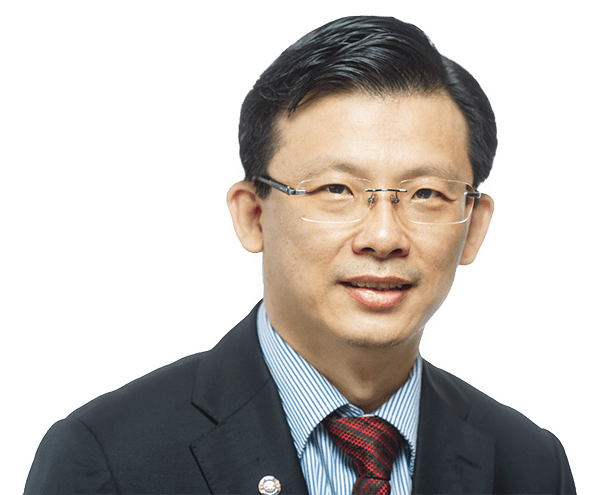
    Lee Khee Chuan estate planning

    Lee Khee Chuan @ Sifu Lee brings with him his unique blend of academic background and experiences. He holds a B.A. with double majors in political science and psychology, and double minors in economics and Malay Studies from National University of Singapore (NUS). Since 1992, he has been in personal selling, as well as a company sales trainer, practitioner, lecturer, and columnist in estate planning.

    He is a trainer, practitioner, and lecturer in the financial & estate planning industry since 1995. He has much to contribute to the industry with his writing, lecturing, practice, and training. His forte is in practice management focusing on integrated approach to estate planning. He brings his many years of practice experiences to this Online Academy and to impart and transfer his knowledge to his students.

    He is the first financial adviser in Malaysia who advocates and promotes the integrated approach in estate planning. Hi strength lies in the integrated and practical aspects of estate planning. Many of his CFP students like his practical teaching and training methods in estate planning.

    Made by the expert in the industry himself.

    3. On A Platform That Is Very Easy To Use
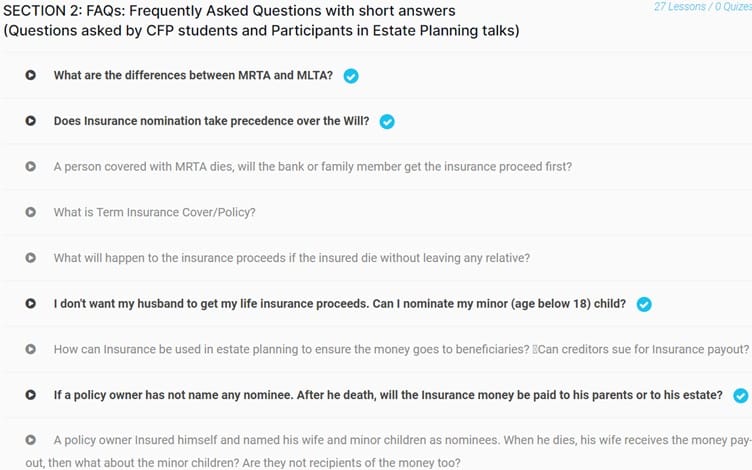
    You get to see everything at a glance and click on the content that you want to learn the most. Or you can follow step-by-step, completing it at your own pace.

    Once a lesson is completed, it will be marked as complete which is useful so that you can track your own progress.
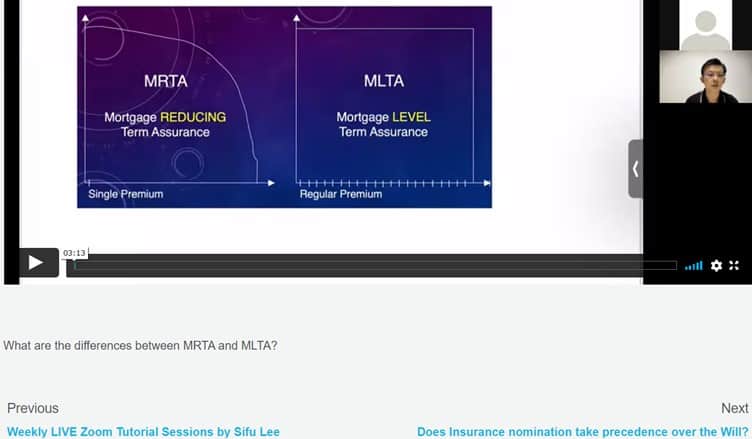
    You can easily watch the previous video or click next to continue with the lesson.

    4. In Layman Terms

    It doesn’t get any simpler than the explanation by Sifu Lee himself. Don’t worry if you don’t have any financial background or estate planning in general, it is being presented in layman terms that is very easy to understand by everyone.

    The practical knowledge combined with easy-to-understand lessons, makes for a very well-equipped understanding of the subject at hand.

    5. Weekly Zoom Meeting

    After you’ve gone through all the modules, you can always ask Sifu Lee via Live Zoom meeting every week. Should you have any queries about a particular topic or if you have a particular case study that you need help on, feel free to ask during this online meeting.

    There will be a minimum of 40 weekly live sessions in a year with 2 hours duration per session. The value that you get from this personal touch is just amazing.

    Smart Investor interviewed a few students who have enrolled in the online estate planning practice course and are learning the subject online. Angel Lee, a life insurance planner from Malacca was excited when learning it using the online portal.

    She really loved the way those courses were prepared and presented, starting by highlighting the issues in estate planning insurance agents and estate planners often overlook. And then the video-ready lessons would provide the answer those questions. The master trainer’s teaching was clear, yet detailed, and she loved the many examples discussed in the online course. The examples are invaluable and help discover how estate planning can be applied to meet clients’ concern.

    Adrian Lean, a unit trust and PRS consultant from Penang, found the estate planning course a comprehensive program and contains practicable knowledge typically sought by not only those interested in estate planning, but also for those who wish to expand their knowledge in this area. The course curriculum contained many gems, and he especially liked the unique integrated approach and the solutions presented in the course.

    Overall, the course is a value for money package, and carries a distinction above other programs in the market today. He congratulated the academy and the master trainers who have done an excellent job in raising the benchmark for the estate planning industry in Malaysia.

    Early Bird Discount If You Start Now

    We all know how Malaysians love discounts, fret not. Estate Planning Malaysia Online Practice Academy in partnership with Smart Investor now offers a SPECIAL discount for 1st year for those who act now.

    All you need to do is:

    1. Browse Estate Planning Malaysia Online Practice Academy website.

    2. Fill in your details and put in the coupon code: SmartInvestor (non case sensitive)

    3. Complete the purchase by credit card

    That’s it, a huge discount from RM2,600 to just RM1,196 first year fee. But it’s only for those who start now.

    See you there!

  • Financial Planning Lessons That I Learned From My 72-Year-Old Customer

    Financial Planning Lessons That I Learned From My 72-Year-Old Customer

    When I joined the financial industry in 2017, I was so lucky to meet my first customer. Not just because of the first investment business he gave to me, but also the lessons that he taught me.

    I remembered the day when I first met him, I was introducing a unit trust fund to him, and he agreed to invest immediately after I finished my explanation. Since he was my first customer, I was being extra careful to avoid any mistakes in the process.

    I asked him every question in the suitability assessment form:

    • Do you have investment experience in the past?
    • Do you understand about the investment risk?
    • How many percent of fluctuation can you accept?
    • Do you read and understand English?

    The customer suddenly slapped the table, and said: “Why do you need to ask so many questions? Other banks did not ask all these questions when I invest with them! I told you, I’m ready to take risk when I invest. I can even accept the RM100k investment becoming a total loss.”

    Knowledge Is Power

    People may think that when one gets older, he/she should be less aggressive in investment. But this customer taught me that when one is fully equipped with knowledge, he/she will be able to make an informed financial decision despite of his/her old age.

    Later, the customer topped up his investment after his first investment made profit within five months. But this time, the market was not going as smoothly as the first time. The unit trust fund was badly hit by the US-China trade war in 2018. The fund dropped ~20% in the first year of investing.

    I asked the customer whether he want to switch his investment to other funds that were not affected by the US-China trade war?

    Surprisingly, the customer did not worry about the paper loss of 20%. He told me that it is normal for the market to be up and down. He does not want to switch the fund because he has belief in China, and he is confident that the fund will rebound; and he has the holding power and patience to wait for it.

    A year later, the fund recovered and the investment broke even at the end of the second year. 6 months later, the fund then made a 20% return. The customer was very happy with the annualised return of 7.63% after waiting for two and a half years.

    Patience Is Key

    Hourglass on dark background

    In reality, most investors might quit the market and cut loss when the fund is at ~20% loss. Some investors might withdraw their investment when the fund finally breaks even at the end of second year. Only a few are able to see the return after waiting for two and a half years.

    The customer taught me another lesson that when one has a clear investing goal and strategy, he/she will not worry unnecessary about the market’s volatility, he/she will always stick to the initial plan without making emotional decision.

    It has taught me the importance of financial literacy and it resulted in my faith to become a licensed financial planner a few years later.

    Thanks to my customer, I’m now a licensed financial planner currently and I’m also conducting financial management workshop regularly to educate Malaysians on financial literacy.

    About the Author

    Angel Chan is a Licensed Financial Planner attached to UOB Kay Hian Wealth Advisors Sdn Bhd. Besides providing comprehensive financial advisory to her clients, she is also committed to educate the public about the correct financial management mindset and methodology through article, YouTube video and Financial Management Workshop conducted by her and her team. Do reach out to her for more information.

    FB page: https://www.facebook.com/angelchan.financialplanner

    FB page: https://www.facebook.com/profinance.my

    YouTube channel: https://www.youtube.com/channel/UCf5f7O3vuOhnwy_wflDuuKA

    Smart Finance: https://smartfinance.my/planners/chan-aun-kei-rfp

    To book a free 1-hour consultation with Angel Chan: https://forms.gle/8Ur46Dox9T6g3yKS8

  • 5 Things You Should Know When Your Spouse Passes Away

    5 Things You Should Know When Your Spouse Passes Away

    The death of your loved ones is a terrible event, but it can’t be avoided and it’s a reality that we have to face. If you are married, it is your hope and wish that you and your spouse will get to grow old together.

    But if it is fated that he or she passes away prematurely while we are not ready, here are 5 things that you should know.

    1. Can I claim alimony (nafkah) for maintenance of myself or for my kids from my late husband’s estate?

    It is a man’s obligation to provide for his wife and kids while he was still alive. But once he passes away, you can only demand for alimony from his estate are those that are overdue only while he was still alive.

    Any claim of the unpaid alimony can be filed in the Shariah Court. You will then need to present the court order to the estate’s Executor/Administrator for the purpose of payment.

    2. I have access to my husband’s bank account. Can I withdraw the money inside and use it to carry on with my life?

    All the wealth of the deceased is considered as inheritance. The priority is to pay off all debts and for the expenses for giving out the inheritance. If there is balance, then it will be distributed to the next of kin.

    If a family member needs the money to carry on living before the above is taken care of, then it requires the approval from all the heirs before it can be used. The amount that can be taken is the one allowed for her share of Faraid entitlement out of the total estate.

    If it exceeds her share, then she needs to repay it or get consent from all heirs to allow it to be used.

    3. My husband puts my name as the nominee for his Employee’s Provident Fund (EPF)/Tabung Haji/Takaful, can I use the money for my own benefit?

    A nominee for his EPF does not make you the beneficiary. A nominee can only act as Executor/Trustee for the money and it can’t be used for your own benefit. Instead, it must be used for the administrative part of the estate and if there are any balance left, then it must be distributed according to the Syariah law inheritance  to the respective heirs.

    If an Executor/Administrator for the deceased’s estate have been appointed, it is better to surrender the money to ensure the transparency in administration and distribution of the estate, as well as to avoid conflicts.

    Whereas a nominee for his Tabung Haji or Takaful depends on the type of nomination. If it being named on the basis of Hibah, then you can receive the money as beneficiary. But if the nominee is on the basis of Executor/Trustee, then you need to act in accordance of a nominee for EPF as mentioned above.

    4. What are the steps to get a bigger portion from my share of Faraid?

    Husband or wife of the deceased can make a claim for Matrimonial Asset (Harta Sepencarian) in the Shariah Court for the wealth that was acquired while you are both married. Through these claims, you are able to get a portion from the Matrimonial Asset that is decided by the Shariah Court as well as the portion based on Faraid.

    5. What should I do if I was appointed as a trustee for my children’s estate who is still a minor?

    All immovable property that is inherited by under-aged children needs to be registered under your name as a trustee.

    For cash, it is best that you open a trust account for the children to be transparent. You need to ensure that the money will be managed and used for the welfare of the children. A trustee must be meticulous and make records or keep receipts on its usage and it must be used for the benefit of the children.

    A Huge Burden

    In managing the estate of someone who has passed away, the main objective is to ensure that the debt and expenses needs to be administered first, before the distribution can be made of what is left. Therefore, estate planning is very important, not only to ensure that the estate is managed well, but also to ensure the well-being of heirs is taken care of.

    About the Author

    The article is written by Ms Rahimah Binti Sazali, Assistant Manager, Estate Management Department of as-Salihin Trustee Berhad. as-Salihin offers full-fledged Islamic Estate Planning products and services such as Wasiat writing, declaration of Hibah, jointly acquired asset agreement, takaful trust and living trust.

  • RONW, a Formula to make Sound Financial Decisions

    RONW, a Formula to make Sound Financial Decisions

    Perhaps, if you are reading this, you might be in the midst of making some financial decisions. They could be:

    • Should I use EPF Account 2 to settle my mortgage?
    • Should I invest my bonus first or settle my liabilities?
    • Should I invest in unit trust, stocks, or properties?
    • Should I buy a new fancier car or a bigger house?

    And, the list goes on. You get the idea.

    Most people may be overwhelmed by them as a decision either way will move you forward or backward financially. Understandably, many will choose to procrastinate because it will seem to be the “safer” option since many financial decisions can be irreversible.   

    However, here’s the real problem: How do you make smarter financial decisions if you are not equipped with the right tools to make them?”  

    Here is a straightforward technique that we believe will be helpful for you to make sound personal finance decisions. The tool is known as the “Return on Net Worth Analysis” or RONW.

    What is RONW?

    RONW tells you how efficient you are in using capital. It is quite similar to the ROE (Return on Equity) ratio we often look at when analysing corporate financial statements.

    Calculating Your RONW

    Here is how to calculate it:

    Step 1: List down all your assets and its value, including the projected return rate of each asset, such as “REITs − RM10k − 6%”, “Cash − RM20k − 3%”, “Rental Property − RM300k − 8%”, etc.

    Step 2: List down all your liabilities, including the effective interest costs, such as “Credit Card − RM5k − 18%”, “Mortgage − 200k − 4.5%”, etc.

    Step 3: Calculate the RONW

    RONW = (Total return – total interest) / Net Worth

    We have a full video demonstration. You can google “RONW KCLau” to find it on my website.

    What does RONW Tell You?

    If you have calculated your RONW and discovered:

    Your RONW is Negative:

    It means your net worth will shrink every year. You may start by clearing out debts with high interest rates such as personal loans and credit card debts to ease your financial burden. Then, you may follow up by adding productive assets to further improve your RONW figures from negative to positive.

    Your RONW in Positive:

    Congratulations! You have more productive assets than liabilities. If your net worth is still small, then, you may continue to grow both your net worth and your RONW. If both your net worth and RONW is significant, most likely, you are wealthy and are enjoying financial freedom.

    To Answer Above Questions Using RONW

    1: Should I use my EPF to settle my Mortgage?

    Source : EPF

    Let’s say you have RM30,000 in your EPF account 2 and you are considering withdrawing it to clear RM30,000 off your mortgage. Is this a smart financial move? Let’s see. Based on the RONW, we would consider:

    Returns from EPF:

    RM30,000 x 6.9% = RM 2,070.

    Interest Payable from Mortgage:  

    RM30,000 x 4.5% = RM 1,350

    If you withdraw EPF to clear mortgage, we would save RM1,350 in interest payment but will forgo RM2,070 in EPF dividends. Thus, you would net out RM720 per annum if you go for it. Hence, the answer is a straight “No” based on the RONW formula.

    2: Should I Invest or Settle my Liabilities?

    First, it depends on how good you are as an investor and what liabilities you owe currently.

    For instance, let’s say, you are a good stock investor who knows how to make 6% dividend yields from your stock investments. You have the following debt such as credit card debt of RM10,000 where the interest rate is 18% and PTPTN loan of RM10,000 where the interest rate is 1%. Today, you are given RM10,000 to either invest in stocks or pay off any of the two debts mentioned. What should you do?

    The answer is obvious. You pay off the RM10,000 in credit card debt because its interest rate is higher than the 6% dividend yield from investing in stocks.

    But, if there’s no outstanding credit card debt, then, you may invest in stocks that pay 6% in dividend yields as it is higher than the 1% interest charged by your PTPTN loan.

    3: Should I invest in Unit Trust, Stocks or Properties?

    Your investment objective is to maximise your RONW safely without taking unnecessary risks. So again, it depends how good you are in investing in unit trusts, stocks and properties. Some seasoned investors go all out to invest in stocks and properties.

    4: Should I Buy a Fancier Car or a Fancier House?

    Let’s start with a fancier car. Apparently, a car depreciates over time. But, the amount of your car loan and interest payment will increase after you’ve purchased or upgraded to a new fancier car. So, should you refrain from getting a brand new car? If you are now into improving your RONW, then, don’t do it. But, if you are not, then, you may go for it if it makes you happier.

    Meanwhile, a fancier house might not affect your RONW as severely as having a more elegant car as properties appreciate over time. Nevertheless, you will still end up with lower RONW after upgrading to a bigger house.

    Again, there is nothing wrong with upgrading your home as it does bring more joy to your family. RONW is a measurement of the efficiency of your capital and not the level of your happiness.

    In conclusion, RONW is very similar to the way we look at the ROE of a company. Value investors love to hold shares of stocks with high ROE because that shows the efficient use of shareholder’s fund. On the personal level, if you know how to maximise your RONW, you will be doing way better than 95% of the population.

    About the author

    This article is co-written by KC Lau and Ian Tai.

    Ian Tai is a Dividend Investor. Financial Content Machine. Producer of 200+ Articles, Weekly Host and Presenter at KCLau.com. Co-Founded DividendVault.com, an online educational membership site that empowers retail investors to build a stock portfolio that pays rising dividends in Malaysia and Singapore.

    KCLau is a financial educator, having published seven books including the current bestseller Money Smart, and co-created a dozen online financial courses. He gives away his popular Money Tips e-book volumes free at his website: https://KCLau.com

  • Protecting Your Nest Egg From Health And Income Shocks

    Protecting Your Nest Egg From Health And Income Shocks

    For many Malaysians approaching retirement or already retired, one of their biggest fears is having a massive hole blown through their nest-egg which they have painstakingly built up over the decades to see them through their golden years.

    For many people, the situation becomes even more tenuous as their retirement funds are barely sufficient to provide a comfortable level of living or last till end of life.

    Two of the major risk factors that can reduce individual retirement savings are health and income shocks, says Mohd Sedek Jantan, head of Investment & Financial Planning / Investment Unit at UOB Kay Hian Wealth Advisors Sdn Bhd.

    Health shocks are defined as unpredictable illnesses that diminish health status, he says. “Individuals facing health shocks are often affected by significant out-of-pocket (OOP) healthcare expenditures incurred to obtain healthcare and the income loss from an inability to work.

    “The OOP spending has particularly serious effects on poor households, who tend to spend more on healthcare as a share of their income compared to their richer counterparts,” he says.

    On the other hand, income shocks are referenced by how many significant drops in income a person has suffered over their working career, says Mohd Sedek.

    “For example, the current Covid-19 pandemic has caused the unemployment of large numbers of people, while others are facing pay cuts. The income shock during the pandemic is more severe among young adults.

    “Income shocks are strongly associated with an expected spending reduction and, at a certain level, the individual will liquidate their savings in order to put food on the table.”

    Mitigating Against The Risk Factors

    Mohd Sedek says like other expenses in retirement, planning can make a difference in managing such risks. He says healthcare costs influence retirement income planning, and as such, the impact of rising healthcare costs should be a priority consideration.

    “The most economical way to absorb the health shock is by changing lifestyle,” he adds.

    He says research studies on people’s behaviour have shown a causal relationship between unhealthy lifestyles and healthcare expenditure, where individuals who practise unhealthy lifestyles need more healthcare services, forcing them to spend more on healthcare expenditure.

    Taking steps to improve health can reduce annual medical expenses, he adds. In the case of Malaysia, hypertension stands as an important area of worry for economic evaluations because of the wide range of issues involved for the individual and for society.

    “It is one of the most expensive diseases as far as treatment is concerned, as it generates higher healthcare expenses than those produced by individuals with normal blood pressure.”

    However, he notes there is a reduction in total direct costs of the hypertension population if each patient’s blood pressure becomes controlled.

    “This reduction in direct costs can be achieved by changing lifestyle habits, for example: reducing dietary sodium intake, decreasing body weight, quitting smoking, and reducing alcohol intake. In addition, anti-hypertensive medications can lower the risk of cardiovascular mortality in hypertensive individuals,” he adds.

    High Cost Of Medical Insurance

    R. Sathia, co-founder and CEO of GFlex40, a Malaysian insurance technology company, concurs the highest risk factors that would lead to reduction of wealth for a majority of Malaysians are health issues, either for themselves or their closest family members.

    “As it has been well researched, the cost of medical insurance in Malaysia is among the highest in Asia and continues to rise,” he adds.

    He points out that Malaysia also suffers from among the highest obesity rates in Asia. “The risk factors increase chances of individuals falling ill, and when combined with the cost of healthcare can quickly result in depletion of any savings that have been built by individuals,” he adds. 

    To reduce the risk of this happening, Sathia says that apart from investing in maintaining one’s own health by way of exercise, diets, etc, another supplementary and important mitigant would be investment in the appropriate health or medical insurance plans.

    “By procuring such a plan early in life, individuals can ensure they are covered for unforeseen circumstances later in life,” he advises.

    For the individual there is little they can do to prevent the rising healthcare cost across the board in the market. “However, on a personal level, everyone can work towards limiting their exposure to such costs by living a healthy lifestyle from early in their life,” he says, adding this would include proper healthy diets and exercise.

    Sathia notes that exercise is a particularly interesting topic when it comes to health/medical insurance.

    “More and more insurance and Takaful companies are investing in health and exercise related insurances that track the lifestyle and exercise habits of customers through the use of electronic gadgets and apps.

    “By availing oneself to such an insurance early and leading a healthy lifestyle, not only would the average person be able to improve on their overall health but they can also potentially reduce their own premiums as a result of their healthy lifestyle. 

    He also says there have been efforts across the world to factor in lifestyles and exercise behaviours through electronic monitoring as inputs in pricing health and medical insurance by technology driven insurance companies.

    “These efforts coupled with efforts to optimise operations of third party administrators and hospitals would eventually be able to lead to a reduction of pricing,” he adds.

    Wealth Protection Measures

    So, whatcan we do to prevent rising healthcare costs from eroding our retirement nest-egg?

    UOB Kay Hian Wealth Advisors’ Mohd Sedek says reviewing one’s current insurance plan is vital to ensure it does not eat up the retirement saving.

    “As healthcare costs continue rising, it is important for each individual to have life and medical insurance. According to the Employee Benefit Research Institute (EBRI), healthcare expenses are the second largest component, and these expenses steadily increase with age.”

    Further, it is important for the policyholder to review their insurance policy from time to time, to ensure having adequate protection for the future and safeguard the income-earning abilities.

    Sound financial advice also plays an important role when it comes to retirement planning.

    “Individuals, regardless of their income level, should engage with a certified financial planner to ensure the retirement saving is not just sufficient but also sustainable, to hedge it against healthcare cost,” advises Mohd Sedek.

    A financial adviser, he says, will review the individual’s overall financial situation and address the solution based on their needs. From the analysis, the financial planner will help the individual to address the challenges by:

    • Estimating their expected out-of-pocket healthcare expenses, such as insurance premiums;
    • Creating contingency plans for unexpected expenses such as long-term care; and
    • Working closely with the client to help protect their wealth by integrating healthcare costs into the overall retirement plan.

    He adds there are a number of insurance types and riders that can help to hedge the rise in healthcare costs, such as investment-linked products, medical card, critical illness coverage and specific elderly insurance.

    In addition, the financial planner can explain the cost–benefit for each insurance plan, creating trust funds and other advanced planning strategies.

    Risk Management Needed To Absorb Income Shocks

    To mitigate against income shocks, individuals should do planning that includes matching up income streams, including guaranteed income, to fund recurring healthcare expenses such as insurance premiums.

    Individuals may also plan on maintaining an emergency health savings fund for non-recurring health expenses, says Mohd Sedek Jantan, head of Investment & Financial Planning / Investment Unit at UOB Kay Hian Wealth Advisors Sdn Bhd.

    Also, delaying withdrawal from the EPF can create a larger monthly benefit. “Hence, personal budgeting is important to achieve a clearer vision of personal finances so you can begin to plan your spending and saving and take control of your money.

    “In short, budgeting helps you to ensure you have the right amount of money at the right time.”

    And when doing budgeting, both regular events and extremely uncertain events must be dealt with. It is advisable for individuals to set aside at least six to nine months of living expenses in a money market account, one that offers liquidity and the safety of the principal.

    “An emergency savings fund should be established so you don’t have to consider tapping your retirement savings,” he adds.

    Dealing With The Medical Insurance Conundrum

    If they can afford it, it is prudent for senior citizens to have medical insurance as it can help offset the medical expenses that they’ll incur as they age.

    However, the flipside is that medical insurance premiums increase dramatically as we grow older, ironically at a time when we are no longer generating income.

    So, is there a way out of this predicament?

    Mohd Sedek Jantan, head of Investment & Financial Planning / Investment Unit at UOB Kay Hian Wealth Advisors Sdn Bhd, notes that age is one of the prime elements in the health insurance premium calculation because it impacts the medical support a policyholder may require.

    It is significant to understand that an elderly insured individual will possess medical conditions quite different from those of a young or adult insured individual, he says.

    “Typically, the premium amount increases on average about 5% to 8% for every year of age; it can be as low as 5% annually if you’re in your 40s, and as high as 12% annually if you are over age 50,” he says, adding that high-risk health status also has the potential to greatly increase costs.

    As such, Sedek says it is advisable to buy health insurance “at a young age to avoid high insurance premiums”, as the policyholder is able to lock in lower premiums and reduce the total amount they will spend on life insurance over the course of a lifetime.

  • A Real Life Investment Question Answered 

    A Real Life Investment Question Answered 

    Dear Mr Neoh, I was hoping that you can give me some advice on my situation, below is a bit about me:

    I am Malaysian, now 62 years old. I am currently single, and I am still working for a living. My take home income is about RM3,000. I do have two children who are now already working and in their late 20s/early 30s. I am feeling a bit insecure because currently, I only have about RM40K in savings with me, and this represents the only money (savings) that I have. What should I invest in order to get extra when I am no longer able to work for a living? Recently, I was approached by a Unit Trust person from a reputable unit trust company who invited me to take up a scheme with her in order to grow my wealth. Since I have never had any investment experiences in life, I honestly think that I lack knowledge about investments. I don’t feel confident about this investment. In fact, I feel a little confused. Can you please give me some advice? 

    Mr Ng

    Answer:

    Hi Mr Ng,

    Thank you for your email, I hope after reading this response, you will feel less confused but empowered to make a decision regarding the above.

    I understand that you are still working, and I am assuming that the take home pay of RM3,000 mentioned here is a net income, consistent month-to-month.

    While I agree that you should actively look for options to invest your money, it is very important for you to ensure that you make a good, quality decision.

    This is because, if you invested into something that is too risky for you, or into something that is not what it seems to be, your chances of losing your money will be higher. This will be very dangerous for you, considering that you are now in your sixties.

    Based on the illustration above, let us assume that you invest all RM40,000 but you suffer a loss of 50% in the first year. You will end up with just RM20,000. If this misfortune happens, you will then need a long time to get back to the original amount of RM40,000, assuming you are able to rebalance the remaining RM20,000 to an investment or portfolio that can grow at 10% pa.

    The above projection shows that if invest RM20,000 into something that can generate 10% a year for the next few years, you will need seven years and four months before you can get back to the original amount of RM40,000; and by that time, you will be 69 or 70 years old.

    Of course, if you can only feel comfortable investing into a “safer” investment generating 5% a year, you will need 14 years to get back to the original amount of RM 40,000 as can be seen in Illustration 3. By then, you would be 76 years.  

    The above example is why it is very important for us to ensure we don’t lose our money by investing into things that we do not understand, or are too risky to match our risk profile.

    At the age of 62, and with RM40,000 being your total savings at this point, you may want to be conservative with your money. Having said this, it does not mean that you should just keep all the money in a savings account or all of it in Fixed Deposit. Because this is also dangerous since our purchasing power will decrease every year due to inflation (where you need to pay more to buy the same or even lesser amount of the item you need).

    Therefore, you should consider investing not more than 20% of your money into equity (stocks or shares). But investing in shares requires knowledge, time, effort, and you will also need a bigger capital to have a reasonable holding of stocks that are properly diversified.

    I suggest you invest into stocks or shares through a Unit Trust fund. You can invest into a Unit Trust fund that invests in “Blue Chip” stocks as it is more stable and less volatile compared to other stock funds.  An alternative to a blue-chip stock fund, will be a Balanced or Moderate fund.  This type of fund typically invests 50% of the money into stock and 50% into fixed income instrument, so it will be quite safe, since we limit your exposure to not more than 20% of your wealth.

    I do not know the kind of fund or scheme the unit trust agent recommended that you invest into, therefore, I cannot comment on the suitability of the fund for you.  

    It is however very important for us to note that no matter what you will eventually invest in, the investment has to be one that suits your current needs, your capacity for risk-taking, and if things go south, will not put you into a position that will likely lose most if not all of your savings.

    About the author

    kevin neohKevin Neoh is a NextGen Money Coach who works with people to help them transform their relationship with money to improve their lives with the money they have. Kevin can be contacted at kevin@nextgenadvisors.my and www.kevinneoh.my

  • 3 Non-Financial Matters of Retirement Planning That You Must Not Ignore

    3 Non-Financial Matters of Retirement Planning That You Must Not Ignore

    From advertisement run by insurance company, investment company to banks, and even the likes of private pension and pension fund, the idea of retirement planning is central on the need to plan early so that we can have adequate savings that sustain our golden years.

    That being said, most (if not all) messages revolving around the concept of retirement is more often than not about “whether you prepared enough money for your retirement”.

    Imagine people who have been working diligently and save very hard to prepare for this eventual phase of life called retirement for the past three decades. When they finally retire from their full-time work, does this now mean they will have a very good retirement?

    I believe that a good retirement is determined not by what product we use to prepare for it, but how we invest our retirement money. In fact, there are three non-financial sides that we should not ignore.

    Time

    retirement

    “What we do with this luxury of time is equally important (if not more important) than whether we have prepared enough money for our old age.”

    One of the biggest differences between before and after retirement is not just about our main income will come to a stop, but rather, we will now have all the time available to ourselves.

    So, what we do with this luxury of time is equally important (if not more important) than whether we have prepared enough money for our old age.

    There is a saying that sound like this, “Growing old with lots of money is no longer the goal. Dying rich cannot compete with living rich, and making a living does not measure up to making a life.”

    This implies that while we may be rich financially, if we are not rich in life, then those money may not carry any significant meaning beyond fulfilling our basic need.

    There are 24 hours a day and this means we will have 168 hours every week now. Before we stop working completely, assuming we spend eight hours a day for our work, and we work 22 days a month, we will now have an additional 160 hours available to us!

    So, how are you planning to use this new found 160 hours of your life? Having an idea for this is crucial because how we use our time will determine how our money will be used.

    Of course, we will have some ideas about what we want to do when we no longer have to wake up to clock in for work. Maybe we can go shopping, hi-tea with friends, travel and do some of our hobbies. This is such a good thing and it will surely be liberating for us to indulge in these activities. However, do we see ourselves constantly doing this to fill up the 160 additional hours for years or decades? Could we come to a point that these activities that look attractive to us now may then become boring in future (after enough repetition)?

    Meaning

    retirement

    “When we do not find life interesting, we may start to lose a sense of what is worth living for.”

    Another key factor for people not retiring well is boredom. When we do not find life interesting, we may start to lose a sense of what is worth living for. It may also lead to us seeking new excitement with the retirement funds we have and in certain extreme situations, the person may even squander away their retirement savings.

    On the other hand, people who have retired well and happy in their golden years usually have a few things in common. One such trait is living their life with a purpose. This can include volunteering at certain organisations with a cause they believe in. It may also be work that allows them to use their talents or experience to help the younger generations, such as a mentoring program.

    Money is not the main motivator for getting involved in such projects or activities, but rather living a life that is ‘rich’ in meaning and purpose. If we look around, there are many people that can already afford to retire, but yet they are still actively pursuing a certain cause.

    Speaking with them to understand their mentality may also help in seeing a different perspective.

    Health

    “No matter how wealthy or how financially prepared we are, without good health, anything else hardly matters.”

    Think about your retirement as having three phases. In early retirement, you hopefully have the time, resources, and fitness to lead an active life. In the middle of retirement, your level of activity will probably start to slow down. And in the third phase, most retirees begin to settle into their homes and prioritise their wellbeing.

    It is in the third phase that health care costs can increase dramatically depending on your needs and your personal support network. This is also potentially one blind spot that most people have not come to realise.

    Some retirees who anticipate assisted living or in-home nursing purchase medical insurance with very high coverage. But these products only can do so much, i.e. it only pays for our hospitalisation bills and some post-hospitalisation. Other things that require money but not a hospital stay are not covered (yet). Hence, there is still a need to plan for additional funds that cater to these situations and having a back-up fund that we can dip into is crucial.

    A more sensible way is to plan and accumulate our retirement savings, while also planning how to keep ourselves healthy and fit so that we enter our retirement with reasonable health.

    Sadly, too many seniors put off making these difficult decisions until they are dealing with a major health or financial crisis. Planning ahead puts folks in a much better position to choose how and where they are cared for on their own terms.

    No matter how wealthy or how financially prepared we are, without good health, anything else hardly matters.

    Retirement Planning Is Never Just About Numbers

    Back to those advertisement messages we are bombarded daily, those are messages about how financial products can help us prepare for retirement. But it is not preparing for a full retirement as money is just part of the picture.

    In order to plan holistically for a retirement that really has meaning, you will have to engage in deeper conversation that helps you in understanding yourself better, discovering your personal values, identifying how you envision your retirement life to be, and how are you going to fill up your 168 hours a week, before looking at the numbers.

    Real retirement planning should be a process that integrate numbers, and your life. Because eventually, it is the person (you) that gives meaning to the number, not the other way around.

    About the Author

    Kevin is a NextGen Money Mentor and founder of NextGen Independent Advisors. He works with people to transform their relationship with money and be brave in their pursuit to live a meaningful life with their money. He is a CFP professional, a certified member of Financial Planning Association Malaysia (FPAM). Kevin can be contacted at www.kevinneoh.my.

  • Should I Nominate My Wife As Sole Beneficiary Of My Life Insurance Policy?

    Should I Nominate My Wife As Sole Beneficiary Of My Life Insurance Policy?

    Most people, especially family breadwinners, have life insurance policies. They assume that on their passing or if they are permanently disabled, the policy will pay out the sum insured that will take care of the financial needs of his family.

    However, depending on the circumstances, things may not pan out as the policy holder intends. The following story about Sam highlights the different scenarios that may lead to unintended consequences, and offers the solutions to deal with it.

    Question:

    Hi, I’m Sam and I’m 43 years old. I’m happily married to Jenny, a 40-year old housewife and together, we are blessed with two children namely, Jim and Gina aged 6 and 3.

    As I write, I wish to continue to provide for my family’s living expenses and pay for Jim and Gina’s tertiary education fees if I pass on prematurely. In view of this, I intend to buy a new life insurance policy where the sum assured is RM1 mil and nominate Jenny to be the sole beneficiary of my new policy.

    With that being said, I have a few concerns. My question is: ‘Who would receive and manage the RM1 mil in sum assured if:

    • I become comatose or mentally disabled?
    • After my passing, my wife passes on before my children reach adulthood? Or,
    • I pass on simultaneously with my wife due to an accident?

    Answer:

    In Sam’s case, having a life insurance policy or a handful of them is a good start. The sum assured is helpful to his loved ones if he passes on prematurely as the money will be paid to his wife Jenny in a couple of weeks after Sam’s passing.

    It is unlike Sam’s estate which may consist of cash, shares, and properties which will be frozen upon his death. It could take 1-5 years to unlock Sam’s estate and have them distributed to his beneficiaries, depending on his testacy status.

    Here, I’ll list down possibilities of how his sum assured of RM1 mil could be received and used in the three scenarios above. More importantly, I’ll share a simple solution that Sam could use to be assured that his life insurance policy will be able to serve his intended objective.

    For a start, most, if not all, life insurance policies will cover both death and total permanent disability (TPD). If Sam becomes comatose or mentally disabled due to an accident, his insurer will pay out the RM1 mil in sum assured to him.

    But, is this RM1 mil collected helpful to his loved ones?

    Well, it depends on the type of bank account his RM1 mil will be deposited into. First, if the RM1 mil is transferred into Sam’s personal savings account by his life insurer, who can have the access to his RM1 mil if Sam is the only person who has the username and password to his bank account?

    Thus, his RM1 mil will be stuck and is of no immediate help to his family members.

    Second, if the RM1 mil is banked into Sam’s joint account with Jenny, she will have full access to the money. So, is this problem solved? Well, I don’t think so because Jenny could be prone to mismanaging the money.

    This could be due to a variety of factors ranging from overspending, to being conned by swindlers and failures in business ventures and investments. But then, Sam could place great confidence in Jenny’s ability to manage his finances.

    If that’s the case, will it solve the issue? In a way, the answer is yes but it’s only if Jenny remains alive on planet earth. If not, this would lead us to:

    insurance

    It is possible for Jenny to pass on before their children reach adulthood, and this is after Sam’s demise. In this scenario, Jenny’s balance sum from the RM1 mil given would form a part of her estate and be distributed based on her testacy status.

    If she has a written will, the balance sum would then be distributed to her beneficiaries accordingly by her executor.

    Otherwise, without a will, the sum shall be allocated based on the ratio of ⅔ to Jim and Gina and the remaining ⅓ to Jenny’s surviving parents as mentioned in the Distribution Act 1958. If Jenny has no surviving parents, then, the sum shall be allocated to her children in full.

    Here is a question. How will Jim and Gina collect their sum allocated, if they are below 18 years old?

    The answer: Jim and Gina must have a trustee to help them collect the money and manage it on their behalf until they reach, at least, 18 years old.

    This leads us to another question: ‘Who shall be their trustee?’

    Will it be one of Jim and Gina’s uncles or aunties from either their paternal or maternal side or both? This could potentially result in conflict and strife among Jim and Gina’s relatives, which leads to more financial uncertainties to them.

    The RM1 mil in sum assured will form part of Sam’s estate. Thus, the sum is to be distributed based on Sam’s testacy status, which is similar to what we had discussed above in Scenario 2. But here, it is common for a husband like Sam to have elected Jenny to be the sole executor of his will.

    Hence, in the absence of a written will or a will without an appointed substitute executor, the question of ‘Who shall be their trustee?’ remains. The siblings’ relatives (both paternal and maternal) may contest to be their trustee, which can result in financial uncertainties for both Jim and Gina as mentioned earlier.

    insurance

    First, the RM1 mil in sum assured shall be kept with Sam’s insurer for a period of 12 months until a trustee to Jim and Gina has been appointed.

    Let’s say, Jim and Gina’s relatives could not come into consensus on who should be their trustee after 12 months of their parents’ passing. In this case, the RM1 mil in sum assured will then be transferred from Sam’s insurer to a public trustee, namely Amanahraya Trustees Bhd.

    The money shall be kept until Jim and Gina reach 18 years old, the age when both of them are eligible to receive their rightful inheritance. However, this would lead to three common issues for both Jim and Gina as listed below:

    • Who shall fund Jim and Gina’s daily living expenses before they hit 18?
    • Would Jim and Gina be aware of their inheritance when they hit 18?
    • If they do, how will they manage their inheritance after receiving theirs?

    Hence, having a life insurance policy alone is insufficient to offer assurance that the money provided for will eventually fulfill Sam’s intended purposes. As such, what then is his solution?

    The answer is for Sam to set up an insurance trust.

    So, what is it?

    For a start, it is the use of both a life insurance policy and a trust to manage the sum assured based on Sam’s intentions upon occurrence of events stipulated in his trust document. Here is how it works;

    a. Sam buys a life insurance policy where his sum assured is RM1 mil.

    b. He assigns his policy to his trust instead of nominating Jenny as a beneficiary.

    c. Then, Sam may elect Jenny, Jim and Gina to be beneficiaries of his trust.

    d. Sam may dictate how and when the RM1 mil would be distributed to his beneficiaries. For instance, he may instruct the trustee to distribute the sum in the event of his passing on or him becoming permanently disabled according to the following proportions:

    First, if Sam becomes permanently disabled, his insurer will pay RM1 mil to his trustee. Thus, the sum will not be stuck in his personal savings account.

    Second, the trustee is to manage the sum based on Sam’s intentions with professionalism and integrity. Thus, the trustee is not permitted to use the sum to invest in stocks, real estate, or new business ventures if it is not instructed by Sam beforehand. This helps to reduce the risk of his funds being mismanaged.

    Third, if Jenny passes on prematurely, Sam may include one additional clause in his trust where it allows his trustee to distribute the money directly to both Jim and Gina. As such, this would assure Sam that his children will be taken care of financially if he and his wife pass on prematurely.

    Perhaps your situation is uniquely different and thus requires assistance from a qualified estate planner.

    About the author

    Jocelline Chee is the founder of WG Legacy, a leading professional estate planning firm. You can download a Strategy Report at wglegacy.com/report to find out how she preserved her family’s financial future via a combination of insurance, will and trust and how you can do the same for your loved ones too. 

  • Meeting With Your Financial Planner For The First Time?

    Meeting With Your Financial Planner For The First Time?

    Congratulations! You have decided to take control of your financial life. You have researched your options, asked a lot of questions, and found the right licensed financial planner professional to help you plan for your financial future.

    As you prepare for your first meeting as a client, it is likely you have even more questions, and if so, you are not alone. Many clients of financial planners are not sure what to expect, how much to divulge, or even what documents to bring to their first official meeting.

    While every financial planner and firm are different, most follow a common general framework based on the six-step financial planning process. The first step often involves something called a ‘discovery’ meeting, in which the financial planner and the client form a basis for their relationship.

    It is an opportunity to build trust, understand problems and priorities, and establish a roadmap for progress toward the client’s financial and life goals.

    Licensed financial planners, CFP professionals, and their firms often have an established process that includes providing a checklist of required documents and information they need to get an accurate picture of a client’s financial situation. While it may seem a bit overwhelming to share your most important financial details with someone you do not know well, it is really no different than consulting with a physician about your health.

    When you engage a CFP professional, you are working with someone who has pledged to place your interests first.

    The Big Picture

    financial planner

    When financial planners conduct a discovery meeting, many will ask questions not only about their clients’ financial situation, but also about their personal interests, family and lifestyle. Often, a person’s interests, family or lifestyle can influence their financial goals and decision-making, so having a good understanding of the client’s background may help the CFP professional understand their willingness to take on risk, or the triggers that will make them excited or spark their concern.

    The goal is to help clients create a plan that will serve them well in good times or bad, so they always feel confident about reaching their goals.

    Thorough financial planners have a process to securely gather their clients’ information, analyse it, and synthesise their findings into a set of recommendations. After receiving and discussing the recommendations from the financial planner, the client and financial planner plan how to implement these, and the role each will play in carrying out the plan.

    The more honest and direct clients are at the beginning of the relationship, the better the financial planner can help them create a sound, actionable plan to help them reach their goals. Although some clients might be hesitant to discuss embarrassing financial mistakes they have made in the past, it is important for them to share those so the CFP professional can address any consequences of those decisions.

    Prepare For Your First Meeting

    financial planner

    Before attending your discovery meeting with a CFP professional, take an hour or two to prepare yourself with answers to these potential questions:

    Identify Your Goals

    • What do you want your money to do for you? (Would you like a comfortable retirement, or a college education for yourself or your children? Would you like to start a business or buy a home? Contribute significantly to a favorite cause?)
    • What are your professional goals?
    • What goals do you have for your loved ones?
    • What legacy would you ultimately like to leave for your family and the world?

    Understand Your Attitude Toward Money

    • Do you consider yourself to be a spender or a saver?
    • What drives your decision to spend or save money?
    • What scares you about money? What makes you excited?

    Process

    • How much would you like to be involved in managing your finances?
    • How comfortable are you in using technology to access online statements, performance reports, tax returns or other documents?
    • What do you expect from your relationship with your financial planner?

    Get Organised

    Your financial planner may also ask you to bring certain documents to your first meeting. Those could include:

    • Bank statements from the past year
    • Other financial statements, such as loan documents
    • Insurance policies
    • Tax returns
    • Pension or retirement savings account information
    • Estate planning documents, such as a will or a trust
    • Brokerage statements

    Some firms provide a checklist with secure links to enable clients to upload their information prior to the meeting, but you may also bring the actual documents with you, depending on your comfort level. Whichever option you choose, be sure to label your documents and clarify any information that could be confusing.

    A Relationship For Life

    Although it may seem like a significant time investment or an emotionally taxing experience, being well- prepared for your first meeting sets the tone for a successful, trusting, long-term relationship with your financial planner. The more your financial planner knows about your history, your family, your interests and your financial situation, the better he or she can help you achieve the financial well-being you and your loved ones deserve.

    This article is courtesy of Financial Planning Standards Board Ltd (FPSB).

  • Property Investment: Make Money via Capital Gain & Rental Yield

    Property Investment: Make Money via Capital Gain & Rental Yield

    Property investment can be classified as a high risk investment category. High risk, high return. Indeed, that statement is true but do not forget the other side of it which the possibility of higher losses also increases.

    Knowledge and strategy are matter the most in investment. It is applicable to all types of investment including property. They are important so that investor can manage their investment properly; control their losses.

    It’s not whether you’re right or wrong but how much money you make when you’re right and how much you lose when you’re wrong.

    George Soros

    Property Investment

    Property investment involved a huge amount of capital as compared to the others. Remember, it is not easy to liquidate your property especially when you are in the lost.

    It involved quite a long process before the deal is done. You will need an agent to market your property, then will have to wait for a buyer. Then, if your property is leasehold, you will have to wait for consent from the land office. Normally it will take 3-6 months for a deal to be completed after you have a buyer.

    Anyway, that is not our discussion in this article. There are whole lot of things can be done to get the best property investment as your investment portfolio.

    How can investors make money via property investment?

    Capital Gain of a Property

    Capital gain also known as capital appreciation can be defined as the increase of the property value from time to time. It can be measured by the difference from original value with current market value.

    You can easily calculate it using this simple calculation,

    Capital gain = ((Current market value – Original value) / Original value) x 100

    For example, you bought an investment property in Setia Alam for RM600,000 in July 2015. As of July 2022, the current market value is RM800,000.

    Your property value has increased as much as RM200,000 in just 7 years. The capital gain from formula given is 33% over the 7 years of ownership. Easily calculated, your property value increased around 4% to 5% a year.

    Your property value appreciation can not be reflected literally by 4% to 5% per year as the appreciation value is pretty volatile over the years. It could have appreciated by 15% in the first year and stagnated until the fifth year and appreciated again.

    So, what can be considered as good capital gain for our investment?

    Average capital gain of residential properties in Malaysia reached 13.9% in 2012 when the economy was great according to National Property Information Center (NAPIC).

    Capital gain of 5% to 7% can be considered ideal during typical market situations. It is good to remember that mostly, the capital gain is impacted by the economy.

    After all, the capital gain can be seen as decent when it is above the inflation rate. Most investors who aim for capital gain will flip or sell their property unit after they reach their goals at certain times.

    Property Rental Yield

    property

    Rental yield can be described as the amount of rental income for a property as compared to the total investment value. This can help property investor to evaluate potential income of the said property.

    Rental Yield = ((total rental income – total maintenance cost)/(property purchase price))x 100

    For example, you purchased a property at RM600,000 while the maintenance cost per year amounting RM5,000 and the rental income per month is RM3,000.

    Then, your rental yield is around 5.2%. What does it mean?

    Rental yield also impacted from the economy. When the demand for rental market is good, the rental yield would likely be good too.

    During the pandemic outbreak, many people lost their job. The demand for the properties especially surrounding business area depleted.

    Normally, the average rental yield for residential properties is about 3.7%. A good rental rate should be at least 7%. As an investor, there are things that need to consider; property furnishing, property repairs, maintenance fees and any other cost involved.

    You have to consider taxes that actually may reduce your rental income.

    Location and type of the property play big role in determining the rental yields. For instance, a high rise property with limited units that located near to the access of public transport and offices are usually get a higher rental yields.

    This rental yield strategy is suitable for those who have a property in a high demand rental area where you can rent it out easily with higher price.

    So, which one is best suits you?