The following story is based on an actual series of events, with some names and circumstances fictionalised. Any similarity to any person’s name, character, or history is coincidental and unintentional. Family in-fighting is common, but it should not hurt family ties and ultimately cause things to flow inside the will.
David is a successful businessman who worked very hard building up his multi-billion dollar ceramic tile manufacturing business. So hard that he had little time for home and family, far less than he should have for bonding with his two sons, Ethan and Ben.
Ethan was the older brother. A slow and steady person. Reliable. Non-controversial. Compliant. But unimaginative. He worked as the chief quality controller in his father’s business.
Ben was a very bright child. The apple of his father’s eye during his younger days. The one his father hoped would take over the business in time.
Don’t Make Hasty Decisions For Things Inside The Will
One day, David called me to lunch at his office. Over dim sum, he told me he wanted to revise his will. Many years earlier, I had written a will for him when he wished to leave his business equally to his two sons and the rest of his assets to his wife.
He instructed me to change his will to cut off Ben and set a small portion of his estate for a trust, RM10 million to be precise, to cater only for Ben’s basic needs for the rest of his life. I was shocked because his business, listed by then, was worth some RM500 million.
“Are you sure?” I asked him. He suddenly looked downcast and said yes.
“Why the great disparity between the allocations for the first and second son?” I asked.
David said that Ben, after university, had worked in his company as the business development manager. Unfortunately, he became an alcoholic, to the deep disappointment of his father, and set a bad example in the office, often coming in late, slurring in his speech and reeking of the smell of alcohol.
Ties Can Be Repaired Before Finalising The Details Inside The Will
I told him a clause would have to be added in the revised will to explain why he was excluding Ben from inheritance through the will. I also mentioned that he should talk with his wayward son before finalising the details inside the will.
He said he had made up his mind, but I asked him whether he had considered that the underlying cause of the son’s behaviour and addiction could have been because he had been too harsh and draconian with the son without listening to his issues.
He stopped in his tracks, stared into space and remained silent for a long while. He sent me off and said he would be in touch.
After two months, he called me to meet again to discuss his new succession plans and to change the details inside the will. To my surprise, this time, his instructions were to leave the business 51% to Ben and 49% to Ethan.
Anticipating my question, he said he finally concurred with Ben through a weekend trip. His son had turned to alcohol to vent his frustrations because of a perceived lack of listening ear from his father for many years. After many souls searching, the son had gone for rehabilitation treatment and managed to kick out his addiction.
Needless to say, the father was ecstatic over his change and hence the revision of his will. Seeing the father and son reconcile after many years of misunderstanding was most satisfying as an estate planner. All because I had asked David a simple question, the family’s relationship improved, which was reflected inside the will.
Rockwills International Group, now in its 28th year, pioneered professional will writing in 1995 and has since evolved into the leading estate planning specialist in the country. It is today the largest provider of solutions and support services in trusts, succession, management and distribution of wealth. It has shareholders’ funds exceeding RM50 million. It has done over 280,000 wills and 15,000 trusts and holds more than RM25 billion in assets under trust.
Bursa Malaysia Berhad (“Bursa Malaysia” or the “Exchange”) and Maybank Berhad (“Maybank”) today co-hosted the 21st instalment of Invest Malaysia (“IMKL 2023”) in Kuala Lumpur. Themed “Reshaping Malaysia’s Narrative: Strengthening Resilience & Sustaining Growth”, IMKL 2023 was officiated by the Honourable Dato’ Seri Anwar Ibrahim, Prime Minister of Malaysia.
To ensure that the Bursa Carbon Exchange (“BCX”) achieves its goal of greening our economy and to catalyse the voluntary carbon market, the Honourable Prime Minister announced the Government’s commitment to a RM10 million seed funding incentive to assure demand for Malaysian-generated carbon credits traded on the BCX. This commitment will encourage issuers and project developers to invest in the necessary efforts and processes to enable carbon credit issuance.
Another announcement made by the Honourable Prime Minister at IMKL 2023 was the LEAP Market Transfer Framework, whereby Bursa Malaysia will be enhancing current regulations to facilitate LEAP Market PLCs to transfer to the ACE Market. Concurrently, Bursa Malaysia will share further enhancements to the Approved Adviser Framework to expand the pool of sponsors and corporate advisers for the ACE Market.
The Honourable Prime Minister also announced that Bursa Malaysia will be working with the London Stock Exchange Group to launch a Centralised Sustainability Reporting Platform. This would enable companies − both publicly listed companies as well as non-listed SMEs − to calculate their carbon emission impact, and disclose common ESG datasets in a standardised manner that conforms to established global standards, such as the Task Force on Climate-Related Financial Disclosures (“TCFD”). Led by Bursa Malaysia, this pioneering initiative will include a consortium of two Malaysian conglomerates, their supply chain and a panel of banks.
“Bursa Malaysia always listens and adapts to the demands of the investing community. Following public feedback from the consultation paper issued earlier, we will soon be announcing the LEAP Market Transfer Framework, as well as the development of the Centralised Sustainable Reporting Platform,” said Datuk Muhamad Umar Swift, Chief Executive Officer of Bursa Malaysia. “We believe these initiatives would increase the vibrancy and accessibility of our market, while better meeting the needs of market participants.”
“We are also pleased with the Prime Minister’s announcement that the Securities Commission Malaysia will extend the Waqf-Featured Fund Framework to include Islamic Real Estate Investment Trusts (REITS) and Islamic Exchange Traded Funds (ETFs). By offering this Waqf asset class and solution on the Exchange, it will further diversify our suite of Shariah-compliant listed products and more importantly, will provide an effective instrument to support our nation’s social development,” added Datuk Muhamad Umar Swift.
Dato’ Khairussaleh Ramli, Group President & Chief Executive Officer at Maybank, said, “A vibrant and robust capital market is a key component of Malaysia’s competitiveness that will help drive economic recovery. We welcome the measures announced by the Honourable Prime Minister at IMKL 2023 today and will continue to play our part in facilitating greater market participation and promoting Malaysia as an attractive investment destination.”
“Maybank believes that sustainability is key to building resilience and ensuring long-term growth. We are working closely with both the government and the corporate sector to execute the national sustainability agenda, and we are pleased to be part of Bursa Malaysia’s sustainable supply chain initiative to support our companies in their decarbonisation journey.”
Speakers at IMKL 2023 included the Honourable Mohd Rafizi Ramli, Minister of Economy who touched on measures to strengthen Malaysia’s economic resilience; the Honourable Senator Tengku Datuk Seri Utama Zafrul Tengku Abdul Aziz, Minister of International Trade & Industry who shared his views on enhancing Malaysia’s competitive edge; the Honourable Ahmad Fahmi Mohamed Fadzil, Minister of Communications & Digital spoke about developing a digital ecosystem; and the Honourable Anthony Loke, Minister of Transport who shared plans about national infrastructure development. Delegates also heard from newly appointed Treasury Secretary General, Datuk Johan Mahmood Merican on Budget 2023, especially pertaining to strengthening fiscal reform.
“IMKL 2023 continues to be the capital market conversation for global fund managers and institutional investors to appreciate Malaysia’s competitive advantage as an attractive and sustainable investment destination,” concluded Datuk Muhamad Umar Swift. “We look forward to bringing the next instalment of IMKL, targeted to be held by the end of the first half 2023.”
The IMKL forum attracted approximately 1,500 delegates attending in-person and virtually, comprising local and foreign fund managers that collectively manage an estimated total AUM of USD10 trillion (approximately RM44 trillion).
Bursa Malaysia is an exchange holding company incorporated in 1976 and listed in 2005, and has grown to be one of the largest bourses in ASEAN today. Bursa Malaysia operates and regulates a fully-integrated exchange offering a comprehensive range of exchange-related facilities, and is committed to Creating Opportunities, Growing Value. Learn more at www.bursamalaysia.com.
About Maybank
Maybank is among Asia’s leading banking groups and South East Asia’s fourth largest bank by asset. The Maybank Group has an international network of over 2,600 offices in Malaysia, Singapore, Indonesia, Philippines, Cambodia, Thailand, Vietnam, Myanmar, Brunei, Laos, India, China, UK, USA, Pakistan, Saudi Arabia, Uzbekistan, and Dubai. The Group offers an extensive range of products and services, which includes consumer and corporate banking, investment banking, Islamic banking, stock broking, insurance and takaful and asset management. It has over 42,000 employees worldwide. (www.maybank.com).
Insurance is an essential aspect of financial planning. Think of insurance as a cushion. If tragedies or accidents occur, insurance acts as a financial cushion to protect what matters most to you – be it your loved ones, your assets, or your business.
Before the Covid-19 pandemic, insurance was considered a ‘nice-to-have’ instead of ‘must-have’. However, the pandemic shook up the general perception of insurance as people started to realise the importance of having a financial safety net to shoulder against life’s uncertainties.
Even so, many do not understand what insurance is, how it works and the types of insurance available.
Insurance is usually a financial cushion to protect you and your family. | Credit: fernandozhiminaicela
What is insurance and how does it work?
In a nutshell, insurance is a contract (deemed as a policy), whereby policyholders receive financial protection against losses resulting from an unforeseen event.
Policyholders pay a fixed premium on a monthly, quarterly, semi-annually or annual basis to an insurance company which pools risks to hedge against potential losses. Financial planners recommend setting aside 6% of your monthly income for insurance.
How do I know which insurance to purchase?
Some simple calculations like what you can afford and how much coverage you’d need would be what you would consider before buying a policy. | Credit: stevepb via Pixabay
Before you purchase an insurance policy, it is important to ask yourself:
Your financial commitments: What is your debt situation? How would you manage your financial risks if you were to lose your job, or for your family manage if you were to pass on?
Your dependents: If you were to lose your job or pass on, would your dependents be able to manage financially? How much would your dependents need to cover living costs?
Your medical history: Is there a history of critical illness such as cancer or stroke in your family? Do you smoke?
The nature of your job: Do you have a high-risk job, a physically demanding job or a job that requires frequent travelling?
Your assets: Is your property insured against potential theft, fire, flooding, burst pipes or earthquake risks? Are you able to sustain losses or damages to your vehicle in the event of accidents, theft or fire?
Based on your answers above, you would have a clearer idea as to the types of insurance as well as the policy limit (sum insured) that you would require.
What are the types of insurance?
Life Insurance or Takaful
People often confuse life insurance and health insurance. Life insurance is essential primarily if you have debt or a spouse/dependents relying on your income. Your life insurance company pays a lump sum benefit to your next of kin to serve as a financial relief in the event of your demise or total permanent disability.
Takaful is an Islamic financial product that is regulated through the Islamic Financial Services Act 2013 and is Shariah-compliant. Do note that it is not considered ‘Islamic insurance’, even though that’s what many seem to regard it as such. Unlike conventional life insurance, Takaful participants contribute or donate an amount to a tabarru fund, from which the mutual risk of losses is borne based on the Islamic principles of brotherhood.
Health or Medical Insurance
If you are diagnosed with an illness, there are both direct and indirect costs involved. On top of direct costs such as your medical expenses, your illness may affect your ability to work, pay off debts or afford living expenses.
According to Aon’s 2023 Global Medical Trend Rates Report, medical inflation in Malaysia stands at 12% and is expected to rise. Medical insurance or commonly known as a medical card is a policy that reimburses your medical expenses in the event of illness, hospitalisation or surgery.
There are many medical cards in the market, with some starting from as low as RM5-10 per month. It is not mandatory but some employers include medical insurance as a fringe benefit which only covers up to a certain limit.
Illness can strike at anytime changing the course of your life; so it’s better to always be prepared. | Credit: geralt via Pixabay
Critical Illness Insurance
Based on your family and medical history, consider purchasing critical illness insurance on top of a medical card. A critical illness policy offers a lump sum payout as an income replacement if you are diagnosed with cancer, stroke, heart attack and so forth.
Personal Accident Protection
If you are a frequent traveller or involved in a physically demanding job, personal accident insurance is ideal for you as it covers medical expenses incurred from an accident, travel inconveniences or sickness resulting from travelling.
Property Insurance
After spending your hard-earned money on your home or property, the last thing you would want is to leave it unprotected from potential risks such as fire, theft, flood and natural disasters. Though property insurance is not compulsory in Malaysia, it is worth purchasing as it is not too costly.
Motor Insurance
Car or motor insurance is mandated by the Road Transport Department (JPJ) Malaysia, as you will not be able to apply for road tax without having a policy. In case of an accident, fire or vehicle theft, a comprehensive motor insurance covers damages and losses associated with the third-party injury as well as you or your authorised drivers who are driving the vehicle.
Getting started with insurance may be an overwhelming process. Rest assured, it is not necessary to purchase all types of policies, only the ones you truly need.
A great way to start is with the essentials such as medical and life policies. Afterwards, you can schedule a regular policy review to assess your evolving protection needs.
By Mabel Yan
If you enjoyed this article, you might also want to check this out:
Many people think you don’t need critical illness insurance in Malaysia if you already have health insurance or are covered by your employer’s health insurance. Your health insurance might not cover severe illnesses like cancer, a stroke, a heart attack, or kidney failure well enough.
Here’s what you need to know to have a better understanding of both medical insurance and critical illness insurance in Malaysia.
What Is Critical Illness Insurance In Malaysia, And Why Would You Need It?
Critical illness protection gives you a lump sum payment if you get one of the critical illnesses covered by your plan. Unlike a health protection plan, critical illness protection is not designed solely to pay your hospitalisation or medical costs but to provide a sum of money to take care of immediate expenses, which means you are free to use the money however you wish.
For example, if you have one, you could use the benefit to pay for ongoing treatment costs or medical equipment not covered by your medical protection plan. You may also use the money for home nursing care, seek alternative treatments, or pay the mortgage for your family’s survival, whichever can help you focus on your recovery.
How Much Is Enough To Protect Me Against This Unfortunate Event?
The rule of thumb for critical illness insurance in Malaysia is to have three times your annual salary. Why three times? In the event of a critical illness diagnosis, it takes at least three years for you to adjust your lifestyle and recover.
What’s The Difference Between Medical Insurance And Critical Illness Insurance In Malaysia?
Medical Card
Critical Illness Insurance
What does it do?
pays for the cost of treatment and medication of a hospitalisation
provides a lump sum payout upon diagnosis of one of 36 critical illnesses, total and permanent disability or death
What can I do with the payout?
Pay for medical cost of treatment or hospitalisation
The patient can use the lump sum payout for anything they want, not restricted to medical treatment. For example, some use it to help their family’s financial situation.
Who does it most benefit?
The policyholder (and his family, if the plan covers family) as it helps pay for their medical treatment
The policyholder and/or their dependents, depending on the payout use.
When Should You Revisit Your Critical Illness Plans?
1. When your income changes, this will affect your coverage with regard to income protection
2. When your life changes, for example: getting married or having kids, this will also include the consideration of how your dependants may be affected if you are diagnosed with a critical illness and whether or not you would need a critical illness payout to help with managing your financial obligations
Do I Need Critical Illness Insurance In Malaysia Right Now?
It is common to think, especially in the prime of one’s life, that you have time on your side and that you do not need a critical illness policy. However, critical illnesses do not differentiate between age or gender. Certain behaviours, such as smoking or leading sedentary lifestyles, are high-risk factors for critical illnesses.
One of the diseases spreading the fastest among Malaysians is kidney failure caused by diabetes. Accidents and incidents can cause injuries like major head trauma or third-degree burns, which are hard to predict and require a lot of (and possibly expensive) medical care.
Having a sound financial plan before the unexpected happens is equivalent to having more choices for treatment and recovery. This includes the choice to take time off from work to focus on complete recovery, the ability to choose quality healthcare, or the privilege to spend time with your loved ones instead of thinking about where the payment for the treatment would come from.
A client of mine was recently told she had breast cancer and had to have surgery. The total cost of the operation is RM26,000, and it is fully covered by medical insurance. Next, she would have to go through post-treatment, after which she would not be able to return to work for a short time.
Critical illness insurance in Malaysia helps patients cover their living expenses with a lump sum payment. This money can then be used for anything and is not restricted to medical treatment (which the medical insurance already covers).
If you have medical insurance, consider adding a premium waiver rider, which allows you to waive the basic premium if you are diagnosed with a critical illness.
This means that the policy does not need to pay for the stipulated premium, while you would still have medical insurance coverage. If this coverage is within your budget, you should consider taking up this rider.
Do You Need Critical Illness Insurance In Malaysia?
Many income protection products are on the market, so spend time understanding which caters to your current financial needs. While you are still well and able to work, you provide food, clothing, and shelter for your family.
But if something were to happen to you, somebody must immediately take over this responsibility for you and your family. This is precisely how income protection works, where insurance will compensate you for the loss of income.
Above all else, protecting and preparing yourself and your family for such uncertainty should be a top priority. That’s why you will need critical illness insurance in Malaysia.
The following story is based on an actual series of events with some names and circumstances fictionalised and any similarity to the name, character or history of any person is entirely coincidental and unintentional. Hope that we can learn a thing or two about protecting our children in a divorce.
Today, it is a sad day for Leng Chai. He got divorced from his wife, Maggie. They had a roller coaster marriage. During happier times, they became parents to twin girls. The court granted Maggie custody of the twins.
Leng Chai spent so much time to build a successful business that he neglected Maggie and the girls in the process. Leng Chai and Maggie attempted several times to reconcile but each time, their relationship became more strained.
As Maggie has been out of work for some time to care for the twins, Leng Chai is worried about the financial wellbeing of the girls (now three years of age) in case he dies before they grow up. Though Maggie knows that Leng Chai loves the girls, she is also worried that he may not keep his promise, like so many of the promises he made when they were trying to save their marriage.
Maggie is also worried that he may remarry and neglect the twins especially when he has children with his new wife. Leng Chai, in turn, is worried that Maggie may remarry and neglect the girls to focus on her new family. The least he can do is provide for them financially.
One of the way to be protecting our children in a divorce, is by the way of trust. An easy way to resolve both Leng Chai and Maggie’s concerns is for Leng Chai to setup a trust for the girls. This agreement to setup a trust could be incorporated as part of their divorce settlement.
The trust would need to be one that cannot be revoked by Leng Chai. If Leng Chai is allowed to revoke the trust, Maggie would be concerned because there is no certainty that Leng Chai will not terminate the trust arrangement in the future or amend it to benefit his new family.
Leng Chai should approach a licensed trust company that is able to address his and Maggie’s concerns for a customised trust solution to be prepared, rather than using a boilerplate trust template. Having a trust company to act as the trustee ensures continuity of the trusteeship and accountability to the twins.
As the purpose of the trust is to provide financial security to the girls, it is important to ensure that the assets placed into the trust provide sufficient funds for them even when Leng Chai is no longer around. Since Leng Hai intends to purchase a RM2 million life insurance policy, he can transfer it to the trustee together with the unit trust investments he owns that has a market value of RM1 million.
With RM3 million in the trust, it makes the protecting our children in a divorce even better. The twins would have financial security to pay for their daily expenses, education, and medical needs in the future.
During Leng Chai’s lifetime, there should not be any distribution to the girls, but any dividends are reinvested by the trustee to increase the available amount for them in the future. Leng Chai can continue to provide financially for the girls before his death or disability.
When death or disability occurs to Leng Chai or when certain conditions stated in the trust are met, it would trigger the trustee to begin disbursing the funds for the girls’ maintenance, education, and medical needs through their guardian before they are 18 years old.
Leng Chai may want to indicate his investment preferences or give power to the protector to make such a decision. It would make sense for Leng Chai to appoint Maggie to act as the protector when he is no longer around. As the protector, Maggie would be the watchdog for the girls and liaise with the trustee on the needs of the girls from time to time.
The trustee may also refer to the protector for an opinion before exercising its discretionary powers with a view of fulfilling the objectives of the trust and to benefit the twins.
This trust arrangement for the twins should end when Leng Chai is no longer around and the girls reaching the age of 25 years. When they are 25, the remaining funds are to be given to them as a legacy from Leng Chai.
At the same time, Leng Chai should have a will written where part of the instructions may give other assets to the twins when they reach a certain age. However, if he remarries, he will need to prepare a new Will as that marriage will revoke an earlier Will.
Maggie in her Will may use her savings and assets to include a testamentary trust for the girls, should she pass on before they are 25 years old. With a testamentary trust, Maggie will leave clear instructions on how her assets should be used for the twins. This is similar to Leng Chai’s trust for the girls.
There are a few differences between Maggie’s testamentary trust and Leng Chai’s trust.
All Bases Covered: Protecting Our Children In A Divorce
For Maggie’s testamentary trust to take effect, it is dependent on Maggie’s passing before her Will is probated and all her debts and taxes fully settled before the testamentary trust begins. It would be different for Leng Chai’s trust where it is not in his Will but in a deed which begins during his lifetime. Leng Chai would have to retitle the unit trust investments and insurance policy into the name of the trustee.
By doing so, the trust will not be subjected to probate and debts, resulting in the trustee being able to use the assets for the girls immediately when Leng Chai is disabled or dies or even when he is having financial difficulty.
In conclusion, by Leng Chai having a trust that is irrevocable for the twins with the right trust company as trustee, it will give reassurance to Maggie and the girls as well as fulfil Leng Chai’s intention to provide for them financially when he is not able to do so.
This will address their concerns and both will have their wishes come true. And that is one way of protecting our children in a divorce.
About Rockwills International Group
Rockwills International Group, now in its 27th year, pioneered professional will writing in 1995 and has since evolved into the leading estate planning specialist in the country. It is today the largest provider of solutions and support services in the areas of trusts, succession, management and distribution of wealth. It has shareholders’ funds exceeding RM50 million. It has done over 280,000 wills and 15,000 trusts and hold more than RM25 billion in assets under trust.
Contrary to popular belief, it’s not just the naïve, greedy and gullible who fall for scams that result in them parting with their hard-earned money. Scammers are becoming increasingly sophisticated with their tactics and technology that anyone with a mobile phone and internet access is a potential victim. Even though some scams may look like the real deal, you can learn how to spot a scam and do background checks to protect yourself from becoming a victim.
The Financial Planning Association of Malaysia (FPAM) held a Facebook livestream on World Financial Planning Day, which was on the 5th of October 2022, where licensed financial planner, Dr Selina Dang offered guidelines on hot to spot a scam and how to avoid them.
Whatever their modus operandi may be, all scammers have the same endgame: to get you to hand over your money to them. That is why it is important to know how to spot a scam. Here are the common scams going around that most of us at some point might have encountered:
How To Spot A Scam: Macau Scams
You get a phone call out of the blue from an authority body; the police, the magistrate, the postal service or the Inland Revenue Board. The authoritative voice on the line will inform you that you have heavy criminal charges against you. The caller would read out your name and IC number to prove that they know who you are, with the purpose to lead you on to reveal personal information, namely your bank account password.
“The scammers put you under pressure, so they can reel you in. We are susceptible to these kind of calls because of our trust in authority,” Dr Dang said.
How To Spot A Scam: Phishing Scams
You see an ad somewhere on a website for a service you need from a legitimate business. You messaged them and got a reply with a link to their website or a request to download an app. Once you click on the link, you will be taken to a phishing website.
“With one click, you will be compromising all your personal data,” Dr Dang warned. “With the technology they have, the scammers are able to steal your usernames, passwords and even gain access to your SMSs.”
How To Spot A Scam: Investment Scams
The most obvious tell-tale sign that an investment opportunity is a scam, according to Dr Dang, is when they start guaranteeing or offering high returns with little to no risk.
“All investments involve some form of risk. The ones with high returns typically carry higher risk. Be aware of investments that promise to generate positive returns regardless of market conditions.”
How To Spot A Scam: Job Scams
Scammers would pose as recruiters in search of workers for foreign job positions in a foreign country with the promise of attractive job opportunities with a lucrative income. The jobseeker may be required to pay a processing fee in advance for work visas, air tickets and the necessary paperwork needed.
“The point of engagement is where the scam starts,” Dr Dang said. Thus, the best way to not get scammed is to not engage with the scammer in the first place. Once you know how to spot a scam, it is important not to fall in their trap.
Here are several strategies one can take to protect themselves from being reeled in by a scammer:
Don’t pick up automated calls
“A good sign of a scam call is when you hear a recorded message, asking you to press a number to speak to a person. If you receive such a call, hang up right away,” Dr Dang said.
Never give away personal information over the phone – Some scammers are able to use technology to spoof their number, so that a legitimate phone number will show up on your Caller ID and make you believe you are indeed speaking to a person in authority. Even in such scenarios, Dr Dang would like to remind you that, “No official body will call you for personal information or to threaten you with legal action.”
Have a spam call filter in place
Very often nowadays, we receive calls from unfamiliar numbers, many of which are likely from scammers. Fortunately, most phone models now come with a Caller ID and Spam Protection feature that filters incoming calls. If your phone doesn’t have this feature, you can install the Truecaller app, available on Apple and Android, which is also useful for screening unsolicited telemarketer calls.
“Speak to the elderly folks and teenagers in your family about protecting themselves from scammers, and help them install these safety features on their phones,” Dr Dang added.
Make sure the bank account you are sending money to is not used for scams
When buying things online where you are dealing directly with the seller, such as through garage sale apps like Carousell and Facebook marketplace, do check to be sure that the bank account you are given to send payment to is not a mule account. This can be done through the Semak Mule portal or the Scam Response Centre by the Commercial Crime Investigation Department (CCID).
Don’t click on any unauthorised links that may take you to a phishing website
“If you happen to click on such links, do not enter your personal details, and only download apps from official app stores,” reminded Dr Dang.
Check with the right regulators
If approached with an investment opportunity, always check first if the product or service is regulated by Bank Negara or the Securities Commission (SC). Next, check to see whether the person you are dealing with is a licensed or unlicensed intermediary.
“SC has very strict guidelines when it comes to investments. Money must be transferred to a legitimate company registered either with Bank Negara or SC, not just any company,” Dr Dang explained.
She then added: “Also, never, under any circumstances, deposit money into an individual’s personal account. If anyone asks you to transfer money to their account or an unauthorised company, please stop. It is a major red flag.”
Now that you know how to spot a scam, let’s do our part to spread the awareness to someone else.
Retirement. The “R” word that many would prefer to delay thinking about until it’s inevitable. I recently had the opportunity to discuss the meaning of retirement planning success with a client. Much of the thought process that she had undergone prior to our discussion was focused on the accumulation phase – making sure that there’s enough saved in the retirement nest egg.
Want to know more about the drawdown strategy? OK, let’s go.
But as one inches closer to the finishing line, the focus will need to shift towards the more interesting, albeit daunting, task of ensuring that whatever has been accumulated is sufficient to last the rest of our ever-increasing post retirement years.
Looking at the environment that we’re facing today, where the cost of living seems to be escalating to worrying levels, one can’t help but to check and recheck their financial numbers before the income tap is finally switched off with retirement.
If we want to increase the chances of our retirement planning success, a well thought-through drawdown strategy should be considered, at least 2-3 years before D-Day comes along. Here are some thoughts to get you going.
Know Your Retirement Resources
Before we’re able to effectively plan our retirement drawdown strategy, we will first need to be clear on what assets we have that can be earmarked for this purpose. As such, an asset listing and tagging exercise is the first step.
Common assets that have been squirrelled away over many working years for retirement would include savings and investments in one’s Employee Provident Fund (EPF) account, bank deposits, properties, stocks, Amanah Saham, unit trust funds, endowment insurance policies and the like. A growing number of people are also investing in alternative assets like cryptocurrencies, private equity and peer-to-peer lending too.
Having a complete listing of available assets and tagging them by financial goals will help us better understand the likelihood of achieving those desired objectives. Otherwise, there’s a chance that we might end up achieving certain goals at the expense of others.
To ensure what we have is enough to cover our expenses in retirement, we will fi rst need to know how much we incur today. If you haven’t already worked out your current expenses, this will be a good time to do so. In retirement, certain expenses will go up while others will decrease.
You might spend less on work related travel or attire, but you might spend more on health supplements, holidays and social activities. If you find working this out a daunting task, then a simple rule of thumb is to budget 70% of your current expenses in retirement.
It’s not all downhill upon retirement, especially for those among us who aspire to retire early. We may have a bucket list of places to go and things to do with all the time that we will have in retirement.
Do you wish travel extensively or take up new hobbies? Do you have some long overdue home renovations or even a plan to relocate to a smaller home?
Some of us might like to make some provisions to partially assist with the tertiary education funding for our grandchildren or help with some charitable causes. Add these goals to your list and put a fi nancial number and expected timeline to them.
A major concern for retirees is unexpected expenses. Some of these can be planned (with funding set aside accordingly), while others might need to be considered more carefully and risk mitigation steps may need to be put in place.
Top of mind for most retirees would be medical funding, especially on the backdrop of the continuously high medical cost inflation these days. Do you have a comprehensive medical card in place with the appropriate daily room and board, annual and lifetime limits?
If this is no longer an option (due to high premium cost or pre-existing medical conditions), you may need to be realistic and rely on government healthcare services as your primary medical provider.
Another factor that is of concern to retirees is inflation. It’s unfortunate that inflation is rearing its ugly head the world over nowadays. Hence, the cost of living for retirees is going up quite drastically. As such, some adjustments to your retirement living expenses might be required to minimise this impact on your lifestyle where possible.
Once retired, you will need a buffer to ensure that the ups and downs associated with investments will not affect your lifestyle or ability to meet other short-term goals.
Commonly termed as the cash reserve, these are funds set aside in stable assets such as bank deposits, capital protected accounts or short-term money market instruments. Ideally one should have between 2-3 years of annual expenses and the cost of any financial goals due during this period as cash reserves.
Investing In Retirement
Now that you’ve considered your financial goals, funding needs and potential risks, how do you continue to make the most of the assets you’ve accumulated to help you achieve your desired retirement?
During retirement, most people tend to focus on income generated by the assets held. For example, an investment property can provide rental income while EPF savings will provide annual dividends. Similarly, stocks may be able to pay good dividends and bank fixed deposits will provide an interest income over the placement period.
While income generation is important, it’s equally important to allow your investable assets the opportunity for capital growth to keep pace with inflation as well.
Otherwise, you might end up relying heavily on the drawdown strategy of capital if income generated is insufficient. An accelerated drawdown strategy of principal, especially in your early retirement years, will have a long-term negative impact on your funding sustainability.
When investing for retirement, you should continue to have a combination of different asset classes to help you ride out the different investment market cycles. Although it’s not the intention of this article to discuss safe withdrawal rates, it’s worth mentioning that commonly used assumptions include the 4% rule – ie one should invest equally in equities and bonds and can withdraw 4% of your investable amount yearly while adjusting for inflation.
Do take note that these assumptions are US centric and might need to be adjusted to the local environment. As investment returns fluctuate, it’s worth to consider the retirement bucket approach to investing. In simple terms, you can think of investing in three buckets.
Bucket One in the drawdown strategy represents your cash reserves for the immediate 2-3 years of living expenses and funding of any short-term financial goals. Funds here are placed in safer assets with minimal price fluctuations.
Bucket Two in the drawdown strategy will comprise of assets that can be held longer to cover the next 7-10 years of expenses, while generating income and capital growth that can be used to replenish Bucket One as you go along. Investments here would include EPF, stocks and high yield bonds, among others.
Lastly, Bucket Three in the drawdown strategy comprises of long-term assets that can be held beyond 10 years and have good capital growth potential (think property assets, alternative assets and your own business). Income and capital growth from Bucket Three can then be utilised to replenish Bucket Two in the same way that Bucket Two replenishes Bucket One. In conclusion, most of us will spend anywhere between 20-30 years in retirement.
As such, planning for this long journey should be given more attention. The sooner you start the process, the more time you have to make the necessary adjustments for the transition to be as smooth as possible.
Remember that retirement is not a checkpoint but rather a lifestyle. As such, consider having something to retire into, rather than to retire from. That’s why it is important to plan for your retirement, and to know how the drawdown strategy is able to help you.
Felix Neoh CFP CERT TM is Director of Financial Planning at Finwealth Management Sdn Bhd and can be contacted at felixneoh@finwealth.com.my
We at Smart Investor and Finwealth is committed to help you better manage your financials. Get a free consultation from an expert by filling in your details here: https://www.smartinvestor.com.my/SIxFinwealth
Malaysians are generally at a loss when it comes to being able to tell the difference between takaful and insurance. Some come to the conclusion that takaful is the Islamic version of insurance, while some perceive that takaful and insurance are just the same, hence the term Islamic insurance.
What Is Insurance?
Insurance is where a company undertakes the risk to provide a guarantee of compensation for specified loss, damage, illness, or death, in return for payment of a specified premium. There are two types of insurance namely, life insurance and general insurance. The coverage includes the insurance of life, personal, property, marine, fire, professional liability and guarantee.
The purpose of insurance is to manage one’s risk. When the insurance is purchased, the participant buys protection against unexpected financial losses. In case an unexpected loss occurs, the insurance company will compensate the loss to the participant.
Should the participant have no insurance coverage and an accident happens, they themselves shall be responsible for all related costs. In other words, the risk in insurance terms means the probability of something harmful or unexpected happening. This might involve the loss, theft, or damage of valuable property and belongings, or it may involve injury or harm.
Takaful is often referred to as ‘Islamic insurance’. It is strictly a business transaction to mitigate the financial risk of unforeseen events to the participants. Takaful is formed on the social solidarity and cooperation amongst a group of participants who mutually agree to jointly indemnify loss or damage from a fund they donate to collectively.
In other words, takaful is a type of Islamic insurance where member participants contribute money into a pool system (tabarru’) to guarantee each other against loss or damage.
There are two types of takaful, namely family takaful (mirror of life insurance) and general takaful (mirror of general insurance). A takaful contract which is called ta’awun must be based on principles of cooperation, protection and mutual responsibility. It must avoid acts of interest, gambling and uncertainty.
The term Islamic insurance is popular, because it takes the insurance concept and turn it into shariah-compliant.
Islamic scholars differ in their opinion about conventional insurance. Some say insurance is permissible, some say only several types of insurance are prohibited but most of the Islamic scholars conclude that conventional insurance is unacceptable in Islam.
The Shariah Advisory Council of Bank Negara Malaysia in its resolution states that the prohibition of conventional insurance is because it does not conform with Shariah law, particularly on the contractual agreement between the policyholder and insurance company.
Conventional insurance uses a sale contract in their agreement but there is an element of gharar fahish (major uncertainty) in the contract since the essential element of the sale contract is not fulfilled. Furthermore, conventional insurance is also based on the concept and practice of charging interest.
Islamic Fiqh Academy gave several reasons for the prohibition of conventional insurance:
The policyholder does not know about the time of the contract and the amount of what the policyholder gives or gets.
It is a contract based on probability.
It includes excess and delayed riba.
It can be considered a form of betting because of the existence of ignorance, uncertainty and probability.
The premium is taken for no consideration in exchange.
There is a compulsion that is not compelled by Shariah law such as the insurer does no specific work for the insured.
Both insurance and takaful are financial safety nets set to helping participants and their loved ones recover after something bad happens to them. Bad things may strike a participant at any time such as a fire, theft, lawsuit or car accident.
When the participant joins in takaful or purchases insurance, they will receive a certificate or an insurance policy, which is a legal contract between them and the takaful operator or insurance company.
‘Insurance’ and ‘takaful’ by name, are known as products. One is offered in the conventional financial system while the other is offered in the Islamic financial system. In Malaysia, insurance companies are under the jurisdiction of the Financial Services Act 2013 and takaful operators are under the jurisdiction of the Islamic Financial Services Act 2013.
Payment to the insurance company are called ‘premiums’ and it is owned by the company. The payment to takaful is known as a ‘contribution’ and it is owned by the fund. The takaful operator just ‘manages’ the fund. The policyholder ‘buys’ insurance, and the participant ‘joins’ takaful.
Takaful and conventional insurance companies share a common objective in providing protection to the participant, their loved ones and their valuable belongings. For Muslims, takaful is not the alternative to insurance.
It is because takaful is based on the concept of social solidarity, cooperation and mutual indemnification of losses of members among the participants. It is a pact among a group of persons who agree to jointly indemnify the loss or damage that may be inflicted upon any of them, out of the fund they donate collectively.
Business-wise, the main difference between conventional insurance and takaful is that the former is a risk-transfer model whereas the latter is a risk-sharing model. Mutual risk sharing is a transaction where instead of passing the risk on to an operator like conventional insurance, the risk in takaful is shared by every participant.
The main concept of insurance is compensation of loss. Any insurance policyholder will be compensated once they lose something.
In takaful, the concept is mutually helping each other (ta’awun). Members will get together to help other members should they incur any losses.
Hope you now have a better understanding of takaful and insurance, and why the term Islamic insurance is often used.
Dr Haji Razli is a Senior Lecturer with Azman Hashim International Business School (AHIBS) at University of Technology Malaysia (UTM) and an Adjunct Fellow with IIUM Institute of Islamic Banking & Finance (IIiBF) at International Islamic University Malaysia. He is also the Honorary Secretary of the Association of Senior in Islamic Finance (ARIF).
Malaysians still have a low level of scam awareness, particularly when it comes to knowledge of investment and capital market products. This can be seen from the significant rise in online scams over the last two years – almost 72,000 scams and RM5.2 billion in losses was reported from 2020 to May 2022, according to the the Royal Malaysia Police’s (Polis Diraja Malaysia; PDRM) commercial crimes investigation department (CCID).
The pandemic, rise of social media and rapid technological developments have all led to more retail participation in the capital market. The popularity of the Internet and social media has also provided fertile ground for fraud and scam activities by entities that are illegal or do not comply with the laws. There is also a low level of digital financial literacy in the country.
A survey commission by Bank Negara Malaysia in 2021 revealed that one in three individuals stated they would be willing to share their bank account passwords or PINs with close friends. This increases the risk of online fraud and being used knowingly or unknowingly as ‘mule accounts’ to perpetrate fraud.
Almost two-thirds of individuals surveyed do not pay attention to the security features of a website before they perform online transactions. As a result, individuals are far more likely to be deceived into providing their banking credentials through a fake website that enables scammers to use their information to commit fraud.
Thus financial education is critical to the safe and effective use of digital financial services. Of the 72,000 scams reported over the last two years, 68% (or 48,850) were related to online scams, while loan and investment scams accounted for almost 12,000 of the overall scam cases.
In the first nine months this year, the Securities Commission of Malaysia (SC) received 1,800 complaints and enquiries related to investment scams and unlicensed activities. Last year, 275 names were added to the SC’s Investor Alert List, 143 websites were blocked and 35 social media pages were geo-restricted.
So far, this year, 194 new names were added to the Alert List, with 143 websites and 26 Facebook pages blocked. The significant increase in scams and retail investor losses reported highlights the continued investor vulnerability and very low scam awareness.
As long as our scam awareness is low, scammers will always find a way to trick us.
Dato’ Seri Dr. Awang Adek Hussin, Executive Chairman, Securities Commission Malaysia
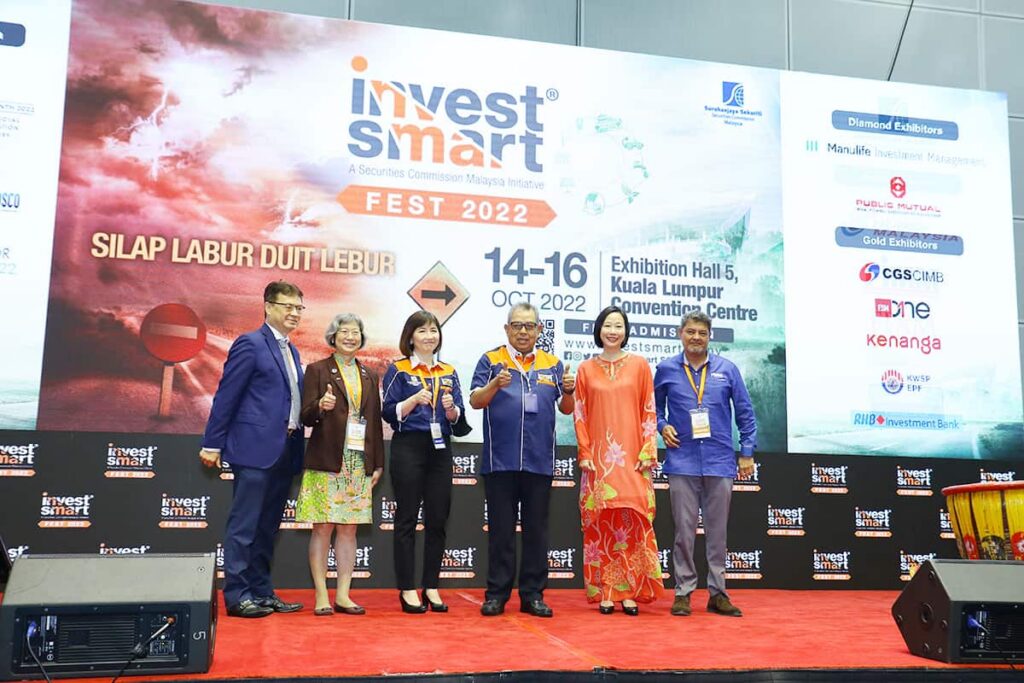
“Most scams are spread through messaging apps and platforms like WhatsApp and Facebook. And we have recently noticed that they have started using Telegram as well. Many of these scams also claimed to be ‘syariah-compliant’ informed SC’s Chairman Dato’ Seri Dr. Awang during the SC’s flagship investor education fair InvestSmart® Fest (ISF 2022) held recently in conjunction with Financial Literacy Month 2022 and World Investor Week 2022.
“Therefore, the best course of action investors can take to avoid falling prey to investment scams and unlicensed activities is to equip themselves with better financial knowledge,” he said in advising investors to safeguard themselves from the porous nature of the Internet.
Surveys undertaken by the SC also found that Malaysian investors have unrealistic expectations about investment returns due to the misconception about risk and returns. Low financial literacy and low scam awareness makes investors vulnerable to unlicensed activities and scams.
Scam Awareness: Unlicensed Activities And Scams
Scammers are finding increasingly sophisticated ways to target investors, who range from the vulnerable at one end to those who invest primarily by the desire – or hope – to gain lots of money irrespective of the risks involved. Some would call this the ‘gambling instinct’.
Under Malaysian law, any company or individual who wants to provide capital market products and services to Malaysian investors, such as unit trusts, stocks, digital investments, bonds, must be licensed or registered with the SC. This also applies to those who are or claim to be licensed overseas. As such, investors are putting themselves at risk when dealing with unlicensed or unregistered parties as the SC’s regulatory reach over these illegal entities is limited.
“This is important because entities licensed or registered with the SC, must fulfil stringent regulatory requirements that are designed to protect investors. Investors who choose to trade on unlicensed platforms risk not being protected in the event of any dispute arising,” said the SC Chairman.
In short, the SC cannot protect you if you choose to invest with unlicensed people. The SC Chairman also disclosed that there has been an increased use of celebrities or influencers on social media to endorse or promote investment advice and investment offerings.
The public should also be wary of self-proclaimed investment gurus who offer questionable advice or use social media to spread false or misleading information, he said.
While pushing for greater adoption of digital innovation in the capital market to better serve the needs of investors, safeguarding investors’ trust and confidence is also important. Indeed, these digital services have widened access to the capital market for underserved investors at a lower cost. The availability of these platforms has made it possible to invest little amounts of money or spare change, some from as low as RM5.
As the Malay proverb goes: “Sikit sikit, lama lama jadi bukit”.
However, investors need to exercise vigilance against potential risk. “An informed investor is a protected investor. We need to cultivate a culture of enthusiastic, yet informed investor participation. One where the public is educated on the numerous investment options available, as well as their rights and responsibilities as investors.
Armed with the right knowledge, investors are better positioned to safeguard their interests, and they can also become the SC’s ‘eyes and ears’ in detecting potential fraud or misconduct,” said Dato’ Seri Dr. Awang Adek Hussin, Executive Chairman, Securities Commission Malaysia.
When it comes to investing, always remember this
Never deposit your money into someone else’s bank account; and
Deal only with licensed persons.
Armed with the right tools and knowledge, investors will be able to capitalise on opportunities offered by our capital market. But first, let’s begin by raising the scam awareness campaign.
When we are young, saving for retirement might not seem urgent. It feels like something that we can focus on later, especially since there are other more pressing and immediate financial commitments. However, we want to emphasise the hard truth: Retirement Is No Joke! That’s why we have the Private Retirement Scheme to help us all out.
Why Should You Save For Retirement?
We Malaysians are expected to live until we reach 75 years old. However, we retire at 60 years old. That means, we can expect to live at least 15 more years without receiving regular salaries.
Some of us may be fortunate enough to receive monthly pensions or be able to rely on our EPF savings. Nonetheless, research has shown that merely having pensions or EPF savings may not be enough.
Some of us may have children who are working and earning salaries. Although they can provide for us, do we really want to burden them, especially if they have children of their own to care for?
Growing Your Retirement Savings
We don’t just want to save our money. We want it to grow. The way to do that is by investing our savings. A viable option is to invest in Unit Trust Schemes (UTS) or Private Retirement Schemes (PRS).
Investing in UTS and PRS is one of the simplest forms of investing. It doesn’t require large amounts of money, time, or expertise.
All you need to do is approach a UTS/PRS Consultant or Distributor. They will assist you to invest your savings into a UTS/PRS fund that is suitable for you. That fund’s investment will then be managed by a licensed professional fund manager.
Remember that life is a marathon, not a sprint. If your retirement is still some time away, it will give you a lot more time to prepare for it. This means that your retirement fund can grow substantially simply by you putting aside some money consistently and invest them over a long period of time.
To maximise your savings, the key is to start early. Just like in a marathon, every now and then, you should keep track of your progress and ‘refresh’ yourself. As your salary increases, revisit your periodic contributions, and adjust accordingly.
After retirement, most of us will not have a fixed salary anymore. However, expenses remain. As such, your target savings should be one which can sustain your desired future lifestyle.
How much should you save?
You can refer to a retirement calculator. All you have to do is key in the requested details. Then, the retirement calculator will calculate for you the amount of savings you will need as well as the projected savings you will have based on your current savings amount.
From there, you can calculate the shortfall and determine how much you should be saving on a regular basis.
Consistency Is Key
Remember to pay yourself first! Most of the time, once people receive their salary, they will save whatever remains after paying their bills, taxes, loans, groceries, and other expenses. However, this practice can lead to inconsistent savings. It is best that you allocate a fixed amount for your retirement savings first, before spending on your other commitments.
Likewise, do NOT take ‘savings holidays’ or defer your savings contributions. You must be consistent!
It would be ideal if you can consider signing up for a regular savings plan when investing in a UTS/PRS. This plan will, on a regular basis, automatically deduct money from your bank account and channel them towards investing in UTS/PRS. Hence, you can ensure that you will be consistent in your savings.
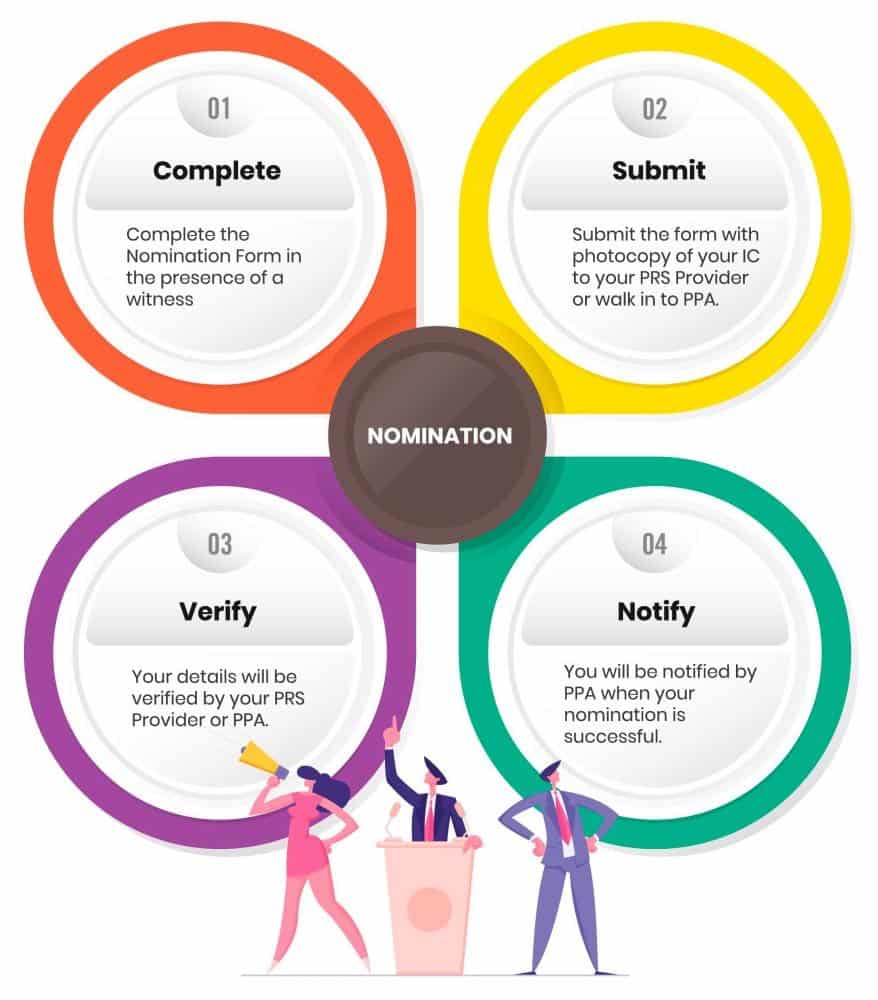
Name A Nominee For Your Private Retirement Scheme
Essentially, a nominee is the person who will inherit your savings/investments in the event something happens to you. Hence, it is essential that you elect a nominee.
Even if you don’t name a nominee, your next-of-kin can still receive your monies from the Private Retirement Scheme. However, the process is a lot more difficult and expensive because he/she will need to prove his/her entitlement. By naming a nominee, the process is a lot easier and more cost effective.
If you have not yet named a nominee, you can contact your authorised UTS/PRS Consultant and he/she will help you with the process of smoothening out the process of taking out the money from your Private Retirement Scheme.
Retirement is no joke! We want to enjoy our retirement comfortably and without any financial worries. As such, we must start saving for retirement early and doing so in a safe and disciplined way. Now you know why the Private Retirement Scheme is necessary to supplement your retirement funds.
This article is in collaboration with The Federation of Investment Managers Malaysia (FIMM), a self-regulatory organization (SRO) that regulates the marketing and distribution of Unit Trust Schemes (UTS) and Private Retirement Schemes (PRS).
Visit www.fimm.com.my for more information on PRS, Unit Trusts, and UTS & PRS Consultants.