Category: Protect Your Wealth

  • Personal Tax Relief for 2022

    Personal Tax Relief for 2022

    Remember to take full advantage of the tax reliefs available in filing your personal tax returns in 2022.

    It is that time of the year where you need to fulfil your duty as a Malaysian individual if you are earning income.

    E-filing with the Inland Revenue Board of Malaysia (IRBM) will only be available from March 1, 2021 and you must ensure that you submit your filing by April 30, 2022.

    For individuals filing their tax returns, you have some personal reliefs that you can claim, such as personal tax relief, medical and insurance premiums paid during 2021.

    Additional relief is available to further reduce your tax burden for caring for your parents, spouse and children.

    Some changes were made to reduce some of the taxpayer’s financial burden and adjusting to life during the pandemic.

     LHDN-Tax-Relief-For-Resident-Individual
    Image from https://twitter.com/LHDNMofficial/status/1473529533391196160


    Tax reliefs for taking care of your parents

    Tax-Reliefs-for-Taking-Care-of-your-Parents.


    With a growing ageing population, many of us are required to care for our ageing parents.

    It can be a privilege to spend time with an older parent. However, it is also a huge responsibility and takes a lot of time, energy and money.

    If you are caring for an elderly or sick parent, you can get a tax break to help relieve some of your financial challenges.

    Effective from the Year of Assessment (YA) 2021, the deduction on the expenses incurred by an individual for the medical treatment, special needs and carer for his parents is increased to RM8,000, an increase of RM3,000 from the previous YA.

    The amount includes parents’ medical treatment, limited dental treatment such as tooth extraction, filling and scaling services as well as care services.

    Expenses for caregiving include nursing home or home caregivers, including cost of foreign hired caregivers with valid visas or special work permits.

    However, it shall not include tax payers and taxpayer’s spouse or children. Note that parents who are physically and mentally healthy who may receive such care do not qualify for this deduction.

    Note-on-claims


    Tax reliefs if you have children

    Tax-Reliefs-If-You-Have-Children.


    Having children is costly, and to reduce the financial burden will encourage better childcare.

    For each child below 18 years old, taxpayers can claim relief of RM2,000.

    For children above 18, the taxpayer can claim up to RM8,000, with the condition that the child is studying or serving under tutelage in a professional trade.

    In addition, if you have children up to age six who attend registered child care centres or kindergartens, you can claim relief of up to RM3,000 for the expenses incurred.

    Since YA 2017, to support mothers in breastfeeding their young children, breastfeeding mothers can claim relief for the purchase of breastfeeding equipment (such as breast pump kit, milk collection and storage and cooler bag) with proof of receipt.

    The relief is up to RM1,000 allowed in total and only claimable once every two years.

    One special tax relief that parents should consider is savings for their children in the Skim Simpanan Pendidikan 1Malaysia (SSPN) account.

    While the child reliefs mentioned earlier can only be claimed by one parent, the relief of up to RM8,000 for savings in SSPN can be claimed by both parents for their respective contributions.

    This is provided that each parent has contributed a net deposit of the claimed amount, even for the same child. This relief has been extended a few times, and the latest extension is to YA 2022.

    Fun-fact-SSPN


    Reliefs available for self

    Regardless if you have any such dependents or expenses, you are entitled to RM9,000 relief where evidence of expenses incurred is not required.

    However, for the rest of the reliefs, you are required to provide supporting records.

    Tax-Reliefs-Available-For-Self


    Disabilities

    To provide further support for those with disabilities, the government has granted added reliefs for the taxpayers.

    Tax-reliefs-disabilities


    Except for the purchase of equipment for disabled use, the rest of the reliefs given do not require proof of expenses incurred.

    ******************

    That summarises the reliefs you can claim in filing for your individual tax return this year based on the latest personal tax filing information updated by the IRBM on January 20, 2022.

    Remember to keep all receipts and supporting records where applicable for seven years, which you will need to produce in the event that the IRBM wants to do a tax audit on you.

  • Financial Planning: Things to Do After a Flood

    Financial Planning: Things to Do After a Flood

    The 2021 year-end flood which affected many areas nationwide surpassed all previous year’s floods within Malaysia.  These has financial implications on the lives of our fellow Malaysians. For those affected, here are some ideas on how to pick up the pieces and build resilience moving forward.

    1. After the flood – restarting your life

    Consider the immediate aids you can leverage on to restart your life and get back on track. These can come in the form of financial, food, or accommodation aid, life essentials such as clothes and household items, or even transport arrangements for stranded individuals.

    2. Get your mental health in check

    Be sure to stabilise your frame of mind and check your stress level. There are a number of free services and apps such as:

    • Talian KASIH (8am – 5pm daily 15999, WhatsApp 019-261 5999)
    • Naluri (03-8408 1748, 24 hours, English, Malay and Mandarin)
    • Selangkah – Selangor Mental Sihat (SEHAT)
    • MySejahtera (Digital Health > Minda Sihat)

    3. Gauge your financial situation

    Once more urgent and pressing matters are taken care of, you can now take stock of your current financial situation. Ask yourself:

    • What are my losses?
    • What are my family incomes?
    • What are my monthly commitments?
    • What are my debts?
    • What is the position of my current investments and savings?
    • What is my protection coverage for my life and assets (takaful/insurance for personal and workplace)?

    These questions will help you paint a picture of your financial situation and will quickly bring up areas of concern (if any) which you can focus on as you look to recover.

    4. Salvaging assets from flood damage

    The next step is to consider your current assets. Firstly, assess damage to items within your household. Check if you have household insurance and if yes, whether it covers special perils or not.

    Assess damage to your vehicles, and be sure not to start them as the electronic system will short-circuit; get tow trucks to haul it to a workshop. Depending on the make of your car, the repair cost may range from RM4,000 to RM10,000.

    Other things to consider:

    • If you are working from home, is your laptop and handphone provided by your company? Do you need to report up or make a police report?
    • Are your important documents destroyed?
    • Do you need to replace NRIC/birth and marriage/divorce certificates at the Registration Department, driving licence and road tax at the Road Transport Department (JPJ), and school certificates from the respective schools?

    5. Stay safe and healthy

    In such trying times, keeping healthy may be the last thing on your mind but it is very important that you do your best to follow Covid-19 standard operating procedures (SOP) by getting help from NGOs and volunteers for masks and hand sanitisers.

    Be wary of water-borne diseases such as typhoid, cholera and dysentery and use water-purifying tablets if you are unsure if the water is safe for drinking or you do not have access to clean water. Follow the dilution instructions that comes with the tablets.

    6. Rebuild your financial status 

    The information in point (2) above is important to guide you on your next steps. You may seek help from:

    • Agensi Kauseling & Pengurusan Kredit
    • A licensed financial planner at SmartFinance.my where you can talk to an expert

    Be on the lookout for scammers; they are heartless and only want your money. Only accept help from reliable sources.  When in doubt, err on the side of caution!

    7. Preparing for a future flood

    The financial challenges you face today is the basis of your emergency fund for the future. Therefore, it is crucial to start building one when you can. Transfer some of the risks to your protection coverage and tap into your network of friends or relatives that you and your family can stay with.

    Flood-proof your home and/or prepare your evacuation SOP and equipment (torch lights, inflatable boats, dry food, bottled water, charged power banks, clothes, blankets and toiletries in waterproof bags, disposable wares and bags). Be constantly alert of your surroundings. Chances are, it may be difficult to sell your home and move to another so you may need to continue staying in your current place.

    Review how you place your furniture and appliances. Some homes put them on platforms that can be jacked up to desired heights (granted, if water level too high, it can render platforms useless). Store critical items in waterproof boxes when the rainy season approaches. It may also be prudent to check if you can convert your rooftop to an emergency accommodation equipped with the evacuation items listed above?

    My heart goes out to all flood victims.  We are fortunate there are volunteers and NGOs that we can contribute to, who will organise, mobilise and distribute contributions to as many victims as they can.  I hope the above is useful to those affected. May you have a respite from your situation and the strength to ride through this tough times.

    This article is contributed by Linnet Lee, CEO of the Financial Planning Association of Malaysia (FPAM).

  • Takaful Malaysia Launches Nation’s First Flexi Motor Takaful Plan with Pay As You Drive Daily Cover

    Takaful Malaysia Launches Nation’s First Flexi Motor Takaful Plan with Pay As You Drive Daily Cover

    Syarikat Takaful Malaysia Am Berhad (“STMAB” or “Takaful Malaysia”), the general takaful arm of Syarikat Takaful Malaysia Keluarga Berhad virtually launched Takaful myClick Motor FlexiSaver, the nation’s first flexi motor takaful plan with Pay As You Drive daily cover. Jointly organized by Takaful Malaysia and technology partner, Fusionex, the virtual launch was officiated by Dato’ Mohammed Hussein, Chairman of Syarikat Takaful Malaysia Keluarga Berhad.

    “Virtual launch of Takaful myClick Motor FlexiSaver signifies Takaful Malaysia’s unwavering commitment to driving product innovation and delivering superior customer value. Flexible protection plans are the future of the insurance and takaful sector. Offering insurance and takaful products in the new mobility space that are simple, flexible, and usage-based is revolutionising the industry. This means, consumers have the option to decide and pay for just the coverage they need, as and when they need it. With more people driving less these days, while some may face financial challenges due to the impact of the COVID-19 pandemic, Takaful myClick Motor FlexiSaver is the best option that suits the financial and protection needs of those who drive infrequently or own several cars and want to save more on motor takaful or insurance plan. The Pay As You Drive daily cover available under this plan is ideal and rewarding, as we give customers the flexibility to activate it the day before they want to drive and will only be charged for the days they drive. Suffice to say, Takaful myClick Motor FlexiSaver is a quick win for customers to enjoy great savings and peace of mind when they drive,” stated Dato’ Mohammed Hussein, Chairman of Syarikat Takaful Malaysia Keluarga Berhad.

    Takaful myClick Motor FlexiSaver is an online motor takaful plan that provides one-year coverage for loss or damage to your vehicle due to fire or theft, as well as third party bodily injury, death, or property damage. Offered through Takaful Malaysia’s online sales portal and Click for Cover mobile application, this plan provides a 24-hour roadside assistance program for unlimited breakdown towing service and minor roadside repairs, including tyre change, fuel delivery, battery change, and jump start. Featuring Pay As You Drive daily cover for accidental damage to your own vehicle and complimentary personal accident coverage of RM15,000 for the driver and all passengers as well as accident towing, Takaful myClick Motor FlexiSaver also offers add-on protection options for windscreen, personal accident, and key replacement. Customers can also enjoy an instant 10% discount when applying the base plan of Takaful myClick Motor FlexiSaver, and when activating Pay As You Drive daily cover.

    Chief Executive Officer of Syarikat Takaful Malaysia Am Berhad, Mohamed Sabri Ramli said, “In our continued efforts to meet ever-changing consumer expectations, and in line with the rapid pace of digital expansion in consumer purchases, it is timely that we introduce Takaful myClick Motor FlexiSaver with Pay As You Drive (“PAYD”) daily cover to better serve our customers with innovative takaful solutions while preserving consumer choice. The PAYD is the key differentiator, a unique feature that sets us apart from other motor insurance and takaful plans available in the market. Customers only need to sign up for the base plan of Takaful myClick Motor FlexiSaver via our online sales portal or Click for Cover mobile app, before activating PAYD through the mobile app. Eventually, we want to make it easy and hassle-free for customers to enrol in this motor takaful plan online, corresponding to our digital strategy to enhance product and service accessibility.”

    “Takaful myClick Motor FlexiSaver with PAYD not only provides a simple online application process along with an array of benefits and services offered to customers but also diversifies Takaful Malaysia’s product offerings and creates a value proposition for consumers at large. Takaful Malaysia’s strategic move to introduce this motor takaful plan will provide new revenue and value-producing opportunities for the company to stay ahead of the curve and remain competitive in the motor insurance and takaful market,” added Mohamed Sabri Ramli.

    Dato’ Seri Ivan Teh, Group Chief Executive Officer of Fusionex said, “Insurance, at its core, is a business that underwrites risks and helps people in times of need. As such, I applaud Takaful Malaysia for revolutionizing their offerings and empowering their customers to take more control over how they purchase insurance. As a long-term and fully-supportive technology partner, Fusionex pledges to lend our experience, expertise and cutting-edge technology to drive excellent user experience for Takaful Malaysia’s customers, and this partnership continues to innovate with the launch of Malaysia’s first pay-as-you-drive motor insurance.”

    “Together with Fusionex, which specializes in analytics, big data, and artificial intelligence, we leverage digital and social media platforms to actively promote this product. Ultimately, we want to ensure that our business is competitive and relevant to the growing consumer demands, particularly the tech-savvy generation. By embracing technology and digital tools to offer differentiated product offerings and services, we will be able to reach new customer segments through superior protection products and customer experience,” said Mohamed Sabri Ramli in conclusion.

    Takaful Malaysia was recently voted once again by Malaysians as the Best Motor Takaful Company in Malaysia for 2021/2022. The annual award clinched by Takaful Malaysia is based on the results of the online survey conducted by iBanding, an independent, knowledge-based company that provides transparent insights about the local insurance and takaful industry that ranks insurance and takaful companies in Malaysia according to the actual feedback from survey responses among motor vehicle drivers.

  • Legacy Planning – It’s Now or Never!

    Legacy Planning – It’s Now or Never!

    Legacy planning. Estate planning. Succession planning. What do all these phrases mean? Am I too young or is it too early to consider such plans? Life as we know it, does not always go according to plan. For example, an unexpected pandemic may have forced a career change on you. Suddenly, you need to dip into your retirement fund for some emergency funds – which would leave you with a depleted income when you reach the age of retirement. What is more worrying is that when your business encounters financial trouble, it leads to more money being pumped from your retirement fund into the business. Would your retirement plan that was created a decade ago still be sufficient? Would you still be able to leave a legacy for your family and protect them from uncertainties in life? Unlikely. It is common for us to think of investment and insurance after settling down, but what about legacy creation and why is it important?

    Legacy planning

    Legacy planning takes on many meanings for different people. However, the focus remains – will I have a lasting and positive impact on the lives of my loved ones? While some have given some consideration to their legacy, most have never put it in writing, and even fewer have established a plan of action. affin maximiser As a doting provider, you would want your family to inherit the fruits of your labour and ensure that they will always be well looked after especially in later years. With legacy planning, it allows you to pass on what is most important to your loved ones without compromising your current and future lifestyle. With adequate legacy planning, you will be able to increase your estate, enjoy greater liquidity and ensure fair distribution should any unforeseen circumstances occur while benefiting from financial freedom in your golden years.

    Estate equalisation and succession planning

    For those who own a family business, one of the challenges is figuring out how to pass on the business to the next generation, especially when one child participates in the business and the other does not. While you want to leave a good legacy for your family, you would also like to ensure that the inheritance is fairly distributed to maintain the peace and harmony of the family. With fair distribution it can help to mitigate family problems which may arise when the distribution of an estate appears unevenly allocated. If your wealth changes your life for the better, you are successful. If your wealth changes others’ lives for the better, you have created a legacy. What legacy will you leave behind? When is the right time for such commitment? The answer is now or the sooner the better. However, there are a few things to be considered such as:

    1. How much do you want to invest?

    Are you looking to invest a lump sum, or set aside a regular monthly amount? And how much money do you – make available for investment? Is this your emergency fund? You are advised not to use your emergency funds for investment.

    2. How long do you want to invest?

    Certain investment products run for a fixed period, so if you have a specific date in mind as to when you need access to your funds, then some product types might not be necessarily right for you.

    3. What is your risk profile?

    How do you feel about investment risk? As the saying goes: the higher the risk, the higher the potential returns. Imagine if you incur losses on your investment; what is your risk appetite and how much loss can you stomach?

    4. How much flexibility do you need?

    It is important to note that when you invest your money, it can get tied up and is no longer easily accessible. But, if you have a sudden need for cash, how quickly and easily can you liquidate your asset? And what is the penalty for doing this? It is always a good idea to consult an appropriate professional or financial adviser on the particular investment in relation to your own circumstances. Alternatively, you could consider Affin Maximiser, an investment-linked plan with flexible investment options to help you gain more. You can choose to invest into different investment funds across both local and regional markets to diversify and balance the risks of your investment portfolio. Top-up your investment for more potential returns and get rewarded with loyalty bonus and extra allocation as you invest.

    AFFIN Maximiser

    Your investment objectives may change over time, and Affin Maximiser gives you greater flexibility to reallocate your investment funds or change your selection of funds without any switching fee. As you may have different financial needs at different life stages, this plan allows you to withdraw your investment funds in part to accommodate your financial needs at any time. Being more than just an investment tool, this plan also provides insurance protection of up to four times in the event of death or total permanent disability. From now till 31 July 2021, all Affin Bank customers can enjoy a fuss-free enrolment via the Maxi Easi Campaign with no medical check-up required. If you have a moderate risk appetite, are able to commit to a long-term investment and looking for protection at the same time, then this might be a suitable plan for you. Or, if you are unsure of your risk appetite, feel free to speak to our Affin Personal Banker/Relationship Manager at your nearest Affin Bank branch. Click here to learn more about this product.
  • 5 Things You Must Know About The EPF Investment Scheme

    5 Things You Must Know About The EPF Investment Scheme

    “Soo Yee, I can’t make any investments. I don’t have money left every month, how do I even invest?” This is a common reply when I bring out the topic of investment. And no, you don’t really need a large amount of cash savings to start investing! Did you know that you have the option to invest your EPF monies into EPF approved investments via the Member Investment Scheme (MIS)? Let me explain more below.

    1. EPF Member Investment Scheme (MIS)

    MIS was introduced back in November 1996 for EPF members to diversify, boost and strengthen their retirement savings. In short, if you have enough funds in your EPF account 1, you can invest part of the funds into EPF approved investments via appointed fund management institutions (FMIs) including Unit Trust Management Companies and Asset Management Companies.

    2. Advantages of MIS

    a. Allows you to enhance investment returns

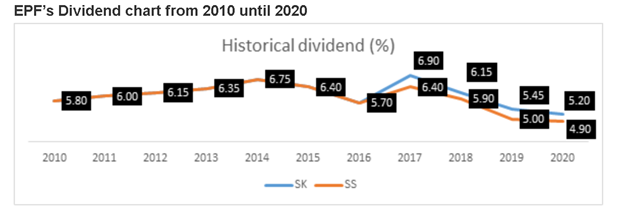
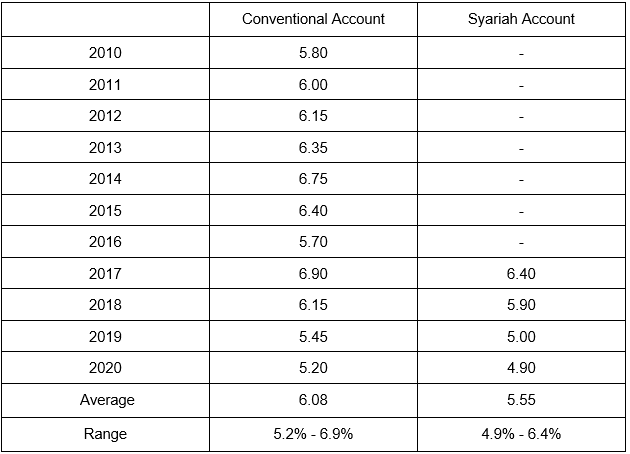
    At the end of February 2021, EPF announced the 2020 dividend rate for Conventional accounts and Syariah accounts, paying out 5.2% and 4.9% respectively. But what has the historical rate of EPF dividends looked like?
    EPF's evident chart, epf member investment scheme
    SK = Conventional Account SS = Syariah Account The graph above is taken from the EPF website (as of 26 May 2021) epf graph - epf member investment scheme So while EPF has been paying a solid return each year, MIS provides the opportunity and potential for you to increase your investment returns and boost your retirement savings overall.

    b. Enables you to increase exposure to foreign markets

    Have you thought about where EPF decides to invest your money? As at December 2020, EPF invested 67% of its investment assets in Malaysia and the remaining 33% outside Malaysia. The numbers show that the majority of your EPF money is invested in Malaysia. So if you’d like to have greater exposure to foreign markets, you can diversify your investments overseas via MIS.

    c. Empowers you to have some control over your EPF investment

    You can now choose to invest according to your risk profile. There are EPF approved investment options for you to match your objectives and risk appetite.

    3. Disadvantages of MIS 

    a. No guarantee of investment returns

    For all its benefits, please note that any investment done via MIS doesn’t come with any guaranteed return, while EPF has a minimum guarantee of 2.5% dividend. You might get a higher or lower return compared to the EPF dividend rate, depending on your actual investment return. You are solely responsible for the investment via MIS that you made.

    b. Not entitled to EPF dividends

    One of the big downsides is that the EPF money that you channel into MIS is no longer eligible for EPF dividends. Basically, you’re on your own. However, if you’re confident about your investment, this shouldn’t concern you.

    c. MIS investments come with fees

    Investment fees (such as sales charges, management fee and trustee fee) might eat up your investment returns. You must ensure that your investment returns (after deducting fees) will still be on par with EPF dividends at the very least.

    4. How much can you invest under MIS?

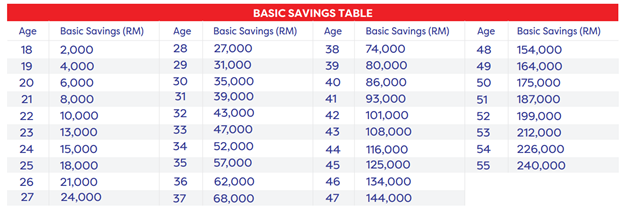
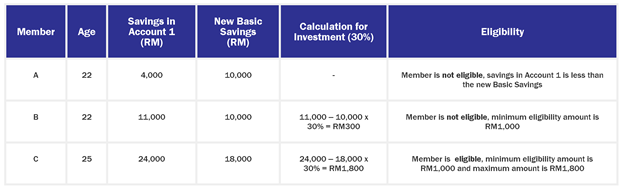
    You may invest up to 30% of savings in excess of basic savings in account 1 with EPF. You may continue investing via MIS every three months as long as your balance in account 1 exceeds your required basic savings and fulfills all EPF requirements. To confirm your eligible investment amount for MIS, you may check it under the i-akaun website. Go to i-akaun website →  withdrawal tab →  withdrawal eligibility → member investment scheme. The number that appears next to the member investment scheme is the amount eligible to invest via MIS. Alternatively, you can also do a self-calculation of how much you can invest under MIS. The formula is as below: (EPF account 1 value – required basic saving in account 1 based on your age) x 30%
    basic savings table - epf member investment scheme
    Basic Saving Table from EPF website (as of 26 May 2021) The minimum savings benchmark set by the EPF will be updated from time to time. You may check out the latest minimum savings required on the EPF website.
    simple epf calculations - epf member investment scheme
    Sample calculation from EPF website (as of 26 May 2021)

    5. Your investment options under MIS

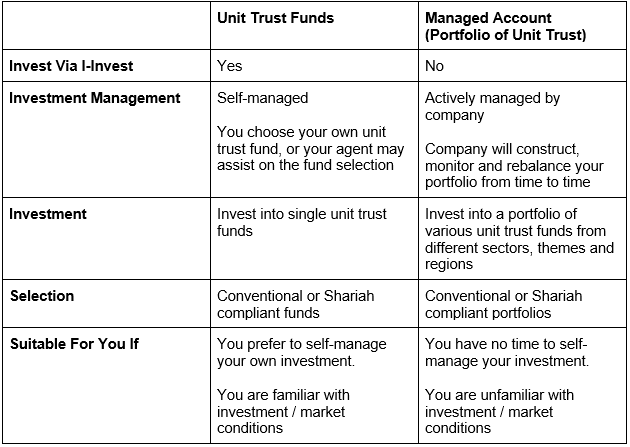
    You may invest via EPF in approved Unit Trust Management Companies and Asset Management Companies under MIS. epf member investment scheme mis

    Difference between investing into unit trust funds compared to managed account (portfolio of unit trust)

    difference in investing in unit trust fund and managed accounts - epf member investment scheme In summary, any investment that you may choose to do via MIS comes with pros and cons. Do research and understand all the risks that you’re taking before proceeding with investing. If you have further enquiries on EPF investment via MIS, I suggest that you seek out a financial professional to discuss and design an investment plan that matches both your risk profile and investment objectives.

    About the author

    Kuah Soo Yee is a Licensed Financial Planner (CFP) who is passionate about helping people make sound financial decisions and achieve their financial goals, and recently launched her own app. Her personalised strategies and advice have helped many to gain better clarity and take firm control of their financial future. She can be contacted at soo.yee@ipp.com.my Website LinkedIn Facebook Instagram  
  • Get Out of Credit Card Debt

    Credit card debt has been an issue for decades, especially among Malaysians. According to a report from the Malaysian Department of Insolvency in December 2019​, credit card debt made up 10% of bankruptcy cases from 2015 to 2019.

    A 2015 survey from the Asian Institute of Finance revealed that 47% of Gen Y respondents aged between 20 and 33 were engaged in expensive credit card borrowings​.

    These days, spending future money is so easy with credit cards where a simple wave will do or shopping online for your favourite items and only worrying about paying it later.

    Many people will continue to pile up debts and only make the minimum payment each month, making things worse. This leads to huge credit card debts that seem to last forever with no end in sight.

    I have a friend that used an extreme method to manage her credit card debt – she physically cut her credit card into two and never owned a credit card again.

    While not everyone will need to resort to such drastic measures, are there other ways to manage credit card debt?

    For me, a credit card is still a very useful financial tool that allows us to make payment for big ticket items or for emergencies where we don’t carry much cash. 

    Steps to get out of credit card debt

    1. Stop using your credit cards until you pay them off

    Credit card balances can grow rapidly due to very high interest rates of 15% to 18% (or more)!

    People often find themselves on a debt treadmill, struggling to make minimum payments and helplessly watch their principal balance grow each month. 

    Stop chasing your debt balances. Use cash or debit cards until your credit cards are paid off.  In this way, you can focus on paying down your balances and you won’t be tempted to spend more than you can afford.

    2. Get organised and prioritise

    If your credit card debt is spread across several different banks, get organised and prioritise payments on the credit card with the highest interest rate.

    Here’s a tip – the interest rate of local bank credit cards are usually cheaper than foreign banks. Review your total credit card statements and settle the debts one by one in order of interest.

    3. Never pay the minimum amount

    I found that many people are in the habit of paying the minimum 5% of their credit card statement each month.

    Do you know that all your statements clearly highlight the disadvantage of paying the minimum each month? However, many still choose to ignore it.  

    You can refer to the table below. If your outstanding debts are RM10,000 and you only pay the minimum amount (RM500), then the repayment period will be 88 months.

    However, if you pay a slightly higher amount (RM600), this repayment period shortens to just 20 months. Don’t ever underestimate the rate of compounding, especially when it comes to debt.

    credit card debt table - getting out of credit card debt

    4. Credit card balance transfer plan

    Do pay attention to promotions or offers from different banks or credit card companies. You may be able to transfer the existing balance on your current credit card to a new or unused credit card​.

    This can be used to consolidate the balance from multiple credit cards into a single credit card, making the debt much easier to manage. You also can take advantage of lower interest rates compared to your existing credit card interest rate, which means you’ll pay less in the long run.​

    5.  Personal loans from banks​

    This works by making full use of the difference in interest rates between the loan and the credit card. Current personal loan rates can range from 5% to 8% depending on the bank and terms and conditions.

    If you can get a personal loan at 5% per annum compared to 18% in credit card interest, then you can save up to 13% in interest. That’s a lot of savings!

    6.  Seek help from AKPK (Credit Counselling and Debt Management Agency)

    Many Malaysians may not know this but AKPK can help you better manage your debt. They’re a good resource for those who are straddled with debt and are worried about being unable to pay it off. 

    AKPK will help you to develop a budget, explore options for getting out of debt, and provide you with a customised action plan. They can also help rebuild your credit and offer financial advice for free!  

    I’d like to highlight and repeat that AKPK is FREE. There are some scammers out there using the AKPK name to charge fees to desperate people in debt. Do be careful and always call AKPK directly.

    7. Manage cash flow and spending habits

    Do some budgeting and manage your cash flow every month. There are many apps that help you to track your expenses so you can understand your spending pattern and look for ways to reduce or cut irrelevant purchases. 

    For example, reduce the frequency of dining out or going to the cinema, and set a limit to online shopping time.

    I’ve found that many young people have the habit of buying online everyday. They say “I’ll spend RM20 only” but that RM20 will add up to become RM600 each month.

    Online shopping is a great temptation and while some may say that it releases stress, trust me that piling up debts is much more stressful – it’s just that the stress comes later!

    After tracking your cash flow for a few months, you may find that your expenses always exceeds your income. If there’s really no way to reduce your spending, it means your income isn’t enough to sustain you.

    Instead of spending your free time relaxing, you may consider using this time to find a part-time job or even start an online business. When your income increases, then you’ll be able to pay off your credit card debts and start leading a better life.

    Let me borrow a phrase from Warren Buffet to make my point: “Don’t save what is left after spending; spend what is left after saving”.   

    I advocate this habit to all my clients by putting regular savings in unit trust so they can grow their money rather than complain that they’ll only save if they have money left after spending.

    By saving than spending, you won’t overspend because you’ve already saved the relevant amount.

    The saved amount will have many objectives such as emergency funds, retirement planning, etc, which means you won’t be using a credit card as your emergency fund and build up credit card debt.

    About the Author

    Andrea Siew is a financial advisor, approved and licensed by Bank Negara Malaysia and the Securities Commission Malaysia. She can be contacted at andreasiew@harveston.com.my

  • MRTA vs MLTA: Which Mortgage Life Insurance to Pick

    MRTA vs MLTA: Which Mortgage Life Insurance to Pick

    Most millennials are taught from a young age that owning a property, especially their own home, should be one of their life goals.

    This leads to them saving up diligently from the day they enter the workforce with the dream of owning a property someday, either for their own stay or investment purposes.

    However, you should remember that getting the keys to your own property is not an endgame.

    Having signed the mortgage loan agreement, most will assume the best and expect to live until the loan is fully paid off.

    But in the unfortunate event that you are no longer around to pay off the loan, it is important to ensure that you leave behind an “ASSET” and not a “DEBT” for your loved ones. On top of that, you have to distinguish what is the difference between MRTA vs MLTA.

    Why Should I Have Mortgage Insurance?

    These days, most mortgage tenures range from 30 to 35 years.

    This is a very long time and should unforeseen circumstances like pre-mature death, disability or serious illnesses occur, your joint-borrower or next of kin (spouse, parents, children etc.) will need to continue servicing this debt until it is fully repaid. In other words, your debt has become their liability.

    Therefore, it’s important to have mortgage insurance to protect against these risks even if the property is meant for investment purposes.

    Some may argue that if the property is bought as an investment, it’s not necessary to have mortgage insurance as the property can be sold should the unforeseen happen. However, you must remember that the property market is cyclical in nature.

    What if tragedy strikes during a crisis or market downturn? Your next of kin may need to sell the property at distressed prices and suffer financial losses from the sale just to pay off your outstanding loan.

    So in order to safeguard against these risks, it is very important to have mortgage insurance and also a will to smoothen the process for distribution of your estate.

    The two most common mortgage insurances are MLTA (Mortgage Level Term Assurance) and MRTA (Mortgage Reducing Term Assurance).

    The Difference between MLTA and MRTA

    Generally, an MLTA offers not only protection for the amount of outstanding loan, but also functions as savings since the amount insured will be consistent throughout the duration of the loan.

    If nothing happens at the end of the loan tenure, you will receive back the total premium that was paid over the years. On the other hand, an MRTA covers the money owed to the bank from the loan.

    The coverage decreases over time and if nothing happens at the end of the loan tenure, you won’t get any money back.

    As for the protection coverage, both MLTA and MRTA offer basic life coverage (Death or Total Permanent Disability) with the option to include critical illness coverage depending on your needs.

    For MLTA, you can appoint anyone as your beneficiary whereas for MRTA, the sole beneficiary is the bank.

    In addition, MLTA is also transferable which means you can sell off a property and replace it with another property under the same MLTA.

    Even if you refinance your loan, you do not need to replace it with a new MLTA. For MRTA, it is non-transferable as it is tied to your loan with the bank.  

    In terms of cost, an MRTA is more affordable. The premium for MRTA is paid as a lump sum and can usually be bundled into the mortgage loan.

    As for MLTA, you can choose to pay your premiums on a monthly, quarterly, semi-annual, or annual basis.

    So What Should I Do?

    In most cases, the banks will typically offer you mortgage insurance (MRTA) together with the loan.

    However, it is not compulsory for you to take up this mortgage insurance from the bank so don’t feel pressured into getting it.

    Instead, seek consultation with your financial planner to discuss which option is best suited for you.

    About the author

    Billy Teoh (RFP) is a licenced financial planner, and can be contacted at billy.teoh@ipp.com.my.

  • A Multi-Generational Wealth Manager for HNWIs

    A Multi-Generational Wealth Manager for HNWIs

    For many high-net-worth individuals (HNWIs) in the region, managing and growing their wealth has become ever more complex with the heightened uncertainties and volatility of recent times.

    This is especially so given the Covid-19-induced global economic shock, US-China trade tensions, rising geo-political risks and prospect of Black Swan events. This is where the value of family offices and private wealth managers come to the fore in helping these HNWIs strengthen the pillars of their wealth.

    And this is a business segment that Affin Hwang Asset Management has seen growth in recent years. In fact, the wealth segment will be a key business focus over the next five years for the asset management firm, which has total assets under administration of RM60 billion as of 30 June 2020.

    “With more focus and resources, we can continue to grow this segment in line with Affin Hwang AM’s aspirations to be a distinguished wealth manager in Malaysia and the region,” says Shawn Kong, senior director, Institution, Corporate & High-net-worth individuals (HNWI) Business.

    It also sees a transfer of wealth across generations with more millennials becoming high-net-worth individuals in the coming years. In reaching out to this group, Kong says Affin Hwang AM will continue adapting to become “a multi-generational wealth manager” by listening to their needs and growing together with its clients. Here are excerpts of our interview with Kong on the company’s fast-growing private wealth business.

    Smart Investor: Wealth structuring whether it’s wealth creation, capital preservation or intergenerational planning has become more complex in light of heightened volatility and black swan events like Covid-19. What is your take on this and how do you think the private wealth landscape has evolved in the new normal?

    Shawn Kong: Investments and markets today have evolved. Market cycles are a lot shorter and more volatile, as we saw this year with the pandemic. Interest rates are low and overall economic growth is slow. As such, investment and wealth management has become more complex and challenging.

    In a world of complexity, the team at Affin Hwang AM is all for simplifying wealth management to our clients. It is crucial to first understand the objective of the wealth structuring for a person or a family before putting in wealth planning tools or products. Upon understanding the investment objective and risk tolerance, we can then craft a suitable diversified portfolio for our clients.

    With heightened volatility, it is essential for clients to first understand the risks of their investment to ensure they are comfortable with the risk they are taking. A litmus test question that I always find helpful would be to ask clients if they are able to sleep at night with the level of risk or volatility that they are taking.

    SI: What have your conversations been with private wealth clients and their main concerns today?

    SK: As we enter a historically low interest rate environment, our recent conversations with clients have centred around the search for yield. There is renewed interest in fixed income and dividend yielders as investors seek to enhance portfolio yields to beat long-term inflation.

    On the other end of the risk spectrum, another common conversation would revolve around the sharp equity recovery since the rout in March due to Covid-19. Many would have felt that they might have missed out on the strong rebound in markets.

    A divergence between how well global and regional equity markets have performed due to ample liquidity versus poor economic fundamentals on the ground presents a dilemma for equity investors. Is it too late? Is the rally sustainable? Those are the questions that keep cropping up.

    Eventually, our client engagements would lead to crafting a well-diversified core portfolio that would provide long-term exposure to a broad range of asset classes, investment strategies and regions. We would overlay that portfolio with some tactical ideas or strategies to capture shorter-term opportunities. It is also crucial to have an on-going portfolio monitoring and review with clients regularly.

    SI: Is there strong appetite for risk including alternative asset classes? How are you guiding asset allocation for your private wealth clients?

    SK: Alternative asset classes like private equity, private debt/ mezzanine funding or private real estate can be very attractive diversification opportunities aside from public equity and fixed income.

    Private equity will provide clients with the opportunity to participate in the growth of a business in the earlier stage before it goes public, thus enhancing the long-term returns.

    On the other hand, private debt or mezzanine funding, which behaves more debt-like instruments, will give recurring income via coupons (typically higher than tradable bonds in the market). The trade-off for these asset classes would be liquidity and usually a longer investment horizon, compared to the public markets.

    We would guide our clients to invest into these asset class according to their risk profile and investment horizon. A more aggressive client may have a higher allocation to private equity while a more conservative client would be more suitable to private debt.

    It is key to know what t he underlying investment is and to understand the risks as well as how the returns are generated. In the case of investing into private funds, it is also important to understand the style of the manager and their track record.

    We have recently provided clients with access to private real estate related deals, from asset-backed securities (ABS) to private REITs; whereby the listing of the asset 3-5 years down the road would give investors a decent total return. All these alternative options provide ways for investors to gain further diversification especially from traditionally listed equities or fixed income that are publicly traded.

    SI: We are seeing a massive transfer of wealth across generations with a larger number of millennials becoming high-net-worth individuals. How is Affin Hwang AM adapting to this demographic shift and catering to the needs of a new generation of wealthy investors?

    SK: The millennial generation has access to infinite amount of information via technology. How Affin Hwang AM can add value is to make sense of all that information or data to help clients translate them into investment decisions. Digitalisation is also important to enhance their investing experience whether it is portfolio monitoring or smoother execution of transactions.

    We have also been running various “future leaders” programmes which include seminars, workshops, study visits and networking sessions to create value for the younger generation of our investor base. Seminar topics range from investment and market updates, wealth preservation concerns as well as leadership and business innovation.

    We are mindful of the large transfer of wealth that is going to take place across Asia (Malaysia included) over the next 20 years. Thus, it is imperative that Affin Hwang AM continues to adapt to be a multi-generational wealth manager over time by listening to their needs and growing together with our clients.

    SI: What further plans does Affin Hwang AM have to grow its private wealth segment?

    SK: This wealth segment is one of our key business focus over the next five years. We have made some encouraging initial progress and growth over the past five years. With more focus and resources, we can continue to grow this segment in line with Affin Hwang AM’s aspirations to be a distinguished wealth manager in Malaysia and the region.

    Among our plans is to continually expand our investment offerings and solutions (e.g. asset classes, strategies, regions and currencies) to help our clients achieve optimal diversification in their portfolios.

    Within the wider wealth management ecosystem, we can then also build other pillars of our client’s wealth including wealth preservation and distribution. We are also continuously upskilling our people and talents as we grow the team.

    Our key proposition as a wealth manager is that we are investment-led, given our roots in asset management as well as client-focus, where we strive to live up to our mantra to always put our client’s interests first.

    Our long-term growth and success has been anchored by this singular trust that we have built with our clients over the years.

    This article was originally published in the September-October 2020 issue of Smart Investor.

  • 5 Ways To Protect Your Family Through Responsible Financial Planning

    5 Ways To Protect Your Family Through Responsible Financial Planning

    Every single breadwinner works hard for the family, regardless of stress at work or business. We work to raise up our family’s standard of living and to provide for our children’s education, retirement and legacy. The importance of financial planning is just like the importance of car maintenance. It keeps your car in good condition and helps it last longer. Similarly, this is how you’d protect your family through financial planning. With that, here’s a family financial planning guide to get you started:

    1. Get the Right Type of Insurance

    Many are being encouraged to sign up for different policies with fancy features. How do you identify what is necessary and what is excessive during financial planning? Let’s look at some examples: 

    • Medical insurance with an annual limit of at least RM1,000,000
    • Critical illness insurance to supplement the limitation of medical insurance and replacement of lost income
    • Life insurance policy which can settle all debts and provide living funds for your family

    Is there a difference between an assured sum of RM100,000 and RM500,000 on your critical illness or life insurance? Let’s assume your annual income is RM60,000 (monthly income RM5,000):

    Scenario 1:

    RM100,000 paid out in the event of diagnosed critical illness or death can barely match your income for 1.5 years. Alternatively, you could place this last source of income RM100,000 in a fixed deposit with 2% interest per annum as your “passive income”.

    Scenario 2:

    RM500,000 paid out in the event of diagnosed critical illness or death could match your income for 8.5 years (RM500,000/RM60,000) or you may invest RM500,000 in any form of investment with a return of 10% per annum as your “passive income”. You have more investment choices to generate passive income instead of just placing it in fixed deposit.

    Capital

    Return on Investment (ROI)

    Annual Income

    RM100,000

    2x

    RM2,000

    RM500,000

    10x

    RM50,000

    Using the formula above, the more you earn, the more you need to protect your family with a 10x return on your annual income when considering life and critical illness insurance.

    2. Diversify Risk on Asset Classes

    Are your assets spread out across the business, fixed deposit, insurance policy, shares and unit trusts, properties and single currencies? What is your allocation between liquid (easy to sell) and illiquid (difficult to sell) assets? I recommend that you try to maintain a 50:50 ratio to ensure flexibility. These are important questions that must be asked during financial planning.

    For example, many fall into the trap of buying too many properties which limits your liquidity and may affect your cash flow in the event of an emergency like Covid-19! Nobody could’ve predicted this pandemic, and many have struggled to liquidate assets like properties. It’s safe to assume they would not be in such a tough position if they had previously stuck to the 50:50 ratio and assessed their financial standing prior to taking on these long-term commitments.

    3. Assess your Dependency Risk

    Do your earnings heavily rely on active income? Are there investments that can generate passive income? Do you have cash in hand to last for 3-6 months of household expenses in the event that you lose your job? Financial planning will involve assessing these areas of concern.

    If you run a business, does your company have enough cash to cover 3-6 months of overhead costs? Is there a dependency risk on a few customers or suppliers? You may feel the impact during a crisis, with many businesses affected which can trigger tensions linked to credit terms and suppliers. Eventually, all these dependent risks could lead to the winding up of your company.

    Whether you are an employee or entrepreneur, always consider your dependency risk before buying or investing in anything.

    4. Writing a Will or Setting Up a Living Trust for Family

    Unfortunately, most people don’t prepare for sudden death or being admitted for surgery. I’ve received a few emergency calls to write a will for parents in a critical stage. Some couldn’t even sign off on their will due to being in a coma or passing away before the will was ready for signing. This led to assets being frozen during the estate clearance while the family was left waiting for funds to carry on with their lives!

    Another example of a worst-case scenario is if both parents die prematurely in an accident while their kids are still under the age of 18, which makes estate distribution even more complicated. Who will be your estate executor? How well will he/she manage your estate fund for your kids? Is there a chance that your estate could be compromised by bad actors? These scenarios are unlikely, but demonstrate the need to set up a living trust on top of writing a will during financial planning in order to protect your family. This ensures your family receives a fixed amount for living expenses and children’s education.

    Structured distribution will also ensure that the funds are not spent all at once. For instance, can you imagine what the average 18-year-old would do if they inherited RM1,000,000? There’s a good chance it’d be spent on travel, a luxury vehicle, and just living the good life. Setting up a living trust mitigates this risk and ensures that funds are distributed in a timely and sensible manner.

    5. Engage a Licensed Financial Planner

    You don’t need to be loaded to engage a professional in financial planning. You can expect your assets to be well planned, allocated and distributed, as they would know everything about your financial standing. From your risk profile to your family relationship chart, he/she will draft a customised financial plan for you from A-Z!

    More importantly, dealing with one licensed financial advisor who is professionally qualified, independent and unbiased is better than dealing with many different agents who may prioritise selling their financial products instead of your financial health! After all, you’re not just doing this for yourself, but to protect your family.

    About the author

    Jordan Peh Kian Hong (FAR CMSRL RFP B.BA) is a FA Director, Licensed Financial Planner and Bank Negara-approved Financial Adviser Representative with approximately 20 years of experience in financial services. He can be contacted at jordan@yesfinancial.co

  • To Withdraw or To Not Withdraw: EPF Account 1

    To Withdraw or To Not Withdraw: EPF Account 1

    Since the beginning of the Movement Control Order (MCO) in Malaysia, we’ve seen how the COVID-19 pandemic has affected countless individuals and businesses.

    The government has done their part to inject assistance and stimulus, and there’s also been the enabling of EPF Account 2 withdrawals via iLestari, which has now been expanded to Account 1 via iSinar.

    From the perspective of a working professional, I understand why industry leaders are discouraging Malaysians not to withdraw their retirement savings.

    However, from the perspective of a layman, if a withdrawal means I can ensure my family will have a roof over our heads, meals on the table, education and other basic necessities taken care of, why not right? After all, it’s my money anyway.

    Whether you are considering to withdraw or not, here are four tips to help you navigate these trying times:

    1. Review your Cash Flow and Debt

    Sort your debt from those with the highest rate of interest down to the lowest. If credit card debt at 18% interest yearly is weighing you down, speak to the bank about converting the credit card debt to a term loan.

    If you have another credit card that you’re not using, consider doing a balance transfer and split the payment to a maximum of 12-month instalments.

    Calculate and see which works best for you and your cash flow situation.

    Either way, it’s still a better option than being stuck as you’ll pay less than the default 18% interest yearly.

    2. Maximise the Returns of your EPF Withdrawals and Savings

    Do a forecast from January to June 2021 to see how much you are short of. Trim the expenses you don’t need.

    If there’s a surplus from the EPF withdrawals or other savings, reinvest the funds back into investment platforms that yield a higher return on average than what you can expect from the EPF. Always make your money work for you.

    However, if this is not an option, do leave your retirement funds in your EPF account as their average returns are still much better than fixed deposit and savings accounts.

    3. Get a Professional Financial Planner

    There are over 1,000 licensed financial planners in Malaysia. It might be prudent to reach out and see how they can help you with your financial dilemmas.

    Sometimes, viewing an issue through the lens of a third party can give you alternative perspectives that you may not have thought about previously.

    If you do decide to withdraw from your EPF Account 1, be sure to work out a plan to replenish the amount you have taken, instead of just waiting for future salary deductions to do the job.

    4. Innovate and Create

    Tap into your inner strength and discover your talents. Turn it into a side hustle and create additional sources of income.

    Withdrawing your life or retirement savings should not be the only strategy for survival. A pilot I know is now a Certified KonMari Consultant, while an oil and gas practitioner has turned to freelance copywriting.

    What about you?

    Covid-19 has shown us that things we used to take for granted can change in the blink of an eye. What used to work has now been replaced by the new normal.

    Perhaps this is the season to recalibrate ourselves and enter the season of transformation. Trust that the pain we are all going through has a purpose and allow the wisdom to guide us towards a breakthrough.

    You will survive this. Have faith.

    About the Author

    Aisya Rahman is a Financial Advisor and Islamic Financial Advisor, approved and licensed by Bank Negara Malaysia and the Securities Commission Malaysia. She can be contacted at aisya@harveston.com.my or her website.