
Category: SMEs

  • EXIM Bank Unveils Go-Export Financing Programme (“GEFP 2023”) To Support SMEs And Corporates’ Business Growth

    EXIM Bank Unveils Go-Export Financing Programme (“GEFP 2023”) To Support SMEs And Corporates’ Business Growth

    Export-Import Bank of Malaysia Berhad (“EXIM Bank”) today unveiled its EXIM Go-Export Financing programme (GEFP 2023) that provides financing to small and medium enterprises (SMEs) and corporate clients, enabling them to invest and grow in the areas of export development, green technology and supply chain ecosystem. GEFP comprises three (3) programmes known as EXIM Go-SMExport, Go-Export ACE, and Go-Export GreenTech.

    Seen as a catalyst for businesses, these financing programmes will enable SMEs and corporate clients to grow their business, obtain funds for cashflow requirements, or expand in strategic green-tech and/or other tech sectors.

    During the launch, the Minister of Investment, Trade and Industry (MITI) Malaysia, Tengku Datuk Seri Utama Zafrul Aziz said: “The fast-changing global landscape requires SMEs to be agile and responsive to key themes such as ESG and IR4.0. As SMEs form the backbone of our economy, they deserve all possible support to make them future-ready. EXIM’s financing for export development, green technology and supply chain ecosystem are welcome solutions to SMEs’ most common challenges. When our SMEs are better-equipped to take on challenges related to funding, tech adoption and ESG, they will not only secure their growth path, but also become more resilient for global supply and value chains.
    EXIM Bank’s President and Chief Executive Officer, Arshad Ismail said: “Our aim is to support SMEs and corporate clients build a successful export business. The EXIM Go Export programme is a tailor-made banking solution that prioritises the needs of our customers and ensures our offerings align with their specific exporting business requirements. In supporting business communities develop the skills and confidence they need to succeed; we are helping them grow – and that fulfils our mandate.”

    EXIM Go-SMExport is created to support and strengthen SMEs’ production capacity and capabilities to enter the global market, while Go-Export Anchor Company Ecosystem (ACE) is a supply chain solution to facilitate anchor companies in building and maintaining a resilient ecosystem and improve business continuity of their suppliers and vendors. Vendors get quick access to funds and anchor companies enjoy greater flexibility in credit terms. EXIM Go-SMExport and Go-Export ACE is open to all sectors, particularly electrical and electronics, digital economy, pharmaceutical, aerospace and chemicals, in line with Malaysia’s National Investment Aspirations and New Investment Policy.

    EXIM Go-Export Green Technology (GreenTech), on the other hand, is a comprehensive, sustainability-driven financing programme designed to help exporters grow by investing in strategic sectors such as automation, digital tech, green tech and biotech.

    EXIM Bank also offers a takaful protection scheme to help Bumiputra exporters expand their markets and protect them from the risk of unpaid credit. Through collaboration with TERAJU, the contribution for this takaful policy will be subsidised for eligible Bumiputra companies. This is yet another initiative by EXIM to encourage the global expansion of Bumiputra companies.

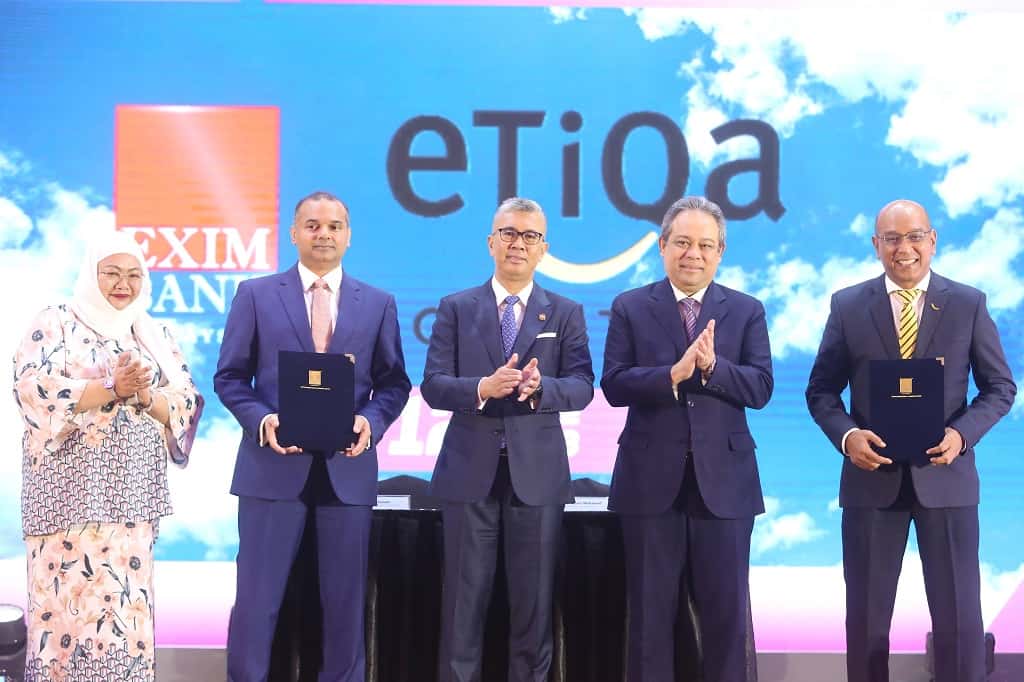
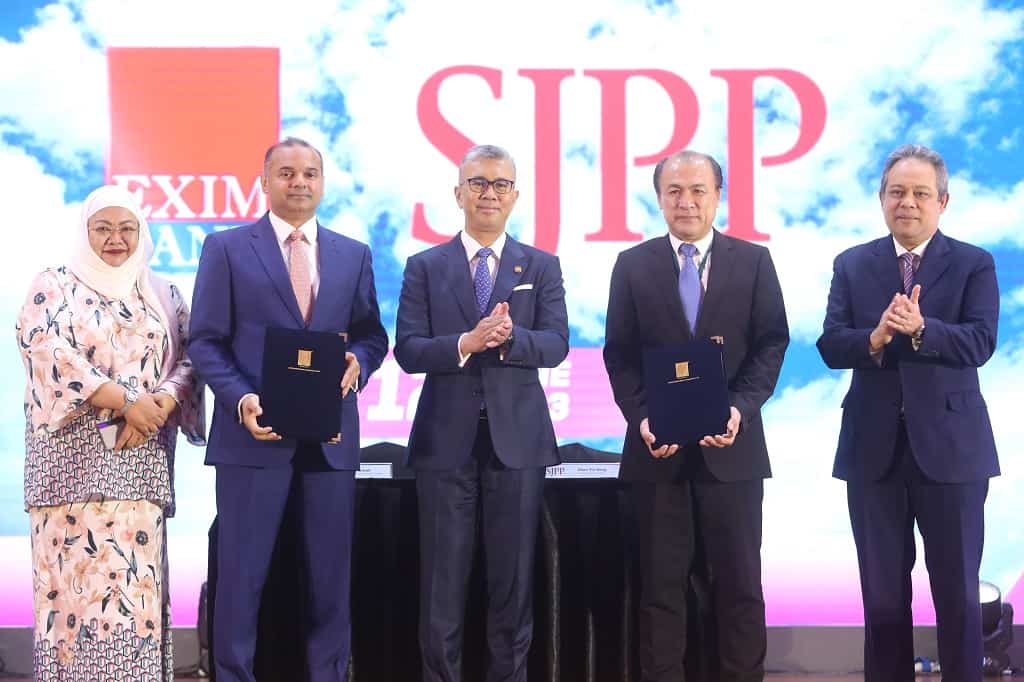
    At the programme launch, EXIM Bank also formalised its collaboration with Etiqa General Takaful Berhad and Syarikat Jaminan Pembiayaan Perniagaan Berhad (SJPP) through the signing of two Memorandums of Understanding (MoU).
    The first MoU with Etiqa General Takaful Berhad is to strengthen the cross-selling of general takaful products and financing facilities to promote domestic and export-oriented production.

    The MoU with SJPP, on the other hand, is to strengthen their existing collaboration in implementing financing facilities, guarantee schemes on domestic and export-oriented propositions, including programmes related to financing, guarantees or advisory.

    EXIM Bank was represented by its President and Chief Executive Officer, Arshad Ismail, witnessed by Tengku Datuk Seri Utama Zafrul Aziz and EXIM Bank’s Chairman Dato’ Azman Mahmud. Etiqa General Takaful Berhad was represented by its Chief Executive Officer, Shahrul Azuan Mohamed, who was witnessed by its Head of Enterprise Corporate, Asmah Daud; while for SJPP, the signatory was its Principal Officer, Chen Yin Heng, with its Senior General Manager, Azlan Mohd Agel, as witness.

    Amongst the other entities present at the event were MIDA, MATRADE, SIRIM, MARii, HDC, TERAJU, Malaysian Exporter Academy and Dewan MyGerak Eksport Malaysia.

    About EXIM Bank of Malaysia Berhad

    The Export-Import Bank of Malaysia Berhad (EXIM Bank) was incorporated on 29 August 1995 and is wholly-owned by the Government of Malaysia. The Bank has assisted a diverse range of Malaysian business in various sectors in their global ventures. EXIM Bank takes pride in meeting its mandated role of stimulating and enhancing the competitiveness of Malaysian industries for exports and investments globally via the provisioning of internationally and domestically competitive banking and insurance products and advisory services. The Bank also offers Shariah-compliant financing and Takaful instruments. For more information, visit www.exim.com.my.

  • How A Buy-Sell Agreement Can Help Business Partners In The Future

    How A Buy-Sell Agreement Can Help Business Partners In The Future

    The following story is based on an actual series of events, with some names and circumstances fictionalised. Any similarity to any person’s name, character, or history is coincidental and unintentional. Business partners normally do well when the relationship and business are good, but what happens when either one passes away? This is how a buy-sell agreement can help all parties involved.

    Teh and Fong have had a successful joint venture called Advanced Computing Machines Sdn Bhd (ACM), distributing computers and accessories throughout Malaysia. Each had an equal share of 50% in ACM.

    Teh and Fong had been classmates since primary school and had a closer relationship with each other than with their siblings. They started the business in 1980 when the market was still new. Desktop computers were clunky, and laptops were unheard of.

    The entry of the ACM joint venture was based on their shared conviction that the market for desktop computers would be big as such machines became popular among corporations.

    As the manufacturing cost of computers came down, the market soon developed into a very competitive one. Fortunately, ACM, one of the early players, had a significant market share and could survive on razor-thin margins because of economies of scale and good teamwork between Teh and Fong.

    Teh excelled in marketing, and Fong was a strong operations man. The two blended well and grew market share successfully. Profit grew to exceed RM10 million on an RM900 million turnover.

    Teh brought in his son as his assistant, and Fong’s son joined shortly after as the company accountant. Their thoughts then were for their sons to be joint successors to the business.

    Over time, however, it became clear to Teh and Fong that the two sons did not get along. They often complained about each other to their father. The animosity between them grew, basically stemming from a lack of trust. Fong’s son, being a typical accountant, was always eager to check on business development expenses, while Teh’s son resented his constant querying.

    One day, Teh expressed his concern to Fong over a golf session. They both acknowledged that it would be a disaster for the business if both sons were to inherit what they owned. They decided to seek advice from me, whom they both knew as a financial planner for over a decade.

    After a few pleasantries, they met me over lunch and brought up the subject of their concern.

    Read: Money Caused Breakup Among Four Close Friends, That’s Why it Is Important To Plan For The Succession Of A Business

    Buy-Sell Agreement As An Alternative

    Teh started by asking: “Jo, as you know, we have equal shares in ACM that you helped bring to IPO, and we are concerned that if one of us dies, the share in the business will go to our family and disrupt the business.”

    Fong added: “The big worry is that our sons don’t get along. Sooner or later, there will be a fight, and the business will go downhill. Is there anything we can do besides leaving our assets in a will?”

    I said: “Yes. There are two routes you can choose from. One is to sell the shares wholly or by a majority to a party interested in further developing the business. The second is to sign a buy-sell agreement between you so that when you die or become mentally incapacitated, your representative can sell to the other at a pre-agreed price or price-fixing formula.”

    “But what if our successor refuses to honour the buy-sell agreement?” Teh asked.

    I replied: “This is where it would be useful to do this buy-sell agreement with an independent trust company to act as your attorney. The trust company can then enforce the provisions you have agreed to and ensure the sale proceeds go to the beneficiaries.”

    “What if my family does not have enough cash to buy?” asked Fong.

    “Two ways. The first way is you can agree beforehand on payment in instalments. Or second way, as commonly done, both of you can buy insurance for a sufficient value to cover the shares to be purchased when the time comes.” I said. “For the process and the tax implications, consult an experienced trust company,” I added.

    Shortly after, the buy-sell agreement and two insurance policies were put in place with the help of the trust company.

    Read: He Had Everything But Children’s Harmony In The Family Business

    Buy-Sell Agreement Put Into Action

    In 2020, Teh died from Covid-19 infection, and the trust company claimed the insurance proceeds, which were paid to the beneficiaries, and his shares were transferred to Fong.

    This was a happy ending for everyone involved, avoiding conflict and hardship for the next of kin. This is a good example of how a buy-sell agreement manages to help.

    Read: The Amazing Reconciliation Of Father And Son, And This Reflected Inside The Will

    About Rockwills International Group

    Rockwills International Group, now in its 28th year, pioneered professional will writing in 1995 and has since evolved into the leading estate planning specialist in the country. It is today the largest provider of solutions and support services in trusts, succession, management and distribution of wealth. It has shareholders’ funds exceeding RM50 million. It has done over 280,000 wills and 15,000 trusts and holds more than RM25 billion in assets under trust.

  • Pre-Budget 2023: Expectations For A More Sustainable Tax

    Pre-Budget 2023: Expectations For A More Sustainable Tax

    The 2022 Budget was short on outlining any initiatives to enable Malaysia to build a more sustainable tax revenue base. The review of the tax incentives
    regime has yet to be finalised and hopefully, some progress will be announced in the coming Budget.

    We expect the 2023 Budget to outline a more structured mid to long term reform of the tax system, so that we can have a more sustainable tax system. Malaysia needs to, in the medium term, broaden the scope of the existing Sales and Service Tax (SST), and ultimately make it a broad-based
    consumption tax with added features such as tax invoicing similar to a Value-Added Tax.

    We should also have a more inclusive capital gains tax and move quickly on an efficient integrated national tax agency, in order to have a more sustainable tax.

    Tax Treatments To Review

    Currently, fees paid to tax advisers and company secretaries for the various services rendered on tax and corporate compliance matters are subject to restriction. Furthermore, the Inland Revenue Board of Malaysia (IRBM) recently issued the Corporate Tax Governance Framework (Framework) to enhance companies’ processes and governance on income tax matters.

    The Framework expects the involvement from the board of directors, audit committee and senior management to set up appropriate checks and balances on tax reporting.

    However, the IRBM states that costs incurred for advice and assistance to develop the Framework are considered to be capital in nature and therefore not tax deductible. This further irks businesses as such expenses are incurred to encourage corporate governance.

    For a more sustainable tax, another area to review is the exclusion of Intangible Assets from the definition of the term “Plant” in the 2021 Budget. This has resulted in cost incurred such as computer software, licences, trademarks, patents, films, copyrights etc are no longer eligible for capital allowances or tax depreciation, despite these being assets utilised in the production of taxable income.

    This is truly surprising, given the Government is leading the push from brick-and-mortar businesses to a digitalised and knowledge-intensive
    economy. Engagements have been held among various parties and it is hoped that in the upcoming Budget, the IRBM would review those tax treatments.

    A More Sustainable Tax Structure

    As a country, we cannot keep on borrowing and servicing debt. We should remove unnecessary exemptions and deductions, and simplify things
    to enable all to be part of the tax net. There is a need to push on towards a reliance on consumption taxes, in order to achieve a more sustainable tax.

    The Ministry of Finance (MOF) has stated in the Pre-Budget Statement in June that tax reform initiatives with the objective of broadening the
    tax base, as proposed by Tax Reform Committee, will continue to be implemented.

    The initiatives include:

    • a) Undertaking a review of broad-based incentives, reliefs and deductions
    • b) Improving tax administration through comprehensive registration of taxpayers
    • c) Better training of tax personnel
    • d) Improved registration of cross-border trade
    • e) Strengthening the tax audit and investigation
    • f) Enhancing legal certainty for taxpayers

    Necessary details on the aforementioned will need to be spelt out in the 2023 Budget.

    On the international front, Malaysia has committed to implement several agreed upon tax standards to create a competitive business environment for investors and to counteract cross-border tax evasion activities. To date, we have implemented four minimum standards of the Base Erosion and Profit Shifting (BEPS) Action Plans, while continuing to review the rest of the Action Plans under our domestic tax law.

    Domestically, the tax net can be widened by tracking down those who should be within the tax net. That means curtailing tax evasion, curtailing smuggling, registering those who should be registered as taxpayers, and devising strategies using the tonnes of data that various agencies
    accumulate to ensure that all who should be taxable are indeed taxed.

    In the Budget 2022, several initiatives were introduced to manage revenue leakages, including:

    • a) Removal of tax exemption on foreign-sourced income received in Malaysia by a Malaysian tax resident
    • b) Introduction of the Tax Compliance Certificate as a precondition for tenderers to participate in Government procurement
    • c) Implementation of a Tax Identification Number (TIN)

    It was a surprise when a five-year exemption of the tax on foreign income was announced subsequently. Even Singapore and Hong Kong, which have similar tax systems to Malaysia do not have such a time-based exemption period.

    However, the implementation of Tax Compliance Certificate and the TIN are very good compliance initiatives to reduce leakages, but more details are needed.

    In line with the 12th Malaysia Plan to strengthen digital services infrastructure, the digitalisation of the tax function will be implemented with e-Invoicing to be done in stages. This will enhance the efficiency of the country’s tax administration, reduce compliance costs to taxpayers, and
    increase the efficiency of business operations. E-Invoicing will also support the use of TIN as a measure to expand the income tax net.

    The Auditor General’s report has stated time and time again about losses and waste in the public sector. Greater accountability on where our tax ringgit goes and how it is utilised is essential to further narrow the trust deficit that exists, which is a factor why some are reluctant to pay their taxes.

    A more sustainable tax structure for the future is probably in the pipeline. But such matters can be excruciatingly slow in coming into fruition, due to the lack of political will and vested interests.

    All said, the 2023 Budget may turn out to be an election budget, with a slew of populist measures to score brownie points that may damage the country’s rather fragile fiscal momentum. Against this backdrop, debt and inevitably debt service charges, will rise.

    Given that Malaysia’s narrow tax base means high concentration revenue risk to the overall economy, its fiscal vulnerability could increasingly become a trigger factor for sovereign rating downgrades by international credit rating agencies. Here’s to a more sustainable tax structure for a better Malaysia.

    About the Author

    Dr Veerinderjeet Singh is a tax observer who is the Non-Executive Chairman of Tricor Malaysia. He is the Immediate Past President of the MIA and MICPA, and a Past President of CTIM. He is a strong advocate of tax reforms and sits on the boards of a few public entities. He is also an Adjunct Professor at Monash University Malaysia, as well as a Vice Chair of the Global Tax Commission at the International Chamber of Commerce based in Paris.

  • Covering All Bases for SMEs With SME Insurance

    Covering All Bases for SMEs With SME Insurance

    The world we live in is highly dynamic and we face different challenges daily. This is even more pronounced if you are involved in the operating a small and medium-sized enterprise (SME). Due to a lack of resources, many SME owners may actually overlook the finer details of managing the operational and financial risks of their businesses.

    Many also view paying for insurance as an additional, unnecessary expense or a luxury instead of a necessity. This often results in the average SME owner missing out on crucial protection to cover their business and mitigate risks.

    Facilitating Risk Management

    The Covid-19 pandemic has provided a timely opportunity for SME owners to reassess and review their business operations. This also includes potential financial risks that could be transferred to insurance companies to minimise potential losses if an unexpected scenario occurs.

    Naturally, different types of businesses are exposed to different levels of risk, which calls for different protection plans. The insurance market offers various forms of protection packages in order to suit the unique requirements and needs of each individual SME.

    Let’s explore a few major areas that SMEs should consider for protection.

    The Basics

    Young Asia girl wear face mask turning a sign from open to closed sign on glass door cafe after coronavirus lockdown quarantine. Owner small business, food and drink, business financial crisis concept

    The first order of business is to ensure that the operations and premises of your SME are fully covered. This is to ensure assets are protected against financial losses caused by fire, burglary, and/or damage from natural disasters.

    A common protection package will include fire insurance cover for the building, fixtures and fittings, and all assets inside, as well as insurance against burglaries.

    Depending on the nature of your business (for example food and beverage, beauty, education, office, healthcare, hospitality, retail, construction), SMEs can also opt for optional coverage deemed necessary, such as coverage for loss of income due to business interruptions (consequential loss), breakdown of machinery or electronic equipment, glass breakage, loss of money on the premises, or during the transit between the premises and bank, floods, fallen trees and so forth.

    With the basic minimum coverage to protect against fire and burglary, should these unfortunate incidents occur, insurance claims can help to negate or reduce your losses on assets, thereby cushioning the financial blow to your business.

    However, there are many other operational risks that occur in running a business. For example, if a small construction or renovation business neglects safety procedures during business activities, this could end up causing injury to employees or even the general public.

    Extra money will need to be forked out in order to compensate for the damages, injuries and other related claims. This could pile up to a hefty amount which will affect business cash flow.

    To minimise the financial impact of risks associated with doing business, it is advisable to protect your SME against potential claims with various liability insurance options available:

    Directors and Officers (D&O) Liability

    Coverage is intended to protect individuals from personal losses if they are sued as a result of serving as a director or an officer of a business or other type of organisation. It also covers legal fees and other costs incurred as a result of such a suit.

    Employers’ Liability

    Protects employers from financial loss if a worker has a job-related injury or illness that is not covered by workers’ compensation. Employers’ liability insurance can be packaged with workers’ compensation insurance to further protect companies against the costs associated with workplace injuries, illnesses, and even death.

    Professional indemnity

    Often referred to as professional liability insurance or PI insurance, this covers legal costs and expenses incurred in your defense, as well as any damages or costs that may be awarded, if you are alleged to have provided inadequate advice, services or designs that causes clients to lose money.

    Public Liability

    Covers the cost of claims made by members of the public for incidents that occur in connection with your business activities. Public liability insurance covers the cost of compensation for personal injuries, loss of or damage to property, and death.

    Product Liability

    Covers manufacturing or production flaws that cause unsafe defects products.

    Protecting Your Greatest Assets

    Confident Vietnamese business executive with digital tablet working at his table

    Did you know that SMEs can also protect against the loss of key staff such as the CEO, CTO or any team member you deem crucial to your business? The loss of such personnel could lead to financial losses due to disrupted sales, loss of creditor confidence, and customer relationships.  

    Keyman insurance is a protection for SME owners to ensure the company has sufficient funds to keep the business going in the short term before a successor is recruited and trained. The coverage calculation can be ten times of the person’s annual compensation.

    It is also important that business owners take care of all their employees. SMEs may consider providing group insurance coverage for employees that includes group personal accident cover for accidental death, total permanent disability, and hospitalisation income.

    While group medical insurance provides hospitalisation and medical surgery coverage, these benefits can also be extended to an employee’s spouse and family members.

    With suitable protection as a safety net, your business can operate with minimum interruption in the knowledge that should the worst happen, public property can be repaired and employee welfare is taken care of.

    Ensuring Business Continuity Interest

    Many businesses come to a standstill or even close down when one of the partners passes away or chooses to exit the business. In fact, plenty of SMEs do not generate enough money to buy over the shares of the owner who passed away, making it tricky for the remaining parties to continue the business.

    To offer a safety net for business continuation, the company can take up an option on life insurance to provide capital for the required liquidity. Together with a buy-sell agreement and a confirmed share valuation, business partners can buy a policy assigned to an insurance trust as a source of funding to pay for the share of the business partner who passes away or wishes to exit.

    This buy-sell agreement effectively keeps business ownership in the hands of existing owners in the event of a sudden exit of one of the partners due to unforeseen circumstances. It can also grant existing partners the first option to buy the exiting owner’s share of the business according to a pre-set valuation formula.

    Existing owners can buy out the share through a direct payment to the exiting partner or the partner’s heirs. This also prevents beneficiaries from being stuck in a business they are not interested in, while protecting the remaining partners from being forced to deal with new partners unexpectedly.

    I would say that all SMEs should assess their operational and financial risks based on their nature of the business, and seek suitable insurance protection to transfer risk for financial peace of mind.

    About the Author

    Angel Pau, CFP, IFP is a financial planner with Wealth Vantage Advisory.

    We at Smart Investor and Wealth Vantage is committed to help you better manage your financials. Get a free consultation from an expert by filling in your details here: https://www.smartinvestor.com.my/SIxWealthVantage

  • Turning A New Page For SMEs

    Turning A New Page For SMEs

    Low technology literacy has created a digital divide amongst businesses in Malaysia, with the common assumption that SMEs are less likely to access and use the internet when it is massively beneficial for them to do so. According to a report by World Bank Group in 2018, only one in three SMEs in Malaysia have implemented digital transformation strategies, while less than a quarter have a dedicated digital strategy team. Despite being the backbone of the country’s economy, SMEs in Malaysia performed rather poorly in adopting digital changes.

    SMEs are also susceptible to the practice of only adopting fundamental technologies for their operation—missing out on the more extensive digital solutions that could ensure their operation to remain robust in the long run. As one of the leaders spearheading digital transformation in various industries, the experts at JurisTech notice that there is an uninformed fear of the change brought on by digitalisation. This is not only specific to SMEs, but also applicable to almost every industry; with most citing ill-suited employees, lack of funding and technology experts for guidance as the reasons they lack the initiatives to start the transformation.

    Accelerating The Digital Transformation of SMEs

    Prior to the global pandemic in 2020, there has been a lag in digital adoption in Malaysia behind the global average. The struggle is not only felt by SMEs, but also technology providers, as there is a gap of knowledge differences between both parties. SMEs are afraid to reach out for help due to the perception that the cost will eventually be too taxing for them to run their operation and digital transformation simultaneously, while technology providers find it difficult to penetrate the market with low technology literacy amongst SMEs decision-makers.

    However, with the current economic climate and new regulation implemented by the government, SMEs in Malaysia are slowly acknowledging the importance of upgrading their current hardware and software infrastructure—where previously wondering how much would the transformation cost them, it is now a question of “how soon can we digitalise our existing processes?” SMEs now recognise digital adoption would enable them to continuously push through the periods of respective lockdown and semi lockdown, allowing them to remain operational and to create further stability in 2021.

    The demand is also spurred on by the need to be paperless and cashless. Besides that, 2020 taught many of us the importance of interpersonal interaction. While the face-to-face interaction was greatly reduced to lessen the effect of the pandemic, it has also speared the movement to innovate existing customer service technologies. An interactive, personalised chatbot is no longer sufficient; SMEs now have to find a way to not only attract and retain customers, but also to create a seamless customer onboarding process. This will help SMEs avoid drop-offs, increase customer acquisitions, and adhere to the lockdown regulations that are in place.

    The new digital transformation program rolled out by MDEC along with encouragement from our government drives the awareness for digitalisation and creates a bridge for many tech companies to offer their expertise to these businesses. SMEs now have a clearer idea of which areas of their operations are direly in need of digitalisation and can create a rising demand for it. This in turn allows technology providers to further enhance the existing features of their products to adapt to SMEs needs, just like JurisTech’s CollectXpress, an invoice-based collection recovery system and Juris Access, a digital customer onboarding platform developed with SMEs in mind.

    Acknowledging The Need For Digital Transformation

    Although the lockdown restrictions have been gradually lifted to encourage the recovery of the nation’s economy, many SMEs continue to operate remotely, cutting back on physical operation cost and manual processes implementation, allowing them to redirect their resources into upskilling their talents. This signifies a good start in many industries as it accelerates the digital adoption that has not seen satisfying progress in the last few years, as previously Malaysia was behind many of its neighbours in terms of technology utilisation.

    Most importantly, this indicates an increase in technology literacy amongst SMEs in Malaysia; as this shows a willingness to explore more extensive digital platforms to be included in their operation to remain relevant in whichever industry they are in. In the upcoming future, we can expect more SMEs will continue to grow alongside the ever-changing technology of today and forming active collaborations with technology providers that allow the development of more digital platforms aligned to their needs without the fear of disrupting ongoing business.

    About the author

    Nuralia Mazlan is part of the marketing and communications team at JurisTech, a leading Malaysian-based Fintech company, specialising in enterprise-class software solutions for banks, financial institutions, and telecommunications companies in Malaysia, Southeast Asia, and beyond. You can reach out to them at contact@juristech.net  

  • The Importance of Financial Planning for Small Businesses in Malaysia

    The Importance of Financial Planning for Small Businesses in Malaysia

    Are you concerned about whether you need to close your business during this MCO period? Most small businesses have been dealing with this concern.

    For small business owners running SMEs, it’s arguably more important to be involved in financial planning as you must consider not only how it affects your personal finances, but also the financial health of your business and your employees in general.

    That’s a lot of responsibility. 

    Based on SSM statistics, a total of 9,675 companies and businesses shut up shop during the first phase of the MCO from 18 March to 9 June 2020, while another 22,794 closed down during the recovery MCO (RMCO) phase from June to September 2020.

    What are the reasons for small business owners to make such a tough decision? Here are some possible reasons why:

    Lack of Crisis Awareness

    Many business owners may overestimate their business operating model. They tend to feel that a higher degree of effort put into their business leads to a higher degree of success.

    While this may be true, it doesn’t take into account emergencies and unforeseen circumstances like the Covid-19 pandemic. Without any backup or emergency funds in place, there’s only one possible outcome.

    Misjudgment

    There’s a common tendency for people to inaccurately assess the degree of risk in a risky situation. This happens mainly due to irrational behaviour and overconfidence in their personal judgement.

    Therefore, losses may occur due to ignoring the possibility of wrong information and hastily acting without performing their due diligence.

    Lack of Financial Planning

    During the MCO, many small business owners applied for loans to sustain their SMEs. Many may have used all their resources in order to start the business at the beginning.

    Thus, when business is not going well, they will need to find a way to raise funds to avoid going bankrupt.

    Transformation of Small Business Model

    Across industries, both small and large businesses are accelerating digital transformation processes for long-term growth and profitability. Yet, there are businesses that remain untested in the face of digital challenges, with their digital transformation readiness remaining uncertain.

    As a result, these companies that cannot adapt to change will be knocked out of the business cycle.

    So, what steps can small business owners take to prevent this?

    Planning ahead is key to ensure businesses can survive periods of uncertainty, with preparations made before it occurs. Regardless of economic conditions, business owners can take several precautions to mitigate risk:

    Plan Well for Financial Health

    In football, strikers spearhead the attack but often have nothing to do with defending. Similarly, small business owners may be too focused on earning money and neglect other financial needs of the business.

    Financial planning is key to ensure good financial health, which allows you to focus on your core business without any concern since a strong financial base has already been built.

    Separate Legal Entity

    All transactions associated with a business must be recorded separately from other business or personal transactions. If records are mixed up with that of its owners or other businesses, the accounting information loses its usability – this is an issue that still plagues many family-owned SMEs today due to a lack of management.

    Many owners will feel that no matter how much they earn, it’s not enough for them to retire. By not recording business cash flow separately, they’ll never truly know how much their business can earn in comparison to their personal expenses.

    Build Up an Emergency Fund

    Strong cash flow allows a company to have more flexibility in regards to business decisions and potential investments. Therefore, it’s very important to have an emergency fund in place to survive tough phases like the current MCO period.

    During this time, many SMEs have been forced to stop operations or close completely due to insufficient funds. However, businesses that were well-prepared have been able to sustain themselves and weather the storm accordingly. After all, “cash is king”!

    Refinancing

    Most people would like to settle their mortgages as soon as possible, and small business owners are no different. The feeling of being in debt is one that no one likes. In times of crisis, they may prefer to rely on overdrafts, credit cards, or term loans and personal loans that don’t require collateral.

    These liabilities may have a higher interest rate and a shorter payment term. For small business owners looking to tough it out, refinancing a home loan is an option as a longer payment term and lower interest rate can be negotiated compared to the loan facilities mentioned. Plus, you’ll end up with a lower monthly commitment!

    Asset Diversification

    As mentioned earlier, “Don’t put all your eggs in one basket”. While properties and other physical assets may be tangible, it doesn’t provide liquidity during periods of low revenue. Therefore, it’s important to diversify assets accordingly.

    Businessmen may select other investment vehicles such as REITs, shares, commodities, bonds, collective investment vehicles such as ETF and unit trust, and also other regulated investment tools that have high liquidity and can be easily converted into cash.

    In conclusion, it’s very important for small business owners to have a sense of urgency about their personal finances. With proper financial planning, you’ll be well-placed to face any uncertainty ahead and can survive black swan events without panicking.

    About the author

    Alex Teoh Teik Shiang (FAR CMSRL) is a FA Director, Licensed Financial Planner and Bank Negara Approved Financial Adviser Representative. He can be contacted at alex.teoh@yesfinancial.co.