Blog

  • Can Money Buy Happiness?

    Can Money Buy Happiness?

    Without a doubt, a lot of people consider money to be crucial in their life. But the question on everyone’s mind is that, can money buy happiness?

    Many of us work hard to earn money so we can buy the things that will make us happy and comfortable. While others might look to money for personal fulfilment, which may involve impressing others by flaunting an expensive handbag or dress.

    Nevertheless, due to its importance, we can find many people fight over it, hate, or adore each other because of it.

    Read: 4 Money Personality, Find Out Yours

    Can Money Buy Happiness?

    Some claim that you can buy happiness with money because they believe it will give them power, while others might disagree. Can money buy happiness?

    From a personal standpoint, I do not agree that we could buy eternal happiness with money.

    But then, to buy the things we need on a daily basis, money is a basic requirement in our life. Although having a lot of money may be utilised to buy upscale and pricey items, the satisfaction would only be temporary. Additionally, you cannot buy the feelings of love and devotion with money.

    Everyone wants money, but it could not possibly purchase everything. This is true, especially when it comes to intangibles things such as general knowledge or a loved one who has passed away and the experiences you shared with them.

    Read: More Money, More Happiness?

    Credit Photo: Amazon

    In a famous book written by Robin Sharma, entitled “The monk who sold his Ferrari”, the main character named Julian Mantle was a lawyer who find himself burned out and feeling dissatisfied despite his amazing achievements. He was a successful lawyer, rich, and highly sought by clients for law advice and cases.

    Suddenly, no one was able to contact him after the incident where he passes out in a courtroom due to a heart attack. He just disappeared and was nowhere to be found.

    After three years he came back to meet his friend, John. John was astonished to see Julian glow in joy, looking wiser and healthy. Julian shared with John the lessons he had learn while meditating with the Himalayas Sages-and surprisingly all his happiness now has nothing to do with money.

    Remarkably, we can find many people who felt the same burnout experience and a have different definition to happiness as Julian.

    Read: How Can You Save Money Without Even Realising It?

    Can Money Buy Happiness For A Couple?

    Credit Photo: Essentially Sports

    In a similar case, Tiger Woods’s ex-wife, Elin Nordegren net worth’s skyrocketed to more than USD200 million after their infamous divorce. While she admitted that money did make things easier for her as she took her children away to somewhere secluded for quite some time from reporters and journalists, she did insist that money could not buy her happiness or put her family back together.

    In fact, she claimed her marriage to Woods was one of the happiest days of her life.

    Can Money Buy Happiness For Kids?

    In India, a man shared over the net that he had broken up with the love of his life and was heartbroken. His friend’s advice him to smoke weed (cannabis) to forget his pain. They agreed to go buy it together.

    Arriving at the place they went to; they saw three children playing nearby. The heartbroken man offered to buy them ice-cream and all three of them could not stop smiling while eating. The man said it made his day and he never took the weed.

    He then asked for the kids’ permission to take photo of their smiling faces for memories. He would frequently look at the beautiful picture and smile. In his opinion, he claimed money can and does buy happiness!

    Picture:  Shared by Aditya Meena, Credit: Medium

    On the other hand, my beloved father, once told me, if your too rich you can become crazy if you do not know what do with the money. Thus, I guess by having money with a purpose would then mean something, and the type of purpose mentioned here should be more akin to empowering yourself and others.

    It should also be inspirational, memorable, helpful, useful, or important.

    Despite how great it is, money cannot alter how you feel about yourself. Most individuals make this mistake. They want to be strong, fashionable, or respected. Most importantly, they want to be admired.

    However, there is nothing that money can do to alter how you feel about yourself. Money won’t make you proud of who you are if you do not feel so yourself and it will definitely fail you if you have insecurities in believing yourself.

    As to answering the question whether can money buy happiness, majority would agree that it does not. But to some it certainly can relieve you some pain, comfort, safety or help when you are in need, thus, that is happiness.

    To me, happiness is something internal and intangible. Therefore, to obtain it obviously is not going to be from something external and tangible.

    How about you, can money buy happiness?

    Read: Are Malaysian Millennials Really That Bad At Managing Money?

    About the Author

    Azah Atikah Binti Anwar Batcha has Accounting, Finance, Auditing, and Islamic Finance background. She has worked with two of the Big four firms prior to pursuing her postgraduate studies at University of Technology Malaysia (UTM), Kuala Lumpur. She can be contacted at aaabwrite@gmail.com

  • Are We Emotionally Intelligent Enough To Be Making Investment Decisions?

    Are We Emotionally Intelligent Enough To Be Making Investment Decisions?

    As we navigate these turbulent times of uncertainty, we are constantly under pressure to make investment decisions and to look for investment strategies or styles that can enhance returns for our long-term investment.

    As we are advised to brace for the impact of increasing market volatility, inflation risks and interest rates while investing, we are dissuaded from investing based on rumours when making investment decisions.

    We are always cautioned to conduct more analyses with facts after verifying from trusted sources such as Bursa Malaysia, Bank Negara Malaysia and Securities Industry Development Corporation (SIDC) before investing.

    In the past, we may pin the blame on rumour mongers and the lack of information for our inability to invest well. But with more information available now, are we more prolific in making informed decisions that produce better investment outcomes?

    While some of us are instilled with knowledge for investing, some still perceive investing as a daunting task. Inevitably, many of us are still prone to making suboptimal decisions despite religiously adhering to tips from the pundits.

    Read: Six Golden Rules In Getting Favorable Returns And Growth, When Investing In Unit Trusts

    While Is It Hard To Make The Right Investment Decisions?

    This is because making the right investment decisions also becomes trickier with an ever-increasing assortment of financial products to suit our investment palates.

    We are also reminded by the investment community to keep our emotions in check when investing. This is because emotions can lead to perverse and suboptimal decisions in investing.

    We feel lousy and we may blame it on luck to make us feel better while some of us become mentally depressed when things turn out badly. Some of us cringe at making investment decisions and shy away from financial products after encountering some painful experiences in the past.

    Thus, can we ignore our emotions when investing? If not, do we need robo-advisory services or digital asset managers proclaiming on investing without emotions to help us in making the right investment decisions?

    Read: Investing And ESG

    Emotions Affecting Investment Decisions

    On the other hand, according to research, not exhibiting the appropriate emotions could impair our ability in making investment decisions.

    So, why are we so hard on ourselves? After all, we are emotional creatures. We can’t possibly ignore our emotions when investing. I suppose if we could understand our emotions and what drives our emotions in the process of decision-making, we could be less subjected to unhealthy thoughts.

    As decision-making is a complex process, we tend to use mental shortcuts termed as ‘heuristics’ by psychologists to solve problems instead.

    According to psychologists, we simply make judgements and decisions by consulting our emotions. We ask ourselves: “Do we like it? Do we hate it? How strongly do we feel about it?”

    We form opinions quickly, make judgements and take risks as expressions of our feelings on the basis of mental images without realising why we are doing so.

    Researchers suggest that our brains exhibit tardiness in adjusting our impression once our mind has been framed. Festinger posits the ‘theory of cognitive dissonance’ and encapsulates that we will try to look for information that reaffirms our initial opinions so that the opinions we form earlier do not contradict the information we receive later. This somewhat explains ‘confirmation bias’ and ‘first impression bias’.

    Read: Investment Risk Management With 6 Simple Ways

    Image by Freepik

    This could also explain why we may fall prey to financial scams. Scammers who have a positive image and are good at manipulating our emotions with words that mesmerize us are more likely to gain our trust.

    To avoid becoming an easy target by malicious people, we may need to think like scammers and beat them at their own game. Of course, we are not advocating that we act like scammers but playing defence all the time in their game can be tiring.

    We need to play like a striker as the situation warrants it or find ways to change the playing field when dealing with scammers. In short, as we could not possibly suppress or ignore our feelings and emotions, we have to try to manage our emotions.

    Numerous books and articles offer tips that we could adopt to improve and practise our emotional intelligence, so we can make better investment decisions.

    Our decisions can be also easily affected by our moods. The effect of mood on decisions is well documented in journal articles. When we are in a bad mood, we tend to be more pessimistic about the future.

    We are more likely to invest in risky assets such as equity, and conduct less critical analyses when we are in a good mood, which predisposes us to underreact to negative information about our investments. Besides this, there are many interesting journals and articles on weather effects on stock returns in the West.

    For instance, Hirshleifer and Shumway in their journal article titled: “Good Day Sunshine: Stock Returns and the Weather” have unearthed that our financial decisions may be affected by sunshine. Sampling 48 developed and emerging countries, Yuan, Zheng and Zhu in their studies titled “Are Investors Moon Struck? – Lunar Phases and Stock Returns”, advanced the notion that the performance of stock exchanges is significantly higher during the new moon.

    Thus, unless we are emotionally intelligent, we may not be able to make wise decisions even if we use digital asset managers for investing. But again, do you think we will be happier if we don’t use heuristics but instead utilise and filter reams of information before arriving at a conclusion?

    Researchers contend that conducting too many analyses may also lead to ‘analysis or information paralysis’, a situation where we are unable to make investment decisions or reach a conclusion due to information overload.

    Read: Where To Invest In 2023: Amidst The Recession And General Election

    About the Author

    Dr. Audrey Lim Li Chin is a lecturer and a researcher at Multimedia University (MMU) Melaka. She teaches International Finance and Derivatives. She is particularly interested in retirement planning, mental health, Fintech especially in Blockchain and data analytics. She is also a Certified Financial Planner, (CFP) and is currently pursuing Chartered Financial Analyst (CFA) certification.

  • Year 2022 So Far And The Market Outlook For 2023

    Year 2022 So Far And The Market Outlook For 2023

    I get questions dealing with investors from different backgrounds. Some of them are very experienced investors and traders. These investors sometimes have questions especially when the markets are driving them nuts. Let’s take a closer look at the year 2022 so far, and the market outlook for 2023.

    So far this year, the markets around the world have certainly affected a lot of people ranging everyone’s emotions from greed to fear.

    The old market saying is that when everybody is thinking the same thing, then nobody is thinking at all. For this issue, instead of the usual format, I will answer some ‘difficult’ questions raised by some of my investors in our recent meetings.

    The questions may be simple, but the answers are complex. However, I was surprised that nobody asked me about the market outlook for 2023 for gold, since the yellow metal has since morphed into a holy object of worship.

    Read: Six Golden Rules In Getting Favorable Returns And Growth, When Investing In Unit Trusts

    Year 2022 So Far And The Market Outlook For 2023

    Q1. Are you still bullish on China and its market outlook for 2023?

    With boots on the ground in Shanghai and Hong Kong, I remain a long-term bull on the Chinese consumer sector. While some foreign investors remain skeptical, there are strong long-term reasons for investors to allocate to China.

    Local research and insights matter more than macro news flows for anyone investing in the Chinese markets. The Chinese markets have corrected to a point that valuations mean solid companies are already priced for the worst-case scenario.

    Therefore, the potential for good risk-adjusted returns are promising in the coming years.

    Q2. I’m very concerned about the shock of inflation putting more pressure on the markets. What is your view on inflation and the market outlook for 2023?

    Wasn’t Ukraine or another nuclear war one of our greatest concerns a couple of months ago? From the market perspective, the worst part of the inflation is behind us. From a poorer consumer perspective, inflation or the rising cost of living will continue to be a problem in the coming years.

    Read: 6 Ways To Deal With Inflation

    Q3. What is your view on the global economy and market outlook for 2023?

    I do not care for the official definition of a recession. The current economic cycle is unlike anything we have seen before in that it has absorbed the impact of a pandemic, followed by a war in Ukraine. Economic data has been distorted for months. If you look at the history, central banks are always too late to engage their efforts and therefore, they very often have to go too far in their response.

    With the backing of more than 400 PhD economists, the Fed’s Chairman Powell, one of the most powerful people on the planet, keeps aggressively tightening an economy that is already showing a lot of weakness with inflation peaking, so economic risk is surging going into 2023.

    Q4. Do you think Powell will want to destroy the US economy in order to save it?

    He will back off. If you believe in the destruction theory, pack your bags and head for the hills with canned food and ammo. The last thing Powell wants is to be blamed for a global financial accident before Christmas. Oops… he already blew up Great Britain and he probably has more phone calls from other central bankers.

    On this note, The Bank of England is in a mess and it looks like the UK is an emerging market now. Politically, it is out of the frying pan and into the fire for the UK government.

    Q5. Can you tell me more about the volatile stock market and its market outlook for 2023?

    Please leave your emotions aside. It is foolish to try and guess the short-term conditions that are so volatile and unpredictable. The long-term bull market is still alive and kicking despite the stomach-churning volatility we have experienced so far this year.

    The human mind always projects the recent past onto the future thinking that bad times will never end. Prices could go a lot higher and longer than people think in the coming months and years.

    What happens after this long-term bull market ends and how will we deal with that later?

    At one stage, the sentiment was so bad especially during the Covid-19 crash. Well, the stock market is a forward-looking mechanism. Extreme volatile markets shake out the weak hands and give long-term investors a strategic mindset and a chance to buy at lower valuations to multiply their wealth.

    Q6. 2022 has been unusually volatile for US equities. A renowned economist predicted the market outlook for 2023, and a stock market crash is expected in the coming months. Do you agree with him?

    No crash or meltdown. The stock market and the economy are very clearly two different things. What if the bear market is not over and I am wrong? As a mere mortal, I have been wrong many times in the past.

    Legendary investor Peter Lynch reminds me that in our business, if you are good, you are right six times out of ten. You are never going to be right nine times out of ten. I do not put all my eggs in one basket.

    Q7. What is your view on cryptocurrencies and its market outlook for 2023?

    Grab a coffee and enjoy the wild ride. Sentiment can change on a dime and it is not a surprise that most institutional investors have concerns around the risk and volatility of the cryptoasset market.

    However, it can further be seen empirically that a simple ‘buy-and-hold’ strategy with an allocation as small as 1% of an investor’s portfolio has resulted in an outperformance of more than 10% over the past seven years. I am a long-term bull and patience is a virtue.

    Read: Stabilising The Unstable Stablecoins

    Q8. You have been a US Dollar bull for a number of years now. What’s the market outlook for 2023 for US Dollar, are you still bullish?

    The US Dollar’s strength has been fairly obvious in the last 12 months, so if anyone is shocked by this, it is probably time to go hands off on his or her finances and get professional help. Since May 2021, the US Dollar has risen 19% against the Euro, even reaching parity in recent weeks.

    It has appreciated 20% against the Pound Sterling, and is up 28% against the Japanese Yen. The market outlook for 2023 is that I am still bullish, but the US Dollar is overbought at the current levels.

    Read: Managing Currency Exposure In Your Portfolio

    Q9. Where is the best place to put your money in the world today?

    Drumroll please… and sorry to disappoint the doom and gloomers, but the US remains the best place for both safety of capital and future growth prospects.

    Q10. Why have you been able to stay calm despite the chaos so far in 2022?

    Those who joined the industry a few years ago are now learning that maybe their success or arrogance in the last few years had more to do with a rising tide lifting all ships and exposure to higher beta areas, than it did their investing acumen. Everyone is a rational investor when things are going higher every day.

    I have seen multiple cycles and survived much worse than this and yet some ‘experts’ are terrified. Regular meditation gives me a sense of calm, peace and balance in my work and overall life.

    Q11. What about the Russia- Ukriaine War?

    I do not have anything to add as the war continues to drag on.

    Q12. What about oil?

    I am not the bear you are looking for. The spike in oil prices we have seen in spring and early summer has faded. Macro worries will continue to keep a ceiling on crude oil but the fundamentals have now set a solid floor.

    OPEC has shown that it is willing to do what is needed to keep markets tight. At some point down, the price range will break to the upside given how constrained supplies will be going forward.

    Q13. What is your advice for those who turn to cash as a source of diversification?

    I have come across people who choose to hold significant amounts of cash. I can feel their pain. The supposedly conservative strategy of putting money in the bank is actually destroying your purchasing power at a rather alarming rate.

    There are other investment opportunities which can help to meet their financial objectives. They just might have to look a little harder.

    Well there you go with what’s been going on for the year 2022, and what the market outlook for 2023 is in store for us.

    Read: Saving vs Investing, Should I Save Or Invest?

    About the Author

    YH Wong has over two decades of experience in the financial services industry. His clients include high net worth investors and boutique institutions such as family offices and investment partnerships in the region. He is currently a senior partner with Satori Consultancy Ltd, a financial services company regulated by the Mauritian Financial Services Commission. He can be reached at yhwong@satoriconsultancy.com.

  • Employers! Are You Ready With These HR Changes Effective 1 January 2023?

    Employers! Are You Ready With These HR Changes Effective 1 January 2023?

    Our Human Resource Minister has recently declared that the Employment (Amendment) Act 2022 with these HR changes effective 1 January 2023. It was earlier announced to take effect from 1 September 2022 but was then postponed.

    What Are The HR Changes Effective 1 January 2023?

    Among them are:

    1) Amendment of Section 37 – Maternity allowance increased from 60 consecutive days to 98 consecutive days.

    2) New Section 41A – Restriction on termination of pregnant female employee unless due to wilful breach of a condition of the contract of service under subsection 13(2); misconduct under subsection 14(1); or closure of the employer’s business. (2) Where the service of a female employee under subsection (1) is terminated, the burden of providing that such termination is not on the ground of her pregnancy, shall rest on the employer.

    3) Amendment of section 60A – in subsection (1), by substituting for the word “forty-eight” wherever the word “forty-five” appears – to reduce work hours in a week.

    4) New Section 60FA – Paternity Leave – a married male employee shall be entitled to a paid paternity leave at ordinary rate of pay for a period of seven consecutive days in respect of each confinement. The paternity leave under subsection (1) shall be restricted to five confinements irrespective of the number of spouses.

    Read: Managing Mental Health in the Workplace

    5) New Part XIIc – Flexible Working Arrangement – anything contained in the contract of service, an employee may apply to an employer for a flexible working arrangement to vary the hours of work, days of work or place of work, in relation to his employment. The employee must apply in writing. Employer may reply within 60 days from the date such application is received, to approve, or refuse the application. The employer shall inform the employee in writing of the employer’s approval or refusal of the application under subsection (1) and in the case of a refusal, the employer shall state the ground for such refusal.

    6) New Section 69F – Discrimination in employment, which employer is liable to a fine not exceeding RM50,000 and shall also, in the case of continuing offence, be liable to a daily fine not exceeding RM1,000 for each day the offence continues after conviction.

    7) New Section 81H – Notice on sexual harassment – an employer shall always exhibit conspicuously at the place of employment a notice to raise awareness on sexual harassment.

    8) Blacklisting employers from employing foreign workers for breaches of labour legislations.

    With these HR changes effective 1 January 2023, it seems that employers will be burdened to prepare for the impact the changes will cause their organisation. These includes increase in costs, reduction in daily operation’s efficiency, measuring employees’ performance, disciplinary and financial issues.

    Employers have no option other than to accept the implementation of these HR changes effective 1 January 2023. Otherwise, a fine will be imposed.

    Read: A “Not-So-Great” Resignation: 39% Of Professionals In Malaysia Who Have Thought Of Resigning In The Past Year Didn’t Leave Their Jobs

    Still Reeling From The Pandemic

    Image by pressfoto on Freepik

    Many employers are now beginning to bounce back after facing the pandemic for two years. Just when their businesses are going back to normal, the new minimum salary of RM1,500 came into effect on 1 May 2022, which have stunted their recovery.

    As a HR Consultant, I’ve heard from clients that the current amendments are more lopsided towards the employees, while employers’ plights are not being heard by the Government. There was no proper discussion between the employers to gain their feedback on these matters.

    In the business world, employers play an important part in providing jobs to the community. There are 1.15 million Small and Medium Enterprises (SMEs) in Malaysia, which makes them a special breed and needs to be taken care of. Already there’s a lot of regulations that they have to comply with, failure which will result in fines and jail time.

    Employers should not be underestimated as if they did not plan ahead for the future. They have their employees’ interest at heart, so the organisation can prosper. When the employees perform well, the company makes profit, and benefits will be passed around.

    It is indeed a struggle to keep up with the rise in inflation and interest rates, which affects both employees and employers. It is hoped that the Government will help small companies thrive. As the proverb goes, “Where there’s a will, there’s a way”. There must be a way to create a win-win solution for both parties.

    But as of now, get yourself ready with these HR changes effective 1 January 2023.

    Read: Establishing Diversity, Equity and Inclusion As The Norm In All Workplaces

    About the Author

    Rozina Md Derus is the Managing Director / CEO of Click H & A Consultancy Sdn Bhd. The company started in 2013 and have helped hundreds of business owners, mostly from the young generation who are actively involved in doing business but with zero knowledge in handling their PEOPLE.

  • Corruption And The Weakening Of Ringgit

    Corruption And The Weakening Of Ringgit

    Malaysian Ringgit (Ringgit) is now hovering around the RM4.40 mark against the US Dollar (USD) after hitting a low of RM4.74 in early November 2022. The pressure eased slightly after Pakatan Harapan won the 15th General Election and Dato’ Seri Anwar bin Ibrahim was sworn in as Malaysia’s 10th Prime Minister.

    Today we will be taking a closer look at corruption and the weakening of Ringgit has affected the nation as a whole.

    A quick throwback, we had a similar experience during the Asian Financial Crisis back in 1998, where Ringgit fell to its lowest at RM4.71 against the USD and this had caused a massive impact to Malaysia as foreign investors pulled out their investments from our country.

    Malaysia subsequently pegged the Ringgit at RM3.8 to the USD and it was eventually removed in 2005 when we were under Tun Dr Mahathir bin Mohamad’s leadership. Today, as the cost of goods, prices and business costs continue to soar due to the continued depreciation of Ringgit, Tun Dr Mahathir had suggested that the Ringgit should once again be pegged to the USD.

    Currency pegging due to devaluation is a nightmare for investors in the country as well as those who intend to invest in Malaysia. It causes Malaysia to lose its monetary sovereignty in managing our own monetary policy based on our economic situation, instead of the economic situation of the country which the Ringgit is pegged to.

    One way to regain the Ringgit’s strength is through Foreign Direct Investments (FDI), plus it is the most desirable form of country capital inflows because it is less susceptible to crises and sudden stops. However, there are many factors that could affect FDI inflows and outflows.

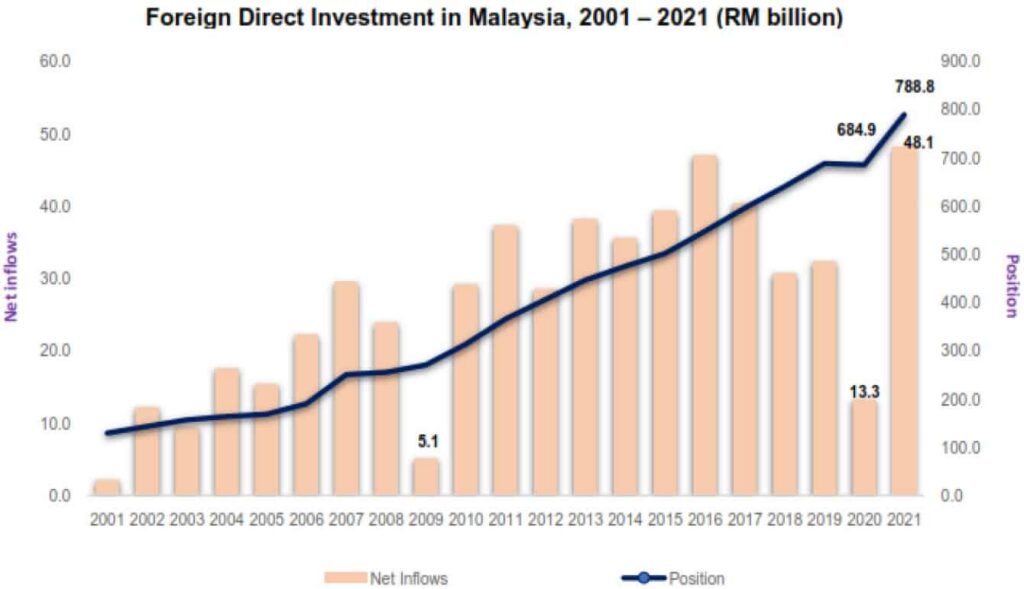
    Malaysia had experienced a major fall with regards to FDI. Malaysia went from being one of the preferred ASEAN countries to invest in, to being behind the Philippines, Singapore, Indonesia, and Vietnam. In the year 2020, Malaysia had posted a drop of 68% in FDI according to Malaysian Investment Development Authority (MIDA).

    Read: Is Malaysia Going To Go Bankrupt?

    The Story Of Corruption And The Weakening Of Ringgit

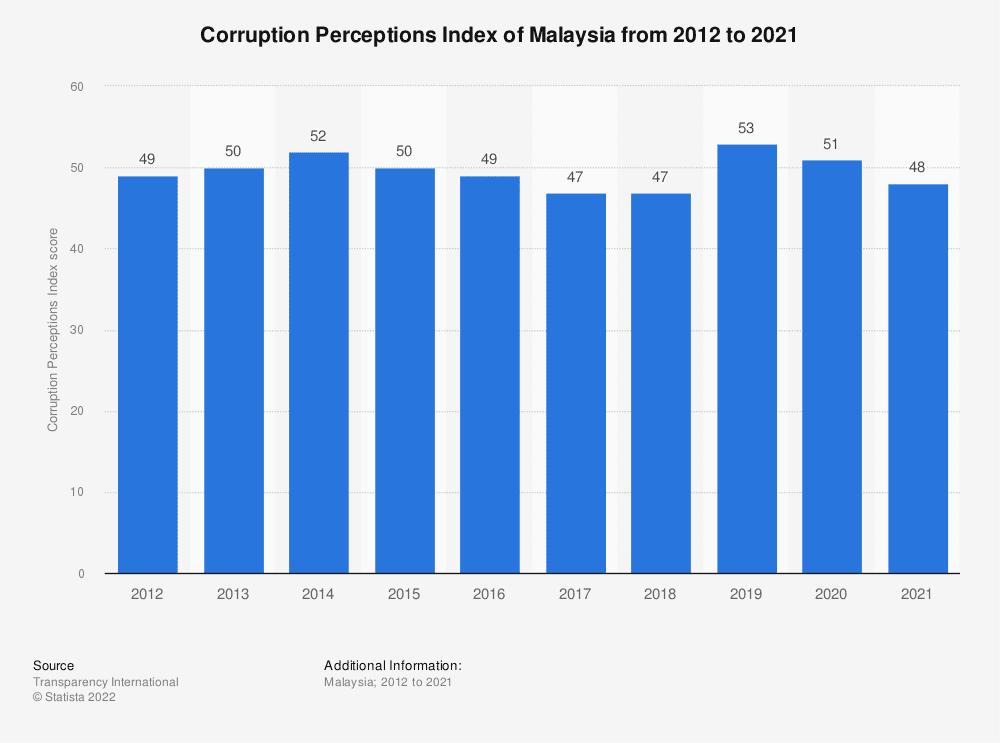
    One of the main reasons why investors choose to stop investing in our country is due to corruption. Malaysia had scored 48 points out of 100 in the 2021 Corruption Perception Index (CPI) as reported by Transparency International. The level of corruption in the host economies is regarded as one of the most important factors that determines which country will benefit from FDI.

    This is where you can see the link between corruption and the weakening of Ringgit.

    Source: Statista

    In relation to this, Department of Statistics Malaysia (DOSM) revealed that although Malaysia’s FDI dropped in 2020, the accumulated investment increased to almost RM700 billion during the pandemic.

    Source: DOSM

    The 1Malaysia Development Berhad (1MDB) scandal has dampened investor’s sentiment towards Malaysia amidst growing concerns over the extent of corruption, levels of impunity, and overall erosion of the rule of law. Another reason that caused foreign investors to exit the local stock market is due to the uncertainty of Malaysian politics.

    In May 2022, researcher David Seth Jones published a research paper which contains his analysis regarding Malaysian corruption. He mentioned that the public and private sector corruption are rampant in Malaysia, and is reflected in the prevalent cases of bribery, embezzlement, and fraud.

    Furthermore, it was specified that bid rigging in procurement, money laundering at the highest levels in major investment such as logging, infrastructure, and procurement projects are the main causes of corruption. His research findings were backed by data gathered from the Malaysian Anti-Corruption Commission (MACC) and Malaysian government reports combined with the reports provided by international organisations such as Transparency International, the World Bank, PricewaterhouseCoopers, media reports, and various academic publications.

    He further stated his findings that corruption remains widespread in Malaysia due to the weak enforcement of anti-corruption measures, political interference within investigation and prosecution of corruption cases, the politics-business nexus, and the issue of money politics as well as limited impact of anti-corruption measures and bodies.

    Read: Fraud Awareness Week 2022: Find Out More About Fraud, The Common Frauds And Its Impact On Investment

    FDI, Corruption And The Weakening Of Ringgit

    It is proven that FDI inflow is positively correlated to the convenience of the entrance of the market, economic stability, political consistency as well as free from corruption. Thus, with the FDI inflows, it can help strengthen our Ringgit once again.

    Government has a crucial role to play in keeping the country clean of corruption by taking up the necessary control measures. Strict law enforcement and governing without fear or favour, severe punishment from the courts and effective government administration are pivotal. Only through this, the goal to reduce corruption can be achieved.

    As corruption decreases, we can expect FDI to increase, and ultimately Malaysia will prosper and is able to realise its potential as the Tiger of Asia. Let us pray that the new government can make a positive impact in eradicating corruption from our beloved country.

    It is clear that there’s a strong link between corruption and the weakening of Ringgit.

    About the Author

    Azah Atikah Binti Anwar Batcha has an Accounting, Finance, Auditing, and Islamic Finance background. She has worked with two of the Big four firms prior to pursuing her postgraduate studies at University of Technology Malaysia (UTM), Kuala Lumpur. She can be contacted at aaabwrite@gmail.com

  • Six Golden Rules In Getting Favorable Returns And Growth, When Investing In Unit Trusts

    Six Golden Rules In Getting Favorable Returns And Growth, When Investing In Unit Trusts

    A Unit Trust is an investment scheme that pools money from many investors who have similar investment objectives, strategies and risk appetites. The pooled moneys are then invested into a diversified portfolio of investment assets, such as shares, bonds, and cash equivalents.

    Lets look at how you can get favorable returns when investing in unit trusts.

    Read: Getting To Know Unit Trust Schemes

    Golden Rule No 1: Invest long-term

    It is important to know that when when investing in unit trusts, it should be a long-term game. But how long is long, you may ask? 

    Unit trusts need to be invested for at least 10 years to see favorable results. As upfront service charges maybe relatively higher than investing in shares, it is advisable to keep it there for the longer term. 

    If you invest in a fund which gives consistent distributions, the distributions declared will eventually bring down the average cost per unit of your fund. And the longer your maintain your fund, the lower you will see your average cost per unit.

    Only buy something that you’d be perfectly happy to hold if the market shut down for 10 years.

    Warren Buffett

    and

    “If you aren’t thinking about owning a stock for 10 years, don’t even think about owning it for 10 minutes.”

    Warren Buffett

    Investing is not trading. Investing has a totally different objective. Investing is about minimizing risk to generate wealth over the long term. Do some homework about the fundamentals and financial status of the stocks invested, the direction and management of the company and the industry potential.

    Golden Rule No 2: Dollar Cost Average

    investment

    When investing in unit trusts, it is important that you do dollar cost average (DCA). Dollar cost average means investing a fixed amount on a regular schedule, usually on a monthly basis. Investors get more units when prices are low and fewer units when prices are high. 

    DCA works favorably for funds with a higher volatility factor and consistent distributions.

    Read: 5 Drawbacks Of Unit Trusts Investment That You Should Know Before Investing

    Golden Rule No 3: Value Cost Average

    While Dollar Cost Average means putting a fixed amount in regular intervals, Value Cost Average means investing a lump sum when prices are low to bring down their average cost by a substantial percentage.

    If RM 1.00 drops to RM 0.50 how much have we lost? 50% right?

    If we purchase then at RM 0.50 and it goes back up to RM 1.00, how much have we gained? 

    Most people would say 50%, but look carefully. Do the math. 0.50 to 1.00 is doubling up, which means we gained 100%. 

    Let’s take a look at this illustration below:

    Having said that, do ensure that the fund stocks have strong fundamentals meaning the fund consists of stocks which are of value when investing in unit trusts.

    Golden Rule No 4: Have a balanced asset allocation

    As we all know, the popular term in investment is ‘Don’t put all your eggs into one basket.’ The same holds true when investing in unit trusts.

    Although the funds asset allocation are already pretty diversified in different asset classes eg. industrial, consumer, technology, telecommunications, etc., we can also spread out our portfolio to:

    • local, regional and global
    • equity, balanced and bonds
    • big cap, mid cap and small cap.

    For the younger group, investing in some bonds or money market funds acts as a reserve when there’s a huge market correction. Switch over some of your bonds/money market funds to your equity funds (Value Cost Averaging principle) to bring down your average cost per unit.

    Read: Best Unit Trust In Malaysia

    Golden Rule No 5: Reinvest your distributions

    dividend

    This rule is more applicable for the younger age group, from your 20’s to 40’s. Reinvesting your distributions will bring down your average cost per unit in the long run.

    Leverage on the power of compound interest when you reinvest your distributions.

    Golden Rule No 6: Choose a reliable fund management company with strong fundamentals and good investment track record

    There has been cases where smaller fund houses were founded and went bust. Qualification of the fund managers were questionable. Do your homework on the fund management company before entrusting your money with them. 

    Be wary of money games and ponzi schemes that promises a monthly return of 3-10% (?!) No proper and legitimate investment vehicle promises those kind of returns. Get out while you can.

    A legitimate investment company would be regulated by FIMM (Federation of Investment Managers Malaysia) and Securities Commission and are willing to disclose their financial statements.

    Read: The Benefits Of Unit Trusts Investment In Malaysia

    Remember These Rules When Investing In Unit Trusts

    Do make sure you abide by the six golden rules when investing in unit trusts. More importantly, do consult your trusted unit trust consultant/financial advisor/investment professional who have extensive experience in the field before embarking on an investment plan.

    Source: AvrilYap.com

    About the Author

    Avril Yap, CFP , IFP, CBC, is a practitioner with a large fund house. She is passionate in empowering people with money management and investment skills as doing so will enable them to fulfill their purpose, live meaningful lives and have better relationships. Her vision is to develop more individuals to be CFP Practitioners with a focus on self growth and strong positive values.

  • How To Save 50% Of Your Housing Loan Interest In Half The Time, And Get Your Dream Car For Free

    How To Save 50% Of Your Housing Loan Interest In Half The Time, And Get Your Dream Car For Free

    I approached one of my couple clients, Chris (the husband & not his real name) and I told them that I was helping my other clients plan financially, I ask them whether they would like me to help them. Here is how the conversation about saving on housing loan interest went.

    “Would you like to buy an AUDI TT for free after you settle your housing loan?”

    They were very curious and our conversation went on like this. (This is an article I wrote in 2015 and is re-posted & re-edited.)

    How to buy an AUDI TT for free after you settle your housing loan?

    Chris: “Are you trying to sell me insurance or unit trust?”

    Me: “Neither”

    Chris: “I’m itching to buy an Audi TT & I’m not sure if this is a good time”

    Me: “I could help you buy your AUDI TT for free after I help you settled your housing loan”

    Chris: “How is it possible?”

    Me: “Let me show you”

    Chris: ‘Sure or not? I’m quite skeptical’

    Read: Save RM1 Million On Your Own Or Do It By Buying A Property?

    How To Save 50% Of Your Housing Loan Interest In Half The Time

    This was their situation:

    1. Property purchase price RM2.5 Million (semi-D in Petaling Jaya area)
    2. Loan Interest Rate was 4.4%
    3. Loan Tenure (no of years to repay back the loan) was 35 years (420 months)
    4. Loan Installment is RM10,471/month
    5. Total Interest Paid for the whole duration was RM2,147,808

    After implementing my advice:

    1. Total Interest Paid is RM 1,068,815, which is a 50% reduction in interest paid.
    2. They finish paying off their loan in 19 years and 2 months (230 months), which is 45% earlier (15 years and 10 months OR 190 months).
    3. He could buy 3 new AUDI TT worth RM285,000 with the interest savings. (Of course, AUDI TT’s price would have gone up, but still, if he did not apply this strategy, imagine the 3 AUDI TTs the bank managers would have driven off with)

    Can you guess what did I suggest to him to do?

    1. Save an additional instalment of RM4,000/month into his housing loan
    2. Ensure their Debt Payment Ratio is still on a Healthy Level (<35%)
    3. Ensure their Total Saving Ratio is Healthy (>33%) & their net worth is still growing

    This was what I suggested to him

    Because they are ‘SAVERS’ (people who like to save money in their bank account), they could channel some of their monthly savings into paying off their housing loans.

    But one has to take note to maintain a balanced lifestyle of not over-saving as you do not want to lose out on any investment opportunity.  Here, it shows how big of a difference it makes over time.

    1. Save an extra of RM4,000/month on their housing loan, making the instalment RM14,471/month. Here you can deposit the extra RM4,000 into a Current Account facility provided by most Malaysian banks by now, which can be used to withdraw later (in the event of emergency)

    2. Currently their Debt Payment Ratio is only 27% & they can commit up to 35%. Debt Payment Ratio measures how much income is used to pay ALL Loans (housing loan + car loan + personal loan & etc) divided by your NET INCOME (Your Gross Salary net off EPF, Socso, EIS & PCB). Since they don’t have any car loan, personal loan or any other loan, then all their funds can be channeled to the housing loan.

    3. By doing (1), they are able to save  almost RM 56,551/year in housing loan interest (Total savings on housing loan interest = RM1,078,993)

    4. The amazing thing of ‘Saving’ the extra RM 4,000/month actually improves their networth. You don’t actually ‘spend’ it, here is how it works

    (Net worth is assumed that Current Market Value of the property grow at 4% per annum)

    5. Interestingly, RM 3,731.25 of your RM 4,000 goes directly to pay off your principal. So it seems like you were force saving in your bank account, is just a different account call loan account

    Read: Double-Up Your Property Investment With These Rules!

    Save on housing loan interest, he calls off his purchase and postpones his booking

    After I have shown them the above, he called off his purchase of his Audi TT & redirect his savings to clear off his housing loan interest. Postponing his purchase after he settled off his housing loan first, he is convinced the savings from the housing loan interest will be able to buy him a free Audi TT.
    *Do take note that you should only do this for a property that you live in. For property investment, you may not want to use this strategy. Talk to your financial planner or a professional first before taking action.

    *DISCLAIMER – All strategies listed here are not a recommendation nor advise. The article is written purely for the purpose of education and journaling only. The content of this article is an expression of my opinion and should not be taken as professional advise. If you are seeking professional advise, please consult me personally . You should do your own research and/or seek expert’s advice when overcoming your debt circumstances.

    Read: 10 Ways to Spot Property Investment in Malaysia – A Property Investment Guide

    About the Author

    Ka Hoe is a Licensed Financial Planner having a “Financial Adviser Representative” (FAR) with Bank Negara and “Capital Market Service Representative License (CMSRL) – Financial Planner” with Securities Commission. He is also the Founder of J Advisory, a Personal Finance Academy that helps struggling Malaysians elevate their financial well-being with proven tools, systems and strategies. For more real-world case studies, you can reach me at my blog – https://jadvisory.asia/

  • Driving The Development Of ESG With Sukuk

    Driving The Development Of ESG With Sukuk

    A sukuk contract is simply defined as a debt arrangement agreed between the sukuk holders and sukuk issuer to engage in Shariah-compliant activities. Let’s look at how we can drive the development of ESG with sukuk.

    But first, what are Shariah-compliant activities?

    They are activities that are permissible as disclosed by the Shariah Advisory Council (SAC) of the Securities Commission Malaysia(SC). For example, this includes any activities that are not involved in gambling, prohibited entertainment, riba’-based transactions, tobacco, weapons, and others. When a sukuk holder invests in a sukuk, he basically has the ownership of the given assets and the sukuk is the certificate evidencing the ownership.

    When sukuk holders have the ownership, it gives them the ‘financial rights’ (remember, it is a debt arrangement) stated in the terms and conditions of the sukuk. The sukuk holders are entitled to the returns generated with the underlying Shariah-compliant transactions structured and disclosed in sukuk contracts.

    A sukuk contract consist of various transactions contracts which form a foundation and has different implications, such as profit sharing, leasing and sale and buyback. There are few structures commonly applied to name a few: ijarah, musharakah, mudharabah, murabahah and wakalah.

    In terms of sukuk structures, features and participants there is generally a difference between the international and domestic sukuk markets hence the requirements and popularity of various sukuk financing structures also differs between the two markets. The hybrid structured sukuk is the most common structure issued representing 48% in 2021 by Sovereign Sukuk Issuers, followed by ijarah (31%) and wakalah (20%).

    As far as the international sukuk market is concerned, sukuk wakalah has been the most popular structure for some time now. Malaysia on the other hand is popular with the commodity murabahah. Based on the International Islamic Financial Market 2022 Sukuk Report, sukuk issuances in the past ten years has been growing. As of 2021 the market stands at US$188.12 billion.

    Throughout the past ten years, however, sukuk issuances were not in constant trajectory. The lowest decline was in 2015 due to a strategic move by Bank Negara Malaysia (BNM) to halt issuing short-term investment sukuk.

    So how then we can drive the development of ESG with sukuk?

    Read: The Islamic Sustainability Approach In ESG

    Total Global Sukuk Issuances In USD Millions

    The US$188.12 billion comprised of international sukuk issuances stood at US$49.43 billion whilst US$138.69 billion represents the domestic sukuk issued in respective countries. Malaysia issued 735 domestic sukuk issuances in 2021 totalling to US$61.045 million representing 44% of total domestic issuances globally.

    Main factors for this improvement in sukuk issuances despite the global pandemic was due to continuation of economic stimulus measures implemented by respective countries coupled with rising commodity prices including oil (IIFM Sukuk 2022 Report).

    Source: IIFM Sukuk Database

    Sukuk issuance had a stronger than usual start to the year, based on the considerable momentum it had built up in 2021. Total sukuk issuance reached a total of US$51.6 billion in Q1 2022, compared to US$43.4 billion issued in Q1 2021 (Source: Refinitiv).

    Referring to Q4 2021 research by Moody’s, Malaysia and Saudi Arabia continued to dominate the sukuk issuance market with 37% and 29% of total issuances, respectively. However, in Q1 2022, a boost came from sukuk issued by Saudi-based entities, which amounted to US$17.9 billion, outpacing issuances from Malaysia (a market leader) for the first time. Sukuk issuance from Saudi Arabia nearly doubled from US$9.3 billion in Q1 2021.

    The Saudi government ramped up issuances through its domestic sukuk programme despite higher oil prices that reached their highest level since the global financial crisis of 2008, amid rising demand for debt from highly rated issuers. The sovereign raised US$14 billion during Q1 2022, up from US$3.7 billion during the same period in 2021.

    This included a US$7 billion in sukuk in March 2022, issued with the purpose of consolidating domestic public debt under the sukuk program.

    Moody’s expects the outlook for sukuk issuance in 2022 to remain divergent. It is expected that the burst in issuance momentum will wind down over the rest of the year as the Gulf Countries Corporation’s (GCC) government funding needs may reduce in the short-term.

    Refinitiv’s Sukuk Perceptions and Forecast Study 2022 also echoed Moody’s forecast stating “whilst the Global sukuk issuance reached US$100.9 billion in H1 2022, issuance momentum is slowing as oil prices are elevated and the Fed leads a global monetary tightening cycle which reduces government borrowing.”

    Read: 4 Things That You Should Know About ESG In Malaysia

    Driving The Development Of ESG With Sukuk

    Nevertheless, just like what was stated in Moody’s and Refinitiv’s report, sukuk is safely being perceived as a viable source of financing for corporate and financial institutions. This includes general purpose requirements, capital adequacies, project financing, budgetary and fiscal requirements, and of liquidity management purposes. ESG with sukuk sure can get along nicely.

    In addition, the integration of ESG considerations into investment mandates is also driving the development of green, sustainable and Social Responsibility Investment (SRI) purposes, which would be attractive to sukuk investors and ultimately embodies the true concept of maqasid al-Shariah. That’s how we can drive the development of ESG with sukuk.

    Read: ESG Investing And The 3 Steps To Build An ESG Portfolio

    About the Author

    Established IFRAC Sdn Bhd in March 2022, Baizurah, a certified HRDC trainer has 15 years of Sukuk experience. Throughout her tenure in the financial industry, she was responsible for various dealings related to Debt and Islamic Capital Market, Project Financing and Financial Advisory. Her achievements include arranging the first aviation Sukuk Musyarakah, global Sukuk Ijarah and a pioneer in financial guarantee structures relating to the plantation and real estate industry.

  • Prioritising The Hereafter, Conventional VS Islamic

    Prioritising The Hereafter, Conventional VS Islamic

    In 2017, as I was just about to leave recital class, my ustazah asked a random question: “Aisya, what kind of funds do your clients invest in?”

    Back then I was still a unit trust agent and didn’t really thought about it thoroughly between conventional vs Islamic. So I told my ustazah that it was a combination between conventional and Islamic funds.

    “Perhaps you should only focus on Islamic funds,” she replied. That question sat with me, but I chose not to dwell on it. Not too long after that, I went to perform umrah (mini pilgrimage) and happened to be in the hotel room instead of with the entourage. I spent my time browsing through the Quran. Fate had it that the page I randomly flipped to was a verse about riba (interest).

    Then it hit me: what was the message I was supposed to comprehend, here at the Holy land about conventional vs Islamic? That was when my curiosity was piqued.

    After the trip, I sat for my CFP and IFP exams within a year. Unfortunately, as much as the modules had taught us theories about riba, gharar and usury, there wasn’t a chapter about here and hereafter implications on financial planners for offering conventional products instead of Islamic products to our clients.

    We are what we eat, right? In Islam, we are what we earn, too. As the years went by, I had accumulated endless burning questions that nobody could answer. Finally, in early 2021, I had the opportunity to consult a reputable Shariah scholar. After our consultation, I finally saw light at the end of the tunnel.

    These are some of the changes I have embedded into my life, including paradigm shifts that I have also been sharing with my clients, and now with you.

    Conventional VS Islamic Are The Same

    Let’s address the elephant in the room. If Islamic banks, Islamic asset management companies and takaful providers are all leveraging on its conventional arms’ back-end offices, systems and talents, then their Islamic arms cannot be that halal, can they?

    Well, if we dig deeper, one additional step required for the Islamic arms would be to get mutual consensus from their internal Shariah Committee before each Islamic product is submitted to regulators and its Shariah Advisory Council for approval.

    Imagine this: if chicken rice can have different recipes and ingredients from different sellers, how do you make a decision as to which chicken rice shop to buy from? The main ingredient is still chicken; isn’t chicken halal?

    Choosing halal doesn’t mean it will be risk-free. It just removes the risks that you have yet to see. For those who resonate with this, if we insist on consuming halal meals when we are abroad or at home, don’t you think we should be doing the same for banking and investing?

    Conventional VS Islamic: Converting To Shariah EPF

    For Muslim readers, have you shifted your conventional EPF to Shariah EPF? If you are thinking: “But I can pay zakat for the profits received from conventional EPF, right?”

    I’m here to tell you that that’s a misconception. Zakat can only be paid when your source of income is free from riba, gharar and usury.

    Incorporating Islamic Solutions Into Your Everyday Life

    There are limited Islamic credit cards with good perks in the market. But there is one worth mentioning. If you are currently using a Maybank credit card, Maybank allows you to switch to Maybank Islamic without affecting your credit limit and credit score. The migration is free and you will still have access to the Treats Points facility.

    A good reason to shift even though you may be paying your credit card in full every month is because riba still exists in all of your conventional cards’ transactions, under what is known as merchant fees. Next, what about your current and savings accounts? Your children’s? Your CDS accounts? What about crypto? The answer is to shift, shift and shift.

    Limitations In The Financial Technology Sector

    There are still many fintech and do-it-yourself platforms out there offering many one-size-fits-all types of accounts. What MIDF Invest has done right is to offer both conventional and Islamic accounts to its investors. This feature is fantastic because the app will only list Shariah-compliant foreign stocks and ETFs for investors who opt for Islamic accounts.

    This shows that it is possible for fintech providers to provide an option for Islamic accounts despite leaning on conventional structures, like how MIDF Invest leans on Saxo Bank.

    Conventional VS Islamic: The Pricing Battle Between Insurance And Takaful

    Until we solve this supply and demand saga, takaful providers will struggle in reducing their pricing to compete with their insurance peers. The cost of takaful plans can sometimes be twice the premium of insurance for the same amount of coverage.

    I see my clients struggling between choosing what is right for their faith versus affordability. Let’s face it, everyone needs sufficient coverage, but how do we guide our clients to choose what is best for them if pricing can sometimes get in the way?

    Islamic Finance Is For All

    One misconception I often come across is the belief that Islamic finance is only for Muslims. One of the strengths of Islamic finance is that it reduces and eliminates exposure to gambling, alcohol, entertainment, banking, companies with high gearing and more in its product mix.

    It forces you to go back to your risk appetite: what do you envision having in your investment portfolio and ultimately, everything else in life?

    Going Above And Beyond Our IFP Certification

    At the current time of writing, there are only 363 Islamic Financial Adviser Representatives registered under Bank Negara Malaysia (BNM). We are still a minority in the market. Here’s something I’d like my fellow colleagues to ponder upon:

    “How are we upholding our IFP certification and license?”

    See, the IFP mark isn’t just a mark on our names and business cards. It isn’t just about providing Islamic financing, Islamic funds and takaful to our clients. For me, Islamic financial planning is a way of life. We uphold the practice here, pave the way for our clients to pursue the same so that it becomes part of our hereafter and theirs.

    Conventional VS Islamic: There Is More To Life Than Just Dollars And Cents

    There are certain things in life that we cannot quantify. There are decisions that we have to make that go beyond the usual tangible ROI. Make the intangible ROI your compass, and see what kind of blessings come knocking on your door.

    I want to call upon those who serve from your hearts, to be the light to those around you. In a world where things are about revenues and returns, how do we draw the line between what’s right for us, our clients and our Creator?

    “Life is about making choices, so why not make our financial choices a win-win for our journey here, as well as in the hereafter?”

    Hope we all now have a greater conscience when it comes to conventional vs Islamic, especially if you are a Muslim.

    About the Author

    Aisya is an Approved Financial Adviser from Harveston Financial Group as well as a HRD Corp Registered Training Provider. She shares financial literacy content on her Instagram @aisyarahman.advisory daily on a variety of financial topics. Aisya can be reached at aisya@aisyarahman.com.

  • AOB: Audit Committees Must Ensure Integrity of Financial Reporting

    AOB: Audit Committees Must Ensure Integrity of Financial Reporting

    The Securities Commission Malaysia’s (SC) Audit Oversight Board (AOB) has called for Audit Committees of public listed companies (PLCs) to create and maintain an environment that supports and upholds auditors’ independence and high audit quality to ensure that reliable audited financial information is made available to facilitate informed decision by users.

    At a recent virtual dialogue series with 823 Audit Committee members from 723 PLCs, the AOB reminded that members of the Audit Committee are instrumental in setting the right tone for the company’s financial reporting process and enabling a close working relationship between the Audit Committee and the independent auditors. It further emphasised that effective oversight by strong, knowledgeable, and independent Audit Committees shall further enhance audit quality in the marketplace.

    Recognising this, the AOB regularly engages with Audit Committees to ensure that they are adequately informed and kept abreast with the relevant information to effectively carry out their oversight responsibilities. This year’s dialogue series also saw the AOB sharing the result of its survey on ‘Transparency Reporting by Audit Firms’, which is based on the responses of 151 Audit Committee members.

    Introduced in December 2019, the Transparency Reports are issued by certain registered audit firms who meet the mandatory reporting criteria as stipulated by the AOB. The Transparency Reports provide information on a firm’s legal and governance structure, measures taken by the firm to uphold audit quality and manage its risks, as well as
    information on the firm’s measurement of audit quality indicators.

    The AOB noted that while 89% of the survey respondents are aware of the requirement for audit firms to produce Transparency Reports, only 68% of the respondents have read the Transparency Reports.

    The AOB strongly encourages Audit Committee members to read the reports in view that 94% of the survey respondents who have done so have found the information disclosed to be useful to facilitate a more effective selection and assessment towards appointment (including re-appointment) of the external auditors. For good corporate governance, the decision for the appointment or re-appointment of auditors shall be made by the Audit
    Committees and not management.

    The recently concluded dialogue series, held on 17 November and 6 December 2022, reflects the SC’s efforts to improve corporate governance in PLCs as well as strengthen the ecosystem for audit quality and increase investors’ confidence in the quality and reliability of audited financial statements.

    It also provides a platform for Audit Committees to raise any issues with respect to their oversight function and to share good practices in supporting audit quality.

    About the Securities Commission Malaysia:

    The Securities Commission Malaysia (SC), a statutory body reporting to the Minister of Finance, was established under the Securities Commission Malaysia Act 1993. It is the sole regulatory agency for the regulation and development of capital markets. The SC has direct responsibility for supervising and monitoring the activities of market institutions, including the exchanges and clearing houses, and regulating all persons licensed under the Capital Markets and Services Act 2007. More information about the SC is available on its website at www.sc.com.my. Follow the SC on twitter at @SecComMy for more updates.

    About the Audit Oversight Board:

    The Audit Oversight Board (AOB) is established under the Securities Commission Malaysia Act 1993 which came into force on 1 April 2010 to promote and develop an effective audit oversight framework and to promote confidence in the quality and reliability of audited financial statements in Malaysia. More information about the AOB is available at www.sc.com.my.