Women-owned businesses (defined as 51% owned, managed, and controlled by one or more women) are on the rise. Micro and small women entrepreneurs (MSWEs) make up 21% of small and medium enterprises (SMEs) in Malaysia.
This translates to approximately 241,767 women-led businesses (MSWEs) forming a vital part of the country’s economy, where SMEs account for 97.4% of all businesses.
While this is encouraging, there is still a notable gender gap as Malaysia aims to achieve a 60% female Labour Force Participation Rate (LFPR) by 2033. The latest female LFPR rose slightly to 56.3%, while the male LFPR stood at 82.9%, highlighting a notable gender gap despite the upward trend in women’s participation.
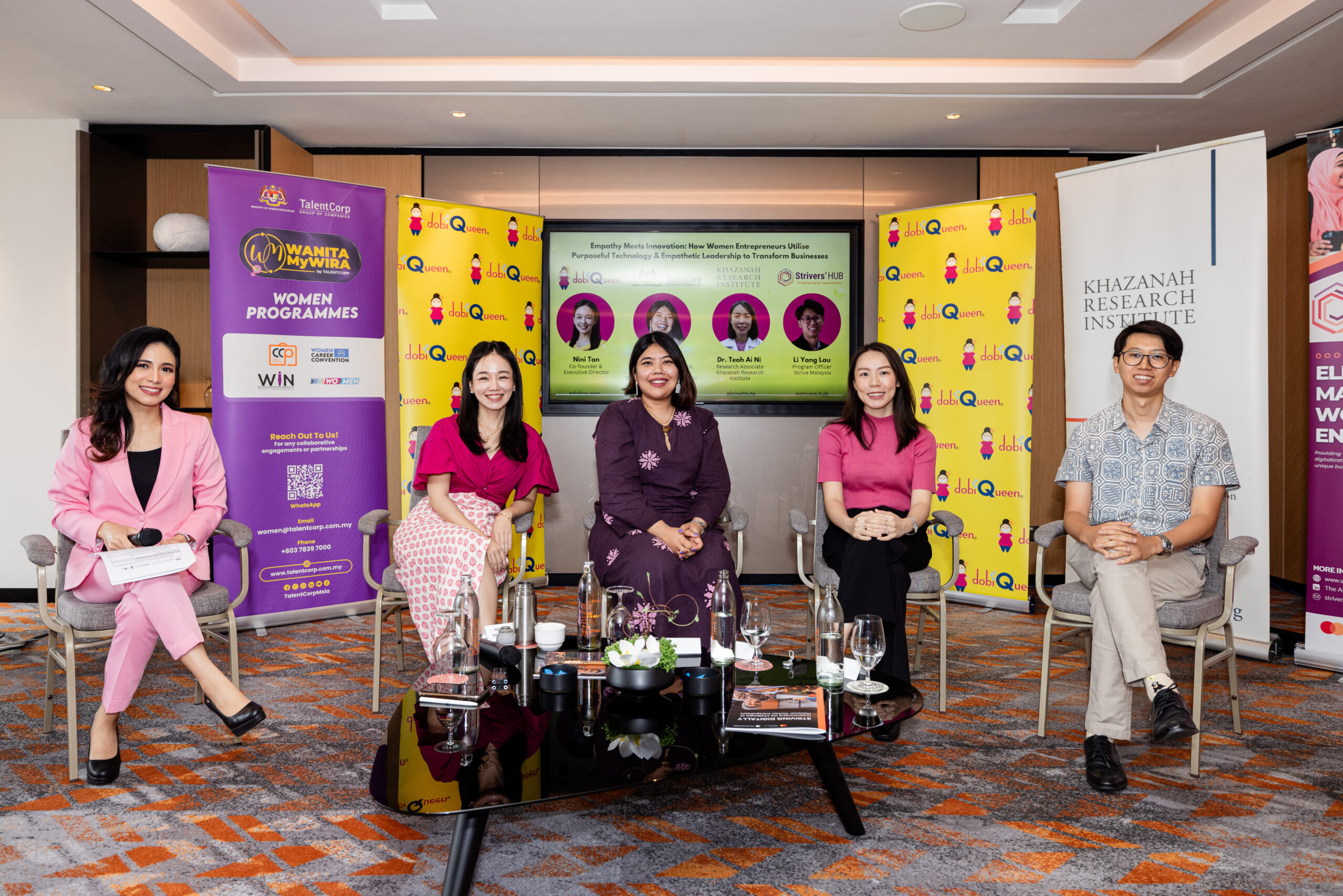
In an effort to bridge the gender gap and uplift MSWEs in Malaysia, leading self-service laundrette dobiQueen has recently organised an engaging panel discussion entitled, “Empathy Meets Innovation: How Women Entrepreneurs Utilise Purposeful Technology & Empathetic Leadership to Transform Businesses” with experts from the public and private sector, including TalentCorp’s Wanita MyWira, Khazanah Research Institute (KRI) and Strive Malaysia.
A study by Strive Malaysia has revealed that women entrepreneurs face three main challenges. Time poverty ranks tops with 97% citing juggling business, childcare, and household responsibilities as the biggest challenge. This is deeply rooted in gender norms, as women are often expected to be the primary caregivers in Malaysia’s social, cultural and religious contexts.
While over 80% of MSWEs acknowledge the potential advantages of digital literacy, and are able to search for information online via Facebook, Instagram, and TikTok, many use it for personal rather than for business purposes. There is a disconnect between digital literacy and entrepreneurial pursuits.
Lastly, only 50% of MSWEs expressed confidence in their financial knowledge and skill, limited to basic expenses of tracking income records, with many lacking understanding of broader financial concepts such as dynamic markets or funding applications. Of this, 78% expressed the need for more information from financial institutions in the areas of loan management, grants, and market information.
“This insightful report has since guided the development of targeted interventions to address the unique needs of women-owned and women-led businesses.
“We provide them with easy access to a free self-assessment tool, tailored skill-building training and microlearning resources, and mentorship opportunities, thus fostering a more enabling business ecosystem via Strivers’ Hub, a one-stop-shop digital platform designed to cater to the evolving needs of small businesses, particularly women entrepreneurs”, said Li Yang Lau, Program Officer at Strive Malaysia.
Women entrepreneurs are on the rise, with women-led businesses such as dobiQueen combining purposeful technology merged with its understanding of Malaysian households facing time poverty as they juggle work, childcare and household responsibilities.
Nini Tan, Co-founder and Executive Director of dobiQueen, shares, “As a small and medium-sized enterprise (SME), dobiQueen was founded 10 years ago with an empathetic mission to ease the burden of household chores.
“Women spend close to 63.6% more time daily on unpaid work than men, with women continuing to perform an additional 3.6 to 4 hours on average for unpaid chores after office hours, leading to the “double burden” or “second shift”.”
Both the private and public sectors have made many strides in uplifting women in society, with the Government allocating nearly RM470 million through the Budget 2025 to assist women-led entrepreneurs in Malaysia.
Natasha Alias, Head of Wanita MyWira at TalentCorp, said, “In 2024, the Ministry of Human Resources, through TalentCorp, introduced Wanita MyWira to address workforce gaps by enabling more women to participate fully in Malaysia’s economy. As the agency driving national talent strategies, we are committed to supporting women’s career journeys – from re-entry to leadership, and strengthening their long-term contribution to the workforce.”
“Wanita MyWira supports a broad spectrum of women – from students and returning professionals to entrepreneurs and industry leaders, through strategic advocacy, skills development, and employer engagement. The aim is to create real pathways into meaningful, sustainable employment.
“In 2025, we’re scaling our impact with targeted efforts. These include promoting tax incentives under the Career Comeback Programme (CCP), embedding diversity, equity and inclusion (DEI) practices within universities, and working with industry to expand job opportunities for women.
“With CCP tax exemptions and hiring incentives outlined in Budget 2024 and 2025, we’re driving outcomes that benefit both women and employers, and laying the groundwork for a more inclusive, resilient workforce.
TalentCorp is also developing the Gender Action Lab Report, which explores forward-looking models for workplace gender equality. Aligned with the UN Women’s Empowerment Principles, this effort reinforces the agency’s commitment to building a more equitable and progressive labour market for Malaysia.
Incorporating a broader view on women entrepreneurs in the marketplace, Dr Teoh Ai Ni, a Research Associate at Khazanah Research Institute (KRI), also shares about women-led participation as agri-food smallholders.
“Based on KRI’s gender gap research conducted among 3,300 agri-food smallholders, agri-food production has similar economic importance for both men and women smallholders, but women are more likely to face challenges.
“In the past, women’s roles in agri-food production tended to be invisible as they were often viewed as the ‘farmer’s wife,’ or the helping hand, rendering them as the ‘invisible farmers’.
“Over time, with significant progress in gender equality and the Government’s efforts in empowering women, women’s contributions to agriculture are increasingly recognised, but their representation remains low.
“This is partly due to the persistent gender-specific challenges women in agriculture face, such as gender stereotypes, the high burden of unpaid care and lower access to resources, that contribute to inequitable experiences.”
With technological advancement and digital adoption, agriculture is no longer as labour-intensive as before. This offers more opportunities for women who are deterred by gender stereotypes or inequality in access to information and resources to participate and strive in agrifood production, similarly to men.
However, more efforts are needed to close the gender inequality in resource access among women agrifood smallholders and address other challenges that generally limit women’s labour force participation, such as disproportionate care burden.
As Malaysia accelerates toward its 2033 goal of a 60% female LFPR, the momentum driven by women-led SMEs, public-private partnerships, and inclusive policy frameworks is undeniable.
Women are reshaping industries with empathy, innovation, and resilience. By addressing structural barriers and unlocking access to digital tools, financial literacy, and supportive ecosystems, Malaysia is not only empowering its women entrepreneurs but also charting a more inclusive, equitable, and prosperous economic future for all.