Tag: Islamic Finance

  • SC unveils initiatives to drive adoption of Masaqid al-Shariah Guidance in ICM

    SC unveils initiatives to drive adoption of Masaqid al-Shariah Guidance in ICM

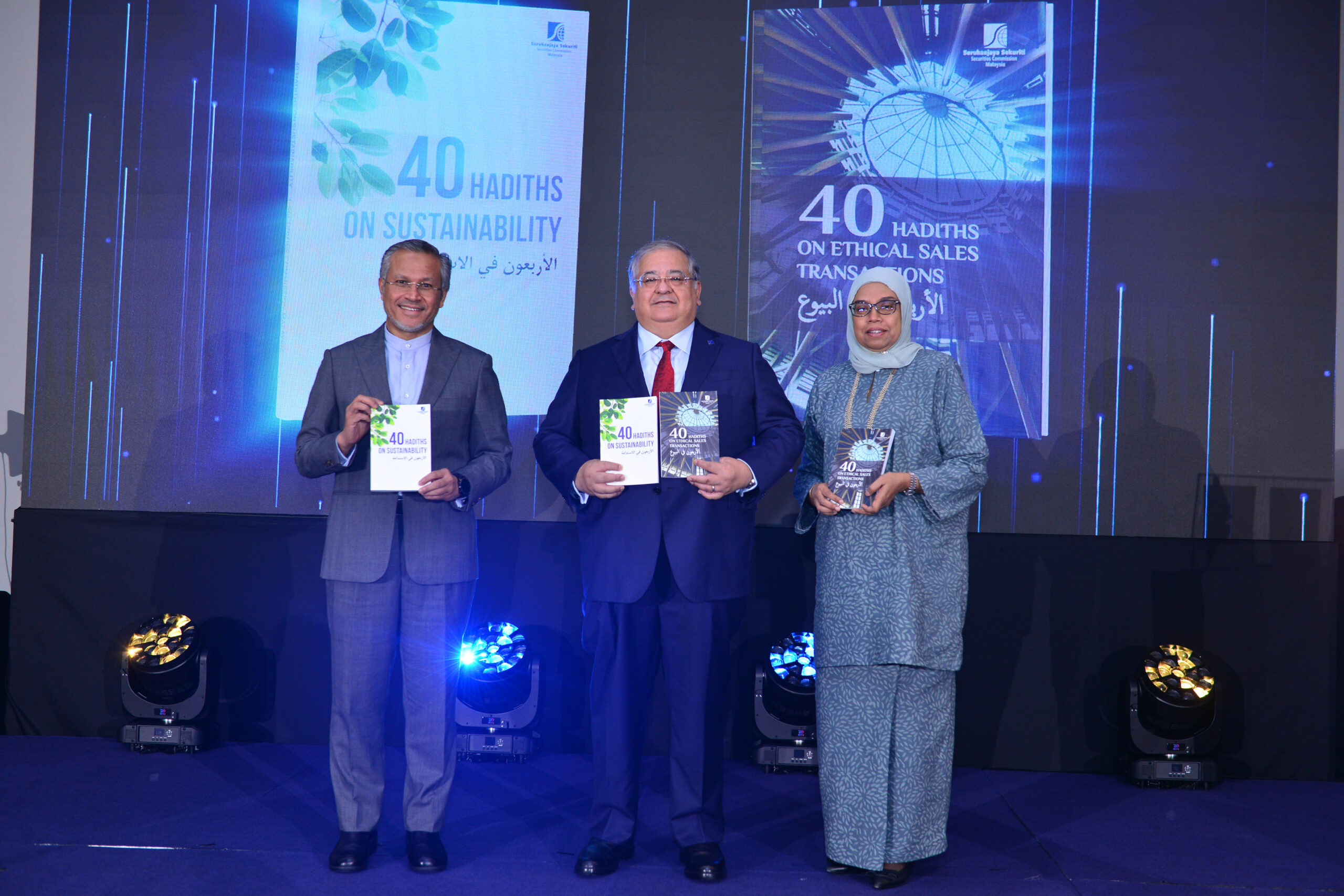
    The Securities Commission Malaysia (SC) today launched the 40 Hadiths book series on sustainability and ethical sales transactions to promote a deeper understanding of the Islamic perspective on sustainability and Islamic ethics in commercial transactions.

    The publications, launched during the 3rd SC Nadwah of Shariah Advisers in Islamic capital market (ICM) (SC Nadwah), aim to enhance industry awareness and practical implementation. They mark a significant milestone in raising industry awareness on embedding the principles of Maqasid al-Shariah Guidance (Guidance) in ICM, specifically in areas such as environmental stewardship, responsible business, and trade practices.

    The SC Chairman Dato’ Mohammad Faiz Azmi said internalising the Guidance encapsulated in these hadiths contributes to the development of a just, inclusive and sustainable economy.

    “More importantly, the SC is committed to making Maqasid al-Shariah a fundamental framework for business dealings in ICM,” he said. “The outcomes that we are witnessing today is one of the approaches towards ensuring Islamic financial products and services are designed and implemented in a way that promotes the welfare of society and the environment,’’ he added.

    The SC also announced the establishment of the Maqasid al-Shariah Task Force for ICM (MaTF), that will drive and streamline adoption of the Guidance across the Malaysian ICM. This includes identifying areas for strategic collaboration and innovation between regulatory bodies and industry players.

    Members of the task force include Bursa Malaysia Berhad, the Malaysian Association of Asset Managers (MAAM), the Federation of Investment Managers Malaysia (FIMM), Malaysian Investment Banking Association (MIBA), the Association of Islamic Banking and Financial Institutions Malaysia (AIBIM), the Islamic Banking and Finance Institute Malaysia (IBFIM), and the International Council of Islamic Finance Educators (ICIFE).

    Established in 2023, the SC Nadwah serves as a convening platform for intellectual discourse on applied Shariah knowledge sharing and charting the next wave of innovative Shariah solutions among Shariah advisers and market practitioners.

    This year’s SC Nadwah brought together over 200 stakeholders from the Shariah advisory ecosystem, including policy makers, government agencies, academia, Shariah advisers, State Islamic Religious Councils, State Mufti Departments and Islamic finance practitioners.

    Speakers were renowned industry leaders in the Islamic finance space. They include esteemed Shariah scholar Sheikh Dr. Nizam Yaquby and Chairman of SC’s Shariah Advisory Council Professor Dato’ Dr. Aznan Hasan. Sheikh Dr. Nizam Yaquby, who serves on more than 30 Shariah boards globally, including the Accounting and Auditing Organization for Islamic Financial Institutions (AAOIFI) and Islamic Development Bank (IDB), commended the SC’s efforts in organising the SC Nadwah.

    He said the SC should continue with this initiative, which he says is an invaluable platform for fostering strategic dialogue and knowledge-sharing in advancing Islamic finance and in facilitating the growth and readiness of the industry to navigate future challenges.

    The 40 Hadiths book series are now available for download at https://www.sc.com.my/resources/publications-and-research.
  • IFSB releases 13th edition of Islamic Financial Services Industry Stability Report

    IFSB releases 13th edition of Islamic Financial Services Industry Stability Report

    The Islamic Financial Services Board (IFSB) has released the 13th edition of its flagship Islamic Financial Services Industry (IFSI) Stability Report. This year’s report reflects a renewed momentum across the industry, with total global assets reaching USD 3.88 trillion in 2024—a 14.9% increase year-on-year.

    Themed “Navigating Shallow Waters: Addressing Structural Vulnerabilities and Shoring Up Resilience to Global Shocks,”, the report also observed broad-based growth across Islamic banking, ṣukūk, and Islamic insurance, signalling deepening market participation, growing global relevance, and broadening geographical reach.

    Key takeaways from the report includes:

    • Renewed growth momentum of the IFSI: High year-on-year growth across key sectors of the IFSI, registering double-digit growth rates. In 2024, total asset growth for the Islamic banking and Islamic insurance grew by 17.05% and 16.9% respectively, while sukuk issuances increased by 25.6%.
    • Emerging markets opening new frontiers: Africa and Central Asia posted the highest growth rates globally, representing important opportunities to deepen local financial markets and expanding the industry’s global footprint.
    • Financial soundness indicators remained broadly stable: Capital, leverage, liquidity, and asset quality positions in both the banking and insurance sectors remain broadly sound. This is reflecting the positive impact of strengthened regulatory frameworks, wider adoption of IFSB standards, and growing investor confidence.
    • While outlook remains positive, some structural vulnerabilities remain: The report underscores the need to address long-standing structural imbalances, particularly the underdevelopment of capital markets and insurance sectors, which can constrain the industry’s scalability and its ability to fully support investment, funding, and liquidity needs across sectors.
    • Critical need to address structural limitations in ṣukūk markets: A key conclusion of the report is the need to deepen ṣukūk markets, which plays a vital role in strengthening financial intermediation and supporting macro-financial stability. While 2024 saw a surge in ṣukūk issuance and growing issuer diversity, structural limitations remain, including underdeveloped market infrastructure, complex ṣukūk structures and limited local-currency sovereign issuances, investor concentration, and low trading volumes, among other factors. If unaddressed, these structural limitations may constrain the IFSI’s long-term growth and pose broader financial stability risks, while also affecting other segments of the industry that depend on capital markets to manage their funding, investment portfolios, and liquidity positions.

    The report further outlines a forward-looking set of policy priorities to address these limitations and unlock the potential growth of Islamic finance. It calls for coordinated action among regulators, policymakers, and industry stakeholders to address these challenges, to ensure the sound development of the Islamic financial services industry.

    First published in 2010, the IFSI Stability Report has become a key reference for global stakeholders, regulators, and market participants. It offers in-depth insights into industry trends, vulnerabilities, and evolving policy priorities shaping the future of Islamic finance.

    The IFSB Islamic Financial Services Industry Stability Report 2025 is now available at https://www.ifsb.org/wp-content/uploads/2025/05/IFSI-Stability-Report-May-2025.pdf.