
Tag: lhdn

  • Personal Tax Relief for 2022

    Personal Tax Relief for 2022

    Remember to take full advantage of the tax reliefs available in filing your personal tax returns in 2022.

    It is that time of the year where you need to fulfil your duty as a Malaysian individual if you are earning income.

    E-filing with the Inland Revenue Board of Malaysia (IRBM) will only be available from March 1, 2021 and you must ensure that you submit your filing by April 30, 2022.

    For individuals filing their tax returns, you have some personal reliefs that you can claim, such as personal tax relief, medical and insurance premiums paid during 2021.

    Additional relief is available to further reduce your tax burden for caring for your parents, spouse and children.

    Some changes were made to reduce some of the taxpayer’s financial burden and adjusting to life during the pandemic.

     LHDN-Tax-Relief-For-Resident-Individual
    Image from https://twitter.com/LHDNMofficial/status/1473529533391196160


    Tax reliefs for taking care of your parents

    Tax-Reliefs-for-Taking-Care-of-your-Parents.


    With a growing ageing population, many of us are required to care for our ageing parents.

    It can be a privilege to spend time with an older parent. However, it is also a huge responsibility and takes a lot of time, energy and money.

    If you are caring for an elderly or sick parent, you can get a tax break to help relieve some of your financial challenges.

    Effective from the Year of Assessment (YA) 2021, the deduction on the expenses incurred by an individual for the medical treatment, special needs and carer for his parents is increased to RM8,000, an increase of RM3,000 from the previous YA.

    The amount includes parents’ medical treatment, limited dental treatment such as tooth extraction, filling and scaling services as well as care services.

    Expenses for caregiving include nursing home or home caregivers, including cost of foreign hired caregivers with valid visas or special work permits.

    However, it shall not include tax payers and taxpayer’s spouse or children. Note that parents who are physically and mentally healthy who may receive such care do not qualify for this deduction.

    Note-on-claims


    Tax reliefs if you have children

    Tax-Reliefs-If-You-Have-Children.


    Having children is costly, and to reduce the financial burden will encourage better childcare.

    For each child below 18 years old, taxpayers can claim relief of RM2,000.

    For children above 18, the taxpayer can claim up to RM8,000, with the condition that the child is studying or serving under tutelage in a professional trade.

    In addition, if you have children up to age six who attend registered child care centres or kindergartens, you can claim relief of up to RM3,000 for the expenses incurred.

    Since YA 2017, to support mothers in breastfeeding their young children, breastfeeding mothers can claim relief for the purchase of breastfeeding equipment (such as breast pump kit, milk collection and storage and cooler bag) with proof of receipt.

    The relief is up to RM1,000 allowed in total and only claimable once every two years.

    One special tax relief that parents should consider is savings for their children in the Skim Simpanan Pendidikan 1Malaysia (SSPN) account.

    While the child reliefs mentioned earlier can only be claimed by one parent, the relief of up to RM8,000 for savings in SSPN can be claimed by both parents for their respective contributions.

    This is provided that each parent has contributed a net deposit of the claimed amount, even for the same child. This relief has been extended a few times, and the latest extension is to YA 2022.

    Fun-fact-SSPN


    Reliefs available for self

    Regardless if you have any such dependents or expenses, you are entitled to RM9,000 relief where evidence of expenses incurred is not required.

    However, for the rest of the reliefs, you are required to provide supporting records.

    Tax-Reliefs-Available-For-Self


    Disabilities

    To provide further support for those with disabilities, the government has granted added reliefs for the taxpayers.

    Tax-reliefs-disabilities


    Except for the purchase of equipment for disabled use, the rest of the reliefs given do not require proof of expenses incurred.

    ******************

    That summarises the reliefs you can claim in filing for your individual tax return this year based on the latest personal tax filing information updated by the IRBM on January 20, 2022.

    Remember to keep all receipts and supporting records where applicable for seven years, which you will need to produce in the event that the IRBM wants to do a tax audit on you.

  • Tax Obligations For Self-Employed Entrepreneurs

    Tax Obligations For Self-Employed Entrepreneurs

    With the rise of self-employed entrepreneurs, here are some tax compliance obligations and common oversights.

    There has been a dramatic growth in recent years on the number of self-employed entrepreneurs in Malaysia. From 2017 to 2018 alone, this number increased from 2.57 million to 2.86 million, an increase of 11.3% (source: Department of Statistics, Malaysia). In 2018, the self-employed are the second largest category (19.3%) in the Malaysian workforce out of a total of 14.8 million working adults.

    Malaysia adopts a self-assessment system where taxpayers are responsible to determine their own tax liability and to submit their tax returns accordingly. As the number of self-employed entrepreneurs continues to grow in the Covid-19 economy, it is important for the self-employed to be aware of one’s tax obligations especially in the area of tax compliance. Failure to do so could result in penalties and additional tax payable.

    A self-employed person is an independent contractor or a sole proprietor. The self-employed consists of sub-contractors working in the trades or construction sectors to professionals such as doctors, lawyers, accountants, engineers, and management consultants. Recent iterations include freelancers working in the commonly named “gig economy” (such as e-hailing drivers).

    Here are some tax compliance obligations a self-employed individual should take note of:

    1. Registration of Tax Identification Number (TIN) and submission of tax return

    A self-employed individual should register for a TIN when the person has taxable income which exceeds a threshold of approximately RM28,000 per annum. A TIN can be registered at the nearest Inland Revenue Branch (IRB) branch or via e-Daftar at the IRB website.

    For entrepreneurs running a business, the income tax return (Form B) will need to be submitted by 30 June the following year (eg. Form B for the year of assessment 2020 is due by 30 June 2021*extended to 30 September 2021 due to Government movement control, IRB website)

    2. Estimate of Tax Payable

    Under the Malaysian tax regime, a taxpayer pays income taxes on a “Pay-As-You-Earn” basis. Where an individual taxpayer receives other than employment income, the IRB may issue a Form CP500 setting out the estimate of tax payable under an instalment scheme. The Form CP500 is determined based on the tax liability of the previous year. What should you take note of:

    • The tax estimate is six (6) bi-monthly instalments commencing from the month of March every year.
    • Each tax instalment payment needs to be made within 30 days from the due date.
    • The remittance slip (Form CP501) should be submitted together with the instalment payment.
    • Should there be a need to revise the tax estimate which affects the instalment amount, you must submit Form CP502 to the IRB not later than 30 June each year on the revision payments. The IRB will issue a Form CP503 if the application is successful.
    • The penalty for late payment of 10% shall be imposed on the unpaid amount if the tax instalment payment has not been paid within 30 days from the due date.
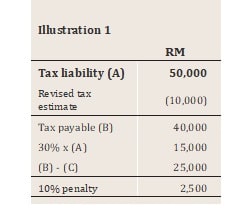
    • Where there is a difference between the revised tax estimate submitted and the final tax liability which exceeds 30% of the tax payable, the difference will be subject to a penalty of 10%.

    The following illustration shows the impact when an estimate of tax payable is inaccurate.

    3.Employer’s Responsibilities

    As an entrepreneur, you might hire employees to expand your business. In this case, you will be considered as an Employer for tax purposes. The responsibilities of an Employer are as follows:

    • The Employer is to inform IRB of any new employees within one month from the date of commencement of employment.
    • Submission of Return of Remuneration by an Employer (Form E) to the IRB on or before 31 March each year. <continues…>

    [ You may read the full article HERE ]
