In this day and age, we have come to depend greatly on air conditioner to cool down the environment, especially our offices and homes. Especially in this hot weather, it seems like we have to turn it on more often than not – the entire time we are working and while we are in the comfort of our homes.
This will ultimately cause our electricity bill to be on the high side, and it is also not good for the environment as well. Smart Investor interviewed Brice Degeyter, General Manager of Bizsu, to find out more about their mission to help company’s save energy and costs.
Brice Degeyter, General Manager of Bizsu
Smart Investor: What is Bizsu and what are you set out to do?
Brice Degeyter: I founded Bizsu in 2019 to help make decarbonization easy for businesses. We do this by helping companies cut down very simply what consumes 60% of a company’s energy and operating costs on electricity: Air Conditioning (AC).
The truth is AC units have become an essential part of modern life, but this simple refrigeration technology has remained relatively unchanged since its creation in the 1920s. As climate change effects like rising temperatures and heat waves encourage more AC use, the increase in energy needed to cool us down could easily accelerate climate change.
So therefore, any effort on cutting down air cond bills, can also help save the planet!
SI: How does your product work to reduce air conditioning bills?
BD: Our product helps users save on average around 25% in energy consumption using a patented natural ceramic air conditioning filter technology.
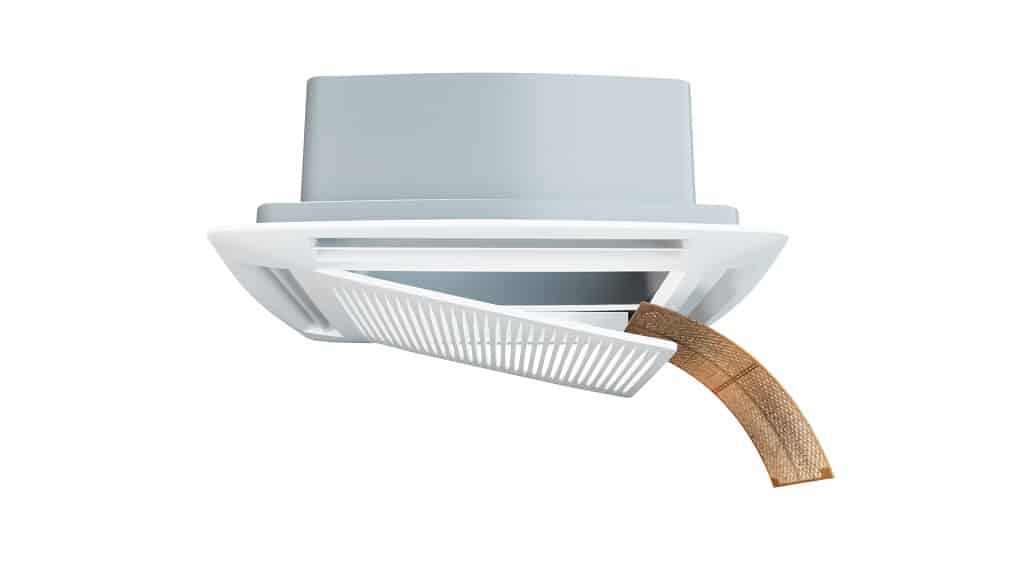
It’s really based on physics and how air conditioning works. In the traditional air conditioner that we have at home, the air is sucked in at the top, goes through the aircon unit, and then comes back down to cool a room. The air that is sucked contains moisture. We then insert our Bizsu net inside the unit.
This breaks down the air water molecules going out of the aircon. This way, the surface area of the room is covered faster, so the AC stops faster. So you end up using less energy, and that means lower electricity bills.
We have done lab tests and recorded, on average, 25%, consistently. Variables include the type of air conditioning unit, the type of room, and how the thermostat is set up, as well as the function of the room. Data centres for example, may require higher cooling compared to an office or university lecture hall, and the savings, therefore, may be quite different – with savings of anything from 8% to 50%.
We’ve seen similar results from on-site installations at client sites as well.
SI: What is your customer base currently?
BD: We currently work with around 35 large companies. We have been securing between two to four new clients every month – and of late, it’s been more like two new clients every week.
Today, more companies come to us instead of us reaching out to them which was the case two years ago. Most of our business today has been through referrals – or word of mouth – as our clients see the savings in their energy consumption bills almost immediately.
SI: How has your revenue growth been since starting out?
BD: We’ve been growing by roughly 10X every year since the beginning, so 1,000% over the past 3 years. We are targeting to end 2023 at around RM7 million in revenue.
SI: Can this innovative product be installed only in new HVACs? Is there an optimum size for 25% energy efficiency to be realised?
Our solution can work on any type and any size of air conditioner. Variables include the type of air conditioning unit, the type of room, and how the thermostat is set up as well as the design and function of the room.
SI: Are there particular industries / building types that would easily benefit from this? Can they run a pilot?
BD: Absolutely! We now work with many large real estate companies. We joined the Capital Land Sustainability Challenge two years ago and from this we did a pilot of our solution in some of their buildings which gave them 51% savings in their electricity costs. They called us “magicians” and we have been implementing our nets in more buildings.
We hope to work with more real estate developers and real estate owners as well – particularly to run a proof of concept in Malaysia in the next few months. A pilot might start at around RM10,000 which is relatively cheap just to start with, and depending on the size of the floor or room that the company has, they can easily recognise savings in the millions.
We have the capacity to equip around 10 big buildings every month – from data centres, offices, hotels, warehouses, learning institutions and more. So the installation work is quite efficient as well without disruption to the business operations. We can complete a 30-floor office building in one day.
That said, gaining customer trust is very, very crucial. At the beginning there were just very few people who thought that something this simple could save 25% on energy bills and with a 20 year warranty sounded too good to be true. But our customers have proven that it is!
SI: How easy is it to install and maintain this new technology? What’s the warranty period?
BD: No modifications are required for the AC unit or for electricity to be switched off during installation. Bizsu’s CONTINEWM® Nets can be installed above the filter at the air return of the AC unit and it is ready for use.
We recommend dusting off the nets with a dry cloth whenever your AC servicing takes place. Best of all, CONTINEWM® has a 20-year warranty.
SI: How are you expanding into Malaysia and how is the Malaysian Research Accelerator for Technology and Innovation (MRANTI) assisting you in this regard?
BD: MRANTI has helped us raise product awareness and introduce us to prospective clients and bigger companies in Malaysia. Having a government agency supporting us through this programme helps open doors.
Right now we are present in Malaysia, we are present in Singapore and we are focused as well in Taiwan.
Main funding sources and funding rounds
In terms of funding, we mainly talk to angel investors or family offices who can really help us grow in a country or in various countries. We raised a pre-seed of RM1 million, now we’re raising seed of RM1.8 million by Q3 this year.
We are already profitable as of today, and the goal is to stay there. The goal is just to keep increasing the number of clients that we can serve and remain profitable.
SI: What are some key growth opportunities and challenges ahead?
BD: We have an objective to help our clients save 1,000,000 tonnes of CO2 within the next five years. We have just started acquiring customers and the potential is huge as we can serve many sectors – real estate, hospitals, schools, hotels, data centres, residential complexes, malls and more!
The transportation sector is an area we are potentially exploring. How cool would it be if we can have it in the metro trains, buses, cars, including in electric vehicles! I believe there will be more climate-friendly solutions in our hands that help us have a much bigger impact than what we can do today.
SI: Tell us about the Hummingbird in your logo?
BD: One day, there was a fire in the forest. And all of them but the hummingbird leave the forest. Instead, he goes and picks up a drop of water in the lake and drops it into the fire. All the animals look and ask: “What are you doing? You really think you’re going to stop the fire just on your own?” The Hummingbird says, “No, but at least I do my part.”
Bizsu’s goal is to do our part in decarbonising the economy and reducing the impact of climate change. What we will do in five years will be towards this, trying to do more. I believe there will be more solutions that help us have a much bigger impact than what we can do today.
What will that be, exactly? The future can only tell.
There are signs of recovery in the Malaysian property sector. And the fact that the Overnight Policy Rate (OPR) is set to increase again later this year to the same level as pre-Covid, we should see a sense of normalcy returning soon.
Smart Investor got in touch with Joanna Ling, CEO of PE Holdings, to find out more about the property industry.
Joanna Ling, CEO of PE HoldingsSmart Investor: Post-Covid, what are the challenges being faced by property developers?
Joanna Ling: Covid changed the industry significantly. Due to the low-interest rate environment and the work-from-home phenomenon, it created an unprecedented need for people to have their own property.
Post-covid, we have seen enthusiasm dampen and return to normal pre-covid levels. The rising inflation environment has affected spending power, and buyers are more price sensitive.
SI: What are the different approaches to selling property as compared to previously?
JL: Social media has become an indispensable tool in selling property since Covid when show units were rendered useless. Therefore, technology that helps developers showcase their products online became valuable. There are even developers selling property on Tik Tok!
SI: How does the increase in OPR affect the property market?
JL: Every time Bank Negara Malaysia announces an increase in interest rates, sales would temporarily halt for a while but inevitably increase again. The truth is that interest rates are right back where they were before Covid, and Malaysia is very fortunate that interest rates have not increased at a crazy rate like some other countries.
SI: What is the market outlook for property in the short-term (6 months), medium-term (1-3 years) and long-term (5-10 years)?
JL: In the short term, property prices in Malaysia will likely remain the same but you will see more affordable products coming into the market such as smaller units and affordable housing schemes. In the medium term, should interest rates continue to rise, property prices would likely adjust slightly lower in areas of lower demand.
However, Malaysia is a place which has shown continuous growth thus over the long term capital appreciation should steadily increase.
SI: What do you mean by sustainable development?
JL: Sustainable developments in my definition means properties that minimises negative environmental impacts and enhances the way one lives.
SI: What initiatives have you implemented or will be implemented in future projects?
JL: All our developments are designed with sustainability in mind. Our shopping mall Design Village Outlet Mall, is designed to embrace shopping within a park. Extensive landscaping has been utilised to lower ambient temperature, even the air-conditioning is a more environmentally friendly VRV system, and we are in the process of installing solar panels in the car park.
Our latest residential development Anggun in Batu Kawan Penang, is built to Green Building Index standards. We have installed a smart rubbish disposal system. This vacuum system transports the rubbish to a central depository that removes all water and compacts the rubbish into easily disposable blocks that will eliminate smells and wastewater and ultimately result in a cleaner, healthier, more pleasant living environment.
SI: What are some of the benefits/impacts of sustainable development?
JL: When done right, the benefits of a sustainable development should ripple and positively affect the developer, the buyer, the community, and the environment. It is an investment into the right way to live while thinking of one’s surroundings and other stakeholders.
Ultimately the most immediate effect to the buyer is that the development will be a more comfortable environment to live in the long term.
SI: Does embracing ESG will cause a hike in the price of the property?
JL: It will in the short term because the elements that go into sustainable development are, for now, much more expensive than conventional construction methods. For example, the smart rubbish system costs millions more than conventional disposal methods. But it results in a way of living that is cleaner, healthier, and ultimately more cost-effective as it will be energy efficient.
Eventually when the markets come to expect to live better and nouveau construction elements such as double glazed glass and sustainable construction and materials, the price of these elements will come down or all developments will embrace these methods and prices will balance out.
SI: Is the co-living concept accepted by Malaysians? What are the benefits?
JL: Co-living has been around in rural Malaysia for a long time. In Sabah and Sarawak, the indigenous tribes live in long houses, a perfect example of successful co-living. Each family has their own private quarters, but all other activities, such as eating, cooking and socialises, are all done in communal areas within longhouses.
The co-living concept in this day and age refers to urban dwelling to save space and cost in high density areas. The benefits are that it is more affordable and provides a social community that looks out for each other, much like the rural concept of ‘kampung’ community.
SI: Who is the target audience for co-living? And why do they choose co-living?
JL: In this modern format, the target audience for co-living is very much young millennials early in their careers who want to live near where they work in urban high-density areas. As young people starting out in anew city, co-living is a good way to meet new people and have a community while saving money on rent by sacrificing space.
SI: Do you think the market for co-living concepts will increase in the near future? Why is that so?
JL: Co-living will become more common as land becomes scarce and it gets more and more expensive in city centres. In high-density cities such as Hong Kong and Singapore, where rents for apartments have soared, more and more apartment blocks have been converted to co-living spaces. This satisfies the tenant by offering smaller space at a lower rent and generating a higher yield for the landlord.
In the UK, where rents are expensive, houses are converted into HMOs (houses of multiple occupancy), a version of co-living. However, rents in Malaysia remain low and thus reasonably affordable, so it may be a while before the co-living concept catches on. We will just see smaller studio or one-bedroom units in the immediate term.
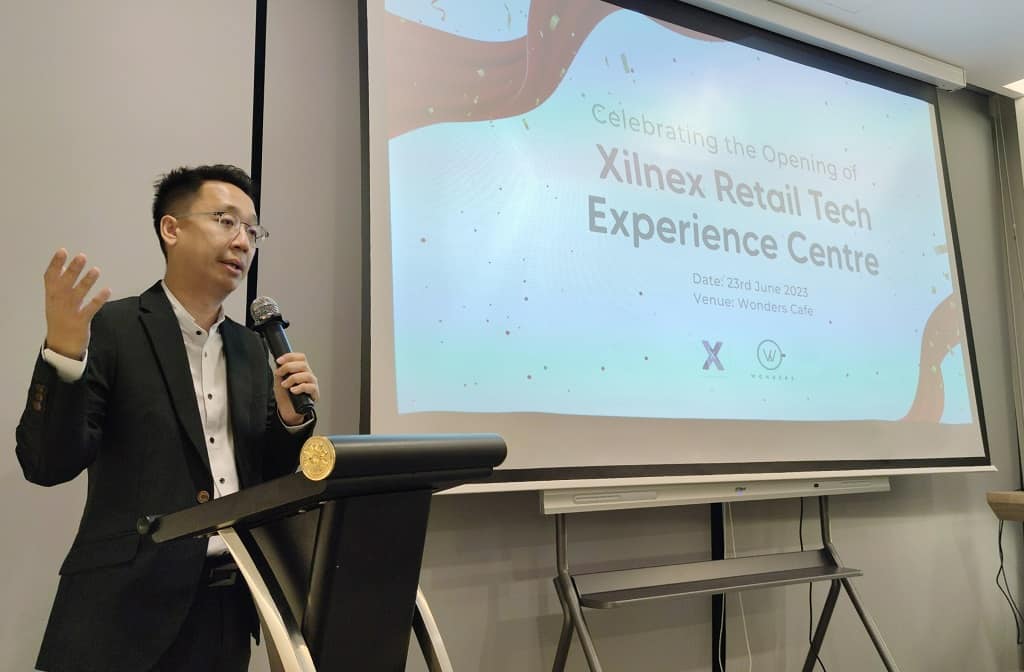
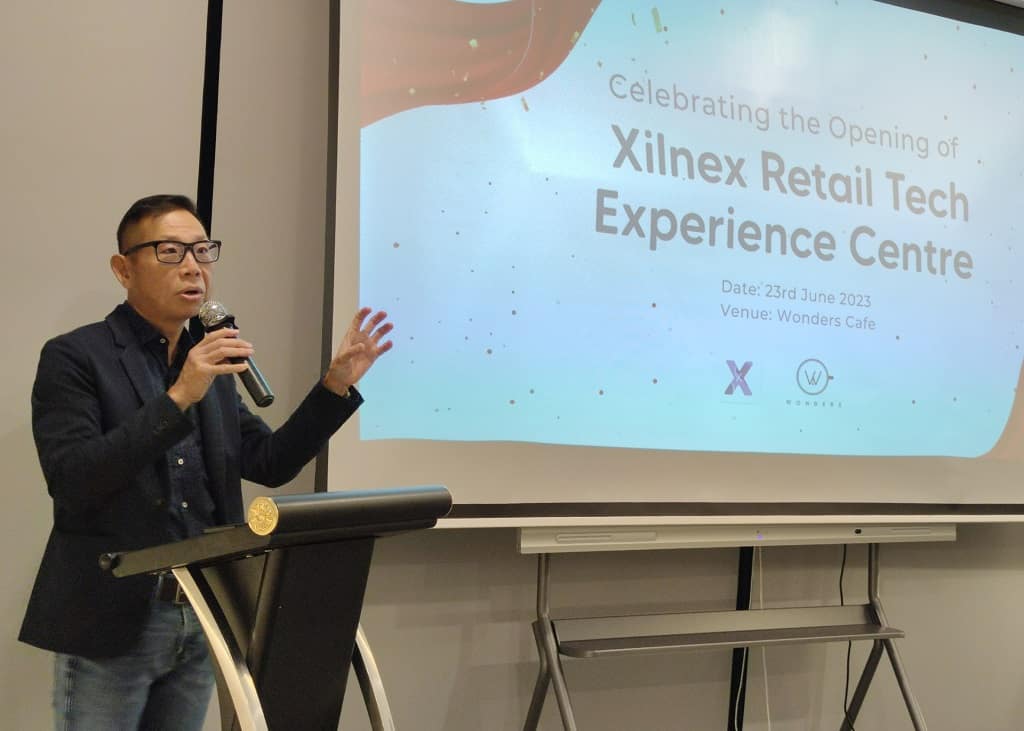
Cloud-based retail management software company, Web Bytes Sdn Bhd, today announced that it has launched the Xilnex Retail Tech Experience Center in Malaysia within its own café named ‘Wonders’. The Center showcases a comprehensive suite of Xilnex retail solutions for brick-and-mortar shops, while offering a fully functional café experience to visitors.
Ooi Boon Sheng, CEO of Web Bytes Sdn Bhd said, “By having a tech experience center installed within a real-life café and retail shop, retailers can witness the power of Xilnex’s retail solutions in action and this can provide them with the firsthand experience of leveraging the right technology towards transforming their retail business, also supporting the growing trend of hybrid stores that combine shopping and dining. In addition, we will use the Center to pilot and validate new customer experience (CX) models as well as use it as a testbed for our new retail technologies, to develop practical real-world applications and use cases”.
Ooi Boon Sheng, CEO of Web Bytes Sdn Bhd explaining how the Retail Tech Experience Center is the first of its kind in Malaysia
Located at PJ Midtown, the Retail Tech Experience Centre is designed to offer retailers an immersive experience where they can interact with Xilnex’s latest technologies in a real retail environment, beyond just simulations or mock demos. Deployed within Wonders Café are a range of Xilnex’s flagship solutions specifically for food and beverage (F&B) retailers such as the Xilnex Self-service Ordering Kiosk, Xilnex iPad POS, Xilnex Restaurant Queue Management System, Xilnex Kitchen Display System and the Xilnex Live Rack, which is an automated food pickup smart rack with built on sensors, to ensure a seamless prepare and serve experience from kitchen to customer.
Also showcased are retail tech innovations such as the Xilnex Self-checkout Kiosk and the Xilnex Live Display, a retail shelf with a built-in RFID reader that offers an interactive and informative experience, enabling shoppers to access detailed information about products on a hi-fidelity screen simply by scanning the RFID tags.
Ken Phua, Deputy President of Malaysia Retailer Chain Association sharing insights on the retail market in Malaysia
Malaysia Retail Chain Association Deputy President, Ken Phua commended Web Bytes for their innovative approach of having a tech experience center for retailers integrated with its own fully operational retail store and café, as this not only underscores Web Bytes’ commitment to understand the needs and challenges faced by retailers but also serves as a catalyst to empower retailers to embrace new technologies, enabling them to thrive in an ever-evolving and demanding retail landscape.
The Retail Tech Experience Center also houses a fully equipped conference room to facilitate training sessions, workshops, and seminars, to help Web Bytes’ retailer customers and partners enhance their understanding of Xilnex’s solutions and leverage the latest technologies of predictive analytics, artificial intelligence, innovative payment channels and more.
Ooi added, “Growing together with our customers is at the heart of our philosophy. We see ourselves as more than just a software and service provider; we strive to be a trusted advisor and strategic ally. We will continue to invest in enhancing our solutions and services, aligning them with the ever-evolving demands of the industry”.
Web Bytes’ retailer customers include food and beverage brands like ZUS Coffee, Gigi Coffee, Tacobell. Bubble Bee as well as retailers like The Body Shop, Eco-Shop and Sunway MultiCare Pharmacy. Xilnex’s POS solutions are also used in all international airports in Malaysia.
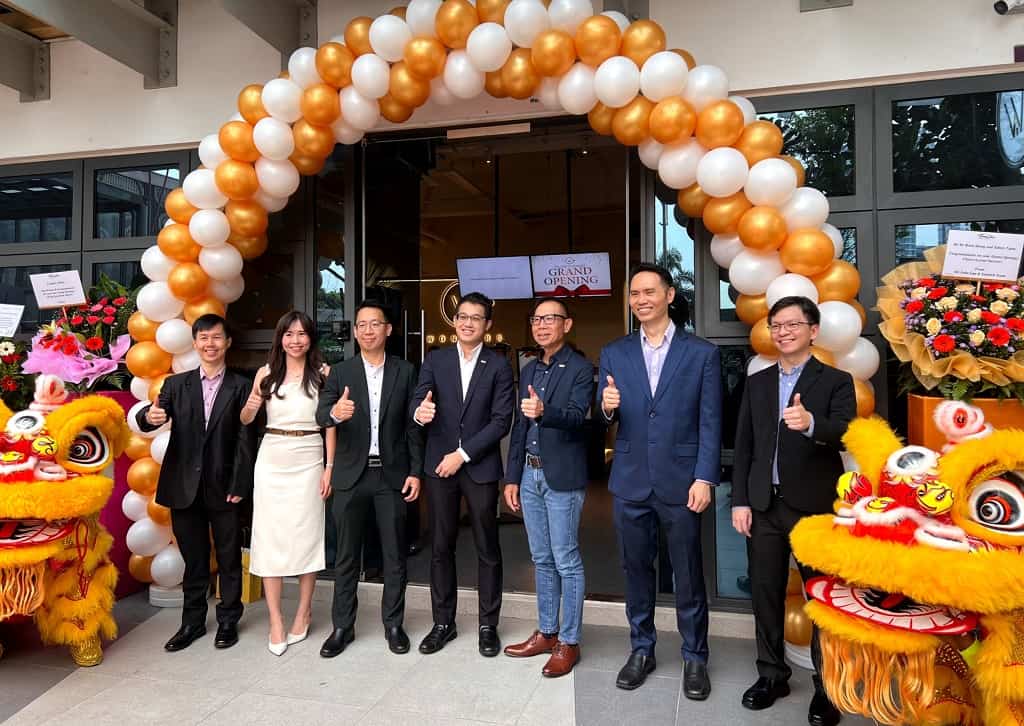
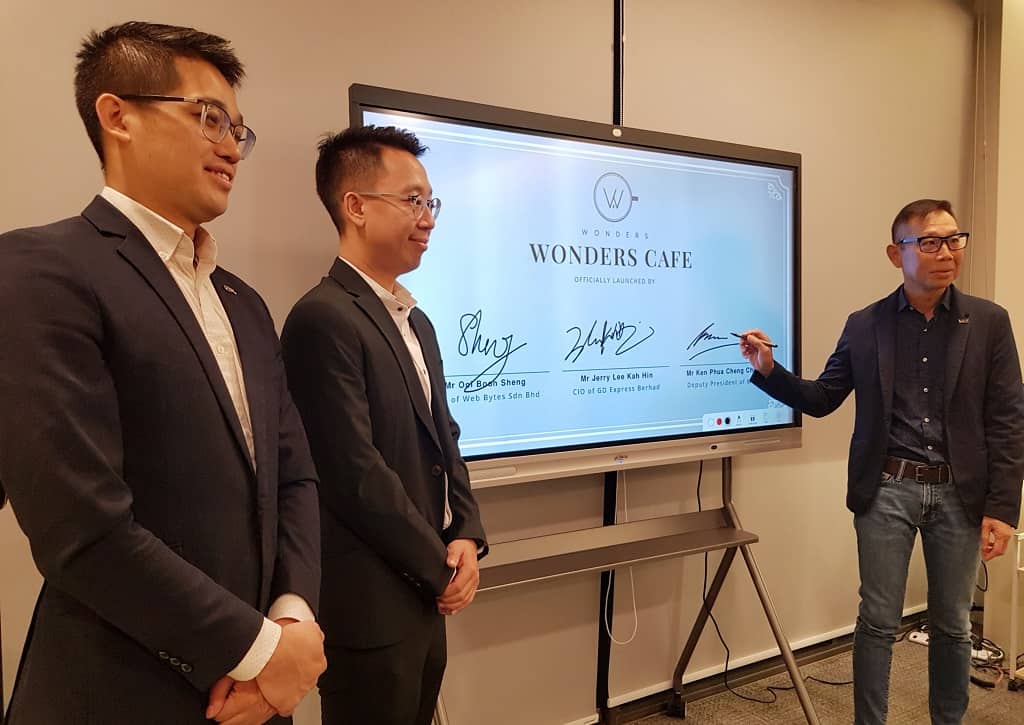
Officiating the launch of Xilnex Retail Tech Experience Center (from L-R): with Lee Kah Hin Jerry, Chief Investment Officer of GD Express Bhd; Ken Phua, Deputy President of MRCA and Ooi Boon Sheng, CEO of Web Bytes Sdn Bhd
About Xilnex and Web Bytes Sdn Bhd
Web Bytes Sdn Bhd, a software development company that is 38% owned by GD Express Carrier Bhd (GDeX), specializes in software solutions for retail and food and beverage industries. The company’s core product is Xilnex, a cloud-based, point-of-sales (POS) retail management solution. Since 2015, Xilnex has expanded its presence beyond Malaysia to Singapore, Indonesia, Cambodia, Vietnam, Canada and Australia.www.xilnex.com
About Wonders Café and Xilnex Retail Tech Experience Center
Wonders Café was first conceptualized more than ten years ago as an imaginary café to serve as a testbed for Xilnex POS solutions. Throughout the years, the imaginary retail shop has served as a valuable tool to enable hundreds of software engineers at Web Bytes to develop and test Xilnex software solutions. Today, Wonders Café has materialized to become a real brick-and-mortar café and retail store while functioning as a Retail Tech Experience Center, to showcase Xilnex latest technologies in a real retail environment. With a tagline of ‘Crafting Wonders’, the café and Retail Tech Experience Center will continue to serve as a sandbox for Xilnex new retail technologies including artificial intelligence, predictive analysis, advanced payment solutions and more. www.wonders.my
The “equity risk premium” could stake a claim to being the most important number in investment. There are different ways to measure it but conceptually they all come down to the same thing: assessing the return pickup from investing in equities compared with bonds.
In general terms a risk premium can be thought of as a measure of the additional return that investors demand or expect for taking on a particular kind of risk, relative to some alternative. Other examples include a credit risk premium, for corporate bonds compared with government bonds, or an illiquidity premium, for illiquid private assets compared with more easily tradable public assets.
These assets are the core building blocks for the vast majority of portfolios, most famously in the classical 60% equity/40% bond portfolio. Their valuations and outlooks also have a bearing on most other asset classes, including private assets. That’s why it matters so much.
The Rationale
Buy a bond and hold it until it matures, and you know what you will get back. Invest in equities and the range of outcomes is wide. You could make a lot of money, but you could lose a lot. Equities have to have a higher expected return to compensate investors for taking on this risk. Otherwise, why bother? And the “equity risk premium “is one way to assess this extra payback.
If it’s high, and you have conviction, it can be an argument for allocating more to equities and less to bonds, and vice-versa.
Importantly, this is all about expectations. There is no way of knowing how equities or bonds will perform until it happens. You can balance the probabilities in your favour but just because you expect equities to do better doesn’t mean they will. Risk means more things can happen than will. That risk is the price of the entry ticket to the equity market.
In this article we look at three of the most popular ways of assessing the equity risk premium and what they say about the prospects for equities compared with bonds today:
The historical approach
The simple approach
The “what’s priced in” approach
We focus on the US for reasons of data availability but also provide some comparisons with Europe and the UK.
The Historical Approach
This looks at the past performance of equities compared with bonds over a long-time horizon. And, with disregard for compliance disclaimers, uses this as an estimate of what they might be expected to earn in in future.
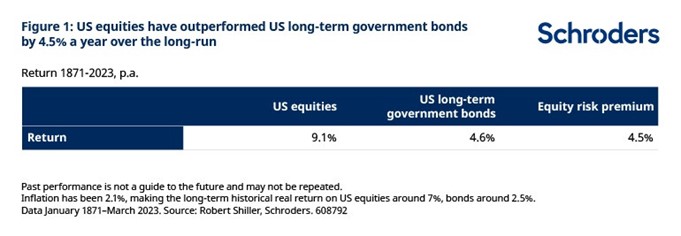
For example, US equities have outperformed long-term US government bonds by 4.5% since the year 1871 (to March 2023), a 152-year period covering wars, depressions, booms, busts, and everything in between.
Adherents to this approach would plug a figure of 4.5% into their asset allocation models, for the assumed outperformance of equities over.
Two challenges with this approach are (1) the answer you get depends on the length of history you are able to analyse and (2) by being backward looking, it is insensitive to whether equities or bonds have better prospects at this point in time.
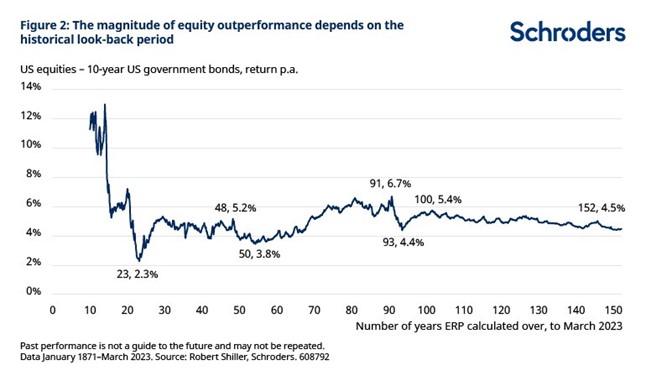
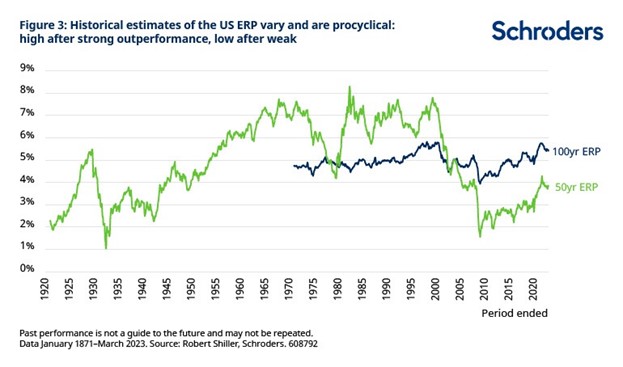
On the first of these, Figure 2 highlights the significant variability in the historical estimate of the ERP, depending on how far back you look. It could be as low as 2.3% (over the last 23 years) or as high as 6.7% (over the past 91 years). Even a difference of a few years could make a big impact if those years cover big market moves.
Plugging 2.3% or 6.7% into an asset allocation model would result in a very different equity/bond split than if 4.5% was used. The length of history available to analyse isn’t always within your control. Not all markets have such a long time series as the US, especially emerging markets. This makes any historical estimate of the ERP hostage to data availability. And, as shown above, that roll of the dice can yield very different results.
The issue about ignoring relative valuations is potentially even bigger. Under this approach, periods of very strong outperformance leads to a higher estimate of the ERP. In the 50 years to 31 December 1999, US equities had outperformed bonds by 7.6% a year. In the 100 years to that date outperformance was 5.8% a year. Both were close to their all-time highs (Figure 3) and would have resulted in elevated equity allocations if used as an input to asset allocation modelling.
This was just before the Dotcom crash, when equity valuations were at record levels of expensiveness and 10-year Treasuries yielded more than 6%. Equities went on to underperform bonds by 7.4% a year in the 10 years which followed (a period made to look worse by the Global Financial Crisis but, even prior to that, equities were underperforming bonds by more than 3% a year)
Using the historical average may seem like the easy way out but it is not necessarily helpful for deciding on asset allocation. The next two approaches attempt to overcome this shortcoming.
The Simple Approach: The Yield-Gap
An easy to calculate, and hence popular, approach to assessing the relative prospects for equities and bonds is to compare the earnings yield on the equity market (the inverse of the price/earnings multiple) with the yield on the 10-year Treasury. When the earnings yield is high relative to bond yields, this approach argues that equities are cheap relative to bonds, and hence more appealing. The opposite is also true.
This is sometimes referred to as “the Fed model” even though it has never been officially endorsed by the Federal Reserve. A variant compares the earnings yield with the real yield on 10-year Treasury inflation-protected securities (TIPS). Another compares it with Treasury bills/cash. The current conclusions (discussed later) are the same whichever approach you take.
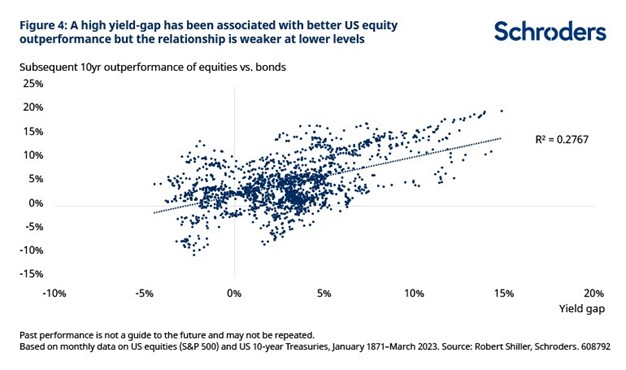
The yield-gap’s historical track record of providing insight on the future difference in equity and bond returns is mixed (Figure 4). Over the very long-term, there has been a positive relationship between the yield-gap and subsequent returns on a 10-year horizon. Periods when it has been high have been more likely to be followed by periods of stronger long-term outperformance from equities over bonds.
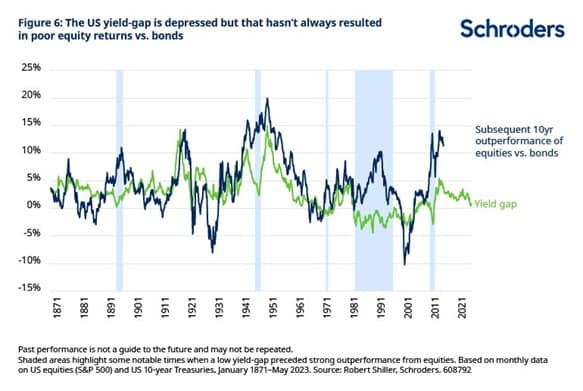
The relationship is much weaker when the yield-gap has been closer to zero or negative. There are lots of instances when a low or negative yield-gap has preceded a period of very strong performance from equities, most obviously the 1980s and 1990s (Figure 6).
There are two main reasons why this indicator can underestimate equity prospects. First, it ignores the earnings growth and dividend income components of equity returns. Second, and harder to estimate, even if equity valuations are expensive, that doesn’t mean they can’t become even more so, boosting returns in the process.
When we look back over historical periods when equities have done well from the starting point of a low yield-gap, a near-condition has been real earnings growth. In many such cases, valuations have fallen but equities have still done much better than bonds – because of strong real earnings growth. It has been more of a rarity for real earnings growth to be negative but valuations ride to the rescue.
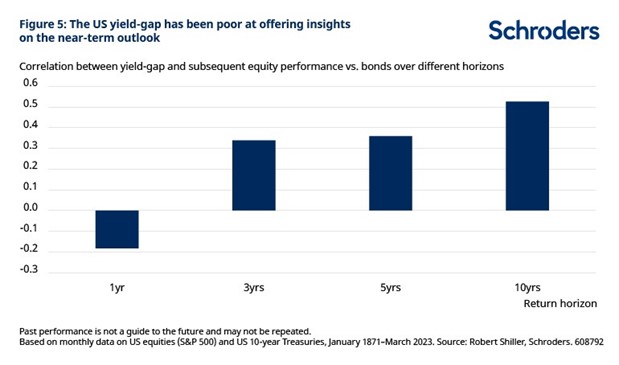
The strength of this relationship also weakens as the investment horizon shortens (Figure 5). It has not been helpful in giving a steer on short-term market movements.
How Should We Interpret The Current Reading?
The yield gap approach can add some value to setting strategic asset allocation, but almost none for tactical.
It has fallen to a depressed level of only 0.6%. This has been driven by bond markets repricing much faster and further than equities. Since December 2021, the 10-year Treasury yield has risen by 2.2%, from around 1.5% to 3.7%. The equity earnings yield has only risen by 0.1%, from 4.2% to 4.3%.
Real yields on 10-year TIPS have risen by slightly more, and cash rates have risen by more than 5%, so the broad conclusions are similar if we calculate the yield-gap using real yields or cash rates.
The TINA trade – There Is No Alternative – was a popular rationale for strong equity performance in the low-interest rate environment. But now there is an alternative. Bond yields are dramatically higher. Cash has also become a more viable alternative, with US cash rates now exceeding bond and equity yields – albeit bonds deliver a yield over a longer time horizon whereas cash rates are unlikely to stay at current levels for such a prolonged period.
This doesn’t have to mean that US equities will struggle versus bonds. Earnings could grow strongly, or valuations rise further. But, with corporate profit margins and equity valuations both still elevated, both face headwinds.
Although US equities cannot be written off, our analysis suggests the outlook for equities is gloomier versus bonds than many investors will have had to contend with for a long time. With the yield gap around 1%, the reward for taking US equity risk has diminished.
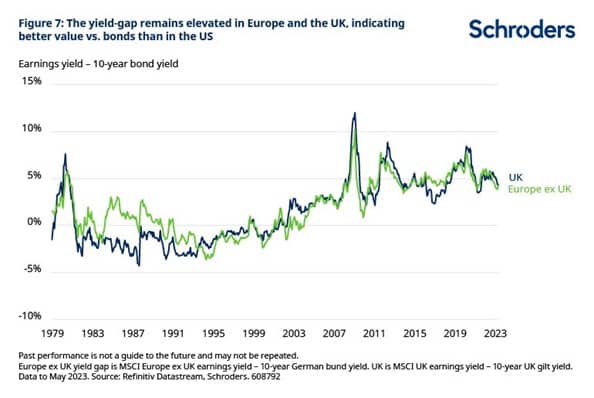
The same is not true of other markets though. The yield-gap has also come down for Europe ex UK equities compared with German bund yields, and UK equities compared with UK gilt yields, but not by as much (Figure 7). The yield-gaps for Europe ex-UK equities and UK equities were both 4.3% at the end of May.
European and UK yield-gaps are also within their ranges of the past 15 years (Figure 7), rather than having dropped well below them, as has happened in the US. Relative to their own histories, European and UK equities continues to offer reasonable value compared with bonds.
Both yield-gaps are a lot higher than the US in absolute terms, although this does not capture their relative growth outlooks (see next section). It could also be flipped around and interpreted to mean that investors are demanding a higher risk premium for investing in European and UK equities compared with the US. It should not be interpreted as a “free lunch”.
The “What’s Priced In” Approach
This approach looks at equity prices and consensus expectations for earnings growth and “backs out” the return assumption that is priced into the equity market. In simple terms, the equity market price equals the sum of discounted future cashflows from the market. That discount rate can be thought of as the return demanded by investors (it is the internal rate of return).
If the equity price falls, you need a higher discount rate to set the present value of cashflows equal to that new lower price, all else being equal (which it rarely is but that’s not important for this framing). In other words, a lower price leads to a higher equity return, all else equal. That is why this can be thought of as looking at the return assumption that is priced in to equity markets.
It is possible to get more granular by coming up with a set of assumptions based on one’s own view of the outlook. But the aim here is not to work out what is “most likely” in one’s own opinion, but what the market is expecting/ what is priced in.
The ERP can then be calculated as the difference between this forward-looking equity assumption and the risk-free rate, such as the yield on 10-year government bonds.
We take a multi-stage approach to assessing the ERP on this basis. For the current and next two calendar years we use consensus analyst earnings growth forecasts from I/B/E/S, the Institutional Brokers’ Estimate System. For subsequent years we assume that earnings grow in line with consensus expectations for 10-year real GDP growth and inflation, sourced from the Survey of Professional Forecasters. This is a simplification as earnings growth and domestic GDP growth do not move in tandem e.g. some earnings are earned overseas so depend on international growth. However, adding such additional complexity only has a small impact on the equity return outlook and hence would not materially impact any of our conclusions. A normalised payout ratio of 50% is assumed. This is higher than the dividend payout ratio to reflect the popularity of share buybacks.
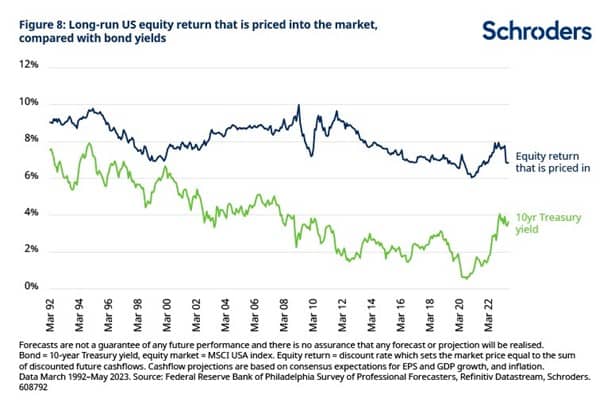
Figure 8 shows the evolution of the equity return priced into the US market since 1992 (the date when I/B/E/S consensus earnings forecasts first became available) alongside bond yields. This shows the nominal equity return outlook. The real equity return outlook has not risen by as much in recent years, as part of that move has been down to higher inflation expectations.
The drop for the recent equity returns figures is primarily because consensus expectations for long-term US real GDP growth have recently been cut from 2.3% to 2.0%, and inflation from 3.0% to 2.4%. As with the yield-gap approach, Figure 8 highlights that the bond market has repriced a lot more than the equity market. This would have been true even without the latest cuts to the US growth and inflation outlook.
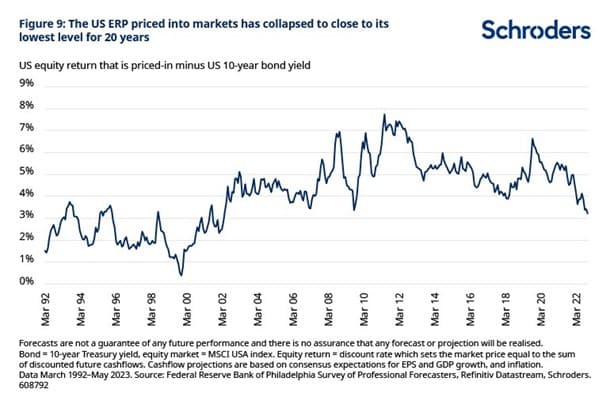
Figure 9 shows how the ERP has varied over time using this approach. It has collapsed to its lowest level for twenty years.
How Reliable Is This Measure As An Indicator?
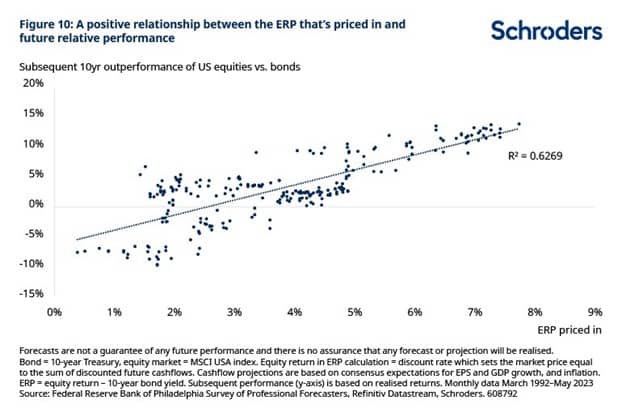
As with the yield-gap approach, this indicator has a reasonable, if slightly mixed, track record of success. A high ERP has been associated with better future 10-year equity performance vs bonds, but the relationship is weaker at low levels (mainly from the 1990s).
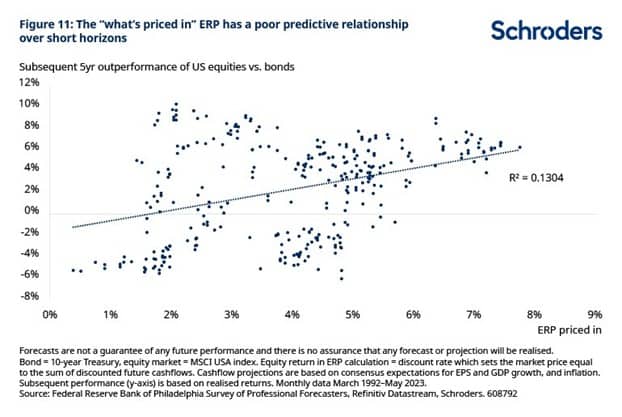
As with our other estimates of the ERP, there has been very little relationship between the ERP that is priced in and subsequent returns over shorter time horizons (Figure 11 shows this on a five-year horizon).
How Should We Interpret The Current Reading?
This is a slightly more damning assessment than the yield-gap approach because this takes account of consensus expectations for earnings growth. The ERP was lower in the 1990s, yet equities performed very well compared with bonds, but that was helped by soaring valuations. Given the starting point and outlook today, that seems a less likely outcome, relying on hope rather than expectation.
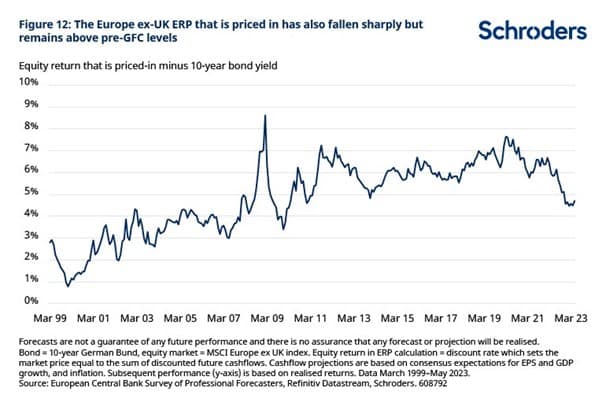
As with the yield-gap, the ERP priced into European markets should not be as worrying for European equity investors (Figure 12). It has also fallen sharply, pointing to reduced reward for bearing equity risk, but remains above pre-GFC levels.
Conclusions
There are different ways to assess the outlook for equities compared with bonds. None is perfect but all can be useful. Historical estimates may seem like the easy option, but they take no account of current market valuations and are sensitive to the time period assessed, which depends on availability of data. For non-US markets this can be particularly problematic and lead to potentially misleading conclusions.
Our more forward-looking measures tell a consistent story. Bond yields have re-priced more than equities. US equity investors today are being rewarded with a smaller return premium for bearing equity risk than at any time in recent memory, at a time when macroeconomic risks are high and central banks are in less supportive mood. More risk, less reward.
The US looks particularly bad on this basis with things not as worrying in Europe and the UK. The US may have been the strongest performing market for much of the past 15 years, but our analysis of the ERP suggests that it will struggle to repeat that feat. And, with the US having risen to now make up 68% of the global developed stock market, global equity investors are highly exposed to US performance. Long-term investors may be better served by allocating more to non-US markets in the decade to come.
Importantly, our analysis demonstrates that these frameworks are only useful when setting strategic asset allocation on a long-time horizon, such as 10 years. In the shorter term, other factors can be more in the driving seat. There will be shorter term periods when equities (US or elsewhere) could do much better, or much worse, than bonds. But identifying those requires a different toolkit.
By Duncan Lamont, CFA, Head of Strategic Research, Schroders
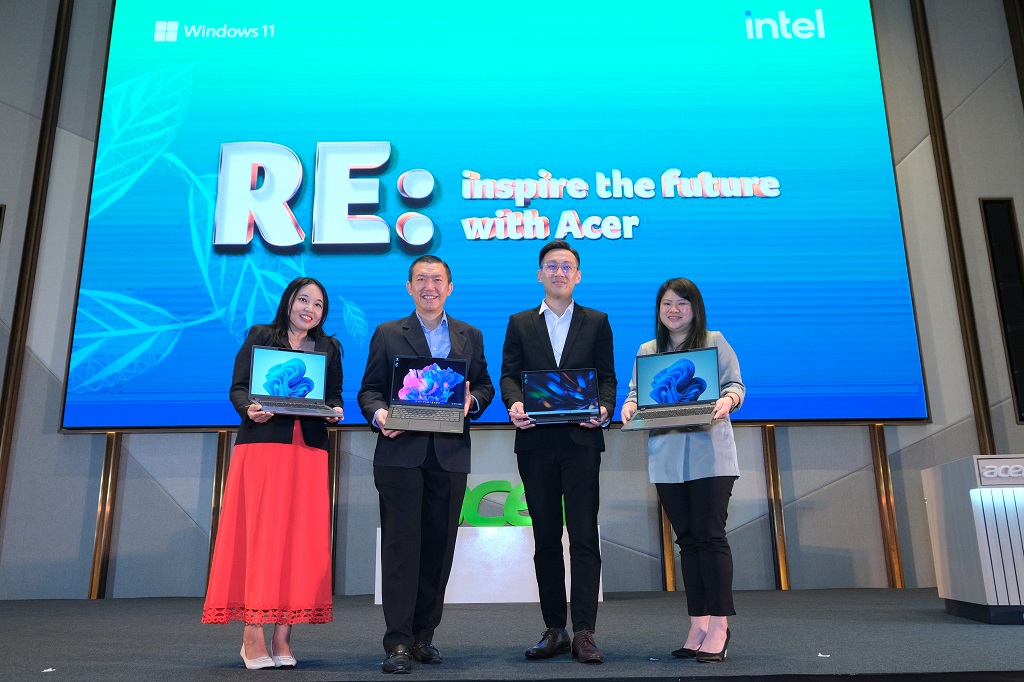
Acer Malaysia today introduced a series of business-grade product including laptops, desktops, an all-in-one (AIO) desktop and monitors. This latest range of refreshed products includes the TravelMate and Veriton devices, which now come incorporated with improved features designed with sustainability in mind, to assist corporations and businesses in fulfilling their commitment to environmental, social and governance (ESG) efforts.
“At Acer, we believe choosing green is only possible when we make green products accessible without compromising user experience, stability and durability. In addition to good and reliable performance, we have improved the robust features that protect an organisation’s data. In the make of the devices, we also incorporated recycled materials which generally cost more and require advance technology to deliver the same performance as regular materials. In walking the talk on sustainability, we are subsidising some of the production cost to make green devices such as the ones we are launching today, accessible. Our goal is to assist organisations make environmentally responsible choices while making sustainability sustainable,” said Chan Weng Hong, General Manager of Products, Sales and Marketing of Acer Malaysia.
Business Sustainability: Safeguard Company Data and Easier Maintenance
Businesses have to be sustainable while contributing to sustainability. Understanding today’s digitalised era and cybersecurity need, Acer integrated hardware, firmware and OS protection into TravelMate and Veriton series to safeguard confidential data of the users. Loaded with commercial bios that helps IT departments to manage and maintain the devices, the new TravelMate and Veriton devices also come with the Acer office manager and Windows AutoPilot to simplify the deployment process while ensuring top security. Furthermore, the TravelMate and Veriton AIO feature a webcam shutter that allows professionals to physically cover the webcam, providing an extra layer of security for their privacy.
Understanding the needs of professionals who value sustained performance in their laptops, Acer introduced the TravelMate P2, P4 and P6 series with the innovative Acer Dust Defender. This advanced feature automatically cleans up the thermal system every 6 hours of use, ensuring the laptops consistently deliver optimal performance over extended use periods. This active maintenance of the device’s capability enables professionals to rely on their laptops to consistently meet their performance requirements, making them a great choice for prolonged and demanding usage.
Stable Performance, Longer Lifespan and Trustable Aftersales Service
The Acer TravelMate and Veriton are powered by the latest 13th Gen Intel Core processor, accompanied by with 4GB or 8GB RAM, and equipped with 256GB or 512GB SSD to enable fast loading speeds. These devices have high upgradability to enable companies to enhance performance and extend the lifespan of the devices without the necessity of a full replacement, resulting in cost savings and reduced electronic waste.
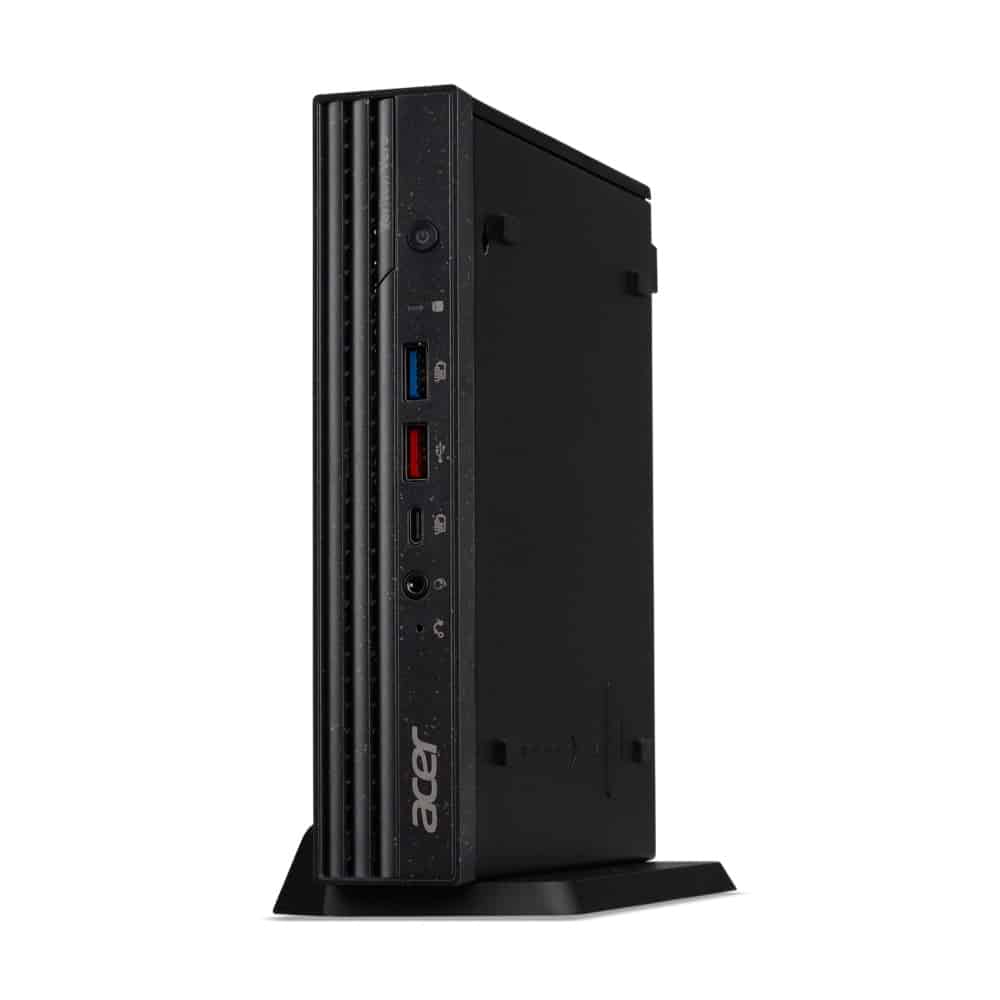
The Acer Veriton Vero Mini desktop (VZ4714G-51348W11PS) and Acer Veriton Vero AIO desktop (VN4710GT) also feature the same design that enables easy upgrading and maintenance despite its compact design, making them ideal desktops for businesses seeking robust devices that take up minimal space in offices that might have spatial constraints.
All the new TravelMate and Veriton devices come with three years on-site service and warranty. Acer Malaysia has established a great reputation of providing excellent ISO9001 certified aftersales service nationwide since 2003. Meanwhile, the ISO 27001 certification attests to Acer’s adherence to information security best practices to minimize risk of data breach and business continuity.
Recycled Materials Incorporated to Automatically Reduce Customers’ Carbon Footprint
The new TravelMate P2, P4 and P6 business laptops go beyond traditional design by incorporating Post-Consumer Recycled (PCR) plastic, effectively helping to reduce carbon footprint and assisting customers achieve their sustainability goals. By choosing these laptops, customers automatically contribute to a greener environment.
For customers prioritising eco-friendly products, the Vero Veriton (Acer Veriton Vero Mini desktop and Acer Veriton Vero AIO desktop) stand out as they birthed from Acer’s Earthion platform, where designers, suppliers and all stakeholders collaborate to create a truly green product from the design phase to packaging. The Vero name is reserved for devices that undergo a comprehensive set of considerations encompassing design, production and materials, packaging, and use-life of the product.
There are up to 56% percentage of PCR plastic in the new Acer Veriton Vero Mini desktop and Acer Veriton Vero AIO desktop as compared to a regular desktop. For more efficient energy usage during use, the devices feature the VeroSense software that allows users to easily to switch to ECO+.
The TravelMate and Veriton Vero series are shipped in green packaging using 100% plastic-free and recyclable packaging. On top of the recycled cardboard, recycled paper from moulded pulp, the devices are protected in recycled PE bags.
The Acer TravelMate laptop prices start from RM3,249. The 360-degree Acer TravelMate Spin P4 convertible laptop with flappable hinge for additional flexibility to share content is priced at RM5,699. The price for the TravelMate P6 that comes with 14-inch OLED display is RM6,899.
In addition, Acer Veriton desktop prices start from RM2,749, while the Veriton Vero AIO desktop (VZ4714G-51348W11PS) that comes with a 23.8-inch wide FHD display is priced at RM4,699 and the Veriton Vero mini is priced at RM3,499.
For more information, please visit Acer Malaysia’s Facebook @AcerMalaysia or call Acer’s Product Infoline at 1800-88-1288 (9am – 6pm, Mondays to Fridays), or email ama.marcom@acer.com.
About Acer
Founded in 1976, today Acer is one of the world’s top ICT companies and has a presence in over 160 countries. As Acer looks into the future, it is focused on enabling a world where hardware, software and services will fuse with one another to open up new possibilities for consumers and businesses alike. From service-oriented technologies to the Internet of Things to gaming and virtual reality, Acer’s 7,000+ employees are dedicated to the research, design, marketing, sale, and support of products and solutions that break barriers between people and technology. Please visit www.acer.com for more information.
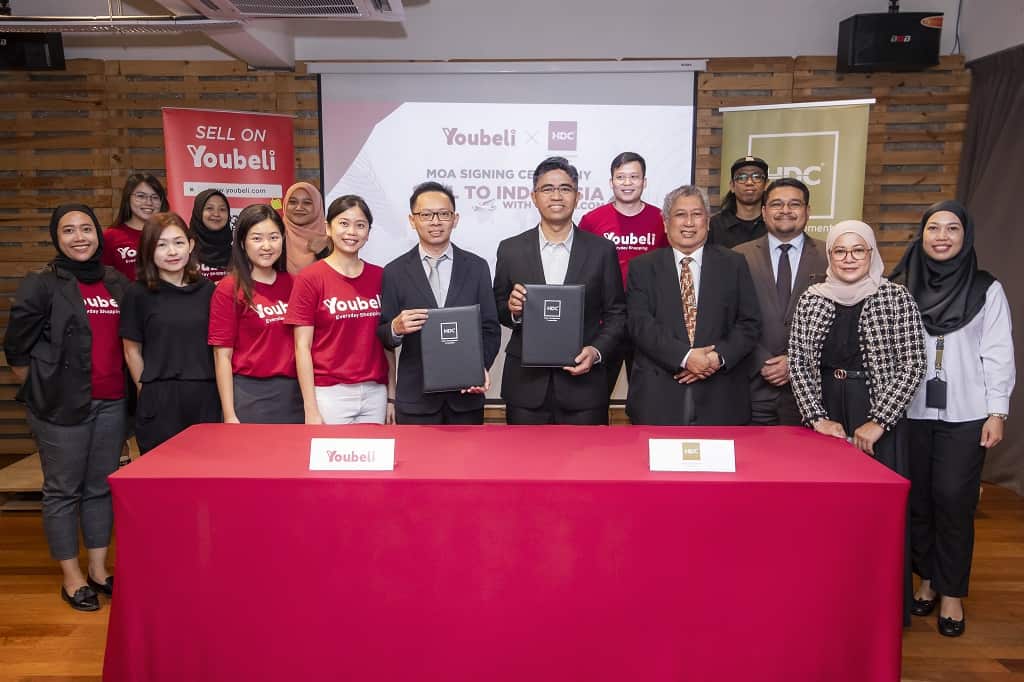
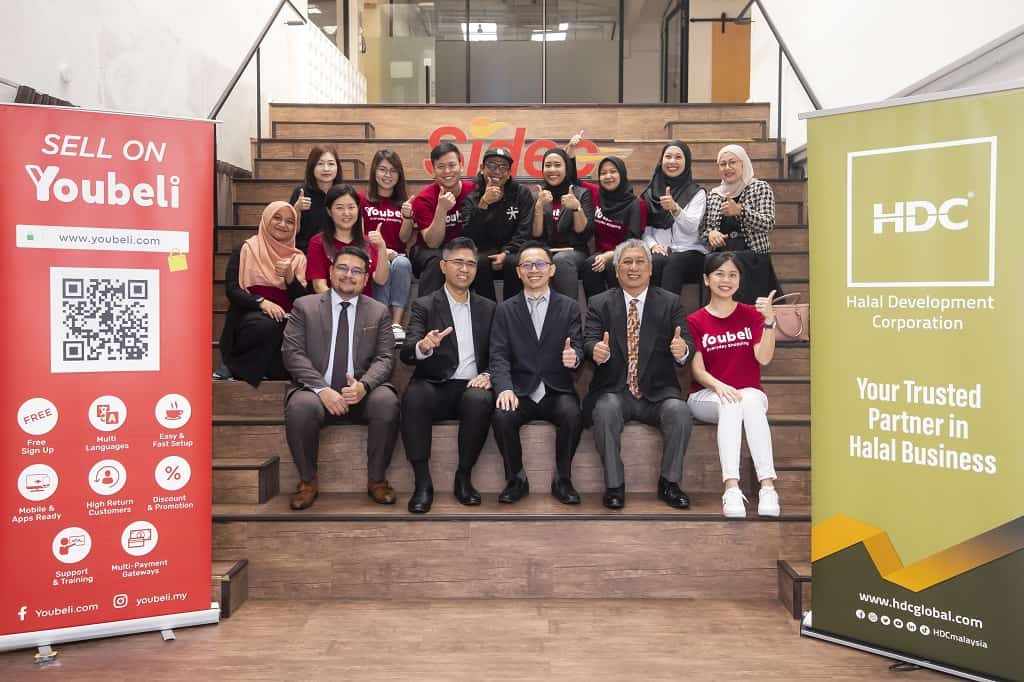
Youbuy Online Sdn Bhd (Youbeli) inked a Memorandum of Agreement (MoA) recently with the Halal Development Corporation Berhad (HDC) to promote the Sell to Indonesia via Blibli Package.
The collaboration between both parties presents a new opportunity for them to engage in joint cooperation and collaboration. They will contribute their respective knowledge, expertise, resources, and technical capabilities to promote and support the ‘Sell to Indonesia Cross Border package. The MOA also outlines their commitment to executing and undertaking this collaboration in accordance with this Agreement to promote the initiatives of HDC’s Halal Integrated Platform (HIP), Youbeli.com, and Youbeli Malaysia Official Store on Blibli.com.
The HIP will be the one-stop online platform to connect industry players in the Halal market. This platform aims to enhance business transactions within the ecosystem, fostering a thriving business environment and enhancing the Halal ecosystem better. It includes services such as Halal Parks, the Halal Training Institute, Halal Consultancy and Advisory, and the Halal Knowledge Centre.
Joint Endeavor for Market Expansion: Youbeli and HDC Establish MOA, Unlocking Potential in Indonesia
Through this partnership, Youbeli and HDC will facilitate suppliers to be onboarded as Youbeli Merchants and register as HIP members. Both parties will also provide an opportunity for Halal Industry players to have a brand presence in the Indonesian market through Cross Border eCommerce and with future expansion plans into B2C trade with the aid of sales and marketing channels.
Under the terms of the MOA, HDC among others, will develop a targeted marketing campaign for the program to HIP’s more than 10,000 members and other Halal Industry players including leveraging HDC ground activation with Halalpreneurs. To assist the efforts, HDC will identify and recommend any relevant HIP services offered by strategic partners and opportunities from both private and government sectors to support the initiatives.
Youbeli will provide technical, logistics, marketing, trade, and settlement support for all products and services provided by Youbeli and Blibli.com to more than 5,000 merchants with the aim to help local sellers in expanding their business to the Indonesian market. This cross-border package will enable merchants to gain transactions without a physical presence in Indonesia, with the help of marketing capabilities by Youbeli and Blibli.com. By availing of this package, merchants can list their products on Indonesia’s top general marketplace, Blibli.com, and seamlessly manage their operations through Youbeli Seller Center. Additionally, the package offered also includes a complimentary warehouse storage service up to 6 months and international logistics to Indonesia.
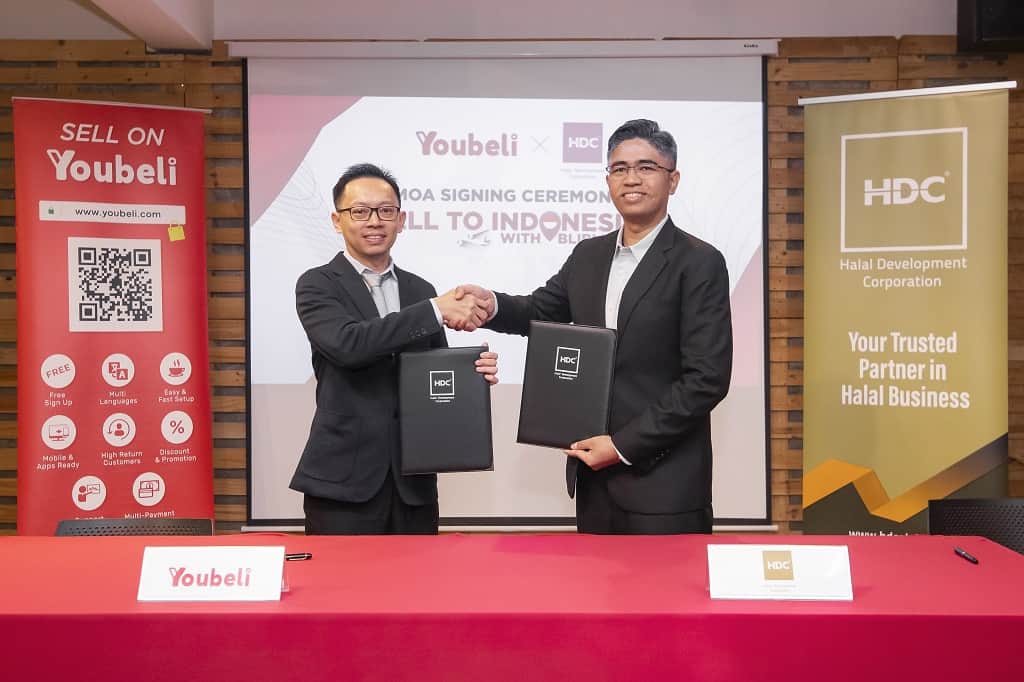
The MOA signing ceremony took place at SIDEC and was signed by Hairol Ariffein Sahari, Chief Executive Officer of HDC, and Youbeli Chief Executive Officer, Chua Khai Suan.
Unlocking Opportunities: Chua Khai Suan CEO of Youbeli and Hairol Ariffein Sahari CEO of HDC Foster Growth through MOA
QUOTE FOR HDC
“The collaboration aims to pave the way for its halal integrated platform (HIP) and micro, small and medium enterprises (MSME) to perform cross border e-commerce export such as Indonesia,” said HDC CEO, Hairol Ariffein Sahari.
“We hope through today’s MOA, there will be further increase in the amount of Malaysian halal products exported to Indonesia since it is one of the main export destinations of our local halal products,” he added.
QUOTE FOR YOUBELI
“This collaboration will create opportunities for Malaysian businesses to thrive in the ever-evolving digital landscape, leveraging the ‘Sell to Indonesia’ package, a strategic partnership between Youbeli.com and Blibli.com,” said Chua Khai Suan, Youbeli CEO.
“This collaboration represents a significant milestone for Youbeli as we continue to champion the growth and success of Malaysia e-commerce business,” he added.
About Halal Development Corporation Berhad (HDC)
HDC is a government agency that spearheads the development of Malaysia’s integrated and comprehensive halal ecosystem with a vision to make halal the first choice in business ventures.
About Youbuy Online Sdn Bhd
Youbuy Online Sdn Bhd (Youbeli) is a premier multi-category online marketplace in Malaysia, that aims to help local sellers to expand their business to the Indonesian market with hassle-free solutions.
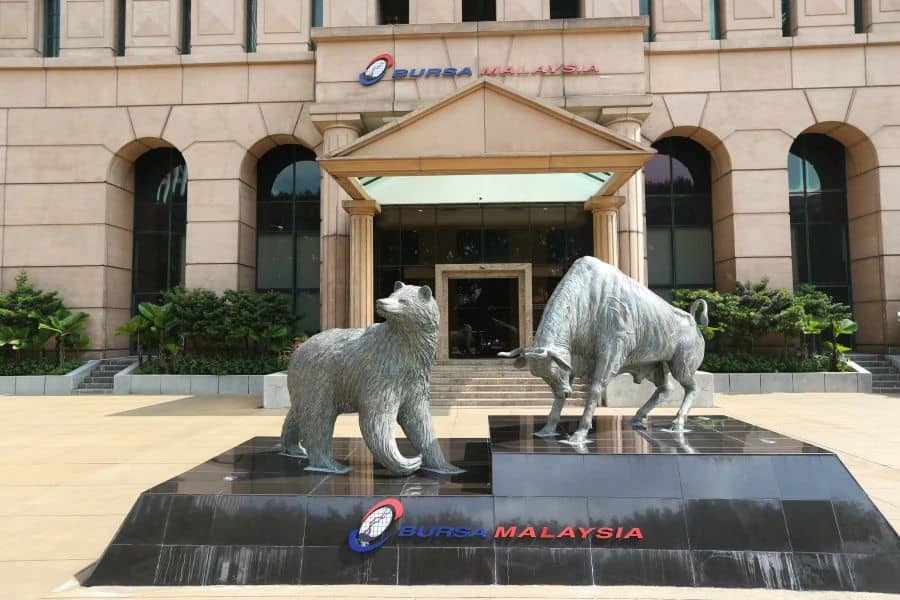
The Securities Commission Malaysia (SC) and Bursa Malaysia Berhad (Bursa Malaysia) today welcome the announcements by the Honourable Prime Minister and Minister of Finance, Dato’ Seri Anwar bin Ibrahim, aimed at driving Malaysia’s economic growth and capital market competitiveness.
The short-term and medium-term measures address three key pillars essential to the growth and development of the capital market in Malaysia:
Pillar 1: Creating market vibrancy with greater participation opportunities for the rakyat;
Pillar 2: Attracting larger pool of investors to support financing for small, medium enterprises and new economy companies; and
Pillar 3: Enhancing Malaysia’s competitiveness to strengthen market confidence.
Measures announced:
1. A reduction of the stamp duty rate for the trading of listed shares on Bursa Malaysia from 0.15% to 0.10%, while the stamp duty cap is maintained at RM1,000 for each contract. This change, which take effect in July, will directly lower the cost of transactions, especially for retail investors, who are particularly sensitive to costs.
2. To widen the pool of investors, the Ministry of Finance and Securities Commission Malaysia will look at policies to achieve the following:- a. to facilitate and attract the setting up of family offices in Malaysia; b. to promote corporate venturing to drive greater domestic direct investment through more facilitative tax and incentive policies; and c. to widen the definition of sophisticated investors to include angel investors.
3. The capital market regulators also commit to explore ways to reduce market friction and shorten time-to-market for initial public offerings.
Quotes by SC Chairman Dato’ Seri Dr. Awang Adek Hussin:
“The SC’s commitment to maintain the capital market’s resilience and competitiveness is of the utmost priority. The capital market initiatives announced will boost greater trading participation and access to financing in the market, encouraging the growth of innovative companies and fostering greater diversity and inclusivity in the industry. We aim to empower issuers and investors by creating a business-friendly environment through relevant support and incentives. The SC is optimistic that these efforts will create a more vibrant capital market to drive economic growth in the country.”
Quote by Bursa Malaysia Chief Executive Officer, Datuk Muhamad Umar Swift:
“We are confident that the proposed measures, along with the existing development initiatives, will stimulate market activity and create a more dynamic and liquid market environment. A liquid and strong performing capital market has tremendous benefits to numerous stakeholders, and the economy as a whole. More importantly, the measures will widen affordable investment choices for the rakyat, and deepen investor interest in our market, leading to Bursa Malaysia being a destination of choice for fundraising.”
The multi-pronged measures by the Government and market regulators reflect the intent to create a conducive environment for a thriving capital market, recognising the pivotal role played by a well-functioning capital market in fostering robust economic growth.
The capital market regulators reinforced their commitment to ensure that the capital market is competitive and vibrant, while supporting the economic needs of Malaysia.
The SC and Bursa Malaysia will continue to work closely with the Ministry of Finance (MOF), industry partners and other relevant bodies to explore further holistic measures towards ensuring an inclusive and sustainable capital market.
About Securities Commission Malaysia
The Securities Commission Malaysia (SC), a statutory body reporting to the Minister of Finance, was established under the Securities Commission Act 1993. It is the sole regulatory agency for the regulation and development of capital markets. The SC has direct responsibility for supervising and monitoring the activities of market institutions, including the exchanges and clearing houses, and regulating all persons licensed under the Capital Markets and Services Act 2007. More information about the SC is available on its website at www.sc.com.my. Follow the SC on twitter at @SecComMy for more updates.
About Bursa Malaysia
Bursa Malaysia is an approved Exchange holding company under Section 15 of the Capital Markets and Services Act 2007. A public company limited by shares under the Companies Act 2016, Bursa Malaysia operates a fully-integrated exchange, offering equities, derivatives, offshore, bonds as well as Islamic products, and provides a diverse range of investment choices globally.
The following story is based on an actual series of events, with some names and circumstances fictionalised. Any similarity to any person’s name, character, or history is coincidental and unintentional. It is about a property tussle, then being left homeless after her sister’s death.
Chung was unable to get a loan from any financial institution to purchase a house. The easiest way out was to purchase the house under a name of his sister who would be eligible to obtain a loan. Nancy did not mind this arrangement as Chung gave the undertaking to pay the monthly loan payments.
The arrangement worked well until Nancy passed away suddenly. She had no Will and since the house was under her name, it was considered her asset. Under the Distribution Act, Nancy’s husband, Jay, and children are entitled to her properties, which include the house that Chung bought and is living in.
Jay, who is not on cordial terms with Chung, would not want to hear anything from his brother-in-law that he had been servicing the housing loan and the house rightfully belonged to him. Chung’s pleas that Jay returns his house fell on deaf ears.
Chung was left with two choices; either goes to court and fight for an equitable interest which may take a long time and the outcome, uncertain; or to stop making instalment payments which will result in the bank claiming from Nancy’s estate for the loan amount.
Either way, Chung is at the losing end with a certainty of incurring losses.
The above scenario of purchasing an asset under another name is quite common, especially among business partners, close friends or relatives for various reasons. Most of them do not realise or appreciate the seriousness of the problem that would occur upon the death of the person whose name is used to register for the asset if no proper estate planning is done – and an ugly property tussle will ensue.
In the event the entrusted person dies or goes into a coma or becomes of unsound mind, his/her representative may not be as cooperative, especially when something of value is involved – that’s when the property tussle will rear its ugly head.
What Chung could have done was to get Nancy to sign a Declaration of Trust. Under this Declaration of Trust, Nancy will hold the house for Chung as a main trustee and an appointed licensed trust company shall be the substitute trustee in the event of her death.
All Nancy needs to do is sign a trust deed which is irrevocable power of attorney with the trust company. Upon Nancy’s death, the trust corporation will take over as substitute trustee and follow the terms and conditions of the trust deed to transfer the house to Chung. From this arrangement, Chung has established a legal right to the house, and the problem with Jay could have been circumvented.
The main benefit of a Declaration Trust is that though the house is under Nancy’s name, the rightful heir to the house would be Chung. Moreover, there is no need to transfer the house to another trustee, and thus there are no transfer fees payable.
The fees are only payable upon the demise of Nancy. The transfer of the house of Chung’s name is hassle free since there is no need to wait for letters of representation over Nancy’s estate.
Furthermore, with a trust company, Chung and Nancy will have peace of mind and their rights and obligations are well preserved without any third party interference since a trust company is duty bound to follow the trust provision and therefore more reliable than an individual.
Moreover, the trust company has continuity compared to a natural person liable to die, fall ill, meet with an accident and be incapacitated, become of unsound mind or go bankrupt. When an individual trustee passes away, his assets are frozen until the necessary legal estate administration processes are completed, which means the asset is frozen too.
And that’s how you can prevent a property tussle with the right tool, a Declaration of Trust.
Rockwills International Group, now in its 28th year, pioneered professional will writing in 1995 and has since evolved into the leading estate planning specialist in the country. It is today the largest provider of solutions and support services in the areas of trusts, succession, management, and distribution of wealth. It has done over 300,000 wills and 16,000 trusts and holds more than RM25 billion in assets under trust.
Economic factors, such as inflation, rising rates and supply chain disruptions have been top of many investors’ minds in 2022. You may ask, in such a volatile economic environment, if it is worth it for investors to think about sustainability and ESG at all.
I would say yes, in fact it is crucial for investors to think about how these economic factors will affect longer-term structural trends, such as the low carbon transition.
Changing Energy Economics
With rising energy prices, political momentum for decarbonisation has slowed. But importantly the private sector continues to push ahead, helping close some of the gaps between the ambitions of global leaders and corporate readiness for transition.
Changing energy economics also affects how companies will look to decarbonise, with higher energy prices incentivising improvements in energy efficiency. Technologies like heat pumps are becoming more viable compared to alternatives. The adoption of technologies will not just affect the companies developing or producing them, but across the value chain.
Rising Demand For Sustainable Food And Water
The global population is expected to increase 40% from now to 10bn in 2050, while getting richer as living standards grow. This will drive the demand for food, while the physical effects of climate change, such as rising temperatures and changes to weather patterns, puts pressure on supply.
Huge amounts of investment will be needed for the world to have sustainable food and water. With these needs come opportunities, for companies who can come up with the technologies and innovations to meet it. Recent food price inflation has accelerated these structural trends, driving a focus on food security.
The Importance Of Human Capital Management
It is not all about the environment. The cost of living crisis has intensified social stresses. Few governments have the fiscal capacity to absorb shortfalls in household budgets. Companies are coming under pressure to ensure vulnerable workers are protected – whether through increasing wages and benefits for their own employees or their responsibility to workers in supply chains.
Companies that are better at managing human capital may be well-placed to navigate the challenges posed by the complicated macro environment. I hope I have showed you that ESG factors are not things to think about in isolation – they are core to informing our view of the world and how to invest.
By Mervyn Tang, Head of Sustainability Strategy, APAC, Schroders
In our previous article, we explored how poor investment and savings behaviours could lead to higher vulnerability among Malaysian investors – leaving them at risk of suffering fraud, financial exploitation, or the effects of unsuitable investments. Nonetheless, we also highlighted that vulnerability is a multifaceted phenomenon with frequently overlapping and closely interconnected drivers.
Beyond financial behaviour and accessibility, the Institute for Capital Market Research Malaysia (ICMR) also identified situational and industry-related drivers of investor vulnerability. Based on findings from our nationwide survey, this article will delve deeper into both these categories to further understand how Malaysians experience vulnerability during their investment journeys.
Navigating Unexpected Life Changes
Situational drivers refer to experiences of specific life events or temporary difficulties such as bereavement, job loss, income shock, death within close relatives, or changes in expenses and savings behaviours. Understanding these drivers is especially significant considering how our lives have been impacted by greater uncertainty since the COVID-19 pandemic.
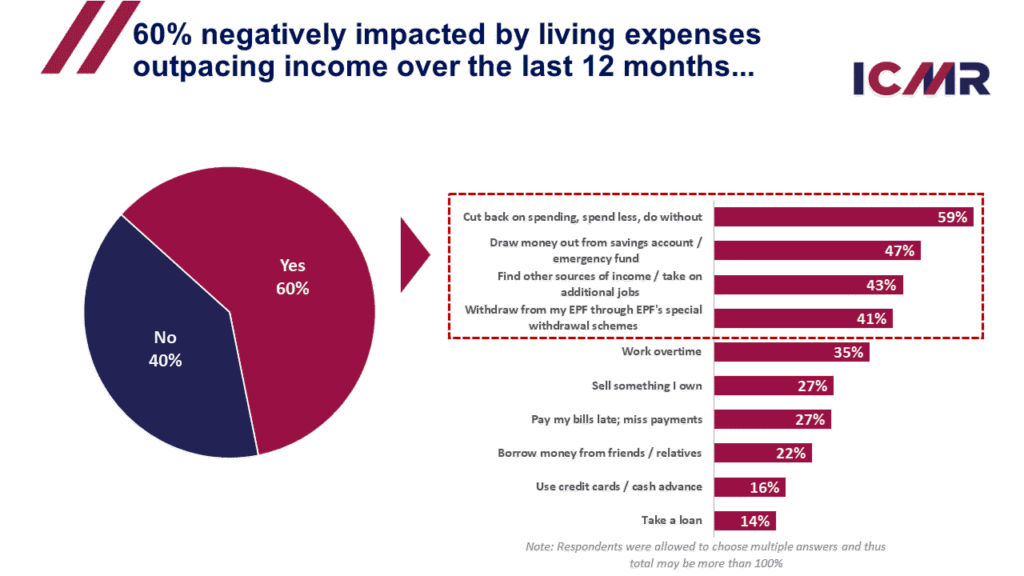
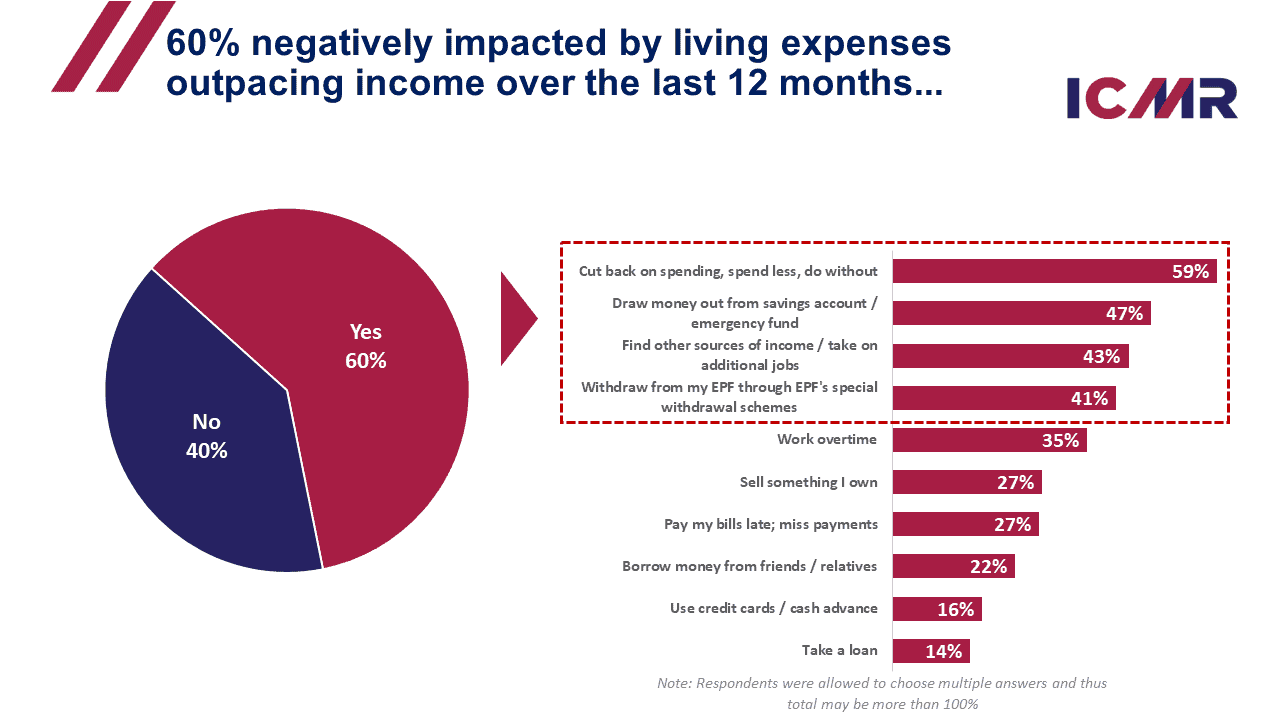
Throughout the pandemic, many Malaysians lost their jobs, income, or faced income cuts. The impact of this lasted even after lockdown measures were lifted and has been exacerbated by the rising cost of living. ICMR’s survey conducted in early 2022 found that 60% of Malaysians felt that their expenses had outpaced their monthly income in the last 12 months, hence affecting how they made ends meet.
Figure 1: How Changes in Living Expenses Affected Financial Behaviour (Data Source: ICMR)
Despite Malaysia’s economy opening up in the post-pandemic phase, many Malaysians are still struggling to sustain themselves financially. This was evident even before the real knock-on effects of inflation had been felt, which rose from 2.3% in January 2022 to 3.8% in December 2022 on the back of higher food and transportation prices.
To curb inflationary pressures, the Central Bank of Malaysia (BNM) increased the Overnight Policy Rate (OPR) by 100 basis points to 2.75% as of the end of 2022. Now, sandwiched between higher borrowing costs and higher inflation of food and oil prices, households will have even less discretionary income – which could increase their level of vulnerability.
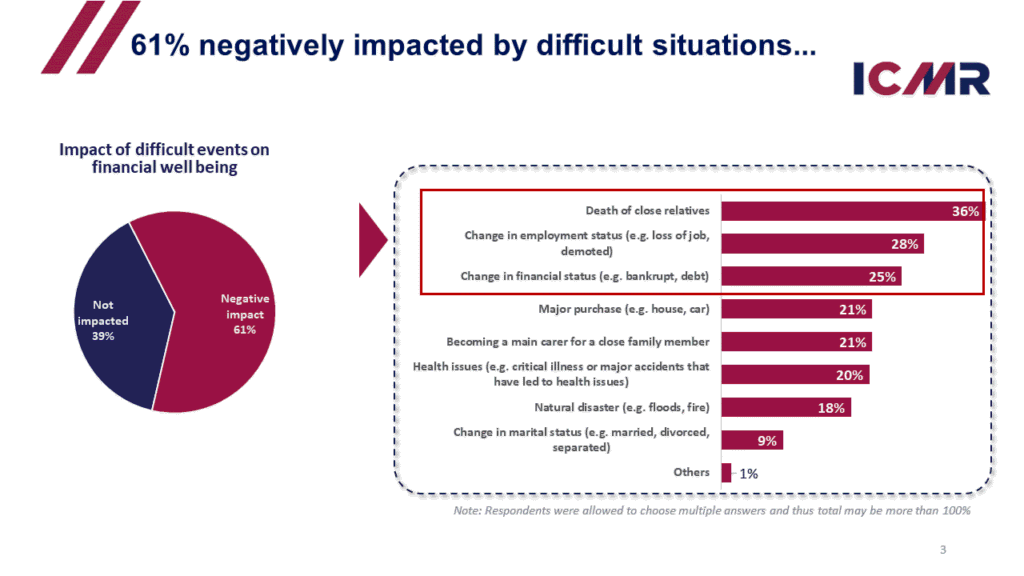
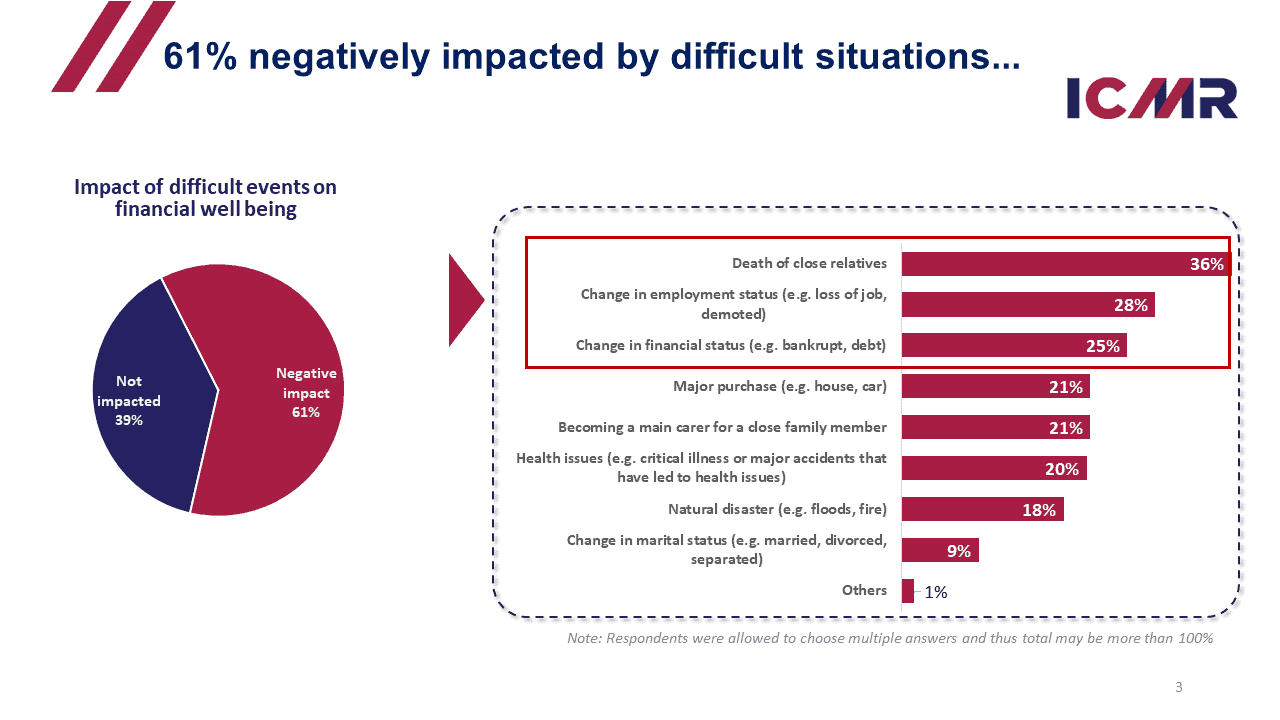
It gets more concerning when the issues of expenses and inflation are coupled with complex life events, which appears to be the case for 61% of respondents to ICMR’s survey. Within this group, most respondents experienced ‘death of close relatives’ or ‘changes in employment and financial status’, potentially most of these losses being due to COVID-19.
Figure 2: Impact of Difficult Events on Financial Well-Being and Type of Negative Impacts Experienced (Data Source: ICMR)
Despite the widespread belief that vulnerable individuals comprise the older generation, our study emphasises that notwithstanding age, changing life situations caused by the pandemic or changes in employment can cause individuals to feel more financially vulnerable. This, coupled with the current state of the economy, further contributes to poor financial decision-making.
Challenges Dealing With Financial Service Providers
The final category of vulnerability driver we identified is ‘industry-related drivers’. The variables measured in this category include experiences surrounding the actions of market or individual financial providers; firms that do not act with appropriate levels of care; products that are inappropriate for a particular client; and inadequate/complex or misleading documentation/information.
ICMR found that 47% of surveyed respondents rely on financial consultants, agents, or brokers as sources of financial information. However, we also found that investors only referred to financial consultants who happened to be their friend or who were introduced by their family or friends. This correlates with our findings of 44% preferring to listen to friends and family for financial information.
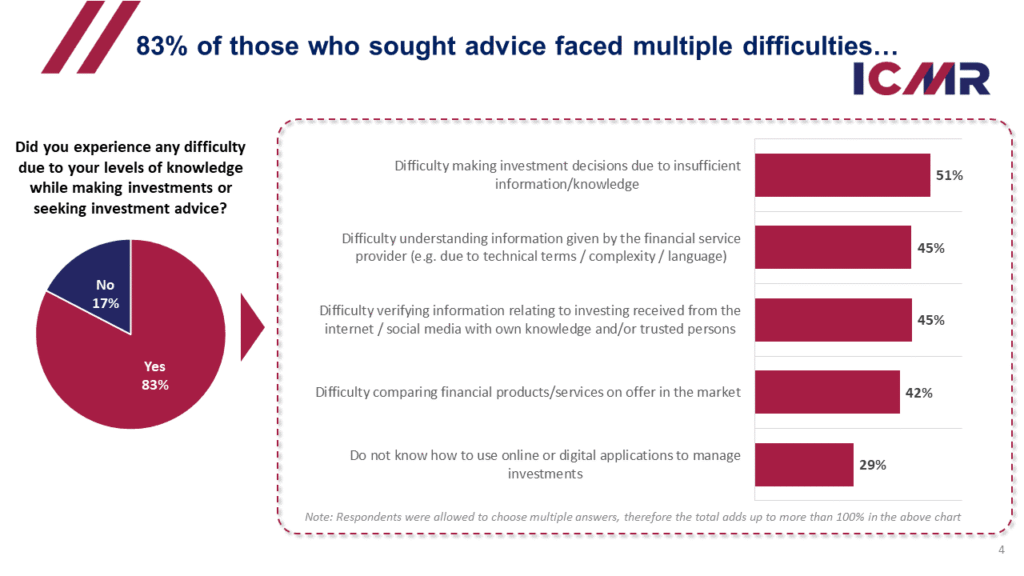
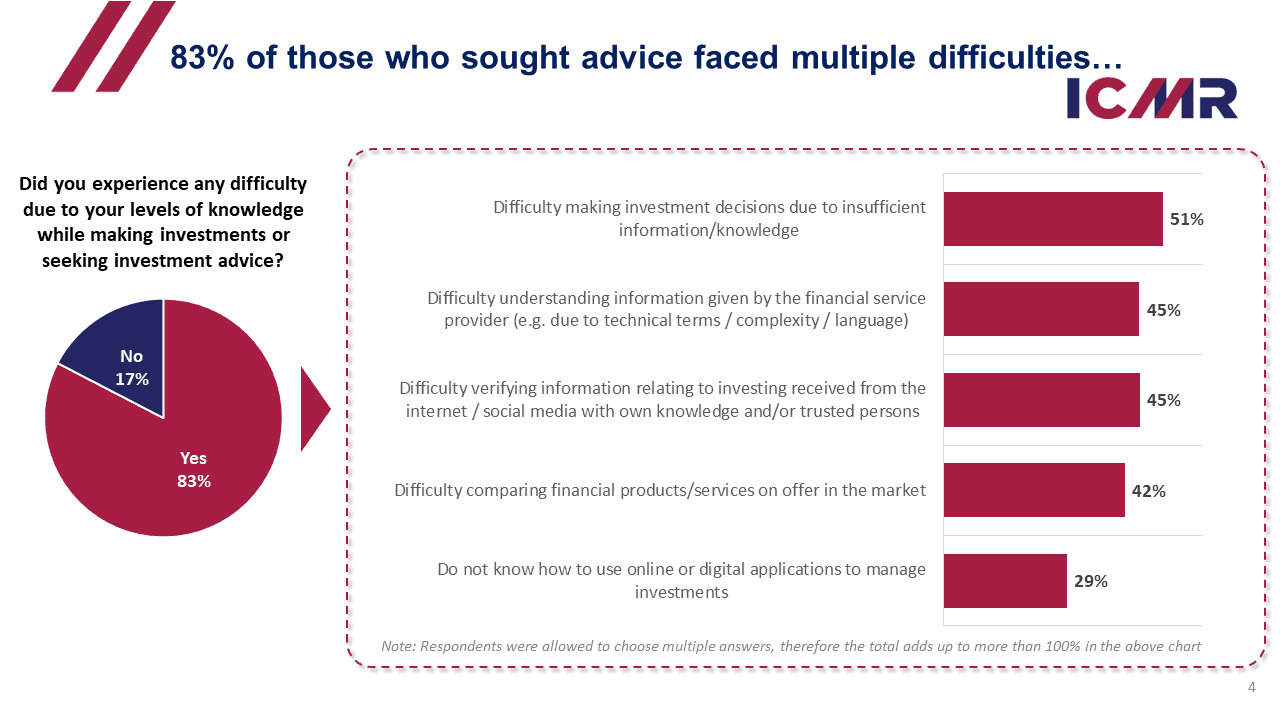
Moreover, 83% of those who do seek professional financial advice claim to experience some difficulties, especially due to insufficient information or knowledge. At the same time, 70% of those who engaged with financial service providers faced some misconduct, including unsuitable prices or terms, being pressured into making an investment, high fees, technical issues, and language barriers.
This was further confirmed in our qualitative interviews, where interviewees felt that all the documents and information given were too complicated and difficult to understand. Elderly folk and youths were among the most affected. This, coupled with low financial knowledge, will make understanding important disclosure documents even more difficult for these groups.
Many investors feel that financial services and products have been streamlined and designed based on the idea of a perfectly rational investor. Because of that, financial consultants and agents struggle to meet the needs of investors who do not fit into the idea of a perfectly rational investor, which has the potential to lead to negative experiences and consumer detriment.
“The documents and disclosure are too complex and hard to understand. Only those with financial background could understand. I feel that the sales agent does not know the details of the product so the agent will just work to promote”
– Emma, 34, real estate consultant
Vulnerable Investors More Susceptible To Financial Scams
Although not all vulnerable individuals face the same challenges, most tend to feel overwhelmed and unable to cope during certain vulnerable moments. When faced with these feelings, individuals find it difficult to prioritise, which leads to sub-optimal decision-making. This results in them making decisions that further worsens their situations, particularly when dealing with financial services firms.
Findings from the three vulnerability drivers we’ve explored highlight that individuals may experience overlapping vulnerable characteristics, leaving more investors susceptible to the allure of making fast money. Stay tuned for our next article, as we will look closely at the factors that cause investors to fall prey to investment or financial scams.
This article is part of a content series by the Institute for Capital Market Research (ICMR). Follow ICMR’s Facebook page to stay updated on behavioural tips and insights for better investing habits. To learn more about ICMR’s research on new age vulnerabilities, visit www.icmr.my or download the full report.
About the Authors
Datin Aida Jaslina Jalaludin, Head of Research, ICMRNadhirah Ibrahim, Research Analyst, ICMR