Author: admin

  • SC Unveils Measures to Support Businesses

    The Securities Commission Malaysia (SC) today announced further reliefs for public-listed companies impacted by the COVID-19 fallout. It is also considering further measures to facilitate greater access to support businesses such as funding for small and midcap companies, as well as micro, small and medium enterprises (MSMEs).

    “With this Covid-19 pandemic, we are confronting a situation that none of us has experienced in our lifetimes. It requires measured responses that consider the longer-term impact on our market and its participants, beyond this immediate crisis,” said SC chairman Datuk Syed Zaid Albar at a virtual media conference to release its annual report for 2019.

    “While the world comes together to combat this public health emergency, we have taken proactive measures to ensure that markets continue to operate in an orderly manner, as access to funding is vital to maintain confidence and ensure the long-term recovery of the market,” he added.

             SC chairman Datuk Syed Zaid Albar

    Acknowledging that companies may face challenges as a result of the pandemic, the SC also announced that Bursa Malaysia will provide affected companies listed on the Main Market temporary relief from the Practice Note 17 nn (PN17) classification in relation to the following criteria:

    1. The shareholders’ equity of the listed issuer on a consolidated basis is 25% or less of the share capital (excluding treasury shares) of the listed issuer and such shareholders’ equity is less than RM40 mil.
    2. The auditors have highlighted a material uncertainty related to going concern or expressed a qualification on the listed issuer’s ability to continue as a going concern in the listed issuer’s latest audited financial statements and the shareholders’ equity of the listed issuer on a consolidated basis is 50% or less of share capital (excluding treasury shares) of the listed issuer.
    3. A default in payment by a listed issuer, its major subsidiary or major associated company, as the case may be, as announced by a listed issuer pursuant to paragraph 9.19A of the Listing Requirements and the listed issuer is unable to provide a solvency declaration to the Exchange.

    These measures will allow companies more time to regularise their financial positions. Similar temporary relief from Guidance Note 3 classification will also be provided by Bursa for companies listed on the ACE Market. The period for this PN17 relaxation will be effective from 17 April until 30 June 2021.

    Measures for Alternative Financing Platforms

    Observing heightened interests by MSMEs to tap into alternative fundraising channels, the SC also lifted fundraising limits on Equity Crowdfunding (ECF) platforms, and allowed ECF and peer-to-peer financing (P2P) platforms to operationalise secondary trading, both with immediate effect.

    From now till 30 September 2020, the government co-investment fund MyCIF, administered by the SC, has also increased its funding matching ratio from 1:4 to 1:2 for eligible ECF and P2P campaigns, to provide additional liquidity into the alternative fundraising space.

    The SC also called upon the industry to seize the opportunity to accelerate their digitisation transformations and offer more online products and services to investors as the regulator observed a significant increase of new online trading accounts opening in recent months.

    The SC itself, in view of this new norm, will expedite guidelines for holding virtual general meetings and facilitate alternatives to meet take-over requirements.

    The regulator is also working on efforts to broaden the suite of product offerings of fund management industry through facilitating the introduction of waqf-based collective investment schemes and alternative investments for wholesale funds, where underlying assets can be property, gold or private equity.

    Noting that extraordinary times call for extraordinary responses, Syed Zaid said this is not business as usual and the SC is deploying a wide range of regulatory tools to provide support to the market and relief to market participants.

    Protecting Investor Interest

    While the regulator is doing what it can to support the businesses, Syed Zaid said the SC remains steadfast in ensuring investor interest is protected during this challenging time. “We continue to raise investor awareness on scams, as scammers tend to target people during times of uncertainty.

    The SC will take a targeted approach to protect vulnerable investors and minority shareholders. I would also like to remind our intermediaries to remain vigilant and for PLCs to remember their obligations to shareholders and to make timely disclosures,” he stressed.

    The SC also assured investors that the Malaysian capital market remains fundamentally strong and is functioning in an orderly manner, supported by deep domestic liquidity, complemented by the government’s stimulus packages, amidst non-resident outflows.

    “Over the years, Malaysia has withstood many crises and the SC has worked closely with the industry to strengthen the capital markets and addressed systemic weaknesses. As a result, the Malaysian players and institutions are better equipped to face the onslaught of challenges arising from this pandemic,” added Syed Zaid.

    As the financial system adjusts to the impact of Covid-19, the SC will continue to monitor the evolving situation in global and domestic markets, and calibrate its responses and update the public accordingly.

    Segments of Bond Issuers under Stress

    Corporate bond issuers in the aviation, oil & gas (O&G) as well as trading and services segments are experiencing short-term financial stress that may result in higher risks to their credit positions.

    While that could weaken their credit positions it would not necessarily result in defaults as the majority of issuers are in the triple A and double A rating categories, said Kamarudin Hashim, SC executive director, of Market and Corporate Supervision, during the same media conference.

    “And in the event of credit deterioration, there should be should be sufficient buffers before cash flow becomes severely constrained.”

    In addition, he said several of these issuers within these segments have some form of support in the form of financial guarantees or corporate guarantees.

    He pointed out that defaults rates in the corporate bond markets have declined significantly since the Asian financial crisis. “At that time it was around 9.4% and has come down to below 1% up to last year,” said Kamarudin when answering a question from the media on the possibility of defaults by issuers of corporate bonds, sukuks and P2P (peer-to-peer financing) notes.

    “Moving forward and due to uncertainties arising from the Covid-19 pandemic as well as the slower global growth, there are several issuer segments that may see higher risks to their credit positions.

    “The areas include aviation, oil & gas as well as trading and services. These are segments under stress currently, and they represent around 8% of the total corporate bonds issuances,” he added.

    He said a prolonged weakening of issuers’ cash flow will be a cause of concern and the SC will continue to monitor this space.

    “As investors in the corporate bond market are also predominantly institutional investors, in the event of default they will be able to pursue various options to preserve their investments through negotiations such as rescheduling or restructuring, or rigorously pursuing their contractual rights and priority of claims against the issuer.”

    In relation to P2P financing, he said the average default rate remains similar to last year at around the 4% mark.

    “At the moment, the SC is not considering imposing a blanket moratorium on P2P financing notes. Our approach is for issuers to work together with [P2P financing platform] operators if they are under stress for possible restructuring and rescheduling,” he added.

    By Lee Min Keong

    For more information on the SC’s measures to maintain market integrity, please visit www.sc.com.my/covid-19 and www.sc.com.my/resources/publications-and-research/sc-ar2019

  • Malaysian Capital Market Continues to Finance Economy

    Malaysian Capital Market Continues to Finance Economy

    The domestic capital market continued to play an important role in financing the Malaysian economy during 2019, says the Securities Commission Malaysia (SC).

    The total size of the capital market expanded to RM3.2 trillion in 2019 from RM3.1 trillion the year before, with debt securities outstanding and equity market capitalisation of RM1.5 trillion and RM1.7 trillion respectively (2018: RM1.4 trillion and RM1.7 trillion respectively), according to the SC Annual Report 2019.

    Notwithstanding the challenging global backdrop and ongoing domestic policy reforms, the Malaysian capital market witnessed a higher level of fundraising activities during the year, with total funds raised in the bond and equity market amounting to RM139.4 bil in 2019 compared to RM114.6 bil in 2018.

    Alternative fundraising avenues have also continued to gain traction, especially in equity crowdfunding (ECF)  and peer-to-peer (P2P) financing, with total funds raised more than doubled to RM443.8 mil (2018: RM195.9 mi).

    A total of RM132.8 bil was raised in the corporate bond and sukuk market compared to RM105.4 bil in 2018, with issuances mainly in utilities and financial services. Sukuk made up 77.1% of total bond issuances in 2019.

    Meanwhile, RM6.6 bil was raised via the equity market (2018: RM9.2 bil), of which RM2 bil was through new equity listings with a total of 30 IPOs and RM4.6 bil raised via secondary fundraising. In 2019, four companies were listed on the Main Market, 11 companies on the ACE Market, and the remaining on the LEAP Market.

    Notably, the size of issuances via the LEAP Market grew by 60.6% y-o-y to RM92.2 mil in 2019 (2018: RM57.4 mil). In the fund management industry, total assets under management (AUM) rose to RM823.2 bil (2018: RM743.6 bil) amidst an increase in market value, driven by robust performance of small and mid-cap equities and higher net injection from dividend reinvestment.

    Total net sales for the unit trust segment amounted to RM30.5 bil in 2019, a decrease of 19.5% y-o-y (2018: RM37.9 bil). In terms of portfolio flows, total non-resident inflows amounted to RM8.7 bil in 2019 (2018: portfolio outflows of -RM33.6 bil), mirroring regional trends.

    The bond market recorded total inflows of RM19.9 bil (2018: outflows of -RM21.9 bil) while the equity market recorded total outflows of -RM11.1 bil (2018: outflows of -RM11.7 bil). In the bond market, non-residents accounted for 13.7% of total outstanding ringgit bonds as at end December (end-2018: 13.1%) – most of which were Malaysian Government Securities (MGS) at 80.1% of total foreign holdings (end-2018: 79.1%).

    Orderly Market Adjustments of Fund Flows

    In the equity market, foreign holdings remained stable at 22.4% of total market capitalisation in 2019, in line with its five-year average. The high level of domestic liquidity in the capital market continued to allow for orderly market adjustments of fund flows between non-residents and local investors.

    The Malaysian bond market grew 7.1% from RM1.4 trillion in 2018 to RM1.5 trillion as at end 2019. This was supported by higher levels of debt fundraising, sustained demand by domestic institutional investors, and favourable domestic macroeconomic conditions.

    Despite the challenging environment, Malaysia was also among the emerging East Asian economies that saw local currency bond markets expand in 2019. In 2019, as a percentage of GDP, Malaysia remained the third largest local currency bond market in Asia after Japan and South Korea.

    However, ongoing trade tensions, the shift in global monetary policy expectations, and general concern over slower global growth continued to drive volatility in the bond market throughout the year. MGS yields experienced downward pressure across tenures, tracking global trends, on the back of major central banks’ shift in monetary policy stance and overall higher global risk aversion.

    It also reflected the lower domestic growth and inflation expectations alongside the Overnight Policy Rate (OPR) cut by Bank Negara Malaysia (BNM) in May 2019. As such, yields reduced across the board while the overall curve was relatively flatter for the year.

    Double-digit Growth for Mid- and Small-caps

    For the Malaysian equity market, overall market capitalisation ended the year marginally higher by 0.7% to RM1.71 trillion in 2019 from RM1.70 trillion in 2018. This was despite the challenging external environment with heightened headwinds mainly from the ongoing US-China trade tensions and weaker global growth.

    Overall, while the FBMKLCI moderated in 2019, some segments in the broader domestic equity market gained significant traction, partly reflecting a shift in investors’ preferences. This occurred as sentiments swayed in favour of constituents with better valuation and corporate earnings prospects, particularly in the small and mid-cap segments.

    The FBMKLCI declined by 6% y-o-y to close the year at 1,588.76 points (2018: -5.9% y-o-y to 1,690.58 points), influenced by a year of event-driven volatility in sentiments as well as subdued corporate earnings, which continued to be a pressure point on the benchmark index.

    Additionally, the FBMKLCI was also weighed down by major counters subjected to key policy adjustments in 2019, aimed at longer-term improvement.

    Nevertheless, the non-FBMKLCI components in the Malaysian equity market performed favourably in 2019. It registered higher growth despite the challenging external headwinds, as improved earnings outlook garnered investor interest into this segment.

    The FBM MidS, FBM Small Cap and FBM ACE indices increased at robust double-digit rates of 32% y-o-y, 25.4% y-o-y, and 21.1% y-o-y respectively in 2019.

    The significant growth in small and mid-cap indices was mainly driven by the energy, construction, and technology sectors, which benefitted from stronger fundamentals and better valuation prospects of their key companies during the year.
    Excluding the FBMKLCI components, the energy sector specifically recorded the largest increase, rising by 50.7% y-o-y (2018: -17.3% y-o-y4), while the construction sector increased by 47.9% y-o-y (2018: -46.0% y-o-y), owing partly to the revival of public projects by the government.

    The technology sector, in turn, rose by 37.5% y-o-y (2018: -9.32% y-o-y), benefitting from the 5G network rollout, higher global smartphone shipments, and potential trade diversion stemming from the ongoing US-China trade war.

    Robust Fund Management Industry

    Meanwhile, in the fund management industry, the unit trust segment remained the largest source of funds towards the AUM, with net asset value (NAV) amounting to RM482.1 bil in 2019 (2018: RM426.2 bil).

    Overall, 75.3% of the fund management industry’s AUM was invested locally, of which 44.2% was in domestic equities, followed by 26.1% in money market placements, and 24.6% in fixed income.

    Compared to 2018, investment in local equities and fixed income rose in value by RM12.9 bil and RM19 bil respectively, while the domestic money market placements decreased by RM6.1 bil.

  • Don’t Let A Career Change Lead To Your Undoing

    Don’t Let A Career Change Lead To Your Undoing

    Author and motivation speaker Simon Sinek said, “Working hard for something we don’t care about is called stress; working hard for something we love is called passion.”

    If you totally relate to this and are considering a career change after climbing the corporate ladder for the past 15-20 years, you are not alone. It is becoming more common for early millennials, who are now in their late 30s or early 40s, to decide to venture out and start a business in a field new to them but which they are keenly interested in. There are numerous different reasons why professionals who have put in some of the best years of their lives into establishing a successful career are now willing to give all of that up.

    For the majority of Malaysians, it mainly tends to include a desire for a better work-life balance, more independence and autonomy, less stress and wanting to spend more time with young children. A decision of this nature is clearly not one that can happen overnight nor should it be rushed through.

    Many individuals have long harboured ambitions to embrace a mid-career change but due to uncertainties surrounding their circumstances, have been forced to put their dreams on hold indefinitely for fear of the financial impact such a change would make. This need not be the case so long as you plan ahead before taking the plunge.

    Before we look at how you can prepare financially to make a career change, it is vital that two prerequisites are covered. First, you need to already know what it is you want to do and why. This is not the time to dabble in a variety of gigs to figure out your calling; you can afford to do that when you are in college, not when you have dependants, loans and expenses.

    Secondly, family support plays a large part in a major decision like this as they are the ones most affected by the change and require assurance that the most important needs will be covered. It is crucial to discuss with your loved ones before taking the next step.

    Once this is done, you can proceed to this eight-point checklist to see how prepared you are before taking the plunge:

    1. Ensure you have sufficient emergency funds

    Your take-home pay is going to change but your household bills might remain the same. If both you and your spouse are working, the effect might not be so drastic. But if your spouse is not employed and you have young children, you will need to factor in a bigger buffer. Your family may need to temporarily cut down on non-essential spending such as upgrading a car or going on an overseas vacation.

    Don’t forget to take into account outpatient medical expenses which you will now have to foot on your own. A comfortable emergency fund of around two years of annual expenses is recommended if you anticipate a fairly certain cash flow from the new business venture, or more if otherwise.

    2. Ensure your family has adequate insurance protection

    The current insurance benefits under your employer will cease once you leave. You will need to review your personal coverage to anticipate a range of circumstances so that your dependents will be taken care of. These include family income insurance (in the event of death), total permanent disablement (in the event of disability), critical illness, medical card for hospitalisation and surgical benefits and also personal accident coverage. You will need to consider the insurance needs of your spouse and your children – particularly for a medical card.

    3. Business funding

    If possible, start with businesses that require lower start-up capital so that you do not exhaust too much of your savings at one go. Should a larger capital be required, consider using “other people’s money”. This does not mean borrowing from banks (or other shadier sources) and getting yourself further into debt.

    Try approaching interested investors for funding or seek out like-minded partners to be joint shareholders in the business. This way, you need not stretch yourself too thin to shoulder the entire capital requirements solely.

    4. Learn the ropes

    In stark contrast to larger organisations with different departments for different functions, once you are a business owner, you will be HR, Sales and Accounts all rolled into one. If your current job function is specialised or niche, it would be timely to start charting a learning path to take you from “employment” to “self-employed” by learning the key aspects required to run a business such as day-to-day operations, finance and marketing.

    Also, it would be a good idea to bring yourself up to speed with digital and social media advertising trends as these will provide a more cost-effective way to market a new business. Talk to friends who are also business owners to get some insights into their experiences and the challenges they might have faced when starting out. While they may not necessarily be in the same industry as the one you intend to break into, all new businesses tend to share some common general issues such as sourcing for investors, regulatory and statutory requirements or shareholding concerns. Certain businesses also require certification and licensing from the relevant authorities so if possible, get a head start on this early on.

    5. Test drive before jumping in

    If the new business venture is not something you are already familiar with, you might want to consider testing it out on a part-time basis to see if it truly suits you. For example, if you plan on getting into the F&B industry, you could help out at a friend’s café over the weekends and gauge if you are indeed cut out for the job demands (long hours, busy weekends, multi-tasking, dealing with customer complaints, etc).

    Given that you might be short on cash flow once you’re in the business on a full-time basis, test out your household’s ability to live on a single income (for double-income families) or on a smaller budget.

    6. Ask those who are already in the game

    Industry experts who have a wealth of experience in their respective fields often give talks to share tips and advice to business novices. You can seek out mentors or coaches in such capacities to guide you in areas that you want to work towards.

    7. Be prepared to give yourself time

    Success is not going to happen overnight, so you will need to have realistic expectations when embarking on this new chapter of your life. Include patience and perseverance into your mantra because chances are you are going to need lots of it. Business owners face multitudes of stumbling blocks all the time regardless of the industry they are in but many survive and become more resilient as a result.

    8. Get clarity on your financial well-being before pulling the plug

    Review your financial status thoroughly and stress test your numbers to ensure you have covered all the key areas of your personal finance for yourself as well as your dependents. Engage the help of a licensed financial planner to be the devil’s advocate and make sure you have not overlooked anything.

    With the assurance that you have the financial green light to make the switch, you will have less to worry about and can direct more energy into researching and preparing for your new career. All decisions involve an element of risk, especially one where your family’s livelihood and financial security may be impacted the most.

    By taking steps to mitigate the risks and increasing your preparedness financially, mentally and emotionally, you can embark on a mid-career change with confidence, knowing that you are one step closer to achieving your dreams.

    By Felix Neoh

    Felix Neoh CFP CERT TM is the director of Financial Planning at Finwealth Management Sdn Bhd and is a certified member of FPAM. He can be contacted at enquiry@finwealth.com.my.

  • How-To: Stock Valuation Strategies

    How-To: Stock Valuation Strategies

    Are you a value investor?

    Value investor

    Value investing motto is buying what’s undervalue in the market and then make money from it  when the price goes up in a long run. As such, stock valuation strategies will have a great impact on investment returns.

    Alex Bryan Morningstar

    Learn Smart Way of Investment Stock Valuation Strategies from Mr. Alex Bryan, CFA, the director of passive fund research with Morningstar.

    Valuations aren’t great for timing investments

    Stock Valuations are helpful for gauging expected returns, so it wouldn’t be wise to completely ignore them. However, valuations don’t appear to be very helpful for tactical adjustments across regions, sectors, and factors, or for timing exposure to credit risk. If valuations are unusually high, future returns will likely be lower than normal, and vice versa.

    Valuations are only a moderate predictor of performance

    Based on a study, from January 1970 through January 2019, a one-point increase in the MSCI USA Index’s price/earnings (P/E) ratio was associated with a 0.72% decrease in returns over the next year, while lower valuations had the opposite effect. Valuations could explain only a small part of the variation in stock returns over this period – 6% to be exact. So, the market’s current valuation says little about what its return over the next year will likely be.

    Case Study #1: MSCI USA Index

    It can take valuations a long time to revert to the mean, so it’s not surprising they appear to have greater explanatory power of returns over longer holding periods – though it’s still low. For example, with a three-year holding period, starting P/E ratios could explain 15% of the variation in the MSCI USA Index’s returns. The explanatory power was slightly higher over a five-year holding period, as shown in Exhibit 1.

    Stock Valuation Strategist

    So, why aren’t valuations a better predictor of returns?

    They aren’t the only variable that matters. Differences in expected growth rates can justify differences in valuations.

    As investors’ growth expectations increase, so do current valuations and stock returns. If they are realised, higher valuations don’t necessarily hurt returns going forward. And there are lots of surprises along the way (both good and bad), as business conditions change, that weaken the relationship between valuations and future returns.

    It’s also more challenging for value investing to work for tactical adjustments across regions, sectors, and factors than it is for stock selection because portfolios aren’t static.

    So, portfolio valuations are less comparable over time.

    Stock-Valuation

    Stock valuation strategy

    Using P/E ratios is not enough

    To test the efficacy of value-driven tactical adjustments, Alex created a strategy that compared the P/E ratios of the MSCI USA and MSCI World ex USA indexes once every three years (as it can take a long time for valuations to rebound). Whichever index had the lower valuation would receive a 60% weighting in the portfolio for the start of the three-year holding period, while the other would receive 40%. He chose to limit these tilts because it is always important to be diversified across both US and foreign stocks, regardless of valuations.

    This strategy didn’t help much. From the end of December 1974 through January 2019, it returned 11.15% annualised, while a static 50/50% split between the two indexes would have returned 11.04%. (The MSCI World Index returned 10.74% over this time.) This weak performance likely stems from the tenuous relationship between valuations and future returns.

    The results of valuation timing were even worse when applied to sectors and factors, though there is less data here. Certain sectors (and factors) persistently trade at lower valuations than others, so without any adjustments, using valuations to select sectors would lead to long-term sector biases. However, Morningstar research shows that value-driven sector tilts are a form of active risk that historically hasn’t been well-compensated.

    To mitigate persistent sector and factor tilts, Alex modified the strategy to measure the attractiveness of each sector and factor index based on how its current P/E compared with its average over the past five years, favouring those trading at the lowest levels relative to their own history.

    The sector strategy ranked the 10 sector indexes listed in Exhibit 2 on this metric and selected the three with the lowest values. It assigned an equal weighting to the indexes that made the cut and held them for three years before rebalancing. The factor strategy followed this same approach using the indexes listed in Exhibit 3. However, it selected the two indexes with the lowest valuations relative to their history.

    STock valuestock value

    The results for the sector and factor strategies are shown in Exhibits 4 and 5. The performance measurement periods start in November 2004 and December 2003, respectively, and run through January 2019.

    sector valuation strategyfactor valuation strategy

    In both cases, the results were disappointing. The sector strategy lagged a static equal sector allocation by 1.19 percentage points annually. Similarly, the factor strategy lagged an equal allocation across the factor indexes by 43 basis points annually (though it beat the MSCI USA Index by 18 basis points).

    As with the regional indexes, this largely owes to the weak relationship between relative valuations at the portfolio level and returns. However, it’s worth noting the value investment style was out of favour during much of this time.

    In practice

    Valuations are helpful for gauging expected returns, so it isn’t prudent to completely ignore them. If they’re unusually high, future returns will likely be lower than normal, and vice versa.

    However, it probably isn’t a good idea to use them to make big tactical adjustments among fund investments. The benefit will likely be modest at best and can easily be outweighed by lost diversification and tax efficiency.

    Stock-Valuation

    Consider using other methods when you evaluate stocks.

    Some popular stock valuation methods that professional analysts use are below.

    Take time to learn and see if it helps you to grow your wealth!

    stock valuation modelProfessional stock valuation strategiesProfessional stock valuation strategies

  • AmanahRaya Wins Morningstar Award For Second Consecutive Year

    AmanahRaya Wins Morningstar Award For Second Consecutive Year

    Another stellar year for AmanahRaya Investment Management Sdn Bhd (ARIM) saw them secure double honours at the Morningstar Awards, the second consecutive year in which it has done so. We spoke to En. Roszali Ramlee, Chief Executive Officer / Managing Director of ARIM to get his views.

    The Reason Behind ARIM’s Funds Successful Performance

    We continue to trust our process which has kept us in the game for many years now. If the process is not yielding the results we wanted, then we would look into our process to see where we can enhance. This allows us to continue to improve continuously and be a better version of ourselves over time.

    We recognise how market dynamics have been changing quite rapidly these days. Some of these factor dynamics are shorter than the others e.g. Covid threat is fading away as vaccination and immunity improve, while other factors such as the inflation threat, may stay longer and give greater impact to our investments.  What history thought us in the past is, risks can never go away, it can only be mitigated.

    Our message to investors is to keep invested, during good or bad times, adjusting the allocation to your comfort and risk-return profile. The geopolitical crisis that has erupted recently seems to be a tail-risk event to many, but in our view, this too shall pass.

    At ARIM, we shall carry our duty as a fund manager to the best of our ability to produce the best results while mitigating the risks. We shall continue to do what we do best, keep hunting for undervalued securities and hold them till prices actually reflect their intrinsic value.

    Upcoming Trends That Investors Should Look Out For

    Fixed-income investors should brace for lower returns than last year. Returns of 4% to 6% is very commendable based on the current market scenario. Interest rate shall remain low in 1H2022, with potential 1 to 2 hike in 2H2022.

    That said, we are hopeful that there will be more sukuk issuances in the pipeline this year to further diversify our portfolios.

    Are There New Investment Products By ARIM

    Yes, we are going to launch our New Income Fund in year 2022. The strategy of this income fund are to focus on short to medium term sukuk with low to medium risk appetite.

  • Analysis: Property Market Expected to Bounce Back

    Analysis: Property Market Expected to Bounce Back

    As the nation endures its third week under the extended Movement Control Order (MCO), Malaysians from every walk of life face increasing uncertainty in the face of unprecedented sociopolitical and economic change.

    The impact of the MCO amid the ongoing Covid-19 outbreak on the Malaysian economy has yet to be fully realised. Conservative estimates forecast Gross Domestic Product (GDP) growth of 2.0% to 2.5% for 2020, while other analysts foresee domestic and global recession.

    However, PropertyGuru Malaysia, in line with its commitment to being the nation’s property advisor, anticipates corresponding effects on home seeker sentiment to be short-lived,with prospects for recovery in the near term.

    Bread-and-butter Issues Take Centre Stage 

    “Income and employment have been adversely affected by the closure of non-essential businesses during the MCO, and many Malaysians are prioritising bread-and-butter issues,” says Sheldon Fernandez, Country Manager, PropertyGuru Malaysia.

    Sheldon Fernandez

    “This dampened sentiment is likely to persist through to H2 2020, though measures such as the government’s Economic Stimulus Package (ESP) announcements and Bank Negara Malaysia’s (BNM’S) six-month moratorium on financing payments are laying the foundation for the market to bounce back.”

    Sentiment among home seekers was already in decline at the start of the year, with the PropertyGuru Malaysia Consumer Sentiment Study H1 2020 reporting a drop in the Property Sentiment Index to 42 points, down from 44 points in the corresponding period last year.

    This will likely see a fall in home loan applications, despite catalysts such as BNM’s recent revision of its Overnight Policy Rate (OPR) to 2.50%. Other markets experiencing Covid-19 outbreaks have seen mortgage applications drop by as much as 30%.

    Beyond these short-term impacts, research by property data analytics and solutions provider MyProperty Data Sdn Bhd underscores the property market’s resilience in the face of prior economic downturns and viral outbreaks, notably the severe acute respiratory syndrome (SARS) epidemic of 2002.

    The Resilience of Property

    While recent events have brought industries such as tourism and hospitality to a standstill, property transaction volumes and values have remained strong throughout periods of uncertainty (see Chart A).


    Chart A: Property Transaction Volume vs Value Growth (Source: MyProperty Data, NAPIC data)

    “The 1998 recession, in conjunction with the outbreak of the Nipah virus, saw volumes and values declining by 32.3% and 47.6% respectively, the largest downturn in recent decades,” says Fernandez.

    “However, the industry still moved forward, with 186,000 transactions worth RM27.9 bil. In addition, house prices as a whole have only continued to grow over the past few decades, highlighting the merits of property as an asset class.”

    According to the National Property Information Centre (NAPIC), the national house price index has not exhibited an overall decline since 1999, though its growth moderated to a low of 1.1% in 2001.

    In terms of property types, high rises exhibited the most volatility in prices from 1999-2009, from a high of 15.1% growth in 2003 to a low of –5.9% the previous year (see Chart B).

    Chart B: Malaysian House Price Index Growth (2000-2009) (Source: PropertyGuru Analytics, NAPIC data)

    From 2009 to 2018, this volatility spread to other property classes such as detached and semi-detached homes. Since 1999, terrace homes have shown the most stability and consistent price growth among property types, with prices in the segment growing by 6.5% in 2018 (see Chart C).

    Chart C: Malaysian House Price Index Growth (2010-2018) (Source: PropertyGuru Analytics, NAPIC data)

    As such, terrace homes will likely be a key focus for property seekers moving forward. This is supported by the PropertyGuru Malaysia Consumer Sentiment Study H1 2020 report, which found that terrace homes are the residence of choice (39%) among Malaysians.

    Locational Variations in Demand

    The aforementioned price trends were seen in the market as a whole, with variations in demand by area. For instance, MyProperty Data research shows that terrace homes emerged as the clear favourite in Greater Klang Valley from 1999 to 2004, in terms of transaction volumes.

    However, Kuala Lumpur saw high demand in luxury condominiums and service apartments throughout these crisis years. High-rise properties were also popular in Penang, particularly lower-end apartments and flats.

    “For Selangor, it was the city fringe, with terrace houses in Subang Jaya, USJ and Putra Heights as the hottest market. Median prices went from about RM220,000 in 1999 to up to RM400,000 by 2004. Around which time, demand similarly progressed to Setia Alam, Klang and other outlying areas towards 2012,” says Joe Hock Thor, CEO, MyProperty Data.

    Joe Hock Thor

    “Developers such as Sime Darby, SP Setia, Gamuda Land and IOI caught the wave perfectly, building larger homes within master planned townships at prices found closer to the city. High-rise popularity in Kuala Lumpur over this period picked up post-2003; this may have been due to cashed-up investors taking the opportunity to pick up glossy headline properties at discount prices.”

    This resulted in substantial price appreciation, with median high-rise prices rising from RM350,000 in 4Q 2003 to RM765,000 in 4Q 2009.

    Inflection Point and Recovery

    Whether in terms of price, transaction volume or value, the property market has repeatedly showcased a tendency to bounce back immediately following a downturn.

    This is seen in surging transaction volumes and values in the years following 1998 (the Asian financial crisis and Nipah virus outbreak), 2002 (the SARS outbreak) and 2008 (the global financial crisis and H1N1 outbreak).

    Similar recoveries are seen in national house price growth in the years following 2001, 2006 and 2009. “Price growth, as well as transaction volumes and values, have slowed down in recent years, with measures in place to address the residential overhang. This may cushion potential impacts on the market as it rolls with the blow,” says Fernandez.

    “Moving forward, investors tend to restructure their portfolios in uncertain times to manage risk, with property as a potentially lucrative venture. This, along with natural corrective forces as the market regains equilibrium, may account for the sharp recoveries seen in domestic property following crisis years.”

    These patterns are set to repeat themselves following the MCO and Covid-19 outbreak, with various initiatives contributing towards significant domestic liquidity moving forward.

    These include BNM’s reduction of the Statutory Reserve Requirement Ratio to 3.00%, moratorium on financing payments, OPR revision as well as revised voluntary EPF contribution guidelines in the government’s earlier ESP announcement.

    “For those struggling to make ends meet, these measures help address costs of living while presenting an opportunity to rebuild savings. For those with leverage, it may be a good time to invest,” says Fernandez.

    “There have already been calls from some quarters for revised loan-to-value ratio caps for third home purchases. This would accommodate demand from property seekers with leverage, driven by developer initiatives to add value for purchasers amid the changing property landscape.”

    GuruCares Reaches Out to Property Agents

    The Covid-19 outbreak and MCO have highlighted existing structural weaknesses in domestic businesses when it comes to technology-driven remote operations. However, while property players are tapping further into online platforms to drive sales, the underlying business model is likely to remain.

    “Developers have already invested in virtual show units and the online paradigm, and these can be useful for informational purposes. Due to the large emotional and financial investment required for property purchases, though, there will always be a need for the human touch, as well as physical showrooms and site visits,” says Fernandez.

    However, PropertyGuru acknowledges the potential impact of the MCO and other recent events on industry stakeholders, particularly property agents, who are often overlooked amid the larger national housing agenda.

    In its role as Asia’s largest property technology company, PropertyGuru has announced the launch of a (), aimed at easing the burden on agent partners. These include:

    • 100 free advertising credits, valid for a 12-month period to support listing activities
    • Complimentary account upgrades for renewing agents
    • 40% price reductions for any agent package, for first-time applicants, and
    • Four months’ unlimited access to Property Transaction Reports.
  • P2P Investing Ideal for Millennials

    P2P Investing Ideal for Millennials

    Every year, thousands of young Malaysians launch their businesses, and as these young entrepreneurs set out to change the business world, raising the funds necessary to start their businesses is invariably a huge obstacle. So, what about P2P investing?

    This is where microLEAP comes in – catering to the Malaysian microfinance sector, the B40 to lower M40 income group as well as businesses that require small funding amounts, the peer-to-peer (P2P) financing platform is exploring an untapped space in the P2P world. In the process, it has found its niche and calling.

    Smart Investor speaks with microLEAP CEO Tunku Danny Nasaifuddin Mudzaffar about P2P financing as an ideal investment option for millennial and Gen Z investors.

    Smart Investor: Can you share what inspired your founders to establish microLEAP, and to focus on micro-enterprises?

    Tunku Danny Nasaifuddin Mudzaffar: After 15 years in banking and financial services, I wanted to do something that would have an impact in people’s lives, yet give me the opportunity to use the knowledge and skills that I’ve learnt in my many years in KL and London.

    So, after leaving my very comfortable banking job, I decided that microfinance was the answer, where small amounts of money can have a great impact on the livelihoods of many people we assist. But in what format? I looked at raising funds from investors and banks to lend from my own balance sheet, but it wasn’t innovative enough.

    There must be another model out there, I thought, and that’s when I stumbled upon P2P financing. P2P financing is perfect to plug the RM80 bil funding gap in Malaysia estimated by the Securities Commission (SC) in 2018. It connects P2P investors, looking for alternative assets that provide a return higher than fixed deposits, to issuers, or borrowers, who require much-needed working capital. It’s a win-win in my book.

    Having learnt that Malaysia was the first country in Asia to regulate P2P financing, I started doing my research and hatched a business plan for my P2P microfinancing platform. I found that microenterprises, which have business owners in the B40 to lower M40 income group, were not really serviced. There was a gap in the market, a gap that could eventually leave the underserved behind as our economy grows.

    So, having found my target market, I then found my co-founder who was the ex-CEO of the largest government-funded microfinance institution in Malaysia. I then set about establishing the founding team and from this microLEAP was born. 

    Can you share how much microLEAP has benefited Malaysian micro-enterprises so far?

    microLEAP is still very new and we only went ‘Go-Live’ in October. With our tagline ‘small steps, BIG IMPACT’, we assist microenterprises raise funds from as little as RM1,000 to RM50,000.

    Nonetheless, we have fully funded six microenterprises with financing amounts ranging from RM1,000 to RM25,000, giving our P2P investors returns from 10%-12%p.a.

    At the moment we have a 0% default rate and our issuers are strictly credit scored before they are hosted on our platform. We also have our first Shariah-compliant Investment Note ready for funding in March and we are targeting a 60-40 split in terms of Islamic vs Conventional Notes.

    The microenterprises we have helped are far reaching and diverse, from a small shop selling handbags in Ipoh, to an e-commerce company selling halal confectionary in Kuantan, all the way to a small events company in Kota Kinabalu.

    Of the microenterprises which received funding from microLEAP, what proportion of its business owners are millennials?

    Millennials account for about 2/3 of all business owners that have requested for funds on microLEAP. This data gives us a couple of things:

    1. As we are in the business of fintech (financial technology), where we cut costs by pushing everything to digital, our issuers (borrowers) need to be able to use a smartphone, laptop or PC to complete their online application. We do not use any physical documents. This sits very well with millennials rather than older issuers who may not be used to filling forms online; and
    2. It tells us who our target market is and where we should concentrate our efforts on. That is not to say we will only concentrate on millennials, as businesses with many years of experience in managing debt and managing P&L is an important consideration when it comes to credit risk. However, it tells us that P2P financing is much more geared towards the tech-savvy millennials than say, Generation X or Baby Boomers.

    What makes P2P financing an ideal investment option for Gen Y and Gen Z investors?

    P2P financing is absolutely made for Gen Y and Gen Z investors. While sipping their soy-milk, decaf chai-latte, they can easily log in, choose the Investment Note that suits their credit risk profile and returns target, top-up their available balance online and invest in the time it takes most Baby Boomers to work out how to log on to Netflix!

    Gen Y and Gen Z investors are extremely tech savvy and their knowledge in this space should not be underestimated.

    How easy is it for millennials to start investing via the microLEAP platform?

    We believe simplicity is key. With everything that we do being online and digital – from your investor application, to our KYC, AML and CFT checks, to your top-up into your available balance and your investments – it is extremely straightforward to carry out any transactions on our platform on your smartphone.

    We also give a RM10 free credit for first time investors to use on the platform, and they can get a RM10 referral fee for every other investor they get to sign-up.

    However, what really sets us apart from the rest, and is a main draw for many of our millennial investors, is the impact that their investments can make.

    Microfinance, and to this extent micro-enterprises, are often the underserved of the economic population. It is not always profitable for banks to cater to microfinance due to the cost per loan (it is much more profitable to write a RM1,000,000 loan than a RM1,000 loan) and so many micro-enterprises lack access to basic loan products.

    By becoming a P2P investor and with a minimum investment of RM50, millennials have the chance to have a real impact in people’s lives by providing much needed working capital to our microenterprises. As our tagline goes, small steps, BIG IMPACT!

    By Bernie Yeo

  • 6 Simple Ways To Reduce Investment Risk

    6 Simple Ways To Reduce Investment Risk

    How do you evaluate your risk before you invest? Experts share how to go through Risk Profile Evaluation to ensure that your take calculated risks towards achieving your personal financial goal, and ways to reduce your investment risk.

    Here are the six factors you should consider that will be affecting your risk profile. Let’s dive in!

    Factor #1: Age

    Risk tolerance reduces as you grow older because you have less time to recover your loss if you make any financial mistakes.

    In other words, do your due diligence before investing in a company, a stock, a property or any investment vehicle.

    The more you understand the ins and outs of an investment vehicle, the better you can make informed decisions and hence, reduce your overall risk.

    Factor #2: Your Current Family Situation

    If you are Single, young and capable, you can tolerate more risks in your decision-making. You have more time to learn, study and grow compared to someone who is already retiring.

    If you’re a young and newly married couple, you should also be able to tolerate more risks towards achieving your financial goals.

    However, couples contemplating divorce and couples with kids should be more risks adverse and opt for more careful planning.

    Factor #3: Your Current Income Source

    Double-income families with both husband and wife working can assume more risks.

    For example, the one with the more stable income, with good employment medical and retirement benefits can enable the other spouse flexibility to take a little bit more risk for higher financial gains, or even starting a business.

    Consider your level of commitment and what would be the worst that can happen, if the investment does not go as planned.

    On the other hand, families with just one spouse as the sole breadwinner should not be making high-risk investments.

    Factor #4: Availability Of Surplus Cash

    If you have a comfortable surplus of cash buffer that could take you through for a minimum or more than 6 months, then you can take more risks with your investments.

    If not, take very calculated risks. Always think about an exit plan and the worst-case scenario as no one can guarantee how the market will perform.

    If you are burdened with debts, it is advisable not to take on any high-risk investment vehicle.

    Factor #5: Your Coverage

    Risks resulting from unforeseen life events such as accidents, sickness, disability or premature death should always be taken into account first before you utilise extra funds to pursue a higher return corresponding with a higher-risk investment.

    If you have adequate insurance coverage to indemnify yourself or your family, then you might be spared the financial burden of having to utilise your liquid assets.

    Factor #6: Sleepless Nights

    Lots of investment schemes in the market paint remarkably beautiful prospects with the promise of high returns.

    Do invest with care!

    It is not worthwhile holding on to one investment if you will be concerned about parting with too much of your hard-earned money.

    Would you be always thinking about how this investment could potentially compromise your existing lifestyle if it doesn’t go well?

    Ask yourself, “If this investment goes bust, will I still be able to sleep at night?”

    Just reject the “opportunity” if you don’t feel at peace with it.

    Start Investing Now, No Matter How Small

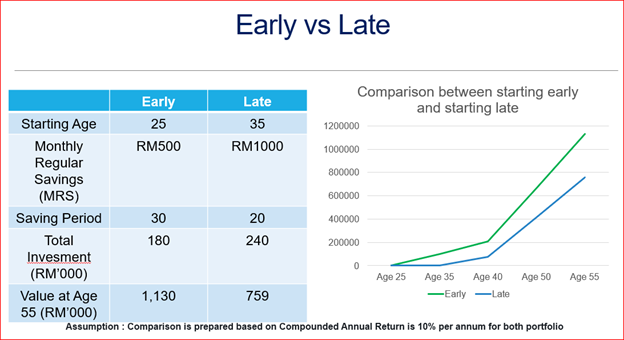
    The early years of working life (between ages 20-30) are surely the best time to begin investing. Ironically, this is also the time of your life when you have the least amount of money to set aside after deducting all your expenses.

    However, no matter how little you are able to set aside, the time factor can make up for that. The concept of compounding interest will kick in to multiply your minute savings into a large retirement nest egg 20-30 years down the road.

    It is also at this early stage of your working life that you can afford to take on higher investment risk vehicles. Should you incur losses due to a wrong investment decision, there is still ample time to start all over again.

    Thus, even if you start with a small amount of money at this stage of life, you can invest in riskier investment vehicles to generate higher returns to make the most out of your small savings.

    In fact, you have two choices to opt for:

    (i) Go for a high-risk/return investment vehicle or

    (ii) Settle with lower risk and safer investment (lower returns).

    Your decision now should depend on your personal risk tolerance level.

    Remember, always strive to set aside some funds, no matter how little, into a vehicle of your choice and set a target or milestone on the investment to help you monitor the progress and appreciate the fruits of your investment.

    Most people did not understand the importance of starting early, and therefore have to compromise their lifestyle when they reached the stage of life when they intend to start a family.

    Manage Your Risk: Cut Losses, Cash Out

    The best-developed investment plan is useless unless appropriate action is taken to implement it.

    Many people assume that they are capable of undertaking the implementation process of their investment plans all by themselves.

    However, investing is not just about buying investment products alone. Knowing when to cash out is equally important. Similarly, knowing when to cut losses is also key.

    Plus, not everything will turn out to be as planned. Circumstances change as well as the investment environment. Constant monitoring of the investment environment and the business environment is required if the investment objective(s) are to be met.

    If the assumptions made in developing your plan have to change, due to the changes in the investment environment, then a reality check of whether the investment plan is still on track is required on a periodical basis.

    Under such circumstances, having a professional consultant may prove useful as they can help review your plans from time to time.

    However,  the cost of engaging a professional investment adviser has to be considered carefully as the cost of their services is certainly an investment in itself!

    In Summary

    Evaluate your current financial position to assess where you currently stand.

    Once you understand your current financial position and stage of life, determine your financial goals and objectives. Whether it is investing in a new house, retirement or children’s education fund, begin with an end in mind.

    Before you determine what type of investment vehicle to choose, you will also need to assess your personal risk tolerance.

    Combining all these factors will assist you in formulating your investment portfolio.

    A wise man once said, “If you know where you want to go, no matter how far or how difficult the journey is, you will reach the destination one day”.

    If you know your investment objective (whether it is for your retirement, children’s education, etc), you will make plans to achieve it.

    How do you manage risk when it comes to investing? Leave us a comment below and share your experience with us.

  • Morningstar Awards Highlight Quality of Investments

    Morningstar Awards Highlight Quality of Investments

    This year, Morningstar Asia Limited announced the winning funds and fund houses for its Morningstar Fund Awards Malaysia in a rather unconventional way. The awards ceremony, which is typically held annually in Kuala Lumpur, was instead hosted via a special webcast on March 19 in light of the Covid-19 outbreak globally. 

    Nevertheless, the change in the awards ceremony format did not prevent Morningstar Asia Limited, a subsidiary of Morningstar, Inc., a leading provider of independent investment research, from recognising retail funds and fund houses that have added the most value for investors within the context of their relevant peer group in 2019 and over longer time periods. 

    Morningstar selects the winners using a quantitative methodology, along with a qualitative overlay. Weightings to one-, three-, and five-year risk-adjusted performance are factored into the methodology.

    Public Mutual Bhd was the biggest winner, sweeping four out of the five awards on offer. Malaysia’s leading unit trust company took home the awards for Best Asia-Pacific Equity Fund, Best Malaysia Large-Cap Equity Fund, Best Malaysia Bond Fund and Best Malaysia Bond (Syariah) Fund. 

    Principal Asset Management Bhd’s Principal Islamic DALI Equity Fund (formerly known as CIMB Islamic DALI Equity Fund) won the Best Malaysia Large-Cap Equity (Syariah) Fund. 

    In his speech delivered via the webcast, Morningstar Asia chief executive officer Nick Cheung said Morningstar’s Annual Awards highlight the quality and breadth of investments available for investors in each region. “Our 2020 winners have been great drivers of investor success. It is our honour to recognise their outstanding achievements and commitments to investors.” 

    Cheung pointed out that every year, Morningstar presents awards to more than 30 countries globally to recognise exceptional fund managers and investment teams who deliver value to investors, and put investors’ interest at the first place.

    “This is in perfect alignment to Morningstar’s vision, which is to empower investors to make more informed investment decisions, and make better investment outcomes. Morningstar has a long history of helping investors.

    “Despite the current diff cult environment, we continue to invest to allow investors to have more and expanded research coverage on equity, fund, ETF, ESG and private investments,” Cheung said. 

    For example, he said Morningstar will soon roll out a new web-based analytic platform of Morningstar Direct which has new features and data sets to allow investors to make better informed investment decisions. 

    Delivering market-beating returns

    Wing Chan, Morningstar’s director of Manager Research Practice, EMEA & Asia, said the 2019 rally in both equities and bonds has rewarded investors handsomely. “However, it was also one of the more unpredictable periods in history, with low interest rates, heightened geopolitical uncertainty, and stretching asset valuations continuing to worry investors. 

    “The awards winners, across our equity and fixed income categories, have proved their ability to deliver market-beating returns over the long term without undue risk,” he added. 

    On what Morningstar looks for when picking the winning funds for the annual awards, Andrew Daniels, senior analyst, Equity Strategies, Manager Research for Morningstar Asia, said the goal is to recognise those funds that have added the most value within the context of a relative peer group for investors over the past year and the longer term. 

    On how Morningstar plays a key role in helping bring about better outcomes for investors, Daniels said Morningstar offers a global reach and has earned investors’ trust through its unbiased and independent research, investor-centric mission, and thought leadership.

    “Since its founding more than 35 years ago, Morningstar’s mission has been to empower investor success. We believe that by taking something nebulous, such as the financial services industry, and making it transparent, investors gain the knowledge to make better decisions. 

    “As a result, Morningstar builds unique products and services that connect people to the investing information and tools they need, because when investors are successful, so are we.”

    By Lee Min Keong

    Please click here to read the full article in the digital edition of Smart Investor (April 2020 issue).

  • Principal Asset Management Bhd Wins Morningstar Fund Awards Malaysia

    Principal Asset Management Bhd Wins Morningstar Fund Awards Malaysia

    Principal Asset Management Bhd took home the Best Malaysia Large-Cap Equity (Syariah) Fund award at the 2020 Morningstar Fund Awards Malaysia for its Principal DALI Equity Fund (formerly known as CIMB Islamic DALI Equity Fund).

    Smart Investor speaks with chief executive officer Munirah Khairuddin on the fund’s performance and how Syariah-compliant funds are gaining traction with investors.

    Despite the strong headwinds buffeting the equity markets, Munirah sees opportunity in adversity, adding that Malaysian equity evaluation is already cheap. While taking a defensive stance, she says Principal Asset Management will take the opportunity to accumulate selective stocks within the plantation, construction, and oil and gas, and healthcare sectors.

    Smart Investor: Congratulations on your win! What were the major changes made to the portfolio in 2019? What key factors drove your winning fund’s performance?

    Munirah Khairuddin: Thank you! I believe the right asset allocation strategy has helped the fund’s performance in 2019. As you may know, the fund consists of 70% Malaysia and 30% Asia Pacific markets, and we manage the fund based on our proprietary top-down FTV and bottom-up FMV Research Process.

    We adopted the Barbell Portfolio structure approach that emphasises on capital preservation and/or growth and have a rigorous portfolio optimisation process that focuses on the Beta, Active Share, and Sharpe Ratio. On top of that, we also run continuous data analytics to ensure that the portfolio is been managed within the optimum risk parameters.

    Are Shariah-compliant funds like Principal DALI Equity Fund gaining traction with investors?

    Yes, we are seeing Islamic Asia Pacific funds gaining traction with investors. This is part of the asset allocation/risk diversification strategies that we are advising investors to consider.

    Historically, Islamic investments are less volatile than their conventional counterparts, especially during periods of uncertainty. During the subprime crisis in 2008, Islamic investments were not as greatly impacted compared to the conventional investments. The Islamic financial markets do not rely on the subprime assets or excessive leverage which caused difficulties for many conventional institutions in the past.

    What are the major risks or challenges facing the financial markets in 2020? How do these risks affect your investment decisions?

    We are in a unique situation in Malaysia. Our markets have been impacted by the Coronavirus outbreak and the US-China trade war. However, for the right investor, we believe there is an opportunity to invest in Malaysian equities and fixed income products because of the value.

    In terms of equity, Malaysian equity valuation is already cheap. We are taking a defensive stance and focusing on stocks which are resilient to the expected slowdown in the domestic economy and/or not exposed to domestic political and regulatory uncertainty. We prefer sectors that benefit from interest rate cuts and are USD earners. This would include stocks in the consumer staples, healthcare, energy, plantation and the REITs sectors.

    On the fixed income side of things, the impact of the Coronavirus outbreak may result in growth in 1Q2020 softening to below 4%. As a conservative move, our fixed income funds are taking a neutral view on benchmark duration. If government bond yields start to rise, we may take advantage of it to extend duration at an opportunistic level.

    Given the current headwinds, which sectors do you see as resilient and can thrive, and how would you position your funds to take advantage of opportunities and/or mitigate risks?

    As I mentioned earlier, we prefer sectors that benefit from interest rate cuts and are USD earners. This would include stocks in the consumer staples, healthcare, energy, plantation and the REITS sectors.

    As always, we advise investors to consider their long-term financial goals and risk tolerance when it comes to investing. Our investment team has recommended the following based on our asset allocation mix (as of Feb 2020):

    Malaysia

    Malaysian equity valuation is undervalued, making it attractive. It’s a great time to take advantage of the opportunity to buy low. We will continue to buy Malaysia on weakness and keep our barbell approach on high yield stocks. We’ll take the opportunity to accumulate selective stocks within the plantation, construction and oil and gas sectors.

    When it comes to the Covid-19 outbreak, we will look at sectors impacted by this event. We’ll tactically underweight the aviation sector, while taking opportunities to trade the glove and healthcare sectors.

    Asia Pacific Region

    A market sell-off during an event like the Coronavirus outbreak usually offers great buying opportunities. Much like Malaysia – it’s a great opportunity to buy low.

    We are taking advantage by buying into structural names with good management and strong business models. We also like companies that are emerging as the key players in the fourth industrial revolution.

    Even though e-commerce may be a relatively more resilient sector with Chinese consumers choosing to spend more time at home and online shopping demand may increase, stocks of these companies are likely to also be sold off indiscriminately in a knee-jerk reaction. We will also be taking the opportunity by adding companies that are capable to lead in the growing consumption space in China.

    By Bernie Yeo

    Please click here to read the full article in the digital edition of Smart Investor (April 2020 issue).