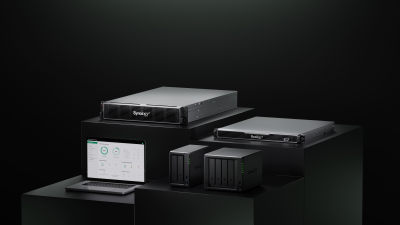
SINGAPORE – Media OutReach Newswire – 18 September 2026 – Synology today launched ActiveProtect Manager 2.0 (APM 2.0), the latest software update for its ActiveProtect data protection appliances. This release introduces expanded platform coverage, cross-platform recovery, and enhanced security, with future updates bringing AI-driven threat mitigation.
ActiveProtect Manager 2.0
“Managing fragmented backup infrastructure drives up costs and slows recovery. The ActiveProtect appliance unites purpose-built storage with powerful data management software into a single, predictable investment,” said Jia-Yu Liu, Executive Vice President of the Synology Data Protection Group. “APM 2.0 builds on that value, enabling organizations to safeguard their entire hybrid infrastructure through one centralized, scalable solution.”
Expanded platform coverage APM 2.0 extends protection to Amazon EC2, Azure VM, Proxmox VE, Nutanix AHV, and Google Workspace. Cross-platform recovery allows workloads to be backed up and restored across different environments, supporting both disaster recovery and seamless workload migration.
Backup destinations have also expanded. ActiveProtect Vault now supports a wider range of Synology NAS models, while Azure Blob Storage joins the list of supported copy and tiering targets. Backups stored in Amazon S3 Storage or Azure Blob Storage can be restored directly into either Amazon EC2 and Azure VM as a cloud disaster recovery strategy without routing through on-premises hardware, significantly reducing recovery times.
AI-driven proactive resiliency ActiveProtect Manager 2.0 adds software-based storage encryption at the volume level to secure data at rest. Backup data and system configurations remain inaccessible in the event of drive theft or hardware loss.
The upcoming APM 2.1 update will add AI/ML anomaly detection, tracking each backup version for shifts in change rate, file modifications, mass deletions, and entropy. Suspicious backup copies will be moved to quarantine for administrators to investigate, limiting the risk of backup contamination. The model learns from those outcomes to improve accuracy and reduce false positives.
APM 2.1 will also scan backups for malware before restoration, using integrated third-party antivirus software such as Microsoft Defender, Bitdefender, and ESET. If malware is detected in the most recent backup, Auto Fallback restores the latest clean version instead.
Availability ActiveProtect Manager 2.0 is available for all DP-Series appliances at no additional cost. For details, please refer to the product page. Hashtag: #Synology #ArtificialIntelligence #DataManagement #Security
The issuer is solely responsible for the content of this announcement.
About Synology
Founded in Taiwan in 2000, Synology is a technology company specializing in network-attached storage (NAS), data backup and recovery, video surveillance, and networking solutions for businesses and individuals worldwide. Over the past two decades, Synology has continuously expanded its ecosystem to help users manage, protect, and unlock the value of data more effectively in the era of cloud, AI, and big data.
Synology’s core philosophy is to build a comprehensive hybrid-cloud ecosystem that enables businesses to protect, synchronize, and manage data through a centralized, intuitive, and easy-to-operate platform. From enterprise storage, data backup, file sharing, and collaboration to video surveillance and network infrastructure, Synology’s solutions are designed to simplify IT management and accelerate digital transformation.
Alongside ongoing technology innovation, Synology also focuses strongly on long-term stability, security, and scalability for data infrastructure. More than half of Fortune 500 companies use Synology solutions, reflecting the brand’s credibility and ability to support large-scale data operations worldwide.
MetroTrans 2026: Join Us to Unlock New Growth Opportunities
GUANGZHOU, CHINA– Media OutReach Newswire – 18 September 2026 – The 2026 China International Metro Transit Exhibition (MetroTrans 2026) will be held from November 9 to 11, 2026, at Area D of the Canton Fair Complex (China Import and Export Fair Complex) in Guangzhou, China.
Centered on the theme of “Urban Rail Transit in the New Era: Enhancing Quality and Efficiency,” MetroTrans 2026 is dedicated to creating an annual industry gala that combines professional depth, industrial breadth, global perspective, and human-centric warmth.
Founded in 2015 and officially approved by China’s Ministry of Commerce, MetroTrans has established itself as a premier international exhibition and exchange platform in the urban rail transit sector, having cumulatively attracted over 1,500 leading global enterprises and more than 200,000 professional visits.
Spanning a planned exhibition area of 50,000 square meters, MetroTrans 2026 is poised to convene more than 500 high-caliber exhibitors and over 40,000 professional attendees from upwards of 50 countries and regions worldwide. The exhibition will feature six specialized zones covering operations and maintenance alongside existing line upgrades and renewal; outdoor rolling stock, vehicle systems, and equipment supply chains; signaling, communications, and intelligent digital solutions; infrastructure; diversified business operations; and talent education coupled with science outreach and study tours. Additionally, the event will highlight two flagship areas: a cutting-edge showcase dedicated to “Rail + Artificial Intelligence” and exclusive “International Pavilions” spotlighting global innovation.
Leveraging a wide spectrum of industry resources, this year’s edition will host a dynamic lineup of concurrent events:
Seminars, technical exchanges, and product matchmaking sessions. Centering on topics such as sustainable industry development and international cooperation, these sessions will bring together leading experts, scholars, and industry pioneers to explore viable pathways for the transformation and upgrading of the urban rail transit sector.
Alongside the main exhibition, the 2026 Guangzhou Rail Transit Week will kick off with the unveiling of Guangzhou’s latest industry support policies and strategic development blueprints. The program will feature a high-profile global investment promotion conference and collective contract-signing ceremony, alongside a vibrant array of supporting initiatives such as specialized job fairs, science outreach programs, educational study tours, a cultural and creative bazaar, and the “Greater Bay Area on Rail” cultural and industrial study tour.
Leveraging the platform advantages of the exhibition, MetroTrans 2026 promotes multi-party, win-win cooperation. Participants can aggregate the strengths of domestic and international rail transit owners, connect global resources, showcase cutting-edge technologies, seize strategic opportunities in the Greater Bay Area, attract outstanding talent, and elevate brand influence.
We sincerely invite global rail transit colleagues to meet in Guangzhou to discuss industry development and explore cooperation opportunities together.
KUALA LUMPUR, MALAYSIA – Media OutReach Newswire – 18 September 2026 – As tools like Google AI Overviews, ChatGPT, and Gemini increasingly influence how consumers search for products and services, Malaysian SEO specialist Terence Lim is warning that businesses optimising only for traditional Google rankings may be missing a growing share of potential customers.
The shift is measurable. AI Overview presence in Google search results has grown from roughly 30% to 48% of tracked queries over the past year, according to BrightEdge’s Generative Parser Research (February 2026) — meaning AI Overviews appeared in nearly half of the queries tracked by BrightEdge. The same research found only about 17% of sources cited in AI Overviews also rank in Google’s organic top 10.
Locally, AI adoption is accelerating — 38% of Malaysian businesses now consistently use at least one AI tool, up from 27% a year ago, according to a 2026 Amazon Web Services (AWS) and Strand Partners study. However, the same study found 67% of adopters still rely mainly on basic tools like public chatbots, and only 19% have a formal strategy to scale AI use — suggesting most Malaysian businesses have yet to apply AI strategically to areas like how customers find them through search.
“In my view, this citation gap shows that ranking #1 on Google is no longer enough on its own,” said Terence Lim, founder of JinMatic, a Kuala Lumpur-based SEO agency. “AI search tools summarise answers directly, often without sending users to a website at all. If your business isn’t structured to be understood by these systems, you can be technically ranking well and still be missing from where customers are actually looking.”
Terence Lim, who has worked in search engine optimisation since 2010 and holds a MOZ Advanced SEO Certification and Google Analytics Individual Qualification, says the gap is particularly relevant for small and medium enterprises, which often rely on SEO agencies or in-house teams still focused solely on traditional keyword rankings.
Terence Lim recommends business owners start by asking three questions: whether their website content directly answers common customer questions, whether their business information is structured in a way search engines and AI systems can easily read, and whether they are tracking visibility in AI-generated answers, not just standard search rankings. A practical starting point, he suggests, is a technical SEO audit to identify what’s currently limiting visibility, paired with keyword research to understand what customers are actually searching for.
JinMatic offers a free SEO Opportunity Review to help Malaysian businesses assess where they stand. Hashtag: #jinmatic #seo #aeo #geo #llm #aiseo #seomalaysia #digitalmarketing #onlinemarketing #terencelim #seoaudit #seoreview #keywordresearch
The issuer is solely responsible for the content of this announcement.
JinMatic
JinMatic is a Kuala Lumpur-based SEO agency specialising in both traditional Google SEO and AI search optimisation (AEO/GEO). Founded by Terence Lim in 2010, JinMatic has worked with businesses across healthcare, e-commerce, and F&B, and has been featured in Sin Chew, Vulcan Post, Malay Mail, Yahoo Finance, SME Magazine, and HR Asia.
SHANGHAI, CHINA – Media OutReach Newswire – 17 September 2026 – Huawei today announced the Peerium Computing Architecture, a new computing architecture for the AI era. The architecture enables processors at the million scale to work as one computer, meeting the ever-growing demand for AI compute.
The Peerium Computing Architecture achieves strong scaling to the million-processor level through nested parallelism, unified memory addressing, and peer interconnect. It breaks through the Turing paradigm with the introduction of Nested BSP (Nested Bulk Synchronous Parallel), extends the von Neumann single-machine architecture, and overturns the master–slave architecture that has prevailed for decades, so that a million processors truly become one larger computer.
UnifiedBus (UB) is the key interconnect technology that makes the Peerium Computing Architecture possible. Built on a single open protocol, UB is a high-speed bus that scales without limit to connect CPUs, NPUs, memory, SSDs, network interface cards (NICs), and switches. With UB, peer interconnect is achieved across compute, storage, and networking.
The Atlas 950 SuperPoD and SuperPoD-based SuperClusters are the first-generation product built on the Peerium Computing Architecture. An Atlas 950 SuperCluster with 256,000 cards is already being deployed, and the Atlas 960 system based on near-packaged optics (NPO) is currently under testing.
Eric Xu, Huawei’s Rotating Chairman, said, “In the AI era, Huawei is drawing on the Peerium Computing Architecture we pioneered to continuously build the SuperPoDs and SuperPod-based SuperClusters that meet customer needs for training and inference, making computing power available everywhere and intelligence accessible to all.”
Hashtag: #Huawei
The issuer is solely responsible for the content of this announcement.
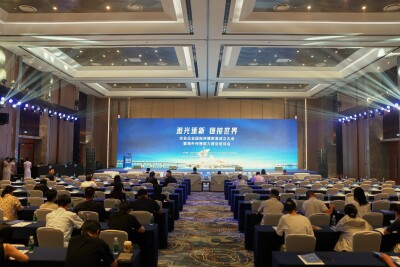
WUHAN, CHINA – Media OutReach Newswire – 17 September 2026 – On September 13, the inauguration ceremony of the Optics Valley International Communication Alliance was held. Representatives of 13 founding member companies — including FiberHome, China Construction Third Engineering Bureau, HGTECH, YHKT Entertainment, Huakang Clean and Shenglong Electric — and of more than 100 other Optics Valley enterprises attended the event.
On September 13th, the inauguration ceremony of the Optics Valley International Communication Alliance was held.
The ceremony was held under the theme “Chasing the Light, Connecting the World.” In recent years, Optics Valley’s innovations have been reaching the world at an accelerating pace. The overseas social media matrix of “Optics Valley of China” has continued to attract attention, and “made in Optics Valley” products such as the Optics Valley Photon sky rail and driverless minibuses have been repeatedly applauded by spokespersons of China’s Ministry of Foreign Affairs, becoming a “calling card for China” in the eyes of overseas netizens. To help companies move from “product export” to “brand export,” Optics Valley has worked with the News & Information Service Center of Xinhua News Agency and other partners to establish the Optics Valley International Communication Alliance, opening international communication resources to Optics Valley companies and providing them with one-stop services such as overseas public opinion response and multilingual content production, so as to serve as a “navigator” for companies going global. As the national news agency of China, Xinhua News Agency has 184 overseas branches and has established cooperative links with more than 2,000 media outlets around the world.
Speaking as a representative of the founding members, Li Lei, vice president of FiberHome, said that FiberHome’s business now covers more than 100 countries and regions, with wholly owned subsidiaries in 36 countries and three overseas optical cable plants in Ecuador, Thailand and Hungary; at its Philippine subsidiary, locally hired employees account for more than 95 percent of the workforce. “We will stay committed to high-quality global expansion and to deepening localized operations, and, with the platform of the Optics Valley International Communication Alliance, we will not only export China’s advanced communication technologies and solutions, but also serve as a bridge for industrial cooperation and people-to-people connectivity between China and the rest of the world,” he said.
Huakang Clean, also a founding member, is a leading enterprise in China’s cleanroom industry. It has made going global a core strategy for the 15th Five-Year Plan period, completed its market layout in Southeast Asia, Central Asia, the Middle East, South America and Africa, and exported mature cleanroom technology solutions. It looks forward to deepening cross-border collaboration and strengthening brand building through the alliance platform.
At the ceremony, a think tank report was released — “Going Global, Competing Worldwide: How ‘Optics Valley of China’ Polishes Its International Calling Card in Service of Building a Strong Nation in Science and Technology — Practices and Insights,” written by Reference News Press · Reference Think Tank. According to the report, leading enterprises represented by the “Seven Stars of Optics Valley” have seen average annual growth in overseas revenue of more than 30 percent. The report sums up Optics Valley’s global communication path as “one strategic direction and ten keywords”: Optics Valley takes serving the building of a strong nation in science and technology as its strategic direction, and adheres to central-local coordination, AI empowerment, going global as a team, and tailored measures for different markets.
The report states that Optics Valley has witnessed and written the confidence and determination of a brand of a strong nation in science and technology going global, and that when the light of “Optics Valley of China” illuminates the global industrial landscape, it conveys the narrative of the times in which China takes part in global competition through technological self-reliance and self-strengthening and shares its opportunities with the world. The report suggests that, for Optics Valley to keep polishing its international calling card in service of building a strong nation in science and technology, three things need to be fully considered: first, elevating the Optics Valley story from “corporate behavior” to a “national narrative”; second, making full use of AI, a global knowledge-service infrastructure, to carry out global communication; and third, moving from “communication empowering industry” to “communication as an industrial capability.”
A training session on overseas communication capacity building was held alongside the inauguration ceremony, with David Wei, founder of Vision Knight Capital, and Cao Yang, deputy director of the International Communication Department of the News & Information Service Center of Xinhua News Agency, invited to give lectures.
The issuer is solely responsible for the content of this announcement.
At HUAWEI CONNECT 2026, Huawei unveiled the industry’s first NPO optical engine with Built-in Light Source, Hi-ONE, offering a total capacity of 7.2 TB/s and enabling Huawei to be the first to mass produce such an optical engine.
Hi-ONE has been applied to the Ascend 960 SuperPoD, built on the “UnifiedBus plus Hi-ONE” architecture. This has reduced the number of 800G optical modules within the SuperPoD by 48,000, significantly lowered system power consumption, and enhanced reliability.
In May 2026, the standard proposal for “12.8 TB/s NPO Module”, jointly submitted by the China Academy of Information and Communications Technology (CAICT), Huawei, and other companies, was officially initiated by the OIF, receiving support from more than 40 global industry chain vendors.
SHANGHAI, CHINA – Media OutReach Newswire – 17 September 2026 – At HUAWEI CONNECT 2026, Huawei unveiled the industry’s first NPO optical engine with Built-in Light Source, Hi-ONE, offering a total capacity of 7.2 TB/s and enabling Huawei to be the first to mass produce such an optical engine. The Ascend 960 SuperPoD, built on the “UnifiedBus plus Hi-ONE” architecture, has already adopted the Hi-ONE optical engine powered by NPO. Hi-ONE is the industry’s first-ever optical engine to adopt a built-in light source architecture, achieving high-density, high-speed optical interconnect while significantly reducing power consumption and latency for signal transmission. The launch of Hi-ONE marks the beginning of NPO technology’s transition from industry consensus to large-scale commercial use, injecting new momentum into the AI computing industry.
NPO technology path: Balancing innovation and ecosystem continuity
NPO technology realizes close interaction between optical and electrical signals but maintains the independence of the optical engine, thus maximizing the continuity of customer usage habits and industry ecosystems. By following this technology path, Huawei has developed the innovative Hi-ONE optical engine, which currently stands as the NPO product with the highest transmission capacity in the industry and the first NPO product to adopt a built-in light source architecture. Rooted in self-developed technologies, Huawei has achieved breakthroughs in key areas such as bandwidth, reliability, power consumption, and latency.
High bandwidth and high reliability: Hi-ONE is the first optical engine to integrate 36 channels of optical transceivers, significantly reducing the number of discrete components and lowering failure rates at the very source. Hi-ONE integrates key technologies, including compound optical chips, silicon photonic chips, and optoelectronic RF chips. Through a balanced design of optical, mechanical, electrical, magnetic, and thermal elements, Hi-ONE supports a transmission capacity of 7.2 TB/s on a single optical engine, and makes built-in light sources a reality in the NPO engine. As a result, overall reliability is improved by 10 times, ensuring the stable operation of long-duration training tasks.
Low power consumption and low latency: With the adoption of a linear direct-drive architecture, Hi-ONE eliminates the need for high-power oDSP chips, cutting power consumption by approximately 66% and latency by about 90%. This both lowers energy costs and boosts communications efficiency.
Standards and ecosystems drive industry consensus
Alongside product innovation, Huawei has also made progress in NPO standards and industry ecosystem development. In May 2026, the standard proposal for “12.8 TB/s NPO Module”, jointly submitted by the China Academy of Information and Communications Technology (CAICT), Huawei, and other companies, was officially initiated by the OIF, with support from more than 40 industry chain vendors worldwide.
From technological breakthroughs to product application, and from international standards to industry ecosystem development, Huawei is driving NPO from industry consensus to large-scale commercial use. It is achieving this through a combination of strong technological innovation and open collaboration with global industry partners, with the ultimate goal of shaping a new AI computing industry landscape.
FAQs:
Q1: What is NPO?
A: NPO, short for Near-Packaged Optics, is an optical interconnect technology that keeps optical engines close to switching chips, shortening the transmission distance between optical and electrical signals while maintaining the independence of optical engines.
Q2: What is the OIF?
A: The OIF, or Optical Internetworking Forum, plays a key role as a core standards developer and interoperability promoter in the optical communications industry. It has huge influence, particularly in the fields of high-speed optical modules and data center interconnect.
Hashtag: #Huawei
The issuer is solely responsible for the content of this announcement.
Strategic focus: The rapid approach of an intelligent world is driving up demand for computing power. Huawei is focused on developing AI infrastructure, and is actively driving innovation in systems and architecture centered around SuperPoDs and SuperClusters. These efforts are aimed at building a solid silicon foundation for the intelligent world.
Technological breakthroughs: Huawei unveiled the Atlas 960E SuperPoD, the first in the industry to use NPO. The company also launched an upgraded TaiShan 950 SuperPoD, as well as the OceanStor M900 (a memory context storage system). Interconnected with UnifiedBus, Huawei’s agentic SuperCluster can scale up to one million NPUs.
Open ecosystems: Huawei is actively building out open computing ecosystems. To date, the Kunpeng ecosystem has attracted 4.16 million developers from around the world. CANN has moved to sustained, community-driven open-source development. Ascend now spans over 90 leading third-party open-source projects and is officially supported as a PyTorch accelerator backend.
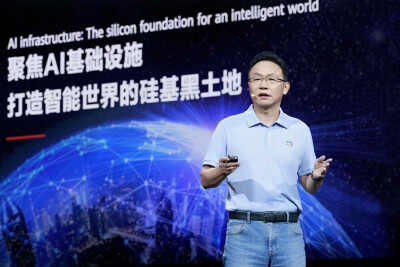
SHANGHAI, CHINA – Media OutReach Newswire – 17 September 2026 – HUAWEI CONNECT 2026 kicked off today in Shanghai. The first keynote of the date was by David Wang, the Deputy Chairman of the Board and Rotating Chairman at Huawei. In his speech (Advancing the Agentic World, Building a Solid Silicon Foundation), Wang highlighted the work the company is doing alongside industry stakeholders to build powerful AI infrastructure, lay a solid computing foundation, and address the challenges and opportunities in the intelligent world to come.
David Wang, Deputy Chairman of the Board and Rotating Chairman at Huawei, delivering a keynote speech at HUAWEI CONNECT 2026
AI is sweeping the world faster than any previous technological revolution. Today, foundation model parameters are rapidly approaching 10 trillion, and are projected to exceed 100 trillion by 2030. AI agents can now work on the same task continuously, for hours on end. By 2030, they will be able to handle tasks that span months.
In China alone, the average number of inference tokens consumed every day has surged to around 500 trillion, and is expected to reach quintillions (1018) by 2030.
On-device AI is also advancing rapidly. On-device models for smartphones have expanded from three billion parameters in 2024 to 30 billion today, and will push toward hundreds of billions in the near future.
These trends will set a much higher bar for the scale, performance, and reliability of underlying technical systems. Only by building powerful AI infrastructure can the industry lay a solid foundation for the future intelligent world.
An intelligent world is approaching – and faster than ever. To lead the charge into this new world, Huawei is laser-focused on building out AI infrastructure – the silicon foundation for the future to come.
In particular, Huawei’s AI strategy is centered on computing power, with a focus on monetizing hardware. The company is also sharpening its competitive edge through systems and architectural innovation. Centering these efforts on SuperPoDs and SuperClusters, the company aims to build a solid computing foundation and offer a new option for the world.
Huawei is a major contributor to open computing ecosystems, and will continue to support native training for mainstream foundation models on its systems, as well as supporting a vast range of models and applications.
For customers, Huawei provides flexible on-premises and cloud compute solutions for its customers to accelerate intelligent transformation across industries.
With diverse forms of compute, including solutions for micro-, low-tier, mid-range, and massive computing power – Huawei is driving the expansion of on-device and in-vehicle AI, making intelligence truly ubiquitous.
Additionally, Huawei is dedicated to building next-generation communications networks to bring readily available compute and intelligence to every person, home, and organization.
SuperPoDs gain broad consensus, with adoption growing in industries, academia, and research institutes
To date, over 1,000 Atlas 900 A3 SuperPoDs have been deployed, and Atlas 950 SuperPoD is seeing large-scale commercial use. While adoption continues to grow, SuperPoDs have gained broad acceptance across industry, academia, and research institutions as a key direction for AI infrastructure. Currently, a SuperPoD is explicitly defined as a computing system in which multiple computing nodes are tightly coupled through high-speed interconnect protocols, featuring unified memory addressing across physical nodes — functioning like a single logical computer.
SuperPoDs are the go-to choice for AI infrastructure buildout. Right now, 100k-NPU computing clusters have become the baseline for training SOTA models. However, traditional server architectures result in intra-cluster communications that account for over 40% of total training time, severely constraining Model FLOPs Utilization (MFU). Simulation results from Huawei’s Markov Lab show that a 100k-NPU cluster built with 4k-NPU SuperPoDs can deliver a 2.75x increase in MFU compared to a 100k-NPU cluster composed of 8-NPU servers.
11-chip UnifiedBus-powered portfolio for SuperPoDs and SuperClusters; the Atlas 960E SuperPoD –the industry’s first to use NPO
The Ascend series of chips is the most critical component in Huawei’s 11-chip UnifiedBus-powered portfolio for SuperPoDs and SuperClusters. Development on Ascend 960 has exceeded the company’s expectations, with performance doubling as planned. Ascend 960DT will be available in Q1 2027, three quarters ahead of the company’s original roadmap. And the Ascend 960PR will be ready in Q3 2027, one quarter ahead of schedule.
“We’re evolving our Ascend chip series on a one-generation-a-year cycle,” said Wang in his keynote. “In 2028 and 2029, we will roll out the Ascend 970 and 980 chips, respectively. Thanks to the Tau (τ) Scaling Law, not only will their compute specifications continue to double, but you can also expect to see huge improvements across the board in terms of memory bandwidth, memory capacity, interconnect bandwidth, and more.”
In addition to Ascend chips, Huawei has also developed a complete portfolio of chips for AI infrastructure, based on UnifiedBus, delivering key capabilities that cover computing, interconnect, storage, and management.
“SuperPoDs are designed to coordinate multiple NPUs through interconnect,” continued Wang. “We have developed a next-generation optical interconnect product based on near-packaged optics (NPO): the High-density Optical-interconnect-Node Engine (Hi-ONE).” Built on Huawei’s proprietary technologies, Hi-ONE has a multi-physics design for balancing optical, mechanical, electrical, electromagnetic, and thermal performance, realizing a transmission capacity of 7.2 Tbit/s per single engine.
“This is the industry’s first NPO product ready for mass production, delivering the largest transmission capacity. It is also the industry’s first NPO product with a built-in light source.”
This product combines high bandwidth and high reliability with low latency and low power consumption. This, coupled with UnifiedBus, will make it far easier to scale up SuperPoD interconnect systems.
Recently, Huawei submitted an implementation agreement (IA) on NPO to the Optical Internetworking Forum (OIF), a standards organization. The response from numerous industry partners has been widely positive. Huawei will continue its efforts to further refine the NPO industry ecosystem.
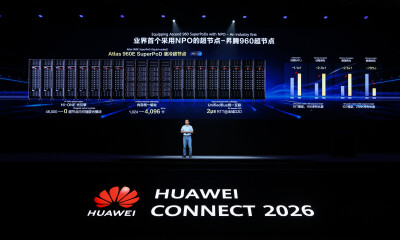
Using Ascend 960 chips and Hi-ONE, Huawei has developed the industry’s first NPO-based SuperPoDs: the Atlas 960E SuperPoDs. A single Atlas 960E SuperPoD can scale up to 4,096 NPUs, delivering 8 EFLOPS of FP8 compute performance, with up to 1 petabyte of HBM capacity. With 5,500 Hi-ONE units, this SuperPoD doesn’t need the 48,000 800G optical modules that would traditionally be required to connect all the NPUs. This cuts power consumption by over 550 kilowatts, while doubling the system’s fault-free operating time, achieving 99.8% system availability.
Combining the upgraded TaiShan 950 SuperPoD and context memory storage to power an ultrascale cluster with 1 million NPUs
As SOTA models scale to 10 trillion parameters, training and inference can no longer rely on a single AI server or AI SuperPoD – they require a more complex computing system. This system includes AI SuperPoDs, general-purpose SuperPoDs, and an interconnect system that features peer-to-peer interconnect and zero protocol conversion. For inference, including a petabyte-scale KV cache cluster is also a must.
To meet these demands, Huawei has fully upgraded its TaiShan 950 SuperPoD. Powered by UnifiedBus all-optical networking, this new SuperPoD supports up to 4,096 nodes with a unified memory pool of up to 256 TB. This setup significantly improves agent performance. For sandbox-intensive workloads, startup speeds for 100,000 sandboxes are 30 times faster than traditional servers, and sandbox density can be improved by an additional 25%. For vector search across 10 billion x 1,000-dimensional vectors, this SuperPoD delivers twice the search efficiency of traditional servers.
Huawei has also launched OceanStor M900 – a UnifiedBus-powered context memory storage cluster that delivers multi-tier KV caching for agent-heavy and longer-context workloads. Designed for agentic inference, this cluster supports one-hop direct access and provides a petabyte-scale KV cache for the L3.5 layer. OceanStor M900 also uses hybrid media and an optimized retention algorithm, extending SSD read/write lifespan by 16-fold. This ensures a higher KV cache hit rate alongside long-term stability and reliability from the ground up.
Combining its strengths in computing and communications, Huawei has built a brand-new agentic SuperCluster to accelerate training and inference for 10-trillion-parameter models. This SuperCluster uses UnifiedBus to consolidate multiple interconnect protocols into a single unified protocol, significantly reducing protocol conversion overhead. This delivers peer-to-peer interconnect between subsystems like Ascend SuperPoDs, Kunpeng SuperPoDs, and KV cache clusters. The SuperCluster also comes with a multi-tier, high-bandwidth, and large-capacity storage system that enables direct single-hop access for all KV cache tiers.
With a two-tier, four-plane Clos architecture, the SuperCluster can interconnect up to 512,000 NPUs. When combined with a multi-rail topology, this cluster can support up to one million NPUs.
One of Huawei’s core strategies: Going open source and open system to build out computing ecosystems
The Kunpeng ecosystem is driving digital and intelligent innovation across a wide range of industries. To date, the Kunpeng ecosystem has attracted over 4.16 million developers and more than 7,200 ecosystem partners from around the globe. The community currently supports over 560 open-source projects worldwide. openEuler has seen more than 20 million installations, securing the largest share in China’s server OS market.
The Ascend ecosystem has reached a new inflection point. The Compute Architecture for Neural Networks (CANN) is the foundation of the Ascend ecosystem. Today, CANN has moved to sustained, community-driven open-source development, which has brought the platform from usable to user-friendly.
External CANN developers now comprise 61% of all CANN developers, outnumbering internal developers for the first time. With over 5,200 monthly active developers, the CANN community has become the most vibrant open-source community in China. What’s more, over 40 models have been natively pre-trained on Ascend and CANN, making it the only proven domestic stack capable of model pre-training.
Ascend now supports over 90 leading third-party open-source projects, including PyTorch, Triton, vLLM, and veRL. With strong support from the Linux Foundation, Ascend is the first official Chinese compute platform on PyTorch’s website. This gives developers around the world ready access to new innovations in the Ascend ecosystem.
Diverse forms of compute for ubiquitous on-device and in-vehicle AI
AI is expanding faster into all kinds of devices. To deliver an unparalleled AI experience across all scenarios, Huawei will continue to strengthen capabilities in four key areas:
First, Huawei will combine Kirin and Ascend chips to drive self-reliance and autonomy in on-device compute.
Second, Huawei will bring together Pangu models and third-party models to make on-device intelligence better and easier to use.
Third, HarmonyOS, as an Agent OS for ubiquitous intelligence, will be completely redefined from the ground up – spanning system architecture, how it operates, and interaction logic – to enable human-agent collaboration.
Fourth, Huawei will keep cultivating a diverse AI ecosystem, which is the foundation for its system agent Celia to thrive.
Huawei plans to build four on-device computing platforms: for AI phones, AI PCs, vehicles, and homes. Through cross-device and device-cloud compute synergy, Huawei will be able to provide distributed swarm intelligence, delivering integrated and continuous intelligent services across personal mobile, office, vehicle, and home spaces, ultimately bringing intelligence to every person and every space.
Building next-generation communications that prioritize readily available compute, because without networks, all compute is siloed
Next-generation communications networks are crucial for fully unleashing the value of AI compute. We are driving the upgrade to networks that, in addition to connecting people, will prioritize delivering readily available compute. These networks will be underpinned by 5G-A/6G, 10-gigabit optical networks, and multi-tier, low-latency bearer networks, delivering intelligent connectivity across data centers, the edge, and devices.
Concluding his keynote, Wang expressed that AI “may well be the final technological revolution in human history,” noting that its impact is deeper and broader, and coming faster than anyone could have ever imagined. “No single company,” he said, “can build an intelligent world alone.”
He stressed Huawei’s ongoing commitments moving forward:
Huawei will remain committed to building a solid silicon foundation to make computing power readily accessible to all.
The company will continue to open source its software, helping developers unleash their full potential.
It will continue to embrace a wide range of models and applications, unlocking value in every form.
“And we will continue to work together to drive shared success, growing together with our customers and partners around the world,” Wang concluded. “Let’s work together to build a fully connected, intelligent world.”
Themed Advancing the Agentic World, HUAWEI CONNECT 2026 will delve into AI across three dimensions: strategy, technology, and ecosystems. You can expect an in-depth look at our latest strategic initiatives, and we’ll also be unveiling our all-new digital and intelligent infrastructure products, scenario-specific solutions for industries, and development tools. The event will run from September 17 to 19 at the Shanghai World Expo Exhibition & Convention Center and Shanghai Expo Center. For more information, please visit HUAWEI CONNECT 2026 online at www.huawei.com/en/events/huaweiconnect
FAQs:
Q1: What is a SuperPoD, and why is it becoming increasingly important?
A SuperPoD is a computing system in which multiple computing nodes are tightly coupled through high-speed interconnect, enabling them to share unified memory and function like a single computer. As foundation model training and inference continue to scale up, SuperPoDs can reduce communications overhead in large-scale clusters and improve Model FLOPs Utilization (MFU). They have gained broad consensus across industry, academia, and research institutes in AI infrastructure, and are the go-to choice for AI infrastructure buildout.
Q2: What makes the Atlas 960E SuperPoDs special?
The Atlas 960E SuperPoD is the industry’s first NPO-based SuperPoD. A single Atlas 960E SuperPoD can scale up to 4,096 NPUs, delivering 8 EFLOPS of FP8 compute performance, with up to 1 petabyte of HBM capacity. With 5,500 Hi-ONE units, this SuperPoD doesn’t need the 48,000 800G optical modules that would traditionally be required to connect all the NPUs. This cuts power consumption by over 550 kilowatts, while doubling the system’s fault-free operating time, achieving 99.8% system availability. Atlas 960E SuperPoDs can provide efficient and reliable computing power for large-scale AI training and inference.
Q3: What is NPO, and what role does Hi-ONE play in a SuperPoD?
NPO stands for Near-Packaged Optics, an optical interconnect technology designed for high-speed connectivity. Hi-ONE, developed by Huawei, is the industry’s first NPO product ready for mass production. It delivers the largest transmission capacity at 7.2 Tbit/s and is currently the industry’s only NPO product with a built-in light source. Hi-ONE, coupled with UnifiedBus, will make it far easier to scale up SuperPoD interconnect systems.
Hashtag: #Huawei
The issuer is solely responsible for the content of this announcement.
Dr. Julie Xing, Global Board Chairman and CEO Discusses New Pathways to High-Quality Growth with Global Business Leaders
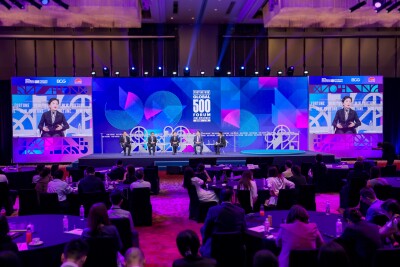
GUANGZHOU, CHINA – Media OutReach Newswire – 17 September 2026 – Lee Kum Kee Sauce (“Lee Kum Kee”), the century-old sauce brand and the only sauce and condiments brand among this year’s Forum partners, actively participated in the 2026 Fortune Global 500 Forum, held on September 16 in Guangzhou, China. Julie Xing, Ph.D., Global Board Chairman and Chief Executive Officer of Lee Kum Kee Sauce, was invited to speak at a panel discussion and to attend the Most Powerful Women (MPW) Breakfast, joining other leading global business leaders to explore the key pathways for enterprises to achieve sustainable growth.
Dr. Julie Xing, Global Board Chairman and Chief Executive Officer of Lee Kum Kee Sauce, speaks at the panel discussion of the 2026 Fortune Global 500 Forum, exchanging insights with industry leaders.
Under the theme “The New Growth Equation”, this year’s forum brought Dr. Xing and three other industry leaders, including Pingyi Huang, Senior Vice President of Shandong Weiqiao Pioneering Group Co., Ltd.; Weiming Xiang, Vice President, GE Aerospace and President, GE Aerospace Greater China; and John Qu, Senior Partner, McKinsey & Company, for a panel discussion titled “The Invisible Moat: Revaluing Soft Power and Sustainability”. Moderated by Wei Yue, Senior Editor at Fortune China, the discussion explored what truly constitutes long-term advantages that can withstand cycles amid rapid technological iteration and intensifying competition. Topics spanned brand trust and consumer mindshare in consumer goods, data insights and organizational transformation in the AI era, and the pathways and stages of globalization for Chinese enterprises.
During the panel discussion, Dr. Xing points out that a true moat is a 360-degree, multi-dimensional structure built on product quality, consumer experience, emotional value, and innovative scenarios. (Photo credit: Fortune Global 500 Forum)
“In an era where almost everything can be replicated, consumers’ mindshare and trust cannot,” Dr. Xing said during the discussion. “The real moat is not just the product itself — it is a 360-degree, multi-dimensional moat built on product quality, consumer experience, emotional value and innovative scenarios.” She added that AI is bringing disruptive changes from consumer insights to organizational structure, and that future-ready organizations must embrace a flatter structure powered by AI agents, redirecting freed-up resources toward strategic decision-making and long-term value creation.
On the topic of Chinese enterprise globalization, Dr. Xing shared a three-stage pathway from product export to local manufacturing to glocalization, emphasizing that true globalization means deeply understanding local consumers and serving local markets with local insights.
Dr. Julie Xing, named to the 2026 Fortune China MPW list, attends the MPW Breakfast and shares her thoughts on corporate competitiveness in the AI era. (Photo credit: Fortune Global 500 Forum)
During the Forum, Dr. Xing was invited to share her insights at the MPW Breakfast themed “Decision-Making Power in the Age of Efficiency”, where she joined leaders from across industries to discuss opportunities and challenges for businesses in the new era. She highlighted that while AI enhances operational efficiency, human judgment, leadership and long-termism remain more critical competitive advantages.
As a recipient of the 2026 Fortune China’s MPW list, Dr. Xing has earned this recognition for three consecutive years. Launched in 2010, the MPW list is regarded as one of the most representative rankings of women business leaders in China.
The Fortune Global 500 Forum this year brought together representatives from over 350 leading global companies, academic institutions, and business leaders worldwide. Discussions focused on topics including artificial intelligence, global supply chain transformation, sustainable development, and opportunities in emerging markets.
Looking ahead, Lee Kum Kee will continue to uphold its commitment to quality and innovation. Alongside driving business growth, the company will further deepen its sustainability practices, nurture talent, and enhance corporate governance, working with all stakeholders to forge new pathways to high-quality growth. Hashtag: #LeeKumKee #LKK
The issuer is solely responsible for the content of this announcement.
About Lee Kum Kee Sauce
Lee Kum Kee Sauce is the global gateway to Asian culinary culture, dedicated to promoting Chinese culinary culture worldwide. Since 1888, it has brought people together over joyful reunions, shared traditions and memorable meals. Beloved by consumers and chefs alike, Lee Kum Kee Sauce’s range of more than 300 sauces and condiments sparks creativity in kitchens everywhere, inspiring professional and home chefs to experiment, create and delight. Headquartered in Hong Kong, China and serving over 100 countries and regions, Lee Kum Kee Sauce’s rich heritage, unwavering commitment to quality, sustainable practices and “Constant Entrepreneurship” combine to enable superior experiences through Asian cuisine for people worldwide. For more information, please visit www.LKK.com.
About Fortune
Fortune is the premier global media company for global business leaders, built on a 96-year-old legacy of trusted, award-winning journalism. Independently owned, Fortune tells the story of business, spanning legacy companies to the world’s new generation of innovators. Fortune measures corporate performance through rigorous benchmarks, and holds companies accountable, in regions around the world. Its iconic rankings include Fortune 500, Fortune Global 500, Most Powerful Women, and World’s Most Admired Companies. Fortune builds world-class communities by convening industry thought leaders for exclusive summits and conferences, including the Fortune Global Forum, Fortune Brainstorm Tech, and Fortune Most Powerful Women. For more information, visit fortune.com.
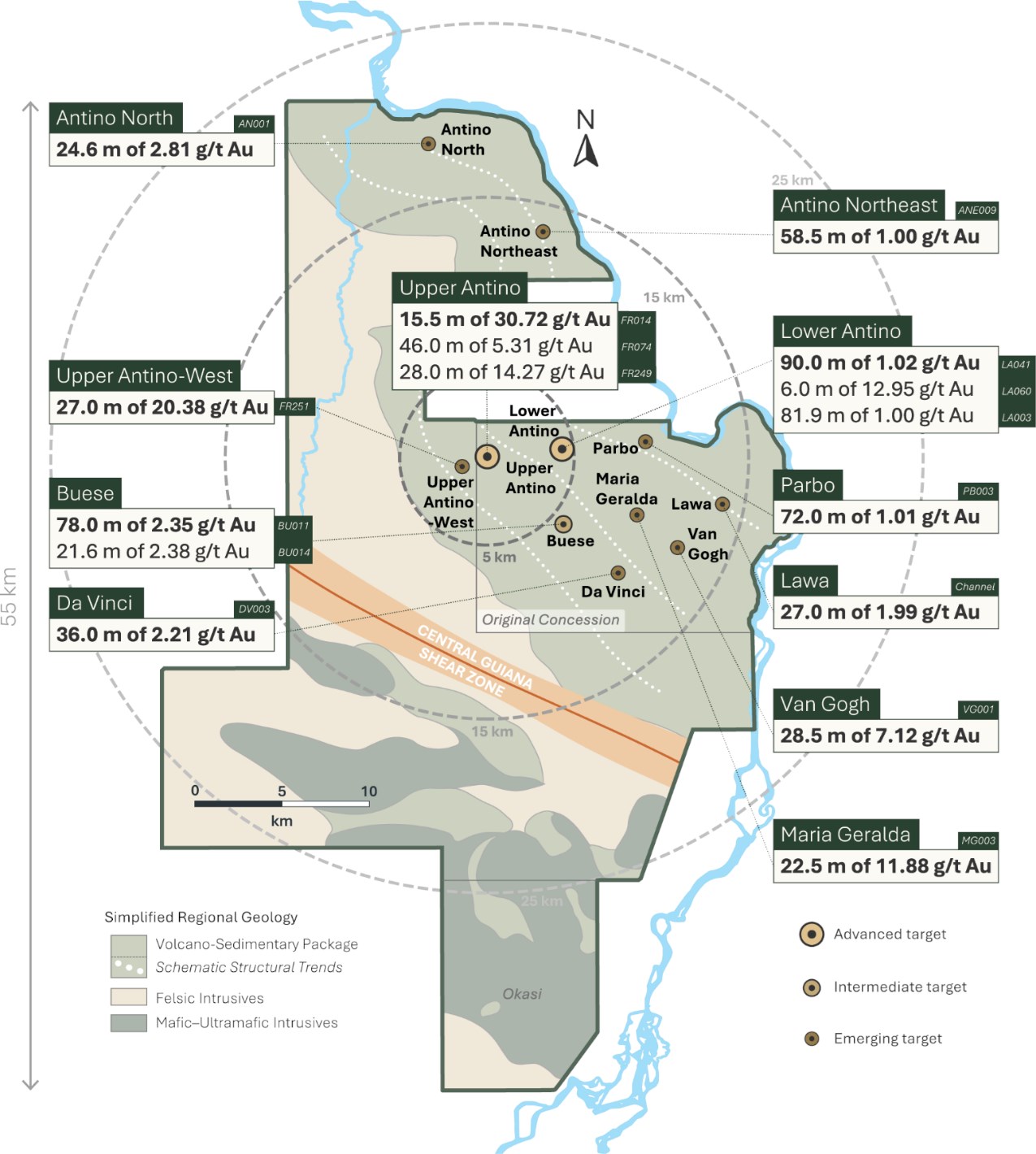
Vancouver, British Columbia – Newsfile Corp. – September 17, 2026 – Founders Metals Inc. (TSXV: FDR) (OTCQX: FDMIF) (FSE: 9DL0) (“Founders” or the “Company”) announces that it has completed the acquisition of the remaining 30% of the issued and outstanding shares of Lawa Gold N.V. (“Lawa”) from Nana Resources N.V. (“Nana”), as previously announced on August 19, 2026 (the “Transaction”). As a result of the Transaction, Founders now holds a 100%, royalty-free interest in the Antino Gold Project (“Antino” or the “Project”) in southeastern Suriname (Figure 1). Concurrently, the Company closed the C$76,958,864 strategic investment by Gold Fields Netherlands Services B.V., an affiliate of Gold Fields Limited (JSE: GFI) (NYSE: GFI) (“Gold Fields”), increasing Gold Fields’ ownership to approximately 19.9% of the Company’s issued and outstanding common shares (the “Gold Fields Investment”).
Under the Gold Fields Investment, the Company issued 14,146,850 common shares (the “Gold Fields Shares”) at a price of C$5.44 per Gold Fields Share. Immediately prior to closing, Gold Fields held 14,489,879 common shares, representing approximately 12.5% of the Company’s issued and outstanding common shares. Following closing, Gold Fields holds 28,636,729 common shares, representing approximately 19.9% of the issued and outstanding common shares of Founders on a non-diluted basis.
Colin Padget, Founders’ President & CEO, commented, “With the closing of this transaction, Founders’ shareholders now hold a 100%, royalty-free interest in the entire 102,360-hectare Antino district, and we have the operational control to advance it on our terms. I want to thank Nana Resources for their partnership in Suriname and their contribution to bringing the project to this point. Gold Fields’ decision to increase its position to 19.9% is a strong endorsement of Antino’s potential and leaves Founders well funded to advance both our known targets and greenfields exploration across the district.”
Transaction Consideration Pursuant to the terms of the Transaction, Nana has received US$17,000,000 in cash and 13,568,944 common shares of the Company (the “Consideration Shares”). Nana is further entitled to receive up to US$21,000,000 in contingent milestone payments, payable in cash, tied to the achievement of specified mineral resource estimate, permitting, construction, and production milestones at the Project. Further details of the terms of the Transaction are set out in the Company’s news release dated August 19, 2026. No finders’ fees were paid by the Company in connection with the Transaction.
Prior to the closing of the Transaction, Nana, with its head office located at Aboenawrokostraat 71, Geyersvlijt, Paramaribo, Suriname, transferred an aggregate of 1,102,531 common shares owned by Nana to certain of its advisors in connection with advisory fees payable to such advisors in respect of the Transaction. As a result of such transfers, following closing, Nana, together with its joint actors, now holds 14,246,413 of the Company’s common shares, representing approximately 9.9% of the issued and outstanding common shares of the Company. Nana will continue to monitor its investment and, depending on various factors and subject to the terms of the Investor Rights Agreement entered into in connection with the Transaction, may from time to time in the future increase or decrease its beneficial ownership, control, direction or economic exposure over securities of the Company through market transactions, private agreements, or otherwise. This press release is being issued in part pursuant to National Instrument 62-103 – The Early Warning System and Related Take-Over Bid and Insider Reporting Issues, which also requires an early warning report to be filed with the applicable securities regulators containing additional information with respect to the foregoing matters. Since the common shares of the Company that Nana beneficially owns or exercises control or direction over now represent less than 10% of the Company’s outstanding common shares, Nana will not file further early warning or insider reports in respect of Nana’s ownership of the Company’s securities, except as may be required by applicable law.
A copy of the early warning report will be made available under the Company’s SEDAR+ profile on www.sedarplus.ca or will be available by contacting Michael Naarendorp, Nana Resources N.V., E-mail: michael.naarendorp@nanaresources.net.
Gold Fields Investment Proceeds from the Gold Fields Investment have been used to pay the cash portion of the Transaction consideration, and the balance is expected to be used to fund regional exploration activities at the Project, working capital, and general corporate purposes.
All Gold Fields Shares and Consideration Shares are subject to a statutory hold period of four months and one day in accordance with applicable Canadian securities legislation and TSX Venture Exchange policies. No finders’ fees were paid by the Company in connection with the Gold Fields Investment.
The issuance of the Gold Fields Shares to Gold Fields under the Gold Fields Investment constitutes a “related party transaction” of the Company under Multilateral Instrument 61-101 – Protection of Minority Security Holders in Special Transactions (“MI 61-101”), as Gold Fields is a “related party” of the Company by virtue of holding more than 10% of the issued and outstanding common shares of the Company. Pursuant to sections 5.5(a) and 5.7(1)(a) of MI 61-101, the Company is exempt from the requirements to obtain a formal valuation and minority shareholder approval in respect of the Gold Fields Investment, as neither the fair market value of the subject matter of, nor the fair market value of the consideration for, the Gold Fields Investment exceeds 25% of the Company’s market capitalization, determined in accordance with MI 61-101.
This press release is being issued in part pursuant to National Instrument 62-103 – The Early Warning System and Related Take-Over Bid and Insider Reporting Issues. Gold Fields, with offices located at Schipholweg 103, Third Floor, Units D7-D10, 2316 XC Leiden, The Netherlands, will file an early warning report in connection with the closing of the Gold Fields Investment. Gold Fields’ decision to acquire the Gold Fields Shares was made in the context of its overall investment purposes. Gold Fields will continue to monitor the business, prospects, financial condition and potential capital requirements of Founders. Depending on its evaluation of these and other factors, Gold Fields may from time to time in the future increase or decrease its equity ownership in Founders through market transactions, private agreements, subscriptions from treasury or otherwise, or may develop other plans or intentions in the future. Prior to the Gold Fields Investment, Gold Fields held 14,489,879 common shares of the Company, representing approximately 12.5% of the Company’s issued and outstanding common shares. Following closing of the Gold Fields Investment, Gold Fields holds 28,636,729 common shares, representing approximately 19.9% of the issued and outstanding common shares of the Company (based on 143,903,160 common shares outstanding after giving effect to the issuance of the Consideration Shares and the Gold Fields Shares).
A copy of the early warning report will be made available under the Company’s SEDAR+ profile on www.sedarplus.ca or by contacting the following persons:
About Founders Metals Inc. Founders Metals Inc. is a Canadian gold exploration company building a district-scale gold camp in southeastern Suriname. The Company owns a 100% royalty-free interest in the Antino Gold Project, a 102,360-hectare contiguous land package representing the largest uninterrupted package of highly prospective greenstone belt geology in the Guiana Shield. Founders is executing one of the most active exploration programs in the global junior gold sector and is backed by a strategic partnership with Gold Fields Limited. The Company is committed to responsible exploration, strong community engagement, and disciplined capital allocation as it advances Suriname’s next major gold camp.
1 Results shown in Figure 1 were previously disclosed by the Company in news releases dated August 24, 2023; July 22, 2024; September 24, 2024; November 7, 2024; December 11, 2024; February 20, 2025; April 23, 2025; June 23, 2025; June 24, 2025; December 11, 2025; January 22, 2026; April 2, 2026; April 30, 2026; June 23, 2026; July 15, 2026; August 6, 2026; and September 9, 2026, each available on the Company’s website and under its profile at www.sedarplus.ca.
ON BEHALF OF THE BOARD OF DIRECTORS,
Per: “Colin Padget”
Colin Padget President, Chief Executive Officer, and Director
Qualified Persons The technical content of this news release has been reviewed and approved by Michael Dufresne, M.Sc., P.Geol., P.Geo., an independent qualified person as defined by National Instrument 43-101.
Cautionary Statement Regarding Forward-Looking Information This press release contains “forward-looking information” within the meaning of applicable Canadian securities legislation, including, but not limited to, the anticipated benefits of the Transaction, the Company’s payment of the contingent milestone consideration under the Transaction, the potential for advancement of known targets at the Project as well as the Company’s ability to conduct greenfields exploration, the potential of the Project, long-term value creation, the Company’s prospects, exploration plans, and anticipated drilling results. Forward-looking information can generally be identified by words such as “plans”, “expects”, “is expected”, “budget”, “scheduled”, “estimates”, “forecasts”, “intends”, “anticipates”, “believes”, or variations indicating that certain actions, events or results “may”, “could”, “would”, “might” or “will” occur or be achieved.
Forward-looking statements are based on management’s current expectations and reasonable assumptions but are subject to business, market, and economic risks, uncertainties, and contingencies that may cause actual results to differ materially from those expressed or implied, including: general business and economic uncertainties; risks related to exploration and development of the Project; the ability of the Company to obtain additional financing; mining industry risks; and other factors described in the Company’s most recent annual management’s discussion and analysis. Although the Company has attempted to identify important factors that could cause actual results to differ materially, other factors may cause results not to be as anticipated. There can be no assurance that forward-looking information will prove accurate, as actual results and future events could differ materially from those anticipated. Accordingly, readers should not place undue reliance on forward-looking information. The Company does not undertake to update any forward-looking information except in accordance with applicable securities laws.
Neither TSX Venture Exchange nor its Regulation Services Provider (as that term is defined in policies of the TSX Venture Exchange) accepts responsibility for the adequacy or accuracy of this release.
All material information on Founders Metals can be found at www.sedarplus.ca.
The issuer is solely responsible for the content of this announcement.
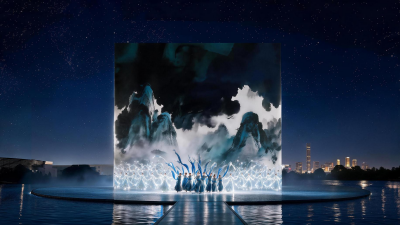
BEIJING, CHINA – Media OutReach Newswire – 17 September 2026 – The 2026 Beijing Chaoyang International Light Festival’s Consumption Season will run from September 11 to October 11, with a limited-edition light-and-shadow installation officially unveiled on September 24. Under the permanent theme “Amazing Chaoyang” and the annual theme “Amazing You” this year’s event builds on three consecutive successful editions with further upgrades.
With the Liangma River Cultural and Economic Belt and the Olympic Central Area as its “two core areas,” the Consumption Season of this year’s Light Festival links the Dawangjing Business District, Chaowai UIC Block, Sanlitun Commercial Area, CBD Business District, and Gaobeidian, among other areas, showcasing Chaoyang District’s new landscape of nighttime consumption.
The Liangma River Cultural and Economic Belt will create its first “processional” night-tour experience, while Chaoyang Park will be transformed into an immersive theatre, allowing residents and visitors to enjoy a new scene at every step and experience drama around every corner. Chinese and international artists will gather once again, classic installations will be renewed and upgraded, and brand-new light-and-shadow works and multiple outdoor premieres will be unveiled, injecting a constant stream of artistic vitality and boundless anticipation into the city’s nightscape.
Alongside the exciting launch of the Light Consumption Season, Chaoyang District will present over 100 cultural, commercial, tourism, sports, and exhibition experiences in quick succession: The 2026 China Open will kick off with passion; the Liangma River International Arts Festival will bloom with aesthetic vitality along the riverbanks; the Olympic Park International Carbohydrate Festival and the Beihu Light and Shadow Life Festival will light up the city’s nighttime economy; the Juicy Taco Fest and the Weibo IN Cross-Dimensional Gravity Field anniversary series will create a distinctive trendy play experience; pop-up events featuring Mao Buyi and Zhou Shen will ignite excitement; the Liangma River will host the “Chi Forest: Your Perfect Drink-Mixing Partner” parade; and the south gate of Chaoyang Park will feature exhibitions of Tesla Cybertruck and other vehicle models, as well as the Optimus robot.
During the Light Consumption Season, commercial districts and over 10,000 brand merchants across Chaoyang District will join forces, integrating Golden Week traffic, top-tier event IPs, and trendy consumption scenarios to create a citywide consumption wave and continuously support Beijing’s development as an international consumption centre.
This autumn, do not miss Chaoyang’s nightscape. As the lights come on, the riverbanks surge with life, and the neighbourhoods come alive together, a more open, more international, more vibrant nightlife awaits you.
Hashtag: #Chaoyang
The issuer is solely responsible for the content of this announcement.

 https://www.synology.com/en-sg/

 https://www.linkedin.com/in/limengjin/