Author: Media OutReach Newswire

  • Gorilla Technology H1 Revenue Surges 99% to US$78.4 Million; Raises FY2026 Revenue Outlook to at Least US$200 Million

    Gorilla Technology H1 Revenue Surges 99% to US$78.4 Million; Raises FY2026 Revenue Outlook to at Least US$200 Million

    London, United Kingdom – Newsfile Corp. – August 24, 2026 – Gorilla Technology Group Inc. (NASDAQ: GRRR) (“Gorilla” or the “Company”), a global solution provider in Security Intelligence, Network Intelligence, Business Intelligence, IoT technology and data centres, today announced its unaudited financial results for the six months ended June 30, 2026.

    Gorilla delivered a significant acceleration in revenue and a marked sequential improvement in reported operating performance during the second quarter. The outperformance was principally driven by earlier-than-anticipated delivery across multiple contracted customer programmes, enabling the Company to recognize the associated revenue ahead of its original expectations. This was complemented by continued execution across Gorilla’s broader portfolio.

    Financial highlights

    • H1 revenue nearly doubled: Revenue increased 99.3% to approximately US$78.4 million, compared with US$39.3 million in H1 2025. Growth was driven by the scaling of Gorilla’s AI infrastructure and data-centre programmes, alongside continued delivery across its security intelligence, network intelligence and smart-city operations, including Egypt, Taiwan and Thailand.
    • Reported and adjusted operating performance: Gorilla reported an IFRS operating loss of approximately US$47.2 million for H1 2026, compared with US$9.1 million in H1 2025. The 2026 results included approximately US$25.4 million of stock-based compensation expense, US$4.0 million of downward fair-value measurement effects, US$2.0 million of debt-transaction costs and US$0.3 million of acquisition-related expenses. Adjusted EBITDA was a loss of approximately US$14.6 million, compared with adjusted EBITDA of approximately US$6.2 million in H1 2025.
    • Reported and adjusted net result: Gorilla reported an IFRS net loss of approximately US$46.9 million for H1 2026, compared with US$8.5 million in H1 2025. Adjusted net loss was approximately US$15.6 million, or US$0.58 per share, compared with adjusted net income of approximately US$6.3 million, or US$0.32 per share, in H1 2025.
    • Operating cash efficiency improved year on year: Net cash used in operating activities declined by approximately US$8.2 million, or 65.3%, from US$12.5 million in H1 2025 to US$4.3 million in H1 2026.
    • Cash position strengthened: Cash increased by approximately US$79.8 million during H1, driven principally by financing inflows and supported by customer collections. Gorilla closed the period with approximately US$179.4 million in cash.
    • Infrastructure investment accelerated: Gorilla deployed approximately US$14.1 million during H1 for the acquisition of property and equipment, including capital advances and project work-in-progress. Property and equipment, including capital work-in-progress, reached approximately US$29.4 million at June 30, 2026.

    Comparative financial performance

    Financial measure H1 2026 H1 2025
    Operating loss (IFRS) US$(47.2)m US$(9.1)m
    EBITDA loss (non-IFRS) US$(46.4)m US$(8.4)m
    Adjusted EBITDA (non-IFRS) US$(14.6)m US$6.2m
    Net loss (IFRS) US$(46.9)m US$(8.5)m
    Adjusted net income (loss) (non-IFRS) US$(15.6)m US$6.3m
    Diluted loss per share (IFRS) US$(1.74) US$(0.43)
    Adjusted diluted earnings (loss) per share (non-IFRS) US$(0.58) US$0.30

    Statement from Jay Chandan, Chairman and Chief Executive Officer

    “This is the clearest evidence yet that Gorilla has entered a different phase of scale,” said Jay Chandan, Chairman & CEO.

    “In one year we managed to nearly double our first half revenue to US$78.4 million. Our second quarter revenue increased 78% sequentially and 138% year-on-year to US$50.1 million, while our reported operating loss narrowed by approximately 85% compared with Q1.

    The progression matters. In the first half, we absorbed a significant share-based compensation charge largely tied to services rendered prior to 2025 and other significant accounting effects. With their removal during the first half of 2026, we are poised for an improvement in operating results.

    We are now converting years of preparation into delivery at scale. We are investing in hardware, infrastructure, people and execution capacity because we see a substantial opportunity ahead of us. Infrastructure cannot be switched on like a tap. Equipment must be procured, installed, commissioned and integrated. Customers must migrate workloads and utilisation must then progress toward steady-state levels.

    That investment is happening now. During H1, Gorilla deployed approximately US$14.1 million for the acquisition of property and equipment, while property and equipment, including capital work-in-progress, reached approximately US$29.4 million at June 30, 2026. We are building the capacity and delivery platform required to support a much larger business. Our priorities for the remainder of 2026 are unambiguous: bring more capacity into service, increase utilisation, expand the workloads we deliver for existing customers and convert additional demand into revenue. We are on track to meet previously announced delivery timelines. The objective is not simply to deploy hardware. It is to build long-term customer relationships around infrastructure, compute and associated services.”

    Statement from Bruce Bower, Chief Financial Officer

    “The first-half results demonstrate both the scale of Gorilla’s investment and the improvement in cash efficiency,” said Bruce Bower, Chief Financial Officer.

    “On an IFRS basis, Gorilla reported an operating loss of approximately US$47.2 million and a net loss of approximately US$46.9 million. Adjusted EBITDA was a loss of approximately US$14.6 million, and adjusted net loss was approximately US$15.6 million. The reconciliation included below provides investors with the individual adjustments and their respective treatment.”

    “H1 revenue increased 99.3%, while net cash used in operating activities declined by approximately US$8.2 million, or 65.3%, to US$4.3 million. Put simply, we nearly doubled revenue while reducing operating cash usage from 31.8% to 5.5% of revenue.”

    “This improvement was achieved while Gorilla deployed approximately US$14.1 million during H1 for the acquisition of property and equipment. Cash deployment may increase as we fund equipment purchases, project-related deposits, construction and commissioning activities. These expenditures represent the planned conversion of liquidity into productive infrastructure and delivery capacity intended to support future revenue-not a weakening of our underlying operating discipline.”

    “The Company recorded an overall increase in cash of approximately US$79.8 million during H1, driven principally by financing inflows and supported by customer collections. We closed the period with approximately US$179.4 million in cash. As this liquidity is deployed, our cash balance may fluctuate as we fund existing projects and build the capacity required to support future revenue.”

    “We are investing ahead of the revenue and utilisation curve, but we are doing so from a position of substantial liquidity. Our priorities remain disciplined capital allocation, project execution, improved utilisation and the conversion of infrastructure investment into sustainable revenue and cash flow.”

    Infrastructure investment and the path to steady state

    Gorilla’s current financial profile reflects the deliberate acceleration of its AI infrastructure strategy.

    Infrastructure projects require capital to be deployed before their full revenue and margin potential can be realized. Hardware procurement is followed by installation, commissioning, integration, customer onboarding, workload migration and utilisation growth. Consequently, expenditure and accounting recognition may precede steady-state revenue generation.

    The Company’s priorities for the second half of 2026 are to:

    • Bring additional infrastructure capacity into service.
    • Increase utilisation across existing deployments.
    • Expand the range of workloads delivered for existing customers.
    • Onboard new customers and convert additional demand.
    • Develop a broader revenue mix across infrastructure, compute and associated services.
    • Maintain disciplined capital allocation and liquidity management while investing for growth.

    Financial Outlook

    Gorilla is increasing its Q3 2026 revenue planning range to approximately US$48 million to US$50 million, compared with its previous planning range of US$36 million to US$40 million. Gorilla now expects revenue for the 2026 fiscal year of at least US$200 million, raising the minimum from its previously announced range of US$160 million to US$200 million.

    2027 guidance

    Gorilla is targeting a revenue range of US$450 to US$500 million in 2027, with substantial gross margin improvement.

    This objective is supported by the infrastructure being installed in connection with previously disclosed projects, the opportunity to increase utilisation, the potential to expand existing customer relationships and Gorilla’s pipeline of additional demand. The objective remains subject to execution, customer demand, deployment schedules and prevailing market conditions.

    Financials

    Gorilla Technology Group Inc. and Subsidiaries
    Condensed Interim Consolidated Balance Sheets
    (Expressed in United States dollars)

    As of
    June 30, 2026 December 31, 2025
    Items (Unaudited and Unreviewed)
    Assets
    Current assets
    Cash and cash equivalents $ 179,361,146 $ 99,532,115
    Restricted deposits 45,933 5,298,442
    Accounts receivable, net and contract assets 145,301,296 111,994,621
    Other current assets 20,045,479 17,221,988
    Total current assets 344,753,854 234,047,166
    Non-current assets
    Property and equipment, net 29,441,217 15,749,411
    Right-of-use assets 1,055,377 1,091,526
    Goodwill and other intangible assets 3,360,361 2,432,278
    Deferred tax assets, net 5,201,078 11,938,173
    Other non-current assets 6,072,360 6,624,980
    Total non-current assets 45,130,393 37,836,368
    Total assets $ 389,884,247 $ 271,883,534
    Liabilities and Equity
    Liabilities
    Current liabilities
    Borrowings $ 10,221,241 $ 10,391,379
    Derivative liability 48,200,000 –
    Accounts and other payables 91,708,655 46,042,759
    Contract liabilities 1,523,600 1,305,644
    Income tax liabilities 1,378,280 11,588,564
    Other current liabilities 899,764 951,094
    Total current liabilities 153,931,540 70,279,440
    Non-current liabilities
    Long-term borrowings 63,025,823 3,404,363
    Deferred tax liabilities 827,315 652,782
    Other non-current liabilities 1,246,054 1,467,110
    Total non-current liabilities 65,099,192 5,524,255
    Total liabilities 219,030,732 75,803,695
    Equity
    Share capital 27,664 26,356
    Treasury shares at cost (5,285,347) (2,105,274)
    Other equity 176,111,198 198,158,757
    Total equity 170,853,515 196,079,839
    Total liabilities and equity $ 389,884,247 $ 271,883,534

    Gorilla Technology Group Inc. and Subsidiaries
    Condensed Interim Consolidated Statements of Comprehensive Loss
    (Expressed in United States dollars)

    Six Months Ended June 30,
    2026 2025
    Items (Unaudited and Unreviewed)
    Revenues $ 78,361,225 $ 39,325,839
    Cost of revenues (74,516,947) (25,877,004)
    Gross profit 3,844,278 13,448,835
    Operating expenses:
    Foreign currency exchange losses, net (2,594,853) (11,552,001)
    Stock-based compensation expenses (25,426,746) (472,642)
    Other operating expenses (23,003,400) (10,494,639)
    Total operating expenses (51,024,999) (22,519,282)
    Operating loss (47,180,721) (9,070,447)
    Net loss (46,893,714) (8,503,060)
    Other comprehensive income (loss), net of tax (748,898) 1,057,235
    Total comprehensive loss $ (47,642,612) $ (7,445,825)
    Basic and diluted loss per share $ (1.74) $ (0.43)

    Gorilla Technology Group Inc. and Subsidiaries
    Condensed Interim Consolidated Statements of Cash Flows
    (Expressed in United States dollars)

    Six Months Ended June 30,
    2026 2025
    (Unaudited and Unreviewed)
    Net cash used in operating activities $ (4,339,769) $ (12,518,511)
    Net cash used in investing activities (12,675,421) (4,852,819)
    Net cash flows from financing activities 98,511,610 5,334,134
    Effect of foreign exchange rate changes on cash and cash equivalents (1,667,389) 448,200
    Net increase (decrease) in cash and cash equivalents $ 79,829,031 $ (11,588,996)
    Cash and cash equivalents at beginning of the period 99,532,115 21,699,202
    Cash and cash equivalents at end of the period $ 179,361,146 $ 10,110,206

    Reconciliation of non-IFRS Financial Measures to IFRS Measures

    In addition to its reported results in accordance with International Financial Reporting Standards (“IFRS”) followed by the Company, it has included in this release certain financial measures that are considered non-IFRS financial measures, including the following:

    (i) Earnings before interest, taxes, depreciation, and amortization (“EBITDA”);
    (ii) Adjusted EBITDA; and
    (iii) Adjusted net income (loss) and adjusted earnings (loss) per share.

    Reconciliation of Operating Loss to EBITDA and Adjusted EBITDA

    Six Months Ended June 30,
    2026 2025
    (Unaudited and Unreviewed)
    Items (Amount in USD)
    Operating loss (IFRS) $ (47,180,721) $ (9,070,447)
    Add: Depreciation expenses 588,726 325,824
    Add: Amortization expenses 181,200 317,806
    EBITDA loss (non-IFRS) $ (46,410,795) $ (8,426,817)
    Add: Foreign currency devaluation (1) – 12,630,726
    Add: Fair value measurement of financial instruments, net (2) 4,002,918 1,531,210
    Add: Stock-based compensation expenses 25,426,746 472,642
    Add: Acquisition-related expenses (3) 340,000 –
    Add: Debt transaction costs (4) 2,044,673 –
    Adjusted EBITDA (non-IFRS) $ (14,596,458) $ 6,207,761

    Reconciliation of Net Loss and Loss per Share to Adjusted Net Income (Loss) and Adjusted Earnings (Loss) per Share

    Six Months Ended June 30,
    2026 2025
    (Unaudited and Unreviewed)
    (Amount in USD)
    Items Amount Per share Amount Per share
    Net loss (IFRS) $ (46,893,714) $ (1.74) $ (8,503,060) $ (0.43)
    Add: Foreign currency devaluation (1) – – 12,630,726 0.64
    Add: Fair value measurement of financial instruments, net (2) 4,002,918 0.15 1,531,210 0.08
    Add: Stock-based compensation expenses 25,426,746 0.94 472,642 0.02
    Less: Tax effects of stock-based compensation expenses (727,217) (0.03) (21,145) –
    Add: Acquisition-related expenses (3) 340,000 0.01 – –
    Add: Debt transaction costs (4) 2,044,673 0.08 – –
    Add: Amortization of acquired intangible assets (5) 171,000 0.01 171,000 0.01
    Adjusted net income (loss) (non-IFRS) $ (15,635,594) $ (0.58) $ 6,281,373 $ 0.32
    Adjusted diluted earnings (loss) per share (non-IFRS) $ (0.58) $ 0.30

    Notes:

    1. Foreign currency devaluation – effects of material depreciation of the Egyptian pound against the U.S. dollar.
    2. Fair value measurement of financial instruments – includes effects of fair value measurement of stock warrants and derivative liabilities.
    3. Acquisition-related expenses – includes expenses incurred for acquisition of Shackleton Finance Limited in June 2026.
    4. Debt transaction costs – includes the portion allocated to derivative liabilities for one-time issuance costs incurred in connection with the convertible notes.
    5. Amortization of acquired intangible assets – includes non-cash amortization expense related to acquired intangible assets.


    About Gorilla Technology Group Inc.

    Headquartered in London U.K., Gorilla is a global solution provider in Security Intelligence, Network Intelligence, Business Intelligence, IoT technology and data centers. We provide a wide range of solutions, including Smart City, Network, Video, Security Convergence and IoT, across select verticals of Government and Public Services, Manufacturing, Telecom, Retail, Transportation and Logistics, Healthcare and Education, by using AI and Deep Learning Technologies.

    Our expertise lies in revolutionizing urban operations, bolstering security and enhancing resilience. We deliver pioneering products that harness the power of AI in intelligent video surveillance, facial recognition, license plate recognition, edge computing, post-event analytics and advanced cybersecurity technologies. By integrating these AI-driven technologies, we empower Smart Cities to enhance efficiency, safety and cybersecurity measures, ultimately improving the quality of life for residents.

    For more information, please visit our website: Gorilla-Technology.com.

    Forward-Looking Statements
    This press release contains “forward-looking statements” within the meaning of the “safe harbor” provisions of the Private Securities Litigation Reform Act of 1995. Gorilla’s actual results may differ from its expectations, estimates and projections and consequently, you should not rely on these forward-looking statements as predictions of future events. Words such as “expect,” “estimate,” “project,” “budget,” “forecast,” “anticipate,” “intend,” “plan,” “may,” “will,” “could,” “should,” “believes,” “predicts,” “potential,” “might” and “continues,” and similar expressions are intended to identify such forward-looking statements. These forward-looking statements include, without limitation, statements regarding our beliefs about the expected timing and amount of revenues that may be recognized under our existing contracts during the second half of 2026 and during 2027, our ability to sign new contracts and execute existing contracts, equipment deployment schedules and overall market conditions, along with those other risks described under the heading “Risk Factors” in the Form 20-F Gorilla filed with the Securities and Exchange Commission (the “SEC”) on April 15, 2026 and those that are included in any of Gorilla’s future filings with the SEC. These forward-looking statements involve significant risks and uncertainties that could cause actual results to differ materially from expected results. Most of these factors are outside of the control of Gorilla and are difficult to predict. Should one or more of these risks or uncertainties materialize, or should underlying assumptions prove incorrect, actual results may vary materially from those indicated or anticipated by such forward-looking statements. Readers are cautioned not to place undue reliance upon any forward-looking statements, which speak only as of the date made. Gorilla undertakes no obligation to update forward-looking statements to reflect events or circumstances after the date they were made except as required by law or applicable regulation.

    Investor Relations Contact
    Dave Gentry
    RedChip Companies, Inc.
    1-407-644-4256
    GRRR@redchip.com

    The issuer is solely responsible for the content of this announcement.

  • First summer vacation season after the opening of the world’s highest bridge

    First summer vacation season after the opening of the world’s highest bridge

    XINYI, CHINA – Media OutReach Newswire – 24 August 2026 – In September 2025, the Huajiang Grand Canyon Bridge in Guizhou Province was open to traffic. This super project, “the world’s highest bridge both vertically and horizontally”, brought Huajiang Village, a once-quiet Bouyei ethnic village, its first full summer vacation season.

    image-1.jpeg

    Since the start of the summer vacation, the village’s 15 homestays and 13 restaurants have been fully booked every day.

    Guizhou Huajiang Grand Canyon Bridge, photographed in September last year (drone photo)
    Guizhou Huajiang Grand Canyon Bridge, photographed in September last year (drone photo)

    With the booming cool-climate economy, nowadays, Huajiang Village has seen idle farm houses turned into high‑end homestays, home‑cooked meals upgraded into special local delicacies, traditional crafts developed into cultural and creative products, and migrant workers returning home to start businesses.

    The village has taken on a brand‑new look with concrete roads, tidy surroundings and growing popularity, and local people’s livelihood and happiness keeps improving.

    The booming cool-climate summer tourism industry has successfully converted cultural‑tourism traffic into sustained development momentum, injecting strong impetus into comprehensive rural revitalization.

    Hashtag: #GuizhouDongjingCultureCommunication

    The issuer is solely responsible for the content of this announcement.

  • Hohhot, Inner Mongolia: Converting Prairie Winds into Computing Power

    Hohhot, Inner Mongolia: Converting Prairie Winds into Computing Power

    HOHHOT, CHINA – Media OutReach Newswire – 24 August 2026 – On August 22, 2026, the fourth annual Green Computing Power (Artificial Intelligence) Conference was held on the picturesque Cilechuan Grassland in Hohhot, Inner Mongolia. Centered on the theme “Building Synergy between Computing and Electricity, Exploring New Horizons in Token Economy, and Creating the Future of Artificial Intelligence Together,” the conference presented the latest research achievements, including the Green Computing Power Development Research Report (2026), and showcased pilot initiatives such as “millisecond-level urban computing” applications. Prominent companies, including ByteDance and Cambricon, signed a series of significant agreements valued at tens of billions, focusing on green intelligent computing centers and token factories.

    The Horinger New District Intelligent Manufacturing Industrial Park
    The Horinger New District Intelligent Manufacturing Industrial Park

    Why has the national computing power industry turned its attention here? Part of the answer lies in this vast grassland.

    Wind turbine blades turn steadily, each rotation generating 12 kilowatt-hours of green electricity. Instead of feeding into the public grid, this clean energy is transmitted via a dedicated 41-kilometer line directly to data centers located tens of kilometers away.

    Inside the machine rooms of these centers, rows of GPU arrays operate around the clock, powered mainly by wind and solar energy.

    Training large-scale AI models utilizing tens of thousands of GPUs can consume over 100 million kilowatt-hours annually. For instance, the Hohhot Intelligent Computing Center, operated by China Mobile, incurred electricity costs of approximately 290 million yuan in 2025, accounting for more than 70% of its total operating expenses. In the competition for computing power, electricity costs proved to be a decisive factor. China’s strategic response includes the “East Data West Computing” project, which redirects the high computing demand from eastern regions to resource-rich western areas. The Horinger data center cluster in Hohhot is among the country’s top ten clusters.

    The city is endowed with a combination of nearly optimal conditions for the selection of data center locations. With an average annual temperature of only 7°C and over 200 days per year suitable for direct outdoor air cooling, the center achieves more than 20% savings in cooling costs. At an electricity price of about 0.36 yuan per kilowatt-hour, a large-scale GPU cluster can save around 50 million yuan annually on power expenses. Currently, Hohhot’s total computing capacity reaches 150,000 P, with green electricity usage exceeding 80%.

    However, the challenge lies in the “green” aspect itself.

    Wind and solar power fluctuate with weather, while computing loads require an uninterrupted 24/7 power supply.

    The local solution is an innovative “computing-electricity synergy” mechanism. China Huadian Corporation constructs a 360,000-kilowatt integrated wind-solar-storage power station, comprising 300,000 kilowatts of wind, 60,000 kilowatts of photovoltaic power, and energy storage capable of continuous four-hour regulation. A collaborative control platform collects data on wind output, solar irradiance, storage status, and computing load at millisecond intervals to dynamically allocate power: when green energy is abundant, storage systems charge and delay-tolerant computing tasks are prioritized; when green energy is limited, storage discharges, the public grid supplements power, and flexible tasks are deferred. This approach transforms power generation and consumption from a unidirectional supply model to a bidirectional interactive system.

    On the consumption side, initiatives to minimize waste are also in progress. The Hohhot data center operated by China Mobile recovers waste heat from nearby power plants to provide cooling for machine rooms. The B02 machine hall has improved its Power Usage Effectiveness (PUE) from 1.315 to 1.209, resulting in annual electricity savings of 560,000 kilowatt-hours since commencing operations. Upon full operation of two machine halls, annual savings are projected to reach 10 million kilowatt-hours of electricity and 150,000 tons of water.

    Operational teams are actively optimizing equipment deployment.
    Operational teams are actively optimizing equipment deployment.

    Today, 62 computing center projects have clustered here, including data centers of China’s three major telecom operators, 16 financial institutions, and computing nodes from Huawei, ByteDance, Kuaishou, and others. Upstream, 45 manufacturing enterprises produce servers, cabinets, and sensors locally. According to the recently published three-year action plan, by 2028, Hohhot aims to establish 10 token factories capable of producing 20 trillion tokens daily. At that time, customers will procure not only cabinets and bandwidth but also directly accessible intelligent services customized to their requirements.

    The prairie winds remain constant, as does the city’s commitment to converting every kilowatt-hour of green electricity into stable and reliable computing power.

    Hashtag: #Hohhot

    The issuer is solely responsible for the content of this announcement.

  • First Phosphate Files NI 43-101 Technical Report for Updated Mineral Resource Estimate for Bégin-Lamarche Igneous Phosphate Deposit

    First Phosphate Files NI 43-101 Technical Report for Updated Mineral Resource Estimate for Bégin-Lamarche Igneous Phosphate Deposit

    Saguenay, Quebec – Newsfile Corp. – August 24, 2026 – First Phosphate Corp (NASDAQ: PHOS) (CSE: PHOS) (OTCQX: FRSPF) (FSE: KD0) (“First Phosphate” or the “Company“) is pleased to announce that the Company has filed its updated Mineral Resource Estimate (“MRE“) Technical Report for the Bégin-Lamarche project located 50 km northwest of the City of Saguenay, Quebec, Canada (the “Deposit”).

    The Technical Report titled “Technical Report and Updated Mineral Resource Estimate of The Bégin-Lamarche Phosphate Property, Saguenay – Lac Saint-Jean Region, Northern Quėbec” dated August 24, 2026, with an effective date of May 1, 2026, was prepared by P&E Mining Consultants Inc. in accordance with National Instrument 43-101 – Standards of Disclosure for Mineral Projects and supports the disclosures made by the Company in its news release dated May 26, 2026. A full copy of the Report is available on the First Phosphate website at https://firstphosphate.com/projects/begin-lamarche-3 and can be found at SEDAR+ (www.sedarplus.ca) under the Company’s issuer profile.

    MRE Highlights include:

    • The updated MRE includes a 378% increase in Indicated Mineral Resources over the Company’s Initial MRE dated September 9, 2024.
    • Measured pit-constrained Mineral Resource: 6.2 Mt @ 7.70% P2O5 (phosphate).
    • Indicated pit-constrained Mineral Resource: 198.5 Mt @ 6.00% P2O5.
    • Inferred pit-constrained Mineral Resource: 89.5 Mt @ 6.16% P2O5.
    • The Deposit remains open at depth.
    • Metallurgical test work indicates an anticipated apatite concentrate grade of 40.4% P2O5 at an 88% process recovery rate, with very low levels of potentially deleterious elements, and has been qualified for production of battery-grade phosphoric acid for lithium iron phosphate (“LFP”) battery with a conversion ratio of 91.1%.
    • The Deposit is located next to existing road and hydroelectric infrastructure and at only 70 km driving distance from the deep-sea Port of Saguenay.
    • The Deposit benefits from definitive, long-term, partially prepaid offtake from an existing, creditworthy partner.
    • Apatite (phosphorus, phosphate) is listed on the critical minerals lists of Québec, Canada, the United States and the European Union.


    The Bégin-Lamarche Deposit Updated Optimized Pit Shell

    Video available at: https://www.youtube.com/watch?v=4TV4WoC_Jhc&feature=youtu.be

    Qualified Person
    The Qualified Person, independent of the issuer, responsible for estimating the Mineral Resources of the Begin-Lamarche Property, within the meaning of NI 43-101, is Mr. Antoine Yassa, P.Geo., of the firm P&E Mining Consultants Inc. Mr. Yassa has read this press release and confirms that the scientific and technical information in this press release for accuracy and compliance with NI 43-101.

    The scientific and technical disclosure for First Phosphate included in this News Release have been reviewed and approved by Steeve Lavoie, P.Geo. Mr. Lavoie is Chief Geologist of the Company and a Qualified Person under National Instrument 43-101 Standards of Disclosure of Mineral Projects (“NI 43-101”).

    About First Phosphate Corp
    First Phosphate (NASDAQ: PHOS) (CSE: PHOS) (OTCQX: FRSPF) (FSE: KD0) is a mineral exploration and development and clean technology company dedicated to building and reshoring a vertically integrated mine-to-market supply chain for the production of LFP batteries in North America. Target markets include energy storage, data centers, robotics, mobility, and national security. First Phosphate’s flagship Bégin-Lamarche property, located in Saguenay-Lac-Saint-Jean, Québec, Canada, represents a rare North American igneous phosphate resource producing high-purity phosphate characterized by very low levels of impurities.

    For additional information, please contact:
    Steeve Lavoie
    Chief Geologist
    Tel: +1 (418) 815-5416

    Investor Relations: https://firstphosphate.com/investors
    General Inquiries: https://firstphosphate.com/contact
    Website: www.FirstPhosphate.com

    Follow First Phosphate:
    X: https://twitter.com/FirstPhosphate
    LinkedIn: https://www.linkedin.com/company/first-phosphate/

    Forward-Looking Information and Cautionary Statements
    This news release contains certain statements and information that may be considered “forward-looking statements” and “forward looking information” within the meaning of applicable securities laws. In some cases, but not necessarily in all cases, forward-looking statements and forward-looking information can be identified by the use of forward-looking terminology such as “plans”, “targets”, “expects” or “does not expect”, “is expected”, “an opportunity exists”, “is positioned”, “estimates”, “intends”, “assumes”, “anticipates” or “does not anticipate” or “believes”, or variations of such words and phrases or statements that certain actions, events or results “may”, “could”, “would”, “might”, “will” or “will be taken”, “occur” or “be achieved” and other similar expressions. In addition, statements in this news release that are not historical facts are forward looking statements, including, among other things: the Company’s planned exploration and production activities; the properties and composition of any extracted phosphate; and the calculation of mineral resources at the project and the possibility of eventual economic extraction of minerals from the project. Although the Company believes the expectations expressed in such forward-looking statements are based on reasonable assumptions, such statements are not guarantees of future performance and actual results or developments may differ materially from those forward-looking statements. Factors that could cause actual results to differ materially from those in forward-looking statements include development and exploration successes, continued availability of capital and financing, and general economic, market or business conditions. These statements are based on a number of assumptions including, among other things: that engineering and construction timetables and capital costs for the Company’s, exploration, development and expansion projects are correctly estimated and not affected by unforeseen circumstances; the ability to obtain financing for its proposed operations on acceptable terms; no material deterioration in general business and economic conditions; no material delays in obtaining permits and other approvals; no significant disruptions affecting the activities of the Company or its ability to access required project equipment and services, and operating supplies in sufficient quantities and on a timely basis; inflation and prices for Company project inputs being approximately consistent with anticipated levels; the ability to complete the exploration and development programs consistent with the Company’s expectations; commodity price expectations including assumptions for P2O5; the Company’s relationship with local municipalities and First Nations remaining consistent with the Company’s expectations; the Company’s relationship with other third-party partners and suppliers remaining consistent with the Company’s expectations; and government relations and actions being consistent with Company expectations. Investors are cautioned that any such statements are not guarantees of future performance and actual results or developments may differ materially from those projected in the forward-looking statements. Accordingly, readers should not place undue reliance on the forward-looking information contained in this press release. The Company does not assume any obligation to update or revise its forward-looking statements, whether because of new information, future events or otherwise, except as required by applicable law. All forward-looking information contained in this release is qualified by these cautionary statements.

    The issuer is solely responsible for the content of this announcement.
    About First Phosphate Corp.

  • NANO Nuclear and Tillman Digital Gateway Sign Strategic Commercial Framework to Enable Advanced Nuclear Power for Gigawatt-Scale U.S. AI Industrial Zones

    NANO Nuclear and Tillman Digital Gateway Sign Strategic Commercial Framework to Enable Advanced Nuclear Power for Gigawatt-Scale U.S. AI Industrial Zones

    • Commercial framework identifies NANO Nuclear as Tillman’s preferred nuclear technology provider; Parties targeting 2 gigawatts (“GW”) or more of advanced nuclear capacity by the mid-2030s and 6 GW or more by 2040
    • Framework also includes fully milestone-vesting warrants for Tillman to purchase up to $100 million of NANO Nuclear Energy common stock, with a majority of the warrants vesting upon future binding reactor purchase commitments and a portion vesting upon achievement of key project-development milestones

    New York, New York–(Newsfile Corp. – August 24, 2026) – NANO Nuclear Energy Inc. (NASDAQ: NNE) (“NANO Nuclear” or “the Company”), a leading advanced nuclear micro modular reactor and technology company focused on developing next-generation energy solutions, today announced the signing of a non-binding Strategic Commercial Framework with Tillman Global Holdings (“TGH” or “Tillman”) and its global data-center platform, Tillman Digital Gateway (“TDG”), to advance the future deployment of NANO Nuclear’s KRONOS MMR™ Energy Systems across Tillman’s planned AI industrial zones in the United States.

    The framework identifies NANO Nuclear as Tillman’s anticipated preferred nuclear technology provider and establishes a structure for the parties to collaborate on the evaluation and development of nuclear generation opportunities across Tillman’s growing U.S. data-center pipeline, with a parallel opportunity to expand to certain international markets.

    In connection with the proposed collaboration, the parties are targeting 2 GW or more of advanced nuclear capacity by the mid-2030s and 6 GW or more by 2040, subject to general and site-specific definitive agreements, customer commitments, financing, regulatory approvals and other project requirements.

    Tillman, a global firm that develops, owns, and scales large-scale digital and energy infrastructure, is advancing a multi-state pipeline of planned AI industrial zones in the U.S. designed to support gigawatt-scale power requirements from anticipated hyperscale and AI tenant customers. As part of its power-first development strategy, Tillman evaluates sites for their ability to accommodate multiple sources of generation and intends to reserve the space to integrate advanced nuclear power as a medium- to long-term source of reliable, baseload generation.

    Figure 1 – NANO Nuclear and Tillman Digital Gateway Sign Strategic Commercial Framework to Advance Nuclear Power for Gigawatt-Scale U.S. AI Industrial Zones

    To view an enhanced version of this graphic, please visit:
    https://images.newsfilecorp.com/files/11703/311012_76d0c2c274ee3872_003full.jpg

    Under the framework, NANO Nuclear and Tillman intend to collaborate across the nuclear project-development lifecycle, including site evaluation and diligence, licensing and development planning, customer engagement and project deployment. The contemplated structure would combine Tillman’s infrastructure development, project financing and power-development capabilities with NANO Nuclear’s advanced reactor technology, nuclear licensing capabilities and integrated approach to the nuclear fuel cycle.

    Combining Complementary Infrastructure and Nuclear Capabilities

    Tillman and its affiliated companies have significant experience developing, financing, owning and operating large-scale digital and energy infrastructure, including U.S. cell towers, fiber infrastructure, in-building connectivity systems and electric vehicle charging infrastructure, and have secured approximately $16 billion of capital since inception. Tillman is leveraging this experience for the development of power-first AI infrastructure designed to address the scale, reliability and speed-to-market requirements of next-generation computing customers.

    NANO Nuclear is developing its KRONOS MMR Energy System, a 15 MWe High-Temperature Gas-Cooled Reactor designed to support modular and phased deployment. The parties believe the technology’s modular architecture is particularly well-suited for staged deployment at large-scale data-center campuses as nuclear generation becomes available over the medium and long term.

    “Power availability is becoming one of the defining constraints on the continued expansion of AI infrastructure, and addressing this challenge will require both near-term execution and long-term planning,” said James Walker, Chief Executive Officer of NANO Nuclear Energy. “This framework represents a milestone in our future customer acquisition strategy, as Tillman brings deep infrastructure-development capabilities, access to capital and relationships across the technology ecosystem, together with a power-first approach to developing the next generation of AI campuses. By planning for nuclear at the earliest stages of site development, we believe we can establish a practical pathway to introduce reliable, baseload power as these campuses scale.”

    “For NANO Nuclear, this framework represents an important potential commercialization pathway that connects our technology with an anticipated multi-gigawatt-site pipeline of power demand,” said Jay Yu, Founder and Chairman of NANO Nuclear Energy. “Importantly, the structure is intended to align both organizations around measurable project-development and commercial milestones as individual opportunities progress. We believe combining Tillman’s infrastructure-development capabilities with our nuclear technology, regulatory licensing pathway and deployment model can create a scalable foundation for future nuclear-powered AI infrastructure.”

    “Meeting the extraordinary power requirements of next-generation AI infrastructure requires us to plan not only for what our campuses need today, but for the resilient, scalable power architecture they will require for decades to come,” said Sachit Ahuja, Co-President of Tillman Global Holdings. “We view NANO Nuclear as an emerging leader in advanced nuclear whose progress to date, commercially focused strategy and modular technology platform make it a compelling potential solution for our medium- and long-term power requirements. This framework combines Tillman’s infrastructure-development platform and relationships with large-scale technology customers and NANO Nuclear’s advanced nuclear capabilities, creating a pathway to benefit from the integration of nuclear generation into future Tillman campuses as our portfolio expands.”

    Potential Multi-Gigawatt Deployment Pathway

    As part of the proposed collaboration, the parties are targeting 2 GW or more of advanced nuclear capacity by the mid-2030s, with a longer-term objective of 6 GW or more by 2040 across Tillman projects. The parties are also evaluating opportunities to extend their collaboration to select international markets where Tillman or its affiliates are developing or evaluating large-scale digital infrastructure.

    Key Elements of the Proposed Framework

    Preferred nuclear technology relationship: The framework identifies NANO Nuclear as Tillman’s proposed preferred nuclear technology provider for potential advanced nuclear energy deployments across Tillman’s planned U.S. AI industrial zones.

    Joint project development: Tillman and NANO Nuclear intend to evaluate candidate sites for future nuclear energy deployment and collaborate on site diligence, development and licensing planning, customer engagement and project structuring as individual opportunities advance.

    IPP-style deployment model: For qualifying projects, the parties contemplate an independent-power-producer-style structure under which Tillman or its affiliates would finance, develop and own project power infrastructure and NANO Nuclear would develop, support operations, and supply the reactors and fuel, with specific commercial arrangements to be negotiated on a project-by-project basis.

    Milestone-Based Warrant Arrangement and $5 Million Initial Equity Grant: The framework contemplates the proposed issuance to Tillman of fully milestone-vesting warrants to purchase up to $100 million of NANO Nuclear common stock. A majority of the warrants would vest only upon future binding reactor purchase commitments. The remaining portion of the warrants would vest only upon achievement of specified project-development milestones.

    The framework also contemplates an initial restricted common stock grant to Tillman with a notional value of $5 million, a portion of which would vest upon execution of definitive equity grant agreements, with the substantial majority vesting only upon achievement of specified project-development milestones.

    Project-level equity participation: The framework also contemplates potential rights for NANO Nuclear to participate alongside Tillman in a portion of the equity of certain project-level entities associated with future nuclear generation and corresponding data-center development once qualifying nuclear projects reach specified development milestones. Any such participation is subject to separately negotiated project-specific terms and definitive agreements.

    All of the foregoing terms remain subject to evolution based on the preparation and execution of definitive documentation.

    NANO Nuclear is being advised on the transaction by EAS Advisors LLC, acting through Odeon Capital Group LLC.

    About Tillman Global Holdings
    Tillman Global Holdings is a U.S.-based holding company that builds and scales leading businesses in essential digital and energy infrastructure. Founded in 2013 by Sanjiv Ahuja, the firm operates with a long-term, operator-led approach, leveraging deep expertise and disciplined capital allocation to address evolving customer and connectivity needs. Tillman applies its hands-on management model to create robust infrastructure platforms that support economic growth and deliver long-term value across the territories in which it operates.

    Tillman’s current portfolio companies operate premier fiber networks, mobile tower platforms, hyperscale data centers, in-building connectivity systems, and energy infrastructure. For more information, visit tillmanglobal.com.

    About NANO Nuclear Energy, Inc.
    NANO Nuclear Energy Inc. (NASDAQ: NNE) is a North American advanced technology-driven nuclear energy company seeking to become a commercially focused, diversified, and vertically integrated company across five business lines: (i) cutting edge portable and other microreactor technologies, (ii) nuclear fuel supply chain, (iii) nuclear fuel transportation, (iv) nuclear applications for space and (v) nuclear industry consulting services.

    Led by a world-class nuclear engineering team, NANO Nuclear’s reactor products in development include the proprietary KRONOS MMR™ Energy System, a stationary high-temperature gas-cooled reactor that is in construction permit pre-application engagement U.S. Nuclear Regulatory Commission (NRC) in collaboration with University of Illinois Urbana-Champaign, “ZEUS”, a portable solid core battery reactor, and the space focused, portable LOKI MMR™, each representing advanced developments in energy solutions that are portable, on-demand capable, advanced nuclear microreactors.

    Advanced Fuel Transportation Inc. (AFT), a NANO Nuclear subsidiary, bolstered by the May 2026 acquisition of Secured Transportation Services (STS), is led by former executives from the largest transportation company in the world and provides nuclear engineering and materials transport services in the U.S. and globally. Through NANO Nuclear, AFT is the exclusive licensee of a patented high-capacity HALEU fuel transportation basket developed by three major U.S. national nuclear laboratories and funded by the Department of Energy.

    HALEU Energy Fuel Inc. (HEF), a NANO Nuclear subsidiary, is focusing on the future development of a domestic source for a High-Assay, Low-Enriched Uranium (HALEU) fuel fabrication pipeline for NANO Nuclear’s own microreactors as well as the broader advanced nuclear reactor industry.

    NANO Nuclear Space Inc. (NNS), a NANO Nuclear subsidiary, is exploring the potential commercial applications of NANO Nuclear’s developing micronuclear reactor technology in space. NNS is focusing on applications such as the LOKI MMR™ system and other power systems for extraterrestrial projects and human sustaining environments, and potentially propulsion technology for long haul space missions. NNS’ initial focus will be on cis-lunar applications, referring to uses in the space region extending from Earth to the area surrounding the Moon’s surface.

    For more corporate information please visit: https://NanoNuclearEnergy.com/

    For further NANO Nuclear information, please contact:
    Email: IR@NANONuclearEnergy.com
    Business Tel: (212) 634-9206

    PLEASE FOLLOW OUR SOCIAL MEDIA PAGES HERE:
    NANO Nuclear Energy LINKEDIN
    NANO Nuclear Energy YOUTUBE
    NANO Nuclear Energy X PLATFORM

    Cautionary Note Regarding Forward-Looking Statements

    This news release and statements of NANO Nuclear’s management and collaborators in connection with this news release contain or may contain “forward-looking statements” within the meaning of Section 21E of the Securities Exchange Act of 1934, as amended, and the Private Securities Litigation Reform Act of 1995. In this context, forward-looking statements mean statements related to future events, which may impact our expected future business and financial performance, and often contain words such as “contemplated”, “expects”, “anticipates”, “intends”, “explore,” “plans”, “aim,” “goal,” “believes”, “potential”, “will”, “should”, “could”, “would” or “may” or derivations of these words and other words of similar meaning about the future, although these are not the exclusive terms that denote forward-looking statements. In this press release, forward-looking statements include those relating to (i) the Company’s potential commercial collaboration with Tillman, which is presently only subject to a non-binding written framework and remains subject to the preparation, negotiation and execution of both general and project specific definitive agreements and (ii) the Company’s and Tillman’s business and operational development plans in general. These and other forward-looking statements are based on information available to us as of the date of this news release and represent management’s current views and assumptions. Forward-looking statements are not guarantees of future performance, events or results and involve significant known and unknown risks, uncertainties and other factors, which may be beyond our control. For NANO Nuclear, particular risks and uncertainties that could cause our actual future results to differ materially from those expressed in our forward-looking statements include but are not limited to, the risk that the Company and Tillman may never advance beyond the exploratory stage and reach definitive documentation (on the terms set forth herein, or at all) or an actual investment by Tillman in the Company, as well as the following: (i) risks related to our U.S. Department of Energy (“DOE”), U.S. Nuclear Regulatory Commission (“NRC”), Canadian Nuclear Safety Commission (“CNSC”) or related state or other U.S. or non-U.S nuclear licensing submissions, (ii) risks related the development of new or advanced technology and the acquisition of complementary technology or businesses, including difficulties with design and testing, cost overruns, regulatory delays, integration issues and the development of competitive technology, (iii) our ability to obtain key vendor, technology and customer contracts and the significant funding necessary to execute on our business plan, (iv) risks related to uncertainty regarding our ability to technologically develop and commercially deploy a competitive advanced nuclear reactor or other technology in the timelines we anticipate, if ever, (v) risks related to the impact of U.S. and non-U.S. government regulation, policies and licensing requirements, including by the DOE, and the NRC, including those associated with the recently enacted ADVANCE Act and the May 23, 2025 Executive Orders seeking to streamline nuclear regulation, and (vi) similar risks and uncertainties associated with the operating a developing business a highly regulated, competitive and rapidly evolving industry, including that our plans may change and we may use our cash on hand faster or in different ways than anticipated as our business requires. Readers are cautioned not to place undue reliance on these forward-looking statements, which apply only as of the date of this news release. These factors may not constitute all factors that could cause actual results to differ from those discussed in any forward-looking statement, and NANO Nuclear therefore encourages investors to review other factors that may affect future results in its filings with the SEC, which are available for review at www.sec.gov and at https://ir.nanonuclearenergy.com/financial-information/sec-filings. Accordingly, forward-looking statements should not be relied upon as a predictor of actual results. We do not undertake to update our forward-looking statements to reflect events or circumstances that may arise after the date of this news release, except as required by law.

    The issuer is solely responsible for the content of this announcement.

  • Six Leading Enterprises Jointly Awarded Tender for Hung Shui Kiu/Ha Tsuen Pilot Development Area

    Six Leading Enterprises Jointly Awarded Tender for Hung Shui Kiu/Ha Tsuen Pilot Development Area

    Cross-industry Collaboration to Support Northern Metropolis Growth
    Total Investment Approximately HK$16.8 Billion

    HONG KONG SAR– Media OutReach Newswire – 24 August 2026 – HSK New Development Limited, a joint venture formed by China Overseas Land & Investment Limited (Stock Code: 0688), China Merchants Land Limited (Stock Code: 0978), China Resources Land (Overseas) Limited, CTG Investment Management Corporation Limited, JD.com Inc., and Sino Land Company Limited (Stock Code: 0083), has been awarded the development project for the first pilot area within the Hung Shui Kiu/Ha Tsuen New Development Area (the ‘HSK Pilot Area’) in the Northern Metropolis. In full support of the National 15th Five-Year Plan and under the coordination of the HKSAR Government, the joint venture will leverage the strengths of cross-boundary collaboration across diverse industries to invest in, develop and operate a large-scale smart logistics project. The project will also incorporate residential and community commercial facilities, with innovative technologies driving industrial upgrading, contributing to the high-quality development of the Northern Metropolis and reinforcing the commitment to supporting Hong Kong’s long-term development.

    Mr Daryl Ng, Chairman of Sino Land Company Limited

    Mr Daryl Ng, Chairman of Sino Land Company Limited, said, ‘The National 15th Five-Year Plan states the accelerated development of the Northern Metropolis as a key priority of Hong Kong’s future growth engine. We are truly honoured to have been awarded the HSK Pilot Area project alongside our distinguished corporate partners. We have full confidence in Hong Kong and believe that the cross-sector collaboration can help bring together diverse expertise to contribute to the region’s innovation and technology development. In the HKSAR Government’s first Five-Year Plan, the Chief Executive also highlighted the pivotal role of the Northern Metropolis in enriching the housing ladder and creating more opportunities and space for home ownership. We are committed to bringing high-value industries and a quality living community to the Northern Metropolis, providing more housing and employment opportunities while enhancing connectivity between Hong Kong and cities across the Greater Bay Area.’

    The HSK Pilot Area development project.

    Hashtag: #SinoLand #NorthernMetropolis #HungShuiKiu

    The issuer is solely responsible for the content of this announcement.

  • Pacific Empire Announces Commencement of 2026 Diamond Drill Program at Trident and Pinnacle

    Pacific Empire Announces Commencement of 2026 Diamond Drill Program at Trident and Pinnacle

    Vancouver, British Columbia – Newsfile Corp. – August 24, 2026 – Pacific Empire Minerals Corp. (TSXV: PEMC) (“Pacific Empire”, “PEMC” or the “Company”) is pleased to announce that diamond drilling is now underway at its flagship Trident copper-gold porphyry project, with drilling also planned at the Company’s Pinnacle project, located immediately to the west of Trident, in north-central British Columbia. The 2026 exploration program is being managed by Equity Exploration Consultants Ltd. (“Equity”), which was formally engaged by the Company earlier this year to provide technical leadership and project management for the season.

    2026 Diamond Drilling Underway at Trident
    Diamond drilling is now underway at the Trident property, with initial holes testing the Trident Main Zone to follow up on the Company’s 2025 drill results, which included holes DD25-TRI-001, DD25-TRI-005 and DD25-TRI-006.

    Following completion of drilling at Trident Main Zone, the drill rig is planned to move to the eastern portion of the Trident property, where the Company just completed two ground-based induced polarization (“IP”) lines designed to follow up on an anomalous chargeability response originally identified in a 2014 survey. Interpretation of the expanded IP dataset has identified a significantly larger area of anomalous chargeability, which has been prioritized as the next drill target at Trident.

    2026 Diamond Drilling Planned at Pinnacle
    Following completion of drilling at the Trident Main Zone and Trident East IP target, diamond drilling is planned to move to the Company’s Pinnacle property, where it will test targets identified from the June 2026 airborne magnetic survey, as well as the Pinnacle South target.

    2026 Work Completed to Date
    Prior to the commencement of drilling, the following work has been completed at Trident and Pinnacle as part of the 2026 field season:

    • Two ground-based IP lines at Trident, expanding on a 2014 chargeability anomaly and identifying a significantly larger area of anomalous chargeability in the eastern portion of the property.
    • An airborne magnetic survey across the northern Pinnacle property block.
    • Review of historical drill core from Trident and Pinnacle.
    • Review of historical exploration data from Trident and Pinnacle.

    Pacific Empire’s President and CEO, Brad Peters, commented: “With diamond drilling now underway at Trident, we are excited to begin testing both the follow-up targets from our 2025 program and the substantially larger IP chargeability anomaly identified through this year’s geophysical work. The expanded target area in the eastern portion of the property is particularly compelling, and the opportunity it gives us to step out and think big about the scale of this system is exciting. At the same time, results from the airborne magnetic survey at north Pinnacle, when considered alongside historical drilling, are equally encouraging. We believe 2026 will be a pivotal year for both projects and look forward to updating shareholders as results become available.”

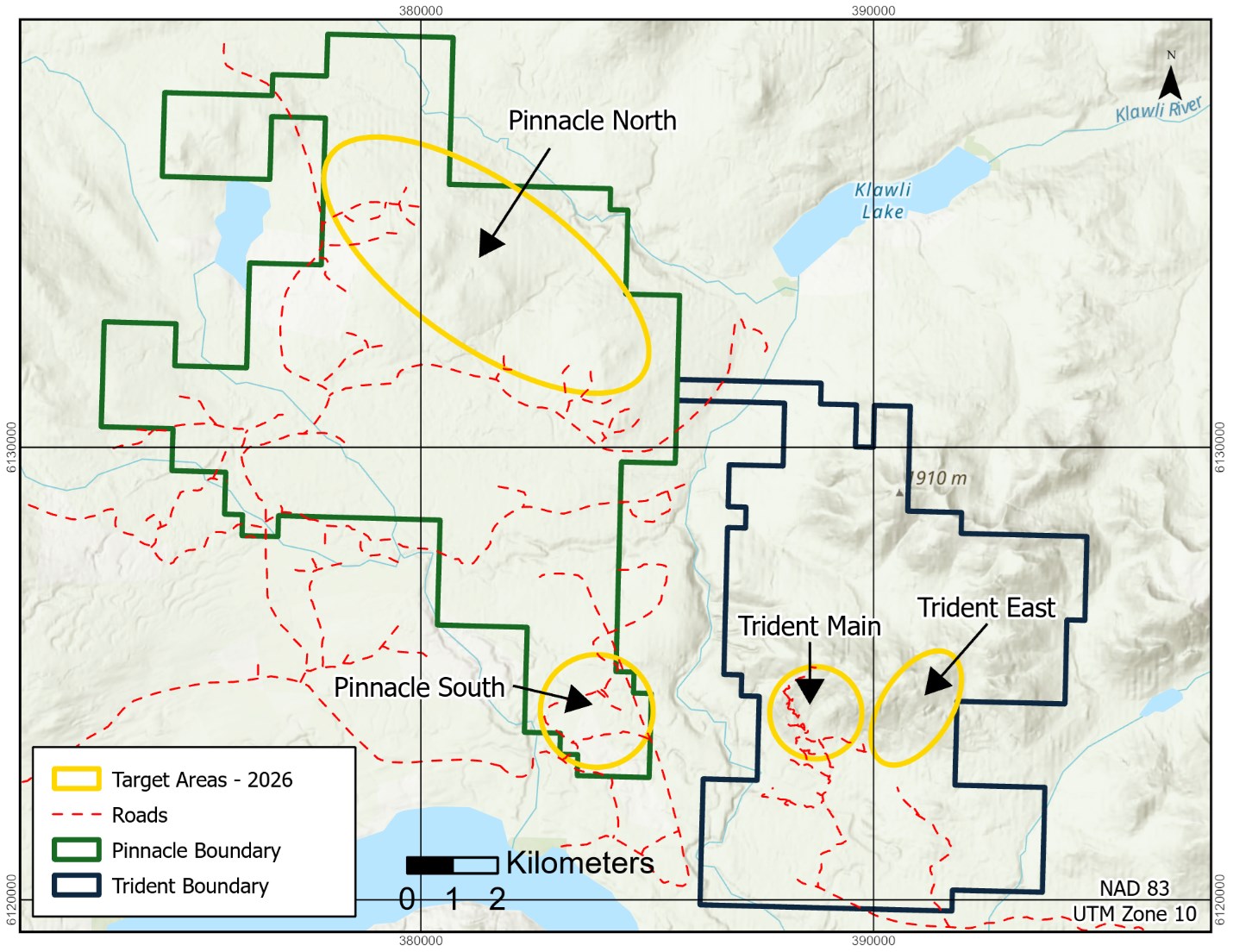
    Figure 1: Location of the four target areas planned for 2026 drilling on Pacific Empire’s Trident and Pinnacle properties. Coordinates shown in NAD83, UTM Zone 10N.

    To view an enhanced version of this graphic, please visit:
    https://images.newsfilecorp.com/files/5412/311026_1d04783a54446945_001full.jpg

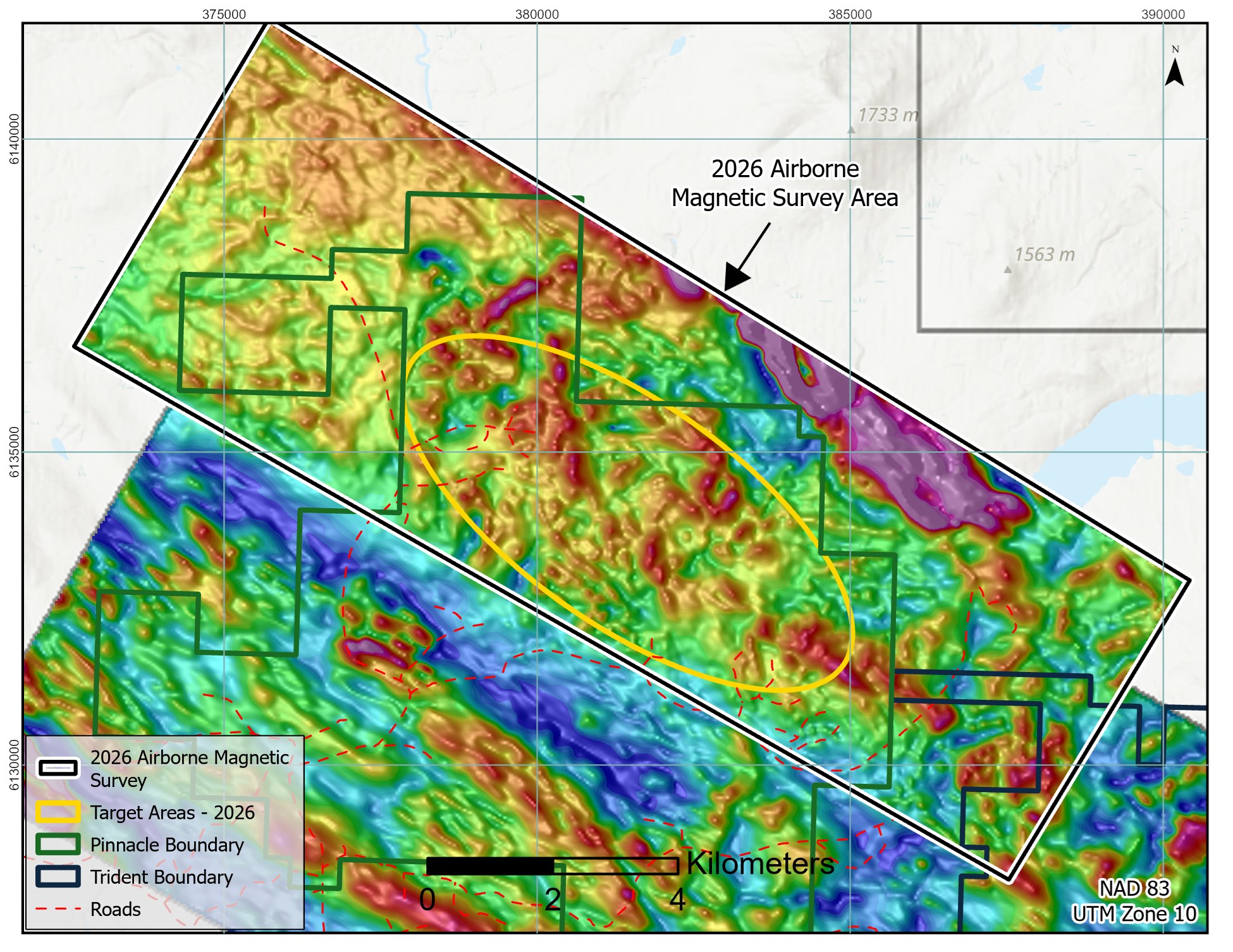
    Figure 2: 2026 airborne magnetic survey coverage over the Trident and Pinnacle properties, with the Pinnacle North target area outlined in yellow. Coordinates in NAD83, UTM Zone 10N.

    To view an enhanced version of this graphic, please visit:
    https://images.newsfilecorp.com/files/5412/311026_1d04783a54446945_002full.jpg

    Qualified Person’s Statement
    Ron Voordouw, P.Geo., Ph.D., is a Qualified Person as defined by National Instrument 43-101. Dr. Voordouw is independent of Pacific Empire Minerals Corp. as defined in NI 43-101 and has reviewed and approved the scientific and technical information contained in this news release.

    About Pacific Empire
    Pacific Empire is a copper exploration company based in Vancouver, British Columbia and trades on the TSX Venture Exchange under the symbol PEMC. The Company has a district scale land position in north-central British Columbia.

    British Columbia is a “Green” copper jurisdiction with abundant hydroelectric power, access and infrastructure in close proximity to the end market.

    ON BEHALF OF THE BOARD,
    “Brad Peters”
    President, Chief Executive Officer and Director
    Pacific Empire Minerals Corp.
    Tel: +1-604-356-6246
    brad@pemcorp.ca
    www.pemcorp.ca
    Neither the TSX Venture Exchange nor its Regulation Services Provider (as that term is defined in the policies of the TSX Venture Exchange) accepts responsibility for the adequacy or accuracy of this release.

    Forward-Looking Statements
    Information set forth in this news release may involve forward-looking statements under applicable securities laws. Forward-looking statements are statements that relate to future, not past, events. In this context, forward-looking statements often address expected future business and financial performance, and often contain words such as “anticipate”, “believe”, “plan”, “estimate”, “expect”, and “intend”, statements that an action or event “may”, “might”, “could”, “should”, or “will” be taken or occur, or other similar expressions. All statements, other than statements of historical fact, are forward-looking statements, including statements regarding the timing, scope and results of the 2026 diamond drilling program at Trident and Pinnacle. By their nature, forward-looking statements involve known and unknown risks, uncertainties and other factors which may cause our actual results, performance or achievements, or other future events, to be materially different from any future results, performance or achievements expressed or implied by such forward-looking statements. Such factors include, among others, the following risks: the need for additional financing; operational risks associated with mineral exploration; fluctuations in commodity prices; title matters; environmental liability claims and insurance; reliance on key personnel; the potential for conflicts of interest among certain officers, directors or promoters with certain other projects; the absence of dividends; competition; dilution; the volatility of our common share price and volume and the additional risks identified in the management discussion and analysis section of our interim and most recent annual financial statement or other reports and filings with the TSX Venture Exchange and applicable Canadian securities regulations. Forward-looking statements are made based on management’s beliefs, estimates and opinions on the date that statements are made, and the Company undertakes no obligation to update forward-looking statements if these beliefs, estimates and opinions or other circumstances should change, except as required by applicable securities laws. Investors are cautioned against attributing undue certainty to forward-looking statements.

    The issuer is solely responsible for the content of this announcement.

  • Uzbekistan Pushes for a More Connected and Competitive Central Asia

    Uzbekistan Pushes for a More Connected and Competitive Central Asia

    Central Bank of the Republic of Uzbekistan and Singapore-headquartered GFTN convene more than 6,000 participants from 74 countries in Tashkent to accelerate investment, financial innovation and regional connectivity

    TASHKENT, UZBEKISTAN – Media OutReach Newswire – 24 August 2026 – Uzbekistan today put its financial reform agenda before a global audience, bringing together policymakers, regulators, investors and founders to advance its ambition to become a gateway for capital, technology and financial connectivity across Central Asia.

    The Silk Road Finance & Technology Forum 2026, convened by the Central Bank of the Republic of Uzbekistan and Singapore-headquartered Global Finance & Technology Network (GFTN), and co-hosted by Ant International, brings together more than 6,000 participants from 74 countries, almost 200 speakers and more than 25 investors representing US$4 billion in assets under management.

    Held at CAEx on 24–25 August, the Forum moves to the Islamic Civilisation Centre on 26 August for The Azimuth, a dedicated programme on Islamic finance and entrepreneurship.

    Uzbekistan’s Reform Push Opens the Door to Global Investment
    Opening the Forum, H.E. Jamshid Kuchkarov, Deputy Prime Minister and Minister of Economy and Finance of the Republic of Uzbekistan, set out the next phase of the country’s economic transformation: converting a decade of reform into deeper markets, greater private-sector participation and long-term investment.

    “Over the past 10 years, as a result of structural reforms, our economy has demonstrated strong and steady growth. During this period, the size of our economy has tripled. Going forward, we will work to achieve investment-grade credit ratings, complete accession to the World Trade Organization, further reduce the state’s presence in the economy, and continue market-oriented reform. This effort will strengthen the role of the private sector, deepen Uzbekistan’s integration into the global economy and create greater opportunities for domestic and international investors,” said H.E. Jamshid Kuchkarov.

    Uzbekistan enters the Forum with strong economic and regulatory momentum. GDP grew 8.5% in the first half of 2026, foreign investment reached US$8.3 billion in the first quarter, and Moody’s upgraded the sovereign rating to Ba2 in June. Presidential Decree PQ-359 and the National FinTech Strategy are advancing open banking, digital payments and financial innovation, with a target of US$1 billion in fintech investment by 2030. Digital-payment adoption rose from 39% in 2021 to 71% in 2025.

    In his opening address, The Silk Road Initiative: Turning a Socio-Economic Heritage into Central Asia’s Financial Innovation Corridor, H.E. Timur Ishmetov, Governor, Central Bank of the Republic of Uzbekistan, framed the country’s fintech strategy through five building blocks drawn from the region’s intellectual and commercial heritage: Al-Jabr, restoring what is missing; Al-Muqabala, balancing the elements of a sustainable financial ecosystem; Zarkaynar, creating a marketplace where innovation meets opportunity; Saroy, building shared financial infrastructure; and Madrassa, developing talent.

    With 57% of payments now cashless, SMEs accounting for more than half the economy and a target of 5,000 young people trained in financial technology by 2030, the Central Bank is translating these principles into its regulatory sandbox, open-banking APIs, payments infrastructure and innovation framework.

    “Scale alone is not sufficient. The objective must be to translate technological adoption and transaction growth into sustainable economic value, competition and broader financial development, while maintaining financial stability, resilience and public trust,” Governor Ishmetov said.

    Sopnendu Mohanty, Group CEO, Global Finance & Technology Network added:.

    “Uzbekistan has the ingredients to become Central Asia’s digital finance gateway: strong political commitment, bold regulatory reform, growing digital adoption and a clear ambition to attract international investment. The next step is to turn those foundations into investment, partnerships and financial corridors that connect Central Asia to the world. That is what the Silk Road Finance & Technology Forum is designed to accelerate.”

    That opportunity comes as fintech moves firmly into the global financial mainstream. In 2025, global fintech revenues reached US$504 billion, growing 22% and more than four times faster than incumbent financial institutions, while 74% of the largest public fintechs were profitable, according to the 2026 Global Fintech Report by BCG and FT Partners.

    For Central Asia, the opportunity is to capture more of that growth by combining financial innovation, inclusion and regional connectivity with the regulatory and institutional foundations required to attract long-term capital.

    From Domestic Reform to a Financial Silk Road

    The Forum is examining how Uzbekistan’s domestic transformation can support a more connected Central Asian financial system, with priorities spanning investable markets, interoperable payments, digital identity, open APIs, tokenisation, digital money, cross-border settlement and long-term institutional capital.

    Central Asia’s relatively young financial infrastructure creates an opportunity to build interoperable systems without inheriting all the constraints of legacy architecture. The next step is moving from domestic digitalisation to cross-border connectivity, with faster settlement, lower remittance costs and infrastructure capable of connecting national financial systems.

    The wider ambition is to recast the historic Silk Road for the digital economy, extending its role from the movement of goods to the movement of money, capital and data between Central Asia and markets across the Middle East, China, South Asia and Southeast Asia.

    Greater connectivity, however, will require more than technology. Predictable regulation, deeper markets, institutional capital, cybersecurity and trusted governance will determine whether new payment rails, AI, tokenisation and digital assets can scale safely across borders.

    New Islamic Banking Law Opens Uzbekistan to US$6 Trillion Market

    Uzbekistan’s new Islamic banking law, effective from June 2026, creates the country’s first legal framework for Shariah-compliant banking and opens a potential channel to a global Islamic finance market approaching US$6 trillion in assets.

    The Forum culminates on 26 August with The Azimuth at the Islamic Civilisation Centre, focused on the standards, Shariah governance, liquidity, digital infrastructure and cross-border capital required to scale the sector. The opportunity extends beyond domestic Islamic banking to positioning Uzbekistan as a bridge between Central Asia and Islamic finance markets across the Gulf, Türkiye, South Asia and Southeast Asia.

    Governor Ishmetov issued a direct invitation to international investors and innovators: “Uzbekistan is open to investment, technology, expertise and long-term partnership. Build here. Test new solutions here. Invest here. Develop talent here. With the right partnerships, Central Asia can become a more connected, competitive and internationally integrated financial region.”

    Hashtag: #GFTN

    The issuer is solely responsible for the content of this announcement.

    About the Silk Road Finance & Technology Forum

    The inaugural Silk Road Finance and Technology Forum takes place in Tashkent from 24 to 26 August 2026, co-hosted by the Central Bank of the Republic of Uzbekistan and the Global Finance and Technology Network (GFTN). The Forum connects policymakers, regulators, investors and founders to shape Central Asia’s next financial corridor across five strategic themes: digital payments and infrastructure, Islamic finance and new corridors, AI and emerging technology, tokenisation and digital assets, and cross-border finance and regulation.
    LinkedIn:
    Website:

    About the Global Finance & Technology Network (GFTN)

    The Global Finance & Technology Network (GFTN) is a Singapore-headquartered not-for-profit organisation established in 2024. With offices in Tokyo, Berlin, and India, GFTN’s mission is to bridge policy, capital, and technology to build financial systems that are resilient, efficient, and inclusive. GFTN Services hosts global forums across five continents, bringing together innovators, entrepreneurs, investors, and policymakers from over 130 countries. It offers policy advice to governments to promote financial technology innovation, inclusion, and capacity building. GFTN Capital will be a venture capital firm investing in growth-stage FinTechs globally. For more information, please visit .

  • 5G Capital Sets a New Benchmark:China Unicom Beijing and Huawei Power the 2nd World Humanoid Robot Games with 5G-A GigaUplink

    5G Capital Sets a New Benchmark:China Unicom Beijing and Huawei Power the 2nd World Humanoid Robot Games with 5G-A GigaUplink

    BEIJING, CHINA– Media OutReach Newswire – 24 August 2026 – The 2nd World Humanoid Robot Games opened yesterday at Beijing’s National Speed Skating Oval, also known as the “Ice Ribbon.” As another real-world validation of 5G Capital in robotics and embodied AI, China Unicom Beijing and Huawei have built an integrated digital foundation powered by a 5G-A GigaUplink network, supporting intelligent event operations, robot competition, and spectator experiences. The deployment also lays a connectivity foundation for humanoid robots to move beyond the arena and into everyday life. Across Beijing, 5G Capital’s region-wide GigaUplink network is providing ubiquitous, secure, and reliable connectivity for a growing range of cultural tourism, embodied AI, and Mobile AI applications and events.

    China Unicom Beijing and Huawei Power the 2nd World Humanoid Robot Games with 5G-A GigaUplink
    China Unicom Beijing and Huawei Power the 2nd World Humanoid Robot Games with 5G-A GigaUplink

    This year’s Games feature major upgrades in both scale and competition design. A total of 1,301 competitions across 51 events will see 2,056 humanoid robots from 666 teams worldwide take part. The number of events has nearly doubled from 26 in the inaugural Games to 51 this year, with new high-intensity head-to-head events such as table tennis and kickboxing. Scenario-based competitions have also expanded into real-world settings including industrial production, hotels, homes, and logistics, while dance events place greater emphasis on synchronized movement across multiple robots. More autonomous competition formats and significantly higher task complexity are placing stringent demands on networks for high-capacity uplink, millisecond-level responsiveness, and high reliability, supporting real-time robot telemetry, precise control signaling, and multi-robot coordination.

    To meet these requirements, China Unicom Beijing and Huawei deployed a dedicated 100 MHz network, complemented by a 300 MHz LampSite ultra-wideband indoor network, to support real-time robot telemetry and precise signaling exchange. A dedicated 5QI 7 slice combined with carrier isolation keeps end-to-end latency for humanoid robots within 30 milliseconds, supporting millisecond-level decision-making and response while helping ensure the precision of multi-robot coordination, obstacle avoidance, and fine-motion control.

    By further integrating the dedicated network with BeiDou RTK (Real-Time Kinematic) positioning, the solution delivers decimeter- to sub-decimeter-level positioning accuracy, supporting autonomous navigation, agile obstacle avoidance, and precision racing in complex environments. On-site tests recorded a peak uplink speed of 1 Gbps, with average latency below 30 milliseconds.

    While safeguarding mission-critical connectivity for the robots, China Unicom has also made the network experience of on-site spectators a priority. To address the high-density, heavy-traffic demands of large crowds, network resources and service assurance policies are dynamically adjusted according to different phases and areas of the event, including admission, waiting, competition, and departure. Core services such as instant messaging, ticket inquiries, QR-code admission, and mobile payments are prioritized for stable access, while the network also accommodates data-intensive services such as photo uploads, short-video sharing, and live streaming. This allows spectators to stay connected, interact seamlessly, and share highlights in real time even during peak traffic periods.

    On the operations side, China Unicom has also developed China’s first embodied AI robot management platform designed for event scenarios. Through a unique network ID assigned to each robot, event staff can monitor its location within the venue, competition status, and operational metrics in real time, creating a closed-loop operations and management system.

    China Unicom and Huawei Together Advancing the 5G Capital initiative
    China Unicom and Huawei Together Advancing the 5G Capital initiative

    Yang Lifan, Deputy General Manager of China Unicom Beijing, said: “This network deployment is not only a real-world test of China Unicom’s network capabilities; it will also help us accumulate valuable network assurance experience for the large-scale deployment of embodied AI. China Unicom will continue to build on the experience gained through the 5G Capital initiative and turn technological innovation into tangible and replicable network capabilities for the Mobile AI era. In doing so, we aim to support industrial innovation and help bring Chinese solutions to the world with China Unicom’s expertise.”

    David Li, President of Huawei’s Wireless TDD Product Line, said: “The 2nd World Humanoid Robot Games have provided a compelling real-world validation of the 5G-A 100 MHz GigaUplink network based on 3.5 GHz 2CC + 2.1 GHz SUL for embodied AI scenarios. Looking ahead, Huawei will continue to work with China Unicom Beijing to strengthen uplink capabilities and advance spectrum coordination, building multidimensional network capabilities with tiered and differentiated service assurance for multimodal device-to-cloud transmission. This will enable real-time interaction and precise control across a wide range of embodied AI scenarios.

    “Networks are about more than speed. Low latency, high reliability, and ubiquitous coverage are equally important. Building on these capabilities, we will further advance the 5G Capital initiative, continue to expand the boundaries of network performance, and lay a solid foundation for the Mobile AI era, working with industry partners to enable an intelligent future.”

    Hashtag: #Huawei #WorldHumanoidRobotGames

    The issuer is solely responsible for the content of this announcement.

  • HiDream.ai Advances Its Native Omni-Modal Roadmap with HiDream-O1-World, an Interactive World Model

    HiDream.ai Advances Its Native Omni-Modal Roadmap with HiDream-O1-World, an Interactive World Model

    BEIJING, CHINA – Media OutReach Newswire – 24 August 2026 – HiDream.ai today launched HiDream-O1-World, a native omni-modal interactive world model that lets users generate complete, explorable 3D worlds from a single text prompt, image, or interactive control.

    HiDream.ai Advances Its Native Omni-Modal Roadmap with HiDream-O1-World, an Interactive World Model

    The model combines three core capabilities — roaming, editing, and interaction — and is built on HiDream.ai’s self-developed UiT (Unified Transformer) architecture. The upgraded UiT delivers a key breakthrough on two persistent challenges in the field: spatiotemporal consistency and physical consistency. As cameras pan, zoom, or track, scene geometry remains stable — objects don’t vanish or deform, and collisions, occlusions, and gravitational responses follow real-world causal logic rather than appearing as randomly stitched frames.

    “The value of an interactive world model isn’t in generating a photorealistic 3D scene — it’s in AI beginning to genuinely understand the depth of space, the texture of objects, the inertia of motion, and the logic of light and shadow,” said Yao Ting, CTO of HiDream.ai. “This is a systematic reconstruction of how the physical world works. HiDream-O1-World is the first bridge in that reconstruction — every interaction leads to a world never reached before.”

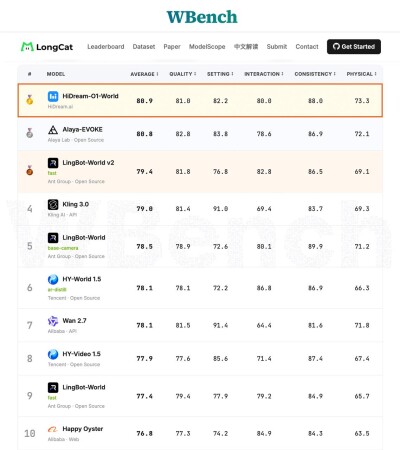
    Topping the Leaderboard on Debut

    HiDream-O1-World’s first third-party benchmark results came from WBench, an interactive world model evaluation benchmark jointly developed by Meituan’s LongCat team and Fudan University. The model topped the core Navi sub-leaderboard with an average score of 80.9, ranked first in the Physical dimension at 73.3, and scored 88.0 on Consistency — the best overall performance on the board.

    WBench covers 289 multi-turn interaction cases and 1,058 interaction turns across five dimensions and 22 metrics. Its Navi board, focused on spatial navigation and viewpoint control, is widely regarded as the core measure of a world model’s spatial understanding. Topping Navi on its first entry, HiDream-O1-World sets a new performance ceiling for interactive world models — outperforming established players including Tencent Hunyuan 1.5.

    One-Click World Generation for Immersive Interaction

    The model lets users generate structurally complete, stylistically diverse interactive worlds from a short description, a single image, or simple controls. Upload a photo of a room, for example, and the model rapidly constructs a high-precision digital twin, completing the full panorama with accurate proportions and fine-grained detail.

    Users can explore worlds in first-person or third-person mode, freely driving a character and adjusting viewpoints. In a diving scene, light patterns on the water surface and refracted glimmers on the seabed shift in sync with the camera; coral textures remain crisp and drift-free throughout.

    Beyond roaming, HiDream-O1-World enables real-time editing — directing characters to grab, run, crouch, or jump, or triggering environmental events like rainfall. Changes maintain globally unified coherence across geometry, lighting, materials, and physical logic, ensuring every interaction remains self-consistent.

    The model generalizes across humans, animals, and fictional characters, adapting to each one’s form and motion. In a snow-climbing scene, footprints press realistic indentations into the snow, snowflakes drift at varied speeds, and distant ridgelines blend naturally with rock textures as the viewpoint shifts. It supports a wide scene and stylistic range — from real city streets and natural terrain to anime-style cartoons and AAA-game-grade rendering.

    Two Core Breakthroughs: Spatiotemporal and Physical Consistency

    Interactive world models have long been constrained by three problems: space, physics, and memory. Camera switches cause blurring and scene drift; physics violations undermine credibility; and without long-term memory, objects disappear when the view turns. HiDream-O1-World addresses these through two coordinated capabilities:

    Long-horizon spatiotemporal consistency. The model pairs 3D priors injected into Memory context with Test-Time Training (TTT) online maintenance. The Memory mechanism encodes scene geometry and object relationships as 3D priors, letting the model “remember” explored structures across viewpoint switches — fundamentally eliminating drift and scene resets. TTT performs lightweight online adaptation during inference, dynamically optimizing adapters so internal representations stay aligned with the scene’s 3D constraints. Where conventional models act like a painter redrawing every frame — with errors compounding into drift and vanishing objects — HiDream-O1-World behaves like a director with spatial memory: it records scene structure rather than re-guessing the environment at each step, recalling the corresponding view when the camera moves.

    Globally stable physical consistency. On the training side, a generative world simulator produces synthetic data covering rigid-body collisions, fluid motion, soft-body deformation, and gravity-driven projectiles — systematically reinforcing the model’s inductive bias through physics-simulated data. On the inference side, the same TTT mechanism enhances physical consistency online, adjusting representations when new object types or materials appear so subsequent frames better follow that scene’s physics. This dual-engine design delivers gains of 13.6% over the industry average on visual-plausibility evaluation and 12.7% on causal-fidelity evaluation across fluid, collision, and deformation dimensions.

    The research has been accepted to ECCV 2026 (European Conference on Computer Vision), one of the three premier academic conferences in computer vision and AI.

    Paper: DreamWorld: Geometry-Grounded Video Diffusion for 3D-Consistent World Modeling
    Project page: https://yanghb22-fdu.github.io/DreamWorld

    Three New Industry Frontiers

    Beyond technical breakthroughs, HiDream-O1-World opens new possibilities for industrial transformation:

    AI interactive film and games. Users no longer follow a linear plot passively but become active participants, with worlds evolving along branching storylines — delivering cinematic visual quality, unprecedented immersion, and the enjoyment of multiple endings.

    Embodied-AI simulation. The model builds physically grounded, high-fidelity simulation spaces — cities, factories, interiors — providing virtual testbeds for robotics training, autonomous driving, and smart manufacturing, replacing high-cost, high-risk real-world testing.

    3D scene production. Creators can generate 3D figurines, home scenes, and art spaces with complete structure and rich detail, supporting structural fine-tuning and instant style switching. It even extends to the microscopic world — simulating cellular behavior and protein interactions for drug discovery and disease-mechanism research.

    When the physical world can be generated at a click and explored freely, many industries deserve to be reimagined. These fields are only the tip of the iceberg — as more developers and creators join, the application boundaries of interactive world models will extend far beyond what can be described today.

    Hashtag: #HiDreamAI

    The issuer is solely responsible for the content of this announcement.