Category: Analysis

  • TikTok Shop’s continues to invest in security for a safe e-commerce ecosystem

    TikTok Shop’s continues to invest in security for a safe e-commerce ecosystem

    Malaysia’s digital economy continues to gain momentum, with an expanding community of over 1.8 million local sellers and 3.8 million affiliate creators leveraging TikTok Shop as the trusted full-funnel e-commerce ecosystem to create sustainable livelihoods.

    With TikTok Shop recording more than 100 million daily product searches in Malaysia, it is uniquely positioned to accelerate the digital transformation of these homegrown entrepreneurs, as proven by its recent milestone of over 130% year-on-year sales uplift for Malaysian-made products under the #JomLokal initiative.

    At the heart of this progress is TikTok Shop’s continuous efforts to build and maintain a safe e-commerce ecosystem that facilitates secure shopping experiences for a nationwide community, from discovery to purchase.

    “Safety is the top priority for TikTok Shop. This commitment is underpinned by our continuous investment, robust end-to-end policies, and compliance with local laws,” said Nur Azre Abdul Aziz, Director of Strategic Partnerships, TikTok Shop Malaysia.

    “As of December 2024, we have invested nearly USD1 billion globally in tools, technologies, and people to protect our community of shoppers, sellers, and affiliate creators from fraudulent, dangerous, illegal, and violative activities,” she emphasised.

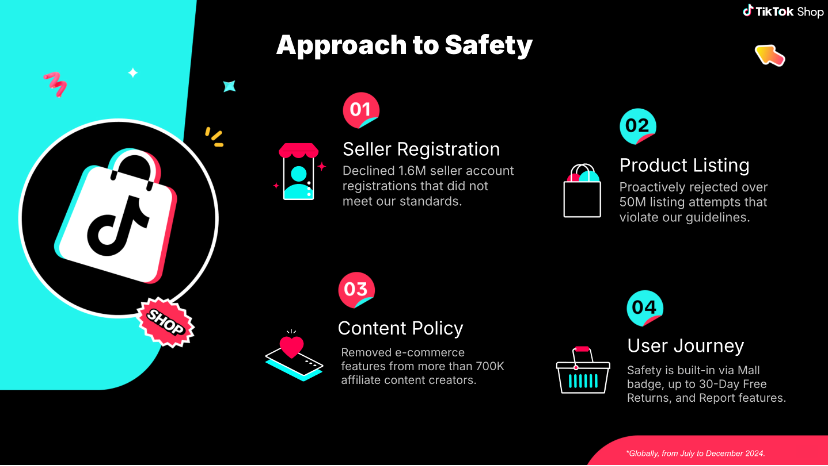
    According to Azre, TikTok Shop adopts a four-pronged approach to safety, which includes Proactive Seller Screening, Proactive Product Listing Governance, Reactive Platform Policy Enforcement, and Safety by Design.

    “We believe creating a trustworthy and secure environment for our community starts with prevention. To this end, TikTok Shop implements extensive proactive measures to screen sellers upon account registration and before products are listed,” she added.

    Diving deeper, Azre mentioned that all businesses must submit official documentation when applying to register for a TikTok Shop Seller Account.

    These applications are said to be scrutinised closely to comply with applicable local regulations and TikTok Shop’s extensive policies, including ensuring that the Identity Card (IC) or relevant business certificates submitted match the corresponding TikTok Shop account and bank account details.

    Even the store names of all sellers must strictly adhere to a comprehensive set of guidelines to ensure accurate business representation, such as restrictions on terms like “Official”, “Flagship”, or “Authorised”.

    “With these preventive processes, from July to December 2024, TikTok Shop has proactively declined 1.6 million seller account registrations globally that did not meet our rigorous standards,” said Azre.

    Once successfully registered, new sellers are then placed on a temporary probation period, with limited daily orders and product listings, to help familiarise themselves with TikTok Shop’s policies and stabilise their operations.

    These policies include TikTok Shop’s Product Listing Guidelines, which explicitly outline prohibited products, including counterfeits and knockoffs.

    “From July to December 2024, TikTok Shop has proactively rejected over 50 million product listing attempts worldwide that violate our guidelines,” explained Azre.

    Affiliate creators are similarly held to high standards under TikTok Shop’s Content Policy, which ensures responsible product promotions by prohibiting illegal activities, intellectual property (IP) rights infringement, misleading or false content, Artificial Intelligence Generated Content (AIGC), and more.

    “However, there is no finish line when it comes to safety. Users are encouraged to directly report violative products, content, and sellers on TikTok Shop via the in-app reporting channel,” Azre reminded.

    Strict enforcement actions are then taken against any sellers or creators who breached its policies, based on TikTok Shop’s Seller Performance Evaluation Policy and Creator Performance Evaluation Guidelines.

    Azre highlighted that, worldwide between July 2024 and December 2024, TikTok Shop removed more than 90,000 listed products, disabled e-commerce features for more than 700,000 creators, and removed more than 450,000 sellers as a result of shop-level violations.

    “In addition to our platform’s proactive and reactive governance, security is also embedded into users’ in-app shopping experience, through our Safety by Design approach,” she underscored.

    All orders on TikTok Shop are protected by its robust Free Returns and Refunds Policy, which facilitates simplified and fair after-sales requests for customers.

    “TikTok Shop will continue collaborating with our community, regulators, and industry stakeholders to share insights, refine best practices, and shape forward-looking policies that promote a safe and vibrant e-commerce ecosystem for all, such as through our #ShopSafe scam prevention initiative,” Azre concluded.

  • Alibaba Cloud’s new whitepaper shows how AI can power sustainable business transformation

    Alibaba Cloud’s new whitepaper shows how AI can power sustainable business transformation

    A new whitepaper released by Alibaba Cloud, Driving Sustainability with AI: A Guide to Partnering with Technology Service Providers, offers a forward-looking blueprint for how organisations can harness digital infrastructure — particularly AI and cloud computing — to accelerate their sustainable journey.

    Based on insights from the Tech-Driven Sustainability Trends and Index 2024, which surveyed 1,300 business leaders across Asia, Europe, and the Middle East, the report combines industry data, actionable recommendations, and real-world case studies to explore how emerging technologies can close the gap between aspiration and execution.

    The State of Sustainability: Progress, Gaps and Opportunity

    The whitepaper highlights the growing urgency for businesses to act on sustainability, with 80% of surveyed organisations setting green targets. Yet only one-third of these have committed to science-based net-zero goals. Many companies still struggle to move from commitment to impact, citing gaps in technical understanding, measurement tools and concerns about the energy footprint of digital technologies.

    Despite these barriers, a strong majority — 76% — see AI and cloud computing as essential tools to achieve sustainability outcomes. At the same time, 82% say it is critical that these technologies themselves are developed sustainably.

    From Insight to Impact: Green AI in Action

    Alibaba Cloud is helping organisations bridge this gap through platforms like Energy Expert, which uses AI to measure emissions and energy consumption in real time. The platform has already served over 3,000 organisations globally.

    One standout case is its collaboration with Covestro, a polymer material company. Working together, the two helped Chinese beverage brand Nongfu Spring trace the full lifecycle emissions of its recycled water barrels — later repurposed into gel pens – offering supply chain transparency from production to reuse.

    The whitepaper also showcases Alibaba Cloud’s commitment to low-carbon AI innovation. Its open-source Qwen series models are designed for efficiency and accessibility. Japanese AI start-up Lightblue, for example, used Qwen to build a localized high-performance Japanese-language model with lower development costs and energy use.

    Five Strategies to Drive Recommendations for Sustainable Digital Transformation

    The whitepaper identifies five strategic actions that businesses can take to align digital transformation with sustainability outcomes. First, organizations are encouraged to link their adoption of AI and cloud technologies with specific sustainability KPIs—for example, using predictive tools to optimise operations or monitor emissions across supply chains. Second, companies should partner with transparent, green technology providers that publish energy usage and emissions data, operate on renewable energy, and invest in energy-efficient infrastructure. Third, the paper highlights the importance of embedding security into sustainability strategies, noting that cybersecurity concerns remain a key barrier to wider adoption of digital sustainability tools.

    Fourth, it recommends embracing open and trustworthy AI, such as open-source models that reduce costs, improve energy efficiency, and allow for localized applications. Finally, the paper calls for stronger public-private collaboration, with 82% of surveyed executives supporting more active government involvement to accelerate the adoption of sustainable technologies through policy, incentives, and education.

    A Roadmap for Business Leaders

    More than a guide, the whitepaper is a call to action. It emphasizes that sustainability is no longer a nice-to-have but rather a competitive differentiator and a catalyst for growth.

    For companies navigating climate and digital transformation simultaneously, the message is clear: success depends on choosing the right partners, tools, and strategies to deliver measurable progress. With the right foundation, AI and cloud can power a greener, smarter, and more resilient future.

  • 4 biggest mistakes drivers make after an accident and how to avoid them

    4 biggest mistakes drivers make after an accident and how to avoid them

    Road accidents continue to be a major concern in Malaysia. Between January and October 2024 alone, Malaysia recorded over 530,000 road accidents, resulting in 5,364 fatalities. If this trend continues, the total number of accidents could surpass the 598,635 accidents reported in 2023.

    Given these alarming statistics, knowing what to do after an accident can make a significant difference. Being prepared helps prevent unnecessary stress, ensures a smoother claims process, and protects your rights.

    On that note, Liberty General Insurance would like to share the four biggest mistakes drivers make after an accident.

    Mistake 1: Failing to Contact Their Insurer First
    Delayed notification makes it difficult to verify accident details and increases the risk of penalties for late reporting to authorities.

    Mistake 2: Engaging Accident Touts / Towing Syndicates / Unscrupulous Middlemen
    Falling for persuasive talk and authorising unethical operators to handle their vehicle which leads to complicated procedures, inflated costs, and substandard repairs.

    Mistake 3: Forgetting to Collect Key Evidence
    Photos of the scene, third-party information, witness details, and vehicle damage are essential but often overlooked in chaos following an accident.

    Mistake 4: Providing Conflicting Statements and Admitting Fault Too Quickly
    In the aftermath of an accident, confusion can lead to inconsistent accounts given to the insurer, police, or medical professionals. These inconsistencies can contribute to guilt or nervousness and often lead drivers to admit faults prematurely.

    The mistakes above can negatively impact your claim, reducing your compensation or even voiding your coverage.

    So, what to do after an accident?

    1. Don’t Panic: Stay calm and contact your insurer immediately for hassle-free roadside assistance services.
    2. Beware of Unauthorised Tow Trucks & Middlemen: Only engage approved towing services to avoid unnecessary complications.
    3. Gather Evidence: Take photos, note details, and collect witness statements.
    4. Opt for Insurer-Approved Repairs: This ensures guaranteed workmanship and warranty for your vehicle.
    5. File a Police Report Promptly: Reporting the accident within 24 hours helps ensure a smooth claims process and prevents potential disputes.

    Managing the Aftermath with Confidence

    Navigating an accident can be overwhelming, but with Liberty General Insurance’s Vehicle Accident Management (VAM), the process becomes much simpler. As part of Liberty’s Motor Claims Service, VAM ensures fast, efficient claims handling—from damage assessment to resolution—so you experience less stress and fewer delays.

    Here’s how Liberty’s claim centre can help simplify the claims process:

    1. Authorised Towing Services: Safe, reliable, and insurer-approved towing to the assessment centre or preferred repairers.
    2. On-the-Spot Damage Assessments for Third-Party Property Damage (TPPD) Claims: Third-party claimants can now bring their vehicles to Liberty’s Vehicle Assessment Center for immediate assessment of damages.
    3. Fast-Tracked Third-Party Claims: Liberty’s experienced loss adjusters will assess damages on-site and determine repair costs without delays. It also reduces waiting time where third-party claims can be attended to immediately.
    4. Instant Windscreen Repairs & Replacements: On-site specialists provide same-day repairs or replacements, as well as quick inspection, documentation, and processing to minimise disruptions.
    5. Expert Repairs: Repairs at insurer-approved workshops with guaranteed workmanship and warranty.
    6. Faster Approvals & Transparent Claims Process: Advanced claim assessment tools help expedite approvals for various motor claims, including Own Damage, Express Claims, Third-Party Property Damage (TPPD), and Windscreen Claims. There will also be expert guidance to prevent unnecessary admissions or complications during the claims process.

    Being prepared and taking the right steps after an accident can make a huge difference in ensuring a smooth resolution. Staying calm, gathering evidence, and working with trusted service providers can help protect your interests and speed up the recovery process.

  • TCS Global Study: 64% of consumers likely to choose EV

    TCS Global Study: 64% of consumers likely to choose EV

    A new study by Tata Consultancy Services (TCS) (BSE: 532540, NSE: TCS), reveals that more than six out of 10 (64%) consumers are likely or very likely to consider an electric vehicle (EV) for their next purchase. The TCS Future-Ready eMobility Study 2025, a comprehensive report on how EVs are shaping the future of sustainable mobility, also highlights that while 60% of consumers said charging infrastructure was a major challenge, 56% were ready to pay up to $40K for an EV.

    This study surveyed over 1,300 anonymous respondents across North America (USA, Canada), United Kingdom & Ireland, Continental Europe (Belgium, Denmark, Finland, France, Germany, Netherlands, Norway, Sweden, Switzerland) and APAC (China, India, Japan, ANZ). The respondents for the survey included transport manufacturers, charging infrastructure players, fleet adopters, consumers and EV adoption influencers.

    Sustainability and lower operational costs were key factors driving EV adoption, according to the study. While consumers and influencers highlighted a clear motivation for EV adoption as ‘environmental sustainability’, the environmental benefits did not match the expectations of many EV influencers. Nearly 48% EV influencers said EVs increase the overall carbon output just as much as they reduce it, with 10% even saying EV adoption is negatively impacting the environment. Commercial fleets maintain a positive outlook towards electric mobility, with a sizable percentage—53%—pointing to reducing operational costs as a primary motivation. Fleet adopters were willing to pay a premium for EVs than for traditional internal combustion engine (ICE) vehicles.

    Despite the growing interest in EVs among consumers, significant challenges remain, particularly in the areas of charging infrastructure and technological advancements. While 74% of EV manufacturers said the lack of appropriate charging infrastructure remains the biggest obstacle limiting growth in the EV market, 55% have already started investing in innovation for battery technology advancements. Nearly 78% are making investments to reduce vehicle costs to cater to growing demand for EVs.

    Anupam Singhal, President, Manufacturing, TCS, said, “The EV industry is at a defining crossroad, navigating the complexities of scale and transformation. While nearly two-thirds of consumers are open to choosing electric for their next vehicle, manufacturers face challenges like advancing battery technology, complex vehicle designs, and production economics. At TCS, our Future-Ready Mobility vision focuses on creating an interconnected ecosystem powered by AI and Gen AI to drive smarter decision-making, enhanced customer experiences, and deliver scalable, sustainable solutions. By addressing these critical challenges, we are accelerating the global shift toward electrified and sustainable transportation.”

    The survey indicates that 90% of manufacturers believe that improvements in battery technology will enhance range and charging speed and will significantly impact the design and performance of EVs in the near term compared to other technological advancements.

    Key results from the survey, which can be found at TCS Future-Ready eMobility Study 2025, include-

    • 90% EV manufacturers and 84% of EV Influencers said battery technology improvements to optimise range and charging speed will have a large impact on design and performance of EVs
    • 74% of manufacturers believed charging infrastructure remains the biggest obstacle limiting EV market growth
    • 72% of EV charging infrastructure players are expecting significant mergers in the EV space driven by financial viability and scaling challenges
    • 41% consumers said that an acceptable EV range on a single charge is 200-300 miles, followed by 31% respondents who felt 300-400 miles is a better deal
    • 63% EV influencers said their primary motivation for EV adoption is to achieve net-zero goals and reduce carbon footprint
    • 55% of EV manufacturers are investing in R&D for battery technology advancements, while 78% are investing in vehicle cost reduction
    • 72% US consumers are likely or very likely to purchase an EV as their next vehicle, compared to less than 31% of Japanese consumers

    In a world quickly moving towards electric mobility, TCS’ vision for future-ready mobility combines technological innovation, strategic collaboration, and deep expertise to empower manufacturers and EV stakeholders to navigate change. TCS drives change across the mobility value chain, from vehicle design and gigafactory planning to digital platforms, generative AI, and personalised customer experiences. Focused on sustainable mobility and measurable value, it partners with customers to shape a bold, sustainable future.

  • Malaysia’s Journey Towards Self-sufficiency

    By Jonathan Di Rollo  

    Independence has been cherished by Malaysians for decades but in a rapidly changing world creating sustainability through economic self-sufficiency has become an increasingly important priority. With sustainable independence as a new priority, the questions of how to achieve this and in what time frame are important and need-considered answers.  

    Malaysia’s government has ongoing development plans to address these issues and answer these questions but every nation depends on, and serves, all of its people.  

    Public and private sector decision-makers are faced with leading and managing local talents and global partnerships in different sectors requiring different governance for achieving optimal outcomes. Leaders in each field have diverse experience to offer that can be used to keep independence going in sustainable directions through self-sufficiency that protects the country from global fluctuations and shocks. 

    Malaysia’s Self-sufficiency Milestones 

    1. Early Development (1957-1970)
    • 1957: Independence from British colonial rule. 
    • 1963: Formation of Malaysia, including Malaya, Sabah, Sarawak, and Singapore (until 1965 when Singapore separated). 
    • 1965: Establishment of Bank Negara Malaysia to manage the country’s monetary policy. 
    1. New Economic Policy (1971-1990)
    • 1971: Introduction of the New Economic Policy (NEP) aimed at reducing poverty and restructuring society to eliminate the identification of race with economic function. 
    • 1974: Establishment of Petronas, the national oil and gas company, marking a significant step towards energy self-sufficiency. 
    • 1981: Launch of the Proton car project, Malaysia’s first national car manufacturer, to reduce dependency on imported vehicles. 
    1. Industrialisation and Modernisation (1991-2000)
    • 1991: Introduction of Vision 2020 by Prime Minister Mahathir Mohamad, aiming for Malaysia to become a fully developed nation by 2020. 
    • 1994: Completion of the North-South Expressway, enhancing transportation infrastructure and boosting economic growth. 
    • 1996: Launch of the Multimedia Super Corridor (MSC) to transform Malaysia into a knowledge-based economy. 
    1. Economic Diversification and Innovation (2001-2010)
    • 2001: Implementation of the Third Industrial Master Plan, focusing on strengthening the manufacturing sector and developing new growth areas. 
    • 2005: Malaysia becomes a net exporter of oil and gas, achieving significant energy self-sufficiency. 
    • 2007: Introduction of the Ninth Malaysia Plan, emphasising human capital development and innovation. 
    1. High-Income Economy and Sustainability (2011-2020)
    • 2010: Launch of the Economic Transformation Programme (ETP) with the goal of making Malaysia a high-income economy by 2020. 
    • 2012: Introduction of the National Automotive Policy to further develop the automotive industry and encourage the production of energy-efficient vehicles. 
    • 2015: Implementation of the Goods and Services Tax (GST) to diversify government revenue sources. 
    • 2020: Achievement of several Vision 2020 goals, although not fully reaching high-income status, significant progress in economic development and self-sufficiency. 
    1. Post-2020 Initiatives and Ongoing Efforts
    • 2021: Introduction of the 12th Malaysia Plan, focusing on sustainable growth and enhancing the resilience of the economy post-COVID-19. 
    • 2022: Continued efforts in renewable energy adoption, aiming for 31% renewable energy capacity by 2025. 
    • 2023: Strengthening food security measures to reduce dependency on imported food products. 

     Malaysia’s Brand Ambassadors 

    Ambassadors perform as diplomats for their country all over the world but a country is a brand too and brand ambassadors represent the soul of the nation and embody all points of contact with the rest of the world.  

    Independent countries are still dependent on their people; their politicians, business people, artists, lawyers, scientists and inventors. High profile brand ambassadors for Malaysia include Datuk Lee Chong Wei, the celebrated Olympic medallist turned corporate and educational brand ambassador who embodies how a country will always depend on its people as leaders to carry on global partnerships that benefit themselves as well as the country. Leading in sport then business and education shows connectivity and influence in independence.  

    There are many more worthy Malaysians who have and continue to contribute to brand Malaysia in different ways in different sectors. The influence of these leaders to self-sufficiency is achieved through economic policies, development programs and well-managed resources. These key people are also role models for others showing us that we are always in dependence.  

    Food Security 

    In a country whose economy depends greatly on for agriculture, self-sufficiency in food is a top priority. In 2023 Malaysia’s self-sufficiency rate (SSR) for rice was at 62.6%, vegetables 44.7%, and fruits 78.1%, according to Datuk Chan Foong Hin, Deputy Agriculture and Food Security Minister. These headline figures for food security are just one part of the story in Malaysia’s self-sufficiency journey.  

    Ramly Processing Sdn. Bhd.  the renowned Malaysian frozen and fast-food company, founded by Ramly bin Mokni, tells an equally important story. From humble beginnings starting in 1984 with the aim of developing a clean and good-quality halal Western fast-food chain in Malaysia, Ramly began selling burgers with his wife. He discovered that it was unknown whether most fresh-meat sources were halal or not and decided to produce a halal-certified meat source for all Muslim consumers in Malaysia. With the halal economy expanding they increased production whilst maintaining stringent quality control. The Ramly Burger brand began to gain recognition not only for its halal certification but also for its taste and affordability becoming a national success story before starting to export to neighbouring countries of Singapore, Brunei, and Indonesia.  

    Halal certification contributes towards self-sufficiency by implementing legal frameworks and enforcement to promote the halal industry as a source of economic growth. Integration between halal finance and halal foods can create a new source of growth. Implementing halal standards and obtaining halal certification is crucial for industry players to export their products to Muslim markets and attract Muslim-friendly tourism.  

    Tech: Towards a Knowledge-Based Economy (K-Economy)  

    Malaysia has been embracing digital transformation for decades and continues to transition towards becoming a k-economy. With the government continuing to recognise that self-sufficient economic growth requires innovation, technology, and human capital development, initiatives taken include the Multimedia Super Corridor (MSC) started in 1979, followed by the Malaysia Digital Economy Blueprint. These technological advancements are pivotal for Malaysia to achieve greater self-sufficiency by reducing its dependency on external resources and foster innovation-driven growth. Former MDEC CEO Surina Shukri left a legacy through the development and execution of the Malaysia Digital initiative, which aims to create substantial digital economic spillovers through equitable access to digital tools, knowledge, and income opportunities.  

    “Predicated on a new framework built upon three primary components – Agility, Flexibility, and Relevance – the blueprint is set to enhance Malaysia’s value proposition to attract digital investments, firmly establishing Malaysia as the digital hub of ASEAN,” Shukri said during her tenure.  

    This strategy was validated by attracting major global tech investors, including Alibaba, which established its first regional e-commerce and logistics hub in Kuala Lumpur and more recently award-winning e-wallet provider Boost. These technological advances have also assisted SMEs in reducing transaction costs and expanding marketing enabling more self-sufficient business.  

    Most recently digital services have expanded to include telemedicine and E-Government and policies and strategies for adopting and using technology have also been applied to agriculture, fisheries and renewable energy in Malaysia reflecting the broad reach and impact of technology and its influence on self-sufficiency. 

    Internationalising Malaysia 

    One of the most high-profile Brand Ambassadors in Malaysia, Tan Sri Tony Fernandez, Capital A Sdn Bhd’ CEO, is an aspirational leader for Malaysians and foreigners alike. Air Asia has not only allowed more people to fly to more destinations than ever before but has also contributed to internationalising the nation.  

    Internationalising countries that lead the world can be seen by the boom in the Japanese economy, followed by China, turning them into world leading countries. However, these gains come with costs, and this is now a hot topic for sustainability. The environmental impact of air travel is closely watched by all airlines with transportation companies being major global contributors to carbon emissions. Addressing sustainability, Fernandez recently called on governments and aviation regulators in the region to improve air traffic management at airports so that airlines can burn less fuel instead of mandating them to use green fuel or sustainable aviation fuel (SAF) that are currently low in production. 

    “SAF is not going to change the world any time soon but there are things that we all can do now…SAF is just too expensive at the moment. There has to be a bigger supply…One per cent (of SAF) is not going to change a lot of things and passengers would have to fund this. Every passenger coming in has to pay a surcharge for SAF.”I would urge (the) governments inclusive of the Singapore government to sort out air traffic control. That’ll be a great place to start in terms of conserving fuel,” he said in a recent interview with local newspaper, New Straits Times.  

    The spill-overs from internationalising Malaysia may be difficult to quantify but there are strong arguments towards contributing to self-sufficiency. 

    Energy and the Environment 

    Any economic activity comes with costs as well as benefits and, with Oil & Gas contributing up to 30% of Malaysia’s GDP, strategies for sustainability in the energy sector have become a top priority. Given the importance of the oil price and its instability, the strategies of key energy sector players are influenced by national as well as international governance. Compliance with global sustainability goals has influenced decision-making and the dependence of the energy producing sector on self-sufficiency.  

    Strategies that diversify economic dependence may be equally important on the nation’s journey to self-sufficiency but these now include legal compliance and investor satisfaction which mean that economic independence is not the former only goal and sustainability is now an essential aspect of creating self-sufficiency. 

    Malaysia’s former Minister of Energy, Science, Technology and Climate Change (MESTECC) who did much during her tenure for adopting sustainable elements to Malaysia famously said, “Malaysia will not be the dumping ground of the world” in the Netflix documentary “Broken” that highlighted Malaysia’s plastic dumping problem. Another initiative by the ex-minister included setting-up a pollution monitoring system in Pasir Gudang Johor in 2019, following the incident where 4,000 people there experienced breathing difficulties. It was discovered that the main cause was due to gases released by chemical industries in the area. Lynas, a rare-earth processing company was also regulated after concerns were raised on radioactive waste.  

    These actions highlight that different levels of action on regulation are required even within the same economic sector and that self-sufficiency and independence are deeply intertwined. 

    Future self-sufficiency 

    Despite many milestones and significant progress made to date, Malaysia still faces challenges on its path to self-sufficiency. Economic inequality, regional disparities, and the need for continuous innovation are some of the issues that require ongoing attention.  

    External shocks such as the COVID-19 pandemic have highlighted vulnerabilities in global supply chains, underscoring the importance of building a resilient and self-sufficient economy. Investing in education, technology, and sustainable practices to remain relevant are key as well as managing the impact of these developments on enhancing social safety nets and addressing regional inequalities.  

    The Malaysian government’s commitment to the Shared Prosperity Vision 2030 (SPV 2030) is part of a vision that emphasises inclusivity and sustainability and by focusing on high-value industries, innovation, and human capital development, SPV 2030 can contribute to achieving self-sufficiency for Malaysia.  

    On the journey Malaysia will still rely on its people to make all these actions effective. National strategies, coupled with the contributions of individuals across various sectors, have laid the foundation for a self-sufficient, knowledge-based country that is globally connected.  

    As Malaysia and its people celebrate Merdeka month, reflecting on past achievements can yield lessons for future guidance that help clarify the path to self-sufficiency. The stories of entrepreneurs, educators, and environmentalists illustrate the human power of Malaysia’s economic vitality. Each individual’s contributions must be considered a source of inspiration, embodying the values of independence, innovation, and resilience that define Malaysia’s journey towards a prosperous and self-sufficient future. – (TSI) 
  • Malaysia’s Bold Bet

    By Jeannie Cotter 

    Malaysia is going all in on advanced manufacturing, green tech and automation. The country’s new industrial master plan outlines an ambitious vision to transform key sectors of its economy over the next seven years. Dubbed the New Industrial Master Plan 2030 (NIMP), the strategy bets big on high-potential industries from healthcare to electric vehicles. The aim is to leapfrog Malaysia into the big leagues as a hub for precision engineering, smart manufacturing and sustainable technologies. 

    For international companies and investors, NIMP maps out priority growth areas where government support and partnerships will be directed. By syncing business plans with the master plan’s strategic goals, firms can capitalise on policies and funding that favour innovation, digitisation and supply chain resilience.  

    In essence, the NIMP provides very useful guidance on where Malaysia is headed and which sectors have the most potential over the next few years. Business plans that sync up with the NIMP’s missions will have a definite advantage when it comes to regulatory issues, talent recruitment and access to financing. 

    Healthcare and Medical Technology 

    A top priority under the plan is to develop higher value-added industries like pharmaceuticals and medical devices. Malaysia stands as the ASEAN region’s largest medical device market, with a substantial total market size of US$1.8 billion, according to the Malaysian Investment Development Authority (MIDA). 

    The country has established itself as a major exporter of medical devices, sending over 90% of its domestic production to international markets. Top destinations for Malaysian medical device exports are the United States, Germany, Singapore, Japan, Belgium, China, the Netherlands, Brazil, the United Kingdom and Australia. 

    Emerging as a significant focal point for medical device production, both regionally and globally, Malaysia boasts a flourishing industry with over 200 manufacturing companies. Within this well-connected ecosystem, 30 of these are multinational corporations that have chosen Malaysia as their manufacturing hub. Renowned names in this category include Abbott, Toshiba Medical Systems and B-Braun. The sector provides employment for over 70,000 skilled workers, serving as the backbone of the industry’s human capital. 

    Malaysia’s strategic location, strong manufacturing capabilities and pro-business environment have allowed it to become a key hub for medical device production and export within Asia. Building on existing strong capabilities in electronics and semiconductor fabrication, the aim is to move into more complex manufacturing like biomedical sensors and diagnostics. 

    Policies will incentivise joint ventures and technology transfers with leading multinationals to upgrade production and R&D capabilities. At the same time, training programmes through public-private partnerships will focus on developing the technical workforce required for advanced medical technology manufacturing. Foreign firms bringing experience in precision engineering and complex supply chain integration can benefit tremendously here. 

    Electric Vehicles and Renewable Energy 

    Another major emphasis is on green technologies, from electric vehicles to large-scale solar and wind power projects. NIMP aims to nurture homegrown electric vehicle (EV) manufacturers serving both domestic and export markets. It also outlines plans to phase out internal combustion engine vehicles entirely by 2040. 

    The electric vehicle (EV) market in Malaysia is gaining traction, fuelled by increasing interest from environmentally-conscious and younger consumers. While overall EV sales remain low, making up just 0.4% of total vehicle sales in 2021, the market is expanding rapidly. EV sales jumped 65% in 2021, with 2,717 units sold compared to 1,642 in 2020, according to data from the Malaysian Automotive Association (MAA).  

    The growing reliance on EVs to cut emissions in transport is intensifying the need for a strategic approach to the energy transition. Despite Malaysia’s predominant reliance on coal and natural gas in its energy mix, Tenaga Nasional Bhd reports a 23% lower emission rate from EVs versus ICE vehicles. 

    The current electricity generation mix in Malaysia leans heavily on coal and gas, with renewable energy sources making up only 17.8%. The nation aims for 31% renewable energy in the national installed capacity mix by 2025, escalating to 70% by 2050, as outlined in the National Energy Transition Roadmap. 

    Malaysia’s wealth of lithium, rare earth metals and other critical battery minerals will provide key inputs for EV production. Meanwhile, the EV shift will drive demand for upgraded electric grid infrastructure and renewable energy generation. These developments underscore the huge potential for renewable energy to play a pivotal role in Malaysia’s energy landscape. 

    Under the NIMP’s Net Zero mission, foreign power producers are encouraged to participate in efforts to decarbonise Malaysia’s economy. Opportunities exist across the clean energy spectrum, from utility-scale solar and wind farms to smaller rooftop solar installations. 

    Looking ahead, the Malaysian government has set a goal of having 125,000 EVs on the road by 2030. If this target is realised, Malaysia’s fledgling EV market is poised for massive growth over the next several years. Younger and eco-minded drivers are expected to continue leading the shift towards EVs in Malaysia. 

    Automation and Artificial Intelligence 

    As part of its goal to “tech up” Malaysian industry, NIMP aims to accelerate digital transformation in manufacturing. The plan sets targets for increased adoption of automation, robotics and artificial intelligence to sharply improve productivity and efficiency. 

    Based on Statista’s data, the artificial intelligence market in Malaysia is projected to reach a market size of US$3,859.00 million by the year 2030. The 2022 Oxford Insights Government AI Readiness Index ranks Malaysia 29th out of 181 countries. This ranking is attributed to Malaysia’s robust digital capacity and infrastructure, providing a solid foundation for the development and integration of artificial intelligence. 

    Tax incentives will promote large-scale integration of industrial Internet-of-things systems. Grants are also available to help SME manufacturers implement automation. And factory automation levels will eventually factor into manufacturing licensing requirements. 

    Malaysia wants to leapfrog ahead as a smart manufacturing location. Multinationals adept at applying technologies like predictive maintenance, computer vision and collaborative robots will find open doors here. 

    The Road Ahead 

    The NIMP represents a bold vision and a significant commitment by the Malaysian government to transform key industries. Achieving the goals will require major investments in infrastructure, workforce development and partnerships between government, businesses and academia. 

    Success is not guaranteed. The targets are ambitious and will require effective execution and adaptation along the way. Regional competition will be fierce as other Southeast Asian nations have similar ambitions to move up the manufacturing value chain. Malaysia’s centralised planning approach could give it an edge in marshalling resources. However, neighbours like Thailand and Indonesia are also making big bets on EVs, automation and other advanced manufacturing. 

    If Malaysia can successfully upgrade industries as envisioned, it will solidify its position as a leading manufacturing hub in Asia. This could make the country an attractive launch pad for foreign firms looking to serve regional and global markets. 

    For investors and companies, the time is now to evaluate how the NIMP’s goals align with their own long-term business strategies. Early movers may benefit the most from government incentives and policies aimed at nurturing priority sectors. 

    How Malaysia navigates the tricky transition toward high-tech, green industries bears watching across the region. Its transformation roadmap under the NIMP could provide valuable lessons for other developing nations. 

  • PropertyGuru: Malaysian Residential Property Market Continues To Face Challenges As Supply And Demand Declines

    PropertyGuru: Malaysian Residential Property Market Continues To Face Challenges As Supply And Demand Declines

    PropertyGuru Malaysia released its PropertyGuru Malaysia Property Market Report (MPMR) Q2 2023, which revealed that property demand and supply eased at the beginning of the year with an overcast economic outlook.

    Based on the insights from DataSense, PropertyGuru’s market data and analytics platform, the report captured downward trends in the Sale Demand Index, with property enquiries decreasing by 5.6% QoQ. While inflation is projected to moderate in the coming months, global economic uncertainties have affected the appetite of Malaysian buyers for big-ticket purchases. Similarly, the Sale Supply Index saw a slight decrease of 0.6% as property owners continued the wait-and-see approach towards their investments.

    Sheldon Fernandez, Country Manager, Malaysia (PropertyGuru.com.my and iProperty.com.my), shared, “With Bank Negara Malaysia’s decision to raise the Overnight Policy Rate by 25 basis points to 3%, it will be difficult to see an uptick in property demand. Potential homebuyers are likely to delay their purchasing plans because of the higher borrowing costs and rising cost of living. Currently, it is still too early to gauge how much impact this will have on the market.”

    Sheldon Fernandez, Country Manager, Malaysia (PropertyGuru.com.my and iProperty.com.my)

    Asking Price Continues to Rise

    The MPMR Q2 2023’s Sale Price Index tracked the asking prices of properties listed on propertyguru.com.my, which increased by 1.6% QoQ in Q1 2023. Sellers are likely not keen to lower prices against the backdrop of an uncertain economic climate. The global increase in construction costs paired with recent labour shortages have also pressured developers to hike their prices to cover the increased costs.

    While Malaysia is projected to see a moderately lower economic growth this year, we may see a more attractive property market as economic activities accelerate towards the second half of the year. Following the boost in investments from companies like Tesla and AWS, as well as China’s RM 170 Billion Investment Commitment, this is likely to spur job creation and push infrastructure development in Malaysia in the near future.

    However, buyers are also aware of the external pressures caused by global inflation and remain cautious with their purchasing decisions, especially with the current higher borrowing costs. If property prices continue to peak with demand lagging, a global recession or economic shock could lead to a price correction. If it happens, property prices adjust accordingly to reflect the slower demand.

    Trends in the Rental Market

    From the report, the indexes in the rental market mirrored the trends in the property sale market, tracking a decrease in the Rental Demand Index by 6.3%. This is likely due to the substantial increase in rental prices, with the Rental Price Index rising by 4.7% QoQ. The rise in rental prices did not go unnoticed, and the Selangor state government has announced plans to look into the feasibility of expanding its Smart Rental Scheme to low-cost housing.

    “The decrease in rental demand, as highlighted in our report, could reflect that Malaysians are becoming even more cautious, perhaps opting to stay with family members and commute to the city to work instead of renting their own place. Again, the wait-and-see approach continues but it may be further exacerbated by the uncertainties ahead,” states Sheldon.

    As rental prices continue to rise, we are seeing increased pressure on the demand for affordable housing near job centres. More individuals are migrating towards these urban areas for convenience, but the rising prices may force them to forgo ideal living conditions. This presents a unique opportunity for developers and landlords to consider repurposing their unsold properties into co-living spaces, which offers more affordable living space by sharing costs and common areas with other residents without completely forgoing privacy.

    “We are seeing cumulative issues of housing affordability, higher cost of investment, mismatch of demand and supply, and “sick” housing projects. These issues have been persistent in the local market, and unfortunately remain unsolved today. While we do see the government taking the first steps to address these issues, developers must also play their part in assessing what homebuyers need – because that’s changed overtime”, he adds.

    Johor in the spotlight

    To kick-start 2023, Johor takes the crown for the most-viewed residential properties in Q1 2023. The state boasts the top four most viewed condominium projects in Malaysia and had four other projects front-running in the landed properties category, with Leisure Farm maintaining its top position as the most viewed residential landed project. In the rental market, R&F Princess Cove became a popular project for those looking to rent, given its strategic location near the Johor Causeway.

    Johor’s development surge is anticipated to persist, fueled by last year’s RM51.1 billion investment in data centres. As a burgeoning digital hub, Johor is attracting attention to its real estate market. The prospect of new job opportunities may entice more Malaysians to relocate to the peninsula’s southern region.

    “Overall in Malaysia, the rising prices driven by global uncertainties will continue to contribute to the current housing affordability issue. As property ownership costs are expected to increase with the OPR hikes, we foresee property buyers and sellers alike will continue to navigate a challenging and unpredictable property market. However,      we are cautiously optimistic that the economy will show improvement in the second half of 2023, and we will continue to look out for more positive signs of growth in the residential property market,” he concluded.

    About PropertyGuru Malaysia

    PropertyGuru.com.my is Malaysia’s leading property marketplace and has been guiding Malaysians in navigating their home-ownership journey since 2011. The company provides easy-to-use, property market data and actionable insights such as Property Guides, Property Market Reports and Home Loan Calculator, which enable property seekers to make confident property decisions wherever they are in their property journey. PropertyGuru Malaysia offers end-to-end solutions for Malaysian property agents (AgentNet) and developers to help achieve their business goals. These include, a high-quality developer sales enablement platform, FastKey; and a host of other property offerings including Awards, events and publications across Asia. The company is part of PropertyGuru Group (NYSE: PGRU), Southeast Asia’s leading property technology company.  

  • Fed Turns The Tide In War On Inflation, But It’s Too Early To Declare Victory

    Fed Turns The Tide In War On Inflation, But It’s Too Early To Declare Victory

    There has been something for everyone in the recent economic data from the US. Rate hawks concerned about inflation and a tight labour market can point to a fall in the unemployment rate to 3.5%, close to the lowest level on record.

    Meanwhile, doves looking for evidence that the Federal Reserve (Fed) has already done enough will highlight the moderation in payroll growth and average hourly earnings, alongside a fall in job openings. Upward revisions to the weekly initial unemployment claims figures add to the case that the labour market is responding to tighter monetary policy.

    However, whilst the labour market is showing signs of cooling, it remains hot. The number of job openings has fallen below 10 million, but with just under six million unemployed, the ratio of openings to applicants is historically high at 1.7. Likewise, initial unemployment claims may have moved up, but at around 200,000, they are well below the levels associated with a loose labour market.

    The labour market is headed in the right direction but needs to slow considerably further to turn the direction of policy. Judging from the Fed’s latest projections from the 21-22 March meeting of the Federal Open Market Committee this would mean an unemployment rate of at least 4.5%, one percentage point (pp) above current levels.

    At the same meeting, the Fed also discussed the problems in the banking sector and the potential impact of tighter credit conditions on the economy. As chair Jerome Powell remarked in his post-meeting press conference, these events are the equivalent of at least one hike in rates and led the Fed to dial back on a bigger rise in March.

    Markets have stabilised since then and fears of a credit crunch have receded. Alongside the continuing tight labour market, this might encourage the Fed to revert back to a more aggressive tightening path. We would note though, that despite more benign financial conditions, the actual bank lending numbers are weak, with loans to business, real estate and consumers all decelerating sharply over the past three months.

    Although the failure of SVB and other regional banks will have played a role, the origins of the weakness in lending began earlier as banks had been tightening credit conditions for some time. The Senior Loan Officer survey showed a considerable tightening and fall in demand for loans in all these areas back in January this year.

    This supports our view that although the problems in the banking sector have idiosyncratic causes, they are also a symptom of monetary tightening impacting the economy. They are a classic sign that policy is biting. As the IMF indicated at their current gathering, we should be wary of treating recent bank failures as isolated incidents.

    Meanwhile, inflation is falling as headline CPI edged up just 0.1% in March after a 0.4% rise in the previous period, dragging the annual comparison down from 6% to 5%. However, the softening was almost entirely due to the food and energy categories, with food prices flat and gasoline prices falling 4.6% over the month.

    Taking these out of the equation, underlying inflation remained firm. Core inflation rose by 0.4%, broadly unchanged from its pace over the prior three months. Much of this stickiness has been concentrated in the rent of shelter category, which comprises 40% of core CPI. This is moderating, albeit slowly, given the infrequency at which rents are negotiated.

    To get a better gauge of domestic price pressures, our preference is to focus on core services less rent of shelter, given how closely it tracks labour market conditions. Whilst an admittedly noisy and narrow-based measure, it has trended down since the middle of last year and is now running at around 4% on a three-month annualised basis.

    Even so, along with the tightness of the labour market, this is likely to be uncomfortably high for the Fed. Barring another major bank failure, we expect policymakers to focus on inflation and raise rates by another 25 basis points at their next meeting on 3 May. Beyond this, if the recent softening in labour demand is sustained as we expect, then inflation should moderate more convincingly, reassuring the committee that further policy tightening is not required.

    By Keith Wade, Chief Economist & Strategist, Schroders & George Brown, Economist

  • Do You Have The Patience To Make Money In Property?

    Do You Have The Patience To Make Money In Property?

    Everyone wants to make a quick buck here and there, but property investment is a long-term game. Let’s hear a real-life case study on how you can make money in property.

    In the early 1990s, a client bought a condominium unit that is 1,396 square feet, comprising three bedrooms and two bathrooms at Taman Tun Dr Ismail. The price after the Bumiputera discount was RM190,000. The condominium was completed in 1993.

    The condominium’s latest transacted price last year was averaging RM600 to RM620 per square feet. Taking the conservative average of RM600 per square feet, it is valued around RM837,000 today.

    Resident real estate negotiators advise that owners are not going to sell anything lower than RM860,000 now. It is a wait and see strategy adopted by owners with no urgency to sell, anticipating higher values post pandemic.

    A simple arithmetic of the numbers brings the capital appreciation to 341%, bringing the Compounded Annual Growth Rate (CAGR) to arrive at about 5.1%

    Does this sound impressive? Is is that easy to make money in property?

    Read: Double-Up Your Property Investment With These Rules!

    Make Money In Property, But…

    Maybe, and if you are using the property for own stay, you will be experiencing comfortable paper gains. However, if this property has been acquired for investment purposes, you will need to take into account these factors to calculate your return on investment:

    • Vacancy costs
    • Agency costs
    • Legal fees (for exiting or selling off the property)
    • Repair & modernisation costs (it is 30 years old!)
    • Building maintenance service fees
    • Mortgage borrowing costs
    • Yearly assessment & council taxes
    • Tax (on rental income & exit cost for future capital gains)

    Due to limited data on the actual Internal Rate of Return (IRR) of this property, I do not have the rental income data as this property was bought over by my cousin for his own stay a few years after this condo was completed.

    But let’s give some hypotheticals:

    – Rental income during the 1990’s was RM650 and it increased by 10% each year (working out to RM2,400 today, which is conservative for a fully-furnished unit today transacting at an average of about RM2,700 to RM2,900).

    – Annual council and assessment taxes at RM300, service charges at RM300 per month and assuming full tenancy. (This is considered on the upside already.)

    – 90% margin on mortgage financing, a 4% interest rate, real property gains tax at 5%, agency selling fees at 3%, selling at RM600 per square feet
    (RM837,000) at the 30th year.

    – Assume a one-off major modernisation cost for kitchen and bathrooms amounting to RM100,000.

    7.16% Return Good Enough?

    With that the computed annualised IRR is 7.16%. This is comparable to returns of a moderate aggressive asset portfolio.

    Read: How to Calculate Internal Rate of Return – Property Investment

    Is this a good way to make money in property? A standard economist answer would be, it depends…

    If you are the original owner, you will likely be enjoying a nice cash flow monthly as a landlord or liquidating with a net gain of capital (after deducting taxes), that could be partially funding retirement. Then you can say that by buying and holding, it is a sure way to make money in property.

    But do bear in mind, it took thirty years for real estate values to reach to these levels, so it is not quite straight forward to make money in property. Having said that, it is also worth highlighting that cash flows enjoyed monthly is subjected to LHDN taxation.

    Read: 10 Ways to Spot Property Investment in Malaysia – A Property Investment Guide

    The Tax Man Is Here

    PERMAI Assistance Package 2021
    Image from boundless.com

    According to Section 4d of the Income Tax Act 1967 LHDN, “the letting of real property is treated as a non-business source and income received from it is charged to tax under paragraph 4(d) of the Income tax act 1967 if a person lets out the real property without providing maintenance services or support services (such as cleaning services and repairs) comprehensively and actively”.

    In layman terms, this means that you are letting out the residential property and deriving passive income from it. If you own one or multiple properties (bought or inherited) that is not used for business purposes, you are required to pay income tax.

    Net rental income is subjected to a progressive income tax rate from 0-30%. These are tax deductible items permitted by LHDN that can be used to derive net rental income for an investment property on residential properties:

    • Assessment and quit rent is the annual assessment paid to the local authority and quit rent to be paid to the land office.
    • Interest portion on the mortgage to finance the purchase of real property which is rented out. (Do note that it is only the interest portion of the mortgage that is deductible and not the total monthly mortgage amount).
    • Fire insurance premium paid in relation to the insurance policy taken on the real property which is rented out.
    • Expenses on rent collection such as rent collection fees and legal expenses incurred to enforce rent collection.
    • Expenses on rent renewals to renew tenancy or change tenant.
    • Expenses on ordinary repair to maintain the property in its existing state.

    Read: Property Investing In A Post-Pandemic World, 4 Things To Consider

    Other things to consider whilst keeping real estate as an investment in your overall portfolio are:

    • Do you have the holding power?
    • Is there a maximum ceiling price to this condo?
    • Can you stomach vacancies or deal with (troublesome) tenants?
    • Do you have the willpower to deal with perpetual repairs, refurbishments and maintenance related to the upkeep of the property?

    To some, these are hidden costs that can’t be quantified and are not worth the time and the headache. They would rather put their capital elsewhere in an asset like a mutual fund that takes minimal effort and see it grow annually at the rate 6-7%.

    The question also would be, can we expect these kind of returns for newer residential projects 20 to 30 years down the road? Is it still going to be easy to make money in property?

    Now I wish I had a magical crystal ball to look in the future, so I can make money in property.

    Read: Is Malaysia Property Still Worth To Invest In?

    About the Author

    Rozanna Rashid is a Director at Alpine Advisory, a financial planning firm. A former corporate banking relationship manager, Rozanna is currently a Licensed Financial Planner (CFP, IFP). She holds an MSc in Real Estate, Economics & Finance from the London School of Economics & Political Science. She can be contacted at rozanna@alpine-advisory.com

  • Post 2023 Budget And Q4 Market Outlook Commentary By Rakuten Trade

    Post 2023 Budget And Q4 Market Outlook Commentary By Rakuten Trade

    Rakuten Trade recently held an event for the media and presented their thoughts about Budget 2023 and their market outlook for the remainder of 2022. Kenny Yee, Head of Research and Thong Pak Leng, Vice President of Equity Research were on hand to explain more about their findings.

    Budget 2023

    A Budget for the whole spectrum of population

    Payouts for the underprivileged and more surprisingly, tax cuts for theM40 should ease the burden of prevailing high prices. Though disposable income will improve from tax cuts, intention is to alleviate the impact from prospective higher interest rates environment going forward.

    The potential creation of 50,000 job opportunities should lessen worries for the fresh graduates aka the Youths. SME owners should also rejoice by the 2% tax cut.

    Contractors will benefit

    The record high allocation for development amounting to RM95 billion emphasizes the dire need to revive the nation’s economy. As we are aware, the construction sector offers the highest multiplier effect hence once this sector commences cranking up activities, the positive impact should spread across other subsegments as its linkages are immense.

    Budget impacts on five sectors

    1. Automotive sector

    Full exemption of import and excise duty for electric vehicles (EV) for CBU (completely-built-up) extended until 31st December 2024 (CKD exemption is still the same until 31st December 2025).

    2. Construction sector

    High development expenditure of RM95 billion – a 32% increase from the estimated amount in 2022.

    3. Consumer sector

    Though higher disposable income is positive from the cash support for M40, B40 and students which are expected to increase consumer spending on goods and services such as F&B and daily essentials. We believe the impact is minimal in view of the prevailing high prices.

    4. Property sector

    75% stamp duty exemption (from 50% prior) for houses worth RM500k to RM1 million for first time home buyers. The additional 25% stamp duty exemption for houses worth RM500k to RM1 million allows first-time home buyers to save an additional RM2,800 to RM7,100.

    5. Technology sector

    The allocation of e-money incentives for the M40 group and youths worth RM800 million and RM400 million, respectively, which will further accelerate the adoption of cashless transactions.

    Market Will Remain Volatile

    Performance of the local bourse has been immensely impacted by global uncertainties primarily from the US. The heightened market volatility have had created ripples across the region as well.

    Commodities were not spared either as both the CPO and crude oil underwent wild gyrations. The CPO from the high of RM7,200 to now RM3,800 while the Brent crude from around USD130 to now USD98.

    As for corporate earnings, we noticed a downward revision for CY22 from 4.3% to now circa. 1% mainly attributed to the cuts for Manufacturing and Utilities sectors.

    Nonetheless, CY23 earnings growth should shine with 6.8% due to upgrades for Banks despite lower estimates for both Plantation and Manufacturing.

    Regional volatility remains high with some above the last 2 years. Unlike the rest, Malaysia’s volatility remains below the region as the local bourse is a captive market. Nonetheless, we expect volatility to heighten in view of the anticipated “hard landing” in the United States.

    Regional Currency Turmoil

    Due to the incessant rate hikes by the Federal Reserves, the USD has had strengthened against all regional currencies. The USD movements has instigated most central banks to be on defensive mode to tame prevailing turmoil amongst the global currencies.