Category: Behavioural Finance

  • Financial Stability Begins With Financial Literacy And Planning

    Financial Stability Begins With Financial Literacy And Planning

    Each year in October, the global financial planning profession comes together to help raise awareness of financial literacy, the importance of having a financial plan, and working with a trusted financial planner to formulate plans towards one’s long and short-term financial goals for financial stability.

    Smart Investor takes a look at the current state of financial literacy in Malaysia, how the past two pandemic-fueled years have impacted Malaysians, and why a financial planner is an invaluable ally in working towards your financial goals.

    Tough Times Called For Financial Stability

    Vincent Kwo, President of the Malaysian Financial Planning Council (MFPC)

    “The recent pandemic drove home the fact that financial planning and literacy are essentials, not options. This came about as many people lost their income unexpectedly and matters were made worse for those who did not have a comprehensive financial plan. Unfortunately, financial literacy is very low among Malaysians,” says Vincent Kwo, President of the Malaysian Financial Planning Council (MFPC).

    Furthermore, Kwo reveals that, “Various studies, including the Capital Market Development Fund (CMDF) report on Financial Literacy and Utilisation of Financial Advisory Services in Malaysia, reveal that Malaysians generally have a worrying low financial capability, do not know how to manage their money, and do not plan ahead. This does not bode well for their financial sustainability, making them prone to falling into the bankruptcy trap, and becoming prey to loan sharks and get-rich-quick scams. The problems arising from the low level of financial literacy have been magnified by the recent pandemic, which greatly affected the financial well-being of many Malaysians.”

    As the body representing financial planning and service providers, MFPC’s objectives – along with developing and enhancing the financial planning
    profession in the country – include elevating financial literacy among Malaysians with various initiatives for the public at no cost.

    One of the initiatives of note to promote financial planning and literacy, observed globally on 6 October each year, is World Financial Planning Day (WFPD). This year’s theme, ‘Live Your Today, Plan Your Tomorrow’, is very relevant to Malaysians as we continue to face various challenges requiring better financial literacy and planning for a better financial stability.

    Ooi Beng Cheang, Financial Literacy Manager at the Financial Planning Association of Malaysia (FPAM)

    “As we live with post-COVID challenges, many are now faced with uncertainties as they might have drained their EPF savings, facing difficulty in servicing their loans again after the end of the moratoriums, dealing with rising healthcare costs, and overall inflation causing cost of living to rise. Adjustments must be made to our current personal finances to adapt to these challenges for us to achieve our future goals,” explains Ooi Beng Cheang, Financial Literacy Manager at the Financial Planning Association of Malaysia (FPAM).

    As an affiliate of the Financial Planning Standards Board (FPSB), the global organizer of WFPD, FPAM has rallied its stakeholders and financial planners to take part in this year’s WFPD2022 to promote financial literacy and the financial planning industry.

    Licensed Financial Planners Are Here To Help

    In the forest of questions about money, a licensed financial planner is an invaluable guide in finding the best path for your life’s journey. No one
    path is alike, and a financial planner will be able to chart the best roadmap for each individual as they aim for financial stability.

    “Malaysians are dealing with many pressing issues related to inflation that may derail their life goals. Plans for retirement or their child’s education
    fund may not seem feasible anymore. Will they have to push back their retirement age by working longer? Will their child still be able to afford tertiary education overseas? These are pertinent questions that one should sit down with a financial planner to hash out a plan together,” says Ooi.

    He further adds that, “Financial literacy is a life skill that if not picked up early on, may result in personal finance mistakes that may have lifelong repercussions. The earlier one engages a financial planner in their life, the better, as they will have a proper financial road map of where they are headed in life. With a proper financial plan, one is much more prepared in facing the variables and uncertainties of the future as opposed to someone stumbling along, making knee-jerk reactions to major changes in their life. Should they encounter adversity, the financial planner will be there to guide them through the storm.”

    Kwo concurs, saying, “A licensed financial planner can help one establish a personal financial plan, set measurable goals to work towards, track progress, reduce doubt and make better financial decisions. This will help one manage cash flow and debt efficiently. Planning can be tailored to suit every personality type and meet different needs, at different times of one’s life stages. A licensed financial planner can provide the necessary advice on changes and adjustments to support one’s lifestyle, resulting in peace of mind and general wellbeing.”

    If one is looking to engage a financial planner soon, make sure that the financial planner is licensed under Securities Commissions Malaysia (SC)
    to practice as a Licensed Financial Planner (LFP). This can easily be done by going to SC’s website (https://easy.seccom.com.my:8222) and searching for the full name of the LFP under Licensed and Registered Persons.

    The result should show their license number and the name of their financial planning firm. As for the other qualities in a financial planner, Kwo suggests the following should be considered: trustworthiness, ability to provide evidence of a good track record of success, ability to provide independent advice, compatibility with the client, the ability to provide up-to-date information, and the ability to refer to other specialists if required.

    “In short, one should look for professionalism in a financial planner,” he concludes.

    It won’t be easy to achieve financial stability, but it is also not impossible to do so.

  • Live Your Today, Plan Your Tomorrow

    Live Your Today, Plan Your Tomorrow

    World Financial Planning Day (WFPD) on 5 October 2022 is a global event organized by the Financial Planning Standards Board (FPSB). The Financial Planning Association of Malaysia (FPAM) as an FPSB affiliate, has rallied its stakeholders and financial planners to take part in this year’s WFPD2022 to promote financial literacy and the financial planning industry.

    Ooi Beng Cheang, Financial Literacy Manager at the Financial Planning Association of Malaysia (FPAM), answers some questions regarding financial literacy and planning, and what it means to ‘Live your today, plan your tomorrow’.

    Smart Investor: This year’s theme for WFPD is ‘Live your today, plan your tomorrow’. Who does it pertain to the most, and why the message is more relevant at this point in time?

    Ooi Beng Cheang: It is a relevant theme for Malaysians as we continue to face various challenges requiring better financial literacy. With the rising cost of living, adjustments must be made to our current personal finances for us to achieve our future goals. Malaysians are faced with many pertinent questions today such as:

    How do we setup a realistic monthly and yearly budget?

    How will inflation affect my retirement plan?

    How do I deal with rising healthcare cost?

    There are many other questions with no easy answers.

    In the forest of questions about money, many will need a licensed financial planner to serve as a guide to find the best path through life’s journey. No one path is alike, and a financial planner will be able to chart the best roadmap for each individual.

    financial planning

    SI: What is FPAM’s plan to promote financial planning and financial literacy this year and how the public can make the most of it?

    OBC: FPAM has organized a much larger campaign for WFPD this year compared to last year. This year, FPAM has engaged with its corporate and chartered members, financial planners, and the media to help promote financial literacy since July 2022. We realize it is important to get the financial planning firms and financial planners involved early so that they will be seen as a source of authority for financial literacy in Malaysia.

    Financial Planners were encouraged to post financial literacy content on social media from 31 August to 5 October and use the hashtag #wfpd2022 and #MYwfpd2022 to increase visibility of the campaign. Postings were also shared by the financial literacy website SmartFinance.my on Facebook and Twitter.

    To ensure that the campaign reaches as many people as possible, financial planners were also encouraged to post content in a variety of languages.

    Besides the promotional campaign, FPAM is also working with the Securities Commission Malaysia (SC) on making #FinPlan4u a success this year. The yearly event allows the public to speak to a licensed financial planner in a one-to-one financial consultation session.

    As the time is limited to one-hour for #FinPlan4U, one should prepare some talking points ready on what they want to address with the financial planner. This could be questions about their life goals like retirement or children’s education fund. In the session, the financial planner is not allowed to sell products and will advise the public in general about personal finance.  

    This year’s #FinPlan4u kicks off in Kuching, Sarawak on 17 to 18 September. After that, the event will continue with online sessions from 11 to 13 October. It will then continue on ground at KLCC from 14-16 October. FPAM is working with the state chapters, corporate and chartered members to rally our financial planners to take part in #FinPlan4u.

    SI: Tell us more about smartfinance.my. Specifically, what function does it serve and how can those seeking the help of a licensed financial planner can make the most of it?

    OBC: Besides the #FinPlan4U sessions for this year in September and October mentioned earlier, the public can also arrange to meet other financial planners by searching for one on smartfinance.my. The website list licensed financial planners that have been vetted to ensure they have the proper credentials. The public can search for a financial planner based on location of specialty area and then arrange for a free one-hour consultation to see if the financial planner is a good fit for them. This way, the public can screen several financial planners and only work with the one that best suits them.

    The public can also read articles and watch videos about financial literacy. These will give them a good basic understanding if they are on the right path. These articles and videos will also give the public some talking points with the financial planner if they notice some areas of concerns.

    SI: Why does one need a financial planner in their life and how can one go about looking for the right professional?

    OBC: Financial Literacy is a life skill that if not picked up early in life, may results in personal finance mistakes that may have lifelong repercussions. For example, going into credit card debts and not paying it off in time will affect one’s credit rating. A financial planner will work with their client to help set a disciplined payment schedule, putting their client on the right path again.

    The earlier one engages a financial planner in their life, the better as they will have a proper financial road map of where they want to go in life. If they should encounter any costly adversity, the financial planner will be there to guide them through the storm.

    To be a licensed financial planner, the person must hold either of these credentials – CFP, IFP, ChFC, RFP, or Syariah RFP. The public should ensure that the financial planner is licensed under SC to practice as a Licensed Financial Planner (LFP). This can easily be done by going to SC’s website (https://easy.seccom.com.my:8222) and searching for the full name of the LFP under Licensed and Registered Persons. The result should show their license number and the name of their financial planning firm.

    Ooi Beng Cheang, Financial Literacy Manager at the Financial Planning Association of Malaysia (FPAM)
  • How Can A Licensed Financial Adviser Help You?

    How Can A Licensed Financial Adviser Help You?

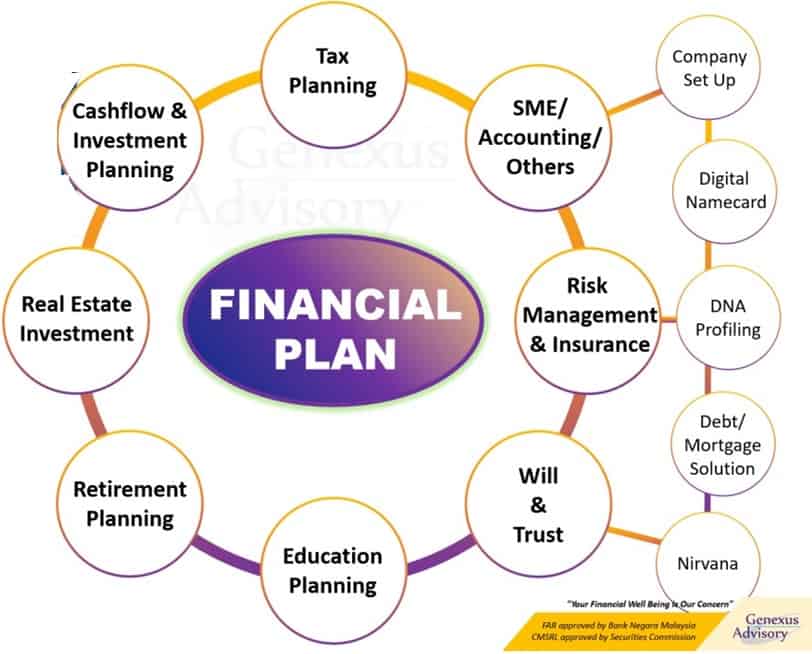
    Many people are always wondering what or who a “Licensed Financial Adviser”(LFA)” or a Financial Adviser’s Representative (FAR) is. Also, many do not understand what is a “Financial Plan”.

    Did you know that there’s only about 1,300 financial adviser in Malaysia, versus our population of 32 million?

    When their numbers are small and very little is known about them, surely a lot of myth and misconception that happens.

    How Can A Financial Adviser Help?

    Why do anybody need a financial adviser while we already have banks, insurance agents, unit trust consultants, estate planners, lawyers and accountants? What resources or values that an LFA/FAR could assist or deliver impact into their life?

    Most Malaysians have the impression that an LFA/FAR is “not focused” or “unprofessional” because he or she is able to provide financial services from multiple providers. For us Financial Advisers, financial providers are our resources and financial tools which are suggested to solve different individual or corporate needs.

    To clarify this misunderstanding, a Licensed Financial Adviser DOES NOT represent any company or financial providers. They represent you.

    All advice and solutions are solely based on your needs, and they will look into the financial market for the best financial tool to suit your life goals.

    Usually we are too busy earning money with our job or business, or too busy with family, that we barely have time to deal with their financial planning. People who are too busy making money for them to make a living, paying off debts and liabilities, is hardly able to get the latest investment updates, market outlook, insurance plans and taxes.

    Due to the lack of financial literacy and knowledge, many have become the victim of ponzi schemes or get-rich-quick schemes. This resulted in many Malaysians losing their wealth.

    Some went into huge debts, by applying personal loans, credit card cash outs, or even loan sharks and ended up a bankrupt. This is one of the reasons why bankruptcy statistics increase gradually every year. It is human nature to take risk and gamble, but why gamble when a Licensed Financial Adviser can help you better manage your finances and investments?

    Most of us gets mixed up with “investment” and “gambling”. Many Malaysians thought that investing in high-risk instruments like stocks, forex, crypto or private equities are similar to gambling. Whereas gambling is purely based on luck or a probability of winning chance.

    A good investment is when you have the knowledge and understand clearly about the instrument along with the risks and rewards. You can predict the results, whether it is an instrument that comes with low risk with low return, or high risk with high potential return. Also the time frame and financial goal or purpose of a particular investment.

    What’s even more important is to make sure that it is being regulated by by Bank Negara Malaysia, Securities Commissions Malaysia or Bursa Malaysia.

    A wise man once said, “Fast is actually slow. Slow is actually fast.” Deep thoughts, deep wisdom.

    A Licensed Financial Adviser is specialising in the Finance industry. They are well-trained professionals that are focused on Financial Planning. To deliver value to your family and businesses, solely based on your needs in order to achieve your life goals.

    Don’t wait no more, get in touch with a licensed financial adviser today.

    About the Author:

    Cheong Kwang Siang, CFP Cert TM
    FAR, CMSRL
    Genexus Advisory Sdn Bhd
    He can be contacted at cheongks@genexus.com.my

  • Overcoming A RM1,700 Monthly Deficit To Buying Three Properties Worth RM1.1 Million

    Overcoming A RM1,700 Monthly Deficit To Buying Three Properties Worth RM1.1 Million

    A story of a typical Malaysian walking a path less travelled. Ian approach me to help resolve his debt problem.

    “Where do I go? Who can I turn to?”

    I met Ian (not his real name) when I went back to serve as a coach in one of the property investment courses I previously attended in 2013. He was introduced to me by a friend, who said that I needed to help him.

    During our first meeting at Old Town Coffee at Kuchai Lama over lunch, Ian shared with me that he was working as a Graphic Designer and has been working for more than 10 years but finds it very hard to have any savings. I see him as someone who has a dream, and ambition because he told me “People around me, my colleagues, friends and even relatives have already had their own families and even owned a few properties”.

    Yet he is still single and haven’t bought his first property nor started any investment.

    This was his situation:

    • Credit card debts, personal loans & Car Loan close to RM66,000
    • Negative cash flow of RM 1,767 (Outflow more than monthly salary)
    • Earns RM5000/month salary
    • His CCRIS has been badly affected, as he wasn’t prompt in paying his debts
    • Total commitments and loans of RM4,870/month (97% of his salary)

    To be honest, I thought he was in a worse-off situation. But after reviewing his situation, I share with him two strategies to resolve his situation. The first strategy is called Debt Consolidation Strategy, as he had multiple loans which needed to manage.

    The second strategy was to use the World’s Simplest Money Management System, which help him not to fall back into the same situation moving forward.

    Here is his situation before and after:

    Ian’s situation before applying the Debt Consolidation Strategy

    Ian’s situation after applying the Debt Consolidation Strategy

    ” If there’s the slightest chance for you to make a change in your life, don’t let go of it. Keep moving and going and you will find a way.”

    After applying the strategy, he managed to:

    • Reduce RM3,152/month after restructuring his debts from RM 4,870 to RM 1,718 per month
    • Ian could now save RM1,650/month as a result (Monthly salary having surplus)
    • Save on interest of 7-9% on average for his credit card debts & personal loans
    • Bought his first property for RM200K & subsequently another RM900K with his property investor team
    • Avoid being ‘EARMARKED’ by not going to AKPK else he wouldn’t be able to buy property. (I don’t have anything against AKPK, as they genuinely help people restructure their debts, but they need you to pay off your debts fully before taking on new debts)

    Ian Was A Mr Nice Guy To Others, But Is He Nice To Himself?

    So with these two financial strategies, Ian can free himself from his debt problem and pursue his dream of owning his own property. What I notice about Ian was, that he was an easy-going and easy to ‘trust people kind of guy’ which led him to this problematic situation.

    This same trait led him to trust his friend, his friend’s MLM products because he didn’t know how to say NO. And as a result, he doesn’t know how much he has spent over the years. After this experience, he is much more aware of his financial situation.

    How Do You Restructure Your Loans When Your CCRIS Is Not Great?

    “How do you qualify for more loans since Ian’s CCRIS is koyak?” If this is the same question you are wondering about, congratulations!

    It means two things. Firstly you are very aware of what you are reading and you probably have a high Financial IQ. Secondly, you could be in the same situation and you need help. Regardless, the solution to your problem is simple but not easy if you are not equipped with proper financial education.

    Learn how to overcome your debt situation by enrolling to Debt-Free Code here.

    *DISCLAIMER – All strategies listed here are not a recommendation or advice. The article is written purely for the purpose of education and journaling only. The content of this article is an expression of my opinion and should not be taken as professional advice. If you are seeking professional advice, please consult me personally. You should do your own research and/or seek expert advice when overcoming your debt circumstances.

    Source: J Advisory

  • How to Handle Family Disputes About Ageing Parents?

    How to Handle Family Disputes About Ageing Parents?

    Providing care for an ageing parent or loved one can be a rewarding experience. However, it is also considered one of the most physically, mentally and emotionally stressful times an adult child will face. This isn’t only because of the intense demands placed on the caregiver, but also due to potential conflict amongst family members. The conflict isn’t just contained to who does what for mom or dad.

    Among other things, financial matters are one of the main sources of conflict among family caregivers. This is especially so when siblings or other family members disagree on how funds are spent or if one or more caregivers are helping to support mom or dad.

    Who is in charge of the money decisions?  Should mom/dad stop handling the investments? Is the ageing parent showing signs of cognitive impairment? How bad is the condition and how do you know? Is one family member doing all the hard work?

    Pertinent questions such as these can sneak up on adult children and the ageing parent, wreaking havoc on family relationships if distinct instructions aren’t discussed and answers are left vague. Combined with the fact that the caregiver may have to reduce working hours or leave their job entirely to care for a parent, resentment and animosity may surface.

    If the situation isn’t handled delicately, the result can be explosive. Ugly accusations fly back and forth, someone brings in a lawyer and the conflict escalates.

    Hence, before things get to this stage, you should have conversations with all parties in the family about how the ageing parent wants their needs met during their later years – especially if you’re getting along in years and still able to make decisions. Doing so would make the caregiving experience easier in later years and bring the family closer.

    While you probably won’t cover all the important topics in one conversation, it’s a good idea to have a plan.  At the very least, make sure you cover these two areas: understand your parents’ financial situation and lay the groundwork for advance care planning.

    Talking with Parents About Finances

    ageing

    Money is often a sensitive issue. Many people don’t talk about their finances, even with family members. As such, communicating with your parents about the subject may feel awkward or like you’re overstepping a boundary in their personal lives. Some are concern that they might upset their parents by talking about issues related to their possible incapacity or death.

    On the other hand, many adult children aren’t aware about their parents’ financial situation. They don’t know if their parents have sufficient money to live on, what type of care or medical treatment they want, whether they can financially afford the care they want, or even what they would want in the event they became incapacitated and unable to make decisions for themselves.

    However, it is never too early to have such discussions with them. Most families don’t talk about these important matters until a major crisis occurs. Then more often than not, important health and financial decisions are made under great emotional distress and without the time to find and consider all the alternatives.

    The Benefits of Advance Care Planning

    ageing

    You may have heard of Advance Care Planning (also known as ACP) and pays to have one. Planning how you receive care ahead of time is important for not only your peace of mind – for yourself, as well as your parents – it also helps to save money and lead you to more options and better choices in healthcare, housing and legal matters. It also helps to reduce family conflicts and ease the emotional distress.

    The sooner your family begin planning for care, the more options they have available. For example, while many Malaysians would choose to stay in their homes for as long as possible – aided by home care services when needed – when given enough time to plan and compare different senior living

    arrangements, your parents might choose to move into a retirement community as they develop more definitively in Malaysia.

    Some may prefer it over other options because they can stay in the neighbourhood near like-minded peers and be assured of the availability of continuum care. The facilities may also offer amenities -such as a fitness centre or transportation to planned social activities and shopping sites – that are important to your parents.

    However, if your parents’ condition requires a high level of care, it could eliminate this alternative altogether. In such circumstances, such as limited mobility, they might have to choose another, less desirable living arrangement. Planning for these situations is especially pertinent as decisions are more difficult if your parents haven’t considered the options.

    While talking about these issues – while they’re still healthy with time to plan and make choices – is discomforting, bear in mind that its much less so than the distress caused by failure to plan and decision-making during a crisis. You may not be successful in getting your parents to do some advance care planning, but the risks of not even having that conversation can be devastating.

    Conclusion – The Pros and Cons

    Unlike writing a will, penning down an Advance Care Plan document is not legally binding in Malaysia. The parties involved – such as doctors, healthcare professionals, and family members – are under no obligation to follow the directives listed and can ignore them in favour of options or treatments that healthcare professionals may deem more suitable.

    However, having an ACP document that clarifies your preferences in a confusing and emotionally charged situation would give you or your parents a higher probability of receiving the care you wish for.

    It also helps reduce ‘silence or violence’ responses – where family members either clam up when they get angry and shut off communication, or they get aggressive, accusatory and begin shouting and name calling, which also shuts off communication – and restore peace within the family.

    If you need help with making an Advance Care Plan, do your research to find a trained and experienced Care Administrator.  You can seek their services from Managedcare’s one stop care platform or visit www.managedcare.com.my for more information.

    In the aftermath of medical emergencies, the matters is that a family pulls through the experience together for the better. 

    Aged Care Group (ACG) is an organisation engaged in the business of elevating and providing aged care services in Malaysia. It is involved in a range of products and services for the elderly including developing and managing day care centres, retirement villages, and aged care facilities.  

    ACG advocates innovation and transformation in ageing by offering continuum care as a premium choice for enriched living. We operate in an ecosystem that provides integrated care services & products through meaningful partnerships. A detailed profile of who we are can be obtained at www.agedcare.com.my.

  • More Money, More Happiness?

    More Money, More Happiness?

    I used to be a full-time musician a decade ago. I produced and arranged music from a home studio consisting of pre-owned musical gears that I bought mostly through eBay.  I was always doing research and upgrading my audio gears from time to time, ranging from keyboards, microphones, sound modules, audio interface, software, and so on. Even though music is a niche and relatively small market, there is an array of equipment available and I was spoiled by vast choices.

    Costly Sound Bites

    For example, just in the area of vocal microphones under Neumann Solution DS, you could find one in the price range of RM100 up to RM50k. I would first buy an entry level microphone, then upgrade it after making more money from music gigs. My first studio mic was about RM800. Then I had one that was RM2,000 a few years later. What was the difference? Of course, it was more expensive but records better quality audio. It captured a wider spectrum of sounds. However, when I played the recording clips from these two different mics to friends, most of them could not hear the difference. The improvement was very subtle.

    How about those mics that cost more than RM10k? It is true that the sound quality will be better. But what is the degree of improvement? If we put it in a graph representation, let’s say the entry-level mic gives a quality of 80%, while the RM2k-mic will boost it to 90%, and the RM10k-mic will produce 95%. However, when you consider the premium you need to pay, is it worth it? There is no right or wrong answer. It depends on your needs and affordability.

    money

    What Price for Prestige?

    Another case we can examine is the passenger cars segment. For a sedan, there are many models from many different brands. Consider the most affordable Perodua Bezza, the value-for-money Honda Civic, the flashy BMW 5-series, or even the stately Bentley Flying Spur. All these vehicles have the same functions like air-conditioning, air-bags, automatic transmission and so on but the most important aspect is that you will get to your destination with any of these cars.

    Now let’s consider the pricing. The cost of a brand new     

    BMW 5 Series 530i M Sport (CKD) (2017) (RM388,888) gives you a budget to buy up to 10 Perodua Bezza. I understand that the feeling and satisfaction you will get out of driving a BMW would be much better than a Perodua. But you will have to pay 10 times the price. Will you be getting 10 times the satisfaction?

    Again, it depends on your level of wealth. You can own a luxury car when you are rich and can make good economic use of the money. From these examples, you can see that there is a premium to be paid for all the good stuff. Most of the time, you might need to fork out two times, five times or even 10 times more just to enjoy maybe a 20% boost of value.

    Consider the Value of your Money

    I would urge you to contemplate whenever you think of paying an extra premium for better stuff or better service. If it is for something within your budget, then go ahead. But when affordability becomes an issue, do consider the value of your money. There are always alternatives that can meet your budget and give you the best stretch for your money.

    There was a research done about the level of wealth versus happiness. Psychologist Daniel Kahneman during his TED talk in 2010 made a note of studies that showed that earning less than US$60,000 per annum can have a significant effect on your happiness levels. It means when you are earning less than RM240k a year, every ringgit will contribute proportionately to your happiness. However, when it comes to making more than US$60,000 per annum, there is entirely no correlation between more income and more happiness.

    money
    Source: The Hedonic Treadmill

    More wealth does not convert to a prorated happiness boost. Similarly, when it comes to material consumption, most of the time, even when you pay 10 times the premium, it does not translate to 10 times better quality.

    If this is true, how do you gain more happiness? The simple act of getting a new car, a bigger house, or a more exotic vacation is no longer the solution. I suggest that you look into areas that give you real satisfaction. Would it be a more meaningful job? Is it the freedom to make life choices? Or perhaps it would be spending more quality time with family? Know yourself.

    About the author

    KCLau is a financial educator, having published seven books including the current bestseller Money Smart, and co-created a dozen online financial courses. He gives away his popular Money Tips e-book volumes free at his website: https://KCLau.com

  • Spend Only on the Things that are Important to You

    Spend Only on the Things that are Important to You

    In today`s challenging economic environment, people from all walks of life are suffering from financial predicaments that also affect their spending.

    Rising Inflation, decrease in value of the Ringgit, increase in prices of goods & services, petrol and cost of living in general, is drastically reducing purchasing power and adding on to the woes.

    According to the statistics from the National Health and Morbidity Survey 2015, one in three adults in Malaysia, either consciously or unconsciously, suffer from mental health problems.

    Financial constraints and stress, as well as family and career problems, are among the key factors which contribute to the rise in mental health problems.

    So, what is the solution for this predicament? It’s none other than financial wellness

    Financial wellness focusses on knowing how to plan, save and invest your money so that you can successfully work toward achieving your financial goals. It’s not about how big is the pay check; rather, it`s very much dependent on one`s right financial habits or behaviour.

    Achieving true financial wellness is more than outward prosperity and has less to do with dollar signs than it does with how money affects your life and your relationships.

    Therefore, to achieve financial wellness, individuals must equip themselves with the right financial habits and knowledge.

    5 steps to achieve financial wellness

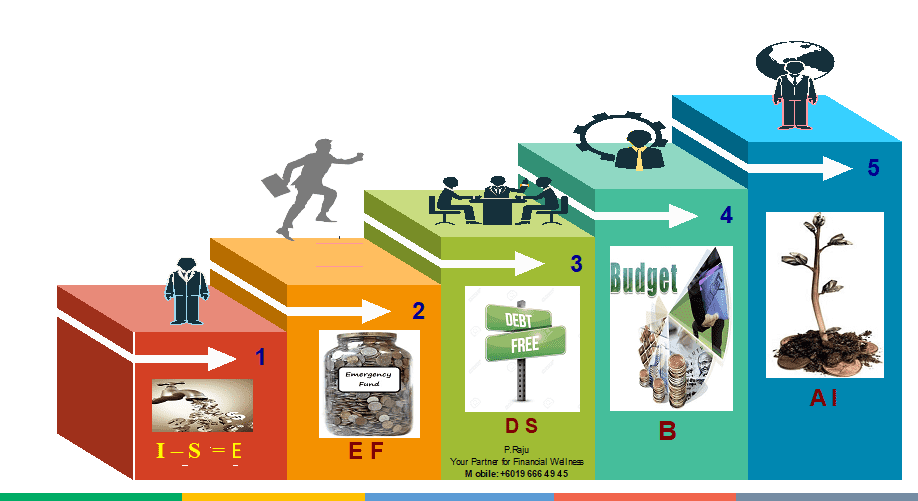
    So, the 5 important steps to achieve financial wellness as described in Figure 1 are as follows:

    Step 1: Be a Conscious Spender to Save Money

    Step 2: Be prepared for Rainy Days

    Step 3: Minimise your leakages by Managing Debts

    Step 4: Be Control of Your Money via a Budget

    Step 5: Consistent Accumulation & Investing of Money

    In the first instalment of this financial wellness article, we will focus on the first step, which is Be a Conscious Spender.

    Conscious Spending

    spend

    Step 1 pretty much implies that you decide exactly where you’re going to spend your money, after you have paid yourself of course. At this stage, you’re also actively choosing to spend on some things and not on others.

    According to American personal finance advisor and entrepreneur, Ramit Sethi, who is also the author of the 2009 New York Times Bestseller on personal finance, I Will Teach You To Be Rich, “The heart of frugality is choosing to spend on the things that are important to you while cutting back ruthlessly on the things that aren’t.”

    So, conscious spending is very important since it fosters every virtue, teaches self-denial, cultivates the sense of order, trains to forethought, and so broadens the mind.

    In a nutshell, it depends on the ability to control one`s money by becoming a conscious spender and focus on needs, then wants, and subsequently cultivate consistent saving habits.

    As you start to practice conscious spending, your financial behaviours or habits improves, which is really the key to achieve financial wellness.

    To put conscious spending in action, you have to learn to ask yourself the questions below before you make a purchase:

    • Will I use this?
    • Can I get this cheaper?
    • Can I wait to buy this?
    • Why am I buying this?
    • Is there something else I’d rather spend the money on?

    Conclusion

    Financial behaviours or habits are formed in individuals over time; it cannot happen overnight. However, once you get it going, it would become very difficult to shrug it off.

    About the author

    Raju Periasamy is a Certified Member of the Financial Planning Association of Malaysia (FPAM) and a Licensed Financial Planner with Phillip Wealth Planners Sdn. Bhd.  He can be contacted at rajuperi@gmail.com

  • Financial Planning for the Middle-Class Rakyat

    Financial Planning for the Middle-Class Rakyat

    Financial planning has often times been associated with the rich. Most people have the perception that only rich people can afford to plan their finances. Is this a fair observation?

    So does this mean that if you are not rich, you should drop the idea of financial planning? What if you are in between these two extremes – the middle class or middle-income people?

    I have constantly observed how the middle-income group struggle more compared to the low-income group. When you’re in the latter, you live a lifestyle more driven by need.

    However, if you belong to the middle-income group, the decision-making process is based more on the want factor, not need anymore.

    How then can the middle-income group reduce their disadvantage and propel themselves toward their aspirations and dreams? Below are some ideas that one can explore:

    Be Aware

    When it comes to investing, you cannot wait until you have enough money, and then only start to think about investing.

    The popular belief is that we can only manage our financial affairs once we have surplus. However, in actual, those who have surplus are those who have done planning, and make it a point to ensure they do the needful.

    Cash-flow management is crucial

    If you manage your cash-flow and debt obligations, you would end up having surplus because without surplus, it’s impossible for one to have savings.

    Protect your savings

    It’s not easy to accumulate savings nowadays; thus, you need to learn to protect it efficiently. We cannot afford to overlook or ignore risk management as this can help protect our savings when financial losses occur.

    Watch your credit behaviour

    Those who are in credit card or debt crisis have once told themselves that they would just use the credit card for rebates and free-gifts, and that they would make sure they pay the billed amount every month.

    The only trouble with this plan is that before you realise it, you are barely making minimum payments, and the amount balloons into a huge outstanding in no time.

    Moreover, interest payment is one of the tiny leakages that will have long-term impact on our ability to save.

    Start early but small

    According to Figure 1 below, a person who starts investing RM12,000 today with no additional new contributions thereafter, will need an investment that generates 10% per annum to have RM130,016 twenty-five years from now.

    financial planning
    Future value of investment

    However, another individual who started with RM6,000 (50% lesser) would require an investment that is 50% less risky (5% per annum) throughout the same time period, to generate RM134,863. The trick is to cultivate the discipline of adding RM200 a month to the savings pot.

    It’s much easier to save a smaller amount than wait for your capital to become significant, as smaller amounts can also grow to become substantial.

    Stay ahead of inflation

    A person who invests his savings in a way that is right and in-line with his risk capacity, will see his wealth grow and become inflation-proof in the long run.

    If you do nothing about inflation, you will find it tougher to maintain your lifestyle. This is due to your shrinking purchasing power, and since it is more likely that your income level will stay stagnant or grow slowly, you will then find that your freedom will be limited by your purchasing power.

    The only way to give our wealth some chance to at least maintain its purchasing power is to put it to work.

    When you invest, you must bear in mind to invest in instruments that are suitable with your risk profile and is regulated at the same time.

    Work on your investment literacy

    A person in the middle-income group may have some disposable income, which they would want to invest, after taking care of their lifestyle.

    However, be aware of scammers who are out to ‘steal’ our money, influence us to make bad investment decisions, resulting in losses or wasted opportunity.

    It is therefore important to have a basic knowledge of investment literacy to conduct appropriate due diligence on investment proposal that is presented to us.

    Financial planning is not for the cheapskate

    One misconception people have is that when we embrace financial planning, we will have to accept a frugal lifestyle.

    However, the whole point of financial planning is to put the aspirations and life goals of a person at the core; as such, it’s rather counter intuitive if you will have to live a frugal lifestyle.

    If you embrace financial planning, what you’ll essentially do is look at your personal finance in totality, make decisions that are smarter and less attached to your urge and emotions for instant gratification.

    It doesn’t mean you have to eat lesser, or not go out with your friends. We all need a life to build our network.

    All said and done, we need to go through a process to manage our financial affairs to ensure that at the end of the day, we will have enough ‘financial muscles’ to help us achieve our life goals.

    About the author

    kevin neohKevin Neoh is a NextGen Money Coach who works with people to help them transform their relationship with money to improve their lives with the money they have. Kevin can be contacted at kevin@nextgenadvisors.my and www.kevinneoh.my.

  • Financial Planning Lessons That I Learned From My 72-Year-Old Customer

    Financial Planning Lessons That I Learned From My 72-Year-Old Customer

    When I joined the financial industry in 2017, I was so lucky to meet my first customer. Not just because of the first investment business he gave to me, but also the lessons that he taught me.

    I remembered the day when I first met him, I was introducing a unit trust fund to him, and he agreed to invest immediately after I finished my explanation. Since he was my first customer, I was being extra careful to avoid any mistakes in the process.

    I asked him every question in the suitability assessment form:

    • Do you have investment experience in the past?
    • Do you understand about the investment risk?
    • How many percent of fluctuation can you accept?
    • Do you read and understand English?

    The customer suddenly slapped the table, and said: “Why do you need to ask so many questions? Other banks did not ask all these questions when I invest with them! I told you, I’m ready to take risk when I invest. I can even accept the RM100k investment becoming a total loss.”

    Knowledge Is Power

    People may think that when one gets older, he/she should be less aggressive in investment. But this customer taught me that when one is fully equipped with knowledge, he/she will be able to make an informed financial decision despite of his/her old age.

    Later, the customer topped up his investment after his first investment made profit within five months. But this time, the market was not going as smoothly as the first time. The unit trust fund was badly hit by the US-China trade war in 2018. The fund dropped ~20% in the first year of investing.

    I asked the customer whether he want to switch his investment to other funds that were not affected by the US-China trade war?

    Surprisingly, the customer did not worry about the paper loss of 20%. He told me that it is normal for the market to be up and down. He does not want to switch the fund because he has belief in China, and he is confident that the fund will rebound; and he has the holding power and patience to wait for it.

    A year later, the fund recovered and the investment broke even at the end of the second year. 6 months later, the fund then made a 20% return. The customer was very happy with the annualised return of 7.63% after waiting for two and a half years.

    Patience Is Key

    Hourglass on dark background

    In reality, most investors might quit the market and cut loss when the fund is at ~20% loss. Some investors might withdraw their investment when the fund finally breaks even at the end of second year. Only a few are able to see the return after waiting for two and a half years.

    The customer taught me another lesson that when one has a clear investing goal and strategy, he/she will not worry unnecessary about the market’s volatility, he/she will always stick to the initial plan without making emotional decision.

    It has taught me the importance of financial literacy and it resulted in my faith to become a licensed financial planner a few years later.

    Thanks to my customer, I’m now a licensed financial planner currently and I’m also conducting financial management workshop regularly to educate Malaysians on financial literacy.

    About the Author

    Angel Chan is a Licensed Financial Planner attached to UOB Kay Hian Wealth Advisors Sdn Bhd. Besides providing comprehensive financial advisory to her clients, she is also committed to educate the public about the correct financial management mindset and methodology through article, YouTube video and Financial Management Workshop conducted by her and her team. Do reach out to her for more information.

    FB page: https://www.facebook.com/angelchan.financialplanner

    FB page: https://www.facebook.com/profinance.my

    YouTube channel: https://www.youtube.com/channel/UCf5f7O3vuOhnwy_wflDuuKA

    Smart Finance: https://smartfinance.my/planners/chan-aun-kei-rfp

    To book a free 1-hour consultation with Angel Chan: https://forms.gle/8Ur46Dox9T6g3yKS8

  • RONW, a Formula to make Sound Financial Decisions

    RONW, a Formula to make Sound Financial Decisions

    Perhaps, if you are reading this, you might be in the midst of making some financial decisions. They could be:

    • Should I use EPF Account 2 to settle my mortgage?
    • Should I invest my bonus first or settle my liabilities?
    • Should I invest in unit trust, stocks, or properties?
    • Should I buy a new fancier car or a bigger house?

    And, the list goes on. You get the idea.

    Most people may be overwhelmed by them as a decision either way will move you forward or backward financially. Understandably, many will choose to procrastinate because it will seem to be the “safer” option since many financial decisions can be irreversible.   

    However, here’s the real problem: How do you make smarter financial decisions if you are not equipped with the right tools to make them?”  

    Here is a straightforward technique that we believe will be helpful for you to make sound personal finance decisions. The tool is known as the “Return on Net Worth Analysis” or RONW.

    What is RONW?

    RONW tells you how efficient you are in using capital. It is quite similar to the ROE (Return on Equity) ratio we often look at when analysing corporate financial statements.

    Calculating Your RONW

    Here is how to calculate it:

    Step 1: List down all your assets and its value, including the projected return rate of each asset, such as “REITs − RM10k − 6%”, “Cash − RM20k − 3%”, “Rental Property − RM300k − 8%”, etc.

    Step 2: List down all your liabilities, including the effective interest costs, such as “Credit Card − RM5k − 18%”, “Mortgage − 200k − 4.5%”, etc.

    Step 3: Calculate the RONW

    RONW = (Total return – total interest) / Net Worth

    We have a full video demonstration. You can google “RONW KCLau” to find it on my website.

    What does RONW Tell You?

    If you have calculated your RONW and discovered:

    Your RONW is Negative:

    It means your net worth will shrink every year. You may start by clearing out debts with high interest rates such as personal loans and credit card debts to ease your financial burden. Then, you may follow up by adding productive assets to further improve your RONW figures from negative to positive.

    Your RONW in Positive:

    Congratulations! You have more productive assets than liabilities. If your net worth is still small, then, you may continue to grow both your net worth and your RONW. If both your net worth and RONW is significant, most likely, you are wealthy and are enjoying financial freedom.

    To Answer Above Questions Using RONW

    1: Should I use my EPF to settle my Mortgage?

    Source : EPF

    Let’s say you have RM30,000 in your EPF account 2 and you are considering withdrawing it to clear RM30,000 off your mortgage. Is this a smart financial move? Let’s see. Based on the RONW, we would consider:

    Returns from EPF:

    RM30,000 x 6.9% = RM 2,070.

    Interest Payable from Mortgage:  

    RM30,000 x 4.5% = RM 1,350

    If you withdraw EPF to clear mortgage, we would save RM1,350 in interest payment but will forgo RM2,070 in EPF dividends. Thus, you would net out RM720 per annum if you go for it. Hence, the answer is a straight “No” based on the RONW formula.

    2: Should I Invest or Settle my Liabilities?

    First, it depends on how good you are as an investor and what liabilities you owe currently.

    For instance, let’s say, you are a good stock investor who knows how to make 6% dividend yields from your stock investments. You have the following debt such as credit card debt of RM10,000 where the interest rate is 18% and PTPTN loan of RM10,000 where the interest rate is 1%. Today, you are given RM10,000 to either invest in stocks or pay off any of the two debts mentioned. What should you do?

    The answer is obvious. You pay off the RM10,000 in credit card debt because its interest rate is higher than the 6% dividend yield from investing in stocks.

    But, if there’s no outstanding credit card debt, then, you may invest in stocks that pay 6% in dividend yields as it is higher than the 1% interest charged by your PTPTN loan.

    3: Should I invest in Unit Trust, Stocks or Properties?

    Your investment objective is to maximise your RONW safely without taking unnecessary risks. So again, it depends how good you are in investing in unit trusts, stocks and properties. Some seasoned investors go all out to invest in stocks and properties.

    4: Should I Buy a Fancier Car or a Fancier House?

    Let’s start with a fancier car. Apparently, a car depreciates over time. But, the amount of your car loan and interest payment will increase after you’ve purchased or upgraded to a new fancier car. So, should you refrain from getting a brand new car? If you are now into improving your RONW, then, don’t do it. But, if you are not, then, you may go for it if it makes you happier.

    Meanwhile, a fancier house might not affect your RONW as severely as having a more elegant car as properties appreciate over time. Nevertheless, you will still end up with lower RONW after upgrading to a bigger house.

    Again, there is nothing wrong with upgrading your home as it does bring more joy to your family. RONW is a measurement of the efficiency of your capital and not the level of your happiness.

    In conclusion, RONW is very similar to the way we look at the ROE of a company. Value investors love to hold shares of stocks with high ROE because that shows the efficient use of shareholder’s fund. On the personal level, if you know how to maximise your RONW, you will be doing way better than 95% of the population.

    About the author

    This article is co-written by KC Lau and Ian Tai.

    Ian Tai is a Dividend Investor. Financial Content Machine. Producer of 200+ Articles, Weekly Host and Presenter at KCLau.com. Co-Founded DividendVault.com, an online educational membership site that empowers retail investors to build a stock portfolio that pays rising dividends in Malaysia and Singapore.

    KCLau is a financial educator, having published seven books including the current bestseller Money Smart, and co-created a dozen online financial courses. He gives away his popular Money Tips e-book volumes free at his website: https://KCLau.com