Category: Behavioural Finance

  • Understanding Your Money Blocks

    Reflecting on my childhood, I remember we were given a book to write down our money spending during school – Buku Wang Saku. We also had to listen to a talk about how to manage our money. I remember only writing in it for a week and there was no follow-up after that. 

    That was almost 20 years ago, yet we’re still here talking about the same issue of money management, poverty and struggling to manage finances. We all subconsciously learn about money as children, with concepts that are good or bad depending on what we hear from our family, society, and even things we pick up from watching television or the news. Therefore, as we grow older, we form these money stories in our heads and couple them with our subconscious beliefs around money that influences our behaviour as adults.  

    It baffles me that even after 20 years, I’m still struggling with the same subject. I started reflecting on managing my money and how I sometimes unintentionally sabotage myself. Now I know that this was due to deep, unresolved money blocks. 

    What are money blocks? 

    Money blocks are negative subconscious beliefs about money that limit you from achieving your conscious desires. The main reason why it’s so hard to implement behavioural change is the part of the brain that is used. When watching a motivational video or reading a self-help book, we’re calm and composed to act better. But when we’re about to go shopping or have lunch, we kind of lose our mind, even though you promised yourself to manage your finances better after reading that self-help book you picked up before.  

    We keep going through this same pattern because of our brain’s subconscious and conscious compartments. For the first five years of our life, our brain is in the theta wave stage, whereby it’s in a sponge mode to absorb everything and anything. We take everything literally and learn how to be a person. These first, vital five years are when we learn all the emotions and feelings that surround us, which results in the formation of habits. 

    We learn all this from the adults that surround us. We observe their behaviours and mimic them as we grow older. We are very habitual human beings, and with that, we tend to keep close to feelings that we are familiar with, that is, the similar, regular cycle we’re programmed to react to. We tend to react the same way as we’re taught in the first few years of our lives, with all of this formed early on when we have no conscious control. These habits are then carried towards adulthood. 

    The conscious part of the brain only starts to develop later in life. So as a child, we unconsciously absorb all things wholeheartedly with no filter, including the good and the bad that cannot be told apart. We form most of our beliefs before the age of 5. Therefore, most days we operate solely out of habit and are on autopilot when we come across familiar situations.  

    When we try to learn a new habit, this is when the conscious part of the brain works. When we’re aware of patterns and want to change bad habits, but are faced with a specific situation that needs an immediate response, previous habits that are hardwired begin to react. This results in the nervous system reverting to existing patterns in the subconscious based on programming, long before our conscious brain can grasp and take control of the situation. Suddenly, you may see yourself falling back to the same lousy money habits even though you know this isn’t a good thing. 

    To have control over this is to make yourself conscious of situations that trigger you relapse into bad money habits. Take a breather and question yourself, before making a conscious decision. The recurring pattern from your past robs you of strength to make better financial decisions. If you can make a conscious decision to create new habits around your triggers and to change that narrative, you’ll be able to change past thought patterns!

    “Money is 80% behaviour, 20% knowledge.”- Dave Ramsey. 

    Although I have a degree in Islamic Financial Planning, I still struggle with my money blocks. Most of the time, financial planning focuses on numbers and figures but not the human thought process; I wish I was taught this back in university. Even with an abundance of education around managing our finances as a nation, there are still people falling back to their old habits and sabotaging their finances. I believe what’s stopping them is the deeply ingrained habits they grew up has made it hard to break the pattern. 

    Some common negative beliefs I learned:

    1. I don’t have the skill to make more money 
    2. Money is evil and rich people are mean and greedy 
    3. I can’t keep a lot of money or else I’ll lose it
    4. Witnessing parents fighting about money 
    5. I have to work hard to make money
    6. You’ll get sick easier if you work for money 
    7. When I am rich, there will be poor people suffering 
    8. There is not enough money for everybody, including me 
    9. A lot of things need to be sacrificed to gain wealth
    10. I have to know someone to be able to gain more wealth

    We tend to fall into this pattern of these messages, thus creating a wrong impression about money. These money beliefs tend to stay in our way and form our habits until we decide to identify them and heal consciously. 

    How to know if you have money blocks? 

    Everyone has them regardless of their financial upbringing. One way to tell is that you’re aware of money, but you’re not getting any results and constantly battle the same issues. Another indicator is that you know how to manage your finances, but you keep sabotaging your success. 

    This is what I’m currently experiencing. I have the knowledge to manage my finances well and I know how every decision I make influences my finances, yet I keep making the same bad decisions that trip me up. 

    Create an action plan 

    The only way to reset your money blocks is to identify your beliefs around money. Write in a journal and answer these questions: 

    1. What are my money beliefs, how did my family view money, and how was I culturally brought up around the subject of money? 
    2. What are your biggest fears around money? 
    3. If you are blessed with an abundance of wealth, how will you use it to help others? 

    “Self-sabotage is like a game of mental tug-of-war. It’s the conscious mind versus the subconscious mind where the subconscious mind always eventually wins.” – Bo Bennett

    Break that pattern 

    When we were growing up, the fears that adults subconsciously placed upon children helped them cope with their money concerns. However, when they didn’t heal from their subconscious fear, it tended to be passed down to their kids.

    In reality, we control how we can benefit and help others when we have an abundance of money. We’re all born with potential, and it’s our birthright to reach for the stars. We form our blueprint with the words used, and the mind tends to interpret it into reality. Our mind is meant to protect us from harm so it starts creating a scenario to defend ourselves. Re-write a better script around your many beliefs. It’s a process, one that never really ends. 

    I’ve been working on my money blocks and it is still a work in progress. I hope you enjoy diving into your thought patterns and enjoy the journey!

    About the author

    Nurul Yahi has a background in Business Administration majoring in Islamic Financial Planning. She’s a financial enthusiast and you can find her at dearduit.com. You can also find Nurul on TwitterInstagram and Facebook.

  • Turning A Financial Emergency Into A Minor Inconvenience

    In my previous article, we covered tips for saving for an emergency fund. In this article, let’s take a deeper dive into other matters related to savings for a financial emergency.

    Food for thought, would you consider your credit card your emergency fund?   

    I guess there is no right or wrong to this statement but it does help that at least we have an emergency fund that’s equal to the credit limit of credit cards. If we have to rely on it to get past an unexpected expense as a last resort, we know very well that we’re able to pay it off without carrying the balance to the future.

    So, it’s not wrong if you consider your credit card your emergency fund. However, there’s one problem. In a scenario where you don’t have to rely on credit or loans to save you in a financial emergency, you don’t really have any pressure or commitment to repay it after the emergency has passed.

    When you rely on credit to get you out of financial emergencies or unexpected events, once this issue is resolved, you’ll then need to deal with the next time bomb. Depending on how well you’ve prepared and managed your money before this, it could lead to another emergency in the near future. Assuming your money management skills haven’t improved in that time, you might be looking at an even more dire situation!

    Firstly, in this second ‘crisis’, you may have less or no capacity to increase your loans or credit limit to help you (since there’s a good chance those limits have been utilised and not cleared from the first time). On top of that, let’s assume for a second that you can still count on credit cards for this second bout; how do you think your monthly cash flow situation will be like after this?

    Certainly a much bigger portion of your future income is now tied to repaying those debts. This will reduce your discretionary cash flow (or disposable income), meaning your ability to save for a ‘real emergency fund’ is now much weaker compared to before. Moreover, with lesser discretionary cash flow, it also implies that you are likely to be unable to prepare or save for other future dreams. In a worst-case scenario, you might be playing musical chairs with your debt, using the income you take home each month.  If such a pattern is maintained, it may affect your overall satisfaction with life, and even lead to a compromise in your mental health.

    So, there seems to be a cost to treating your credit cards’ limit like an emergency fund, and this is more costly than monetary cost (interest rate). It comes with a much bigger price tag like your freedom and ability to plan for the life that you really want to live.

    If you’re thinking about keeping a certain card’s limit as your emergency fund, why not consider the alternative that’s much less complicated, and most likely comes with less pain in future?

    I get it – this alternative comes with a pain today, as it requires us to not spend that amount of money, save it up, stash it somewhere, and forget that we have that money. With our brain wired to seek pleasure, and that instant gratification is a sure way to reward us with such pleasure, this could be a tough call for some people.

    Is there a way to avoid having to sacrifice your lifestyle today while still able to prepare for emergencies? I’d say YES. There are certain emergencies that we can actually ‘neutralise’ and make it a non-emergency. Based on common ‘emergencies’ people have told me about, here are some and how you can prepare for it:

    Your Real Expenses 

    Have you had this experience where you were shocked, or even found yourself wondering how a certain bill that should be due a long time from now ‘suddenly’ becomes payable? For example, your car insurance and annual road tax renewal, your car’s battery that gives up on you every one or two years, your yearly subscription to certain services, yearly insurance premiums etc.

    The truth is, these bills don’t suddenly become due today; it’s just that time really flies and while looking at the new renewal or invoice, your mind tells you you’ve just paid for it not long ago. Just like this, you have landed yourself in a financial emergency. You may not have sufficient money at that moment to pay for those annual or quarterly bills which can be very important expenses. That’s how you will notice your savings getting depleted every now and then.

    Can you stop these things from becoming emergencies? Yes, you certainly can, and it’s very easy and simple. You just need to add all of these bills up, divide by 12, and set aside this amount every month in another savings account. Settle those bills with the money in this account when they’re sent to ‘surprise’ you and take comfort in knowing that these will stop becoming a surprise to you!

    Celebrations, Occasions, Vacations 

    As social animals, we have people we love, care about and celebrate festivals with, or even birthdays, and other milestones. It costs money to celebrate and in a typical month where you have too many to celebrate, you may find it difficult to strike a balance.

    You can also prepare for these ‘emergencies’ in advance. List out important occasions and celebrations. Include your expected spending during festivals like the New Year, Hari Raya, Deepavali, Christmas etc. Divide by 12, and save this amount monthly in a separate savings account.

    You can now celebrate with peace of mind and sense of freedom knowing that you are spending money you have prepared for, and best still, your own money (from the past, not the future)! This method is also workable for bigger ticket items such as your dream vacation.

    Medical Emergencies 

    Accept the fact that no matter how healthy your lifestyle is, you’ll get sick eventually. Apart from sickness, it may also pay to make regular visits to the dentist or doctor, including to conduct health tests. Like everything else, these cost money.

    Like the previous examples, you can apply the same method to prepare for this. The only problem is that you’re not able to accurately predict how frequently you’ll be unwell and how much that will cost. This is when you have the ‘fun’ to make an estimate. Personally, I put away RM50 a month for clinical visits. When I don’t get sick so often (which is a good thing), I get to carry forward the balance to the following year.

    For bigger medical emergencies, like hospitalisation or a long treatment process, you can either save using your own money, or ‘outsource’ this to medical or personal accident insurance.

    By preparing accordingly, the occurrence of financial emergencies can be reduced greatly. Moreover, by taking into account and being realistic about the spending that will eventually take place today, you’re taming your instant gratification monster by having less to fuel and feed it.

    If you have put aside the set amount, can you pay for these things using a credit card? You can! Because you already have cash in your accounts available to pay for your credit card spending. So, if you want to, why not?

    About the author

    Kevin Neoh is a NextGen Money Coach and can be contacted at kevin@nextgenadvisors.my and www.kevinneoh.my


  • The Most Common Financial Planning Myths

    The Most Common Financial Planning Myths

    Financial planning has been defined as a process of developing strategies to help people manage their financial affairs to meet life goals. However, many people tend to have misconceptions that can be described as financial planning myths.

    “The best time to invest was yesterday. The next best time is now.”

    Yesterday has passed, so now’s the time for you to plan for your future, which involves learning about money and financial planning. If you master your finances well, then you’ll likely live a great life in the future because delayed gratification helps you to reach your life goals faster.

    What this means for you is to overcome the most common financial planning myths that I’ll be sharing with you in this article.

    1. Financial Planning is Only for the Wealthy 

    It doesn’t matter whether you earn RM2,000 a month or RM20,000 a month. As long as your income is used to pay for expenses, you need to have a financial plan regardless of whether it’s a simple or comprehensive plan. You need to calculate your net worth statement, cash flow statement and well as other relevant financial ratios.

    Whether you are driving a luxury car or economical car, you’ll still need to send your car for regular servicing – the only difference is the cost of servicing. Similarly, regardless of income levels, all of us still need to manage our own daily expenses, loan expenses and other allocation into savings or investments.

    2. I’m Too Young for Financial Planning

    Financial planning is meant for everyone regardless of age. If you are a child or teenager, it would be great if your parents teach you the importance of savings and growing your money that you received from red or green packets during festive seasons and other celebrations. Parents with good financial beliefs should plan for their children by starting a high interest savings or investment account for them in order to reap the benefits of the long-term returns.

    If you’re a working adult, you probably should have a financial plan in place to set aside and build an emergency fund, start insurance planning, retirement planning, travelling fund and or savings for your first house or car, and / or a wedding.

    If you’re a new parent, you need to plan for your children’s education, on top of your retirement and insurance planning. Some may probably need to save and invest so that he or she can accumulate enough capital to start a dream business. It’s at this stage that you may want to consider estate planning.

    If you’re a retiree, you may review and plan the expenses required for your desired lifestyle, which could include travelling goals, or simply your medical expenses.

    3. I Will Start Financial Planning when I Earn More

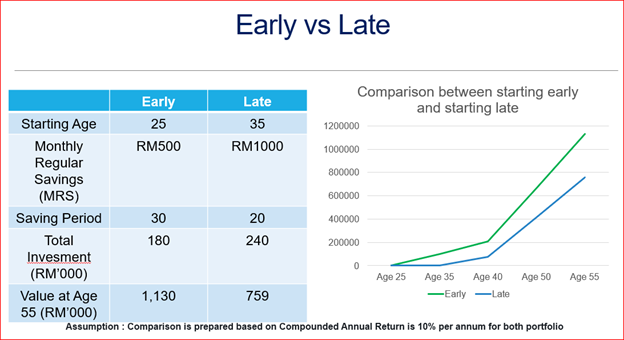
    Another common answer is, “I don’t have much income to plan financially and I will only start when I earn more”. Let me illustrate why this is a bad idea through this chart blow:

    financial planning early vs late

    These are two individuals, Mr. Early and Mr. Late. Assuming, both portfolios are growing with an annual compounded rate of 10% over the period of their investment horizon. Mr. Early who has learned the power of compounding from his dad and through reading investment books started saving regularly at age 25 with RM500 per month till age 55.

    However,  Mr. Late who believed that he should spend first and save later when he started working only realized the power of compounding and saving regularly after attended a wealth seminar recently. He started saving regularly at age 35 (10 years later than Mr. Early) with RM1,000 per month until age 55.

    When both reach age 55, Mr.Early would have accumulated RM1.13 million and Mr. Late with RM759,000 (even double the amount of Mr. Early monthly savings). The difference is around RM371,000 just by delaying it for another 10 years. Hence, do spend some time to learn and establish what your beliefs about money and financial planning are. Otherwise, it could have serious consequences on your financial goals or life goals. 

    “It’s not your salary that makes you rich, it’s your spending habit” – Charles A. Jaffe.

    What are you waiting for in your financial planning journey?

    About the Author

    Goh Chee Yong is a Licensed Financial Planner, and can be contacted at cygoh@imaxfinancial.com.my.

  • How to Set Financial Goals for Your Future

    How to Set Financial Goals for Your Future

    Much has been said and written about the sorry state general of financial literacy among people, both local and globally. According to financial literacy platform Multiply, almost 70% of Malaysians are in need of financial literacy support.

    “Financial planning” seems to be a popular catchphrase in recent years. The 7th of October is even recognised as “World Financial Planning Day”, which began four years ago. The purpose? To raise awareness about the importance of financial planning.

    If I used the term financial planning with my grandparents, they would say “Don’t worry so much, just work hard and be honest in your trade”. This shows how the concept of Financial Planning is fairly modern, with such an ideology being so foreign back in those days. Chances are, if you asked someone who is in their 60s or 70s today what financial planning means, there’s a high chance they’ll say it’s having insurance!

    However, financial planning is the process of developing strategies to help people manage their financial affairs to meet life goals. What constitutes a good financial plan? First and foremost, it involves taking stock of your assets, liabilities, investments, income, expenses and cash flow. The next part is important because it involves knowing the right strategies in order to achieve future goals. It also helps to break down goals according to priority and affordability. It then requires constant monitoring because we know circumstances in life will change – for both good or bad.

    Financial planning is clearly not as simple as signing up for a product. It’s a commitment to yourself and your family to ensure that your financial goals are achieved. In my observation and dealings with clients, I have found that the challenges in developing and sticking to a financial plan are summed up below (the list is not exhaustive):

    • Lack of priority – due to busyness at work and family commitments. The fear of the unknown future can be very daunting and it is easy to sweep this aside
    • Rising consumerism – shopping and spending is extremely easy. You can purchase literally anything in the world online and get it delivered to your doorstep. If left unchecked, would there be funds in the event of an emergency, let alone savings for the future?
    • Escalating prices of real estate – one of the social issues that the government is trying to tackle is the issue of affordable housing
    • Low interest rates – At the point of writing, the Overnight Policy Rate (OPR) rate is 1.75% which translates to Bank fixed deposits of 1.6% to 1.9% per annum
    • Salary vs inflation – not on par with rising cost of living

    All these seem to indicate that the younger generation is already at a disadvantage in achieving the same levels of success compared to their parents. For example, if your parents could afford to send you overseas when you were in university, can you confidently say you will be able to do the same for your children today?

    Having a financial plan is akin to being prepared for battle. You will know your limitations, ability to optimise your resources and your odds of winning.

    In the case of an investment portfolio, the more you spend time monitoring, the more invested you will be. For example, if you exercise daily, you’ll be much more conscious of your lifestyle, choice of food and calorie intake. The same can be said for a financial plan when you monitor it on a regular basis, which will lead to you becoming wired to make more informed financial decisions.

    Too much focus on any one area such as savings, investments, or insurance, may adversely affect the balance of your financial plan. The topic of investments alone is so vast, with plenty of choices available today, and is often confusing for consumers. Each platform has its pros and cons and it’s easy to get distracted by the whole process and only see things from that one perspective. Having a macro view is important and most consumers are not trained to do that.

    Let me give you an example. It’s highly possible to have false confidence knowing you invested in a portfolio that is performing at 15% per annum. However, if the amount invested was RM10,000, and even IF this portfolio could consistently perform for the next 10 years at 15%, the future value is only RM45,000. In the larger scheme of things, is that total of RM45,000 a meaningful solution in terms of the end goal to fund a child’s tertiary education and/or your retirement? Investment should be a means to an end, not the end in itself. Successful investment requires time, strategy and consistent positive returns to be favourable.

    There’s also the danger of neglecting risk management. An employee or an entrepreneur’s greatest asset is their ability to earn and also their potential future earnings. This asset can be severely affected due to a major health crisis. Have you considered income replacement in your financial plan? Most companies would have decent employment benefits that would cover you in the event of death and hospitalisation. However what happens if an employee is unable to contribute 100% to his/her job due to a health condition? Will your employer be happy to retain such an individual?

    In summary:

    • Work hard and smart in your trade
    • Manage potential risks that could happen in your working years
    • Look for opportunities to invest (in products/services registered with the Securities Commission Malaysia)
    • Monitor your financial plan and goals diligently
    • Seek out a Licensed Financial Planner to get a second opinion on your finances
    • Develop an estate plan as an act of love to your loved ones/charities

    With proper monitoring and guidance, you can be on the right track to achieve your financial goals.

    About the Author

    Kam Teik Guan is a Licensed Financial Planner, and can be contacted at kam.teik.guan@ipp.com.my.

  • What Is Financial Wellness?

    What Is Financial Wellness?

    We have a choice daily on how we want to manage our lives. Every day we decide whether we’re willing to go the extra mile in ways that contribute to our financial needs. At times we drown ourselves in our work to chase that paycheck and ignore our own personal health. 

    We stress about things that are out of our control, like pay cuts and job loss. It does not help that we are constantly bombarded with our mobile from the first thing we grab when we wake up and the last thing we see before going to bed. Currently, the average person is seeing up to 10,000 advertisements every single day. 

    It’s just a matter of time before we start fighting back or drive ourselves crazy. How are we supposed to feel in control when we are constantly bombarded by even living our daily lives? The whole goal is mastering our money control in pursuit of our dream life. We’re not meant to suffer all of our lives in search of happiness

    “Pain is inevitable, suffering is a choice.”

    Focusing On Financial Wellness 

    I’ve realised it’s vital to pursue financial wellness because we must have a purpose behind all the effort we put into earning money. Some people can master their finances completely and even reach financial freedom but may be extremely unhappy. 

    The current COVID-19 pandemic has not helped either, genuinely showing just how many people are unhappy in general, often falling into the rabbit hole of depression. It’s easier to understand financial freedom or financial independence, but the concept of “financial wellness” is a whole other story. 

    This is more of a personal take on looking at how we manage money. We’re not only focusing on the monetary aspect of finances but our emotional health too. I like that it’s not only focusing on the numbers but the dream we had before being buried by the numbers game. 

    When you think about financial wellness, it’s not typically something you can seek out a doctor for. It’s a whole new term that looks deep into the needs and wants of our soul. It’s taking an entirely new picture of the state of our wellbeing. It’s not only focusing on how much money you need in the bank or investments but also on taking care of your health and making sure you don’t destroy your body and relationship to pursue something as fleeting as money. 

    Often I feel I’m stuck in a financial trap where I’m bombarded with many boxes I need to tick to get my life “right”. But looking at financial wellness, I’m looking at myself in the mirror and asking what I need to do to feel happier and healthier. 

    It’s easier to just merely set a target number to reach. Let’s say you wanted to hit RM2 million to secure financial freedom, but in hindsight, you only needed RM1 million. The difference between this and financial wellness is that it brings you back to the present moment, focusing on the now instead of incorporating someone else’s thoughts and ideas into your race, which creates unnecessary fear that may not seem like the best-fit dreams. 

    This pandemic has taught me to just really slow down and reflect. I’ve been in such a deep pursuit of my short-term and long-term dreams that I forgot how much I’ve achieved along the way. The act of chasing has literally made me feel burnt out. 

    Knowledge Is Key to Financial Wellness

    The Society for Human Resource Management (SHRM) has started to recognise the impact of financial stress on people and how it affects their work quality. When employees have high financial pressure, they’re more likely to bring that stress to work, which can impact the quality of work and relationships with managers, resulting in a negative effect on the bottom line. Money affects most things, but money is not everything, although the pressure of financial goals can create this illusion. 

    As I reflect on my childhood and how I was taught to manage my finances, it has always been drilled into me that we need to save as much as we can because we are not rich. There were so many limitations when it comes to purchasing something nice, and I didn’t grow up enjoying many luxury holidays or getting expensive gifts. 

    My grandparents and even my parents are frugal people when it comes to managing their finances. They’ll go the extra mile to save as much as they can of their money. My mother would even go to different stores and compare prices just to get the best deal. This limited belief had me thinking that I needed to work extra hard to reach financial freedom, but in fact, it shouldn’t be so hard. 

    Typically, parents will try to shield children from issues relating to money as much as possible, which was no different when I was growing up. We never talked about exactly how much we had in the bank or how much we should be spending. My parents had one mantra – save as much as you can. 

    Thankfully, the abundance and accessibility of knowledge we have now have made it much easier to learn about managing our finances. Through the many psychological training sessions I sat through, I came to realise that it’s possible to have a balanced life without sacrificing mental health.

    “1 in 3 Malaysians have mental health issues, with highest prevalence among those aged 16-19 years as well as those from low income families.”- Ministry of Health Malaysia.

    This trend is not going down, and I believe it’s steadily increasing with many households affected by the current health crisis. 

    What Can I Do When Everything Feels Out of Control? 

    The most essential thing that you can practice is breathing. Studies have shown that practising breathing exercises may trigger body relaxation that benefits both physical and mental health. One thing I have learned during this pandemic is the value of our breath. How valuable is something we take for granted daily until it’s taken away? 

    Focus On What You Can Control

    Understand that you can control your input, but you can’t control the result of it. You can possess the time and effort spent preparing for a job interview, but you can’t control whether you’ll get the job. 

    You could work diligently on a task, but you can’t control how your boss would react to the end product. Just like any financial decision we make, we can’t control the outcome of it. We can either focus on the financial distress we face or look at it from a positive perspective by assessing our financial capability to turn the current situation around. 

    Therefore, financial wellness considers various aspects of our well-being and our financial goals. It’s not merely focusing on monetary value but also covers all aspects of well-being.

    About the author

    Nurul Yahi is a financial enthusiast and you can find her at dearduit.com, and on TwitterInstagram and Facebook.

  • The Financial Happiness Formula: Applying DMAS to Life

    The Financial Happiness Formula: Applying DMAS to Life

    Life can be complicated if we choose to make it so. As adults, we should know what makes us happy. Yet, most of us adults have fewer happy moments now compared to when we were younger. Is there a financial happiness formula?

    After years of working experience, I’ve come to realise that the easiest way for us to achieve Financial Happiness is by going back to basics.

    Most of us started our experience in dealing with numbers during our kindergarten years. We learnt about numbers, how to count and perform mathematical operations, geometry, and other math concepts from young till high school and beyond.

    Due to not regularly practising these equations in everyday life, it’s not surprising that most adults develop misconceptions with the order of operations to be performed while solving a mathematical expression (BODMAS – acronym for Bracket, Order, Division, Multiplication, Addition, and Subtraction).

    How Does One Reach Financial Happiness?

    It is normal for us to begin practicing Addition from young, and by the time we joined the workforce, we would’ve become experts at this. Our environment trains us to view the Addition of new “wants” or “needs” positively; as something to be desired.

    However, it’s rare for young adults to be taught how to differentiate between wants versus needs. The perception that “more is better than less” leads us towards the trappings of the proverbial rat race.

    We fail to leverage our understanding of BODMAS in our financial life and furthermore, we aren’t aware of how it plays a vital role in our effort to pursue Financial Happiness.

    BODMAS is the golden rule for solving equations and guides us on how to solve mathematical problems by following the correct sequence, otherwise, our answers may be wrong if we fail to follow the rules. When we apply the BODMAS rule to solve equations, we must first solve the Bracket.

    Subsequently, we solve the Order (that mean powers, roots, etc), then we continue with Division, Multiplication, Addition, and Subtraction. The key point to note is that Division and Multiplication rank equally, and in fact take precedence over Addition and Subtraction.

    Applying DMAS to Life

    Taking a leaf out of the BODMAS system, I’d like to suggest that DMAS (Division, Multiplication, Addition and Subtraction) can be the core approach to solve our personal financial matters.

    Let’s go through an example to see how we can achieve Financial Happiness by applying DMAS in our daily life.

    By following the proper arrangement, we always start with either Division or Multiplication.

    Division is the action of separating or process of splitting things into equal parts. This action and process is so much more meaningful when we apply it to determine our life priorities, for example in areas such as health, relationships, career or how we deal with money.

    Obviously, we all understand that these priorities are equally important and deserve equal attention throughout our lifetime. 

    In fact, changes in life stages and socio-culture environments might lead or force us to make disproportionate choices.

    Common life problems such as financial or health, marriage and family, or career pressures often occur due to mistakes and failure to maintain the balance while fulfilling our needs.

    Hence, a proper and systematic rebalancing strategy (also an important strategy in investment management) will enable us to review our situation and ensure we reposition ourselves at the appropriate ratio.

    Multiplication gives the results of combining groups of equal sizes whereby we can consider it as repeated addition, creating a larger whole. Multiplication in finance is always related to the rule of compounding, and it amplifies our financial condition, either positively or negatively.

    If we start off on the wrong foot, we’ll most likely end up with a bigger mistake. This can be clearly seen in the increasing number of Malaysians declared bankrupt or affected by overwhelming debts, especially credit card debts.

    We should recognise that the rule of Multiplication is not limited to money but also other scarce resources such as our networks and knowledge.

    As long as we’re able to identify the appropriate resources we want to grow, by putting enough time and effort, we will reap what we sow.

    After applying both Division and Multiplication, you may now continue with Addition and Subtraction.

    Addition of two whole numbers results in the total amount. In life, we tend to add new compartments by fate or chance. Given the same 24 hours a day or 365 days a year, we never tire of being attracted to new things and adding them to our bucket list.

    All of us have a different threshold and we should know better the tipping point of fulfilling our own desires as we become older and more experienced.

    Always take into consideration the results you will likely get from Division and Multiplication mentioned above. When the time is right, consider adding a new skill to grow your career, a new asset class into your investment horizon, or a good hobby or habit that helps you to excel in life.

    Subtraction is the operation of removing objects from a collection. It’s not an easy task for us to practice even though more people are now attracted to the KonMari Method. With respect to financial matters, you may want to consider the two subtractions below:

    1. Get rid of negative financial thoughts
    2. Eliminate unwanted financial habits

    There are no shortcuts to Financial Happiness. It only seems impossible if we don’t act at all. Apply the basic rules of DMAS patiently and wisely, and you will have an easier journey to achieve Financial Happiness.

    About the author 

    Jess Hon is a Licensed Financial Planner and can be contacted at jesshon@finwealth.com.my.

  • Does Value Investing Work?

    Does Value Investing Work?

    For decades, value investing has been popular with financial luminaries like Ben Graham and Warren Buffett, who is arguably the most famous investor in the world. Buffett is renowned for his investing style which is “value investing”. Many are curious about what value investing is and whether the concept still works in an environment where the Covid-19 pandemic is plaguing the whole world.

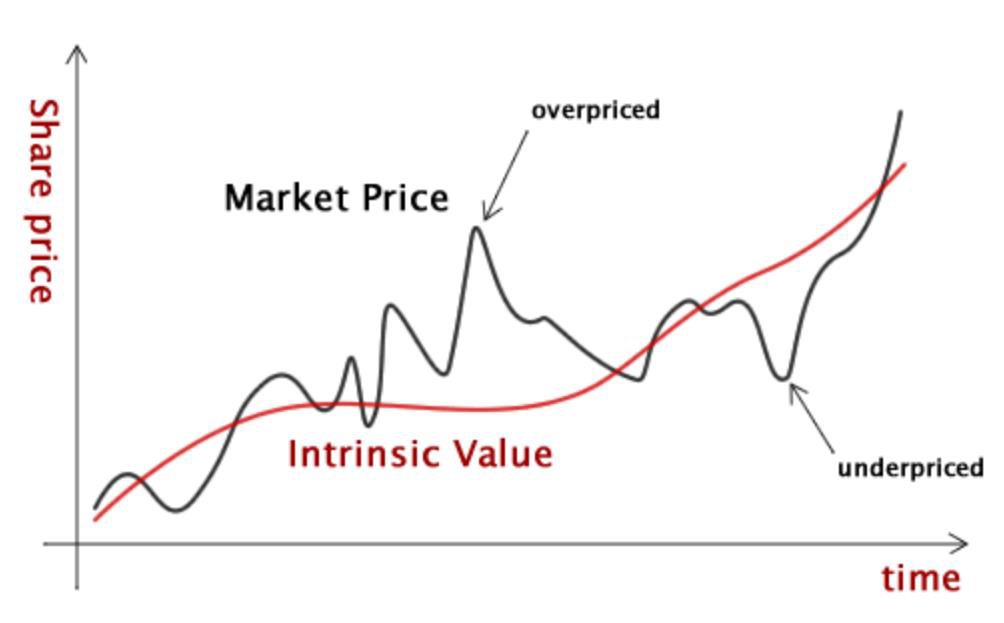
    Firstly, investors must understand how value investing works. In layman terms, value investing is a strategy for taking advantage of the market at the right moment. It’s based on the idea of “appraising” stocks, with value investing advocating hunting for stocks that are undervalued based on their “intrinsic value”, before buying them, holding them and weathering the volatility of the market. In theory, a company’s stock value should be the same as its market price but in many cases, this doesn’t hold true. It’s possible that stocks could be overvalued and at other times, it’s undervalued.

    To carry out this strategy, the investor will be required to analyse the company’s fundamentals and project the future profits that the business is going to generate in its lifetime and with that the investor is able to assess whether the company is underestimated in the market or not. If so, you get to buy its stocks at a bargain in the hopes that the market will turn in their favour over the long run. These value stocks are being sold below their intrinsic value and have huge potential to grow in the future when the price is adjusted accordingly.

    Although the concept seems simple, value investing is extremely difficult to implement properly and requires rigorous analysis to determine what the “underlying value” of a stock is. In today’s environment, investors must consider geopolitical factors, fiscal or monetary policies, currency, business model, supply and demand of the company’s services or products, and other underlying factors.

    stock analytic chart

    Understanding Value Investing is Vital before Making any Investments

    If you look at the chart above, the red line indicates the company’s potential or intrinsic value. In the beginning, due to its low value, the market misinterpreted the situation and quickly undervalued its stock. Value investors wait for this golden opportunity to buy the shares at a discounted price. They know the company has future growth potential. Then, they sell their stock when the market price is overvalued, earning them a nice, big profit. 

    For example, let’s take Microsoft whose product is widely used and accounts for 76.56% share of its industry as of December 2020 according to Statista.com and has about 1.5 billion active users worldwide. On average, its net income margin is about 25% per year and it consistently manages to turn over healthy profits. Despite the Covid-19 outbreak, its products were still massively used but during the pandemic selloff in March 2020, it lost about 25% of its share value. 

    Putting the factor of the COVID-19 outbreak aside, this company maintained good, continuous growth, and its share value grew about 23,000% in the last 30 years. Using the value investing strategy, one will see a huge opportunity in this company due to its nature of business, as well as the demand for its service and product continuing even during a pandemic. 

    (*Note: This should not be taken as financial advice or a buy recommendation.)

    Like all investment strategies, patience and diligence to stick to the investment philosophy is a requirement. There will be days when an investor may want to purchase some stocks because the fundamentals are sound, but he or she may have to wait if it’s overpriced at that time.

    If investors are unable to properly carry out this strategy themselves or commit to the time needed to invest themselves, it’s always advisable for them to seek for professional advice or seek a proper licensed financial planner or financial advisor to assist them. These professionals will be able to offer advice according to the investors’ risk appetite, goals and objectives. Other factors will also be used to evaluate the investors’ current financial condition before such advice is given.

    Conclusion

    Therefore, do buy the stock that is most attractively priced at that moment, and if there is none that meets the criteria, just sit and wait and let the cash sit idle until an opportunity arises. The bottom line is, value investing is a long-term strategy, it requires hard, there is no short cut and it works as Warren Buffett is still a devoted advocate of this strategy.

    About the author 

    Alex Ng Wern Ping is a licensed financial planner, and can be contacted at alexng.alpineadvisory@gmail.com.

  • Kenanga Investors Bhd: The Art of Diversity

    Kenanga Investors Bhd: The Art of Diversity

    Kenanga Investors Bhd has always been guided by its unwavering conviction in the investment strategies that has weathered them through many challenging periods in the past. And this deep-rooted philosophy has proven its resilience, especially in these trying times.

    The firm’s success isn’t a single-handed effort, however.

    Rather, it is attributed to the organisation’s capable and dynamic investment team as well as the diversity of ideas, strengths and competencies that come from the team, Kenanga Investors Bhd chief executive officer Ismitz Matthew De Alwis tells Smart Investor.

    “Diversity is strength, and together, all of us have worked tirelessly to uphold our firm’s philosophy that is ‘Consistent Top Performance’ and ensure sustainability in what we do,” he reveals candidly.

    Key Drivers for Impressive Growth

    Over the years, Kenanga Investors Bhd’s strategy to be a multi-segment, multi-distribution and multi-product platform has spurred the organisation’s strong growth.

    “We are able to cater our services and products to meet different client risk appetites be it equity, fixed income, managed portfolios or even alternative investments.

    “We achieve this by firstly prioritising the optimisation of our investment engine to create an alpha-centric performance culture – a culture that is the foundation of our consistent top performance,” De Alwis explains.

    From a product perspective, Kenanga Investors Bhd has streamlined its entire suite of offerings to ensure their investors’ various needs are being met.

    In addition to sourcing for new investment ideas and strengthening the distribution of the funds on their platform, much thought and effort has been put into ensuring their existing product line-up continue to contribute to their vision of being a market leader. This also provides a holistic approach to their clients’ investment and wealth management journey.

    “We have also taken up the mantle of championing financial planning which will benefit our consultants and investors alike by focusing on a needs-based structure.

    “This highly complements our goal of eventually becoming a one-stop wealth advisory firm with access to all capital market products while also providing holistic financial planning to our clients,” says De Alwis.

    Pandemic’s Impact on Fund Management Strategies

    Kenanga Investors Bhd’s investment strategy, reveals De Alwis, has always been premised on a bottom-up stock-picking approach on stocks that can offer a strong earnings trajectory.

    As such, across its top-performing funds, the common performance contributors are their overweight positions in technology and rubber glove sectors, with the global outbreak of the Covid-19 pandemic leading to a surge in demand for glove products.

    “This strong earnings profile coming from the tech sector especially is a showcase of not only their capabilities but the emerging importance of home-grown Malaysian technology companies in the global semiconductor supply chain.

    “Kenanga Investors Bhd believes there are structural drivers such as the rising adoption of 5G, artificial intelligence, electric vehicles and industrial automation and thus the supply chain that provides the components to these industries will benefit.

    “Besides growth, tech stocks also have solid balance sheets and strong cash flows which enable them to weather an economic downturn better than some other cyclical.”

    For check and balance, De Alwis reveals Kenanga Investors Bhd adopts a holistic approach to risk management to prepare the firm for inevitable situations by identifying, assessing, reporting and managing the probability and impact of all related activities.

    Indicators are used to provide early warning signals which then determine the responses required. For instance, during unsustainable bull markets, their indicators may help them to avoid companies with weak fundamentals or to avoid paying excessive prices for stocks relative to its intrinsic value.

    “Kenanga Investors Bhd’s risk management policies that our returns commensurate with the risks we take which means achieving out-performance without taking on more risk.”

    Navigating Market Complexities of Tomorrow

    The economic fallout from the pandemic has many Malaysians questioning their financial security, with concerns such as needing to postpone retirement or tapping into savings to pay for basic expenses.

    So how does Kenanga Investors Bhd address such concerns?

    The firm, according to De Alwis, has always been known as an equities expert within the Malaysian landscape. Since 2019, however, they have expanded into the fixed income space after a strategic mergers and acquisitions (M&A) exercise, while in early 2020, Kenanga Investors Bhd launched Malaysia’s first leveraged and inverse ETF to be benchmarked against the FTSE Bursa KLCI.

    “Investors now have the flexibility to diversify their portfolios further to suit changing needs and investment environments backed by superior and holistic investment expertise.

    “Furthermore, Kenanga Investors Bhd’s on the financial planning model ensures we are a needs-based asset manager, instead of mere product-pushing which may not benefit investors in the long run,” says De Alwis, stressing the firm is now more equipped than ever to guide investors of today in navigating the market complexities of tomorrow.

    By helping an investor map out their risks and goals to develop a plan (possibly comprising a diversified portfolio of various asset classes), they will eventually achieve their intended goal.

    “Following that, we will work hand-in-hand with the investor to keep periodic tabs on their overall portfolio to ensure they are on the right track and to make adjustments where necessary.

    “It is critical for the investor to stay diversified so that the various assets in the portfolio can take advantage of different economic conditions, leading to the best possible outcomes during crashes,” he adds.

    De Alwis goes on to highlight the need for investors to avoid following a herd mentality, especially when they are caught in times of crises.

    “It is easy to follow where the crowd goes because many believe there is safety in numbers. But when it comes to personal financials, one person’s risk appetite and goals can differ to the next person’s.

    “With Kenanga Investors Bhd in the picture, we can help the investor to assess their situation before they indulge in panic selling and finding out later that they would have recovered or profited had they stayed the course,” he concludes.

    By Bernie Yeo

  • How to: Achieve Financial Independence in 5 Years

    How to: Achieve Financial Independence in 5 Years

    In the digital age, many young Malaysians are eager to invest and grow their hard-earned money.

    Through information, they have obtained on the internet and through their peers, they understand the importance of growing their wealth through investing and have a desire to achieve financial independence as early as possible.

    There are also young adults who find it more comfortable to not invest until their financial situation becomes more stable or they have more money to invest.

    For this category, they are looking to invest and will do so when they have the extra disposable income to set aside.

    There are also others who have embraced the YOLO lifestyle, looking to live in the present and are accustomed to instant gratification.

    They spend every ringgit they earn, and perhaps even more by borrowing through their credit card or personal loans and choosing to let tomorrow worry about itself.

    Whichever category you may fit in, one key point to take home is that if you’re in your 20s, you have a big advantage over many others when it comes to investing.

    Here are three reasons why your age can be your biggest advantage:

    1. Time and Compounding Interest

    There is a famous saying attributed to Albert Einstein where he called compound interest the “8th Wonder of the World.”

    Whether Einstein said this or not, compound interest is the key that allows young investors to grow their wealth over time.

    Compound interest requires only two things: the reinvestment of earnings and time.

    • Compound interest can be thought of as “interest on interest,” and will make a sum grow at a faster rate than the simple interest which is calculated only on the principal amount.
    • Interest can be compounded on any given frequency schedule from daily, to annually.
    • When calculating compound interest, the number of compounding periods makes a significant difference.

    Assuming a 6% interest rate per annum, the table below shows the stark difference in the final amount based on how long an initial investment of RM10,000 is put to work:

    Starting Age Compounding Period (Years) Final Amount at Age 60
    20 40 RM 102,857
    30 30 RM 57,434
    40 20 RM 32,071

    The longer money is put to work, the more wealth it can generate in the future for you.

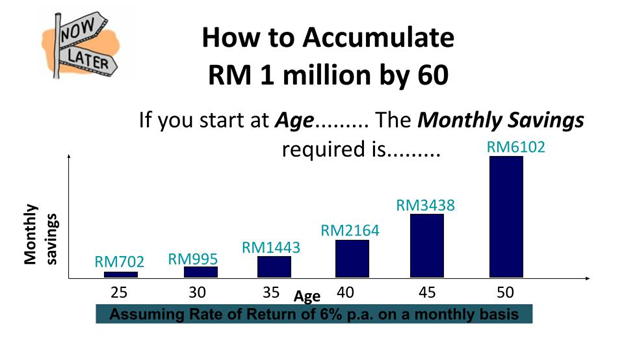
    Here’s another chart that demonstrates how much you would need to set aside every month at different ages, assuming you are looking to accumulate RM1 million for your retirement.

    As shown below, if you start investing at an earlier age, it is much easier to hit your financial targets through the sheer power of compounding interest.

    How to Accumulate RM1 million by the age of 60

    2. The Ability To Take Risk

    It goes without saying that higher-risk investments that are more volatile yield the highest return. Simply put, the higher the risk, the higher the return and the lower risk, the lower the return.

    Younger investors are usually focused on growing their wealth and should invest in higher return investments.

    This is because you have the time to recover if something were to go wrong, giving you the opportunity to make riskier moves. For example, when you are in your 20s, even if you suffer a loss today, you’ll be working for the next 25-40 years and have many years to earn an income. In short, you’ll likely recover from that investment loss.

    Those who begin to invest late in life are often inherently more cautious with how they invest their money.

    As one nears retirement, one usually starts allocating their investment portfolio to lower risk assets which correspondingly have lower returns. By starting late and having lower returns, one might fall short of their financial goals.

    3. Learning by Doing

    As a younger investor, you have the flexibility and time to study investing and learn from both successes and failures.

    Since investing has a fairly lengthy learning curve, young adults are at an advantage because they have years to study the markets and refine their investing strategies.

    You will make money, and lose money on some investments.

    Examples of things one needs to learn can include opening a stock trading account, opening a mutual fund account, buying real estate, or even calculating investment returns – these are all best learnt through experience.

    There are many other aspects when it comes to investing such as understanding how the market works, how the economic cycle affects your investment, or how mutual funds and Robo-advisor fees can affect your returns.

    Gaining this experience at a younger age will give you the confidence and knowledge to invest and grow your wealth to achieve your financial goals in the long term.

    Capitalise on Your Biggest Advantage

    There are many factors that one looks at when designing an investment portfolio. Ultimately, it should be designed to allow you to achieve your financial goals, be it short-term such as planning for a wedding, or long-term such as retirement.

    It cannot be overstated how beneficial it is to start early. In today’s information age, it’s your responsibility as a young investor to educate yourself on investing and take action to capitalise on the key advantage you have, which is time.

    Time cannot be bought and unlike investment losses, lost time cannot be recovered.

    Every day you delay is an opportunity loss to capitalise on the power of compounding interest and the ability to take risks.

    When one starts early, you get to learn from experience and make mistakes when they are less costly (ie. you have less money to lose) compared to when you get older.

    About the author

    Nicholas Wong is a licensed financial planner and can be contacted at nicholas.wong@ipp.com.my.

  • What Is Financial Abuse?

    What Is Financial Abuse?

    Are You Being Financially Abused? What Is Financial Abuse?

    Abuse comes in many forms and one of it is financial abuse.  In a marriage, money is usually co-owned but in many cases, the husband may control every aspect of finances and the wife doesn’t have access to it. 

    If she needs to ask for money, the assumption is that she doesn’t have any access to the bank accounts.

    This can be the case in many situations, especially if the husband is the sole breadwinner in the family, with his income going directly into a bank account that only he can access and control.

    In some instances, the wife won’t have her name on it and will need to ask for money in order to purchase basic household items.

    Other than the fact that she’s in a very dangerous position if anything happens to the husband, the marriage is built on the principle that he is above her in terms of finances.

    He makes all the financial decisions, and then decides if he wants her input while she has no control over it because she has no access to the money. 

    From the beginning, if a marriage is built on the basis that money is “his”, and he’s doing her a favour by letting her have some of it, this is not acceptable in today’s climate.

    Marriage is for two people to come together as one flesh and a partnership, not for one to be fully dependent on the other.

    If your partner is denying you access to finances and is treating it like it’s only “your” money instead of the marriage’s money, that can be categorised as financial abuse. 

    Money as a Method of Control

    The partner often uses money as a weapon to maintain control in the relationship.

    Your partner may assure you that they have it all covered, but the reality is that he or she is restraining you of your rights and potentially robbing you of your freedom.

    Financial abuse in a relationship is often hard to identify considering that the abuse is embedded with complex beliefs and social norms, so it can often go unrecognised by the person experiencing this.

    This robs the woman’s or man’s right to acquire and maintain economic resources, threatening their financial security and pushing them to not be self-sufficient. 

    Types of Financial Abuse 

    1. The controllers – This person uses a combination of abusive behaviours to exert their power over their family 
    2. The exploiters – This person takes all responsibility and also uses all kinds of abuse to financially exploit their partner for their own needs 
    3. The schemers – They have a specific plan in place to steal their partner’s financial resources and leave 

    Research has shown that the traditional stereotypes and attitudes toward gender roles and attitudes make grounds for controlling, exploitative and abusive behaviours regarding finances.

    In most cases, women trust their partner to act in the best interest of their family.

    However, their judgment is often clouded by the belief that their partner knows what’s best for the relationship, resulting in them fully relinquishing all financial responsibility to the abusive partner. 

    It Doesn’t Get Easier After the Separation 

    If the partner decides to leave the abusive marriage, it doesn’t mean that the effects of the abuse stops.

    Studies have shown that their income decreases further and suffers more after leaving their marriage, in addition to being impacted psychologically, whereby they experience a loss of confidence, guilt and also shame. 

    “Each year, more women are touched by domestic violence than breast cancer, ovarian cancer, and lung cancer combined.”

    – Purple Purse, Allstate Foundation 

    How Do I Get Out of a Financially Abusive Relationship? 

    Most of the time, people tend to feel trapped in their position. They stay in an unhappy marriage or relationship out of fear that they can’t afford to feed, clothe and house their children, as a result of having no idea about their partner’s income, or even the assets and debts in their name. 

    The first step to move on is to understand and believe that there are ways to leave this financial abuse in the past.

    It’s so important that you’re mentally prepared and have decided that you’ll do whatever it takes to leave this toxic relationship for that light at the end of this tunnel. 

    Step two is to gather all the information about your finances. Every single detail is needed to take the first steps towards regaining your power.

    The last step is to start planning out your new financial life. Write down all your hopes and dreams for yourself and your future. Think of realistic ways for you to take steps towards achieving your financial dream. 

    The journey is a long one. It’ll be tough psychologically, physically and financially but the earlier you take the necessary steps to gain control of your finances, the better the chances are of you determining your own financial future. 

    About the Author

    Nurul Yahi is a financial enthusiast and you can find her at dearduit.com. You can also find Nurul on Twitter, Instagram and Facebook.