Category: Cash Management

  • Budgeting Is So Yesterday: Here’s 3 Intelligent Approaches to Financial Management for Youths

    Budgeting Is So Yesterday: Here’s 3 Intelligent Approaches to Financial Management for Youths

    The usual monthly paycheck, a nice little work bonus, festive allowance from uncles and aunties — we all know the adrenaline rush of having some extra cash on hand.

    But let’s be real: more often than not, that money’s out of the bank just as quickly as it came in! While it could have gone to buying that shiny thing we’ve been eyeing for months, the reality is that many of us young adults know we can’t always blow it all on a luxurious lifestyle. We’re more likely to put it towards a loan we’ve been servicing, or a big (but essential) purchase that’s been put off for months, or even just clearing the monthly mountain of bills.

    In fact, that’s the case for an alarming 73 per cent of Malaysians aged 18 to 40: we’re all repaying some form of debt.

    We can promise ourselves that we’ll just “save more next time”. We can set aside stricter budgets for emergencies and rainy days. But with financial commitments piling up on top of ballooning costs, what else can we do on top of that?

    It’s not entirely about sacrificing that daily dose of coffee or the occasional self-care treat. It’s about knowing where the money should go.

    1. Turning credit cards and BNPL into friends, not foes

    We’ve all heard the horror stories: getting carried away by the convenience of living on credit, enjoying the financial freedom of delaying payment for expensive items that can be purchased immediately. Credit cards and ‘buy now, pay later’ (BNPL) platforms have long had a bad rep as massive debt traps, with some more careful Malaysians even avoiding the latter completely.

    In truth, though, they can actually be quite good for our financial health — as long as we approach them with a slightly different mindset.

    Rather than seeing them as a means to postpone payment (which could awaken the payment procrastinator in us), we as young Malaysians should instead fully leverage our youth and consider them as ways to start building a positive credit score! This is more likely to motivate us to pay our bills on time and reduces the chances of snowballing interest rates. Better yet: it also improves our financial standing for the loans that will really count in the future, like a housing or wedding loan.

    Mastering which purchases to use credit cards or BNPL for can also make us small profits. For instance, by using credit only for certain types of weekly or monthly purchases, we’re more likely to be able to pay each month’s bill in full — which many credit card companies now reward with extra cashback or reward points. Rack them up, and we may just be able to afford a fancy item off their redemption catalogue for free!

    2.  Start investing early, small, and diverse

    Investment can come off as an income stream for older folks who already have some spare money set aside. Less than 35 per cent of young Malaysians consider it a priority, an even smaller proportion than those who are prioritising their own businesses.

    Truth is, though, investing is an important way of growing wealth — which is all the more important now in the face of rising costs. Effective investing is less about the amount of money put into it, but rather about knowing what to invest in to suit your current age group and knowledge of the market. Even the smallest investment can make a huge difference over time.

    Often, young and inexperienced investors can be made to feel like they are “missing out” on more lucrative opportunities or that they are “misplacing” their investments. But I consider investing a lot like swimming: it’s always better to start small than jumping into the deep end from the get-go.

    Low-risk investments like fixed deposits, unit trusts, or Amanah Saham Bumiputera are recommended to start off with, especially since banking staff or trust agents will always be on hand to answer questions or profile any investment needs. Moreover, passive investment apps or platforms can also be a low-effort, digitised way to grow your wealth on the side.

    Dabbling in small-scale investments is a learning experience that can boost confidence to eventually diversify to higher-knowledge or more volatile ones, like the stock and capital markets. (And as always, remember that reward is proportional to risk, so tread cautiously!)

    3. Getting an expert opinion — that understands you

    With so many financial solutions and platforms out there, we’re not only spoilt for choice — we probably wouldn’t even know where to begin! It’s already natural instinct for us to turn to Google or social media to find information, so why not use that to connect with financial advisors that can cut through the noise as well?

    Financial consultancy has come a long way from the middle-aged man with a suit and briefcase. These days, they come in the form of a US$104 billion market: social media finfluencers (financial influencers) and modern advisory firms like Intelligent Consultancy.

    The financial consultant market is becoming increasingly younger, with advisors that are more relatable to the everyday Malaysian youth. They’re easier to connect with and understand: they do away with the fancy jargon, replacing that with easily digestible advice through social media content and personalised consultancy sessions.

    Debt management, personal loans, credit checking, even small business financing — advisors can help young Malaysians manage their financial health and work out payment strategies that work best with the lifestyles we hope to lead. Moreover, consultants and finfluencers may also have their own areas of expertise that can be a valuable source of financial upskilling and knowledge for us: investment security, stock market analysis, and even up-and-coming financing alternatives like Bitcoin or cryptocurrency.

    Even the best athletes have coaches, and for good reason! Financial advisors are uniquely positioned to help us devise strategies that not only meet our needs, but take us to the top: to future lifestyle aspirations, financial ambitions, and the big purchases we want to make — all without giving up that daily coffee.

    About the Author

    Keith Khor Kah Yong, Founder of Intelligent Consultancy

  • How To Save 50% Of Your Tax Payment?

    How To Save 50% Of Your Tax Payment?

    It is that time of year we have to file our taxes. I heard most employees file it quickly to get their refunds quicker. Is that the same for you too?

    I hope you have taken advantage of all your tax relief, especially if you earn more than RM7,000 a month. But is there a way to save 50% of your tax payment?

    I did a one-on-one with one of my Double Your Networth student, and she asked me, “How do I take advantage of my tax relief?” And I am grateful she ask me this question.

    Because sometimes I take for granted that everyone around me knows what to do. Especially since she earns RM25,000 a month, I know how paying taxes through her nose feels.

    I won’t go through all 15 categories, but  I prepared a simple tool I normally use to plan to see the difference between ‘taking advantage of the tax relief’ vs ‘not taking advantage of it’. Once you download it here, you can see how much money you will save & more importantly, and you can see your Effective Tax Rate (ETR)

    ETR is very important as I was misguided when I thought my ETR was 24% when my income was RM200,000 a year. But in reality, when you deduct all the tax relief, my ETR was probably at 10% of my total income.    

    Here is a quick summary of what Personal Tax Relief you can take advantage of (and the typical misses) depending on which category you are in for YA 2022. Only by knowing these details, will you be able to save 50% of your tax payment.

    Single Or Married Without Kids

    1. Self – RM9,000
    2. EPF – RM4,000 (if you are under the EPF scheme and not the pension scheme)
    3. Life Insurance – RM3,000
    4. Medical Insurance – RM3,000 (read here on what mistakes to avoid, I wrote a blog on this last year)
    5. Private Retirement Scheme – RM3,000
    6. Lifestyle – RM2,500 (purchase of books, laptop, tablets and smartphones and internet subscription)
    7. Additional lifestyle – RM2,500 (purchase of laptop, tablets and smartphones)
    8. Domestic Travelling – RM1,000
    9. Sports Equipment and Fees for rental – RM500
    10. Medical Fees for Parents – RM8,000 (do ensure you are the only 1 claiming & not claimed concurrently by your other siblings)
    11. Socso – RM250
    12. Vaccination – RM1,000 (Up to RM1,000 for yourself)

    Married With Kids Under 18 years old

    1. All the above
    2. SSPN – RM8,000 (most parents don’t take advantage of this for their kids)
    3. Ordinary Child Relief – RM2,000 per child (either parent can claim and not a claim by both parents)
    4. Lifestyle – RM2,500 (You can buy laptops, tablets and books for your spouse and kids as well. Since they can’t track, you can even buy laptops, tablets, and books for your nieces or nephew)
    5. Additional lifestyle – RM2,500 (if you have more than 1 child, you can claim additional on this purchase of laptop, tablets and smartphones)
    6. Child Education Insurance – RM3,000 (read here on what mistakes to avoid, I wrote a blog on this last year)

    Figure 1

    Here Is How You Can Save 50% Of Your Tax Or Effective Tax Rate (ETR)

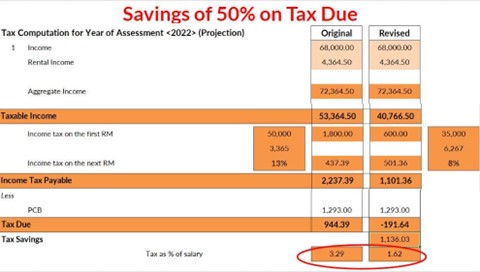
    Mr Nair (not his real name) is working for a famous foreign Bank for 5 years. He and his wife have 2 kids. He manages to buy one property for investment purposes and is getting rental income.

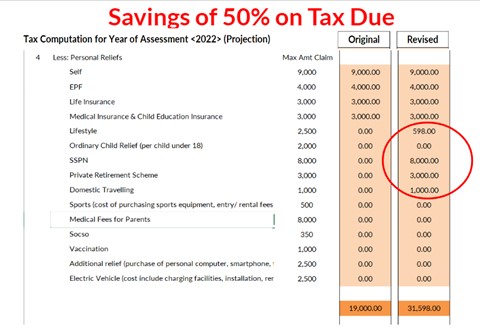
    The main strategy to save 50% of your Effective Tax Rate is to maximize all your tax relief (if possible) OR spend/save consciously in areas with tax relief.

    For Mr Nair, all he needed to do was to:

    1. Maximize his SSPN by saving for his 2 kids – RM8,000 (RM4,000 each)
    2. Maximize his PRS by saving RM3,000 to any of the approved Private Retirement Unit Trust
    3. Take his family for a year-end holiday of RM1,000 (through approved operators and selected premises here – Item 8)
    4. Buy a basic smartphone for his son – RM598

    Figure 2

    You will notice in Figure 1, his tax bracket dropped from 13% to 8% because his taxable income dropped below the RM50,000 level.

    Hence he could save RM1,136 on something he needed to do anyway (to save for himself and his kids).

    In case you are tight on cash, one of the method I used was to transfer some of my existing investments / spare cash / emergency funds to my kids’ SSPN or my PRS. The idea is like “Move from your left pocket to your right pocket.”

    Is this something that benefits you? Yes, I know this is a bit late, but this doesn’t stop you from planning for this year (YA 2023), right? Hope you have a clearer idea on how to save 50% of your tax payment.

    *DISCLAIMER: All tax references have been taken from PWC’s website. All my sharing on how to save 50% of your tax payment is for educational purposes and is my personal opinion. It should not be confused with tax advice. Do consult a licensed tax consultant for proper tax planning.

    About the Author

    Ka Hoe is a Licensed Financial Planner having a “Financial Adviser Representative” (FAR) with Bank Negara and “Capital Market Service Representative License (CMSRL) – Financial Planner” with Securities Commission. He is also the Founder of J Advisory, a Personal Finance Academy that helps struggling Malaysians elevate their financial well-being with proven tools, systems and strategies.

  • Money Caused Breakup Among Four Close Friends, That’s Why it Is Important To Plan For The Succession Of A Business

    Money Caused Breakup Among Four Close Friends, That’s Why it Is Important To Plan For The Succession Of A Business

    The following story is based on an actual series of events, with some names and circumstances fictionalised. Any similarity to any person’s name, character, or history is entirely coincidental and unintentional. It is good to have a plan for the succession of a business.

    Gerald, John, Steven and Mazlan were close friends, dating back to schooldays. So close they would get punished together for naughty things that schoolboys typically did.

    The first two were involved in building up a successful business in manufacturing and distributing car interior accessories. At the same time, the latter two had also built up an equally successful business, this one in car exterior accessories.

    Because of the obvious synergies involved, they decided to merge and apply for listing. The structure that was decided on was one where a holding company (Car Listco) was formed to hold the two operating companies as subsidiaries. 25% of the shares in Car Listco would be offered to the public.

    Read: Tragic Procrastination On Estate Planning Documents

    The Succession Of A Business: Case Study Of Four Shareholders

    At the same time, the balance shareholding held by the four individuals would be swapped into an investment holding company (Holdco), which would then control Car Listco. The four shareholders held shares in Holdco with equal portions of 25% each. Car Listco was successfully listed and well received by the public, and the market price on listing was about twice the offer price.

    The four shareholders were very happy with the high valuation, translating into approximately RM60 million above the pre-listing value. And that was not all. Others were also prepared to pay a control premium for control of a listed company of some RM50 million at that time.

    This kind of structure is, in fact, not uncommon for companies preparing for listing. Somewhat innocuous. Until the four shareholders disputed distribution, Car Listco performed well for many years, selling through a larger distribution network after the merger and declaring healthy annual dividends.

    In the initial years after listing, Holdco received its share of dividends and distributed 80% of all it received, and shareholders were happy with the arrangement. But five years on, the first two shareholders, who were also partners in another business, began to have cash flow problems and pressured Holdco to distribute more, even suggesting liquidation of part of the stake in Car Listco.

    This led to many arguments and fractured the close relationship the first two had with the other two, which puts a pressure on the succession of a business. Compounding the problem, Mazlan died, and his brother, the only next-of-kin, took over his directorship, which became the last straw because of his lack of trust and aggressiveness towards the other shareholders.

    In the end, the shareholders decided to liquidate Holdco and distribute it individually to each shareholder to be free to do what they wanted with the shares. The result of this breakup was that the shareholders lost the control premium, therefore they have failed in ensuring the succession of a business.

    Read: Being An Executor Of Will Is Not As Easy As It Seems To Be

    How To Ensure The Succession Of A Business?

    So what went wrong? How did a successful merger and listing end with a breakup and loss of control?

    The crux of the problem was the lack of liquidity. The Holdco made up of friends’ stakes tied together at the outset was a mistake. While Car Listco shares owned by Holdco were liquid, the shares in Holdco were not, leaving no liquidity for shareholders in need.

    It would have been better had 51% shareholding been locked up in Holdco and the balance distributed to the individual founders so that they would have liquidity. This would have avoided the disputes they went through before liquidation. In addition, it would have been good to plan the succession of a business, where shareholdings with a buy-sell arrangement, so that the founders would retain control when any of them exited.

    Read: Unfulfilled Wishes, Learn How To Protect Yourself

    About Rockwills International Group

    Rockwills International Group, now in its 28th year, pioneered professional will writing in 1995 and has since evolved into the leading estate planning specialist in the country. It is today the largest provider of solutions and support services in trusts, succession, management and distribution of wealth. It has shareholders’ funds exceeding RM50 million. It has done over 280,000 wills and 15,000 trusts and holds more than RM25 billion in assets under trust.

  • How To Free Up RM 2,000 Per Month Without Sacrificing Your Lifestyle?

    How To Free Up RM 2,000 Per Month Without Sacrificing Your Lifestyle?

    How would you 𝗳𝗲𝗲𝗹 when you are in this situation of…..

    ❗Total RM 382,000 𝗼𝘄𝗶𝗻𝗴𝘀 in credit card & personal loan

    ❗Have a 𝗱𝗲𝗳𝗶𝗰𝗶𝘁 of RM 5,328/month, of which RM 13,500/month is into servicing debt instalments

    ❗𝗡𝗲𝗴𝗮𝘁𝗶𝘃𝗲 net worth due to faster growth of loan interest than the growth of his assets

    To feel 𝗰𝗼𝗻𝗳𝗶𝗱𝗲𝗻𝘁 & 𝗳𝗿𝗲𝗲 like this……

    ✔️𝗥𝗲𝘀𝘁𝗿𝘂𝗰𝘁𝘂𝗿𝗲 his personal loan & Credit card outstanding to only RM 131,000 from RM 382,000

    ✔️𝗦𝗮𝘃𝗶𝗻𝗴𝘀 of RM 7,851/month by restructuring his commitments from RM 13,500/month to RM 5,649/month

    ✔️𝗜𝗺𝗽𝗿𝗼𝘃𝗲 his wealth to RM 565,000 after we help him restructure his debts, giving him 𝗰𝗼𝗻𝗳𝗶𝗱𝗲𝗻𝗰𝗲 to buy two properties worth almost RM 1 Million

    So this is what happened to Raymond, who is an IT professional, working for a famous Multinational company. Single & available, he is very friendly & has a very good relation with his friends & colleagues.

    Not settling for mediocrity, he always dreams of doing his own business. That is how he started partnering with a long-time friend in the chicken-rearing business. His friend was a veterinarian, and chicken is a staple food in Malaysia.

    So he put in his share of RM 225,000 in investment from his side, while his friend put in RM 75,000 to purchase live stocks and stock feeds. The condition was that his friend would run and manage the company’s operations.

    But within six months, the business couldn’t generate enough sales, struggled to stay afloat, and accumulated a debt of RM 120,000. He went from having good cash flow with monthly savings to having a deficit of RM 5,328/month by using his credit cards to finance the losses of the business.

    When we dive deeper into his situation, we see that his problem compounded because, over the years, he did not pick ‘G.O.O.D’ assets, despite earning a high income. Simply put, his assets were not growing as fast as his loans. We discovered that he also placed a large amount of his savings into insurance policies—21, to be exact.

    So while most individuals are right about having a mix of high-risk investment vs low-risk investment in their portfolio to generate good returns, Raymond was right on the big picture but struggled to see that insurance does not generate healthy returns.

    So here is two things we did to help Raymond:

    1. Restructure his debt of RM 382,000, which is causing him to have a negative cash flow of RM 5,328/month, by using Debt Replacement
    2. Freeing up RM 27k/year cash flow by restructuring his insurance using PMR rate and maximising his low coverage up to 5x

    You have heard a lot about Debt Restructuring, but what is PMR?

    You might be wondering, what actually is this PMR tool? Is it some kind of magic?

    PMR stands for Policy Maximisation Rate and is used to measure “Is your insurance coverage maximized with the lowest possible premium?

    For example, a PMR rate of 125 means that for every Ringgit premium paid, you are getting coverage of RM125.

    One of the first things we did was to list down all his insurance policies and premiums and run them through my proprietary PMR tool to identify Raymond’s under-optimised policies and correct them.

    To his surprise, Raymond was undercovered despite paying for so many policies.

    Raymond: “But, Ka Hoe, all the savings plans are good. At least the premiums are not burned, and I will get a lump sum back?

    Well, it depends,” I answered. After calculating the rate of returns of the savings plans, we found that Raymond is getting about 2% per year. His money will earn better interest if deposited in FD.

    Next, we calculated how much Raymond needs to cover so he won’t be under-covered or over-insured.

    Raymond is not alone. Most people buy insurance based on what they think they need without calculating their actual needs and end up paying too much and covering too little.

    So, what is a good PMR, then? Based on my experience in the past 14 years, after reviewing thousands of policies, a PMR of less than 100 is normally under-optimised.

    If your PMR rate is between 100 and 200, it’s somewhat optimised, but it can be better. A PMR rate over 200 is well optimised, but you must ensure each component of your insurance needs is covered.

    You can learn more about the PMR tool here. (short video of my previous sharing on KCLau’s webinar)

    Interested to find out what is your PMR?  Are you currently under or over-insured or simply paying too much in premium?

    Then, I would like to invite you to our first “How to Free Up RM2k/month Without Sacrificing Your Lifestyle” webinar in 2023.

    This webinar has assisted many of my students in lowering their insurance premiums and increasing their coverage, allowing them to start working twice as hard and possibly retiring five to ten years earlier.

    During the webinar, I will not only go through with you the exact steps I did with Raymond with my proprietary PMR tool but also:

    1) How to identify under-optimized policies and correct them

    2) Calculate how much you need to cover so you won’t be under-covered or over-insured.

    3) Better prepare you for the future and prevent potential time bombs from blowing up during retirement

    4) Go through real-world case studies with proven results on how to free up your cash flow so that you can work your money 2x harder.

    Click here to learn more about how Raymond and the rest free up their cash flow up to 3x and maximize their coverage up to 5x. Use this promo code SIGUEST to get it at 9.87 (80% off the retail ticket of RM 47, the webinar is valued at RM 1,997)

    Ka Hoe is a Licensed Financial Planner having a “Financial Adviser Representative” (FAR) with Bank Negara and “Capital Market Service Representative License (CMSRL) – Financial Planner” with the Securities Commission. He is also the Founder of J Advisory, a Personal Finance Academy that helps struggling Malaysians elevate their financial well-being with proven tools, systems and strategies.

    Disclaimer: All strategies listed here are neither recommendations nor advise. The article is written purely for education and journaling only. The content of this article is an expression of my opinion and should not be taken as professional advise. If you are seeking professional advise, please consult me personally. When dealing with debt, you should conduct research and seek expert advice.

  • An 8-Step Wealth Workout Plan

    With gyms all over town teeming again with fitness junkies, almost everyone is playing catch-up with their fitness goals after a long hiatus from the gym. Whether it’s building muscles, improving stamina, or just getting healthy, all of us can benefit from a good old sweat session.

    But what about our financial fitness?

    If you’ve been putting off your financial goals for some time, now is a great time to rebuild and reposition yourself to get back on track as we usher in a new year.

    Here’s an 8-step wealth workout plan to ease yourself back into it and get financially fit.

    Wealth Workout Plan #1: Reassess Your Position

    Before you jump right back into your routine, it’s important to first evaluate your current financial position and understand what has changed. Maybe there was a new family addition, or you had to take out a new personal
    loan. In both instances, your tolerance for risk may be lower and you are more susceptible to ‘pain’ in markets.

    Like any fitness routine, a financial plan needs to be specifically tailored to your needs. Work together with your wealth trainer to craft a financial plan with short- and long-term goals. Remember to be realistic in your plan, otherwise, you won’t feel motivated to stick to it.

    Read: 5 Investing Mistakes to Avoid During a Downturn

    Wealth Workout Plan #2: Crunch Those Figures

    With a destination in mind, it’s now time to do some number-crunching.

    How much do you typically spend every month? What percentage of your salary are you setting aside for saving and investing? Taking inflation into account, are you putting away enough to reach your dream retirement in 30 years?

    Commit to your goals and take responsibility for your financial situation, whatever it may be. Don’t be dissuaded easily or quit before you even start going. The path ahead could be painful with many short-term setbacks, but the glory belongs to those with the grit and determination to push through.

    Wealth Workout Plan #3: Build Your Financial Core

    Having strong core muscles is important to keep from getting hurt because they support your spine. In the same way, a solid core is the base of any financial plan. This will help you get through bad market cycles and accidents.

    That’s where an emergency fund comes in to ensure you have a safety net to fall back on. Ensure you have built an
    adequate financial buffer of at least six months in living expenses which can help tide you over when times get rough.

    Keeping an emergency fund also prevents you from being forced to sell your investments during a downturn and crystallising your losses, thereby allowing you to stay invested.

    Read: Follow These 5 Steps For An Effective Asset Allocation In Your Investment

    Wealth Workout Plan #4: Warm Up And Gradually Progress

    Nobody should start deadlifting 100kg on their first visit to the gym. As an investor, you should not be piling everything you have into a single investment to generate returns. Take small steps to build your wealth and invest at levels you are comfortable with.

    Once you’ve become more confident, you can gradually increase the amount you invest every month to build your ideal portfolio. With a better grasp of the market, you could also load up on more tactical positions to amplify returns by taking advantage of current market conditions or mispricing opportunities.

    Wealth Workout Plan #5: Ice That Pain & Spending

    Pain management is also a critical element of a wealth workout plan. Investors would inevitably face some ‘pain’ in their portfolio as markets go through different cycles.

    But investors can manage this by stacking up on some fixed income and safe haven assets like gold which offers capital preservation by cushioning losses during a downturn given its low correlation.

    If you can’t get your budget to balance, consider also freezing some of your worst financial habits by going on a spending diet. Sweet caramel macchiatos and night-outs are nice but learn to resist financial temptations to
    lower your cash burn.

    Read: ESG Investing And The 3 Steps To Build An ESG Portfolio

    Wealth Workout Plan #6: Stick To The Schedule

    As any fitness guru will say, it is far more important to stay consistent, rather than to focus on the intensity. This applies to investing too, which gets easier over time as you compound your gains and accumulate wealth.

    Much like fitness, investing is really a long-term game that won’t give you immediate results even if you put in all your energy or resources overnight. A shredded body can take months, if not years of consistent training.

    Similarly, building wealth also takes time and lots of patience. Legendary investor Warren Buffet only made over 90% of his wealth after he turned 65 years old. A great way to maintain consistency is to practice dollar-cost averaging by investing equal amounts at fixed intervals to ensure that it becomes habitual.

    Wealth Workout Plan #7: Target All Areas

    Gym bros who focus on chest exercises but skip leg days usually end up with an unbalanced physique. Similarly, you don’t want a portfolio that is lopsided because it is heavily tilted towards a particular ‘hot’ asset class or sector that has made strong gains in the past.

    It might look good on the surface, but chances are it might crumble under pressure once the euphoria runs past its peak. Thus, any fitness programme should be all-encompassing by targeting all areas of your body to maximise resilience.

    This applies to your portfolio too by ensuring that you have a good mix of different asset classes, sectors, and country exposure so that you stay on top of your game and can endure market drawdowns.

    Read: Are Malaysian Millennials Really That Bad At Managing Money?

    Wealth Workout Plan #8: Enjoy The Process

    Lastly, take the time to savour the moment and just enjoy your wealth and fitness journey. You may find yourself hitting a plateau and feeling like you’re not moving ahead.

    But investing is a lifelong pursuit, where your success should be measured across years if not decades. The ride could be riddled with short-term volatility, but that’s just part and parcel of investing.

    So, keep your eyes on the prize and keep a long-term perspective in your quest towards building wealth.

    With this wealth workout plan in place, you should be able to weather any conditions.

    About the Author

    Lee Sheung Un is an assistant manager of communications & content at AHAM Capital. A millennial, he is still finding that balance between wealth, freedom, and purpose. Views expressed are his own.

  • Give Your Relationship With Money A Fresh Start

    Give Your Relationship With Money A Fresh Start

    It is not uncommon to see or hear people we know to make life decisions based on our relationship with money. Even when one is unhappy with their environment, they may not have the courage to make any moves or changes because they fear the impact on their financial well-being.

    We enjoy seeing our investments grow but lose many nights of sleep when the opposite occurs. If we find our lives saddled with debt or see our peers living a more lavish life, we may feel that we are not enough.

    Money has a huge role in our quest to feel enough or be happy. The reason I want to talk about this is that we must not use money as the measurement of our progress in life. It should not be the reason we feel inadequate or terrible.

    Read: Can Money Buy Happiness?

    Our Relationship With Money

    People seek belonging, acceptance, and validation from the people around them. We want to feel that we belong to something, to a certain group or culture. When it comes to our relationship with money, the same pattern and need to be seen as ‘normal’ can also be easily observed.

    When we see others around us dress well and drive expensive cars, we tend to assign them to the ‘successful group’ and think ‘they are doing well in life’. But statistics have told us that people who earn a high income can also deal with money issues and seek debt management programs from AKPK (Agensi Kaunseling & Pengurusan Kredit). On the other hand, not all middle- or low-income earners are terrible money managers.

    Comparing what we have to what others have can lead us to an endless chase of happiness based on what other people are doing. It takes away our focus on how well we are doing.

    Have you been telling yourself: “If I have X amount of income, I will be able to do this or feel happier”?

    Read: 4 Money Personality, Find Out Yours

    This thinking puts money in the driver’s seat behind every decision we make and that money is the only enabler for us to do anything.

    When we give more power to money, it will take it and eventually become the lens through which we make most, if not all, of our life decisions. We must break this pattern and take back control. It starts with redefining the relationship we have with our money.

    Doing this early is important. If we do not confront this relationship with money early, it may cause us to tie our self-worth to our net worth, which means if you don’t feel you are as rich as me, you will convince yourself to believe that you are not as good as me, and this may blind you from seeing your true potential.

    Money is not unimportant. Don’t get me wrong. It is important, but it should not be more important than our sense of self or cause us to lose our sense of self.

    Money shouldn’t be why we cannot prioritise caring for others or stop us from feeling happy. Money is the car that gets us to our desired destination; it is not the driver itself. You are.

    To regain control, the driver must know where he or she wants to go. But many times, we don’t have a clear idea of what our goal is. You don’t have to feel bad or guilty if this is you.

    We haven’t been taught how to think about our goals. I think we need to first find out what we value most.

    Understanding what we treasure the most can help us discover what we want to make happen. If your core value is your family, you may find ways to use your money to help your family live a better life or protect your family’s financial security.

    If your core value is health, you can learn how to use your money to help you live healthier. I think it makes little sense to use our money on things we don’t value as much because this will deprive us of our life satisfaction. They may give us a short boost in happiness, but they may not be as sustainable as when we use our money on things that truly matter more to us.

    Determining our core values and things we hold dear will help us shift the steering wheel into our own hands and help us focus on how to utilize our money to live the type of life we want.

    Read: How Can You Save Money Without Even Realising It?

    Those Who Fail To Plan, Plan To Fail

    This will help us find out how to manage our money accordingly and create a spending plan to help us keep our money in the right place. This financial plan would have had a say in where we wanted our money to go and what we wanted it to do for us, not the other way around.

    Also, in our quest to have a constructive relationship with money, we must first determine what kind of relationship we have with it now. What would a mutually supportive relationship look like?

    It makes sense to conduct an initial assessment to determine how much money we need to live the best life we want. From there, we can then find out what things would need some tweaking to create the kind of future we’d love to have.

    When our relationship with money is healthy, our financial well-being can improve. We will be more at peace with ourselves and our money.

    We can live better today. Wishing you a great 2023 by starting with a refresh on your relationship with money.

    Read: Are Malaysian Millennials Really That Bad At Managing Money?

    About the Author

    kevin neoh

    Kevin Neoh works with people to transform their relationship with money and support them to use their money to live a meaningful life. He is a CFP professional and a certified member of Financial Planning Association Malaysia (FPAM). Kevin can be contacted at www.kevinneoh.my.

  • Save Monthly Repayment Up To RM9,000 Per Month

    Save Monthly Repayment Up To RM9,000 Per Month

    Taking out loans is a normal part of life. Some take out loans to buy a house, or a car, to sustain their lifestyle and many other things. But is there a better way to manage debts, so we can save monthly repayment and sleep better at night?

    Meet Isabela (not her real name), a working mother at a multinational bank in Malaysia. Managing 20 employees as a senior manager while raising seven children was frequently like working two jobs. She was so busy she did not have time to manage her finances.

    As a result, Isabela suffered from a negative cash flow of RM5,000 every month, even though she earned a T20 income* as a senior manager in a bank. She constantly asked these same questions over and over: “Why is it that I pay my credit card bill every month on time, but my outstanding debt seems to be getting bigger and bigger?”

    So how is it possible that if one pays their credit card on time, they are still in debt?

    This is what we found out when we sat down with Isabela. The main contributor to her RM5,000 per month deficit is the ‘Loan Repayment’ row (in the diagram below).

    Can you imagine paying RM11,000 per month on your loan repayments? Is there a way to save monthly repayment?

    Read: Save RM1 Million On Your Own Or Do It By Buying A Property?

    How To Save Monthly Repayment Up To RM9,000 Per Month?

    Before and after: a monthly cash flow summary from a deficit of RM5,000 to saving RM2,000 in two months

    As I dug deeper, I found four credit cards with multiple instalment plans (refer to Chart 1). “Okay, it’s not too bad,” I thought. I have seen worse, something like 10 to 20 cards.

    Chart 1

    For Isabela, some of the cards were tied to recurring payment plans. Nothing out of the ordinary but they all had one thing in common: all the cards had outstanding balances.

    I started to organise them to understand how much she was paying monthly for each card. Here’s a snapshot, where we found the root cause.

    I realised she was paying a fixed amount for some of the cards. I knew she was in trouble because her income couldn’t support the card repayments. She was paying on ‘gut feel’, meaning she would pay an average of RM3,000 per card for three of the four cards.

    For example, as shown in Chart 1, she only pays RM3,000 for her CIMB Credit Card. However, the monthly instalments come up to RM2,130, and she was spending RM3,071 in June, totalling to RM5,201. Meaning the payment was short of RM2,201, so she owed her credit card outstanding payments before she started that month.

    This is a bad habit and one of the major blind spots for most credit card users as they don’t clear their monthly balance. Here’s what I have to advise:

    First, although you pay your cards on time every time, you still need to pay the amount spent in full for that month or else the outstanding will grow out of proportion. You cannot just pay on time without paying in full for what you need to pay.

    Secondly, when you miss paying in full for one month (that means having an outstanding balance for the following month), it would be very hard to keep track of your expenses. It becomes impossible to reconcile what you spend the subsequent months unless you sit down and take a snapshot of your expenses over three months of credit card spending.

    Read: Saving vs Investing, Should I Save Or Invest?

    When you don’t know what you have been spending, you won’t know how much you have to pay. And this will go on like running on a treadmill that won’t stop and will keep going faster until you fall.

    Thirdly, most people who constantly pay off any outstanding monthly credit card expenses will not have this problem.

    So how can we save monthly repayment and solve this issue?

    Read: How Can You Save Money Without Even Realising It?

    Case Study On How To Save Monthly Repayment

    Once we identify the problem, we can develop solutions and strategies. In Isabela’s case, here’s what we needed to do to save monthly repayment:

    1) Restructure her debt and consolidate it into one unifying loan.
    2) Manage her expenses through ICE JAR, the world’s simplest money management system, to prevent her from falling into the same situation in the future.

    Although she has a housing loan that we can use to consolidate her credit card debts, there wasn’t much capital appreciation as these properties were purchased recently.

    So, we had to use another ‘container’ to consolidate her loan. The most effective ‘container’ is similar to a housing loan that uses a ‘reducing balance interest’ calculation instead of a ‘fixed line interest’ calculation loan (also known as a personal loan) that most people use.

    Within a month, my team and I managed to help Isabela find her ‘container’ and save monthly repayment by reducing her loan repayment from RM11,648 to just RM2,594 monthly.

    Many of our fellow Malaysians are unaware of a significant difference in interest calculation.

    Read: 4 Money Personality, Find Out Yours

    The ‘fixed line interest’ calculation (typically used for traditional car loans and personal loans) is very different from the ‘reducing balance interest’ calculation (typically used for housing loans). Let me illustrate by using this example of taking an RM100,000 loan with a 5% interest rate over ten years.

    From the diagram illustrating Isabela’s Debt Consolidation Strategy (DCS), you can clearly see why I chose to use the ‘reducing balance interest’ option. Given the same loan amount, interest rate and same 10-year duration, and a monthly instalment of RM1,250, you can see that the ‘reducing balance interest’ calculation gives 50% interest savings compared to the ‘fixed line interest’ calculation.

    This is how you can save monthly repayment and sleep better at night.

    Read: 6 Ways To Deal With Inflation

    This is the reason we need to invest in our financial education. As they say: “Education lifts us past poverty,” and that especially includes financial education, and save monthly repayment is something that almost everyone needs to know how to do it.

    *T20 income is classified by the Household Income & Basic Amenities Survey Report 2019 by the Department of Statistics Malaysia (DOSM). The income classifications for T20 have been revised to reflect inflation, the rising cost of living, and household size, among a host of other factors, into two parts:

    • T20 Part 1 – RM 10,961 to 15,039 and
    • T20 Part 2 – RM 15,040 and above

    About the Author

    Ng Ka Hoe is a Licensed Financial Planner and a Financial Adviser Representative (FAR) with Bank Negara Malaysia and“Capital Market Service Representative License (CMSRL) Financial Planner with Securities Commission Malaysia. He is also the Founder of J Advisory, a Personal Finance Academy that helps struggling Malaysians elevate their financial well-being with proven tools, systems and strategies. For more real-world case studies, you can head over to https://jadvisory.asia/.

  • 5 Tips To Help You Set And Achieve Your Financial Goals

    5 Tips To Help You Set And Achieve Your Financial Goals

    Have you ever set goals for yourself but failed to meet them? It may be to start exercising, investing, spending more time with your family members or loved ones, or whatever goals you may have.

    You set goals at the start of the year but did not follow through in the following weeks or months. You only realize your goals as year-end approaches.

    A study by Martin Oscarsson published online in 2020 on large-scale experience with New Year’s Resolutions found that 55% of the respondents successfully sustained their resolutions at a 1-year follow-up.

    Therefore, it is possible to follow through on your goals by following these five tips to help you set and attain your financial goals.

    Read: Six Golden Rules In Getting Favorable Returns And Growth, When Investing In Unit Trusts

    1. Clarity

    Do you have a clear and specific goal for how much you want to achieve in financial goals?

    It can be measured by savings amount, net cash flow or how much net worth or how much investment portfolio, how many like properties or how much reduction of debt or how much sum insured you would like to have at a certain time frame.

    Clarity is power; having that clear focus on what you want helps give you that clear direction.

    When you use your GPS, whether you are using Waze or Google Maps, the first step is to key in your destination. In your financial planning, you need to know what clear financial goals you want to achieve.

    Read: Should I Take Out My EPF To Settle My Housing Loan?

    2. Compelling Reason

    After you know what you want, the next thing is to know why you want those financial goals.

    “ Reasons come first. Answers come second.”

    – Jim Rohn

    Why do you need to achieve that goal? For what purpose? Is it for yourself or for others?

    Having that compelling reason will pull you toward the goals that you set. You may face certain challenges/obstacles, but your stronger reasons will pull you back to the right track.

    For example, by achieving that financial freedom, what would this allow you to do? Is it to live a comfortable lifestyle for yourself and your family? Is it to travel worldwide and create memories with your loved ones? Is it to start a charitable organisation?

    Read: Where To Invest In 2023: Amidst The Recession And General Election

    3. Consistency

    Consistency is key to ensuring that you are getting closer to your goals. Don’t undervalue the small steps you take every day.

    For example, by saving RM3 per day for 365 days, you will save around RM1,100 over one year. What if you put it in an investment vehicle that grows at a certain percentage?

    For example, someone saving RM500 per month over 35 years with the assumption of an 8% compounded annual return will have over RM1.1 million at the end of that period.

    Read: 5 Easy Steps to Achieving Financial Merdeka

    4. Accountability

    Do you have someone accountable to you who helps you track and guide you in achieving your financial journey, be it your financial planner or someone competent enough to advise you on your personal finances?

    It is like having a mentor or a coach who can advise you on the rights and wrongs.

    Read: 5 Investment Tips For Beginners That You Should Know

    5. Review and Measure

    It is always good to measure periodically; it may be quarterly, half-yearly, or yearly, depending on the duration of those financial goals that you set. Knowing the actual results will allow you to make necessary adjustments to try out different methods to save or reduce unnecessary expenses that contribute to your overall financial goals.

    Once you have your financial goals, the most important step is to take action either to create that investment account opening or schedule that appointment with your financial planner or what would the next things you can do.

    Read: Saving vs Investing, Should I Save Or Invest?

    5 Tips To Help You Set And Achieve Your Financial Goals

    Every new year comes with optimism and new year resolutions. I hope that these tips will be able to help you set and achieve your financial goals.

    About the Author

    Goh Chee Yong is a Licensed Financial Planner under Capital Markets Services Representative License (CMSRL) and Bank Negara approved Financial Advisor Representative (FAR). Prior to becoming a financial advisor, he spent eight years working in Big 4 audit firms and multinational corporations. He is also invited to speak on financial literature at universities and public events. He can be contacted at cygoh@imaxfinancial.com.my

  • Survey Finds Malaysians Are Struggling Financially From the Pandemic

    As the world braces itself for a recession and continued inflation in 2023, Malaysians are in their worst-ever financial position to prepare for it. Data from the RinggitPlus Malaysian Financial Literacy Survey (RMFLS) 2022 revealed various painful truths about the current financial state of the rakyat, including depleted savings, cash flow issues, and other worrying trends.

    Malaysians are still struggling from the financial impacts of the pandemic

    Malaysians from all walks of life are now facing severe financial challenges that leave them vulnerable to financial shocks, as various financial aids reduced the impact in 2020 and 2021. 70% of respondents indicated that they save less than RM500/month or do not manage to save at all. This is the worst-ever result tracked by the RMFLS in 5 years.

    At the other end of the spectrum, the amount of Malaysians who manage to save more than RM1,500 per month has also dropped significantly. From 20% in 2020, the figure has dropped four times lower to just 5% in 2022.

    The RMFLS 2022 results also indicate that more Malaysians are struggling with less savings in hand, as 63% of respondents stated that they can survive for 3 months or less with only their savings (52% last year). A similar pattern is also seen where 55% of Malaysians spent exactly or more than what they earned each month (44% last year), essentially living paycheck-to-paycheck.

    With depleted savings and higher cost of goods, the survey also highlighted a worrying trend where more credit cardholders are not paying off their bills in full – just 55% in 2022 compared to 70% last year.

    Hann Liew RinggitPlus Survey

    Forgoing long-term security and wealth generation for short-term relief

    With the challenges in cash flow and savings, the survey results show that Malaysians are choosing short-term monetary relief over long-term financial stability. A staggering 66% of respondents above 21 stated that they will consider applying for more Employees’ Provident Fund (EPF) withdrawals if the government allows it.

    In addition, the survey also found that 52% of Malaysians above the age of 18 have not started investing. Meanwhile, a majority of those who are investing have low-risk appetites but medium-term investment horizons which is not optimal – though these may be influenced by current financial challenges and global economic outlooks.

    Current trends are a wake-up call to all parties to take action

    “The financial effects of the pandemic have been devastating and our survey findings this year reaffirm that Malaysians have real financial challenges to address. It is a harsh reality not only for the rakyat, but also for policymakers and industry players – this is a generational issue that requires long-term solutions with sustained and concerted support from all parties. We cannot leave anyone behind,” said Hann Liew, co-founder and director of RinggitPlus.

    In line with this, RinggitPlus recently introduced a new section to its Savings vertical on RinggitPlus.com that highlights the various cash management solutions in the market as it aims to encourage Malaysians to save and earn best-in-class returns.

    “The new section on the Savings vertical at RinggitPlus.com is timely as it highlights a relatively new product line in the industry, and will help those looking to research and compare for the best savings products in the market. Meanwhile, offering our content in Bahasa Malaysia is part of our mission to extend our range of services to other languages and thus reach out to more Malaysians,” said Liew.

    Financial literacy continues to be a major step towards helping Malaysians overcome financial challenges and take control of their financial health. As RMFLS celebrated its 5th anniversary, the annual survey continues to highlight the importance of financial literacy among Malaysians and provides data points that have been used by various organizations, education bodies, and governmental sectors towards guiding Malaysians to take control of their financial health.

    If you enjoyed this article, you might also want to check this out:

  • Protecting Our Children In A Divorce

    The following story is based on an actual series of events with some names and circumstances fictionalised and any similarity to the name, character or history of any person is entirely coincidental and unintentional. Hope that we can learn a thing or two about protecting our children in a divorce.

    Today, it is a sad day for Leng Chai. He got divorced from his wife, Maggie. They had a roller coaster marriage. During happier times, they became parents to twin girls. The court granted Maggie custody of the twins.

    Leng Chai spent so much time to build a successful business that he neglected Maggie and the girls in the process. Leng Chai and Maggie attempted several times to reconcile but each time, their relationship became more strained.

    As Maggie has been out of work for some time to care for the twins, Leng Chai is worried about the financial wellbeing of the girls (now three years of age) in case he dies before they grow up. Though Maggie knows that Leng Chai loves the girls, she is also worried that he may not keep his promise, like so many of the promises he made when they were trying to save their marriage.

    Maggie is also worried that he may remarry and neglect the twins especially when he has children with his new wife. Leng Chai, in turn, is worried that Maggie may remarry and neglect the girls to focus on her new family. The least he can do is provide for them financially.

    Read: Unfulfilled Wishes, Learn How To Protect Yourself

    Protecting Our Children In A Divorce

    One of the way to be protecting our children in a divorce, is by the way of trust. An easy way to resolve both Leng Chai and Maggie’s concerns is for Leng Chai to setup a trust for the girls. This agreement to setup a trust could be incorporated as part of their divorce settlement.

    The trust would need to be one that cannot be revoked by Leng Chai. If Leng Chai is allowed to revoke the trust, Maggie would be concerned because there is no certainty that Leng Chai will not terminate the trust arrangement in the future or amend it to benefit his new family.

    Leng Chai should approach a licensed trust company that is able to address his and Maggie’s concerns for a customised trust solution to be prepared, rather than using a boilerplate trust template. Having a trust company to act as the trustee ensures continuity of the trusteeship and accountability to the twins.

    As the purpose of the trust is to provide financial security to the girls, it is important to ensure that the assets placed into the trust provide sufficient funds for them even when Leng Chai is no longer around. Since Leng Hai intends to purchase a RM2 million life insurance policy, he can transfer it to the trustee together with the unit trust investments he owns that has a market value of RM1 million.

    With RM3 million in the trust, it makes the protecting our children in a divorce even better. The twins would have financial security to pay for their daily expenses, education, and medical needs in the future.

    Read: Fighting Over Equity Distribution, The Importance Of Succession Planning

    Taking Care Of The Children In Whatever Condition

    During Leng Chai’s lifetime, there should not be any distribution to the girls, but any dividends are reinvested by the trustee to increase the available amount for them in the future. Leng Chai can continue to provide financially for the girls before his death or disability.

    When death or disability occurs to Leng Chai or when certain conditions stated in the trust are met, it would trigger the trustee to begin disbursing the funds for the girls’ maintenance, education, and medical needs through their guardian before they are 18 years old.

    Leng Chai may want to indicate his investment preferences or give power to the protector to make such a decision. It would make sense for Leng Chai to appoint Maggie to act as the protector when he is no longer around. As the protector, Maggie would be the watchdog for the girls and liaise with the trustee on the needs of the girls from time to time.

    The trustee may also refer to the protector for an opinion before exercising its discretionary powers with a view of fulfilling the objectives of the trust and to benefit the twins.

    This trust arrangement for the twins should end when Leng Chai is no longer around and the girls reaching the age of 25 years. When they are 25, the remaining funds are to be given to them as a legacy from Leng Chai.

    At the same time, Leng Chai should have a will written where part of the instructions may give other assets to the twins when they reach a certain age. However, if he remarries, he will need to prepare a new Will as that marriage will revoke an earlier Will.

    Maggie in her Will may use her savings and assets to include a testamentary trust for the girls, should she pass on before they are 25 years old. With a testamentary trust, Maggie will leave clear instructions on how her assets should be used for the twins. This is similar to Leng Chai’s trust for the girls.

    There are a few differences between Maggie’s testamentary trust and Leng Chai’s trust.

    All Bases Covered: Protecting Our Children In A Divorce

    Read: The Importance Of Estate Planning, Avoid Last Rites Drama

    For Maggie’s testamentary trust to take effect, it is dependent on Maggie’s passing before her Will is probated and all her debts and taxes fully settled before the testamentary trust begins. It would be different for Leng Chai’s trust where it is not in his Will but in a deed which begins during his lifetime. Leng Chai would have to retitle the unit trust investments and insurance policy into the name of the trustee.

    By doing so, the trust will not be subjected to probate and debts, resulting in the trustee being able to use the assets for the girls immediately when Leng Chai is disabled or dies or even when he is having financial difficulty.

    In conclusion, by Leng Chai having a trust that is irrevocable for the twins with the right trust company as trustee, it will give reassurance to Maggie and the girls as well as fulfil Leng Chai’s intention to provide for them financially when he is not able to do so.

    This will address their concerns and both will have their wishes come true. And that is one way of protecting our children in a divorce.

    About Rockwills International Group

    Rockwills International Group, now in its 27th year, pioneered professional will writing in 1995 and has since evolved into the leading estate planning specialist in the country. It is today the largest provider of solutions and support services in the areas of trusts, succession, management and distribution of wealth. It has shareholders’ funds exceeding RM50 million. It has done over 280,000 wills and 15,000 trusts and hold more than RM25 billion in assets under trust.