Category: events

  • 2021 Morningstar Fund Awards Malaysia Winners

    2021 Morningstar Fund Awards Malaysia Winners

    Morningstar Asia Limited, a subsidiary of Morningstar, Inc., a leading provider of independent investment research, has announced the winning funds for its 2021 Morningstar Fund Awards Malaysia. The annual Morningstar Malaysia Fund Awards recognise retail funds that have added the most value for investors within the context of their relevant peer group in 2020 and over longer time periods. Morningstar selects the winners using a quantitative methodology, along with a qualitative overlay. Weightings to one-, three-, and five-year risk-adjusted performance are factored into the methodology.

    “The market volatility resulting from the pandemic in 2020 highlighted the importance of investors staying the course and maintaining perspective. The 2021 Morningstar Fund Awards winners stand out for their ability to serve the best interests of investors and deliver excellent returns over the longer term. We applaud all winners for their outstanding achievements,” said Nick Cheung, chief executive officer for Morningstar Asia Limited.

    Wing Chan, Morningstar’s director of manager research practice, EMEA & Asia, remarked, “After a year of exceptional market performance, global financial markets are increasingly pricing in a strong economic rebound this year. Combined with an elevated risk appetite, investors are advised to be mindful of stretched asset valuations and risk of a market pullback. This year’s winners demonstrated their abilities to navigate through turbulent times and delivered competitive long-term results for investors.” The winners of the 2021 Morningstar Fund Awards Malaysia are:

    FUND CATEGORY AWARDS WINNERS
    Best Asia-Pacific Equity Affin Hwang Select Asia Pacific (ex Japan) Dividend Fund
    Best Malaysia Bond Fund AMANAHRAYA UNIT TRUST FUND (BOND FUND)
    Best Malaysia Bond (Shariah) Fund AMANAHRAYA SYARIAH TRUST FUND (SYARIAH BOND FUND)
    Best Malaysia Large-Cap Equity Fund Public Industry Growth Fund
    Best Malaysia Large-Cap Equity (Shariah) Fund Public Islamic Alpha-40 Growth Fund

    The Morningstar fund category awards are based on Morningstar fund data as of 31 December 2020. The awards methodology emphasises the one-year period, but funds must also have delivered strong three- and five-year returns after adjusting for risk within the awards peer groups in order to obtain an award. In selecting winners, fund returns are adjusted for risk using the Morningstar Risk, a measure which imposes a higher penalty for downside variation in a fund’s return than it does for upside volatility.

  • ESG Resilience: Is Green the New Gold?

    ESG Resilience: Is Green the New Gold?

    As the COVID-19 pandemic continues to dampen financial markets, funds with Environmental, Social and Governance (ESG) strategies have seen their fortunes rise.

    In fact, major ESG funds have outperformed classic indices like the S&P 500 during the first weeks of the pandemic, and several ESG funds were able to soften the blow to loss in value as compared to standard non-ESG benchmarks.

    This is bolstered by the fact that worldwide investors had poured US$45.6 bil into ESG funds in the first quarter of 2020 as compared to outflows of US$384.7 bil for the overall fund universe, according to research firm Morningstar.

    To capitalise on this growing demand for ESG funds, Affin Hwang Asset Management Bhd recently unveiled the Affin Hwang World Series – Global Sustainability Fund (the fund). Launched on 14 September, it feeds into the Allianz Global Sustainability Fund (Target Fund).

    As a feeder fund, it will invest at least 80% of its net asset value (NAV) into its collaborating partner’s Allianz Global Sustainability Fund with the remaining 20% of its NAV into money market instruments, deposits and/or cash. The Target Fund is a Luxembourg domiciled fund managed by Allianz Global Investors.

    For context, ESG funds are portfolios of equities and/or bonds for which environmental, social and governance factors have been integrated into the investment process.

    Changing Demographics and Trends

    Affin Hwang Asset Management chief marketing & distribution officer Chan Ai Mei says the new ESG fund provides an avenue for investors to buy into global quality stocks with sustainable growth, whilst investing according to their own principles and beliefs.

    “Changing demographics and trends, coupled with the unprecedented impact of the Covid-19 pandemic, have only accelerated the adoption of ESG by both businesses and the investing community in their decision-making.

    “Our belief is that good governance ultimately leads to better financial performance, with industry research showing positive correlation between ESG and stronger returns over the long-term,” Chan adds.

    The base currency of the fund is the US dollar. The fund is offered in four currency classes, namely USD Class, MYR-Hedged Class, SGD-Hedged Class and AUD Hedged-Class. The minimum investment amount is $5,000 for all listed currency classes.

    Commenting on how the ESG space has fared in the aftermath of the coronavirus-related financial crisis, Allianz Global Sustainability Fund lead portfolio manager Paul Schofield says the pandemic in and of itself may not have huge issues on ESG investing. Rather, it may highlight some areas and downplay others.

    “The trend for ESG has long been established and has been increasing year on year. ESG is just one tool in the toolbox that investors may use when analysing companies. We do not believe Covid-19 will change that; the trend was already in place and it is only going one way,” he tells Smart Investor.

    “I have been told again and again by people on the other side of the table that ‘ESG is a bull market phenomenon’ and ‘no one will care when markets are under stress’. Hence, the year 2020 has certainly been a good opportunity to test those theories!”

    Shifting the Focus to ESG

    Despite the existing trends surrounding ESG investing, there is no doubt that the focus has shifted a little in the face of the pandemic.

    According to Schofield, the governance element of ESG was always the easiest one to talk about, as everyone understood this and was  comfortable that good corporate governance is a ‘good thing’.

    However, in the past few years, the clear focus of ESG was the ‘E’ – the environmental benefits. In particular, climate change was the area that clients had a particular connection with. The ‘S’ – the social part of the equation – has always been the difficult one to discuss with people, and the pandemic has helped to highlight some of the social factors a little more, he adds.

    “The need to get the economy back and firing means working conditions, for example, will need to be managed closely all around the world. Companies will have to convince its employees, trade unions and regulators that workers will be kept safe.

    “This will be much discussed going forward, and topics will include healthcare, access to medicine, education, and health and safety – all of which were areas that were less discussed pre-pandemic,” Schofield explains.

    The Investment Strategy

    The Allianz Global Sustainability strategy invests in a diversified mix of companies on the global stock market that aims to generate long-term out-performance and a positive, measurable impact on society.

    The investment process is a collaborative effort consisting of four stages: SRI Ratings; Idea Generation; Team Stock Selection; and Portfolio Construction.

    The strategy takes a ‘Best in Class’ approach to SRI, seeking to own companies which outperform sector peers on ESG criteria. ESG performance is assessed using AllianzGI’s proprietary SRI Ratings model.

    The strategy also aims to avoid stocks with reputational risks, excluding stocks with significant revenues from coal, tobacco, alcohol, weapons, gambling and/or pornography.

    The model ranks stocks as Best in Class, Average or Worst in Class. Thereafter, using bottom-up fundamental analysis, the portfolio managers construct a concentrated, diversified and long-only portfolio of c.50 stocks with superior financial and ESG performance.

    The team analyses all potential investments from the bottom up, considering stocks in terms of their quality, growth and valuation characteristics. The focus is on high quality companies generating returns sustainably above the cost of capital, with a clear growth trajectory, on reasonable valuations.

    These stocks tend to be excellent franchises, operating in sectors with low competitive intensity and high barriers to entry. The valuation discipline is based on reverse discounted cash-flow analysis.

    “The strategy invests primarily (at least 75% of portfolios) in companies that are considered ‘Best in Class’ according to our SRI ratings. It can also invest up to 25% of the portfolio in ‘Average’ rated stocks that have demonstrated a commitment to improving ESG performance,” explains Schofield.

    This flexibility incentivises the portfolio managers to engage with investee company managements to press for continued ESG improvements.

    “We believe that superior ESG performance may ultimately translate into share price appreciation. As a result, this mechanism is an important source of alpha for the strategy, as well as positive, societal impact. The strategy cannot hold any worst-in-class rated names.”

    By Bernie Yeo


    This article was first published in the November-December 2020 issue of Smart Investor.

  • All You Need to Know About the PERMAI Assistance Package 2021

    All You Need to Know About the PERMAI Assistance Package 2021

    In 2020, the Malaysian Government announced four stimulus packages worth RM305 billion to keep the economy running against the backdrop of a global pandemic. Coupled with the initiatives under Budget 2021, it was hoped that 2021 would be a year of swift economic recovery given Malaysia’s past success in managing the Covid-19 outbreak. However, record high cases and widespread community infection had necessitated the re-imposition of the Movement Control Order (MCO 2.0) and a declaration of a National Emergency, the first of its kind for the country in this century.

    In response to these new developments, the Malaysian Government has announced the PERMAI Assistance Package worth RM15 bil. This round of economic assistance aims to at provide vital support to businesses and the general public who may be affected by MCO 2.0. Continued cash assistance to selected groups, improvements in the i-Sinar program, tax reliefs for screening and detection, and loan moratorium extensions stand out as key policy announcements to help uplift the ailing Malaysian economy amid this crisis.

    Despite many hoping that 2021 would see a return to “business-as-usual” practices, it seems that greater uncertainties now lie ahead. For now, the only thing that remains certain is that economic challenges remain and may only abate once global vaccine rollouts have reached optimum levels. In the meantime, taxpayers are faced with further economic uncertainties along with questions as to how these initiatives will help them weather this storm.

    Key Highlights at a Glance

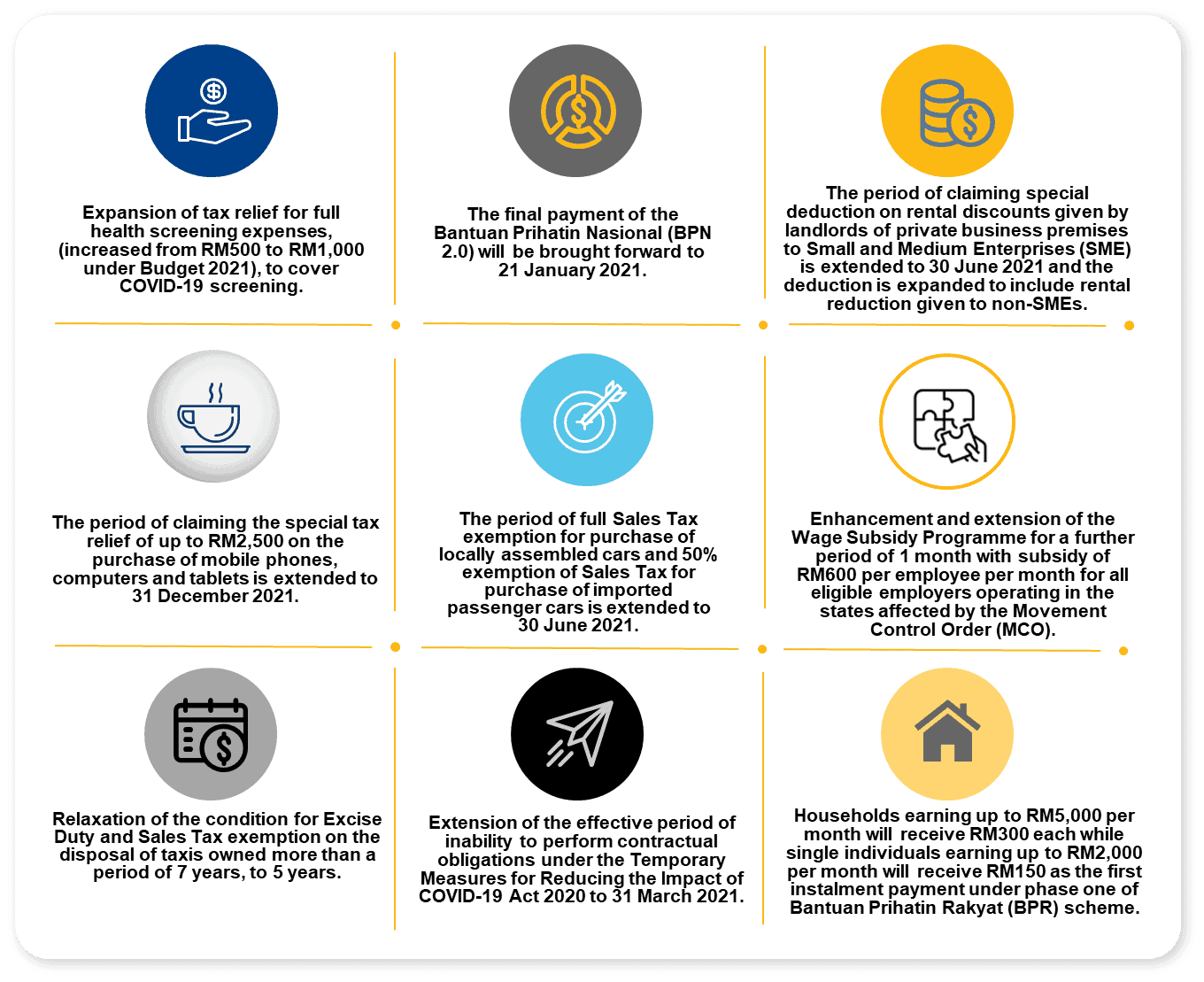
    The focus is on the extension and enhancement of existing schemes that were introduced in 2020, including various tax exemptions and relief, cash assistance. This includes bringing forward the final payment of the Bantuan Prihatin Nasional (BPN 2.0) to 21 January 2021, while households earning up to RM5,000 per month will receive RM300 each, with single individuals earning up to RM2,000 per month receiving RM150 as the first instalment payment under phase one of Bantuan Prihatin Rakyat (BPR) scheme.

    Other highlights include:

    • Expansion of tax relief for full health screening expenses, increased from RM500 to RM1,000 under Budget 2021, to cover COVID-19 screening.
    • The period of claiming special deduction on rental discounts given by landlords of private business premises to Small and Medium Enterprises (SME) is extended to 30 June 2021 and the deduction is expanded to include rental reduction given to non-SMEs.
    • The period of claiming the special tax relief of up to RM2,500 on the purchase of mobile phones, computers and tablets is extended to 31 December 2021.
    • The period of full Sales Tax exemption for purchase of locally assembled cars and 50% exemption of Sales Tax for purchase of imported passenger cars is extended to 30 June 2021.
    • Enhancement and extension of the Wage Subsidy Programme for a further period of 1 month with subsidy of RM600 per employee per month for all eligible employers operating in the states affected by the Movement Control Order (MCO).
    • Relaxation of the condition for Excise Duty and Sales Tax exemption on the disposal of taxi owned more than a period of 7 years to 5 years.
    • Extension of the effective period of inability to perform contractual obligations under the Temporary Measures for Reducing the Impact of COVID-19 Act 2020 to 31 March 2021.

    Image from crowe.com/my

    Employers and Businesses

    In a bid to curb an economic recession, the government has pledged to continue schemes that aim to distribute funds, speed up processes and delay loans. Discounts have also been promised for essential services, with an electricity rebate to all Tenaga Nasional Berhad (TNB) users at a rate of 2 sen per kilowatt-hour from 1 January 2021 to 30 June 2021. Six business sectors will also receive 10% off on their electricity bills from January to March 2021, comprising of hotel operators, theme parks, convention centres, shopping malls, local airline offices as well as travel and tour agencies.

    Other highlights include:

    • Moratorium on MARA loans will be given until 31 March 2021 and MARA will provide a 30% rental discount on business premises for 6 months from November 2020 to April 2021.
    • A guarantee of RM1 billion is given for the Bus and Taxi Hire Purchase Rehabilitation Scheme where a 50% guarantee on financing from hire purchase and leasing companies will be provided for selected buses such as sightseeing buses, and taxis.
    • The implementation of microcredit schemes to micro-enterprises and SMEs that had been announced previously will be expedited.
    • One-off financial assistance of RM500 will be given to tourist guides, drivers of taxis, school buses, tour buses, rental cars and e-hailing vehicles.
    • An allocation of RM300 million is provided to accelerate the implementation of the SME and Micro SME e-Commerce Campaign and Shop Malaysia Online campaign.
    • Enhancement of the Danajamin PRIHATIN Guarantee Scheme with the maximum financing limit increased to RM1 billion and the scope of financing expanded to include working capital with a guarantee period of up to 10 years. The scheme is also now open to foreign-owned companies operating in Malaysia as long as Malaysians make up at least 75% of their workforce.
    • The conditions for the Employment Insurance Scheme program will be relaxed for those who lost their jobs during the enforcement of the MCO.
    • An allocation of RM24 million is provided to fund the full contribution under SOCSO’s Self-Employment Social Security Scheme for delivery riders.
    • An additional allocation of RM650 million is given for the expansion of the Prihatin Special Grant Plus assistance to cover 500,000 SMEs in the 7 MCO states with a payment of RM1,000 each, while 300,000 SMEs in other states will receive RM500 each.

    People

    For citizens, the various allocations are aimed at sustaining the general population, especially those in the B40 and M40 categories, with a focus on essential goods and services that aim to tide them through this trying period of time. RM50 mil will be allocated to the Food Basket Program, which will provide essential food items worth RM100 for each eligible household, while the Employees Provident Fund (EPF) will advance RM1,000 from the amount applied under the i-Sinar Category 2 facility.

    Other highlights include:

    • The free internet connectivity of 1Gb per day initiative will be extended until the end of April 2021.
    • A matching grant with government-linked companies of RM25 million is allocated under the GLIC/GLC Disaster Relief Network for the provision of community assistance to the elderly, homeless, disabled and flood victims.
    • Electricity rebates to all TNB users, both domestic and non-domestic at a rate of two sen per kilowatt-hour, which is equivalent to a reduction in electricity bills of up to 9% for a period of 6 months, from Jan 1 to June 30, 2021
    • Moratorium facility including extension of the moratorium and restructuring of loan repayment will continue to be offered by banks.
    • PTPTN borrowers affected by the pandemic or floods can apply for a 3-month PTPTN loan repayment moratorium and application for this moratorium can be made until 31 March 2021.

    Healthcare Initiatives

    There are several initiatives being extended to frontliners who are tirelessly serving the nation, with funds allocated to healthcare services and personnel in a bid to ensure that the fight against Covid-19 will continue. A one-off payment of RM500 to healthcare frontliners and RM300 to other frontliners will be paid in the first quarter of this year, while the existing special monthly allowance of RM600 to healthcare frontliners and RM200 to other frontliners will continue until the COVID-19 pandemic is over.

    Other highlights include:

    • An additional 3,500 healthcare personnel will be recruited at the end of January 2021 with an allocation of RM150 million.
    • An allocation of RM1 billion will be provided to the Ministry of Health, National Security Council and other relevant agencies for supplies specifically for the healthcare frontliners.
    • An allocation of RM100 million is dedicated for private hospitals to treat Covid-19 and non-Covid-19 patients.
    • RM3 billion is allocated for the Covid-19 National Immunisation Programme.

    Accelerating the Bantuan Prihatin Rakyat (BPR) Assistance

    Bantuan Prihatin National (BPN) 2.0 was introduced by the Government in a special announcement under Kita Prihatin on 23 September 2020. Currently, the amount of assistance channelled under BPN 2.0 is as follows:

    • B40 households – RM1,000
    • B40 single individuals – RM500
    • M40 households – RM600
    • M40 single individuals – RM300
    • The BPN 2.0 payment will be made in two instalments. The first instalment payment was made on 26 October 2020 and the second instalment is expected to be paid in January 2021.

    A similar scheme known as the Bantuan Prihatin Rakyat (BPR) was introduced by the Government in the Budget 2021 to replace the previous Bantuan Sara Hidup. However, information on this payment scheme was not made available during the Budget 2021 announcement. It is proposed that the second instalment payment of the BPN 2.0 will start from 21 January 2021 onwards, but there was no mention on the payment date for BPR.

    Click here to read the full special report from Crowe Malaysia.

    By Crowe Malaysia

  • AmanahRaya Wins Morningstar Award For Second Consecutive Year

    AmanahRaya Wins Morningstar Award For Second Consecutive Year

    Another stellar year for AmanahRaya Investment Management Sdn Bhd (ARIM) saw them secure double honours at the Morningstar Awards, the second consecutive year in which it has done so. We spoke to En. Roszali Ramlee, Chief Executive Officer / Managing Director of ARIM to get his views.

    The Reason Behind ARIM’s Funds Successful Performance

    We continue to trust our process which has kept us in the game for many years now. If the process is not yielding the results we wanted, then we would look into our process to see where we can enhance. This allows us to continue to improve continuously and be a better version of ourselves over time.

    We recognise how market dynamics have been changing quite rapidly these days. Some of these factor dynamics are shorter than the others e.g. Covid threat is fading away as vaccination and immunity improve, while other factors such as the inflation threat, may stay longer and give greater impact to our investments.  What history thought us in the past is, risks can never go away, it can only be mitigated.

    Our message to investors is to keep invested, during good or bad times, adjusting the allocation to your comfort and risk-return profile. The geopolitical crisis that has erupted recently seems to be a tail-risk event to many, but in our view, this too shall pass.

    At ARIM, we shall carry our duty as a fund manager to the best of our ability to produce the best results while mitigating the risks. We shall continue to do what we do best, keep hunting for undervalued securities and hold them till prices actually reflect their intrinsic value.

    Upcoming Trends That Investors Should Look Out For

    Fixed-income investors should brace for lower returns than last year. Returns of 4% to 6% is very commendable based on the current market scenario. Interest rate shall remain low in 1H2022, with potential 1 to 2 hike in 2H2022.

    That said, we are hopeful that there will be more sukuk issuances in the pipeline this year to further diversify our portfolios.

    Are There New Investment Products By ARIM

    Yes, we are going to launch our New Income Fund in year 2022. The strategy of this income fund are to focus on short to medium term sukuk with low to medium risk appetite.

  • Morningstar Awards Highlight Quality of Investments

    Morningstar Awards Highlight Quality of Investments

    This year, Morningstar Asia Limited announced the winning funds and fund houses for its Morningstar Fund Awards Malaysia in a rather unconventional way. The awards ceremony, which is typically held annually in Kuala Lumpur, was instead hosted via a special webcast on March 19 in light of the Covid-19 outbreak globally. 

    Nevertheless, the change in the awards ceremony format did not prevent Morningstar Asia Limited, a subsidiary of Morningstar, Inc., a leading provider of independent investment research, from recognising retail funds and fund houses that have added the most value for investors within the context of their relevant peer group in 2019 and over longer time periods. 

    Morningstar selects the winners using a quantitative methodology, along with a qualitative overlay. Weightings to one-, three-, and five-year risk-adjusted performance are factored into the methodology.

    Public Mutual Bhd was the biggest winner, sweeping four out of the five awards on offer. Malaysia’s leading unit trust company took home the awards for Best Asia-Pacific Equity Fund, Best Malaysia Large-Cap Equity Fund, Best Malaysia Bond Fund and Best Malaysia Bond (Syariah) Fund. 

    Principal Asset Management Bhd’s Principal Islamic DALI Equity Fund (formerly known as CIMB Islamic DALI Equity Fund) won the Best Malaysia Large-Cap Equity (Syariah) Fund. 

    In his speech delivered via the webcast, Morningstar Asia chief executive officer Nick Cheung said Morningstar’s Annual Awards highlight the quality and breadth of investments available for investors in each region. “Our 2020 winners have been great drivers of investor success. It is our honour to recognise their outstanding achievements and commitments to investors.” 

    Cheung pointed out that every year, Morningstar presents awards to more than 30 countries globally to recognise exceptional fund managers and investment teams who deliver value to investors, and put investors’ interest at the first place.

    “This is in perfect alignment to Morningstar’s vision, which is to empower investors to make more informed investment decisions, and make better investment outcomes. Morningstar has a long history of helping investors.

    “Despite the current diff cult environment, we continue to invest to allow investors to have more and expanded research coverage on equity, fund, ETF, ESG and private investments,” Cheung said. 

    For example, he said Morningstar will soon roll out a new web-based analytic platform of Morningstar Direct which has new features and data sets to allow investors to make better informed investment decisions. 

    Delivering market-beating returns

    Wing Chan, Morningstar’s director of Manager Research Practice, EMEA & Asia, said the 2019 rally in both equities and bonds has rewarded investors handsomely. “However, it was also one of the more unpredictable periods in history, with low interest rates, heightened geopolitical uncertainty, and stretching asset valuations continuing to worry investors. 

    “The awards winners, across our equity and fixed income categories, have proved their ability to deliver market-beating returns over the long term without undue risk,” he added. 

    On what Morningstar looks for when picking the winning funds for the annual awards, Andrew Daniels, senior analyst, Equity Strategies, Manager Research for Morningstar Asia, said the goal is to recognise those funds that have added the most value within the context of a relative peer group for investors over the past year and the longer term. 

    On how Morningstar plays a key role in helping bring about better outcomes for investors, Daniels said Morningstar offers a global reach and has earned investors’ trust through its unbiased and independent research, investor-centric mission, and thought leadership.

    “Since its founding more than 35 years ago, Morningstar’s mission has been to empower investor success. We believe that by taking something nebulous, such as the financial services industry, and making it transparent, investors gain the knowledge to make better decisions. 

    “As a result, Morningstar builds unique products and services that connect people to the investing information and tools they need, because when investors are successful, so are we.”

    By Lee Min Keong

    Please click here to read the full article in the digital edition of Smart Investor (April 2020 issue).

  • Principal Asset Management Bhd Wins Morningstar Fund Awards Malaysia

    Principal Asset Management Bhd Wins Morningstar Fund Awards Malaysia

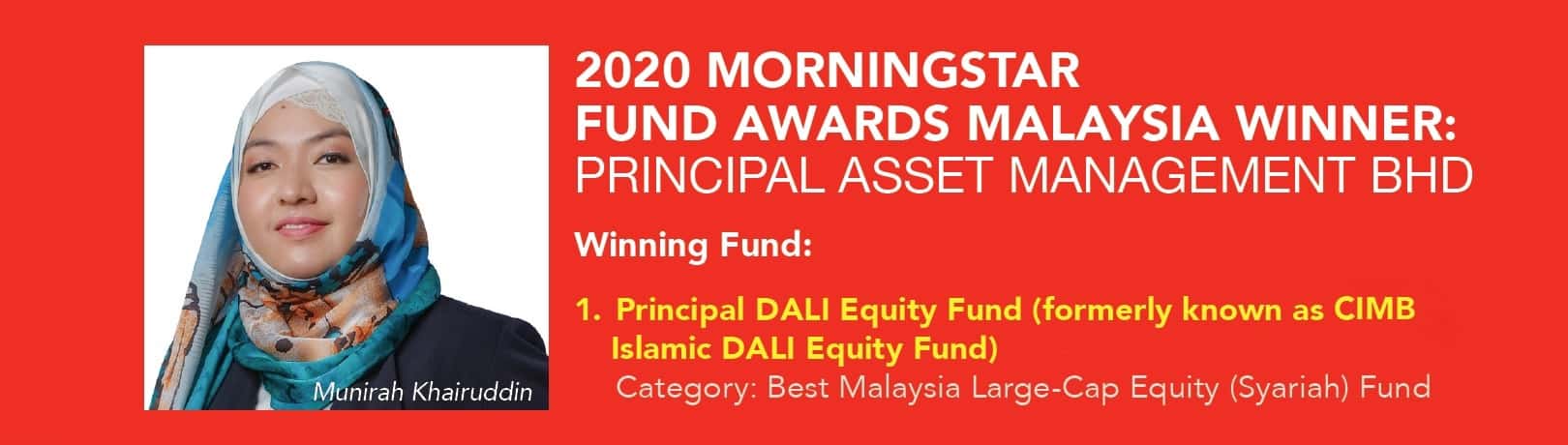
    Principal Asset Management Bhd took home the Best Malaysia Large-Cap Equity (Syariah) Fund award at the 2020 Morningstar Fund Awards Malaysia for its Principal DALI Equity Fund (formerly known as CIMB Islamic DALI Equity Fund).

    Smart Investor speaks with chief executive officer Munirah Khairuddin on the fund’s performance and how Syariah-compliant funds are gaining traction with investors.

    Despite the strong headwinds buffeting the equity markets, Munirah sees opportunity in adversity, adding that Malaysian equity evaluation is already cheap. While taking a defensive stance, she says Principal Asset Management will take the opportunity to accumulate selective stocks within the plantation, construction, and oil and gas, and healthcare sectors.

    Smart Investor: Congratulations on your win! What were the major changes made to the portfolio in 2019? What key factors drove your winning fund’s performance?

    Munirah Khairuddin: Thank you! I believe the right asset allocation strategy has helped the fund’s performance in 2019. As you may know, the fund consists of 70% Malaysia and 30% Asia Pacific markets, and we manage the fund based on our proprietary top-down FTV and bottom-up FMV Research Process.

    We adopted the Barbell Portfolio structure approach that emphasises on capital preservation and/or growth and have a rigorous portfolio optimisation process that focuses on the Beta, Active Share, and Sharpe Ratio. On top of that, we also run continuous data analytics to ensure that the portfolio is been managed within the optimum risk parameters.

    Are Shariah-compliant funds like Principal DALI Equity Fund gaining traction with investors?

    Yes, we are seeing Islamic Asia Pacific funds gaining traction with investors. This is part of the asset allocation/risk diversification strategies that we are advising investors to consider.

    Historically, Islamic investments are less volatile than their conventional counterparts, especially during periods of uncertainty. During the subprime crisis in 2008, Islamic investments were not as greatly impacted compared to the conventional investments. The Islamic financial markets do not rely on the subprime assets or excessive leverage which caused difficulties for many conventional institutions in the past.

    What are the major risks or challenges facing the financial markets in 2020? How do these risks affect your investment decisions?

    We are in a unique situation in Malaysia. Our markets have been impacted by the Coronavirus outbreak and the US-China trade war. However, for the right investor, we believe there is an opportunity to invest in Malaysian equities and fixed income products because of the value.

    In terms of equity, Malaysian equity valuation is already cheap. We are taking a defensive stance and focusing on stocks which are resilient to the expected slowdown in the domestic economy and/or not exposed to domestic political and regulatory uncertainty. We prefer sectors that benefit from interest rate cuts and are USD earners. This would include stocks in the consumer staples, healthcare, energy, plantation and the REITs sectors.

    On the fixed income side of things, the impact of the Coronavirus outbreak may result in growth in 1Q2020 softening to below 4%. As a conservative move, our fixed income funds are taking a neutral view on benchmark duration. If government bond yields start to rise, we may take advantage of it to extend duration at an opportunistic level.

    Given the current headwinds, which sectors do you see as resilient and can thrive, and how would you position your funds to take advantage of opportunities and/or mitigate risks?

    As I mentioned earlier, we prefer sectors that benefit from interest rate cuts and are USD earners. This would include stocks in the consumer staples, healthcare, energy, plantation and the REITS sectors.

    As always, we advise investors to consider their long-term financial goals and risk tolerance when it comes to investing. Our investment team has recommended the following based on our asset allocation mix (as of Feb 2020):

    Malaysia

    Malaysian equity valuation is undervalued, making it attractive. It’s a great time to take advantage of the opportunity to buy low. We will continue to buy Malaysia on weakness and keep our barbell approach on high yield stocks. We’ll take the opportunity to accumulate selective stocks within the plantation, construction and oil and gas sectors.

    When it comes to the Covid-19 outbreak, we will look at sectors impacted by this event. We’ll tactically underweight the aviation sector, while taking opportunities to trade the glove and healthcare sectors.

    Asia Pacific Region

    A market sell-off during an event like the Coronavirus outbreak usually offers great buying opportunities. Much like Malaysia – it’s a great opportunity to buy low.

    We are taking advantage by buying into structural names with good management and strong business models. We also like companies that are emerging as the key players in the fourth industrial revolution.

    Even though e-commerce may be a relatively more resilient sector with Chinese consumers choosing to spend more time at home and online shopping demand may increase, stocks of these companies are likely to also be sold off indiscriminately in a knee-jerk reaction. We will also be taking the opportunity by adding companies that are capable to lead in the growing consumption space in China.

    By Bernie Yeo

    Please click here to read the full article in the digital edition of Smart Investor (April 2020 issue).

  • 2020 Morningstar Fund Awards Malaysia: Public Mutual Bhd

    2020 Morningstar Fund Awards Malaysia: Public Mutual Bhd

    Public Mutual Bhd took home four awards at the Morningstar Malaysia Fund Awards 2020, namely Best Asia-Pacific Equity Fund, Best Malaysia Large-Cap Equity Fund, Best Malaysia Bond Fund and Best Malaysia Bond (Syariah) Fund.

    Smart Investor met up with Public Mutual chief executive officer Yeoh Kim Hong to discuss the out-performance of its winning mutual funds, risks in the market risk, and the technologies the fund house has adopted to make its business more appealing and
    efficient to investors.

    Smart Investor: Congratulations on your win! Public Mutual won four awards this year. What are the key factors behind the winning funds’ successful performance?

    Yeoh Kim Hong: Despite volatile market conditions in 2019, our winning funds continued to adopt a fundamental approach to investing by selecting stocks and bond/sukuk which have sustained earnings, strong financial positions and proven management track records.

    Public Far-East Alpha-30 Fund (PFA30F), which is a regional equity fund that invests in a concentrated portfolio of a maximum of 30 stocks, won in the Best Asia-Pacific Equity Fund category. In 2019, the fund generated a return of +19.9% to outperform the regional equity markets, as proxied by the MSCI All Country Far East ex-Japan Index, which rose by 15.2% (in ringgit terms).

    The fund’s performance was driven mainly by the out-performance of regional technology stocks which are leveraged to the increasing adoption of digital products and services globally, as well as the secular growth trends in online financial and e-commerce services.

    The second equity award achieved is for the Best Malaysia Large-Cap Equity Fund category. Public Strategic Growth Fund (PSTGF), which focuses its investments on growth stocks in the Malaysian market, achieved a return of +4.3% in 2019. In comparison, the FBM KLCI, which tracks the performance of the domestic equity market, declined by 6%.

    Despite challenging market conditions, the fund was able to achieve a commendable performance, as it focused on fundamentally-strong companies within the consumer, healthcare and technology sectors. These stocks benefitted from sustained consumer spending as well as the trade diversion arising from the US-China trade tensions.

    Public Enterprises Bond Fund (PENTBF), which invests mainly in ringgit-denominated bonds, won the Best Malaysia Bond Fund category. In 2019, the fund achieved a return of +8.2% due to its focus on long-duration bonds with sound credit fundamentals, primarily in the infrastructure and banking sectors. Bonds in these two sectors saw strong buying interest on the back of easing monetary policies globally, which contributed to the fund’s strong performance.

    The second bond award achieved is for the Best Malaysia Bond (Syariah) Fund category. PB Aiman Sukuk Fund (PBASF), which mainly invests in ringgit-denominated sukuk, registered a return of +9% in 2019.

    The fund’s strong performance was due to its focus on long-duration sukuk with sound credit fundamentals, especially in the infrastructure and banking sectors. The fund also benefitted from its sukuk holdings issued by the Malaysian government, which performed strongly in 2019 as sukuk yields compressed.

    Moving forward, how can your bond funds outperform in a volatile yet increasingly low-yield environment?

    The low global interest rate environment as well as the accommodative domestic monetary policy is anticipated to underpin the domestic bond/sukuk market in 2020. Our bond/sukuk funds will continue to seek investment opportunities in bonds/sukuk with strong credit fundamentals while adopting an active portfolio rebalancing approach and maintaining reasonable portfolio yields to ride through periods of volatility in the domestic bond/sukuk market.

    How will market risks like the US-China trade war, geopolitical tensions, and Covid-19 outbreak impact your investment decisions moving forward? What are some of the under-reported risks that could surface this year?

    In light of the uncertainties pertaining to the US-China trade relations, our investments in sectors deemed to be susceptible to increased trade tariffs or restrictions have been reduced. In addition, our funds have largely avoided tourism-related sectors which are directly impacted by the slowdown in travel activities amid the Covid-19 outbreak.

    Other uncertainties include the upcoming US presidential election in November 2020, the Brexit negotiations as well as the sharp fall in oil prices following the Organisation of the Petroleum Exporting Countries’ (OPEC) move to hike oil production despite weak global demand.

    However, accommodative monetary policies by major central banks and various fiscal stimulus measures by global and regional governments should help lend support to global economic activities. The volatility in financial markets will provide opportunities for our equity funds to add to their positions in fundamentally-backed stocks with positive long-term growth prospects.

    Meanwhile, there could be volatility within the domestic bond/sukuk market in the run-up to September 2020 when FTSE Russell is anticipated to announce its decision on the retention of Malaysian bonds in the FTSE World Government Bond Index (WGBI).

    To navigate such market uncertainty, our bond/sukuk funds will continue to focus on high-quality bond/sukuk issuances and rebalance the funds’ portfolio duration accordingly. Our focus on fundamental research and long-term investment strategies should help both our equity and bond/sukuk funds to ride through market cycles as well as through periods of elevated market volatility.

    What measures or strategies has Public Mutual put in place to deal with these market risks?

    In addition to the aforementioned measures, we will continue to be vigilant to developments within the economic and financial markets so as to proactively manage the exposure of our investments to these risks.

    In this respect, we believe our adherence to fundamental research and long-term investment strategies will serve us well in delivering consistent returns to our unitholders over the long term.

    With Malaysia gravitating towards a digital economy, what are some advanced technology that Public Mutual has adopted to make its business more appealing and efficient?

    Among our technological offerings for investors is a dedicated online investment platform, Public Mutual Online (PMO), which provides them with easy access to our products and services on a 24/7 basis. Its key features include a Fund Analytics feature that allows investors to easily review the different features and performance of our available funds.

    Meanwhile, our PMO landing page allows investors convenient access to stock market performance data and fund reviews, as well as a quick overview of their portfolio holdings.

    We also recently revamped our website with improved functionality as well as enhanced user navigation. Investors can now use the website to explore funds, view fund performance and discover the right funds for their investment needs. It also allows investors to conveniently access articles on the financial markets and financial planning.

    New investors can use the Digital Onboarding facility to sign up without need for physical documents, while existing investors can leverage on other facilities to top up their investments and register for the Direct Debit Authorisation (DDA) facility within a few clicks.

    We have also designed several digital tools as part of our efforts to facilitate our unit trust consultants (UTCs) in servicing investors. For instance, the CAMS software allows UTCs to present to investors their investment account details including returns.

    Meanwhile, the U@Bis$ app allows UTCs to guide investors in answering a risk-profiling questionnaire, before subsequently building a unit trust portfolio based on the recommended allocation.

    By Bernie Yeo

    Please click here to read the full article in the digital edition of Smart Investor (April 2020 issue).