Blog

  • PB Asia Equity Fund (PBAEF) and Public Islamic Alpha-40 Growth Fund (PIA40GF) Wins It Again For Public Mutual

    PB Asia Equity Fund (PBAEF) and Public Islamic Alpha-40 Growth Fund (PIA40GF) Wins It Again For Public Mutual

    Congratulations to Public Mutual for another double win for the second successive year. It is no easy feat to achieve, considering the tough market in 2021.

    On hand to share more insights on their success, we spoke to Chiang Kang Pey, Deputy Chief Executive Officer of Public Mutual.

    Key Factors Behind These Two Wins?

    Our key strategy behind both wins is our adherence to a fundamental investment approach of focusing on companies with sustained earnings, strong financial positions and proven track records. Despite the elevated levels of market volatility in 2021, the portfolios of our winning funds – PB Asia Equity Fund (PBAEF) and Public Islamic Alpha-40 Growth Fund (PIA40GF) – were rebalanced accordingly in line with the changing trends in the respective markets, sectors and industries that the funds were invested in.

    Steps Taken For Best Chance Of Continued Growth?

    In 2021, PBAEF, which focuses its investments in the Asian markets, locked in profits from selected growth stocks and positioned in semiconductor-related stocks within the Asian region which benefitted from the shortage of chips amid supply chain disruptions and China’s localisation trend. In addition, the fund’s performance was lifted by its holdings of North Asian technology and electric vehicle-related stocks which ride on the structural trends of digitalisation and the increased focus on cleaner energy solutions.

    Meanwhile, PIA40GF, which focuses its investments in the domestic market, continued to capitalise on technology and basic materials stocks which stood to benefit from the long-term digitalisation trend as well as the strength in commodity prices. The fund also locked in gains from selected technology stocks at the end of 2021 amid concerns over the potential rise in global interest rates.

    To ensure the long-term growth of our funds, we constantly assess and monitor the long-term prospects of our investee companies’ business models and strategies – including their pricing power, market dominance, growth potential as well as the competitive landscape. These strategies have proven to work well for the performance of our funds.

    Strategies That Have Shifted In Line With Market Forces?

    Despite the decline in the severity of symptoms for the newer Covid-19 Omicron variant, the evolving nature of this virus could mean that potentially new and unpredictable variants may emerge. Nevertheless, barring unforeseen circumstances, the global economy is anticipated to continue on its path towards recovery amid the easing of movement restrictions and the re-opening of international borders as governments increasingly transition towards policies to ‘live with Covid’.

    Tightening monetary policies by global central banks, global supply chain disruptions as well as sanctions triggered by the current geopolitical conflict between Russia and Ukraine have also led to elevated levels of volatility in global financial markets this year.

    That said, the domestic and Asian markets – which PIA40GF and PBAEF focus their investments on – are less exposed to the geopolitical risks in Europe. As such, both funds will continue to invest in selected recovery plays within the local and regional markets such as the financial, energy and commodities sectors, as well as selected consumer discretionary and leisure stocks.

    The funds will also continue to position for the long-term growth potential of the technology sector which will benefit from the increasing adoption of digital products and services as well as the rise of automation, online shopping and hybrid/ remote working arrangements.

    Upcoming Trends For Investors?

    Global markets may continue to experience volatility and uncertainties in the short term amid the normalisation of monetary policies by major central banks in response to elevated inflation levels, as well as the current Russia-Ukraine conflict which has exacerbated global supply chain disruptions and inflationary pressures. Meanwhile, the performance of the China stock market will depend on whether the Chinese government will continue to implement policies on sectors such as technology and real estate which may impact their profitability or earnings visibility.

    In addition to the recovery plays which will benefit from the re-opening of international borders and the lifting of social-distancing restrictions, investors are expected to focus on sectors that are more defensive such as utilities and consumer staples amidst the uncertainty surrounding the global economic outlook. Sectors that will benefit from the impact of high inflation such as the commodity, basic materials and energy sectors which have staged a strong performance compared to the broader markets thus far this year may also continue to outperform if inflationary pressures remain elevated.

    Over the longer term, sectors that possess structural growth prospects such as those driven by the trends of digitalisation and the push towards greener energy solutions are also expected to do well. The rising adoption of cloud computing, artificial intelligence, cybersecurity, e-commerce, electric vehicles and lower-carbon solutions is expected to drive sustainable earnings growth for companies in these segments in the years ahead. The valuations of such growth-oriented stocks have also fallen on profit-taking activities amid higher bond yields; thus providing buying opportunities for investors who have a longer-term investment horizon.

    Plans And Strategies For 2022?

    We will remain committed to our fundamental-based approach and long-term investment strategies which have served us well in delivering consistent returns to our unitholders over the long term. Given the volatile markets amid uncertainties surrounding the Russia-Ukraine conflict and its impact on global growth and inflation, we have adopted a portfolio comprising growth and value stocks.

    We will continue to monitor developments in the global markets so as to re-deploy our funds’
    cash holdings when opportunities arise.

     

  • Morningstar Announces Winners for 2022 Morningstar Fund Awards Malaysia

    Morningstar Announces Winners for 2022 Morningstar Fund Awards Malaysia

    KUALA LUMPUR, 7 April 2022 — Morningstar Asia Limited, a subsidiary of Morningstar, Inc. (NASDAQ: MORN), a leading provider of independent investment research, has announced the winning funds for its 2022 Morningstar Fund Awards Malaysia.

    The annual Morningstar Malaysia Fund Awards recognise retail funds that have added the most value for investors within the context of their relevant peer group in 2021 and over longer time periods. Morningstar selects the winners using a quantitative methodology, along with a qualitative overlay. Weightings to one-, three-, and five-year risk-adjusted performance are factored into the methodology.

    Wing Chan, Morningstar’s Head of Manager Research, Europe and Asia Pacific, remarked: “Our 2022 winners have proven themselves to be excellent stewards of investors’ capital. They have demonstrated their abilities to navigate through market volatility and deliver excellent returns over the longer term. We applaud all winners for their outstanding achievements.”

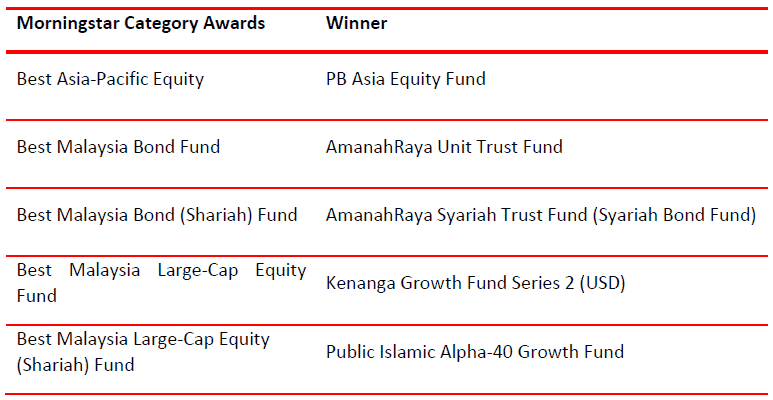
    The 2022 Morningstar Awards winners in Malaysia are:

    Methodology

    The Morningstar fund category awards are based on Morningstar fund data as of 31 December 2021. The awards methodology emphasises the one-year period, but funds must also have delivered strong three- and five-year returns after adjusting for risk within the awards peer groups in order to obtain an award. In selecting winners, fund returns are adjusted for risk using the Morningstar Risk, a measure which imposes a higher penalty for downside variation in a fund’s return than it does for
    upside volatility. For the full methodology, please click here. The full methodology for the awards is available here.

    Morningstar Asia Limited is a subsidiary of Morningstar, Inc., a leading provider of independent investment research in North America, Europe, Australia, and Asia. The Company offers an extensive line of products and services for individual investors, financial advisors, asset managers and owners, retirement plan providers and sponsors, and institutional investors in the debt and private capital markets. Morningstar provides data and research insights on a wide range of investment offerings, including managed investment products, publicly listed companies, private capital markets, debt securities, and real-time global market data. Morningstar also offers investment management services through its investment advisory subsidiaries, with approximately US$265 billion in assets under advisement and management as of Dec, 31. 2021. The Company has operations in 29 markets.

    For more information, visit www.morningstar.com/company. Follow Morningstar on Twitter @MorningstarInc.

    ©2022 Morningstar, Inc. All Rights Reserved.

  • Digital Art (NFT), Is It A Prudent Investment Or A Bubble Waiting To Burst?

    Digital Art (NFT), Is It A Prudent Investment Or A Bubble Waiting To Burst?

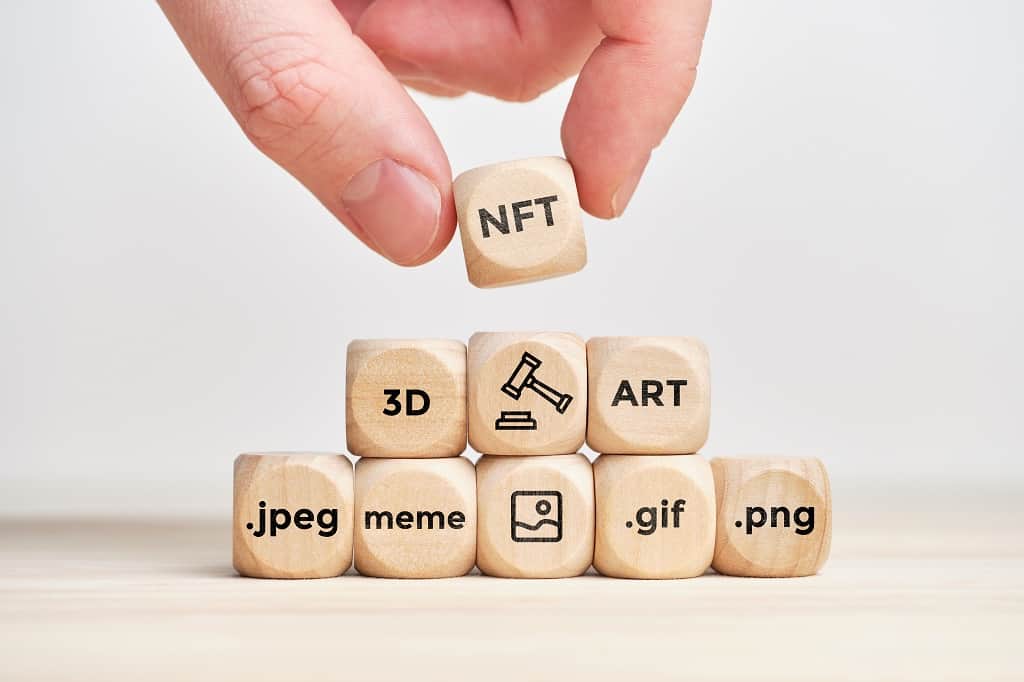
    If you have paid any attention to investing news over the past year, you would almost certainly have come across the term NFT (non-fungible token). Often linked to digital art, it is responsible for some of last year’s biggest investment headlines, with jaw-dropping amounts being spent on them.

    But what exactly is an NFT?

    In A Nutshell

    As the phrase “non-fungible” suggests, it is a one-of-a-kind, irreplaceable token that acknowledges a person’s ownership over a digital asset. Think of it as a digital certificate that recognises ownership, similar to a certificate of authenticity for valuable artwork or timepieces. Although NFTs are commonly linked to art, it can be used to prove ownership of any digital assets such as memes, songs or even tweets!

    The assets being sold can be freely viewed, or even saved to their own devices, by anyone, which is often what detractors point at when denouncing NFTs. However, just like how there are knockoff versions of famous art pieces, there is only ever one original, which is where it gets its perceived value.

    Like cryptocurrencies, owners of assets are documented on a publicly shared ledger, also known as the blockchain, that cannot be tampered with or altered by any single individual or party. Any changes to this ledger must be acknowledged and ratified by all members of the blockchain before being made permanent, making it close to impossible to tamper with.

    The most popular platform to buy or list NFTs is OpenSea but there is a raft of competing marketplaces that are all aiming to carve their own slice of a very lucrative pie. Local NFT marketplaces have also sprung up, with Pentas.io being the most prominent.

    Do They Have Any Use?

    Metaverse and Blockchain Technology Concepts. Person with an Experiences of Metaverse Virtual World via Smart Phone. Futuristic Tone. Conceptual Photo

    Although copies can be made of these digital artworks (memes, tweets, music etc.), the NFT is the sole acknowledgement of who is the “owner” of the piece. Art has long been used as a store of value, and this easily extends to digital art, with the value stored in the certificate of ownership.

    But whether this has any tangible value depends solely on the market. Many are of the belief that NFTs are in a bubble, including artists themselves.

    Digital artist Beeple, also known as Mike Winkelmann, holds the current record for the most expensive NFT, with his piece EVERYDAYS: THE FIRST 5000 DAYS, auctioned off by Christie’sforUS$69,346,250, but he thinks that NFTs are a bubble waiting to burst.

    Speaking to the New York Times Sway podcast last year, he said “This stuff will absolutely go to zero.”

    He believes the key aspect of NFTs is proving ownership which is why popular pieces trade for millions.

    “The more something is widely shared, the more popular it becomes, the more valuable it will become.”

    “When you go to The Louvre and take a picture of the Mona Lisa and share it on the internet no one is like ‘Wow, I just devalued the Mona Lisa.’”

    However, he does believe NFTs serve a purpose and that an eventual bubble burst will simply remove the deadweight, much like how the dotcom bubble did not cripple the internet’s functionality and its now ubiquitous influence on the world.

    Money-Spinning Endeavours

    Jack Dorsey, the former CEO of Twitter, sold his first ever tweet on the platform as an NFT for just over 1,630 ETH or US$2.9 million to Malaysian businessman Sina Estavi, the CEO of Bridge Oracle. Famous memes have also been put up for sale for life-changing amounts, with originators eager to strike while the iron is hot.

    The trend is already being jumped on by local artists as well. Graffiti artist Abdul Hafiz Abdul Rahman, better known as Katun, sold two NFT collections in August 2021, titled Apes Stand Strong, with a limit of 50 pieces (1 ETH each) and Mystical Fruits, an open edition that sold 776 pieces at 0.1 ETH each. This raised a total of 127.6 ETH (over RM1.6 million at the time, now worth over RM2.1 million at the time of writing).

    Another well-known local artist, Red Hong Yi, sold her Doge to the Moon NFT for 36.3 ETH (approx. RM325,000 at the time, now worth RM620,000 at the time of writing) in July 2021, while local rapper Namewee made 209 ETH (approx. RM3.5 million) from selling 100 NFTs of his song Go NFT in November.

    Many buyers of NFTs also immediately list it at a higher price in a bid to make a quick profit. Whether these prove to be prudent investments or not, it is clear that there is a demand for NFTs, either for speculative purposes or as stores of wealth.

    What is less certain though is whether NFTs are a bubble or if it will ever become a popular method of investment. Whatever happens, digital natives are making moves and it is up to the rest of the world to get up to speed or possibly be left behind.

    NFTs In Numbers To Date

    • Number of NFTs sold: 19,390,873
    • Total sales of NFTs: US$13.95 billion
    • Average value per sale: US$719.77
    • Primary sales: 11,244,153
    • Secondary sales: 8,146,720
    • Active market wallets: 1,510,331
    • Most popular project (volume): CryptoPunks – US$1.8 billion
    • Most expensive NFT sold (ETH): CryptoPunks (Ͼ #3100) – 4,200 ETH
    • Most expensive NFT sold (US$): EVERYDAYS: THE FIRST 5000 DAYSBeeple (aka Mike Winkelmann)US$69,346,250

    Statistics are accurate as of December 2021.

  • Higher Minimum Wages Causes Unemployment And Steep Inflation? Not Necessarily

    Higher Minimum Wages Causes Unemployment And Steep Inflation? Not Necessarily

    The Malaysian experience seems to suggest that raising the minimum wage has been good for us.

    The need to implement minimum wages is based on the protection it offers to workers at the lowest income strata. These often tend to be workers from groups often marginalised in society such as youth workers and women. They may not have the bargaining power to demand higher wages without direct government intervention.

    For several decades there was a near-consensus among economists that raising minimum wages just like any other floor would substantially reduce employment. Some persist on the potential employment costs argument. However, that view has changed where a majority now view a significant rise to be a good idea.

    To understand the shift, it is important to appreciate the natural experiments conducted by Nobel Laurette David Card, who found that increasing minimum wages did not lead to increased unemployment[1]. In fact, it was found to lift many out of poverty and benefit those in the bottom half, including those making more than the minimum wage[2].

    There are those who view the implementation of a higher minimum wage as harming low-wage workers as it is an artificial value imposed by the government rather than determined via market forces. This is because those with lower skills or experience tend to have lower productivity levels. Hence, a higher cost structure would put-off hiring of these workers rather than employing them at lower wages until they become more experienced.

    However, my opinion is that the wage policy in Malaysia should be based on the domestic context. In 2013, the minimum wage was first set to be at RM 900 per month for West Malaysia and RM 800 for East Malaysia. The rate has since gone up in stages over the years. About a decade later, it is set to reach RM 1,500 per month effective 1st May 2022.

    This seems to be a fair rate given that the International Labour Organisation reported that the average minimum wage around the world for developing and emerging nations to be about 67% of the median wage[3].  At the end of 2019 before the pandemic, according to the Department of Statistics Malaysia (DOSM), the median income in Malaysia was at RM 2,442 where the minimum wage was set at RM 1,200 (about 49%). However, according to data from DOSM, the pandemic has lowered the median income to RM 2,206, a minimum wage of RM 1,500 represents about 68% which is in-line with the global average. Given that the economy is expected to see a strong rebound of more than 5.5% in 2022, the median wage can be expected to surpass 2019 levels by 2024. This would eventually represent a minimum wage representing 60% of the median wage.

    Research on the implementation of previous minimum wage levels in Malaysia shows that it tends to increase labour productivity, act as a motivator, and reduce employee turnover[4]. In fact, longer terms studies have shown that it reduces unemployment and increases labour participation rates[5]. Research also documents that the previous increase in 2016 also did not result in any significant reduction in labour demand[6].

    There have been views that increase of minimum wages may lead to inflationary pressures. For example, if a restaurant owner is suddenly forced to pay his workers RM 1,500 instead of RM 1,200, he needs to raise the price of his product to account for this increase in costs.

    malaysia people holding flag celebrating independence day together

    But in the Malaysian context, it is likely that most employees in urban areas are already being paid close to the proposed rate of RM 1,500. Thus, there might be very little additional price pressure in these areas.  It is likely that the new rate would account for the difference in wages and costs in urban versus rural areas, in-line with the current approach.

    In addition, inflation tends to be insignificant as a determinant of employment in Malaysia[7]. In fact, research in Malaysia shows that labour markets in Malaysia tend to follow the efficiency-wage theory where the increase of costs (of higher wages) would be recouped through greater productivity as well as increased employee retention[8]. Thus, inflationary pressures are unlikely to be severe, given that increased productivity would then counter the potential increase in price levels. Thus, it seems that the new higher rate may point towards a positive picture overall.

    However, given the potential that it may harm SMEs which are unable to offer higher wages, there is a need to explore a mechanism beyond minimum wages going forward. Imposing minimum wage laws puts the role of reducing poverty on the business owner. But a different approach via social welfare programmes for low-wage workers would allow all taxpayers to share the financial burden.  Among areas that would be beneficial to B40 households would include part cover for housing costs, healthcare as well as childcare costs.

    About the Author

     Professor Dr Hafezali bin Iqbal Hussain is the Head of Research at the Faculty of Business and Law, Taylor’s University and a member of the Centre for Industrial Revolution and Innovation (CIR4I). Taylor’s Business School is the leading private business school in Malaysia for Business and Management Studies based on the QS World University Rankings by Subject 2021 edition.


    [1] Microsoft Word – aea3.docx (nber.org)

    [2] Minimum Wages and the Distribution of Family Incomes – American Economic Association (aeaweb.org)

    [3] Global Wage Report, 2020-21.

    [4] Minimum Wage Policy: Is There Any Impact on Low Skilled Workers in Electrical and Electronics Companies in Malaysia? | International Journal of Business and Society (unimas.my)

    [5] http://myscholar.umk.edu.my/bitstream/123456789/2586/2/ICBT2020_039_MW.pdf

    [6] Minimum Wages: Helping or Hurting Producers? | SpringerLink

    [7] ICBT2020_039_MW.pdf (umk.edu.my)

    [8] The effect of real wages and inflation on labour productivity in Malaysia: International Review of Applied Economics: Vol 28, No 3 (tandfonline.com)

  • What Protection Does A High-Net-Worth Individual Needs?

    What Protection Does A High-Net-Worth Individual Needs?

    Insurance plans for high-net worth individuals are often beyond what is available to the everyday man.

    For many Malaysians, the importance of insurance is drilled into their minds early on in their lives or careers, and it is likely that most have a friend or relative that is an insurance agent. However, in terms of pure numbers, insurance penetration in the country is still low.

    A survey commissioned by Zurich Malaysia last year showed that 38% of Malaysians remain uninsured; another survey conducted by the Health Ministry in 2020 found that only 22% of Malaysians had personal health insurance.

    According to Dennis Chin, director at Harveston Wealth Management, life insurance needs usually start with self-protection such as medical cost and critical illnesses, which is then followed by financial security for family such as family income protection and credit protection.

    And while it may be the norm to be uninsured, for high-net-worth individuals (HNWI), this is likely to border on sacrilege!

    “For HNWI, the abovementioned is essential as well even though they have more financial resources to take care of the medical bills and family income need,” says Chin.

    He adds that the typical insurance planning for such individuals goes beyond personal risk as there are often other assets and collateral that may be used as guarantors in business borrowings, for example if a key person in the business suddenly leaves.

    “These borrowings will risk their personal assets being used for paying off in the event of sudden departure of the key person in the business or guarantor for the loan.”

    Protection For HNWI

    The main difference when it comes to insurance coverage for HNWI usually comes down to two things – the required sum assured and the type of risk.

    If the person requires RM10 million in life coverage, insurance plans can come in the form of offshore universal life policies denominated in US dollars while also being more cost efficient. Such offshore policies are not accessible to lower/middle income individuals as the minimum sum assured is usually beyond reach, often starting at US$500,000 and above.

    dennis chin harveston hnwi“This type of plan may offer different health and financial underwriting requirements which are offered differently by insurance companies locally,” says Chin.

    He shares that “asset protection is also essential” for HNWI as they tend to own wide varieties and classes of assets. Typically, such assets would include real estate, jewellery, or art collections to name just three. Often, these may also make up the bulk of their net worth.

    For example, a standard house insurance will not hack it when it comes to covering a bungalow that is constructed with exotic woods and expensive, custom-made furniture and fittings. Special coverage will be required for such a home in the event of fire or burglary explains Chin.

    “Therefore, the scope of insurance needs for HNWI is much wider than lower- and middle-income individuals,” he adds.

    Healthcare is another area in which HNWI are usually well-covered in. For those that travel regularly around the world, international medical coverage is key in order to counter the risk of being forced to seek medical services in a foreign country.

    “This type of medical plan comes with high medical limit in US dollars and the premium is also payable in US dollars as well,” he shares.

    “It also provides peace of mind while travelling globally as usually it comes with services on international consultation for medical services and evacuation back to their home country.”

    For The Next Generation

    HNWI with highly sought-after professional skills may also choose to take “future economic value” into consideration when setting up their life coverage. For example, in the event that a person is no longer able to work through total or permanent disability, or death, this will ensure that his or her projected earnings over a set number of years will be paid out to the family.

    There are notable examples of celebrities doing this, such as footballer Cristiano Ronaldo getting insured for £90 million in 2009, while singer Taylor Swift reportedly insured her legs for US$40 million in 2015.

    Chin explains that utilising insurance as a tool for wealth management is not a foreign concept to HNWI, with family trusts and family offices usually set up for wealth preservation for the benefit of the next generation and even beyond.

    Insurance For Wealth Creation

    Once the basic protection needs covering medical costs or critical illnesses are in place to ensure future financial security for HNWI, “a large sum assured is usually a tool in wealth management for wealth creation” Chin says.

    Alvin Yap, managing director at A.D. Financial, adds, “For family offices, insurance is also treated as a tool for estate planning, risk diversification and even wealth creation.”

    He gives an example on how a patriarch owning several offshore real properties may purchase life insurance with proceeds to cover any tax liabilities (e.g. inheritance tax, etc.) upon his demise, ensuring that the offshore real properties will be transferred to his family office smoothly after his passing.

    Using another example, he says, “Let us assume a matriarch purchases life insurance and makes it a point that the family office will manage and invest the insurance proceeds which will be treated as an education fund for many generations to come. She bequeaths her personal wealth to her children and her family office manages the insurance proceeds (education fund) upon her demise.”

    The mechanics of a family trust makes it useful for liquidity purposes as “insurance proceeds will be paid directly to the family trust”, providing an immediate source of cash flow to beneficiaries of the trust as opposed to individual nominees.

    “This is because in the event the nominee does not survive as well, the insurance paid out will fall into estate which can only be used after obtaining grant of probate,” highlights Chin.

    This can also help to prevent any squabbles among beneficiaries when the head of the family passes on. It is not uncommon to hear of huge lawsuits which entail siblings and other family members fighting in court to claim their piece of the pie. Hence, in most families, there will be a need for such a structure to be in place.

    To illustrate this point, Chin uses a scenario where there are multiple properties to be passed down to several beneficiaries.

    “What if these properties are not identical and each of them carries a different value? This might create some issues about fairness whereby the value of inheritance of each beneficiary is not the same,” he says.

    “In this case, a method of wealth equalisation can be adopted by buying life insurance that eventually creates the cash to compensate those beneficiaries that inherited lower value properties.”

    Charitable Endeavours

    Apart from taking care of their families, many HNWIs also engage in the practice of philanthropy through monetary gifts or donations to those in need, utilising the mechanics of life insurance to achieve this purpose.

    “Apart from donating existing resources and funds, such as allocating a pre-determined amount of profit from businesses, one can plan by using life insurance proceeds to make charitable donations,” explains Chin.

    “There are many family offices which have a foundation in place for philanthropy purposes, consisting of existing assets and cash, as well as life insurance.”

    “By paying premiums from existing resources every year, this eventually increases the assets in the 

    foundation by claiming the sum assured for charity purposes which can help more people,” he adds.

    What Are Family Offices?

    HNWI often have a family office to manage their financial affairs, but not much is known to the general public. We speak to Alvin Yap, managing director at A.D. Financial, to learn more.

    alvin yap a.d. financial hnwi

    Smart Investor: Can you describe how the various structures of family offices work?
    Alvin Yap: Family office is originally from the concept of preserving generational family wealth for European royalty and it is increasingly popular among high and ultra-high net worth Asian families. However, there is still much puzzlement as to what defines them and their primary functions.

    Briefly, a family office is about effectively preserving, growing and transferring wealth across generations. It can be treated as a legal entity that houses professionals in various areas such as administration, legal, investment, corporate finance, real estates and so forth to achieve the abovementioned primary functions. Some family offices are more investment oriented; others could be driven by philanthropic causes. In terms of establishments, there is single-family office servicing one individual family and also, multi-family office that service several families benefiting from economies of scale.

    SI: Can you explain the role that insurance plays in family offices as a form of generational wealth management or preservation?
    AY: Primarily, insurance is used to mitigate financial damages caused by loss of life or properties. For family offices, insurance is also treated as a tool for estate planning, risk diversification and even wealth creation.

    SI: How do you determine the type and amount of insurance coverage that different family offices require?
    AY: It can be complex but it all boils down to family business needs and family lifestyle.

    In Malaysia, term life insurance can be purchased as keyman insurance, meaning insuring the key person such as the owner or someone who is critical to the business; some family offices will source for offshore term life insurance that comes with a lower premium. There is also a variety of universal life insurance that offer very low initial cash outlay for insurance premium or options to fund the premium with movable/ immovable assets and many other flexible premium financing features. Family offices take advantage of these features and purchase universal life with very high insurance coverage.

  • Insurance Affordability vs Need, 6 Factors You Should Consider

    Insurance Affordability vs Need, 6 Factors You Should Consider

    How can you determine your insurance requirements for better financial risk management?

    We often encounter young members of the workforce looking to embark on their financial planning journey with a simple life insurance coverage. This move should be lauded as it makes a lot of sense to play defense before offense, so to speak. To kick start the conversation, the question of affordability will inadvertently crop up – how much can you afford to pay? While this is a practical approach for young career starters, is there a more optimal way to determine your insurance needs for better financial risk management?

    Before sharing some thoughts on risk mitigation needs that should be addressed by leveraging on insurance tools, perhaps it is best that I briefly touch on the types of life insurance coverage that individuals can consider.

    The most basic is to address concerns in the event of death. The idea is that should financial dependents and family members face a premature or untimely departure of a main breadwinner, there will be a financial payout to help the next of kin recover from this setback by ensuring that living expenses and financial commitments can continue to be met with minimal disruptions for an extended period thereafter.

    Related to this is the need to provide financial relief if the breadwinner is still alive but no longer able to generate income due to a total and permanent disability (TPD).

    In this scenario, funding is required to replace the revenue of the income earner while also considering any additional living expenses that can arise due to the disability.

    The third area is for critical illness (CI) needs where a lump sum is paid to the insured if there is a diagnosis of a covered serious illness. This payment can be used to fund non-hospitalisation related medical expenses as well as rising living expenses to aid a faster recovery.

    It is no secret that medical inflation is rising rapidly. The escalating medical costs and the fact that life expectancy is prolonging means that it is more important now than ever to have our own hospitalisation & surgical (H&S) coverage (also known as medical card). Lastly, we are also exposed to the risk of all forms of accidents that might partially incapacitate us for a short period or permanently. Personal accident (PA) coverage provides payment for accidental related risks.

    Having an appreciation of these five types of coverage will enable us to address our personal risk management need through insurance planning more comprehensively. However, as alluded to earlier, trying to address these areas based on affordability alone might give one a false sense of having effective risk mitigation in place.

    So how then should one go about calculating the more accurate amount of insurance coverage for the respective funding needs?

    1. Family Income

    Family income refers to the amount of money required to provide sufficient levels of funds to surviving financial dependents, so long as they remain financially reliant on the breadwinner. This will need to cover expenses such as living expenses for the whole family including dependent parents (ideally until the youngest child reaches the age of 25 and for nonworking spouse for their remaining life expectancy), education fees and related costs for minor children up till tertiary education and insurance premiums for family members.

    It can include funeral expenses and estate administration costs of the deceased also. The sum of these costs will give you a more precise indication of the amount required for death insurance coverage.

    2. Income Replacement

    This refers to the need for funding if one is no longer able to work due to TPD and is calculated based on how much expenses are incurred in a year for normal living expenses. In the ideal scenario, the calculation should be from now till one’s life expectancy. However, this could be a tall order for most people, particularly young employees, as such a simple guideline is that TPD coverage should amount to at least five years of income or until one’s retirement age (assuming that one is able to fund retirement expenses separately).

    3. Debt Cancellation

    For those who have outstanding loans, especially a mortgage on the family home, or any other loans, this may reduce the amount of money the family will receive and should be considered. Some clients will expect investment properties to be sold while others would prefer to transfer the assets to their loved ones free from encumbrance.

    As such, depending on your wishes, you should consider the loan cancellation needs to ensure that your estate has sufficient funds to pay off these loans as well as providing the required funding for the family. You have the option to self-insure (if there are sufficient assets to settle the loan) or transfer that risk to the insurance company. The sum assured needed can be provided for utilising potentially cheaper products such as a term insurance policy over the outstanding loan period.

    4. Critical Illness

    If you are diagnosed with CI, you may need to stop work temporarily to undergo the necessary treatment and take a break to have a successful recovery. If you need to cover your living expenses during the recovery period due to concerns over non-covered medical expenses or higher cost of living, then CI funding will help to defray these expenses. To ensure that you are not over-paying in premiums for this need, you can use the rule of thumb to providea sum assured of between 3-5 years of your current annual income.

    5. Medical Expenses

    As mentioned earlier, medical costs particularly for private hospitalisation needs is rising. While one can depend on public hospitals for treatment, it is better to have alternatives via the private medical route. We do have some clients who work with multinational companies providing comprehensive medical card coverage and question the need for their own medical card.

    However, our advice is always to obtain your own medical card early so that the premiums are lower while you are in better health. Purchasing one only upon retirement may make you ineligible (due to pre-existing medical conditions) or having to pay a hefty premium due to your age or loading due to medical factors. Ideally one should have a medical card providing a room and board of at least RM200 with an annual medical limit of minimum RM1 million and no lifetime limit.

    6. Personal Accident

    Lastly, one should also have coverage for the risk of accidental injury, TPD or accidental death which may not be covered by the above policies. It does not help that the statistics do not favour the young – a higher percentage of youths meet with accidents resulting in the inability to carry on employment, permanent disablement or even death.

    One should not only rely on payment from SOCSO for accidental claims as there are terms and conditions to be met. Often forgotten (as they are rarely sold due to low premium costs), PA policies are generally very cost effective especially with the attractive renewal bonus offered. Similarly, you can use the guideline of providing a sum assured of between 3-5 years of your current annual income for this need as well.

    In summary, the path to having the right insurance coverage is indeed a balancing act of sorts. Too much, and you might make it more daunting to save and invest to achieve your desired financial goals. If you are underinsured, then you or your dependents might be in a financial quandary. So good on you for getting the ball rolling by purchasing insurance policies based on what you can currently afford as a
    fresh member of the workforce, but do recognise that you will need to review your needs over time to ensure that you have an effective financial risk management plan in place.

    About the author

    Felix Neoh CFP CERT TM is the director of financial planning at Finwealth Management Sdn Bhd and can be contacted at enquiry@finwealth.com.my.

    We at Smart Investor and Finwealth is committed to help you better manage your financials. Get a free consultation from an expert by filling in your details here: https://www.smartinvestor.com.my/SIxFinwealth

  • How to Protect Yourself at Different Stages in Life With Insurance

    How to Protect Yourself at Different Stages in Life With Insurance

    We speak with financial planners to get their advice on what people at different stages in life need for insurance coverage.

    If you think about your circle of family and friends, there is a good chance that you will know someone that works in insurance. But for a product that is seemingly ubiquitous, the numbers paint a different story.

    In 2020, Life Insurance Association of Malaysia (LIAM) president Loh Guat Lan revealed that almost half of the country does not have life insurance, while the National Health and Morbidity Study conducted in 2019 by the Ministry of Health (MOH) showed that only 54% of Malaysians have health insurance coverage.

    Apart from reasons of affordability, many do not have insurance simply because they do not see a need. However, this can be a dangerous mindset to have as it does not offer a safety net in the event of  unfortunate accidents or peril. After all, it is likely that anyone will go through life and come out completely unscathed.

    Here is what three financial planners have to say about the types of insurance you should be looking to get:

    What Insurance Should You Get In Your 20s?

    This is the time when most people are settling into life as working professionals, often in their first job. Earning income for the first time can be a thrill, and with disposable income to spend on clothing, dining, hobbies and more, it is no wonder that insurance can often be the last thing on their minds.

    marshall wong insurance“I often tell younger clients and friends that the first insurance one should get is a health insurance, or commonly known as the medical card,” says Marshall Wong, a licensed financial planner at FA Advisory.

    “A health insurance covers the hospitalisation bill that may cost more than one’s annual income.”

    He adds that personal accident insurance is the second most important insurance that young working adults should seek out, given that traffic accidents are the fourth-highest cause of death in the country according to the Department of Statistics Malaysia.

    Although a life insurance policy will usually cover accidental death, he notes that the premium for such coverage is “a lot higher” than insurance for personal accidents.

    “Young adults may not be able to afford an adequate coverage,” he notes, with this being the reason why personal accident insurance is important.

    Although having insurance is always important, Wong acknowledges that many of today’s youths may be of the mindset that it is unnecessary given their age. He warns that a lack of insurance could potentially lead to financial ruin if an unfortunate event occurs.

    “Young adults need to know that not all insurance is expensive, and not all insurance agents are out there to take their money,” he advises.

    “There are plenty of affordable insurance that may be suitable for them. If you cannot afford an investment-linked medical card, you may opt for a stand-alone medical card. The standalone medical card may not have as many features as an investment-linked counterpart, however, it may cover the basic necessities, and it may cost 50% lesser!”

    When quizzed about niche forms of insurance, Wong says that it is more important for young adults to “stay nimble” rather than opting for unnecessary protection.

    “Hire a fee based financial planner to go through your financial position as the exit cost of some insurance products can be very high,” he suggests.

    What Insurance Should You Get In Your 30s?

    By this time, most people should be well-established at work and have built up a solid base in terms of finances. This is the period in which many start taking on more financial responsibilities and assets. So where does insurance factor into this?

    Pang Wan Khim insurance“In your 30s, your financial status is likely to be more stable,” says Pang Wan Khim, a licensed financial planner with VKA Wealth Planners.

    She recommends a life insurance policy for those who do not have one at this age, as most people will have plenty of bills and commitments to pay down, such as cars, houses, and even marriage.

    “With many financial responsibilities, and good health likely still on your side, you should get a life insurance policy to protect your loved ones’ future from life’s uncertainties,” she says.

    Such policies pay out a lump sum of money to beneficiaries in the event of premature death. The idea is that death benefit should be sufficient to replace future income loss especially if you have a spouse who solely relies on your income. The total amount will cover the expenses and obligations outstanding such as funeral costs, medical expenses, debts, children education or living cost for your loved one.

    “This gives your family financial continuity so they do not have to struggle and have more time to structure the financial status or fill the financial gaps,” explains Pang.

    With most people in this age bracket acquiring assets like property, vehicles, and businesses, the upfront cost usually takes decades to accumulate. This is where financial assistance from banks come into play, with loans usually taken to acquire these assets.

    “But as a borrower, if you pass away, all the debts will still need to be repaid in full by your estate,” she warns.

    “Life coverage plays a crucial role in this situation and most people tend to overlook this when planning.”

    She also believes critical illness insurance is very important as it helps to cover insufficient limits on hospitalisation plans as well as costs not covered on such plans, as well as non-medical costs like nurse care, transportation expenses, income replacement, medical equipment or even time off while recovering.

    Although she is recommending guidelines for those in their 30s, Pang believes that insurance should be bought as soon as you can afford it, regardless of age. It goes without saying that the best time to buy is also while you remain healthy, but ultimately, these are just best-case scenarios as life is not the same for everyone.

    “My general recommendations will not work for everyone because our situations are unique and financial statuses are different,” she observes.

    Pang also recommends investment-linked insurance because most people tend to be busy with work and family, and it provides flexibility and peace of mind. With the cost of insurance generally increasing, she suggests using some of the investment proceeds to cover this increase in later years.

    “The design of this product does offer a structure that helps us to gradually accumulate value which may be used to help us fund for the future when charges are generally higher,” she adds.

    “However, as this is still an insurance product, the main focus should still be about protection, not growing your wealth.”

    What Insurance Should You Get In Your 40s?

    Individuals in this age group should be firmly at their peak in life. Many will have assumed positions of seniority at their jobs or built a family. With all these added dependents, not having insurance by this time can often be concerning, with premiums usually higher due to the advanced age of potential buyers. So, have you missed the boat by the time you hit your 40s?

    Nicholas Wong insuranceNicholas Wong, a certified financial planner with IPP Financial Planning Group, believes that it is “never too late to get insurance”, but concedes that it is advisable to start getting insurance at an early age.

    “It is always recommended to get coverage as soon as possible if one can afford it as one can only obtain insurance when healthy,” he shares.

    The higher risk of developing illnesses or other serious health conditions means that for individuals in their 40s, it is now or never when it comes to buying insurance, especially if they are still healthy. Those with pre-existing conditions may find it harder to purchase insurance coverage says Wong.

    “Your plan might come with exclusions or premium loading, which is paying more due to illnesses such as hypertension, for example. If one has diabetes, one generally can no longer purchase medical or critical illness coverage.”

    “Thus, it is better to get a plan when you are younger as the premiums are lower and there is less risk of having exclusions or insurance coverage being denied,” he concludes.

    For middle-aged people looking to get insurance for the first time, there is still time as alluded to earlier.

    “For insurances, we always look at the needs of the individual and have to select the appropriate type of coverage,” says Wong.

    “For example, if they have dependents such as young children or old parents, life insurance would be a need unless they have surplus liquid cash around.”

    Wong, who formerly worked in insurance, recommends critical illness and disability insurance as a safety net against a loss of income arising from unfortunate events. This is because those in their 40s are likely to be at the peak of their career in terms of earnings and income replacement coverage will help to mitigate against unfortunate life-changing events.

    “For critical illness cover, the recommendation is three to five times of the annual income or annual expenses,” he says.

    “This means that while one is recovering from a critical illness, they would be able to take three to five years off work and not worry about expenses or dipping into their savings.”

    Wong also recommends a 20-year term plan for those in their 40s as it is both affordable and provides large amounts of cover.

    “A 20-year term plan with RM500,000 for life and total and permanent disability cover with RM100,000 critical illness cover can start from approximately RM200 a month,” he continues, noting that premiums may differ depending on plan benefits and type.

    Wong suggests that one should usually budget 5-10% of total income for insurance payments, with this amount set aside to “protect or guarantee the remaining 90-95%” in the event of death, disability, critical illness or hospitalisation.

    “Medical insurance which gives access to private healthcare is also something one can consider as it gives you more options when it comes to medical treatments as not everything is covered by our government hospitals,” he adds.

    Insurance As Wealth Management

    angie ng insuranceWhile many may look at insurance purely from a protection standpoint, it may also help to picture it as a mechanism to manage or preserve your wealth. Here are four ways which Angie Ng suggests insurance can be used for this purpose:


    1. Wealth creation
    “Part of the premium paid each month can go into cash value and there are also some products available that will help people who prefer very conservative savings instruments to build their wealth slowly and steadily.”

    2. Debt cancellation
    “There are insurance policies from which the proceeds can settle outstanding loans on assets like houses, cars, businesses and others in the event that they are unable to repay the balance.”

    3. Wealth protection
    “When risk is incurred, medical treatment, critical illnesses or total permanent disability occurs, insurance can protect their wealth as the treatment and insurance proceed can ease their financial burdens without
    touching their hard-earned money.”

    4. Wealth distribution
    “In the event of an untimely death, life insurance policies can help to settle a person’s outstanding taxes, estate administration fees, and most importantly, leaving a legacy behind for their loved ones.”

    In addition, insurance can also be used to mitigate the risk of natural disasters, no matter how rare or unexpected they may be. According to the Department of Statistics, the 2021 floods caused total losses of RM6.1 billion, with RM1.6 billion of damage to residential properties, RM1 billion to vehicles, RM900 million to the manufacturing sector, RM500 million to business premises, RM90.6 million to agriculture, and RM2 billion to public assets and infrastructure.

    “If you are exposed to risk, for example, flooding in low lying areas or landslides in high hill areas, it is wise to include additional peril in your insurance policy to cover for natural disasters or other events,” says Ng.

  • What Net Zero Means for Inflation

    What Net Zero Means for Inflation

    Inflationary pressures are likely to increase amid measures to discourage high-carbon energy sources, although much depends on how policymakers intervene to tackle global warming.

    Reducing carbon emissions is essential to curb global warming, one of the biggest long-term risks for the world economy. All countries across the globe will have to introduce ambitious mitigation policies over the next few years if the physical costs associated with a changing climate are to be limited.

    Consensus among economists on carbon taxes as an effective policy lever to tackle climate change is rapidly growing.

    By internalising the costs of the negative impact on health, the environment, and future generations, carbon taxes provide great incentives to transition to “net zero” emissions. They not only curb demand for fossil fuels, but also encourage business investment in renewable energy and low-carbon technologies, stimulating innovation.

    In addition, they represent a source of government revenue. This can be used to finance tax reforms, lowering taxes on workers and businesses while supporting economic growth, or redirected to fund investment in climate technology.

    Carbon taxes are fundamental to discourage the use of high-carbon energy sources and key to drive the behavioural change needed for the move towards net zero. They are, however, likely to have a large impact on energy and electricity prices, given the current widespread use of fossil fuels for energy production.

    What Our Three Scenarios Tell Us

    business man show increase market share, growth of profit investment

    To analyse and better understand the impact of carbon taxes on inflation, we use the Oxford Economics Global Economic Model (GEM) to consider three different scenarios: Net Zero, Net Zero Transformation (NZT) and Delayed Transition.

    Given the high degree of uncertainty around policy intervention to tackle global warming, scenario analysis is a key framework to assess the implications of climate-related risks.

    In the Net Zero and NZT scenarios, global warming is limited to around 1.5°C by 2050 as carbon taxes start from 2022.

    The Delayed Transition scenario, meanwhile, sees temperatures increase by 1.7°C as it assumes annual emissions do not decrease until 2030.

    The key difference in assumptions between the first two scenarios is that only the NZT scenario assumes that there are wider economic benefits associated with innovation. NZT also factors in a greater amount of green investment from the private sector.

    Carbon prices are lower than those in the Net Zero scenario as it is assumed that benefits from research and development bring down the marginal cost of reducing emissions.

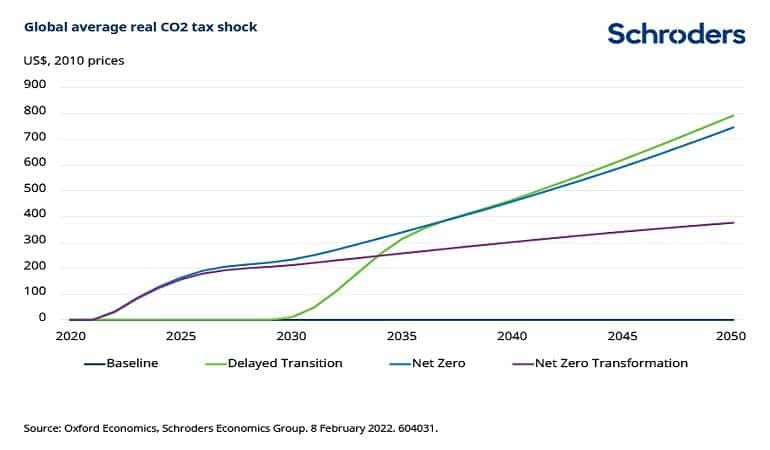
    The assumptions on carbon taxes for the different scenarios are shown in chart 1. These trajectories are consistent with the analysis done by the Network for Greening the Financial System (NGFS) that derives the carbon tax for a given degree of mitigation while maximising welfare. The Delayed Transition scenario highlights the risks associated with governments failing to act swiftly. The world ends up with more stringent policies from 2040 as a stronger price signal is needed to limit global warming. The chart also shows the economic benefits associated with greater innovation, reflected in much lower carbon taxes for the NZT scenario.

    Chart 1

    chart 1 inflation net zero schrodersCarbon prices rise to US$200 per tonne of carbon dioxide (tCO2) by 2030 and steadily increase to more than US$700/tCO2 in 2050 in the Net Zero scenario. Prices do not exceed US$400/tCO2 under NZT. In the Delayed Transition, carbon prices increase rapidly after 2030 to reach US$800/tCO2 in 2050.
    Oxford Economics assumes that the government recycles 50% of the carbon tax revenues back to consumers in the Net Zero and in the Delayed Transition scenarios. The other 50% remains on government balance sheets and is partly used to fund investment.

    In NZT, they assume that the government fully recycles revenues in the form of lump-sum transfers to households. Therefore, the clean energy transition is financed by increased government borrowing that takes the global economy on a higher equilibrium level of economic growth.

    What Will Drive Inflation?

    The impact on inflation will come via changes in energy prices. The Oxford Economics model assumes that fossil fuel supply is slow to adjust to the change in prices. In contrast, demand is more elastic, adapting more rapidly to a change in price. These are realistic assumptions.

    Therefore, spot prices fall below baseline on the back of weaker demand for fossil fuels. However, the move in the spot price is not large enough to keep the after-tax price at the pre-shock level. Given the large magnitude of the tax increase, after-tax prices are significantly higher than their baseline level.

    It is evident that oil prices will rise more rapidly in the Delayed Transition scenario starting from 2030 given the disorderly impact of the late policy implementation. Meanwhile, oil price increases are more modest in NZT thanks to the lower tax profile associated with greater innovation and green investment that boosts productivity.

    Higher Inflationary Pressures On The Horizon

    The recent developments in the gas and oil markets are already showing us how important energy prices are for headline inflation. Accelerating energy prices have been a key factor behind the recent surge in global inflation. Therefore, it should not come as a surprise that with the adoption of carbon taxes, inflationary pressures will increase globally. In addition, the move to net zero will also dramatically boost demand for key industrial metals used to generate and store renewable energy. Given the supply challenges, this is likely to add further pressure on inflation, via higher prices for aluminium, copper, cobalt and lithium.

    Carbon prices are estimated to boost US headline CPI, adding 300 basis points (bps) to our baseline forecast in the years following the implementation of the carbon tax. However, higher inflation will be temporary as pressures on prices will be mostly concentrated in the early stages of the transition.

    As countries decarbonise their energy production and move away from taxed products, inflation will start declining in the second half of 2020s, returning to its baseline level by 2050. Inflation under the NZT will return more quickly to its baseline due to higher productivity and less severe carbon pricing. Meanwhile, in Delayed Transition, inflation will start rising from 2030 and remain above the baseline in the longer term due to continued increases in taxation policy.

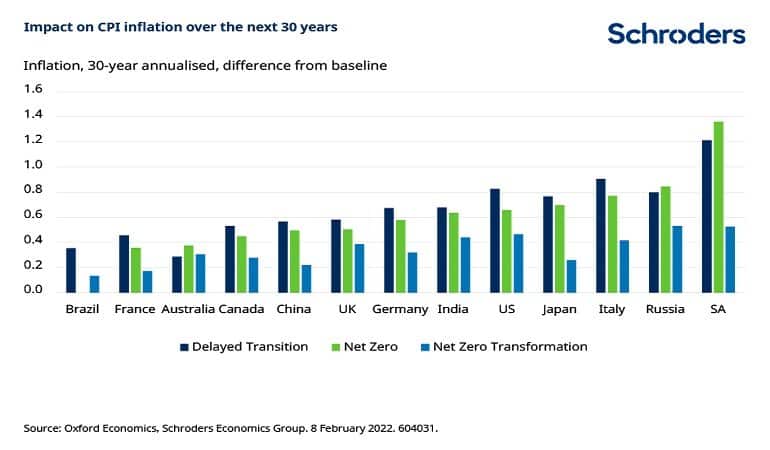
    It is important to note that the impact on price growth will not be homogeneous across countries, as shown in chart 2. Over the next 30 years Brazil and France will see the smallest inflation increases, while Russia and South Africa are likely to experience the largest rises. The UK and Germany will also be affected, with the Net Zero transition expected to add more than 50bps to headline inflation over the next 30 years. The analysis also highlights the greater risks to price pressures associated with the delayed transition on the back of more severe increases in carbon prices.

    Chart 2

    chart 2 inflation net zero schroders

    The impact of carbon pricing across the globe will depend on various country-specific factors. First of all, the magnitude of carbon taxes is a key determinant in the change in energy prices. Most developed markets will see carbon prices well above the global average. Europe will experience the highest price, almost US$900/tCO2 in 2050 in the Net Zero scenario, closely followed by the US and Japan. European prices are higher than other developed countries due to the region’s relatively smaller endowment for CO2 removal, via carbon capture storage technology, for example. Carbon prices for emerging markets will be much lower than their developed counterparts, increasing to US$600/tCO2 by 2050.

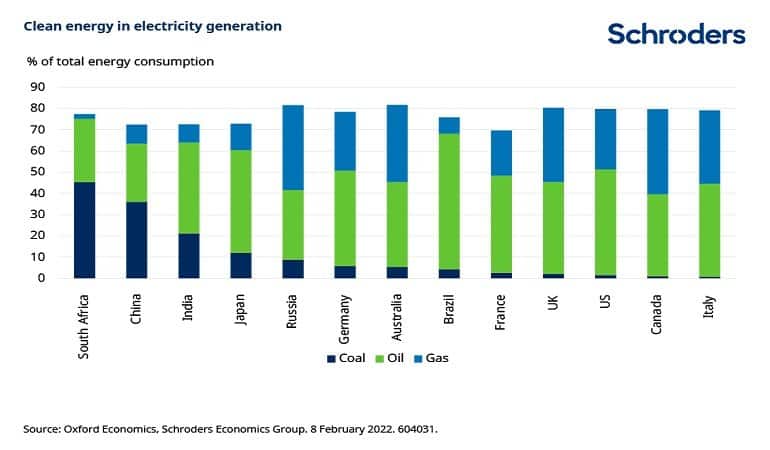
    Another key factor behind the cross-country differences of the inflationary impact is the energy mix. Countries that are currently more reliant on fossil fuels for their energy generation will be more exposed to carbon taxes, as a higher share of fossil fuels strengthens the pass-through to prices.

    The degree to which energy prices rise also strictly depends on the carbon content of the fossil fuels used. This is because coal is much more carbon intensive than oil and especially gas, implying that for the same amount of tax, coal prices will rise more than the other fossil fuels.

    It is therefore important not only to look at the amount of fossil fuels used in the energy production, but also at the carbon content of each source. Chart 3 highlights that emerging markets heavily rely on dirtier sources of energy. South Africa leads the way, as coal accounts for more than 60% of its energy demand, followed by China and India. Countries highly dependent on oil like Brazil, Japan, Russia and the US will also see significant increases in fuel prices.

    Chart 3

    chart 3 inflation net zero schroders

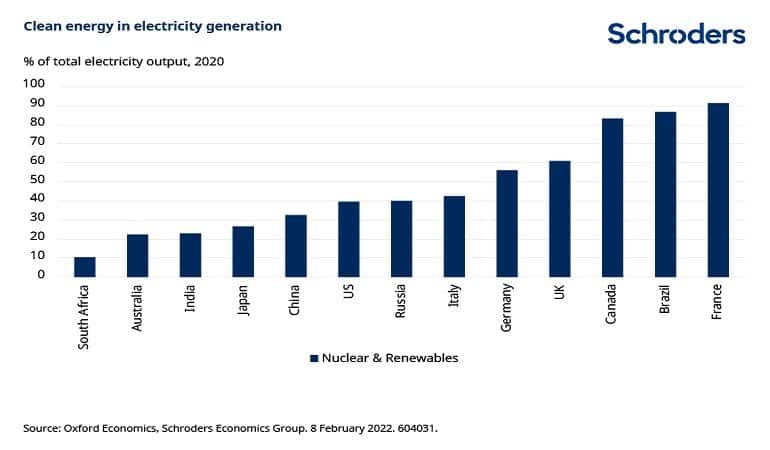
    Electricity prices will also be impacted by carbon taxes. The higher the share of renewables and nuclear used for electricity generation, the weaker the pass-through to electricity prices. Countries like France, Brazil, and Canada, whose electricity is already being produced with more than 80% of clean energy, will see a more modest rise in inflation.

    Achieving net zero emissions requires a radical decarbonisation of the energy mix. By 2050, all coal mining will need to end, stranding these assets. Moreover, the majority of oil reserves will also be unburned. This means that developed countries will need to be less dependent on these dirty sources of energy, and consume low-carbon sources, like natural gas, and rely more on nuclear and renewables. By 2050, oil is assumed to account for less than 10% of total energy consumed for most developed economies (chart 4).

    Chart 4

    chart 4 inflation net zero schroders

    What Are The Implications For Central Banks?

    Carbon taxes represent an efficient policy tool to tackle environmental problems, but it is clear that they will lead to inflationary pressures. These will be felt across the globe, but will be more pronounced for economies that still largely rely on energy from fossil fuels. It is interesting that the impact on inflation in European countries will be more limited despite them likely to see the most severe carbon taxes and highest carbon prices. This is thanks to their greater use of clean energy, especially in France.

    Our analysis also shows that inflationary pressures are mostly concentrated in the near term. The transitory nature of inflationary impact could imply that central banks look through the carbon pricing shock. The current prevailing consensus is that monetary policy should look through energy shocks as these tend to be short-lived and only result in a temporary deviation from the inflation target, provided that expectations remain anchored. And this is in line with what the Oxford Economics model assumes. But the energy transition will require a radical transformation in the energy sector, with the potential to generate large demand and supply imbalances, posing profound challenges to policymakers.

    Finally, carbon prices are likely to act as a trigger for large investment stimulus, boosting employment and aggregate demand. Higher energy prices, if associated with a smaller output gap and stronger underlying price pressure, could force central banks to abandon any “look-through policy” and act to preserve price stability.

    About the author

    Irene Lauro is an economist at Schroders.

  • Changing Habits in a Cashless Society

    Changing Habits in a Cashless Society

    Are you psychosocially fit to harness fintech solutions for your financial well-being?

    The outbreak of the Covid-19 pandemic has accelerated the use of cashless payments in Malaysia. There is a surge in the usage of cashless payment as consumers start to adopt e-wallets like Touch ‘n Go, GrabPay, and MAE, besides the use of electronic payment through cards, mobile banking and internet banking during the Movement Control Order (MCO).

    A cashless society does not necessitate that cash transactions do not exist in the economy but rather, financial transactions are facilitated by electronic means in an attempt to minimise the volume of cash transactions.

    As the buzzword “fintech” is rapidly becoming a household name, early adopters may have already benefited from their early adoption of fintech solutions. There were many lengthy articles written on the benefits and risks of moving towards a cashless society as well as highlighting the risks associated with the adoption of fintech platforms such the potential compromise of client privacy, security and operational risks. In their quest for higher customer acquisition, fintech platforms provider may have overstated their claims with regards to their services.

    Not surprisingly, certain segments of the society, which are either unconvinced of the benefits or lack the ability to reconcile with the technology, are still rejecting the use of tech-based solutions despite rapid adoption by the tech-savvy generation.


    So, are we getting or feeling smarter as technology users? Is our digital financial literacy moving in parallel with the availability of fintech solutions to manage our finances?

    As reported by EPF, our savings are not sufficient and some EPF members are opting for early special withdrawal under i-Lestari, i-Citra and i-Sinar due to the pandemic.

    So, are cashless and fintech solutions the panacea to help us save, spend or invest better?

    The main issue does not lie with using technologies per se for financial planning but rather, a lack of awareness in understanding savings and spending behaviour. This is because, if we cannot or do not have the self-disciple to save, knowledge and skills alone will not enable us to fully capitalise on investment opportunities provided by fintech solutions.

    Let us try to understand ourselves. In this age of consumerism, by nature, it is our inherent behaviour to prefer current consumption over future consumption. The additional satisfaction known as marginal utility in Utility theory expounded that the marginal utility of current consumption is always higher compared to the marginal utility of future consumption.

    In other words, it may be difficult for some of us to save for tomorrow unless we are incentivised to do so. As most people are not self-motivated creatures, we need external push and interventions from time to time to help shape our savings behaviour. In addition to this, psychologically, we dislike waiting.

    But unfortunately, the incentive to compensate us for waiting and delaying our current consumption in the form of interest rate is negative. In this low or negative interest environment coupled with the availability of easy credit, plastic cards such as debit cards or credit cards, e-wallets or other alternative payment systems, the motivation to save becomes even lower, and spurs us to spend recklessly.


    While we love the constant innovations or fintech solutions by companies in their attempt to provide a seamless experience for customers, we are becoming somewhat less patient. Spoilt for choices with a button or click-away conveniences provided by companies, our impulse to spend for instant gratification is magnified.

    In addition, the theory also explicates that we tend to value current consumption even more over future  consumption during period of scarcity. Thus, it is no surprise that due to the Covid-19 pandemic, we may have the urge to spend and consume even more like there is no tomorrow.

    Some of us are being lured into adopting exuberant lifestyles that are beyond our means as we are besieged daily by spam, scam calls, marketing gimmicks or repetitive unwanted advertisements.

    While some of us are plunging deeper into the abyss of maintaining exuberant lifestyles that we find hard to extricate ourselves from, companies are getting unrelentingly creative in helping us to reduce our pain of losing money via innovations in electronic payment means. Accordingly, we do not just experience as much pain as our predecessor because we are just literally transferring the numbers or data via the electronic systems when we make our purchases. In consequence, we are inclined to spend lavishly on unnecessary items.

    Things were markedly different back then when cash was used extensively. Our grandparents or parents may have better spending habits because they get to feel, touch, smell and count the hard cash of their money in their hands before parting with their money. The painful experience associated with seeing with their own eyes that the money is actually leaving their hands or pockets may have deterred them from spending on unnecessary items. This explains why they spend more on necessities that benefit themselves to equalise the pain inflicted upon parting with their money.

    To put it in another way, if we could not be cognizant of our own innate behaviour by getting psychosocially ready, in harnessing the so called “smart” fintech solutions, we are not going to get smarter. On the contrary, we may become more mentally depressed.

    Cultivating good spending habits and resisting temptations to splurge often require self-discipline, practice and planning. To be more unsusceptible to act impulsively when our brains process words frequently used by marketers such as easy, convenient, fast, instant, and limited, we should stop being hyperconnected all the time.

    By not subscribing to this new religion of “irrational exuberance” (a popular term used by Professor Robert Shiller) in our daily spending habits, hopefully, then, perhaps, our life would be psychosocially and financially happier.

    About the author

    Dr Audrey Lim Li Chin is a lecturer and a researcher at Multimedia University (MMU) Melaka. She teaches International Finance and Derivatives. She is particularly interested in retirement planning, mental health, fintech especially in blockchain and data analytics. She is also a Certified Financial Planner, (CFP) and is currently pursuing Chartered Financial Analyst (CFA) certification. She is also the external educational advisor to Max Wealth Education Sdn Bhd.

    Upgrade Yourself To Become A Certified Financial Planner And Islamic Financial Planner

    The Certified Financial Planner (CFP) qualification is for those wishing to practice the profession of financial planning and who wish to master a certain level of theoretical knowledge and practical application of financial planning in such areas as:

    • General principles of financial planning
    • Insurance planning
    • Taxation planning
    • Investment planning
    • Retirement planning
    • Estate planning
    • Financial plan construction and professional responsibilities

    Islamic Financial Planner (IFP) is designed especially for professionals and personnel serving the retail segment of the Islamic financial products and growing demands of discerning Muslim retail clientele call for higher standards of competency and ethical practice of financial planning professionals. Equip yourself with enhanced knowledge in the personal financial advisory space.

    Exclusively for Smart Investor followers, click https://www.smartinvestor.com.my/SIxMaxWealth to find out more about the Special Promotion Package and get up to 20% special discount.

    *This promotion is valid until 31st December 2022 only

  • The Cause And Effect Of Anger

    The Cause And Effect Of Anger

    Everyone experiences this emotion, but knowing how to control it is crucial.

    Overblown anger usually indicates a larger underlying problem in life. Depression, anxiety, and other mental health issues are associated with many magnified negative feelings, some common culprits being worthlessness, shame, and disappointment, all of which can translate into anger.

    Addiction is also a common source of anger, showing up when we get frustrated with ourselves for not being able to stop our compulsions, or to get the fix that would soothe us temporarily.

    What Causes Anger?

    There are two sets of structures in the brain that govern us: the cortex thinks, while the limbic system takes care of the more ancient aspects such as emotions and memories. External triggers, particularly fears, are sent to a deep, central part of the brain called the amygdala.

    The amygdala decides whether to send the incoming data to the cortex for rational processing, or straight to the limbic system that generates quick knee-jerk reactions.

    Childhood maltreatment, poor social adaptation, and unchecked habits sometimes lead to an overactive amygdala, causing us to react too strongly and out of proportion to the actual gravity of the triggering event. Anger becomes an undesirable response when we keep getting uncontrollably irritated against a perceived threat, no matter how small or unfounded it is.

    What Makes Us Angry?

    Anger makes everything seem worse or more important than it actually is. It also makes us feel sure that the things that offend us are true even though we cannot know absolutely whether they are. We feel the urge to exert our will, and we feel justified to let our ego overcome others’ rights.

    Having said that, anger is nevertheless a normal response experienced by everyone in the face of unfairness. Some events in life make us feel deliberately harmed, even when on a deeper level we know that that is not true.

    Such events can cause unforgiving feelings that manifest themselves in anger:

    • Frustration — Feeling victimised when things are not going the way we want them to.
    • Injury — Feeling the need to revenge after being attacked.
    • Exploitation — Feeling the need to set things straight after being taken advantage of.
    • Lack of attention — Feeling small as a result of being ignored or dismissed.
    • Envy / jealousy — Feeling obsessed when someone else has something that we desire.
    • Lack of conformity — Feeling irritated when other people do not obey the rules that we obey or believe to be important.
    • Sympathy — Feeling troubled when seeing someone else suffer a harm that should not be allowed to happen.

    Everyone Expresses Anger Differently

    Even though anger is completely normal, it becomes a problem when we feel it too frequently, too overwhelmingly, or when we express it in ways that can hurt other people or ourselves.

    Noticing our own physical signs of anger is the best way to catch the beast before it overcomes us. Because physical signs tend to show up even when we are trying to suppress our feelings, they are highly useful for those who are used to restraining themselves, but nevertheless suffer from deep-seated and unresolved rages.

    Some of anger signs include:

    • Clenched fists
    • Fast and shallow breathing
    • Stomach in knots
    • Shaking or trembling
    • Sweating
    • Hotness
    • Pounding heart
    • Reddened face

    Apart from classical displays of anger such as verbal abuse and physical violence, many people have learned to express their anger in subtler forms due to social conditioning and habitual inhibition. These are not better or worse than other kinds of aggression, whether self-directed or interpersonal, and should also be monitored mindfully with consistent practice:

    • Passive aggression — “I want to control your emotions or behaviour but I don’t want you to notice it.”
    • Sarcasm — “I want to hurt you verbally and I will force you to take it as a joke.”
    • Contempt and disdain — “I am better than you and you are lesser than me.”
    • Disgust — “You contaminate me or the things I care about.”
    • Coldness — “I refuse to acknowledge you, and I take pleasure in your misfortune.”
    • Hostility — “I am ready to fight you if I have to.”

    How To Cope With Anger?

    Unbridled anger can form a vicious cycle that becomes more aggressive at every outburst and harder to break. The understanding that anger is usually fuelled by an overblown emotional threat is essential to rebuilding a response mechanism that is not based on defensiveness and flight-or-fight reaction, but compassion and rationality.

    Anger can be caused by real problems in our lives that need to be solved, but our ability for problem solving is weakened if we continuously fail to provide ourselves a suitable framework in which to assess life that is based on reality instead of drama.

    Many established anger management techniques are not only meant for emotional de-escalation, but also for helping us to restructure our attitudes and rebuild our empathy, so as to restrain our ego from taking centre stage on every occasion:

    • Maintain a diary to record the thinking patterns and common triggers that have led to your angry outbursts.
    • Recognise the moment anger starts appearing in your body.
    • Observe whether the angry feeling is taking over your logical mind.
    • Do not feel guilty about your anger, but accept that you need ample personal space to avoid lashing out (even though you really want to), and to let the urge flow through you.
    • Practise switching attention to your breathing until the anger feels less urgent.
    • When things have calmed, retrace and revisit the train of thought that you have experienced during the provoking situation.
    • Do not blame yourself.
    • Visualise giving yourself a pat on the shoulder or hugging yourself like a parent would to a child.

    Exploring Our Inner Thoughts

    Therapy and counselling help us understand our anger and learn how to manage it, so that we can limit its negative impact on our lives in scientifically proven ways.

    To gain more insight into our anger, it is useful to ask, “in what ways had this situation hurt me?” and, “am I overestimating the damage that can be done to me?” The answers to these might put things into perspective as we realise that our anger has more to do with our flawed beliefs about ourselves, other people, and the world, than the actual severity of the situation itself.

    After an angry episode has subsided, ask yourself the following questions, and remember your answers when the next tantrum begins to simmer:

    • Do I talk to myself in an overtly emotional language that tends to describe situations as catastrophes, exaggerated dramas, or black-and-white scenarios?
    • Was the situation worth getting angry over?
    • Did I really need to be angry at that moment? Did it solve my problems?
    • Did the pleasure of lashing out justify the harm done (or could potentially do)?
    • How did the effects of my anger impact people on the receiving end?

    We often either use anger as a tool to avoid feeling hurt, or hurt ourselves by directing the rage inwards. Neither pattern is necessarily our fault, but both can lead to bigger mental health problems and social issues. Learning how to control anger does not mean denying ourselves the freedom of expression, but that it happens to be a vital step towards gaining more inner peace and overall contentment in life. 

    Seek the help of a psychiatrist or a clinical psychologist if you often feel unsure, overwhelmed, or out of your depth when confronting difficult feelings.

    This article is adapted from an article by Sunway Medical Centre, Sunway City.