Blog

  • 3 Tips to Building Your Emergency Fund

    3 Tips to Building Your Emergency Fund

    In the previous month, I talked about the importance of having an emergency fund. This will put us in a better place to deal with surprises and curveballs in life. 

    Sometimes, this sounds like a no-brainer as most of us are well aware of this. Yet, according to some statistics published in the media, we are constantly reminded of the dire situation among consumers.

    The most infamous one is the Bank Negara Malaysia study that showed 75% of Malaysians would struggle to come up with RM1,000 to deal with unexpected situations.  

    This is the kind of number that makes me feel frustrated, and sad at the same time.

    On one hand, people gladly use this revelation as a ‘sales tool’ to create a need for consumers to buy their financial products.

    On the other hand, it does highlight a serious scenario that needs attention. People are finding it hard to save, and worse, deal with any unexpected situation, which we’re almost ‘guaranteed’ to face in life. 

    As painful as it sounds, I really hope I can play my part to help people build up their savings.

    Here are some suggestions that you can use as a guide in your efforts to build up your own emergency fund.

    I hope this will help make it easier, and together, we’ll bring down that 75% to a much lower number! 

    A Ringgit Saved = A Ringgit Earned  

    Commonly, people tend to say “I will save what I have at the end of the month”.

    Just because most people adopt this mindset, it doesn’t mean this is an effective approach. In fact, based on experience, almost everyone that struggles to save money has told themselves this.

    The results show that this mindset will only get us limited results. 

    If you’re a salaried person, have you ever struggled to pay your income tax bill? The answer is most likely “No”. Why do you think this is?

    That’s because, before the money even reaches your hand, it’s already been ‘taken out’ and ‘paid’ to where it should go.  

    If you’re still not convinced, how do you think your EPF account continues to grow in size each year?

    While the dividend is a good reason, however, the main reason you see the amount grow is due to the regular contribution, which again, before you can ever touch it, has already been redirected towards your EPF account. 

    If you want to see a different outcome, from “I can’t save” to “I am saving”, you just have to change the sequence.

    Save first, spend the rest. It’s as easy as this! 

    Where Do You Keep This Money? 

    Keeping your savings in your salary-receiving account is never a good idea.

    A majority of people I’ve interacted with seemed to know this. Some of them who have trouble saving up their emergency fund tend to keep this money in a separate account.  

    However, this account also tends to be their ‘day-to-day’ account. Perhaps that’s another reason why your savings won’t sit there for long.

    We’re creatures of habit, and our basic instinct is wired to spend money.

    To build on this instinct, we’re also constantly bombarded by messages, advertisements, and opportunities that induce us to spend and part with our money. This eventually creates an inevitable outcome, which is helping us to spend.  

    For what it’s worth, do note that there’s nothing wrong with keeping your emergency savings in your day-to-day account. It’s just that it increases the likelihood for the money to leave you.

    For example, in the middle of last month, I saw my day-to-day account still had about RM4,000. 

    This immediately made me feel excited knowing I still have RM4,000 to spend for the next two weeks.

    However, when I checked my credit card used for the past 2 weeks, I noted that the balance has already built up to about RM2,000+.

    This instantly means my real spending amount is not RM4,000 (although the money is there), but just the leftover after paying off my credit card.  

    This is what is likely to happen to emergency savings if mixed with your day-to-day account. And since emergency savings are so important, you should avoid this possibility at all costs.  

    In general, an ideal place to keep this money will be a place where we don’t have to worry about the value of the money.

    This means it shouldn’t be placed in accounts or asset classes that tend to be volatile. The idea is for it to be easily accessible anytime we need it, and as soon as possible.  

    How Much Do I Need to Save? 

    While there are plenty of guides or rules of thumb offering answers to this question, please note that you can actually determine this.

    You don’t have to let existing guides tell you how much you need to save up.  

    Have you ever tried travelling to the moon? I can confidently ‘predict’ that most of you haven’t or even thought about doing this.

    For things that you don’t think is possible, chances are you’ll never even bother trying to do it. 

    Another common situation I tend to encounter often is that people ‘plan’ to save a huge amount, or when they apply the rule of thumb, the projected amount made them feel hopeless.

    This feeling ends up making them feel defeated, resulting in them giving up trying. To them, this amount is like travelling to the moon! 

    When it comes to emergencies, we can never predict what will happen, hence it’s impossible to predict how much we’ll need.

    Therefore, you can aim for emergency savings as low as RM1,000. Even RM50 can be crucial. Imagine someone without any savings, who one day needed to go to the clinic to get a consultation for a fever. To them, RM50 is a huge deal. 

    So, if you’re low on your emergency savings, don’t despair. Start saving up in small amounts. It’ll be better than when you haven’t set aside this small amount that doesn’t seem to matter now.

    When you’ve built enough momentum and have a small fund, start to make it a goal to save up for one month of your expenses, then three months, then six months, then a year or more.  

    Just like collecting water in a tank, you must ensure you store as much as possible and refill it to the maximum level each time you use it up when there’s a water disruption.

    If you have to dip your hand into this pot in between, make it a point to refill it.  

    About the author 

    Kevin Neoh is a NextGen Money Coach and can be contacted at kevin@nextgenadvisors.my and www.kevinneoh.my

  • Should I Pay Off My Car Loan Early?

    Should I Pay Off My Car Loan Early?

    Pre-payment of a loan is the payment of the outstanding loan amount before it becomes due. This usually comes in the form of a car loan.

    For example, if you have a house loan for 35 years, you can opt to pay off the remaining balance at year 10 and free yourself from the monthly repayment from year 11 onwards.

    The way I see it, loans when used correctly can be very powerful, but when abused / ignorant it will be destructive.

    Today, I want to take an objective angle on this – backed with numbers, of course. Before answering the question “Should I settle my loan early?”, I want to highlight a term.

    Opportunity Cost

    This often comes up in the subject of finance and economics. In truth, you experience this in our lives daily. Opportunity cost refers to the loss of something when you choose one option over the other.

    If you snooze your alarm, you lose 10 minutes of being awake for the benefit of 10 more minutes of sleep/rest.

    When you choose to drive to work, it takes 30 minutes of focus on the road vs paying RM10 for 30 minutes of free time in a cab. Spending RM5,000 on a new phone takes RM5,000 away from other things like investment, a holiday to Thailand, a laptop for work, etc.

    Investing in stock A means less/no cash to invest in other companies.

    You will always face the question of “what is the opportunity cost” when you make choices. And you make lots of choices every day, though some are more obvious than others.

    Loans and prepayments present a very relevant opportunity cost issue – interest rates.

    Interest Rates

    Fixed Rates

    Fixed interest rates are not affected by the changes in the market and will remain the same throughout the tenure of the loan.

    Variable/Floating Rates

    Variable interest rates are tied to and will change in accordance with the market reference rate – this usually means the change of the overnight policy rates (OPR) in Malaysia or “prime/base rates”.

    Structure – Flat

    A flat interest rate structure calculates the interest rates based on the original loan amount regardless of how much principal has been paid down.

    Structure – Reducing Balance

    Reducing balance calculates the interest rate payable based on the amount of principal outstanding.

    The interest portion of the loan instalment reduces (and the principal portion increases) every month because the principal is being paid down in each instalment.

    Structure (TRAP) Rule of 78

    This is commonly found in cars and personal loans. In short, you pay most of your interest rates at the start of the loan as opposed to evenly distributing across the loan tenure.

    Yes, this means that if you prepay at a later stage of the loan tenure, there are not much interest savings because you would have paid up most of our interest portion by then.

    You can read up about the rule of 78 by doing your own research, but be warned that you might get upset once you discover how some bank loans work!

    4 Horsemen of Loans for Individuals

    I’ll approach this section on four fronts – interest rate type, loan structure, interest rate and prepayment opportunity cost.

    1. House Loan

    Interest Rate Type: Commonly variable / floating

    Loan Structure: Reducing balance

    Interest Rate: Base Lending Rate minus 2.5% (Averages around 3.3% as of now)

    Opportunity Cost: A house loan is typically quite a big sum.

    Hence, to prepay it involves coughing out big money! This will forgo a lot of other purchases/investment opportunities that may generate income more than the 3% – 5% interest rate (floating rate) paid here.

    Verdict: Given the interest rate that we are paying and the reducing balance interest rate, it is better to use the capital to invest in assets that can generate returns beyond 5%, including ASB / ASM, REITS, etc.

    On top of that, if it’s an investment property that is generating rental income, then is the monthly instalment actually still an issue?

    2. Car Loan

    Interest Rate Type: Fixed

    Loan Structure: Flat + Rule of 78 Trap

    Interest Rate: 2.9% – 3.3% (Effective Interest Rate is 5.5% – 6.2%)

    Opportunity Cost: The amount of interest savings from prepayment depends on when we prepay. The earlier we prepay -> The more interest we save -> But the more capital we need.

    Prepaying early would require bigger capital, hence losing out on investment returns. Prepaying later would be sacrificing investment returns for not many savings in interest payment.

    Verdict: Given the nature of the Rule of 78 and the EIR of about 6%, we have screwed all ways.

    It’s highly likely not worth it to prepay since the interest savings would not be much a few years down the loan tenure.

    The capital can be better used to invest in assets that can generate higher returns than the interest rate and compound the returns from such investments.

    If you want to prepay very early in the loan, you might as well buy the car in cash!

    3. Personal Loan

    Interest Rate Type: Fixed

    Loan Structure: Flat + Rule of 78 Trap

    Interest Rate: 4% – 7% (Effective Interest Rate is 7.5% – 13.5%)

    Opportunity Cost: Forgo investment returns on the prepayment capital in exchange for saving effectively 7.5% – 13.5% interest charges annually. But again, this is subject to the Rule of 78 issues, similar to the car loan.

    Verdict: Given the high EIR, it’s highly likely that prepayment is a better choice to avoid serving an extended loan.

    I suggest using a loan settlement calculator to see how much you would save, before deciding whether your capital is better used to prepay or to invest and generate higher returns.

    4. Credit Card Loan

    Interest Rate Type: Fixed

    Loan Structure: Special as it is based on your last month’s outstanding amount but with an interest that is compounded daily – read more on iMoney for the exact details

    Interest Rate: 15% – 18% tiered and compounded daily effectively making it up to 20%

    Opportunity Cost: Forgo investment returns on the prepayment capital in exchange for saving up to 20% interest charges annually.

    Verdict: I’ve said before that I love using credit cards compared to other payment methods.

    However, as a loan, it’s ridiculous due to the way the interest is structured as well as the exorbitant interest rates.

    If you don’t pay your credit card loan ASAP, you’d incur the interest rate wrath of up to 20% effectively (due to the daily compounding).

    I don’t know any investments out there that provide more than 20% returns consistently, so I won’t hesitate to prepay this in full today. In my opinion, avoid getting into this loan in the first place!

    The Ultimate Opportunity Cost

    So, should I settle my loan early? To answer this question – it depends on what your opportunity cost is when you choose to prepay.

    In my choices above, I won’t prepay if I can use the capital to generate higher returns elsewhere compared to the interest rate that I am paying for.

    The ultimate opportunity cost here is this – getting a loan allows you to use less capital to acquire an asset in exchange for paying an “interest rate”.

    If I have RM100,000, I can use RM10,000 to pay for the downpayment of a house worth RM100,000.

    I could borrow RM90,000 with an interest rate of 3%, but use this RM90,000 to invest into a REIT that pays out 5% dividend yield. 

    From this 5% return, I pay the loan of 3% and I still have 2% in returns that I can reinvest to get more returns.

    Essentially, I own a house with RM10,000, and RM90,000 worth of REIT shares and generate a net return of 2% on the RM90,000, which will be compounded.

    And this is without renting out the property. It’s a simple example, but it showcases the power of using loans the right way.

    The other option is using RM100,000 to buy the house in cash. I now have a house and no cash or extra investments. Are you seeing what I see?

    About the Author

    This article was originally published at betweenthemoney.com, a personal finance website by Jason Loh that focuses on money matters and investment topics for Malaysians.

  • What are The Many Benefits of E-Wallets in Malaysia?

    What are The Many Benefits of E-Wallets in Malaysia?

    “What is your preferred method to make your payment?”

    “We accept cash, cards and e-wallets.”

    “For e-wallet, we accept Boost, GrabPay, Touch ‘n Go…”

    Does this sound familiar to you? This tedious decision can be quite a challenge for those who are indecisive. However, this is a common scenario these days; we’re never short of payment methods although we may be short of funds! Undoubtedly, the rise of e-wallets has given impetus to the evolution of our spending habits.

    Most Popular E-Wallets in Malaysia

    With the help of the government, many are adopting e-wallets through subsidies like e-Tunai and e-Penjana. The three most popular e-wallets in Malaysia are Boost, GrabPay and Touch ‘n Go.

    Boost

    • Backed by Axiata Group
    • One of the pioneers in the Malaysian e-wallet market
    • Accepted at any UnionPay QR merchants
    • BoostUp Reward Programme and CashUp Cashback Programme

    GrabPay

    • Backed by Grab
    • Leverages the Grab Ecosystem for GrabFood, GrabRide and other provided services
    • Partnership with Maybank for cross platform use
    • Earn GrabRewards Points from every transaction

    Touch ‘n Go e-Wallet

    • Backed by Alipay and Touch ‘n Go
    • Taps into the large existing user base of Touch ‘n Go cards
    • PayDirect: link your Touch ‘n Go Card and pay toll fare directly with your e-wallet balance at participating highways
    • Money-back guarantee: full refund within five working days if your e-wallet is charged erroneously

    Irresistible Benefits 

    1. Convenience & safety

    What is the first thing you take when you head out? Your wallet or phone? Frankly speaking, I will often forget my wallet, but never my phone. We heavily rely on smartphones today and with the high adoption of e-wallets among merchants, we can easily make payments without cash on hand. Besides, I think everyone has faced the awkward situation of having to squeeze the notes and “syiling” back into your wallet after receiving your change. With an e-wallet, problem solved!

    The safety of digital payments is also a concern for some, but data in the e-wallets are encrypted and some providers even provide money back guarantee features to ensure the safety of using their services. It can be also argued that e-wallets have helped to reduce theft cases, which usually occurs with physical cash!

    2. A hassle-free spending tracker

    Do you always get shocked when checking your bank balance? Clueless on where the money has gone? You can easily check your e-wallet where all transactions made are recorded. Gone are the days of forgetting where you spent your money. Keeping track of your daily spending is crucial to cultivating good financial habits. This provides an overview of your spending patterns and insight as to where you could improve.

    3. Promotions and rewards

    While having many e-wallets has been confusing for some, the war to acquire users has been beneficial for us consumers. All e-wallets offer their own rewards, and it’s up to you to make the most of it:

    • Boost allows you to earn BoostUp coins with every transaction and exchange for gifts
    • GrabRewards Points comes with an extendable validity feature which technically makes it technically a “never expiring” points system (every point-earning transaction will extend the expiry date of your GrabRewards points till the last day of the 3rd month)
    • Touch n’ Go e-wallet rewards frequent user with cashback vouchers for selected merchants 

    All the e-wallet players partner with various merchants to provide attractive promotions to users in a bid to increase their market share. So look out for where you can save and earn through regular activities like refueling your car, buying groceries or even reloading your mobile credit. But please don’t use these promotions as an excuse to spend more than you need to!

    4. Your one-stop “private assistant”

    Paying your utility bills? Use e-wallet!

    Topping up your mobile credit? Use e-wallet!

    Sending money to your spouse? Use e-wallet!

    The utility of e-wallets is increasing by the day, and are no longer just avenues for sending or receiving money. Many can be used to pay for your parking, buy insurance, settling utility bills and more! There will be definitely more that an e-wallet can do in the near future!

    Curbing Your Digital Spending?

    For some, e-wallets or digital payments makes it easy to overspend with its convenience. Compared to counting out physical cash notes by hand, a big purchase simply requires a scan or swipe. Credit cards already made it easy to spend in the past, so the focus should not be on blaming such platforms, but rather on what you can control in terms of your spending habits:

    1. Set a monthly top-up limit 

    To avoid overspending, you must know how much you have. For example, if your spending budget is set at RM500, only reload RM500 into your e-wallet and make sure it lasts the whole month! If you’re out of credit before the month is over, you’ll know you need to fix your spending habits. Don’t top-up until next month as a reminder to stick to your budget!

    2. Only reload with your bank account or debit card

    I understand many will argue that we should optimise rewards on both ends by reloading e-wallets with credit cards. However, from a licensed financial planner’s perspective, this is not necessarily suitable for beginners who have just started to learn how to manage their spending. Only use this option when you are confident about your financial planning. If not, please don’t borrow money from your credit card to support your e-wallet spending habits!

    About the Author

    Ocean Pon is a Licensed Financial Planner and likes to help millennials make wiser financial decisions to achieve financial independence. He can be contacted at oceanpon@finwealth.com.my.

  • How To Check And Claim Unclaimed Money in Malaysia Online

    How To Check And Claim Unclaimed Money in Malaysia Online

    In 2019, the sum of money NOT being claimed by Malaysians was reportedly over RM10 billion, which is quite a sizeable amount! According to the news article, the Accountant-General’s Department (AGD) wanted to help Malaysians check the status of their unclaimed monies, leading to the development of an online system for this purpose.

    Previously, to check whether you have any unclaimed monies (eg. from tax relief), you’ll need to queue up without knowing if you even have any unclaimed money! However, earlier in 2020, the AGD’s eGUMIS portal went live and it was a significant improvement for people wanting to check whether they had any unclaimed monies.

    Despite this breakthrough, if you wanted to claim the money, you were still required to pay a visit to the AGD’s office to submit a physical form (Borang Permohonan Bayaran Balik WTD “UMA-7”).

    I remembered I had a small sum of money unclaimed, but due to the trouble and since the amount was not significant, I procrastinated and left the money unclaimed, on purpose. Towards the end of 2020, I read an article on The Star that stated the government could consider using unclaimed monies as a “source of revenue” – this triggered me to check my unclaimed money again.

    I was asked to create an account again as my account had expired after six months of inactivity. As I registered for another account, I realised that the user interface had changed and the more I explored, the more I realised that eGUMIS now allowed us to submit forms online.

    My step-by step experience of claiming my unclaimed monies is outlined below, and be sure to read till the end as I will also explain how to overcome a certain bug (as of 28 November 2020) in the system:

    Step 1: Register For a New Account

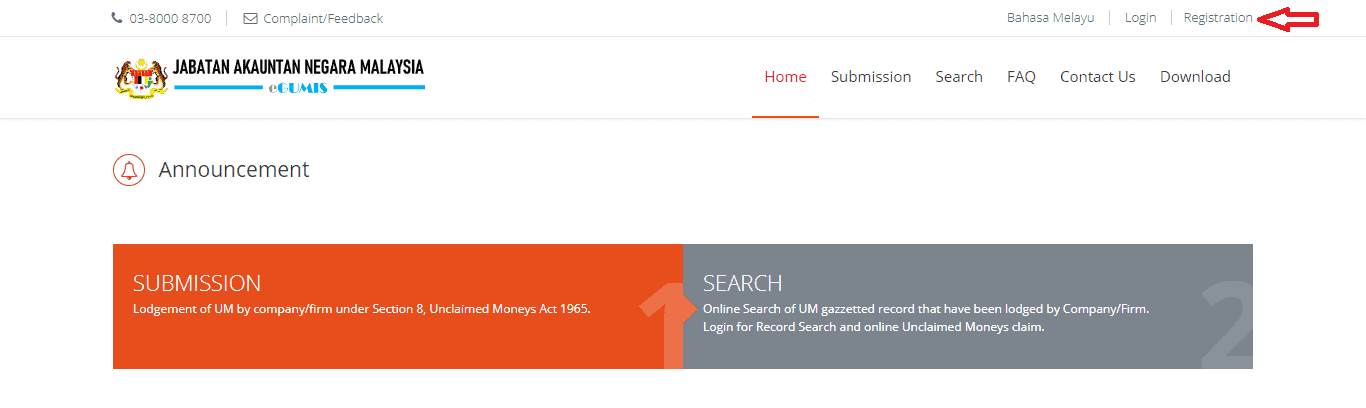
    First, head over to this link to register for a new account. Then click on ‘Registration’ in the top right corner as per the screenshot below to get started.

    Note: You may first need to change the default language to English, or you may proceed in Bahasa Melayu.

    egumis home

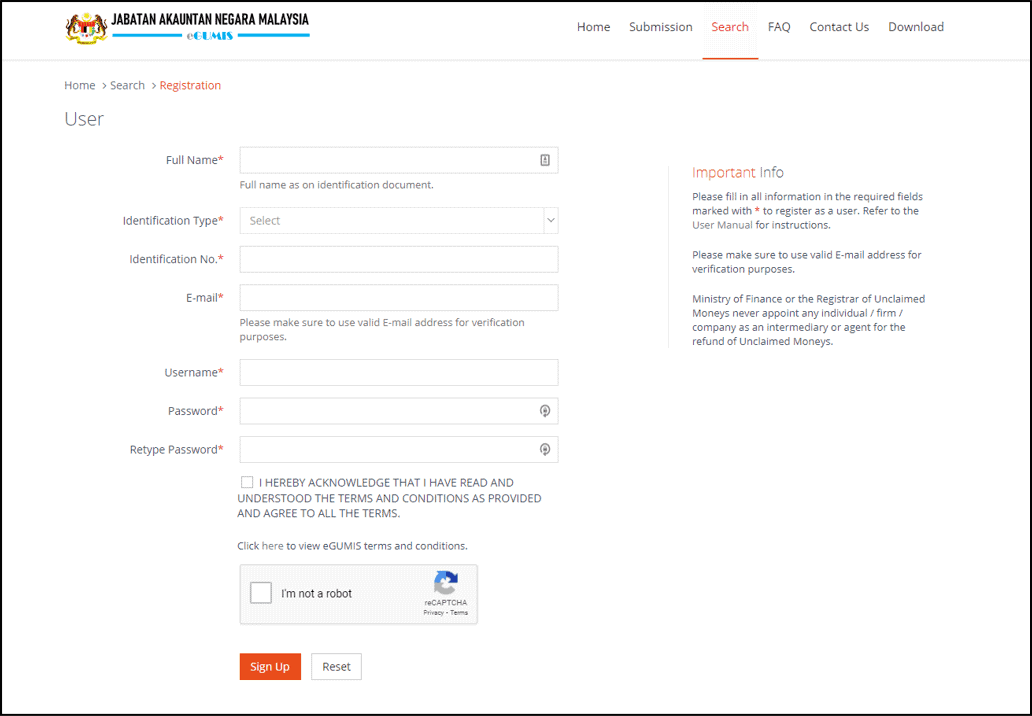
    You may then fill in the form to register your new account.

    Account Registration Form

    Your account will be deactivated after six months of inactivity, so if you have previously registered and have not logged in for the past six months, you’ll need to register for a new account.

    Step 2: Update your Profile

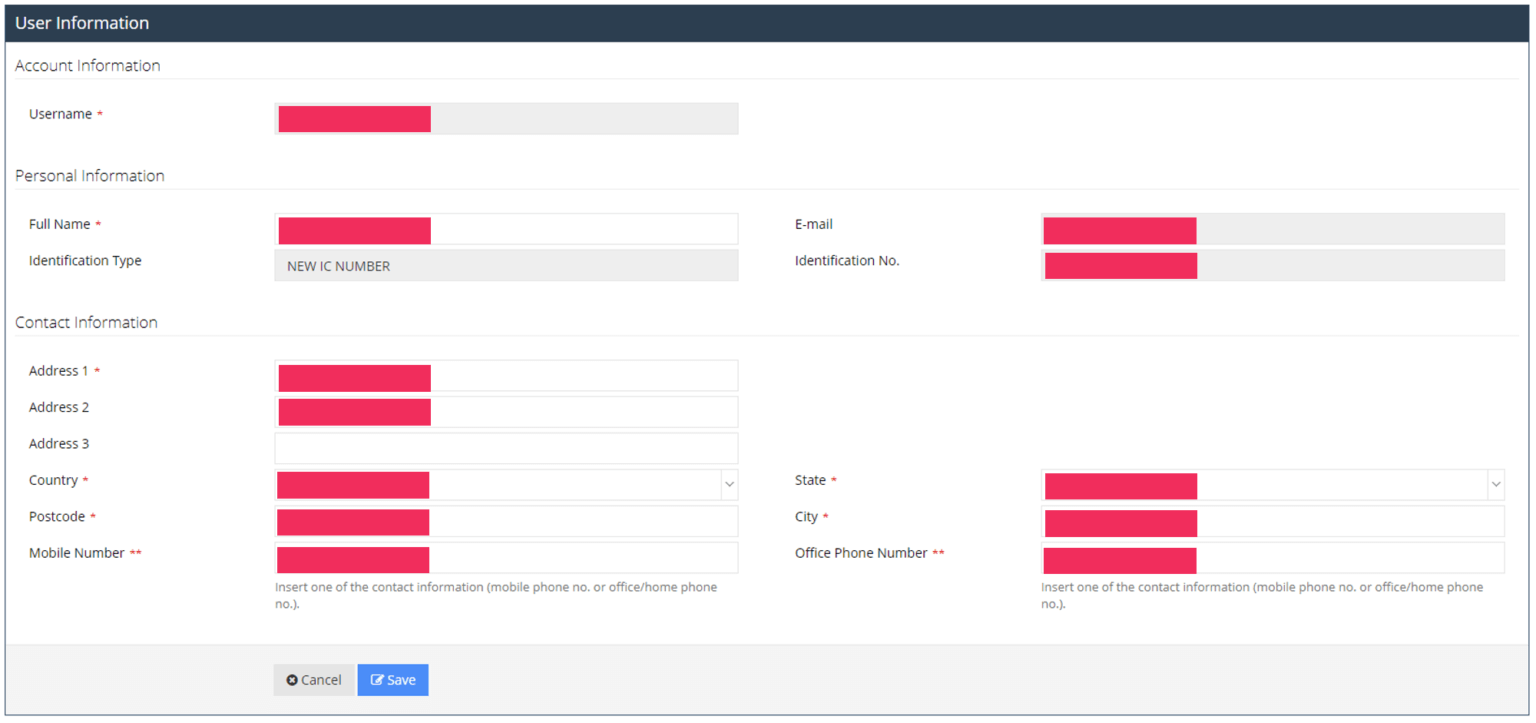
    Next, update your profile. Make sure to fill up all the boxes that is marked as compulsory (*).

    User Profile Information Form

    Step 3: Check for Unclaimed Monies

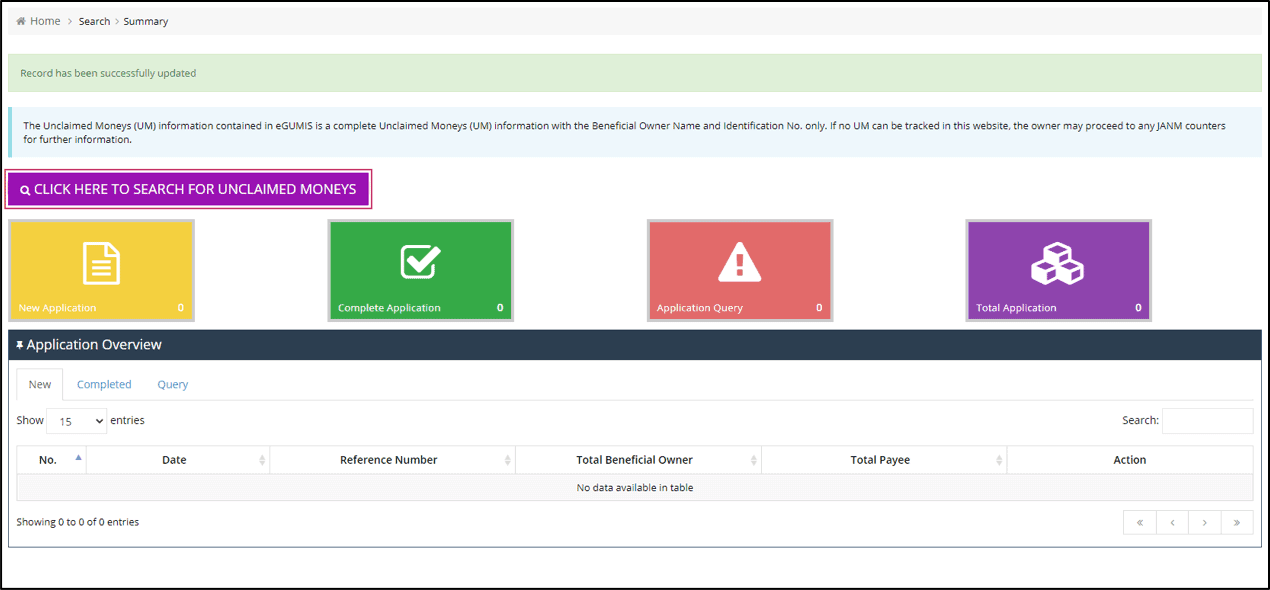
    Click on “Search for Unclaimed Moneys” and enter your Identification Number into the provided space. If you have any unclaimed money, it will show up in the search result.

    Unclaimed Monies Summary Search Result For Unclaimed Monies

    I also helped my parents check their unclaimed money through my account. However, I’m not sure if I can actually process the claims using my account, so to be on the safe side, I registered new accounts for them to help them claim their money.

    Do note that you can only check a maximum of two IDs per day.

    Step 4: Application Form

    If you have any unclaimed money, here is what you need to do to claim it:

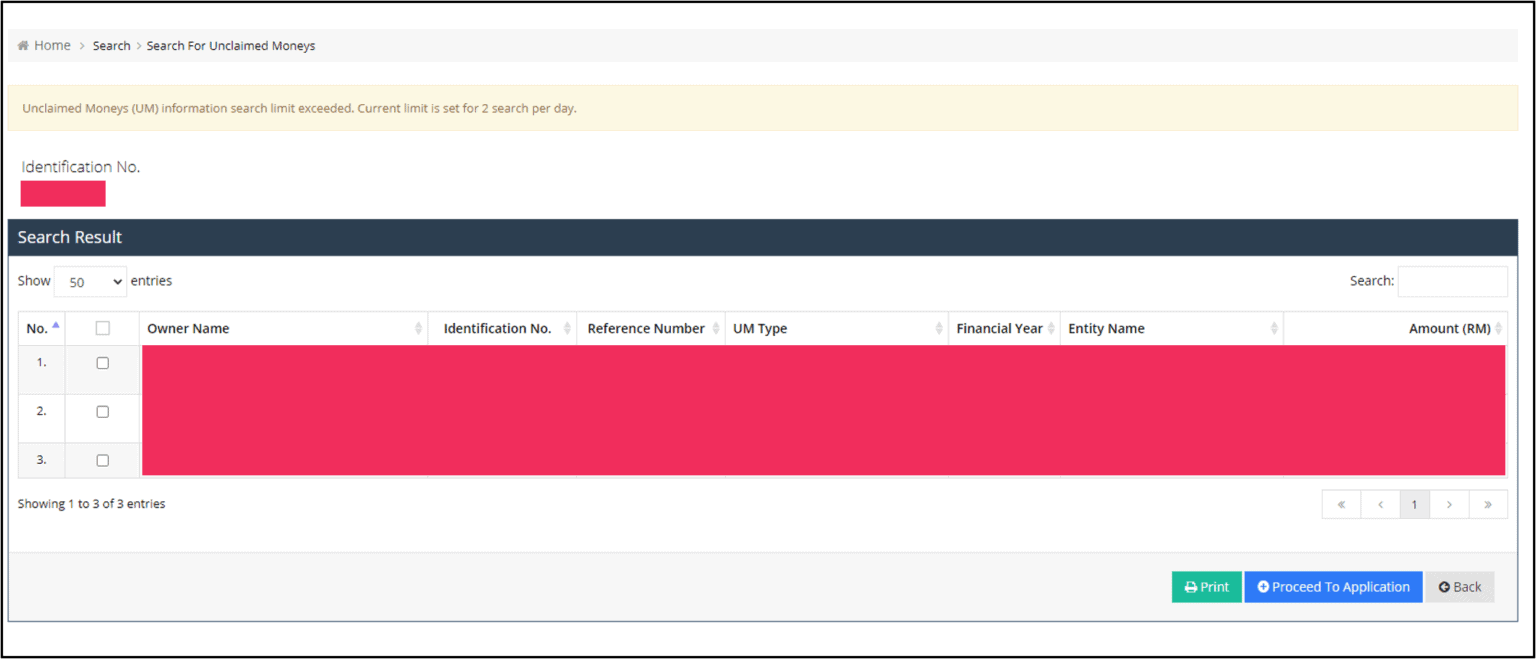
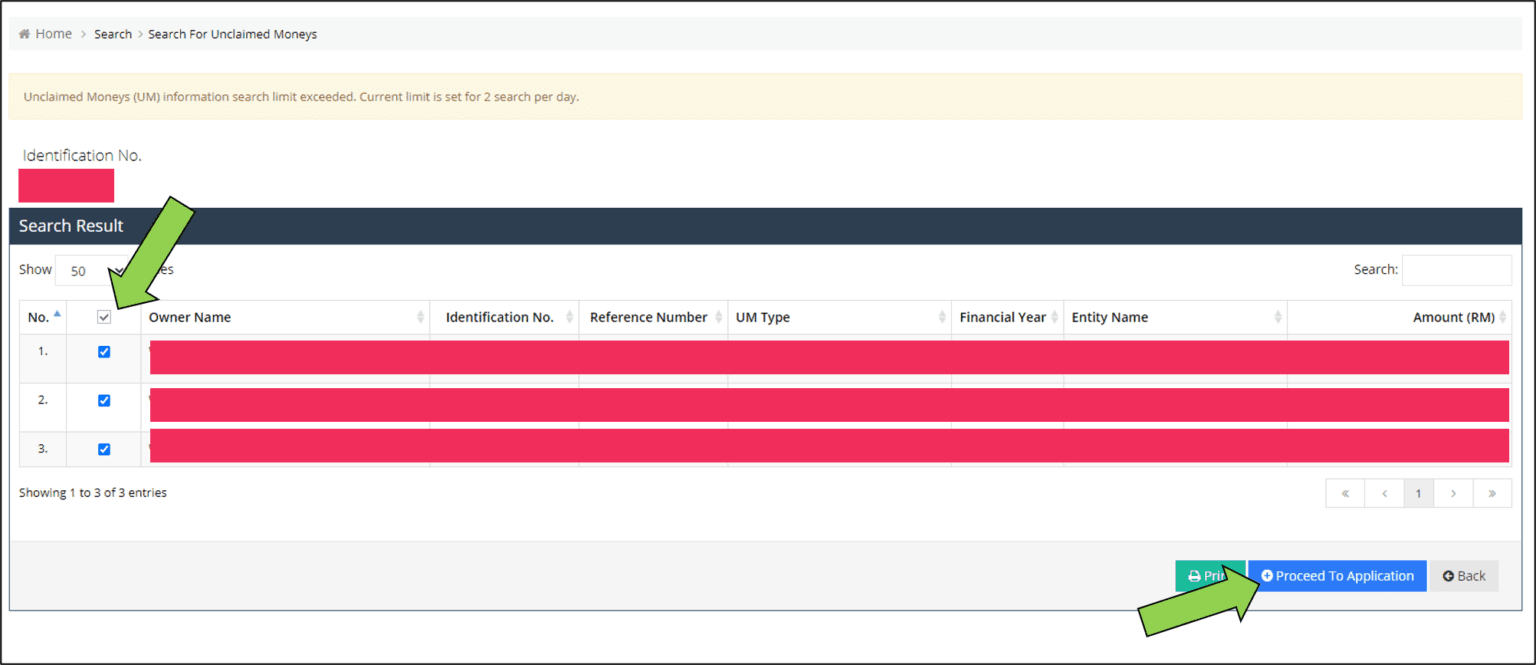
    Don’t click anything other than the following two steps. As the system doesn’t save your search results, if you use up your quota of two searches per day, you have to wait for the next day to proceed to the next step.

    Search Result For Unclaimed Monies

    Select the “check all” box, as I assume everyone wants to claim all their unclaimed monies.

    Select the “Proceed to Application” box.

    Step 4.5: (Workaround) Bug in the System

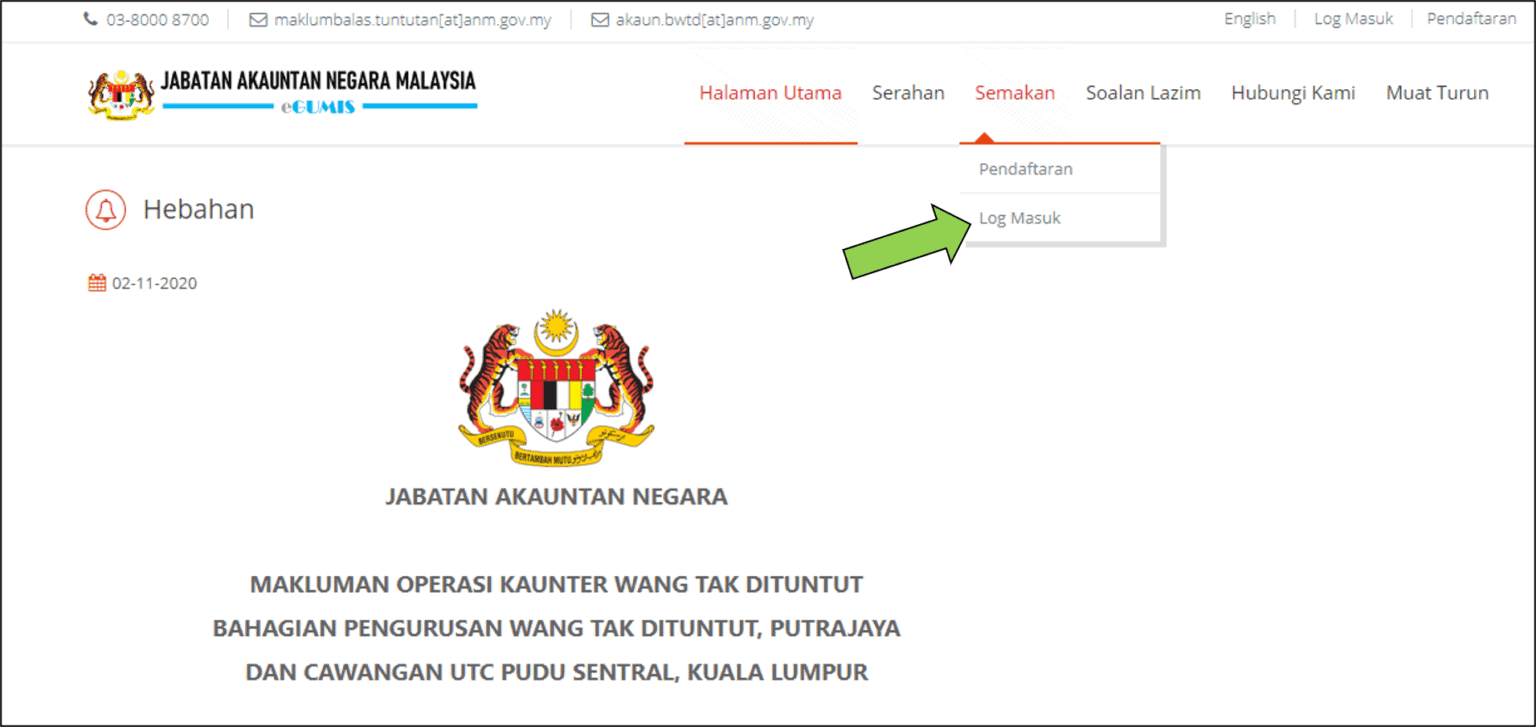
    In my experience, for some reason, there is a bug in the English version of eGUMIS which prevented me from proceeding to the next step. I’ll save your time without boring you with the details; here’s the work around:

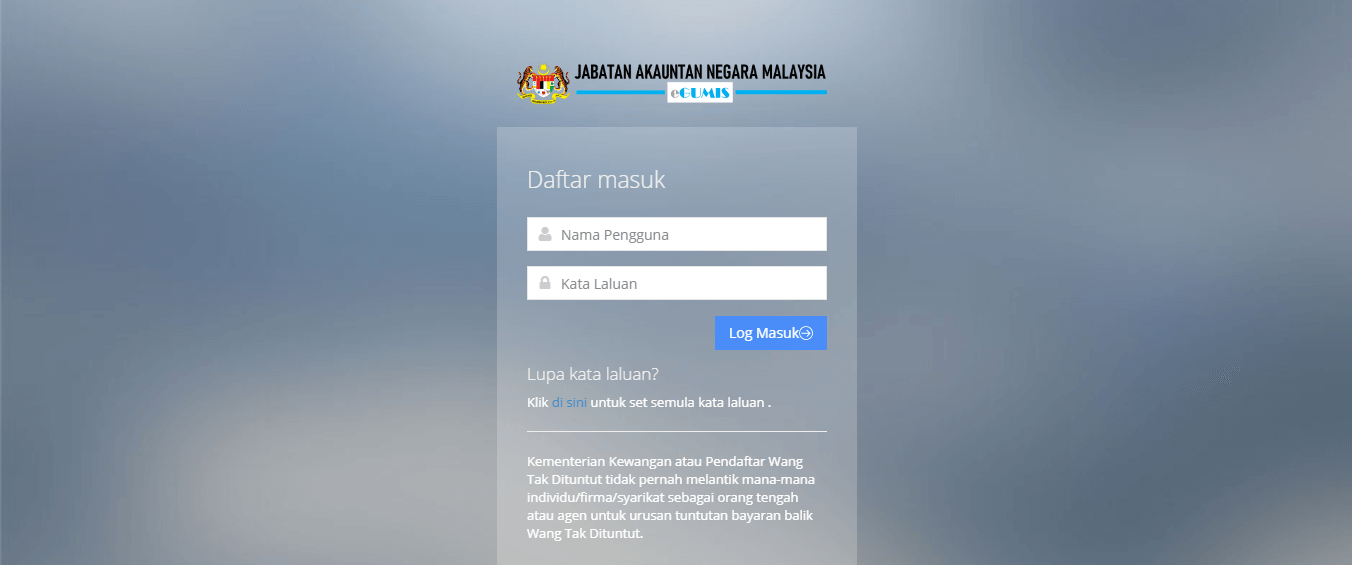
    English eGUMIS login JANM Login Page

    Visit this link and under “Semakan” click “Log Masuk”. This is the Bahasa Malaysia version of eGUMIS.

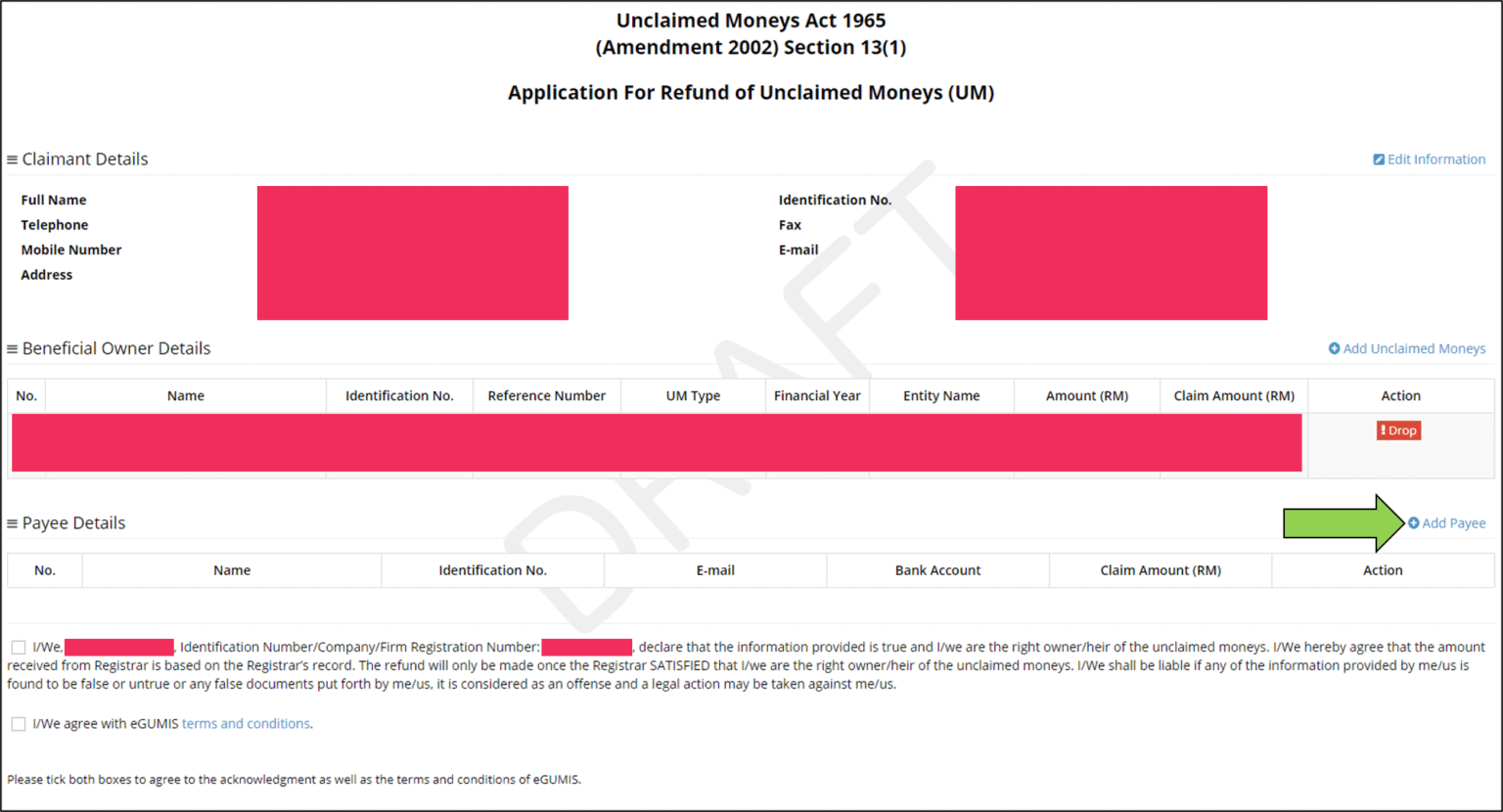
    Step 5: Enter Payee Information

    This screenshot was taken in the English version. In the Bahasa Malaysia version, “Tambah Penerima” is also located in the same position.Enter Payee Information Screenshot

    Once you click on “Tambah Penerima” (Payee), a pop-up will appear and you’ll need to fill in your particulars and bank account number accordingly.

    After you’ve saved the Payee details, check the two boxes below and click on the “Hantar” button.

    Step 6: Almost there

    Once you’ve completed your application, you should receive an email by the AGD. To complete the claim, you are required to submit:

    • A copy of your ID (IC / passport / company certificate)
    • Bank statement (from the same bank that you entered in the Payee column).

    Submit the above document to permohonan_wtd@anm.gov.my with the application number as the email subject.

    (Please be reminded that each email cannot exceed 15MB.)

    Final Thoughts

    Even though there’s no time limit as to when you can claim your money, it’s better to claim it as soon as possible. This is because the Registrar of Unclaimed Money doesn’t pay any interest on the money claimed while your money can be invested elsewhere to generate a return.

    One common reason why money remains unclaimed is because the legal beneficiaries don’t know about the money after the owner passes away. This is especially true if the owner dies unexpectedly. Therefore, it’s good to have a simple will (at the very least) to avoid this scenario.

    Don’t stop at checking your own account; if you have elderly parents or family members, do help them to check as well.

    However, please be reminded that the Ministry of Finance or the Registrar of Unclaimed Money doesn’t appoint any individual/firm/company as agents for the refund of unclaimed monies. Be extra careful if anyone claims that they can help you claim the money.

    This article was originally published at planNERD.

    About the Author 

    Marshall Wong is a licensed financial planner and can be contacted through his website or marshallwong@fa.my.


  • What Is Financial Abuse?

    What Is Financial Abuse?

    Are You Being Financially Abused? What Is Financial Abuse?

    Abuse comes in many forms and one of it is financial abuse.  In a marriage, money is usually co-owned but in many cases, the husband may control every aspect of finances and the wife doesn’t have access to it. 

    If she needs to ask for money, the assumption is that she doesn’t have any access to the bank accounts.

    This can be the case in many situations, especially if the husband is the sole breadwinner in the family, with his income going directly into a bank account that only he can access and control.

    In some instances, the wife won’t have her name on it and will need to ask for money in order to purchase basic household items.

    Other than the fact that she’s in a very dangerous position if anything happens to the husband, the marriage is built on the principle that he is above her in terms of finances.

    He makes all the financial decisions, and then decides if he wants her input while she has no control over it because she has no access to the money. 

    From the beginning, if a marriage is built on the basis that money is “his”, and he’s doing her a favour by letting her have some of it, this is not acceptable in today’s climate.

    Marriage is for two people to come together as one flesh and a partnership, not for one to be fully dependent on the other.

    If your partner is denying you access to finances and is treating it like it’s only “your” money instead of the marriage’s money, that can be categorised as financial abuse. 

    Money as a Method of Control

    The partner often uses money as a weapon to maintain control in the relationship.

    Your partner may assure you that they have it all covered, but the reality is that he or she is restraining you of your rights and potentially robbing you of your freedom.

    Financial abuse in a relationship is often hard to identify considering that the abuse is embedded with complex beliefs and social norms, so it can often go unrecognised by the person experiencing this.

    This robs the woman’s or man’s right to acquire and maintain economic resources, threatening their financial security and pushing them to not be self-sufficient. 

    Types of Financial Abuse 

    1. The controllers – This person uses a combination of abusive behaviours to exert their power over their family 
    2. The exploiters – This person takes all responsibility and also uses all kinds of abuse to financially exploit their partner for their own needs 
    3. The schemers – They have a specific plan in place to steal their partner’s financial resources and leave 

    Research has shown that the traditional stereotypes and attitudes toward gender roles and attitudes make grounds for controlling, exploitative and abusive behaviours regarding finances.

    In most cases, women trust their partner to act in the best interest of their family.

    However, their judgment is often clouded by the belief that their partner knows what’s best for the relationship, resulting in them fully relinquishing all financial responsibility to the abusive partner. 

    It Doesn’t Get Easier After the Separation 

    If the partner decides to leave the abusive marriage, it doesn’t mean that the effects of the abuse stops.

    Studies have shown that their income decreases further and suffers more after leaving their marriage, in addition to being impacted psychologically, whereby they experience a loss of confidence, guilt and also shame. 

    “Each year, more women are touched by domestic violence than breast cancer, ovarian cancer, and lung cancer combined.”

    – Purple Purse, Allstate Foundation 

    How Do I Get Out of a Financially Abusive Relationship? 

    Most of the time, people tend to feel trapped in their position. They stay in an unhappy marriage or relationship out of fear that they can’t afford to feed, clothe and house their children, as a result of having no idea about their partner’s income, or even the assets and debts in their name. 

    The first step to move on is to understand and believe that there are ways to leave this financial abuse in the past.

    It’s so important that you’re mentally prepared and have decided that you’ll do whatever it takes to leave this toxic relationship for that light at the end of this tunnel. 

    Step two is to gather all the information about your finances. Every single detail is needed to take the first steps towards regaining your power.

    The last step is to start planning out your new financial life. Write down all your hopes and dreams for yourself and your future. Think of realistic ways for you to take steps towards achieving your financial dream. 

    The journey is a long one. It’ll be tough psychologically, physically and financially but the earlier you take the necessary steps to gain control of your finances, the better the chances are of you determining your own financial future. 

    About the Author

    Nurul Yahi is a financial enthusiast and you can find her at dearduit.com. You can also find Nurul on Twitter, Instagram and Facebook.

  • All You Need to Know About the PERMAI Assistance Package 2021

    All You Need to Know About the PERMAI Assistance Package 2021

    In 2020, the Malaysian Government announced four stimulus packages worth RM305 billion to keep the economy running against the backdrop of a global pandemic. Coupled with the initiatives under Budget 2021, it was hoped that 2021 would be a year of swift economic recovery given Malaysia’s past success in managing the Covid-19 outbreak. However, record high cases and widespread community infection had necessitated the re-imposition of the Movement Control Order (MCO 2.0) and a declaration of a National Emergency, the first of its kind for the country in this century.

    In response to these new developments, the Malaysian Government has announced the PERMAI Assistance Package worth RM15 bil. This round of economic assistance aims to at provide vital support to businesses and the general public who may be affected by MCO 2.0. Continued cash assistance to selected groups, improvements in the i-Sinar program, tax reliefs for screening and detection, and loan moratorium extensions stand out as key policy announcements to help uplift the ailing Malaysian economy amid this crisis.

    Despite many hoping that 2021 would see a return to “business-as-usual” practices, it seems that greater uncertainties now lie ahead. For now, the only thing that remains certain is that economic challenges remain and may only abate once global vaccine rollouts have reached optimum levels. In the meantime, taxpayers are faced with further economic uncertainties along with questions as to how these initiatives will help them weather this storm.

    Key Highlights at a Glance

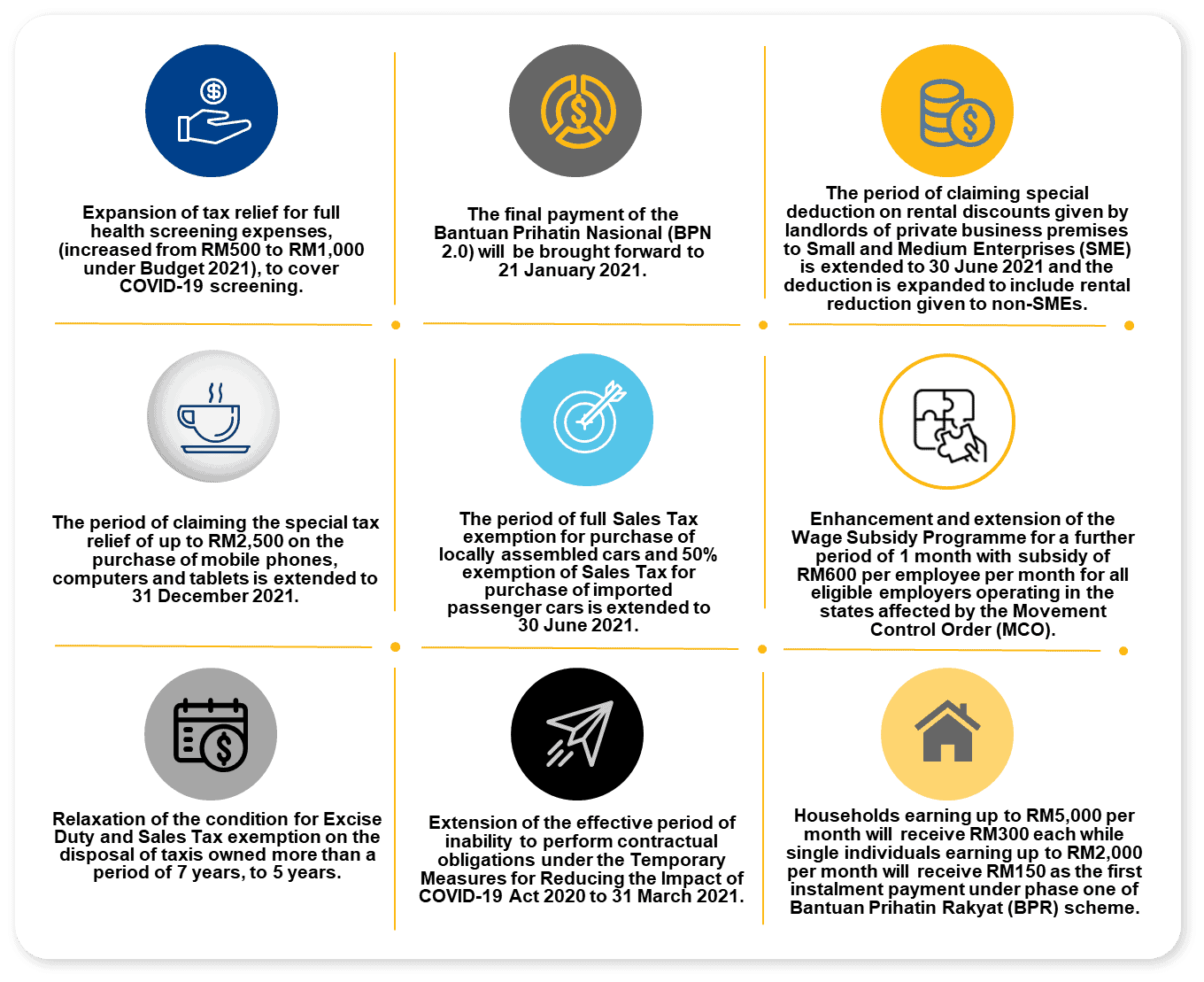
    The focus is on the extension and enhancement of existing schemes that were introduced in 2020, including various tax exemptions and relief, cash assistance. This includes bringing forward the final payment of the Bantuan Prihatin Nasional (BPN 2.0) to 21 January 2021, while households earning up to RM5,000 per month will receive RM300 each, with single individuals earning up to RM2,000 per month receiving RM150 as the first instalment payment under phase one of Bantuan Prihatin Rakyat (BPR) scheme.

    Other highlights include:

    • Expansion of tax relief for full health screening expenses, increased from RM500 to RM1,000 under Budget 2021, to cover COVID-19 screening.
    • The period of claiming special deduction on rental discounts given by landlords of private business premises to Small and Medium Enterprises (SME) is extended to 30 June 2021 and the deduction is expanded to include rental reduction given to non-SMEs.
    • The period of claiming the special tax relief of up to RM2,500 on the purchase of mobile phones, computers and tablets is extended to 31 December 2021.
    • The period of full Sales Tax exemption for purchase of locally assembled cars and 50% exemption of Sales Tax for purchase of imported passenger cars is extended to 30 June 2021.
    • Enhancement and extension of the Wage Subsidy Programme for a further period of 1 month with subsidy of RM600 per employee per month for all eligible employers operating in the states affected by the Movement Control Order (MCO).
    • Relaxation of the condition for Excise Duty and Sales Tax exemption on the disposal of taxi owned more than a period of 7 years to 5 years.
    • Extension of the effective period of inability to perform contractual obligations under the Temporary Measures for Reducing the Impact of COVID-19 Act 2020 to 31 March 2021.

    Image from crowe.com/my

    Employers and Businesses

    In a bid to curb an economic recession, the government has pledged to continue schemes that aim to distribute funds, speed up processes and delay loans. Discounts have also been promised for essential services, with an electricity rebate to all Tenaga Nasional Berhad (TNB) users at a rate of 2 sen per kilowatt-hour from 1 January 2021 to 30 June 2021. Six business sectors will also receive 10% off on their electricity bills from January to March 2021, comprising of hotel operators, theme parks, convention centres, shopping malls, local airline offices as well as travel and tour agencies.

    Other highlights include:

    • Moratorium on MARA loans will be given until 31 March 2021 and MARA will provide a 30% rental discount on business premises for 6 months from November 2020 to April 2021.
    • A guarantee of RM1 billion is given for the Bus and Taxi Hire Purchase Rehabilitation Scheme where a 50% guarantee on financing from hire purchase and leasing companies will be provided for selected buses such as sightseeing buses, and taxis.
    • The implementation of microcredit schemes to micro-enterprises and SMEs that had been announced previously will be expedited.
    • One-off financial assistance of RM500 will be given to tourist guides, drivers of taxis, school buses, tour buses, rental cars and e-hailing vehicles.
    • An allocation of RM300 million is provided to accelerate the implementation of the SME and Micro SME e-Commerce Campaign and Shop Malaysia Online campaign.
    • Enhancement of the Danajamin PRIHATIN Guarantee Scheme with the maximum financing limit increased to RM1 billion and the scope of financing expanded to include working capital with a guarantee period of up to 10 years. The scheme is also now open to foreign-owned companies operating in Malaysia as long as Malaysians make up at least 75% of their workforce.
    • The conditions for the Employment Insurance Scheme program will be relaxed for those who lost their jobs during the enforcement of the MCO.
    • An allocation of RM24 million is provided to fund the full contribution under SOCSO’s Self-Employment Social Security Scheme for delivery riders.
    • An additional allocation of RM650 million is given for the expansion of the Prihatin Special Grant Plus assistance to cover 500,000 SMEs in the 7 MCO states with a payment of RM1,000 each, while 300,000 SMEs in other states will receive RM500 each.

    People

    For citizens, the various allocations are aimed at sustaining the general population, especially those in the B40 and M40 categories, with a focus on essential goods and services that aim to tide them through this trying period of time. RM50 mil will be allocated to the Food Basket Program, which will provide essential food items worth RM100 for each eligible household, while the Employees Provident Fund (EPF) will advance RM1,000 from the amount applied under the i-Sinar Category 2 facility.

    Other highlights include:

    • The free internet connectivity of 1Gb per day initiative will be extended until the end of April 2021.
    • A matching grant with government-linked companies of RM25 million is allocated under the GLIC/GLC Disaster Relief Network for the provision of community assistance to the elderly, homeless, disabled and flood victims.
    • Electricity rebates to all TNB users, both domestic and non-domestic at a rate of two sen per kilowatt-hour, which is equivalent to a reduction in electricity bills of up to 9% for a period of 6 months, from Jan 1 to June 30, 2021
    • Moratorium facility including extension of the moratorium and restructuring of loan repayment will continue to be offered by banks.
    • PTPTN borrowers affected by the pandemic or floods can apply for a 3-month PTPTN loan repayment moratorium and application for this moratorium can be made until 31 March 2021.

    Healthcare Initiatives

    There are several initiatives being extended to frontliners who are tirelessly serving the nation, with funds allocated to healthcare services and personnel in a bid to ensure that the fight against Covid-19 will continue. A one-off payment of RM500 to healthcare frontliners and RM300 to other frontliners will be paid in the first quarter of this year, while the existing special monthly allowance of RM600 to healthcare frontliners and RM200 to other frontliners will continue until the COVID-19 pandemic is over.

    Other highlights include:

    • An additional 3,500 healthcare personnel will be recruited at the end of January 2021 with an allocation of RM150 million.
    • An allocation of RM1 billion will be provided to the Ministry of Health, National Security Council and other relevant agencies for supplies specifically for the healthcare frontliners.
    • An allocation of RM100 million is dedicated for private hospitals to treat Covid-19 and non-Covid-19 patients.
    • RM3 billion is allocated for the Covid-19 National Immunisation Programme.

    Accelerating the Bantuan Prihatin Rakyat (BPR) Assistance

    Bantuan Prihatin National (BPN) 2.0 was introduced by the Government in a special announcement under Kita Prihatin on 23 September 2020. Currently, the amount of assistance channelled under BPN 2.0 is as follows:

    • B40 households – RM1,000
    • B40 single individuals – RM500
    • M40 households – RM600
    • M40 single individuals – RM300
    • The BPN 2.0 payment will be made in two instalments. The first instalment payment was made on 26 October 2020 and the second instalment is expected to be paid in January 2021.

    A similar scheme known as the Bantuan Prihatin Rakyat (BPR) was introduced by the Government in the Budget 2021 to replace the previous Bantuan Sara Hidup. However, information on this payment scheme was not made available during the Budget 2021 announcement. It is proposed that the second instalment payment of the BPN 2.0 will start from 21 January 2021 onwards, but there was no mention on the payment date for BPR.

    Click here to read the full special report from Crowe Malaysia.

    By Crowe Malaysia

  • Asia-Pacific REITs: Past, Present and Future

    Asia-Pacific REITs: Past, Present and Future

    Despite a volatile and unpredictable 2020, it is always important to remember why investors choose to invest in REITs. While they certainly can offer the possibility for price appreciation (or depreciation), stable and predictable income payouts through dividends has been the main historical source of return.

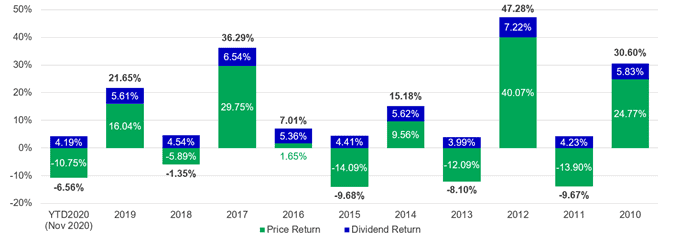
    Chart 1: AP REITs historical payout

    reits asia pacific manulife
    Annual total returns of Asia ex-Japan REITs (2010 –2020 YTD)

    Indeed, over the past 10 years, AP REITs have provided, on average, a 6.8% annualised return; roughly 5% of the total return came from dividend payouts. To put this dividend yield in perspective, Asia (ex-Japan) equity markets offered, on average, a 5.4% total return, with only 2.4% coming from dividends over the same time period.

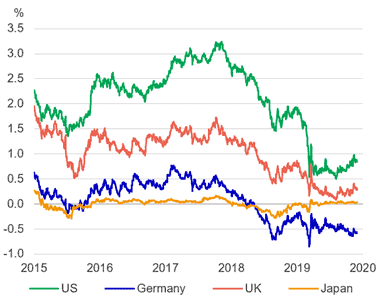
    Despite the notable challenges of the past year, from another perspective, AP REITs historical yield is also attractive in the current “lower for longer” interest rate environment. As Chart 2 shows, developed markets’ sovereign bond yields have steadily declined since December 2015.

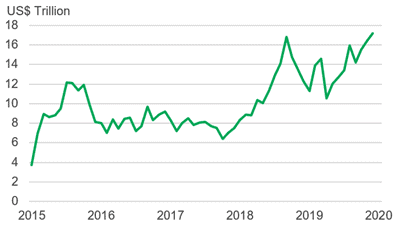
    In some developed markets, bond yields have even turned negative, with the current level of negative-yielding debt instruments near US$18 trillion and expected to climb even further in the near-term.

    Chart 2: Negative yielding bonds

    reits asia pacific manulife
    Developed market 10-year government bonds yields

    reits asia pacific manulife
    Negative-yielding debts size mounted

    While the lower for longer interest rate environment is a headwind for many fixed income segments, it is supportive for REITs due to lower borrowing costs.

    Despite these traditional strengths, 2020 was indeed a challenging year for REITs globally as well as Asia, as the economic impact of the COVID-19 pandemic called into the question the asset class’s predictable history of dividend payout.

    The Past: Early 2020

    The global outbreak of COVID-19 had a varying impact across the sub-sectors of real estate, but initially led many to question the viability of dividend pay-outs in a worsening environment. The worst hit sector globally was retail as a result of national lockdowns and social distancing requirements.

    In contrast, industrial/specialised real estate assets continued to generate stable cashflows and high-income visibility, as the acceleration in e-commerce trends led to stronger demand in warehousing and logistics facilities.

    Many segments of AP REITs have gradually recovered from the economic shock due to unprecedented monetary and fiscal policy measures. Policy responses from governments such as Singapore and Australia have helped save jobs and companies, with some packages totalling up to 20% of GDP.

    At the same time, central banks across the region have slashed rates, with the Reserve Bank of Australia starting quantitative easing for the first time in 2020.

    The Present: End of 2020

    The top priority across all landlords and REITs managers has been to ensure high cleaning/maintenance standards, temperature checks to ensure safety for all their tenants and instil confidence for people to visit their facilities. The pandemic has brought about unprecedented economic impact and all stakeholders in one form or another must bear some pain from it.

    Landlords for commercial assets in Singapore and Australia are mandated to provide rental holidays for tenants who were badly affected by the loss of sales/income. landlords have also offered help in terms of rental commissions, waiver of management fees, lease restructuring to tide tenants through the difficult period.

    We saw suburban retail landlords have also accelerated their digital marketing plans to help their tenants to sell their products online or food delivery services for their food and beverage tenants, with more people working from home, these suburban malls have ramped out digital offering to capture the sales in their neighbourhood.

    The Future: 2021

    Moving into 2021, we envisage the macroeconomic backdrop should gradually improve across the region, with significant dispersion in economic growth across the region.  Despite the economic rebound, we expect that the low interest rate environment should remain a strong tailwind for the asset class. The low cost of borrowing continues to underpin healthy demand in trophy assets across Asia.

    Our base case scenario is that key markets like Singapore, Hong Kong, and Australia should not enter into national lockdowns given policy learnings and experiences. The positive newsbytes on vaccines successes could restore confidence in consumer and corporate spending in 2021.

    Retail landlords should enjoy recovery in cashflows given the low base in 2020 (high rental reliefs) and industrial REITs remain stable with growth boosted from accretive acquisitions.

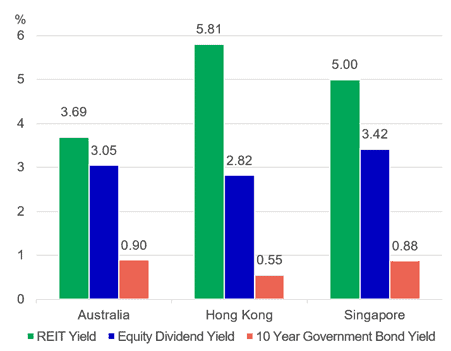
    Based on this base case and favourable macro backdrop, the outlook for yields of AP REITs should remain attractive next year (see Chart 3). Forecasted yield for AP REITs is approximately 5.1% compared to a 2.1% yield for Asian equities. In our view, this payout is expected to remain stable over the long-term, largely due to the strength of the asset class and improved economic conditions.

    Chart 3: AP REITs offer attractive forward yield

    reits asia pacific manulife


    Conclusion

    In our view, the main attraction of AP REITs as an asset class is the stable, sustainable payout of dividends to investors. While this assumption was challenged in early 2020, the response by governments and central banks helped to stabilise the real estate sector. Moving into 2021, we believe an improving economic outlook and continued low interest rates should be beneficial for the asset class.

  • Cultivating Healthy Financial Literacy for Kids

    Cultivating Healthy Financial Literacy for Kids

    “I wish I knew about this earlier. Why were we not taught this at school?” Thus begins the lack of education and awareness of financial literacy in kids.

    Whenever I discuss financial planning and other sub-topics with clients and prospects, this is the most common thing I hear. 

    Have you ever thought about how great it’d be if good money management skills were nurtured in our young ones? And how it’d be even better if we’re prepared to face the challenges in handling money from young? 

    One of the best skills that parents can teach children from a young age is smart money habits. It’s important to impart good knowledge and attitude in handling money during the early years as it’ll shape their attitude towards money as adults.

    Undeniably, this will largely be influenced by parents, peers as well as the media. If their foundation is strong, they’ll be able to rationalise the idea of money and become financially savvy in the future once they become adults.

    However, it’s getting tougher to teach kids about the value of money since we’re firmly in the cashless era now. More and more people are no longer used to paying for things in cash, with more online transactions and card payments used.

    Thus, kids do not see physical money transactions when their parents and people around them purchase goods and services. In addition, with the easy availability of credit today, the need to be able to manage money is even more important.

    So how can we start teaching our kids about good money management?

    1. Start Them Young

    Parents can teach their kids from as early as three years old. Kids at this young age learn through observations so for a start, parents can teach the concept of money by exchanging it for food or toys, which is likely to be their primary interest at such an age.

    2. Value of Money

    For kindergarteners and school-going children, you can start to teach them about the value of money. This is to prepare them since they will need to purchase their own food when at school. At this age, parents must be more involved by instilling confidence in their kids. 

    For instance, get your kids to approach the cashier and pay when making purchases, while you observe.

    To assist when they’re paying to ensure that they can calculate the money to give and balance to receive.

    Provide them with a fixed allowance and rationalise with them by suggesting substitutes if the item they choose is more than what’s budgeted. As a result, you’re also teaching them that not everything can be purchased, and we should spend within our means.

    3. Include Your Kids in Conversations

    When your children are in their teenage years, do include them in conversations when making money decisions.

    You may ask for their opinions and discuss the advantages and disadvantages, repercussions, and rationalisation behind making decisions with regards to financial decisions like buying a car, a television, a phone etc. 

    You can also discuss with them their aspirations for college and the cost it entails. This is important as they will learn that it’s okay and safe to talk about money with someone that they trust i.e. family members.

    In addition, they will feel involved and should develop a sense of responsibility towards money as their opinion is heard.

    As a result, they’ll have more understanding and familiarity about how money works and how better to manage debts.

    4. The 3 Jars System

    Parents should provide a consistent allowance to school-going kids so they can practice handling money and learn how to manage their allowance.

    One of the ways to inculcate a healthy financial mindset is to set up jars that signify a percentage of their money eg. 70% for spending, 20% for savings and 10% for charity or donation. 

    At the end of each quarter, bring your kids to the bank to save the money accumulated and bring them to the charity of their choice to share some of their savings.

    Consequently, you are teaching your kids about sharing with the less fortunate, how to save for their future, and budgeting for spending on what they need and want.

    5. Paint the Picture that Things Can Go Wrong, Sometimes

    Kids should know that sometimes, things will not be in our favour and it’s not always rainbows and butterflies.

    Parents may share with their kids if they’re facing money difficulties and some compromises or sacrifices need to be made by the family. At times like this, where the economy is not as good, most people face pay cuts, unpaid salaries, and even retrenchment. 

    Thus, it is best to layout the expenses that can be dropped temporarily, for example, extra classes like piano, art, taekwondo, swimming etc.

    Do involve the kids in the discussion where some expenses need to be cut off as this will affect them, physically and mentally. Explain to them what needs to be prioritised for the time being.

    In this way, you also teach them that when things don’t go your way, you’ll need to have a mitigation plan in place without sacrificing what truly matters.

    6. Be a Good Example

    Parents should always portray a good attitude towards money in front of children. Avoid quarrelling about money due to overwhelming debts or spending lavishly above your means.

    Talk about money from positive angles and paint money as a tool that can help us achieve what we desire eg. education in the university of choice, to live comfortably within our means, and the freedom to work towards what we want to acquire with peace of mind. 

    Children learn about money from observing you. Thus, parents need to learn how to speak the right money language and develop the right money attitude and skills.

    Children will absorb these money habits from their observation and listening while growing up.

    Your beliefs become your thoughts,

    Your thoughts become your words,

    Your words become your actions,

    Your actions become your habits,

    Your habits become your values,

    Your values become your destiny.

    A famous quote from Mahatma Gandhi

    Kids that are taught good money management skills will have a better chance of making sound financial decisions and not getting into money troubles when becoming adults.

    They’ll also be better prepared to face any challenges in the future.

    As parents, we should discuss openly with kids and share our financial mistakes so that they won’t repeat them in the future (touch wood!).

    Nonetheless, in order to cultivate a healthy financial mindset in our children, we should also equip ourselves with the right skills, knowledge and good money management!

    About the Author 

    Fateen Binti Rosli (IFP) is a Licensed Financial Planner. Her expertise is in holistic financial planning that includes health care planning, children education planning, retirement planning, wealth accumulation and cash flow management. She can be contacted at fateen@wealthvantage.com.my

  • Naluri: Mental Health and Wellbeing

    Naluri: Mental Health and Wellbeing

    As an entrepreneur, CEO and Ironman triathlete, many only see my public persona of strength, resilience and energetic enthusiasm to embrace life’s challenges and opportunities. Hardly anyone knows about the recurring anxiety attacks and chronic stress that can leave me either bed-ridden or feeling disengaged and withdrawn.

    Many do not understand that mental health is just like physical health. Some days we feel physically strong, and other days we become sick – either from an infection that may heal in a few days, or when we are struck with a lifelong or life-threatening disease.

    This can either be from a genetic or inherited condition, or even from being unhealthy from our own lifestyle choices like getting diabetes or hypertension because of poor diet, lack of exercise, smoking and stress.

    Mental health also exists on a spectrum. There’s positive mental wellbeing – when someone is optimistic and curious, focused and resilient, and socially connected. On the other hand, feeling depressed, anxious and stressed is completely normal.

    Most of us can self-regulate and feel better after a few days, but others suffer from clinical levels of depression and anxiety because the triggers that lead to these feelings are either prolonged or so intense that the body can no longer return to normal.

    It is similar to diabetes where consuming a lot of sugar can cause our blood glucose to spike. If it is only occasionally, for example, having a slice of chocolate cake, the body’s insulin hormones normalise blood glucose.

    However, prolonged and excessive sugar consumption impairs the ability of insulin hormones to regulate glucose and that leads to diabetes. Over time as diabetes progresses, it can cause kidney failure, blindness and even death.

    Similarly, other hormones control our mental and emotional state, like serotonin and oxytocin. Prolonged stress and pressure, or even intense trauma, can interfere with the functioning of these hormones, causing clinical disorders.

    Other mental health conditions can be brought about by genetic and biological factors, leading to illnesses like psychosis, schizophrenia or bipolar disorders, just like auto-immune diseases or cancer which affect our physical heath.

    The links between mental and physical health are very deeply intertwined, and there are significant overlaps between these chronic conditions. This can be seen, for example, in the relationship between diabetes and depression, or anxiety and heart diseases.

    Addressing only one aspect without the other may be a partial solution, with lower chances of success. We need healthcare that is more holistic with ongoing support, rather than transactional consultations or prescriptions.

    Seeking support

    So, how do we know if what we are feeling is a regular level of emotional depression or anxiety, or a sign of serious distress?

    Again, parallels to physical health are crucial. We can measure our blood sugar levels or blood pressure, but we still need a trained physician to conduct a comprehensive examination and provide a diagnosis of diabetes or hypertension.

    Similarly, while there are some symptoms of mental illness, it is important for trained clinical psychologists or psychiatrists to provide a proper diagnosis.

    Potential signs or symptoms include feelings of helplessness or hopelessness, loss of interest in daily activities, anger or irritability, insomnia or oversleeping, appetite or weight changes (eating too much or too little), reckless behaviour and unexplained aches and pains.

    Professionals would probe to see if these symptoms persist for about two weeks to indicate the body’s inability to self-regulate, and that the person can no longer carry out their usual tasks and responsibilities.

    The best way to support someone going through these conditions is to get proper professional help and support. Well-meaning friends and family members can be unhelpful because they can be too judgmental or dismissive, e.g. telling their loved one to snap out of it or to pray hard, or by wanting to help ‘solve’ the problem, they add more pressure.

    Unless there is a visible danger where we need to quickly escalate it to medical professionals, the best way to be supportive is to just be there for them in a non-judgmental way, and to validate that what they are feeling is real.

    Avoid asking them why they are feeling that way and avoid telling them that you’ve been through what they are going through. It’s about them, not you. Just be present, either by holding their hand, or offering to help them with any tasks to lighten their burden.

    When they are ready to talk, they will open up to you. Do not expect them to instantly open up just because you want to help them there and then.

    If we are going through these feelings ourselves, there are different actions that we can take. The best is to reach out and get assistance from professionals who are trained to listen attentively and be supportive without judging you.

    One of the organisations you can reach out to is Naluri, which provides clients with a 24/7 telephone helpline as a first level of support.

    There are various ‘first-aid’ actions for someone going through an anxiety or panic attack, in the form of breathing exercises or grounding exercises. These bouts usually last for about 10-20 minutes.

    However, it is important that your mental healthcare professionals help you get to the root issue, define goals and motivations, reframe mindsets and help you focus on the actions that you have control over instead of dwelling on factors beyond your control.

    Now more than ever as we go through the pandemic and resulting economic slowdown, financial pressures are overwhelming for many. Through Naluri’s quantitative approach, we have seen a 30% increase in depression and anxiety after the lockdown and movement restrictions.

    This is even higher when we narrow it down to young millennials, typically in the 21-30 age group. A traumatic event such loss of employment or even bankruptcy can even escalate to financial post-traumatic stress disorder (FPTSD), which is now its own mental illness classification.

    From a preventive perspective, just like going to a gym to get physically fitter, there are various daily exercises that we can perform to sharpen our focus and concentration, and build our optimism, resilience and curiosity mental muscles.

    The challenge lies in avoiding over-reliance on specific short-term actions or ‘hacks’ readily available on the web, and to find sustainable support and coaching to embed these as regular habits so that they do not die off after a few days. Prevention, after all, is much better than cure.

    About the author

    Azran Osman-Rani is the CEO of Naluri, a Malaysian digital health technology company.

  • P2P Financing: The Next Frontier of Retail Investment?

    P2P Financing: The Next Frontier of Retail Investment?

    The new year always brings with it hope and a positive outlook for a fresh start. This is especially true for those with investments and other financial goals that they want to achieve. With the Covid-19 pandemic showing no signs of letting up, many retail investors dove into the stock market headfirst, snapping up trending stocks like hotcakes and selling them equally fast when the tides began turning.

    Alternative investments like robo-advisors, cryptocurrency and peer-to-peer (P2P) financing have also proved popular, with many attracted by the higher risk, higher reward model offered by these financial products. This is a point not lost on Wong Kah Meng, the co-founder and CEO of Funding Societies, a P2P financing platform that connects retail investors to SMEs.

    “The top concerns facing investors when it comes to making investment decisions include low returns, long investment tenure, and being a research-intensive process,” he says.

    “P2P financing platforms such as Funding Societies mitigate these concerns. For instance, investors on our platform can easily invest in local SMEs across various sizes and industries and earn higher risk-adjusted returns through SMEs.”

    The low barrier to entry means that such platforms are easily accessible to retail investors, where investors as young as 21 years old can get started on their investment journey from as low as RM100. Users are also urged to diversify their investment portfolios in order to spread the risk across multiple small-medium enterprises (SMEs); it is for this reason that Funding Societies adopted a low minimum investment, so investors can diversify across multiple notes.

    This follows the age-old rule of not putting all your eggs into one basket. Although default rates are currently low, the chance of an SME failing to fulfil obligations to investors remains due to market risks such as unemployment rates, interest rates and economic recession.

    The company helps to facilitate this diversification by offering a range of investment products. These include business term financing, accounts payable financing, accounts receivable financing, and dealer financing.

    P2P Financing Performance to Date

    Having first launched in 2017, the P2P financier has come a long way in a relatively short time. To date, it has disbursed over RM500 mil in Malaysia and over RM5 bil regionally while maintaining a low default rate of just 1.4% to date. Although default rates were below 1% prior to the Covid-19 outbreak, the current number is lower than the 2.3% default rate back in 2017.

    Such numbers bode well for the future, especially with retail investors turning to alternative investments in greater numbers. However, Wong believes that education remains the foremost priority to establish P2P financing as not just an alternative investment, but a legitimate financing and investing platform.

    “To this end, we are still pushing for public education through participations in financial literacy seminars and industry conferences with the aim to drive thought leadership, not only in Malaysia, but also across the Southeast Asia region that we operate in,” he says.

    Business Enablers, Economic Catalysts

    While the barrier to entry is low for retail investors, Funding Societies holds the SMEs seeking to raise funding on their platform to a higher standard. Businesses come in all shapes and sizes from all segments, but the one thing they all have in common is strong credit history.

    “80% of financing deals agreed are for a tenure of under six months as we focus on transaction-based financing, which is less risky,” says Wong.

    The shorter turnaround time allows investors to get returns quicker while also balancing the amount of risk in the disbursement of funds. This is reflected in the breakdown of SMEs, where businesses specialising in wholesale and retail trading make up the majority of funding seekers on the platform, which also highlights the make-up of the overall Malaysian economy.

    The Keys to Success

    While every investment carries some form of risk, Funding Societies aims to help mitigate the risk posed to investors as much as possible. Its market-leading auto-investment algorithm was introduced as far back as 2017,
    sharing similarities with robo-advisors in that users can easily spread their investments across multiple SMEs that fit their risk profile.

    “Over 70% of investors have autobot set up for their account. It helps to queue on your behalf to execute investment opportunities based on parameters you set,” says Wong.

    This comes in handy for investors that are busy with day-to-day activities and have no time to monitor all aspects of cash deployment, making it much more than just another fancy feature.

    However, he is keen to stress that the platform also wants to ensure that investor awareness is at the highest level possible, with a detailed fact sheet provided for all SMEs seeking funding that includes a history of financial statements, write-up on the company, and risk assessment of the investment opportunity presented to investors.

    “The fact sheet is available to all investors before the start of any crowdfunding. This is to ensure investors have sufficient time to study each investment opportunity and make an informed decision,” he added.

    Alternative investments have long been championed as financial products of the future, but the Covid-19 pandemic is bringing them into sharp focus ahead of schedule. In the case of Funding Societies, the rate of user adoption was not stunted during this time and continued to grow, albeit at a slower pace.

    “This shows how investors are now skewing towards online or digital investment platforms, such as P2P financing,” says Wong.

    An impressive track record only serves to back up his claims, and being registered with the Securities Commission Malaysia also gives the platform credence among its users which include retail, high net worth, and institutional investors. It also helps that the majority of its users are on the younger side, with 80% under the age of 40. With all the progress made so far, it is not far-fetched to say that Funding Societies has arrived and is very much here to stay!

    By Caleb Khew