Blog

  • Life Lessons Learnt From Investing

    Life Lessons Learnt From Investing

    Investment has been a big part of my personal finance journey. And with that, there have been a lot of life lessons learnt from investing

    There are so many things we can learn about investing in modern society (share market, private equities, debt, commodities, properties, mutual funds, derivatives, robo-advisors, crowdfunding, digital assets, etc) that it seems far-fetched to ever think of mastering them all.

    One of the things I was mulling on was the similarities between investing and life itself, while it was interesting to see that how we invest tends to reflect how we live our lives. Here are five life lessons that I’ve observed from my own investing journey.

    1. Hard Work Pays Off (Eventually!)

    All seasoned investors know that proper analysis is key to successful investments. Although all investment comes with risks, it’s important to make sure that the reward is worth the risk taken.

    If you want your long-term investment to pay off in the end, you must put in the work to ensure that:

    • Your investments is aligned with your investing principles
    • You’re comfortable with your asset allocation and not taking on too much risk
    • You know exactly what investments we are entering into (e.g. equities, ETFs, robo-advisors, StashAway Simple, ASNB funds, mutual funds, etc)

    Similarly in life, you work for what you want. Successful people don’t get to where they are overnight. It takes years of hard work, building the foundation in knowledge and experience, to eventually master something in life.

    An important caveat is that the effort put in must be something that contributes to the goal or the hard work will be worthless.

    This is like looking to invest in property but analysing the materials used to build the place. Not exactly useless, but definitely pointless for the purpose of an investment property!

    2. Diversification vs Focus

    All investment professionals mention the need to diversify your investments. It’s a valid argument for you to distribute and lower your risk across different assets.

    If one asset class/industry drops in value, your other investments can help to alleviate the damage.

    However, the counterargument to that is that your returns are also muted in conjunction with lower risks.

    If you had the power to accurately predict the movements of your investments this year (and no one does!), wouldn’t you have focused on glove stocks in May 2020 which saw 3x – 5x growth in only four months? Of course, the risk is that you may also have lost all your capital if this didn’t work out. Is it worth it?

    We are also often faced with the same in other aspects of life such as:

    • Studies (double/triple degree, ACCA, doctor, law, psychology etc.)
    • Career path (work and side hustle, or go all-in and start a business)
    • Employment (stay in one job for a long time or continue job hopping)
    • Skills (master a single skill or learn multiple skills)
    • Holiday (save and go somewhere far and exotic, or go on several cheaper trips nearby)

    3. People Will Talk, Regardless

    In investing, all market news and announcements are met with either a positive or negative view. Short-term traders will trade based on news, whilst fundamentalists will always look at the news with a long-term view in mind.

    As long as an investor believes that negative news will not affect his long-term prospects, then noise in the market from forums, news and analysts will be ignored.

    Conversely, even if positive news keeps pushing prices higher, the investor will assess the company based on his / her gauge to ensure that the investment remains sound.

    In life, all decisions you make will be met with judgmental eyes and “advice” from family, friends, colleagues, or even people you’ve just met! It takes a lot of mental discipline to shut out the noise and focus on what you want to do in life.

    Remember, even if you get “advice” from others, ultimately you are the one that decides what action to take.

    4. Be Clear on Your Goal and Know When to Cut Losses

    When investing, you should know the reasons behind why you bought into a particular asset, share or business.

    Each investment carries their own goals, be it for capital preservation, income generation or capital gains. Keep your eyes fixed on the goal. If the investment turns sour, cut your losses and move on to the next.

    The epitome of this is when you discover your purpose in life and focus all your energy into achieving it. Of course, we plan for things we want to achieve in life and go for it a little at a time.

    For example, building an emergency fund, accumulating your first RM100k, getting the next promotion at work and so on.

    On the other hand, you also need to acknowledge when you’ve given it your all and things just don’t work.

    Knowing when to cut losses is a valuable skill in life to save time to work on something more worthy. I’ll be the first to acknowledge that I’m very bad at cutting losses when it matters, meaning I usually suffer more than I should! 

    5. Luck is a Factor of Success

    The Roman philosopher Seneca famously said “Luck is what happens when preparation meets opportunity”.

    Whilst the majority of life and investments hold true to tried and tested principles, I believe that there is a part where luck is purely just that… luck.

    In investing, you don’t control market movements. It’s made up of various different gears (business direction, scandal, market makers, insider movements, retail investors, traders, fund managers, etc) that are set into motion every time the market is active. In most cases, you invest without knowing which way the market will go.

    By pure luck, if the gears decide to move in your favour, the prices will move in our estimated direction earlier than expected. 

    It’s similar to other aspects of my life which I attribute to pure luck:

    • When my speaker broke down and I happened to have enough credit card points to get a new one
    • The time when I wasn’t able to stay in Australia after graduation but managed to land a decent job in Malaysia
    • Surviving a major car crash due to driver fatigue
    • Landing a dream job but having to put up with a terrible boss

    Some may call it attraction or guidance by a higher power of sorts.

    All in all, I’d say it’s luck and it plays a big part in our lives to get us around. So don’t be too down on yourself if luck isn’t going your way – the tide will eventually turn at some point!

    About the author 

    This article was originally published at betweenthemoney.com, a personal finance website by Jason Loh that focuses on money matters and investment topics for Malaysians.


  • Does Money Make You Happier?

    Does Money Make You Happier?

    Is there something that we’re afraid of talking about?

    YES. We’re all afraid to talk about money.

    We were taught and trained to be polite when talking about personal finances. Most of us feel awkward when we’re approached by someone to talk about it, and tend to be alert and sensitive when asked about our personal finances.

    This taboo in treating money as a touchy subject hinders people from learning about it.

    Despite this, many young people nowadays turn to social media to learn about making money, growing money and many other money-related issues.

    There is nothing wrong with this, only the potential consequences of your actions thereafter. Most of these money questions on social media lead you to take some form of action.

    As a result, you might have SKIPPED and MISSED the opportunity to understand your relationship with money and your purpose of money.

    To gain a different perspective, you should ask the following questions:

    1. What does money mean to you?
    2. Does money make you happier?
    3. What have you done to grow your happiness by leveraging on money?

    What is Financial Happiness and Why is it Important?

    Finnian Kelly, the financial happiness expert, defines Financial Happiness as a philosophy and a practice that guides you into an intentional relationship with money.

    With this intentional relationship, you can unlock the financial confidence to enjoy your life NOW while also feeling excited about your big vision and plans for your future. 

    Managing money can be simple. Most of the time we merely focus on how we earn it, save it, invest it, and protect it. Nevertheless, the underlying purpose – happiness, is in actual fact the ultimate factor that motivates and drives us to work better in these areas.

    In life, we spend money and put in time and effort to pursue happiness. According to psychologists David Myers and Ed Diener, there is a scientific correlation between money and happiness.

    From a data-driven perspective, money can buy happiness, but only up to a certain point. In reinforcing this, happiness economics studies in various countries by leading economists also led to similar conclusions.

    This perspective is compatible with what was suggested by Tal Ben-Shahar, professor of the most popular course at Harvard, “How to Be Happier” who describes happiness as the ultimate currency. With the progress of the times, Financial Happiness is becoming a trend.

    Principles to Achieve Financial Happiness

    Good information alone will not drive you towards Financial Happiness; you need to take action. Here are a few general principles to practice towards this goal:

    1. Focus on habits that increase your financial happiness

    • Keep your eyes on small expenses – building good spending habits are important but it is more practical to increase your awareness on small expenses incurred, for example the supposedly RM1 unlimited premium music subscription fees. Small leaks will sink a great ship, so stay alert on small purchases that can eventually help you save a big sum of money.
    • Grow your personal capital – resources such as time, energy, talent, network and money represent your personal capital that are vital in your wealth building process. Most of the time, you’ll start by trading time and energy for money. With time and better exposure, you’ll probably have more options. Your wealth creation journey can be easier if you can identify important and meaningful resources to grow and sustain yourself from an early age. So take action now to develop your blueprint to build, expand and manage your personal capital required for long term wealth building.
    • Connect with your inner self – a profound body-mind interconnection is crucial. Maintaining physical and mental health will enhance your abilities and strengths. Once your relationship with your inner self improves, your relationships with nature and people around you will strengthen as well. 

    2. A happy present leads to a happy future

    Dwelling on the past will affect your achievements in the present and failing to concentrate your efforts on the now might affect your future happiness. To have a balanced orientation in life, you must embrace your past, present and future. 

    • Don’t underestimate what you can do TODAY – big things have small beginnings. You must discipline yourself to focus on practicing the habits mentioned above. Your persistence will determine your future.
    • Don’t be too optimistic about the future – many only start thinking about financial planning at a later age and are optimistic that the future will bring a better job or better income. However, no one has a crystal ball to see what the future holds. As such, you should take action now and do the best you can, and select the best options available to you right now.

    3. Establish ‘financial goals’ as a positive strategy  

    Never be afraid to speak out about what you want – all of us know what we actually like and dislike; what we want and don’t want.

    The reason less people speak about it is because many are scared of knowing what is needed of them to fulfil their wants. It’s always good to establish specific “financial goals” and use them as your yardstick for future success.

    4. Stay curious, stay simple

    Curiosity and simplicity are the keys to happiness. Curiosity allows us to explore new opportunities while simplicity keeps our thinking process grounded. People prefer simplicity and are always looking for easier ways to achieve what they want.

    The simplest way to practice this is to always stay alert to new information, find out more by asking appropriate questions and make simple decisions as we go along the way. Connecting curiosity and simplicity in your financial matters will lead you to more possibilities and an easier route to achieve Financial Happiness.

    5. Balancing egoism and altruism

    Proper discovery about yourself and your own values will empower you to continue to create value for others while not sacrificing your own position.

    Uphold the principle that the more money you create and accumulate, the more you will be able to benefit others. This will streamline your decision-making process and add more value to those around you.  

    So, if your peers are searching for ways to grow wealth or are seemingly successful, don’t jump to the conclusion that they’re doing better.

    All of us deserve a unique financial journey. So does money make you happier? Ultimately, your small steps today will lead you closer to the Financial Happiness that you dream of. For easier practice, you might want to start practising from top to bottom and you will realise the importance that these principles should rank bottom to top once you successfully adopt it!

    About the Author

    Jess Hon is a Licensed Financial Planner and can be contacted at jesshon@finwealth.com.my.

  • 5 Ways To Protect Your Family Through Responsible Financial Planning

    5 Ways To Protect Your Family Through Responsible Financial Planning

    Every single breadwinner works hard for the family, regardless of stress at work or business. We work to raise up our family’s standard of living and to provide for our children’s education, retirement and legacy. The importance of financial planning is just like the importance of car maintenance. It keeps your car in good condition and helps it last longer. Similarly, this is how you’d protect your family through financial planning. With that, here’s a family financial planning guide to get you started:

    1. Get the Right Type of Insurance

    Many are being encouraged to sign up for different policies with fancy features. How do you identify what is necessary and what is excessive during financial planning? Let’s look at some examples: 

    • Medical insurance with an annual limit of at least RM1,000,000
    • Critical illness insurance to supplement the limitation of medical insurance and replacement of lost income
    • Life insurance policy which can settle all debts and provide living funds for your family

    Is there a difference between an assured sum of RM100,000 and RM500,000 on your critical illness or life insurance? Let’s assume your annual income is RM60,000 (monthly income RM5,000):

    Scenario 1:

    RM100,000 paid out in the event of diagnosed critical illness or death can barely match your income for 1.5 years. Alternatively, you could place this last source of income RM100,000 in a fixed deposit with 2% interest per annum as your “passive income”.

    Scenario 2:

    RM500,000 paid out in the event of diagnosed critical illness or death could match your income for 8.5 years (RM500,000/RM60,000) or you may invest RM500,000 in any form of investment with a return of 10% per annum as your “passive income”. You have more investment choices to generate passive income instead of just placing it in fixed deposit.

    Capital

    Return on Investment (ROI)

    Annual Income

    RM100,000

    2x

    RM2,000

    RM500,000

    10x

    RM50,000

    Using the formula above, the more you earn, the more you need to protect your family with a 10x return on your annual income when considering life and critical illness insurance.

    2. Diversify Risk on Asset Classes

    Are your assets spread out across the business, fixed deposit, insurance policy, shares and unit trusts, properties and single currencies? What is your allocation between liquid (easy to sell) and illiquid (difficult to sell) assets? I recommend that you try to maintain a 50:50 ratio to ensure flexibility. These are important questions that must be asked during financial planning.

    For example, many fall into the trap of buying too many properties which limits your liquidity and may affect your cash flow in the event of an emergency like Covid-19! Nobody could’ve predicted this pandemic, and many have struggled to liquidate assets like properties. It’s safe to assume they would not be in such a tough position if they had previously stuck to the 50:50 ratio and assessed their financial standing prior to taking on these long-term commitments.

    3. Assess your Dependency Risk

    Do your earnings heavily rely on active income? Are there investments that can generate passive income? Do you have cash in hand to last for 3-6 months of household expenses in the event that you lose your job? Financial planning will involve assessing these areas of concern.

    If you run a business, does your company have enough cash to cover 3-6 months of overhead costs? Is there a dependency risk on a few customers or suppliers? You may feel the impact during a crisis, with many businesses affected which can trigger tensions linked to credit terms and suppliers. Eventually, all these dependent risks could lead to the winding up of your company.

    Whether you are an employee or entrepreneur, always consider your dependency risk before buying or investing in anything.

    4. Writing a Will or Setting Up a Living Trust for Family

    Unfortunately, most people don’t prepare for sudden death or being admitted for surgery. I’ve received a few emergency calls to write a will for parents in a critical stage. Some couldn’t even sign off on their will due to being in a coma or passing away before the will was ready for signing. This led to assets being frozen during the estate clearance while the family was left waiting for funds to carry on with their lives!

    Another example of a worst-case scenario is if both parents die prematurely in an accident while their kids are still under the age of 18, which makes estate distribution even more complicated. Who will be your estate executor? How well will he/she manage your estate fund for your kids? Is there a chance that your estate could be compromised by bad actors? These scenarios are unlikely, but demonstrate the need to set up a living trust on top of writing a will during financial planning in order to protect your family. This ensures your family receives a fixed amount for living expenses and children’s education.

    Structured distribution will also ensure that the funds are not spent all at once. For instance, can you imagine what the average 18-year-old would do if they inherited RM1,000,000? There’s a good chance it’d be spent on travel, a luxury vehicle, and just living the good life. Setting up a living trust mitigates this risk and ensures that funds are distributed in a timely and sensible manner.

    5. Engage a Licensed Financial Planner

    You don’t need to be loaded to engage a professional in financial planning. You can expect your assets to be well planned, allocated and distributed, as they would know everything about your financial standing. From your risk profile to your family relationship chart, he/she will draft a customised financial plan for you from A-Z!

    More importantly, dealing with one licensed financial advisor who is professionally qualified, independent and unbiased is better than dealing with many different agents who may prioritise selling their financial products instead of your financial health! After all, you’re not just doing this for yourself, but to protect your family.

    About the author

    Jordan Peh Kian Hong (FAR CMSRL RFP B.BA) is a FA Director, Licensed Financial Planner and Bank Negara-approved Financial Adviser Representative with approximately 20 years of experience in financial services. He can be contacted at jordan@yesfinancial.co

  • To Withdraw or To Not Withdraw: EPF Account 1

    To Withdraw or To Not Withdraw: EPF Account 1

    Since the beginning of the Movement Control Order (MCO) in Malaysia, we’ve seen how the COVID-19 pandemic has affected countless individuals and businesses.

    The government has done their part to inject assistance and stimulus, and there’s also been the enabling of EPF Account 2 withdrawals via iLestari, which has now been expanded to Account 1 via iSinar.

    From the perspective of a working professional, I understand why industry leaders are discouraging Malaysians not to withdraw their retirement savings.

    However, from the perspective of a layman, if a withdrawal means I can ensure my family will have a roof over our heads, meals on the table, education and other basic necessities taken care of, why not right? After all, it’s my money anyway.

    Whether you are considering to withdraw or not, here are four tips to help you navigate these trying times:

    1. Review your Cash Flow and Debt

    Sort your debt from those with the highest rate of interest down to the lowest. If credit card debt at 18% interest yearly is weighing you down, speak to the bank about converting the credit card debt to a term loan.

    If you have another credit card that you’re not using, consider doing a balance transfer and split the payment to a maximum of 12-month instalments.

    Calculate and see which works best for you and your cash flow situation.

    Either way, it’s still a better option than being stuck as you’ll pay less than the default 18% interest yearly.

    2. Maximise the Returns of your EPF Withdrawals and Savings

    Do a forecast from January to June 2021 to see how much you are short of. Trim the expenses you don’t need.

    If there’s a surplus from the EPF withdrawals or other savings, reinvest the funds back into investment platforms that yield a higher return on average than what you can expect from the EPF. Always make your money work for you.

    However, if this is not an option, do leave your retirement funds in your EPF account as their average returns are still much better than fixed deposit and savings accounts.

    3. Get a Professional Financial Planner

    There are over 1,000 licensed financial planners in Malaysia. It might be prudent to reach out and see how they can help you with your financial dilemmas.

    Sometimes, viewing an issue through the lens of a third party can give you alternative perspectives that you may not have thought about previously.

    If you do decide to withdraw from your EPF Account 1, be sure to work out a plan to replenish the amount you have taken, instead of just waiting for future salary deductions to do the job.

    4. Innovate and Create

    Tap into your inner strength and discover your talents. Turn it into a side hustle and create additional sources of income.

    Withdrawing your life or retirement savings should not be the only strategy for survival. A pilot I know is now a Certified KonMari Consultant, while an oil and gas practitioner has turned to freelance copywriting.

    What about you?

    Covid-19 has shown us that things we used to take for granted can change in the blink of an eye. What used to work has now been replaced by the new normal.

    Perhaps this is the season to recalibrate ourselves and enter the season of transformation. Trust that the pain we are all going through has a purpose and allow the wisdom to guide us towards a breakthrough.

    You will survive this. Have faith.

    About the Author

    Aisya Rahman is a Financial Advisor and Islamic Financial Advisor, approved and licensed by Bank Negara Malaysia and the Securities Commission Malaysia. She can be contacted at aisya@harveston.com.my or her website.

  • Financial Planning for Fresh Graduates

    Financial Planning for Fresh Graduates

    Congratulations on your recent graduation! You are now entering into another exciting stage in life as a fresh graduate and are ready to start building wealth. This is just like building your dream house. Let’s start with financial planning for fresh graduates.

    You have to start building a strong foundation, so that your wealth is solid and stable. Here are three steps you can take to start your journey:

    1. Change Your Money Management Mindset

    Wealth accumulation is all about having the right mindset in terms of money management. Let’s start by accessing your way of handling money.

    Equation 1

    • Income – Saving = Expenses  

    Equation 2

    • Income – Expenses = Saving

    Which equation do you apply in your life? Your answer will reveal where your PRIORITY lies in managing money. In equation 1, you prioritise SAVING before spending. In equation 2, you prioritise SPENDING before saving. Eventually, you might end up saving nothing.

    For you to accumulate wealth, you have to pay yourself first every time you receive an income. It’s recommended to start saving (and investing) at least 10% of your income, and then gradually increase this percentage to 30% and beyond as your income continues to grow.

    The secret to wealth accumulation is all about spending below your means, saving and investing your money, and to continue repeating this with every pay raise you get!

    However, why are people prone to spend first instead of saving money? We are living in a digital era where our decisions and behaviour are easily manipulated via social media marketing, without us even realising it.

    I bet you can relate to the following scenarios:

    • When the latest technology gadget is launched, you are magnetised to purchase it to keep up with the trend
    • After viewing your friend’s Instagram story, you might make an impulsive decision to book a flight ticket for vacation
    • You are spending, dressing, behaving in certain ways to impress others

    The above scenarios are examples of social validation. We’re social animals and will do whatever it takes to belong to a social group. Therefore, you are likely to spend your hard-earned money just to keep up with trends and stay updated among your peers.

    Realising your worth is more than your social appearance can help in breaking social validation patterns. Sit down and think about who you really are and what defines you. Once you’ve cleared this up, you’ll start to make better decisions for your financial and mental health.

    2. Build An Emergency Fund

    Emergency funds are a financial safety net for unexpected events like losing your job. Not having a financial cushion might lead you into bad debts such as personal loans and credit card defaults. The biggest enemy of wealth accumulation is bad debt, because it is impossible for you to accumulate wealth while serving high interest bad debt.

    According to the RinggitPlus Malaysian Financial Literacy Survey (RMFLS 2020), 53% of Malaysians would not be able to survive for more than three months with their current savings. What will happen to them after exhausting their savings?

    The Covid-19 pandemic has put the importance of emergency funds firmly in the spotlight, so it’s important that you build up your own in order to survive unexpected events. But how big of an emergency fund do you need?

    If you are single with no dependents, aim to prepare an emergency fund with at least six months of monthly expenses. For example, if your monthly expenses (loans, food and beverages, transportation, accommodation, insurance, etc) is RM3,000, you should have at least RM18,000 on hand at all times.

    If you have dependents like your parents, spouse, or kids, prepare an emergency fund that can cover at least 12 months of expenses. Let’s say your loans and living costs total RM5,000 each month – this means you should have RM60,000 available in case of emergencies.

    3. Risk Management

    Life does not come with guarantees. The Covid-19 pandemic has shown us that anyone is vulnerable. Accidents can happen. Health issues may arise due to lifestyle choices, stress, and family history. When something unexpected happens, the last thing you want to worry about is money.

    In order to protect and grow your wealth, you need to mitigate your risks. Generally, there are a few types of insurance that’s advisable to have, depending on your situation. 

    Types of Insurance Purpose
    Medical Insurance Pays for your medical bills
    Critical Illness Insurance Lump sum money payable to you upon diagnosis of critical illness.
    Acts as income replacement
    Life Insurance Lump sum money payable to your beneficiaries upon death. 
    This is especially for those with dependent (parents, spouse, kids)
    Disability Insurance Lump sum money payable to you upon disability.
    Acts as income replacement

    By following the three steps above, you’re well on your way to building the right foundation in wealth accumulation. Once your foundation is solid, the next step is to understand and set your wealth accumulation goals like house purchase or retirement, as well choosing the right strategies and solutions to achieve your goals. However, Rome was not built in a day; be patient and take your wealth accumulation journey one step at a time!

    About the Author

    Kuah Soo Yee is a Licensed Financial Planner (CFP) who is passionate about helping people make sound financial decisions and achieve their financial goals. She can be contacted at soo.yee@ipp.com.my

  • Review: 5 Things We Learned about Luno Malaysia

    Review: 5 Things We Learned about Luno Malaysia

    Recently, Luno Malaysia held a virtual media conference to reflect on a year of operations since its relaunch in Malaysia, sharing its achievements to date and plans for 2021.

    Having originally entered the market back in 2015, it quickly became the platform of choice for Malaysians to purchase and trade bitcoin, before being forced to suspend operations while being audited by the Securities Commission Malaysia (SC). After securing approval, it relaunched in October 2019 and has gone from strength to strength.

    Here’s five things we learnt about the digital asset exchange (DAX) during the presentation:

    2020 Was a Stellar Year for Luno Malaysia

    According to Luno Malaysia Country Manager Aaron Tang, the DAX has processed a cumulative total of RM827 million since its relaunch.

    It also claims to hold approximately RM165 million worth of digital assets on behalf of their customers, spread across Bitcoin (BTC), Ethereum (ETH), Ripple (XRP) and Litecoin (LTC).

    LUNO relaunch in Malaysia
    Luno relaunched in Malaysia back in October 2019.

    These figures clearly show that there is a healthy demand for cryptocurrencies in Malaysia. According to Luno, 68% of its users buy cryptocurrencies for investment purposes, while 10% conduct trades on the platform, and a further 8% use it for sending and receiving cryptocurrencies.

    Luno is the Runaway Market Leader in Malaysia

    Claiming to hold over 90% of the market share among the regulated DAXs in Malaysia, Luno has certainly made the most of its past year!

    The platform currently boasts more than 180,000 registered users, and given that Luno was the first Securities Commission-approved DAX in Malaysia, it not surprising that they have leveraged their first-mover advantage to great effect.

    With the recent surge in the price of bitcoin and other cryptocurrencies, we think it is a pretty safe bet that this number will continue growing exponentially in the near future.

    Bitcoin Isn’t Just for Risk-Taking Youngsters

    More seasoned investors may have the idea that the volatile, high-risk nature nature of investing in cryptocurrencies is only suitable for younger people that are looking to make a quick buck off the huge swings.

    However, for Luno this is far from the case.

    According to Tang, the majority of Luno’s customers are aged between 30-49 years old. These are people in their prime working age, with the demographic mostly made up of accountants, engineers, educators and entrepreneurs.

    This trend is also reflected globally, with institutional interest from the likes of Grayscale and PayPal credited with driving up the price of bitcoin in recent times.

    Who says cryptocurrency is just for millennial and Gen Z investors?

    2021 Promises to be an Exciting Year for Luno

    On plans for 2021, Tang shared that Luno aims to launch a Savings Wallet for customers, where they will be able to allocate bitcoin to an interest-bearing account which allows them to earn 3-4% interest per annum on their holdings.

    While this feature is already available for Luno users worldwide, it is currently under review by the Securities Commission Malaysia (SC).

    luno malaysia new features - luno relaunch
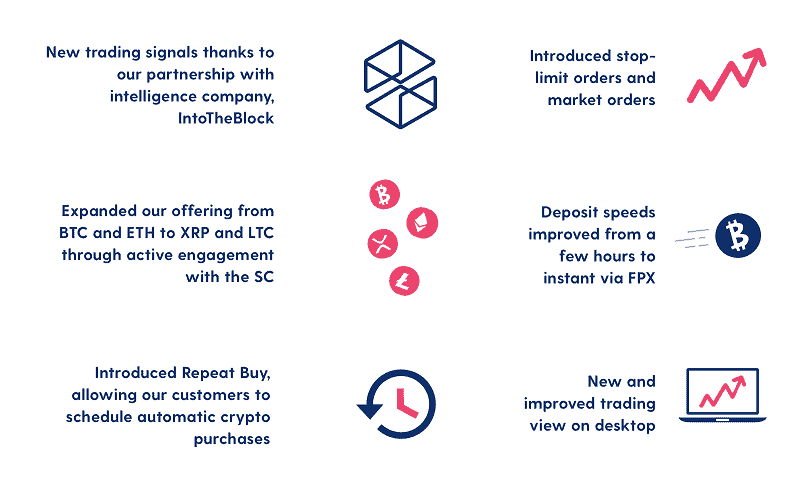
    Some of the features Luno Malaysia introduced in 2020.

    The company also plans to introduce new cryptocurrencies to the platform in 2021, subject to regulatory approval. Tang would not divulge which coins were under consideration, but the pending introduction of more assets to invest and trade in should help to bolster Luno’s position as the clear market leader in Malaysia.

    Luno is About as Safe as it Gets

    The issue of safety is one that retail investors often have when purchasing cryptocurrencies on a particular platform, with more seasoned cryptocurrency owners often championing the practice of storing digital assets on a privately-owned wallet instead of a platform.

    However, Tang was quick to elaborate on the extensive security measures that Luno has in place to safeguard customer assets.

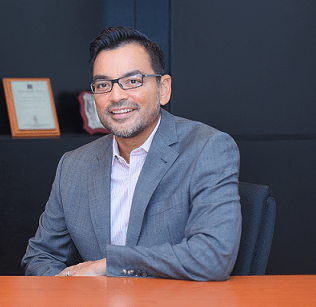
    luno malaysia country manager aaron tang - luno malaysia relaunch“Any regulated platform in Malaysia must have their security systems audited and vetted by the Securities Commission,” he said.



    “This is the first point of confidence that consumers can have, in that you are dealing with a regulated platform that must prove that its systems are safe and secure.”

    In terms of asset storage, Luno works with the digital asset custodian BitGo to secure its “hot wallet” which is directly linked to its platform and facilitates all transactions.

    The majority of its customer assets are stored in “cold storage” (not connected to the internet), rendering it impossible for hackers to gain access to it.

    A portion of assets are also stored in “deep freeze”, which means they are spread out across several vaults in separate locations, spanning multiple continents around the world.

  • Weathering the Storm with a Solid Financial Plan

    Weathering the Storm with a Solid Financial Plan

    So which financial plan predicted COVID-19?

    None, unfortunately. In the financial services industry, product pushers will always tell you “failing to plan is planning to fail”.

    But is that true? Which product could have predicted Covid-19? No salesman, financial planner or even fund manager could have possibly envisioned this pandemic a year ago.

    When unprecedented events like these occur, any plans you made, or were sold, are bound to crumble like a house of cards.

    Is There No Point in Having a Financial Plan?

    Well, yes and no.

    Yes, because a financial plan is just a static document. It is only true today, and its authority will fade with each passing day when the assumptions used in the plan turn out to be different in reality. In fact, I believe that the plan has no tangible value at all.

    No, because I believe that a financial plan is not the main focus. Rather, the real value lies in the planning process. It is here that the client reflects on their life, assesses their financial position, identifies challenges and issues, thinks of action plans, and sets KPIs that propels them forward.

    Evidently, no one could have predicted Covid-19. However, if you have gone through a proper planning process, you may be able to deal with this better than most. Here are a few reasons why.

    Liquidity in Net Worth

    For many, their net worth is a good indicator of financial health and could even be in the millions. However, if this value is tied to illiquid assets, this means they are asset rich but cash poor.

    In this case, the planning process would show the client that most of their net worth is tied to non-liquid assets that cannot be sold quickly. This may help the client to see things in different light, resulting in them using future cash surplus to build a portfolio of assets that is easily liquidated.

    Emergency Fund

    A fundamental part of my work is ensuring clients have an adequate emergency fund.

    The current pandemic has shone a spotlight on emergency funds, as many without one have been caught out and now face a huge mountain to climb.

    It is crucial to have emergency funds as this is our fallback plan when unforeseen events strike.

    Cash Flow Management

    Most people have a strong tendency to opt for instant instead of delayed gratification. Going through the financial planning process allows us to honestly assess our spending habits and lifestyle choices.

    Looking at your cash flow also helps you understand if you are being hindered by excessive debt. If your debt-servicing-ratio is high (over 50%, or 60% in extreme cases), you will suffer greatly during salary cuts or retrenchment. Even if ignoring Covid-19, you are likely to be tied down to your job because you cannot afford to lose this income.

    Prior to taking on new loans, look at your cash flow situation and be certain that you will still be able to work towards other life goals.

    Are You Saving for the Future?

    Covid-19 may have disrupted your plans for 2020 and even 2021, but it surely will not destroy what you want to do in five or ten years.

    For example, if you began to prepare for a big event like a wedding at the start of this year, the MCO may have prevented you from building the funds required.

    However, if you have been steadily saving for years, you would have your wedding money prepared by now. You might have to postpone your wedding, but not because you were not financially stable. We cannot control external factors, but we can certainly control our preparation for life.

    Risk Management and Dependent Care

    What if you unexpectedly left your family earlier than you wished, like many who fell victim to Covid-19? What about children or elderly parents who depend on you for their living expenses like food and shelter?

    The process of financial planning forces you to think about the what-ifs in life. If you have not planned in advance, your dependents are at your life’s mercy. You could (and should) do better.

    Diversification and Asset Allocation

    If you make investment decisions on a piecemeal basis and only chase after returns, chances are your investment portfolio is not optimised.

    With proper planning, you would have an asset allocation and portfolio strategy that fits your risk tolerance, risk profile, and investment objective. When the stock market fell earlier this year, not every asset class fell with it. That is why you will benefit from not putting your eggs in one basket.

    If you are yet to sit down and plan your finances for life and finances yet, this is a good time to do so. It will help you build a stronger base so that during the next crisis, you can say, “it could have been worse”.

    About the author

    Kevin Neoh is a NextGen Money Coach at NextGen Independent Advisors and a certified member of the Financial Planning Association Malaysia (FPAM). He can be contacted at www.kevinneoh.my.

    financial plan kevin neoh

  • Silver Lining for Alternative Investments Despite Pandemic

    Silver Lining for Alternative Investments Despite Pandemic

    Since the first peer-to-peer (P2P) financing platform was launched in 2016, the alternative investments industry has witnessed healthy growth under the watch of the Securities Commission Malaysia (SC). The COVID-19 pandemic has, suffice to say, thrown the industry off course.

    “The Covid-19 pandemic has negatively impacted businesses across most industries, especially businesses that operate predominantly offline or rely on physical touch,” Funding Societies Malaysia co-founder and CEO Wong Kah Meng tells Smart Investor.

    In this case, P2P financing platforms play an important role in balancing the needs of both SMEs and investors, and this remains true, especially during the current unprecedented economic situation.

    On the outlook for the P2P financing sector, Wong foresees the sector will become more appealing to the investment community given the low-interest rate environment, coupled with the volatile capital markets globally.

    “Over the medium and longer term, we are hopeful the pandemic could even serve as a catalyst to spur the next wave of digitalisation of businesses across the economy as well as the emergence of new digital business models, which will benefit the P2P financing industry given its digital focus,” he opines.

    Wong Kah Meng

    However, equity crowdfunding (ECF) platform Ata Plus co-founders Elain Lockman and Kyri Andreou say it would be naïve to assume it is business as usual for the economy.

    Elain Lockman (left) and Kyri Andreou (right)

    “People’s behaviour, spending, and investment patterns have changed and the medium- and long-term impact on businesses have yet to be ascertained with any level of accuracy,” they say.

    For players in the ECF and P2P financing space, they observe there has been a considerable increase in interest for raising funds by SMEs via these two methods.

    “The improved terms for the Malaysian Co-Investment Fund (MyCIF) introduced at the onset of the pandemic can then be said to have succeeded to an extent, though in the end it still requires the participation of the wider investor market,” they explain.

    Challenges to Meet Loan Obligations

    As cash flow becomes tight and businesses see substantial declines in revenue during the coronavirus outbreak, it is inevitable many MSMEs find it a challenge to meet their loan obligations to P2P lenders.

    “Throughout the MCO, Fundaztic has never stopped MSMEs from having a chance to apply for funding with us. From a credit standpoint, however, we did take a more prudent and careful approach to ensure that all approved applicants are viable and creditworthy businesses,” explains Calvin Foo, acting CEO of Peoplender Sdn Bhd (which operates P2P platform Fundaztic).

    Bearing in mind that most businesses were not able to operate during the MCO and CMCO period, Fundaztic has also taken a proactive approach to offering restructuring and rescheduling (R&R) to their issuers as a solution to get them through these tough times.

    “This approach has eased our issuers’ financial burden over this short-term period and therefore, we are not seeing any huge spikes in our default rate,” adds Foo.

    Calvin Foo

    The situation, he continues, did improve mid-June onwards, and the number of notes and investments have started to gradually increase since then. This indicates a majority of businesses are starting to become operational once more.

    “As more businesses are adapting to the ‘new normal’, I foresee the P2P financing sector will continue to grow and assist more MSMEs in the country. In fact, I believe there will be more opportunities for the sector as businesses are starting to shift their businesses online.”

    microLEAP founder and CEO Tunku Danny Nasaifuddin Mudzaffar concurs, adding that the ability to restructure their loans allow issuers to extend the tenor of their financing so that they can pay less than what they usually pay in a month.

    “Doing so will also give P2P investors higher interest/profit at maturity. It’s a win-win situation for all parties rather than allowing the Investment Note to default.”

    On Funding Societies Malaysia’s part, Wong shares that with the slower economic activity during MCO, they anticipated deferment and restructuring requests from their SMEs.

    “Deferment and restructuring options can help SMEs alleviate their immediate repayment obligations of up to three months so that they were able to meet other financial commitments such as salary payments to their employees, thereby helping to save jobs. “In return, investors are able to earn additional interests during the deferment period as compensation,” Wong reveals.

    Growth Opportunities Abound

    Despite the predicament brought about by the pandemic, growth opportunities for the P2P industry are still available.

    Wong says one of their active efforts during the MCO was identifying SMEs with growth opportunities, particularly those within the defensive and counter-cyclical industries.

    These industries include healthcare, e-commerce, wholesale and retail of perishable goods, FMCG (fast-moving consumer goods), telecommunications and utilities, and transportation and logistics, among others, which they believe will remain strong or thrive during the current macroeconomic situation.

    “As traditional financing avenues are tightening up their credit lines, this gives the opportunity for digital financing platforms such as P2P financing to reach out to more unserved and underserved SMEs in Malaysia that would benefit from the additional financing assistance,” he adds.

    After all, over 98% of businesses in the country are MSMEs and as the whole industry has only served over 2,200 MSMEs as of June 2020, P2P financing is barely scratching the surface of the funding gap.

    Mitigating Risks for Investors

    The P2P financing industry is far from matured and although the COVID-19 pandemic may have slowed down the growth of the industry, this is believed to be just temporary.

    There will be many businesses still being underserved by financial institutions, and these are the target segments P2P financing platforms are working hard on closing the financing gap for.

    Tunku Danny

    At the end of the day, says microLEAP’s Tunku Danny, MSMEs still need financing and P2P investors still have funds to deploy. However, the question is this: how do P2P investors know that their investment comes with the least risks possible?

    “P2P investors need to look at which type of businesses will survive and which won’t. Businesses that have pivoted or have an online presence are doing well, while those that are only brick-and-mortar will find it hard to make money due to lower footfall.

    “P2P financing operators, on the other hand, need to encourage diversification of investments on their platform while being more selective in terms of the issuers they host on their platforms.”

    Interest in Early Technology Investments

    The pandemic, according to Ata Plus’s Lockman and Andreou, has clearly shown technology played a crucial role in keeping our society functional during periods of lockdown and quarantines.

    “These technologies coupled with the application of ‘new’ business concepts and/or models may prove to have a long-lasting impact beyond this pandemic. In terms of how we do business, how we trade, how we work, how we produce goods, how we buy goods, how we learn, how we seek medical services and how we entertain ourselves.

    “Business concepts/models such as the sharing economy, co-creation, crowdsourcing, customer to customer (C2C), freemiums, gamification, Big Data, software as a service (SAAS), community-driven, democratisation and Open Source are now more readily accepted and relevant than ever before.

    “It is not a surprise there is a renewed interest in technology investments due to the pandemic. Technology or tech-driven businesses that are agile, scalable and have high degree of automation or digitalisation capabilities with new business concepts/models will be the ones that will be on the watch list,” they say.

    As an ECF platform, Lockman and Andreou believe that Ata Plus, like other platforms, want to give investors access to new investment opportunities that would previously only have been available to angel investors, venture capitalists, or private equity firms.

    “We are here to connect investors who have the funds and businesses that need growth capital. Through ECF, sophisticated and retail investors can now access these investment opportunities with a much lower investment entry point into these exciting businesses. In Malaysia, the smallest investment that has been accepted by an issuer was RM10.

    “While this is a medium-longer term investment asset class with potential high returns, investors need to be aware of the risks and limits of their total crowdfunding investments. The investors may lose all their money and most start-ups will fail. The trick is to always diversify your investment and not to put all your eggs in one basket,” they conclude.

    By Bernie Yeo

  • Millennials Driving Stock Market Frenzy

    Millennials Driving Stock Market Frenzy

    The COVID-19 pandemic has had a devastating impact on global economies, sparking huge volatility in stock markets worldwide. However, the lockdowns imposed by many countries seemed to have sparked a strange phenomenon where millennials have piled into stock markets around the world including in Malaysia.

    In the past few years, millennial investor participation has been recording steady growth, with participation by this cohort in the local stock market being consistently above 20%. In their 20s to mid-30s, millennials are born between the early 1980s and mid-1990s.

    Statistics from Bursa Malaysia show retail investors in the local equity market have witnessed substantial growth in the last few months, coinciding with the imposition of the Movement Control Order (MCO).

    The exchange operator revealed year-to-date May 2020 the total retail registered an increase of 30% in new accounts opened while trading activity among retailers registered an 82% increase in average daily value.

    The retailers were also net buyers at RM5.1 bil, a whopping 607% increase compared to the same period last year.

    Similarly, online brokerage Rakuten Trade has reported a surge in account openings during the MCO period with almost 50,000 new accounts being activated between 18 March and 30 June 2020.

    “If one compares this to the more than 100,000 accounts activated since our start in May 2017, about half of the total accounts were opened in just four months,” acting CEO and chief marketing officer Kazumasa Mise tells Smart Investor.

    “The surge in retail participation can be attributed to the availability of good-value stocks due to the state of the capital market at the time. Many shares were below their historical prices, so it was a good time for new investors to enter the market and weigh their options,” he adds.

    Kazumasa Mise

    Equity Investment Trending among Millennials

    Investing in equities is fast becoming a trend among millennials, and the fact that approximately 80% of Rakuten Trade’s accounts are held by millennials is testament to this.

    For context, Rakuten Trade contributed almost RM20 bil in total trading value on Bursa Malaysia since its inception in May 2017. As of 30 June 2020, their retail market share stood at almost 7% while the clients’ assets under trust stood at more than RM1.5 bil.

    “From the onset, our fully-digital equity trading platform has appealed to those below the age of 40. This essentially means we are attracting a new segment of investors and thereby, enabling greater retail market participation, and this includes traders with no prior investment experience,” says Mise.

    He adds from the company’s perspective, their millennial traders generally find it easy and convenient to use a ‘zero contact’ and ‘low fees’ trading platform.

    As to what sectors or industries its millennial account holders are focusing their equity investments in, he says, “Our clients typically trade stocks that are in the news, trending or based on thematic investment such as healthcare-related or oil-related stocks while also generally favouring small- and mid-cap stocks.”

    Lok Eng Hong

    Maybank Investment Bank regional head of Retail Brokerage Lok Eng Hong says low interest rates globally is what’s pushing savers and investors into equity investment.

    “With better access to information and technology, millennials are most prepared to participate in online share trading and investment.

    “Investment gains and validation of good analysis attract young investors to develop money-managing skills and later, to begin their own investing journey.

    “Millennials are also deeply passionate about global issues that are important to them, and these include Environmental, Social and Governance (ESG), green technology and clean technology. Ultimately, investing in companies that champion good causes makes millennials happy,” says Lok.

    Investing in the Era of Technology

    Millennials have come of age during a time of technological change, globalisation and economic disruption. Being more diverse, better educated and more investment- and technology-savvy than the generations before them, millennials are fast changing the face of investing and wealth management.

    “Social media, private chat groups and easy access to research reports have provided trading insights and ideas to tech-savvy millennial investors during the MCO period,” says Lok.

    However, being able to gain access to information quickly with the use of social media and various available platforms does not always positively impact one’s portfolio, Lok reveals.

    “Millennials, usually the younger ones, can be influenced by various sources and influences, and we are not just talking about mainstream financial news or analysts’ recommendations – some may also be exposed to ‘expert’ commentaries and ideas, which may or may not be accurate.

    “Text messages, views and comments without proper support can easily spread through networks of friends and contacts. Sometimes, great ideas are shared, but more often than not, some high-risk speculative trade ideas are being shared as well,” he continues.

    As such, it is important for millennials to remain cautious and to rely on strong technical and fundamental aspects of a professional company and not being drawn into quick gains and rumours, especially during periods of market volatility.

    Risk Mitigation is Essential 

    All investments carry with them some degree of risk, and these risks can range from inflation and interest rate changes to political uncertainties and economic trends. Investing in equities can often be risky especially in times of market volatility such as that caused by the Covid-19 pandemic and resulting economic downturn.

    As such, risk mitigation – the process of determining what risks exist in an investment and then handling those risks in the best-suited way – is essential for any investment strategy and can help investors reduce losses and achieve their investment goals.

    “With investment of any kind, one must weigh the risks and benefits, and buying and selling shares are no different and must be done with caution,” Rakuten Trade’s Mise opines, adding when it comes to investing, time and effort are very much required.

    “An investor must know his own risk tolerance, investment time horizon, and most importantly, his own financial goals. Holding investments for the long term, too, is advisable.”

    Mise also goes on to emphasise the importance of financial literacy to make informed decisions when it comes to one’s investments.

    “Plan ahead on the possible circumstances that would justify selling. Investors should also avoid getting caught up with emotions that lead to making hasty decisions when their stocks are not performing well,” he advises.

    In terms of investment risks, Maybank Investment Bank’s Lok believes new investors should be aware of the risk of them losing all their investment funds, and potentially going into debt from over-trading and the wrong use of high leveraged derivative products.

    “Trading on stocks that have no fundamental earnings, poor cash flow and poor business model is a dangerous start. Penny stocks and cheaply priced warrants, too, can also turn into potential big losses as their price drops can be very sharp too,” he cautions.

    In addition, new investors should also be aware of the risk of stock price gap down and low trading volume, which will make some stop-loss strategy impossible to execute, says Lok.

    As such, investors should consider only value stocks and business models that are sustainable and should always make a practice of verifying if the information received is accurate. “It’s also always good to diversify. Track the market, and keep some cash ready for new opportunities that might arise,” he concludes.

    By Bernie Yeo

  • Business Confidence of Asian CEOs Shaken by Pandemic

    Business Confidence of Asian CEOs Shaken by Pandemic

    A study by Big 4 global accountancy firm KPMG revealed how drastically priorities and concerns of Asian CEOs have changed in the wake of the Covid-19 pandemic.

    The crisis has shaken CEO confidence, with fewer chief executives saying they are confident now than they were at the start of the year when reflecting on business and growth prospects over the next three years.

    In the first study of its kind, KPMG conducted two surveys – one at the onset of the pandemic in January and a second in July/August to measure changes in CEOs’ priorities and concerns during the global pandemic.

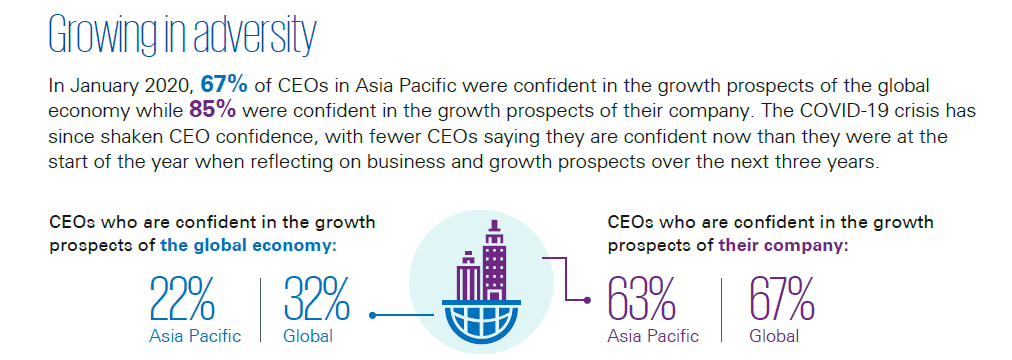
    The 2020 KPMG Global CEO Outlook revealed only 22% of CEOs in Asia Pacific remain confident about the growth prospects of the global economy over the next three years, a significant drop from 67% in January 2020.

    A clear result from the study reveals business leaders have “radically shifted” their perspectives as businesses and governments around the world continue assessing the long-term impact of Covid-19.

    It found during this period of unprecedented uncertainty, CEOs are prioritising digital transformation, talent and ESG (Environmental, Social and Governance) factors at the top of their agendas.

    On a more positive note, CEOs are much more assured in the resilience of their own business as 63% expressed confidence in their company’s growth for the same time period.

    Source: 2020 Global CEO Outlook, KPMG International

    Critical Measures to Bolster Resilience

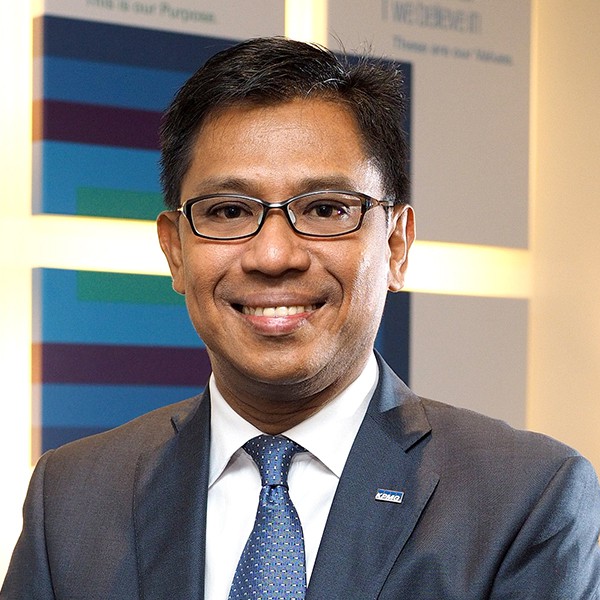
    Datuk Johan Idris, managing partner of KPMG in Malaysia commented: “A majority of CEOs have undertaken critical measures to bolster their company’s medium-term resilience.

    “This is particularly evident at the height of the crisis when business leaders worldwide took steps to maintain business-as-usual activities in answer to restricted movements. With the extension of the Recovery Movement Control Order (RMCO) until 31 December 2020, business leaders are forced to relook at their operational strategies,” says Johan (pic).

    And key to this is the ability to move away from short-term measures and prepare for mid and long-term growth.”

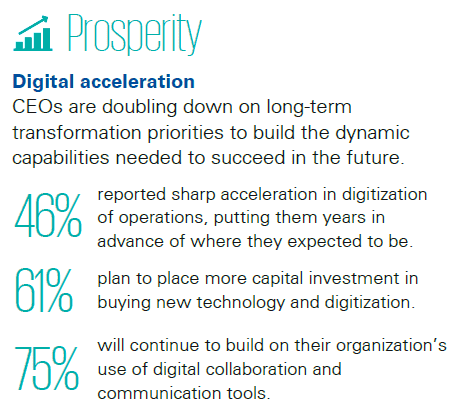
    One way CEOs are collectively doing to secure long-term growth is channeling resources towards digital transformation initiatives.

    Before the pandemic, 64% of CEOs felt overwhelmed by the lead times required to achieve significant progress on digital transformation.

    However, following worldwide lockdowns and the need for physical distancing, 46% of CEOs have reported that progress for their digitisation of operations has sharply accelerated, putting them years in advance of where they expected to be.

    Almost two out of 3 (61%) plan to prioritise more capital investment in buying new technology and digitisation.

    “Clearly, there has been a momentous change in mindset in that CEOs are now more confident and willing to invest in technology to make their companies more operationally resilient, agile and customer-focused to achieve growth during this tumultuous time,” says Johan, adding he expects digital acceleration to increase in speed and scope even after the pandemic subsides.

    New Risk Paradigm

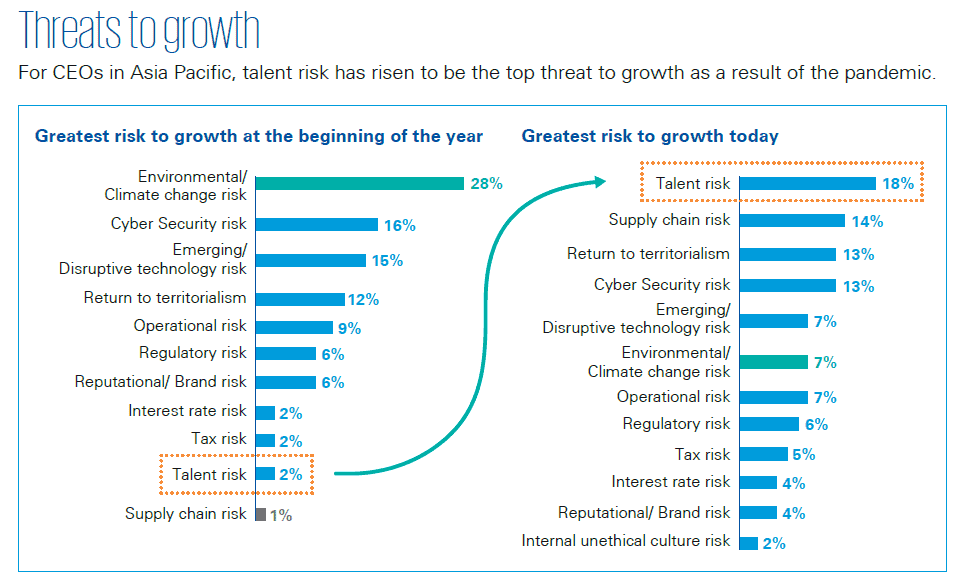
    CEOs have also identified talent risk as the main threat, a category which encompasses recruitment/retention, overall well-being and health of staff.

    This was the threat that CEOs were least concerned about at the beginning of the year. As a result of this pandemic, it has now risen to be the highest perceived threat to long-term growth.

    This could reflect the challenges CEOs face with recruiting and retaining personnel while motivating the workforce despite disruption to the usual ways of working.

    Most CEOs (72%) have said that remote working caused them to make significant changes to their policies to nurture culture, while 69% reported how remote working has widened their potential talent pool for future hires.

    Regardless of the barrier caused by physical distancing measures, CEOs recognise that losing key employees, attracting specialised talent, keeping workforces productive and the health and wellbeing of their staff can have a critical impact on their future business performance.

    Supply chain risk (just 1%) was at the bottom of the list for CEOs in January but catapulted to second place (14%) by July-August, the surveys revealed.

    The rise in supply chain concerns could be attributed to the fact over two-thirds of organisations (72%) have had to rethink their global supply chain approach given the disruptive impact of the pandemic.

    This could potentially lead to a redesign of global supply chains to become more agile in response to changing customer needs, and more robust to reduce risks and disruptions over the long term.

    Renewed Sense of Purpose

    Recent developments have driven 78% of CEOs in Asia Pacific to develop a stronger emotional connection to their organisation’s purpose, with 66% stating how they responded to the pandemic by shifting focus towards the ‘Social’ component of their ESG programme.

    KPMG’s survey also found that 76% have had to re-evaluate their organisation’s purpose as a result of the Covid-19 crisis.

    Johan concluded, “Recovery from the pandemic does not mean a return to normal, but instead an opportunity to define our post-pandemic reality.

    “As the crisis continues to change what good corporate leadership looks like, the role of the CEO is more important than ever in steering the business towards growth in the new reality and beyond.”