Rakuten Trade recently held an event for the media and presented their thoughts about Budget 2023 and their market outlook for the remainder of 2022. Kenny Yee, Head of Research and Thong Pak Leng, Vice President of Equity Research were on hand to explain more about their findings.
Budget 2023
A Budget for the whole spectrum of population
Payouts for the underprivileged and more surprisingly, tax cuts for theM40 should ease the burden of prevailing high prices. Though disposable income will improve from tax cuts, intention is to alleviate the impact from prospective higher interest rates environment going forward.
The potential creation of 50,000 job opportunities should lessen worries for the fresh graduates aka the Youths. SME owners should also rejoice by the 2% tax cut.
Contractors will benefit
The record high allocation for development amounting to RM95 billion emphasizes the dire need to revive the nation’s economy. As we are aware, the construction sector offers the highest multiplier effect hence once this sector commences cranking up activities, the positive impact should spread across other subsegments as its linkages are immense.
Budget impacts on five sectors
1. Automotive sector
Full exemption of import and excise duty for electric vehicles (EV) for CBU (completely-built-up) extended until 31st December 2024 (CKD exemption is still the same until 31st December 2025).
2. Construction sector
High development expenditure of RM95 billion – a 32% increase from the estimated amount in 2022.
3. Consumer sector
Though higher disposable income is positive from the cash support for M40, B40 and students which are expected to increase consumer spending on goods and services such as F&B and daily essentials. We believe the impact is minimal in view of the prevailing high prices.
4. Property sector
75% stamp duty exemption (from 50% prior) for houses worth RM500k to RM1 million for first time home buyers. The additional 25% stamp duty exemption for houses worth RM500k to RM1 million allows first-time home buyers to save an additional RM2,800 to RM7,100.
5. Technology sector
The allocation of e-money incentives for the M40 group and youths worth RM800 million and RM400 million, respectively, which will further accelerate the adoption of cashless transactions.
Market Will Remain Volatile
Performance of the local bourse has been immensely impacted by global uncertainties primarily from the US. The heightened market volatility have had created ripples across the region as well.
Commodities were not spared either as both the CPO and crude oil underwent wild gyrations. The CPO from the high of RM7,200 to now RM3,800 while the Brent crude from around USD130 to now USD98.
As for corporate earnings, we noticed a downward revision for CY22 from 4.3% to now circa. 1% mainly attributed to the cuts for Manufacturing and Utilities sectors.
Nonetheless, CY23 earnings growth should shine with 6.8% due to upgrades for Banks despite lower estimates for both Plantation and Manufacturing.
Regional volatility remains high with some above the last 2 years. Unlike the rest, Malaysia’s volatility remains below the region as the local bourse is a captive market. Nonetheless, we expect volatility to heighten in view of the anticipated “hard landing” in the United States.
Regional Currency Turmoil
Due to the incessant rate hikes by the Federal Reserves, the USD has had strengthened against all regional currencies. The USD movements has instigated most central banks to be on defensive mode to tame prevailing turmoil amongst the global currencies.
No two economic cycles are the same, but as the American writer Mark Twain eloquently put it, “history doesn’t repeat itself, but it often rhymes”. This cycle is proving to be particularly different, however, which makes it even more challenging to draw parallels with the past.
Depending on which indicators you look at, the US economy could be categorised as being in any one of the business cycle’s four phases. These are expansion, slowdown, recession and recovery.
If we use the textbook definition of recession – two consecutive quarters of negative real GDP growth – the US is in one. Recessions, however, are usually accompanied by a meaningful pick-up in the unemployment rate, and this has not occurred.
Instead, the unemployment rate is at a multi-decade low. Indeed, the strength of the labour market speaks of an economy in its expansion phase, albeit now clearly pushing at capacity limits.
Other economic indicators, however, such as business surveys (deteriorating) and the rate of change in inflation (still accelerating), suggest an economy already experiencing that particularly difficult type of slowdown, stagflation. Certainly, the sharp de-rating of US equities seen this year is in keeping with stagflation.
In short, this economic cycle can’t be easily categorised.
Unique Circumstances Have Created Two-Speed Economy
As the rapid pace of rate rises by the Federal Reserve (Fed) continue to take effect we expect economic indicators to become less contradictory. This should occur next year when we anticipate the US economy to be in a recession.
Since the post-war period, every time there has been two consecutive quarters of negative real GDP growth, recession has been confirmed by the NBER (National Bureau of Economic Research). The NBER is the official authority on dating US recessions based on monitoring a variety of macro-economic indicators.
So far, they have not announced recession.
The weakness in second quarter GDP was also distorted by a significant fall in inventories after strong stockpiling in previous quarters. So, it seems premature to call the end of the cycle based on recent disappointing GDP releases.
In contrast, the Schroders Output Gap model, which measures the amount of spare capacity in the economy, suggests that the US economic cycle remains in the expansion phase (see chart 2, below). This is because the output gap is positive and rising.
The output gap is the difference between an economy’s actual output and its potential output, a positive output gap suggests the economy is running out of spare capacity, which adds to inflationary pressures. Ordinarily, monetary policy would be tightened at this stage to bring actual output back to its potential (the maximum level of output an economy can produce without generating inflation). The Fed is currently attempting to engineer just this.
As activity slows down the positive gap begins to shrink, and the economy enters the slowdown phase – although this is not yet occurring following a blistering pace of interest rate rises.
Schroders Output Gap model and phases of the economic cycle
Expansion – output gap is positive and rising Slowdown – output gap is positive and falling Recession – output gap is negative and falling Recovery – output gap is negative and rising
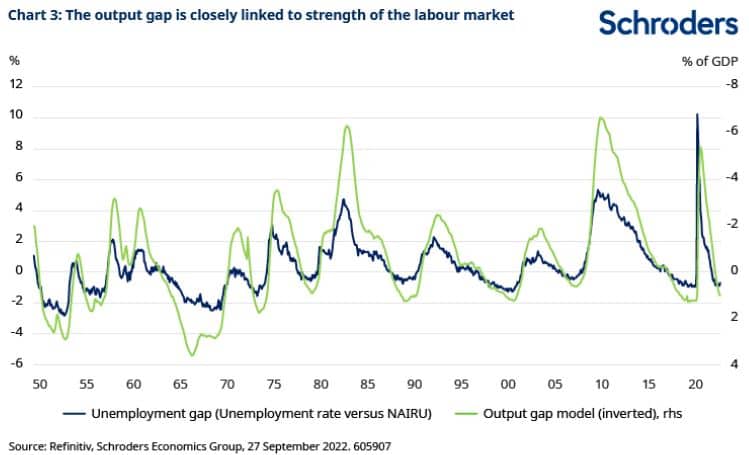
Instead, a presently positive and rising output gap reflects labour market strength, as captured by the ‘unemployment gap’ (chart 3). The unemployment gap is one of the key inputs into the output gap model and tells us if there are less unemployed workers compared to trend levels.
Monetary policymakers make a judgement on what is the NAIRU (Non-Accelerating Inflation Rate of Unemployment), being the lowest level of unemployment that can be achieved before inflation begins to rise in the economy.
So, there will need to be a meaningful rise in the unemployment rate before the positive and rising output gap begins to shrink.
US Economy And Markets Showing More Late Cycle Traits
While we expect our output gap model to move into slowdown at the start of 2023, we recognise that other areas of the US economy are already showing late cycle characteristics. Growth momentum has peaked, and business surveys have eased while inflation has accelerated.
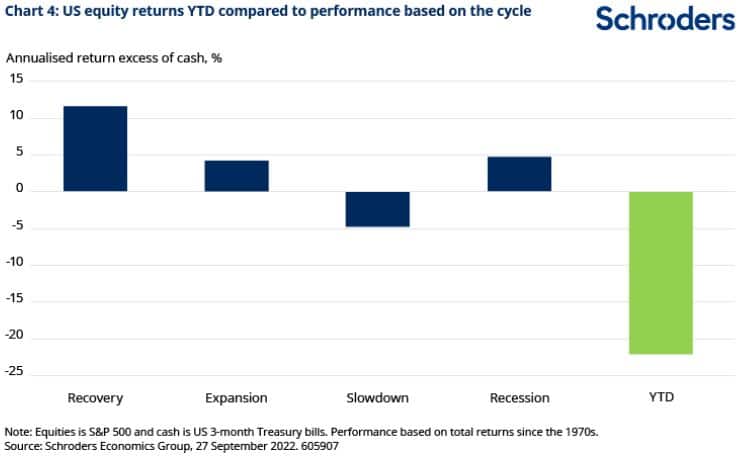
Even the particularly poor performance of markets is typical of a stagflationary environment. The performance of the S&P 500 year-to-date (YTD) is more consistent with past slowdowns as defined by our output gap model (see chart 4, below).
Equities typically suffer during slowdowns as corporate profitability gets hit by weaker growth and rising costs from higher wages and interest rates.
But the magnitude of equity losses this time around has been greater compared to past slowdowns. Despite robust corporate earnings, valuations have significantly de-rerated.
This is because the high levels of inflation have led to more aggressive expectations of policy tightening by the Fed.
This Cycle Is Proving Rather Different
We’re in rather unusual circumstances in that the contraction in economic activity this year has come after a very sharp recovery in growth from Covid-19 lockdowns. So, macro data has eased back to more normal levels. At the same time, US inflation at 8.5% is usually high relative to past cycles. This has led to comparisons with the stagflationary period of the 1970s as inflation back then surged to record levels prompted by an oil price shock.
Unlike the 1970s, the imbalance between supply and demand for goods, resulting from the Covid-19 pandemic, is the root cause of inflation in this cycle. This has been further exacerbated by the Ukraine-Russia war and the impact on supply chains resulting from China’s zero-Covid policy.
So, it is not straightforward to draw parallels with the 1970s, particularly given the robust labour market (see chart 5, below).
The tightness in the labour market has also been driven by factors resulting from the pandemic. In particular, the decline in the number of workers participating in the labour force.
Firstly, more people in the older cohorts have decided to take up early retirement due to health concerns. Secondly, some workers have chosen to exit the labour force due to a reassessment of priorities such as caring for relatives. Thirdly, long Covid has hit the workforce and according to the Brookings Institute accounts for 15% of 10.6 million unfilled jobs in the US.
Some of these factors could ease over time as higher wages incentivise workers to return to the labour force. But more importantly, the tightening in monetary policy by the Fed to bring inflation back to target should result in a more significant slowdown in growth and a rise in the unemployment rate. This would lead to a return to a more normal economic cycle.
Semblance Of Normality To Return, But Not Quite Yet
We expect some semblance of a normal cycle return in the coming quarters as the US economy goes into recession. Not only would GDP growth likely to be contracting, but the pick-up in the unemployment rate would first lead to the output gap shrinking, then turning negative. Inflation should also have eased from lofty levels.
For investors, it would mean a return to more familiar territory where equities offer attractive valuation opportunities in recessions. At the same time, despite dismal corporate earnings, US stocks have typically been lifted by the re-rating in the market.
This occurs thanks to the central bank cutting interest rates in response to the worsening growth and inflation landscape. We saw with the rally this summer how investors (prematurely) anticipated a Fed ‘pivot’ to a less restrictive policy stance in support of economic growth and its second mandate of maximum employment. This drove a powerful re-rating, which abruptly reversed when Fed chairman Jerome Powell dashed hopes of a looser near-term policy.
He warned that the central bank would ‘keep at it’ in relation to raising interest rates.
We do, however, expect there to be scope for a Fed pivot toward the end of next year as the policy is likely to be eased to counter the impact of a recession.
“Wen lambo?” or “Wen moon” are just some of the phrases that is quite common in the crypto world. It is a way to ask crypto investors on when they are going to get rich with their crypto investment. The misspelling looks cool in a way, but investment is actually serious business.
Crypto investment is considered to be a very high risk investment with a very high potential return, the question is do you really want to invest your hard-earned money into it?
Fancy yourself a return of 16,000% per year? It is possible with crypto investment, in fact there were two cryptos that managed to achieve this staggering return on crypto investment in 2021.
Imagine putting in RM100 in 1st January 2021, your crypto investment would be worth RM16,365 by 31st December 2021. Now imagine investing RM1,000, by the end of the year the crypto investment in The Sandbox will be worth RM163,653.
Sounds too good to be true, right? But that is what happened last year.
On 9th May 2022, the whole world was shocked when Luna comes crashing down – losing 99.99% percent of its value in just 48 hours. Who would have thought that Luna was once a top 10 cryptocurrency in terms of market capitalisation, would be brought down to its knees in a way that was unimaginable.
Well, that’s crypto for you. You can make big money, and you can also lose it all. We managed to talk to a few financial planners for their advise on crypto investment.
“I won’t advise my clients to invest into crypto investment unless they are higher risk investor and I see they are matured enough for this type of investment. Normally even if they are, we would work out a small portion of their assets or net worth to be invested in alternative investments, which is not more than 10%,” says Ng Ka Hoe, Founder of J Advisory, a personal finance academy.
Ng Ka Hoe, Founder of J Advisory
Before You Start Investing In Crypto
According to Ka Hoe, he would ensure that his clients understand the following before embarking on their crypto investment:
What are the alternative investments’ underlying assets?
What are the risk involved?
Have they invested into traditional investments such as property, stocks and unit trusts? If they haven’t, why not?
It is important not only for the financial planner to understand what makes their client’s emotional ticks, but it is more important for the client themselves to know and understand their own emotions, as it is truly the investor’s emotions that makes or breaks their investment.
Don’t Go All In With Crypto
Essentially, crypto assets are assets that are non-income generating but more for the crypto investment objective for capital gain. While it is undeniable that crypto currency has helped make many new millionaires, for this wealth to be sustained into the future, one may want to explore how this new wealth can be protected or kept, so that even if the value of the asset class reverses its course, this person will not be knocked back to the ‘pre-crypto’ life.
“Of course, it is perfectly fine if we remain having 100% of our wealth be invested in crypto assets. However, that will also mean we tie our future financial health and possibility in life to a single asset class,” opines Kevin Neoh, a licensed financial planner and NextGen Money Coach.
Kevin Neoh, licensed financial planner and NextGen Money Coach
Don’t Invest In Crypto
Meanwhile there are also opinions on the other side of the fence that warns against investing in crypto.
“Ask yourself when it comes to crypto, are you investing, trading, speculating or gambling?” says John Chan, CEO of YES Financial, a financial advisory firm.
John Chan, CEO of YES Financial
Apparently, we ourselves are confused with the terms. Trading or investing in crypto may incur a significant level of risk, even worse if you are using an unregulated or an unlicensed platform.
Conventionally, when a person is betting on horse racing, they will tell you all sorts of stories and logic with regards to horse riding. When a person is speculating on crypto, they may tell you all kinds of fintech and futuristic tech stories about blockchain or even the recent hot topic of Metaverse and NFTs to push up prices.
In conventional gambling, there are licensed casino and the underground operators. Why do some governments grant casino a license? The most common reasons are due to profit making, demand and the need to safeguard public interest through monitoring and control.
The Myth Behind Decentralisation
Everyone wants to have freedom, and nobody likes to be controlled. Some level of freedom is good but it would be a disaster if there is absolute freedom.
Imagine that you are living in a place with no government in power What would be the scenario?
“When there is no effective government, there are bound to be warlords or mafias controlling the area. Is it a safe place to stay then?” mentions John.
Instead, there would be chaos all over as everyone will be fighting for power.
Scarcity, Really?
Bitcoin is called Digital Gold as there is a maximum supply of 21 million Bitcoins. This means that Bitcoin has a unique feature of scarcity. This is where people seem to illustrate the scarcity of Bitcoin to Gold, as there is a limited supply of Gold available on our planet.
However, gold exist and play its role in civilization since ancient times as precious metal, jewelleries, commodity, storage of value, medium of transfer, barter trade, technology components, currencies etc. It is kept by government and central banks as reserves.
“Gold is a natural resources and is not created by human beings. Unlike cryptocurrencies that are created by humans and there are now more than 19,000 cryptocurrencies in existence,” shares John.
Ask yourself, is ‘scarcity’ real then?
Crypto As Legal Tender?
According to BIS Annual Economic Report 2018, for cryptocurrencies with decentralised trust model such as Bitcoin, each user needs to download and verify the history of all transactions ever made. This has the effect of slowing down transaction processing time, making it not scalable to facilitate day-to-day retail payments.
Compared to major international cards networks which is able to process 2,000 to 3,500 transactions per second, Bitcoin is only able to process 3.3 transactions per second.
“Most cryptocurrencies are not likely to be used as payment instruments primarily because they do not exhibit the universal characteristic of money. Not to mention the price volatility, vulnerability to cyber attack, lack of scalability, not a good store of value, payment method and medium of exchange,” John emphasized.
As of March 2022, 87 countries are exploring the issuing of Central Bank Digital Currency (CBDC), according to the Atlantic Council. While CBDC may adopt blockchain or Distributed Ledger Technology (DLT), CBDC differs from normal crypto as CBDC is legal tender and is backed by a claim on the central bank. Unlike cryptos that are not legal tender and have no intrinsic value.
Bank Negara Financial Sector Blueprint 2022-2026 stated that they are looking into CBDC through multiyear exploration, starting with Phase One via Project Dunbar.
Comparison of CBDC, stablecoins and non-backed digital assets. Source: Financial Stability Board (2020), “Enhancing Cross-Border Payment System: Stage 1 Assessment Report to G20”
Asset Allocation Is Important
At the end of the day, there is no one investment that suits everyone. It will be best if you diversify your investments into several asset classes, such as stocks, properties, unit trusts, robo-advisors, fixed deposits, bonds etc.
There should be a mixture of low risk investments with low returns, some in medium risk investments with medium returns, and some in high risk investments with high returns such as crypto investment. Because you never know with crypto, you can go big but you can also go home with nothing.
Think about it. When are times ever ‘easy’? At the time of writing, we face inflation, COVID-19, wars, trade tensions, the ups and downs in interest rates, currency exchange rates, and commodity prices.
On top of all that, there is the ever-evolving political, economic, and social instability around the world. It only makes sense to say that ‘uncertainties’ is a certainty in present times.
So, is it still relevant to be investing in uncertain times?
Well, it depends. Some may react by not investing altogether. But that approach is likened to an ostrich burying its head in sand. It is impractical. Today, the awareness to invest has largely increased among the general public.
However, investors may lack a plan to navigate their investments through the stormy seas of the markets today.
Here, I have observed two different approaches to navigating the market and investing in uncertain times. They resulted from having a different mindset towards investing.
This refers to investors who believe that wealth is about having more money. To them, if they invest in an investment, be it stocks, properties, ETFs, cryptos, so on and so forth, and its price had appreciated, they will consider it to be a good investment.
If its price had fallen, it would be deemed as a failure. Thus, it is common for them to measure investment success based on the following:
Price Goes Up = Good Investment
Price Comes Down = Bad Investment
Hence, they tend to invest during good times, as prices of investments tend to rise in line with heightening optimism. Also, they would avoid investing in uncertain times due to falling investment prices. Some would sell off investments as they have a pessimistic outlook on the future.
In extreme cases, this could lead to manias and panics in the investment markets. Basically, their guiding principle is to buy in good times, sell in bad times.
So, how do they know where the market is heading in the future?
Well, the answer is to try predict the markets. Many would speculate. Some will be checking on the macros and technicalities if they are more sophisticated.
Generally speaking, they are always trying to find the ‘best time’ to invest or to dispose of their investments. To me, that is trading or speculating.
If you are in this group, you will always be anticipating if today or tomorrow may be a ‘better time’ to invest. Even after you have invested, you would always want to find out when would be the ‘best time’ for you to sell off your investments.
That is not my approach when it comes to investing in uncertain times.
Unlike the aforementioned approach, this group of investors believe that wealth is about owning assets that are income-productive. Thus, the measure of investment success would be based on the income productivity of the assets.
The more income they produce over time, the more successful the investment.
Income Rises Over Time = Good Investment
Income Falls Over Time = Bad Investment
For this group of investors, they are focused on the assets’ fundamental quality. They want to know if the asset can generate more income in good and bad times.
To them, it does not matter if the stock market, the economy, the Ringgit and the interest rates are going up or down. What matters is this: Is the asset in consideration profitable and sustainable in all economic conditions, particularly in tough times?
By focusing on income productivity, this group of investors would tend to invest differently from the market predictors. Normally, in good times when asset prices are rising, this group of investors would have difficulty in finding income productive assets that are offered at attractive valuation.
Thus, they invest less in good times. This would be different in tough times when asset prices are falling. In this situation, this group of investors will have an easier time acquiring such assets at discounted prices. So, they invest more in bad times.
Therefore: “The answer lies in your belief system when it comes to investing in uncertain times.”
Buy Less / Don’t Buy = Good Times
Buy More = Bad Times
If you are in this group, you would have less tendency to do market predictions. Instead, your focus is on the asset’s fundamental qualities and its valuation, which makes predicting market movements irrelevant.
So, should you be investing in uncertain times?
The answer lies in your belief system when it comes to investing. As for myself, my interest is in the accumulation of fundamentally strong stocks, if they are offered at attractive valuations. This is because I believe wealth is about the income productivity of my assets and thus I had invested accordingly.
If your beliefs on wealth are different from mine, you would invest differently. Ultimately, it is up to you to be navigating the market and be smart when it comes to investing in uncertain times.
Ian Tai, Financial Content Machine. Dividend Investor. Produced 200+ Financial Articles featured in KCLau.com in Malaysia. Co-Founded DividendVault.com, an online membership site that empowers retail investors to build a stock portfolio that pays rising dividends year after year in Malaysia and Singapore.
One survey from the University of Michigan indicated that 73% of adults between the ages of 22 and 35 overthink, and 52% of 45 to 55-year-olds do too. While it is important to engage in thinking in our work, overthinking on the other hand affects our effectiveness in getting things done.
What is overthinking and what are some of the ways to manage overthinking? Overthinking is a process where people engage in excessive thinking to the extent that it impedes their actions and productive results. It becomes a justification for procrastination and inaction.
On the surface, it would seem legit for one to gather more information for analysis prior to making a decision and taking action. However prolonged thinking and rethinking can be a wasteful habit and can stop people in their tracks.
The way forward is to strike a healthy balance between thinking and action. To do that we need to come up with effective strategies to avoid overthinking and engage in the right thinking and take the right actions to achieve the desired results.
Over the last 25 years in leading various projects in my consulting work for organizations, I have developed a framework to ensure that our team avoids overthinking but engages in productive thinking to enable practical execution to achieve the desired results.
Let’s check out some of the ways to manage overthinking.
6 Ways To Manage Overthinking
1. Set A Time Frame
To ensure that we do not get into paralysis by analysis mode, we need to set a clear time framework for various tasks such as gathering information, analysis and diagnosis, decision-making, recommendations, and a clear action plan with specific measurable goals and deadlines.
Having a clear time frame is important and requires one to be more practical and balanced without getting carried away with a long engagement in one task that one loves to do more than others. It is not uncommon that some leaders love to debate over the smallest of stuff which is often more intellectual than practical.
There are many root-causes of why some leaders engage in overthinking. Some are perfectionists who are never contented until they explore everything to the fullest. Others lack courage in making decisions, so they avoid them by prolonging thinking and analyzing.
By setting a deadline for each task in each of the phases of work, one becomes compelled to move forward without being stuck in the thinking phase. This is certainly one of the ways to manage overthinking that you can try.
2. Ascertain The Necessary Information
There is no end to getting more information. It will be useful to choose the criteria needed to make a good decision and then go about collecting information about them.
The more data and information we collect, the more analysis and thinking will be involved. We do not live in a perfect world where we can have all the information needed to draw a perfect conclusion.
One of the ways to manage overthinking is by making sure we need adequate information that enable us to make a reasonable decision to move forward. Often more information creates overload and crowds one’s thinking. What is needed is relevant information to help make a sound conclusion that is directive enough to spell out the correct actions to be taken.
3. Analyze To Come To A Decision
One needs to be aware that we need not reinvent the wheel. We only need analyze the information to achieve better understanding in the areas that lack clarity. In those areas in which we are already clear, there is no need for more analysis.
The purpose of our thinking and analysis is to help make a decision. It should not be analysis for analysis’ sake. A better way is to set specific areas where clear decisions need to be made. Then go ahead with the thinking and analysis to arrive at those decisions.
4. Moving From Negativity To Positivity
A lot of overthinking may arise from negative mindsets with constant worrying about the past as well as concerns about the future. Often worrying about what could go wrong will get one to stall under the pretext of waiting for more information or analysis.
Too much negativity will certainly dampen one’s courage to take action. Many would justify that in view of the risks of what could go wrong, they need more thinking and rethinking on various issues. While a little caution with an exploration of contingencies is a good measure, taking an over-cautious stance with great doses of pessimism will wreak havoc on good decision-making.
Worrying forward leads to overthinking which is just creating problems that do not even exist. One of the ways to manage overthinking is by moving from what could go wrong to what could go right with the right strategies is a good way to move out of overthinking.
5. Execute To Achieve Productive Results
Thinking and more thinking would not create results. The missing link in most organizations is concrete actions. There are many leaders who love to have meetings after meetings to discuss over many things. The ills of overthinking are that they create a comfortable habit of inaction.
Inaction provides temporary refuge and comfort but over time it dents the credibility of leaders as they are eventually judged by the results they achieve. Without execution, there will be no results and without results, a leader is deemed to have failed.
In one of the ways to manage overthinking, is to execute what was planned.
6. Recognise And Reward Results
To discourage people from engaging in overthinking, organizations should realign their recognition and rewards towards result based. Assessing one’s work based on concrete and measurable results directly or indirectly is a good way to get people to move from overthinking to taking the right actions to get the desired results.
So there you have it, some of the ways to manage overthinking.
You need to stop overthinking, be a realist and not a perfectionist. Focus on getting things you want to be done right instead of things that could be done wrong.
About the Author
Dr. Victor SL Tan is the CEO of KL Strategic Change Consulting Group. He undertakes change management consulting and training. He is also the author of 14 management books. His bestseller books include Leading Positive & Productive Change and The Secret of Change. For more information email him at victorsltan@klscc.com or contact him at 012-3903168.
The following story is based on an actual series of events with some names and circumstances fictionalised and any similarity to the name, character or history of any person is entirely coincidental and unintentional. Hope that we all don’t make the same mistake and full understand that planning is important.
“It was like robbery!” a distraught Mama Yan said in a high tone as she opened the door for Mandy.
“They were in uniform and they just barged in,” she continued. “One of them held up a letter and others just came in and started to take the TV and other items.
“And Sharon, she, she…” her mouth quivered as she looked towards the lone figure lying on the bed in the living room. “Sharon, she tried to get up as if to stop the men and she fell…”
Mama Yan related that at that moment, everything stopped. A more elderly among the men just shouted “Jangan!”, reached forward and with a few others, helped carried Sharon back to the bed.
“I just froze and what happened next was a blur. All I can recall now was the elderly officer coming to me, saying something like “…datang pejabat untuk selesai. Kita tidak akan ambil apa apa.”
Mandy went towards Sharon and in a soft tone said: “Are you alright? Don’t worry, I’ll sort things out…”
She then turned to Mama Yan and pacified her, assuring her that she would take care of things. Mandy seemed to have figured out what the ‘raid’ was all about and asked for the notice the men left behind.
Let’s take a closer look at why planning is important.
Planning Is Important, Things Can Turn Ugly In An Instant
This incident stemming from failure to settle outstanding payments of property assessment fees is the latest of episodes of non-payment of bills, the last being the disconnection of electricity supply that left the family in darkness just two weeks back.
Mandy pitied Mama Yan, who was a sharp contrast from what she used to be – a happy contented mother, always beaming with pride that her Sharon, who in her late 30s, was at the prime of her career, having climbed the corporate ladder to be Marketing Director in an MNC.
Sharon was Mama Yan’s pride and joy as a daughter. Despite being busy, often home late and out to office early, she had never failed to make sure that her mama and wheel chair-bound Pa were well cared for. They never had to worry about finances. Sharon was that ever responsible, dependable, and caring daughter!
That was until one late afternoon six months ago. A call came in from Sharon’s colleague that she had blacked out and she was being rushed to the hospital.
A Stroke Of Bad News
Later, the doctor broke the news to Mama Yan that Sharon had a stroke and the left side of her body was paralysed. Mama Yan’s heart shattered in pieces when she finally got to see Sharon. Tears streamed from Sharon’s eyes. Tried as Sharon could, no words came out from her mouth. Her frustration could only be seen from her eyes.
Tears welled up too in Mama Yan. Sharon, who always had things in control, was lying there helpless. The pain of seeing the suffering that Sharon was undergoing was after a while replaced by thoughts racing through her mind about Sharon’s future and what would be in store for the family.
Sharon had taken care of the family well, providing for their financial needs. The live-in maid was a great help in attending to Sharon’s Pa, who even though recovering for the stroke, needed help in movement.
Can you see now why planning is important?
Good Times Won’t Last Forever
Six months have passed. There are no indications how long more Sharon would be bed-ridden. Weighed down by worries of mounting expenses and depleting savings, how to cope with two stroke patients, and a load of unexpected problems, Mandy was the only family friend that Yan could turn to.
Mandy, however, could only provide help in sorting out certain problems like dealing with municipalities and local Government departments. What was of greater concern was that their one-time solid financial pillar had crumbled. Yan has never felt so hapless.
Mama, amidst tears, said to Mandy: “I have no choice but to see Yong and beg him for financial help now. He is the brother-in-law that I don’t really like but I have no choice.”
Considering that Sharon had built a successful career and if she has got down to writing a Will to take care of her dependent family, her parents would not be in dire straits if their financial pillar passed on.
However, in this instance, her plans under the Will could not be effected as she is still alive, but incapacitated.
Will VS Trust
Planning is important. Had she set up a Trust, Sharon would have planned well for such an eventuality if not for this cruel twist of fate. She could have placed certain assets she had accumulated in the trust of her appointed licensed trust company.
In the trust deed or instructions spelled out by the settlor (person setting up the Trust), she could have instructed the amount, frequency of payment for the living expenses of the family, as well as medical expenses, which in the case of Sharon’s family could be substantial as it would be for both her father and her.
Sharon could have even directed the trustee on how the monies in the trust fund should be invested until her death, after which she could set conditions as to what and how to invest. Such planning will ensure that income is generated while she is incapacitated to meet living and medical expenses.
The family’s financial pillar would still have been intact in this case as Sharon’s ability to financially provide for her dependent parents has been transferred to a reliable trustee. While the trustee can be an individual, a trust company is recommended as the latter will exist in perpetuity and has experienced and skilled staff with the time and resources on hand to administer the Trust.
Hope we now understand on why planning is important.
About Rockwills International Group
Rockwills International Group, now in its 27th year, pioneered professional will writing in 1995 and has since evolved into the leading estate planning specialist in the country. It is today the largest provider of solutions and support services in the areas of trusts, succession, management and distribution of wealth. It has shareholders’ funds exceeding RM50 million. It has done over 280,000 wills and 15,000 trusts and hold more than RM25 billion in assets under trust.
The stock market is hugely popular, not only in Malaysia but the entire world. During the Movement Control Order (MCO) back in 2020, retail investors made a huge splash in Bursa Malaysia, and most investors made quite a handsome profit.
Let’s look at the two ways which you can earn in Malaysia share investment.
1. Capital Gain
Capital gain is the increase in a capital asset’s value and is realized when the asset is sold. It is the profit that you get when the selling price of the stock exceeds its purchase price. It is the difference between the selling price (higher) and purchase price (lower) of the stock.
For example:
Stock ABC price = RM1 per unit Buy 10 lot (100 unit) = RM1 x 100 units Purchase price = RM1,000
One month later
Stock ABC price = RM1.10 per unit Selling price = RM1,100 Profit/Capital gain = RM100 or 10%
The above shows an example of how a capital gain of 10% is being made. ABC price went up by RM0.10, and was then sold at RM1.10.
*Note, the profit does not take into consideration costs such as brokerage charges, stamp duty and clearing fees. The net profit should be less after deducting these fees
The second way to earn in Malaysia share investment is through dividend. A dividend is the distribution of a company’s earnings to its shareholders and is determined by the company’s board of directors.
When a company generates a profit and accumulates retained earnings, those earnings can be either reinvested in the business or paid out to shareholders as a dividend. Dividends are often distributed quarterly and may be paid out as cash or in the form of reinvestment in additional stock.
If the company is not making good profit, or even making a loss, then we shouldn’t expect any dividends from the company. In fact, we don’t invest in these companies that do not have good fundamentals.
Malaysia Share Investment: Capital Gain VS Dividend?
The stock market is suitable for all kinds of investors. There are those who are in for the short term, perhaps capital gain is more suitable. But do keep in mind that if a stock price can go up so fast, it can go down even faster.
Whereas dividend stocks are more suitable for those who are in it for the long term. By investing in good and strong fundamental companies, you should be able to get a steady stream of dividends.
But that shouldn’t stop you from looking for stocks that can give you both capital gain and dividend right?
In a world overflowing with mindless narratives and political polarisation, separating the signal from the noise in the markets can be challenging for anyone. The markets so far this year reminded us all that stock markets are risky. Even SPAC activity has not been this bad for the past five years.
Surely no one can correctly guess where market is heading, where uncertainties are the one thing that is certain.
Never mind that rising inflation is eating away our purchasing power as poor consumers. Oh, for all the coffee lovers out there, coffee, already noticeably imbued with the bitter taste of inflation, is likely to get even costlier, as farmers in world-leading coffee exporters face the fallout of extreme weather.
Here’s why you shouldn’t be placing too much importance on where market is heading.
Sure, it is easy to get emotional especially if you are stuck in losses, given the significant negative returns across most asset classes in the first half of the year and can no longer think rationally. On top of recession and inflation concerns, investors also had to deal with a deteriorating geopolitical environment.
Will there be another war somewhere? Who cares!
Where Market Is Heading?
As most of my long-term suffering readers know, I am a big advocate of alternative investments or absolute return strategies. Alternative investments have long been used as a tool in portfolio construction by large institutions, pensions, and endowments.
In recent years, many qualified individual investors have increased exposure to alternative investments to boost returns, generate income, and achieve long-term financial goals. Tech-enabled business models make it possible to serve customers on the lower end of the wealth spectrum.
One of the most attractive aspects of alternative investments is that they typically have a low correlation with equity and bond markets. When used as a complement to traditional investments, alternative investments are a valuable piece of a long-term investment portfolio.
Financial players of all sizes are aggressively pursuing product innovations to survive the competition. My strategic partnerships with trusted managers allow me to move fast with innovation.
Alternative Investments Are Important
From another perspective, alternative investment managers make the capital markets work better and more efficient which gives a meaning as to where the market is heading is not really important. They make them more liquid.
The local financial services industry was a simpler place more than 20 years ago and most investors were happily invested in plain vanilla equity and bond funds back then.
Indeed, one of the primary attractions of alternative investments for me when I began dealing with them in 1995 was that I knew the benefits of traditional diversification are overstated. Let me stress clearly that I am not against local investments. I am an enthusiastic local stock market investor.
Shifting to another gear, many people assume that if somebody is really wealthy, he or she does not really have to worry about anything. In harsh reality, when you have more money, you have more problems or concerns. One of the concerns is the ability to preserve capital in the long-term.
Most people do not become wealthy by being irresponsible with their hard-earned money. Most of them worry about the downside risk which could affect their portfolio value especially during extreme market conditions. A proven alternative investments help investors to preserve their wealth while achieving growth over the long-term.
Many people mistakenly believe that alternative investments are all about making leveraged bets and getting big returns. In my line of work, some investors are looking to increase the amount of income in their asset allocation. The level of passive income varies greatly based on their wealth. A high income driven strategy is also a solid defence against rising inflation.
But Beware Of Scams
Where market is heading won’t mean a thing if you can’t differentiate financial scams.
Nobody likes to work and everybody loves high and guaranteed returns. If anyone knows how to produce extremely high returns all the time, he or she would already run a properly regulated investment vehicle and the money will find them. Please tell me something that I do not know because I am an “idiot”.
When you have more money, you will likely be the target of some unscrupulous people trying to sell something to you without having your best interests in mind. They can be anyone like your neighbors, relatives, colleagues and even your financial advisors. For these “greedy” sales people, while money cannot buy real happiness, there never seems to be quite enough.
I work with successful alternative investment managers or traders who are rational, analytical, able to control emotions, and performance oriented. They must have an edge and employ good money management by having rigid risk control rules.
I am always cautious about the specific investment ideas in my public articles due to internal compliance, but I will share with you in broad strokes about some of them in this limited space. It is a sample of different opportunities in the world of alternative investments especially for sophisticated investors and family offices, while some of you are still looking for a crash.
I talked about them in detail in a zoom meeting with investors not long ago. Grab that filtered water (cheaper than coffee) and be ready.
Stable Income Is Better Than Losing Money
Regular income despite not giving a damn about where market is heading? An alternative fixed income bond which is also available in the Islamic shariah version offers a solid infrastructure to mitigate the risk and pays a fixed coupon per month, paid quarterly in arrears to the investors. The generous income stream from the profits allow investors to support the lifestyle they desire.
Available in major currencies, the profits are generated from contract arbitrage trading. Contract arbitrage is the simultaneous purchase and sale of an asset to profit from the price differential between a seller and a buyer. The difference in price generates the profit.
Moving to another idea is an alternative global multi strategy fund which invests in global digital assets. The fund has performed very well at a much lesser volatility so far this year, given the sharp sell-offs in cryptocurrencies that hurt some of the high profile players with poor risk management and overleveraged.
Those crypto geniuses who blew up their trades knew what they were doing right?
Consider Digital Assets Too
The emerging digital assets industry has experienced a rollercoaster ride in recent years, with a lack of transparency and significant volatility discouraging some genuine investors from investing. Where the market is heading is not important, as the fund provides a simple, efficient solution for sophisticated investors to gain exposure to the digital assets space with low volatility and minimal exposure to systemic market risk.
On this note, while on a capital raising roadshow in Europe, the fund was well received by some of the largest wealth managers and investment banks. All wealth managers and institutions have plans for adding digital assets or funds to their offering. It is inevitable that sophisticated investors realise that evolution in Blockchain-based applications provides strong growth potential for the foreseeable future.
No Loss, So No Worries On Where Market Is Heading
Taking the world by storm, here is another gem. A global macro strategy fund with no losing years since its inception has continued to provide consistent positive returns amid the volatile market conditions in 2022 so far. The fund aims for consistent absolute returns over a medium-to-long term period, by leveraging on the fund’s proprietary technology and the manager’s alpha skills in both good and bad times.
The fund invests in equities, fixed income, commodity, forex and interest rates.
To wrap up this article, as an investor, you can prepare your portfolio for uncertainty. Much like preparing for a road trip where you cannot control the traffic on the road, and having to deal with rude drivers and potholes.
Instead of trying to control or fix the problem, you can control how you prepare and react to it. Where market is heading? I don’t care!
About the Author
YH Wong has over two decades of experience in the financial services industry. His clients include high net worth investors and boutique institutions such as family offices and investment partnerships in the region. He is currently a senior partner with Satori Consultancy Ltd, a financial services company regulated by the Mauritian Financial Services Commission. He can be reached at yhwong@satoriconsultancy.com.
We read about individuals losing money to scams in Malaysia almost on a daily basis. The losses are staggering, and even though the warning signs are all around us, the number of victims keep piling up. According to the Inspector-General of Police, Tan Sri Acryl Sani Abdullah Sani, there were 71,833 fraud cases recorded since 2020 until May 2022, with a loss amounting to RM5.2 billion.
The most prevalent financial scams in Malaysia as revealed by the Royal Malaysia Police (RMP) are:
Bank / Government Impersonation
Illegal Loans
Money Mules / Account / ATM
Card Rental
Investment Scams
E-Commerce Scams
Romance Scams
Since we want to become a smart investor, we will be taking a closer look at investment scams, with the hope that we are able to identify them and take the necessary actions to avoid becoming a victim.
Common Types Of Investment Scams In Malaysia
1. Get Rich Quick on Social Media Platforms
Usually, the scammer will ask for a small investment with a promise of very hight returns. For example, 100% return in three hours or RM1,000 in 30 minutes. Since the initial ‘investment’ is small, investors would have no problem giving away the money to start.
Once we see the gains in our account, we will be tempted to put in more money. And when the time to cash out the gains or to take out the capital, normally the scammer will ask us to pay certain fees. By the time we realise that we have been scammed, the damage had already been done.
2. Clone Firm Scams
Another famous scam that is going around is done where scammers use legitimate investment firms, but misuse their name and logo to dupe victims. It looks so real that you can’t easily tell them apart.
For example, the real business is Smart Investor, but the clone uses the name Smart Investment. It even uses the same logo, so you will genuinely mistake it for the real deal.
The Modus Operandi Of Scams In Malaysia
Operators of illegal internet investment schemes lure unsuspecting victims to make online investments or receive investment advice online, by offering investment opportunities with unusually high returns with zero or very low risk.
When questioned about their legitimacy, most scammers operators will claim to be foreign operators that do not require licensing from Malaysian regulators to operate their business.
In truth, these operators have no legitimacy whatsoever; they are not licensed to receive deposits by Bank Negara Malaysia or licensed to offer investment advice from the Securities Commission (SC) related to fund management, securities and futures.
Unsuspecting victims would then be enticed as scammers will pay them the high returns during the initial stage, and this is used as a tactic to lure and recruit new investors. The survival of this scheme actually depends on new depositors.
The funds obtained from new depositors will be used to pay dividends to the existing depositors. Therefore, the scheme will fail when there is no contribution of funds from new depositors.
However, the scam operator will eventually abscond deposits collected when they feel that the scheme is about to fail, thus leaving the depositors at the losing end.
With So Many Legitimate Investment Schemes, Why Do People Still Fall For Scams In Malaysia?
“Scammers employ various means to manipulate their victims including promising high-returns, illusion of safety and inducing fear-of-missing-out (FOMO),” said Bryan Zeng, CEO of FA Advisory, a financial planning service provider.
Bryan Zeng, CEO of FA Advisory
On the other hand, legitimate investment schemes are highly regulated with clear guidelines on what is permissible or not. These guidelines are designed to protect the investors but may make the legitimate investment appear as less attractive.
But then again, the promise of getting rich quick in these situations is hard to resist. Scammers will promise crazily high returns in a very short time, which makes no sense once you think about it. But at the spur of the moment, we feel that it is too good to pass on such an opportunity – and we tend to make decisions based on our emotions.
As emotional beings, we are often easily manipulated when we are at our most vulnerable, which makes us easy prey for scammers. When we are not able to think clearly, that is when we make ill-informed decisions that will come back to haunt us.
Always remember the old adage: “If something is too good to be true, it is most likely a lie.”
Hence, a healthy dose of scepticism, emotional restrain, and critical thinking can go a long way. You can also check with the relevant authorities before investing or depositing money into someone else’s bank account.
Have you been surprised by your credit card statement at the end of the month after purchasing something from an international online store? Does it seem that the total charged to your credit card was not the same as the amount you saw during checkout?
Online shopping has become more popular in recent years because it enables us to purchase various items with just a few clicks from our electronic devices. However, many Malaysians remain susceptible to hidden fees and unfair charges when making international purchases, travelling, and transferring funds.
This is where having a multi-currency account can help streamline how you send, spend or receive money. Whether you are using it personally or for business purposes, a global currency account provides added freedom and removes borders.
Here are a few ways on how a multi-currency account and card can help make your life easier.
1. Spend in local currency while shopping internationally
We all know that Malaysians love to shop. When the pandemic hit, many Malaysians transitioned from shopping in malls to online stores, both locally and internationally.
The transition to online shopping was spurred out of necessity but it helped many Malaysians to purchase their favourite items even from the comfort and safety of their homes. However, it can be frustrating when dealing with uncertain conversion rates and hidden fees.
Hence, a great way to navigate this is by choosing to pay in the currency of the country you are buying from – here’s where your multi-currency account comes in. Pay like a local to save on extra fees and get a better exchange rate!
2. Be in control of your finances when travelling abroad
With countries opening their borders after the pandemic, many Malaysians have been hit with the travel bug and are planning their vacations meticulously. As such, if you are looking to travel overseas, owning a multi-currency card will help you to spend in multiple currencies whichever country you are in, with better exchange rates that are often lower than your traditional bank.
You don’t have to worry about fraud as you are always in control when using a multi-currency account, with instant transaction notifications and the ability to freeze your card instantly. You can also spend like a local as you can use your card to withdraw money from your multi-currency account at ATMs worldwide.
3. Get paid like a local even from overseas clients
Top view of woman using laptop computer
Freelancing is a great way to support a lifestyle outside of the traditional office job. For many, it is also an opportunity to work with exciting companies in different countries. It also means having the liberty to go about your day, but at the end of the day, you are responsible for maintaining a continuous flow of work.
Expanding your horizon to regional or global clientele could yield better results and maybe even better pay. But it brings up the question of how do you actually get paid? Most companies seek to pay their freelancers in their local currency.
So that’s where a multi-currency account comes in, allowing you to receive your salary and invoice payments in their local currency, which can then be converted to your local currency for use. No more hefty bank fees or unfair exchange rates on both sides!
4. Manage your overseas property remotely
Once you purchase properties abroad, you may find yourself thinking about the most convenient way to pay utilities, taxes, and other mandatory fees. It is often stressful trying to decipher the uncertain and hidden charges that come from doing a bank money transfer.
After all, no one wants to pay more than necessary, as it would only result in loss of money. This is especially true if you bought the property as an investment and turned it into an Airbnb or event rental space.
A great option to manage these properties is with a multi-currency account, where you can pay in local currency and receive money locally as well, and then convert it into your desired currency when the rates are right. Make it simple and take the hassle out of property management — and save money in the process.
It is important to select a multi-currency account which allows you to hold, receive or convert various different currencies at the lowest rates possible. With Wise, you will be able to enjoy the mid-market exchange rate for transfers, conversions and more without hidden fees. Another
feature to look out for is 3-D secure authentication, which ensures every transaction is safe. So, if you want to make international transactions from the comfort of your home or travel the world to see for yourself, it would be wise to own a multi-currency account.