
Category: Asset Management

  • Saturna Sdn Bhd Launches Innovative Digital Platform For Shariah-Compliant Investments

    Saturna Sdn Bhd Launches Innovative Digital Platform For Shariah-Compliant Investments

    Saturna Sdn Bhd, a leading shariah-compliant financial services firm, today officially launched its digital platform to help investors grow their wealth ethically and securely.

    The online tool enables individuals to begin their investment journey in just a few clicks, with the guidance of Saturna’s deep expertise in the world of Islamic finance. Unlike other offerings currently available on the market, Saturna takes an investor-friendly approach by imposing no sales nor redemption charges and no hidden fees. Potential investors can also enjoy flexibility as Saturna’s funds do not come with a minimum holding period. 

    “Our new online platform is designed to be simple and secure for a seamless user experience,” said Pn. Shahariah Binti Shaharudin, President of Saturna Sdn Bhd. “It’s accessible enough for anyone to start investing in shariah-compliant solutions instantly, regardless of their experience or investment budget.”

    Pn. Shahariah Binti Shaharudin, President of Saturna Sdn Bhd

    The launch of Saturna’s digital platform was officiated by Pn. Ruslena Ramli, Director of Digital Finance and Islamic Digital Economy of Malaysia Digital Economy Corporation (MDEC), who expressed her hope that more organisations within the Islamic financing space will adopt innovative solutions to grow the industry further. “With this online platform, Saturna has led the way in making Islamic-based investment opportunities more available to a wider audience, enabling more individuals to benefit from the wealth of expertise they have to offer ,” said Pn. Ruslena.

    In addition to Islamic principles, Saturna’s funds also comply with global Environmental, Social, and Governance (ESG) standards, where investments are made in companies engaging in socially-responsible and environmentally-friendly business practices or products.

    “We see ESG measures as complementary to shariah-compliant initiatives, as they are both driven by sustainability considerations, mitigate volatile risk-taking, and value long-term growth,” explained Pn. Shahariah. “I believe the events of the past few years, from the 2008 financial crisis to the Covid-19 pandemic, have inspired a paradigm shift in the way we view investing and increased the appetite for socially-conscious metrics. With our extensive expertise in Islamic-based fund management, Saturna is well-positioned to meet this demand with alternatives to conventional financial planning solutions.”

    The launch event also featured a forum discussion on future trends that will shape the investment scene in the coming year. Panellists at the dialogue included Pn. Ruslena Ramli, Director of Digital Finance and Islamic Digital Economy of Malaysia Digital Economy Corporation (MDEC), Yang Berusaha Ahmad Dasuki Abdul Majid, Chief Executive Officer of PTPTN and Professor Dato’ Dr Mohd Azmi Omar, President and Chief Executive of the International Centre for Education in Islamic Finance (INCEIF).

    Saturna Sdn Bhd is a wholly-owned subsidiary of US-based Saturna Capital, whose Amana Growth Fund was ranked as the top Large Growth Fund of 2022 by US News & World Report. Since entering the Malaysian market in 2010, Saturna has established itself as a reputable and transparent Islamic financial firm, listing the National Higher Education Corporation Fund (also known as Perbadanan Tabung Pendidikan Tinggi Nasional or PTPTN) and the the Employees’ Provident Fund (EPF) as among its largest corporate investors.

    Among the key tenets of shahriah-based investing are the prohibition on interest (or riba) as well as investments in activities that are prohibited by Islam (or haram), such as alcohol, gambling, and conventional insurance. Pn. Shahariah points out that these criteria are underpinned by a need to be socially responsible, making shariah-friendly investments an attractive option for anyone interested in ethical and transparent financial solutions.

    “We are unique even within the Islamic finance sector as we prioritise value-orientated investments and sustainability over short-term profits, as backed by strong research and screening tools; our global track record over the decades has shown that this is an approach that works. Our commitment to Islamic principles shines throughout our investment process and client relationships. Since we operate on a collaborative model based on profit-and-loss sharing, we do not charge any fees when it comes to investing or withdrawing returns — we only earn if our clients earn,” said Pn. Shahariah.

    In Malaysia, Saturna manages two popular shariah-compliant equity trust funds, namely the ICD Global Sustainable Fund and the ASEAN Equity fund, which offer investors exposure to global and regional investments respectively. Both funds are authorised by the Securities Commission Malaysia, and invest in a diversified portfolio that favours stable earnings for the long-term.

    To sign up to Saturna’s digital platform, or learn more about its investment portfolio, go to: https://saturna.com.my/

    About Saturna Sdn Bhd

    Saturna Sdn. Bhd. (199501012969) is the wholly-owned Malaysian subsidiary of Saturna Capital Corporation, resulting from the 2010 purchase by Saturna Capital of Alpha Asset Management located in Kuala Lumpur. Saturna Capital is internationally recognised as an adviser to the Amana Mutual Funds Trust. We help individuals and institutions build wealth and preserve capital.

    We serve institutional clients with active asset management services, individual investors with private mandates and manage unit trust funds approved and regulated by the SC of Malaysia

    Saturna’s deep-rooted belief in value investing shines through in the quality of our investments. We don’t follow trends, we analyse opportunities. Our broad experience distinguishes Saturna in the investment business. Each of our employees is committed to creating and maintaining a unique firm, where client interests always come first.

    Our global headquarters in Bellingham, WA sits between the Pacific Northwest’s major cities (Seattle and Vancouver, BC). Employees in the Bellingham, Los Angeles, Henderson (Nevada), and Chicago metropolitan areas service clients across the U.S.

    Saturna Sdn Bhd holds an Islamic Fund Management Licence (“IFML”) with the Malaysian Securities Commission. Saturna is the first conventional asset manager to be converted to an Islamic asset manager.


  • 4 Reasons Why You Need To Invest In ETF

    4 Reasons Why You Need To Invest In ETF

    Exchange-traded funds (ETFs) are a popular investment vehicle that has recently gained popularity due to their simplicity, flexibility, and low cost. An ETF is a type of investment fund traded on a stock exchange, similar to a stock. It is designed to track the performance of a specific market index, such as the FTSE Bursa Malaysia KLCI or the MSCI Malaysia Index.

    ETFs, offer several advantages over other investment vehicles, such as mutual funds and individual stocks. They provide investors with a low-cost way to invest in a diversified portfolio of assets that can be bought and sold throughout the trading day. This article will look at some of the reasons why you need to invest in ETF.

    Why You Need To Invest In ETF#1 Diversification In Portfolio

    One of the main advantages of investing in Malaysia’s ETFs is that it allows investors to gain exposure to a diversified portfolio of assets that would be difficult or expensive to acquire individually.

    For example, MyETF MSCI Malaysia Islamic Dividend or MyETF-MMID aims to provide investment results that closely correspond to the performance of the Benchmark Index, which is a price return index comprising 16 to 30 Shariah-compliant securities listed on Bursa Securities, with higher than average dividend yield that is deemed both sustainable and persistent by MSCI.

    With an ETF, you will own multiple shares with only one purchase!

    Read: Is It Relevant To Be Investing In Uncertain Times?

    Why You Need To Invest In ETF#2 Exposure to Malaysia’s Fast-Growing Economy

    Another advantage of investing in Malaysia’s ETFs is that it allows investors to gain exposure to a fast-growing emerging market. The Malaysian economy has been growing consistently over the years, and the country is known for its export-oriented industries, such as electronics, palm oil, and petroleum.

    The Malaysian government has also been implementing various initiatives to attract foreign investors, such as providing tax incentives and streamlining regulations.

    Source: Bursa Malaysia

    To encourage investors to invest in the ETF, the Malaysian government has exempted Stamp Duty of 0.1% until 31 December 2025.

    Read: Investing VS Trading, Which One Is Suitable For Me?

    Why You Need To Invest In ETF#3 Cost-Efficient

    investment

    Investing in Malaysia’s ETFs is also a cost-effective way to invest in the Malaysian stock market. ETFs are passively managed, which means that they track a particular market index rather than being actively managed by a fund manager.

    As a result, ETFs typically have lower management fees than actively managed funds, making them an attractive investment option for cost-conscious investors. For example, the MYETF Dow Jones U.S 50 (METFUS50) has a total expense ratio of 0.62%, which is relatively low compared to other actively managed funds.

    In other actively managed funds, the minimum cost usually involves around 2% to 5% annually for management fees. Some mutual funds also will charge you a performance fee when your investment outperforms the market or the benchmark.

    Read: Picking the Best Time to Invest

    Why You Need To Invest In ETF#4 High Liquidity

    ETFs are also highly liquid, meaning they can be bought and sold on a stock exchange throughout trading. This gives investors great flexibility and control over their investments, as they can buy and sell their ETF holdings anytime.

    Additionally, because ETFs are traded on a stock exchange, investors can buy and sell them at market prices, which means they can take advantage of price movements throughout the trading day.

    Investors can consider several ETFs on the Bursa Malaysia stock exchange. In addition to the two ETFs mentioned above, other ETFs provide exposure to specific sectors of the Malaysian economy.

    For example, the TradePlus Shariah Gold Tracker (0828EA) tracks the London Gold Fixing PM price performance. The MyETF MSCI South East Asia Islamic Dividend (0825EA) or MyETF-MSEAD is an ETF that tracks the performance of the MSCI South East Asia IMI Islamic High Dividend Yield 10/40 Index, which objectively and passively represents the dividend yield opportunity within South East Asia’s Shariah equity markets.

    Read: What Is Halal Investing And Why Is It Important?

    Now You Know Why You Need To Invest In ETF?

    choose the right investment

    Investing in Malaysia’s ETFs can expose investors to a fast-growing emerging market and a diversified portfolio of assets. ETFs are also cost-effective, highly liquid, and easy to invest in. However, as with any investment, it is important to conduct thorough research and seek professional advice before investing in Malaysia’s ETFs or any other investment vehicle.

    Read: SPY vs SPUS: A 2023 Comparison of S&P 500 ETFs

  • SPY vs SPUS: A 2023 Comparison of S&P 500 ETFs

    SPY vs SPUS: A 2023 Comparison of S&P 500 ETFs

    The SPY (SPDR S&P 500 ETF) and the SPUS (SP Funds S&P 500 Sharia Industry Exclusions ETF) are exchange-traded funds that track the performance of the S&P 500 index, but they have different approaches to selecting the stocks that make up the index.

    The SPY tracks the performance of the S&P 500 index, which includes the 500 largest publicly traded companies in the US. The SPUS also tracks the S&P 500 index but excludes companies that generate revenue from activities deemed non-compliant with Islamic principles, such as alcohol, tobacco, and gambling.

    Read: What Is Halal Investing And Why Is It Important?

    The Fund Performance

    Over the past few years, both funds have performed well, with the SPY showing slightly better performance overall. However, there have been periods where the SPUS has outperformed the SPY. For example, in 2020, the SPUS had a slightly better performance than the SPY, with a return of 18.8% compared to 18.4% for the SPY.

    It is important to note that the SPUS may have a more limited selection of stocks than the SPY, potentially impacting its performance. Additionally, the criteria used to exclude certain companies from the index may result in excluding companies that may perform well in the future.

    The SPY and the SPUS have shown positive performance over the past few years. The choice between the two depends on an investor’s preference for investing in socially responsible companies that adhere to Islamic principles.

    The SPY (SPDR S&P 500 ETF) and the SPUS (SP Funds S&P 500 Sharia Industry Exclusions ETF) both track the performance of the S&P 500 index. Still, the SPUS excludes companies that generate revenue from activities deemed non-compliant with Islamic principles, such as alcohol, tobacco, and gambling.

    Read: What Is ESG Investing?

    Top 10 Constituents of SPY & SPUS

    As of February 18, 2023, the top 10 constituents of the SPY are:

    1. Apple Inc. (AAPL)
    2. Microsoft Corporation (MSFT)
    3. Alphabet Inc. (GOOGL)
    4. Amazon.com Inc. (AMZN)
    5. Facebook Inc. (FB)
    6. Berkshire Hathaway Inc. Class B (BRK.B)
    7. Tesla Inc. (TSLA)
    8. JPMorgan Chase & Co. (JPM)
    9. Johnson & Johnson (JNJ)
    10. Visa Inc. (V)

    As for the SPUS, the top 10 constituents as of February 18, 2023, are:

    1. Apple Inc. (AAPL)
    2. Microsoft Corporation (MSFT)
    3. Alphabet Inc. (GOOGL)
    4. Visa Inc. (V)
    5. Procter & Gamble Co. (PG)
    6. PepsiCo Inc. (PEP)
    7. Cisco Systems Inc. (CSCO)
    8. Coca-Cola Co. (KO)
    9. McDonald’s Corporation (MCD)
    10. Verizon Communications Inc. (VZ)

    Dividends Payout

    The SPY (SPDR S&P 500 ETF) and the SPUS (SP Funds S&P 500 Sharia Industry Exclusions ETF) are exchange-traded funds that track the performance of the S&P 500 index. As such, the dividends paid by these ETFs are based on the dividends paid by the individual companies in the index.

    The SPY has a current dividend yield of approximately 1.24%, which means that for every share held, an investor would receive an annual dividend payout of US$1.24. The SPY pays dividends every quarter, and the dividend amount can fluctuate depending on the performance of the companies in the index.

    The SPUS, which excludes companies that generate revenue from activities deemed non-compliant with Islamic principles, may have a different dividend yield than the SPY. As of February 18, 2023, the dividend yield for the SPUS is approximately 0.66%.

    This means that for every share held, an investor would receive an annual dividend payout of US$0.66.

    It is important to note that the dividend yield for both the SPY and the SPUS can vary over time based on several factors, including changes in the underlying companies’ dividend policies, overall market conditions, and other economic factors.

    How Much?

    As of the market close on February 18, 2023, the prices for the SPY (SPDR S&P 500 ETF) and the SPUS (SP Funds S&P 500 Sharia Industry Exclusions ETF) were:

    • SPY: US$499.55 per share
    • SPUS: US$50.53 per share

    With US$1,000, You Can…

    As of the market close on February 18, 2023, the price for one share of the SPY was US$499.55, and the price for one share of the SPUS was US$50.53. Based on these prices, $1000 could buy approximately:

    • 2 shares of the SPY (US$1,000 / US$499.55 = 2.00)
    • 19 shares of the SPUS (US$1,000 / US$50.53 = 19.77)

    Over the past year (as of February 18, 2023), the SPY (SPDR S&P 500 ETF) has had a total return of approximately 31.7%. Assuming that you invested US$1000 in the SPY at the start of the year, your investment would have grown to approximately US$1,317 by the end of the year (not accounting for any fees or expenses).

    Meanwhile, the SPUS (SP Funds S&P 500 Sharia Industry Exclusions ETF) has had a total return of approximately 28.5% over the past year (as of February 18, 2023). Assuming that you invested US$1000 in the SPUS at the start of the year, your investment would have grown to approximately US$1285 by the end of the year (not accounting for any fees or expenses).

    Assuming that you invested US$1,000 in each S&P 500 ETF and held them for a year, the projected dividend income would be approximately:

    • SPY: US$13.70 (1.37% of US$1000)
    • SPUS: US$6.80 (0.68% of US$1000)

    Important Notes

    It is important to note that past performance does not guarantee future results and that investing in the stock market always carries some risk. It is also important to consider various factors, including expense ratios, historical performance, and overall investment strategy, before making investment decisions.

    Additionally, it is important to note that the prices of the S&P 500 ETFs can fluctuate daily based on many factors, including changes in the underlying companies’ stock prices, overall market conditions, and other economic factors. Additionally, investors need to consider factors beyond just the price of the S&P 500 ETF, such as its performance history, expense ratio, and other factors, when making investment decisions.

    Read: Investing With Recession Fears Looming, Are We Nearing Market Bottom?

    About the Author

    Mukhriz Mangsor is currently the Head Global Market Strategist at Quantdynamic Research Company. His expertise includes financial education, financial institutions, and property trading with clients, including Brunei, Canada, Malaysia, Singapore, and the United States firms.

  • ESG Investing – How To Integrate It Into Your Investment Planning?

    According to the Global Investment Review 2020 report, at the start of 2020, ESG investing or ESG-themed investing had reached USD35.3 trillion in the five major markets, a 15% increase in the past two years (2018-2020) and a 55% increase in the past four years (2016-2020). It’s up from 33.4% in 2018 to 35.9% of all professionally managed assets across all regions.

    This trend is continuing to grow in most regions, with Canada experiencing a tremendous increase in absolute terms over the past two years (48% growth), followed by the United States (42% growth), Japan (34% growth), and Australasia (25% growth) from 2018 to 2020.

    So, what is ESG investing? Let’s look at the facts.

    Read: All You Need To Know About ESG And ESG Benefits

    ESG Investing For Sustainable Investment

    ESG is an acronym that stands for Environmental, Social, and Governance Investing. In addition to evaluating an investment’s financial metrics, the ESG investing approach involves a need to weigh up the corporation’s or fund’s policies related to:

    • Environmental matters (climate change and pollution, for example)
    • Social issues (such as diversity and ethics)
    • Governance (style of leadership and transparency)

    Why Are People Attracted to ESG Investing?

    Traditionally, most long-term investors felt they had to choose between their values and making money. To fulfil this intention, they will hold a massive and diversified portfolio that likely ended up with companies that paid well but did not do much good for the planet or society in their business practices.

    However, the Schroders Global Investment Study 2020 reported that almost half (47%) of people around the globe are attracted to sustainable investments because of their broad environmental impact. Another 42% believe sustainable funds are appealing because they are likely to provide higher returns.

    The data shows that investors no longer have to choose between two options because ESG-based sustainable investing is good for both goals, making it a very good choice.

    Local ESG Investing Growth Trends

    Where do Malaysians stand when it comes to adopting ESG investing?

    The Securities Commission Malaysia (SC) developed a 10-year strategy blueprint (2010-2020) involving ESG investing. Since 2014, SC has introduced several initiatives, including developing the Sustainable and Responsible Investment (SRI) Sukuk Framework.

    Read: Driving The Development Of ESG With Sukuk

    In December 2014, Bursa Malaysia launched the FTSE4Good Bursa Malaysia (F4GBM) Index for the Malaysian market to provide more visibility and profiling of ESG-compliant companies that meet various ESG inclusion criteria and are eligible to be included.

    The standard is consistent with the global ESG model that FTSE developed, with strong references to the Global Reporting Initiative and Carbon Disclosure Project. As of 30 September 2019, there are 71 constituents of the Index, with a market capitalization of RM510.4 billion. As of June 2022, the total number of constituents is 87.

    On the other hand, the FTSE4Good Bursa Malaysia Shariah (F4GBMS) Index was launched in July 2021 with 54 constituents to cater to investor demand for ESG and Shariah-compliant index solutions. The purpose is to track constituents in the F4GBM Index that are Shariah-compliant. For the most recent review period, June 2022, nine new companies were added to the F4GBMS Index. This brought the total number of companies in the index to 65.

    Both indices are reviewed semi-annually in June and December against international benchmarks.

    Read: The Islamic Sustainability Approach In ESG

    The Reality Of ESG Investing

    From the perspective of industry players, the challenges arising in developing ESG investments locally are due to a limited investment universe and a lack of quality ESG reporting standards. These limitations are reflected in the types of ESG-themed funds available in Malaysia.

    With the limited local investment universe, the fund houses need to construct a portfolio that consists of global securities for diversification purposes. The aim is to deliver the most value to their investors with higher potential returns and manage downside risks.

    In addition to not having good reporting standards, fund houses need to spend more money to make sure the information they report is correct. Some might rely on information from ESG rating agencies, while others use third-party screening tools.

    Read: ESG Investing And The 3 Steps To Build An ESG Portfolio

    ESG Investing With A Licensed Financial Planner

    Fear of missing out (FOMO) in investing is the desire to stay continually connected with what others are doing. Often, one succumbs to “recency bias” and makes a rushed decision based on recent investment performance.

    How do you combat this and align your investment portfolio with your values? Let’s look at how financial planners can help in this situation.

    •  Discover client’s ESG values

    Usually, financial planners will seek to learn about their client’s unique set of financial goals and risk tolerance first. But ESG values can be very personal, and they can differ from one person to the next. One client may prioritise environmental issues, while another values diversity.

    Financial planners must first understand how clients might want to see them executed in the investments they pursue. Then, personalize their portfolio to mirror the client’s values.

    •  Deploy a negative screening approach

    Once financial planners are on the same page with their clients, they can start putting clients’ values into practice. They will identify companies that don’t align with clients’ values and remove them from clients’ portfolios.

    A straightforward approach is to identify the right ESG funds for their clients. A fund will reduce the need to analyze individual stocks and spread out risk by holding a large basket of equities.

    • Review and reporting

    Greenwashing is one of the risks associated with ESG investing. It is a strategy to market a company as sustainable or green when it isn’t.

    To manage the risk, financial planners will use the right ESG data and tools to monitor and report ongoing changes to the ESG scores of the companies or funds. By working hand in hand with a professional Licensed Financial Planner, you will have clarity on the placement of ESG in your investment portfolio.

    Have you incorporated ESG investing?

    About the Author

    Zulkhairi Zulkifli (CFP) is a Licensed Financial Planner With Expanded Scope. His expertise is in holistic financial planning and advising on equities, debentures, or warrants listed on Bursa Securities. Zulkhairi truly believes that a simple and personalized investment plan is vital to growing your financial assets. He can be contacted at zulkhairi@wealthvantage.com.my

  • Six Golden Rules In Getting Favorable Returns And Growth, When Investing In Unit Trusts

    Six Golden Rules In Getting Favorable Returns And Growth, When Investing In Unit Trusts

    A Unit Trust is an investment scheme that pools money from many investors who have similar investment objectives, strategies and risk appetites. The pooled moneys are then invested into a diversified portfolio of investment assets, such as shares, bonds, and cash equivalents.

    Lets look at how you can get favorable returns when investing in unit trusts.

    Read: Getting To Know Unit Trust Schemes

    Golden Rule No 1: Invest long-term

    It is important to know that when when investing in unit trusts, it should be a long-term game. But how long is long, you may ask? 

    Unit trusts need to be invested for at least 10 years to see favorable results. As upfront service charges maybe relatively higher than investing in shares, it is advisable to keep it there for the longer term. 

    If you invest in a fund which gives consistent distributions, the distributions declared will eventually bring down the average cost per unit of your fund. And the longer your maintain your fund, the lower you will see your average cost per unit.

    Only buy something that you’d be perfectly happy to hold if the market shut down for 10 years.

    Warren Buffett

    and

    “If you aren’t thinking about owning a stock for 10 years, don’t even think about owning it for 10 minutes.”

    Warren Buffett

    Investing is not trading. Investing has a totally different objective. Investing is about minimizing risk to generate wealth over the long term. Do some homework about the fundamentals and financial status of the stocks invested, the direction and management of the company and the industry potential.

    Golden Rule No 2: Dollar Cost Average

    investment

    When investing in unit trusts, it is important that you do dollar cost average (DCA). Dollar cost average means investing a fixed amount on a regular schedule, usually on a monthly basis. Investors get more units when prices are low and fewer units when prices are high. 

    DCA works favorably for funds with a higher volatility factor and consistent distributions.

    Read: 5 Drawbacks Of Unit Trusts Investment That You Should Know Before Investing

    Golden Rule No 3: Value Cost Average

    While Dollar Cost Average means putting a fixed amount in regular intervals, Value Cost Average means investing a lump sum when prices are low to bring down their average cost by a substantial percentage.

    If RM 1.00 drops to RM 0.50 how much have we lost? 50% right?

    If we purchase then at RM 0.50 and it goes back up to RM 1.00, how much have we gained? 

    Most people would say 50%, but look carefully. Do the math. 0.50 to 1.00 is doubling up, which means we gained 100%. 

    Let’s take a look at this illustration below:

    Having said that, do ensure that the fund stocks have strong fundamentals meaning the fund consists of stocks which are of value when investing in unit trusts.

    Golden Rule No 4: Have a balanced asset allocation

    As we all know, the popular term in investment is ‘Don’t put all your eggs into one basket.’ The same holds true when investing in unit trusts.

    Although the funds asset allocation are already pretty diversified in different asset classes eg. industrial, consumer, technology, telecommunications, etc., we can also spread out our portfolio to:

    • local, regional and global
    • equity, balanced and bonds
    • big cap, mid cap and small cap.

    For the younger group, investing in some bonds or money market funds acts as a reserve when there’s a huge market correction. Switch over some of your bonds/money market funds to your equity funds (Value Cost Averaging principle) to bring down your average cost per unit.

    Read: Best Unit Trust In Malaysia

    Golden Rule No 5: Reinvest your distributions

    dividend

    This rule is more applicable for the younger age group, from your 20’s to 40’s. Reinvesting your distributions will bring down your average cost per unit in the long run.

    Leverage on the power of compound interest when you reinvest your distributions.

    Golden Rule No 6: Choose a reliable fund management company with strong fundamentals and good investment track record

    There has been cases where smaller fund houses were founded and went bust. Qualification of the fund managers were questionable. Do your homework on the fund management company before entrusting your money with them. 

    Be wary of money games and ponzi schemes that promises a monthly return of 3-10% (?!) No proper and legitimate investment vehicle promises those kind of returns. Get out while you can.

    A legitimate investment company would be regulated by FIMM (Federation of Investment Managers Malaysia) and Securities Commission and are willing to disclose their financial statements.

    Read: The Benefits Of Unit Trusts Investment In Malaysia

    Remember These Rules When Investing In Unit Trusts

    Do make sure you abide by the six golden rules when investing in unit trusts. More importantly, do consult your trusted unit trust consultant/financial advisor/investment professional who have extensive experience in the field before embarking on an investment plan.

    Source: AvrilYap.com

    About the Author

    Avril Yap, CFP , IFP, CBC, is a practitioner with a large fund house. She is passionate in empowering people with money management and investment skills as doing so will enable them to fulfill their purpose, live meaningful lives and have better relationships. Her vision is to develop more individuals to be CFP Practitioners with a focus on self growth and strong positive values.

  • Who Are Unit Trust Consultants?

    Who Are Unit Trust Consultants?

    When it comes to investing, you can either do it yourself (DIY) or you can rely on a professional.

    The DIY approach requires you to take the time to study each investment asset and search for a brokerage firm or platform that will allow you to build your own portfolio.

    However, the DIY approach can be very time-consuming. It also comes with increased responsibilities and worries. On your own, you will be more sensitive to shifts in the market and you may feel pressured into buying or selling the wrong asset at the wrong time, which can lead to heavy investment losses.

    Additionally, certain investment products may be out of your reach. You may also be required to put up more capital than you are comfortable with.

    The second option, relying on a professional, offers a safer investment experience. For investing in Unit Trusts, this means engaging the services of a Unit Trust Consultant, or a professional fund manager at a Unit Trust Management Company (UTMC) or at a funds distributor, such as at an Institutional Unit Trust Adviser (IUTA) or Corporate Unit Trust Adviser (CUTA).

    What Can A Consultant Do For You?

    Generally, Unit Trust Consultants are there to assist investor/client in establishing his/her investment objectives and to propose Unit Trusts products that are suitable to the investor/client based on his/her risk appetite. Additionally, Consultants are expected to provide prompt, efficient and continuous service to their investors/clients.

    In short, Consultants have the necessary skills, relevant experience and dedicated resources to help you with your Unit Trust investments. They can help guide you towards your financial goals by helping you choose the right funds that suit your needs.

    In addition, they can introduce investors to Unit Trusts that invests in assets/options that would otherwise not be accessible to an average DIY investor, vastly increasing your investment opportunities.

    If you feel any hesitation about placing your trust – and your money – in the hands of another person, you can rest assured that legitimate Consultants are bound by FIMM’s Code of Ethics.

    A good Consultant should have the following characteristics: honesty and integrity, professionalism, acting in the best interest of investors, deal with investors in good faith, comply with all requirements, avoid any conflicts of interest, provide accurate, timely and adequate information, and maintain investor confidentiality.

    All these are meant to ensure that the Consultants’ ultimate duty is to help you reach your financial goals in the best way possible. Similar requirements are also applicable to the Private Retirement Scheme (PRS) Consultants.

    The Benefits Of Choosing A Consultant

    First-time investors, or those who have a particular financial goal in mind, would especially benefit from the advice that a Consultant can provide. The Consultant’s job is to educate you and help guide you along your investment journey.

    A Consultant can also deliver a more personal touch, especially for investors that are new to or less familiar with Unit Trusts and Private Retirement Scheme (PRS).

    Investors can engage a Consultant via the UTMC, IUTA, CUTA or even search for one themselves on the internet or through social media.

    However, it is important to keep in mind that all Unit Trust and PRS Consultants are required to be registered with FIMM prior to them being able to market and distribute Unit Trusts and PRS. And it is easy to find out if your Consultant is legitimate.

    By visiting FIMM’s website, anyone can check if a Consultant is authorised by FIMM or not. All he/she has to do is search the Consultant’s name or registration number. Additionally, anyone can reach out to FIMM – just send an email to info@fimm.com.my to make enquiries or to complaints@fimm.com.my to lodge a complaint.
    This allows you to have a safety net while you embark on your investment journey. It also assures you that all your interests are safeguarded.

    Bring Confidence To Investors

    There are various channels to buy Unit Trusts, and investors who feel that they do not need advice may choose the DIY option without having to pay a sales charge or advisory fee.

    One of the most common reasons for people not wanting to engage a Consultant has to do with the increasing amount of freely-available investment information over the internet.

    Nonetheless, Consultants can provide a wealth of resources that investors doing DIY may lack. As investors become more aware of personal wealth management, continuous efforts in upskilling Consultants in advisory (goal-based investing) and client servicing (after-sales service) will add value and bring confidence to investors.

    Regarding the issue of costs, in the form of consultant fees, it should be noted that all fees are clearly disclosed in the funds’ offering documents (i.e. prospectus), which is lodged with the Securities Commission Malaysia. Consultants cannot simply charge any fee that is not disclosed in the offering documents.

    Furthermore, ongoing after-sales services from Consultants can also help investors achieve their financial goals by monitoring and keeping the investor informed of their progress, and reviewing the investment portfolio regularly and recommending changes where necessary.

    The Final Word

    Ultimately, the decision on how you wish to proceed with your investment is in your hands. Nonetheless, you must understand your investment objective and equip yourself with basic investment knowledge before you start investing.

    Visit www.fimm.com.my for more information on Unit Trusts and Unit Trust Consultants.

  • Getting To Know Unit Trust Schemes

    Getting To Know Unit Trust Schemes

    Financial planning is a very important life skill that most of us had to learn on our own. At times, especially when we were young, we don’t realise how important it is to plan for our financial future until we hit a life-changing moment, such as marriage or having our first child, which require a lot of money.

    As such, some of us will have to start making up for lost time, increasing the pressure to reach a certain financial goal. It may not be enough to just save money. We will need to invest too in search of better returns.

    One option is to invest in Unit Trust Schemes, or Unit Trusts.

    What Are Unit Trusts?

    A Unit Trust is an investment scheme that pools money from many investors who have similar investment objectives, strategies and risk appetites. The pooled moneys are then invested into a diversified portfolio of investment assets, such as shares, bonds, and cash equivalents.

    Unit Trusts are managed by professional fund/investment managers who have been licensed by the Securities Commission Malaysia. These professionals will be investing your money, using their expertise to help you reach your financial goals. With the professional fund managers making investments on your behalf, you are free from having to study the markets yourselves and making decisions on each individual investment.

    Additionally, investing in Unit Trusts is an affordable option, especially for those who are just beginning their financial freedom journey. Only a small amount of capital is needed for you to start investing.

    How Long Should I Invest In Unit Trust Schemes?

    There are many reasons why investing in Unit Trusts makes good financial sense, particularly if you already have a goal in mind. You can choose to invest in a Unit Trust for varying lengths of time, from one to three years (usually defined as short-term), three to five years (medium-term) or more than five years (long-term).

    Here are some examples of how these investment strategies would work with your particular goals:

    Short-term: These are good for more immediate goals such as buying a car, looking to take a holiday, or wanting to start a family.

    Medium-term: These are suitable if you are looking for slightly higher returns to be used towards the down payment for a house or seeking capital to start a new business in the near future.

    Long-term: These are more suitable for big financial goals that you have lined up for the future, such as paying for your young child’s tertiary education or if you want a comfortable nest egg for retirement.

    What Are The Risks Involved?

    As with most forms of investments, there are risks involved in investing in Unit Trusts. But the beauty of investing in Unit Trusts is that you can choose an investment strategy that best fits your risk appetite.

    In general, there are three types of investment strategies you can consider, based on your preferred level of risk:

    Conservative: This is often the best strategy for older investors who have a large amount of capital and prefer stability over quick gains. Investments in this risk category tend to be in safe assets that are not easily susceptible to market shocks or swings, and very often, help to preserve the principal amount you invested.

    Moderate: For investors who are willing to take some risks, this strategy is the perfect balance between wanting to preserve your principal investment, while still taking advantage of some assets that can offer potential growth.

    Aggressive: For younger investors, a small amount of capital can go a long way, especially if you are willing to invest for the long term. While there might be a chance that you may lose some of the initial capital, the fact that you have time on your side means that you can take higher risks to maximise growth.

    Let’s see how Unit Trusts measure up to other forms of investments and savings:

    Unit Trusts offer a middle ground when it comes to investment options. Generally, it is safer than investing directly in the market and yet, it has the potential to offer better returns than standard savings accounts. For those looking to safeguard their financial future or grow their wealth, it is well worth considering investing your money into Unit Trusts.

    Visit FIMM’s website for more information on Unit Trusts.

  • Robo Advisor In Malaysia, 8 Robo Advisor Platforms To Choose From

    Robo Advisor In Malaysia, 8 Robo Advisor Platforms To Choose From

    A robo advisor is a low-cost, online investing platform that uses algorithms to create and manage investment portfolios. Robo advisor in Malaysia aims to make investing simple by removing the guess-work in stock and fund picking. Normally you would answer a few questions to determine your risk profile, then you start putting in your money. The robo advisor then does the investing for you, does the rebalancing for you, does the buying and selling for you, and many more.

    A robo advisor employs technology to monitor global markets and to react to new investing opportunities. The technology analyses thousands of data points each day, incorporating information from across continents and asset classes, to develop investment portfolios, without the influence of human emotions. These portfolios aim to generate sustainable returns while managing risk.

    Benefits Of Robo Advisor

    They also do away with the traditional need to lock in funds for a set amount of time. Its user-friendliness is a positive for beginner investors, and would be a good place to learn how investing works and to understand your personal risk profile and appetite, before moving onto more hands-on and advanced investing.

    The fees charged are minimal when compared to traditional investment products, and its accessibility and low barrier to entry suggests that it is a viable alternative for individuals that are not financially savvy or have the time to pore over countless annual reports.

    Some only requires you to make an initial deposit of RM100, which makes it very accessible by most Malaysians. Then there’s also the convenience of the account opening can be done online, all by just using a smartphone.

    Getting Started With Rob0 Advisor In Malaysia

    Robot hand Artificial intelligence trading stock or forex graph global network business data concept banner background 3d illustration

    Robo advisors are automated financial advisors. They are an online tool that assists investors in picking an optimal investment portfolio according to their risk tolerance profile. Typically, robo advisors start by asking investors questions to understand their risk appetite and allocate investments based on certain algorithms.

    Once investors agree to the investment allocation, they can start funding their account and the robo advisors will purchase the underlying securities and manage their portfolio by rebalancing it periodically. Robo advisors have emerged as favorites to younger demographics due to their low account minimums, low fees, digital-only service and overall, a more efficient and timesaving offering.

    8 Licensed Robo Advisor In Malaysia

    There are now 8 licensed robo advisor in Malaysia or also known as digital investment managers (DIM) that are recognised by the Securities Commission Malaysia (SC):

    1. Akru Now Sdn Bhd
    2. BH Global Fintech Solutions Sdn Bhd
    3. GAX MD Sdn Bhd
    4. Raiz Malaysia Sdn Bhd
    5. StashAway Malaysia Sdn Bhd
    6. UOB Asset Management (Malaysia) Bhd
    7. Wahed Technologies Sdn Bhd
    8. Kenanga Investment Bank Bhd (KIBB)

    Each comes with their own product and uniqueness. Robo advisor platforms typically invest in exchange-traded funds (ETFs) which are a compilation of stocks, bonds and other investments. Most robo advisor in Malaysia tend to focus on foreign ETFs.

    You can actually start investing in robo advisor with just RM100. It is also a good habit to perform regular savings every month, so you can see your investment in robo advisor growing.

    With robo advisor, you can easily diversify your portfolio since it is investing in multiple instruments. Just like the popular saying that goes, “Don’t put all your eggs in one basket”.

  • Best Unit Trust In Malaysia

    Best Unit Trust In Malaysia

    With so many options when it comes to unit trust, it won’t be easy to come out with a list of the best unit trust in Malaysia. Nevertheless, here are some of the best unit trust in Malaysia.

    Source: FSMOne Recommended Unit Trusts Awards 2022/2023

    There were a total of 44 categories to emerge as the best unit trust in Malaysia. In total, there were 5 broad categories: Core Equity, Core Fixed Income, Balanced, Supplementary Portfolio and Private Retirement Scheme (PRS).

    The winner for Core Equity – Global category, goes to Manulife Global Thematic Fund by Manulife Investment Management (M) Berhad.

    The winner for Core Equity – Global (Islamic) is abrdn Islamic World Equity Fund by abrdn Islamic Malaysia Sdn Bhd.

    The winner for Core Equity – Global Emerging Markets is won by Eastspring Investments Global Emerging Markets Fund by Eastspring Investments Berhad.

    Two winners for Core Equity – Asia ex-Japan, one goes to Affin Hwang Select Asia Pacific (ex Japan) Dividend Fund by Affin Hwang Asset Management Berhad and the other goes to Principal Asia Pacific Dynamic Growth Fund by Principal Malaysia.

    We also have two winners for the Core Equity – Asia ex-Japan (Islamic) category, won by Affin Hwang Aiiman Asia (ex Japan) Growth Fund by Affin Hwang Asset Management Berhad and Principal Islamic Asia Pacific Dynamic Equity Fund by Principal Malaysia.

    For the Core Equity – Malaysia category, the two winners are Affin Hwang Equity Fund by Affin Hwang Asset Management Berhad and KAF Tactical Fund by KAF Investment Funds Berhad.

    Core Equity – Malaysia (Islamic) category have two winners as well: Affin Hwang Aiiman Growth Fund by Affin Hwang Asset Management Berhad and PMB Shariah Premier Fund by PMB Investment Berhad.

    Moving on to the Core Fixed Income, the Core Fixed Income – Malaysia category have two winners: KAF Bond Fund by KAF Investment Funds Berhad and Manulife Investment Bond Fund by Manulife Investment Management (M) Berhad.

    Core Fixed Income – Malaysia (Islamic) was won by AmanahRaya Syariah Trust Fund by AmanahRaya Investment Management Sdn Bhd.

    Next up we have the Balanced category, with Balanced – Global won by RHB Asset Management Sdn Bhd with its RHB Global Allocation Fund.

    Balanced – Asia ex-Japan winner is Principal Asia Pacific Dynamic Mixed Asset Fund by Principal Malaysia.

    Balanced – Malaysia category was won by Affin Hwang Select Balanced Fund by Affin Hwang Asset Management Berhad.

    Finally, Pheim Unit Trusts Berhad won the Balanced – Malaysia (Islamic) with its Dana Makmur Pheim.

    Under Supplementary Portfolio, the winner for Sub Regional Equity – ASEAN is Principal ASEAN Dynamic Fund by Principal Malaysia.

    Sub Regional Equity – ASEAN (Islamic) was won by ASEAN Equity Fund by Saturna Sdn Bhd.

    The Sub Regional Equity – Greater China was won by Principal Malaysia with its Principal Greater China Equity Fund.

    Sub Regional Equity – Greater China (Islamic) category winner is Eastspring Investments Dinasti Equity Fund by Eastspring Investments Berhad.

    Sub Regional Equity – Europe was won by Europe Equity Growth by AmFunds Management Berhad.

    Single Country Equity – US winner is Manulife Investment U.S. Equity Fund by Manulife Investment Management (M) Berhad.

    Single Country Equity – China category winner is RHB Asset Management Sdn Bhd with its RHB Big Cap China Enterprise Fund.

    Single Country Equity – Japan was won by Affin Hwang Asset Management Berhad with its Affin Hwang World Series – Japan Growth Fund.

    Single Country Equity – Singapore was won by Singapore Dividend Equity Fund by Nikko Asset Management Asia Limited.

    The Sector Equity – Asia ex-Japan Small to Medium Companies category winner is Affin Hwang Select Asia (ex Japan) Quantum Fund by Affin Hwang Asset Management Berhad.

    Sector Equity – Malaysia Small to Medium Companies winner is KAF Investment Funds Berhad with its KAF Vision Fund.

    Meanwhile Sector Equity – Malaysia Small to Medium Companies (Islamic) category was won by Kenanga Investors Berhad with its Kenanga Shariah Growth Opportunities Fund.

    Then we have Kenanga Investors Berhad winning the Sector Equity – Malaysia Focused with its Kenanga Growth Fund Series 2.

    The winner for Sector Equity – Global ESG (Water Theme) is Manulife Investment Management (M) Berhad with its Manulife Global Aqua Fund.

    Sector Equity – Global Healthcare category winner is Manulife Global Healthcare Fund by Manulife Investment Management (M) Berhad.

    TA Investment Management Berhad wins in the Sector Equity – Global Technology category with the TA Global Technology Fund.

    Maybank Asset Management Sdn Bhd wins in the Fixed Income – Global (Islamic) with its MAMG Global Income-I Fund.

    There were two winners in the Fixed Income – Asia ex-Japan category: Affin Hwang Asset Management Berhad with its Affin Hwang Select Bond Fund and AmFunds Management Berhad with its AmTactical Bond.

    Under the Fixed Income – Emerging Markets category, RHB Asset Management Sdn Bhd emerge victorious with the RHB Emerging Markets Bond Fund.

    Fixed Income – Malaysia (Short Duration) category saw that AmFunds Management Berhad wins with its AmIncome Plus.

    In the Fixed Income – Malaysia with Foreign Exposure category, AmFunds Management Berhad won it with the AmDynamic Bond.

    In the Private Retirement Scheme (PRS), there were a total of four categories. Affin Hwang Asset Management Berhad wins the Private Retirement Scheme – Moderate with its Affin Hwang PRS Moderate Fund.

    Next we have AIA Pension and Asset Management Sdn Bhd winning the Private Retirement Scheme – Growth category with AIA PAM – Growth Fund.

    The Private Retirement Scheme – Moderate (Islamic) category was Manulife Investment Management (M) Berhad picking it up with its Manulife Shariah PRS-Moderate Fund.

    Last but not least, Manulife Investment Management (M) Berhad wins the Private Retirement Scheme – Growth (Islamic) with its Manulife Shariah PRS-Growth Fund.

    How The Best Unit Trust Was Selected?

    The winners were chosen using a meticulous selection process that involves quantitative and qualitative criteria.

    Performance

    The most objective way to determine the quality of the fund manager is to assess the fund’s historical performance, a factor we weigh heavily in our fund selection exercise. For this, we consider both the magnitude of performance as well as the consistency of returns. In the case of new funds which feed into their overseas target funds with a longer track record, we may assess the target fund’s performance. We recommend funds which have at least a 3-year track record.

    Expense Ratio

    The expense ratio is what investors pay for the management of their fund on an annual basis. This charge is deducted from the value of the unit trust, and it takes into account all the operating expenses that a fund incurs, including its annual management fee, administration costs as well as trustee and custodian fees. Generally speaking, the lower the expense ratio, the better it is for you, because you are incurring less costs.

    Risk

    Instead of purely using standard deviation as the measure of risk, we believe that it is more appropriate to focus on how well a fund holds up during periods when the relevant markets saw substantial decline. As such, in our assessment of risk, we focus on the maximum decline of a fund over a given period, and also incorporate a measure of downside volatility, which tells us how volatile a fund is over periods when it is losing value.

    Bond Funds

    Equity funds usually track well-known stock market benchmarks, making it easier to compare funds invested in a similar region or country. Bond funds are less comparable, given their differentiated focus on credit, country selection, currency and duration. To reflect the emphasis on stability in fi xed income investments, we assign different weightings to the three quantitative parameters as shown below.

    Other Qualitative Criteria

    In addition to looking at the above-mentioned quantitative parameters, we also consider other qualitative factors in our analysis, including the fund manager’s consistency in their investment approach, the departure of key personnel as well as the stability of the management team. We also incorporate our outlook on the fi xed income market to assess the merits and disadvantages of a bond fund.

    As most of the funds which invest in other regions buy companies that predominantly have their assets and earning streams denominated in foreign currencies, there is currency risk involved. A gain in the MYR against another currency may reduce the returns of the funds exposed to other currencies, while a drop in the MYR against other currencies would increase the returns. Thus, qualitative analysis is a necessary step to distinguish
    funds with superior management ability from those which were beneficiaries of strong market or currency movements.

    As we take into account the qualitative factors, the highest scoring fund based on quantitative assessment in a particular category may not necessarily be the fund we recommend, although fund performance remains a significant factor.

    Weightage Of Quantitative Parameters

    Those are some of the best unit trust in Malaysia, but always do your own due diligence before buying any of it.

    Know your risk tolerance, time horizon and capital that you can invest in. A unit trust might be suitable for me, but might not necessarily be suitable for you or others.

  • Top Unit Trust In Malaysia

    Top Unit Trust In Malaysia

    There are thousands of unit trust funds in Malaysia, making it very hard for an individual to choose to invest in which unit trust. There are many categories to choose from, ranging from equities (high risk) to bonds (low risk).

    Let’s check out some of the top unit trust in Malaysia as per below:

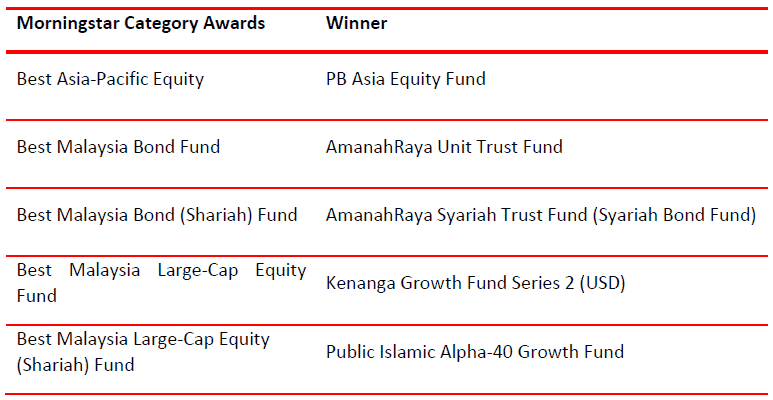
    2022 Morningstar Fund Awards Malaysia

    The above are the 2022 Morningstar Fund Awards winners in Malaysia.

    For the category Best Asia-Pacific Equity, the winner is PB Asia Equity Fund by Public Mutual Berhad.

    Best Malaysia Bond Fund category goes to AmanahRaya Unit Trust Fund by Amanahraya Investment Management Sdn Bhd.

    Amanahraya Investment Management Sdn Bhd wins again in the Best Malaysia Bond (Shariah) Fund category with its Amanahraya Syariah Trust Fund (Syariah Bond Fund).

    Kenanga Investors Berhad won the Best Malaysia Large-Cap Equity Fund with its Kenanga Growth Fund Series 2 (USD).

    Finally, Public Mutual Berhad won again for the category Best Malaysia Large-Cap Equity (Shariah) Fund with its Public Islamic Alpha-40 Growth Fund.

    How The Winners Are Selected?

    The Morningstar fund category awards are based on Morningstar fund data as of 31 December 2021. The awards methodology emphasises the one-year period, but funds must also have delivered strong three- and five-year returns after adjusting for risk within the awards peer groups in order to obtain an award. In selecting winners, fund returns are adjusted for risk using the Morningstar Risk, a measure which imposes a higher penalty for downside variation in a fund’s return than it does for upside volatility. The full methodology for the awards is available here.

    So there you go, those are some of the top unit trust in Malaysia. But before investing in any unit trust or any investment vehicle for that matter, do your own due diligence first. The unit trust might be suitable for me, but it might not be suitable for you or for everyone.