Category: Asset Management

  • Asian Market Recovery: Light at the End of the Tunnel

    There has not been a more dramatic rollercoaster ride for investors than the year 2020. From the global outbreak of the Covid-19 pandemic to subsequent economic lockdowns and geopolitical tensions, it has been a year that many investors would probably like to forget. With that 2021 is expected to be a year for Asian market recovery.

    A highly volatile year for financial markets, the year started off with cautious optimism as the global trade war between the United States and China began to thaw. Come February, global markets were hitting new highs.

    And then came the Covid-19 pandemic, which caused markets to sell-off by 34% (as measured by the MSCI World Index) within a short span of just six weeks.

    “However, as quickly as the market sold down, the recovery was swift. In early April, we saw benchmark gauges retracing back their losses induced by the pandemic as stimulus optimism buoyed market gains,” Affin Hwang Asset Management deputy managing director and chief investment officer David Ng tells Smart Investor.

    Policymakers were seen doing whatever it takes to shelter the economy through a swathe of stimulus measures ranging from relief packages to loan facilities and asset purchases.

    “All the losses were finally recovered at the beginning of November, which coincided with the initial release of Phase III clinical trial data for the vaccines. So, there is light at the end of the tunnel in every cycle,” he adds.

    Opportunities for Asian Markets

    There is an emerging bullish consensus that 2021 will be a recovery year. While current estimates suggest that global gross domestic product (GDP) is expected to fall by around 5% in 2020, this is expected to rebound by 5.4% in 2021 as growth returns and more economies open up.

    “So far, economic growth has surprised on the upside and there are positive revisions to corporate earnings. These will be supportive of risk assets. Effective vaccines will be key in providing a boost for markets,” Ng remarks.

    However, as the vaccines will take time to produce, the recovery will be prolonged into 2022 and 2023, thus making this a multi-year theme.

    Being a recovery year, the expected key investment themes are normalisation/rebound plays that include banks, insurers, materials, consumer discretionary and tourism and hospitality.

    “Stocks that were trading at low multiples are now coming back in flavour as we see a rotation to value,” says Ng.

    However, he stresses that the shift in value does not signal the end of the upside for technology and growth stocks. After all, while valuations are expensive, it is also one of the sectors that has the ability to grow profits consistently and exhibit secular growth, and not many sectors can claim as much.

    According to Ng, Affin Hwang Asset Management is adopting a barbell approach for their portfolio positioning.

    “On one end, we are tilted towards a basket of secular growth names with multi-year prospects that would continue to grow beyond the development of the vaccine. On the other end, we are also weighted towards cyclical and value-plays that would benefit from a re-opening of the economy,” he says.

    On the flipside, there are also risks that could derail this recovery theme.

    “Firstly, we would be closely monitoring president-elect Joe Biden’s approach to dealing with China. Asian markets and Asian foreign exchanges have reacted positively to the recent election results. An antagonistic approach would certainly bring downside risks,” Ng explains.

    Another key risk the team is monitoring is whether corporate earnings can recover as strongly as expected given the rising Covid-19 cases globally. Market valuations are high and good earnings are thus required to anchor them.

    As it will take time to produce enough vaccines on a global scale, Ng also expects the economic conditions in the near term to stay muted. “Growth may stay tepid until various countries and/or sectors can fully reboot,” he says.

    Investing in the New Normal

    But while 2020 may be a year that investors would like to forget, it was also one filled with important lessons.

    “If anything, the year has emphasised yet again the importance of diversification. Staying diversified across different asset classes is crucial; geographical and sector exposure can help minimise volatility and smoothen returns. In turn, this will induce investors to remain invested and help them stay the course,” Ng opines.

    2020 has also underscored the perils of market timing and investing according to one’s emotions. When the markets plunged in March, for instance, many investors may have panicked and resorted to shifting all their allocations to cash.

    According to Ng, the market began to recover and recouped back its losses a few weeks after the drop, and not wanting to miss out on the surge, many investors have shifted back their exposure into equities.

    “Timing the markets can prove to be more costly than the actual correction itself. That being said, investors should periodically reassess their risk capacity to see if they are comfortable with the level of risk in their portfolio.

    “If investors are taking on more risk than they can handle, this might cause jitters and lead to making impulsive decisions that do not benefit them,” concludes Ng.

    By Bernie Yeo

  • Global Economy Set for Recovery Phase

    Global Economy Set for Recovery Phase

    If anything, 2020 has taught us that opportunities for investors can arise in the midst of uncertainty, and that market sentiments can change within a short span of time.

    The pessimism during the first quarter, according to FSMOne research analyst Shawn Low Tian How, has been  quickly replaced with a bullish rally up to the point of writing as demonstrated by the benchmark for global equities, which is represented by the MSCI All Country World Index.

    Performance-wise, Low reveals that most unit trust funds have come out of 2020 in the green despite the difficulties during the first quarter of the year.

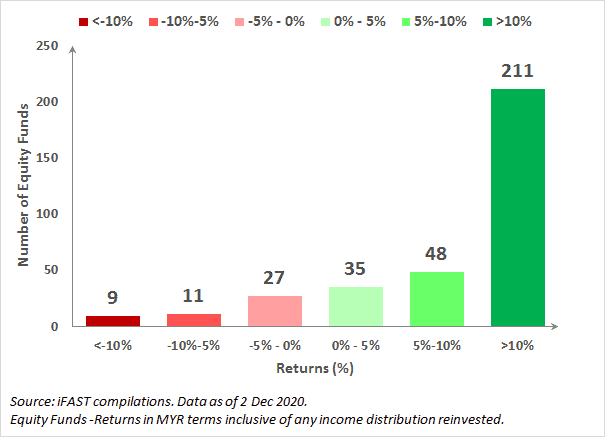
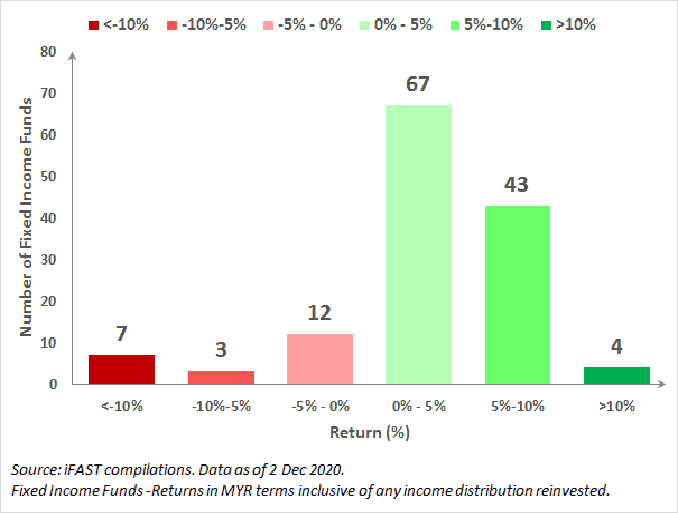
    “86% of the 341 equity and 84% of the 136 fixed income funds on the FSMOne platform have clocked in positive gains on a year-to-date basis (see Figures 1 and 2). These two asset classes have had stellar performances largely due to the immense liquidity injected by major policymakers of the world,” he tells Smart Investor.

    global economy recovery growth markets equity funds

    Figure 1: Equity funds have performed decently over the year.

    global economy recovery growth markets fixed income funds

    Figure 2: Similar occurrences can be seen in fixed income funds.

    “This event has once again reinforced a timeless quote by Warren Buffett — ‘Be fearful when others are greedy, be greedy when others are fearful’.

    “Investors who had invested during the Covid-19-induced March sell-off would have benefitted greatly on the following run up in asset prices. On the other hand, investors who exited the market in the midst of the selloff in fear of further drawbacks have lost out on potential returns during the subsequent recovery.

    “This also strengthens our belief that investors should not be shrouded by short term noises and should stay invested at all times with a long-term view,” he reveals.

    Investment Outlook for 2021

    The conditions going ahead is likely to be constructive for equities, according to Low.

    “Looking at the business cycle, we may have just witnessed a trough in 2020. Given that most leading indicators such as Purchasing Managers’ Index (PMI) or exports have begun bottoming out, the global economy could be positioned for a recovery/expansionary phase in 2021,” he explains.

    “However, a resurgence in Covid-19 cases could force many economies to reimplement lockdown measures, much like how European countries are doing. Should this threat be prolonged, it will overshadow any chances for a global recovery,” warns Low.

    That said, positive progress surrounding the vaccine such as the slew of efficacy test of around 90% in recent weeks have shed some light on the pandemic.

    “We expect more positive news to follow suit as other vaccine developers catch up to the final phases of testing, providing more options for countries to combat the coronavirus,” he points out.

    Meanwhile, the United States presidential election – which was the key risk event in 2020 – has mostly come to an end. The world will see a Biden presidency, alongside a bipartisan Congress in 2021, which is ideal for the market, reckons Low.

    Foreign policies firstly are likely to be more predictable, to which actions taken could be more bilateral instead of unilateral.

    “In terms of the bipartisan congress, some of the more extreme bills such as raising taxes could face some challenges in being passed, or at least being downsized. Given that extreme changes are unlikely, the probability of increased volatility coming from new legislations are likely to be low.”

    While the tensions between US-China may be a recurring theme going ahead, that president-elect Biden’s stance towards China is less aggressive compared to President Trump, he adds.

    Bright Spots Aplenty

    Given that most markets have experienced depressed earnings in 2020, many markets should register decent earnings growth in 2021 due to the low base effect.

    “Amongst the many markets we cover, emerging markets such as China and Asia Ex-Japan will lead their global counterparts. China, being one of the first countries to successfully curb the pandemic, is expected to clock positive GDP growth.

    “Coupled with tailwinds such as growing middle income and high population, the country is one of the more fundamentally sound markets and could remain so for many years to come. In extension, given that most Asia Ex-Japan countries export mainly to China, the recovery of China could also serve to boost its neighbours’ growth,” opines Low.

    Closer to home, Malaysia’s recent announcement of the 2021 Budget sets the tone for the year ahead. Budget beneficiaries include the property and construction sectors as the government focuses on providing support to low-income housing and the continuation of infrastructure projects.

    The local technology sector, mainly the semiconductor players, are also expected to do well, benefitting from secular trends such as Internet of Things (IoT) and 5G technologies.

    “In addition to the key risk posed by the Covid-19 pandemic, other risks are likely to be implementation risks as infrastructure projects historically have faced pause orders.

    “However, we deem this risk to be relatively low given the high multiplier effect of the sector which is used to support the economic growth of the country. In terms of the technology sector, while high valuations could be a concern for many, the decent growth potential of the sector is likely to bring valuations to more palatable levels,” says Low.

    Strategies to Ride through Market Uncertainties

    Due to volatility being part and parcel of investing, the strategy of investing through a diversified portfolio (incorporating different asset classes, geographies and sectors, among others) has been proven to help lower overall portfolio volatility and give investors better peace of mind in times of market distress.

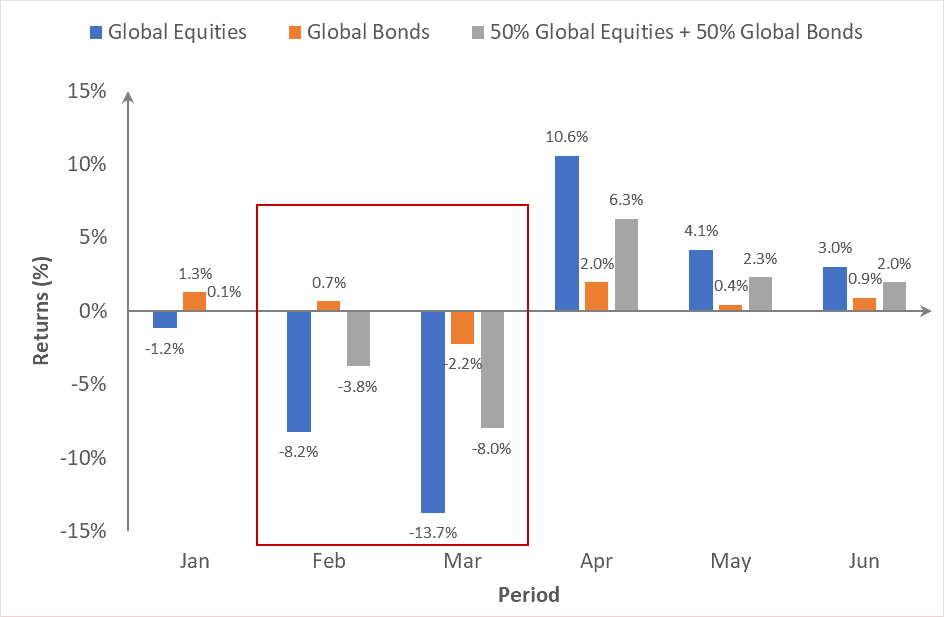
    To illustrate his point, Low draws attention to the start of 2020 where global equities (represented by MSCI AC World Index) suffered sell-offs of -8.2% and -13.7% in February and March respectively due to Covid-19 induced fears.

    Global bonds (represented by Bloomberg Barclays Global Aggregate Bond Index), on the other hand, were up 0.7% in February and only down -2.2% in March (see Figure 3).

    global economy recovery growth markets global equities bonds

    Figure 3: Global equities and bonds monthly returns in 2020.

    The deviation in price movements is because equities and bonds are different asset classes and have a low correlation with one another, he explains.

    “A mixed asset portfolio with 50% allocation in global equities and 50% in global bonds would evidently have much lower volatility than global equities over the same period.

    “For example, during the Covid-19 induced sell-off, the portfolio was down -3.8% and -8.0% in February and in March respectively. The annualised volatility of the portfolio is 17.4%, significantly lower than the 30.6% that of global equities.

    “As such, investors should adopt the strategy of investing through a diversified portfolio to help them ride through any market uncertainties in the future as just as it would have in 2020,” he explains.

    By Bernie Yeo
  • Succesfully Investing in a Pandemic

    Succesfully Investing in a Pandemic

    For many investors around the world, the onslaught of the Covid-19 pandemic wreaked havoc on their investment portfolios as stock markets tanked in late February and March. How does one start successfully investing in a pandemic? From the lows of late March, equity markets including Bursa Malaysia rebounded significantly in April though it remains to be seen whether this just a “dead cat bounce” or an unsustainable rally within a bear market.

    Investors are understandably concerned the lockdown imposed in many countries, including Malaysia, will tip the global economy into a deep recession. In the event Malaysia falls into a recession, this will be the first time since 2009 that the economy has contracted.

    In such a scenario, investors will be preoccupied with preserving their investments in case the markets drop further. Nevertheless, astute investors are licking their chops in anticipation of a market crash that will enable them to swoop in to snap up a host of quality assets at a steep discount.

    Despite the volatility in the capital markets, FSMOne assistant research manager Tan Wei Yine thinks there are still opportunities residing within equity markets.

    However, he cautions that while global equities have rebounded strongly from their March lows, there is still “a great deal of uncertainty” surrounding the containment progress of Covid-19 across the globe.

    “In the coming weeks, macroeconomic data reflecting Covid-19’s impact on the economy are going to surface with more negative signs, which could inject an additional dose of volatility in stock markets.”

    On whether the rebound from the March lows is just a rally within a bear market, Tan notes that from a historical perspective the S&P 500 Index has seen 16 bear markets (excluding the current one) over the past 90 years.

    “With hindsight, four out of those bear markets have posted intermittent bull market rallies of more than 20% before trending lower later. Although counter-trend bulls may not appear as often, it would be unwise for one to rule out the possibility of it happening again completely,” he adds.

    Rebalancing investment portfolios

    What strategies should investors adopt during times of market stress such as now?

    FSMOne advocates investors to have a mix of equities and fixed income that is aligned to their risk profiles, explains Tan (right).

    “In market distressful periods, the fixed income portion of the portfolio could help provide stability and in decent times, the exposure to equity markets could help capture capital growth opportunities.

    “Investors may find it easier to hold onto a risk-aligned portfolio in challenging times. An investment portfolio that has large, concentrated exposure to volatile assets may induce huge swings in emotions that could lead to poor investment decisions in market distressful periods,” he adds.

    Tan advises that an investor should hold a portfolio that aligns with his risk profile. For instance, a balanced investor should have equal weights of 50:50 into equities and fixed income.

    In a market downturn, the equity allocation is expected to decline along with the drawdown in stock markets’ movement, while the fixed income portion that is holding up relatively well should have a higher allocation (e.g. the portfolio now has <50% to equities and >50% to bonds), he explains.

    Investors may take the opportunity to rebalance their portfolios by reducing their fixed income exposure and increasing equity exposure, bringing those allocations back to the neutral level of 50:50, he adds.

    “Mainly, investors are selling high (fixed income prices that held up relatively well) and buying low (equity prices that have been battered heftily). As there is still a great amount of uncertainty surrounding Covid-19 over the near-term, we recommend investors to rebalance progressively when equity markets continue to decline,” he advises.

    Preserving your capital

    When markets turn bearish, investors will need to adopt a defensive stance when it comes to their portfolio.

    Affin Hwang Asset Management chief marketing and distribution officer Chan Ai Mei says as a defensive measure, investors can diversify and opt to tilt their allocation towards fixed income and bond funds.

    “Its more modest drawdowns can help ensure capital preservation as well as provide a measure of stability through a regular income stream,” she says.

    To position their portfolios and navigate through volatility ahead, investors should first review their portfolios and assess if they are comfortable with the level of risk they are taking. Ideally, investors should also rebalance their asset allocation annually to correct any portfolio drifts, she adds.

    “If liquidity is crucial, especially for conservative investors who have retired or are approaching retirement, we believe it is appropriate for them to reduce exposure in equities. This might forego some future upside, but is ideal to help preserve and protect capital.

    “Within fixed income, conservative investors should also tilt their allocation towards investment-grade bonds and avoid high-yield exposure.”

    For investors sitting in the middle of the risk-profile spectrum and want some equity exposure, an important question they need to ask themselves is whether they can stomach the volatility for the next three to five years?

    “If the answer is yes, then investors should average down and split your investment into a few tranches to ease your way into the market,” Chan advises.

    Timing the Market

    With equity markets rebounding from recent lows, should investors consider buying the dip? Is it even possible to know when the market’s bottom is reached?

    Chan believes there is always an element of danger in timing the market. “Even the savviest investor can get it wrong. The ongoing Covid-19 episode has shown how sudden and vicious markets can turn, especially coupled with the presence of algo-traders that have exacerbated volatility.

    “Instead of trying to time a market in a downturn, the ideal approach for investors to take may be to just do nothing at all.”

    To illustrate, Chan examines how an investment of RM100,000 fares through different market cycles and how it would fare under two different scenarios:

    * The investor cuts losses by selling in every market downturn; and

    * The investors hold and does nothing in every market downturn.

    As can be seen from the tables, the investor who does nothing would perform better overall. Thus, investors should endeavour to spend time in the market instead of trying to time the market, she says.

    “Avoid making drastic shifts in one’s asset allocation, whether it is ploughing into the market or cashing-out all at once.”

    The Value of Waiting

    Chan also highlights what investing legend Charlie Munger – Warren Buffett’s right-hand man – once said: “It is waiting that helps you as an investor, and a lot of people just can’t stand to wait.”

    In this type of market environment, she says investors’ nerves are bound to get frayed and they may start turning jittery whenever they see a new headline about new infection rates or whispers about a recession or layoffs.

    “We believe investors stand to benefit more by doing less in 2020. Once the Covid-19 contagion recedes, there will be very little impact to long-term investment decisions and fundamentals. As such, we don’t advise doing much on your portfolios.

    “It is crucial that investors stick to their asset allocation and stay prudent in this current volatile landscape. Investors who remain disciplined in their approach by investing consistently and sticking to their long-term asset allocation will eventually reap the benefits and fare better overall,” Chan concludes.

    By Lee Min Keong

  • Malaysian Capital Market Continues to Finance Economy

    Malaysian Capital Market Continues to Finance Economy

    The domestic capital market continued to play an important role in financing the Malaysian economy during 2019, says the Securities Commission Malaysia (SC).

    The total size of the capital market expanded to RM3.2 trillion in 2019 from RM3.1 trillion the year before, with debt securities outstanding and equity market capitalisation of RM1.5 trillion and RM1.7 trillion respectively (2018: RM1.4 trillion and RM1.7 trillion respectively), according to the SC Annual Report 2019.

    Notwithstanding the challenging global backdrop and ongoing domestic policy reforms, the Malaysian capital market witnessed a higher level of fundraising activities during the year, with total funds raised in the bond and equity market amounting to RM139.4 bil in 2019 compared to RM114.6 bil in 2018.

    Alternative fundraising avenues have also continued to gain traction, especially in equity crowdfunding (ECF)  and peer-to-peer (P2P) financing, with total funds raised more than doubled to RM443.8 mil (2018: RM195.9 mi).

    A total of RM132.8 bil was raised in the corporate bond and sukuk market compared to RM105.4 bil in 2018, with issuances mainly in utilities and financial services. Sukuk made up 77.1% of total bond issuances in 2019.

    Meanwhile, RM6.6 bil was raised via the equity market (2018: RM9.2 bil), of which RM2 bil was through new equity listings with a total of 30 IPOs and RM4.6 bil raised via secondary fundraising. In 2019, four companies were listed on the Main Market, 11 companies on the ACE Market, and the remaining on the LEAP Market.

    Notably, the size of issuances via the LEAP Market grew by 60.6% y-o-y to RM92.2 mil in 2019 (2018: RM57.4 mil). In the fund management industry, total assets under management (AUM) rose to RM823.2 bil (2018: RM743.6 bil) amidst an increase in market value, driven by robust performance of small and mid-cap equities and higher net injection from dividend reinvestment.

    Total net sales for the unit trust segment amounted to RM30.5 bil in 2019, a decrease of 19.5% y-o-y (2018: RM37.9 bil). In terms of portfolio flows, total non-resident inflows amounted to RM8.7 bil in 2019 (2018: portfolio outflows of -RM33.6 bil), mirroring regional trends.

    The bond market recorded total inflows of RM19.9 bil (2018: outflows of -RM21.9 bil) while the equity market recorded total outflows of -RM11.1 bil (2018: outflows of -RM11.7 bil). In the bond market, non-residents accounted for 13.7% of total outstanding ringgit bonds as at end December (end-2018: 13.1%) – most of which were Malaysian Government Securities (MGS) at 80.1% of total foreign holdings (end-2018: 79.1%).

    Orderly Market Adjustments of Fund Flows

    In the equity market, foreign holdings remained stable at 22.4% of total market capitalisation in 2019, in line with its five-year average. The high level of domestic liquidity in the capital market continued to allow for orderly market adjustments of fund flows between non-residents and local investors.

    The Malaysian bond market grew 7.1% from RM1.4 trillion in 2018 to RM1.5 trillion as at end 2019. This was supported by higher levels of debt fundraising, sustained demand by domestic institutional investors, and favourable domestic macroeconomic conditions.

    Despite the challenging environment, Malaysia was also among the emerging East Asian economies that saw local currency bond markets expand in 2019. In 2019, as a percentage of GDP, Malaysia remained the third largest local currency bond market in Asia after Japan and South Korea.

    However, ongoing trade tensions, the shift in global monetary policy expectations, and general concern over slower global growth continued to drive volatility in the bond market throughout the year. MGS yields experienced downward pressure across tenures, tracking global trends, on the back of major central banks’ shift in monetary policy stance and overall higher global risk aversion.

    It also reflected the lower domestic growth and inflation expectations alongside the Overnight Policy Rate (OPR) cut by Bank Negara Malaysia (BNM) in May 2019. As such, yields reduced across the board while the overall curve was relatively flatter for the year.

    Double-digit Growth for Mid- and Small-caps

    For the Malaysian equity market, overall market capitalisation ended the year marginally higher by 0.7% to RM1.71 trillion in 2019 from RM1.70 trillion in 2018. This was despite the challenging external environment with heightened headwinds mainly from the ongoing US-China trade tensions and weaker global growth.

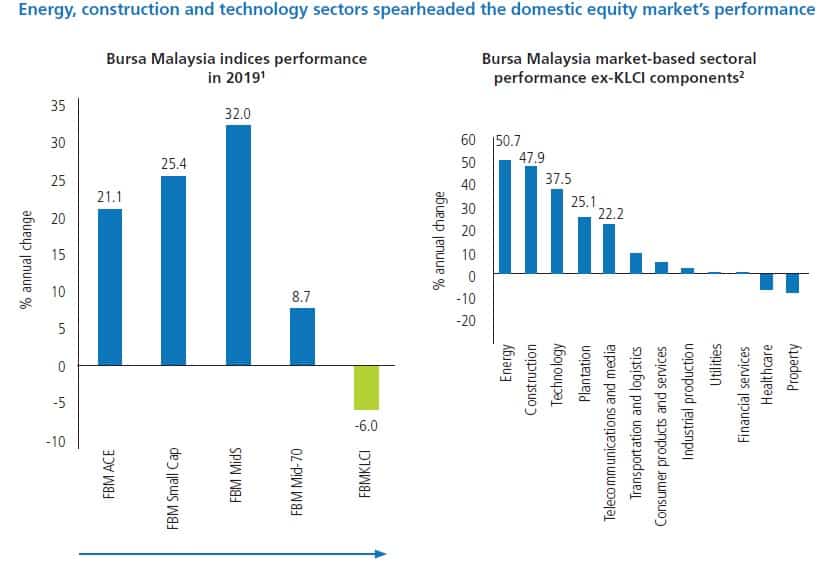
    Overall, while the FBMKLCI moderated in 2019, some segments in the broader domestic equity market gained significant traction, partly reflecting a shift in investors’ preferences. This occurred as sentiments swayed in favour of constituents with better valuation and corporate earnings prospects, particularly in the small and mid-cap segments.

    The FBMKLCI declined by 6% y-o-y to close the year at 1,588.76 points (2018: -5.9% y-o-y to 1,690.58 points), influenced by a year of event-driven volatility in sentiments as well as subdued corporate earnings, which continued to be a pressure point on the benchmark index.

    Additionally, the FBMKLCI was also weighed down by major counters subjected to key policy adjustments in 2019, aimed at longer-term improvement.

    Nevertheless, the non-FBMKLCI components in the Malaysian equity market performed favourably in 2019. It registered higher growth despite the challenging external headwinds, as improved earnings outlook garnered investor interest into this segment.

    The FBM MidS, FBM Small Cap and FBM ACE indices increased at robust double-digit rates of 32% y-o-y, 25.4% y-o-y, and 21.1% y-o-y respectively in 2019.

    The significant growth in small and mid-cap indices was mainly driven by the energy, construction, and technology sectors, which benefitted from stronger fundamentals and better valuation prospects of their key companies during the year.
    Excluding the FBMKLCI components, the energy sector specifically recorded the largest increase, rising by 50.7% y-o-y (2018: -17.3% y-o-y4), while the construction sector increased by 47.9% y-o-y (2018: -46.0% y-o-y), owing partly to the revival of public projects by the government.

    The technology sector, in turn, rose by 37.5% y-o-y (2018: -9.32% y-o-y), benefitting from the 5G network rollout, higher global smartphone shipments, and potential trade diversion stemming from the ongoing US-China trade war.

    Robust Fund Management Industry

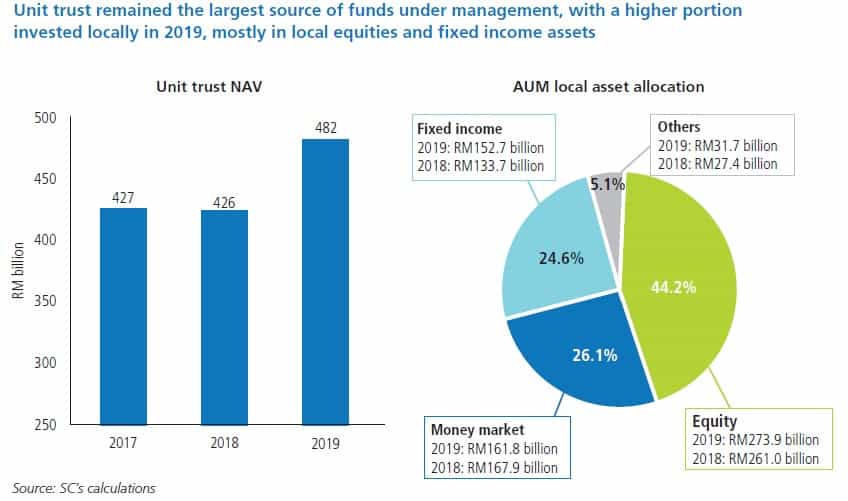
    Meanwhile, in the fund management industry, the unit trust segment remained the largest source of funds towards the AUM, with net asset value (NAV) amounting to RM482.1 bil in 2019 (2018: RM426.2 bil).

    Overall, 75.3% of the fund management industry’s AUM was invested locally, of which 44.2% was in domestic equities, followed by 26.1% in money market placements, and 24.6% in fixed income.

    Compared to 2018, investment in local equities and fixed income rose in value by RM12.9 bil and RM19 bil respectively, while the domestic money market placements decreased by RM6.1 bil.

  • AmanahRaya Wins Morningstar Award For Second Consecutive Year

    AmanahRaya Wins Morningstar Award For Second Consecutive Year

    Another stellar year for AmanahRaya Investment Management Sdn Bhd (ARIM) saw them secure double honours at the Morningstar Awards, the second consecutive year in which it has done so. We spoke to En. Roszali Ramlee, Chief Executive Officer / Managing Director of ARIM to get his views.

    The Reason Behind ARIM’s Funds Successful Performance

    We continue to trust our process which has kept us in the game for many years now. If the process is not yielding the results we wanted, then we would look into our process to see where we can enhance. This allows us to continue to improve continuously and be a better version of ourselves over time.

    We recognise how market dynamics have been changing quite rapidly these days. Some of these factor dynamics are shorter than the others e.g. Covid threat is fading away as vaccination and immunity improve, while other factors such as the inflation threat, may stay longer and give greater impact to our investments.  What history thought us in the past is, risks can never go away, it can only be mitigated.

    Our message to investors is to keep invested, during good or bad times, adjusting the allocation to your comfort and risk-return profile. The geopolitical crisis that has erupted recently seems to be a tail-risk event to many, but in our view, this too shall pass.

    At ARIM, we shall carry our duty as a fund manager to the best of our ability to produce the best results while mitigating the risks. We shall continue to do what we do best, keep hunting for undervalued securities and hold them till prices actually reflect their intrinsic value.

    Upcoming Trends That Investors Should Look Out For

    Fixed-income investors should brace for lower returns than last year. Returns of 4% to 6% is very commendable based on the current market scenario. Interest rate shall remain low in 1H2022, with potential 1 to 2 hike in 2H2022.

    That said, we are hopeful that there will be more sukuk issuances in the pipeline this year to further diversify our portfolios.

    Are There New Investment Products By ARIM

    Yes, we are going to launch our New Income Fund in year 2022. The strategy of this income fund are to focus on short to medium term sukuk with low to medium risk appetite.

  • Morningstar Awards Highlight Quality of Investments

    Morningstar Awards Highlight Quality of Investments

    This year, Morningstar Asia Limited announced the winning funds and fund houses for its Morningstar Fund Awards Malaysia in a rather unconventional way. The awards ceremony, which is typically held annually in Kuala Lumpur, was instead hosted via a special webcast on March 19 in light of the Covid-19 outbreak globally. 

    Nevertheless, the change in the awards ceremony format did not prevent Morningstar Asia Limited, a subsidiary of Morningstar, Inc., a leading provider of independent investment research, from recognising retail funds and fund houses that have added the most value for investors within the context of their relevant peer group in 2019 and over longer time periods. 

    Morningstar selects the winners using a quantitative methodology, along with a qualitative overlay. Weightings to one-, three-, and five-year risk-adjusted performance are factored into the methodology.

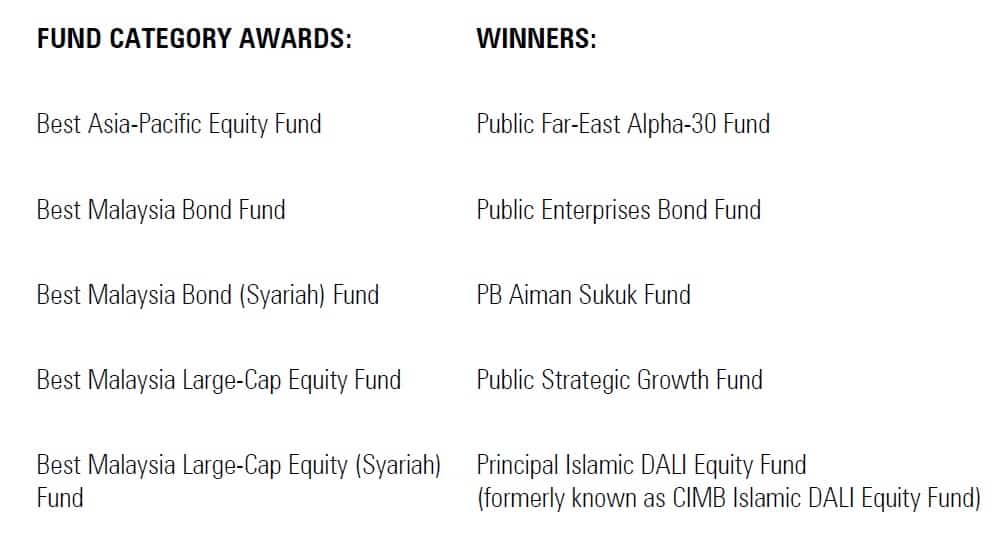
    Public Mutual Bhd was the biggest winner, sweeping four out of the five awards on offer. Malaysia’s leading unit trust company took home the awards for Best Asia-Pacific Equity Fund, Best Malaysia Large-Cap Equity Fund, Best Malaysia Bond Fund and Best Malaysia Bond (Syariah) Fund. 

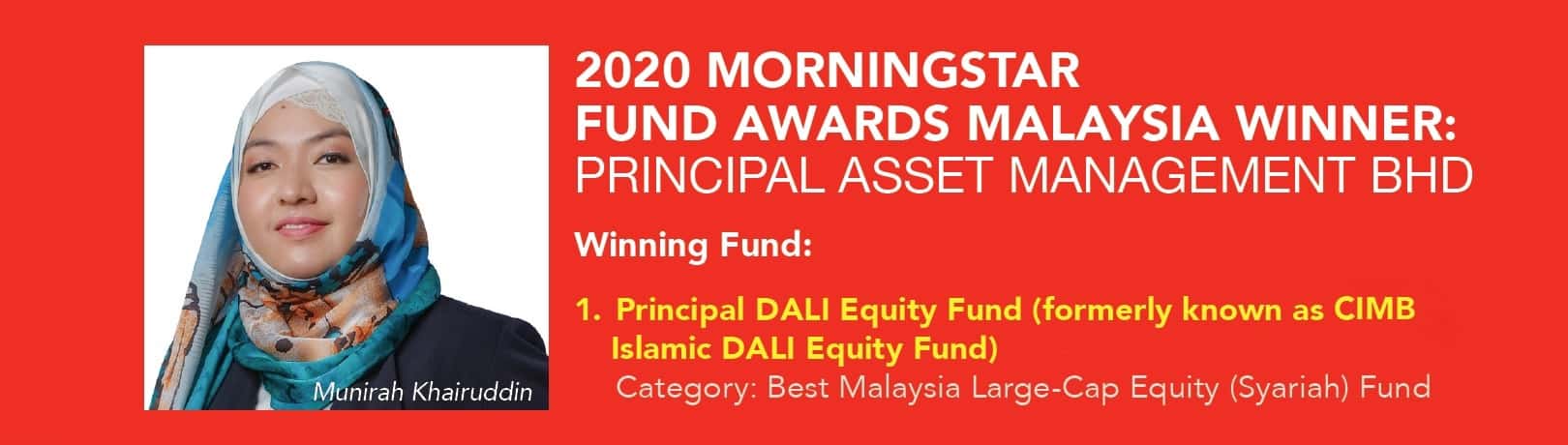
    Principal Asset Management Bhd’s Principal Islamic DALI Equity Fund (formerly known as CIMB Islamic DALI Equity Fund) won the Best Malaysia Large-Cap Equity (Syariah) Fund. 

    In his speech delivered via the webcast, Morningstar Asia chief executive officer Nick Cheung said Morningstar’s Annual Awards highlight the quality and breadth of investments available for investors in each region. “Our 2020 winners have been great drivers of investor success. It is our honour to recognise their outstanding achievements and commitments to investors.” 

    Cheung pointed out that every year, Morningstar presents awards to more than 30 countries globally to recognise exceptional fund managers and investment teams who deliver value to investors, and put investors’ interest at the first place.

    “This is in perfect alignment to Morningstar’s vision, which is to empower investors to make more informed investment decisions, and make better investment outcomes. Morningstar has a long history of helping investors.

    “Despite the current diff cult environment, we continue to invest to allow investors to have more and expanded research coverage on equity, fund, ETF, ESG and private investments,” Cheung said. 

    For example, he said Morningstar will soon roll out a new web-based analytic platform of Morningstar Direct which has new features and data sets to allow investors to make better informed investment decisions. 

    Delivering market-beating returns

    Wing Chan, Morningstar’s director of Manager Research Practice, EMEA & Asia, said the 2019 rally in both equities and bonds has rewarded investors handsomely. “However, it was also one of the more unpredictable periods in history, with low interest rates, heightened geopolitical uncertainty, and stretching asset valuations continuing to worry investors. 

    “The awards winners, across our equity and fixed income categories, have proved their ability to deliver market-beating returns over the long term without undue risk,” he added. 

    On what Morningstar looks for when picking the winning funds for the annual awards, Andrew Daniels, senior analyst, Equity Strategies, Manager Research for Morningstar Asia, said the goal is to recognise those funds that have added the most value within the context of a relative peer group for investors over the past year and the longer term. 

    On how Morningstar plays a key role in helping bring about better outcomes for investors, Daniels said Morningstar offers a global reach and has earned investors’ trust through its unbiased and independent research, investor-centric mission, and thought leadership.

    “Since its founding more than 35 years ago, Morningstar’s mission has been to empower investor success. We believe that by taking something nebulous, such as the financial services industry, and making it transparent, investors gain the knowledge to make better decisions. 

    “As a result, Morningstar builds unique products and services that connect people to the investing information and tools they need, because when investors are successful, so are we.”

    By Lee Min Keong

    Please click here to read the full article in the digital edition of Smart Investor (April 2020 issue).

  • Principal Asset Management Bhd Wins Morningstar Fund Awards Malaysia

    Principal Asset Management Bhd Wins Morningstar Fund Awards Malaysia

    Principal Asset Management Bhd took home the Best Malaysia Large-Cap Equity (Syariah) Fund award at the 2020 Morningstar Fund Awards Malaysia for its Principal DALI Equity Fund (formerly known as CIMB Islamic DALI Equity Fund).

    Smart Investor speaks with chief executive officer Munirah Khairuddin on the fund’s performance and how Syariah-compliant funds are gaining traction with investors.

    Despite the strong headwinds buffeting the equity markets, Munirah sees opportunity in adversity, adding that Malaysian equity evaluation is already cheap. While taking a defensive stance, she says Principal Asset Management will take the opportunity to accumulate selective stocks within the plantation, construction, and oil and gas, and healthcare sectors.

    Smart Investor: Congratulations on your win! What were the major changes made to the portfolio in 2019? What key factors drove your winning fund’s performance?

    Munirah Khairuddin: Thank you! I believe the right asset allocation strategy has helped the fund’s performance in 2019. As you may know, the fund consists of 70% Malaysia and 30% Asia Pacific markets, and we manage the fund based on our proprietary top-down FTV and bottom-up FMV Research Process.

    We adopted the Barbell Portfolio structure approach that emphasises on capital preservation and/or growth and have a rigorous portfolio optimisation process that focuses on the Beta, Active Share, and Sharpe Ratio. On top of that, we also run continuous data analytics to ensure that the portfolio is been managed within the optimum risk parameters.

    Are Shariah-compliant funds like Principal DALI Equity Fund gaining traction with investors?

    Yes, we are seeing Islamic Asia Pacific funds gaining traction with investors. This is part of the asset allocation/risk diversification strategies that we are advising investors to consider.

    Historically, Islamic investments are less volatile than their conventional counterparts, especially during periods of uncertainty. During the subprime crisis in 2008, Islamic investments were not as greatly impacted compared to the conventional investments. The Islamic financial markets do not rely on the subprime assets or excessive leverage which caused difficulties for many conventional institutions in the past.

    What are the major risks or challenges facing the financial markets in 2020? How do these risks affect your investment decisions?

    We are in a unique situation in Malaysia. Our markets have been impacted by the Coronavirus outbreak and the US-China trade war. However, for the right investor, we believe there is an opportunity to invest in Malaysian equities and fixed income products because of the value.

    In terms of equity, Malaysian equity valuation is already cheap. We are taking a defensive stance and focusing on stocks which are resilient to the expected slowdown in the domestic economy and/or not exposed to domestic political and regulatory uncertainty. We prefer sectors that benefit from interest rate cuts and are USD earners. This would include stocks in the consumer staples, healthcare, energy, plantation and the REITs sectors.

    On the fixed income side of things, the impact of the Coronavirus outbreak may result in growth in 1Q2020 softening to below 4%. As a conservative move, our fixed income funds are taking a neutral view on benchmark duration. If government bond yields start to rise, we may take advantage of it to extend duration at an opportunistic level.

    Given the current headwinds, which sectors do you see as resilient and can thrive, and how would you position your funds to take advantage of opportunities and/or mitigate risks?

    As I mentioned earlier, we prefer sectors that benefit from interest rate cuts and are USD earners. This would include stocks in the consumer staples, healthcare, energy, plantation and the REITS sectors.

    As always, we advise investors to consider their long-term financial goals and risk tolerance when it comes to investing. Our investment team has recommended the following based on our asset allocation mix (as of Feb 2020):

    Malaysia

    Malaysian equity valuation is undervalued, making it attractive. It’s a great time to take advantage of the opportunity to buy low. We will continue to buy Malaysia on weakness and keep our barbell approach on high yield stocks. We’ll take the opportunity to accumulate selective stocks within the plantation, construction and oil and gas sectors.

    When it comes to the Covid-19 outbreak, we will look at sectors impacted by this event. We’ll tactically underweight the aviation sector, while taking opportunities to trade the glove and healthcare sectors.

    Asia Pacific Region

    A market sell-off during an event like the Coronavirus outbreak usually offers great buying opportunities. Much like Malaysia – it’s a great opportunity to buy low.

    We are taking advantage by buying into structural names with good management and strong business models. We also like companies that are emerging as the key players in the fourth industrial revolution.

    Even though e-commerce may be a relatively more resilient sector with Chinese consumers choosing to spend more time at home and online shopping demand may increase, stocks of these companies are likely to also be sold off indiscriminately in a knee-jerk reaction. We will also be taking the opportunity by adding companies that are capable to lead in the growing consumption space in China.

    By Bernie Yeo

    Please click here to read the full article in the digital edition of Smart Investor (April 2020 issue).

  • 2020 Morningstar Fund Awards Malaysia: Public Mutual Bhd

    2020 Morningstar Fund Awards Malaysia: Public Mutual Bhd

    Public Mutual Bhd took home four awards at the Morningstar Malaysia Fund Awards 2020, namely Best Asia-Pacific Equity Fund, Best Malaysia Large-Cap Equity Fund, Best Malaysia Bond Fund and Best Malaysia Bond (Syariah) Fund.

    Smart Investor met up with Public Mutual chief executive officer Yeoh Kim Hong to discuss the out-performance of its winning mutual funds, risks in the market risk, and the technologies the fund house has adopted to make its business more appealing and
    efficient to investors.

    Smart Investor: Congratulations on your win! Public Mutual won four awards this year. What are the key factors behind the winning funds’ successful performance?

    Yeoh Kim Hong: Despite volatile market conditions in 2019, our winning funds continued to adopt a fundamental approach to investing by selecting stocks and bond/sukuk which have sustained earnings, strong financial positions and proven management track records.

    Public Far-East Alpha-30 Fund (PFA30F), which is a regional equity fund that invests in a concentrated portfolio of a maximum of 30 stocks, won in the Best Asia-Pacific Equity Fund category. In 2019, the fund generated a return of +19.9% to outperform the regional equity markets, as proxied by the MSCI All Country Far East ex-Japan Index, which rose by 15.2% (in ringgit terms).

    The fund’s performance was driven mainly by the out-performance of regional technology stocks which are leveraged to the increasing adoption of digital products and services globally, as well as the secular growth trends in online financial and e-commerce services.

    The second equity award achieved is for the Best Malaysia Large-Cap Equity Fund category. Public Strategic Growth Fund (PSTGF), which focuses its investments on growth stocks in the Malaysian market, achieved a return of +4.3% in 2019. In comparison, the FBM KLCI, which tracks the performance of the domestic equity market, declined by 6%.

    Despite challenging market conditions, the fund was able to achieve a commendable performance, as it focused on fundamentally-strong companies within the consumer, healthcare and technology sectors. These stocks benefitted from sustained consumer spending as well as the trade diversion arising from the US-China trade tensions.

    Public Enterprises Bond Fund (PENTBF), which invests mainly in ringgit-denominated bonds, won the Best Malaysia Bond Fund category. In 2019, the fund achieved a return of +8.2% due to its focus on long-duration bonds with sound credit fundamentals, primarily in the infrastructure and banking sectors. Bonds in these two sectors saw strong buying interest on the back of easing monetary policies globally, which contributed to the fund’s strong performance.

    The second bond award achieved is for the Best Malaysia Bond (Syariah) Fund category. PB Aiman Sukuk Fund (PBASF), which mainly invests in ringgit-denominated sukuk, registered a return of +9% in 2019.

    The fund’s strong performance was due to its focus on long-duration sukuk with sound credit fundamentals, especially in the infrastructure and banking sectors. The fund also benefitted from its sukuk holdings issued by the Malaysian government, which performed strongly in 2019 as sukuk yields compressed.

    Moving forward, how can your bond funds outperform in a volatile yet increasingly low-yield environment?

    The low global interest rate environment as well as the accommodative domestic monetary policy is anticipated to underpin the domestic bond/sukuk market in 2020. Our bond/sukuk funds will continue to seek investment opportunities in bonds/sukuk with strong credit fundamentals while adopting an active portfolio rebalancing approach and maintaining reasonable portfolio yields to ride through periods of volatility in the domestic bond/sukuk market.

    How will market risks like the US-China trade war, geopolitical tensions, and Covid-19 outbreak impact your investment decisions moving forward? What are some of the under-reported risks that could surface this year?

    In light of the uncertainties pertaining to the US-China trade relations, our investments in sectors deemed to be susceptible to increased trade tariffs or restrictions have been reduced. In addition, our funds have largely avoided tourism-related sectors which are directly impacted by the slowdown in travel activities amid the Covid-19 outbreak.

    Other uncertainties include the upcoming US presidential election in November 2020, the Brexit negotiations as well as the sharp fall in oil prices following the Organisation of the Petroleum Exporting Countries’ (OPEC) move to hike oil production despite weak global demand.

    However, accommodative monetary policies by major central banks and various fiscal stimulus measures by global and regional governments should help lend support to global economic activities. The volatility in financial markets will provide opportunities for our equity funds to add to their positions in fundamentally-backed stocks with positive long-term growth prospects.

    Meanwhile, there could be volatility within the domestic bond/sukuk market in the run-up to September 2020 when FTSE Russell is anticipated to announce its decision on the retention of Malaysian bonds in the FTSE World Government Bond Index (WGBI).

    To navigate such market uncertainty, our bond/sukuk funds will continue to focus on high-quality bond/sukuk issuances and rebalance the funds’ portfolio duration accordingly. Our focus on fundamental research and long-term investment strategies should help both our equity and bond/sukuk funds to ride through market cycles as well as through periods of elevated market volatility.

    What measures or strategies has Public Mutual put in place to deal with these market risks?

    In addition to the aforementioned measures, we will continue to be vigilant to developments within the economic and financial markets so as to proactively manage the exposure of our investments to these risks.

    In this respect, we believe our adherence to fundamental research and long-term investment strategies will serve us well in delivering consistent returns to our unitholders over the long term.

    With Malaysia gravitating towards a digital economy, what are some advanced technology that Public Mutual has adopted to make its business more appealing and efficient?

    Among our technological offerings for investors is a dedicated online investment platform, Public Mutual Online (PMO), which provides them with easy access to our products and services on a 24/7 basis. Its key features include a Fund Analytics feature that allows investors to easily review the different features and performance of our available funds.

    Meanwhile, our PMO landing page allows investors convenient access to stock market performance data and fund reviews, as well as a quick overview of their portfolio holdings.

    We also recently revamped our website with improved functionality as well as enhanced user navigation. Investors can now use the website to explore funds, view fund performance and discover the right funds for their investment needs. It also allows investors to conveniently access articles on the financial markets and financial planning.

    New investors can use the Digital Onboarding facility to sign up without need for physical documents, while existing investors can leverage on other facilities to top up their investments and register for the Direct Debit Authorisation (DDA) facility within a few clicks.

    We have also designed several digital tools as part of our efforts to facilitate our unit trust consultants (UTCs) in servicing investors. For instance, the CAMS software allows UTCs to present to investors their investment account details including returns.

    Meanwhile, the U@Bis$ app allows UTCs to guide investors in answering a risk-profiling questionnaire, before subsequently building a unit trust portfolio based on the recommended allocation.

    By Bernie Yeo

    Please click here to read the full article in the digital edition of Smart Investor (April 2020 issue).

  • Public Mutual Bags 4 Morningstar Fund Awards

    Public Mutual Bags 4 Morningstar Fund Awards

    Public Mutual Bhd was the biggest winner at the Morningstar Malaysia Fund Awards 2020, bagging four out of the five awards on offer.

    The unit trust company took home four awards, namely Best Asia-Pacific Equity Fund, Best Malaysia Large-Cap Equity Fund, Best Malaysia Bond Fund and Best Malaysia Bond (Syariah) Fund.

    Principal Asset Management Bhd’s Principal Islamic DALI Equity Fund (formerly known as CIMB Islamic DALI Equity Fund) won the Best Malaysia Large-Cap Equity (Syariah) Fund.

    The winners were unveiled during an awards webcast today by Morningstar Asia Ltd, a subsidiary of Morningstar, Inc., a leading provider of independent investment research.

    The annual Morningstar Malaysia Fund Awards recognise retail funds and fund houses that have added the most value for investors within the context of their relevant peer group in 2019 and over longer time periods.

    Morningstar selects the winners using a quantitative methodology, along with a qualitative overlay. Weightings to one-, three-, and five-year risk-adjusted performance are factored into the methodology.

    “Morningstar’s Annual Awards highlight the quality and breadth of investments available for investors in each region,” said Nick Cheung, chief executive officer for Morningstar in Asia. “Our 2020 winners have been great drivers of investor success. It is our honour to recognise their outstanding achievements and commitments to investors.”

    He pointed out that every year, Morningstar presents awards to more than 30 countries globally to recognise exceptional fund managers and investment teams who deliver value to investors, and put investors’ interest at the first place.

    “This is in perfect alignment to Morningstar’s vision, which is to empower investors to make more informed investment decisions, and make better investment outcomes.

    “Morningstar has a long history of helping investors. Despite the current difficult environment, we continue to invest to allow investors to have more and expanded research coverage on equity, fund, ETF, ESG and private investments,” Cheung said.

    For example, he said Morningstar will soon roll out a new web-based analytic platform of Morningstar Direct which has new features and data sets to allow investors to make better informed investment decisions.

    Wing Chan, Morningstar’s director of Manager Research Practice, EMEA & Asia, said the 2019 rally in both equities and bonds has rewarded investors handsomely.

    “However, it was also one of the more unpredictable periods in history, with low interest rates, heightened geopolitical uncertainty, and stretching asset valuations continuing to worry investors.

    “The Awards winners, across our equity and fixed income categories, have proved their ability to deliver market-beating returns over the long term without undue risk,” he added.

    Public Mutual, the No 1 private unit trust company and Private Retirement Scheme (PRS) provider in Malaysia, commands a market share of 34.6% for the retail funds sector and 42.7% for the PRS sector. A wholly-owned subsidiary of Public Bank, its total net asset value stands at RM85.3 bil as at end-January 2020.

    Principal Asset Management is a joint venture between Principal Financial Group, a Nasdaq-listed global financial services company, and CIMB Group Holdings Bhd. Headquartered in Malaysia, Principal Asset Management has footprint across Indonesia, Thailand and Singapore, with nearly RM88 bil in assets under management as of February 2020.

    2020 Morningstar Fund Awards Malaysia

    Nick Cheung, CEO for Morningstar Asia