Category: Business Planning

  • The Importance of Financial Planning for Small Businesses in Malaysia

    The Importance of Financial Planning for Small Businesses in Malaysia

    Are you concerned about whether you need to close your business during this MCO period? Most small businesses have been dealing with this concern.

    For small business owners running SMEs, it’s arguably more important to be involved in financial planning as you must consider not only how it affects your personal finances, but also the financial health of your business and your employees in general.

    That’s a lot of responsibility. 

    Based on SSM statistics, a total of 9,675 companies and businesses shut up shop during the first phase of the MCO from 18 March to 9 June 2020, while another 22,794 closed down during the recovery MCO (RMCO) phase from June to September 2020.

    What are the reasons for small business owners to make such a tough decision? Here are some possible reasons why:

    Lack of Crisis Awareness

    Many business owners may overestimate their business operating model. They tend to feel that a higher degree of effort put into their business leads to a higher degree of success.

    While this may be true, it doesn’t take into account emergencies and unforeseen circumstances like the Covid-19 pandemic. Without any backup or emergency funds in place, there’s only one possible outcome.

    Misjudgment

    There’s a common tendency for people to inaccurately assess the degree of risk in a risky situation. This happens mainly due to irrational behaviour and overconfidence in their personal judgement.

    Therefore, losses may occur due to ignoring the possibility of wrong information and hastily acting without performing their due diligence.

    Lack of Financial Planning

    During the MCO, many small business owners applied for loans to sustain their SMEs. Many may have used all their resources in order to start the business at the beginning.

    Thus, when business is not going well, they will need to find a way to raise funds to avoid going bankrupt.

    Transformation of Small Business Model

    Across industries, both small and large businesses are accelerating digital transformation processes for long-term growth and profitability. Yet, there are businesses that remain untested in the face of digital challenges, with their digital transformation readiness remaining uncertain.

    As a result, these companies that cannot adapt to change will be knocked out of the business cycle.

    So, what steps can small business owners take to prevent this?

    Planning ahead is key to ensure businesses can survive periods of uncertainty, with preparations made before it occurs. Regardless of economic conditions, business owners can take several precautions to mitigate risk:

    Plan Well for Financial Health

    In football, strikers spearhead the attack but often have nothing to do with defending. Similarly, small business owners may be too focused on earning money and neglect other financial needs of the business.

    Financial planning is key to ensure good financial health, which allows you to focus on your core business without any concern since a strong financial base has already been built.

    Separate Legal Entity

    All transactions associated with a business must be recorded separately from other business or personal transactions. If records are mixed up with that of its owners or other businesses, the accounting information loses its usability – this is an issue that still plagues many family-owned SMEs today due to a lack of management.

    Many owners will feel that no matter how much they earn, it’s not enough for them to retire. By not recording business cash flow separately, they’ll never truly know how much their business can earn in comparison to their personal expenses.

    Build Up an Emergency Fund

    Strong cash flow allows a company to have more flexibility in regards to business decisions and potential investments. Therefore, it’s very important to have an emergency fund in place to survive tough phases like the current MCO period.

    During this time, many SMEs have been forced to stop operations or close completely due to insufficient funds. However, businesses that were well-prepared have been able to sustain themselves and weather the storm accordingly. After all, “cash is king”!

    Refinancing

    Most people would like to settle their mortgages as soon as possible, and small business owners are no different. The feeling of being in debt is one that no one likes. In times of crisis, they may prefer to rely on overdrafts, credit cards, or term loans and personal loans that don’t require collateral.

    These liabilities may have a higher interest rate and a shorter payment term. For small business owners looking to tough it out, refinancing a home loan is an option as a longer payment term and lower interest rate can be negotiated compared to the loan facilities mentioned. Plus, you’ll end up with a lower monthly commitment!

    Asset Diversification

    As mentioned earlier, “Don’t put all your eggs in one basket”. While properties and other physical assets may be tangible, it doesn’t provide liquidity during periods of low revenue. Therefore, it’s important to diversify assets accordingly.

    Businessmen may select other investment vehicles such as REITs, shares, commodities, bonds, collective investment vehicles such as ETF and unit trust, and also other regulated investment tools that have high liquidity and can be easily converted into cash.

    In conclusion, it’s very important for small business owners to have a sense of urgency about their personal finances. With proper financial planning, you’ll be well-placed to face any uncertainty ahead and can survive black swan events without panicking.

    About the author

    Alex Teoh Teik Shiang (FAR CMSRL) is a FA Director, Licensed Financial Planner and Bank Negara Approved Financial Adviser Representative. He can be contacted at alex.teoh@yesfinancial.co.

  • Business Confidence of Asian CEOs Shaken by Pandemic

    Business Confidence of Asian CEOs Shaken by Pandemic

    A study by Big 4 global accountancy firm KPMG revealed how drastically priorities and concerns of Asian CEOs have changed in the wake of the Covid-19 pandemic.

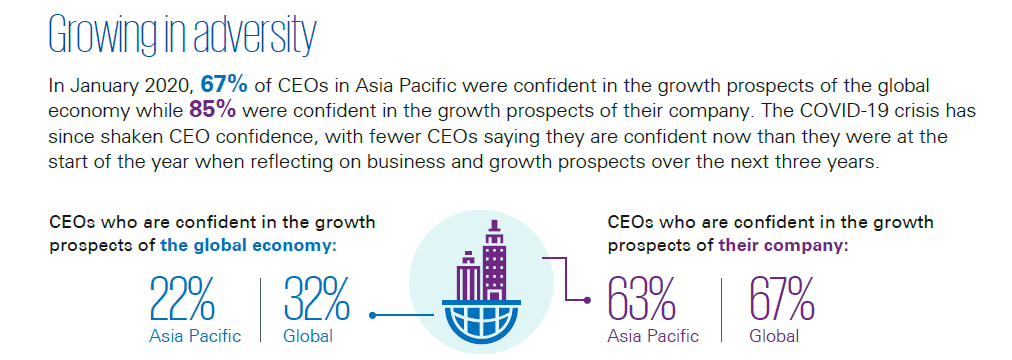
    The crisis has shaken CEO confidence, with fewer chief executives saying they are confident now than they were at the start of the year when reflecting on business and growth prospects over the next three years.

    In the first study of its kind, KPMG conducted two surveys – one at the onset of the pandemic in January and a second in July/August to measure changes in CEOs’ priorities and concerns during the global pandemic.

    The 2020 KPMG Global CEO Outlook revealed only 22% of CEOs in Asia Pacific remain confident about the growth prospects of the global economy over the next three years, a significant drop from 67% in January 2020.

    A clear result from the study reveals business leaders have “radically shifted” their perspectives as businesses and governments around the world continue assessing the long-term impact of Covid-19.

    It found during this period of unprecedented uncertainty, CEOs are prioritising digital transformation, talent and ESG (Environmental, Social and Governance) factors at the top of their agendas.

    On a more positive note, CEOs are much more assured in the resilience of their own business as 63% expressed confidence in their company’s growth for the same time period.

    Source: 2020 Global CEO Outlook, KPMG International

    Critical Measures to Bolster Resilience

    Datuk Johan Idris, managing partner of KPMG in Malaysia commented: “A majority of CEOs have undertaken critical measures to bolster their company’s medium-term resilience.

    “This is particularly evident at the height of the crisis when business leaders worldwide took steps to maintain business-as-usual activities in answer to restricted movements. With the extension of the Recovery Movement Control Order (RMCO) until 31 December 2020, business leaders are forced to relook at their operational strategies,” says Johan (pic).

    And key to this is the ability to move away from short-term measures and prepare for mid and long-term growth.”

    One way CEOs are collectively doing to secure long-term growth is channeling resources towards digital transformation initiatives.

    Before the pandemic, 64% of CEOs felt overwhelmed by the lead times required to achieve significant progress on digital transformation.

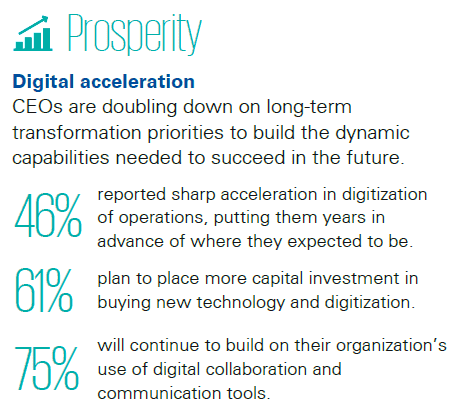
    However, following worldwide lockdowns and the need for physical distancing, 46% of CEOs have reported that progress for their digitisation of operations has sharply accelerated, putting them years in advance of where they expected to be.

    Almost two out of 3 (61%) plan to prioritise more capital investment in buying new technology and digitisation.

    “Clearly, there has been a momentous change in mindset in that CEOs are now more confident and willing to invest in technology to make their companies more operationally resilient, agile and customer-focused to achieve growth during this tumultuous time,” says Johan, adding he expects digital acceleration to increase in speed and scope even after the pandemic subsides.

    New Risk Paradigm

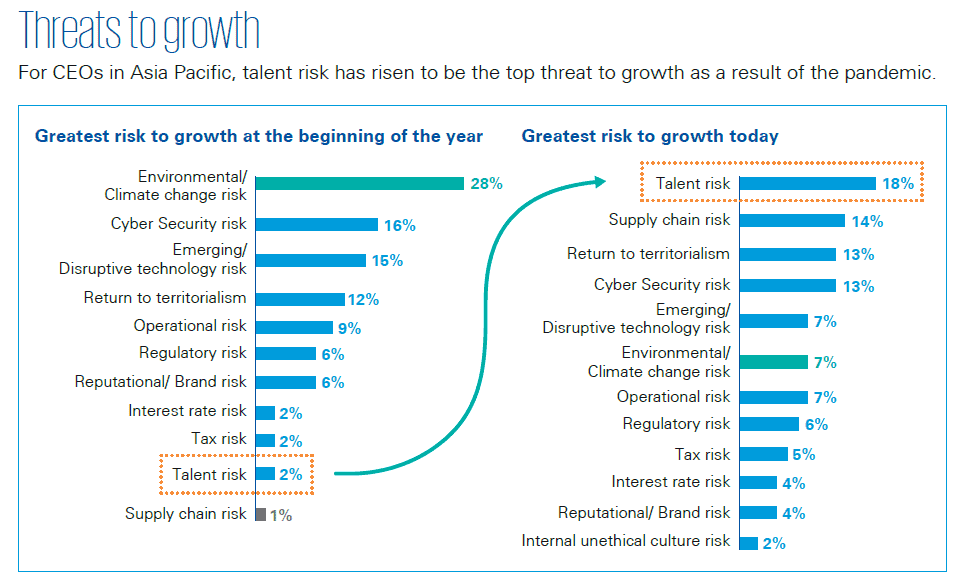
    CEOs have also identified talent risk as the main threat, a category which encompasses recruitment/retention, overall well-being and health of staff.

    This was the threat that CEOs were least concerned about at the beginning of the year. As a result of this pandemic, it has now risen to be the highest perceived threat to long-term growth.

    This could reflect the challenges CEOs face with recruiting and retaining personnel while motivating the workforce despite disruption to the usual ways of working.

    Most CEOs (72%) have said that remote working caused them to make significant changes to their policies to nurture culture, while 69% reported how remote working has widened their potential talent pool for future hires.

    Regardless of the barrier caused by physical distancing measures, CEOs recognise that losing key employees, attracting specialised talent, keeping workforces productive and the health and wellbeing of their staff can have a critical impact on their future business performance.

    Supply chain risk (just 1%) was at the bottom of the list for CEOs in January but catapulted to second place (14%) by July-August, the surveys revealed.

    The rise in supply chain concerns could be attributed to the fact over two-thirds of organisations (72%) have had to rethink their global supply chain approach given the disruptive impact of the pandemic.

    This could potentially lead to a redesign of global supply chains to become more agile in response to changing customer needs, and more robust to reduce risks and disruptions over the long term.

    Renewed Sense of Purpose

    Recent developments have driven 78% of CEOs in Asia Pacific to develop a stronger emotional connection to their organisation’s purpose, with 66% stating how they responded to the pandemic by shifting focus towards the ‘Social’ component of their ESG programme.

    KPMG’s survey also found that 76% have had to re-evaluate their organisation’s purpose as a result of the Covid-19 crisis.

    Johan concluded, “Recovery from the pandemic does not mean a return to normal, but instead an opportunity to define our post-pandemic reality.

    “As the crisis continues to change what good corporate leadership looks like, the role of the CEO is more important than ever in steering the business towards growth in the new reality and beyond.”

  • Growth of the Malaysian Gig Economy Among Gen-Zers

    Growth of the Malaysian Gig Economy Among Gen-Zers

    Social media has been the main source in forming a new culture among the younger generation, creating a new norm that challenges Gen Z to come out of their comfort zone. With technology constantly progressing and simplifying the way we execute our tasks, the gig economy is now high in demand, especially during a time like COVID-19.

    While many among us are afraid of salary cuts and retrenchments, Malaysians are leveraging the resourcefulness and popularity of freelancing to make ends meet.

    Glenn Tay

    According to Glenn Tay, CEO and Founder of Gigworks, the freelancing landscape will not be diminishing anytime soon but will in fact continue to grow at a rapid pace as majority of the workforce are currently conquered by millennials and their priorities are more focused on work-life balance.

    “Malaysian youths, similar to those around the world, are always craving for that opportunity to do the things that they are passionate about, be it traveling, exploring, experiencing etc. and while doing so, they want to have the flexibility to earn sufficient income from wherever they are residing at that time.

    “We cannot deny that this is a new way of working now where jobs are no longer restricted by geographical boundaries. The idea of being fully employed by one firm is not desirable for those looking to have ‘freedom’ in their work management,” said Tay.

    With jobs experiencing drastic change and with the labour force shrinking, competition for talent is getting increasingly intense. Organisations need to think out-of-the-box to attract the talent market such as redesigning the job scopes in a way that can both draw in and connect with the Gen Z and, at the same time guarantee that these jobs continue to create a path for future talents.

    The Gen Z in Comparison to X and Y

    A study by the Zurich Insurance Group (Zurich) and the Smith School of Enterprise and the Environment at the University of Oxford on agile workforce has found that 38% of the respondents in Malaysia who are currently in full-time employment, are looking to enter the gig economy in the next 12 months. This percentage is significantly higher than the global average of 20% recorded in the study.

    While individuals involved in the gig economy come from a diverse range of backgrounds, identifying the main target is essential for the gig economy to develop in years to come. An ever-increasing number of individuals from Generation Z appear to shun ordinary 9-to-5 jobs. Instead, they would prefer working for themselves by freelancing their way in order to obtain their dream jobs.

    The impact of their entry into the working environment will be quick and significant. However, Gen Z has an entirely different point of view compared to the rest when it comes to careers and how to define success.

    Gen Z More Inclined towards Autonomy 

    One of the factors contributing to more people opting for freelance work over permanent 9-to-5 professions is self-directed motivation. It is much simpler to be driven when you are in control of the flow of your work.

    It gives Gen Z a sense of autonomy which they desire for themselves – generating a sense of individuality, determination and providing the ability to achieve what they have been dreaming of. Having control over how they work and the type of job to work on is something that appeals to this young crowd.

    The appeal in this type of working lifestyle is that it also allows for work to be centred around creative passions based on portfolios and skills, as opposed to a full-time job that provides steady income but is more monotonous and rigid in structure.

    For example, university students juggling between college and work-life can find it challenging, therefore they are looking for easier alternatives to fund their tuition fees. Joining the gig economy as a freelancer allows them to have this much-desired flexibility. Although they may not always be able to earn as much as a full-timer, the option of being able to pay off their debts bit by bit while still having the capacity to manage their work-life-balance is satisfactory enough for these undergrads.

    Desire for Flexibility

    According to Workforce Institute, 55% of Gen Z-ers are attracted to the ability to work on their terms in gig employments as the flexibility allows you to go at your own pace and avoid breakdowns. Approximately 26% of Gen Z-ers would work harder and remain longer at an organisation that supports flexible working hours.

    Millennials and Gen Z currently account for slightly over a third of the global workforce. In the next decade, that figure is set to shoot up to 58%, making the youthful generations the most dominant drivers of the workforce.

    To meet the demands of this up-and-coming generation, we, as a society, have to respond to these differences in a mutually beneficial way that would increase trust and generate positive societal impact.

    Thus, it is important that a proper transition and greater overall acceptance of freelance careers is in place to welcome this new way of work.

    Digital Natives 

    Being moulded by technology, Gen Z was exposed to the Internet at a young age, making them the youngest influencers to appear on the scene. They are generally more tech-savvy than the older generations as they have never known a world without smartphones and the Internet.

    Non-traditional ways of working appeal to this group as they are more familiar and accustomed to a technology-driven society.

    We see a rising consensus that digital readiness is no longer optional, but mandatory. When MCO was enforced, the few months of this nation-wide exercise have shown that Malaysians have become more comfortable with utilising technology to collaborate and deliver work on time, replacing the need for physical travel.

    However, this period also brought to light certain difficulties and challenges encountered when working from home such as network issues, communication barriers, and lack of technology readiness.

    Nonetheless, Malaysia is well equipped and ready to adapt to this new normal, with Tun Dr. Mahathir Mohamad looking to implement the gig economy as part of the upcoming 12th Malaysia Plan, and most organisations already alerted and prepared following the MCO period.

    It is only a matter of time before we start to enjoy improved network connectivity and speed, better IT infrastructure, and clear work procedure and discipline to be implemented for the majority of Malaysian freelancers.

    Is Gig Work Appealing Enough?

    Numerous permanent jobs today do not provide a similar degree of job security compared to the past as employers often look at optimising cost efficiencies. Organisations often choose to reduce operation size as a way to find more resources to invest in other parts of the business.

    Instead of simply keeping full-time employees, a coordinated workforce permits organisations to better manage expenses and investments to coordinate business and market demands. Gen Z wants both stability and flexibility at the same time to stay in business.

    Due to this sentiment and in realising the limited options for individuals to find valid yet justifiable freelance work, Gigworks, a mobile application providing online professional service engagement is opening doors for all groups including the younger generation to ensure their talents are being recognised by businesses while catering to the needs of Gen Z.

    “We want to introduce a culture that builds the interest of Gen Z to have a work-balance and offer stability to foster them financially especially during a time like this. Encouraging them to pursue their passion will only make them more confident, allowing them to venture into new projects,” said Tay.

    In a nutshell, now that technology finally exists and caters to these demands, this will be something everyone can benefit from in the gig industry.

    This article is contributed by Gigworks, a mobile application inspired by the impact and advancement of technology in people’s lives. For more information on the company and its services, visit www.gigworks.co/sg.

  • Building a Thriving Online Business

    Building a Thriving Online Business

    Malaysia’s e-commerce industry is expected to continue its upward trajectory and rapid growth in 2020 and for many years to come.

    As an aspiring entrepreneur, the opportunity to ride on the sector’s coat tail is an intriguing and exciting one. Whether you have already launched an online business on one of the e-commerce platforms or are looking to get involved in your very first venture, now is the time to get your foot in the door.

    Indeed, data from German online statistics portal Statista reveals that Malaysia’s e-commerce market for 2019 generated a whopping revenue of US$3.68 bil (RM15.2 bil), with a prediction for annual market growth to reach 11.8% by 2023.

    DataReportal, meanwhile, revealed there were 26.69 million internet users in Malaysia as at January 2020. The number of internet users in the country increased by 919,000 (+3.6%) between 2019 and 2020, while internet penetration in Malaysia stood at 83% as at January this year.

    Source: Datareportal 

    Mapping E-commerce Growth

    For perspective, Shopee led the industry with the highest consumer downloads of its mobile application, according to iPrice Group Sdn Bhd’s Map of E-commerce report for the third quarter of 2019 (3Q19). The e-commerce platform also tops the list of the most visits to its websites at 25,789,300 monthly web visits.

    As for Lazada, the e-commerce platform had the highest number of monthly active users of mobile application in 3Q19, while breaking into the top five list of most visited websites is PG Mall, a homegrown online shopping mall.

    With technological advances and not to mention the growth of the internet economy, the e-commerce industry is set for an exciting ride in the next few years.

    E-commerce Malaysia chairman Ganesh Kumar concurs, saying the local e-commerce industry is expected to grow up to 30% in 2020, supported by advancement in technology and wider access to virtual buying platforms.

    “Currently, we are seeing more people buying online and trusting e-commerce sites. More merchants are also starting to sell their products online,” he said recently.

    Fast-changing E-commerce Landscape

    In the era of Industry 4.0, technological advances have had a massive impact on the e-commerce industry, transforming the way consumers connect with brands and empowering them to shop more cost-effectively.

    Driven by the convenience of making purchases without the need to visit a physical store, e-commerce has now become an integral part of everyday life. But while the shift in consumer behaviour is a given, businesses, too, are adopting a changing mindset when it comes to e-commerce.

    “Rather than seeing e-commerce as a competition, businesses have now come to see it as another stream of revenue which will complement their brick-and-mortar business,” Shopee regional managing director Ian Ho (pic) tells Smart Investor.

    These businesses, to cater to the increasing demands of today’s e-commerce landscape, have set up dedicated e-commerce teams to manage various facets of their operations.

    This includes manning the online store, pricing, handling orders, fulfilment, and customer service, as well as investing in warehouses that come equipped with advanced systems to organise warehouse operations.

    Evolving mindset aside, many businesses however find it difficult to grow their sales effectively after opening a store.

    “This is because of operational and marketing challenges. These businesses lack the know-how to nurture the business and run marketing efforts to increase exposure for their online stores and product offerings,” Ho reveals.

    Helping Hand from Shopee

    In Shopee’s case, the e-commerce platform has empowered many brands and sellers to succeed online because they understand the challenges that businesses face, and offer various forms of support to help them succeed.

    For example, Shopee University, a free seller’s workshop to provide sellers with the knowledge and skills to grow their businesses on the Shopee platform, was launched in 2016.

    From the workshop, participants will learn multiple ways to boost sales; tips and marketing techniques to promote their store on Shopee; the right way to list products; and how to fully utilise all of Shopee’s features to help promote sales.

    “What has made these workshops even more resourceful is that they are also available through web seminars, which means that participants anywhere with an internet connection can join in,” shares Ho.

    To date, around 10,000 sellers have benefited from the Shopee University modules.

    In addition to Shopee University, the e-commerce platform further launched Shopee Live in 2019 in an effort to bring users closer to their favourite sellers and brands.

    This allows brands/sellers to engage their users throughout the shopping journey via a wide array of live content such as product reviews, guides and demonstrations hosted by popular local influencers.

    And the results are pretty impressive, to say the least. Tyra Kamaruzzaman’s Beautyra lipsticks, for instance, sold out in minutes on Shopee Live, recording over 2,000 orders, while Photobook’s store traffic and visibility increased by 18x after running a 45-minute live stream on Shopee Live.

    “In addition to driving orders, Shopee Live is also effective in driving traffic and followers to the retailers’ stores, as indicated by Shopee seller wanjojo of JJ70 Store who gained more than 800 store followers after a single live stream.

    “Another seller also shared that by doing daily live streams, he was able to rapidly gain followers and double his sales in less than three months, with 2019 being the first time he had managed to break the RM1 mil mark in annual sales,” Ho shares, adding the results are testament to Shopee Live’s success.

    Success: an effort of both parties

    Over the years, many businesses have achieved success on e-commerce platforms, but many others have also not done well. So how does a business guarantee its success online?

    PG Mall managing director Datuk Wira Louis Ng believes that success on e-commerce platforms stems from the effort of both parties, namely the platform operator and the merchant.

    “Successful merchants on the PG Mall platform put in a lot of effort from their end to build store awareness and visibility by participating in all PG Mall-related activities and campaigns.

    “In addition to providing attractive prices, these merchants are very committed, have zero cancellations rate, are very responsive to shoppers’ enquiries, and are efficient in processing orders to ensure a positive shopping experience.”

    On the flipside, there are merchants who – after setting up their online store – solely rely on the platform to drive sales without going all out and taking the initiative to do more, he adds.

    Merchants on the PG Mall platform are supported with regular creative campaigns that partner with different e-wallets and banks to drive both sales and traffic to the stores.

    PG Mall is also the only platform to partner with all major e-wallets in the country. The vast check-out options available will in turn gives merchants a boost in capturing more shoppers.

    On how merchants can conduct a successful business on PG Mall, Ng points out that PG Mall’s mission is to be the number one choice when it comes to online shopping, and therefore, it is always best for merchants to feature all products on hand to be available on the PG Mall platform.

    “Providing a fair price for shoppers is essential, as is the effort put into managing the store by putting up clear and attractive images as well as the right product descriptions.

    “While Success on e-commerce platforms stems from the effort of both parties, namely the platform operator and the merchant. these may sound trivial, these are factors that will influence a shopper’s final decision.”

    The homegrown e-commerce platform, which cites gold jewelleries, groceries and pets, as well as home appliances as its current best-performing categories, are in the midst of bringing in more brands to join the PG Mall family.

    Trusted Delivery Service

    Delivery service is a crucial aspect of online businesses, as it allows for the efficient and timely transportation of goods to customers.

    In today’s world, customers expect fast and reliable delivery, and the ability to track their orders in real-time. This is especially true for e-commerce businesses.

    Use Delyva as your main delivery platform that allows you to choose the best delivery service in Malaysia by price, speed, area coverage and reliability.

    By Bernie Yeo

    Find out more about Delyva here: https://delyva.com/my/delivery-service-in-malaysia/

  • Laws of Attraction: What Attracts Malaysian Jobseekers?

    Laws of Attraction: What Attracts Malaysian Jobseekers?

    JobStreet Malaysia today announced the Laws of Attraction recruitment study, with insightful data from more than 10,000 local candidates, cutting across over 25 industries. The study of Malaysian jobseekers is especially timely for organisations seeking to build and retain teams that agilely combine skills and mindsets needed in the path toward post-COVID economic recovery.

    The Laws of Attraction study not only offers insights by JobStreet at a Malaysia-specific level but also crystallised information in terms of specialisation, industries, age groups and job levels with an overview comparison for each finding. The collective data is unlike any other as it is customisable, allowing organisations to explore and extract different candidates from any industry, based on their organisational as well as skills requirements.

    For Malaysian organisations seeking to navigate their way forward after the lifting of the Movement Control Order (MCO), these findings go hand in hand with the government stimulus package which is designed to help retain the existing workforce and secure new talents for rebuilding. Staying close to JobStreet’s mission as the trusted talent partner for organisations, the study is available online as a microsite with easy-to-use navigation tabs, categorised by segments to narrow down the specialisation the organisations require. This further solidifies JobStreet’s position as Asia’s Best Talent Sourcing Partner with user-friendly tools to find the right candidate.

    The study reveals thinking driving four generations of jobseekers from Gen Z: aged 18-23, Gen Y: aged 24-34, Gen X: aged 35-54 up to Baby Boomers aged: 55-65.

    Salary and Compensation along with Work-life Balance applied to all Malaysian talents but not for Gen Z. They prefer Personal Growth and Career Development as they are just starting to enter the workforce.

    Gen Y focuses on Career Development in an organisation when it comes to choosing a job – this includes overseas training and promotion opportunities.

    Job Security drives Gen Y, X and Baby Boomers due to factors such as commitments or family. The majority of Malaysians in the workforce are currently from Gen X and Gen Y, which comprise 45% and 40% respectively.

    The key drivers also differ according to industries. Salary and Compensation are high priorities for the Banking/ Finance and Consulting (IT) industries, whereas Work-life Balance is important for Advertising and IT industry. For talents in the Auto, Electronic & Manufacturing and those in Oil & Gas, are driven more by Career Development.

    The Laws of Attraction at a Glance

    With more Gen Z, Gen X, Gen Y and Baby Boomers working together, organisations today face unprecedented challenges in managing a multigenerational workforce. This is where the Laws of Attraction data help organisations make the right recommendation and hire with precision.

    Organisations are also faced with issues of retaining talents during this challenging time due to cash flow and income issues. To help organisations retain rather than retrench staff, the Malaysian government announced its RM250 bil Prihatin Rakyat Economic Stimulus Package (PRIHATIN).

    This package includes a range of financial assistance, ranging from deferment of payments for tax instalments up to six months to subsidising employee salaries. This initiative is targeted at assisting SME businesses which are especially prone to choosing this short-term solution due to their vulnerable cash flow, but such decisions tend to extract a higher cost when it comes in the recovery-19 crisis.

    As JobStreet Malaysia Country Manager Gan Bock Herm explained, “With the current economic pressures brought about by COVID-19, more than ever, employers need stronger recruitment and retention efforts. This is where data and local insights are important to understand what Malaysian organisations and workers need to form teams critical for their economic recovery after the pandemic. The Laws of Attraction harnesses insights on important motivators across four generations of talents. These insights provide a clearer overview for an organisation and recruiters to attract and retain top talent.”

    As organisations move toward recovery, the working environment is faces transformation in response to uncertainties brought about by the pandemic.

    Multi-generational Workforce 

    The two major factors of driving changes in the multi-generation workforce are demographic and technological transformation. In terms of demographics, each generation has different ways of communicating, different ways of working, and each with different expectations for employers. It is necessary to manage such an expectation in order to be able to work efficiently. The Laws of Attraction give insightful detail for organisations to understand these generational characteristics and enable them to effectively attract, building teamwork while adapting to economic changes.

    As underlined by Gan, “With four generations working together, organisations and recruiters need to pay attention to the subtleties of multi-generational cooperation so that the organisation can successfully maximize integration, collaboration and engagement toward business recovery as well as sustainability.”

    Accelerating Digitalisation 

    The COVID-19 pandemic has fast-tracked digital transformation in organisations. It has rapidly reshaped the way organisation and employees communicate and work as well as the deployment of technologies such as Big Data, Internet of Things (IoT), Artificial Intelligence, Machine Learning and Robotics to cope with the pandemic’s onset.

    These changes also impact the skills that are required in the workforce as well as how recruitment processes are done. Almost overnight, organisations not only had to speed up their digital transformation but more importantly, maintain a humanised recruitment process.

    The Laws of Attraction study found that 34% of Gen Z find it acceptable to have interviews through video calls than other generations, as compared to Gen Y at 32% and Gen X at 30%. For contrast, just 19% of Baby Boomers found video interviews acceptable. This further signifies the importance of organisations humanising the whole recruitment process. For example, a smart organisation would adapt to provide an immersive experience and making the session feel more like a two-way conversation. Talents, in turn, can get a real feel for the company values, culture or even team members as they would be “there in person”.

    Work-Life Balance 

    This is the second most common factor across all generations and an important sub-driver for work-life balance is the ability to work from home or remotely. This has proven particularly important and relevant to the current situation as the Malaysian Government enforces social distancing and the Movement Control Order (MCO) to contain COVID-19. It is shaping to be a requirement, rather than an option, at a time when organisations in non-essential industries to operate remotely to ensure business continuity.

    The Laws of Attraction findings further assist organisations to understand the perception of working from home from the four generations. It reveals 72% of Gen X prefer to work from home, closely followed by Gen Y with 71%, Gen Z trails with 64% and Baby Boomers at 66%. Malaysians are receptive toward working from home or remotely, given the higher than 50% approval rating from all generations.

    The comprehensive findings through the Laws of Attraction by JobStreet Malaysia offer a good perspective of talents for organisation and also help organisation to strategically plan their workforce, especially during these economic uncertainties. The findings will also help to minimise discord in the process of recruiting by understanding the forces that attract Malaysian talents to a role and how to best retain them in the long run. For more information, visit https://www.jobstreet.com.my/en/cms/employer/laws-of-attraction/