Category: Grow Your Wealth

  • Should I Make A Voluntary EPF Contribution Today?

    Should I Make A Voluntary EPF Contribution Today?

    In February 2021, the Employer’s Provident Fund (EPF) announced dividends of 5.2% for conventional savings and 4.9% for shariah accounts for 2020. Overall, I believe contributors were satisfied in view of the effects of the pandemic caused by Covid-19 which greatly affected both the local and global economy. At least their retirement fund continued to grow!

    In Malaysia, EPF contribution is mandatory for both employers and employees as long as they are under full-time employment. This scheme allows workers to automatically save for their retirement from the day they start working. However, there is another category of people consisting of self-employed or business owners that might not contribute to EPF as it isn’t mandatory under business entities such as sole proprietors, partnerships or private companies (Sdn. Bhd.) and do not draw a salary from their company. Instead of drawing a salary, they get paid through director fees or dividends.

    So should such income earners opt for voluntary contributions to EPF? Let’s look at this from various perspectives:

    Compounding Interest Effect through Long-term Savings

    In order to have a comfortable life after retirement, we have to set aside money to create a pool of funds which must adequately cater for 20 years of retirement costs. Therefore it’ll be much easier to hit this target if you start saving immediately when you begin earning an income. If you understand the power of compounding interest, you’ll know that by starting to save early, your money will be put to work for you. Therefore a self-employed person should set aside a certain percentage of income or business profits for the purpose of retirement as early as possible.

    The next question is why EPF? Why can’t I save the money in the bank? Firstly, we’re currently in the low interest era and it’s likely to remain that way for the foreseeable future. EPF dividends are much higher than what banks are offering for fixed deposits, currently between 1.8% and 2.2% depending on the amount and period.

    One might argue that contributors can’t withdraw the money as they wish except under certain criteria from time to time, such as the i-Sinar scheme due to the Covid-19 pandemic. The restriction on withdrawal serves its purpose to secure your future; otherwise, there’s a good chance that it will be withdrawn and spent for a variety of reasons along the years.

    Discipline in regular savings is one of the key success factors in achieving your desired retirement goal. Another will be the determination of keeping those funds for your later years and not simply withdrawing it for unimportant matters. This should be your last resort of getting financial assistance, as naturally it’s much easier to spend money than save it. Furthermore, early withdrawal of the funds has a long-term impact on the accumulated funds due to the effect of compounding interest.

    Tax planning

    Apart from the benefits of compounding interest, as business owner should draw monthly salary from the business and contribute to EPF according to the mandatory contribution rate. In such a scenario, there’s an advantage in terms of tax savings as the amount contributed by the company is tax deductible against company profits up to 19% of the salary drawn from the company. As the business is self-owned, it’s just a matter of transferring one side of the pocket to another while enjoying tax savings simultaneously! Of course the criteria is that the company is profitable and has sufficient cash flow to do so.

    Fixed Income in Your Investment Portfolio

    Some might argue that instead of comparing to bank savings, why not invest in other investment tools like shares or unit trusts which can generate better returns. Provided the risk is well-managed, it could indeed be a better option than to keep savings in the bank.

    To structure an investment portfolio for retirement purposes, it’s advisable to split into different asset classes for risk diversification and liquidity. Normally a conservative asset class will form part of the portfolio to provide security. In this case, you can treat EPF savings as the more secure tool that generates a fixed income of 5.5% returns on average. Other resources in the form of cash will be allocated to more aggressive tools such as unit trusts that aim for higher returns of 8%-12% for example, to enhance the overall returns of your retirement portfolio.

    After much discussion on the importance and benefits of long term savings through EPF contribution, it’s advisable for the majority of people to do so. The exception will be an individual that has the capability and time to manage all their direct investments and is very disciplined in setting aside money for retirement funds, in addition to managing risk and return very well.

    Otherwise do start your retirement planning as early as possible and leverage on the expertise of our country’s established retirement scheme to ensure you have a comfortable retirement. Last but not least, it’s also recommended that non-income earners such as housewives also contribute voluntarily to EPF for their future security with support from their spouse.

    About the author

    Dennis Chin is a financial advisor, approved and licensed by Bank Negara Malaysia and the Securities Commission Malaysia. He can be contacted at dennischin@harveston.com.my

  • Value Investing in the Pandemic Economy

    Value Investing in the Pandemic Economy

    Most investors use either one of two primary strategies when it comes to investing – value investing or growth investing. Interestingly, the term ‘value investing’ is often used but not all investors understand the meaning of ‘value investing’.

    What is value investing all about, and what are value funds and the benefits of investing in a ‘value fund’? When the Covid-19 pandemic spread globally and became the world’s largest health crisis, it stirred things up completely and left us with the question “Do value investing strategies remain relevant in these times?”

    What Is Value Investing?

    Value investing is a strategy that focuses on trading at a share price that’s considered to be a bargain for businesses with good fundamentals. The strategy involves selecting stocks that are undervalued compared to the industry average or their peers. The theory behind this approach is that the stocks of good companies will bounce back in time, if or when their true value is recognised by other investors.

    A stock price may be undervalued because of an overreaction to market news, such as disappointing earnings, negative publicity or legal problems, all of which may raise doubts about the company’s long-term prospects. To determine the real value, value investors usually ignore the stock price and look at the entire company. They focus on the company’s fundamentals such as sales data, financial reports, holdings, real estate, patents, intellectual property, research and development, and many other factors. Value investing aims to exploit the irrational short-term behaviour of emotional investors.

    What Is a Value Fund?

    A value fund primarily invests in value stocks. Value fund managers will research and analyse a company’s fundamentals to determine if its stock is “good value” and should be purchased. However, it’s commonly believed that investors decide to buy into a fund based on the fund’s net asset value (NAV), which is incorrect. Investors should focus on macro-trends for the sectors in which the fund has invested.

    Value investing is a long-term strategy, as it invests in companies with a high likelihood of generating a higher income to produce a sustainable cash flow. Thus, in a value fund, even if the stocks do not appreciate in value, the investor can benefit from dividends, if there’s high upside potential.

    Market Review

    The COVID-19 pandemic, followed by the movement control order (MCO) and a series of conditional movement control orders (CMCOs), disrupted many industries. A significant number of companies suffered as both their top line and their bottom line were affected. As people were unable to travel and were quarantined at home, business revenues dropped precipitously.

    A lack of cash flow impacted the growth and performance of many firms, which was reflected in stock prices. Many investors, especially retail investors, resorted to panic selling which led to the market plummeting much faster compared to previous crises.

    Sectors like energy and banking, plus cyclical, such as automakers, aerospace and defence firms, insurance companies and building material suppliers, all suffered, as they’re sensitive to economic cycles. Investors are currently weighed down by concerns that COVID-19 would persist, unemployment would remain high, interest rates and inflation would stay low, and dividends would not recover.

    As a result, they shortened their time horizons. They piled into secular winners and avoided cyclicals. Fear and uncertainty also meant that investors favoured well‑understood growth stories during the recovery rally without considering valuations. Growth stocks, supercharged by low interest rates, digitisation, working from home and other pandemic-related trends, were continuously bought up which drove the market higher.

    However, while the circumstances clouding the market were dark, falling prices created opportunities for fund managers to buy undervalued stocks. As mentioned earlier, a value investing strategy aims to benefit from the irrational behaviour of emotional investors. This is because fear and greed remain ever present and frequently lead to poor investment decisions based on perception and emotion rather than reality. For example, on March 15, 2020, the FBM KLCI slumped to its lowest level since December 2011, due to the second wave of Covid-19.

    2021 Economic Recovery – The Benefits of a Value Investing Strategy

    Growth should accelerate as the vaccine becomes widely available, allowing consumer, work, leisure and travel habits to return towards more sustainable levels. If the vaccination programme is effective, it will help drive economic recovery, which should favour the cyclical parts of the market. Furthermore, the expansionary government policy may see unemployment drop sharply and the bull market may keep running, with the COVID-19 losers likely to be the first to benefit.

    China is a great example of how a recovery scenario could potentially play out globally. Their aggressive efforts to control the Covid-19 pandemic in the early days of the crisis were widely scrutinised, but the country’s heavy-handed approach paved the way for it to be largely Covid-free by the second half of last year. Consumer spending, car sales, and economic growth have all bounced back strongly from the depths of the pandemic back in March.

    Certain sectors, such as airlines, energy, banking and other value sectors, may not recover in 2021, as the demand for their goods and services may not pick up until 2022. However, the stock market is forward looking and pricing in an anticipated recovery. These sectors may do better in 2021 than the economies in their respective states. Moreover, comparisons of corporate earnings could become more important in 2021. Many value cyclicals will have an easier time beating their dismal 2020 figures, unlike growth companies, which have a much higher bar for impressing investors.

    The Bottom Line

    The road to a post-COVID-19 ‘new normal’ will not be smooth. Investing during uncertain times can make an investor anxious and fearful, but even in good times, it can also be challenging. Investing successfully depends on being able to control and manage the risks without skipping the possible returns. This pandemic is having a significant impact on both value and growth stocks in the short term and long term. The most popular value investing strategy is diversification, which is designed to create a high safety margin.

    About the author

    Joe Tiong is a certified financial planner and she can be contacted at joe.tiong@uobkayhian.com.

  • The Best Alternatives to Fixed Deposits

    The Best Alternatives to Fixed Deposits

    We’ve seen how the COVID-19 pandemic has hit us in many ways last year, and 2021 looks like it won’t be any different. Looking at the aspect of interest rates, it’s cheaper to borrow money now than ever before. However, the direct impact of cheaper loans will be the rate of return on your investments such as fixed deposits. What are the alternatives to fixed deposits?

    Gone are the days when one could earn a comfortable yield of 3 to 4% per annum; we’re looking at less than 2% right now!

    As an investor, should you maintain the status quo and let your funds float in fixed deposit, or should you re-strategise to see if there are any other products that could give you interest rates like before, or maybe even more?

    Here are some steps you could explore in order to bring your portfolio back to its glory days:

    Start the ‘New Normal’ in Investing

    Let’s face it, storing all of your hard-earned savings for emergency funds and future retirement in fixed deposits isn’t really a crisis-proof strategy.

    Your parents and grandparents may have taught you that fixed deposit is a safe haven, but with the banks’ overnight policy rate (OPR) currently sitting at interest rates of 1.75%, can it still be considered that?

    Imagine teaching the same investing values to the next generation – they’ll be forced to earn more just to keep up with inflation! Why not teach them something valuable such as financial literacy? This starts with you.

    There’s More to Life than Just Fixed Deposits

    Keep an amount that you’re comfortable with as your nest egg in fixed deposit, which could range from 6 to 12 months’ worth of expenses. Invest the excess in platforms that can meet your medium to long-term needs such as purchasing a home, getting married, children’s education as well as your retirement.

    The cost of basic life necessities such as home, food, clothing, and medical will continue to rise faster than your salary increments, which is much better than simply collecting poor returns from low-interest rates.

    Thus, it’s vital that you make your money work hard for you, or else you’ll need to work harder and longer for less pay!

    Decide Now and Adapt

    The COVID-19 pandemic has swept away what used to be comfortable safety nets, like fixed deposits for example.

    Businesses are shutting down, pay cuts are a norm and exploring additional income is more common now than ever for many. Investors who used to fear dividend-based and equity funds are now more open to exploring these asset classes. 

    That’s the beauty about human beings – we’re all survivors. When push comes to shove, we’ll do whatever it takes to survive.

    Do the same with your investment portfolio. You’ve worked hard all your life, so avoid letting these hard earned funds slowly slip away by not maximising your returns. How does investing in Tesla, Geely, Proton, Alibaba, Facebook and Microsoft sound like to you?

    Consider Investing in A Foreign Currency

    For investors who have specific goals such as migration or sending your children abroad for education, you can consider beginning your investment journey in foreign currencies such as GBP, USD, SGD and AUD.

    The benefits of doing this earlier could save you the cost of currency conversions later. Your funds will already be in foreign currency and when the time comes to execute your goal, you save yourself the conversion differences. Use these savings to boost your retirement instead. 

    Work with a Licensed Financial Planner

    The benefits of working with a professional such as Licensed Financial Planner is the unbiased advice you’ll get as well as recommendations on potential investment products that suit your risk tolerance.

    By tapping into their experience, you’re able to cut short your learning process and immediately hop onto the investing bandwagon that goes beyond just fixed deposits. What if there are ways to help you earn an average annual return of 5% to 10%? Would you be willing to give yourself the chance to learn and explore?

    The way forward in this current pandemic setting is to continue to be nimble in everything that you pursue.

    If you’ve always relied on your salary (otherwise known as active income), you ought to start somewhere in building your passive income.

    If your passive income is not growing at the rate that you want it to be, review what works, what doesn’t and explore other options that could take your portfolio further. Change is constant, and the decisions you make determine your destiny.

    Decide and choose what’s best for you. One simple change could drastically change the course of your future!

    About the author

    Suean Chung is a Financial Advisor, approved and licensed by Bank Negara Malaysia and the Securities Commission Malaysia. She can be contacted at sueanchung@harveston.com.my.

  • Should I Adopt Dollar Cost Averaging?

    Should I Adopt Dollar Cost Averaging?

    There are multiple ways to invest, with one of the more passive ways recommended by many is dollar cost averaging.

    “Dollar-cost averaging (DCA) is an investment strategy in which an investor divides up the total amount to be invested across periodic purchases of a target asset in an effort to reduce the impact of volatility on the overall purchase. The purchases occur regardless of the asset’s price and at regular intervals; in effect, this strategy removes much of the detailed work of attempting to time the market in order to make purchases of equities at the best prices.” – Investopedia

    At the core of the fancy lingo used above, it means you put a fixed amount daily/monthly/yearly into a certain investment so that you average out your buy-in price.

    Think of it like gardening where you need to tend to the plants regularly and conscientiously in hopes that it will grow well.

    Dollar-cost Averaging Illustration

    For example, let’s say you’re buying into a Real Estate Investment Trust (REIT) counter on any market in Malaysia. Why? Because in most cases, it gives you steady dividends and that’s why it’s a good place to exercise dollar cost averaging.

    Assume that you allocate RM500 per month to contribute to REIT 1. Every month you diligently buy up RM500 worth of shares in REIT 1.

    I want to present two scenarios here.

    If the prices go up monthly by 10 sen:

      Amount Invested Cumulative Investment Price Investment Value % Gain
    Month 1 500 500 1 500
    Month 2 500 1,000 1.10 1,050 5%
    Month 3 500 1,500 1.20 1,646 10%
    Month 4 500 2,000 1.30 2,283 14%
    Month 5 500 2,500 1.40 2,958 18%
    Month 6 500 3,000 1.50 3,670 22%

    If the prices go down monthly by 10 sen:

      Amount Invested Cumulative Investment Price Investment Value % Loss
    Month 1 500 500 1 500
    Month 2 500 1,000 0.90 950 5%
    Month 3 500 1,500 0.80 1,345 10%
    Month 4 500 2,000 0.70 1,677 16%
    Month 5 500 2,500 0.60 1,937 23%
    Month 6 500 3,000 0.50 2,114 30%

    Can you see the effect it has?

    Pros and Cons of Dollar Cost Averaging

    As you can see in the illustration above, with a 50% increase/decrease in the stock price by month six, the total returns/losses are reduced.

    Yes, it’s a double-edged sword. You minimise your potential losses and hopefully when it rebounds, you’ll get more returns. However, you also lose the full upside if the stock goes up in price.

    The other potential risk here is that in most dollar cost averaging mechanisms, you set a fixed time in a month to invest that sum, such as the start or end of the month, when your salary is in etc. The issue here is that you could also be unlucky in that every time it’s time to invest, it’s at the higher price point for the month. That’s not fantastic but luck does play a part.

    Then why do people recommend dollar cost averaging? If I were to guess, it’s because it gives people the “sense of calmness” that you don’t need to worry about the market’s ups and downs and just need to periodically invest a sum like clockwork.

    I must add on that this was also popularised by mutual funds. At least, that’s where I heard this method being used the most, but I’m sceptical as they’re partially motivated by the sales charge.

    Which brings me to… the case of commissions that we’re paying for any investments (depending on the amount). By doing a monthly dollar cost averaging investment, we’re technically paying 12 times a year at the highest commission rate (in most cases due to smaller investment size).

    With that said, I do think there are uses for dollar cost averaging.

    What Do I Use Dollar Cost Averaging On?

    My journey on dollar cost averaging began with mutual funds. I’ve tried dollar cost averaging via direct debit on mutual funds a long time ago. The market was going up monthly and hence my cost was averaging up. Then one fine day the market decided to take a dip. That’s when I realised that the amount I’ve invested thus far actually suffered a much bigger loss due to my average cost being higher. Hence, I stopped doing dollar cost averaging.

    Another asset that I’ve used dollar cost averaging on is bond funds via robo-advisors because their prices rarely fluctuate too much, but currently the only other investment asset that I practice dollar cost averaging on is gold.

    Averaging Down vs Dollar Cost Averaging

    What I prefer is to use the concept of “averaging down” in my investments.

    I can’t control how the market moves and whether the prices will go up or down after I invest. What I can control is how and when I invest.

    My approach is to always keep a basket of potential stocks in my watchlist. With this shortlist of stocks, I can then monitor where prices are heading. Rather than investing into a stock or any asset when the prices are up, I’d only invest when the prices fall to a target price.

    When investing in a stock or asset, it’s possible that the price will fall below the invested prices. This is where averaging down shines as it takes on the benefit of dollar cost averaging to minimise losses and amplifies the profits via more investment in the particular asset. This is on the assumption that you’re investing in a fundamentally strong asset whereby prices will eventually turn around. However, it could take years in some cases, so patience is needed.

    If prices are above my invested price, then I’d only think about when to realise that investment into profits. I’d seldom add on unless there is a particularly compelling reason to do so and would rather scour my watchlist for other stocks to invest in instead.

    This approach is obviously not too relevant for short term traders but can be beneficial to the long term investors.

    But how about non-stock related investments?

    Modified Dollar Cost Averaging

    For assets such as robo-advisors, bond funds and gold, I do recommend the use of some form of dollar cost averaging. However, I’d keep the monthly amount small.

    Upfront I will invest a lump sum amount and when prices fall substantially, I’ll average down again with a lump sum amount. Hence, I keep a close eye on the prices of these investments and have a ready cash pile to go in when prices are right.

    This is my take on dollar cost averaging. I don’t use a straight up dollar cost averaging strategy as I believe with some active management, I can reap more benefits from my investments.

    About the author

    This article was originally published at betweenthemoney.com, a personal finance website by Jason Loh that focuses on money matters and investment topics for Malaysians

  • Investment Options for Young Investors

    Investment Options for Young Investors

    Young investors (or any beginner investor) will often ask: “What should I invest in?”

    If you are a millennial, the idea of investing your hard-earned money can come across as complex or perhaps intimidating. While it is important to secure your future, how do you go about doing it?

    Unlike previous generations, millennials are comfortable with technology and the convenience emanating from their smart devices. They enjoy co-working and travelling, and value experience above others.

    In other words, millennials are breaking away from the conventional mode of spending and saving, developing a pattern of higher risk-taking due to their need for instant gratification. But there is still hope!

    Despite the common misconception, investing isn’t just for the financially established – you can start investing for as little as RM50 per month and begin your journey to building wealth. To brave the high seas of investing, it is important to remember the key is not just randomly betting on different investments but learning to save and making informed decisions for your future.

    Smart Investor reaches out to several experts in the field for their perspective on the topic.

    SURAYA ZAINUDIN, FOUNDER, RINGGIT OH RINGGIT

    Based on my interactions with the Ringgit Oh Ringgit audience who are primarily within the millennial age group, many of them invest their money in a combination of unit trusts and mutual funds.

    Amanah Saham Bumiputera (ASB) and Private Retirement Schemes (PRS) are popular, with many taking advantage of the PRS Youth Scheme a few years back, and collecting the RM500/RM1,000 bonus upon RM1,000 deposit.

    Other popular investment options are stocks (especially dividend stocks), fintech platforms like Wahed Invest, Stashaway and MyTheo (robo-advisory platforms), gold (HelloGold), P2P lending (Funding Societies) and crypto assets (Luno).

    In terms of the recommended proportion of their income to be put aside for savings and investments, I recommend anyone to save at least three to six months of living expenses as soon as possible, regardless of income level. You need the savings to protect yourself against any of life’s unexpected expense.

    After you hit that amount, feel free to choose either to save as much income from salary, add more income (increase salary or do a side hustle), or both. Taking willpower out of the equation by automating investments is a great way to get rich slowly.

    The stock market, generally speaking, intimidates any beginner, millennials included. However, it is great that there are personal finance content creators nowadays that share their stocks portfolios online using relatable language. It makes the whole process – from research to reallocation – easier to visualise and thus implement.

    Getting help from a financial adviser, a robo-adviser or opting for a do-it-yourself (DIY) approach or investing in mutual funds or exchange-traded funds (ETFs) – these are great ways to get started. Personally, I’m an advocate for the DIY approach since it’s the most cost-efficient approach.

    Investment information and advice is very easy to get for free online, via a quick Google search. I would personally save for the services of a financial adviser for estate planning instead.

    STEPHEN YONG, CHIEF KNOWLEDGE OFFICER, WEALTH VANTAGE ADVISORY

    The concept of ‘pay yourself first’, which is to set aside funds every time you receive an active income, is advocated by many financial advisers.

    The whole idea behind paying yourself first is to consider as if you were an employee of Me Sdn Bhd, and ensure that you get paid every month. That being said, the moment you receive your pay, set aside an amount into another account that you will not touch.

    Once you have accumulated three to six months’ worth of emergency funds, paying yourself first should be channelled towards investing. This is especially important for young adults to allow for early investing and compounding to build serious wealth. Here are a few practical steps to pay yourself first:

    • Decide how much you will pay yourself. It can be a percentage (20% of your pay, for example), or a fixed figure (RM1,000 monthly);
    • Set up an automatic transfer every month into a separate account designated for investing; and,
    • Set objectives for the money in your account to be allocated into various investments.

    You can also automate some investments if there is a regular savings plan option to gain the benefits of dollar cost averaging.

    For those who have just started out in their career, there are an increasing variety of investment vehicles available. Rather than start investing based on recommendations from friends and family (which is something young investors are prone to do), a smarter approach to selecting your investments is to have a customised personal investment plan following your desired asset allocation.

    One of the most important determinants comes from deciding on asset allocation which determines ~90% of volatility and gives ~40% of returns (Determinants of Portfolio Performance by BHB published in the Financial Analysts Journal).

    What is asset allocation?

    Asset allocation is to set how much of one’s investments goes into various asset categories to get the best balance between returns and reduced overall portfolio volatility. Here are some smart investment options for each asset class:

    For risk appetite, investor risk profiles are generally categorised into the following from the highest to lowest risk:

    Examples of high-risk investments include shares, commodities, cryptocurrency and alternate investments. Examples of low-risk investments include bonds and money market funds.

    In terms of how much risk millennials should be willing to take to build their investment portfolio, it is important to note that every millennial investor needs to decide for themselves how much risk is suitable.

    As a millennial, time and compounding are on your side, so you may be able to take on more risk than someone who is retired or near-retirement. There are various investor risk profile assessments available which help you to know your investment risk appetite.

    Overall, one can reduce risk by practicing diversification and having a personal investment plan. Diversification can be done by diversifying across the following:

    On the question of whether millennials are generally apprehensive about investing in the stock market, I would say millennials today have access to a wealth of information and resources.

    As such, everyone has their own preferences with some feeling comfortable investing directly in the stock market while some prefer using other investment vehicles. The key thing for millennials is to get trustworthy professional advice on how to invest.

    Overall, we are seeing a blended approach working out well with a combination of working with a financial planner, robo adviser, and maybe handling some areas using a DIY approach.

    MARSHALL WONG, FOUNDER, planNERD

    The ‘pay yourself first’ concept is a good practice, and as a financial planner myself, even I have created an automated system to make sure that I am getting paid first. The keyword here is ‘automated’.

    To do this, I have two bank accounts. The first is what I call the ‘Holding Account’, which is the main account which I use to receive my income. In this particular account, I set a recurring transfer of funds to another account, which I call the ‘Parking Account’, which is set up for the sole purpose of accumulating money for my next investment.

    When it comes to smart investment options that a young person can consider, as cheesy as it may sound, I believe that investing in one’s own knowledge is always the first thing a young person should do. Without proper knowledge, the line between investing and gambling can blur.

    Take cryptocurrency as an example. Most people that do not understand blockchain beyond it being ‘just a system behind Bitcoin’ may think that cryptocurrency is a gamble. But for those that truly understand the potential and the value that blockchain can bring to us in the future, cryptocurrency is seen as an investment.

    Don’t get me wrong, I am not saying that everyone should jump into cryptocurrency. A young person should start reading articles on business and finance to be equipped with the necessary knowledge to understand the true value of where they put their money into.

    On the topic of mobile-friendly investment platforms, I have personally invested with StashAway, Wahed and MyTheo. These platforms are great for beginners as they are simple, seamless and do not require investors to do as much homework before they invest.

    However, it is important to be reminded that we should diversify and not put all our eggs in the same basket.

    Recently, we have seen a US$7.6 bil online brokerage firm, Robinhood experienced a massive outage due to technical problems. Nevertheless, I encourage young investors to use platforms like these but remember to consider other traditional investments.

    Are millennials apprehensive towards investing in the stock market? I personally don’t think so.  Whether they ought to get help from a financial adviser, a robo adviser or opt for a DIY approach, I think millennials should start by doing their own research and try out the DIY approach.

    That being said, if they do not have the time or confidence, or they have tried the DIY approach with unsatisfactory results, they should consult a fee-based financial planner. A fee-based financial planner will identify and quantify their life objectives and assist them in choosing the correct investment.

    Investing in mutual funds, index funds or ETFs on a piece-meal basis without knowing the bigger picture is dangerous as each investment has different levels of volatility and time horizons.

    Risk-wise, there is no hard and fast rule, but then again, it all depends on the investors’ investment objective. If the objective is a short-term one, you should not take too much risks. But if the objective is a long-term one, millennials should consider taking on more risk and pay less attention to the short-term fluctuations.

    All in all, as a financial planner, I encourage young investors to have multiple investment portfolios to achieve different investment objectives. As such, investors can have both portfolios with high and low risk simultaneously.

  • Analysis: Global Pension Report

    Analysis: Global Pension Report

    Allianz has recently unveiled the first edition of its ‘Global Pension Report’, taking the pulse of pension systems around the world with its proprietary pension indicator, the Allianz Pension Indicator (API).

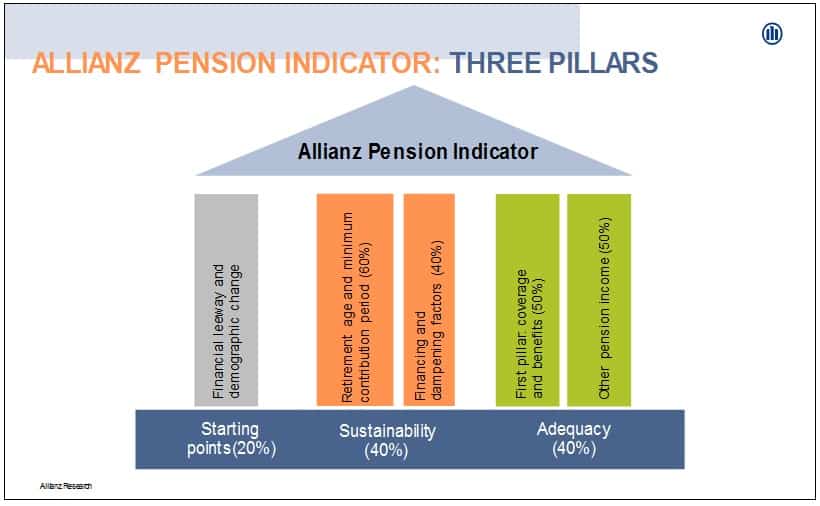
    The indicator follows a simple logic: It starts the analysis with the demographic and fiscal prerequisites and then continues to examine pension systems along their two decisive dimensions: sustainability and adequacy.

    Hence, it is based on three pillars and takes in all 30 parameters into account, which are rated on a scale of 1 to 7, with 1 being the best grade. By adding up all weighted subtotals, the API assigns each of the analyzed 70 countries a grade between 1 and 7, thus providing a comprehensive view of the respective pension system.

    “Demographics and pensions have been eclipsed by other policies in recent years, first and foremost climate change and today the fight against Covid-19,” said Allianz chief economist Ludovic Subran.

    “But you ignore demographics at your own peril, demographic change will soon be back with a vengeance. Defusing the looming pension crisis and preserving generational justness and equality are key for building inclusive and resilient societies.”

    Dramatic Shifts in Demographics

    The dramatic shift in demographics is best characterised by the increase in the global old-age dependency ratio: until 2050, it will grow by a whopping 77% to 25%, i.e., faster than in the last 70 years since 1950.

    In many emerging economies the ratio is going to more than double within the next three decades, that is, in less than half of the time this development took in Europe and Northern America.

    The most prominent example is China where the ratio is going to increase from 17% to 44%. For industrialised countries, however, the absolute level of this ratio is the main reason for concern, reaching, for example, 51% in Western Europe.

    This development is reflected in the first pillar of the API, called the starting points, which combines demographic change and the public financial situation (financial leeway).

    Not surprisingly, many emerging countries in Africa score rather well as the population is still young and public deficits and debts are rather low. On the other hand, many European countries such as Italy or Portugal are among the worst performers: old populations meet high debts.

    “For most industrialised countries, the old Scottish joke applies: If I were to build a stable pension system, I certainly wouldn’t start from here,” said Michaela Grimm, author of the report.

    “And that is the situation before the coronavirus and its tsunami of new debt. One of the legacies of the current crisis will certainly be that we have to double our efforts to reform our pension systems. What remained of financial leeway has gone for good.”

    The second pillar of the API is sustainability, measuring how systems react to demographic change: Are there built-in stabilizers or will the system be blown apart when the number of contributors falls while that of beneficiaries keeps rising?

    In that context, an important lever is the retirement age. In the 1950s, an average 65-year old men, living in Asia could expect to spend around 8.9 years in retirement (women 10.3 years).

    Today, the average further life expectancy of a 65-year old is 17.8 years for women and 15.2 years for men and it is set to increase to 19.9 years (women) resp. 17.5 years (men) in 2050.

    As a consequence, the ratio of working life to time spent in retirement has declined markedly. Countries, which decided to adjust the legal retirement age or the increase of pension benefits to the development of further life expectancy like the Netherlands, have thus a more sustainable pension system than countries where postponing retirement further is still taboo.

    The third pillar of the API rates the adequacy of the pension system, questioning whether pension systems provide an adequate standard of living in old age.

    Important levers are the coverage ratio – i.e. how big are the shares of the working-age population and the age group in retirement age that are covered by the pension system? –, the benefit ratio – i.e. how much money (measured in terms of average income) does an average pensioner receive? –, and last but not least the existence of capital-funded old-age provision and other sources of income.

    Overall, the average score in the adequacy pillar (3.7) is slightly better than that in the sustainability pillar (4.0), a sign that most systems still put greater weight on the well-being of the current generation of pensioners than on that of the future generation of tax and social contribution payers.

    The countries leading the adequacy ranking have either still rather generous state pensions, like Austria or Italy, or strong capital-funded second and third pillars, like New Zealand or the Netherlands.

    However, capital-funded retirement solutions are under increasing pressure in the persisting low-interest rate environment. The COVID-19 pandemic has further exacerbated this trend by further pushing down yields.

    “The low yield environment has forced both pension funds and life insurers to explore alternative asset classes,” said Allianz SE head of global retirement proposition Cameron Jovanovic.

    “This push into alternatives enables benefit providers to capture the illiquidity premium that matches well with their portfolio duration. Another strategy is to offload risk rather than chasing returns as longevity swaps, pension risk transfers and creative reinsurance set-ups become means of optimizing the exposure taken on by pension funds and insurers.”

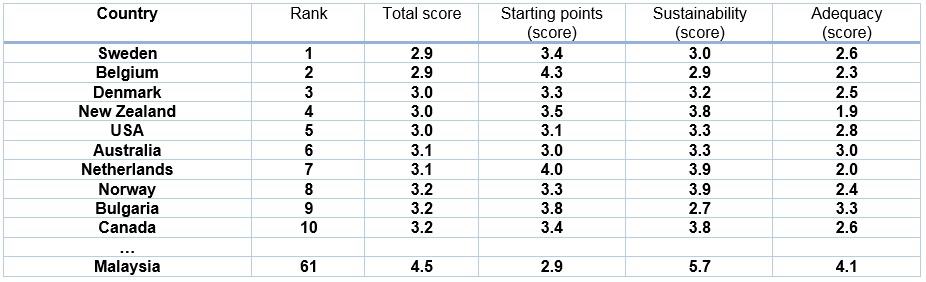
    Top 10 Pension Systems Worldwide

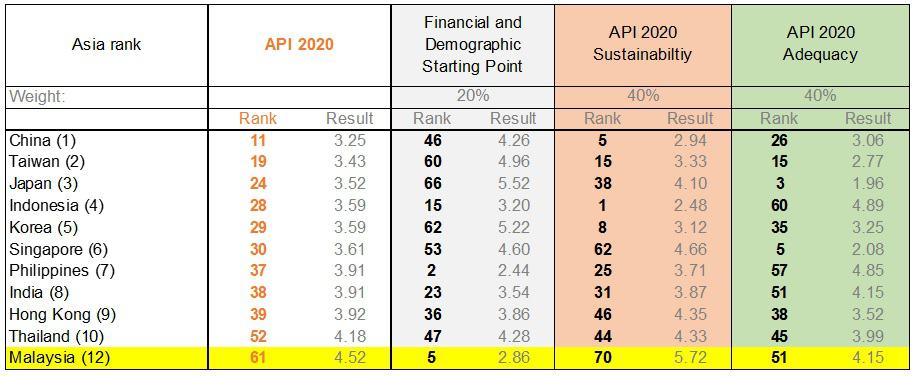
    Top 10 Pension Systems in Asia

  • Retirement Plans for the Self-Employed

    Retirement Plans for the Self-Employed

    A large segment of the working population in Malaysia is self-employed or works in the gig economy, so what are their retirement plans? Drawn by the flexibility to choose which projects to take on, the opportunity to accumulate diverse work experience and the autonomy to set their own working hours, many gravitate towards the entrepreneurial route to pursue their dreams and chart their own paths.

    Indeed, out of a total workforce of 15.54 million, according to the latest figures published by the Department of Statistics Malaysia, the World Bank estimates that more than one in four – about four million – are self-employed. From financial planners and small business owners to online merchants and e-hailing drivers, the nature of work among the self-employed is numerous, varied and multi-faceted.

    In line with global trends, reports indicate that this is increasingly also the preferred choice of employment among Malaysian millennials and Gen Z – those born in the mid-1990s onwards. As exciting as this development is, Malaysians who are self-employed often neglect something everyone should do the moment they start working: saving for retirement.

    Retirement savings for the self-employed

    Being a freelancer, independent contractor or technopreneur means you do not get to enjoy the usual perks of salaried employment. Income typically fluctuates from month to month, and there are no pensions or mandatory schemes to provide a financial safety net.

    It might be tempting, or even necessary, to channel any excess money towards expanding or covering the cost of business. The risk of saving too little for retirement is high.

    This state of affairs is supported by a survey conducted by Private Pension Administrator Malaysia (PPA), the central administrator for Private Retirement Schemes (PRS), where 62.8% of those who are self-employed said they wish they are saving more for retirement. Unless you are expecting to receive a substantial windfall or a generous inheritance, it is important you start taking proactive measures to save for your retirement.

    “While you are busy growing your business or juggling several projects simultaneously, don’t make the mistake of not saving for retirement at all,” says PPA Chief Executive Officer Husaini Hussin.

    “Create a retirement plan based on your needs, goals and risk appetite and then stick to it by automating your savings.”

    Source: PPA Malaysia

    Why consider PRS

    Having a retirement plan is vital for a successful self-employed person. It can mean the difference between toiling into your old age and taking leisurely strolls on the beach.

    With PRS, a voluntary long-term savings and investment scheme designed to help you save more for retirement, you can contribute at your own pace and within your own financial ability.

    “Think of retirement savings in terms of percentages instead of a fixed amount or putting aside only what is left over at the end of the month,” advises Husaini.

    “This ensures you don’t overstretch yourself in a lean month and you save a little bit more when business is good.”

    To have adequate replacement income to sufficiently sustain your standard of living throughout retirement, PPA’s research suggests setting aside one-third of your income every month. When you save a percentage of your income each month this way, market volatility works in your favour as you gain more units when prices are low.

    “It is a great way to save for your retirement over the long term,” Husaini adds.

    “The top performing PRS funds have given PRS members good returns since inception up to 31 October 2019.” (See table)

    Another aspect of PRS is the Nomination feature, which supersedes all wills. Other than the mandatory scheme, PRS is the only savings scheme in Malaysia with a feature to ensure your loved ones or nominees receive your gift hassle-free in the event of your untimely demise.

    Recently, Budget 2020 proposed that PRS Members be allowed to make pre-retirement withdrawals for the purposes of healthcare and housing without any tax penalty. Additionally, zero tax penalty withdrawals for medical expenses incurred by immediate family members are also allowed, in recognition of rising healthcare costs.

    “The introduction of 0% tax penalty for pre-retirement withdrawals of PRS from sub-account B, which holds 30% of the savings for purposes of healthcare and housing, reflects the government’s understanding and commitment to help all Malaysians use a portion of their retirement savings for their needs,” Husaini said. “This proposal shall take effect from next year.”

    Beyond that, PRS Members who reached the retirement age of 55 or suffer from permanent total disablement, serious disease or mental disability can withdraw the full sum of their PRS savings without any tax penalty.

    PRS Online

    You can start saving with just a few simple steps by using PRS Online Enrolment, a service developed by PPA to help you save for your retirement in an easy, convenient and secure way. All you need is RM100 for the initial contribution and the minimum amount for subsequent top-ups is as low as RM50.

    There are 55 conventional and Shariah PRS funds offered by eight PRS Providers to select from, but if you can’t decide, opt for the age-based default option. It is a unique feature of PRS which will automatically align the suitable asset allocation to your age group.

    “The beauty of PRS is the choice and flexibility that PRS members have to enrol or top up into multiple PRS funds anytime and anywhere with just one PRS account,” Husaini says.

    “Track your savings and monitor your investments with the myPPA mobile app. You always have the option of optimising your returns by switching PRS funds within the same PRS Provider or transferring your savings to another PRS Provider.”

    Furthermore, PRS contributions you make are also eligible for a personal tax relief of up to RM3,000 per year, giving you tax savings which can further boost your retirement savings. You could enjoy zero sales charges or free insurance or takaful with coverage of up to RM100,000 with certain PRS providers.

    Do it on your own

    Being self-employed can be exciting, scary, and rewarding all at once, but without a mandatory scheme that makes savings and employer contributions compulsory, the onus of building a retirement nest falls squarely on you.

    Money starts working for you the moment you set them aside for retirement. Whether you’re an entrepreneur, a photographer or e-hailing driver, take advantage of the flexibility to choose how often and how much to save with PRS.

    Do it on your own. Senang jer. Save in PRS.