Category: Grow Your Wealth

  • Knowing Your Financial Ratio

    Knowing Your Financial Ratio

    Sometimes people tend to wonder what we can do with the surplus cash that we have at hand. Well, as a start, it is good that there is a surplus in cash, but if we are not careful this surplus may be gone before we even realize and by then it could be too late to think about “what-ifs” and “I-should-haves”.

    In financial management, there are parameters that can be used to gauge if one is “financially healthy”. Here are few basic financial ratios one can use to gain better understanding of their state of personal finance:

    • Liquidity Ratio: This measures one’s ability to cover unforeseen expenses such as emergencies, car repairs, job loss, etc.
    • Debt to Asset Ratio: If there is an solvency issue, you must have assets to cover your debt obligations. If your debt value is too high compared to asset values, then even if you sold off all assets, it may still lead to
 bankruptcy.
    • Liquid Asset to Net Worth Ratio: Consider how much of your assets are liquid or “moveable”?
    • Savings Ratio: You should be able to save at least 10% of your income each month to go towards your retirement. 

    Liquidity Ratio

    financial ringgit malaysia

    Should a person have a very low liquidity ratio, the first thing he or she needs to do is to start saving money for a rainy day (the amount of which is measured by one’s liquidity ratio). Don’t think about paying off debts (except to service scheduled repayment), and investing at this point should be the last thing on this person’s mind.  

    Debt to Asset Ratio

    If you have a good liquidity ratio (healthy savings) but also have high debt to asset ratio, then you are advised to pare down some of your debts.  For instance, a person may have a huge positive net worth, but most of this comes from immovable assets such as real properties. If this is the case, this person should consider increasing the proportion of movable assets by investing in other paper assets such as stocks or fixed incomes to diversify and also to provide some liquidity to the balance sheet.

    Savings Ratio

    financial savings

    Savings ratio is quite easy to measure, but if you cannot save any money you bring home, then obviously you have a lifestyle or income problem. You need to tackle that first before thinking about putting your money to work hard for you.

    See the Big Picture

    What I advocate as a financial planner is that no matter what we decide, we must see the bigger picture, the bigger picture being a person’s life, and what he wants out of it. It is important that our decision correlates and supports our aspirations, and if a decision does not derail our goals and dreams but brings us nearer to them, then this is the right thing to do.

    In financial terminology, financial planning is described as a systematic process to organize our finance to help achieve our life goals.  That being said, any amount on top of the threshold a person feels comfortable treating as their rainy-day fund should be put to work via investments.

    Depending on your marital status, income sensitivity or fragility, health condition, and so on, it is rather advisable to have emergency funds worth at least six months of your take-home income (some will say six months of monthly expenses but I would strongly suggest you look to your take-home income as it is more conservative).

    If you would like to strengthen your foundation, you may even create an emergency fund that is worth six months or more of your take-home income plus your loan repayment commitment for an additional 12 months. This will help make sure you avoid defaulting or failing to repay your loan obligations.

    Of course, it is rather impossible to save enough to help cover emergencies such as serious diseases and so on. This is why you need to be aware of risks and potential losses and take up insurance. After saving enough to feel comfortable and at peace, you must then invest the surplus and let it work for you. Be a master of your cash; not a servant to it.

    About the author

    kevin neohKevin Neoh is a NextGen Money Coach who works with people to help them transform their relationship with money to improve their lives with the money they have. Kevin can be contacted at kevin@nextgenadvisors.my and www.kevinneoh.my

  • Fired Up: A Look At Southeast Asians Pursuing The Financial Independence, Retire Early (FIRE) Movement

    Fired Up: A Look At Southeast Asians Pursuing The Financial Independence, Retire Early (FIRE) Movement

    Having an early, secure retirement is a dream of many, and a small, but growing number of people are striving to turn this dream into reality. The FIRE movement, acronym for Financial Independence, Retire Early, is essentially about aggressively tightening belts, and finding multiple sources of income in order to achieve early financial freedom.

    Milieu Insight released the results of their ‘Financial Independent, Retire Early’ study, which aimed to find out how common the FIRE movement is among Southeast Asians, and the steps they are taking to achieve their goal. The survey was conducted in May 2022 with N=1500 employed respondents, aged 18-49 years old, each from Thailand, Singapore, Malaysia, Indonesia, and the Philippines.

    Do Southeast Asians want early retirement?

    • The bulk of respondents expect to retire in their 50s or 60s (62%); Indonesians tend to expect earlier retirement, with only 52% expecting to retire in their 50s or 60s
    • Retiring early (defined as retiring before 50s) is a possibility for 60% of respondents, but only 14% think that they are on track for early retirement – Singaporeans seem most pessimistic about being able to do so, with only 9% indicating that they are on track

    Steps towards early retirement

    • Most common strategy towards early retirement is regular saving (71%), followed by ‘being careful with how I spend my money’ (63%) and ‘investing’ (63%).
    • Finding additional employment is much less common (37%) as part of strategy to retire early, but tends to skew towards Thais (54%)
    • Insurance – one way of investing – is also more common among Singaporeans (56%) and Filipinos (53%)
    • Perhaps due to vast amount of resources on the Internet, most people are hands-on for retirement planning, with only 31% of those who plan to retire early saying that they have a financial consultant to help plan for retirement

    A look at the most common strategies for early retirement: Saving and investing

    • Among those who save regularly for early retirement, 43% save more than 20% of their incomes
    • Among those who invest, 36% indicated that more than 20% of their incomes go towards investments
    • The most common investment types are:
    • Investment funds (56%)
    • Stocks (53%)
    • Real estate (52%)
    • Cryptocurrency and NFTs, which are gaining momentum but have yet to enter mainstream investing due to their volatility, registers at 41%, and seem to be more popular in Thailand (57%) and the Philippines (54%)

    How do people feel about FIRE?

    • 57% feel very or somewhat positive about their journey towards achieving early retirement
    • Comparing those who are on track to early retirement, and those who are planning to retire early but don’t think they are able to, the former tends to feel more positive about it (83% vs 49% who selected very/somewhat positive)

    Methodology

    Based on Milieu Insight surveys with N=1500 employed respondents, aged 18-49 years old, each from Thailand, Singapore, Malaysia, Indonesia, and the Philippines, conducted in May 2022.

    About Milieu Insight

    Milieu Insight is a consumer data and analytics company that connects businesses directly with their target audience. Milieu’s platform offers businesses a wide range of tools for accessing, analyzing, and visualizing high-value and timely consumer opinion data to help power better decision-making and strategy. For more information about Milieu Insight visit: www.mili.eu

  • 5 Different Types of Income

    5 Different Types of Income

    Since childhood, parents advise us to study hard, get good grades, go to college and graduate so that we can land a job with great benefits. It has been our only concrete financial plan until we faced the reality of adulthood. here are many types of income which easy.

    We became students of financial matters ever since and have begun to explore many types of income from books, workshops, online media, and casual chats over coffee. It has led us to build multiple streams of income, instead of relying solely on a single job for pay.

    In this article, let’s explore these income types. Each has its unique attributes, requirements, and usages to build wealth for the long term. We’ll examine five different types of income, discuss their pros and cons, and how they can contribute progression towards your financial life.

    1. Active Linear Income

    types of income

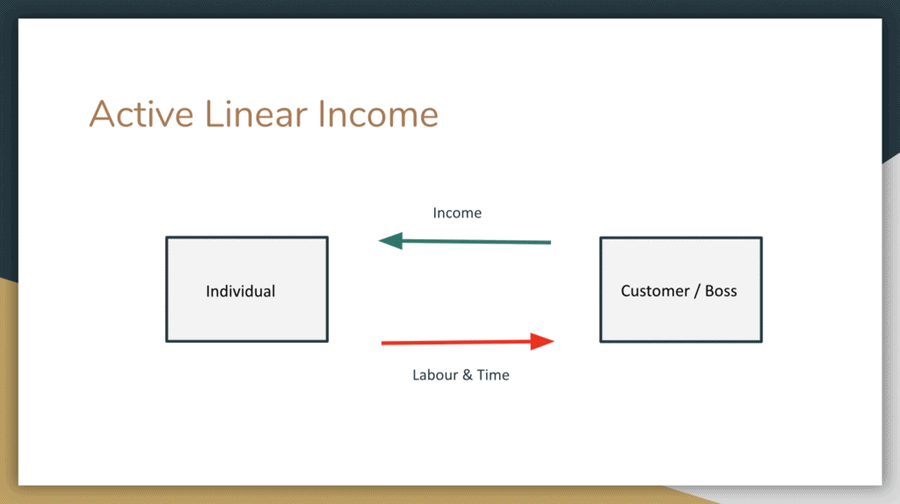
    It is income derived from an exchange of physical labour and time with a single paymaster. This type of income is most common for it is the fastest means that one uses to make money as it requires the least time, effort and investments to establish this source of income.

    For instance:

    • You are an employee working for $ xxx per period (hour, day, week, month, shift, etc.).
    • You are a freelancer who charges a fixed fee of $ xxx per project.

    This type of income is useful when one is starting off. After all, everyone has bills to pay. With that being said, this income is dependent solely on your effort physically.

    So, it may be limiting in terms of growth for all of us possess only one physical body, 24 hours a day, 365 days a year, and can only be at one place at a time. As such, this leads us to explore our next few sources of income.

    Maybe this worth your read : 4 Lessons I Learnt on Wealth And Life As I Enter My 30s

    2. Active Scalable Income

    types of income

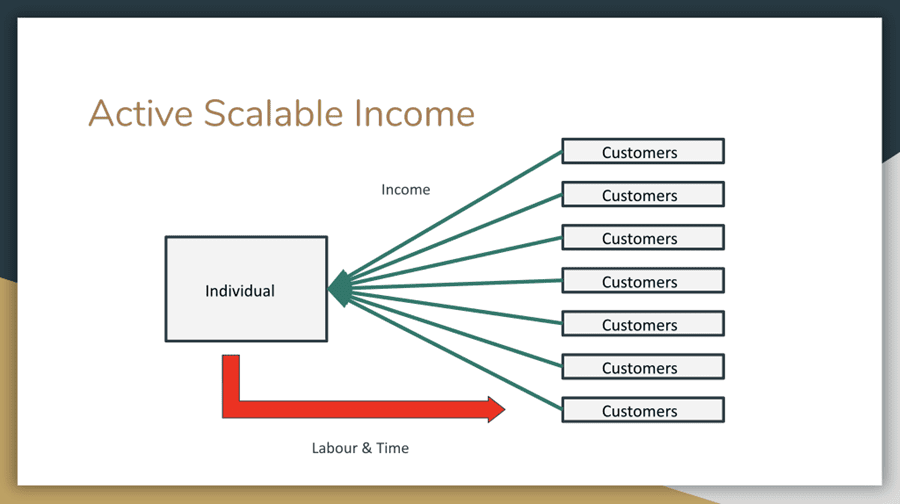
    Likewise, it is also income earned from an exchange of physical labour and time but to a network of paymasters. It involves one having built a system or a team or multiples of both to increase income exponentially via scale.

    It includes:

    • You earn x% in overriding commission from sales generated from your sales team.
    • You are a freelancer who makes x% profit share from project undertakings.
    • You sell products or services via a network of distributors and retailers.
    • You sell digital products to an online community consisting of xxx people.

    This type of income is expandable because the number of clients you serve can increase significantly without you substantially increasing your efforts at work. In other words, a 100% growth in your customer base may bring 100% more income without you increasing your workload by 100%.

    This is usually the type of income that propels one from earning 4-figures to 5, 6, or, 7-figures per month, hence, raising more significant capital faster for investments.

    But, if it is that good, why not more people earn this type of income?

    This is because it requires people to invest time, effort, and money to first learn about marketing, branding, leadership, and system building. Upon which, there might be no immediate payoffs.

    For instance, you may have a desire to make millions from pitching your products to a broad audience in a mega preview event. The money sounds enticing. But, you would need first to master effective public speaking and closing.

    3. Passive Income

    types of income

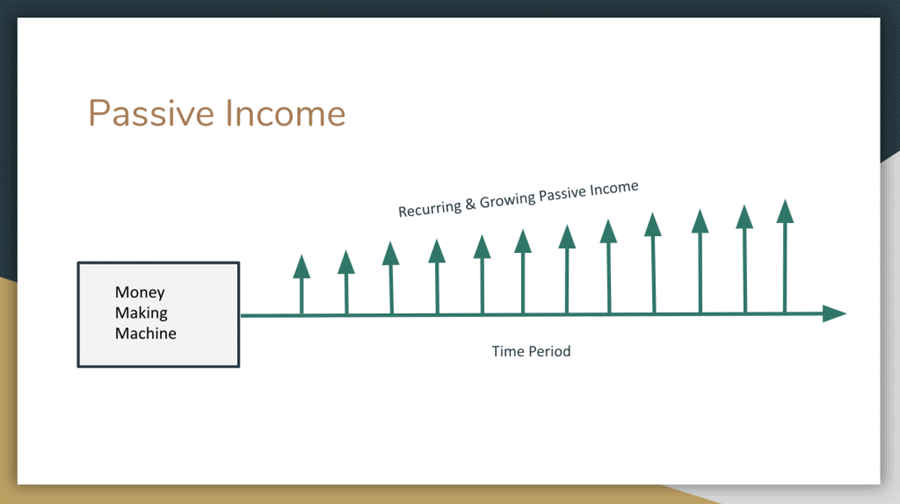
    It is recurring income derived from ownership of profitable assets. It includes:

    • Interest income from fixed deposits, P2P lending, and other forms of credits.
    • Coupons from bonds.
    • Dividend income from a portfolio of stocks that pay dividends.
    • Rental income from tenanted properties.
    • Royalty income from intellectual properties.
    • Passive income from owning businesses that you don’t physically manage.

    This type of income is awesome because cash is flowing into your bank account without physical labour. In essence, receiving passive income is earning time as it frees your time to pursue what you like. Besides, there are many tax benefits if you have any of the above sources of passive income.

    If you are earning $ 100,000 in active income, you will be paying more income tax on as compared to another person who makes $ 100,000 in passive income. He may even pay literally zero in income taxes in Malaysia.

    However, you need higher financial intelligence to create passive income effectively. One inevitably has to learn about investing and be a skillful investor with a great temperament.

    Therefore, although passive income doesn’t require much physical labour, you need to study a lot (mental labour) before being good at it. Besides, without huge capital, you can’t survive on meagre passive income to do it fulltime.

    4. Portfolio Income

    types of income

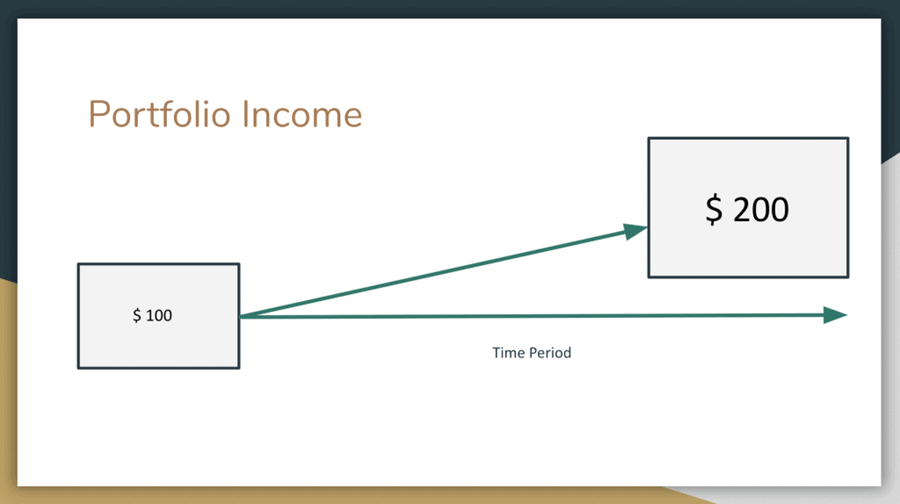
    It is income derived from market value appreciation of your assets, also known as a capital gain. Alternatively, you can earn this profit via investing in assets at prices below their market valuation. Some examples include:

    • Your stock has appreciated from $1.00 to $2.00 in x period of time.
    • You bought a property for $80,000. Now, it is worth $100,000.
    • The value of your home is $200,000. You bought it for $80,000 7 years ago.

    Many people find investing appealing because of the prospects of earning portfolio income or capital gains. It is even more attractive as compared to making passive income for the money is more significant. After all, eating steak immediately is more appealing than having milk every day.

    I find there are two types of people who want to earn portfolio income.

    First, it is people who are focused on money. They intend to make more money via selling assets at higher prices than their cost of purchasing them. This group of people are either traders if they can make money consistently or speculators and gamblers if they lose money consistently from their activities.

    Second, it is people who are focused on accumulating assets. They are not ones who will kill their golden goose as they treasure them. For instance, they would invest in stocks or properties and hold onto them for long-term capital growth. Their mindset is to keep them and not sell them for a profit. In most cases, they would build massive net worth from their investments over time.

    5. Phantom Income

    It is income derived through the leverage of tax benefits, corporate entities and debt. It is known as Phantom Income as the income is not receivable via cash. It is an income of the rich as it requires a higher degree of financial intelligence to grasp the concept and utilise it fully.

    We won’t list down its examples for its explanation is more technical. Here, suffice to say, the best way to use this income efficiently is to surround yourself with a team of advisors such as investors, consultants, accountants, lawyers, bankers and other related professionals.

    Looking for financial freedom? 8 Healthy Financial Habits To Build Your Financial Freedom Fund

    Conclusion

    There you go, the five different types of income that one could earn for himself to increase financial wealth.

    If you think about it, the five types of income is an income progression of most wealthy people who began with very little. You would begin with earning active linear income first to survive, expand your income through scale, invest your capital for passive income and portfolio income and roped in a team of advisors to make phantom income by setting up corporations to save on tax payments and use low interest rate debt to accumulate more assets that would build even more wealth.

    Now you know how it works. Go work on it!

    About the author

    This article is co-written by KCLau and Ian Tai

    Ian Tai is the founder of DividendVault.com, a platform that analyse and filter stocks that pay increasing dividends year after year.

    KCLau is a financial educator. He had published 6 books and co-created a dozen online financial courses. After conducting more than 461 hours of free webinar and 2000 articles published online, he gives away his popular Money Tips e-book volumes absolutely free at his website: https://KCLau.com

  • Saving Up For Our Retirement, Is It Possible To Do It Post-Pandemic?

    Saving Up For Our Retirement, Is It Possible To Do It Post-Pandemic?

    The global pandemic that hit the world has changed all aspects of our life. Besides the health and human loss that is caused by COVID-19, it has also impacted the economy quite severely.

    Efforts by the government to curb the pandemic by imposing Movement Control Order (MCO) have a great impact on businesses and individuals. Many companies have closed shop and many individuals saw their income greatly reduced.

    To help Malaysians, the Employees Provident Fund (EPF) rolled out three withdrawal retirement income initiatives namely i-Lestari, i-Sinar and i-Citra. The pandemic has clearly disrupted the cash flow of individuals affected by lockdown and economic slowdown.

    A total of RM101.1 billion EPF withdrawals have been made and there are now 54% or 4.4 million members who have less than RM10,000 savings in their EPF.

    This leads us to the question; can we save for retirement in this post-pandemic era?

    A Long Term Game

    retirement planning

    Saving for retirement is a lifelong journey. Many Malaysians put their savings for retirement plans on-hold as they struggle for the past few years.

    A survey conducted by the Private Pension Administrator (PPA) highlighted that 80.1% of respondents who are facing financial challenges were rethinking their retirement plans and goals, while 19.2% of respondents want to resume saving once they have achieved financial stability.

    Government approval on EPF withdrawals should not be the only solution to ease an individual’s burden. To alleviate the difficulties of the rakyat, the government must create more funding schemes or come out with other forms of assistance rather than approving the withdrawals from retirement funds.

    This will be a huge problem in the future, as many are left with very little once they retire.

    The country is now rebuilding its economy, our borders have reopened, and many people are going back to work. Even the traffic jams are getting worse.

    If you are badly affected and have exhausted the means from your EPF, it is about time to start filling in your retirement funds. We can see the light at the end of the tunnel, just need to persevere a little bit more.

    About the Author

    Nur Aiziera Sukman completed her Masters in Quality & Productivity Improvement from Universiti Kebangsaan Malaysia in 2007. She has more than 10 years of experience in the Financial Services industry and specializes in understanding financial planning needs and develop customized plans to suit retail and corporate client.

    In 2019 she pursued her professional certificate in Certified Financial Planner from Financial Planning Association of Malaysia and continued her study in Islamic Financial Planner from IFBIM and received the IFP Certificate in 2021. She can be reached at aiziera@aswaadvisory.com.

    Aswa Advisory is your preferred one-stop center for Shariah Independent Financial Advisory. Get a free consultation from an Islamic Financial Adviser Representative by filling in your details here: https://www.smartinvestor.com.my/SIxAswa

  • 4 Tips For Millennial On Accumulating Wealth

    4 Tips For Millennial On Accumulating Wealth

    For many millennials striving for success in their careers, starting their own family and seeking to build up a nest egg for a comfortable retirement, the journey of wealth accumulation can often be fraught with challenges and pitfalls.

    Many think that wealth accumulation is just having lots of money. In fact, “having money” and “wealth accumulation” are two different things.

    Having money allows you to pay for your expenses but it is typically spent shortly after it comes in. The latter goes a step further – it is taking disciplined steps over a period of time to achieve wealth accumulation. Here are some tips for the millennial on how they can accumulate wealth.

    Saving, Saving, Saving!

    For wealth accumulation, you need cashflow. The very first step is to set a financial goal and stick to it! Once you are clear about your objective, the next step is to be disciplined enough to achieve your money goal.

    A good suggestion is to use “automation”. Automation adds built-in discipline to your financial life and reduces the likelihood that you will forget your objective or spend money on things you do not need.

    You can set up automatic deductions from your paycheck bank account to send money directly to another savings account, unit trust or investment account. By automating these payments, you are making sure that you are paying yourself first.

    Cut Expenses

    Cutting unnecessary expenses is the key to living below your means, so you can reach your financial dreams. Challenge yourself by resisting expenses that are most tempting. For example, you might:

    • Cook at home every day for a month instead of eating out;
    • Refrain yourself from buying any new clothes or handbags for six months;
    • Avoid window shopping as that will cause unnecessary spending;
    • Say no to cinema and other entertainment places for six months; and
    • Cancel or delay your annual trip to another year.

    Imagine how much money you could save if you are successful in overcoming the above challenges. You could easily have an additional RM10,000 to RM20,000 to add up to your savings.

    Multiple Streams of Income

    You need cashflow to build wealth, and the best way to generate that extra cashflow is to earn more money. In Robert Kiyosaki’s book ‘Rich Dad, Poor Dad’, he mentions four types of income streams: Employee, Self-employed, Business Owner and Investor.

    For the first three sources of income, you are exchanging your time for money. It is a form of active income whereby you need to be “actively” working for money.  However, please do not underestimate these sources of income, as it can be useful when you want to utilise this as a leverage power to accumulate your wealth.

    You may buy your first property with this financial leverage. And if your investment is a positive cashflow, you would probably end up owning the property for free as your rental income is able to pay down your mortgage loan.

    The last source of income –  Investor – is the status that people most closely associate with wealth. This is where “money works for you”. As an investor, you earn the best kind of income possible – passive income by investing in assets such as stocks and properties.

    Why is it the best? Because you earn money while you were sleeping! If you can generate enough passive income, you may never need to work again in your life. In short, you can retire early.

    Get Rid of Your Bad Debt

    In the journey of wealth accumulation, we also want to identify the obstacles preventing us from achieving our financial goals. One big obstacle could be having too much debt. However, not all debts are bad – there are good debts and bad debts.

    Good debt is money you borrow at a low interest, with which you could make a higher rate of return, such as your mortgage rate. Bad debt, in contrast, is consumer debt. For example, money you borrow at a high interest rate to buy things that do not produce income or grow in value such as cars, electrical appliances, furniture and even luxury trips.

    The price of bad debt is the impact of compounding rates of return working against you instead of for you. If you have credit cards or bank loans costing you 18% or more a year, that’s 18% compounding against your retirement.

    The Bottom Line

    In summary, wealth accumulation does not happen overnight, it is a gradual and a disciplined process that requires proper planning and execution.

    Nevertheless, It is always good to have a licensed financial planner to guide you in setting up a blue print for your financial journey. They are generally able to help you to make better investment decisions and make sure your money is being deployed in the best manner.

    About the Author

    Pauline Yong is the CEO of Sigma Wealth Sdn Bhd. She is a CFP® (Certified Financial Planner), a licensed financial planner with a Securities Commission license (CMSRL) and a Financial Advisor Representative (FAR) licensed by Bank Negara.

    She has published five investment and financial planning books and writes regularly for various publications. Pauline is also a regular commentator on stock market outlook for City Plus FM radio station.

  • Retirement Planning, Why It Is Important From An Islamic Point Of View

    Retirement Planning, Why It Is Important From An Islamic Point Of View

    Malaysia is a country whose most professed religion is Islam. As of the latest statistics, there were approximately 19.5 million Muslims or 61.3% of the total Malaysian population.

    From another perspective, in 2019, it was estimated that the Malaysian population aged over 65 years stood at 6.7 percent. Malaysia is currently facing the prospect of an aging population, and the latest statistical data predicted this to be happening as soon as in 2030. 

    In a simplification, Muslims are the majority in Malaysia, and we are looking at the more significant rate of retirees as the year goes.

    However, are we truly ready for it? According to a recent survey by the Credit Counselling and Debt Management Agency (AKPK), more than 50% of Malaysians may not be financially ready for retirement. While the figure alone is already scary, what been happening, in reality, is even worse.

    We start to see the senior citizens who now need to continue working despite their retirement and against their suitability due to financial constraints and weak to no financial planning. Those with completely empty retirement savings within not even a few years without accomplishing anything contributing toward financial freedom – to name a few.

    Why Islam Encourages Us To Plan Their Lives In All Aspects?

    Muslim asian retirement planning

    Islam encourages Muslims to plan their lives economically and financially to achieve the objectives of Shariah (Maqasid al-Shariah). As Islam governs all aspects of life, it takes full cognizance of how Muslims gain and spend their money, including wealth. 

    Even though the child should look after their parents, especially when the recipient becomes too old and incapable of sustaining themselves, however, with a good understanding by the parent that their children are responsible for their own families, too. 

    The need to plan one’s retirement becomes more evident as the years pass. Retirement planning becomes more significant as the financial impact and demands of modern society take their toll on the grown children’s lives. Then once the cost of living increases, the ability of the children to care for other people other than their immediate families will become increasingly difficult. 

    Hence, one should consider the Islamic retirement planning tools and processes as one’s preparation to be independent financially when one is old or retires from one’s job.

    Aspects Of Islamic Retirement Planning

    Retirement planning is one of the elements of Islamic financial planning and wealth management. Retirement planning is a process that includes a comprehensive review and analysis of retirement income, retirement goals, and investment strategy.

    The purpose of retirement planning is to coordinate the financial resources available so an individual can plan for a financially secure retirement or reduce financial risk during retirement.

    Role Of A Financial Planner

    Financial planner planning

    To build a retirement planning is not an uneasy task. That is due to while everybody has an opinion on how to plan their financial needs, the truth is, a wholistic plan from a financial planner point of view, it should start with assessing the future income needs of an individual.

    Followed by financial objectives need to be established so that the retirement plan would have a clear target on how much future come to need to be achieved. Also, the retirement plan must align with the projected future income. 

    The most crucial part for the Muslims here is to ensure that shariah compliance must be taken into account. It is essential to make sure the retirement plan is free from prohibited elements, especially riba. 

    Even if one claims that they are ready for retirement period and have a clear set of financial and lifestyle visions and goals, it is always encouraged for them to seek advice from experts such as Licensed Financial Planner.

    That because only a financial planner specializing in that area, to giving any pieces of advice or a financial planner, can be aware of several common missteps that many fall victim to, even those with a plan. 

    Retirement Hazard

    caution retirement planning

    Many fields might fail to notice by one person when it comes to retirement planning. The most common mistakes made when we talked about retirement planning are lack of preparation of finances related to the impact on one’s health, misjudging how long one or one’s spouse will live, presuming a longer working life. Many take lightly how to prepare for and live in retirement. 

    To conclude, the retires worker’s situation is different from his previous situation during the working time with a specific income. Hence, everyone must prepare for their retirement by planning. In other words, planning one’s retirement is similar to planning against the risk of premature death.

    The preparation should be holistic from the financial planning overview. It should be avoided element that is prohibited in Islam such as riba, gambling, gharar, etc. The planning should also prepare for the religious obligation that, as Muslims, we need to perform hajj, payment of zakat, and the recommended donations, helping the poor and needy. 

    About the Author

    Nuraishah Hanani Abdul Ghani is a Certified Islamic Financial Planner with a demonstrated history of working in the banking industry.She has a strong finance professional background with a focus in Islamic finance and is a graduate from Universiti Islam Antarabangsa Sultan Abdul Halim Mu’adzam Shah (UniSHAMS) in Ba (Hons) Islamic Finance and Banking, Master in Chartered Islamic Finance Professional (CIFP) from INCEIF and Certified Islamic Financial Planner (IFP) from IBFIM.

    We at Smart Investor and Wealth Vantage is committed to help you better manage your financials. Get a free consultation from an expert by filling in your details here: https://www.smartinvestor.com.my/SIxWealthVantage

  • Retiring Early Thanks to Financial Independence, Have You Heard Of The FIRE Movement?

    Retiring Early Thanks to Financial Independence, Have You Heard Of The FIRE Movement?

    If you were to ask the average millennial about how early they would be able to retire, chances are you would get varied responses. However, it is unlikely that any of them would be aiming to retire before the age of 50.

    That is where the concept of FIRE comes in.

    What Is FIRE Movement?

    It stands for “financial independence, retire early” and is a growing movement worldwide. In short, proponents of the movement aim to save a large portion of their income (up to 70% or even more!) and aggressively invest in order to hit a set number they feel comfortable with for retirement.

    The aim is to hit this number far earlier than traditional work structures after which they become financially independent and can “retire” or pursue work or projects they are passionate about.

    Proponents of this movement suggest the “4% rule” as a guideline – the goal is to accumulate 25 years’ worth of annual living expenses through various investments, and withdrawing 4% per annum, assuming it generates at least that much in passive income.

    This is unlikely to diminish the portfolio, and individuals that have reached this level can be considered financially independent, with any form of employment or work now optional instead of necessary.

    4 Varieties Of FIRE Movement

    Fat FIRE: This allows individuals to live a more traditional or typical lifestyle, but also requires saving more than the average retirement investor. It usually allows for luxuries like fancy meals, holidays and gadgets depending on the amount saved up.

    Lean FIRE: This model requires a strict commitment to follow a minimalist lifestyle with little expenditure and extreme savings. An individual can achieve this when they have saved and invested 25 times their annual expenses while also spending less than the average person.

    Barista FIRE: This form refers to devotees that do not follow a set 9-to-5 job, but do work in some capacity on a part-time basis to cover necessary expenses that would otherwise have them tap into their retirement nest egg.

    Coast FIRE: This can also apply to followers that have a part-time job, but who have already saved up enough to fund their retirement and living expenses (thanks to compounding investments), allowing them to “coast” towards retirement.

    Julian Ng, co-founder and CEO of robo-advisor Akru, believes that the FIRE movement is intriguing and helps people think beyond the realm of what is considered financial normalcy.

    “I thought it not only had interesting financial planning principles but also life angles,” he remarks, adding that FIRE devotees did not have to stick to the concept of only being able to retire when they are older.

    Ng believes followers of this movement are tired of being stuck in the rat race and want to work towards other goals that offer fulfilment. Corporate highs to be replaced by personal pursuits and leisure. The latest gadgets and cars substituted with experiences and time with their loved ones.

    “I think they plainly want a life. They want to spend time on things that matter like family, friends and their passions. They also value health and emotional wellbeing. In terms of bigger life philosophies, they figured out that they do not need to have caviar and business class all the way. They are a bit minimalist in that sense, although they are also financially very comfortable.” 

    Early Retirement?

    According to Malaysian law, the minimum age of retirement of an employee in the private sector is 60 years of age. There have been calls to raise this number to 65, meaning that the average person could potentially work for over 40 years before calling it quits – hardly a tantalising prospect to most people.

    Although following the FIRE movement potentially offers a way out for weary millennials, not everyone is specifically aiming for an early retirement.

    “Personally, I’m aiming for the FI part of FIRE as I don’t plan to retire early,” says Leigh, the founder of popular investing blog Dividend Magic, who aims to have a passive income of RM36,000 a year, most of which is derived from various investment dividends.

    “I lived a pretty frugal lifestyle even before learning of FIRE. These habits have been instilled in me since a young age and I have actually been telling myself to spend more often, but on things that genuinely bring me joy. And it will have to be happiness that lasts,” he adds.

    This is a notion shared by Lee Sheung Un, communications officer of Affin Hwang Asset Management, who describes himself as a subscriber to a milder version of FIRE.

    “Early retirement is not the end goal for me, but rather achieving financial independence,” he says.

    “Personally, I aim to save at least 40% of my monthly income which is not quite close to the FIRE benchmark to save at least 70%. I am sure it is possible if I really tried, but I also like spending on my own comfort to save time and avoid stressing about the small things.”

    To the average person, the idea of retiring early may sound good on paper, but it is not surprising that many FIRE devotees are not just looking to coast through the rest of their life. Rather, they are aiming for the freedom and time that financial independence unlocks to be able to pursue what fulfils them.

    Achieving FIRE In Malaysia?

    As a concept originating in the West, the burning question for many will be whether it is possible to achieve financial independence in Malaysia.

    Suraya Zainuddin Ringgit Oh Ringgit personal insurance

    “FIRE is not realistic for people living in countries with a wide wealth gap,” sighs Suraya Zainudin, the founder of personal finance website RinggitOhRinggit.com.

    “Mathematically and statistically speaking, the structure simply does not allow the majority of people to reach their financial goals, even modest ones. Unfortunately, Malaysia is one of those countries.”

    However, Leigh believes that FIRE is definitely possible but that it is not for everyone as it can be hard or too intensive to keep up with.

    “We live in a world of spending and instant gratification. Getting a new phone, signing up for gym memberships all costs money. Not everyone is willing to grind all day and put a hold on spending. And a huge problem in Malaysia is that people are not investing,” he observes.

    And while not everyone may be cut out for the FIRE movement, the philosophies and beliefs around it can help to cultivate a healthier understanding and relationship with money, as well as a way to escape traditional ways of thinking.

    FIRE Movement: Theory And Reality

    The points highlighted above shows how investment formulas are great in theory – but we know real life works out differently. Things start to fall apart when you are faced with unexpected expenses, for example.

    What happens if you are suddenly responsible for another dependent – a child, or parent? Or if you lose your job or become incapacitated?

    On the positive side, the financial dynamics might change because you inherit a windfall or enjoy a rapid increase in earnings. Any of these instances will alter the time it takes you to reach your desired retirement age.

    Neil Walton, Head of Investment Solutions says: “We know the concept of FIRE has spurred some to consider downsizing, retiring, investing and changing their lives. But even for those who do not intend to do anything so radical, FIRE provides a useful blueprint for planning. Good investment will sit on a good financial plan, and that is inevitably about building investments over time to provide an income in the future.”

  • Here’s Why You Need To Plan For Your Retirement

    Here’s Why You Need To Plan For Your Retirement

    In the traditional context, the word “retirement” means withdrawing from one’s active working life. However, in today’s modern world, the concept of retirement goes beyond its literal interpretation, with more individuals now viewing retirement as the dawn of a new chapter in their lives.

    A meaningful retirement should be one that affords you peace of mind without the worries of financial concerns. Only then would you be able to relax and enjoy the fruits of your labour.

    However, an ideal retirement does not happen overnight. Just as building strong body muscles requires us to work out in a dedicated and consistent manner over time, the same principle applies to retirement too. When we want to build strong wealth muscles, there needs to be a continuous effort over a long period of time.

    What is the right long-term strategy for our retirement planning to achieve our desired retirement lifestyle? The answer will form a clear blueprint to lead us towards a successful retirement path.

    If it sounds straightforward, why aren’t more people committing towards this?

    Financial Planning: The Starting Point For Retirement Planning

    The biggest mistake one can make in retirement planning is thinking that we do not need to have a plan. Contrary to common belief, financial planning is not exclusively for the wealthy alone. Our financial planning journey is a lifelong marathon to uncover different needs, new opportunities and specific challenges that may arise at different stages of life. 

    A comprehensive financial roadmap will give us more clarity on our current financial situation so that we are able to identify the gaps and address them as we work towards achieving our financial goals.

    Time Waits For No Man

    People have all sorts of reasons for not planning retirement properly, with the most common excuse being – “I am too busy and have no time!”

    I’m sure all of us are guilty of spending time on unproductive pursuits such as our social media activities or watching too much TV. Doesn’t it seem like a sorry excuse that we cannot plan for the rest of our lives because we have no time?

    When we let retirement happen on its own, there is a real risk of running out of money before our time is up! Do we really want to live our golden years tightening our belts and scrimping on every sen daily?

    The Sooner, The Better

    It’s time to face reality and not let excuses hold us back any longer. If you are in your mid-20s, this is the best time to start as your young age affords the benefit of the compounding effect. If you are in your 30s, it is all the more critical to commence your retirement planning without further delay.

    Once you are in your 40s, you will need to work harder to reach your retirement goals which will get increasingly challenging to execute if you wait until your 50s. Financial mistakes may still have a chance to be fixed even at this critical stage. 

    As a baby step, we can start by tracking our own expenses as we need to know where our money goes before we can have better control of our finances. As the saying goes “if we do not manage money, money will end up managing us instead”.

    The Sandwich Generation

    The dilemma faced by many Malaysians nowadays is that parents jeopardise their retirement for the sake of their children’s education, while the younger generation also risk their financial security to fund their parents’ retirement in return. This is an unhealthy financial cycle, leaving parents at an increased risk of a stressful retired life.

    The younger generation themselves are struggling with the burdens of financial commitments brought about by the escalating cost of living and high levels of debt.

    Mindsets need to change so that aging parents do not place excessive financial expectations on their children. At the same time, young adults need to have better financial literacy to plan their money matters better.

    Many Hands Make Light Work

    If the task at hand gets too overwhelming for us to tackle on our own, it is always a good idea to seek assistance. Many people already have their hands full managing their day-to-day or monthly financial affairs, what more to sit down and seriously plan for their retirement!

    Help is always readily available in the form of professional advice and proper guidance to achieve your financial goals. Everyone has their own special skills and abilities; focus on your expertise to continue earning your active income while leveraging on a licensed financial planner’s know-how to help you grow your wealth.

    In the past, retirement planning was hardly the norm and people went about their lives rarely thinking about it, only to deal with the situation when it happens. We cannot afford to adopt this outlook in this day and age where things around us are changing at a rapid pace, and taking a passive stance on our retirement is a huge gamble.

    It is never too early to have a solid plan and a clear vision on how to work towards it with the right strategies.

    One small step for our retirement, a giant leap for financial independence.

    About the Author

    Chan Li Yun is a Licensed Financial Planner with Finwealth Management Sdn Bhd and would like to assist others to improve their standard of living with proper wealth management planning. She can be contacted at liyun@finwealth.com.my

    We at Smart Investor and Finwealth is committed to help you better manage your financials. Get a free consultation from an expert by filling in your details here: https://www.smartinvestor.com.my/SIxFinwealth

  • Tax For The 6 Common Investments In Malaysia

    Tax For The 6 Common Investments In Malaysia

    Most investors swear by the saying “Never put all your eggs in one basket”. They usually invest in various types of investment vehicles by putting more money into safer types of investments rather than the riskier ones. Previously, most Malaysians chose shares, unit trusts, real estates, fixed deposits and bonds as the main vehicle to grow their money.

    Over the last few years, a range of new investment vehicles have emerged in Malaysia, namely, cryptocurrencies, peer-to-peer (P2P) financing, robo-advisors and equity crowdfunding.

    As the saying goes, there are two things you cannot avoid in life – death and taxes. This article aims to explore the tax concerns when investing into certain types of investment vehicles in Malaysia, with a greater focus on these popular, emerging investment vehicles:

    1. Shares

    Over the shoulder view of and stock broker trading online while accepting orders by phone. Multiple computer screens ful of charts and data analyses in background.

    When investing in shares or stocks, investors may focus on investing either for dividend yields or capital gains. Any capital gains on shares are not subject to tax under the Malaysian Income Tax Act, 1967 (ITA).

    However, if the activity of trading in shares is frequent enough, the Malaysian Inland Revenue Board (IRB) may treat the gain as a revenue gain which will be taxable. Alternatively, dividends distributed by a company is taxed at the company’s level as a final tax. Hence, dividend yields are exempted from tax in the hands of the shareholders.

    2. Unit Trusts

    The return on investment for unit trust holders is usually in the form of income distribution or capital appreciation which is derived from the pool of assets supporting the unit trust fund. Generally, unit holders are subject to tax on their share of the total taxable income of the unit trust.

    The distribution received by the unit holders are net of tax. In this regard, unit holders are advised to check their dividend statements to identify the Section 110 tax credit. Unit holders are entitled to utilise this tax credit to offset against any income tax payable by them. In the event the tax credit exceeds the tax liability of the unit holder, the excess will be refunded to the unit holders.

    3. Equity Crowdfunding

    Happy young Asia businessmen and businesswomen meeting brainstorming some new ideas about project to his partner working together planning success strategy enjoy teamwork in small modern home office.

    Start-ups and small-to-medium enterprises often use equity crowdfunding to raise funds from the public. The term “angel investor” is usually related to equity crowdfunding. An angel investor is generally a high net-worth individual who invests in start-ups.

    In Malaysia, angel investors are accorded tax incentives in terms of a tax exemption of up to RM500,000 per year in the second year of assessment following the year of assessment in which an investment is made. Prospective angel investors are required to apply to the Malaysian Business Angel Network (MBAN) to ensure that the eligibility criteria are met and to accredit them as angel investors (see Public Ruling 12/2020, IRB).

    4. Cryptocurrencies

    The IRB has mentioned that all cryptocurrency transactions will fall within the ambit of the ITA. The IRB referred to Section 3 of the ITA where any gains from trading in cryptocurrencies will be taxed if it is revenue in nature for the investor.

    Therefore, gains made by occasional trading in cryptocurrencies should be viewed as capital gains and under the local tax law, capital gains are not taxed.

    With that said, the Malaysian tax authorities have recently updated its Guideline on Taxation of Electronic Commerce Transactions in 2019 to include digital currency under its scope of charge. This now effectively allows the IRB to collect revenues generated by cryptocurrency trading.

    With the absence of any provisions in the Malaysian tax law on taxing virtual assets, investors involved in digital currency activities are strongly advised to keep their transaction records and any relevant documents for seven years in case of a tax audit.

    5. P2P Financing

    Millennial Asia businessmen and businesswomen having conference video call meeting brainstorming ideas about new project colleagues working together planning strategy enjoy teamwork in modern office.

    P2P financing is akin to traditional borrowing with the exception of a financial intermediary such as a bank or financial institution. Therefore, the subject of concern in P2P financing will be the interest earned. So will the interest income be subject to tax? Yes, the interest earned is taxable for both Malaysian resident and non-resident investors.  

    What is the tax treatment on your P2P interest earned? While Malaysian resident investors will need to declare the interest earned as interest in their annual income tax returns, the P2P financing operators will directly deduct 15% withholding tax at source for non-resident investors.

    6. Robo-Advisors

    Certain investors prefer to simply let a third party handle the investment aspect of their money. This is possible with the existence of robo-advisory platforms which use algorithms to allow an investor’s portfolio management to be automated.

    Robo-advisor platforms typically invest in exchange traded funds (ETFs) which are a compilation of stocks, bonds and other investments. Furthermore, most robo-advisor platforms in Malaysia tend to focus on foreign ETFs.

    Investors should be aware that the dividend yields from trading in foreign ETFs may be subject to withholding tax depending on the jurisdiction of the ETF. The distributions received from the foreign ETFs will be exempted from tax in Malaysia as it is considered a foreign source of income.

    About the Author

    Shanthini Parama Dorai is a Tax Senior Manager at Crowe Malaysia PLT. Crowe Malaysia PLT is a member firm of the Crowe Global network of independent accounting and advisory services firms. She can be contacted at shanthini.dorai@crowe.my.

  • How to Choose the Right Investment Vehicle for Yourself?

    How to Choose the Right Investment Vehicle for Yourself?

    “Soo Yee, I saw someone on Instagram saying that stock investment is better than unit trust investment. What is your view?”

    This is one of the questions that I get from my client on investment.

    Everyday, we are bombarded by a myriad of information on social media. It’s especially important to process the information, rather than consuming it blindly. How can you take up a piece of investment advice from someone who does not understand your financial situation as a whole? Does the mentioned investment vehicle suit your investment plan?

    Is stock investment really better than unit trust investment? It depends. Stock investment might be good for that person, but it is not necessarily good for you.

    When it comes to investment vehicles that suit you, there are many factors to consider. Here are some of the questions to ask to find your preferred investment vehicle.

    1. Risk level of the investment

    • Is the investment low, moderate or high risk?
    • Does it match your risk appetite?

    2. Capital needed to start investing

    • Does the investment require low or high capital?

    3. Investment lock in period

    • Is there a lock in period for your investment?
    • Is the investment easy to sell?

    4. Guaranteed element of the investment & its income tax implication

    • Is there a minimum guaranteed return for this investment?
    • How does this investment affect your income tax?

    5. Other considerations on the investment

    • Do you enjoy handling property management?
    • Do you enjoy spending time doing stock research & analysis?
    • Are you skilled in stock picking or do you prefer getting professional fund managers to manage your investment?

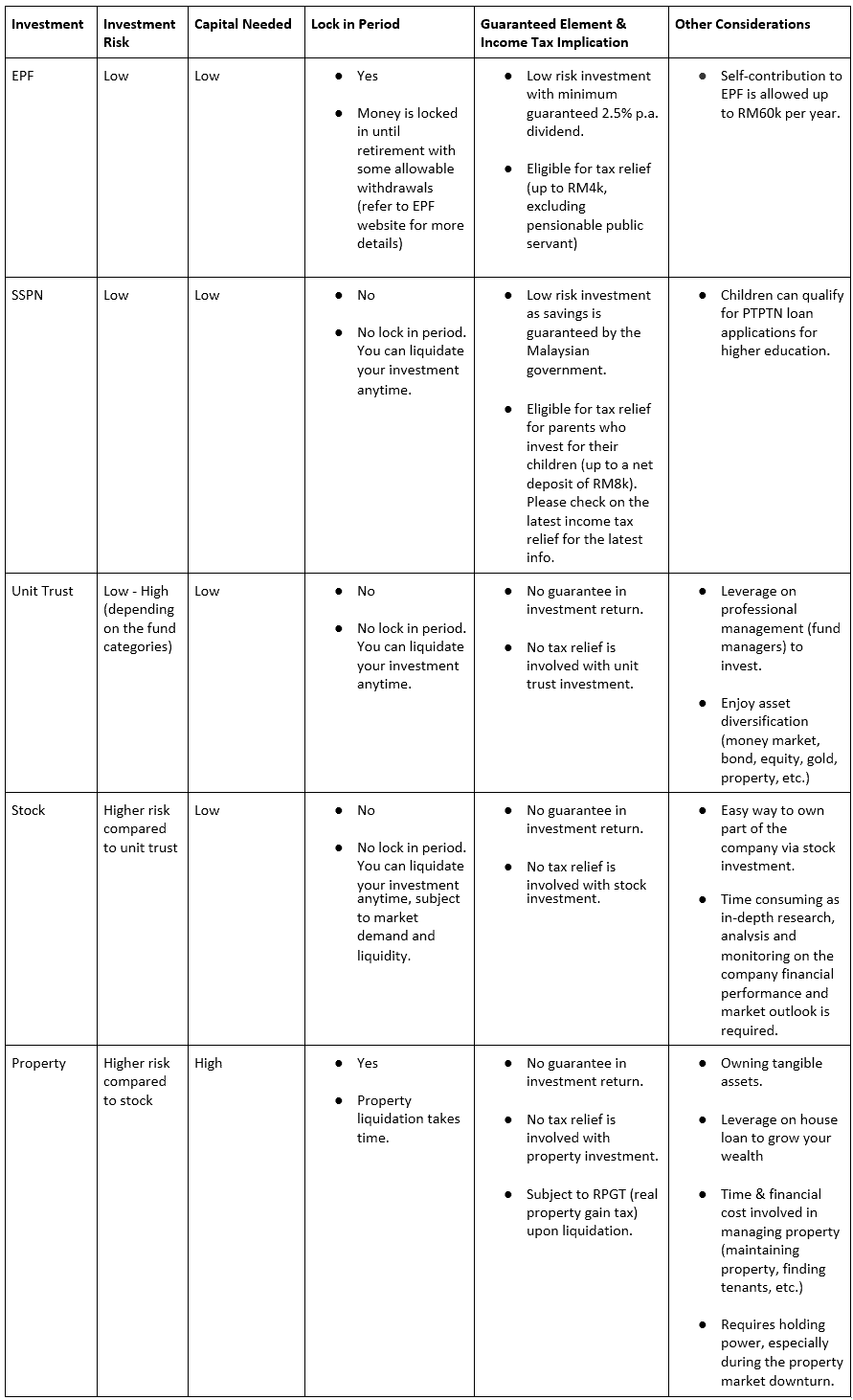
    There’s a multitude of investments available, so here are five of the more common investment types for your reference:

    How to Choose the Right Investment Vehicle

    If you’re a business person (without EPF contributions) and concerned about payable tax, some of the investments that can be considered are EPF and SSPN. Both EPF and SSPN will help to reduce your payable tax.

    If you’re a person who doesn’t have time or enjoy doing stock research & analysis, perhaps you can look into unit trust investment that leverages on professional management to invest your hard earned money.

    In short, a suitable investment vehicle for you should be tailored to your financial situation as a whole. If you’re clueless about your investment planning, you may consider investing in a licensed financial planner. A licensed financial planner will be able to look at your whole financial landscape and advise on the right investment vehicles to help you to reach your financial goals.

    About the author

    Kuah Soo Yee is a Licensed Financial Planner (CFP) who is passionate about helping people make sound financial decisions and achieve their financial goals, and recently launched her own app. Her personalised strategies and advice have helped many to gain better clarity and take firm control of their financial future. She can be contacted at soo.yee@ipp.com.my

    Website
    LinkedIn
    Facebook
    Instagram