Category: Grow Your Wealth

  • Bob’s Dilemma: How To Convert Highly Illiquid Assets To More Liquid And Easily Realisable

    Bob’s Dilemma: How To Convert Highly Illiquid Assets To More Liquid And Easily Realisable

    The following story is based on an actual series of events, with some names and circumstances fictionalised. Any similarity to any person’s name, character, or history is coincidental and unintentional. It is about how to convert highly illiquid assets to more liquid and easily realisable.

    Bob and Leonard were the best of buddies. They did everything together in school and through university, including courting the same girl until she decided on Leonard, whereupon Bob graciously withdrew.

    After graduation, Bob worked as a lawyer while Leonard became an engineer. After several years, Bob made a name for himself in law practice, while Leonard decided to leave his job and strike out as an entrepreneur.

    With some inheritance capital and savings, Leonard bought a small but profitable boutique hotel in Kuala Lumpur. At the same time, he embarked on some small development projects building shophouses, small industrial lots and housing schemes in the Klang Valley.

    Five years later, he had the opportunity to purchase a piece of land to build a 200-room resort hotel in Penang, and as this needed a substantial amount of money, he approached Bob to help arrange to finance. Bob recognised the project’s viability and managed to help him secure financing, as well as personally putting up 40% of the capital required by Leonard.

    The hotel was completed and began making money consistently. The company that developed the hotel soon embarked on the construction of an adjoining tower of 150 apartment suites, which units were slowly released for sale.

    No dividends were paid as profits generated from the hotel were ploughed back into the company to finance the apartment tower. Sales of the units had been strong, reaching 70% until the pandemic hit.

    By this time, Bob was in his 50’s and thinking of retirement. During the pandemic, he started thinking a lot about succession. What if he passed on suddenly? How would his family access his assets?

    Read: How A Buy-Sell Agreement Can Help Business Partners In The Future

    Estate Planning Is Crucial: Learn How To Convert Highly Illiquid Assets To More Liquid

    He reached out to me and got an estate plan worked out for when he was not around – some assets to be distributed through his will while some substantial ones were put into a living trust to be distributed in stages to avoid overspending by the beneficiaries. We didn’t discuss yet on the topic of how to convert highly illiquid assets to more liquid.

    But what niggled him was the 40% stake he had in Leonard’s company. His family was unfamiliar with Leonard or his business. Bob realised that after his demise, the close relationship, trust and understanding between the two shareholders would be gone. Which was like saying the two shareholders would be strangers to each other.

    He was worried that his stake, which was now substantial in value, may become worthless after his death in that his family, as minority shareholders, would not be able to influence dividend pay-out, if any, and the company’s direction. And no one other than Leonard would buy a 40% stake at a fair price.

    He felt it would be difficult to impose on Leonard to buy his stake at a time when he needed to fund his business expansion. Hence he felt the need to convert highly illiquid assets to more liquid.

    Read: Money Caused Breakup Among Four Close Friends, That’s Why it Is Important To Plan For The Succession Of A Business

    Convert Highly Illiquid Assets To More Liquid And Easily Realisable

    He talked to me about his dilemma and wondered whether I had a solution. I inquired about the details of the company assets and realised that his solution lay on how to convert highly illiquid assets to more liquid.

    So, I suggested that he propose to Leonard to swap his shareholding with unsold units that Leonard held. He gave a bit of a stunned reaction and said: “I should have thought of that.” And we both worked out what we thought was a fair exchange ratio, using cost instead of profit element (avoiding the need to revalue the hotel and apartment suites).

    We then brought the idea to Leonard, who liked the idea of being free from pesky shareholders if Bob was no longer around, and at the same time, getting rid of unsold stocks. A buy-sell with a trust was set up with our trust company based on the transaction carried out according to the agreed exchange ratio upon Bob’s death or mental incapacity.

    As it turned out, the solution worked after Bob had multiple strokes last year and had to be taken care of by his family, using proceeds from the sale of the apartment suites. Sometimes, I think the best solution is the simplest one.

    In this case, it is about how to convert highly illiquid assets to more liquid and easily realisable.

    Read: Hard Facts About The Executor Of A Will In Malaysia

    About Rockwills International Group

    Rockwills International Group, now in its 28th year, pioneered professional will writing in 1995 and has since evolved into the leading estate planning specialist in the country. It is today the largest provider of solutions and support services in trusts, succession, management and distribution of wealth. It has shareholders’ funds exceeding RM50 million. It has done over 280,000 wills and 15,000 trusts and holds more than RM25 billion in assets under trust.
  • ESG Investing – How To Integrate It Into Your Investment Planning?

    According to the Global Investment Review 2020 report, at the start of 2020, ESG investing or ESG-themed investing had reached USD35.3 trillion in the five major markets, a 15% increase in the past two years (2018-2020) and a 55% increase in the past four years (2016-2020). It’s up from 33.4% in 2018 to 35.9% of all professionally managed assets across all regions.

    This trend is continuing to grow in most regions, with Canada experiencing a tremendous increase in absolute terms over the past two years (48% growth), followed by the United States (42% growth), Japan (34% growth), and Australasia (25% growth) from 2018 to 2020.

    So, what is ESG investing? Let’s look at the facts.

    Read: All You Need To Know About ESG And ESG Benefits

    ESG Investing For Sustainable Investment

    ESG is an acronym that stands for Environmental, Social, and Governance Investing. In addition to evaluating an investment’s financial metrics, the ESG investing approach involves a need to weigh up the corporation’s or fund’s policies related to:

    • Environmental matters (climate change and pollution, for example)
    • Social issues (such as diversity and ethics)
    • Governance (style of leadership and transparency)

    Why Are People Attracted to ESG Investing?

    Traditionally, most long-term investors felt they had to choose between their values and making money. To fulfil this intention, they will hold a massive and diversified portfolio that likely ended up with companies that paid well but did not do much good for the planet or society in their business practices.

    However, the Schroders Global Investment Study 2020 reported that almost half (47%) of people around the globe are attracted to sustainable investments because of their broad environmental impact. Another 42% believe sustainable funds are appealing because they are likely to provide higher returns.

    The data shows that investors no longer have to choose between two options because ESG-based sustainable investing is good for both goals, making it a very good choice.

    Local ESG Investing Growth Trends

    Where do Malaysians stand when it comes to adopting ESG investing?

    The Securities Commission Malaysia (SC) developed a 10-year strategy blueprint (2010-2020) involving ESG investing. Since 2014, SC has introduced several initiatives, including developing the Sustainable and Responsible Investment (SRI) Sukuk Framework.

    Read: Driving The Development Of ESG With Sukuk

    In December 2014, Bursa Malaysia launched the FTSE4Good Bursa Malaysia (F4GBM) Index for the Malaysian market to provide more visibility and profiling of ESG-compliant companies that meet various ESG inclusion criteria and are eligible to be included.

    The standard is consistent with the global ESG model that FTSE developed, with strong references to the Global Reporting Initiative and Carbon Disclosure Project. As of 30 September 2019, there are 71 constituents of the Index, with a market capitalization of RM510.4 billion. As of June 2022, the total number of constituents is 87.

    On the other hand, the FTSE4Good Bursa Malaysia Shariah (F4GBMS) Index was launched in July 2021 with 54 constituents to cater to investor demand for ESG and Shariah-compliant index solutions. The purpose is to track constituents in the F4GBM Index that are Shariah-compliant. For the most recent review period, June 2022, nine new companies were added to the F4GBMS Index. This brought the total number of companies in the index to 65.

    Both indices are reviewed semi-annually in June and December against international benchmarks.

    Read: The Islamic Sustainability Approach In ESG

    The Reality Of ESG Investing

    From the perspective of industry players, the challenges arising in developing ESG investments locally are due to a limited investment universe and a lack of quality ESG reporting standards. These limitations are reflected in the types of ESG-themed funds available in Malaysia.

    With the limited local investment universe, the fund houses need to construct a portfolio that consists of global securities for diversification purposes. The aim is to deliver the most value to their investors with higher potential returns and manage downside risks.

    In addition to not having good reporting standards, fund houses need to spend more money to make sure the information they report is correct. Some might rely on information from ESG rating agencies, while others use third-party screening tools.

    Read: ESG Investing And The 3 Steps To Build An ESG Portfolio

    ESG Investing With A Licensed Financial Planner

    Fear of missing out (FOMO) in investing is the desire to stay continually connected with what others are doing. Often, one succumbs to “recency bias” and makes a rushed decision based on recent investment performance.

    How do you combat this and align your investment portfolio with your values? Let’s look at how financial planners can help in this situation.

    •  Discover client’s ESG values

    Usually, financial planners will seek to learn about their client’s unique set of financial goals and risk tolerance first. But ESG values can be very personal, and they can differ from one person to the next. One client may prioritise environmental issues, while another values diversity.

    Financial planners must first understand how clients might want to see them executed in the investments they pursue. Then, personalize their portfolio to mirror the client’s values.

    •  Deploy a negative screening approach

    Once financial planners are on the same page with their clients, they can start putting clients’ values into practice. They will identify companies that don’t align with clients’ values and remove them from clients’ portfolios.

    A straightforward approach is to identify the right ESG funds for their clients. A fund will reduce the need to analyze individual stocks and spread out risk by holding a large basket of equities.

    • Review and reporting

    Greenwashing is one of the risks associated with ESG investing. It is a strategy to market a company as sustainable or green when it isn’t.

    To manage the risk, financial planners will use the right ESG data and tools to monitor and report ongoing changes to the ESG scores of the companies or funds. By working hand in hand with a professional Licensed Financial Planner, you will have clarity on the placement of ESG in your investment portfolio.

    Have you incorporated ESG investing?

    About the Author

    Zulkhairi Zulkifli (CFP) is a Licensed Financial Planner With Expanded Scope. His expertise is in holistic financial planning and advising on equities, debentures, or warrants listed on Bursa Securities. Zulkhairi truly believes that a simple and personalized investment plan is vital to growing your financial assets. He can be contacted at zulkhairi@wealthvantage.com.my

  • 5 Tips To Help You Set And Achieve Your Financial Goals

    5 Tips To Help You Set And Achieve Your Financial Goals

    Have you ever set goals for yourself but failed to meet them? It may be to start exercising, investing, spending more time with your family members or loved ones, or whatever goals you may have.

    You set goals at the start of the year but did not follow through in the following weeks or months. You only realize your goals as year-end approaches.

    A study by Martin Oscarsson published online in 2020 on large-scale experience with New Year’s Resolutions found that 55% of the respondents successfully sustained their resolutions at a 1-year follow-up.

    Therefore, it is possible to follow through on your goals by following these five tips to help you set and attain your financial goals.

    Read: Six Golden Rules In Getting Favorable Returns And Growth, When Investing In Unit Trusts

    1. Clarity

    Do you have a clear and specific goal for how much you want to achieve in financial goals?

    It can be measured by savings amount, net cash flow or how much net worth or how much investment portfolio, how many like properties or how much reduction of debt or how much sum insured you would like to have at a certain time frame.

    Clarity is power; having that clear focus on what you want helps give you that clear direction.

    When you use your GPS, whether you are using Waze or Google Maps, the first step is to key in your destination. In your financial planning, you need to know what clear financial goals you want to achieve.

    Read: Should I Take Out My EPF To Settle My Housing Loan?

    2. Compelling Reason

    After you know what you want, the next thing is to know why you want those financial goals.

    “ Reasons come first. Answers come second.”

    – Jim Rohn

    Why do you need to achieve that goal? For what purpose? Is it for yourself or for others?

    Having that compelling reason will pull you toward the goals that you set. You may face certain challenges/obstacles, but your stronger reasons will pull you back to the right track.

    For example, by achieving that financial freedom, what would this allow you to do? Is it to live a comfortable lifestyle for yourself and your family? Is it to travel worldwide and create memories with your loved ones? Is it to start a charitable organisation?

    Read: Where To Invest In 2023: Amidst The Recession And General Election

    3. Consistency

    Consistency is key to ensuring that you are getting closer to your goals. Don’t undervalue the small steps you take every day.

    For example, by saving RM3 per day for 365 days, you will save around RM1,100 over one year. What if you put it in an investment vehicle that grows at a certain percentage?

    For example, someone saving RM500 per month over 35 years with the assumption of an 8% compounded annual return will have over RM1.1 million at the end of that period.

    Read: 5 Easy Steps to Achieving Financial Merdeka

    4. Accountability

    Do you have someone accountable to you who helps you track and guide you in achieving your financial journey, be it your financial planner or someone competent enough to advise you on your personal finances?

    It is like having a mentor or a coach who can advise you on the rights and wrongs.

    Read: 5 Investment Tips For Beginners That You Should Know

    5. Review and Measure

    It is always good to measure periodically; it may be quarterly, half-yearly, or yearly, depending on the duration of those financial goals that you set. Knowing the actual results will allow you to make necessary adjustments to try out different methods to save or reduce unnecessary expenses that contribute to your overall financial goals.

    Once you have your financial goals, the most important step is to take action either to create that investment account opening or schedule that appointment with your financial planner or what would the next things you can do.

    Read: Saving vs Investing, Should I Save Or Invest?

    5 Tips To Help You Set And Achieve Your Financial Goals

    Every new year comes with optimism and new year resolutions. I hope that these tips will be able to help you set and achieve your financial goals.

    About the Author

    Goh Chee Yong is a Licensed Financial Planner under Capital Markets Services Representative License (CMSRL) and Bank Negara approved Financial Advisor Representative (FAR). Prior to becoming a financial advisor, he spent eight years working in Big 4 audit firms and multinational corporations. He is also invited to speak on financial literature at universities and public events. He can be contacted at cygoh@imaxfinancial.com.my

  • How Drawdown Strategy Can Help Your Retirement Planning

    How Drawdown Strategy Can Help Your Retirement Planning

    Retirement. The “R” word that many would prefer to delay thinking about until it’s inevitable. I recently had the opportunity to discuss the meaning
    of retirement planning success with a client. Much of the thought process that she had undergone prior to our discussion was focused on the accumulation phase – making sure that there’s enough saved in the retirement nest egg.

    Want to know more about the drawdown strategy? OK, let’s go.

    But as one inches closer to the finishing line, the focus will need to shift towards the more interesting, albeit daunting, task of ensuring that whatever has been accumulated is sufficient to last the rest of our ever-increasing post retirement years.

    Looking at the environment that we’re facing today, where the cost of living seems to be escalating to worrying levels, one can’t help but to check and recheck their financial numbers before the income tap is finally switched off with retirement.

    If we want to increase the chances of our retirement planning success, a well thought-through drawdown strategy should be considered, at least 2-3 years before D-Day comes along. Here are some thoughts to get you going.

    Know Your Retirement Resources

    Before we’re able to effectively plan our retirement drawdown strategy, we will first need to be clear on what assets we have that can be earmarked for this purpose. As such, an asset listing and tagging exercise is the first step.

    Common assets that have been squirrelled away over many working years for retirement would include savings and investments in one’s Employee Provident Fund (EPF) account, bank deposits, properties, stocks, Amanah Saham, unit trust funds, endowment insurance policies and the like. A growing number of people are also investing in alternative assets like cryptocurrencies, private equity and peer-to-peer lending too.

    Having a complete listing of available assets and tagging them by financial goals will help us better understand the likelihood of achieving those desired objectives. Otherwise, there’s a chance that we might end up achieving certain goals at the expense of others.

    Read: Retirement Planning, Why It Is Important From An Islamic Point Of View

    Know Your Retirement Expenses

    To ensure what we have is enough to cover our expenses in retirement, we will fi rst need to know how much we incur today. If you haven’t already worked out your current expenses, this will be a good time to do so. In retirement, certain expenses will go up while others will decrease.

    You might spend less on work related travel or attire, but you might spend more on health supplements, holidays and social activities. If you find working this out a daunting task, then a simple rule of thumb is to budget 70% of your current expenses in retirement.

    Read: How a Trust Can Help You in Times of Need During Retirement

    Financial Goals In Retirement

    Retirement Planning

    It’s not all downhill upon retirement, especially for those among us who aspire to retire early. We may have a bucket list of places to go and things to do with all the time that we will have in retirement.

    Do you wish travel extensively or take up new hobbies? Do you have some long overdue home renovations or even a plan to relocate to a smaller home?

    Some of us might like to make some provisions to partially assist with the tertiary education funding for our grandchildren or help with some
    charitable causes. Add these goals to your list and put a fi nancial number and expected timeline to them.

    Read: Retirement Is No Joke, Here’s Why We Need Private Retirement Scheme

    Consider Potential Curve Balls

    Image by jcomp on Freepik

    A major concern for retirees is unexpected expenses. Some of these can be planned (with funding set aside accordingly), while others might need to be considered more carefully and risk mitigation steps may need to be put in place.

    Top of mind for most retirees would be medical funding, especially on the backdrop of the continuously high medical cost inflation these days. Do you have a comprehensive medical card in place with the appropriate daily room and board, annual and lifetime limits?

    If this is no longer an option (due to high premium cost or pre-existing medical conditions), you may need to be realistic and rely on government healthcare services as your primary medical provider.

    Another factor that is of concern to retirees is inflation. It’s unfortunate that inflation is rearing its ugly head the world over nowadays. Hence, the cost of living for retirees is going up quite drastically. As such, some adjustments to your retirement living expenses might be required to minimise this impact on your lifestyle where possible.

    Read: Debt-Free vs Retirement Savings: Which to Prioritise?

    Create Your Financial Buffer

    Once retired, you will need a buffer to ensure that the ups and downs associated with investments will not affect your lifestyle or ability to meet other short-term goals.

    Commonly termed as the cash reserve, these are funds set aside in stable assets such as bank deposits, capital protected accounts or short-term
    money market instruments. Ideally one should have between 2-3 years of annual expenses and the cost of any financial goals due during this period as cash reserves.

    Investing In Retirement

    Now that you’ve considered your financial goals, funding needs and potential risks, how do you continue to make the most of the assets you’ve
    accumulated to help you achieve your desired retirement?

    During retirement, most people tend to focus on income generated by the assets held. For example, an investment property can provide rental income while EPF savings will provide annual dividends. Similarly, stocks may be able to pay good dividends and bank fixed deposits will provide an interest income over the placement period.

    While income generation is important, it’s equally important to allow your investable assets the opportunity for capital growth to keep pace with inflation as well.

    Otherwise, you might end up relying heavily on the drawdown strategy of capital if income generated is insufficient. An accelerated drawdown strategy of principal, especially in your early retirement years, will have a long-term negative impact on your funding sustainability.

    When investing for retirement, you should continue to have a combination of different asset classes to help you ride out the different investment market cycles. Although it’s not the intention of this article to discuss safe withdrawal rates, it’s worth mentioning that commonly used assumptions include the 4% rule – ie one should invest equally in equities and bonds and can withdraw 4% of your investable amount yearly while adjusting for inflation.

    Do take note that these assumptions are US centric and might need to be adjusted to the local environment. As investment returns fluctuate, it’s worth to consider the retirement bucket approach to investing. In simple terms, you can think of investing in three buckets.

    Read: 5 Best Thing To Do When Your Retirement Funds Are Insufficient

    Drawdown Strategy: It’s About These 3 Buckets

    Bucket One in the drawdown strategy represents your cash reserves for the immediate 2-3 years of living expenses and funding of any short-term financial goals. Funds here are placed in safer assets with minimal price fluctuations.

    Bucket Two in the drawdown strategy will comprise of assets that can be held longer to cover the next 7-10 years of expenses, while generating income and capital growth that can be used to replenish Bucket One as you go along. Investments here would include EPF, stocks and high yield bonds, among others.

    Lastly, Bucket Three in the drawdown strategy comprises of long-term assets that can be held beyond 10 years and have good capital growth potential (think property assets, alternative assets and your own business). Income and capital growth from Bucket Three can then be utilised to replenish Bucket Two in the same way that Bucket Two replenishes Bucket One. In conclusion, most of us will spend anywhere between 20-30 years in retirement.

    As such, planning for this long journey should be given more attention. The sooner you start the process, the more time you have to make the necessary adjustments for the transition to be as smooth as possible.

    Remember that retirement is not a checkpoint but rather a lifestyle. As such, consider having something to retire into, rather than to retire from. That’s why it is important to plan for your retirement, and to know how the drawdown strategy is able to help you.

    Read: The Future of Retirement?

    About the Author

    Felix Neoh CFP CERT TM is Director of Financial Planning at Finwealth Management Sdn Bhd and can be contacted at felixneoh@finwealth.com.my

    We at Smart Investor and Finwealth is committed to help you better manage your financials. Get a free consultation from an expert by filling in your details here: https://www.smartinvestor.com.my/SIxFinwealth

  • Getting To Know Private Retirement Schemes (PRS)

    Getting To Know Private Retirement Schemes (PRS)

    For most people, the goal is to be able to retire comfortably. However, the effects of the Covid-19 pandemic have made achieving this goal a lot more challenging. But have you heard about Private Retirement Schemes?

    Various economists have warned that a retirement crisis is on the horizon. To insulate ourselves from this retirement crisis, the best time to act is now. The earlier you start saving for your retirement, or even growing your wealth again after it has taken a hit, the better.

    This time, we would like to explore a wealth-building option known as a “Private Retirement Scheme”, or more commonly known as “PRS”. This investment solution is offered and managed by PRS Providers and is governed by the Securities Commission Malaysia.

    As the name indicates, a PRS is a voluntary long-term investment scheme that is designed to help you save more for your retirement. First introduced in 2012, it is meant to help encourage people to contribute to their retirement savings.

    Investments in PRS are structured in the following manner: contributions are divided into two sub-accounts, and you can only make withdrawals once you reach retirement age. You are permitted to make partial withdrawals before then, but you will incur a penalty fee (there are exceptions, such as emigration).

    Contributions to PRS are entirely voluntary. It seeks to enhance choices available for all Malaysians, whether employed or self-employed, to supplement their retirement savings under a well-structured and regulated environment. Each PRS offers a wide range of retirement funds from which you may choose to invest in based on your retirement needs, goals and risk appetite.

    Why Invest In Private Retirement Schemes?

    Investing in PRS may be one of the best things you can do for your retirement. Here’s why:

    Designed for retirement

    As a scheme originally established to help investors accumulate more savings for their retirement, you can be assured that there is a selection of investment options to suit your specific goals and needs.

    Easy investments

    Anyone can invest in a PRS. There is a wide choice of PRS Providers and self-selected funds, as well as default option funds that have been pre-selected based on investors’ age.

    Affordable savings

    The minimum contribution varies depending on your chosen PRS Provider. While the flexible nature of the investment scheme means that there is less pressure on you to commit to a certain amount, just remember that the more you ‘save’, the better your potential returns can be.

    Tax incentive

    At the moment, the benefits of investing in PRS are not only for the future. In the short term, you can also enjoy a yearly personal tax relief of up to RM3,000 from your taxable income, for as long as you contribute to a PRS (the tax relief is available up to 2025). The earnings generated from a PRS will also be tax exempted, so that is even more reason to contribute!

    Factors To Consider Before Investing In Private Retirement Schemes

    When making your PRS contribution, you need to consider various factors such as your age, personal and household income, risk tolerance, retirement objectives as well as the suitability of the different funds offered under the various schemes to meet your retirement needs.

    The following chart offers suggestions on what you should take into consideration prior to investing in PRS. While the rule of thumb is that your investment strategy should be based upon the time you have until retirement (i.e. long-term investment strategies should focus more on capital growth, while short-term investment strategies should focus on income generation), remember that everyone’s situation is different, and that you should always consult an expert should you have any questions.

    Read: Who Are Unit Trust Consultants?

    Among the key items to note:

    Objectives: Based on your intended goals, you can choose to invest with the intention of growing your capital, generating income, or a combination of both. The goals of each person are different. As such, it is important to decide which option you wish to take.

    Your life stage: Those who are nearing retirement age should focus on investments that can provide them with a sustainable income, while younger people should be looking towards investments that have a higher potential for growth.

    Your risk appetite: Investors who can handle greater risks tend to be those with a long-term view as they are more able to weather any market volatility. Those who value stability tend to be those already nearing retirement age and therefore, would benefit more from investments that would allow them to preserve their initial capital.

    Additionally, it is important to review your PRS portfolio regularly. As your life progresses, your circumstances change and so do your needs and objectives. Hence, do ensure that your PRS portfolio continues to match your risk appetite and investment objectives.

    Investment Risks Associated With Private Retirement Schemes

    Investing in PRS is not risk-free. You will be exposed to some general investment risks as well as specific risks when investing in PRS. Therefore, you must consider the different type of risks that may affect you and the fund.

    These risks are disclosed in the PRS’ Disclosure Document and Product Highlights Sheet (PHS).

    How Do I Invest In Private Retirement Schemes?

    Your journey to save more for your retirement with PRS begins with these four simple steps:

    1. Select your PRS Provider.

    2. Choose a suitable fund.

    3. Open your PRS account.

    4. Top up your funds regularly.

    The Final Word About Private Retirement Schemes

    Remember that with careful planning, a PRS can be a useful tool to help you in your wealth-building journey. By staying focused, disciplined and investing wisely, you can be assured of a comfortable nest egg once you reach your golden years.

    Read: Getting To Know Unit Trust Schemes

    This article is in collaboration with The Federation of Investment Managers Malaysia (FIMM), a self-regulatory organization (SRO) that regulates the marketing and distribution of Unit Trust Schemes (UTS) and Private Retirement Schemes (PRS).

    Visit www.fimm.com.my for more information on PRS, Unit Trusts, and UTS & PRS Consultants.

  • Retirement Is No Joke, Here’s Why We Need Private Retirement Scheme

    Retirement Is No Joke, Here’s Why We Need Private Retirement Scheme

    When we are young, saving for retirement might not seem urgent. It feels like something that we can focus on later, especially since there are other more pressing and immediate financial commitments. However, we want to emphasise the hard truth: Retirement Is No Joke! That’s why we have the Private Retirement Scheme to help us all out.

    Why Should You Save For Retirement?

    We Malaysians are expected to live until we reach 75 years old. However, we retire at 60 years old. That means, we can expect to live at least 15 more years without receiving regular salaries.

    Some of us may be fortunate enough to receive monthly pensions or be able to rely on our EPF savings. Nonetheless, research has shown that merely having pensions or EPF savings may not be enough.

    Some of us may have children who are working and earning salaries. Although they can provide for us, do we really want to burden them, especially if they have children of their own to care for?

    Growing Your Retirement Savings 

    We don’t just want to save our money. We want it to grow. The way to do that is by investing our savings. A viable option is to invest in Unit Trust Schemes (UTS) or Private Retirement Schemes (PRS).

    Investing in UTS and PRS is one of the simplest forms of investing. It doesn’t require large amounts of money, time, or expertise.

    All you need to do is approach a UTS/PRS Consultant or Distributor. They will assist you to invest your savings into a UTS/PRS fund that is suitable for you. That fund’s investment will then be managed by a licensed professional fund manager.

    Read: Getting To Know Unit Trust Schemes

    Saving For Retirement 

    A Long-Term Activity 

    Remember that life is a marathon, not a sprint. If your retirement is still some time away, it will give you a lot more time to prepare for it. This means that your retirement fund can grow substantially simply by you putting aside some money consistently and invest them over a long period of time.

    To maximise your savings, the key is to start early. Just like in a marathon, every now and then, you should keep track of your progress and ‘refresh’ yourself. As your salary increases, revisit your periodic contributions, and adjust accordingly.

    After retirement, most of us will not have a fixed salary anymore. However, expenses remain. As such, your target savings should be one which can sustain your desired future lifestyle.

    How much should you save?

    You can refer to a retirement calculator. All you have to do is key in the requested details. Then, the retirement calculator will calculate for you the amount of savings you will need as well as the projected savings you will have based on your current savings amount.

    From there, you can calculate the shortfall and determine how much you should be saving on a regular basis.

    Consistency Is Key

    Remember to pay yourself first! Most of the time, once people receive their salary, they will save whatever remains after paying their bills, taxes, loans, groceries, and other expenses. However, this practice can lead to inconsistent savings. It is best that you allocate a fixed amount for your retirement savings first, before spending on your other commitments.

    Likewise, do NOT take ‘savings holidays’ or defer your savings contributions. You must be consistent!

    It would be ideal if you can consider signing up for a regular savings plan when investing in a UTS/PRS. This plan will, on a regular basis, automatically deduct money from your bank account and channel them towards investing in UTS/PRS. Hence, you can ensure that you will be consistent in your savings.

    Name A Nominee For Your Private Retirement Scheme

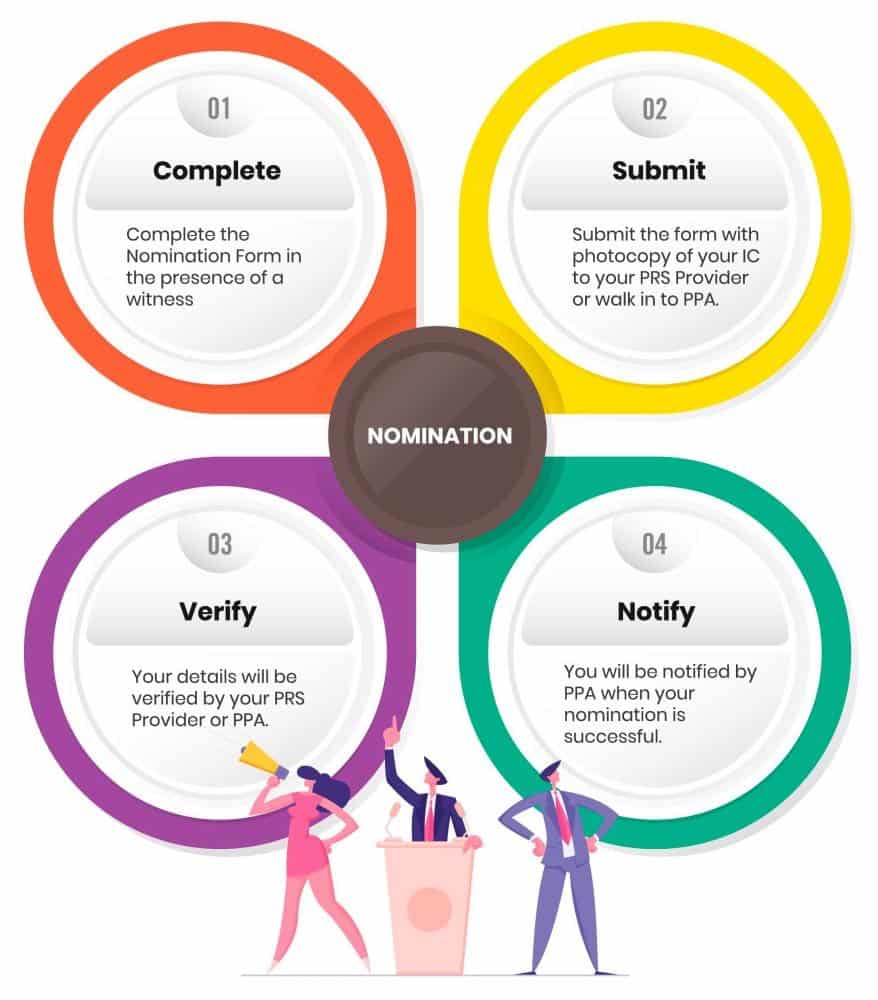
    Essentially, a nominee is the person who will inherit your savings/investments in the event something happens to you. Hence, it is essential that you elect a nominee.

    Even if you don’t name a nominee, your next-of-kin can still receive your monies from the Private Retirement Scheme. However, the process is a lot more difficult and expensive because he/she will need to prove his/her entitlement. By naming a nominee, the process is a lot easier and more cost effective.

    If you have not yet named a nominee, you can contact your authorised UTS/PRS Consultant and he/she will help you with the process of smoothening out the process of taking out the money from your Private Retirement Scheme.

    Read: Who Are Unit Trust Consultants?

    The Final Word

    Retirement is no joke! We want to enjoy our retirement comfortably and without any financial worries. As such, we must start saving for retirement early and doing so in a safe and disciplined way. Now you know why the Private Retirement Scheme is necessary to supplement your retirement funds.

    This article is in collaboration with The Federation of Investment Managers Malaysia (FIMM), a self-regulatory organization (SRO) that regulates the marketing and distribution of Unit Trust Schemes (UTS) and Private Retirement Schemes (PRS).

    Visit www.fimm.com.my for more information on PRS, Unit Trusts, and UTS & PRS Consultants.

  • 3 Ways To Increase Your Source Of Income

    3 Ways To Increase Your Source Of Income

    59.7 million results when I searched on Google on ‘multiple streams of income’ on the day this article in written. This is a massive result. With the recent pandemic, many sectors are impacted, and many individuals suffered as a result from loss of their major of source income.

    In this article, I am going to share with you some general big ideas on how to increase your source of income.

    1. Investment Portfolio

    Investment provides you with capital growth or income. Capital growth means the appreciation asset value or difference between the realization value and cost of investment. Income refers to the dividend, rental income or other incomes received by investing in the investment assets.  

    There are many investment options to increase your source of income these days. We have Exchange Traded Fund (ETF), Equity Crowdfunding (ECF) and Peer-to-Peer Lending (P2P) apart from traditional investment classes like property or stocks.

    With new innovative products, you don’t need huge investment to kickstart your investment journey. Some can start from as low as RM100 or you can have a diversify investment portfolio with traditional assets and new investment asset classes.

    Below are some of questions that you can use as guide to ask yourself as follows:

    • What are your financial goals?
    • What is your investment horizon? Is it for Income or Capital Growth?
    • Does the asset class suit my investment profile?
    • What is the amount that I can allocate to start with? Lumpsum or Regular Savings Plan?
    • Can I do it myself or do I need assistance from Licensed Financial Planner or other professionals?


    What is the purpose of building an investment portfolio? Different portfolios are to cater for different needs, for example cash/money market is to cater for emergency and or short-term needs.

    Whereas for medium-term goals could be for holiday, buying house, for marriage and or starting a new family. For the longer-term goals, it is for replacement of active income and or for retirement. That’s how you build up an investment portfolio as a way to increase your source of income.

    Read: 5 Investment Tips For Beginners That You Should Know

    2. Business Income

    There are several types of business income for you to consider like online food business, selling things at online platforms that can earn you additional income. Yes, many businesses are affected due to the pandemic, but you can still increase your source of income via a business income.

    There was 7.5% increase in new businesses being registered in Malaysia year 2020 as compared to prior year based on the information available from Company Commission of Malaysia. Due to many who had lost their jobs or income; therefore, many self-employed or small entrepreneurs have either started their own freelancing or contract services and some had started selling at online social media platforms like Facebook, Instagram and or TikTok.

    Gig economy which meaning temporary and flexible jobs have been on the rise and there are close to 4 million freelance workers in Malaysia.

    Read: Fall of Family Business Empire, Why Family Business Fail?

    3. Leverage On Your Existing Skills To Teach Or Share With Others

    If you have certain skills or experience that you are good at which you can use it, teach or share with other individuals, that will allow you to earn additional income. For example, if you good in singing or master certain language, therefore you can create a course to teach others how to sing virtually either in a group setting or individually, as a way to increase your source of income.

    It may include creating videos or posting photos with are beneficial to certain market segments may land you opportunity either to be involved as key opinion leaders or in the affiliate marketing. It may be teaching others how to cook food or bake a cake or maybe just a hobby of how to grow certain plants via the online platform.

    Read: 5 Different Types of Income

    3 Ways To Increase Your Source Of Income

    What if these additional sources of income allow you to provide yourself and family with better lifestyle and provide you security in the event of uncertainty, would you think that sacrifices that you make now by building your new sources income worth your effort?

    You are the only person is responsible to for your own future rather that relying on others. I would like to end it with a quote from Jeff Bezos, “I knew that if I failed, I wouldn’t regret that, but I knew the one thing I might regret.” Now that you know some of the ways to increase your source of income, which one do you prefer?

    About the Author

    Goh Chee Yong is a Licensed Financial Planner under Capital Markets Services Representative License (CMSRL) and Bank Negara approved Financial Advisor Representative (FAR). Prior to becoming a financial advisor, he spent eight years working in Big 4 audit firms and multinational corporations. He can be contacted at cygoh@imaxfinancial.com.my

  • Saving vs Investing, Should I Save Or Invest?

    Saving vs Investing, Should I Save Or Invest?

    This is one of the most heated debate in the financial industry, saving vs investing. Before we get into it, let’s first take a look at the definition of saving and investing.

    “Saving is income not spent, or deferred consumption. Methods of saving include putting money aside in, for example, a deposit account, a pension account, an investment fund, or as cash. Saving also involves reducing expenditures, such as recurring costs.”

    -Wikipedia

    Saving is your income, either from your monthly salary or sales commission, being put aside somewhere. This could be in your savings account or cash.

    “Investment is the dedication of an asset to attain an increase in value over a period of time. Investment requires a sacrifice of some present asset, such as time, money, or effort.”

    -Wikipedia

    Whereas investing is putting in your money in an instrument where you can watch it grow. The longer you invest, the bigger returns from your investment.

    Saving vs Investing

    As you can see from the above, you won’t be able to invest if you don’t have money in the first place. Which also means that if you don’t have any savings, then you can’t invest.

    And did you know that according to statistics, 75% of Malaysians can’t even come out with RM1,000 for any emergency? The culture of saving is sorely missing in our community.

    In case anything untoward happens such as meeting with an accident, car repairs, or dengue fever which requires hospitalization, then you may have to resort to borrowing money from family members or friends. Worse if there’s no one to help, then you turn to ‘ah long’ and be trapped in a vicious cycle.

    So in the case of saving vs investing, make sure you have sufficient savings first.

    RM5.2 Billion Lost To Scammers

    According to the Inspector-General of Police, Tan Sri Acryl Sani Abdullah Sani, there were 71,833 fraud cases recorded since 2020 until May 2022, with a loss amounting to RM5.2 billion.

    Hang on a minute, but didn’t you say that Malaysians don’t save but they have tons of money to invest, and ultimately gets scammed in the process?

    It goes to show how poor we are in managing our finances. We don’t have savings, and we invest in investment that is not legitimate or scams. When we lose it all to scammers, then we don’t have anything to fall back on – because we don’t have any savings.

    Of course everyone wants the fastest way to getting rich, myself included. But bear in mind that investment should be a long-term game. For example you want to build up your retirement fund, and you have 30 years until you hit the retirement age of 60. That means you have time on your side, and still can afford to make mistakes.

    Compared with someone in his 50’s and have less than 10 years to retire, he/she needs to invest for a shorter time period and take lesser risk.

    So again, get your priorities right when it comes to saving vs investing.

    Save Before Invest

    That’s why you need to get your priorities right. Save at least 3-6 months of your monthly salary. If your salary is RM5,000 per month, have at least RM15,000 in an emergency fund for rainy days ahead. Best if you can have RM30,000, to better prepare for any emergencies.

    If there’s anything that the pandemic has shown us, is that no plan can prepare us for something of that magnitude. Even if you have done the necessary preparation, you should still feel the effects of it.

    Let alone those who didn’t have any savings. Thankfully the government came out with many schemes to help us out.

    Now you know what to do when faced with the dilemma of saving vs investing?

    Invest In A Diversified Portfolio

    I’m sure we all have heard of the phrase, “High risk high return”. Which literally means that in order to get a high return, you need to take a high risk.

    And I’m also pretty sure that you have heard of “Don’t put all your eggs in one basket”.

    Combine the two of them, and you should be investing in a diversified portfolio – some in low-risk instruments (with low returns) such as fixed deposits or money market funds, some in medium-risk instruments (with medium returns) such as unit trust or property, and some in high-risk instruments (with high returns) such as stocks and crypto.

    By having a diversified portfolio, should any ‘basket’ were to fall and break all the eggs inside it, you will still have other basket of eggs that can compensate for your loss.

    But in the case of saving vs investing – make sure you have some savings first before deciding to invest.

    What About The Upcoming Recession Next Year?

    In a recent survey on saving vs investing that was carried out by Palindrome Communications, 40 percent of respondents said that they thought that investing is more important in a recession than holding on to cash. 60 percent of the respondents said that holding on to cash is more important than investing.

    The data displayed a cautious sentiment among professionals in Malaysia as we head into what might possibly be an upcoming recession. Respondents were made up completely of professionals in the fintech and tech sectors.

    Palindrome helps finance companies communicate more effectively in the market. More info here.

  • Good Debt VS Bad Debt?

    Good Debt VS Bad Debt?

    Debt, in essence, is all about borrowing money from a third party, and having the means to pay it back. Debt is not always bad news; it really depends on the kind of debt you currently have and your ability to pay it back. Let’s take a closer look at ‘good debt vs bad debt’.

    Therefore, let’s start off with a self-assessment on debt. Referring to Table 1, kindly answer the statements with a “yes” or “no”. The more “no” in your replies, the higher your stress level in debt management.

    1My monthly loan servicing ratio over my monthly income is about 38% or below.
    2I am only investing my free money and never borrow to invest.
    3I have consistently (monthly) and/or fully paid my credit card debts.
    4I keep a track of my total debts annually and it is decreasing over the years.
    5I know the difference between good and bad debt, and only utilise the good debt to acquire appreciating assets like property.
    6I pay all my household bills on time.
    7I am current on all my debt payments.
    8I know who to look for help if any of my family members r I are in deep debt.
    9I know the risks of becoming a guarantor, co-loan owner and supplementary credit card owner.
    10I know the interest rate of each loan that I borrowed, and how the interest is charged on the loan amount.
    11I know how to restructure my debt wisely if needed, and clear the loan with the highest interest rate first.
    Table 1: Self-Assessment

    Good Devt VS Bad Debt?

    Did you know that debts can be categorised as “good” or “bad”? Good debts refer to the ones with low-interest rates (below 8%), and your borrowing is used to purchase appreciating assets such as residential or commercial properties, or investing in a business.

    A study on Malaysian property valuation between 1991 and 2014 showed that the compound annual growth rate (CAGR) for overall property in Malaysia is around 5.97%。No doubt that property is an appreciating asset, still location is key for greater return.

    Bad debt, on the other hand, is akin to borrowing money to buy a car, which is a depreciating asset, although the loan interest rate is considerably not high (around 4-6%). Every year, the car value will drop at an average of 10%.

    From Table 2, it is crystal clear that we shouldn’t borrow if the interest rate is more than 8%.

    Debt TypeAverage Interest Rate (Annual)
    Illegal Shark Loan60%
    Credit Card15-18%
    Personal Loan10-12% (Promotional 8.88%-9.99%)
    Education Loan8-10%
    House Loan4.5-6.5%
    Car Loan4-6%
    PTPTN1% (3% is the old rate)
    Table 2: Types of Debt and Average Interest Rate (Annually)

    Words Of Advice

    Healthy Debt Ratio – A key indicator on whether you have a healthy debt ratio is the Monthly Debt Servicing Over Monthly Income Ratio. It simply totals up your monthly debt repayment amount over your monthly income.

    This ratio should always be kept below 40% at all times, though a temporary spike is still acceptable. For those far below 40%, you have more room to gear on appreciating assets resulting in easier loan approvals.

    Never Borrow to Invest – The first rule of financial planning is not borrowing to invest, even in share margin investment, where the interest rate is low at about 4%.

    We should only invest free money. Don’t borrow money even from family members, relatives or friends to invest. Otherwise, it could cost you both money and relationship.

    Get the Longest Loan Period (if possible) – Forget affordability, will you apply for a 25-year loan (instalment: RM2,400) or 35-year loan (instalment: RM1,200) for a property purchase?

    Choosing 35 is a wiser strategy to deal with loan and cash flow. Even if you opt to pay RM2,400 (instead of RM1,200) monthly and consistently, the loan will end in 25 years.

    However, if you select the 25-year package, there is no way you can reduce your monthly repayment if you have cash flow problems in certain months.

    In the event you don’t pay consistently, banks will increase the interest rate causing the repayment amount to rise, lesser free cash in hand, and a whole lot more stress!

    If non-repayment continues for two months or more, you will be seen as failing to service your home loan, and worse, the bank might even auction your house. Therefore, why risk your financial position with a shorter period of loan which offers lesser flexibility?

    The longer the tenure of your home loan, you would have more cash in hand to actively invest into an investment instrument that can give you an annual return of more than 6%. This is smart financial planning.

    About the Author

    This article is written by Yong Chu Eu. He is the Founder, Principal, MFPC Shariah RFP, CPD/CPE, HRDF Certified Corporate Trainer of Money & Life, Financial Book Author, Licensed Financial Planner, E2E Financial Literacy Principal Coach & Local Media Guest.

  • The 4 Stages Of Side Hustle For A Bigger Investment Capital

    The 4 Stages Of Side Hustle For A Bigger Investment Capital

    We are living in one of the most volatile period over the past few decades, where it feels like a series of black swan events arises back to back (to back). However, as investors, we know that in every crisis lies great opportunities. Some of us will try to time the market, and rest of us will DCA (Dollar Cost Average). All of us wants to invest when the market is low and reap theHus profit when the market recovers.

    In times where price of goods are high and employment income stays relatively stagnant, how do we allocate more capital into our investment portfolio? In this article, we will explore the best ways to start a side hustle to complement your investment capital and how to make it successful.

    What Is A Side Hustle?

    Side hustle is simply a second income that you can generate to help you to be financially free. A side hustle is any type of business that you can run while you are working on a full time job. Side hustles can be a small business that you run from your house, or they can be a big business that you run from an office.

    You can start a side hustle with minimal initial investment. It can be anything from selling your own crafts, to selling products on marketplaces, to providing a service to paying clients.

    A side hustle is a great way to make some extra money, learn new skills, and network with interesting people. 

    Now let’s look at the 4 stages of side hustle.

    1. Choosing A Side Hustle (Ideation Stage)

    Thoughtful creative asian man in glasses thinking while making post on social media, looking away, pondering or making decision, holding smartphone, choosing something in internet.

    There’s no shortage of ideas for a side hustle. The challenge is finding one that’s a good fit for you and that you can be successful with.

    Here are a few tips for choosing a side hustle:

    • Start with something you’re interested in or that you’re good at
    • Find a need that isn’t being met and fulfilled
    • Think about what you can offer that others can’t
    • Start small and grow your business gradually

    2. Building An MVP (Creation Stage)

    Once you’ve chosen a side hustle, the next step is to get started. This is where the rubber meets the road.

    This is where you need to start thinking about your MVP. What is an MVP?

    An MVP is your minimum viable product. The idea is to build a simple product that can be tested and experience by potential customers. Even though your MVP is not a finished product, it is the first version of your product.

    The goal with an MVP is to test your idea, market, and product to see if they are viable. One of the most painful experiences is to invest your heart and soul into a product that no one cares about.

    3. Getting Customers (Acquisition Stage)

    Marketing Ideas Share Research Planning Concept

    This is where things get tricky. How do you get customers?

    Getting your first 10 paying customers can be difficult. Here are a few ways that you can experiment, but bear in mind that there is no one-size-fit-all solution. 

    • Find individuals and businesses that are in need and ask them to try your service or product,
    • Work with a local business and get them to try your service,
    • Post your service or product on marketplaces like Fiverr, Shopee or Lazada,
    • List your service or products on the social media,
    • Offering a part of your service or product for free to build trust and credibility.

    You may also consider building a community around your service or product.

    Your community will be made up of people who are interested in what you sell. As you build a community around your product, you will be able to recruit people interested in your product.

    4. Growing Your Side Income (Expansion Stage)

    This stage is optional. You may treat your side income as a real business that may one day replace your full-time job, or, it can also be a side project that let’s you earn a comfortable side income while doing something you love.

    However, should you want to grow your side income, you may want to strengthen your process within your business/company from end-to-end. You may no longer rely on your notebook and your memory to handle the increased number of transactions within your business.

    There are plenty of digital tools from book-keeping to human resources to customer relationship management software. You may also want to look at business automation software that can help you with your business.

    Having a proper process in place is important because it allows you to delegate your work systematically should you wish to hire employees to help you with your business. Having a clear process makes it easier for you to monitor your team’s performance and causes less confusions between you and your employee.

    Protecting Your Hard Work

    Last but not least, let’s not forget why do we want to start a side hustle – that is to increase our investment capital. Building multiple streams of income help hedge against the sudden change of events.

    However, when times are good, remember to invest for the future. You will never know when do you need to use it.

    To sum up, investing in a side hustle can be a great way to supplement your investment capital. In return, you can get a second income that will help you to be financially free.

    Source: PlanNERD.io

    About the Author

    marshall wong insurance

    Marshall Wong is a financial planner holding licenses from the Securities Commission Malaysia and Bank Negara Malaysia. He can be contacted via email at Marshall@plannerd.io