IPO (Initial Public Offering) has recently been the latest stock market trend. But what is an IPO? Before we look at the guide to apply for IPO in Malaysia, we must first understand what an IPO is.
IPO is the process of offering shares of a private corporation to the public by issuing new stocks for the first time.
In other words, it is when a privately owned company first sells its shares to the public. That is the reason why it is called an initial public offering.
Why Would A Private Company Go Public?
When companies decide to go for an IPO, the companies can raise equity capital to aid the company’s business growth.
Some other reasons are to pay off debts, raise their public profile, purchase new assets, and get funds for the company’s business operation.
As a smart investor, you would probably know how to differentiate between a good and bad IPO.
Always ask yourself, are you willing to invest your money into a company with growth potential or a lot of debt to settle?
For the past two years, most IPOs were listed at a premium price on the first day. Some of the IPOs even managed to hit more than 100%. Sounds interesting to you? If it interests you, I believe most investors also feel the same.
This created a trend in the local stock exchange where investors see IPO as a great opportunity. Do not worry if you never apply for any IPO out there. After reading this guide to apply for IPO in Malaysia, perhaps it will be the first time you apply for an IPO. Let’s get started.
This article will share two methods for applying for an IPO. First of all, do you have either Maybank2u or CIMB Clicks?
If not, you should register one now.
Guide To Apply For IPO In Malaysia Via Maybank2u
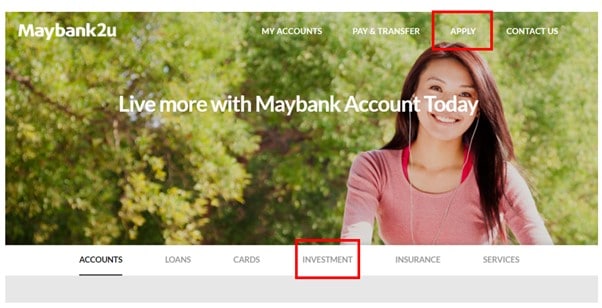
Log in to your Maybank2u account. Click on Apply and next click Investment.
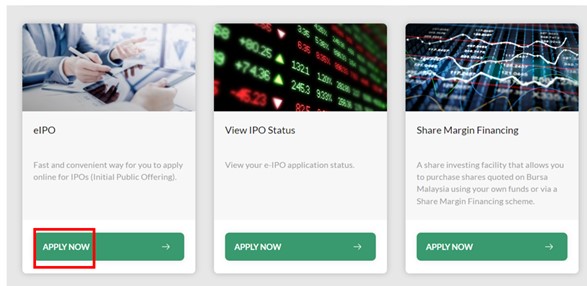
Scroll down until you see eIPO. Click Apply Now.
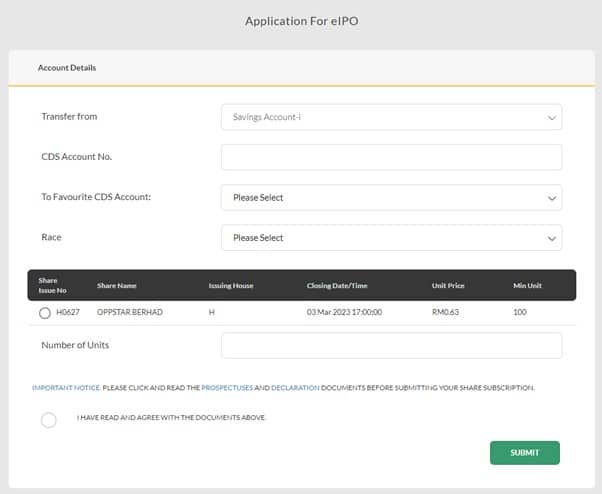
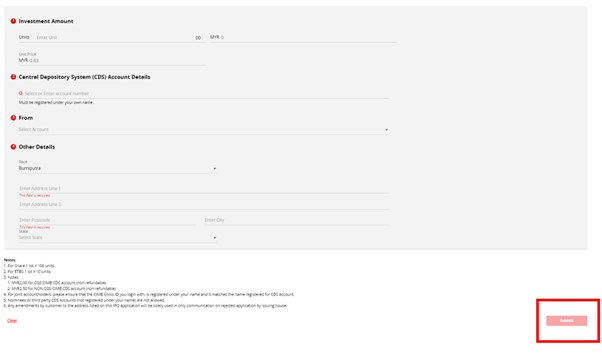
Select the IPO that you wish to apply for. Complete your application and click Submit. You will redirect to the payment gateway to perform payment for your application.
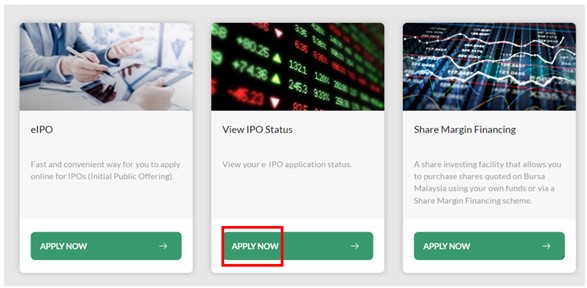
To view your e-IPO application status, go to View IPO Status.
Guide To Apply For IPO In Malaysia Via CIMB Clicks
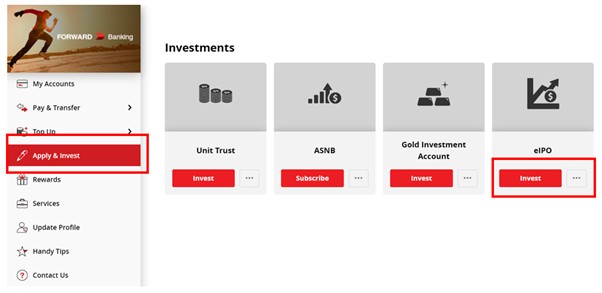
Log in to your CIMB Clicks. Click on Apply & Invest. Scroll down to eIPO and click Invest.
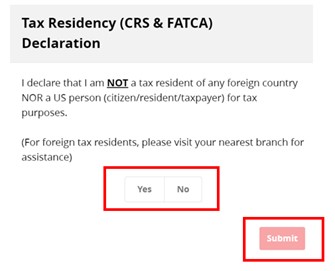
Declare that you are not a tax resident of any foreign country NOR a US person (citizen/resident/taxpayer) for tax purposes. Then, click Submit.
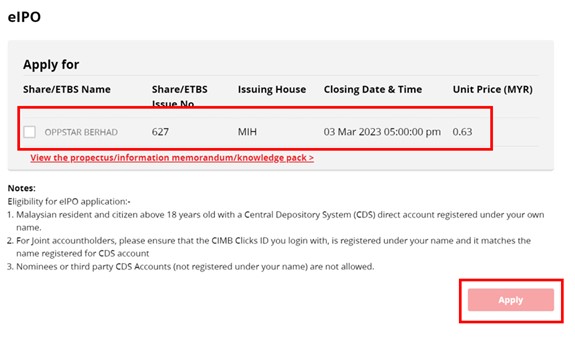
Select on the IPO that you wish to apply and click Apply.
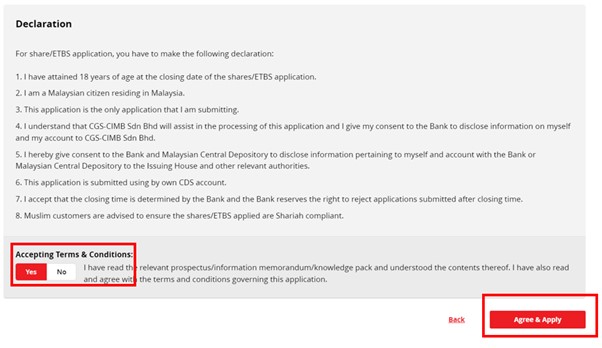
Click Yes if you accept the Terms & Conditions. Next, click Agree & Apply.
Complete the application and click Submit. You will be redirected to the payment gateway to perform payment for your application.
Apply Your IPO Now
So, now do you still think IPO is difficult? We have shared two methods above on the platforms that you can apply for an IPO which are Maybank2u and CIMB Clicks.
We hope you find the guide to apply for IPO in Malaysia useful. Wish you all the best in your IPO application!
Bursa Malaysia Berhad (“Bursa Malaysia” or the “Exchange”) held its 10th annual Bursa Excellence Awards 2022 ceremony on 20 March 2023, to honour outstanding performance of brokers and market intermediaries in the Malaysian capital market. Themed “Recognising Excellence, Celebrating Success”, a total of 54 accolades spanning 24 categories in the Securities, Derivatives and Islamic markets were awarded.
In 2022, the Exchange witnessed active trading of securities, at an Average Daily Trading Value (“ADV”) of RM2.1 billion. “Initial public offerings in 2022 were strong and vibrant,” said Tan Sri Abdul Wahid Omar, Chairman of Bursa Malaysia. “We welcomed 35 IPOs in 2022, the highest on the Exchange since 2007, which raised a total of RM3.5 billion and contributed RM11.15 billion to the overall market capitalisation of RM1.74 trillion.”
Winner of the Bursa Excellence Awards 2022 for “Best Overall Equities Participating Organisation” category. From R-L: Datuk Muhamad Umar Swift, CEO of Bursa Malaysia; Ng Meng Wah, Affin Hwang Investment Bank Berhad; Lee Kok Khee, Kenanga Investment Bank Berhad; Azizah Mohd Yatim, CGS-CIMB Securities Sdn Bhd; Tan Sri Abdul Wahid Omar, Chairman of Bursa Malaysia
“The derivatives market, on the other hand, recorded an all-time high in trading volume last year, achieving a record high of 19.1 million contracts traded in 2022, surpassing the previous high of 18.4 million contracts registered in 2021. Meanwhile, our Commodity Murabahah platform Bursa Suq Al-Sila performed similarly well in the Islamic Capital Market, with 22.3 percent higher ADV, up from RM37.3 billion in 2021 to RM45.6 billion in 2022,” he added.
Winner of the Bursa Excellence Awards 2022 for “Best Overall Derivatives Trading Participant” category. From R-L: Datuk Muhamad Umar Swift, CEO of Bursa Malaysia; Khairul Azim, Kenanga Futures Sdn Bhd; Nor Asma, TA Futures Sdn Bhd; Lam Choon Jin, Phillip Capital Sdn Bhd; Tan Sri Abdul Wahid Omar, Chairman of Bursa Malaysia
“Bursa Malaysia will continue to collaborate with all brokers and market intermediaries to strengthen our value proposition and attract more participation in the Exchange,” concluded Tan Sri Abdul Wahid Omar. “This will be achieved by facilitating innovations to revamp the investors’ trading experience, while driving market conversations with more targeted educational and marketing initiatives.”
Datuk Muhamad Umar Swift, Chief Executive Officer of Bursa Malaysia added, “Given the rising global competition, it is imperative that we maintain our endeavours to promote our market and its various investment options, catering to the diverse risk appetites of investors. Working closely with our broker partners is essential in producing our collective desired outcomes, and we will continue to do so to raise public awareness about investing and make our market dynamic and appealing to investors.”
Winner of the Bursa Excellence Awards 2022 for “Best Overall Bursa Malaysia-i Participating Organisation” category. From R-L: Datuk Muhamad Umar Swift, CEO of Bursa Malaysia; Dato’ Fad’l Mohamed, Maybank Investment Bank Berhad; Lim Chia Wei, Malacca Securities Sdn Bhd; Azizah Mohd Yatim, CGS-CIMB Securities Sdn Bhd; Tan Sri Abdul Wahid Omar, Chairman of Bursa Malaysia
The complete list of winners of the Bursa Excellence Awards 2022 is as follows:
About Bursa Malaysia
Bursa Malaysia is an exchange holding company incorporated in 1976 and listed in 2005, and has grown to be one of the largest bourses in ASEAN today. Bursa Malaysia operates and regulates a fully-integrated exchange offering a comprehensive range of exchange-related facilities, and is committed to Creating Opportunities, Growing Value. Learn more at www.bursamalaysia.com.
People who invest their wealth expect, on average, to retire 3 years earlier than non-investors, a survey by global market research firm YouGov commissioned by private market exchange ADDX has found. The retirement expectation gap is more pronounced in the case of investors with allocations to private market assets, who expect to retire 9 years earlier than non-investors. The survey covered both Europe and Asia[i].
According to the poll, the average expected retirement age is 62.1 among non-investors and 59.2 among investors. For those who invest in the private markets, the average expected retirement age is lower still, at 53.5.
In total, just 19% of people who do not invest expect to retire before the age of 60, compared to 31% of people who invest. For people who invest in private market assets[ii], this figure goes up to 47%.
Significant gender gap in investment behaviour
Globally, 29% of respondents do not invest. The gender gap is significant, with nearly 4 in 10 women (37%) saying they do not invest, compared with just 2 in 10 men (21%) who said the same.
The gender gap translates into a difference between the retirement expectations of men and women – with 76% of women expecting to retire after the age of 60, compared with 68% of men. The gender retirement age gap exists in both Europe and Asia. On average, women expect to retire at 61.1, compared to 59 for men.
The survey also found that men who invest tend to adopt a “do-it-yourself” style of investing, as compared to women. Some 81% of men said they invest entirely or mostly on their own, compared with 64% of women who said the same.
Women and men also value different sources of investment advice. Women tend to value investment advice from financial advisors and family members (51% and 39% respectively, versus 41% and 29% for men), while men are slightly more likely to value advice from online forums and social media (22% and 15% respectively, versus 19% and 12% for women).
By age group, the share of non-investors was also higher among Generation Z[iii] (32%), Baby Boomers[iv] (38%) and respondents from London (48%). By contrast, only 13% of respondents from Hong Kong are non-investors.
Regional findings: Asian investors look for safer options
Chart 1: How investors would allocate their investment across asset classes – each respondent selected 3 asset classes
The survey uncovered regional differences in investment instruments. Investors from Asia[v] expressed a preference for fixed deposits, with about 1 in 2 perceiving the asset class as a core component of their investment portfolio. Nearly half of respondents from Singapore (46%) and Hong Kong (47%) said they would choose fixed deposits as one of their top three investments.
Respondents from Hong Kong also leant heavily toward stocks, with 60% choosing that option as one of their top three investments.
In contrast, investors from Europe[vi] preferred a more balanced allocation across asset classes. For London investors, interest was consistent across fixed deposits (28% included this option in their top three investments), stocks (30%), bonds and fixed income (27%), as well as funds (21%).
Investors in Frankfurt were slightly more keen to take part in funds, with 40% of respondents indicating it as a top three investment choice. Another 24% of German respondents chose fixed deposits, 35% chose stocks, while 19% chose bonds and fixed income products.
Of the regions covered in the survey, Singapore respondents were the most future-oriented. Asked what they would do if they unexpectedly inherited US$100,000, 39% of Singapore respondents said would set aside 90% to 100% of the sum to invest, compared with 22% in Hong Kong, 33% in Frankfurt and 32% in London.
ADDX CEO Oi-Yee Choo said: “Not investing has serious consequences. It reduces your buying power and lifestyle options. In the long run, it might also mean you have little choice but to extend your working life in order to adequately fund your retirement. Women are less likely to invest than men, and that has a negative impact on their ability to retire earlier, should they want to. Early retirement is also topic of growing interest, especially among the younger generation[vii] – and increasingly, retirement is being defined as achieving financial freedom and independence, rather than just ‘stopping work’. The implications of this YouGov-ADDX survey are clear: young or old, women or men, every individual and household needs to think about channelling some of their savings into investments, so that they can secure their well-being in the long term.”
She added: “Almost a third of global respondents (29%) said they do not invest. That means we still have a way to go in our education efforts. We believe investing should be a level playing field, and eventually, investors should get full access to any and every asset class – including private market investments. By access, we don’t just mean the ability to subscribe to investments, but also the knowledge to understand how such assets can play a role in portfolio diversification and wealth creation.”
SURVEY METHODOLOGY
This survey has been conducted using an online interview administered to members of the YouGov PLC panel individuals from Singapore, United Kingdom (London), Hong Kong, and Germany (Frankfurt) who have agreed to take part in surveys. Emails are sent to panelists selected at random from the base sample. The email invites them to take part in a survey and provides a generic survey link. Once a panel member clicks on the link, they are sent to the survey that they are most required for, according to the sample definition and quotas. (The sample definition could be “Singapore adult population” or a subset such as “Singapore adult females”). Invitations to surveys do not expire and respondents can be sent to any available survey. The responding sample is weighted to the profile of the sample definition to provide a representative reporting sample. The profile is normally derived from census data or, if not available from the census, from industry accepted data.
YouGov PLC makes every effort to provide representative information. All results are based on a sample and are therefore subject to statistical errors normally associated with sample-based information.
For further information about the results of this survey, please contact YouGov PLC (+44)(0)207 012 6231 or email realtime@yougov.com quoting the survey details.
All figures, unless otherwise stated, are from YouGov PLC. The total sample size was 1019 adults, consisting of (SG): n=257, (UK – London): n=257, (HK): n=253, (DE – Frankfurt): n=252. Fieldwork was undertaken in Q4 2022, between 1-9 November 2022. The survey was carried out online.
ABOUT ADDX
ADDX is a global private market exchange headquartered in Singapore. Using blockchain and smart contract technology, ADDX reduces manual interventions in the issuance, custody and distribution of private market products. The resulting efficiency from the use of digital securities allows the platform to fractionalise investments in a scalable and commercially viable manner, reducing minimum investment sizes and thereby widening investor access to the private markets. To date, ADDX has listed more than 50 deals on its platform involving blue-chip names such as Hamilton Lane, Partners Group, Investcorp, Singtel, UOB, CGS-CIMB, as well as Temasek-owned entities Mapletree, Azalea, SeaTown and Fullerton Fund Management. Asset classes available on ADDX include private equity, hedge funds, venture capital, private credit, real estate, debt and structured products.
The full-service capital market platform has raised a total of US$140 million in funding since its inception in 2017, including US$50 million in its Series A round in January 2021 and US$58 million in the first tranche of its Pre-Series B round in May 2022. Its shareholders[viii] include Singapore Exchange (SGX), the Stock Exchange of Thailand (SET), Temasek subsidiary Heliconia Capital, the Development Bank of Japan (DBJ), UOB, Hamilton Lane, Tokai Tokyo Financial Holdings and Hanwha Asset Management.
ADDX currently serves individual accredited investors from 39 countries spanning Asia Pacific, Europe and the Americas (except the US). ADDX also serves wealth managers and corporate investors through its institutional service, ADDX Advantage. For more information, visit ADDX.co or www.linkedin.com/company/addxco.
[i] Individuals surveyed were from Singapore, United Kingdom (London), Hong Kong, and Germany (Frankfurt). For more information, see “Methodology” subsection.
[ii] Participants were asked what share of an unexpected inheritance of US$100,000 they would spend right away versus invest for the future, and, bearing in mind the sum to be invested for the future, how they would allocate their investments across asset classes. This finding refers to those who said they would allocate funds to private market investments.
[iii] Defined as those born between 1997 and 2009, inclusive of both years
[iv] Defined as those born between 1946 and 1964, inclusive of both years
Real estate investment trusts (REITs) are an increasingly popular investment vehicle that allows investors to invest in a diversified portfolio of real estate assets. REITs are structured as trusts, with the income generated from the underlying properties being passed on to the investors as dividends.
This article will look at 3 reasons why you need to invest in REITs in Malaysia. Investing in REITs can provide investors with a steady income stream and exposure to the real estate market without the need to purchase and manage real estate properties themselves.
Why You Need To Invest In REITs#1 Diversification Portfolio
One of the main advantages of investing in Malaysia’s REITs is that it provides investors with a diversified portfolio of real estate assets. REITs invest in various real estate properties, including office buildings, shopping malls, and residential properties. This provides investors with exposure to a range of different real estate markets and helps to reduce the risk of investing in a single property or asset class.
Why You Need To Invest In REITs#2 Stable And Predictable
Another advantage of investing in Malaysia’s REITs is that they offer a stable and predictable source of income. REITs must distribute at least 90% of their taxable income to their shareholders as dividends. This means investors can expect regular dividend payments from their REIT investments.
Additionally, because REITs are typically invested in income-producing properties, such as rental properties or commercial buildings, the income generated from these properties can provide a steady income stream for investors.
Why You Need To Invest In REITs#3 Cost-Efficient
Investing in Malaysia’s REITs is also a cost-effective way to invest in real estate. REITs are traded on stock exchanges, just like stocks, which makes them easy to buy and sell. Additionally, because REITs are passively managed, they typically have lower management fees than actively managed funds.
This means that investors can benefit from the expertise of real estate professionals without having to pay high fees.
Cityscape of Kuala lumpur city skyline at sunrise in Malaysia.
Malaysia’s growing and diverse real estate market provides investors various REIT options. Some of the REITs listed on Bursa Malaysia, Malaysia’s stock exchange, include:-
Sunway REIT, which owns a portfolio of properties including retail, office, hospitality and healthcare assets;
Axis REIT, which specializes in industrial and logistics properties; and
KLCC REIT, which owns properties such as the iconic Petronas Twin Towers.
Investing in Malaysia’s REITs also exposes investors to a fast-growing economy. Malaysia is one of the fastest-growing economies in Southeast Asia, with a GDP growth rate of 4.3% in 2019. The country has a well-developed infrastructure, a skilled workforce, and a growing middle class, which makes it an attractive destination for foreign investment.
In addition to exposing investors to diverse real estate assets, Malaysia’s REITs are also highly liquid. REITs are traded on stock exchanges, meaning they can be bought and sold quickly and easily. Additionally, because REITs are typically invested in income-producing properties, they are less volatile than other investments, such as individual stocks.
In conclusion, investing in Malaysia’s REITs can provide investors with a diversified portfolio of real estate assets, a stable source of income, and exposure to a fast-growing economy. REITs are also cost-effective, highly liquid, and easy to invest in. Now that you know why you need to invest in REITs, as with any other investment, it is important to conduct thorough research and seek professional advice before investing in Malaysia’s REITs or any other investment vehicle.
Morningstar recently announced the winners for the 2023 Morningstar Fund Awards – Malaysia. Of the five awards given out, KAF Investment Funds Berhad won two.
Morningstar Category Awards
Winner
Best Asia-Pacific Equity
KAF Jade Fund
Best Malaysia Large-Cap Equity Fund
KAF Core Income Fund
Congratulations to KAF Investment for winning the Best Asia-Pacific Equity award with KAF Jade Fund, and Best Malaysia Large-Cap Equity Fund with their KAF Core Income Fund.
Smart Investor had the opportunity to interview Chue Kwok Yan, Chief Executive Officer cum Chief Investment Officer, KAF Investment, to learn more about their winning funds.
Smart Investor: Congratulations on winning the Morningstar Award! Can you share with us what the recipe for your success is?
Chue Kwok Yan: This is a very difficult question indeed, as there are so many critical ingredients required to win such a coveted award that it is difficult to describe in such a short space. At the most basic level though, we believe that the building block is our people. We have successfully assembled a group of very talented individuals who share the same vision and work ethics that operate seamlessly in a close-knit team.
The huge diversity of background in our team is also by design where each member is able to contribute different viewpoints that is useful in navigating the drastically different investing circumstances over the past few years. Collectively, these allow us to formulate the right strategies for each unique circumstance.
SI: What are the strategies that you used in 2022? How was the fund positioned to mitigate risks and optimise opportunities?
CKY: Even after having managed money over the extreme market conditions of the past few years would not have prepared portfolio managers for 2022. The simultaneous fall in asset prices made our job very difficult especially for long-only funds. Previous approaches were untenable, and we had to start from a clean slate.
The breakthrough came when we accepted the correlation in asset prices on the downside. We mitigated risk by decisively cutting high valuation stocks to a minimum and hid in value stocks. This helped us weather the downshift for most of the year while we were able to take positions from a bottom-up stock selection basis towards the 2H of 2022 that fortunately worked well for us.
SI: 2022 was a bad year for most investments; how has this affected your investment strategies for both the short- and long-term?
CKY: It is not just the bad year for investments in 2022 but the series of extraordinary events over the past few years that has made a lasting impression on us. In a sense it solidifies our approach that focuses on our core competency. It taught us there is no ‘one size fits all’ hence the need to discard biases and remain adept in facing every circumstance that is different.
We will need to evaluate every situation by its merit and formulate suitable approaches and strategies in our investment decision making process.
SI: The recession is expected to hit us this year. What are your plans and strategies for 2023? Is there anything you plan to do differently?
CKY: Investment is a perennial process and hence 2023 is really a continuous window for making the most appropriate decision for maximizing returns while minimizing risks. In this sense, recession is just a blip in the investment journey requiring more focus on managing risk. We are fortunate that 2023 has started well for us with our funds posting relatively strong gains thus far.
Therefore, this gives us better flexibility in our strategies, allowing us to be more selective in our stock picks on higher conviction calls rather than constantly trying to catch up in performance by moving down the riskiness scale. We will dig deep into our core competency, as always, and focus on our competitive advantage in managing our esteemed clients’ money.
SI: With high inflation and interest rates, what’s your advice for retail investors?
CKY: The current episode of high inflationary pressure has laid bare a key shortfall in retirement planning and driven home the key message in pension weakness. Prior to this, each productive working individual is already facing inadequate pension due to longer life expectancy.
Compounding the effect is high inflation that erodes the real value of retirement funds with each Ringgit having lower purchasing power ability. In order to counter these effects, each working person would need to either work longer by retiring later or save more. Unfortunately, not everyone has the choice of the former with the statutory retirement age of 60 in Malaysia while not everyone has the luxury to save more.
As such, we advise all investors to make their retirement fund sweat for better returns that at the minimum compensates for inflation. Hence choose a fund base on knowledge of the Portfolio Manager who is managing it and stay invested all the time!
Morningstar recently announced the winners for the 2023 Morningstar Fund Awards – Malaysia. Of the five awards, AmanahRaya Investment Management Sdn Bhd won two.
Morningstar Category Awards
Winner
Best Malaysia Bond Fund
AmanahRaya Unit Trust Fund (ARUTF)
Best Malaysia Bond (Shariah) Fund
AmanahRaya Syariah Trust Fund (ARSTF)
Congratulations to AmanahRaya Investment for winning the Best Malaysia Bond Fund award with the AmanahRaya Unit Trust Fund (ARUTF), and Best Malaysia Bond (Shariah) Fund with the AmanahRaya Syariah Trust Fund (ARSTF).
Smart Investor had the opportunity to interview Mohamad Shafik Bin Badaruddin, Managing Director / Chief Executive Officer, AmanahRaya Investment to learn more about their winning funds.
Mohamad Shafik Bin Badaruddin, Managing Director / Chief Executive Officer, AmanahRaya Investment
Smart Investor: Congratulations on winning the Morningstar Award! Can you share with us what the recipe for your success is?
Mohamad Shafik: Thank you. Our accomplishment is due to a combination of factors. Our recipe is founded on a disciplined approach to managing investments, stringent credit checks, strict risk management, and a focus on giving our investors strong and consistent returns. In addition, we prioritise establishing long-term relationships with our clients by providing them with clear, as well as timely communication.
Our team of seasoned investment professionals works closely to identify opportunities in the market and manage risk in a controlled manner. As we navigate the market, we constantly learn and adapt to the changes in the market and the economy, which we believe will enable us to stay ahead of the ‘game’.
SI: What are the strategies that you used in 2022? How was the fund positioned to mitigate risks and optimise opportunities?
MS: Our strategies for 2022 involved a focus on high-quality investments and a cautious approach to risk management. We positioned the fund defensively, with a bias towards shorter duration and higher credit quality bonds. However, we remain invested for most parts of the year and tried to play with allocation and diversification strategies as opposed to timing the market.
We were highly focused on building resilient portfolios that could withstand volatility and unexpected events, by diversifying across ratings, issuers and sectors. Overall, our approach was designed to balance risk and return, and to deliver consistent performance over the long term.
SI: 2022 was a bad year for most investments; how has this affected your investment strategies for both the short- and long-term?
MS: The macro landscape in 2022 was not very supportive of fixed-income investing, especially when central banks began to turn hawkish and tighten liquidity condition. The challenging landscape had reinforced the importance of having a strong investment discipline. While we did some adjustments to our investment strategies in response to changing market dynamics and conditions, our overall approach remained consistent with what we have been practising all these years.
In short, the prevailing market condition did not affect or change the way we do things at ARIM. The key is to have a plan upfront. Something along the line of – if the market does this, we do this, if otherwise, then we do this. After refining our strategies and listing down all the actionable ideas and probable outcomes, before executing, we always ask ourselves the question “what could go wrong”, just so to be aware of the risks to our strategies.
SI: The recession is expected to hit us this year. What are your plans and strategies for 2023? Is there anything you plan to do differently?
MS: We are monitoring the market and economic condition very closely. Having said this, we are in an ever ready state to change direction of our strategy if need be. If a recession happens – now that is a big ‘IF’, general we would expect bond prices to fall during a recession. Also, shorter tenure bonds would look more attractive compared with longer tenured ones.
In our view, the market is already discounting a mild recession in the U.S., Europe, as well as the UK, for 2023. As of now, it looks like central banks appear to be in control to engineer a soft landing with inflation slowing meaningfully by the end of 2023.
Given the scenario, we would maintain our current portfolio duration for the first half and revisit them with the view to possibly extend the duration slightly in the second half.
SI: With high inflation and interest rates, what’s your message for retail investors?
MS: Our message to retail investors is to keep invested, during good or bad times, and avoid market timing. While we are not against timing the market, doing it consistently is something that is very difficult to achieve based on industry experience in general.
It is also important for investors to work with financial advisors or unit trust agents who are able to advise them on how to asset allocate their monies into a diversified portfolio. Building a well-diversified portfolio across multiple asset classes is key to building wealth in the long run.
Morningstar recently announced the winners for the 2023 Morningstar Fund Awards – Malaysia and PMB Investment Berhad emerged as one of the winners.
Morningstar Category Awards
Winner
Best Malaysia Large-Cap Equity (Shariah) Fund
PMB Shariah Tactical Fund
Congratulations to PMB Investment for winning the Best Malaysia Large-Cap Equity (Shariah) Fund award with their PMB Shariah Tactical Fund.
Smart Investor had the opportunity to interview Mahani Ibrahim, CEO of PMB Investment Berhad, to learn more about their winning funds.
Mahani Ibrahim, CEO of PMB Investment
Smart Investor: Congratulations on winning the Morningstar Award! Can you share with us what the recipe for your success is?
Mahani Ibrahim: The equity market’s performance last year was put under pressure by a combination of factors, such as rising inflation, interest rate hikes, the prospects of slower global growth, fears of a US recession, the Russia & Ukraine war, geopolitical events, supply chain disruptions and China’s zero-Covid policy.
In line with the market condition, the fund manager maintained the equities position around 70% to 82%. The fund manager was cautious about the equity market. The fund manager also adopted a trading strategy stance.
Last year, we focussed on non-traditional and essential businesses, export-oriented companies and ESG themes. Due to this approach, some of the stock selections contributed handsomely to the portfolios under our management.
SI: What are the strategies that you used in 2022? How was the fund positioned to mitigate risks and optimise opportunities?
MI: Last year’s asset allocation had a fair combination of core, dividend, growth and trading play. There was no significant re-balancing exercise as we practically held to our core and dividend stocks as we believed the companies had a potential upside.
However, the FM cut losses on some non-profitable stocks and replaced them with other companies we evaluated to have good potential. The fund manager maintained the cash level around 18% to 30%.
SI: 2022 was a bad year for most investments; how has this affected your investment strategies for both the short- and long-term?
MI: Throughout these challenging years, we emphasised stock picking to achieve outperformance. Besides, we used the “Buy on Weakness” approach if the market went down to a certain level and applied temporary defensive measures during adverse periods. We are more comfortable to raise cash and we are comfortable to be underperforming our peers and benchmark on short-term basis.
As our focus is our long-term performance, it is only natural that our performance to sway in the short-term basis due to the volatility.
SI: The recession is expected to hit us this year. What are your plans and strategies for 2023? Is there anything you plan to do differently?
MI: At the moment, we plan to stick to our approach as stated in Q3. However, we will be flexible on our strategy depending on the market and economic situation. Currently, we are focusing on defensive such as the consumer staples and quality yield play, energy (due to underinvestment in the recent years following the collapse of oil price), ESG themes and small and medium size companies with potential growth.
SI: With high inflation and interest rates, what’s your advice for retail investors?
MI: They should focus on the long-term value of their portfolio and avoid making poorly timed asset sales. Besides, they must be ready to withstand the short-term volatility of the equity market.
KUALA LUMPUR, 16 March 2023 — Morningstar, Inc. (Nasdaq: MORN), a leading provider of independent investment research, today announced the winners for the 2023 Morningstar Fund Awards – Malaysia. The awards recognise those funds and asset managers that have served investors well over the long term and which Morningstar’s manager research team believes will be able to deliver strong risk-adjusted returns in the longer term.
The annual Morningstar Fund Awards recognise the retail funds and fund groups that added the most value for investors within key sectors and across asset classes. Morningstar selects the winners using a quantitative methodology, and eligible funds require a five-year performance track record. Weightings to one-, three-, and five-year performance are factored into the methodology, along with a qualitative overlay.
Wing Chan, Head of manager research, Europe and Asia Pacific, Morningstar
“The Morningstar Fund Awards commends funds and asset managers that served investors well by delivering top notch risk-adjusted performance for investors in 2022 and over longer time periods. Morningstar’s manager research team have used Morningstar’s extensive datasets and quantitative methodology to determine the winners across equity and fixed income categories, as the leading funds within Malaysia for investors,” said Wing Chan, Head of manager research, Europe and Asia Pacific, Morningstar.
The 2023 Morningstar Fund Award – Malaysia winners are:
Morningstar Category Awards
Winner
Best Asia-Pacific Equity
KAF Jade Fund
Best Malaysia Large-Cap Equity Fund
KAF Core Income Fund
Best Malaysia Large-Cap Equity (Shariah) Fund
PMB Shariah Tactical Fund
Best Malaysia Bond Fund
AmanahRaya Unit Trust Fund (ARUTF)
Best Malaysia Bond (Shariah) Fund
AmanahRaya Syariah Trust Fund (ARSTF)
Methodology
The Morningstar fund category and fund house awards are based on Morningstar fund data as of 31 December 2022. The awards methodology emphasises the one-year period, but funds must also have delivered strong three-year returns after adjusting for risk within the award peer groups in order to obtain an award. In selecting winners, fund returns are adjusted for risk using the Morningstar Risk, a measure which imposes a higher penalty for downside variation in a fund’s return than it does for upside volatility.
The full methodology for the awards is available here.
About Morningstar
Morningstar, Inc. is a leading provider of independent investment insights in North America, Europe, Australia, and Asia. The Company offers an extensive line of products and services for individual investors, financial advisors, asset managers and owners, retirement plan providers and sponsors, and institutional investors in the debt and private capital markets. Morningstar provides data and research insights on a wide range of investment offerings, including managed investment products, publicly listed companies, private capital markets, debt securities, and real-time global market data. Morningstar also offers investment management services through its investment advisory subsidiaries, with approximately $246 billion in assets under advisement and management as of Dec. 31, 2022. The Company operates through wholly- or majority-owned subsidiaries in 32 countries. For more information, visit www.morningstar.com/company. Follow Morningstar on Twitter @MorningstarInc.
They say history repeats itself. To learn our lessons from Silicon Valley Bank, we need to take a trip down memory lane and look at what happened to Lehman Brothers previously.
The collapse of Lehman Brothers in 2008 was a major event that shook the global financial system. The investment bank was one of the largest and most successful in the world, but it filed for bankruptcy after a series of bad bets on the housing market led to huge losses.
One of the key factors in Lehman’s collapse was its use of derivatives, financial products that derive their value from underlying assets such as stocks, bonds, and mortgages. In particular, the bank had invested heavily in high-leveraged mortgage-backed securities (MBS), which were complex products that bundled together thousands of mortgages and then sliced them up into different tranches with varying levels of risk.
Lehman’s strategy was to buy up these MBS and use them as collateral to borrow even more money from other banks and investors. This created a highly leveraged position that was highly risky but promised big rewards if the housing market continued to grow.
However, when the housing market began to collapse in 2007, the value of Lehman’s MBS holdings plummeted. As a result, the bank faced huge losses and could not meet its financial obligations. Its creditors began to pull their money out, causing a run on the bank that ultimately led to its bankruptcy.
The collapse of Lehman Brothers had far-reaching consequences for the global economy. It sparked a major financial crisis that spread worldwide, causing a sharp decline in stock markets, a freeze in credit markets, and a wave of bank failures.
The lessons learned from the collapse of Lehman Brothers have led to increased regulation of the financial industry, with tighter controls on the use of derivatives and other complex financial products. However, the risk of another financial crisis remains, and investors and regulators must remain vigilant to prevent another Lehman-style collapse from happening again.
After 14 Years: Lessons From Silicon Valley Bank (SVB)
Silicon Valley Bank, a well-known bank in the United States, was recently declared the biggest bank failure since 2008 and the second-largest in US history. This news came as a shock to many people, given that just a year earlier, Forbes had named it one of America’s Best Banks, and Moody’s had given it an A rating.
The bank had been around for 40 years and had been home to half of all venture-backed startups. So how could such a reputable bank fail so spectacularly? There are multiple reasons, but some common culprits have been identified. These culprits are considered “cancers” for the economy and the markets according to Shariah, a set of Islamic laws that guide ethical and moral behavior.
Lessons From Silicon Valley Bank#1
The first culprit is debt trading. Silicon Valley Bank used customer deposits (checking and corporate payroll accounts) to buy bonds. The bank was betting that the Federal Reserve would hike interest rates slowly, but they hiked rates faster than expected, causing the bonds to lose value rapidly. This type of debt trading is not permitted in Shariah.
Lessons From Silicon Valley Bank#2
The second culprit is Riba, which means charging or paying interest on loans. When Riba and debt combine, they create a web of risk in the markets. This exposes everyone to each other’s liabilities, creating a domino effect. The incentive to take on debt is driven by Riba, making it one of the core reasons for the fiasco.
Lessons From Silicon Valley Bank#3
The third culprit is trading what you cannot deliver. This is not permitted in Shariah, and the fractional reserve system, where banks hold only a fraction of their deposits in reserve and lend out the rest, makes banks vulnerable to bank runs.
Lessons From Silicon Valley Bank#4
The fourth culprit is managerial incompetence and moral hazard. There was a mismatch between the bank’s assets and liabilities, and the fractional reserve system created a moral hazard, leading to risky lending practices. Shariah prohibits moral hazard and emphasizes the importance of good governance.
Lessons From Silicon Valley Bank#5
The fifth culprit is the lack of good governance. In 2018, a deregulation bill allowed banks like Silicon Valley Bank to take reckless risks, which would not be acceptable in a Shariah framework. Shariah has controls to reduce the risk of contagion.
Silicon Valley Bank’s collapse will significantly impact the start-up ecosystem, setting it back by 10 years or more, according to some experts. The tragedy is that it is not the wealthy taking the hit but the thousands of companies that borrowed from the bank and were required to keep their cash there.
When debt, Riba, and Gharar come together, don’t expect anything but an eventual collapse and collateral damage. It’s the same old story, over and over again. Hope we all learn our lessons from Silicon Valley Bank.
Mukhriz Mangsor is currently the Head Global Market Strategist at Quantdynamic Research Company. His expertise includes financial education, financial institutions, and property trading with clients, including Brunei, Canada, Malaysia, Singapore, and the United States firms.
Initial Public Offerings (IPOs) have become increasingly popular recently, with many investors rushing to invest in newly listed companies. IPOs can be exciting opportunities for investors to get in on the ground floor of a new company and potentially earn a big return on their investment.
However, IPOs can also be risky, and investors must be aware of potential red flags when considering an IPO investment. Here are 7 signs of bad IPO. Avoid them if you see these red flags.
Signs Of Bad IPO#1 Lack Of Profitability
A lack of profitability is one of the most important red flags to look out for. When a company is not profitable, it may not be able to provide a return on investment for its shareholders. Investors should carefully review the company’s financial statements to determine whether or not it is profitable. This can include reviewing the company’s revenue, expenses, and net income over time.
If the company has a history of losses or cannot demonstrate a clear path to profitability, it can be a major red flag for investors.
Another red flag to look out for is high debt levels. Companies with high levels of debt can be risky investments, as they may struggle to meet their financial obligations in the long term. Investors should review the company’s debt-to-equity ratio and debt-service coverage ratio to evaluate its debt levels.
If the company has a high debt-to-equity ratio, this can indicate that it is relying heavily on debt financing to grow its business, which can be a risky strategy.
Signs Of Bad IPO#3 Weak Financial Performance
Weak financial performance is another red flag to watch out for when considering an IPO investment. A company with weak financial performance may struggle to grow its revenue or generate profits. Investors should carefully review the company’s financial statements to evaluate its financial performance and determine whether or not it has the potential for future growth.
This can include analyzing the company’s revenue growth, gross margins, and operating expenses over time.
Poor management is another potential red flag for IPO investors. A company with poor management can be a risky investment, as management is responsible for making strategic decisions that can impact the company’s success. Investors should review the company’s management team and board of directors to evaluate their experience and track record.
This includes reviewing their accomplishments, education, and relevant industry experience.
Signs Of Bad IPO#5 Having Legal Or Regulatory Issues
Legal or regulatory issues can also be a red flag for IPO investors. Companies facing legal or regulatory issues can be risky investments, as these issues can lead to fines, penalties, or other legal consequences. Investors should review the company’s regulatory filings to determine whether or not it is facing any legal or regulatory issues.
This can include reviewing pending lawsuits or investigations and regulatory compliance issues.
Competitive threats can also be a red flag for IPO investors. Companies facing strong competition can be risky investments, as they may struggle to maintain their market share and profitability. Investors should review the company’s competitive landscape to evaluate its position in the market and the potential threats it may face from competitors.
This can include analyzing the company’s market share, competitive advantages, and potential threats from new entrants or disruptive technologies.
Signs Of Bad IPO#7 Overpriced
Finally, investors should consider the company’s valuation when considering an IPO investment. Companies with high valuations may be overpriced, and investors may not see a sufficient return on their investment. Investors should carefully review the company’s valuation and compare it to its peers and the broader market to determine whether or not it is reasonable.
In summary, IPO investments can be exciting opportunities for investors, but they can also be risky. Investors should carefully evaluate potential red flags when considering an IPO investment, including a lack of profitability, high debt levels, weak financial performance, poor management, legal or regulatory issues, competitive threats, and valuation. By conducting thorough due diligence and taking a careful and thoughtful approach, investors can minimize risk and increase their chances of success in the IPO market.