Blog

  • 3 Most Popular E-Wallet in Malaysia

    3 Most Popular E-Wallet in Malaysia

    An e-wallet or also known as digital wallet, is an electronic device, online service, or software program that allows one party to make electronic transactions with another party for buying goods and services. With the rise of smartphone usage, so does the popularity of e-wallet in Malaysia.

    Let’s check out the 3 most popular 3 e-wallet in Malaysia.

    Boost

    • Backed by Axiata Group
    • One of the pioneers in the Malaysian e-wallet market
    • Accepted at any UnionPay QR merchants
    • BoostUp Reward Programme and CashUp Cashback Programme

    GrabPay

    • Backed by Grab
    • Leverages the Grab Ecosystem for GrabFood, GrabRide and other provided services
    • Partnership with Maybank for cross platform use
    • Earn GrabRewards Points from every transaction

    Touch ‘n Go e-Wallet

    • Backed by Alipay and Touch ‘n Go
    • Taps into the large existing user base of Touch ‘n Go cards
    • PayDirect: link your Touch ‘n Go Card and pay toll fare directly with your e-wallet balance at participating highways
    • Money-back guarantee: full refund within five working days if your e-wallet is charged erroneously

    Each e-wallet in Malaysia comes with its own uniqueness. You should look at which is more convenient and brings the most benefits to you as a user.

    In terms of benefits, here’s what you can expect from the 3 e-wallet in Malaysia as per below:

    1. Convenience And Safety

    What is the first thing you take when you head out? Your wallet or phone? Frankly speaking, I will often forget my wallet, but never my phone. We heavily rely on smartphones today and with the high adoption of e-wallets among merchants, we can easily make payments without cash on hand. Besides, I think everyone has faced the awkward situation of having to squeeze the notes and “syiling” back into your wallet after receiving your change. With an e-wallet, problem solved!

    The safety of digital payments is also a concern for some, but data in the e-wallets are encrypted and some providers even provide money back guarantee features to ensure the safety of using their services. It can be also argued that e-wallets have helped to reduce theft cases, which usually occurs with physical cash!

    2. Spending Tracker

    Do you always get shocked when checking your bank balance? Clueless on where the money has gone? You can easily check your e-wallet where all transactions made are recorded. Gone are the days of forgetting where you spent your money. Keeping track of your daily spending is crucial to cultivating good financial habits. This provides an overview of your spending patterns and insight as to where you could improve.

    3. Promotions And Rewards

    While having many e-wallets has been confusing for some, the war to acquire users has been beneficial for us consumers. All e-wallets offer their own rewards, and it’s up to you to make the most of it:

    • Boost allows you to earn BoostUp coins with every transaction and exchange for gifts
    • GrabRewards Points comes with an extendable validity feature which technically makes it technically a “never expiring” points system (every point-earning transaction will extend the expiry date of your GrabRewards points till the last day of the 3rd month)
    • Touch n’ Go e-wallet rewards frequent user with cashback vouchers for selected merchants 

    All the e-wallet players partner with various merchants to provide attractive promotions to users in a bid to increase their market share. So look out for where you can save and earn through regular activities like refueling your car, buying groceries or even reloading your mobile credit. But please don’t use these promotions as an excuse to spend more than you need to!

    4. Private Assistant

    Paying your utility bills? Use e-wallet!

    Topping up your mobile credit? Use e-wallet!

    Sending money to your spouse? Use e-wallet!

    The utility of e-wallets is increasing by the day, and are no longer just avenues for sending or receiving money. Many can be used to pay for your parking, buy insurance, settling utility bills and more! There will be definitely more that an e-wallet can do in the near future.

    About the Author

    Ocean Pon is a Licensed Financial Planner and likes to help millennials make wiser financial decisions to achieve financial independence. He can be contacted at oceanpon@finwealth.com.my

    We at Smart Investor and Finwealth is committed to help you better manage your financials. Get a free consultation from an expert by filling in your details here: https://www.smartinvestor.com.my/SIxFinwealth

  • Fuller Academy Targets To Upskill 30,000 ASEAN Talents, Bridging The Knowledge Gap In Sustainability

    Fuller Academy Targets To Upskill 30,000 ASEAN Talents, Bridging The Knowledge Gap In Sustainability

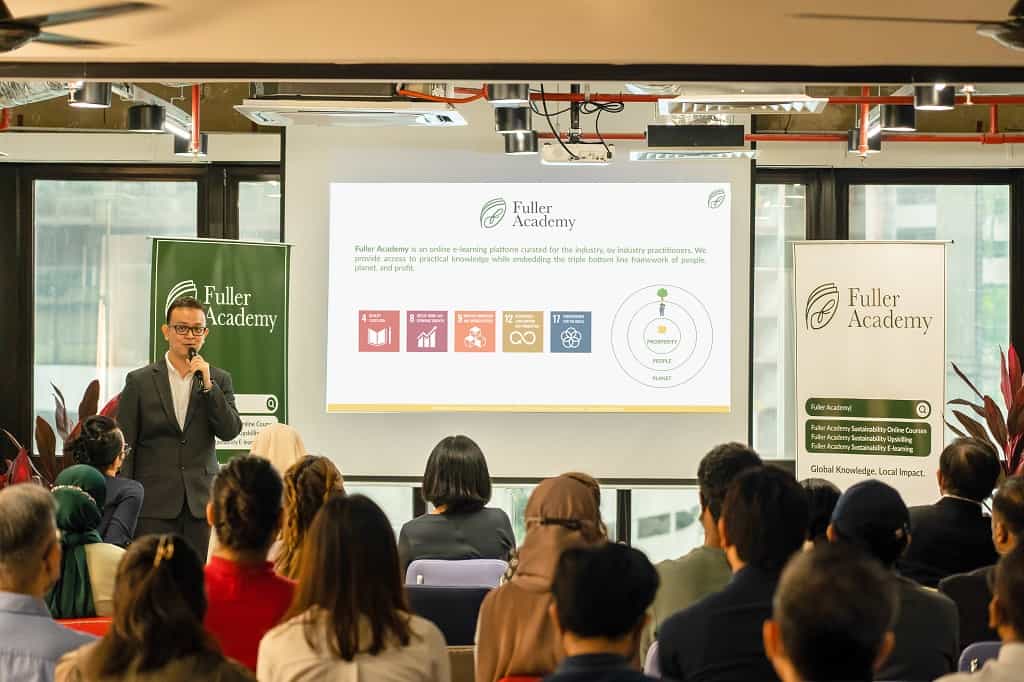
    Kuala Lumpur-based Fuller Academy is poised to enrol to 30,000 learners across ASEAN through its 12 sustainability short courses, designed and curated by the industry, for the industry, to enhance talents’ knowledge and skills in sustainability.

    Chief Executive Officer Wan Imran said all programmes certified by Human Resource Development Corporation (HRDCorp) are part of micro-credential short courses, which aim to provide knowledge solutions for talents, in line with the global demand for talent upskilling in sustainability.

    “Based on a recent analysis by Bloomberg, global ESG assets are on track to exceed $53 trillion by 2025, representing more than a third of the $140.5 trillion in projected total assets under management. This is a strong driving force encouraging the industry to shift towards a more sustainable approach. Hence, now is a critical time for organisations to start enabling their talents with knowledge and purpose in the areas of sustainability. This is also aligned with our national agenda of creating 200,000 green jobs by 2030.he said during the launch of Fuller Academy.

    Wan Imran, Co Founder and CEO of Fuller Academy & Michelle, Co Founder and COO of Fuller Academy

    To date, more than 1,600 participants from various industries have signed up across various of our programs from within the country and abroad.

    “Our learners come from different industries and backgrounds, as we offer a range of courses targeting different skill sets from sustainability communications to the introduction of carbon emissions. We have been getting a lot of learners from ASEAN and other regions, with many learners hailing from Europe. The courses which were curated with our global instructors have set a new standard in sustainability learning, which is effective, practical and engaging.” he added.

    Breaking it down further, Imran said the courses are all designed and created by industry experts and practitioners thus providing insights into the practical industry knowledge.

    “We have made it accessible geographically and financially. Being an online platform, anyone from across the region and beyond can sign up as a learner. For Malaysia-based companies, they can benefit from the financial support HRDCorp can provide, and for outside of Malaysia, they can also take advantage of our entry-level pricing.”

    “The courses are designed to be short and bite-sized, with the flexibility for the learners to complete the course in their own time within the monthly cohorts. This on-demand format is

    ideal for busy professionals, allowing them to learn around their working schedule through a structured yet flexible course.”

    In conjunction with the launch, Fuller Academy also hosted a series of dialogue sessions on sustainability, attended by experts in the field such as Elina Jani from Malaysian Green Technology And Climate Change Corporation (MGTC), Wan Dazriq from Ethis Malaysia, Karina Cady from Nandina Partners, Yasmin Rasyid from EcoKnights, and Yasir Qureshi from Kantar Malaysia.

    About Fuller Academy:

    Fuller Academy is the trusted strategic partner in the business sustainability journey, providing industry-driven sustainability education through online courses. Current open enrollment includes Fundamentals of Business Sustainability, Introduction to Carbon Emissions, Internal Communications for Sustainability, and Shaping Consumer-Centric Sustainable Strategy.

  • Banking For Expats In Malaysia, 6 Things You Should Know

    Banking For Expats In Malaysia, 6 Things You Should Know

    It has become increasingly difficult to move money anywhere around the world, and it is set to get tougher. Fraud, cyber security, tax and compliance procedures, amongst other rising trends, are creating obstacles. Traditional banks are being marginalised by digital transformation in banking and non-banking sectors, with the ease of moving money around with crypto wallets, in Malaysia, and worldwide being a prime example.

    So, if you are an expatriate in Malaysia, or thinking of moving to Malaysia, you may be left wondering what’s the best option for banking.

    Let’s check out banking for expats in Malaysia.

    1. Setting Up A Bank Account

    Abstract blur and defocused hotel lobby interior for background

    Opening a bank account as an expatriate in Malaysia is straightforward and fast, if you have the relevant paperwork. If you do not then it is not possible. If you are employed in Malaysia, then you will be able to open a bank account at a local Malaysian, or international, bank.

    If you are not employed in Malaysia but own a residential property, then you should also be able to open a bank account. If you are considering starting up your own company in Malaysia then it is best to check that it will be possible to open a corporate bank account in Malaysia before you take the time and expense to establish a legal identity.

    Due diligence on several aspects of opening a company should be done in Malaysia, and in any other Asian countries, before you decide to proceed. You may find that it is possible to open a company but not possible to open a corporate bank account in Malaysia, or elsewhere. Check before you get started on the incorporation to avoid wasted effort and expenses.

    2. Banking For Expats: Multi-Currencies

    Caution should be exercised when you open a multi-currency account in Malaysia, or anywhere in the world. You may find that, despite having a choice of accounts to keep your hard-earned currencies in, when you transfer foreign currency from abroad your bank in Malaysia will convert all currencies into Malaysian Ringgit initially.

    This is fine if you intend to spend most of your money in Malaysia, but if you want to hedge against currency volatility then you may lose out on any initial transfer on the exchange rate and on currency risk.

    3. Digital Wallets

    ebelia rm300 million e-wallet credit

    Digital wallets are hot. They are useful too. If you have not already tried using one, or more, digital wallets, then what is stopping you exploring? There are currently over 40 similar providers but this space is likely to reduce to a few niche players in the future.

    The Covid-19 pandemic has accelerated the adoption of e-money payments in Malaysia, and globally, with transaction value crossing RM30 billion (between January and September so far in 2021, according to data from Bank Negara Malaysia.*

    Points earned from spending through your e-wallet may be going to waste and if you look at the amount of money you, and your family, will save in a whole year using e-wallets then this may be a good motivator. E-wallets also mean you do not have to handle cash for shopping and small purchases.

    Read: What are The Many Benefits of E-Wallets in Malaysia?

    4. Fraud And Cyber Attacks

    The two major security issues a local or an expatriate faces with their bank account in Malaysia, or anywhere in the world, are fraud and cyber risks. Malaysia is reportedly a leader in cyber security amongst Asian countries. Does this really mean your bank account is safer in Malaysia than somewhere else?

    Reportedly, Malaysia leverages policy capacity with a broad network of international intelligence alliances to rate highly in the cyber-power rankings. Malaysia came in fifth out of 194 states in the 2020 Global Cybersecurity Index constructed by the International Telecoms Union, a United Nations agency.

    With 98.06 out of a possible 100 points, Malaysia was only fractionally behind Singapore and South Korea, and equal with Russia and the United Arab Emirates. It has been in the top 10 since the first report was released in 2014. However, the best way for you, and your family to prevent losses through cyber attacks is to be vigilant when banking online.

    5. Benefits Of Domestic And Overseas Credit Cards

    credit card 101 rules

    Cashback is one benefit of shopping with a local Malaysian credit card. If you are an expatriate and want to make the most of your earnings in Malaysian Ringgit then it is probably a good idea to spend most of what you earn in Malaysia. From time to time, a few countries may not allow you to exchange your hard-earned Malaysian Ringgit for foreign currency when you travel overseas, or the exchange rate may be unfavourable.

    If you are sending Malaysian Ringgit savings back home, or to an overseas investment, then you may also be caught by a dip in the value of the Malaysian Ringgit. Remember, it is usually best to have more than one credit card just in case there are simultaneous cyber and fraud attacks on both your credit cards at the same time, leaving you stranded overseas without means to pay for a night out or accommodation.

    Some international credit cards offer no international currency charges, as well as favourable exchange rates, so take a look around at what is on offer. You may find that using an overseas credit card in Malaysia is low on cost and favourable on exchange rates.

    Read: How Credit Card Works in Malaysia: Credit Card 101-Know the Rules Before Playing The Game

    6. Money Transfers

    Most banks around the world now require that you give a reason for any money transfer from your own bank account to a third party. Any bank transfers of a substantial sum must be investigated by the bank and a report made to the central bank, Bank Negara.

    You can save yourself time, money and stress by making money transfers of small amounts, less than US$10,000 or foreign currency equivalent, if you want to avoid unnecessary hassle. Some crypto currency wallets do not require you to state a reason for your money transfer and, if you have not already tried, you may be interested to transfer funds around the world using cryptocurrencies.

    It is not as difficult as you may think with many transfers simply requiring you to cut and paste an ‘address’ into their portal, then press send.

    A lot of wasted time and money is not down to banks, it is down to you. Becoming more aware of the benefits of non-bank and digital banking options, and their associated risks, could save you pennies or earn you pounds.

    So there you have it, the available options on banking for expats in Malaysia.

    About the Author

    Dr. Jonathan Di Rollo (PhD Econ) has been actively and passively investing in Asian markets for more than 20 years.

  • Malaysian Brands Return To Growth After COVID As Petronas Remains On Top

    Malaysian Brands Return To Growth After COVID As Petronas Remains On Top

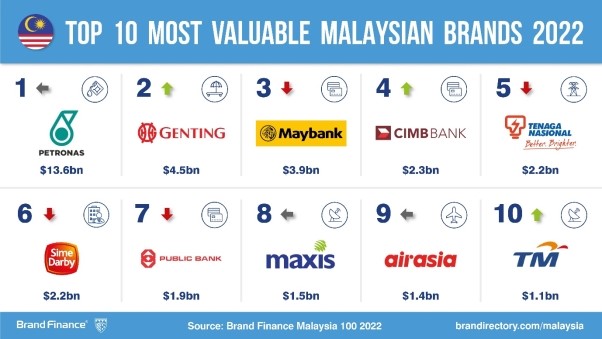
    Petronas has retained its position as Malaysia’s most valuable brand for the 12th consecutive year, with its brand value rising strongly by 13% to US$13.6 billion, according to a new report from leading brand valuation consultancy, Brand Finance. The brand value of Petronas is worth just over three times as much as the second-ranked Malaysian brand, Genting (brand value up 44% to US$4.5 billion).

    The brand values of many big Malaysian brands have returned to growth as the nation looks beyond the pandemic, with Malaysia’s 100 most valuable brands worth 21% (US$ 9.3 billion) more in 2022 (US$53.7 billion) than they were worth in 2021 (US$44.4 billion).

    Every year, leading brand valuation consultancy Brand Finance puts 5,000 of the world’s biggest brands to the test, and publishes around 100 reports, ranking brands across all sectors and countries. Indonesia’s top 100 most valuable and strongest brands are included in the annual Brand Finance Malaysia 100 2022 ranking.

    Alex Haigh, Managing Director, Asia Pacific commented: “Top performing brands in the oil and gas, banking and telecommunications sector including Petronas, Maybank, and Affin Bank continue to innovate using digital transformation and are making up for losses incurred during the COVID-19 pandemic, gearing up and enhancing customer acquisition and engagement.”

    Petronas brand value growth is correlated with their sustainability agenda and increased demand for their core products. The brand is fully committed to remain disciplined in its delivery of its Three-Pronged Growth Strategy, strengthening its core and growth portfolio while investing for the future and resolute in its efforts to achieve the goal of net zero carbon emissions by 2050. As the energy transition unfolds, Petronas continues to seize the attractive opportunities and recently introduced a new entity, Gentari Sdn Bhd which aims to accelerate the adoption and commercialisation of clean energy, by offering a suite of renewable energy, hydrogen and green mobility solutions that are safe, responsible, cost-optimised and emissions-abated via an integrated approach across the clean energy value chain for customers globally.

    Genting rises to second place, overtaking Maybank.

    The Genting brand (brand value 44% up to US$4.5 billion) has achieved strong growth following the removal of pandemic-related constraints. The brand is placing greater emphasis on maximising its overall operational efficiency by intensifying performance, optimising its databases, the quality of its services and its marketing strategy with the ultimate goal to elevate customer experience. Looking ahead, Genting has further opportunities for growth as its major operations in Singapore and Malaysia become more accessible to more tourists, especially from mainland Asia.

    Airlines are bouncing back

    AirAsia (brand value up 18% to US$1.4 billion) retains the 9th position in the 100 most valuable brands 2022 far away from the second and last airline company included in the ranking, Malaysia Airlines (brand value up 15% to US$200 million) which rank 44 this year, one position higher.

    Revenues was significantly increased for AirAsia Aviation Group (AAAGL), a subsidiary of Capital A (formerly known as AirAsia Group), in Q1 attributed to improved demand and further easing travel restrictions across the key markets in the region. The brand has had a shake-up with new management and plans to diversify its business during 2022 especially since the recent launch of the AirAsia Super App.

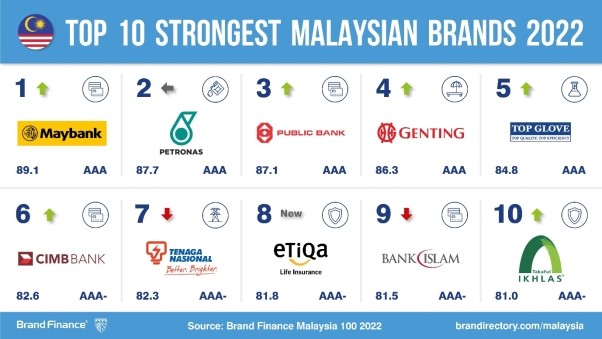
    Maybank is Malaysia’s strongest brand with AAA ranking.

    In addition to calculating brand value, Brand Finance also determines the relative strength of brands through a balanced scorecard of metrics evaluating marketing investment, stakeholder equity, and business performance. Compliant with ISO 20671, Brand Finance’s assessment of stakeholder equity incorporates original market research data from over 100,000 respondents in more than 35 countries and across nearly 30 sectors.

    According to these criteria, Maybank (brand value up 7% to US$3.9 billion) is Malaysia’s strongest brand, with a Brand Strength Index (BSI) of 89.1 out of 100 (up by 2.3 points) and a corresponding AAA brand strength rating. Maybank overtakes Petronas (87.7 out of 100) in the strength ranking in 2021 and DiGi (79.2 out of 100).

    Maybank, aims to accelerate its growth post COVID-19 and entrench its position among the leading financial services groups in the region with specific focus on enhancing digital capabilities, discovering new value drivers for business growth besides championing sustainable practices.

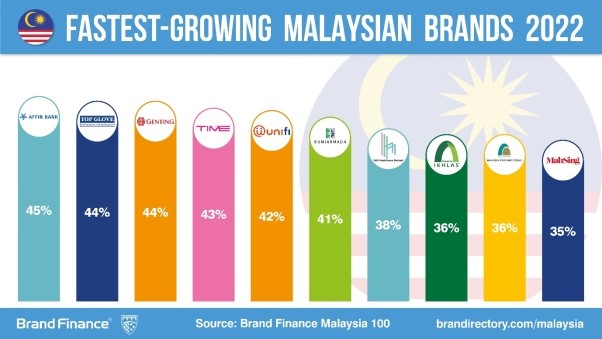
    Affin Bank, Top Glove and Genting are the fastest growing brands in Malaysia

    Affin Bank is the fastest growing brand in Malaysia (brand value up 45% to US$232 million) followed closely by Top Glove (brand value up 44% to US$499 million) and Genting (brand value up 44% to US$4.5 billion).

    Affin Bank doubled their net profit this year, the bank has achieved growth as it increased its issuance of loans because of consumer spending in the region. The brand’s Brand Strength Index (BSI) also jumped 7.8 points this year, owing to an improvement in consumer perceptions such as ‘value for money’ according to research conducted by Brand Finance coupled with the company’s commitment to ESG resulting in an improvement in BSI scores.

    The bank has also invested in technological innovation to grow and has therefore won two awards under the Cloud and Mobile-Banking categories in the Malaysia Technology Excellence Awards 2022, a strong reflection that customers and industry stakeholders are aware of their ongoing strategic focus.

    The brand value of Top Glove has grown strongly in connection with the very obvious increase in demand for gloves globally. Top Glove has developed a strong reputation amongst stakeholders for their glove products and is now producing up to a quarter of gloves in the world.

    Mah Sing and IHH jump 10 places in rankings

    Mah Sing (brand value up 35% to US$130 million) and IHH (brand value up 38% to US$87 million) both jumped ten places in the ranking, to 56th and 67th place respectively. Mah Sing’s projects continued to record a rebound in sales momentum as the reopening of the country’s borders and the transition to the COVID-19 endemic phase spurred a recovery in economic activities. The group plans to hive off its rubber glove business which contributed to accelerate its growth, after venturing into the segment only 19 months ago under the Mah Sing Healthcare Sdn Bhd banner as the demand for rubber gloves has decelerated sharply.

    On its part, IHH is working to align itself with three major trends that have begun to shape the healthcare industry: healthcare being delivered digitally, growing consumer demand for greater transparency and improved public-private collaboration. The hospital operator said that Covid-19 accelerated the group’s efforts to innovate, leverage synergies and build platforms for growth.

  • The New Heir: Managing Your Inheritance

    The New Heir: Managing Your Inheritance

    Managing an inheritance can be life-changing and for many people, as it can open up many new possibilities. The biggest question one would probably face, therefore, is how your new inheritance should be managed to benefit you the most.

    Whether wealth management is something that you are familiar with or whether your inheritance suddenly puts you in an entirely new financial situation, receiving a substantial amount of money or a property can be overwhelming if you don’t know what to do with it.

    With that in mind, Smart Investor spoke with experts to give you a clearer understanding on managing your inheritance.

    Set Up a Trust

    Azhar Iskandar Hew, Group Chief Executive Officer of Rockwills Trustee Berhad

    If your inheritance comes in the form of cash or property, the best way to handle an inheritance from the perspective of the heir, would be to cooperate with the executor or trustee on obtaining details required for probate application and to track the progress of the estate.

    Upon receiving the inheritance and if the inheritance comes in the form of cash, one option is to set up a trust with a professional trust company. You then execute a trust deed in which the terms for the use of the cash can be clearly written down.

    At the same time, the heir can also mention who should inherit the cash and how it is to be distributed, should anything happen to him. This way, the heir or settlor of the trust would have control over the distribution or usage of the cash.

    Some of the main instructions in the trust can include directing the trustee to pay for the settlor’s maintenance, medical bills, children’s education and family’s living expenses on a regular basis. By doing so, the money will not be given to anyone in one lump sum which can be wrongly invested or misused.

    Of course, another advantage of a trust is that unauthorised persons will not be able to touch the cash, as only the named beneficiaries can receive the money.

    It’s All About Priorities

    inheritance

    Kenney Khew, CFP
    Philip Wealth Planners

    Upon receiving your inheritance, you should first of all, list down all your financial goals and prioritise them according to your preferences.

    Put aside an amount (at least 6 months of your gross salary) into an Emergency Fund. This is recommended, as you would then have money to fall back on in the event of an urgent matter that is out of your control.

    With the cash you should also pay off your debts, including your credit card debts, outstanding housing loan, car loan, student loan and any other personal loans.

    It is also recommended that you put aside an amount of money for your children’s education fund according to the calculations made based on future values of tuition, transportation, living, and course fees. In this case, you must also take into consideration the inflation, as well as exchange rates.

    Be sure to also purchase a term life insurance of up to 80 years old. The rule of thumb is for the sum insured to be 10 times your annual income. A medical insurance plan is also important in this context. By doing so, you will be able to protect your assets against mishaps as to not affect your future plans.

    The remaining money can further be used to invest in properties. You can rent out these properties to earn extra income and what’s more, this is a form of passive income that would benefit you in your golden years.

    I Just Inherited a Property – Now What?

    inheritance

    Gor Sheau Shuenn, CFP
    Blueprint Planning

    If you’re lucky enough to receive an inheritance, you should consider what the assets are and how much you will be receiving. If cash is the legacy you’ve received, it should be invested in a proper mixture of different portfolios, as otherwise, liquid assets are bound to be spent too frivolously.

    However, if the inheritance you will receive comes in the form of a property, there are a few factors that need to be considered:

    1. Has the mortgage of the property been paid off in full; if not, what is the loan repayment amount?
    2. Is the property currently being rented out? If so, is the rental yield positive?
    3. What are the appreciation possibilities of the property in the future?
    4. Who is going to manage the property, and will the return be able to cover the maintenance cost?             

    If all answers to the above questions point to a resounding ‘yes’, the property will be all the more attractive as you will receive rental income and capital gain for the disposal of the property.

    At the end of the day, it doesn’t really matter whether the legacy you’d inherited comes in the form of cash or property. All that matters is how the legacy can assist you in shortening the period of time you will need to achieve your financial goals.

    The Financial Planning Factor

    inheritance

    Kevin K.M. Neoh, CFP CERT TM
    MBA, VKA Wealth Planners Sdn Bhd

    It is perfectly normal to do nothing while you consider what to do with your inheritance. Ride out the emotional period and contemplate what you hope to achieve from this fund or inheritance with a clear mind to avoid mishandling or making poor decisions. Even if it means waiting for a couple of years as you do some soul-searching, go for it.

    Should you be the sole beneficiary of this inheritance, why not consider investing or managing it based on your financial plan, or in a manner that will support your life goals and values? Proper management and budgeting is important to ensure that the windfall will not be squandered unnecessarily.

    While you sit on your inheritance, it is also important to note that inflation will erode the purchasing power. Therefore, the need to find an instrument that can yield at least above inflation rate is important because it tends to shield the inheritance from being eroded by inflation.

    Don’t change your plan or your spending habits just because you have received an inheritance. In fact, try to use this as an added advantage to help you realise your life and financial goals.

    Making the Most of Your Inheritance Money

    inheritance

    Yong Chu Eu, FAR, CMSRL, CFP®, Shariah RFP
    Founder, managing director and principal trainer of Money & Life Academy

    Your inheritance can be divided into 3 parts:

    a) Untouched – This portion of your inheritance money can be put into liquid investments (property, insurance, PRS or EPF) and locked down

    b) Investment – Done according to your risk profile and availability of knowledge and time. You can also purchase stocks or unit trusts with the purpose of growing the money, or use it to start a business in a field that you are passionate about

    c) Spend – upgrade your lifestyle with comfort, quality and safety in mind, further your studies, clear off your debts, travel, or give back to the community

  • Lifestyle VS Living Your Life?

    Lifestyle VS Living Your Life?

    During the pandemic, two words that we always heard or read are “lives and livelihoods”. These two words were often mentioned in press conferences by the government and how they are trying hard to balance between the two.

    How does this relate to us an individual, lifestyle vs living your life?

    Based on the Oxwhite Shopper Survey 2021 published on TheEdge on 28 June 21, about 58% of the participants shop for only things they need when they need them, 24% usually keep a wish list. While the remaining 12.5% buy on impulse and 5.5% always on the lookout for the latest product.

    Let’s explore few ideas before you decide to place your next order.

    Luxury VS Necessities

    When we talk about luxury product, there are generally perception associated with a certain product. Be it a luxury watch or car, it is either a symbol of success, quality or excellent.

    Does that mean you have to avoid buying luxury product altogether? No.

    The more important question to ask yourself are as follows:

    • What is your current financial situation?
    • Have your cover your necessities?
    • Have you been putting aside your monthly savings for protection or medium to long term financial needs?

    For instance, if you spend more than 1/3 of your expenditure to pay for your luxury items, then you may need to reconsider whether buying that item is necessary now or should you defer or consider another product.

    Only when your financial situation allows, then you can re-evaluate whether to buy it in the future.

    Buy Now Pay Later (BNPL) VS Pay In Full

    Another new payment method that offers interest free payment is “Buy Now Pay Later” (BNPL). It is actually be good for consumers who are prudence in managing their spending, as they do not have to come up with a large sum of money at one go to purchase something and is also not subjected to any interest payment. But if you do not not pay the amount every month as per the due date, you tend to build up more debts and end up spending over your means.

    It is the same with anything, for example a knife. If you use it appropriately in the kitchen, it is a great cooking tool. However, if it falls to the wrong hands with bad intentions, it can take away someone’s life.

    Current VS Future

    By having ads being shown to us many times when we are searching for something online, it builds our liking towards that product unknowingly. Not many of us are able to refrain from the temptation of getting the latest gadget and or any new product that is being launched in the market.

    Some products are marketed via influencers or artists as their ambassadors, therefore this encourages their fans to buy the product because of their idols are associated with that particular product or brand. Our brain tends to focus more on the present rather than the delayed gratification that enable us to build more sustainable savings at a later age.

    Choose The Lifestyle That You Can Afford

    There is always a choice in how we live our life. Do we really buy certain items because we can afford it and want to give the best to our loved ones? Or do we only need certain product to perform certain task?

    There is no right or wrong on how one lives their life. Therefore, we cannot have one rule for all circumstances. These are just some of the factors for you to consider before making your next purchase.

    A great habit to inculcate is to manage your money and spend it prudently. It is about finding the right balance between lifestyle and living your life.

    “Lifestyle is not an amount, it’s a practice.”

    – Jim Rohn

    About the Author

    Goh Chee Yong is a Licensed Financial Planner under Capital Markets Services Representative License (CMSRL) and Bank Negara approved Financial Advisor Representative (FAR). Prior to becoming a financial advisor, he spent eight years working in Big 4 audit firms and multinational corporations. He can be contacted at cygoh@imaxfinancial.com.my

  • Financial Management Basics In 3 Steps

    Financial Management Basics In 3 Steps

    Despite the well accepted fact that everybody has unique circumstances, in general each of us should do the following in order to have a solid financial management:

    • Establish an emergency fund;
    • Ensure sufficient insurance coverage is in place for your dependents in the event of death or at the onset of critical illness;
    • Ensure you and your partner have wills on how your estate should be distributed in the event of death.

    Emergency Fund

    financial emergency

    The foundation to a great financial management is that we should set aside some money or follow a disciplined effort to build up an emergency fund that is equivalent to at least 6 months of our income. For a safer and secured future, you may want a buffer of 9-12 months and more if you have a young family.

    It does not always have to be an accident or hospitalisation. Many times, we associate emergency funds with these events.

    There are many other forms of emergency or unexpected events such as usual sickness, retrenchment, dental issues, or when one is out of job after resigning and yet to land a new offer.

    This emergency fund should be kept in a deposit or money market account, which will give ease of liquidity when it is needed.

    With adequate emergency funds backing you up, things could not possibly go too wrong as you have a buffer to support you through the rough tide. Thus, it is advisable not to invest any of your savings until you have accumulated this buffer fund.

    Insurance Coverage

    financial insurance

    Just think about how much is needed to settle your debt today if something untoward happened to you? Most of us have mortgage, credit card, study loan (such as PTPTN), hire purchase and so on.

    How will your dependents continue to survive with these challenges and financial hurdles? What’s even worse is if you’re the sole breadwinner of your family, or you contribute a huge chunk to the household income?

    If you were to become ill for long-term, how much of your current income or savings can continue to support you and your family, and for how long?

    That is why in financial management, we need to ensure that we have at least this amount of life insurance coverage in place. Also, ensure that you have a basic medical insurance in place, so that your emergency fund and hard-earned savings will not be wiped out overnight by hefty hospital bills.

    There are many types of insurance products; some are good for you, and some are good for the one who sold you the products; so, be sure to read the fine print, and know what you’re signing for.

    What’s better is to work with someone who is independent and not tied to a product provider. This way, the chances are that your best interest is likely to be more protected.

    Write a Will

    financial will

    A Will is a legal document that sets out who is to benefit from your property and possessions (your estate) after your death.

    There are a number of ways to make a Will, but to be on the safe side, it is advisable to seek the assistance of a licensed financial advisor on how your Wills should be drafted in order to cater to your unique situation and wishes.

    It is important to have a Will in place as if you were to die ‘intestate’ (without a Will), there is a danger that your assets may not reach your family or beneficiaries. Furthermore, it will relatively take a longer time for the court to issue a clearance order.

    Depending on your circumstances, you may wish to include guardianship arrangements in your will so that, in the event that your children are left parentless, there will be someone to take care of them: you obviously need to get the agreement of the people you intend to name as guardian(s) beforehand.

    Conclusion

    The three areas mentioned above may look unimportant to most people, or appear to be ‘simple’; however, we should not underestimate its importance for a solid financial management.

    The benefit of having an emergency fund allows the person to have the ability to handle unexpected events without having to incur mental stress that usually comes when we deal with money issues.

    It also reduces the chances of enlisting an external party to assist us. Moreover, if any form of loan or borrowings was involved today to address any unexpected issues, it simply means we have to pay back in the future.

    Thus, having an emergency fund could help prevent these from happening. I would say the same is true with regards to having adequate insurance coverage, especially personal accident and medical insurance.

    While the first two areas provide flexibility and ability for an individual to deal with unexpected events without having to trouble others, preparing a Will or paying attention to estate planning can help ensure that our family members do not have to deal with the emotional pain of losing out their family member

    It also makes the process of unfreezing and distributing the estate much easier; thus, preventing them from going through more troubles, that potentially could drag up to years, or create tension and conflict among the surviving family members.

    By building up this financial cushion (and taking concerted efforts to maintain it), you will protect yourself when things go the wrong way. This allows you to be in a better position to work out alternatives, in order to focus on the next important step in peace.

    About the author

    kevin neohKevin Neoh is a NextGen Money Coach who works with people to help them transform their relationship with money to improve their lives with the money they have. Kevin can be contacted at kevin@nextgenadvisors.my and www.kevinneoh.my.

  • The 101 on Alternative Offshore Investment

    The 101 on Alternative Offshore Investment

    Not many of us are aware that we can invest overseas in the form of offshore investment. An offshore investment is an investment in another country of which we are not a resident of that particular country. Offshore jurisdictions are used to pay less tax in many countries.

    We caught up with YH Wong who has over two decades of experience in the financial services industry to find out more about offshore investment.

    Q1. In the offshore world, the alternative theme has become more common. More investors are talking about including alternative investments in their portfolios. What are alternative investments and their role in portfolio diversification?

    Alternative investments are assets that are not considered conventional assets like stocks, bonds and cash. Alternative offshore investments include venture capital, private equity, hedge funds, real estate investment trusts, commodities as well as real assets such as precious metals, rare coins, wine, and art.

    If you live long enough, you see everything. Most people understand how important it is to diversify their investment portfolios. Proper diversification requires more than a traditional allocation to stocks and bonds. One of the biggest strengths of most alternative investments is their absolute performance which is often illustrated by their low correlation to certain asset classes.

    investment

    Q2. We have come across some negative articles about alternatives like hedge funds: they are risky, performance is poor, and they are suffering redemptions and some are even shutting down. What’s your view on this from your experience dealing with alternative investments?

    There is a very long education which needs to happen. There are so many wrong assumptions about hedge funds – like they are high-risk vehicles, that you will burn all your money at some stage, that they are taking too much leverage and that there are many uncalculated risks. Of course, some funds fall into some of these categories but they do not represent the entire industry.

    There is a certain mismatch of expectations in terms of performance. People really need to be clear what types of characteristics they are really looking for when they plan to use hedge funds in their portfolios. Also, please remember that even the good managers will have periods of underperformance over time.

    Another observation is that the hedge fund industry has become too crowded. Consolidation in the industry is a positive development.

    Q3. So, does this mean that hedge fund managers and strategy selection will become even more important? Can you comment on the massive IT revolution that is sweeping the offshore world?

    You are right. I’m always looking for niche strategies to generate portfolio alpha that matches the risk tolerance of my investors. A growing number of hedge fund managers today are just generating beta with very little alpha.

    Everywhere you look, the signs of change are there. I am a big fan of using technology such as Artificial Intelligence, Big Data and Quantitative Trading to take advantage of market opportunities. There are a growing number of managers that are actively embracing innovation and, in doing so, they are creating new opportunities for competitive advantage.

    Q4. What about hot-button issues like the fees?

    There are some specialist managers who don’t exist in big numbers and who actually do very interesting things that can’t be replicated easily. Under this situation, fees become less relevant because investors enjoy solid performance after fees.

    investment

    Q5. How are managers of different sizes coping with the competition in the industry these days?

    It is always easy for well-known and big names to attract assets compared to the smaller guys. Things are even more difficult for the young ones mainly due to the costs involved when setting up their whole business and fulfilling all the regulations. Without naming anyone here, most smaller managers are able to perform better than their larger competitors in most measures.

    Q6. What is the common due diligence process for any investors looking for new alternative managers?

    I am a big advocate of proper and extensive due diligence. Whether you are investing in stocks, bonds or alternative investments, always make sure you perform your due diligence.

    Due diligence should fit in independent, bottom up, qualitative, quantitative, and operational analysis. The on-going monitoring is as important as the initial due diligence. As for me, personal touch with the managers is very important where I am able to sit down with them if needed.

    Q7. The alternative investment industry is changing more than ever before, and a lot of that is driven by the regulators. Can you comment on this?

    Regulation has become much stricter at a time when the financial institutions themselves started to have more reporting and controlling. It is encouraging when you see players and regulators working together to promote and achieve something. Being part of a strong regulatory framework is an advantage for investors as well as managers.

    Q8. Some investors are talking about higher risk in the markets in the coming months. What is your advice for the average investors?

    Well, at some point we will experience a correction or even a meltdown with a real dislocation of the markets. Nobody knows what is going to happen. What you can do is proper diversification of managers, strategies and underlying factors.

    Hedge funds that can weather the storm make great sense for investors. For those looking to impress the pretty girls next door, long volatility can be an interesting diversifying strategy for portfolios.

    YH Wong has over two decades of experience in the financial services industry. His clients include high net worth investors and boutique institutions such as family offices and investment partnerships in the region. He is currently a senior partner with Satori Consultancy Ltd, a financial services company regulated by the Mauritian Financial Services Commission. He can be reached at yhwong@satoriconsultancy.com.

  • The 4 Stages Of Side Hustle For A Bigger Investment Capital

    The 4 Stages Of Side Hustle For A Bigger Investment Capital

    We are living in one of the most volatile period over the past few decades, where it feels like a series of black swan events arises back to back (to back). However, as investors, we know that in every crisis lies great opportunities. Some of us will try to time the market, and rest of us will DCA (Dollar Cost Average). All of us wants to invest when the market is low and reap theHus profit when the market recovers.

    In times where price of goods are high and employment income stays relatively stagnant, how do we allocate more capital into our investment portfolio? In this article, we will explore the best ways to start a side hustle to complement your investment capital and how to make it successful.

    What Is A Side Hustle?

    Side hustle is simply a second income that you can generate to help you to be financially free. A side hustle is any type of business that you can run while you are working on a full time job. Side hustles can be a small business that you run from your house, or they can be a big business that you run from an office.

    You can start a side hustle with minimal initial investment. It can be anything from selling your own crafts, to selling products on marketplaces, to providing a service to paying clients.

    A side hustle is a great way to make some extra money, learn new skills, and network with interesting people. 

    Now let’s look at the 4 stages of side hustle.

    1. Choosing A Side Hustle (Ideation Stage)

    Thoughtful creative asian man in glasses thinking while making post on social media, looking away, pondering or making decision, holding smartphone, choosing something in internet.

    There’s no shortage of ideas for a side hustle. The challenge is finding one that’s a good fit for you and that you can be successful with.

    Here are a few tips for choosing a side hustle:

    • Start with something you’re interested in or that you’re good at
    • Find a need that isn’t being met and fulfilled
    • Think about what you can offer that others can’t
    • Start small and grow your business gradually

    2. Building An MVP (Creation Stage)

    Once you’ve chosen a side hustle, the next step is to get started. This is where the rubber meets the road.

    This is where you need to start thinking about your MVP. What is an MVP?

    An MVP is your minimum viable product. The idea is to build a simple product that can be tested and experience by potential customers. Even though your MVP is not a finished product, it is the first version of your product.

    The goal with an MVP is to test your idea, market, and product to see if they are viable. One of the most painful experiences is to invest your heart and soul into a product that no one cares about.

    3. Getting Customers (Acquisition Stage)

    Marketing Ideas Share Research Planning Concept

    This is where things get tricky. How do you get customers?

    Getting your first 10 paying customers can be difficult. Here are a few ways that you can experiment, but bear in mind that there is no one-size-fit-all solution. 

    • Find individuals and businesses that are in need and ask them to try your service or product,
    • Work with a local business and get them to try your service,
    • Post your service or product on marketplaces like Fiverr, Shopee or Lazada,
    • List your service or products on the social media,
    • Offering a part of your service or product for free to build trust and credibility.

    You may also consider building a community around your service or product.

    Your community will be made up of people who are interested in what you sell. As you build a community around your product, you will be able to recruit people interested in your product.

    4. Growing Your Side Income (Expansion Stage)

    This stage is optional. You may treat your side income as a real business that may one day replace your full-time job, or, it can also be a side project that let’s you earn a comfortable side income while doing something you love.

    However, should you want to grow your side income, you may want to strengthen your process within your business/company from end-to-end. You may no longer rely on your notebook and your memory to handle the increased number of transactions within your business.

    There are plenty of digital tools from book-keeping to human resources to customer relationship management software. You may also want to look at business automation software that can help you with your business.

    Having a proper process in place is important because it allows you to delegate your work systematically should you wish to hire employees to help you with your business. Having a clear process makes it easier for you to monitor your team’s performance and causes less confusions between you and your employee.

    Protecting Your Hard Work

    Last but not least, let’s not forget why do we want to start a side hustle – that is to increase our investment capital. Building multiple streams of income help hedge against the sudden change of events.

    However, when times are good, remember to invest for the future. You will never know when do you need to use it.

    To sum up, investing in a side hustle can be a great way to supplement your investment capital. In return, you can get a second income that will help you to be financially free.

    Source: PlanNERD.io

    About the Author

    marshall wong insurance

    Marshall Wong is a financial planner holding licenses from the Securities Commission Malaysia and Bank Negara Malaysia. He can be contacted via email at Marshall@plannerd.io

  • US Equities: Opportunities Amid Turbulence

    US Equities: Opportunities Amid Turbulence

    Global markets are at a crossroads, reflecting deep concerns around inflation, interest rates, moderating economic growth, and elevated geopolitical uncertainty in Europe as it pertains to the Russia-Ukraine war and its potential ripple effects. Market sentiment has swung dramatically, from bullish peaks in 2021 to extremely bearish levels in recent weeks.

    Indeed, sentiment indicators are close to the lows of 2009. This is notable considering that the state of the economy today is certainly stronger than 2009, when the U.S. economy was reeling from the impact of significant financial imbalances and an imploding housing market.

    In our view, the sentiment indicators reflect anticipated economic headwinds ahead and an expectation that consensus earnings estimates could be revised lower in the coming quarters. In aggregate, we believe S&P 500 earnings growth will face pressure in the second half of the year, but should remain positive in 2022.

    Valuations have rapidly contracted over the last six months; the forward price-to-earnings (P/E) ratio of the S&P 500 Index has returned to pre-COVID-19 levels and is trading about one standard deviation below its past five-year average. Stock price pressure has largely been driven by multiple compression as interest-rate increases have impacted discount rates and, in turn, reduced what investors are willing to pay for future earnings.

    While this is appropriate to some degree, it is notable that the profitability and earnings power of many companies remain intact and earnings reports have been resilient across many sectors. In our opinion, recent volatility has created interesting opportunities in the market for long-term investors who are able to look through the near-term turbulence and focus on the growth opportunity of future years.

    In our analysis, U.S. stocks continue to trade at a premium versus other markets. In our view, these higher relative valuations reflect stronger corporate profitability, better return on equity, and more robust growth in comparison to equity markets in other parts of the world.

    While interest-rate increases can slow the economy and lead to recessionary downturns, equity markets have historically performed well in rising interest-rate environments. Over the last eight rate hike cycles dating back to the early 1990s, the S&P 500 has typically declined ahead of and going into the first interest-rate increase, but as the pace of policy tightening becomes more transparent and predictable, equity markets have tended to perform well. Looking at the last few months, the market has followed its historical pattern, but with a higher degree of downside volatility.

    Long-term secular growth trends, such as health care innovation, digital transformation and the rise of fintech, remain intact. These trends were clear beneficiaries of the COVID environment but remain deeply relevant even as economic growth moderates. We believe they will likely create productivity and profitability tailwinds for companies operating in these integral sectors.

    Outlook For Inflation: Some Pressures May Moderate

    We think the United States has probably seen the inflationary peak, but core levels of inflation may remain stubbornly high for a while. However, we believe this should moderate as supply challenges abate and pent-up demand normalizes. As it stands, we’ve already seen some moderate pullback in commodity prices including oil, lumber and copper from very elevated levels, which should ease inflationary pressure somewhat.

    It is important to note that measures of inflation, such as the Consumer Price Index (CPI) and Personal Consumption Expenditures (PCE), are lagging indicators, with substantial backward-looking components. The more forward-looking components of inflation seem to point to some moderation. Home prices have moderated in the United States and home sales have slowed meaningfully.

    Wage inflation has slowed, and we have started to observe layoffs across some companies—early indications that the labor market is rightsizing. The auto backlog, which was primarily driven by supply chain problems, has started to recede and auto deliveries have increased. Energy prices have also receded from recent highs. Taken together, we believe these should create an environment for moderating inflationary pressure, although the effects will only be seen in headline and core inflation gauges after a lag.

    Directionally, in our opinion, inflation should continue to improve in the second half of the year and may moderate faster than market participants anticipate. This could be a net positive for risk assets as it means the U.S. Federal Reserve (Fed) may not have to move as aggressively as it had intended in the face of slowing economic momentum.

    While we think inflation will moderate, there is a strong likelihood that it will not hit the Fed’s 2% core PCE inflation target. Instead, inflation may hover around a 2%–3% range for some time, reflecting the stickier aspects of inflation that may not dissipate quickly. This will keep pressure on the Fed, in that they may keep policy settings tighter for longer.

    As it stands, we’re already seeing the effects of higher interest rates ripple through mortgage rates, auto lending rates and other consumer credit rates, which is likely to dampen aggregate demand further in the face of already moderating growth. The challenge for the Fed will be to calibrate monetary policy settings, such that it is tight enough to curtail inflation, yet not too tight that it triggers a deep and long recession. Engineering a soft landing is a tall order.

    Probability Of Severe Recession Appears Low

    We believe the probability of a severe recession in 2022 is low. Underlying economic conditions in the United States, while weaker than last year, remain healthy, in our view. Two pillars of the U.S. economy appear resilient: corporate earnings have remained relatively robust, while consumer balance sheets are solid, and debt-servicing ratios remain low. That said, earnings growth could slow and we’re likely to see a moderation of gross domestic product (GDP) growth from a fairly elevated base on a year-on-year basis.

    As long as the labor market remains healthy, where unemployment hovers around 3%–4%, it is difficult to fathom a case where we enter a recession that is anything but shallow. A technical recession—two quarters of negative GDP growth—in the next year or so is certainly possible, but ultimately it is likely to be a shallow and short-lived one, in our opinion.

    Sector Opportunities

    We have a quality basis and primarily focus on businesses with robust competitive positions, strong pricing power and healthy financials as we believe these are the companies that perform well in any market environment. Our focus on major secular themes, like digital transformation and health care innovation, invariably leads us to both established and emerging growth players in various sectors.

    Companies across the globe are focused on improving productivity, lowering costs and finding ways to widen their reach and deepen relationships with customers. These often require investments in digital technologies, digital applications, software and hardware.

    We continue to see robust demand for technology enablers from enterprises across various sectors. The outlook for digital spending remains bright as investing in digital capabilities has moved up the needs ladder for many businesses post-COVID.

    We do think that some technology players have been unfairly penalized in the recent rates-driven market correction. Many of these tech businesses are unprofitable and are likely to remain so in the near term. Being in the early stages of growth, they’re understandably focused on spending to engage the huge addressable market opportunity for their products as they grow their business.

    As active and fundamental investors who focus on the bottom-up, we continue to see healthy fundamentals among some of these businesses. They’re growing at a rapid clip and continue to acquire customers at a rapid pace. There are certain viral aspects to their businesses and existing customers are also spending more on their platforms.

    That said, we remain discerning on our exposure, focusing on software over hardware given their resilience to supply chain snarls, and favoring enterprises over consumers given that the former is a reliable source of demand and is likely to spend more on tech. We also pay close attention to unit economics in terms of the cost to acquire a customer and the return they earn on that investment. These are the businesses we believe will shine with time and grow to be the next-generation leaders in their respective sectors.

    Striking A Balance

    We seek a good balance of consistent, high-quality, name brand, best-in-class, established businesses along with exposure to next-generation leaders. To do this, we rely a great deal on our bottom-up, fundamental research capabilities and leverage our in-house team of analysts to uncover promising companies that have the potential to become market leaders. Having a constant dialogue with the companies we hold also helps us discern potential winners that may emerge in different sectors.

    As long-term investors, we typically take a three-to-five-year view when assessing opportunities. Ultimately, we believe outperformance can be generated by identifying these long-term winners rather than timing short-term trades in the market. As such, we view the current volatility as a compelling buying opportunity.

    The dramatic performance of mega-cap (companies with market capitalizations in excess of $200 billion) technology stocks, specifically Apple, Alphabet and Microsoft, relative to the broader S&P 500 Index has been a defining feature of the market environment since the onset of the COVID-19 pandemic. These three names continue to account for roughly one-sixth of the S&P 500 based on market capitalization.

    While these are very good companies, in our view there are many opportunities outside of these names that offer compelling potential for alpha generation. We believe the opportunity set outside these mega-cap names is large and robust and the real opportunity for active equity investors is to find uncovered gems that have the potential to be the next generation of market leaders.

    Gauging The Market Bottom

    We do not focus or rely on any one particular indicator to divine or predict where the market is headed next. We typically observe a range of indicators to better understand the market environment.

    Historically, overly bearish sentiment tends to signal good buying opportunities. Incrementally shallower selloffs in the stock market in response to adverse new information often tells us that a great deal of bad news is already baked in the price. We are starting to see this in sectors like tech.

    Over the next quarter, any negative earnings revisions could test this hypothesis. The reaction to companies missing earnings estimates or providing negative forward guidance on top-line earnings, costs and growth may offer insights into what outcomes the market has already priced in.

    On a macro level, seeing a sustained moderation in forward-looking inflation indicators will be crucial to pinpoint the potential top-end for interest rates, as it provides some scope for the Fed to temper the pace of monetary policy tightening. Directionally, this means less headwinds and more tailwinds for risk assets like stocks.

    For now, we think it is too early to call a market bottom, although we do think we’re close. Valuations are very supportive for many companies, and the outlook for growth and earnings has been significantly reset over the last six months, not just in equities, but also across many asset classes.

    Grant Bowers,
    Portfolio Manager, Franklin Equity Group,
    Franklin Templeton