Blog

  • Debt-Free vs Retirement Savings: Which to Prioritise?

    Debt-Free vs Retirement Savings: Which to Prioritise?

    One aspect of wealth planning is managing debts. Asians, particularly Malaysians, often have the mindset of prioritising debt payment over savings for retirement. Any extra cash at the end of the day is used to pay off existing debts rather than investing into a retirement plan.

    Smart Investor spoke to a few prominent financial experts to gage which should prioritised – being debt-free or saving for retirement.

    Retirement Savings More Important

    retirement

    Kenney Khew, Licensed Financial Planner
    Phillip Wealth Planners Sdn Bhd

    Managing both our debts and savings is important because it increases our net worth eventually.

    However, I personally would give more importance to retirement savings than reducing mortgage debt, especially now when inflation rate is pretty high. Furthermore, planning for the next 25 to 30 years is more important than focusing on debts that have already incurred.

    One way to manage mortgage debt is by purchasing the Mortgage Reducing Term Assurance (MRTA) from banks. The MRTA is usually incorporated in the mortgage debt or monthly housing instalment to mitigate anything untoward happening to the primary borrower, namely accidents, death, total permanent disability and critical illness.

    If this happens, the insurance company will pay a compensation to the bank to fully settle the mortgage loan.

    However, if your Debt to Service Ratio (annual loan payment/annual take home pay) is greater than 35% and Debt to Asset Ratio (total liability/total assets) is greater than 50%, you might want to consider settling your debts first.

    Debt is Cheap

    retirement

    Steve Lim, Chief Learning Officer
    Affin Hwang Asset Management

    I think it depends a lot on an individual’s cost of debt verses investment returns. If I make say 12% returns from my investment in the long run, I would rather put more attention to retirement savings than paying off my debts that’s costing me 4% per annum.

    Of course, you can quickly pay off your debts if you decide otherwise, but you’re only going to save 4%, and give away differential returns of about 6-8% on retirement savings.

    As Asians, we have a debt-free mentality. But debt is very cheap in this environment right now. Everyone is getting very low interest rates, thus, if you can accumulate a return of 10% on your investment, better focus on that than settling a debt that is very cheap.

    The only time an individual needs to focus on debt is if he is a conservative investor, investing predominantly in fixed income instruments that gives him a return of 5-6% per annum. With a 4% cost of debt, he would be quite indifferent as to whether he should pay off his debts or invest for retirement.

    Understand your debts first before managing them. For instance, concentrate on settling short-term debts like credit card and car loans rather than mortgage loan. It’s wise to keep your short-term debt low as the repercussions of non-payment can be quite damaging.

    Housing loans, on the other hand, are long term, and if you have a savings buffer of 6 months to a year, you should be able to pay off the instalment if you lose your job.

    In fact, a home loan can only become a non-performing loan (NPL) after a year, so you shouldn’t be too worked up over a long-term debt, as you still have time. Therefore, my advice is to put things into perspective rather than doing intuitive.

    Balance the Scale

    retirement balanced scale

    Yong Chu Eu, Licensed Financial Advisor
    Fin Freedom Sdn Bhd

    In my opinion, both are equally important, so instead of choosing to prioritise one over the other, we should try balancing the scale – meaning settle our debts and have adequate retirement savings.

    If you’re debt-free upon retirement, which is highly recommended, but lack savings, you will be having a tough time managing even your daily expenses.

    Likewise, if you have adequate savings, and still have a high level of debt upon retirement, most of your wealth will be used to settle those debts. This is why I always stress on simultaneous management of debt and savings.

    Most Malaysians are conservative. They prefer to utilise their free cash flow to clear off debts, only then think of investing for retirement. But this is not a good idea as they will have lesser time in compounding their wealth.

    The best way is to service your debts on a monthly basis according to the loan requirements. Take note that your total debts should not be more than 40% of your monthly salary.

    Invest extra cash into an investment vehicle that you’re familiar with, but make sure that the returns are higher than the loan interest rate.

    50/30/20 Budgeting Rule

    Gor Sheau Shuenn, Licensed Financial Planner
    Blueprint Planning Sdn Bhd

    Reducing mortgage debt is recommended if it’s for self-occupancy because we want to have a debt-free home to live in upon retirement.

    However, if it’s investment property, just follow the loan repayment schedule and cover the commitment with rental income. Furthermore, the interest on loan are allowable tax expenses, which could be used to reduce chargeable income.

    Nevertheless, saving for retirement is equally important. Retirement cashflow should focus on living necessities instead of loan repayment.

    If you put all your money into paying off mortgage loan, eventually, you would have a house to stay, but not money to fund for basic living needs. What would you do then?

    Of course, investment property can be disposed off anytime for capital gains and parked under retirement fund. But the question is whether you would be able to liquidate the property immediately.

    Therefore, I would like to introduce to you the 50/30/20 budgeting thumb rule:

    • 50% of your take-home pay should be used to pay for mortgage, home insurance and maintenance, hire-purchase loan, car insurance and maintenance, and other bigger commitment.
    • 30% of your take-home pay should be used to pay for groceries, dining out, entertainment, and other family and personal expenses.
    • 20% of your take-home pay should be used for savings, out of which 50% should be kept for retirement and the balance 50% for other financial goals and emergency purpose. This is on top of your EPF savings.

    For instance, assuming you are 25 years old today, with the ability to invest RM500 every month into an investment instrument which gives you a return of 7%.

    In 10 years’ time, or by the time you’re 35, you will be able to save RM86,500, and RM260,500 by 45.

    Apply the Rule of 72 every 10 years, and you would be able to double up your capital by 7% per annum. By the time you reach 65, you would already have RM1 million, even if you have stopped investing at 45 years old.

    Financial Discipline is Key

    retirement

    Tan Kim Book, Licensed Financial Planner
    Philip Wealth Planners Sdn Bhd

    For an individual who would like to plan for effective wealth accumulations for retirement and distributions, we would first have to take a look at his personal financial statement.

    If the cost of mortgage is higher than the rate of return on your investment, then I would advise you reduce your mortgage debt, which is logically and mathematically very effective as this can reduce the instalment tenure and save the mortgage cost.

    However, you need to have the discipline to save more for your retirement after reducing your mortgage debts. Sometimes, you might have the discipline, but alas, time and compound interest may not be on your side.

    Liquidity for day-to-day cash flow and accumulating for future retirement income is equally important. Unless you have a very high annual savings ratio of 20-30%, you may want to consider reducing your mortgage debts. Otherwise you have no choice but to increase your savings through your earning capacity.

    On the other hand, if the rate of return on your investment is higher than the cost of mortgage, the problem is solved.

    For instance, let’s assume that the cost of your mortgage is 4.5%, and the rate of return on your investment is 8%. In this case, there is no hurry to reduce your mortgage debts.

    Instead, you should channel your surplus into the Employment Provident Fund (EPF) or a Private Retirement Scheme (PRS), and allow time and compound interest to work for you.

    An important fact that many of us aren’t aware of is that we shouldn’t withdraw the savings in our EPF Account 2 facility, either monthly or lump sum, for paying mortgage instalments or early settlement, if the EPF return is higher than the mortgage cost.

    It’s an Ongoing Process

    retirement

    Kevin Neoh, Licensed Financial Planner
    VKA Wealth Planners Sdn Bhd

    I would say both are equally important. Debt management is also part of the key component towards a sound retirement planning, for if we have debts on our shoulders, we can never truly retire as we still have to service the loan when we stop working.

    But if one has to take precedence over the other, then it is important to note that usually, our mortgage has a tenure that is as long as our time horizon towards retirement.

    If one repays more to reduce the mortgage and to redeem the property from the financier earlier than the tenure stated in the loan agreement, no doubt there will be extra cash in hand and also a property that is free from incumbencies.  

    However, what happens when the person runs out of retirement fund? Does he have to sell his property then? If yes, where will this person stay after that?

    Hence, it is important to prepare for a retirement fund while we are still working, as there is still ample of time before reaching retirement age. In short, just follow your mortgage repayment schedule and save the extra cashflow towards building a retirement fund!

  • Estate Planning: It’s All About How You Leave

    Estate Planning: It’s All About How You Leave

    Regardless of your level of wealth, estate planning is a vital part of your overall financial plan, with effective estate planning providing you with greater control, privacy and opportunity to leave more of your legacy to your loved ones.

    To put things in perspective, an Estate Plan is a collection of preparation tasks that serve to manage one’s asset base in the event of their incapacitation or death, thus ensuring that all the individual’s personal assets go to his/her intended loved ones.

    However, good estate planning is much more than just making a plan in advance and naming whom you want to receive the things you own after you die – there are many important factors to be considered in this aspect. Here’s what the experts have got to say.

    Pay Attention to the Details

    Azhar Iskandar Hew, Rockwills Trustee Berhad Group Chief Executive Officer

    The key points to consider when doing estate planning and successfully leaving a legacy depends on whether the person is preparing a Will of trust, or both. Generally, an estate plan should include:

    1. The list of beneficiaries;
    2. Who to appoint as the trusted executor of the Will;
    3. If the children are young, then appointment of guardians is recommended;
    4. What are the assets to be distributed;
    5. In what proportion, as well as the terms of distribution;
    6. Substitute beneficiaries will need to be considered, depending on the family’s lifestyle such as yearly family holidays, along with the number of beneficiaries to be named.

    In addition to the above, it is important to have a complete and accurate record of assets and liabilities including tax file status; items held in trust by others and for others; and a list of overseas assets.

    Special attention must also be given to joint properties, assets or funds where nominees have been made earlier. It is also important to ensure that there is enough liquidity to pay debts.

    For business owners, it is important to plan for proper business succession, both in terms of management and ownership. Not to forget, preservation of controlling interest as well as preservation of capital, including protection against creditors and ex-spouse claims.

    With the above, the individual can then leave clear instructions to prepare a comprehensive Estate Plan to ensure he has a successful legacy. Depending on the person’s objective, Estate Planning can also cover various aspects including planning for business succession, education and retirement.

    As an example, Mr Tan and his wife are the shareholders in two private limited companies involved in manufacturing and services. His two children are working for him.

    Both Mr Tan and his wife intend for the companies to continue to be owned by the family for many generations to come. The solution would be for Mr Tan and his wife to create a trust by settling in it their shares in the two companies.

    An independent trust company should be appointed as the trustee to hold the shares of the two companies for the benefit of the children and their lineal descendants.

    During the lifetime of Mr Tan and his wife, they have sole ownership control over the companies and upon their passing or disability, the two children will be given control, and thereafter suitable and qualified descendants will be appointed as successors.

    The trust should spell out the detailed succession and distribution plan so that control remains within the family.

    With a proper business succession plan, the ownership of the two companies will be fragmented which would lead to in-fighting among the descendants which in turn may cause the companies’ business to be disrupted.

    In the same trust, Mr Tan and his wife can instruct the dividends received by the trust to be used to pay for the tertiary education of the descendants that is related to the business of the companies. This would ensure that there would be continuity of suitable and qualified successors in the business.

    Don’t Procrastinate Estate Planning

    estate planning

    Kenney Khew, CFP
    Philip Wealth Planners

    Estate planning is important throughout our cycle of life, regardless whether you’re in your 20s, 30s, 40s or 50s. Many tend to have the misconception that only the rich should think about distributing their wealth, while others may even feel uncomfortable to broach the subject when you’re still alive!

    That aside, wealth planning is crucial as it allows you to leave your hard-earned wealth to the beneficiaries of your choice in the shortest time possible with very few hassles and setback through the application of a grant of probate (testate).

    In the case of Intestate (not having made a Will before one dies), the deceased’s family will need to apply for a Letter of Administration by choosing an Administrator to determine the value of the estate, and get two sureties (guarantors) to unlock the frozen assets.

    Should we want to leave a legacy for our children, there are certain aspects to consider:

    1. Your appointment of trusted Executors – A valid Will should spell out the appointment of executors to carry out your wishes so that wealth is properly distributed to your loved ones as soon as possible, and the best person is a trust corporation or professional trustee, and it is important to look for a qualified person who is professional, independent and knowledgeable;
    2. Your choice of guardian for your children below the age of 21 – With the choice of guardians in your hand, you can be sure that your children will be well taken care of;
    3. Your choice of beneficiaries and their entitlements – how much of your wealth is to be distributed to your beneficiaries upon your demise has to be clearly stated in your Will (normally in the form of percentage);
    4. Testamentary Trust – a testamentary kicks in upon your death and allows your young children and ageing parents to receive a sum of money for living expenses and school fees. In these circumstances, you will need to entrust the trustees to carry out your wishes accordingly.
    5. Will custodian – in this case, a will custodian is very important as it is pointless to write a Will only for your loved ones to not be able to locate your Will. The safekeeping of the Will and its easy retrieval are vital in order to ensure your wealth is distributed to your beneficiaries with no hassle.
    6. Witnesses – once the Will has been drawn up, it is not effective until it has been signed in the presence of two witnesses. These witnesses have to be present at the same time when the Will is signed to confirm that you are of sound mind, that the Will is made voluntarily and without pressure from another person, and that the Will was not signed when you are intoxicated or drunk.

    A Will is a Must!

    estate planning will writing

    Kevin K.M. Neoh, CFP CERT TM, MBA
    VKA Wealth Planners Sdn Bhd

    When it comes to effective estate planning, you mainly need to consider the position of the estate (i.e. if there will be anything left to be given away to the beneficiary).

    If the person has more debts than assets, then this person would die insolvent, which means that it does not matter if the person has written a legit or complete Will or not, since most of the estate would be used to repay his outstanding debts.

    Next comes tax matters. It is important to ensure that we keep proper filing and do our tax filings well, and have no outstanding and unpaid dues.

    The basic form that we need to consider when it comes to estate planning is perhaps writing a Will. A will is simply a legal document and we will need an executor to carry out the wishes of the testator.

    Appointing executors, therefore, is a very important matter because if the appointed executor is not capable or have a good sense of responsibility, the entire process may go haywire and worse, the interests of the beneficiaries may not be protected.

  • Will Writing: Can I Do it Myself?

    Will Writing: Can I Do it Myself?

    In my article published in August 2017 entitled “Have You Prepared Your Will?” I dealt with the general process of making a will, the advantages of having a will made, and some questions that I have answered from my clients over the years with regards to the will-writing process.

    I have since then received further queries on whether it is necessary or mandatory for one to use the services of a law firm, or a professional will-writer for the purposes of writing a will. This article will deal with that question from a legal and practical perspective.

    Firstly, the law does not compel you to appoint a law firm or a professional will-writer to have your will written.

    Unlike applying for Letters of Administration or a Grant of Probate where the services of a lawyer are required for the purposes of filing the requisite applications in Court, will-writing can be done by the individual.

    However, when you undertake the will-writing process without the services of a professional, it is prudent that you are fully aware of the requirements and intricacies of the laws relating to inheritance, in particular, the Distribution Act 1958, The Wills Act 1959 and the Probate and Administration Act 1960. 

    Will Writing: Dos and Don’ts

    will writing

    The worst thing you can do is to use a standard template obtained from the internet, which could eventually lead to various problems, including your will being challenged.

    Neither should you use templates given to you by friends as their wills may have been drafted under different circumstances from yours.

    It is important to remember that a lack of clarity and vital omissions in your will can lead to disputes between your family members and unnecessary protracted and costly litigation.

    If you wish to intentionally leave out a particular family member from your will, it is advisable that you set out expressly that you wish for this person to be excluded and give reasons for that exclusion. This will reduce the chances of a successful challenge in Court.

    There have even been circumstances where the Courts have gone against the contents of the Will, and pursuant to the Inheritance (Family Provision) Act 1971, made provisions for other members of the family, where the Court was of the opinion that the deceased had not made reasonable provisions for the maintenance of a particular dependent.    

    When the Court makes such a decision to contradict or go against the contents of a will, the Court will consider all circumstances, including the assets and income of the dependent, the conduct and relationship of the dependent with the deceased, the size of the estate, and the interest of the named beneficiaries.

    If you are unwell or are under heavy medication for a prolonged sickness, it is advisable that you get your doctor to confirm your state of mind when your will is being signed, as there have been instances where a will has been challenged on the grounds that the deceased was of unsound mind or under heavy medication, and therefore, making it impossible for the deceased to have known what document he or she was signing, let alone the contents of the said document.  

    The Courts have in the past dealt with disputes where family members have challenged a will on the basis that the contents of the will had been altered, the signature of the deceased had been forged and that the execution of the will was not properly witnessed.

    It is prudent to note here that wills do not need to be stamped, but there is a requirement in law for the will to be properly witnessed.

    I have read lots of articles about this matter and have heard many people say that will-writing is a simple matter that any lay person should be able to handle on their own.

    However, I am cautious about taking such a position as it may not be as simple as it seems, as I have described above.

    Knowledge is Key

    will writing

    Firstly, you must be very clear in expressing your intentions in writing. It is advisable to appoint a professional, who will be able to craft your thoughts and intention on paper, rather than to be left with a document that is ambiguous, and thus open to challenge in the future.

    It is also necessary for you to constantly review and update the contents of your will. This is important as you may have sold some of your properties and may want to omit those properties from your will.

    In other circumstances, the status of your relationships may have changed and you may want your will to reflect that. It is important to make those changes and have it properly documents.

    There have been circumstances where family members have produced two different wills by the deceased in Court and have challenged the authenticity of later will.

    It is my opinion that one should not look too lightly at the will writing process. From a litigation lawyer’s perspective, a badly drafted will can mean years of protracted, costly litigation and years of turmoil and dispute between warring family members.

    It is important that one does not leave a legacy of strife and for that, I would advise that the services of a professional be sought for the purposes of writing your will.    

    About the author

    SHARMILA RAVENDRAN is the founder of the law firm, Messrs Ravindran located in Mont Kiara, Kuala Lumpur. She has more than 14 years of experience in the legal industry servicing clients that include local and foreign companies. She is now actively involved in corporate advisory work and commercial litigation and is a Panel Adjudicator with the Kuala Lumpur Regional Centre for Arbitration. She also sits on the Bar Council Child Rights Committee and is the Legal Director for Lean in Malaysia. She can be contacted at sharm@ravindran.com.my.                    

  • Do You Have a Plan B?

    Do You Have a Plan B?

    Lee-Wang’s story is not unusual these days. He and his family have been living in Asia for more than 25 years. But as his business expands globally, he spends more and more time shuttling between countries.

    The globetrotting businessman is in the process of getting his citizenship through a Portuguese golden visa programme that offers a real estate investment route to gaining residency and potential citizenship in the country and hence European citizenship.

    A big driver is for his two children to have the ease of travel a European passport offers in the future. The golden visa programme in Portugal is the most popular in Europe.

    Portugal Golden Visa Programme

    financial plan b passport

    It was launched by the Portuguese government in 2012 to stimulate investment into Portugal and has since encouraged several billion Euros in real estate investment and over 2,000 family applications each year.

    An investment of €500,000 is required in real estate in Portugal. The property, either residential or commercial, can be rented for income. Any number of properties can combine to make up the €500,000 minimum investment.

    Joint buyers can pool investments into one property. The property can be mortgaged for any investment exceeding the minimum.

    Portugal has a very favourable tax regime for anyone considering living in the country. No taxes are charged on overseas income for the first 10 years.

    For those non-resident individuals, tax is charged at 28% on income derived in the country. This can be reduced with expenses for rental income.

    Capital gains tax is 28% and there are allowances for costs and depreciation. There is no inheritance tax in Portugal. Applicants can apply for permanent residency after five years and Portuguese citizenship after six years.

    Global residency and citizenship programmes have been in existence since the 1980s. The demand for the benefits of such programmes expanded rapidly in recent years. The new golden visa programmes in Europe and the Caribbean have wide appeal across many countries.

    However, not every country and programme are the same. There are significant differences relating to investment level, family qualification, permanent residency, minimum stay, citizenship and passports, and not to mention, the differing economic states and real estate investment prospects in each country.

    The EU Context

    plan b european map
    Colorful Isolated Europe in Watercolor

    A number of European countries offer golden visas through investment in real estate, government bonds and donations. A citizen of any EU country is a citizen of the EU. Citizenship and a passport from any EU country allow the holder to live, work, study or travel visa free to any EU country because they are a European citizen.

    A resident of any Schengen countries can travel freely throughout the Schengen zone without border controls even though they may not have a European passport.

    The Schengen Area is the area comprising 26 European countries that have abolished passport and any other type of border control at their common borders, also referred to as internal borders. It mostly functions as a single country for international travel purposes, with a common visa policy.

    Based on experiences, some of the motivations behind global residency and citizenship planning are:

    Investment Return

    Most programmes offer real estate investment as the route to gaining a golden visa from that country. Long, medium and often short-term investment horizons lead to significant capital gains for real estate.

    Safe Haven Investment

    The USA and Europe remain safe havens for investment with clear property ownership laws, democratically elected governments and established taxation rules.

    The laws of the Caribbean countries offering citizenship programmes are based on UK law with democratically elected governments.

    Legacy for Family

    plan b family legacy

    Once the investment is made and the visas, residency cards and citizenship are granted then the ties and contacts with that country begin to increase.

    Children can be included, they eventually move on perhaps for an education, eventual jobs, eventual citizenship and the next generations have firm roots which they have either put down or have the option to do so.

    Education for Children

    Once permanent residency is established by living full time in the country, children can be educated under either the state or private education system.

    Looking to the future, as European citizens, children can gain access to universities in English speaking countries such as the UK at European and not international rates (a substantial saving).

    Some Caribbean countries offer higher education offering ease of access to universities in the USA.

    Ease of Travel

    plan b ease of travel

    A golden visa will lead to a residency card or eventually citizenship and a second passport. In all cases this can significantly improve an applicant’s ease of travelling throughout the world.

    A European passport allows the holder to live, work and travel anywhere in the EU including countries outside the Schengen Zone, such as Switzerland, the UK and Ireland.

    Second Passport

    The second passport and citizenship option arise from all the Caribbean programmes and several golden visa programs in Europe.

    Taxation

    plan b tax

    Taxation is a big concern for most wealthy investors. This is an area where more detailed planning will be needed. The Caribbean countries offer low or no taxation on overseas income.

    In Europe, some countries such as Portugal impose no further taxation on overseas income for the first 10 years of residency.

    No doubt, there are changing times ahead, with residency and citizenship planning or getting a Plan B already becoming an essential part of an offshore wealth management strategy for high net-worth individuals.

    On a final note, beware of fraud. The demand for second citizenships has created opportunities for fraud and misrepresentation.

    Be sure to perform the necessary due diligence or hire a qualified advisor or consultant specialising in such programmes. Get the right advice that is balanced and independent.

    About the author

    YH Wong has over two decades of experience in the financial services industry. His clients include high net worth investors and boutique institutions such as family offices and investment partnerships in the region. He is currently a senior partner with Satori Consultancy Ltd, a financial services company regulated by the Mauritian Financial Services Commission. He can be reached at yhwong@satoriconsultancy.com.

  • Review Your Business Legal Health Yearly

    Review Your Business Legal Health Yearly

    Whether we are business owners or in employment oftentimes we neglect our legal well-being. The general notion is ‘what isn’t broken need not be fixed’.

    What we fail to recognise is that most of the time, a lot of our legal problems, which may at the material time appear small or insignificant, can with time and neglect, multiply and become costly to rectify.

    Most times these legal crises and complications can be averted or reduced if the right steps are taken at the appropriate time.

    Why is a Legal Health Check Important?

    It is important to remember that if your financial and legal matters are badly managed, you are directly exposing yourself personally as well as your company and clients to various legal implications.

    These risks can cause unnecessary cost, loss of business relationships, knowledge and possible statutory or regulatory breaches. The effect of a badly managed business is far- reaching and can in some situations take years to rectify/remedy.

    The advice here is to be constantly aware and apply your mind to a couple of key areas when you are performing your own legal health check. Here are some of them:

    1. Have You Complied with the Relevant Statutory Regulations & Laws?

    legal compliance

    Often, as business owners, you may not be aware of the changes in law that may have taken place, and as such need to be advised by your legal advisers on the latest legislation or amendments to any current legislation that concerns the industry you are in and the services you render.

    There are currently more than 20 new Acts that have been made and countless new regulations and amendments to the current laws.

    If you are not keeping abreast with the changes, you will be exposing yourself and your business to risk. What you do not can hurt you!

    2. Partnerships and Shareholding

    legal partnership and shareholding

    Make it a yearly affair where you have a formal discussion with your partners/directors on their roles, scope of work, performance and entitlements.

    Have these discussions minuted and served on them officially. This makes it easier to address partnership or business issues and enables you to make any necessary changes to your business structure, revising targets, scope of work etc.

    It is also of utmost importance to have written partnership and/or shareholders agreement to cover all terms of your partnerships and shareholding.

    Ensure that your agreements adequately deal with matters such as buyouts, raising capitals, succession, put & call options and exit clauses. Your partners/directors must also be fully aware of their duties and obligations under the new Companies Act 2016.

    3. Trade Creditors and Debtors

    By this time of the year, you must know who owes your company money and how you intend to recover those unpaid debts. Have a list of creditors prepared and send out the necessary reminders and letters of demand.

    Start the process of recovering monies before the New Year. The longer you wait, the harder it will be to collect these debts.

    For those creditors who, for whatever reason cannot pay you in full, it would be advisable to speak to them about an instalment plan and get a settlement agreement drafted to confirm the instalment terms. If possible collect post-dated cheques.

    4. Employment Contracts

    legal contract

    It is pivotal for you to know what your exposure as a company or business in an employment dispute. It is also important for you to know the processes and procedures that you need to carry out before you terminate a belligerent employee.

    It is prudent that you have an Employment Handbook prepared and served on all your employees.

    This year alone there have been a lot of discussion on the need for change to our employment laws in particular, to laws covering sexual harassment at work, maternity and paternity leave, data protection and personal information.

    5. Intellectual Property

    Whatever industry you’re in, it is prudent to consider registering your trademark and tradename. As your business gains popularity and people start recognising your brand and name, it is inevitable that a competitor may want to benefit from your goodwill to gain some traction.

    You do not want a competitor to proceed to use your name and logo in a similar industry and reap the benefits and goodwill off your hard work.

    Please do consider securing your intellectual property rights. It makes it easier for you to enforce your rights when you have the requisite trademarks being registered.

    6. Written Contracts and Agreements

    Always have your written contracts and agreements revised and up to date. Review the terms of your Purchase Orders, Invoices, Supplier Contracts, Equipment/ Machinery Leases, Rental Agreements.

    It is important that at all material times, you are aware of your key suppliers and key customers. Review these contracts and agreement as there may be renewal clauses in those contracts that may have slipped your mind, which could cause you undue losses.

    7. Train Your Staff

    legal staff training

    Always train your staff to be aware of what type of legal documents to look out for. For example, a Winding up Notice that is served on your registered address needs to be brought to the immediate attention of the Board of Directors, as there are dire repercussions of not responding to the said Notice within the statutory imposed period of time.

    Conclusion

    There is no such thing as a ‘one size fits all’ when it comes to legal matters. You will need to design your own Legal Health Check which is suitable for your own business or company.

    Like a well-tended garden, you will need to constantly prune, remove and regrow your legal structures to ensure that it is in perfect order.

    Always remember that a detailed examination of these key areas will help you identify any danger or grey areas which will then enable you to circumvent or reduce any potential risks and liabilities to your business.

    About the author

    SHARMILA RAVENDRAN is the founder of the law firm, Messrs Ravindran located in Mont Kiara, Kuala Lumpur. She has more than 14 years of experience in the legal industry servicing clients that include local and foreign companies. She is now actively involved in corporate advisory work and commercial litigation and is a Panel Adjudicator with the Kuala Lumpur Regional Centre for Arbitration. She also sits on the Bar Council Child Rights Committee and is the Legal Director for Lean in Malaysia. She can be contacted at sharm@ravindran.com.my.                                                                                                                                            

  • Rich Debt, Poor Debt

    Rich Debt, Poor Debt

    Debt seems to give a negative impression. Sometimes it even gives people the chills just by hearing the word. But what is debt? Both layman and business dictionaries define debt as something that someone has given permission to borrow but with conditions to repay.

    Now when it comes to organisations around the world, debt is used as an engine that creates financial leverage and multiplies yield on investment; provided returns generated by debt exceed its cost because the interest paid on debt can be written off as expenses.

    Looking at this, is debt a good thing? Does debt put you in a better position or worse? Does debt make you RICHER or POORER? The answer is: “It depends!”

    Poor Debt

    We have seen tremendous growth in lifestyle expenditure. The unfortunate part of this culture is the increase of debts which makes people poorer. Let’s take the credit card as an example; 40% of credit card holders’ debt revolve around their credit, which means they only pay the minimum or part of the due amount after spending in full every month.

    This trend has been rising for some time now. When you spend beyond your means and revolve unnecessarily, especially on lifestyle lavishness, you are paying a high price for your indulgences as the payback for your expenditure is compounded by a whopping 18% per annum.  

    To make matters worse, most of these lifestyle extravagances depreciate in value.

    Responding to this trend, the personal loan product emerged as another form of new age credit. It gives easy cash access as it requires no asset pledged or charged as security. Many people are attracted to this sudden access to large volumes of cash that can be used for anything desired.

    What’s more, its fixed low monthly payback instalment makes borrowers believe they have more control of their finances this way. The personal loan is another lending facility that gives the after effect of one week of pure enjoyment and five to seven years of dreadful commitment.

    Running a debt on a credit card and personal loan is EXPENSIVE. It will cost you three to four times MORE than a home loan / mortgage.

    In a nutshell, a poor debt is basically spending your future money for current or past expenditure and it does not generate anything for your future.

    Rich Debt

    Please see the situation below on how a debt that can make you richer.

    John buys the same asset worth RM1M, and after three years, he also sold it at RM1.2M and made a handsome profit of 20%. He paid the entire asset of RM1M in cash. This was his capital outlay.

    Amanda buys an asset worth RM1M, and after three years, she sells it for RM1.2M, making a handsome profit of 20%. She had the cash to buy the asset but she took a loan to finance 90% of the asset. Her capital outlay was only RM100,000.   

    Who is a smarter investor? Who made more money? Who is financially more resilient?

    1. Amanda only used RM100,000 to make RM200,000 in three years.
    2. While on the other hand John used RM1,000,000 to make RM200,000 over three years.

    Amanda applied the power of SMART Leveraging. Amanda leveraged using debt, which she intentionally created, and a debt that is clearly controllable both in paying down and its desired outcome to increase her ROI (return of investment) percentage from 20% to 200%.

    On top of that, she had funds for emergencies and additional money to invest on other opportunities that give better ROI than a savings plan. Doesn’t that make more financial sense? Amanda successfully leveraged her way for higher gains.

    So, What is the Power of SMART Leveraging?

    To simplify it, let’s say you have an objective to achieve, you know how to achieve it but all you need is something to leverage on to make it happen. A mortgage is a cost-effective way of borrowing. Interest rates on mortgage is no doubt the cheapest form of borrowing available in the market because it is secured with property.

    What this is creating is that you are now boosting your wealth with effective returns. Just like the example of Amanda and John − Amanda has successfully increased her wealth by using only 10% of the asset value to give her a return of 200% after three years.

    Worth a read : 3 Important Steps For Your Mortgage Application

    Borrowing is Not New

    We borrow to buy our homes. We borrow to buy cars, which is a depreciating asset but at times, a necessity. We also borrow to buy lifestyle indulgence goods.

    Most of the time we borrow to do things that are not financially productive.  SMART Leveraging can be incredibly productive when it is understood and used properly.

    Therefore, equip yourself with the right financial knowledge and start using mortgages as a wealth creation tool. It can be used as arbitrage to leverage what you don’t have and yet benefit based on the total current value of the property when it appreciates over time.

    The key here is;

    A mortgage allows us to leverage and leverage allows us to do more with less.

    About the Author

    Gary Chua is the Chief Executive Officer of Smart Financing Co.

  • Is Malaysia Going To Go Bankrupt?

    Is Malaysia Going To Go Bankrupt?

    Lately, after Sri Lanka became bankrupt, numerous messages have been circulating on social media claiming that Malaysia will go bankrupt next.

    You might have seen them on FB, Insta, and Tik Tok or forwarded WhatsApp messages that we are doomed next.

    But do these claims hold? Let’s examine the numbers.

    How Does A Country Go Bankrupt?

    A country’s economy collapses when it has no or zero cash reserve, exports and economic activities.

    In Sri Lanka’s case, rampant corruption, economic mismanagement and meddling with the constitution by the ruling elite have led Sri Lanka to bankruptcy, affecting millions of citizens in the island nation.

    They are now facing fuel and food shortages, high inflation and endless political turmoil. Sri Lanka is now drowning in its worst-ever economic crisis and pleading for other nations’ help to keep its economy afloat.

    Following a 70% drop in foreign exchange reserves since January 2020, Sri Lanka has struggled to pay for essential imports such as food and fuel. Its foreign currency reserves fell to US$2.31 billion in February, a fall of US$779 million from December 2021 through January 2022.

    What led to these dire situations was a series of unfortunate events.

    Here Are Some YouTube Videos Which Explain The Crisis In Detail:

    Why Sri Lanka is Collapsing: the Coming Global Food Crisis

    Gravitas Plus | Explained: Sri Lankan economic crisis

    How One Powerful Family Destroyed A Country

    To summarise the videos, some key factors diagnose the health of a nation’s economy. Let’s have a look.

    Foreign Exchange Reserve

    Sri Lanka’s Foreign Exchange Reserve

    Malaysia’s Foreign Exchange Reserve

    Foreign reserves are the foreign currencies a country’s central bank holds as backup funds in an emergency, such as a rapid devaluation of its currency.

    It is good practice to hold foreign exchange reserves in a currency that is not directly connected to the country’s currency. Therefore, most reserves are held in U.S. dollars, the most traded currency in the world.

    Countries use foreign currency reserves to keep a fixed rate value of their currency, maintain competitively priced exports, remain liquid in case of crisis, pay external debts and provide confidence for investors. Therefore, an increasing foreign exchange reserve is ideal. Malaysia, in comparison to Sri Lanka, has a strong foreign reserve which has been increasing while Sri Lanka’s foreign reserve has been declining.

    Balance Of Trade

    Sri Lanka’s Balance of Trade

    Malaysia’s Balance of Trade

    Balance of trade (BOT) is measured as the difference between the value of a country’s exports and the value of a country’s imports for a given period.

    A positive trade balance (surplus) is when exports exceed imports, while a negative trade balance (deficit) is when exports are less than imports. A trade surplus does not necessarily indicate a healthy economy, nor does a trade deficit necessarily indicate a weak economy.

    While a trade surplus helps in creating employment and economic growth, it may also lead to higher prices and interest rates within an economy. When based solely on trade effects, a trade surplus means high demand for a country’s goods in the global market, which pushes the price of those goods higher and leads to a direct strengthening of the domestic currency. On the other hand, a trade deficit can be beneficial to countries that import heavily and simultaneously invest in economic development.

    Malaysia, an export nation, has a consistent trade surplus, while Sri Lanka has had a trade deficit for the past years. Unfortunately, Sri Lanka did not invest heavily in economic development activities.

    Malaysia’s Export Category

    Sri Lanka’s Export Category

    Moreover, Malaysia’s exports are varied, well diversified and highly valued, mainly contributed by the Electric and Electronics industry, Oil and Gas and palm oil. Sri Lanka’s exports, on the other hand, are highly dependent on the low-value clothing and agriculture industry, and their GDP heavily relies on tourism.

    Government Debt To GDP

    Sri Lanka’s Government Debt to GDP in Percentage

    Malaysia’s Government Debt to GDP in Percentage

    The debt-to-GDP ratio compares a country’s debt to its gross domestic product (GDP). The ratio indicates a country’s ability to pay back its debts by comparing what it owes with its production.

    The higher the debt-to-GDP ratio, the higher its risk of default and the less likely the country will pay back its debt.

    Even though Malaysia has gone through a series of economic and financial recession crises before, it has never failed to pay interest and mature debts, proving Malaysia’s reputation and capability as a debtor with a good repayment record.

    Article 98 (1) (b) of the Federal Constitution stipulates that the Government must prioritise debt charges over other operating expenses. The External Borrowing Act 1963 provides that offshore borrowings cannot exceed RM35 billion. As of the end -of June 2022, this debt amounted to RM29.4 billion.

    The Provisional Measures for Government Financing (Coronavirus Disease 2019 (COVID-19)) (Amendment) Act 2021 stipulates that the statutory limit of Government debt cannot exceed 65% of GDP. At the end of June 2022, statutory debt accounted for 60.4% of GDP.

    In addition, 97% of the Federal Government’s total debt is in the Ringgit denomination. This reflects prudent debt management as exposure to foreign exchange risk is minimal.

    Is Malaysia Going To Go Bankrupt?

    Based on Malaysia’s economy, the big answer is NO.

    However, as I explored more about the circumstance which led to the Sri Lanka crisis, I couldn’t help noticing parallels between the political and economic situation in Sri Lanka and Malaysia. The situation in Sri Lanka warns us about where we could be headed if we don’t address similar structural problems in Malaysia.

    We can avert the crisis Sri Lanka faces if we are willing to learn the lessons the island nation offers.

    The problem in Malaysia is social economics, which is stagnant. To elaborate more on social economics problems, here is the list:

    • Lack of proper economic policy and implementation of the policy
    • Lack of policies to control fake demand induced inflation, especially in the property market
    • Lack of technological innovation and skills appreciation in STEM
    • Lack of policies to ensure proper business ethics and transparencies in the business industry
    • Lack of law enforcement leading to rampant corruption
    • Lack of political stability

    Therefore, we, the Rakyat should exercise our rights by electing competent leaders at the next general elections to ensure Malaysia does not go down the path taken by Sri Lanka.

    Source: J Advisory

  • Protecting Your Overseas Assets

    Protecting Your Overseas Assets

    We now live in a more connected world, thanks to technology and easy travel access to other countries, which is why it has become increasingly normal for us to have our wealth scattered around the world.

    However, I would like to urge you not to overlook and forget to protect your assets that are outside of Malaysia when you invest overseas.

    Different Jurisdiction, Different Law

    We often tend to take things for granted with regards to presuming that the laws and taxes where our foreign assets are domiciled are similar to the set of laws and taxes in Malaysia. As such, many Malaysians will kick-start their foreign adventure without even knowing what will affect them.

    One such drastic difference that we must know from day one is perhaps the presence of estate tax or inheritance tax. If you have assets in countries like the US, your estate (US-situated asset) may be subjected to two levels of estate taxes, namely at the Federal and State levels.

    Estate tax is a form of tax levied on the taxable estate, meaning after making certain adjustments to the gross estate value such as deducting funeral expenses and donating to charities, among others. It can rack up to as high as 40% of excess of US$5mil for resident and $60,000 for non-resident (on the Federal level).

    My Client’s Experience

    One of my clients, Mr. Y had experienced a great loss when his brother passed away. His brother is a Malaysian who is domiciled in Singapore a decade ago.

    Mr. Y’s brother had accumulated his wealth both in Singapore and Malaysia prior to his death and had left behind a self-drafted will – one that was drafted about 6 years ago, with its contents neither reviewed nor changed since. Mr. Y’s brother had also appointed his younger sister, who resides in Johor Bahru, to be the executor of his Will.

    However, when Mr. Y’s brother passed away suddenly, his sister refused to be the executor of the will since she couldn’t make time to go to Singapore on such a short notice.

    What’s worse, Mr. Y’s brother did not leave behind a list of his assets and liabilities, which meant that they had to first find out what these assets were, and where they were located.

    This responsibility was passed to Mr. Y, who had to write in to every financial institution to inquire if his brother had maintained any accounts with them. This process took Mr. Y several months, and brought him down to Singapore numerous times.

    To avoid leaving a mess for our beneficiaries, consider these options to ensure that our foreign assets are protected from the two things that are inevitable in life: Death and Taxes.

    1. Making a Will

    asset

    While a will can lead to a smoother and simpler process of distribution, we also need to understand that not every will is executable.

    The most important thing about writing a will is not about the instructions, but who the executor of the Will should be. Taking into consideration distance and proximity to decide who the executor should be might not help the situation a bit; instead the executor of the will has to be, first and foremost, someone who is capable and, at the same time, trustworthy.

    As the executor might pass away before the testator, or may not have the time to handle the tedious task of executing the will, the will also needs to be monitored from time to time.

    Another point to note would be that we should have multiple wills to separate Malaysian assets from foreign assets in different jurisdictions, especially when immovable assets such as properties are involved.

    This will save precious time and money for both beneficiaries and executors as they can execute concurrently, rather than having to wait or decide where to apply for Grant of Probate (original will is needed to apply for probate).

    2. Setting up a Trust or Foundation

    A Trust or a Foundation is the recommended solution if you have a sizeable asset to leave to beneficiaries. The requirement for applying Grant of Probate is not applicable in this case as the transfer of assets into the Trust will have to occur prior to death of the settlor or founder.

    Indeed, a Trust or a Foundation is the solution for investors who need a higher level of planning as compared to the use of will. A will’s role is to mainly dictate the intention on distribution of assets, while a Trust goes beyond and preserves it upon death.

    A Trust or Foundation can be maintained for few generations, and some can be perpetual, provided that the funds and asset size are big enough. This can ensure succession for future kin and also allow the settlor to still have control over how beneficiaries can receive from the Trust or Foundation as there will be a Trust deed or Foundation Charter that contains the wishes of the settlor.

    3. Insurance Wrap Account

    assets

    An easier way to protect our paper assets overseas would be through the use of a life insurance wrapper. This is an open-architecture account whereby an investor can put in any form of liquid assets such as equities, bonds, mutual funds, bank deposits, ETFs, and even currencies into the account.

    This life insurance wrapper allows investors to trade and buy stocks directly from major exchange such as the New York Stock Exchange and Tokyo Stock Exchange, and buy funds from renowned company such as JP Morgan, BlackRock and Fidelity.

    Life insurance wrapper accounts can only be done via a Licensed Financial Planner and the account will be registered in tax havens such as Isle of Man, Cayman Island, the Bahamas and Panama, thus allowing protection from tax leakage as all investment returns are tax-free.

    When we open a life insurance wrapper account, we will be able to nominate beneficiaries, thus allowing for smoother transfer of assets when death occurs, and at the same time maintaining protection from tax.

    About the author

    kevin neohKevin Neoh is a NextGen Money Coach who works with people to help them transform their relationship with money to improve their lives with the money they have. Kevin can be contacted at kevin@nextgenadvisors.my and www.kevinneoh.my.

  • Spend Only on the Things that are Important to You

    Spend Only on the Things that are Important to You

    In today`s challenging economic environment, people from all walks of life are suffering from financial predicaments that also affect their spending.

    Rising Inflation, decrease in value of the Ringgit, increase in prices of goods & services, petrol and cost of living in general, is drastically reducing purchasing power and adding on to the woes.

    According to the statistics from the National Health and Morbidity Survey 2015, one in three adults in Malaysia, either consciously or unconsciously, suffer from mental health problems.

    Financial constraints and stress, as well as family and career problems, are among the key factors which contribute to the rise in mental health problems.

    So, what is the solution for this predicament? It’s none other than financial wellness

    Financial wellness focusses on knowing how to plan, save and invest your money so that you can successfully work toward achieving your financial goals. It’s not about how big is the pay check; rather, it`s very much dependent on one`s right financial habits or behaviour.

    Achieving true financial wellness is more than outward prosperity and has less to do with dollar signs than it does with how money affects your life and your relationships.

    Therefore, to achieve financial wellness, individuals must equip themselves with the right financial habits and knowledge.

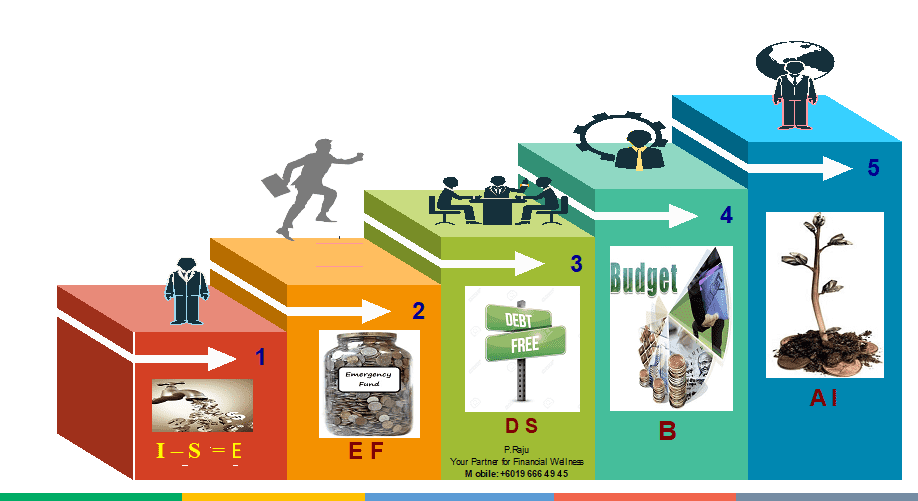
    5 steps to achieve financial wellness

    So, the 5 important steps to achieve financial wellness as described in Figure 1 are as follows:

    Step 1: Be a Conscious Spender to Save Money

    Step 2: Be prepared for Rainy Days

    Step 3: Minimise your leakages by Managing Debts

    Step 4: Be Control of Your Money via a Budget

    Step 5: Consistent Accumulation & Investing of Money

    In the first instalment of this financial wellness article, we will focus on the first step, which is Be a Conscious Spender.

    Conscious Spending

    spend

    Step 1 pretty much implies that you decide exactly where you’re going to spend your money, after you have paid yourself of course. At this stage, you’re also actively choosing to spend on some things and not on others.

    According to American personal finance advisor and entrepreneur, Ramit Sethi, who is also the author of the 2009 New York Times Bestseller on personal finance, I Will Teach You To Be Rich, “The heart of frugality is choosing to spend on the things that are important to you while cutting back ruthlessly on the things that aren’t.”

    So, conscious spending is very important since it fosters every virtue, teaches self-denial, cultivates the sense of order, trains to forethought, and so broadens the mind.

    In a nutshell, it depends on the ability to control one`s money by becoming a conscious spender and focus on needs, then wants, and subsequently cultivate consistent saving habits.

    As you start to practice conscious spending, your financial behaviours or habits improves, which is really the key to achieve financial wellness.

    To put conscious spending in action, you have to learn to ask yourself the questions below before you make a purchase:

    • Will I use this?
    • Can I get this cheaper?
    • Can I wait to buy this?
    • Why am I buying this?
    • Is there something else I’d rather spend the money on?

    Conclusion

    Financial behaviours or habits are formed in individuals over time; it cannot happen overnight. However, once you get it going, it would become very difficult to shrug it off.

    About the author

    Raju Periasamy is a Certified Member of the Financial Planning Association of Malaysia (FPAM) and a Licensed Financial Planner with Phillip Wealth Planners Sdn. Bhd.  He can be contacted at rajuperi@gmail.com

  • Financial Planning for the Middle-Class Rakyat

    Financial Planning for the Middle-Class Rakyat

    Financial planning has often times been associated with the rich. Most people have the perception that only rich people can afford to plan their finances. Is this a fair observation?

    So does this mean that if you are not rich, you should drop the idea of financial planning? What if you are in between these two extremes – the middle class or middle-income people?

    I have constantly observed how the middle-income group struggle more compared to the low-income group. When you’re in the latter, you live a lifestyle more driven by need.

    However, if you belong to the middle-income group, the decision-making process is based more on the want factor, not need anymore.

    How then can the middle-income group reduce their disadvantage and propel themselves toward their aspirations and dreams? Below are some ideas that one can explore:

    Be Aware

    When it comes to investing, you cannot wait until you have enough money, and then only start to think about investing.

    The popular belief is that we can only manage our financial affairs once we have surplus. However, in actual, those who have surplus are those who have done planning, and make it a point to ensure they do the needful.

    Cash-flow management is crucial

    If you manage your cash-flow and debt obligations, you would end up having surplus because without surplus, it’s impossible for one to have savings.

    Protect your savings

    It’s not easy to accumulate savings nowadays; thus, you need to learn to protect it efficiently. We cannot afford to overlook or ignore risk management as this can help protect our savings when financial losses occur.

    Watch your credit behaviour

    Those who are in credit card or debt crisis have once told themselves that they would just use the credit card for rebates and free-gifts, and that they would make sure they pay the billed amount every month.

    The only trouble with this plan is that before you realise it, you are barely making minimum payments, and the amount balloons into a huge outstanding in no time.

    Moreover, interest payment is one of the tiny leakages that will have long-term impact on our ability to save.

    Start early but small

    According to Figure 1 below, a person who starts investing RM12,000 today with no additional new contributions thereafter, will need an investment that generates 10% per annum to have RM130,016 twenty-five years from now.

    financial planning
    Future value of investment

    However, another individual who started with RM6,000 (50% lesser) would require an investment that is 50% less risky (5% per annum) throughout the same time period, to generate RM134,863. The trick is to cultivate the discipline of adding RM200 a month to the savings pot.

    It’s much easier to save a smaller amount than wait for your capital to become significant, as smaller amounts can also grow to become substantial.

    Stay ahead of inflation

    A person who invests his savings in a way that is right and in-line with his risk capacity, will see his wealth grow and become inflation-proof in the long run.

    If you do nothing about inflation, you will find it tougher to maintain your lifestyle. This is due to your shrinking purchasing power, and since it is more likely that your income level will stay stagnant or grow slowly, you will then find that your freedom will be limited by your purchasing power.

    The only way to give our wealth some chance to at least maintain its purchasing power is to put it to work.

    When you invest, you must bear in mind to invest in instruments that are suitable with your risk profile and is regulated at the same time.

    Work on your investment literacy

    A person in the middle-income group may have some disposable income, which they would want to invest, after taking care of their lifestyle.

    However, be aware of scammers who are out to ‘steal’ our money, influence us to make bad investment decisions, resulting in losses or wasted opportunity.

    It is therefore important to have a basic knowledge of investment literacy to conduct appropriate due diligence on investment proposal that is presented to us.

    Financial planning is not for the cheapskate

    One misconception people have is that when we embrace financial planning, we will have to accept a frugal lifestyle.

    However, the whole point of financial planning is to put the aspirations and life goals of a person at the core; as such, it’s rather counter intuitive if you will have to live a frugal lifestyle.

    If you embrace financial planning, what you’ll essentially do is look at your personal finance in totality, make decisions that are smarter and less attached to your urge and emotions for instant gratification.

    It doesn’t mean you have to eat lesser, or not go out with your friends. We all need a life to build our network.

    All said and done, we need to go through a process to manage our financial affairs to ensure that at the end of the day, we will have enough ‘financial muscles’ to help us achieve our life goals.

    About the author

    kevin neohKevin Neoh is a NextGen Money Coach who works with people to help them transform their relationship with money to improve their lives with the money they have. Kevin can be contacted at kevin@nextgenadvisors.my and www.kevinneoh.my.