
Blog

  • Thinking Of Using An Initial Exchange Offering (IEO) To Raise Funds?

    Thinking Of Using An Initial Exchange Offering (IEO) To Raise Funds?

    Fintech has made it easier for ordinary retail investors to discover new opportunities through innovation in crowdsourcing. Investors can participate directly as shareholders of private enterprises via equity crowd funding (ECF) or become lenders via peer-to-peer financing (P2P).

    Conversely, these enterprises gain access to new capital pools beyond their immediate network of families and friends. Or they get to tap into alternative funding sources after exhausting the credit lines in their banking relationships.

    Initial Exchange Offering (IEO) opens another avenue for them. Theoretically, digital assets are borderless and enable free movement of capital. This means that IEO can potentially attract global capital inflows for local enterprises, which is an advantage vis-à-vis ECF and P2P.

    A Boon for Local Tech Entrepreneurs?

    We know that the financing gap for micro-, small- and medium enterprises (MSME) has always been a perennial problem. This is a key growth engine for the economy but lack funding options. Based on estimates by the Securities Commission (SC), the MSME segment contributes around 60% of our country’s gross domestic product (GDP) but face a financing gap of RM90 billion.

    [1] Funding from conventional equity and bond markets mainly cater to listed companies, even though they contribute to only an estimated 15% of GDP. 

    In the technology sector, which is typically loss-making in the early stages, the problem is more acute. It has to rely on a limited base of angel investors, government grants, and onshore venture capital (VC) funds, many of which are also government-linked.

    It doesn’t help either that the local VC landscape is less robust compared to our neighbours like Singapore and Indonesia – with fewer active firms, smaller fund sizes, and lower risk appetite.

    This is where IEOs come in to fill this gap, as an alternative tool for enterprises to form capital across their spectrum of growth (see diagram).

    IEOs specifically cater to enterprises with projects that “provide an innovative solution or a meaningful digital value proposition for Malaysia”.[2] This is wide enough to include anything that “addresses an existing market need or problem; or improves the efficiency of an existing process or service”.

    By allowing IEOs to raise up to a maximum of RM100 million, this could carry start-ups and early-stagers through to the Series rounds. In fact, this amount is even higher than what late-stagers averagely raise at public listings on the junior boards of Bursa Malaysia like ACE and LEAP!
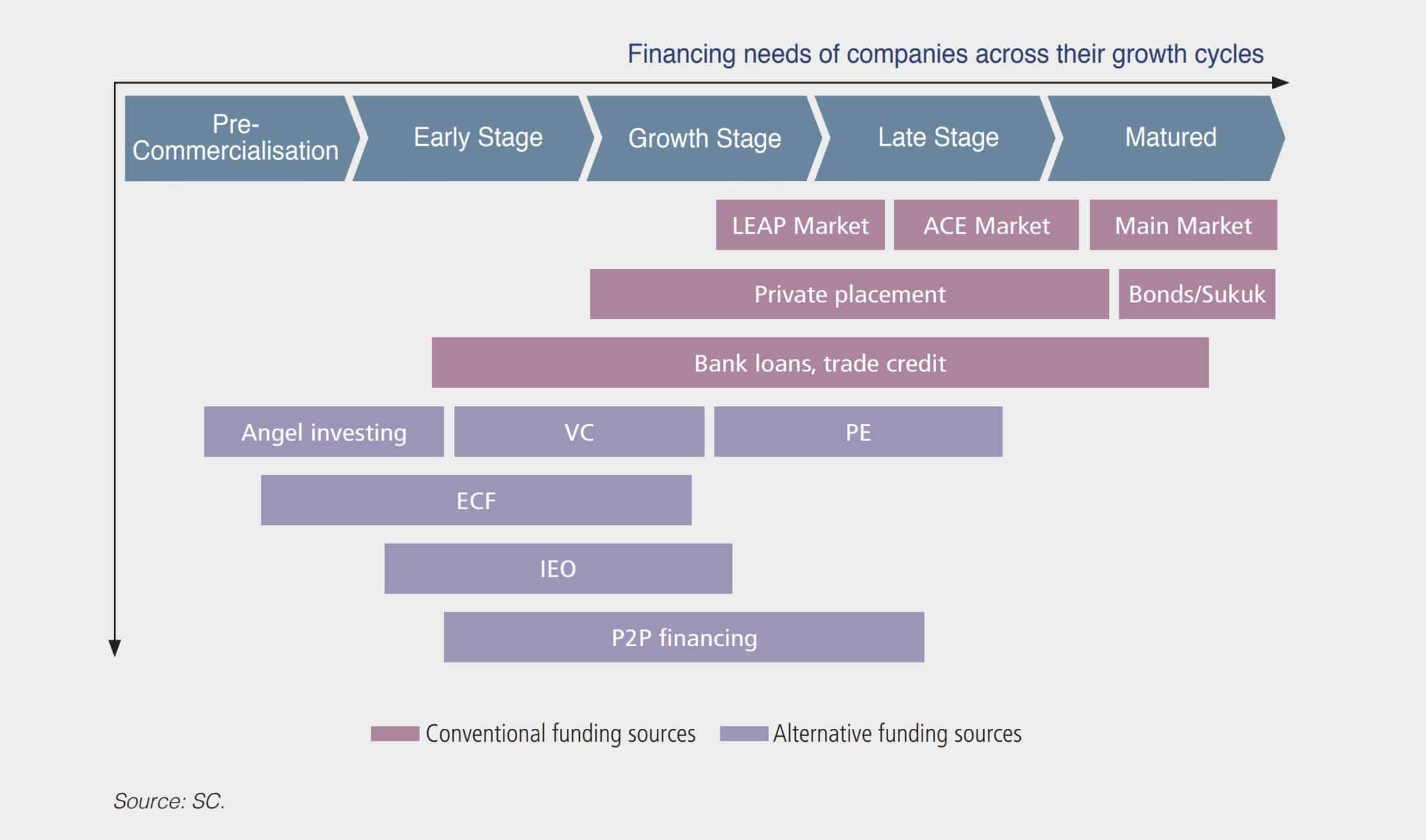
    Source: Securities Commission Malaysia

    Is it Difficult to Become an Issuer?

    While there are regulatory requirements to ensure the integrity of the offering, the funds are kept in trusted hands, and the people running the show are fit and proper – overall, the entry barrier is kept low. If you are planning to issue tokens for your business, you can approach the IEO operator who will qualify your investment thesis and make the decision to approve or reject it. It does not have to go through SC for approval. 

    What you do need is to prepare a whitepaper for submission to the IEO operator and SC. Although this is not subject to stringent Prospectus Guidelines, the requisite coverage of contents is extensive. Put bluntly, this is not going to be any run-of-the-mill whitepaper of an Initial Coin Offering (ICO) project that you just pull from the web.

    It has to include, among other things, the audited financial statements of the issuer, distribution policy of the digital tokens, their accounting and valuation treatments including “all reasonable presumptions adopted in such calculation”, and the scheduled timeline for drawdown and utilisation of proceeds.[3] And should there be any material changes or omission to the whitepaper, a supplement is required for submission anew.

    The issuer should also note that an IEO is an ‘all-or-nothing’ raise. Essentially what this means is that the issuance must be fully subscribed. If it is under-subscribed, the issuer is not allowed to keep the monies raised unless the target amount is achieved, and the IEO operator must refund back to investors. If it is over-subscribed, the issuer is not allowed to keep any amount exceeding the target amount raised.

    Does This Replace Venture Capital?

    No, it doesn’t. The intent is to diversify funding sources as shown in the diagram above. But there are other factors at play.

    To the cash-hungry entrepreneur, the IEO option generally provides lower cost of funds with lower cost of issuance (though this is debatable). Their investors are less demanding than banks when it comes to assessing the credit risk profile of the enterprise.

    More importantly, digital tokens are not considered shares (as mentioned in Part 1) and are thus non-dilutive to capital structure. The shareholding control and cap table will remain the same post-IEO.

    On the other hand, VCs may prefer the conventional funding route for their investees because digital token issuance can complicate valuation during investment rounds and cause problems for eventual public listing. Why would VCs want to accept digital tokens, which might seem legally untested, instead of the usual tried-and-true convertible notes?

    Furthermore, the VC contract includes detailed covenants and provisions which cannot be summarily replaced by the ‘smart contract’ used in digital tokens in an IEO relationship.  

    And while there are global ‘crypto VCs’ that do accept digital tokens, they face a hurdle in Malaysian IEOs because cryptocurrency is not allowed as a form of payment for investment. More on this in Part 3.

    One thing to note is that IEOs cannot provide the kind of support that VCs do: To incubate, mentor, and accelerate the business. This is a major lesson from the ICO Boom-Bust during the 2016-19 period: While most people think of ICOs as scams or money grabs, the truth is, many projects were genuine without malicious intent, but their entrepreneurs didn’t know how to handle too much investors’ money and ended up failing. Cheap and easy capital can be both a blessing and a curse!

    Simply said: IEOs can give what entrepreneurs want but not necessarily what they need. The IEO regulations ensure that there is accountability for the funds raised – but not the advisory to prevent these funds from being misused by management.

    Why Are Other Sectors Also Eyeing This?

     

    The ability to tokenise assets and businesses into units of investment, and distribute them through IEOs, has captured the imagination of other industries such as property, agriculture, and hospitality.

    For lumpy or indivisible assets like real estate or property, tokenisation can carve them up conceptually into smaller affordable portions (commonly known as ‘fractionalisation’) with lower minimum investment for retail investors. For commoditised sectors like agriculture, the issuer can sell digital tokens that represent metric units of their production yield e.g., one token equals to one tonne of wheat.

    It boils down to how you play with the economics: Hotels are intuitively tokenisable as they are made up of individual rooms which generate income. Investors can estimate how much a hotel room unit is worth based on its future earnings potential.

    Certain suites can be tokenised at a higher price. Shopping malls and integrated projects can choose to unbundle different property rights by issuing different class of tokens, or strip the property into different income streams which are hardcoded into the ‘smart contract’.

    There is no doubt that a tokenised structure can provide much flexibility for property owners or developers sitting on illiquid stocks. It can be similar or even go beyond what securitisation models or REITs (real estate investment trusts) can achieve.

    However, it is important to realise that what is technically possible may not always be legally feasible. Given the dearth of regulatory guidance on IEOs at this point, there are a lot more questions than answers.

    Finally, the RM100 Million Question…

    In the end, literally the hundred-million-ringgit question on everyone’s minds is this: Could an IEO operator raise this kind of money, consistently? Even a mere 10% of this is a huge raise on its own, and extremely rare, by ECF standards. Where will the investors come from?

    Let’s find out in Part 3.

    About the Author

    Edmund Yong is the managing partner of Celebrus Advisory and appointed by MDEC as part of its Talent Expert Network (formerly known as Digital Expert Panel) for blockchain technology. He is also the resident consultant for GLT Law, a multi-award-winning legal practice with specialisation in digital assets. All opinions expressed are the author’s own.

    [1] Securities Commission of Malaysia, Capital Market Masterplan 3: 2021-2025 (2021).

    [2] Securities Commission of Malaysia, Guideline on Digital Assets (28 October 2020).

    [3] Ibid.

  • Financial Literacy & Financial Accountability Are Life Changing

    Financial Literacy & Financial Accountability Are Life Changing

    For us to pursue our multiple life goals, we will need to have financial resources, which is like our ‘financial muscle’. We will need to have muscles to do the weight-lifting, which is to turn our life goals into reality. Therefore, we need to have the know how.

    This, essentially, is financial literacy.

    The Organization of Economic Co-operation and Development has defined financial literacy as a combination of awareness, knowledge, skill, attitude and behaviour necessary to make sound financial decisions and ultimately achieve individual financial wellbeing.

    Why Is Financial Literacy Important?

    financial literacy

    Obviously, the decision we make today has a long-term impact on our financial wellness in the future. Hence, a poorly made decision may have a very detrimental impact on our future.

    If a person is not financially literate, then this person may face multiple challenges in respect to managing his or her own wealth. Potential consequences can be:

    • Not protecting savings and assets adequately;
    • Not prudent in borrowings and ending up with too much debt;
    • Not investing to inflation-proof your purchasing power;
    • Not having a will; and
    • Not having financial safety net like an emergency fund and health insurance.

    The list can go on and on.

    When a person is in a situation as above, it’ll be rather difficult person to attain financial independence as well as pursue his or her life goals.

    How Financially Literate Are We?

    The following statistics from the National Strategy for Financial Literacy 2019-2023 Report gives us a picture of where we stand as a nation in terms of financial literacy.

    • 43% of Malaysians understand that growth of money is compounded over time, while 22% believe money grows on linear basis;
    • 75% of Malaysians understand that inflation means cost of living is rising, only 38% can relate the effect of inflation on their own purchasing power;
    • 84% of Malaysians who claim to save regularly typically withdraw it at month-end to cover daily subsistence expenses;
    • Three in 10 of working adults need to borrow money to buy essential goods;
    • 52% have difficulty raising RM1,000 as an emergency fund;
    • Only 24% are able to sustain their living expenses for at least three months if they lose their main source of income, and only 10% can sustain for more than six months;
    • Six in 10 adults are self-employed and hence not covered by a social security system or any formal retirement fund; and
    • About 60% of investors were found to have unrealistic expectations on potential annual return from investment in capital market products.

    A Financially Responsible Person

    financial literacy & financial accountability

    When a person is financially literate, he or she will be more capable in understanding how his or her decision can impact their financial future, hence becoming a responsible person financially.

    When we are financially responsible, we will be careful about adding financial responsibility to our finances. We will ensure that we do not spend all we make but make provision for our future, and for emergencies.

    In fact, most people are aware of this but somehow, fail to take action.

    What Is Missing?

    Since most of us who are working adults have not been taught about financial literacy in school, we need to learn it from somewhere.

    Learning is a passive thing – you can continue to read, learn, listen to podcasts or attend workshops for years. However, it is not the learning that matters but the doing that makes a difference.

    To ensure that we do what is in our best interests, not only do we need financial education, we also need financial accountability. I truly think this is the key missing piece of the puzzle.

    Perhaps you can read Unit Trusts, The ‘Safest’ Investments For Beginners In Malaysia?

    That is why we are unable to behave rationally and stick to our plans, fail to save what we plan to save every month, all because of a lack of accountability.

    I will define accountability as having a sense of ownership over your work and accepting consequences for your actions and behaviours.

    Many times, we are aware that if we don’t save, it will leave us in a worse shape compared to when we save. But we spend anyway.

    So to increase your financial accountability, it’s best if you work with someone interested to help you stay true to your own words, and be accountable for your own actions.

    Financial Accountability Partner

    An accountability partner is someone who coaches another person to keep a commitment. Getting a right accountability partner is known to be a highly effective strategy for goal-setting and achievement.

    The good news is that If we want to stick with our action plan, we just need an accountability partner. The bad news is that we cannot be our own accountability partner.

    And if you have selected a candidate who is not so suitable, your accountability partner may well turn into your partner in crime.

    What To Look For In Your Accountability Partner?

    Ideally, this person should be able to complement you in terms of knowledge, skills, expertise. Since this is a financial accountability need, your candidate should possess extensive knowledge on this subject matter. Otherwise, coaching you to do the wrong thing will eventually send you down a path that is cursed as well.

    However, you should look beyond things that are measurable such as knowledge. Will this person be willing to challenge you to out-grow your limit?

    Your main objective of getting an accountability partner is to outperform your own set objectives. Therefore, you need someone who has the courage and discipline to tell you what you need to hear, not what you want to hear.

    Your accountability partner should also be able to make sure you follow through on your commitments, monitor and review your action plans with you so that you can find ways to improve on it.

    When you are in doubt, he should also be able to provide you with independent feedback and show you the next step so that you will not be stuck at status quo.

    Who Can Be Your Ideal Financial Accountability Partner?

    financial literacy

    Most of us have friends, and family members who we care a lot for. Are we their financial accountability partner?

    Did any of our friends or family members volunteer to talk to us about our financial successes and planning? Has anyone have taken the time or initiative to tell us the importance of save-first, spend later, or the importance of having an emergency fund?

    I guess the common answer to these questions will be a string of “no’s”.

    That is also why I volunteer myself to be your financial accountability partner by devoting my lifework to be a licensed financial planner. I have a strong sense of fulfilment whenever people feedback to me that they are seeing progress and happy because they are sticking to their own plans and are seeing results.

    That sense of fulfilment is even stronger when I get credit for the success my client is having.

    Personally, I believe that it is important for us to work at something we love to do and are passionate about. I’m just glad I’m under this category.

    I think someone who is doing what they are doing when not motivated by monetary reward alone, will be the right person to do the best work.

    So, get an accountability partner to make sure you are accountable for your financial independence.

    About the author 

    kevin neohKevin Neoh is a NextGen Money Coach who works with people to help them transform their relationship with money to improve their lives with the money they have. Kevin can be contacted at kevin@nextgenadvisors.my and www.kevinneoh.my

  • Going Global With The Property Investment Life Cycle

    Going Global With The Property Investment Life Cycle

    Over a long time of observing and interviewing many established developers, high-profile bankers, ultra-high net-worth investors, successful entrepreneurs and private equity firms, I would like to share with you a market proven real estate investment strategy that I call Property Investment Life Cycle or PILC.

    With the skyrocketing house prices since 2010 in Malaysia, common investors have stampeded into property investment to ride the wave of fortune. Indeed, property investment is always one of the favorite options for high net-worth individuals to preserve their wealth and is arguably the safest asset class of all.

    Delving into the fundamentals of property, I noticed that PILC is very similar to the human life cycle – people are born, grow up, age, and cease living. It makes no difference when it comes to property development and the property investment cycle. By adding value to a property according to different stages of its life cycle, investors can enjoy continuous profit regardless of the market condition. 

    Property Investment Life Cycle

    The following are the six key stages in PILC and how you can reap significant return in these stages: 

    1. Land Acquisition

    Property investment life cycle

    Buying land is usually significantly less costly while it is undeveloped compared to land that has usable construction structure. To put it clearly, the land is the raw material of any property development. Thus the saying – the best investment on earth is earth. Land is always a scarce resource as it is non-produce-able.

    Hence, developers are constantly on the lookout to increase their land banks. Acquiring the right type of land such as agriculture, industrial, residential, commercial, and many more with the right size of density, plot ratio, type of usage and development, individual unit size will ultimately decide the potential value of the land. 

    Getting a housing or any loan in Malaysia? Worth a read Housing Loan In Malaysia: What Is Debt Service Ratio (DSR) And How To Calculate DSR?

    2. Development

    property investment

    Where property is “born” –  this is the real crown jewel among the six stages as it contributes the biggest profit-making ratio within a short period in the PILC. Traditionally, developers acquire a parcel of land (or sometimes have a joint-venture with the land owner) and build multiple units on the same title.

    Upon construction completion, the developers will market the end units to the public at a premium. Due to the high barrier of entry, huge capital and expertise involved, only large corporations and conglomerates are able to participate in this lucrative segment. However, by deploying the joint-development strategy a common investor can now invest together and earn like a developer as well. 

    3. Management

    Property investment

    With an eye to enjoying constant property value appreciation, good property management always plays a pivotal role. Once a property is constructed, it needs both building management and tenants’ management to keep it in top-notch condition and attract quality tenants.

    However, for some common investors, management is a nightmare in the journey of property investment while for an experienced investor, there are a lot of hidden gems in managing a property.

    On the other hand, some special purpose property management strategies are able to reap high profit margin compared to the ordinary property investment. For example, Airbnb, co-working spaces, commercial car parks, student hostels, short stay accommodations are some proven strategies in property management. 

    4. Renovation

    Renovation is like adding the soul into the body. It grants new functionality and enhances the appearance of a property. This strategy is one of the investors’ favourite as it can drive high profit within a short period of time.

    In fact, there are many buildings in disrepair due to negligence of the owners. To shake the dust off the owner’s feet, they are willing to let go the property at a discounted price. By picking up these properties, you will attain profit by renovating the property and reselling it to the market at a better price. 

    5. Refurbishment

    Property investment life cycle

    When an ageing property, especially heritage buildings in some countries, is occupied over some years, it may experience rundown, be severely damaged and may not be in liveable condition anymore. The deterioration of the abandoned building sometimes go beyond renovation works. This type of building requires a large fund for refurbishment.

    Due to the reason that some property owners do not have the financial capacity to refurbish the building, these buildings can be purchased much lower than the market value. It can then be refurbished to a new design, providing new life to the historical building. 

    6. Redevelopment

    When experiencing special events e.g. natural disasters such as an earthquake, volcanic eruption, fire, or change of market demand, the accelerated depreciation of the property value makes redevelopment a sensible decision.

    Through redevelopment, existing buildings are fully or partially demolished and a new building is constructed. At this final stage of the PILC strategy, the said piece of land is given a new life to meet the local demand and thus boost the value of the property. 

    As mentioned in one of the famous quotes of The Art of War by Sun Tzu

    If you know your enemy and know yourself, you need not fear the result of a hundred battles. If you know yourself but not the enemy, for every victory gained you will also suffer a defeat. If you know neither the enemy nor yourself, you will succumb in every battle. 

    In short, if you plan to invest in any country, you need to understand its background including its economy, politics, risks and other important considerations that may ease your forthcoming investing journey.

    What we invest in our time defines who we are.

    About the Author

    Max Shangkar is group CEO of Max Capital Management Holding Ltd and an expert in global project management consultancy. He is also the author of the best-selling book Investment Strategies for Global Real Estate.

    He propounded the market-proven investment strategies of Property Investment Life Cycle and Business Investment Life Cycle that educated over 6,000 Global Investment Community members to invest in property projects and businesses in over 10 countries.

  • The Benefits Of Unit Trusts Investment In Malaysia

    The Benefits Of Unit Trusts Investment In Malaysia

    In previous articles, we already touched on what a unit trust is and how it works. Most probably, you will have rough ideas of how unit trust works in Malaysia and what unit trust is. How about the benefits of unit trusts?

    Let us now take a closer look at the benefits of a unit trust investment. You may consider investing in a unit trust after being well informed about this product.

    If you don’t follow what unit trust is, please have a read first at Unit Trusts, The ‘Safest’ Investments For Beginners In Malaysia?

    Benefits Of Investing In Unit Trust

    What are the benefits of investing in a unit trust? ASB is one kind of unit trust investment. Keep in mind that ASB is only for the Bumiputera. How about the others? Does investing in unit trust profitable enough?

    1. Managed By The Professionals

    benefits of unit trusts

    You know what? An expert is looking after your investment. Worry not, it’s better to have someone professional to take care of our investment portfolio rather than most of us who know nothing when it comes to investing.

    Fund managers are responsible for managing and investing the pool of money from the investors. They’re skilled investors who understand the market, spending a lot of time analysing shares as well as the industry and economy at large.

    They’re always on the market to be as fast as they can to take advantage of the market price movement. Would you be able to do that?

    2. Diversification Of Portfolio

    unit trust diversification

    You have a small amount of money, but there are so many potential things that can be profited from your investment. Well, unit trust can help you diversify your investment portfolio. Diversification will help you to reduce your investment risk.

    Let’s say you have 10 eggs. Would you place all your eggs in one basket or place them into a few different baskets? If anything happens to one basket, then what about the rest of the eggs?

    The same goes for investment. If anything happens to one or more of these shares while you put everything in the same stock or industry, your investment portfolio will be affected. To reduce the risk, diversify your investment!

    3. Liquidity

    liquidity money cash unit trust

    Most investors prefer their investment to be liquid. It means that the investment can be easily converted to cash. Unit trusts provide this feature. Any unit can be bought or sold easily. Some of the funds can return your investment to cash within the same day.

    This option will help those in their emergency time to gain cash by liquifying their investment easily.

    Unit trusts may be the best investment, especially for beginners but it will not suit every investor’s appetite. Make sure that you understand your risk and also the investment products before making any investment decision.

  • How To Manage Your Quarter Life Crisis?

    How To Manage Your Quarter Life Crisis?

    As a counsellor, I have seen many young adults come in claiming that they are depressed.  From my perspective what they might actually be experiencing can be termed as ‘’quarter life crisis’’

    Then the question arises “What is quarter-life crisis?’’

    This is a new phenomenon that is happening to young adults who are in their twenties and thirties. Fresh graduates who are entering the ‘real world’, suddenly find themselves under a lot of pressure to succeed vocationally, relationally and financially even before hitting their thirties!

    Signs That Young Adults are Facing a Quarter Life Crisis

    quarter life crisis young adults
    • They are confused about what their next step in life should be – Questions like these would appear in their minds: Is this what I want in life? Will I be stuck here? What can I do next? There are tons of questions that they don’t seem to be able to answer.
    • They are overwhelmed by all the possibilities out there – The modern economy is fast and dynamic; it’s in a constant state of change. Adapting or succumbing to change is the only option. This creates high stress and anxiety effect on them.
    • They feel stuck in terms of their life choices and feel like not having control over their own future – Some may feel pressured to marry and have children before the age of 30 as some of their friends may already be married and have a high-paying job to accommodate their luxurious lifestyle whereas they are still questioning the decisions they made for their life.They keep jumping from one career to another. They spend a lot of time wondering if they should work for money or follow their passion and do what they love. They would second-guess their choice of career field and be probably wondering if they should go abroad to explore the opportunities or stay where their family and friends are. 

    Finding the Right Ways to Cope

    Become aware

    Identify which aspects of their life they struggle with and break them down into smaller segment. Look at it one by one; don’t mix relationship issues with career, and don’t compartmentalise them either.

    Don’t be hard on them

    Remember that they are a beginner and it takes time to adjust. Venturing into something new is a tough transition so be patient. 

    Don’t be afraid to let them try new things

    It is okay to make mistakes as they journey through this phase in their life. They will slowly gain experience as they go along and this will be their priceless assets. It is like learning how to ride a bicycle and once they master it, they will be able to do it without having to think of it much.

    Recognise their achievements

    quarter life crisis young adults

    Recognise their accomplishments. Take pride in them. Be grateful for them. It will provide them with the energy to keep moving forward. Take comfort in knowing that through hard work and determination, everything else will fall into place. 

    Seek help from a counsellor or a mentor

    Find a counsellor/career mentor to help them strategise what their next move should be. Counsellors/career mentors are trained to identify problems people face and will be able to empower a person who is facing difficulties find practical solutions to their problems.

    Lastly, quarter-life crisis is not a crisis! It is an expected development of personal growth and evolution of an individual. Young adults are growing, learning and noticing new talents as they grow. It is not a crisis if they have not achieved greatness by their late twenties and it is okay to make mistakes as it helps them become better human beings.

    As long as they continue to love themselves, discover their potentials, and evolve into their authentic self just remember that every step they take in life is helping them become something better.

    So, if at any point of time you come across a young adult who is facing a hurdle in their path, don’t let it overturn them, just encourage them to keep going as this is just a small dent in the road, to the beginning of the rest of their life. After all this is what is called LIFE.

    About the author

    Faith Foo (MA Counselling) is a Registered & Licensed Counsellor at Rekindle Therapy (www.rekindletherapy.com)

  • Malaysia’s Employer-Sponsored Medical Benefit Costs Expected To Increase 12% In 2022

    Malaysia’s Employer-Sponsored Medical Benefit Costs Expected To Increase 12% In 2022

    Insurers in Asia are experiencing above inflation rises in the cost of employer-sponsored medical benefits programs over pre-pandemic levels, according to a report by Mercer Marsh Benefits (MMB). According to findings in MMB Health Trends, costs in Malaysia decreased by 3% in 2020, but increased by 8% in 2021. Insurers are expecting medical costs to further rise by 12% in 2022 – six times the predicted general inflation rate for Malaysia, the third highest increase in Asia, the report noted.

    The MMB Health Trends report surveys 210 insurers globally, including 74 in Asia, and identifies key trends influencing the future of employer-provided medical benefits. The results show that five countries in Asia experienced higher medical trend rates than the regional average (8.8%) in 2021, namely India with the highest medical inflation rate of 14%, followed by China (12%), Indonesia (10%), Vietnam (10%), and the Philippines (9%). Overall, 81% of insurers in Asia indicated an upward trend in medical claims activity in 2021, even though 53% of insurers reported lower medical claims than pre-pandemic levels.

    Malaysia’s Ministry of Health has estimated that non-communicable diseases (NCDs) cost the Malaysian economy RM 12.88 billion in terms of productivity losses arising from absenteeism, presenteeism or premature death in persons of working age per year.[i]

    The MMB Health Trend report reveals that cancer (55%), diseases of the circulatory system (43%), and COVID-19 (36%) were the top cost drivers of medical claims in Asia in 2021, while respiratory diseases (47%), gastrointestinal diseases (36%) and COVID-19 (34%) are healthcare conditions that experienced the most frequent claims.

    Joan Collar, Asia Regional Leader, Mercer Marsh Benefits, commented: “Costs have soared despite lower levels of medical treatment than before the pandemic, a trend exacerbated by deferred healthcare treatments that for many have resulted in more adverse outcomes, leading to higher costs. Reducing NCDs remains a key priority for employers for the health of their employees and their business. More than ever, employer-sponsored medical benefits should be viewed as an investment in employees’ well-being. Employees who feel their employer cares about their health and well-being are more motivated, productive, committed, and loyal.”

    Gaps remain in mental health coverage though inclusive benefits increase

    Of all global regions, the report identified Asia as having the most inadequate coverage in relation to mental health, with only 34% of insurers providing coverage for outpatient treatments in mental health, and just 21% providing coverage for preventive mental health measures. Moreover, 32% do not offer any coverage for mental health services, reflecting a huge protection gap between access to benefits against the burden of mental health risks.

    However, the study shows that 33% of insurers are making changes to facilitate more inclusive medical plan designs by allowing coverage for the non-permanent or full-time workforce with 54% either adding or considering extending eligible expenses that are more inclusive for women.

    “Employers need to develop a mental health strategy to enhance the overall well-being of their employees and refine their benefits strategy accordingly to align it to their diversity, equity, and inclusion goals and the different needs of their employees. With a sharp rise in the number of employees experiencing burnout and fatigue, this has become a workplace imperative. Employers need to deploy investments and resources to ensure they maintain a mentally resilient workforce,” Ms. Collar added.

    The Mercer Marsh Benefits (MMB) is the service value proposition that Marsh brings to its clients. MMB is not an insurance product. In India, an insurance product can be provided only by a registered insurance company. Insurance is a subject matter of solicitation.

    About Marsh

    Marsh is the world’s leading insurance broker and risk advisor. With over 45,000 colleagues operating in 130 countries, Marsh serves commercial and individual clients with data-driven risk solutions and advisory services. Marsh is a business of Marsh McLennan (NYSE: MMC), the world’s leading professional services firm in the areas of risk, strategy and people. With annual revenue nearly $20 billion, Marsh McLennan helps clients navigate an increasingly dynamic and complex environment through four market-leading businesses: Marsh, Guy Carpenter, Mercer and Oliver Wyman. For more information, visit mmc.com, follow us on LinkedIn and Twitter or subscribe to BRINK.

    [1] The Impact of Noncommunicable Diseases and Their Risk Factors on Malaysia’s Gross Domestic Product (2020). Putrajaya, Malaysia: Ministry of Health Malaysia.

  • When Investment Habits Affect Your Optimal Wealth Growth

    When Investment Habits Affect Your Optimal Wealth Growth

    Over the course of the Movement Control Order in Malaysia, brought about by the global pandemic of COVID-19, the lives of every individual in the country have been upended in more ways than one. Changes to our daily routine that we would not have imagined half a year ago have become part and parcel of the “new normal” and almost second nature by now: wearing a mask in public spaces, having a bottle of hand sanitizer available on hand anywhere we go or constantly keeping a social distance from friends and colleagues.

    Apart from adopting new habits, a silver lining has emerged where some have ended up discarding unhealthy habits such as late-night suppers, smoking or regularly eating out. Had it not been for circumstances forcing a change in lifestyle, many individuals would probably carry on less than ideal practices without giving much thought to them.

    Likewise, when it comes to making investments, many individuals may not realise that some of their investment habits are actually detrimental to their financial health and can impede their ability to grow their wealth optimally. It is important that these “unhealthy” investment habits are recognised so that they can be addressed in a timely manner to avoid long term repercussions. These are some of the most common habits that we observe among many investors:

    1. Investing TOO Safely

    Many people particularly retirees may prefer to play safe by putting all their money in FD alone because it is deemed to be the safest form of investment. However, in the current market environment where FD rates are below 3%, the impact of inflation is very apparent.

    The Rule of 72 states that when you take 72 and divide it by the rate of return, the answer will tell you the number of years required to double your money. So, if you are getting a 3% return, it will take you 24 years to double your money! With inflation eating into your money, your purchasing power 24 years later is going to be a lot less than today. In comparison, if you can navigate through a moderate risk diversified investment portfolio and earn an 8% annualised return, it would only take 9 years to double your money. 

    2. Emotional Investing

    Some investors tend to wait for the “right time” to invest, anticipating a feel-good factor when markets go up and this is when they decide to ride the wave of the moment in hopes of buying high to sell even higher.

    In contrast, when the markets come down, they stay on the side-lines and play the waiting game, using negative market sentiment as justification for inaction when instead they should be taking the opportunity to bargain hunt. This is contrary to the investment philosophy of “buy low, sell high”.

    3. Following The Crowd (FOMO: fear of missing out) Mentality

    When it comes to investing, word of mouth among friends and relatives is a common approach. Often what you hear are the good things informed to them by the salesperson and passed on without verification of facts or supporting evidence.

    Victims of investment scams are commonly “recruited” into it by people they know and trust. It usually starts off innocently enough with a nominal amount put in for the sake of maintaining a cordial relationship with the so-called referrer and also out of curiosity to see how the scheme pans out.

    However, small losses can add up over time and the opportunity cost of missing out on bona fide investments is time permanently lost. 

    4. Misplaced Sense of Confidence

    This is when an investor applies knowledge garnered from certain investment exposure as THE investment strategy for all investment asset classes, not realising that expertise in one area does not necessarily translate to identical outcomes in other areas as far as investments are concerned.

    For example, a share trader who is used to high frequency trading activities decides to apply the same investment strategy in diversified investments such as unit trust, but the experience might turn out to be entirely different. As a result, he decides to stick to investments which allow active trading like forex or crypto currency investing since high frequency trading is his forte.

    5. Not Investing Based on the Best of Breed Investments

    This is quite typical of investors who, perhaps due to lack of time to do the necessary research, tend to invest with a blinkered approach instead of comparing the best investments in the target category. In other words, are you considering all the available options for the similar type of product to compare, or are you limited to only one or two options as presented by the salesperson?

    For example, an individual who wishes to invest in Malaysian small capitalised stocks should comb through the performance of various funds in the same category before arriving at a decision. Thereafter, this process should be repeated periodically to ensure that he remains in the best funds within the same category.

    6. Investing Without a Strategic Asset Allocation in Mind

    All investments can be loosely categorised as low, moderate or high risk. This categorisation is a function of the inherent price volatility of the investments. When one invests, it is important to understand the appropriate percentage or allocation of low, moderate and high risks assets and this is dependent on one’s risk profile.

    As an example, the strategic asset allocation of a moderate risk investor should be around 10% of investable assets in low risk assets, 70-80% in moderate risk assets and the remaining 10-20% in high risk assets. Low risk assets will comprise of assets such as bank deposits, capital protected investments or investment grade bonds.

    Moderate risk assets consist of investments such as balanced diversified portfolios, high dividend yielding shares, property investments or REITs. Lastly, high risk assets would encompass highly volatile assets such as growth focused or small cap stocks and alternative assets such as crypto currencies.  

    Very often, we come across those who invest a very high allocation (>70%) of their investable funds in their favourite assets, either properties or shares or plain old fixed deposits.

    While it is not wrong to invest in instruments that you are familiar with, choosing these over your ideal strategic asset allocation could result in an over exposure in certain asset classes that can leave you vulnerable during in a down market cycle of that asset class, or having to deal with very low yields as is the current scenario for FD investors.

    7. No Active Performance Management

    Another habitual tendency of investors is investing – full stop. What this means is once they put their money in an investment product, it’s hands-off from thereon. Active performance management is important because it allows:

    • Tracking the performance of the investment and taking profit when there’s an opportunity;
    • Reinvesting profit when the market goes down to average down your cost;
    • Rebalancing your investment portfolio with a target asset allocation in mind; and
    • Restructuring in order to move from an under-performing fund to a better performing fund in the same category.

    Without active performance management, investors may miss out on time sensitive opportunities to better their investment returns.

    In conclusion, while unhealthy investment habits may not bankrupt you overnight, they can potentially pose a large stumbling block to your wealth accumulation in the long run. In the current economic situation, most of us would agree that every ringgit counts. Replacing these habits with new, healthier investment practices only requires some willpower and determination and the rest will follow suit.

    About the Author:

    Felix Neoh CFP CERT TM is the Director of Financial Planning at Finwealth Management Sdn Bhd and is a certified member of FPAM. He can be contacted at enquiry@finwealth.com.my

    We at Smart Investor and Finwealth is committed to help you better manage your financials. Get a free consultation from an expert by filling in your details here: https://www.smartinvestor.com.my/SIxFinwealth

  • 4 Tips For Millennial On Accumulating Wealth

    4 Tips For Millennial On Accumulating Wealth

    For many millennials striving for success in their careers, starting their own family and seeking to build up a nest egg for a comfortable retirement, the journey of wealth accumulation can often be fraught with challenges and pitfalls.

    Many think that wealth accumulation is just having lots of money. In fact, “having money” and “wealth accumulation” are two different things.

    Having money allows you to pay for your expenses but it is typically spent shortly after it comes in. The latter goes a step further – it is taking disciplined steps over a period of time to achieve wealth accumulation. Here are some tips for the millennial on how they can accumulate wealth.

    Saving, Saving, Saving!

    For wealth accumulation, you need cashflow. The very first step is to set a financial goal and stick to it! Once you are clear about your objective, the next step is to be disciplined enough to achieve your money goal.

    A good suggestion is to use “automation”. Automation adds built-in discipline to your financial life and reduces the likelihood that you will forget your objective or spend money on things you do not need.

    You can set up automatic deductions from your paycheck bank account to send money directly to another savings account, unit trust or investment account. By automating these payments, you are making sure that you are paying yourself first.

    Cut Expenses

    Cutting unnecessary expenses is the key to living below your means, so you can reach your financial dreams. Challenge yourself by resisting expenses that are most tempting. For example, you might:

    • Cook at home every day for a month instead of eating out;
    • Refrain yourself from buying any new clothes or handbags for six months;
    • Avoid window shopping as that will cause unnecessary spending;
    • Say no to cinema and other entertainment places for six months; and
    • Cancel or delay your annual trip to another year.

    Imagine how much money you could save if you are successful in overcoming the above challenges. You could easily have an additional RM10,000 to RM20,000 to add up to your savings.

    Multiple Streams of Income

    You need cashflow to build wealth, and the best way to generate that extra cashflow is to earn more money. In Robert Kiyosaki’s book ‘Rich Dad, Poor Dad’, he mentions four types of income streams: Employee, Self-employed, Business Owner and Investor.

    For the first three sources of income, you are exchanging your time for money. It is a form of active income whereby you need to be “actively” working for money.  However, please do not underestimate these sources of income, as it can be useful when you want to utilise this as a leverage power to accumulate your wealth.

    You may buy your first property with this financial leverage. And if your investment is a positive cashflow, you would probably end up owning the property for free as your rental income is able to pay down your mortgage loan.

    The last source of income –  Investor – is the status that people most closely associate with wealth. This is where “money works for you”. As an investor, you earn the best kind of income possible – passive income by investing in assets such as stocks and properties.

    Why is it the best? Because you earn money while you were sleeping! If you can generate enough passive income, you may never need to work again in your life. In short, you can retire early.

    Get Rid of Your Bad Debt

    In the journey of wealth accumulation, we also want to identify the obstacles preventing us from achieving our financial goals. One big obstacle could be having too much debt. However, not all debts are bad – there are good debts and bad debts.

    Good debt is money you borrow at a low interest, with which you could make a higher rate of return, such as your mortgage rate. Bad debt, in contrast, is consumer debt. For example, money you borrow at a high interest rate to buy things that do not produce income or grow in value such as cars, electrical appliances, furniture and even luxury trips.

    The price of bad debt is the impact of compounding rates of return working against you instead of for you. If you have credit cards or bank loans costing you 18% or more a year, that’s 18% compounding against your retirement.

    The Bottom Line

    In summary, wealth accumulation does not happen overnight, it is a gradual and a disciplined process that requires proper planning and execution.

    Nevertheless, It is always good to have a licensed financial planner to guide you in setting up a blue print for your financial journey. They are generally able to help you to make better investment decisions and make sure your money is being deployed in the best manner.

    About the Author

    Pauline Yong is the CEO of Sigma Wealth Sdn Bhd. She is a CFP® (Certified Financial Planner), a licensed financial planner with a Securities Commission license (CMSRL) and a Financial Advisor Representative (FAR) licensed by Bank Negara.

    She has published five investment and financial planning books and writes regularly for various publications. Pauline is also a regular commentator on stock market outlook for City Plus FM radio station.

  • Retirement Planning, Why It Is Important From An Islamic Point Of View

    Retirement Planning, Why It Is Important From An Islamic Point Of View

    Malaysia is a country whose most professed religion is Islam. As of the latest statistics, there were approximately 19.5 million Muslims or 61.3% of the total Malaysian population.

    From another perspective, in 2019, it was estimated that the Malaysian population aged over 65 years stood at 6.7 percent. Malaysia is currently facing the prospect of an aging population, and the latest statistical data predicted this to be happening as soon as in 2030. 

    In a simplification, Muslims are the majority in Malaysia, and we are looking at the more significant rate of retirees as the year goes.

    However, are we truly ready for it? According to a recent survey by the Credit Counselling and Debt Management Agency (AKPK), more than 50% of Malaysians may not be financially ready for retirement. While the figure alone is already scary, what been happening, in reality, is even worse.

    We start to see the senior citizens who now need to continue working despite their retirement and against their suitability due to financial constraints and weak to no financial planning. Those with completely empty retirement savings within not even a few years without accomplishing anything contributing toward financial freedom – to name a few.

    Why Islam Encourages Us To Plan Their Lives In All Aspects?

    Muslim asian retirement planning

    Islam encourages Muslims to plan their lives economically and financially to achieve the objectives of Shariah (Maqasid al-Shariah). As Islam governs all aspects of life, it takes full cognizance of how Muslims gain and spend their money, including wealth. 

    Even though the child should look after their parents, especially when the recipient becomes too old and incapable of sustaining themselves, however, with a good understanding by the parent that their children are responsible for their own families, too. 

    The need to plan one’s retirement becomes more evident as the years pass. Retirement planning becomes more significant as the financial impact and demands of modern society take their toll on the grown children’s lives. Then once the cost of living increases, the ability of the children to care for other people other than their immediate families will become increasingly difficult. 

    Hence, one should consider the Islamic retirement planning tools and processes as one’s preparation to be independent financially when one is old or retires from one’s job.

    Aspects Of Islamic Retirement Planning

    Retirement planning is one of the elements of Islamic financial planning and wealth management. Retirement planning is a process that includes a comprehensive review and analysis of retirement income, retirement goals, and investment strategy.

    The purpose of retirement planning is to coordinate the financial resources available so an individual can plan for a financially secure retirement or reduce financial risk during retirement.

    Role Of A Financial Planner

    Financial planner planning

    To build a retirement planning is not an uneasy task. That is due to while everybody has an opinion on how to plan their financial needs, the truth is, a wholistic plan from a financial planner point of view, it should start with assessing the future income needs of an individual.

    Followed by financial objectives need to be established so that the retirement plan would have a clear target on how much future come to need to be achieved. Also, the retirement plan must align with the projected future income. 

    The most crucial part for the Muslims here is to ensure that shariah compliance must be taken into account. It is essential to make sure the retirement plan is free from prohibited elements, especially riba. 

    Even if one claims that they are ready for retirement period and have a clear set of financial and lifestyle visions and goals, it is always encouraged for them to seek advice from experts such as Licensed Financial Planner.

    That because only a financial planner specializing in that area, to giving any pieces of advice or a financial planner, can be aware of several common missteps that many fall victim to, even those with a plan. 

    Retirement Hazard

    caution retirement planning

    Many fields might fail to notice by one person when it comes to retirement planning. The most common mistakes made when we talked about retirement planning are lack of preparation of finances related to the impact on one’s health, misjudging how long one or one’s spouse will live, presuming a longer working life. Many take lightly how to prepare for and live in retirement. 

    To conclude, the retires worker’s situation is different from his previous situation during the working time with a specific income. Hence, everyone must prepare for their retirement by planning. In other words, planning one’s retirement is similar to planning against the risk of premature death.

    The preparation should be holistic from the financial planning overview. It should be avoided element that is prohibited in Islam such as riba, gambling, gharar, etc. The planning should also prepare for the religious obligation that, as Muslims, we need to perform hajj, payment of zakat, and the recommended donations, helping the poor and needy. 

    About the Author

    Nuraishah Hanani Abdul Ghani is a Certified Islamic Financial Planner with a demonstrated history of working in the banking industry.She has a strong finance professional background with a focus in Islamic finance and is a graduate from Universiti Islam Antarabangsa Sultan Abdul Halim Mu’adzam Shah (UniSHAMS) in Ba (Hons) Islamic Finance and Banking, Master in Chartered Islamic Finance Professional (CIFP) from INCEIF and Certified Islamic Financial Planner (IFP) from IBFIM.

    We at Smart Investor and Wealth Vantage is committed to help you better manage your financials. Get a free consultation from an expert by filling in your details here: https://www.smartinvestor.com.my/SIxWealthVantage

  • Unit Trusts, The ‘Safest’ Investments For Beginners In Malaysia?

    Unit Trusts, The ‘Safest’ Investments For Beginners In Malaysia?

    Are you new to investing? Well, a lot of choices out there that can be used as your investment platform. But in this article, we will look more into one of the investments offered in Malaysia which is unit trusts.

    Do you know what unit trust is? Maybe we heard it before but do we know how unit trust works? Is it better than any other investment scheme or is unit trust the safest investments for beginners?

    Maybe this article will help you to understand more about this product, unit trust. Be advised that investment goals vary for each one of us. It also depends on our investment goals to decide on which type of product or platform suit us well.

    What Are Unit Trusts?

    Unit trust investment stock chart

    Unit trusts can be simply said as mutual funds that will be invested in various places. It holds assets that will turn into profits which will be given to the investors. It pools money from various investors to invest in assets such as bonds and equities. Fund managers will manage the investments for you. All you need to do is just relax and enjoy your daily life.

    But hey! You should understand that investing has its own risk. Your investment may be profitable or you may face some losses.

    It’s good that we know and understand a few basic things in unit trusts.

    1. Unit Trust
      Have you heard about Amanah Saham Bumiputera (ASB)? The concept is about the same. ASB is one of the funds in unit trust but it’s only for the Bumiputera. ASB will give you bonuses and dividends as your profit while you will gain profit from unit trusts via dividends and the increment of the funds’ price per unit.
    2. Unit Trust Management Company (UTMC)
      Malaysia Security Commission (SC) monitored UTMC. For UTMC to operate in Malaysia, it will need approval from the Central Bank of Malaysia and the Ministry of Finance. Based on the report by SC, there are 39 approved unit trust management companies in Malaysia as of March 2022.
    3. Fund
      Based on the same report from SC, there are 761 authorized funds and 279 of them are shariah-compliant funds.

    Is It Safe To Invest In Unit Trusts?

    Unit trust investment stock chart

    As what being said before, any investment will have its own risks. Depending on our risk appetite, we can choose our investment that can cater to our needs in investment. Unit trusts make it easy to diversify our portfolio but different funds will have different risks and rewards. I’m sure that you’ve heard this before, but a high-risk investment will provide you with a high return. Be in mind that not only you’ll be served by a high return but there’s a chance your investment might not work well and prepare for your losses (most probably with high losses too!).

    What Are The Fees Incurred In Unit Trusts Investment?

    Unit trusts investment use fund managers to manage our pool of money to invest. There are fees that need to be paid even if the investment are not profitable.

    1. Management Fee
      Charged once a year
    2. Trustee Fee
      Charged once a year
    3. Switching Fee
      Charged when switched to another fund
    4. Redemption Fee
      Charged when unit sold
    5. Sales Charge
      Charged for each ‘buy’ transaction

    Safest Investment For Beginners?

    Unit trust investment stock chart

    Have you understood what unit trust is now? At least, you get a rough idea of what and how unit trusts work.

    Do you think that unit trusts are the safest investment for beginners? Well, the answers are yes and no. Each one of us has a different risk appetite. Before you make any investment decision, make sure that you’ve studied and understand on how things work.

    Don’t rush and jump into something that you’re not well of. Investment is a journey. It’s not some kind of Skim Cepat Kaya.