Category: Alternative Investments

  • The 101 on Alternative Offshore Investment

    The 101 on Alternative Offshore Investment

    Not many of us are aware that we can invest overseas in the form of offshore investment. An offshore investment is an investment in another country of which we are not a resident of that particular country. Offshore jurisdictions are used to pay less tax in many countries.

    We caught up with YH Wong who has over two decades of experience in the financial services industry to find out more about offshore investment.

    Q1. In the offshore world, the alternative theme has become more common. More investors are talking about including alternative investments in their portfolios. What are alternative investments and their role in portfolio diversification?

    Alternative investments are assets that are not considered conventional assets like stocks, bonds and cash. Alternative offshore investments include venture capital, private equity, hedge funds, real estate investment trusts, commodities as well as real assets such as precious metals, rare coins, wine, and art.

    If you live long enough, you see everything. Most people understand how important it is to diversify their investment portfolios. Proper diversification requires more than a traditional allocation to stocks and bonds. One of the biggest strengths of most alternative investments is their absolute performance which is often illustrated by their low correlation to certain asset classes.

    investment

    Q2. We have come across some negative articles about alternatives like hedge funds: they are risky, performance is poor, and they are suffering redemptions and some are even shutting down. What’s your view on this from your experience dealing with alternative investments?

    There is a very long education which needs to happen. There are so many wrong assumptions about hedge funds – like they are high-risk vehicles, that you will burn all your money at some stage, that they are taking too much leverage and that there are many uncalculated risks. Of course, some funds fall into some of these categories but they do not represent the entire industry.

    There is a certain mismatch of expectations in terms of performance. People really need to be clear what types of characteristics they are really looking for when they plan to use hedge funds in their portfolios. Also, please remember that even the good managers will have periods of underperformance over time.

    Another observation is that the hedge fund industry has become too crowded. Consolidation in the industry is a positive development.

    Q3. So, does this mean that hedge fund managers and strategy selection will become even more important? Can you comment on the massive IT revolution that is sweeping the offshore world?

    You are right. I’m always looking for niche strategies to generate portfolio alpha that matches the risk tolerance of my investors. A growing number of hedge fund managers today are just generating beta with very little alpha.

    Everywhere you look, the signs of change are there. I am a big fan of using technology such as Artificial Intelligence, Big Data and Quantitative Trading to take advantage of market opportunities. There are a growing number of managers that are actively embracing innovation and, in doing so, they are creating new opportunities for competitive advantage.

    Q4. What about hot-button issues like the fees?

    There are some specialist managers who don’t exist in big numbers and who actually do very interesting things that can’t be replicated easily. Under this situation, fees become less relevant because investors enjoy solid performance after fees.

    investment

    Q5. How are managers of different sizes coping with the competition in the industry these days?

    It is always easy for well-known and big names to attract assets compared to the smaller guys. Things are even more difficult for the young ones mainly due to the costs involved when setting up their whole business and fulfilling all the regulations. Without naming anyone here, most smaller managers are able to perform better than their larger competitors in most measures.

    Q6. What is the common due diligence process for any investors looking for new alternative managers?

    I am a big advocate of proper and extensive due diligence. Whether you are investing in stocks, bonds or alternative investments, always make sure you perform your due diligence.

    Due diligence should fit in independent, bottom up, qualitative, quantitative, and operational analysis. The on-going monitoring is as important as the initial due diligence. As for me, personal touch with the managers is very important where I am able to sit down with them if needed.

    Q7. The alternative investment industry is changing more than ever before, and a lot of that is driven by the regulators. Can you comment on this?

    Regulation has become much stricter at a time when the financial institutions themselves started to have more reporting and controlling. It is encouraging when you see players and regulators working together to promote and achieve something. Being part of a strong regulatory framework is an advantage for investors as well as managers.

    Q8. Some investors are talking about higher risk in the markets in the coming months. What is your advice for the average investors?

    Well, at some point we will experience a correction or even a meltdown with a real dislocation of the markets. Nobody knows what is going to happen. What you can do is proper diversification of managers, strategies and underlying factors.

    Hedge funds that can weather the storm make great sense for investors. For those looking to impress the pretty girls next door, long volatility can be an interesting diversifying strategy for portfolios.

    YH Wong has over two decades of experience in the financial services industry. His clients include high net worth investors and boutique institutions such as family offices and investment partnerships in the region. He is currently a senior partner with Satori Consultancy Ltd, a financial services company regulated by the Mauritian Financial Services Commission. He can be reached at yhwong@satoriconsultancy.com.


  • What Blockchain Taught Me About Parenting and Economic Wisdom

    What Blockchain Taught Me About Parenting and Economic Wisdom

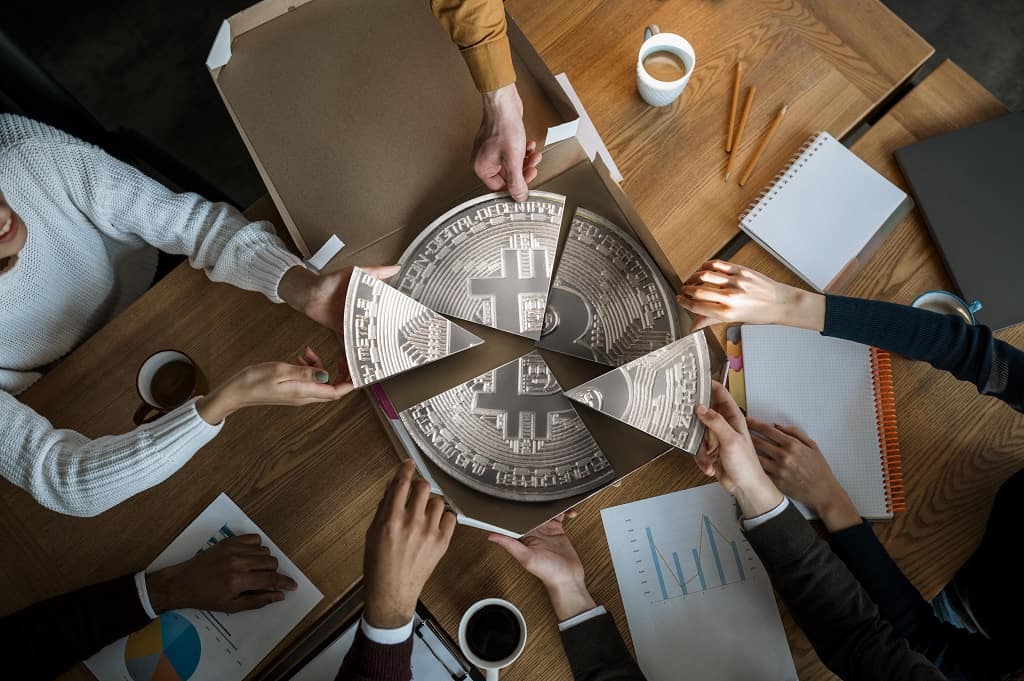
    Imagine the following situation: you bring your twins out for a family dinner in a pizza restaurant. When the pizza arrived, the restaurant didn’t split it. Now, you must split it between your children. The trillion-dollar question is how will you do it?

    For this exercise, I present two plausible options:

    1. You, as the parent, will split for the children.

    2. You let the children decide for themselves.

    For the first scenario, being their parent, you may rightfully believe that you are bestowed the right (by social convention for example) to decide for them. Here’s the catch though, what happens if you have good intentions but are inept with logic (e.g. You can’t tell that a large pizza with 8 slices and a large pizza with 12 slices is the same)?

    Or your method might not yield consistently good results due to some long held tradition (e.g. tiger parenting). When your children grow up, they might constantly defer to a “higher” authority while imposing their will rightly or wrongly on their children.

    For the second scenario, you are laissez-faire, trusting your children to behave well towards each other. Let’s say one of your twins is epigenetically different from the other. So one has a growth spurt much earlier than another. Making a twin stronger, but also hungrier. Then, it is easy for one to bully the other to get a larger slice. This creates an unhealthy dynamic between the twins. They might grow up hating each other, causing a rift in the family.

    The first method sounds tyrannical; while the second can turn into anarchy. Both scenarios presented above are not meant to predict what would happen definitively. It aims to jolt us into being more conscious of our methods, because they might lead to undesirable outcomes.

    Okay, what would be a better approach? How can we split the pizza between the children in such a way where a parent’s authority is not needed in the future; at the same time, the children will learn imaginative ways to treat each other as fair as possible?

    The Fairness Solution

    There is a little game to play when splitting the pizza, it is called the “split and choose”. To play the game, one of the twins is given the right to split the pizza into two slices, then the other gets to choose the first slice. For example, twin A splits the pizza into two, then twin B gets to choose which slice to take first. If twin A cheats by splitting the pizza unevenly, twin B will naturally choose the larger slice first.

    In such a game, only the cheater loses. You don’t have to use your parental authority, nor enforce any fairness values. The self-evident fairness of this game creates a naturally desirable result.

    Such games are at the centre of blockchain protocol development. This “split and choose” game is commonly referred to as proposer-builder separation in the blockchain development. The proposer (i.e. pizza splitter) will propose a block for the blockchain, while the builder (i.e,. pizza chooser) will build the block for the blockchain. The exact details of how this works is too lengthy and technical to cover in this article.

    Nonetheless, you can find out more in the Ethereum discussion forum here. The point of all these is to keep a balance of power by avoiding centralization, so that it is worthwhile to build meaningful use cases on it. Without which, the participant with the most power can corrupt the entire system.

    Not Everyone Thinks Fair

    For the astute reader, you might be able to detect a flaw in this game. This game only works if participants are willing to play the game. What if in the future, without parental supervision, the stronger twin decides not to play this game and resorts to brute strength for a larger share?

    This abuse of power happens a lot in the real world and in blockchain. However, let’s not forget that with continuous abuse, the weaker twin can also decide not to play the game and find other players willing to follow the fairer rule. One example in the real world is the migration of a minority group from one country to another.

    In blockchain speak however, we call it “forking”. Forking is a situation where a group of participants decide to create another version of a blockchain with a new set of rules. Participants fork a blockchain because of competing beliefs in a better system given the risks and rewards like utility, cost, convenience, scalability, security, transparency, decentralization etc.

    The trillion dollar question here is that given more time, which of these factors will society value most?

    Shade They will Never Sit

    Blockchain protocol developers are building blockchain infrastructure primitives (i.e. rules, standards, systems, protocols etc) that they believe will naturally and legitimately benefit society. Good blockchain protocols are developed through pragmatic first principles approaches using science, maths, cryptography, extensive human behavioural research etc.

    We are already reaping the rewards from these efforts. In 2014, disadvantaged groups torn by war and oppression found refuge and financial freedom through Bitcoin. In 2021, we see the rise of NFTs (through ERC-721 standard) which allows artists from all around the world to have another sustainable means of income.

    People living in countries with hyperinflation and foreign exchange controls use stablecoins (created through the ERC-20 standard) to keep the value of their hard earned incomes from eroding. And of course, some of us trade or invest in cryptocurrencies as a new class of asset.

    In the coming years, there will be a lot more innovation in this field (so don’t sleep on it). Only with hindsight, will we realise how these imaginative games played a pivotal role in solving difficult social, political and economic problems. With it, we may no longer require blind obedience to an authority, nor giving up to zero-sum anarchy.

    Future generations will reap the rewards of these old men who planted trees whose shade they shall never sit. Isn’t that what any good parent would want for their children?

    About the Author

    Chia Sheng Yeong is the partner of Celebrus Advisory, a bespoke and industry-acclaimed consulting firm for digital assets with focus on regulatory compliance, technical delivery, and project outcomes.

  • Crypto And Digital Asset, Learn Before You Earn

    Crypto And Digital Asset, Learn Before You Earn

    With the recent crypto market crash, investors are now very fearful of the market. Who would have thought Luna can lose almost 100% of its value in just a few days. Even the big boys like Bitcoin, Ethereum and BNB are not spared either, with huge losses all across the board.

    Smart Investor spoke with Wei Zhou who is the new CEO of Coins, Philippines’ leading crypto and mobile wallet to find out more on this topic. Coins.ph is regulated by the Bangko Sentral ng Pilipinas (BSP) and is the first ever crypto-based company in Asia to hold both Virtual Currency and Electronic Money Issuer licenses from a central bank. One of its uniqueness is that it has a crypto license by the regulators and by becoming a bridge between virtual and real-life, accepting crypto and fiat along the way.

    A brief introduction about Wei Zhou, he formally served as Chief Financial Officer of Binance, Zhaopin.com, and Charm Communications. He also led the landmark acquisition of Grindr, where he served as Vice Chairman. He started his career at Goldman Sachs, and he graduated from Harvard University with a Bachelor’s Degree in Economics and East Asian Studies.

    According to him, everyone needs to learn about digital asset, since it is the future. Start by taking the time to understand the blockchain technology behind it. Then move on to the digital assets itself, such as Bitcoin and Ethereum. Understand what it is, why it was created, what are the benefits and what causes its price to move up and down.

    It’s Easy To Get Started

    Start opening up your own account by creating your own crypto wallet. It is now so much easier whereby most onboarding process can be done online. Some can even be done using only your smartphone. There are also platforms that did not even require its users to undergo a KYC (Know Your Customer) process.

    Next up, get to know more about Non-Fungible Token or NFT. A non-fungible token is a financial security consisting of digital data stored in a blockchain, a form of distributed ledger. The ownership of an NFT is recorded in the blockchain, and can be transferred by the owner, allowing NFTs to be sold and traded.

    We may have seen an NFT in the form of pictures, digital art. As the adoption rate of NFT gets higher, so does the NFT market value in general.

    What’s The Reason For The Crypto Market Crash?

    Crypto is still in its early stage and is highly speculative. There may also be an element of the Greater Fool Theory, where the next person is willing to buy more for crypto despite it not having any clear fundamentals.

    But in all honesty, it is not only the crypto that is suffering from the bears. The world’s stock market is also crashing down.

    For those who are suffering huge losses now, you need to go back as to why you bought them in the first place. Do you believe in the digital asset? Its ecosystem? Or do you simply buy because everyone else is buying?

    That’s the reason why it is so important to be doing your own research. But the take-up rate for crypto is considered to be still low. With more people coming in the crypto market, the price will start going back up.

    Upcoming Trends?

    asian young male wearing wearable goggle headset virtual online meeting digital space working with 3d augmented dimension at home,cyber virtual working with virtual vr goggle and pc desktop device

    The blockchain is definitely the future. It is a proof of ownership for digital assets. There will be more games and metaverse taking the spotlight in the years to come. For content creators, NFT are good for them to able to earn an income.

    But there must be a huge effort to build up the community, build up your trust and brands.

    In the sports industry, national associations such as for basketball and football are partnering with the blockchain players.

    Plans For The Future?

    Wei Zhou is set to come out with additional tokens that has its own value in the market. Also, there are plans to come out with new NFTs with utilities that can benefit the holders.

    He is also keen to embark on play-to-earn games which lets gamers earn money while playing their favorite games.

    Start Small But Start Now

    Cryptocurrency coding digital black background open-source blockchain concept

    The easiest way to get started is by going on social medias and following influencers on their Twitter account. Next is to listen to podcasts so you are able to understand the terms and jargons that is being used.

    Once you are in, there’s nothing better than getting your feet wet by joining in the crowd as community managers and engage the audience directly. At Coins, there’s the Coins champion for this purpose.

    Making Money From Digital Asset?

    Finally, Wei Zhou advises us to have a diversified portfolio and not to put everything in digital assets. Make sure you invest in real estate, stocks and start-ups, before going into digital asset.

    Also invest in time as there are a lot of opportunities out there, waiting for it to go boom. This is true in the metaverse space where there’s a lot of hardware and software involved.

  • How Does Hanlon’s Razor Apply To Crypto Investment Risks?

    How Does Hanlon’s Razor Apply To Crypto Investment Risks?

    In the wake of the massive crash of the Luna stablecoin that brought the crypto industry to its knees, people everywhere are demanding justice. There are memes comparing it to the notorious Bernie Madoff, right next to McDonald’s job ads for those who lost their life savings.

    Blame It On Stupid!

    The creator of Luna which lost almost 100% of its US$40 billion value at one point, told the Wall Street Journal that it’s not a scam: “I made confident bets and made confident statements on behalf of UST because I believed in its resilience and its value proposition. I’ve since lost these bets, but my actions 100% match my words.”

    He emphasized: “There is a difference between failing and running a fraud” (italics added).

    There is an age-old wisdom called the Hanlon’s Razor which states: ‘Never attribute to malice that which can be adequately explained by stupidity’. What this means, reductively, is that not everything is a fraud. People can and do make dumb mistakes.

    So don’t automatically assume that everyone is evil. The world is not out to scam you. Sometimes sh*t happens! You just have to accept that as a part of life.

    If the Hanlon’s Razor is applied to the context of Luna, it suggests that stupidity is to blame: Not everyone is smart enough to manage a multi-billion-dollar crypto fund. Sorry to the investors who lost everything. Do you buy that?

    Law enforcement investigations are now underway. Unfortunately for Luna, stupidity is not a great legal defence. There might not be an intent to defraud investors, but failure could mean negligence which is punishable by law. Were proper measures taken to safeguard investor monies? Was there a duty of care to do the right thing? Did they fail to do so, chose not to react in time, or were wilfully ignorant of the fallout?

    Stupidity Is A Big Risk

    What is not obvious to most investors, and which Hanlon’s Razor elucidates, is that that the risk of stupidity is as serious as the risk of scams! But investors tend to mix up the two even though incompetent or dumb management is a much more outspread problem than perceived. While scams are intentional, stupidity is not and generally can’t be helped (‘if you are dumb, you are dumb, so help you God’).

    One reason is because so much of the crypto DeFi space is unregulated. DeFi or “decentralised finance” with their anonymous operations and offshoring structures are still beyond the reach of national laws. Furthermore, in a traditional financial firm, the management has to be ‘fit and proper’ with deep requisite experience and board oversight.

    But with most DeFi projects, you are stuck with the founding team. Even if they can’t perform, you can’t fire or remove them. And while they claim to be decentralised, their decision-making flows often indicate otherwise.

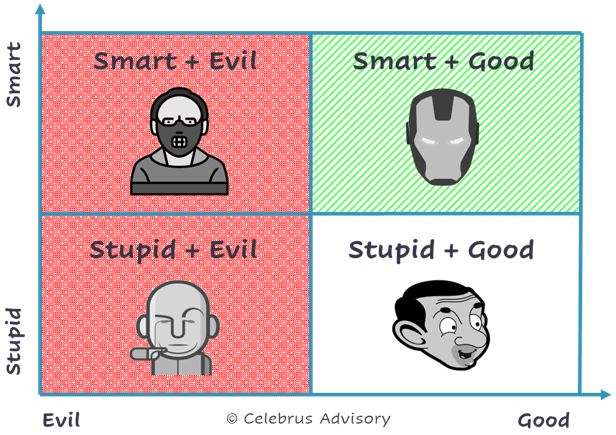
    We created a quadrant to illustrate this. In a very simplistic world where investment projects are ranked on two factors – only 1 in 4 (or 25% chance) have the rare combination of competency and virtue (green area). There is a possibility that 2 out of 4 projects (50% chance) are led by those who are incompetent, or by those with malice (red area). In other words, there is an equal chance of project failure due to either stupidity or scams.

    Each quadrant can be profiled by these fictional ‘straw men’:

    a. Smart + Evil: For instance, pure villains such as Gordon Gekko (the fabled Wolf of Wall Street) or Hannibal Lecter.

    b. Stupid + Evil: This could be like the Dr. Evil and Mini Me characters, or the bumbling burglars in Home Alone movies.

    c. Stupid + Good: A classic case is Forrest Gump, or when Mr. Bean tries to save the world.

    d. Smart + Good: The most relatable is Ironman, a genius and philanthropist, in the Marvel Universe; or Dr. Manhattan in the DC Universe. 

    For the Smart Investor, there are two things to take away from this. First, while there is moral hazard or malice everywhere, it particularly thrives in an unregulated environment. Second, never underestimate the power of stupidity. Dumb management can do a lot of damage. If you want to invest your life savings with a bunch of college dropouts and young punks who genuinely want to make the world a better place, please don’t cry fraud when you lose.

    Disclaimer: Contents above are for educational purpose only.

    About the Author

    Edmund Yong is the managing partner of Celebrus Advisory and appointed by MDEC as part of its Talent Expert Network (formerly known as Digital Expert Panel) for blockchain technology. He is also the resident consultant for GLT Law, a multi-award-winning legal practice with specialisation in digital assets.

  • How Does Gresham’s Law Apply To Private Money Like Crypto?

    How Does Gresham’s Law Apply To Private Money Like Crypto?

    Back in 2018, the Managing Director of the Monetary Authority of Singapore (MAS) Ravi Menon, gave a speech about the future of crypto and cited an old concept in economics known as Gresham’s Law, which is loosely interpreted as ‘bad money drives out good money’.

    He opined: “Like Money, crypto tokens can be a force for good or bad… It is the enchantment with these tokens as a way to make a quick buck and their abuse for illicit activities that are at the root of our concerns.”

    Therefore: “We must work together – regulators and the crypto industry – to make sure that bad money does not take hold. And that a new generation of crypto tokens emerges, that harnesses the potential of blockchain technology for social good while mitigating the risks today’s tokens pose.”

    Good Money vs. Bad Money

    crypto

    The original concept in Gresham’s Law is that in an economy where there are two currencies with the same face value, people will use up first the currency that is constantly devaluing (bad money), and hoard the currency that retains or increases in value (good money). 

    For example, let’s say you are given equivalent amounts in both MYR and USD. As MYR keeps depreciating against USD, you will spend MYR first and hold USD in reserve. The so-called ‘bad money’ would be used for daily transactions and dominate circulation, while ‘good money’ would eventually disappear from circulation as it is kept for savings and long-term investment.

    Imagine now that you are given BTC (bitcoin) instead of USD. If you expect that BTC will rise in value, you will not pay your daily expenses with BTC as you may lose out on its future valuation. This is one of the reasons why BTC has grown faster as a store of value than as a means of payment.

    Going back to the MAS speech: Interestingly, it applies the concept to market conduct. It refers to the illicit use of crypto by bad actors in the market, along with the profusion and poor quality of crypto products as a form of currency. If these bad actors continue to flourish, they will crowd out and drive away the good actors. The crypto industry and its innovation benefits will suffer as a result. 

    But if crypto can be used responsibly as a force for good, it will be ennobled and gain wide acceptance by the public. This would turn into the opposite of Gresham’s Law (known as Thiers’ Law) which states that ‘good money will drive out bad money’.

    Is Private Money Good or Bad?

    crypto

    The characterisation of crypto as either good-or-bad is not always helpful. Private money like crypto, which are not issued by central banks, is very diverse and hard to generalise. Tech is morally neutral. They are self-serving financial constructs and are not mandated to be a public good. The vast majority of them are work-in-progress prototypes that will fail.

    On one hand, you would read of industry reports claiming that illicit or criminal activity constituted only 0.10% (according to CipherTrace) to 0.15% (Chainalysis) of total crypto transaction volume in 2021, the lowest level ever. This makes crypto sound like a model private citizen!

    But on the other hand, the crypto scandals keep getting bigger and bolder, with contagion impact on venture capital and lending companies as seen recently. The industry has spawned an entirely new genre of lawlessness (which Elliptic calls) “DeCrime” which could rewrite the penal code. Black hat hacks are commonplace, highly sophisticated, and even state-sponsored.

    Ironically, as crypto improves and creates better version of themselves, they become too good to ignore. Savings and capital may leave financial systems, for good. Domestic banks may become undercapitalised. In response, governments are mulling to create crypto-versions of central bank digital currencies (CBDC), so that their national currencies will not be substituted by crypto. And they have the natural advantages to do so. As the Bank of International Settlements remarked, “anything that crypto can do, CBDCs can do better”!

    Investors are at a unique point in economic history. They are spoilt for choice between private money (crypto) and public money (fiat), something that was unthinkable a generation ago. They have free capital movement, in the truest sense of the word, across borders, assets and entities. Whether this is ‘good’ or ‘bad’ is anyone’s guess.

    Disclaimer: All opinions expressed above are the author’s own.

    About the Author

    Edmund Yong is the managing partner of Celebrus Advisory and appointed by MDEC as part of its Talent Expert Network (formerly known as Digital Expert Panel) for blockchain technology. He is also the resident consultant for GLT Law, a multi-award-winning legal practice with specialisation in digital assets.

  • How Does The Greater Fool Theory Apply To Crypto Investing?

    How Does The Greater Fool Theory Apply To Crypto Investing?

    You may have heard of crypto investors being labelled as ‘fools’. Business figures such as Jim Cramer, host of CNBC, and Bill Gates, founder of Microsoft have made such comments. Asian regulators such as Felipe Medalla, incoming governor of the Philippine Central Bank, and Raghuram Rajan, former governor of the Reserve Bank of India, have warned the public about crypto investing.

    What And Who Is The Greater Fool?

    According to the Greater Fool Theory, investors buy a digital asset not because they believe that it is worth the price, but rather they believe that they are able to sell it later to someone else at a higher price. The original investor is a ‘fool’ and hopes he or she can sell it to a ‘greater fool’ out there. The theory is about investor psychology and not a name-calling insult.

    Let’s say you are thinking about buying an NFT (Non-Fungible Token) of a cute animal that costs 1 ETH. You know it’s just a cartoon image on a JPEG file. It doesn’t cost much to produce. You don’t even own the copyright to it and the NFT creator can reproduce other copies for sale.

    But you want to buy it anyway because you are confident of selling it (or ‘flipping’ as they say) for 2 ETH. You are influenced by Youtubers and TikTokers who claim to have made a lot of money doing so.

    What should you do then? Always, always ask this question – Is there a ‘greater fool’ than you out there who will eagerly pay a higher price than you did for the NFT? If none of your immediate circle of families and friends are willing to do so, then you are the ‘only fool’ you know!

    First, you need to be sure there exists a ‘greater fool’ that will buy the NFT from you – before you buy it yourself. If you are not convinced that there is a ready market out there, then you shouldn’t buy it at all.

    To further illustrate this theory, here is a real-life case study close to home. Last year, a Malaysian-based businessman Sina Estavi made headlines around the world after buying an NFT of a tweet for US$2.9 million. In April this year, he put it up for sale via an auction and started the bid at US$48 million. However, as Bloomberg reported, the auction for the NFT closed with only seven offers ranging from US$6 to US$280!

    You read that correctly, this is close to the cost price – but minus four big zeroes! It is almost a complete write-off. There were just no ‘greater fools’ in the market for this deal.

    Are All Crypto Investors Fools?

    The Greater Fool Theory has been used to criticise the investment thesis of bitcoin back in its early days, when it was in the sub-US$10K levels. Since then, crypto has become a lot more mainstream. Wall Street is accumulating bitcoins, and even some governments and pension funds are doing the same. Are they all ‘fools’ writ large?

    The critique had gone quiet for some time but recently surfaced again due to the NFT mania and ‘degen’ culture. The word ‘degen’ is a shorthand for ‘degenerate’ and refers to crypto investors who go after risky digital assets like NFTs without doing their own research. Crypto ‘degens’ have become the new punching bag in this current bear market with the Greater Fool Theory as its punchline.

    For some, the theory is an investment strategy to profit from ‘fools’ – specifically when there is a high degree of price uncertainty and herd mentality in the market. This works for certain assets like art and real estate where there is no objective price reference. The founder of modern macroeconomics, John Maynard Keynes explained this with an example of a beauty pageant, where judges are rewarded for selecting the contestant whom all judges think is the most beautiful, instead of the one they personally find the most attractive.

    One can observe similar behaviour in the NFT market. Investors don’t value an NFT based on what they think it’s fundamentally worth, but what everyone else thinks the value of the NFT is. Some investors know how to use this to their advantage, though many fail as well, no doubt. It ends up being a zero-sum game, you either fool others or be fooled yourself.

    Disclaimer: Contents above shall not be considered financial advice.

    About the Author

    Edmund Yong is the managing partner of Celebrus Advisory and appointed by MDEC as part of its Talent Expert Network (formerly known as Digital Expert Panel) for blockchain technology. He is also the resident consultant for GLT Law, a multi-award-winning legal practice with specialisation in digital assets.

  • Is It Possible To Earn A Living With Play-to-Earn Games?

    Is It Possible To Earn A Living With Play-to-Earn Games?

    Most of us like to play games in our spare time. But did you know that there are also those who earn a living just by playing games? With the rise of digital games, we now have Play-to-Earn games that rewards its users well enough for those who stay invested in it.

    Smart Investor spoke to Mr. Lucaz Lee, Founder and CEO, Affyn to gain more insights on this interesting new concept. Affyn is a newly launched play-to-earn metaverse, that aims to bring people and communities together and allow them to play a mobile geolocation-based game (similar to that of Pokemon Go), and earn Fyn tokens to be used for transactions at the same time.

    Let’s find out more from him on this interesting topic.

    How Did You Started With Crypto Investment?

    I first heard of Bitcoin in 2016, which was worth around USD400. Many people in my immediate circle warned me not to get involved, claiming that it was a sham with no foundation. In my experience, I have learnt to recognise that the best kind of opportunities are those that most people do not understand, are uncertain about and are sceptical of; yet, it is obviously working and growing at a progressive rate. 

    Unlike today, buying cryptocurrency was a highly complex process back then. My friend and I would spend the whole day figuring out how to buy it. Even though it was complicated and we didn’t understand it, we decided to go for it anyway. Nonetheless, we took the leap of faith first and learned about it later.

    How Does Play-to-Earn Works?

    The gaming industry has thrived for years, with gaming companies reaping the benefits. While a large amount of money has been flowing into the industry, the players have largely been left out. I believe that the concept of Play-to-Earn will be able to rebalance things so that players can earn while playing games. 

    Play-to-Earn is a concept where players can earn financial rewards such as cryptocurrencies or NFTs, which can be traded or sold to other players in their games. Most Play-to-Earn games are still largely unsustainable because this is a relatively new concept that many Web 3.0 companies are still figuring out. However, I believe that Play-to-Earn games will eventually transform the gaming industry.

    What Do We Need To Get Started?

    Typically, an initial capital layout is required in most Play-to-Earn games. To get started, players must learn how to buy crypto and then use the token to buy the NFT. The barrier of entry is too complex for Play-to-Earn games to breakthrough into mainstream adoption.

    I think the future of Play-to-Earn is Free-to-Play games where players can download an app, sign up for an account as easily as signing up for a Tik Tok account, play for free, and earn without realising that the whole app is powered by blockchain or crypto.

    Can A Player Really Make Money And Turn It Into A Full-Time Job?

    Just like in any other industry, what you put into it is what you get out of it. You get part-time results if you put in the part-time effort. There are definitely opportunities for players to make gaming a full-time income, depending on how much effort and time they are willing to put into it.

    With The Recent Crash Of The Crypto Market, Is Play-to-Earn Affected?

    As someone who has been through the bull market of 2017 and the crash and bear market of 2018, I can say that no cryptocurrency is immune to a crash. The Play-to-Earn ecosystem will undoubtedly be impacted. When there is a crash or a bear market, it usually means that speculative money is leaving the ecosystem. Products with utility will thrive because, while speculative money is leaving, money will flow into games with utility and demand. 

    Play-to-Earn games have the potential to thrive in bear markets because people are looking for financial vehicles to generate income when the economy is bad. Despite the fact that it has yet to be proven, I believe Play-to-Earn games can thrive during bear markets.

    What Are Your Plans For The Future?

    We intend to become the largest and most successful platform that creates fascinating experiences for our users through gaming and lifestyle, where they can earn virtual rewards and spend them in the real world within our lifestyle ecosystem. It’s also free to play.

  • From Almost Being Murdered To Setting Up A Digital Marketing Agency, To Branding And NFT

    From Almost Being Murdered To Setting Up A Digital Marketing Agency, To Branding And NFT

    The story that we are about to share with you is truly an interesting one. It is about an individual who bounces back after a tragic event to reach greater heights.

    Let’s meet Mr. Sanz Teoh, Chief Executive Officer and Founder of Jumix and his inspiring story below.

    Smart Investor: Thanks for taking the time to talk to Smart Investor. Can you tell us a little bit about yourself, about Jumix, and what makes you started the company?

    Sanz Teoh: Hi, I’m founder and CEO of Jumix. In 2014, I was almost murdered by a local gangster group. That inexperienced me was trying to work a side hustle while having a full-time digital marketing job.

    It was at that moment, I decided that I have to fully commit my time, effort, and energy to my own business. I promised myself that no one else in this world should go through the same experience as I did, and I set out to make this my business mission.

    Combining my educational knowledge in marketing and my personal passion in creating digital products, I founded Jumix. It started off as a web design & digital marketing agency, now we also do Branding and NFTs for businesses.

    nft

    Smart Investor: We heard about your recent foray into the NFT scene with BeU, care to elaborate on that?

    Sanz Teoh: Yes, and I’m very excited about this. There’s a story behind why we are doing NFT. Previously during the MCO, we have a long discussion with a creative agency to come out with a ‘Virtual Influencer’ that is set for a launch in late 2020.

    My entire team put a lot of effort and commitment into that project. But due to some contractual dispute, the plan didn’t work out. It is then we decide to take things into our own hands, and is determined that we are going to create something new all by our own instead of working with another agency.

    This is why we decided to dive into the NFT scene. Being a seasonal cryptocurrency investor and familiar with blockchain technology myself, I proposed to my team that we can use utilize our creativity to create characters, which will then be a set of collectibles on the blockchain.

    Starting from scratch, my team brainstorm, sketch, draw, produce and code the entire BeU NFT project. Throughout the entire journey, we learnt a lot more about NFTs and how NFTs can really help brands and creators to bring a lot more to the table.

    People who are interested in an NFT project can ‘own’ it and enjoy the benefits or utilities that the NFT project gives.

    For example, people who own BeU NFT will get another NFT for free, which is the ‘egg’ of the original character, which will ‘hatch’ and revealed later on. It would remain a mystery for now.

    All owners will also get to involve in the roadmap of BeU project, which include deciding on which charity foundation that we will donate our money to, getting access to exclusive BeU merchandise, stand a chance to win life-size BeU figurine, and ultimately, be the first to access the virtual world that BeU created – BeUtopia.

    nft

    Smart Investor: How big is the NFT industry in Malaysia and are Malaysians ready to get on board the NFT phenomena?

    Sanz Teoh: I would say that the NFT industry in Malaysia is still pretty new. But so far I’ve already seen quite a number of artists, creators and brands that have dived into NFTs.

    Things are just going to get more interesting for Malaysians, but just like any other market, there’s always a stigma when it comes to adopting or investing into something new.

    I believe with more brands and creators embracing NFT with more following suit, this is why Jumix is going to bring more both brands and creators into this industry, and drive the growth of Malaysia’s market together.

    Smart Investor: With the recent crash of the crypto market, does it have an effect on the NFT market?

    Sanz Teoh: Crypto market has its ups and downs over the years. While I’m not talking about cryptocurrencies trading, the price crash of crypto does affect the NFT market as well.

    When prices of crypto drops, it actually makes NFTs more appealing, as you can now purchase NFTs at a much lower price. This makes collecting or investing in NFTs much more approachable to the public.

    Smart Investor: Can you share with us your plans for the future?

    Sanz Teoh: BeU is only the first NFT project that Jumix pushes out, we’ll have more NFT projects in collaboration with other brands, which would include more utilities, features and more creative concepts.

    For the next 6-12 months, other than growing the BeU community, I’m also looking to work with brands who are interested in NFT to build new projects with them.

    Smart Investor: What is your advice to Malaysians out there who wants to get involved with NFT?

    Sanz Teoh: There will be two groups of people here. The first ones are the brands and creators.

    For brands and creators, my advice is to get involved as soon as possible, as the trend is rising rapidly and the attention in this space is high. But please do not take this opportunity as a money grab, NFT is still very community-driven and it should be created for the community, not for your own profit’s sake.

    The second group of people are the owners and investors. For investors, don’t take this as a get-rich-quick investment, but something more like a long-term investment. But before putting in your hard-earned money, make sure that you believe in a particular NFT project and do your own due diligence.

    For smaller NFT owners, go ahead and support your favourite creators and brands while enjoying the benefits that the NFTs provides, experience how blockchain and cryptocurrency work, and have fun at the same time.

    nft

    Smart Investor: Can we really make money from NFT, is NFT a good investment to venture into?

    Sanz Teoh: I’m not one to tell people that we can ‘earn money’ from NFT. I would tell them to first, truly understand as to what, why and how cryptocurrency, blockchain and NFT exists.

    Once you fully understand the benefits of blockchain and NFT, then, like any venture or business, you have to be creative, committed, and create something that people want, or of interest, to be able to ‘make money’ from it.

    For the general public, some NFTs project are really good, and has good utilities, visionary founders, responsible project team and for a good cause. These are NFT projects that you can invest into.

    For brand and business owners, investing in creating NFTs is a good way to differentiate your brand and business, raise funds, or to offer additional utilities and benefits to your fans or loyal customers.

    The potential of NFT is vast. With proper strategy and ethical purpose, NFT is definitely the way to go.

  • Will Initial Exchange Offerings (IEOs) Change the Crowdfunding Game?

    Will Initial Exchange Offerings (IEOs) Change the Crowdfunding Game?

    In this final part of our article series, we explore the viability of the new IEO model. Two IEO operators have been announced so far.[1]

    From the aspect of the platform, how will these operators perform as a capital formation channel i.e., how will they raise serious money? This has traditionally been the domain of licensed investment banks, so all eyes are on these operators. The business community is eager to hear its first success stories.

    And from the aspect of the market, how will these IEO assets be structured to appeal to investors? These are exotic financial products that befit a narrow risk profile. They have often been compared as alternatives to IPO. Suitable investors who are seeking digital asset exposure in their portfolios might consider this.

    Given that IEO is a major innovation, there are bound to be problems when we look under the hood. They are not operational yet, generally high risk, and involve novel points in law. Many things could change, including regulatory positions over time. Hence our opinions too are tentative.

    Is There Enough Local Investor Base for This?

    The IEO operators’ role is to draw investors into the platform. But they do not underwrite raises. In other words, they do not guarantee results.

    When you do the math, you will understand that this is not retail play. Here is a simple back-of-envelope calculation: Retail investors can only invest up to a limit of RM2000 per project. If a project has a RM100 million target, it will need to raise from at least 50,000 retail investors – assuming every single one of them maxes at RM2000, passes background checks, and nobody backs out during the cooling off period.

    Imagine the sheer marketing cost and investor relations effort needed to convert such a large group. Imagine the due diligence work to onboard 50,000+ names.

    And there is a further rub: According to the Securities Commission (SC), the total number of investors that have collectively used ECF and P2P financing platforms since 2017 is only about 31,000 investors![2] So IEO operators – if they focus only on the retail segment – will need to be able to recruit new adequate investor bases to cover the demand, presumably within Malaysia itself.

    This is the reason why institutional participation and sophisticated investors will be crucial to the success of IEO. They are the main target.

    But it remains to be seen whether the IEO operators will take an active role in building the order books i.e., sourcing investor demand; or whether they will merely facilitate the offering like an ECF model.

    Rather than setting a blanket investment limit on all retail investors, the regulators should consider marketing restrictions and ensure IEO operators perform suitability assessment on all investors. This could ease the fundraising burden of IEO operators. Even with the investment limit, vulnerable investor groups like the elderly and financially illiterate can still be indiscriminately targeted by IEO marketing.

    What Would IEOs Look Like Without Crypto?

    At first thought, the local digital asset exchanges (DAX) may seem to provide some low hanging fruits and serve as the addressable market for IEOs. The number of DAX accounts has been growing phenomenally and may well cross 1 million this year.

    But investors who are used to trading highly liquid digital currencies like Bitcoin and Ether might not have the same appetite for tokenised private securities like IEOs.

    The biggest impact will come from the restriction on the use of crypto (or digital currencies) to pay for IEO investment. This effectively turns off the crypto segment and the entire trillion-dollar global crypto capital pool. While it is possible to cross-sell IEOs to third party DAXs in Malaysia, DAX customers cannot use their crypto holdings to invest in IEOs.

    Foreign-based crypto investors including hedge funds and venture capitalists will have to convert into Malaysian Ringgit, wire through the correspondent banking system, and be subject to exchange control rules.

    Why is crypto restricted? Perhaps from a compliance viewpoint, this mitigates the money laundering and terrorist financing (MLTF) risks associated with crypto. Unlike DAXs, the IEO operators are not equipped to screen and surveil illicit cross-border flows in crypto.

    There are other substantive implications. In a standard ICO or IEO, the crypto received is used to activate the ‘smart contract’ for the automatic distribution of digital tokens to investors. Without the crypto element, this step is removed.

    In the Malaysian modified version, it is basically just an ‘asset tokenisation’ process. What this means is that digital assets are programmed and recorded on a blockchain ledger and issued as tokens.

    Also, there will be no need for digital asset custodians (DAC) as there are no crypto funds received and handled. The digital tokens, minted by the IEO operator on behalf of the issuer, don’t require custody as they are proprietary, remain in a closed loop, and all settled in fiat currency.

    The reality is, IEOs without crypto is a rather hollow proposition. IEOs may end up like another vanilla ECF platform – but with more investor risks!

    If Something Goes Wrong, Where Do I Seek Help?

    If digital tokens are not well-defined legally, it will be tough for both aggrieved investors to litigate and for regulators to prosecute. In our opinion, the current taxonomy does not provide sufficient clarity on the status of stablecoins, DeFi lending, and non-fungible tokens (NFT) – what more private tokenised securities that can be designed in so many ways?

    It will be good to have legal certainty and a path of recourse if things go awry. Having to go to court to enforce an ambiguous investment contract is the last thing any investor wants. In the absence of such, you can expect IEO operators to prop up the legal paperwork.

    Despite the use of ‘smart contracts’ for IEOs, it is very likely that investors will be required to physically sign subscription agreements, including the acknowledgment and acceptance of all instrument risks, and even limitation of liability!

    Conflicts of interest need to be properly disclosed if any, where the IEO operator approves the project, develops the token, promotes to the public, and gets paid in tokens. Whose interests is the operator beholden to – the issuer, investor, or its own? If the tokens purport to be asset-backed, the collateralisation agreements and prudential policies should rightfully be shown.

    For the smart investor, this is the Achilles heel of IEOs: Wouldn’t he or she be better off putting their money in normal shares or loans (via ECF or P2P), where there are more legal safeguards, investor protection, and formal dispute resolution?

    For the impatient investor, please be reminded that there is currently no linkage between the primary (IEO) and secondary markets (DAX) locally. The digital tokens are unlisted products for time being. Angels and early investors cannot take money off the table. Investors cannot transfer their tokens between one another.

    Note: Remarkably, the IEO guidelines do not state any prohibition of foreign DAX listings, which could be something to watch out for.

    Will IEOs Be Around a Few Years from Now?

    The race for global crypto capital has become heated. The major economies in ASEAN have rolled out crypto licensing regimes which are capital-friendly, competitive, and compliant. Regulators expect market operators to keep the pace of innovation, sustain the interest of investors, and remain relevant.

    The face of global crypto capital is also evolving rapidly. IEOs can already be offered on normal centralised exchanges like DAXs (in Singapore), through licensed intermediaries (like ICO portals in Thailand), or without going through DAXs at all e.g., through an Initial DEX Offering (or IDO) on open decentralised platforms. There are even DAICOs where decentralised autonomous organisations are created as the token issuer.

    Investors and issuers will be spoilt for choice as this space matures. IEOs will morph into the next in-thing. There will be more regulatory uniformity and cooperation across jurisdictions. New bespoke laws will be created instead of relying on extant securities laws. This article series surely won’t outlive its purpose.

    About the Author

    Edmund Yong is the managing partner of Celebrus Advisory and appointed by MDEC as part of its Talent Expert Network (formerly known as Digital Expert Panel) for blockchain technology. He is also the resident consultant for GLT Law, a multi-award-winning legal practice with specialisation in digital assets. All opinions expressed are the author’s own.

    [1] https://www.sc.com.my/resources/media/media-release/sc-registers-two-initial-exchange-offering-ieo-operators#

    [2] Securities Commission of Malaysia, Capital Market Masterplan 3: 2021-2025 (2021).

  • 5 Things That You Should Know About This Local NFT Artist Who Is Making Waves Worldwide

    5 Things That You Should Know About This Local NFT Artist Who Is Making Waves Worldwide

    Non-Fungible Token (NFT) is the buzzword these days, and you can see many brands embracing it. We have McDonald’s, Coca-Cola, Nike, Ray-Ban, Louis Vuitton and BMW among the well-known brands that have started their own NFT initiative.

    Over here in Malaysia, we have KFC, AEON and MyeongDong Topokki offering NFT with benefits to its holders; whereas MY EG Services Bhd (MYEG) have launched their own NFT marketplace called Pangolin.

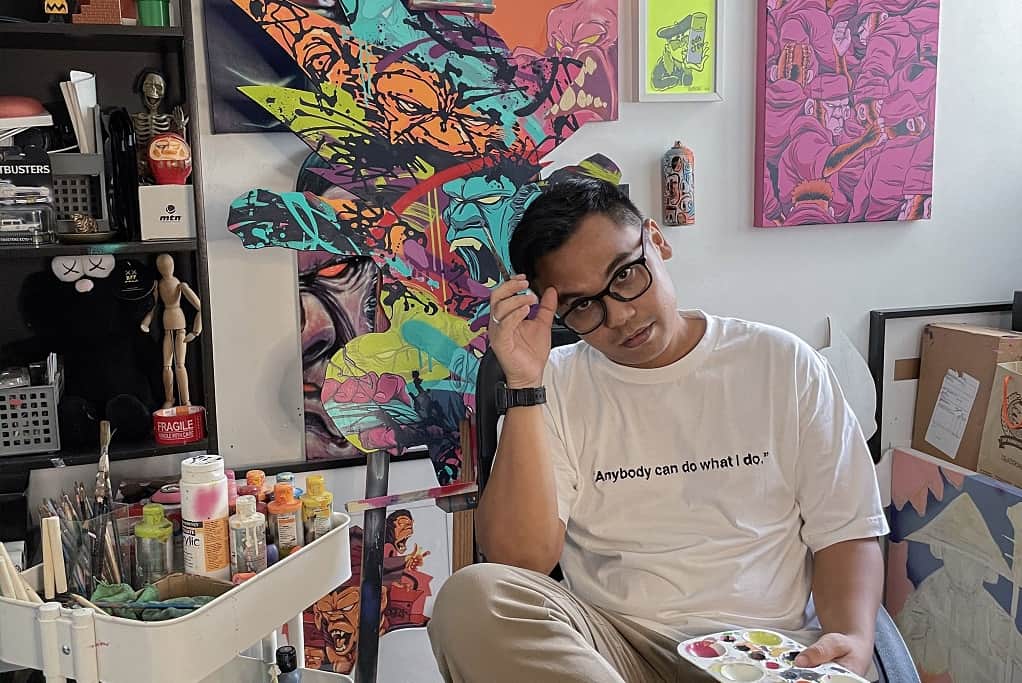
    Having said that, there’s a local NFT artist that have been making waves worldwide and raking in millions of dollars from his NFT collection. Let’s meet Katun and get to know him a little bit better.

    Here are 5 things that you should know about this local NFT artist.

    1. How It All Started

    Katun is a Graffiti Artist and Illustrator based in Kuala Lumpur, Malaysia. He first embarked on his NFT journey with his manager/partner David Ku. Although the NFT sector locally is still in its infancy, they both shared a common vision and their ideas clicked.

    With Katun’s experience in the art community, David believed that they could take it to the next level by stepping into the NFT space. Several months of back and forth conversations with industry leader Elliot Wainman, co-founder of U.S based Superfarm platform, resulted in their partnership that set the groundwork for 4 Stages, which then sets the Apes R Us project into motion.

    2. Have Been Creative Since Young

    Katun have always been a creative person and he has been drawing since a very young age. When Katun was in kindergarten, he used to imitate all of his favorite 80’s cartoon character styles, and even told his teacher that he wanted to be a cartoonist when he grow up.

    What do you know, dreams do come true!

    3. His NFT Have Been Sold For Millions

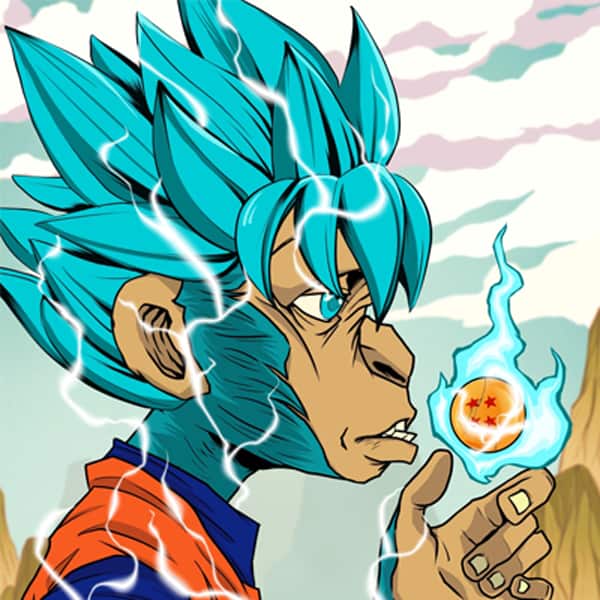
    His recent collection entitled Apes R Us, consisting of 8,444 NFTs was sold out within 28 hours. The collection, which valued at USD7 million, surpassed his previous NFT releases – ‘Apes Stands Strong’ and ‘Mystical Fruits’ – which reached an approximate total sale of USD401 thousand.

    He have also worked with renowned international artists such as Chris Brown, Dua Lipa, & Post Malone, and brands such as DC Shoes, JBL, Vans, Sony and New Era.

    4. His Advice To Fellow Malaysians

    For fellow Malaysians who wants to get involved with NFT, it is important to know the value of your art and your audience. Take your time to create good artwork and most importantly, don’t rush. Don’t stress yourself out on how much you can earn, just enjoy creating instead of thinking about it.

    Focus, concentrate, and trust the process.

    5. His Plans For The Future

    There is plenty in the works regarding the Apes R Us project. He aims to expand and explore other mechanisms and mediums.

    A few brand collaborations are in store as well, and anyone that wants to know more about his projects, feel free to join their Discord community and follow their Instagram profile for the latest updates.

    Of course we didn’t stop there, we also asked Katun on NFT as an investment tool. Let’s check out his answers.

    With The Recent Crash Of Crypto, Will The NFT Market Crash Too?

    Personally, he don’t foresee the NFT market crashing. As a creator, he have always been self-motivated, and don’t quit easily.

    “Ups and downs are part of the game, you either keep going or you’ll get chewed out. For as long as there are creators in this world, it will always be survival of the fittest”, said Katun.

    And we can see that NFT is still in a very early stage. We haven’t even get started talking about Metaverse, which is said to be booming in the next few years – which prompted Facebook to change its name to Meta.

    Is NFT A Good Investment To Venture Into?

    “If you have a solid plan of action, a valid strategy, I believe money can be made, but my core focus is on building and growing the project, along with the community, and putting emphasis on executing development work”, said Katun.

    For investors, yes NFT would be a good investment. But maintaining a diversified portfolio to mitigate the risks involved is equally important.