Category: business

  • Kenanga Investors Bhd: The Art of Diversity

    Kenanga Investors Bhd: The Art of Diversity

    Kenanga Investors Bhd has always been guided by its unwavering conviction in the investment strategies that has weathered them through many challenging periods in the past. And this deep-rooted philosophy has proven its resilience, especially in these trying times.

    The firm’s success isn’t a single-handed effort, however.

    Rather, it is attributed to the organisation’s capable and dynamic investment team as well as the diversity of ideas, strengths and competencies that come from the team, Kenanga Investors Bhd chief executive officer Ismitz Matthew De Alwis tells Smart Investor.

    “Diversity is strength, and together, all of us have worked tirelessly to uphold our firm’s philosophy that is ‘Consistent Top Performance’ and ensure sustainability in what we do,” he reveals candidly.

    Key Drivers for Impressive Growth

    Over the years, Kenanga Investors Bhd’s strategy to be a multi-segment, multi-distribution and multi-product platform has spurred the organisation’s strong growth.

    “We are able to cater our services and products to meet different client risk appetites be it equity, fixed income, managed portfolios or even alternative investments.

    “We achieve this by firstly prioritising the optimisation of our investment engine to create an alpha-centric performance culture – a culture that is the foundation of our consistent top performance,” De Alwis explains.

    From a product perspective, Kenanga Investors Bhd has streamlined its entire suite of offerings to ensure their investors’ various needs are being met.

    In addition to sourcing for new investment ideas and strengthening the distribution of the funds on their platform, much thought and effort has been put into ensuring their existing product line-up continue to contribute to their vision of being a market leader. This also provides a holistic approach to their clients’ investment and wealth management journey.

    “We have also taken up the mantle of championing financial planning which will benefit our consultants and investors alike by focusing on a needs-based structure.

    “This highly complements our goal of eventually becoming a one-stop wealth advisory firm with access to all capital market products while also providing holistic financial planning to our clients,” says De Alwis.

    Pandemic’s Impact on Fund Management Strategies

    Kenanga Investors Bhd’s investment strategy, reveals De Alwis, has always been premised on a bottom-up stock-picking approach on stocks that can offer a strong earnings trajectory.

    As such, across its top-performing funds, the common performance contributors are their overweight positions in technology and rubber glove sectors, with the global outbreak of the Covid-19 pandemic leading to a surge in demand for glove products.

    “This strong earnings profile coming from the tech sector especially is a showcase of not only their capabilities but the emerging importance of home-grown Malaysian technology companies in the global semiconductor supply chain.

    “Kenanga Investors Bhd believes there are structural drivers such as the rising adoption of 5G, artificial intelligence, electric vehicles and industrial automation and thus the supply chain that provides the components to these industries will benefit.

    “Besides growth, tech stocks also have solid balance sheets and strong cash flows which enable them to weather an economic downturn better than some other cyclical.”

    For check and balance, De Alwis reveals Kenanga Investors Bhd adopts a holistic approach to risk management to prepare the firm for inevitable situations by identifying, assessing, reporting and managing the probability and impact of all related activities.

    Indicators are used to provide early warning signals which then determine the responses required. For instance, during unsustainable bull markets, their indicators may help them to avoid companies with weak fundamentals or to avoid paying excessive prices for stocks relative to its intrinsic value.

    “Kenanga Investors Bhd’s risk management policies that our returns commensurate with the risks we take which means achieving out-performance without taking on more risk.”

    Navigating Market Complexities of Tomorrow

    The economic fallout from the pandemic has many Malaysians questioning their financial security, with concerns such as needing to postpone retirement or tapping into savings to pay for basic expenses.

    So how does Kenanga Investors Bhd address such concerns?

    The firm, according to De Alwis, has always been known as an equities expert within the Malaysian landscape. Since 2019, however, they have expanded into the fixed income space after a strategic mergers and acquisitions (M&A) exercise, while in early 2020, Kenanga Investors Bhd launched Malaysia’s first leveraged and inverse ETF to be benchmarked against the FTSE Bursa KLCI.

    “Investors now have the flexibility to diversify their portfolios further to suit changing needs and investment environments backed by superior and holistic investment expertise.

    “Furthermore, Kenanga Investors Bhd’s on the financial planning model ensures we are a needs-based asset manager, instead of mere product-pushing which may not benefit investors in the long run,” says De Alwis, stressing the firm is now more equipped than ever to guide investors of today in navigating the market complexities of tomorrow.

    By helping an investor map out their risks and goals to develop a plan (possibly comprising a diversified portfolio of various asset classes), they will eventually achieve their intended goal.

    “Following that, we will work hand-in-hand with the investor to keep periodic tabs on their overall portfolio to ensure they are on the right track and to make adjustments where necessary.

    “It is critical for the investor to stay diversified so that the various assets in the portfolio can take advantage of different economic conditions, leading to the best possible outcomes during crashes,” he adds.

    De Alwis goes on to highlight the need for investors to avoid following a herd mentality, especially when they are caught in times of crises.

    “It is easy to follow where the crowd goes because many believe there is safety in numbers. But when it comes to personal financials, one person’s risk appetite and goals can differ to the next person’s.

    “With Kenanga Investors Bhd in the picture, we can help the investor to assess their situation before they indulge in panic selling and finding out later that they would have recovered or profited had they stayed the course,” he concludes.

    By Bernie Yeo

  • How to: Achieve Financial Independence in 5 Years

    How to: Achieve Financial Independence in 5 Years

    In the digital age, many young Malaysians are eager to invest and grow their hard-earned money.

    Through information, they have obtained on the internet and through their peers, they understand the importance of growing their wealth through investing and have a desire to achieve financial independence as early as possible.

    There are also young adults who find it more comfortable to not invest until their financial situation becomes more stable or they have more money to invest.

    For this category, they are looking to invest and will do so when they have the extra disposable income to set aside.

    There are also others who have embraced the YOLO lifestyle, looking to live in the present and are accustomed to instant gratification.

    They spend every ringgit they earn, and perhaps even more by borrowing through their credit card or personal loans and choosing to let tomorrow worry about itself.

    Whichever category you may fit in, one key point to take home is that if you’re in your 20s, you have a big advantage over many others when it comes to investing.

    Here are three reasons why your age can be your biggest advantage:

    1. Time and Compounding Interest

    There is a famous saying attributed to Albert Einstein where he called compound interest the “8th Wonder of the World.”

    Whether Einstein said this or not, compound interest is the key that allows young investors to grow their wealth over time.

    Compound interest requires only two things: the reinvestment of earnings and time.

    • Compound interest can be thought of as “interest on interest,” and will make a sum grow at a faster rate than the simple interest which is calculated only on the principal amount.
    • Interest can be compounded on any given frequency schedule from daily, to annually.
    • When calculating compound interest, the number of compounding periods makes a significant difference.

    Assuming a 6% interest rate per annum, the table below shows the stark difference in the final amount based on how long an initial investment of RM10,000 is put to work:

    Starting Age Compounding Period (Years) Final Amount at Age 60
    20 40 RM 102,857
    30 30 RM 57,434
    40 20 RM 32,071

    The longer money is put to work, the more wealth it can generate in the future for you.

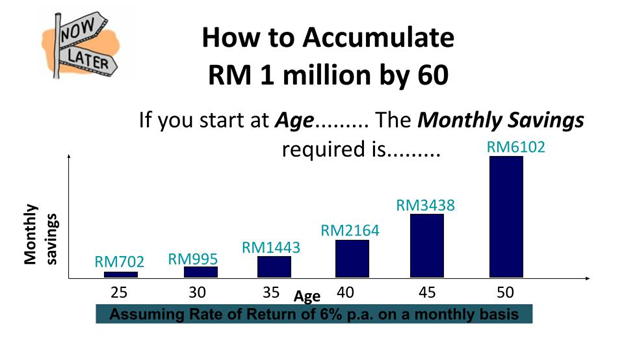
    Here’s another chart that demonstrates how much you would need to set aside every month at different ages, assuming you are looking to accumulate RM1 million for your retirement.

    As shown below, if you start investing at an earlier age, it is much easier to hit your financial targets through the sheer power of compounding interest.

    How to Accumulate RM1 million by the age of 60

    2. The Ability To Take Risk

    It goes without saying that higher-risk investments that are more volatile yield the highest return. Simply put, the higher the risk, the higher the return and the lower risk, the lower the return.

    Younger investors are usually focused on growing their wealth and should invest in higher return investments.

    This is because you have the time to recover if something were to go wrong, giving you the opportunity to make riskier moves. For example, when you are in your 20s, even if you suffer a loss today, you’ll be working for the next 25-40 years and have many years to earn an income. In short, you’ll likely recover from that investment loss.

    Those who begin to invest late in life are often inherently more cautious with how they invest their money.

    As one nears retirement, one usually starts allocating their investment portfolio to lower risk assets which correspondingly have lower returns. By starting late and having lower returns, one might fall short of their financial goals.

    3. Learning by Doing

    As a younger investor, you have the flexibility and time to study investing and learn from both successes and failures.

    Since investing has a fairly lengthy learning curve, young adults are at an advantage because they have years to study the markets and refine their investing strategies.

    You will make money, and lose money on some investments.

    Examples of things one needs to learn can include opening a stock trading account, opening a mutual fund account, buying real estate, or even calculating investment returns – these are all best learnt through experience.

    There are many other aspects when it comes to investing such as understanding how the market works, how the economic cycle affects your investment, or how mutual funds and Robo-advisor fees can affect your returns.

    Gaining this experience at a younger age will give you the confidence and knowledge to invest and grow your wealth to achieve your financial goals in the long term.

    Capitalise on Your Biggest Advantage

    There are many factors that one looks at when designing an investment portfolio. Ultimately, it should be designed to allow you to achieve your financial goals, be it short-term such as planning for a wedding, or long-term such as retirement.

    It cannot be overstated how beneficial it is to start early. In today’s information age, it’s your responsibility as a young investor to educate yourself on investing and take action to capitalise on the key advantage you have, which is time.

    Time cannot be bought and unlike investment losses, lost time cannot be recovered.

    Every day you delay is an opportunity loss to capitalise on the power of compounding interest and the ability to take risks.

    When one starts early, you get to learn from experience and make mistakes when they are less costly (ie. you have less money to lose) compared to when you get older.

    About the author

    Nicholas Wong is a licensed financial planner and can be contacted at nicholas.wong@ipp.com.my.

  • A Multi-Generational Wealth Manager for HNWIs

    A Multi-Generational Wealth Manager for HNWIs

    For many high-net-worth individuals (HNWIs) in the region, managing and growing their wealth has become ever more complex with the heightened uncertainties and volatility of recent times.

    This is especially so given the Covid-19-induced global economic shock, US-China trade tensions, rising geo-political risks and prospect of Black Swan events. This is where the value of family offices and private wealth managers come to the fore in helping these HNWIs strengthen the pillars of their wealth.

    And this is a business segment that Affin Hwang Asset Management has seen growth in recent years. In fact, the wealth segment will be a key business focus over the next five years for the asset management firm, which has total assets under administration of RM60 billion as of 30 June 2020.

    “With more focus and resources, we can continue to grow this segment in line with Affin Hwang AM’s aspirations to be a distinguished wealth manager in Malaysia and the region,” says Shawn Kong, senior director, Institution, Corporate & High-net-worth individuals (HNWI) Business.

    It also sees a transfer of wealth across generations with more millennials becoming high-net-worth individuals in the coming years. In reaching out to this group, Kong says Affin Hwang AM will continue adapting to become “a multi-generational wealth manager” by listening to their needs and growing together with its clients. Here are excerpts of our interview with Kong on the company’s fast-growing private wealth business.

    Smart Investor: Wealth structuring whether it’s wealth creation, capital preservation or intergenerational planning has become more complex in light of heightened volatility and black swan events like Covid-19. What is your take on this and how do you think the private wealth landscape has evolved in the new normal?

    Shawn Kong: Investments and markets today have evolved. Market cycles are a lot shorter and more volatile, as we saw this year with the pandemic. Interest rates are low and overall economic growth is slow. As such, investment and wealth management has become more complex and challenging.

    In a world of complexity, the team at Affin Hwang AM is all for simplifying wealth management to our clients. It is crucial to first understand the objective of the wealth structuring for a person or a family before putting in wealth planning tools or products. Upon understanding the investment objective and risk tolerance, we can then craft a suitable diversified portfolio for our clients.

    With heightened volatility, it is essential for clients to first understand the risks of their investment to ensure they are comfortable with the risk they are taking. A litmus test question that I always find helpful would be to ask clients if they are able to sleep at night with the level of risk or volatility that they are taking.

    SI: What have your conversations been with private wealth clients and their main concerns today?

    SK: As we enter a historically low interest rate environment, our recent conversations with clients have centred around the search for yield. There is renewed interest in fixed income and dividend yielders as investors seek to enhance portfolio yields to beat long-term inflation.

    On the other end of the risk spectrum, another common conversation would revolve around the sharp equity recovery since the rout in March due to Covid-19. Many would have felt that they might have missed out on the strong rebound in markets.

    A divergence between how well global and regional equity markets have performed due to ample liquidity versus poor economic fundamentals on the ground presents a dilemma for equity investors. Is it too late? Is the rally sustainable? Those are the questions that keep cropping up.

    Eventually, our client engagements would lead to crafting a well-diversified core portfolio that would provide long-term exposure to a broad range of asset classes, investment strategies and regions. We would overlay that portfolio with some tactical ideas or strategies to capture shorter-term opportunities. It is also crucial to have an on-going portfolio monitoring and review with clients regularly.

    SI: Is there strong appetite for risk including alternative asset classes? How are you guiding asset allocation for your private wealth clients?

    SK: Alternative asset classes like private equity, private debt/ mezzanine funding or private real estate can be very attractive diversification opportunities aside from public equity and fixed income.

    Private equity will provide clients with the opportunity to participate in the growth of a business in the earlier stage before it goes public, thus enhancing the long-term returns.

    On the other hand, private debt or mezzanine funding, which behaves more debt-like instruments, will give recurring income via coupons (typically higher than tradable bonds in the market). The trade-off for these asset classes would be liquidity and usually a longer investment horizon, compared to the public markets.

    We would guide our clients to invest into these asset class according to their risk profile and investment horizon. A more aggressive client may have a higher allocation to private equity while a more conservative client would be more suitable to private debt.

    It is key to know what t he underlying investment is and to understand the risks as well as how the returns are generated. In the case of investing into private funds, it is also important to understand the style of the manager and their track record.

    We have recently provided clients with access to private real estate related deals, from asset-backed securities (ABS) to private REITs; whereby the listing of the asset 3-5 years down the road would give investors a decent total return. All these alternative options provide ways for investors to gain further diversification especially from traditionally listed equities or fixed income that are publicly traded.

    SI: We are seeing a massive transfer of wealth across generations with a larger number of millennials becoming high-net-worth individuals. How is Affin Hwang AM adapting to this demographic shift and catering to the needs of a new generation of wealthy investors?

    SK: The millennial generation has access to infinite amount of information via technology. How Affin Hwang AM can add value is to make sense of all that information or data to help clients translate them into investment decisions. Digitalisation is also important to enhance their investing experience whether it is portfolio monitoring or smoother execution of transactions.

    We have also been running various “future leaders” programmes which include seminars, workshops, study visits and networking sessions to create value for the younger generation of our investor base. Seminar topics range from investment and market updates, wealth preservation concerns as well as leadership and business innovation.

    We are mindful of the large transfer of wealth that is going to take place across Asia (Malaysia included) over the next 20 years. Thus, it is imperative that Affin Hwang AM continues to adapt to be a multi-generational wealth manager over time by listening to their needs and growing together with our clients.

    SI: What further plans does Affin Hwang AM have to grow its private wealth segment?

    SK: This wealth segment is one of our key business focus over the next five years. We have made some encouraging initial progress and growth over the past five years. With more focus and resources, we can continue to grow this segment in line with Affin Hwang AM’s aspirations to be a distinguished wealth manager in Malaysia and the region.

    Among our plans is to continually expand our investment offerings and solutions (e.g. asset classes, strategies, regions and currencies) to help our clients achieve optimal diversification in their portfolios.

    Within the wider wealth management ecosystem, we can then also build other pillars of our client’s wealth including wealth preservation and distribution. We are also continuously upskilling our people and talents as we grow the team.

    Our key proposition as a wealth manager is that we are investment-led, given our roots in asset management as well as client-focus, where we strive to live up to our mantra to always put our client’s interests first.

    Our long-term growth and success has been anchored by this singular trust that we have built with our clients over the years.

    This article was originally published in the September-October 2020 issue of Smart Investor.

  • 3 Tips to Building Your Emergency Fund

    3 Tips to Building Your Emergency Fund

    In the previous month, I talked about the importance of having an emergency fund. This will put us in a better place to deal with surprises and curveballs in life. 

    Sometimes, this sounds like a no-brainer as most of us are well aware of this. Yet, according to some statistics published in the media, we are constantly reminded of the dire situation among consumers.

    The most infamous one is the Bank Negara Malaysia study that showed 75% of Malaysians would struggle to come up with RM1,000 to deal with unexpected situations.  

    This is the kind of number that makes me feel frustrated, and sad at the same time.

    On one hand, people gladly use this revelation as a ‘sales tool’ to create a need for consumers to buy their financial products.

    On the other hand, it does highlight a serious scenario that needs attention. People are finding it hard to save, and worse, deal with any unexpected situation, which we’re almost ‘guaranteed’ to face in life. 

    As painful as it sounds, I really hope I can play my part to help people build up their savings.

    Here are some suggestions that you can use as a guide in your efforts to build up your own emergency fund.

    I hope this will help make it easier, and together, we’ll bring down that 75% to a much lower number! 

    A Ringgit Saved = A Ringgit Earned  

    Commonly, people tend to say “I will save what I have at the end of the month”.

    Just because most people adopt this mindset, it doesn’t mean this is an effective approach. In fact, based on experience, almost everyone that struggles to save money has told themselves this.

    The results show that this mindset will only get us limited results. 

    If you’re a salaried person, have you ever struggled to pay your income tax bill? The answer is most likely “No”. Why do you think this is?

    That’s because, before the money even reaches your hand, it’s already been ‘taken out’ and ‘paid’ to where it should go.  

    If you’re still not convinced, how do you think your EPF account continues to grow in size each year?

    While the dividend is a good reason, however, the main reason you see the amount grow is due to the regular contribution, which again, before you can ever touch it, has already been redirected towards your EPF account. 

    If you want to see a different outcome, from “I can’t save” to “I am saving”, you just have to change the sequence.

    Save first, spend the rest. It’s as easy as this! 

    Where Do You Keep This Money? 

    Keeping your savings in your salary-receiving account is never a good idea.

    A majority of people I’ve interacted with seemed to know this. Some of them who have trouble saving up their emergency fund tend to keep this money in a separate account.  

    However, this account also tends to be their ‘day-to-day’ account. Perhaps that’s another reason why your savings won’t sit there for long.

    We’re creatures of habit, and our basic instinct is wired to spend money.

    To build on this instinct, we’re also constantly bombarded by messages, advertisements, and opportunities that induce us to spend and part with our money. This eventually creates an inevitable outcome, which is helping us to spend.  

    For what it’s worth, do note that there’s nothing wrong with keeping your emergency savings in your day-to-day account. It’s just that it increases the likelihood for the money to leave you.

    For example, in the middle of last month, I saw my day-to-day account still had about RM4,000. 

    This immediately made me feel excited knowing I still have RM4,000 to spend for the next two weeks.

    However, when I checked my credit card used for the past 2 weeks, I noted that the balance has already built up to about RM2,000+.

    This instantly means my real spending amount is not RM4,000 (although the money is there), but just the leftover after paying off my credit card.  

    This is what is likely to happen to emergency savings if mixed with your day-to-day account. And since emergency savings are so important, you should avoid this possibility at all costs.  

    In general, an ideal place to keep this money will be a place where we don’t have to worry about the value of the money.

    This means it shouldn’t be placed in accounts or asset classes that tend to be volatile. The idea is for it to be easily accessible anytime we need it, and as soon as possible.  

    How Much Do I Need to Save? 

    While there are plenty of guides or rules of thumb offering answers to this question, please note that you can actually determine this.

    You don’t have to let existing guides tell you how much you need to save up.  

    Have you ever tried travelling to the moon? I can confidently ‘predict’ that most of you haven’t or even thought about doing this.

    For things that you don’t think is possible, chances are you’ll never even bother trying to do it. 

    Another common situation I tend to encounter often is that people ‘plan’ to save a huge amount, or when they apply the rule of thumb, the projected amount made them feel hopeless.

    This feeling ends up making them feel defeated, resulting in them giving up trying. To them, this amount is like travelling to the moon! 

    When it comes to emergencies, we can never predict what will happen, hence it’s impossible to predict how much we’ll need.

    Therefore, you can aim for emergency savings as low as RM1,000. Even RM50 can be crucial. Imagine someone without any savings, who one day needed to go to the clinic to get a consultation for a fever. To them, RM50 is a huge deal. 

    So, if you’re low on your emergency savings, don’t despair. Start saving up in small amounts. It’ll be better than when you haven’t set aside this small amount that doesn’t seem to matter now.

    When you’ve built enough momentum and have a small fund, start to make it a goal to save up for one month of your expenses, then three months, then six months, then a year or more.  

    Just like collecting water in a tank, you must ensure you store as much as possible and refill it to the maximum level each time you use it up when there’s a water disruption.

    If you have to dip your hand into this pot in between, make it a point to refill it.  

    About the author 

    Kevin Neoh is a NextGen Money Coach and can be contacted at kevin@nextgenadvisors.my and www.kevinneoh.my

  • Should I Pay Off My Car Loan Early?

    Should I Pay Off My Car Loan Early?

    Pre-payment of a loan is the payment of the outstanding loan amount before it becomes due. This usually comes in the form of a car loan.

    For example, if you have a house loan for 35 years, you can opt to pay off the remaining balance at year 10 and free yourself from the monthly repayment from year 11 onwards.

    The way I see it, loans when used correctly can be very powerful, but when abused / ignorant it will be destructive.

    Today, I want to take an objective angle on this – backed with numbers, of course. Before answering the question “Should I settle my loan early?”, I want to highlight a term.

    Opportunity Cost

    This often comes up in the subject of finance and economics. In truth, you experience this in our lives daily. Opportunity cost refers to the loss of something when you choose one option over the other.

    If you snooze your alarm, you lose 10 minutes of being awake for the benefit of 10 more minutes of sleep/rest.

    When you choose to drive to work, it takes 30 minutes of focus on the road vs paying RM10 for 30 minutes of free time in a cab. Spending RM5,000 on a new phone takes RM5,000 away from other things like investment, a holiday to Thailand, a laptop for work, etc.

    Investing in stock A means less/no cash to invest in other companies.

    You will always face the question of “what is the opportunity cost” when you make choices. And you make lots of choices every day, though some are more obvious than others.

    Loans and prepayments present a very relevant opportunity cost issue – interest rates.

    Interest Rates

    Fixed Rates

    Fixed interest rates are not affected by the changes in the market and will remain the same throughout the tenure of the loan.

    Variable/Floating Rates

    Variable interest rates are tied to and will change in accordance with the market reference rate – this usually means the change of the overnight policy rates (OPR) in Malaysia or “prime/base rates”.

    Structure – Flat

    A flat interest rate structure calculates the interest rates based on the original loan amount regardless of how much principal has been paid down.

    Structure – Reducing Balance

    Reducing balance calculates the interest rate payable based on the amount of principal outstanding.

    The interest portion of the loan instalment reduces (and the principal portion increases) every month because the principal is being paid down in each instalment.

    Structure (TRAP) Rule of 78

    This is commonly found in cars and personal loans. In short, you pay most of your interest rates at the start of the loan as opposed to evenly distributing across the loan tenure.

    Yes, this means that if you prepay at a later stage of the loan tenure, there are not much interest savings because you would have paid up most of our interest portion by then.

    You can read up about the rule of 78 by doing your own research, but be warned that you might get upset once you discover how some bank loans work!

    4 Horsemen of Loans for Individuals

    I’ll approach this section on four fronts – interest rate type, loan structure, interest rate and prepayment opportunity cost.

    1. House Loan

    Interest Rate Type: Commonly variable / floating

    Loan Structure: Reducing balance

    Interest Rate: Base Lending Rate minus 2.5% (Averages around 3.3% as of now)

    Opportunity Cost: A house loan is typically quite a big sum.

    Hence, to prepay it involves coughing out big money! This will forgo a lot of other purchases/investment opportunities that may generate income more than the 3% – 5% interest rate (floating rate) paid here.

    Verdict: Given the interest rate that we are paying and the reducing balance interest rate, it is better to use the capital to invest in assets that can generate returns beyond 5%, including ASB / ASM, REITS, etc.

    On top of that, if it’s an investment property that is generating rental income, then is the monthly instalment actually still an issue?

    2. Car Loan

    Interest Rate Type: Fixed

    Loan Structure: Flat + Rule of 78 Trap

    Interest Rate: 2.9% – 3.3% (Effective Interest Rate is 5.5% – 6.2%)

    Opportunity Cost: The amount of interest savings from prepayment depends on when we prepay. The earlier we prepay -> The more interest we save -> But the more capital we need.

    Prepaying early would require bigger capital, hence losing out on investment returns. Prepaying later would be sacrificing investment returns for not many savings in interest payment.

    Verdict: Given the nature of the Rule of 78 and the EIR of about 6%, we have screwed all ways.

    It’s highly likely not worth it to prepay since the interest savings would not be much a few years down the loan tenure.

    The capital can be better used to invest in assets that can generate higher returns than the interest rate and compound the returns from such investments.

    If you want to prepay very early in the loan, you might as well buy the car in cash!

    3. Personal Loan

    Interest Rate Type: Fixed

    Loan Structure: Flat + Rule of 78 Trap

    Interest Rate: 4% – 7% (Effective Interest Rate is 7.5% – 13.5%)

    Opportunity Cost: Forgo investment returns on the prepayment capital in exchange for saving effectively 7.5% – 13.5% interest charges annually. But again, this is subject to the Rule of 78 issues, similar to the car loan.

    Verdict: Given the high EIR, it’s highly likely that prepayment is a better choice to avoid serving an extended loan.

    I suggest using a loan settlement calculator to see how much you would save, before deciding whether your capital is better used to prepay or to invest and generate higher returns.

    4. Credit Card Loan

    Interest Rate Type: Fixed

    Loan Structure: Special as it is based on your last month’s outstanding amount but with an interest that is compounded daily – read more on iMoney for the exact details

    Interest Rate: 15% – 18% tiered and compounded daily effectively making it up to 20%

    Opportunity Cost: Forgo investment returns on the prepayment capital in exchange for saving up to 20% interest charges annually.

    Verdict: I’ve said before that I love using credit cards compared to other payment methods.

    However, as a loan, it’s ridiculous due to the way the interest is structured as well as the exorbitant interest rates.

    If you don’t pay your credit card loan ASAP, you’d incur the interest rate wrath of up to 20% effectively (due to the daily compounding).

    I don’t know any investments out there that provide more than 20% returns consistently, so I won’t hesitate to prepay this in full today. In my opinion, avoid getting into this loan in the first place!

    The Ultimate Opportunity Cost

    So, should I settle my loan early? To answer this question – it depends on what your opportunity cost is when you choose to prepay.

    In my choices above, I won’t prepay if I can use the capital to generate higher returns elsewhere compared to the interest rate that I am paying for.

    The ultimate opportunity cost here is this – getting a loan allows you to use less capital to acquire an asset in exchange for paying an “interest rate”.

    If I have RM100,000, I can use RM10,000 to pay for the downpayment of a house worth RM100,000.

    I could borrow RM90,000 with an interest rate of 3%, but use this RM90,000 to invest into a REIT that pays out 5% dividend yield. 

    From this 5% return, I pay the loan of 3% and I still have 2% in returns that I can reinvest to get more returns.

    Essentially, I own a house with RM10,000, and RM90,000 worth of REIT shares and generate a net return of 2% on the RM90,000, which will be compounded.

    And this is without renting out the property. It’s a simple example, but it showcases the power of using loans the right way.

    The other option is using RM100,000 to buy the house in cash. I now have a house and no cash or extra investments. Are you seeing what I see?

    About the Author

    This article was originally published at betweenthemoney.com, a personal finance website by Jason Loh that focuses on money matters and investment topics for Malaysians.

  • How To Check And Claim Unclaimed Money in Malaysia Online

    How To Check And Claim Unclaimed Money in Malaysia Online

    In 2019, the sum of money NOT being claimed by Malaysians was reportedly over RM10 billion, which is quite a sizeable amount! According to the news article, the Accountant-General’s Department (AGD) wanted to help Malaysians check the status of their unclaimed monies, leading to the development of an online system for this purpose.

    Previously, to check whether you have any unclaimed monies (eg. from tax relief), you’ll need to queue up without knowing if you even have any unclaimed money! However, earlier in 2020, the AGD’s eGUMIS portal went live and it was a significant improvement for people wanting to check whether they had any unclaimed monies.

    Despite this breakthrough, if you wanted to claim the money, you were still required to pay a visit to the AGD’s office to submit a physical form (Borang Permohonan Bayaran Balik WTD “UMA-7”).

    I remembered I had a small sum of money unclaimed, but due to the trouble and since the amount was not significant, I procrastinated and left the money unclaimed, on purpose. Towards the end of 2020, I read an article on The Star that stated the government could consider using unclaimed monies as a “source of revenue” – this triggered me to check my unclaimed money again.

    I was asked to create an account again as my account had expired after six months of inactivity. As I registered for another account, I realised that the user interface had changed and the more I explored, the more I realised that eGUMIS now allowed us to submit forms online.

    My step-by step experience of claiming my unclaimed monies is outlined below, and be sure to read till the end as I will also explain how to overcome a certain bug (as of 28 November 2020) in the system:

    Step 1: Register For a New Account

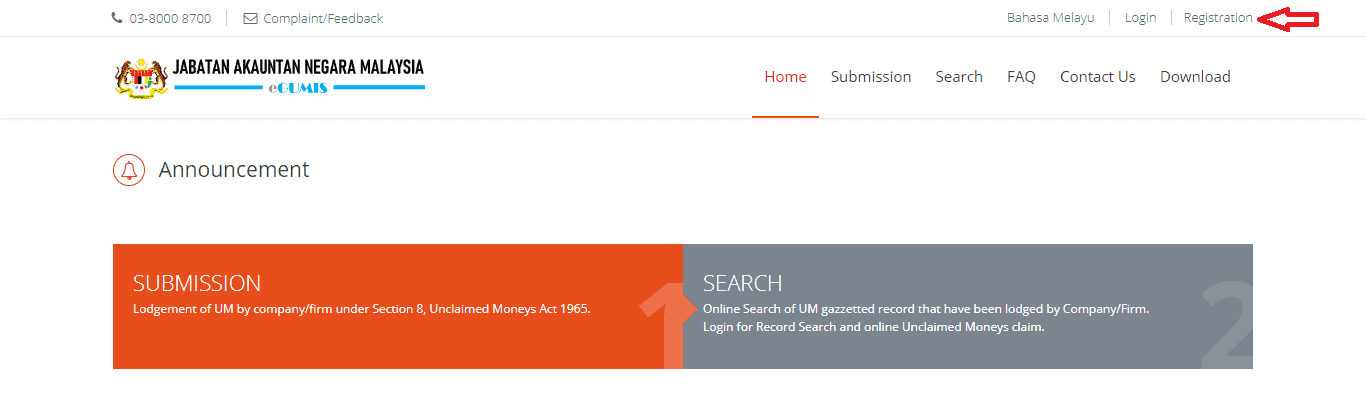
    First, head over to this link to register for a new account. Then click on ‘Registration’ in the top right corner as per the screenshot below to get started.

    Note: You may first need to change the default language to English, or you may proceed in Bahasa Melayu.

    egumis home

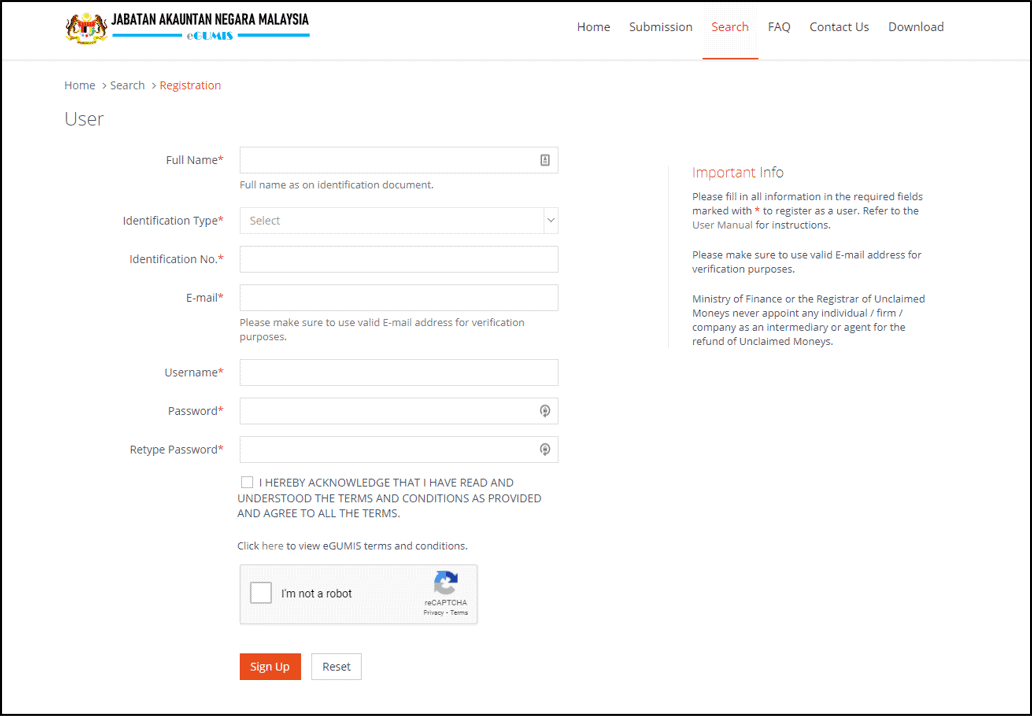
    You may then fill in the form to register your new account.

    Account Registration Form

    Your account will be deactivated after six months of inactivity, so if you have previously registered and have not logged in for the past six months, you’ll need to register for a new account.

    Step 2: Update your Profile

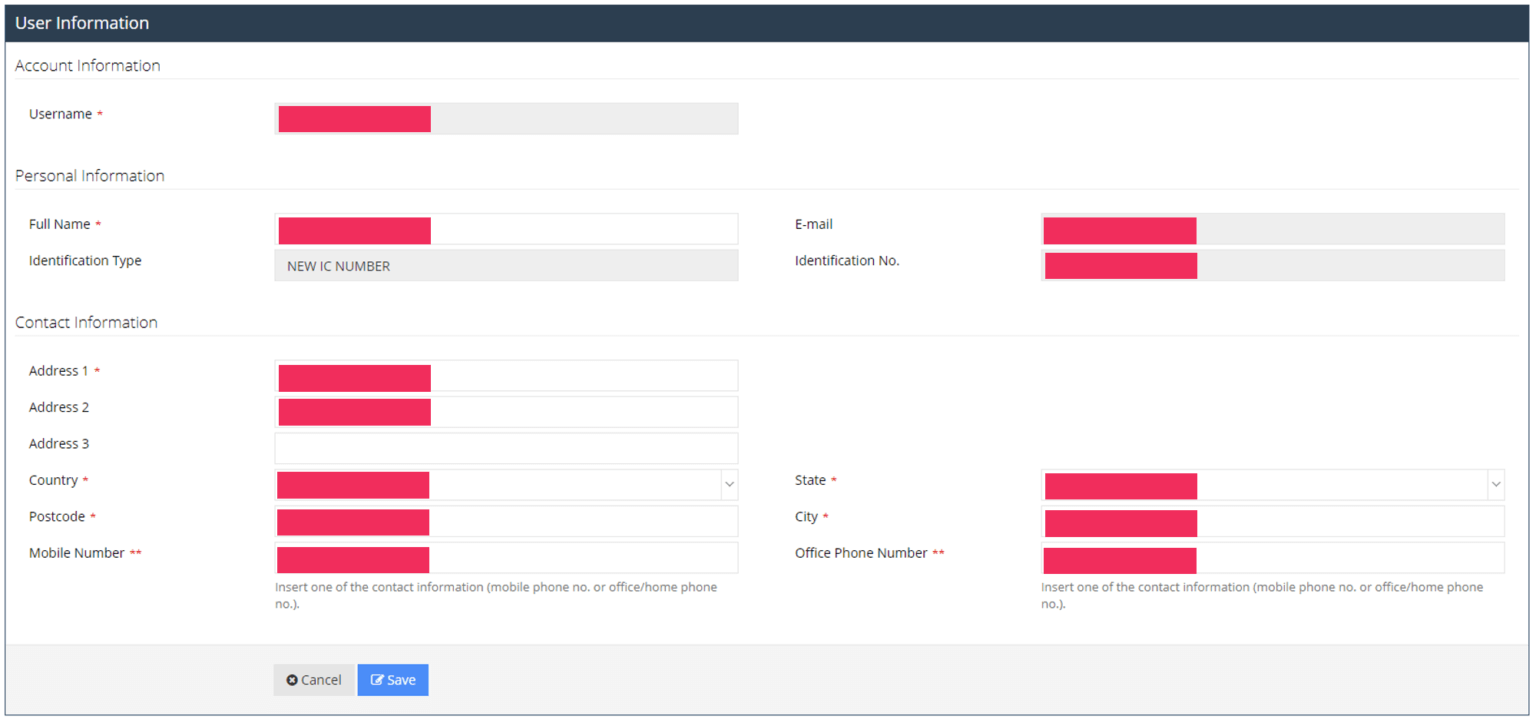
    Next, update your profile. Make sure to fill up all the boxes that is marked as compulsory (*).

    User Profile Information Form

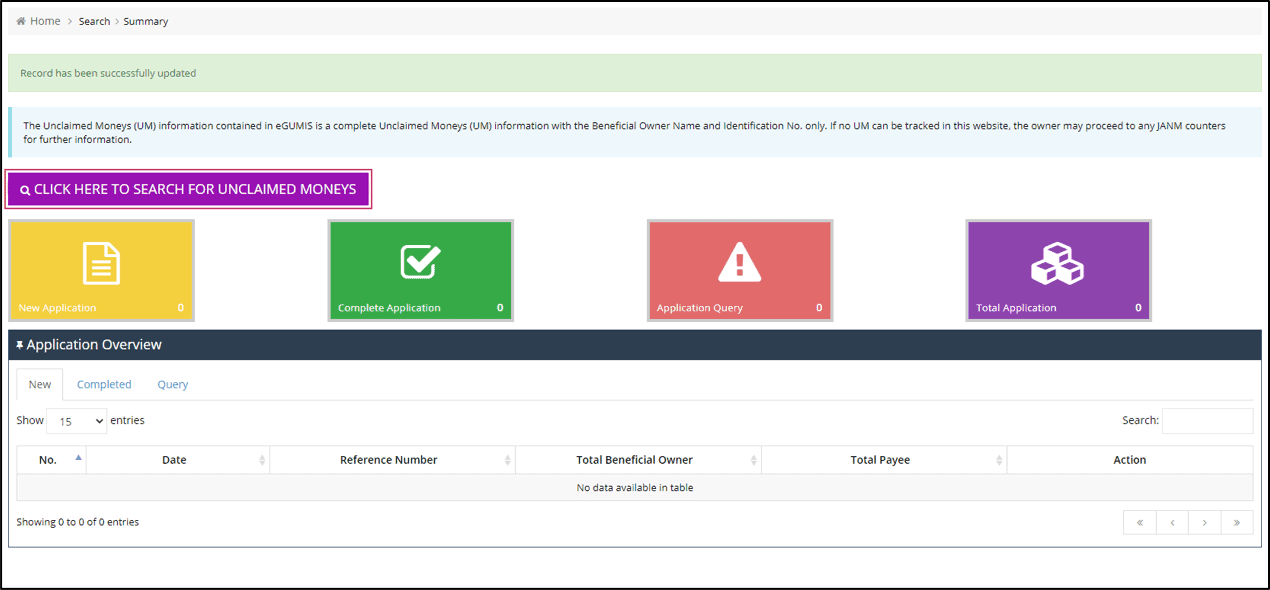
    Step 3: Check for Unclaimed Monies

    Click on “Search for Unclaimed Moneys” and enter your Identification Number into the provided space. If you have any unclaimed money, it will show up in the search result.

    Unclaimed Monies Summary Search Result For Unclaimed Monies

    I also helped my parents check their unclaimed money through my account. However, I’m not sure if I can actually process the claims using my account, so to be on the safe side, I registered new accounts for them to help them claim their money.

    Do note that you can only check a maximum of two IDs per day.

    Step 4: Application Form

    If you have any unclaimed money, here is what you need to do to claim it:

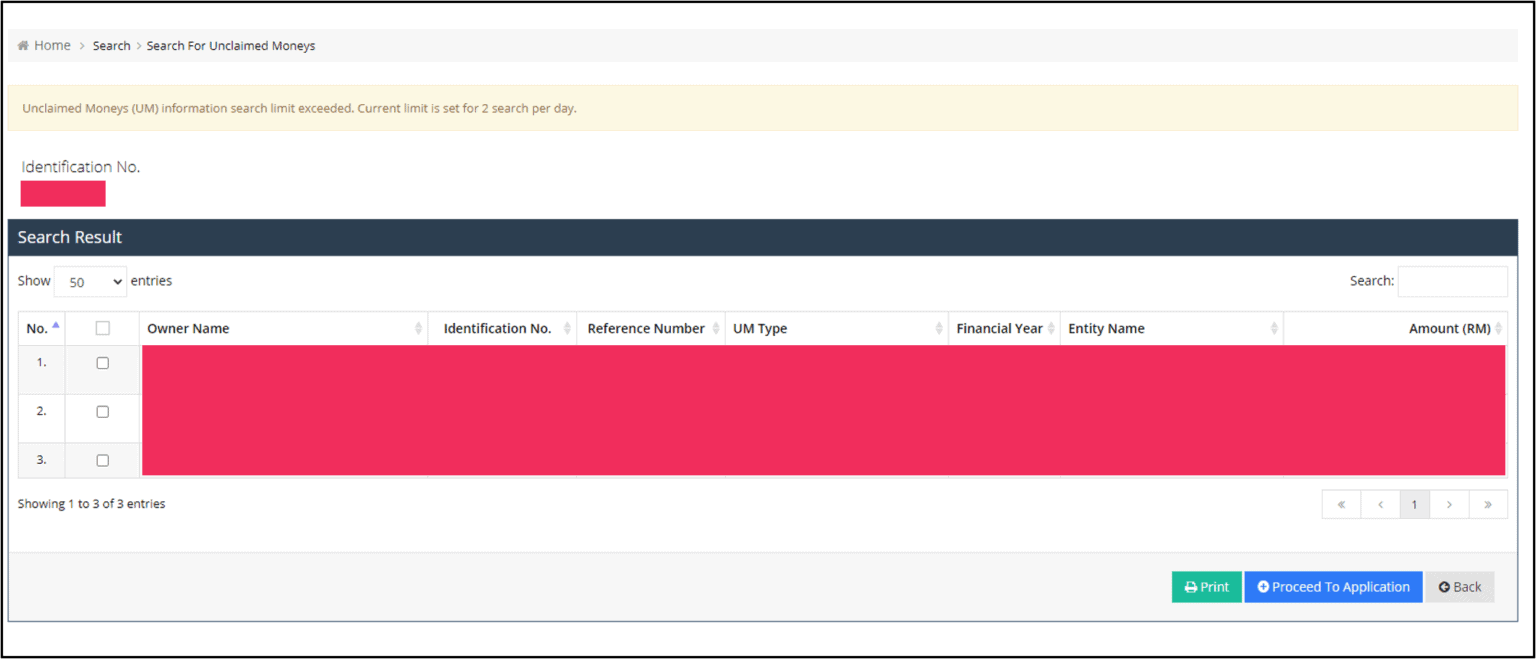
    Don’t click anything other than the following two steps. As the system doesn’t save your search results, if you use up your quota of two searches per day, you have to wait for the next day to proceed to the next step.

    Search Result For Unclaimed Monies

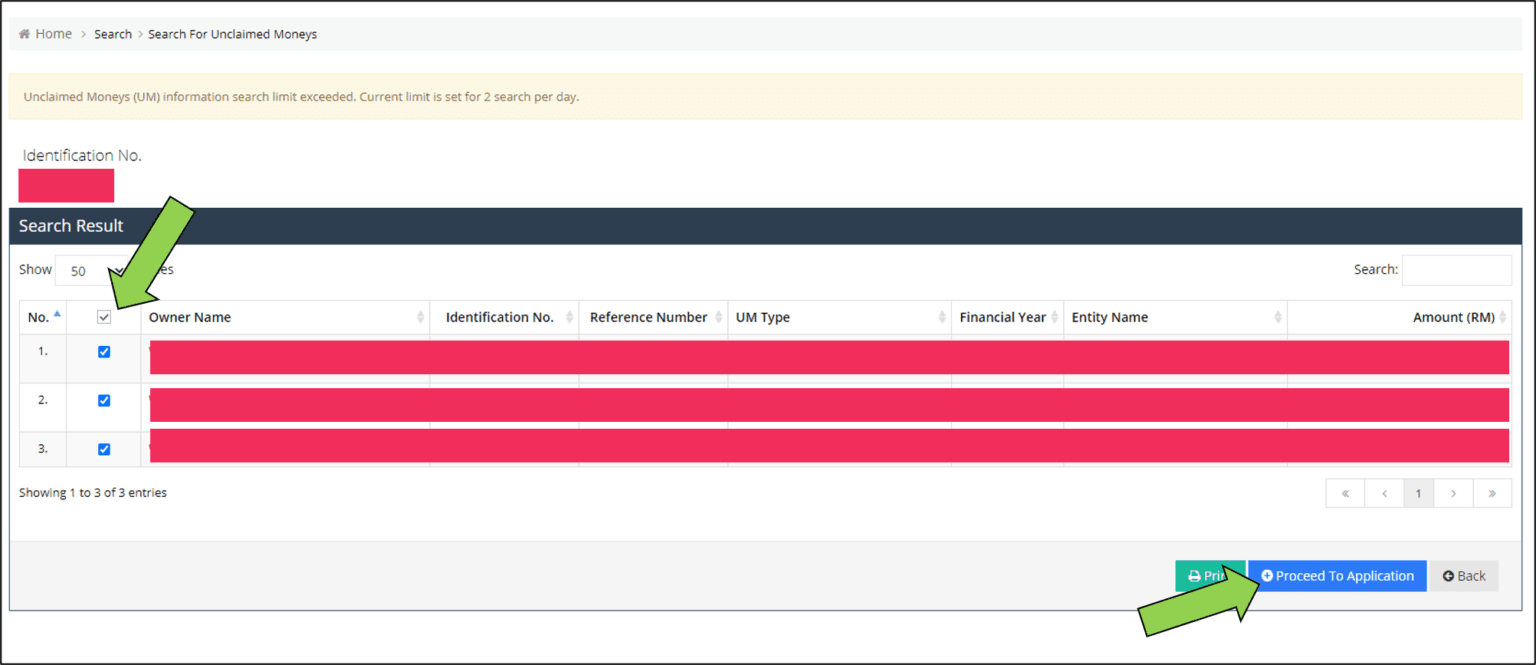
    Select the “check all” box, as I assume everyone wants to claim all their unclaimed monies.

    Select the “Proceed to Application” box.

    Step 4.5: (Workaround) Bug in the System

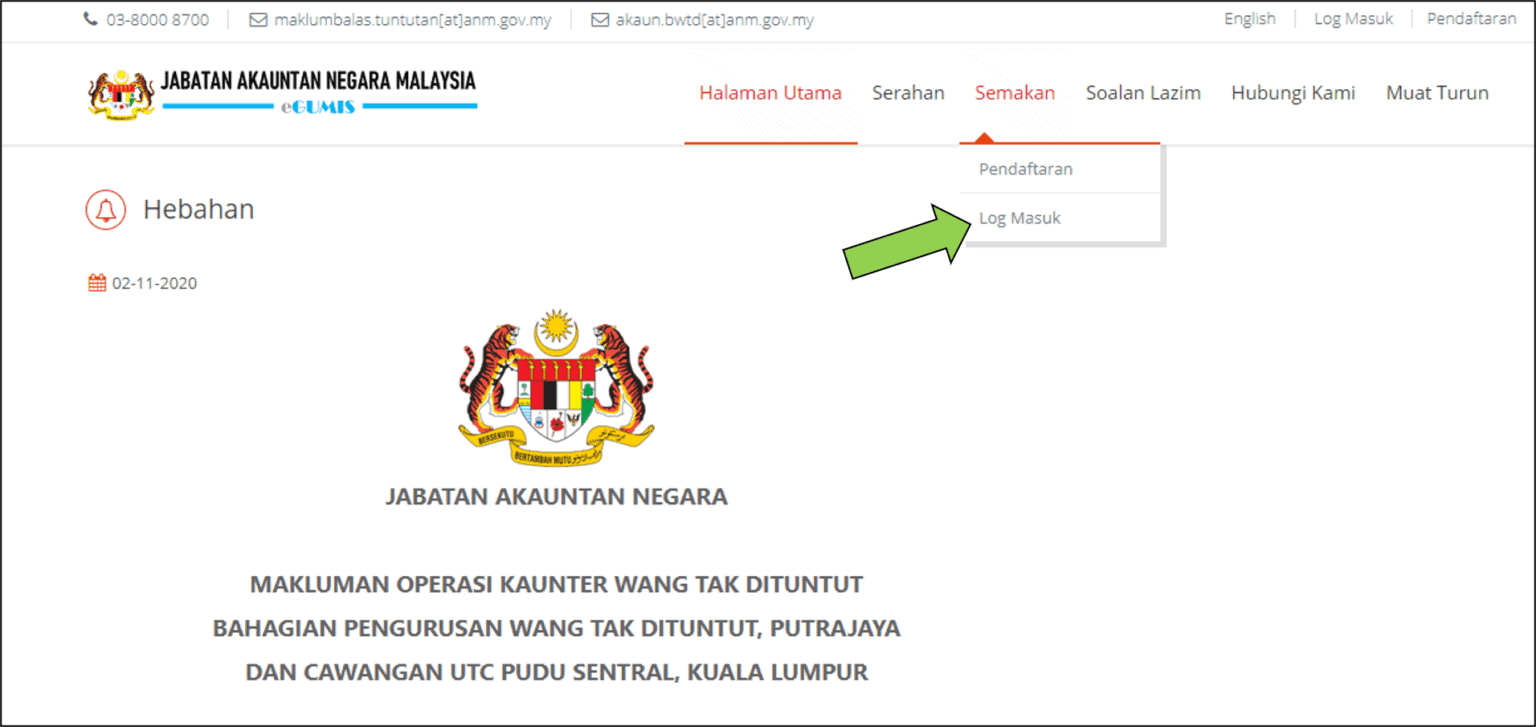
    In my experience, for some reason, there is a bug in the English version of eGUMIS which prevented me from proceeding to the next step. I’ll save your time without boring you with the details; here’s the work around:

    English eGUMIS login JANM Login Page

    Visit this link and under “Semakan” click “Log Masuk”. This is the Bahasa Malaysia version of eGUMIS.

    Step 5: Enter Payee Information

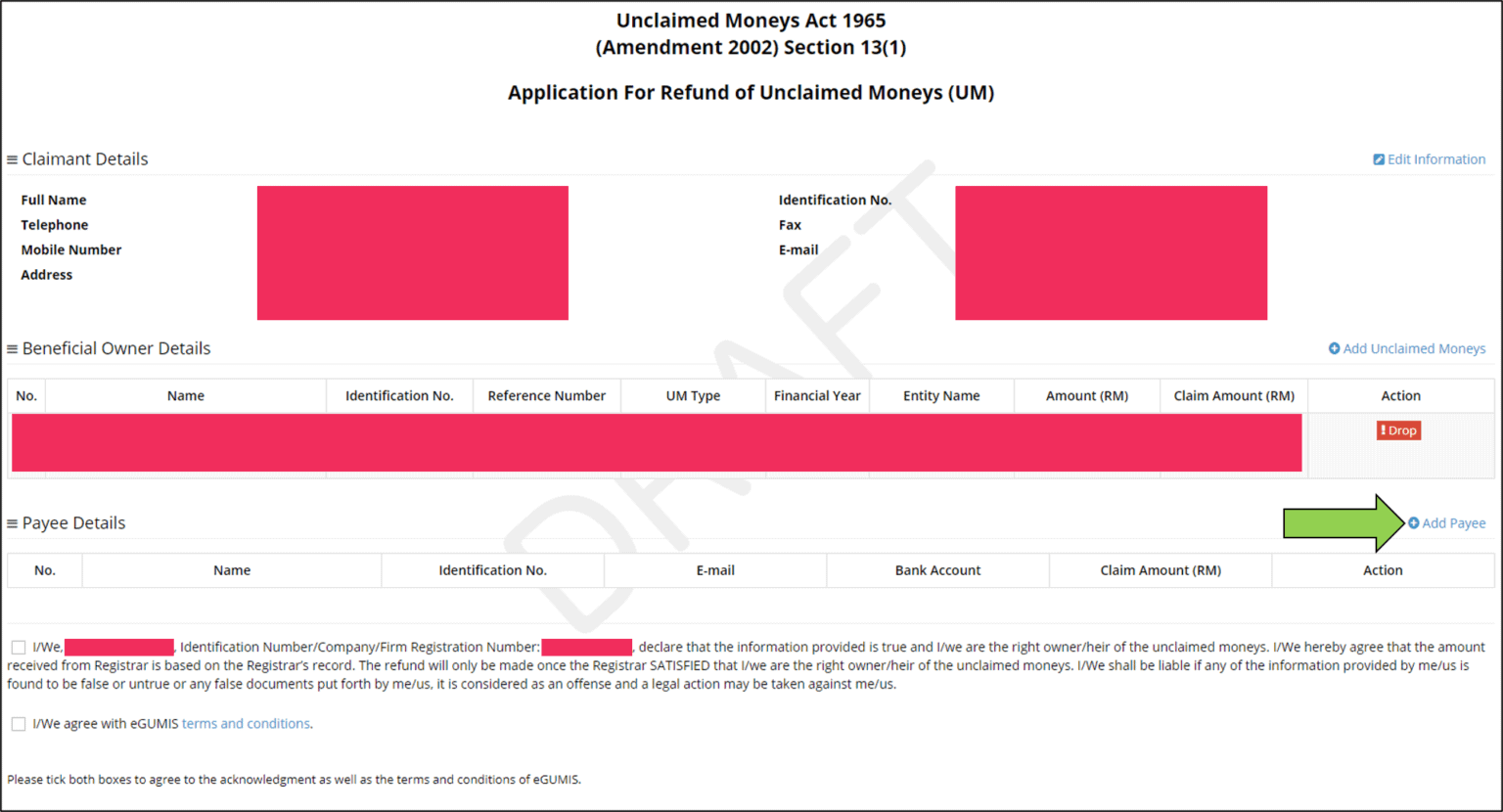
    This screenshot was taken in the English version. In the Bahasa Malaysia version, “Tambah Penerima” is also located in the same position.Enter Payee Information Screenshot

    Once you click on “Tambah Penerima” (Payee), a pop-up will appear and you’ll need to fill in your particulars and bank account number accordingly.

    After you’ve saved the Payee details, check the two boxes below and click on the “Hantar” button.

    Step 6: Almost there

    Once you’ve completed your application, you should receive an email by the AGD. To complete the claim, you are required to submit:

    • A copy of your ID (IC / passport / company certificate)
    • Bank statement (from the same bank that you entered in the Payee column).

    Submit the above document to permohonan_wtd@anm.gov.my with the application number as the email subject.

    (Please be reminded that each email cannot exceed 15MB.)

    Final Thoughts

    Even though there’s no time limit as to when you can claim your money, it’s better to claim it as soon as possible. This is because the Registrar of Unclaimed Money doesn’t pay any interest on the money claimed while your money can be invested elsewhere to generate a return.

    One common reason why money remains unclaimed is because the legal beneficiaries don’t know about the money after the owner passes away. This is especially true if the owner dies unexpectedly. Therefore, it’s good to have a simple will (at the very least) to avoid this scenario.

    Don’t stop at checking your own account; if you have elderly parents or family members, do help them to check as well.

    However, please be reminded that the Ministry of Finance or the Registrar of Unclaimed Money doesn’t appoint any individual/firm/company as agents for the refund of unclaimed monies. Be extra careful if anyone claims that they can help you claim the money.

    This article was originally published at planNERD.

    About the Author 

    Marshall Wong is a licensed financial planner and can be contacted through his website or marshallwong@fa.my.


  • What Is Financial Abuse?

    What Is Financial Abuse?

    Are You Being Financially Abused? What Is Financial Abuse?

    Abuse comes in many forms and one of it is financial abuse.  In a marriage, money is usually co-owned but in many cases, the husband may control every aspect of finances and the wife doesn’t have access to it. 

    If she needs to ask for money, the assumption is that she doesn’t have any access to the bank accounts.

    This can be the case in many situations, especially if the husband is the sole breadwinner in the family, with his income going directly into a bank account that only he can access and control.

    In some instances, the wife won’t have her name on it and will need to ask for money in order to purchase basic household items.

    Other than the fact that she’s in a very dangerous position if anything happens to the husband, the marriage is built on the principle that he is above her in terms of finances.

    He makes all the financial decisions, and then decides if he wants her input while she has no control over it because she has no access to the money. 

    From the beginning, if a marriage is built on the basis that money is “his”, and he’s doing her a favour by letting her have some of it, this is not acceptable in today’s climate.

    Marriage is for two people to come together as one flesh and a partnership, not for one to be fully dependent on the other.

    If your partner is denying you access to finances and is treating it like it’s only “your” money instead of the marriage’s money, that can be categorised as financial abuse. 

    Money as a Method of Control

    The partner often uses money as a weapon to maintain control in the relationship.

    Your partner may assure you that they have it all covered, but the reality is that he or she is restraining you of your rights and potentially robbing you of your freedom.

    Financial abuse in a relationship is often hard to identify considering that the abuse is embedded with complex beliefs and social norms, so it can often go unrecognised by the person experiencing this.

    This robs the woman’s or man’s right to acquire and maintain economic resources, threatening their financial security and pushing them to not be self-sufficient. 

    Types of Financial Abuse 

    1. The controllers – This person uses a combination of abusive behaviours to exert their power over their family 
    2. The exploiters – This person takes all responsibility and also uses all kinds of abuse to financially exploit their partner for their own needs 
    3. The schemers – They have a specific plan in place to steal their partner’s financial resources and leave 

    Research has shown that the traditional stereotypes and attitudes toward gender roles and attitudes make grounds for controlling, exploitative and abusive behaviours regarding finances.

    In most cases, women trust their partner to act in the best interest of their family.

    However, their judgment is often clouded by the belief that their partner knows what’s best for the relationship, resulting in them fully relinquishing all financial responsibility to the abusive partner. 

    It Doesn’t Get Easier After the Separation 

    If the partner decides to leave the abusive marriage, it doesn’t mean that the effects of the abuse stops.

    Studies have shown that their income decreases further and suffers more after leaving their marriage, in addition to being impacted psychologically, whereby they experience a loss of confidence, guilt and also shame. 

    “Each year, more women are touched by domestic violence than breast cancer, ovarian cancer, and lung cancer combined.”

    – Purple Purse, Allstate Foundation 

    How Do I Get Out of a Financially Abusive Relationship? 

    Most of the time, people tend to feel trapped in their position. They stay in an unhappy marriage or relationship out of fear that they can’t afford to feed, clothe and house their children, as a result of having no idea about their partner’s income, or even the assets and debts in their name. 

    The first step to move on is to understand and believe that there are ways to leave this financial abuse in the past.

    It’s so important that you’re mentally prepared and have decided that you’ll do whatever it takes to leave this toxic relationship for that light at the end of this tunnel. 

    Step two is to gather all the information about your finances. Every single detail is needed to take the first steps towards regaining your power.

    The last step is to start planning out your new financial life. Write down all your hopes and dreams for yourself and your future. Think of realistic ways for you to take steps towards achieving your financial dream. 

    The journey is a long one. It’ll be tough psychologically, physically and financially but the earlier you take the necessary steps to gain control of your finances, the better the chances are of you determining your own financial future. 

    About the Author

    Nurul Yahi is a financial enthusiast and you can find her at dearduit.com. You can also find Nurul on Twitter, Instagram and Facebook.

  • Cultivating Healthy Financial Literacy for Kids

    Cultivating Healthy Financial Literacy for Kids

    “I wish I knew about this earlier. Why were we not taught this at school?” Thus begins the lack of education and awareness of financial literacy in kids.

    Whenever I discuss financial planning and other sub-topics with clients and prospects, this is the most common thing I hear. 

    Have you ever thought about how great it’d be if good money management skills were nurtured in our young ones? And how it’d be even better if we’re prepared to face the challenges in handling money from young? 

    One of the best skills that parents can teach children from a young age is smart money habits. It’s important to impart good knowledge and attitude in handling money during the early years as it’ll shape their attitude towards money as adults.

    Undeniably, this will largely be influenced by parents, peers as well as the media. If their foundation is strong, they’ll be able to rationalise the idea of money and become financially savvy in the future once they become adults.

    However, it’s getting tougher to teach kids about the value of money since we’re firmly in the cashless era now. More and more people are no longer used to paying for things in cash, with more online transactions and card payments used.

    Thus, kids do not see physical money transactions when their parents and people around them purchase goods and services. In addition, with the easy availability of credit today, the need to be able to manage money is even more important.

    So how can we start teaching our kids about good money management?

    1. Start Them Young

    Parents can teach their kids from as early as three years old. Kids at this young age learn through observations so for a start, parents can teach the concept of money by exchanging it for food or toys, which is likely to be their primary interest at such an age.

    2. Value of Money

    For kindergarteners and school-going children, you can start to teach them about the value of money. This is to prepare them since they will need to purchase their own food when at school. At this age, parents must be more involved by instilling confidence in their kids. 

    For instance, get your kids to approach the cashier and pay when making purchases, while you observe.

    To assist when they’re paying to ensure that they can calculate the money to give and balance to receive.

    Provide them with a fixed allowance and rationalise with them by suggesting substitutes if the item they choose is more than what’s budgeted. As a result, you’re also teaching them that not everything can be purchased, and we should spend within our means.

    3. Include Your Kids in Conversations

    When your children are in their teenage years, do include them in conversations when making money decisions.

    You may ask for their opinions and discuss the advantages and disadvantages, repercussions, and rationalisation behind making decisions with regards to financial decisions like buying a car, a television, a phone etc. 

    You can also discuss with them their aspirations for college and the cost it entails. This is important as they will learn that it’s okay and safe to talk about money with someone that they trust i.e. family members.

    In addition, they will feel involved and should develop a sense of responsibility towards money as their opinion is heard.

    As a result, they’ll have more understanding and familiarity about how money works and how better to manage debts.

    4. The 3 Jars System

    Parents should provide a consistent allowance to school-going kids so they can practice handling money and learn how to manage their allowance.

    One of the ways to inculcate a healthy financial mindset is to set up jars that signify a percentage of their money eg. 70% for spending, 20% for savings and 10% for charity or donation. 

    At the end of each quarter, bring your kids to the bank to save the money accumulated and bring them to the charity of their choice to share some of their savings.

    Consequently, you are teaching your kids about sharing with the less fortunate, how to save for their future, and budgeting for spending on what they need and want.

    5. Paint the Picture that Things Can Go Wrong, Sometimes

    Kids should know that sometimes, things will not be in our favour and it’s not always rainbows and butterflies.

    Parents may share with their kids if they’re facing money difficulties and some compromises or sacrifices need to be made by the family. At times like this, where the economy is not as good, most people face pay cuts, unpaid salaries, and even retrenchment. 

    Thus, it is best to layout the expenses that can be dropped temporarily, for example, extra classes like piano, art, taekwondo, swimming etc.

    Do involve the kids in the discussion where some expenses need to be cut off as this will affect them, physically and mentally. Explain to them what needs to be prioritised for the time being.

    In this way, you also teach them that when things don’t go your way, you’ll need to have a mitigation plan in place without sacrificing what truly matters.

    6. Be a Good Example

    Parents should always portray a good attitude towards money in front of children. Avoid quarrelling about money due to overwhelming debts or spending lavishly above your means.

    Talk about money from positive angles and paint money as a tool that can help us achieve what we desire eg. education in the university of choice, to live comfortably within our means, and the freedom to work towards what we want to acquire with peace of mind. 

    Children learn about money from observing you. Thus, parents need to learn how to speak the right money language and develop the right money attitude and skills.

    Children will absorb these money habits from their observation and listening while growing up.

    Your beliefs become your thoughts,

    Your thoughts become your words,

    Your words become your actions,

    Your actions become your habits,

    Your habits become your values,

    Your values become your destiny.

    A famous quote from Mahatma Gandhi

    Kids that are taught good money management skills will have a better chance of making sound financial decisions and not getting into money troubles when becoming adults.

    They’ll also be better prepared to face any challenges in the future.

    As parents, we should discuss openly with kids and share our financial mistakes so that they won’t repeat them in the future (touch wood!).

    Nonetheless, in order to cultivate a healthy financial mindset in our children, we should also equip ourselves with the right skills, knowledge and good money management!

    About the Author 

    Fateen Binti Rosli (IFP) is a Licensed Financial Planner. Her expertise is in holistic financial planning that includes health care planning, children education planning, retirement planning, wealth accumulation and cash flow management. She can be contacted at fateen@wealthvantage.com.my

  • A Guide on Applying for A Housing Loan in Malaysia

    A Guide on Applying for A Housing Loan in Malaysia

    “Your loan application has been rejected.” If you had this said to you when you applied for a housing loan in Malaysia, then read on.

    Getting this response to your mortgage loan may be daunting and make you feel like a lost cause but don’t give up hope! There are several ways to navigate the murky waters of mortgage loan application – here are some points to look into to maximise your odds of obtaining approval for future mortgage loan applications:

    1. Check Your Debt Service Ratio

    This is one of the preliminary checks for financial institutions, with your debt service ratio (DSR) used to determine whether you’re able to afford the loan repayments. If the DSR is within their threshold given a range of income, it passes one stage of the mortgage loan application.

    The formula to calculate DSR is:

    DSR = Total monthly liability commitments / total monthly nett income

    Monthly Net income = Gross Income – Total Deductions (EPF, SOCSO, tax etc)

    Monthly Commitments = new loan application amount + car loan + personal loan + credit cards + mortgage loan

    Once the DSR has been determined, each bank will have their respective guidelines for the maximum allowable DSR threshold given a range of incomes.

    It’s typically determined by income level, but it may also be affected by your net worth and even things as arbitrary as educational background, age and nature of employment and sector.

    For example, some banks may recognise 100% of investment property rental income, and some may only consider 50% of the rental income.

    The calculation may differ also when it comes to variable income earners and the nature of the job. For instance some banks may take 80% of the six-month average income of an insurance agent, while others may take only 60%.

    2. Get Your Documents in Order

    Banks always look for a clear and complete set of documents for assessment. For any bank to process any mortgage or loan application, they require supporting documents including proof to validate your income sources and employment.

    For a salaried employee, the banks would like to see that you contribute to EPF and your income taxes via your payslips and tax submissions.

    For variable income earners, do keep a record of at least six months’ worth of income/payout statements and supporting transactions into your bank account(s).

    For the self-employed or business owners, ensure that your business documentation and accounting of bank balances are up to date as this will assist the loan officer to get any loans approved. In most cases, the bank would like to see a business with at least two to three years of operations supported by audited profit and loss and bank statement transactions to evaluate the ability to service the loan.

    3. Don’t Apply for Loans Immediately

    If you are a fresh graduate looking to submit a bank loan application, don’t apply immediately for a mortgage or credit facility once you receive your first payslip.

    While it may be tempting to get on the credit ladder, banks typically want to see a minimum of three to six months of permanent employment supported by your salary payslip, along with EPF and tax deductions (if applicable). 

    In the case of the self-employed or commission earners, banks look for stability in income and usually need to see a minimum of six months of payments to be certain that you can service the loan.

    4. Don’t Go Bankrupt!

    It goes without saying but if you are declared bankrupt, you won’t be able to secure any loans or credit facilities with any financial institution. Your status of bankruptcy can be obtained by checking the Malaysian Department of Insolvency (MDI) or searching on CTOS.

    5. Issuing Bad Cheques

    If cheques that you issue bounce back three times, this is a huge red flag. A bad cheque is commonly referred to as a bounced cheque, and refers to a cheque issued by an account holder, dishonoured and returned by the drawee bank when it is issued from an account with insufficient balances or a blacklisted account under the Credit Bureau by Bank Negara Malaysia. 

    Banks usually view this as a precautionary signal and will reject the mortgage loan application and other pending loan applications.

    6. Maintain a Good Credit Score

    Maintaining a good record and positive status in CCRIS and CTOS is essential. Banks use CCRIS and CTOS as a reference to evaluate credit pattern behaviours and adverse reporting that will illustrate credit payment ability and servicing financial commitments.

    The Central Credit Reference Information System (CCRIS) is a system created by Bank Negara Malaysia that maintains the repayment track record for the last 12 months of all credit facilities of participating financial institutions in Malaysia.

    Any late payment or prolonged late payments of over six months will be flagged as a “Special Attention “ account in CCRIS. This indicates a red flag for banks.

    CTOS is a privately-owned credit reporting agency that provides credit reporting and also has access to information such as bankruptcy, legal action and case statuses, individual’s business ownerships, shareholding and directorships.

    They can also retrieve information from utility and telecommunication companies if you have outstanding bills (even if it’s only RM50!) and which can be a cause for banks to reject your loan application!

    7. Ensure your Quantitative Elements are Solid

    In this day and age, every bank has its own algorithm and software to calculate an individual’s score. This can be a subjective matter as software calculates the scoring according to quantitative and qualitative elements, which may not be the same as the algorithm and systems used by other banks.

    The quantitative elements include DSR calculation, the net worth of an individual or profit and loss of a company and also refers to CCRIS records. Qualitative elements include factors such as age and educational background.

    Your score will differ across each bank as they use different algorithms and systems. As a mortgage loan applicant, you can improve your profile by ensuring the quantitative aspects are covered and within their requirements.

    8. Not Having Any Credit History

    A poor credit score is not the only reason lenders reject mortgage loan applications. Having no credit history makes banks uncertain of your ability to pay.

    It’s advisable to build up a clean credit history, and it’s normally best to start this by applying for a credit card application or taking up a small loan. 

    With a smaller credit card facility or loan (that is consistently paid!), this may create a higher approval rate for your mortgage loan in the future because the perceived chances of defaulting on payment are lower.

    9. Late Payment of Instalments

    A poor track record of loan repayments gives a bad impression to potential lenders and might impact your future application. So try your best not to be late and settle your credit card bills, car loan instalments and other commitments on time.

    One way to do this is to set a payment reminder on your calendar or other forms of reminders on your mobile devices.

    10. Bank Risk Appetite

    Lastly, it is important to note that all banks have different risk appetites. There are instances where a bank has their own non-preferred segments; this could include people working in a niche industry, not meeting the minimum age, or not having a strong educational background requirement.

    You may get rejected for holding too many credit cards and you may also get rejected for not holding any credit card. In addition, a rejection could also be due to the mortgage financing not being within their particular area, developer, property type or market segment.

    Treat applying for any mortgage or loan like you’re going for a job interview. With a little financial planning help in money management, preparation of supporting documents and maintaining a clean profile in CCRIS and CTOS you stand a better chance of getting your mortgage loan approved by the right bank.

    About the Author

    Rozanna Rashid is a Licensed Financial Planner (CFP, IFP) that has an MSc in Real Estate Economics & Finance from the London School of Economics & Political Science. Her background is in corporate banking and Islamic finance and she can be contacted at rozanna@alpine-advisory.com

  • Understanding Your Assets And Liabilities

    Understanding Your Assets And Liabilities

    Many of you will know the difference between assets and liabilities, but allow me to explain for those that don’t. An asset is something that potentially goes up in value over time, such as a limited edition timepiece, property, or blue chip shares. Liabilities are what’s owed to other parties such as banks or even friends and family, which can include your house or car loan, or study loans. The difference between your assets and liabilities is what’s known as your net worth.

    But why does this matter? Consider this – if you stop working today, how long can you survive financially? Many people have lost their jobs or faced pay cuts during the Covid-19 pandemic, and the hardest hit are usually entry-level employees who have just started their careers. Most, if not all, would have accumulated some assets if they consistently saved and invested from their first paycheck, while others may have car loans or credit card loans to settle. 

    Some may have filial responsibilities and need to support their family and loved ones with their entry-level pay. According to a Jobstreet salary report, the minimum income level for fresh graduates before the pandemic was between RM1,949 to RM2,836, which is very low considering the time-cost requirements to get an education. No matter the situation, you must repay your commitments, and if you’re unable to, the worst case scenario is being declared bankrupt and forfeiting your assets to the bank! It’s crucial for fresh graduates to have basic financial knowledge, and take proper action to safeguard their own finances.

    Good Assets vs Bad Assets

    Although your net worth is your true wealth, this isn’t the be-all and end-all. There are many other financial areas we must look at; assets and liabilities are only one part of the equation. Generally, there are good and bad assets but of course, whether or not it’s a good asset depends on the owner’s perception, so there are no hard and fast rules to judge whether an asset is good or bad. 

    For instance, an investment property that has been successfully rented out for the past 10 years might be deemed as a good asset, but when it loses its ability to be rented, then it suddenly becomes a bad asset.  Impatient or desperate owners may try to sell the property before finding out the underlying reason for the failure to secure a new tenant. 

    Another common example is a car, which many perceive as a liability. However, this has changed since technology revolutionised the taxi industry, with the emergence and eventual merger of the Uber and Grab ride-sharing platforms. For many gig workers, the traditional perception of a car being a liability changed as it became a tool to generate active income instead of solely required for travelling to work. As you can see, what can be considered a good or bad asset is somewhat subjective, but all it takes is a little assessment to judge for yourself.

    Understanding Various Forms of Debts

    Apart from assets, you also need to review your debt. In the market, there are numerous forms of debt, such as personal debt, corporate debt, or even government debt, and so on. Let’s focus on some of the debt that fresh graduates are more likely to carry, which may include student loans, credit card debts, hire purchase (car loans), and mortgages (housing loan). 

    These four types of loan are common among fresh graduates, and are typically the type of debts that people start acquiring in their 20s. Of course, the ideal scenario is not getting into these but it’s more likely than not! As these loans come at different costs to the consumer, you must fully understand the respective terms and conditions before taking on these debts.

    Managing Money by Understanding Assets and Liabilities 

    Once you’re mindful of what assets and liabilities are available, you can start learning how to maximise opportunities. For example, if you love shopping, get a credit card with cash-back or rewards points and use them when purchasing daily necessities. Needless to say, you should be conscious of your budget and settle the bill in full before the due date! In the long run, not only does timely credit card repayments build your credit score, but more importantly, it becomes ingrained as part of your money habits!

    How to grow your net worth?

    Now that you know the difference between assets and liabilities, you should start planning how to grow your net worth? As a fresh graduate, the road is likely to be long but not unattainable so do try some of these tips to speed up the journey:

    • Reduce your debt

      Since debt is the major factor dragging down your net worth, it’s advisable to keep this to a minimum. As a benchmark, your total debt should be around 50% out of your total assets. If you’re at a higher debt level, consider allocating more of your income to reducing it.
    • Expenses

      This may seem obvious but your daily expenses can pile up, especially if you don’t differentiate between needs and wants. Spend on what you truly need rather than what you want. If you buy too much of what you want, you may not have enough to buy what you need.
    • Savings

      Once you have successfully lowered down your expenses, you’ll definitely see your savings increase. If you are working in the Klang Valley, a good benchmark to aim for is a saving rate of 30% from your gross income. Anything more than this is amazing!
    • Investing

      Once you have built up your savings for a rainy day, start looking at investing elsewhere since keeping your money in bank deposits will hardly beat inflation. In the long run, you’ll potentially see your assets grow steadily if you do it right, and increase your net worth as a result.

    In short, clear your debts, spend wisely and invest sensibly. Bear in mind though, it’s easier said than done!

    About the Author

    Wong Chee Yang is a financial advisor representative and is dedicated to promoting financial literacy amongst fellow Malaysians. He can be contacted at cywong@finwealth.com.my.