Category: business

  • Analysis: Global Pension Report

    Analysis: Global Pension Report

    Allianz has recently unveiled the first edition of its ‘Global Pension Report’, taking the pulse of pension systems around the world with its proprietary pension indicator, the Allianz Pension Indicator (API).

    The indicator follows a simple logic: It starts the analysis with the demographic and fiscal prerequisites and then continues to examine pension systems along their two decisive dimensions: sustainability and adequacy.

    Hence, it is based on three pillars and takes in all 30 parameters into account, which are rated on a scale of 1 to 7, with 1 being the best grade. By adding up all weighted subtotals, the API assigns each of the analyzed 70 countries a grade between 1 and 7, thus providing a comprehensive view of the respective pension system.

    “Demographics and pensions have been eclipsed by other policies in recent years, first and foremost climate change and today the fight against Covid-19,” said Allianz chief economist Ludovic Subran.

    “But you ignore demographics at your own peril, demographic change will soon be back with a vengeance. Defusing the looming pension crisis and preserving generational justness and equality are key for building inclusive and resilient societies.”

    Dramatic Shifts in Demographics

    The dramatic shift in demographics is best characterised by the increase in the global old-age dependency ratio: until 2050, it will grow by a whopping 77% to 25%, i.e., faster than in the last 70 years since 1950.

    In many emerging economies the ratio is going to more than double within the next three decades, that is, in less than half of the time this development took in Europe and Northern America.

    The most prominent example is China where the ratio is going to increase from 17% to 44%. For industrialised countries, however, the absolute level of this ratio is the main reason for concern, reaching, for example, 51% in Western Europe.

    This development is reflected in the first pillar of the API, called the starting points, which combines demographic change and the public financial situation (financial leeway).

    Not surprisingly, many emerging countries in Africa score rather well as the population is still young and public deficits and debts are rather low. On the other hand, many European countries such as Italy or Portugal are among the worst performers: old populations meet high debts.

    “For most industrialised countries, the old Scottish joke applies: If I were to build a stable pension system, I certainly wouldn’t start from here,” said Michaela Grimm, author of the report.

    “And that is the situation before the coronavirus and its tsunami of new debt. One of the legacies of the current crisis will certainly be that we have to double our efforts to reform our pension systems. What remained of financial leeway has gone for good.”
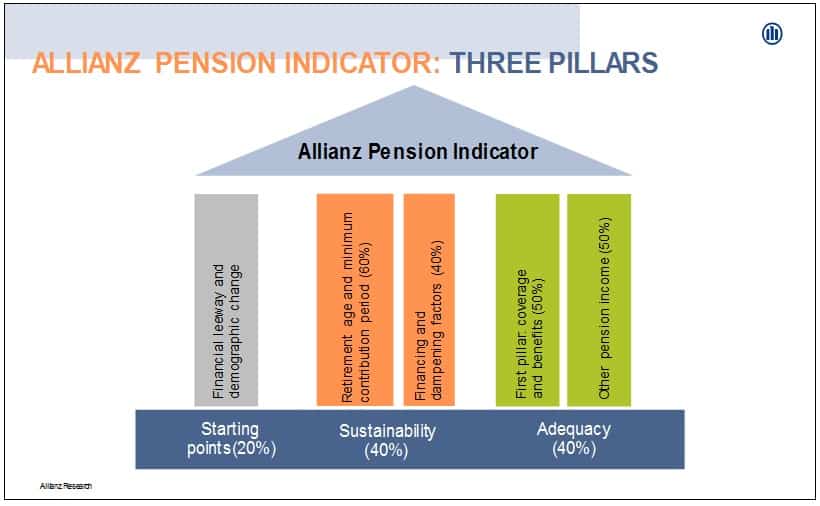
    The second pillar of the API is sustainability, measuring how systems react to demographic change: Are there built-in stabilizers or will the system be blown apart when the number of contributors falls while that of beneficiaries keeps rising?

    In that context, an important lever is the retirement age. In the 1950s, an average 65-year old men, living in Asia could expect to spend around 8.9 years in retirement (women 10.3 years).

    Today, the average further life expectancy of a 65-year old is 17.8 years for women and 15.2 years for men and it is set to increase to 19.9 years (women) resp. 17.5 years (men) in 2050.

    As a consequence, the ratio of working life to time spent in retirement has declined markedly. Countries, which decided to adjust the legal retirement age or the increase of pension benefits to the development of further life expectancy like the Netherlands, have thus a more sustainable pension system than countries where postponing retirement further is still taboo.

    The third pillar of the API rates the adequacy of the pension system, questioning whether pension systems provide an adequate standard of living in old age.

    Important levers are the coverage ratio – i.e. how big are the shares of the working-age population and the age group in retirement age that are covered by the pension system? –, the benefit ratio – i.e. how much money (measured in terms of average income) does an average pensioner receive? –, and last but not least the existence of capital-funded old-age provision and other sources of income.

    Overall, the average score in the adequacy pillar (3.7) is slightly better than that in the sustainability pillar (4.0), a sign that most systems still put greater weight on the well-being of the current generation of pensioners than on that of the future generation of tax and social contribution payers.

    The countries leading the adequacy ranking have either still rather generous state pensions, like Austria or Italy, or strong capital-funded second and third pillars, like New Zealand or the Netherlands.

    However, capital-funded retirement solutions are under increasing pressure in the persisting low-interest rate environment. The COVID-19 pandemic has further exacerbated this trend by further pushing down yields.

    “The low yield environment has forced both pension funds and life insurers to explore alternative asset classes,” said Allianz SE head of global retirement proposition Cameron Jovanovic.

    “This push into alternatives enables benefit providers to capture the illiquidity premium that matches well with their portfolio duration. Another strategy is to offload risk rather than chasing returns as longevity swaps, pension risk transfers and creative reinsurance set-ups become means of optimizing the exposure taken on by pension funds and insurers.”

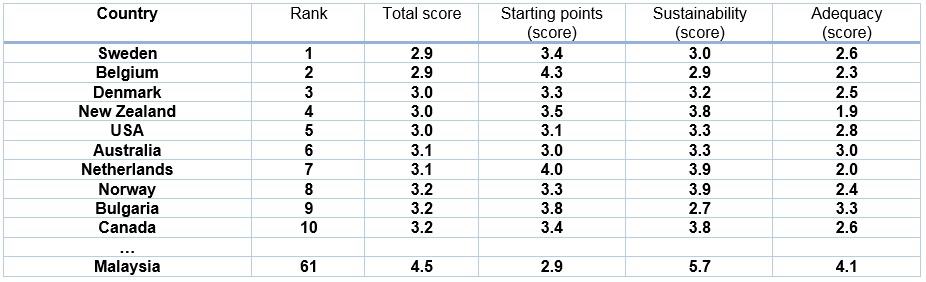
    Top 10 Pension Systems Worldwide
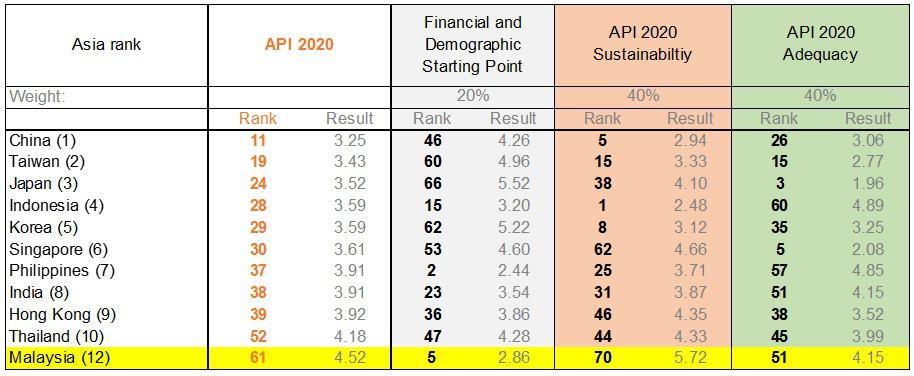
    Top 10 Pension Systems in Asia
  • Don’t Let A Career Change Lead To Your Undoing

    Don’t Let A Career Change Lead To Your Undoing

    Author and motivation speaker Simon Sinek said, “Working hard for something we don’t care about is called stress; working hard for something we love is called passion.”

    If you totally relate to this and are considering a career change after climbing the corporate ladder for the past 15-20 years, you are not alone. It is becoming more common for early millennials, who are now in their late 30s or early 40s, to decide to venture out and start a business in a field new to them but which they are keenly interested in. There are numerous different reasons why professionals who have put in some of the best years of their lives into establishing a successful career are now willing to give all of that up.

    For the majority of Malaysians, it mainly tends to include a desire for a better work-life balance, more independence and autonomy, less stress and wanting to spend more time with young children. A decision of this nature is clearly not one that can happen overnight nor should it be rushed through.

    Many individuals have long harboured ambitions to embrace a mid-career change but due to uncertainties surrounding their circumstances, have been forced to put their dreams on hold indefinitely for fear of the financial impact such a change would make. This need not be the case so long as you plan ahead before taking the plunge.

    Before we look at how you can prepare financially to make a career change, it is vital that two prerequisites are covered. First, you need to already know what it is you want to do and why. This is not the time to dabble in a variety of gigs to figure out your calling; you can afford to do that when you are in college, not when you have dependants, loans and expenses.

    Secondly, family support plays a large part in a major decision like this as they are the ones most affected by the change and require assurance that the most important needs will be covered. It is crucial to discuss with your loved ones before taking the next step.

    Once this is done, you can proceed to this eight-point checklist to see how prepared you are before taking the plunge:

    1. Ensure you have sufficient emergency funds

    Your take-home pay is going to change but your household bills might remain the same. If both you and your spouse are working, the effect might not be so drastic. But if your spouse is not employed and you have young children, you will need to factor in a bigger buffer. Your family may need to temporarily cut down on non-essential spending such as upgrading a car or going on an overseas vacation.

    Don’t forget to take into account outpatient medical expenses which you will now have to foot on your own. A comfortable emergency fund of around two years of annual expenses is recommended if you anticipate a fairly certain cash flow from the new business venture, or more if otherwise.

    2. Ensure your family has adequate insurance protection

    The current insurance benefits under your employer will cease once you leave. You will need to review your personal coverage to anticipate a range of circumstances so that your dependents will be taken care of. These include family income insurance (in the event of death), total permanent disablement (in the event of disability), critical illness, medical card for hospitalisation and surgical benefits and also personal accident coverage. You will need to consider the insurance needs of your spouse and your children – particularly for a medical card.

    3. Business funding

    If possible, start with businesses that require lower start-up capital so that you do not exhaust too much of your savings at one go. Should a larger capital be required, consider using “other people’s money”. This does not mean borrowing from banks (or other shadier sources) and getting yourself further into debt.

    Try approaching interested investors for funding or seek out like-minded partners to be joint shareholders in the business. This way, you need not stretch yourself too thin to shoulder the entire capital requirements solely.

    4. Learn the ropes

    In stark contrast to larger organisations with different departments for different functions, once you are a business owner, you will be HR, Sales and Accounts all rolled into one. If your current job function is specialised or niche, it would be timely to start charting a learning path to take you from “employment” to “self-employed” by learning the key aspects required to run a business such as day-to-day operations, finance and marketing.

    Also, it would be a good idea to bring yourself up to speed with digital and social media advertising trends as these will provide a more cost-effective way to market a new business. Talk to friends who are also business owners to get some insights into their experiences and the challenges they might have faced when starting out. While they may not necessarily be in the same industry as the one you intend to break into, all new businesses tend to share some common general issues such as sourcing for investors, regulatory and statutory requirements or shareholding concerns. Certain businesses also require certification and licensing from the relevant authorities so if possible, get a head start on this early on.

    5. Test drive before jumping in

    If the new business venture is not something you are already familiar with, you might want to consider testing it out on a part-time basis to see if it truly suits you. For example, if you plan on getting into the F&B industry, you could help out at a friend’s café over the weekends and gauge if you are indeed cut out for the job demands (long hours, busy weekends, multi-tasking, dealing with customer complaints, etc).

    Given that you might be short on cash flow once you’re in the business on a full-time basis, test out your household’s ability to live on a single income (for double-income families) or on a smaller budget.

    6. Ask those who are already in the game

    Industry experts who have a wealth of experience in their respective fields often give talks to share tips and advice to business novices. You can seek out mentors or coaches in such capacities to guide you in areas that you want to work towards.

    7. Be prepared to give yourself time

    Success is not going to happen overnight, so you will need to have realistic expectations when embarking on this new chapter of your life. Include patience and perseverance into your mantra because chances are you are going to need lots of it. Business owners face multitudes of stumbling blocks all the time regardless of the industry they are in but many survive and become more resilient as a result.

    8. Get clarity on your financial well-being before pulling the plug

    Review your financial status thoroughly and stress test your numbers to ensure you have covered all the key areas of your personal finance for yourself as well as your dependents. Engage the help of a licensed financial planner to be the devil’s advocate and make sure you have not overlooked anything.

    With the assurance that you have the financial green light to make the switch, you will have less to worry about and can direct more energy into researching and preparing for your new career. All decisions involve an element of risk, especially one where your family’s livelihood and financial security may be impacted the most.

    By taking steps to mitigate the risks and increasing your preparedness financially, mentally and emotionally, you can embark on a mid-career change with confidence, knowing that you are one step closer to achieving your dreams.

    By Felix Neoh

    Felix Neoh CFP CERT TM is the director of Financial Planning at Finwealth Management Sdn Bhd and is a certified member of FPAM. He can be contacted at enquiry@finwealth.com.my.

  • 6 Simple Ways To Reduce Investment Risk

    6 Simple Ways To Reduce Investment Risk

    How do you evaluate your risk before you invest? Experts share how to go through Risk Profile Evaluation to ensure that your take calculated risks towards achieving your personal financial goal, and ways to reduce your investment risk.

    Here are the six factors you should consider that will be affecting your risk profile. Let’s dive in!

    Factor #1: Age

    Risk tolerance reduces as you grow older because you have less time to recover your loss if you make any financial mistakes.

    In other words, do your due diligence before investing in a company, a stock, a property or any investment vehicle.

    The more you understand the ins and outs of an investment vehicle, the better you can make informed decisions and hence, reduce your overall risk.

    Factor #2: Your Current Family Situation

    If you are Single, young and capable, you can tolerate more risks in your decision-making. You have more time to learn, study and grow compared to someone who is already retiring.

    If you’re a young and newly married couple, you should also be able to tolerate more risks towards achieving your financial goals.

    However, couples contemplating divorce and couples with kids should be more risks adverse and opt for more careful planning.

    Factor #3: Your Current Income Source

    Double-income families with both husband and wife working can assume more risks.

    For example, the one with the more stable income, with good employment medical and retirement benefits can enable the other spouse flexibility to take a little bit more risk for higher financial gains, or even starting a business.

    Consider your level of commitment and what would be the worst that can happen, if the investment does not go as planned.

    On the other hand, families with just one spouse as the sole breadwinner should not be making high-risk investments.

    Factor #4: Availability Of Surplus Cash

    If you have a comfortable surplus of cash buffer that could take you through for a minimum or more than 6 months, then you can take more risks with your investments.

    If not, take very calculated risks. Always think about an exit plan and the worst-case scenario as no one can guarantee how the market will perform.

    If you are burdened with debts, it is advisable not to take on any high-risk investment vehicle.

    Factor #5: Your Coverage

    Risks resulting from unforeseen life events such as accidents, sickness, disability or premature death should always be taken into account first before you utilise extra funds to pursue a higher return corresponding with a higher-risk investment.

    If you have adequate insurance coverage to indemnify yourself or your family, then you might be spared the financial burden of having to utilise your liquid assets.

    Factor #6: Sleepless Nights

    Lots of investment schemes in the market paint remarkably beautiful prospects with the promise of high returns.

    Do invest with care!

    It is not worthwhile holding on to one investment if you will be concerned about parting with too much of your hard-earned money.

    Would you be always thinking about how this investment could potentially compromise your existing lifestyle if it doesn’t go well?

    Ask yourself, “If this investment goes bust, will I still be able to sleep at night?”

    Just reject the “opportunity” if you don’t feel at peace with it.

    Start Investing Now, No Matter How Small

    The early years of working life (between ages 20-30) are surely the best time to begin investing. Ironically, this is also the time of your life when you have the least amount of money to set aside after deducting all your expenses.

    However, no matter how little you are able to set aside, the time factor can make up for that. The concept of compounding interest will kick in to multiply your minute savings into a large retirement nest egg 20-30 years down the road.

    It is also at this early stage of your working life that you can afford to take on higher investment risk vehicles. Should you incur losses due to a wrong investment decision, there is still ample time to start all over again.

    Thus, even if you start with a small amount of money at this stage of life, you can invest in riskier investment vehicles to generate higher returns to make the most out of your small savings.

    In fact, you have two choices to opt for:

    (i) Go for a high-risk/return investment vehicle or

    (ii) Settle with lower risk and safer investment (lower returns).

    Your decision now should depend on your personal risk tolerance level.

    Remember, always strive to set aside some funds, no matter how little, into a vehicle of your choice and set a target or milestone on the investment to help you monitor the progress and appreciate the fruits of your investment.

    Most people did not understand the importance of starting early, and therefore have to compromise their lifestyle when they reached the stage of life when they intend to start a family.

    Manage Your Risk: Cut Losses, Cash Out

    The best-developed investment plan is useless unless appropriate action is taken to implement it.

    Many people assume that they are capable of undertaking the implementation process of their investment plans all by themselves.

    However, investing is not just about buying investment products alone. Knowing when to cash out is equally important. Similarly, knowing when to cut losses is also key.

    Plus, not everything will turn out to be as planned. Circumstances change as well as the investment environment. Constant monitoring of the investment environment and the business environment is required if the investment objective(s) are to be met.

    If the assumptions made in developing your plan have to change, due to the changes in the investment environment, then a reality check of whether the investment plan is still on track is required on a periodical basis.

    Under such circumstances, having a professional consultant may prove useful as they can help review your plans from time to time.

    However,  the cost of engaging a professional investment adviser has to be considered carefully as the cost of their services is certainly an investment in itself!

    In Summary

    Evaluate your current financial position to assess where you currently stand.

    Once you understand your current financial position and stage of life, determine your financial goals and objectives. Whether it is investing in a new house, retirement or children’s education fund, begin with an end in mind.

    Before you determine what type of investment vehicle to choose, you will also need to assess your personal risk tolerance.

    Combining all these factors will assist you in formulating your investment portfolio.

    A wise man once said, “If you know where you want to go, no matter how far or how difficult the journey is, you will reach the destination one day”.

    If you know your investment objective (whether it is for your retirement, children’s education, etc), you will make plans to achieve it.

    How do you manage risk when it comes to investing? Leave us a comment below and share your experience with us.

  • What is Millennial Wealth Management?

    What is Millennial Wealth Management?

    While millennials may sometimes be seen as flippant in their attitude towards wealth, this is far from the reality as many young adults are financially aware and understand the importance of saving and investing for the future. When it comes to millennial wealth management, this tech-savvy generation also expects convenience and automation in their investments while demanding top value for their dollar and solid returns from their investments, says Affin Hwang Asset Management chief marketing & distribution officer Chan Ai Mei.

    In an interview with Smart Investor, Chan gives her take on Malaysia’s millennial investors.

    Smart Investor: Technology and innovation have altered the investment landscape, especially for millennials. How has the investment landscape evolved?

    Chan Ai Mei: Millennials are certainly more discerning when it comes to investing. A product of their environment, this digital-savvy generation desires much more convenience and automation in their investments without necessarily going through a financial adviser. 

    Most millennial investors instead prefer a DIY-approach and doing away with face-to-face meetings or phone calls. Also known as a generation of instant gratification and speed, you would be hard-pressed to find millennials which aren’t glued to their smartphones.

    As a result, asset managers today have to evolve together and cater to the needs of this new generation through a rich front-end digital platform (whether through an app or an online portal). The objective here is to create a seamless investing experience from the process of on-boarding, selection of funds, making a deposit, fund transfers, portfolio monitoring and financial advisory.

    How do you think millennials differ in their investment approach and what do they desire from their investments?

    Millennial investors are very savvy consumers and they do pay a lot of attention to cost. These includes not just consumer goods and services, but also extends to financial products. However just because an item is cheaper, it does not mean that they are willing to forgo quality. They still demand top value for their dollar and want solid returns from their investments. 

    Another area that millennial investors might differ are their value systems and openness towards championing a cause that they believe in. Most millennials would only invest if it is aligned to their own personal values and they can see sustainable outcomes. This has also led to the rise of impact investing as well as the growing importance of environmental, social and governance (ESG) considerations. 

    Millennials sometimes get a bad rap about their attitude towards wealth and can be rash in making financial decisions. What’s your take on this? 

    We think more credit should be given to millennial investors. There are a lot of assumptions about millennials being reckless about their finances and only knowing how to live in the moment. However, most are financially aware and understand the importance of saving and investing for the future. 

    A key factor that may be hindering millennial investors from achieving their goals is perhaps in striking a balance between immediate and delayed gratification. Learning to control one’s impulses and practicing self-control would ultimately help investors achieve their long-term goals. However, striking a perfect balance may be difficult to achieve with competing priorities.

    That’s why it’s crucial that investors first sit down and properly plan their investment goals (both short-term and long-term) and then draw up a financial roadmap towards achieving them. Don’t be afraid of setting ambitious goals, but the plan should also be realistic by incorporating measures to meet your short-term needs and lifestyle.

    For instance, if you do enjoy forms of entertainment like movies, concerts or social events, you should also ‘treat’ yourself and consider allocating a portion of your budget towards these forms of discretionary expenditure. 

    What are some healthy investing habits millennial investors should adopt?

    It’s first important to have this realisation that investing is a marathon and not a sprint. Millennial investors living in the digital age may find this paradoxical, when they are used to getting everything quickly at the tip of their fingertips. 

    But investing is a different ball-game altogether and rewards the patient.  As legendary investor Charlie Munger puts it, “It is waiting that helps you as an investor, and a lot of people just can’t stand to wait”.

    For millennial investors just starting out in their investment journey, our advice is for them is to stay disciplined and stick to their investment plan regardless of how markets behave. Dollar-cost averaging is a simple yet effective technique to ease one’s way into the market over periodic intervals and helps reduce the impact of volatility in one’s investment. 

    Newer investors’ nerves can be easily rattled when faced with choppy market conditions and this may drive them to making impulsive decisions in their portfolio and selling too early. However, our advice is for them to stay invested and avoid timing the market. 

    Let the professional fund managers make adjustments to the portfolios when market conditions warrant them. For individual investors, you should stay focused on your goals and rebalance annually to correct any portfolio drifts that will ensure you are on track towards achieving your goals with a level of risk you are comfortable with. 

    What should a millennial’s ideal investment portfolio look like? 

    Time is on the side of millennial investors and they should make the most of this finite resource. Whilst some millennials may be wary of taking too much risk and getting jittery quickly, they should also realise they have a much longer investment horizon to recoup back losses and compound returns further.  

    Thus, if circumstances allow, a millennial investor’s portfolio should be tilted more aggressively towards capital growth via equities and growth funds. The remainder of the portfolio can be diversified through allocations in fixed income that can provide stability and consistent income with lower drawdowns when market conditions turn more volatile. 

    For tactical exposure which constitutes a smaller portion of the total portfolio, millennials can also seek exposure in more thematic and structural growth funds like China consumption or disruptive technology for example. 

    By Bernie Yeo

    Please click here to read the full article in the digital edition of Smart Investor (April 2020 issue).

  • Global Diversification in the Year of the Metal Rat

    Global Diversification in the Year of the Metal Rat

    The Year of the Metal Rat has started. The rat is the first of all zodiac animals. According to one myth, the Jade Emperor said the order would be decided by the order in which they arrived to his party. The rat tricked the ox into giving him a ride. Then, just as they arrived at the finish line, the rat jumped down and landed ahead of the ox, becoming first.

    Feeling good about the Year of the Rat? Will the Metal Rat be seen as a deliverer of good fortune? If you look at the world objectively and understand what is happening regardless of what the famous Chinese fortune tellers or feng shui masters are going to sell to you, there are lots of good opportunities to be found around the world.

    The view here is that the Year of the Rat will likely be bullish for risk assets although timing is always a tricky factor plus the expected volatility. The global investment backdrop contains many positives that remain in favour of maintaining a bullish outlook for stock market investors.

    Don’t fight the Fed

    “Don’t fight the tape, don’t fight the Fed.” It is never a good idea to fight the US Federal Reserve and other central banks, and that is one of the key reasons I subscribe to the overall positive outlook. It is a great policy if you are dancing until the music stops. I am flexible and can always adjust my thoughts and strategies along the way.

    I sold a few positions and rebalanced one of my client portfolios which have made extensive moves and have gone parabolic during the latest rally. Let me make myself clear. The bullish position here does not mean complacency.

    Can one actually make good money without lifting a finger these days? It is scary to find young professionals putting a majority if not all of their hard-earned savings into the stock market for quick money. I hope they really know what they are doing.

    At the time of writing this missive, stocks are going higher around the world. With every tick up, the stock markets gain some more credibility with the public. Why not invest a little more? It is important for investors to avoid the temptation to buy blindly because of the tempting hot markets.

    There is no need to get emotional in dealing with any asset classes or markets. Like most investors and traders, I like to make money in bull markets but one should always be disciplined and not get carried away.

    Risk management vital

    Please remind your spouse that anyone can make big money initially when everything goes up in prices but keeping it and staying in the game long-term requires risk management, which is one of the most important recipes in investing.

    The global economy and markets continue to face old worries in the year of the Rat. The recent geopolitical situation in the Middle East shows there are always potential for negative surprises. I expect a more bumpy road ahead in the second half of this year.

    We have always been told not to put all our eggs in one basket, right? Real diversification is important for medium to long-term investors who wish to load up stocks. On this note, are you someone who is still stuck with homegrown meat and potatoes ignoring other opportunities or are you an investor who has a diverse mix of asset classes around the world using different investment styles or strategies?

    Investing globally

    In my work over the years, I have always viewed investment choices as a global beauty contest. Chart 1 illustrates my model portfolio which is invested globally and can be customised for investors with different risk profiles.

    Chart 1: Model Portfolio

    Observations from Chart 1:

    1. Globally diversified asset class exposure with different investment styles.
    2. Maintain a minimum exposure to local assets.
    3. Exposure to a range of alternative investment solutions that promotes low volatility.

    Chart 2 and 3 show the performance in the US Dollar of a balanced strategy for more risk-averse investors with different time frames. Of course, past performance is not a guarantee of future results.

    Chart 2: Balanced Portfolio (2019)

    Chart 3: Balanced Portfolio (Since Inception)

    I have observed that there is now a new appreciation among some investors that not all opportunities for profit are homemade. For others, there are still concerns and questions in their minds. Even good old-fashioned patriotism.

    There are many benefits of a globally diversified portfolio which I will discuss more in another article. Spare your venom please. I am not suggesting anyone dump the local economy or markets.

    Before I hit the send button, no matter what the Year of the Rat brings, I wish my readers a healthy, happy and prosperous Chinese New Year. In that order because without the first two, prosperity would have definitely less appeal.

    The start of a new year usually comes with new resolutions of goals that we hope to achieve. These include setting for ourselves financial goals.

    For those who are “home-biased” when it comes to investing, one of the financial goals they should aim for in this Year of the Rat is to learn how to invest globally.

    ———————————

    YH Wong has over two decades of experience in the financial services industry. He is currently principle of Noble Hills Partners Ltd and is also a senior partner of a licensed offshore investment platform. His clients include high net worth investors and boutique institutions such as family offices and investment partnerships. He can be reached at yhwong@noblehillspartners.com.

  • Retirement Planning: Best Practices and Advice From Experts

    Retirement Planning: Best Practices and Advice From Experts

    How do you plan for your retirement?

    How early should you start planning for your retirement?
    (The answer may shock you!)

    What are some of the proven retirement methodology that works?

    How do you diversify your funds, savings, and assets to create more wealth and ultimately, becoming financially independent or financially free?

    Today, we talked to a few experts, from the council and certified financial planner on how they help their clients plan and execute their retirement planning.

    If you want to learn from the pros on how they do it, then keep on reading!

    As in all successful ventures, the foundation of a good retirement is planning - Retirement planning advise from the experts

    “As in all successful ventures, the foundation of a good retirement is planning,” 

    Generally, there are 2 types of fundamental retirement plan for the Malaysian workforce, your EPF and pension scheme if you’re a government servant.

    News has again and again saying that these plans alone will not be enough.

    Why?

    1. We live longer, we have a longer lifespan than ever before due to medical and technology advancements.
    2. Inflation. Cost of living goes higher, year by year, and so does your day-to-day expenditure, healthcare cost, children education cost and so on.

    Now, let’s see what our experts have to say –

    Yap Ming Hui From Whitman Independent Advisors 

    This is a very common issue – Most of our clients realized that they may not have enough savings for their golden age when they’re about to retire. (That would be a little too late.)

    Worse still, escalating costs of children private education can easily drain your savings, especially for those who have two to three children.

    Maximise retirement savings while you are young and fir - Retirement planning advise from the experts

    Solution? 

    1. Start saving for your future self the moment you start earning an income, no matter how small the amount. If not now, then when?
    2. Stay investing in the stock market regardless of the bull or bear market with a time frame of 20-30 years. (Invest for long term)
    3. Researching and educating yourself to invest in a solid and quality investments (Whether it’s stock or unit trust) is a MUST before making such a decision to avoid scams.
    4. Channel 30% of your gross income into a pension fund (mandatory 11%+ additional 19%). Of course, the quantum very much depends on your age, financial commitment or desirable retirement lifestyle.
    5. Another one simple assessment method is to do holistic financial planning via our free iWealth mobile app which could assess your current situation, your desired lifestyle and how much you need to be financially independent.
    6. Always prioritize not to lose your hard-earned money. For example, choosing a regulated investment, diversify into different asset classes, and set your own investment criteria, discipline, and strategy, and stick to it (If it works) no matter what.

    Linnet Lee from the Financial Planning Association of Malaysia

    If you expect to spend 30 years living in retirement, you should start accumulating your nest egg 30 – 40 years in advance, a great effort to start planning when you start working.

    There are two ways of planning for retirement:

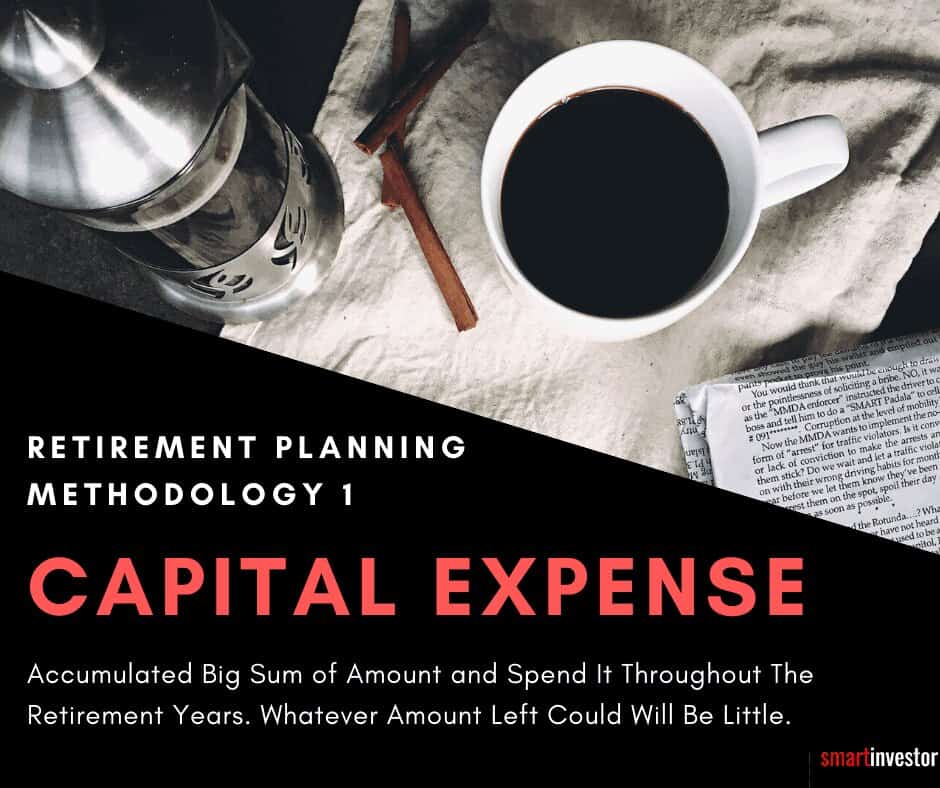
    Capital Expense Method:

    Capital Expense Method - Retirement Planning

    Whatever you saved for retirement (the capital), you will utilize during your retirement and estimate that upon death, the amount left is minimal.

    This requires active management during retirement to ensure that the money is enough (the assumption is your money continues to work when you retire).

    Capital Intact - Retirement planning advise from the experts

    Capital intact method:

    You accumulated huge sum of capital and live based on the interest and dividends received during retirement.

    This capital you accumulated over the years can be passed down to your loved ones as a legacy.

    So now, what you need is to identify suitable types of investment tools based on your risk appetite.

    Other quick tips from Linnet Lee:

    1. Consider late retirement if you are still healthy and energetic.
    2. Consider keeping a minimalist retirement lifestyle.
    3. Start investing in dividend-yielding investment vehicles such as
      a. Real Estate Investment Trusts (REITS)
      b. Exchange-traded Funds (ETF)
      c. Stocks
      d. Unit Trust Funds
      e. Private Retirement Schemes (PRS)
    4. Ensure sufficient health protection through own savings plus insurance/takaful policies.
    5. Best work with a financial planner to prevent costly financial mistakes.
    6. Factor in cost that might incur more during retirement such as:
      1. home refurbishment/wear and tear
      2. maintenance of the family cars 
      3. Purchase of healthcare products 
    7. Closely monitor your investment portfolio from time-to-time to best match your risk profile and lifestyle changes.
    8. Avoid Scams that offer unbelievably high and quick returns.

    Bryan Zeng from FA Advisory

    One day, you will retire. The matter is when.

    Are you planning for it?

    Living in uncertain and turbulent times like now, external changes that are beyond your expectations will continue to happen.

    Is your retirement fund robust and flexible enough to last through your retirement years?

    We are talking about 20 – 30 years at least.

    If you have not started your retirement planning, start now.

    Take action to maximize your retirement savings while you are young and fit to actively earn income, make time and compound interest your best friend as money-making leverage for you.

    Key actions - Retirement planning advise from the experts

    Key actions that you can start taking are:

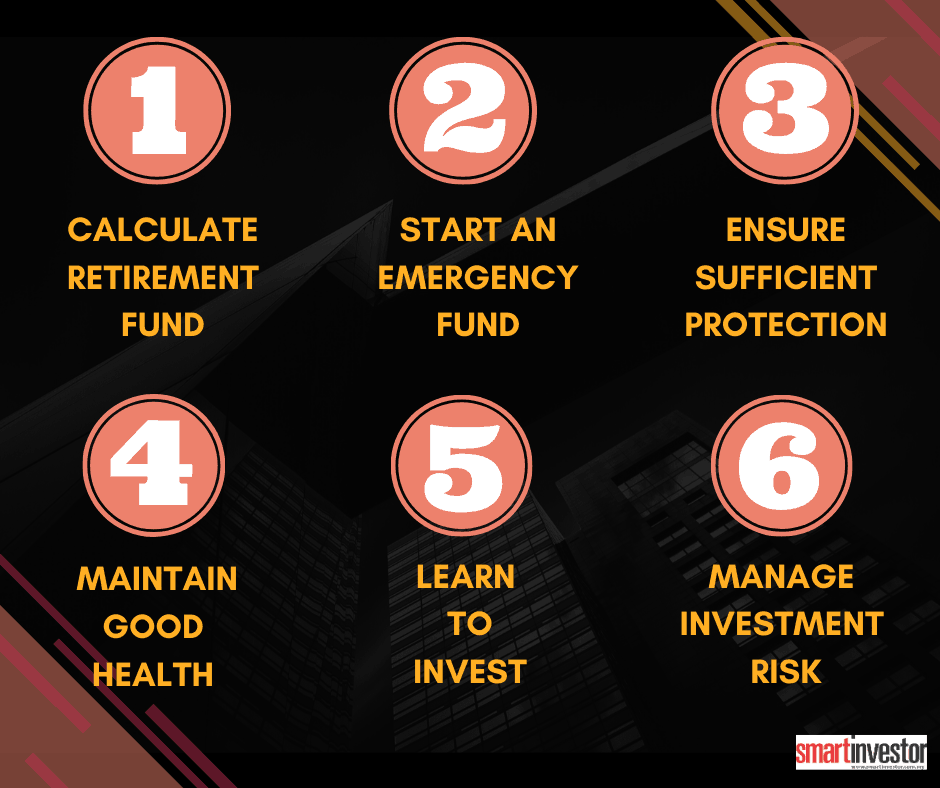
    • Setting up an emergency fund
    • Paying off debts
    • Get sufficient insurance protection (trust me, medical inflation over 10% will wipe off your savings in months)
    • Maintain a healthy lifestyle.
    • Make efforts to improve your medical conditions if you are Obese, Overweight or Pre-diabetes. These health situations are reversible and would save on your future medical bills.
    • Diversify your investment portfolio, consider alternatives to EPF.

    Yes, these steps sound simple yet hard to be done.
    Some strategies that you can take to make it happen are:

    • Track and reduce your spending.
    • Increase savings
    • Create a second and third streams of income.
    • Delay in retirement.
    • Look for investment products that match your risk-return profile as well as being highly liquid with low or zero tax applicable.
    • Simple investments with low capital outlay are his favourite.

    Derick Tan from Association of Financial Advisers Malaysia

    The best time to start investing for retirement is always “Now”. The sooner we start, the earlier we can achieve our retirement goals while undeniably having more choices to choose from.

    Some keywords related to retirement planning and selection of investment instruments are:

    • Long term regular savings
    • Sustainable growth of your funds
    • Diversified portfolio of your investment

    As the world economy is uncertain and the market situation is unpredictable, Derick advises that you should place 70% – 80% of your savings in fixed income or money market asset classes, while the balance 20% – 30% can be channeled into equity class that invests in the Asia Pacific and China.

    Knowledge and skills to achieve financial goals - Retirement planning advise from the experts

    While the EPF’s management team has performed a good job in managing the retirement fund, you cannot depend solely on EPF savings for retirement. So, look into the following:

    • How much EPF savings would you accumulate by the time you retire?
    • How much fund is needed for your desired retirement lifestyle?
    • What are your investment criteria to achieve your retirement goals?
    • What are the pros and cons of each investment you have?
    • Are you diversifying your investment into different asset classes or funds to manage potential investment risk factors?

    In summary, you will need to have the right blend of knowledge and skill to profit from investment products, i.e. by fully comprehending the cut loss mechanism or even switching or topping up to average down to maintain long-term accumulation growth.

    Phang Kar Yew from Malaysian Financial Planning Council (MFPC)

    Planning for retirement is a long term journey. It takes a long term vision, long term commitment and long term investment strategy to be successful.

    Did you know? - Retirement planning advise from the experts

    It is well-documented that over 90% of investment returns are generated through asset allocation.

    As such, a portfolio of investments is required since asset allocation is all about spreading your investments across a variety of asset classes.

    For those who do not have funds or technical skills to invest in the stock market directly, unit trust investment managed by professional managers with market diversification is a good start.

    Do remember that you should be clear of your investment objectives, risk-return profile and manage your expectations over the investment performance.

    Alternatively, investing in property can be a good choice.

    Investing in real estate provides an excellent capital gain opportunity whilst enabling recurring rental income.

    However, risks associated with real estate investment are higher than other investment instruments too.

    Note: You should assess the property location, monthly installment amount, property price and the rental income before committing yourself to a property.

    Investment properties with positive cash flow after deducting the cost of renting it out are rare gems.

    Is there an alternative plan in place to cover the loan installments if the property could not be rented out for a long period?

    If you can’t afford to have any unexpected downturn to the huge financial commitment, you should think ten times before you commit to it.

    did you know II? -Retirement planning advise from the experts

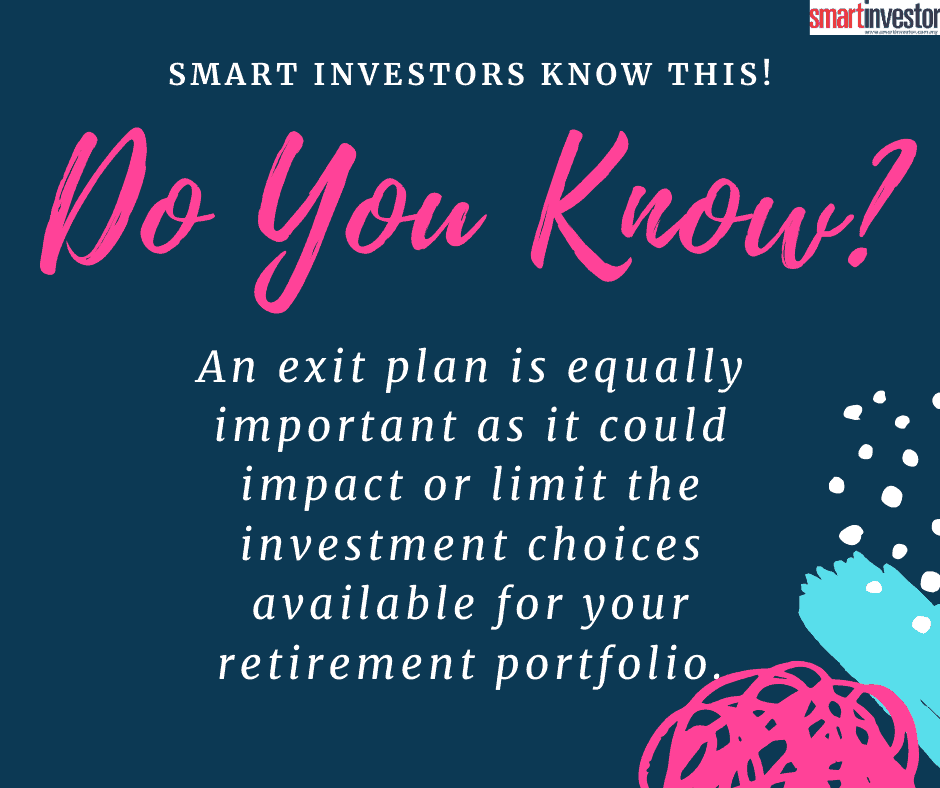
    An exit plan is equally important as it could impact or limit the investment choices available for your retirement portfolio.

    WHAT ABOUT YOU?

    Have you started your own retirement planning strategy? What are some other tips that you can share with us? Let us know!

  • Retirement Plans for the Self-Employed

    Retirement Plans for the Self-Employed

    A large segment of the working population in Malaysia is self-employed or works in the gig economy, so what are their retirement plans? Drawn by the flexibility to choose which projects to take on, the opportunity to accumulate diverse work experience and the autonomy to set their own working hours, many gravitate towards the entrepreneurial route to pursue their dreams and chart their own paths.

    Indeed, out of a total workforce of 15.54 million, according to the latest figures published by the Department of Statistics Malaysia, the World Bank estimates that more than one in four – about four million – are self-employed. From financial planners and small business owners to online merchants and e-hailing drivers, the nature of work among the self-employed is numerous, varied and multi-faceted.

    In line with global trends, reports indicate that this is increasingly also the preferred choice of employment among Malaysian millennials and Gen Z – those born in the mid-1990s onwards. As exciting as this development is, Malaysians who are self-employed often neglect something everyone should do the moment they start working: saving for retirement.

    Retirement savings for the self-employed

    Being a freelancer, independent contractor or technopreneur means you do not get to enjoy the usual perks of salaried employment. Income typically fluctuates from month to month, and there are no pensions or mandatory schemes to provide a financial safety net.

    It might be tempting, or even necessary, to channel any excess money towards expanding or covering the cost of business. The risk of saving too little for retirement is high.

    This state of affairs is supported by a survey conducted by Private Pension Administrator Malaysia (PPA), the central administrator for Private Retirement Schemes (PRS), where 62.8% of those who are self-employed said they wish they are saving more for retirement. Unless you are expecting to receive a substantial windfall or a generous inheritance, it is important you start taking proactive measures to save for your retirement.

    “While you are busy growing your business or juggling several projects simultaneously, don’t make the mistake of not saving for retirement at all,” says PPA Chief Executive Officer Husaini Hussin.

    “Create a retirement plan based on your needs, goals and risk appetite and then stick to it by automating your savings.”

    Source: PPA Malaysia

    Why consider PRS

    Having a retirement plan is vital for a successful self-employed person. It can mean the difference between toiling into your old age and taking leisurely strolls on the beach.

    With PRS, a voluntary long-term savings and investment scheme designed to help you save more for retirement, you can contribute at your own pace and within your own financial ability.

    “Think of retirement savings in terms of percentages instead of a fixed amount or putting aside only what is left over at the end of the month,” advises Husaini.

    “This ensures you don’t overstretch yourself in a lean month and you save a little bit more when business is good.”

    To have adequate replacement income to sufficiently sustain your standard of living throughout retirement, PPA’s research suggests setting aside one-third of your income every month. When you save a percentage of your income each month this way, market volatility works in your favour as you gain more units when prices are low.

    “It is a great way to save for your retirement over the long term,” Husaini adds.

    “The top performing PRS funds have given PRS members good returns since inception up to 31 October 2019.” (See table)

    Another aspect of PRS is the Nomination feature, which supersedes all wills. Other than the mandatory scheme, PRS is the only savings scheme in Malaysia with a feature to ensure your loved ones or nominees receive your gift hassle-free in the event of your untimely demise.

    Recently, Budget 2020 proposed that PRS Members be allowed to make pre-retirement withdrawals for the purposes of healthcare and housing without any tax penalty. Additionally, zero tax penalty withdrawals for medical expenses incurred by immediate family members are also allowed, in recognition of rising healthcare costs.

    “The introduction of 0% tax penalty for pre-retirement withdrawals of PRS from sub-account B, which holds 30% of the savings for purposes of healthcare and housing, reflects the government’s understanding and commitment to help all Malaysians use a portion of their retirement savings for their needs,” Husaini said. “This proposal shall take effect from next year.”

    Beyond that, PRS Members who reached the retirement age of 55 or suffer from permanent total disablement, serious disease or mental disability can withdraw the full sum of their PRS savings without any tax penalty.

    PRS Online

    You can start saving with just a few simple steps by using PRS Online Enrolment, a service developed by PPA to help you save for your retirement in an easy, convenient and secure way. All you need is RM100 for the initial contribution and the minimum amount for subsequent top-ups is as low as RM50.

    There are 55 conventional and Shariah PRS funds offered by eight PRS Providers to select from, but if you can’t decide, opt for the age-based default option. It is a unique feature of PRS which will automatically align the suitable asset allocation to your age group.

    “The beauty of PRS is the choice and flexibility that PRS members have to enrol or top up into multiple PRS funds anytime and anywhere with just one PRS account,” Husaini says.

    “Track your savings and monitor your investments with the myPPA mobile app. You always have the option of optimising your returns by switching PRS funds within the same PRS Provider or transferring your savings to another PRS Provider.”

    Furthermore, PRS contributions you make are also eligible for a personal tax relief of up to RM3,000 per year, giving you tax savings which can further boost your retirement savings. You could enjoy zero sales charges or free insurance or takaful with coverage of up to RM100,000 with certain PRS providers.

    Do it on your own

    Being self-employed can be exciting, scary, and rewarding all at once, but without a mandatory scheme that makes savings and employer contributions compulsory, the onus of building a retirement nest falls squarely on you.

    Money starts working for you the moment you set them aside for retirement. Whether you’re an entrepreneur, a photographer or e-hailing driver, take advantage of the flexibility to choose how often and how much to save with PRS.

    Do it on your own. Senang jer. Save in PRS.