Category: Cash Management

  • Should I Buy a Car in Malaysia?

    Do you really need to own a car today? Should you buy a car in Malaysia? You might think I’m crazy even to ask this question. For most people, the answer to this question is YES! But before we discuss this topic further, here are some points that you need to consider:

    Cost of ownership

    Some may think that the purchase price of a vehicle is the cost of ownership. In fact, when you factor in other costs such as financing, maintenance fees, insurance, road tax, etc., the cost of ownership is in fact more than just the purchase price of the vehicle. All these costs differ depending on the vehicle, but often, these ancillary costs go in tandem with the purchase price – the higher the purchase price, the higher the other costs.

    Utility value of a car

    Usually, people purchase a car as a mode of transportation. However, you have more options these days, which means a car may not be as useful as before. These days, rail transportation is extensively accessible, particularly in the Klang Valley and encompasses the services of Keretapi Tanah Melayu (KTM), Light Rail Transit (LRT) and Mass Rapid Transit (MRT). Not only do these public transportation options cost less, utilising public transport also means less hassle as there’s no need to be focused on driving or other common modern-day problems like traffic jams. 

    In addition, there are ride-sharing platforms such as Grab if you prefer less crowded transportation. So with all these developments, one should really consider the utility value of a car before pulling the trigger to purchase one.

    Depreciation

    The value of a car will drop over a period of time. Depreciation starts the moment the car is delivered to you and the rate of depreciation can vary for different vehicles. On average, a vehicle tends to lose 10% to 20% of its value annually, and as such, it’s not surprising that cars are often referred to as a depreciating asset!

    Credit score

    Generally, a credit score indicates a consumer’s credit worthiness. Before qualifying for financing, creditors (lenders) such as banks will evaluate our credit score. Usually, a higher credit score represents a better credit standing and lenders will be more confident that you’re able to repay future debts as agreed – making you more creditworthy. 

    In addition to this, having a higher credit score might also allow us to enjoy a better financing rate, resulting in a lower amount of interest to be repaid, which means you can save more. The opposite is usually true for those with lower credit scores. But here’s a tip to have a better credit score – repay all your loans in a timely manner. Doing this allows you to get a better credit score than people who don’t have any loans.

    Debt Service Ratio (DSR)

    This ratio represents how much of our income is needed to service the debts you have, and it’s commonly calculated in monthly terms. Some of the regular debt payments include home loans, property investment loans, personal loans, study loans and car loans. A conservative benchmark for this ratio is around 30%, therefore it’s important to be mindful of your DSR before applying for a loan. Those with DSR of more than 30% should be more cautious on their spending especially, when it comes to applying for new loans.

    Rule of 78 

    The Rule of 78 is usually applied to car loans and is a method of calculating interest where a higher percentage of interest charged is paid at the earlier part of the loan tenure. As such, any early settlement of the loan will not help the consumer save much. This is different from the reducing balance method (usually applied to mortgages) where interest expense is based on the outstanding loan amount. 

    In short, this form of loan calculation does not favour the consumer but rather the banks. Based on the current Overnight Policy Rate (OPR), the interest rate for a car loan is around 3 to 3.4% per annum for a person with an average credit score. Therefore, consumers need to be aware of this before borrowing.

    Net worth and cash flow 

    Once you acquire a car loan, not only is your cash flow affected by the monthly repayment of the car loan, but you’ll also be affected by other expenses such as petrol, car insurance and toll charges. With higher expenses, cash flow could be tighter which may result in less savings available to be channelled to grow our wealth. 

    Your net worth will also be reduced once you acquire a loan. Why is this important? Since net worth tells you how much your assets are worth after deducting liabilities, if your net worth is positive, it means that you can pay off all debts that you carry after liquidating all assets. However, this isn’t good news for those with a negative net worth position.

    Should you buy a car?

    After taking all these factors into consideration, you’re now in a better position to weigh the pros and cons of buying a vehicle rationally. Ask yourself – are you willing to sacrifice all the above considerations just to get a depreciating asset? If you are unsure or unconvinced, then maybe taking a Grab is a better option as you won’t have to worry about the costs and monthly repayments, which could have a detrimental effect on our financial well-being in the long run. 

    Nevertheless, buying a car does have its upside. Some of the benefits include convenience, personal safety and privacy. In the age of Covid 19 – this is also a definite plus! So, buying a car may not necessarily be bad. Alternatively, you may consider getting a second-hand car instead, although this too comes with various costs considerations such as maintenance and repairs. Consumers just have to be aware of all the factors and spend within your means so that you can optimise your money!  

    About the Author

    Wong Chee Yang is a licensed financial planner and is dedicated to promoting financial literacy amongst fellow Malaysians. He can be contacted at cywong@finwealth.com.my

    We at Smart Investor and Finwealth are committed to helping you better manage your financials. Get a free consultation from an expert by filling in your details here: https://www.smartinvestor.com.my/SIxFinwealth

  • Turning A Financial Emergency Into A Minor Inconvenience

    In my previous article, we covered tips for saving for an emergency fund. In this article, let’s take a deeper dive into other matters related to savings for a financial emergency.

    Food for thought, would you consider your credit card your emergency fund?   

    I guess there is no right or wrong to this statement but it does help that at least we have an emergency fund that’s equal to the credit limit of credit cards. If we have to rely on it to get past an unexpected expense as a last resort, we know very well that we’re able to pay it off without carrying the balance to the future.

    So, it’s not wrong if you consider your credit card your emergency fund. However, there’s one problem. In a scenario where you don’t have to rely on credit or loans to save you in a financial emergency, you don’t really have any pressure or commitment to repay it after the emergency has passed.

    When you rely on credit to get you out of financial emergencies or unexpected events, once this issue is resolved, you’ll then need to deal with the next time bomb. Depending on how well you’ve prepared and managed your money before this, it could lead to another emergency in the near future. Assuming your money management skills haven’t improved in that time, you might be looking at an even more dire situation!

    Firstly, in this second ‘crisis’, you may have less or no capacity to increase your loans or credit limit to help you (since there’s a good chance those limits have been utilised and not cleared from the first time). On top of that, let’s assume for a second that you can still count on credit cards for this second bout; how do you think your monthly cash flow situation will be like after this?

    Certainly a much bigger portion of your future income is now tied to repaying those debts. This will reduce your discretionary cash flow (or disposable income), meaning your ability to save for a ‘real emergency fund’ is now much weaker compared to before. Moreover, with lesser discretionary cash flow, it also implies that you are likely to be unable to prepare or save for other future dreams. In a worst-case scenario, you might be playing musical chairs with your debt, using the income you take home each month.  If such a pattern is maintained, it may affect your overall satisfaction with life, and even lead to a compromise in your mental health.

    So, there seems to be a cost to treating your credit cards’ limit like an emergency fund, and this is more costly than monetary cost (interest rate). It comes with a much bigger price tag like your freedom and ability to plan for the life that you really want to live.

    If you’re thinking about keeping a certain card’s limit as your emergency fund, why not consider the alternative that’s much less complicated, and most likely comes with less pain in future?

    I get it – this alternative comes with a pain today, as it requires us to not spend that amount of money, save it up, stash it somewhere, and forget that we have that money. With our brain wired to seek pleasure, and that instant gratification is a sure way to reward us with such pleasure, this could be a tough call for some people.

    Is there a way to avoid having to sacrifice your lifestyle today while still able to prepare for emergencies? I’d say YES. There are certain emergencies that we can actually ‘neutralise’ and make it a non-emergency. Based on common ‘emergencies’ people have told me about, here are some and how you can prepare for it:

    Your Real Expenses 

    Have you had this experience where you were shocked, or even found yourself wondering how a certain bill that should be due a long time from now ‘suddenly’ becomes payable? For example, your car insurance and annual road tax renewal, your car’s battery that gives up on you every one or two years, your yearly subscription to certain services, yearly insurance premiums etc.

    The truth is, these bills don’t suddenly become due today; it’s just that time really flies and while looking at the new renewal or invoice, your mind tells you you’ve just paid for it not long ago. Just like this, you have landed yourself in a financial emergency. You may not have sufficient money at that moment to pay for those annual or quarterly bills which can be very important expenses. That’s how you will notice your savings getting depleted every now and then.

    Can you stop these things from becoming emergencies? Yes, you certainly can, and it’s very easy and simple. You just need to add all of these bills up, divide by 12, and set aside this amount every month in another savings account. Settle those bills with the money in this account when they’re sent to ‘surprise’ you and take comfort in knowing that these will stop becoming a surprise to you!

    Celebrations, Occasions, Vacations 

    As social animals, we have people we love, care about and celebrate festivals with, or even birthdays, and other milestones. It costs money to celebrate and in a typical month where you have too many to celebrate, you may find it difficult to strike a balance.

    You can also prepare for these ‘emergencies’ in advance. List out important occasions and celebrations. Include your expected spending during festivals like the New Year, Hari Raya, Deepavali, Christmas etc. Divide by 12, and save this amount monthly in a separate savings account.

    You can now celebrate with peace of mind and sense of freedom knowing that you are spending money you have prepared for, and best still, your own money (from the past, not the future)! This method is also workable for bigger ticket items such as your dream vacation.

    Medical Emergencies 

    Accept the fact that no matter how healthy your lifestyle is, you’ll get sick eventually. Apart from sickness, it may also pay to make regular visits to the dentist or doctor, including to conduct health tests. Like everything else, these cost money.

    Like the previous examples, you can apply the same method to prepare for this. The only problem is that you’re not able to accurately predict how frequently you’ll be unwell and how much that will cost. This is when you have the ‘fun’ to make an estimate. Personally, I put away RM50 a month for clinical visits. When I don’t get sick so often (which is a good thing), I get to carry forward the balance to the following year.

    For bigger medical emergencies, like hospitalisation or a long treatment process, you can either save using your own money, or ‘outsource’ this to medical or personal accident insurance.

    By preparing accordingly, the occurrence of financial emergencies can be reduced greatly. Moreover, by taking into account and being realistic about the spending that will eventually take place today, you’re taming your instant gratification monster by having less to fuel and feed it.

    If you have put aside the set amount, can you pay for these things using a credit card? You can! Because you already have cash in your accounts available to pay for your credit card spending. So, if you want to, why not?

    About the author

    Kevin Neoh is a NextGen Money Coach and can be contacted at kevin@nextgenadvisors.my and www.kevinneoh.my


  • How A Credit Card Works in Malaysia

    How A Credit Card Works in Malaysia

    2020 was a challenging year for many, but undoubtedly, it also sped up the transformation of people’s spending habits, pushing all of us towards online channels. Try to recall your last online shopping experience. How did you pay? It most likely would’ve been through online banking, e-wallet or credit card. Many of us choose to pay using credit cards because of a particular bank’s promotion or to collect points.

    In the mid-1970s, credit cards were first introduced in Malaysia. Since then, it has become one of the most common payment methods and the main source of short-term borrowing. With credit cards, we can buy the item now but pay for it later when it’s due. Today, with the government’s cashless society initiatives, credit cards are playing their role everywhere, and aren’t limited to just physical payments. It can be used for monthly auto-recurring bills, reloading e-wallets, signing up for an easy payment plan (EPP) and more.

    It’s a reality that credit cards are a major payment method in our daily lives. However, to play well in the “game of credit cards”, we need to know the rules to abide by first.

    1. What’s The Entry Fee?

    There are two kinds of fees involved here.

    a) Service Tax

    Effective from 1 September 2018, all cardholders are required to pay an annual service tax of RM25 for each active credit card (principal card and a supplementary card will be charged separately). This fee is unavoidable but some banks do offer rebates for this.

    b) Annual Fee

    From a personal finance perspective, you should only opt for a zero annual fee card! Unless you have strong and valid reasons, you should avoid a card that charges you hundreds or thousands of ringgit in annual fees.

    2. What You Need to Know?

    To avoid falling into traps, it’s better to know some jargon first.

    a) Credit Limit

    Treat it like a pre-agreed loan amount. This is the maximum amount that the bank grants to us for our spending. To determine the credit limit, banks usually look at two factors – our income and credit history. If we spend more than our limit (ie. breaking the rules of the game), be prepared to get a fine!

    b) Minimum Payment

    Ideally, you should endeavour to pay your outstanding balance in full. However, at the very least, you’re required to pay the minimum amount, which is 5% of the outstanding balance subject to a minimum of RM50. However, please take note for instalment payments like easy payment plans (EPP), the full instalment amount must be paid. If you can’t pay the minimum payment before the due date, be prepared to get a fine as well.

    c) Interest-Free Period

    This is the tricky part. We do enjoy an interest-free period of 20 days from the statement date provided all outstanding balance is fully paid. The last day of this interest-free period is usually referred to as the due date. Many people will have a wrong perception that they will always enjoy the interest-free feature for all new purchases, even when there’s an outstanding balance on their cards. However, this isn’t the case. If you have any outstanding balance on your credit card, the interest-free period won’t apply to the outstanding balance as well as any new purchase.

    For example, if someone has an outstanding due balance of RM1,000, and he/she makes another new purchase of RM1,000 with the same credit card, the finance charge will be calculated based on the RM2,000 balance (outstanding and new purchase) instead of the previous balance due of RM1,000.

    3. Are There Penalties?

    If you can’t play the game well, you might need to pay a penalty.

    Most people know that credit cards charge high-interest rates. However, between interest rate and convenience, people tend to opt for convenience first. A swipe of a card will always be the top choice compared to a loan application, which can take a few weeks to be approved!

    a) Late Charges

    Everyone knows credit cards work under the buy-now-pay-later mechanism. However, if we don’t make the minimum payment before the bill’s due date, a late payment will be charged. Usually, the amount will be 1% of your outstanding balance (subject to a minimum of RM10, or up to a maximum of RM100).

    b) Finance Charge

    If there is an outstanding balance that remains unpaid on the due date, a finance charge will be applied (usually people refer to it as interest). Bank Negara Malaysia implements a tiered interest rate system for credit cards, ranging between 15% to 18% depending on your repayment track record.

    c) Overlimit Fee

    If you spend more than your approved limit, an over limit fee will be charged. It varies across different banks, from RM25 to RM50 per month.

    These are some of the important things you must know before you apply for or start using a credit card. It’s important to take note because misusing credit cards can lead to financial ruin. Shifting your payment pattern to cashless can be rewarding. However, it can easily lead to overspending as well. According to the Department of Insolvency, Malaysia recorded 84,805 cases of bankruptcy between 2015 and 2019, with around 10% attributed to credit card debt!

    For credit card newbies, I have five important suggestions for you:

    1. Apply for only one card and get used to the full credit card payment cycle before applying for a second (if required).
    2. Limit your monthly credit card usage initially, then you can consider increasing later once you have proven to yourself that you can manage this well.
    3. If you can’t pay the full amount in cash now, don’t even think of making another purchase with your credit card.
    4. Check your credit card statement every month to review your “swiping pattern” and ensure there are no fraud / unauthorised transactions.
    5. Never pay the minimum amount for the month; full payment is a must by each due date.

    Financial literacy is not just about knowing about financial matters. Acquiring and consuming knowledge is easy in the internet era, but behaviour and habits are what counts. A credit card is a good financial tool if you use it wisely. Be responsible for your personal finance today as financial planning starts from small baby steps. If you need a professional to assist you along the journey, consider engaging a licensed financial planner to keep you on the straight and narrow path towards financial freedom.

    About the author

    Ocean Pon is a Licensed Financial Planner and can be contacted at oceanpon@finwealth.com.my

  • The Importance Of Building An Emergency Fund

    The Importance Of Building An Emergency Fund

    As we start this new year, there’s a lot of hope that 2021 will be a better year than 2020, and that our lives will resume some form of normalcy since the start of the Covid-19 pandemic. We’d all like to go around our daily lives in the way we were able to previously.

    Unfortunately, 2021 has started to unfold in a similar pattern to 2020, but we should remain optimistic and hope for the best. As with any new year, it’s a great time to set goals and have a fresh start. I believe many of us will have new year resolutions this season, some of which will revolve around finances.

    For many people, financial freedom, being debt free or cash rich is often on their goals or resolution list, but how many are able to achieve it? There’s a popular adage often attributed to Benjamin Franklin, the father of time management ” Failing to plan is planning to fail.” Many of us draft a new year resolution list but without proper planning, and setting goals, timeframe, and deadlines to meet, one will never achieve their plan.

    When Malaysia went into our first Movement Control Order (MCO) in March 2020, many Malaysians found themselves in financial difficulty as they were not prepared to face salary cuts, reduced working hours or even losing their jobs due to the economic shutdown. News has also been circulating of those who just managed to restart their businesses or get new jobs going back to square one as a result of MCO 2.0 due to the rising Covid-19 daily positive cases, currently at the four digit mark.

    Due to the uncertainty of such times, it’s important to reflect on where you are and where you want to be, as life altering events usually result in people taking a hard look at themselves to reform and transform. No doubt the pandemic has impacted many people in more ways than one, with saving habits being one of them. If you’ve planned your financials appropriately and have a sufficient emergency fund in place, you’d at least be able to support yourself and be less stressed in such times. One of the things that Covid-19 has taught us besides resilience and adaptability, is the importance of proper financial planning and having sufficient savings.

    The purpose of an emergency fund is to cushion the blow should unexpected events occur, such as medical bills, retrenchment, business closure, home emergencies home or car repairs. You’ll have peace of mind and less money worries if you know you have sufficient funds to tide you through difficult times. In addition, you’ll also have more confidence to save money for other financial goals such as retirement or your children’s education if you have an emergency fund in the first place.

    How Much is Sufficient for an Emergency Fund?

    Your emergency fund should cover at least 3-6 months’ worth of essential expenses. Of course, you can save for more than six months; some people have up to 12 months of savings or more! It depends on:

    • Family size – are you single, a breadwinner, or in a dual-earner family i.e. you or your husband/wife works?
    • How closely your job is tied to economic changes
    • Financial responsibility

    Essential expenses are bills that you can’t stop paying such as food, utilities, household essentials, rental or mortgage repayment, car repayment, insurance and medication. Gym passes, entertainment expenses, or Starbucks coffee aren’t essential expenses.

    Six months of fixed expenses is the guideline, but it’s acceptable to save more but be warned that keeping excessive funds in your bank account only is also not advisable as the money doesn’t generate additional returns for you and will be slowly eroded by inflation.

    How to Start an Emergency Fund?

    As with all other things in life, start with a small realistic goal. Determine an amount that you’re comfortable to set aside every month, for e.g. RM200. It doesn’t matter if you start small as long as it’s realistic and you can move forward. Once you have accomplished this, set a new savings goal that will require more effort e.g. RM500, slowly add to it until you have accumulated one month’s worth of expenses. Your ultimate goal will be to reach 3-6 months of your fixed expenses.

    Where Should I Keep My Emergency Fund?

    An emergency fund is all about keeping it safe. Hence, there’s no specific investment tool to keep your emergency fund, as long as it is safe, liquid and easy to access. Most people will prefer to save in a savings account or fixed deposit (FD).

    The reason for putting these funds into a safe investment tool is because if the money is in high-risk investments, there’s a risk that you could lose all the money. For example, saving an emergency fund of RM15,000 earning 2% interest in fixed deposits gives you RM300. If you were to invest in the stock market and can generate 8% annually, that’s RM1,200. While an extra RM900 may be significant to you, it isn’t guaranteed as you could lose all the capital you invested in the stock market if market conditions are unfavourable.

    Hence, don’t be greedy and just leave your emergency fund in a fixed deposit or savings account as the goal is liquidity, not high returns.

    Life can be unpredictable so it’s important to put aside a small amount of cash each month to cushion the blow of emergencies in difficult times. Many people strive for high-risk investments where they take on unnecessary risk to earn more money but are left with no basic savings. For those who don’t have this habit, start building your emergency fund from now. Learn from the past and don’t procrastinate. Once sufficient emergency funds are set up, it’s time to aim for your next financial goal, which can be for the short, medium or long term, depending on your life goals and/or values.

    About the author

    Yit Wei Yeing is a registered financial planner. She can be contacted at wyyit@genexus.com.my.

  • How to: Plan for Your Children’s Education Fund

    How to: Plan for Your Children’s Education Fund

    Among the Chinese, there is a saying: “再穷也不能穷教育”, which translates to: “Education shouldn’t be sacrificed even if we’re poor”.

    Parents believe that when their children are educated, they can secure a higher income and get better opportunities in life, allowing them to contribute back to the family and society in various aspects.

    Just like any investment, time can be your friend or your worst enemy. If you’re a parent with young children, why not start preparing the best angpao you can give your children now?

    To start planning for your children’s education fund, you should:

    1. Estimate the Cost of Education

    When estimating the cost of education, consider the following factors:

    • The type of studies your child may pursue.
    • Will you send your child to attend a local or an overseas university?
    • How much is the basic cost of living should your child attend an overseas university?

    Information on the fee structure and the overall cost of living are readily accessible on the internet. You can refer to this website to learn more about the fees and cost of education in Malaysia.

    However, bear in mind that these factors may change over time. Review the plan at least once a year to keep yourself updated on the latest developments and be sure to get the information from various sources to ensure that the cost of education and overall cost of living falls within a similar range.

    2. Understand Your Current Financial Position

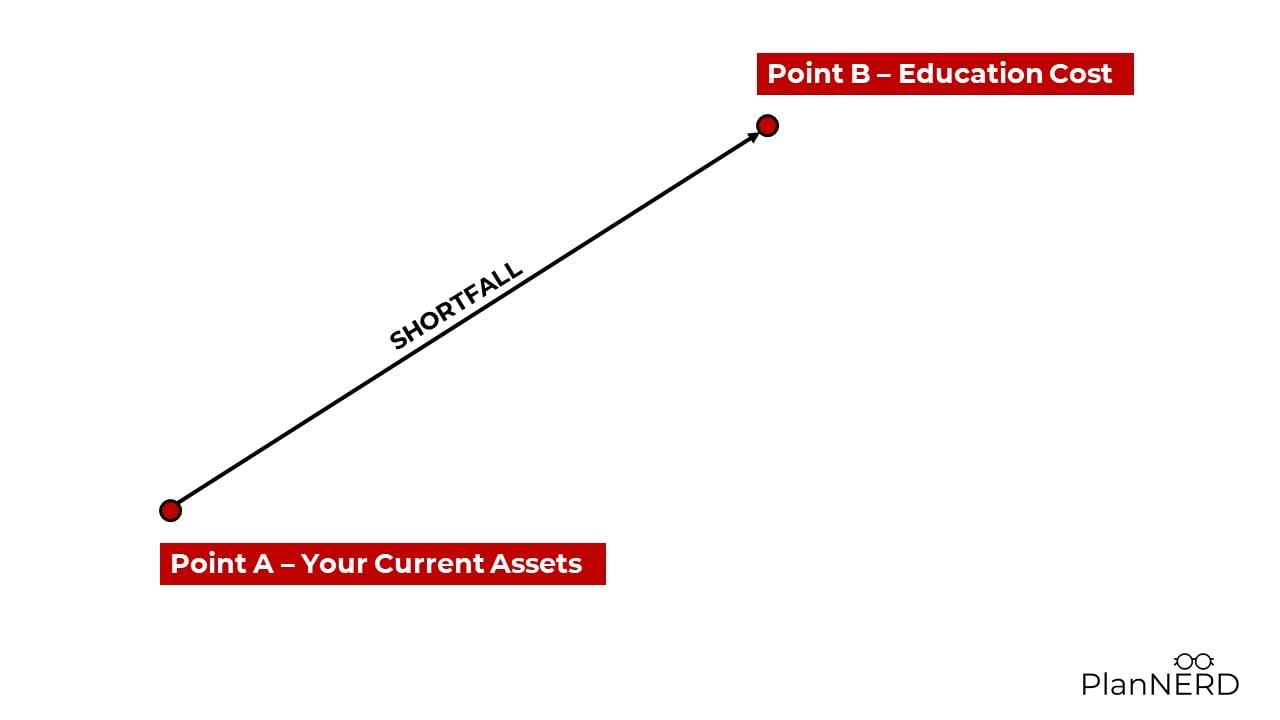
    current financial position graphic - children's education planning

    Now you know how much is needed to reach point B (cost of education), to calculate how much you need to set aside every month to cover the shortfall, you’ll also need to know how much you currently have – point A.

    Most people store their wealth in cash, properties, and other types of investments. You should ask yourself; what portion of the above-mentioned assets can be allocated for your children’s education?

    For example, you may want to allocate 10% to 20% of your cash for the sole purpose of funding your children’s education. If you have investment properties, you may also designate a property to be sold once your child reaches 18 years old. Some may even have endowment policies with insurance companies that may mature in 20 years.

    The key is to write down a list of assets that you will dedicate to its sole purpose of being your children’s education fund.

    3. Determine the Amount to Cover the Shortfall for Your Children’s Education

    In this step, we’ll use a free financial calculator to easily calculate how much you need to save/invest for your children’s education. You can access the calculator here.

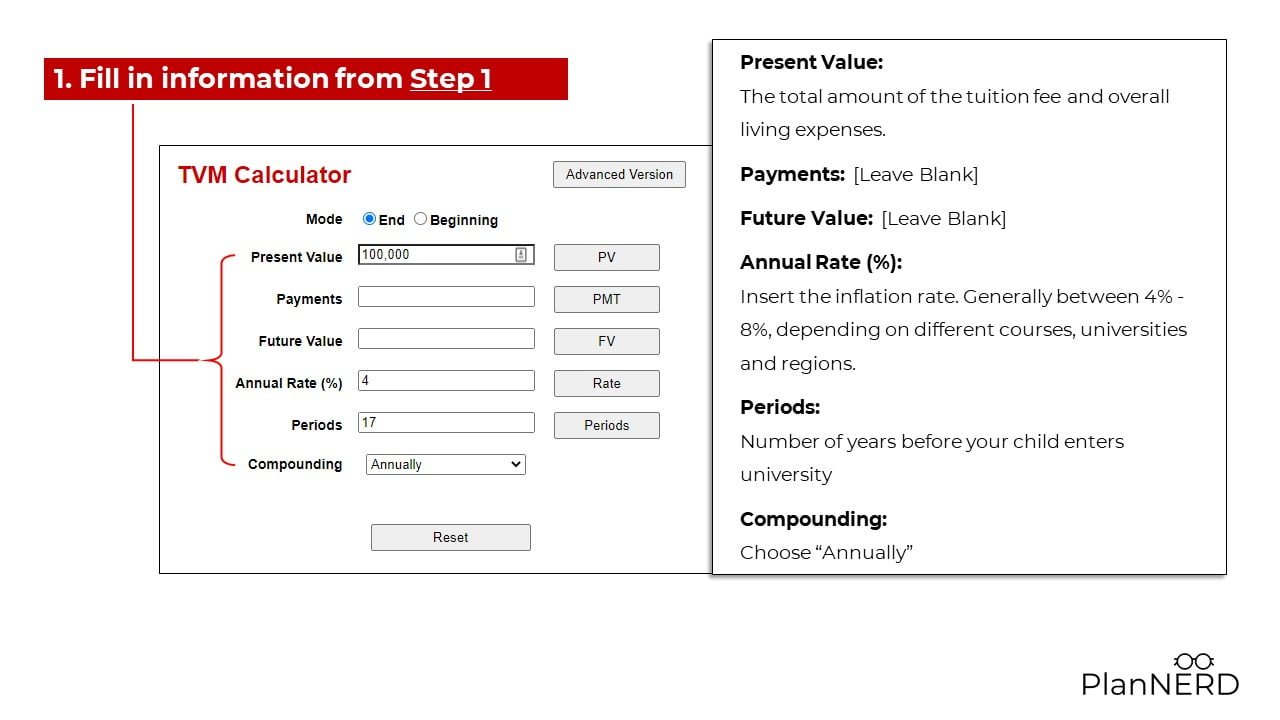
    (i) Enter the following field with the information you had prepared in Step 1 above.

    Step 2 for FV calculations - children's education planning

    (ii) Click on ‘FV’

    step 2 for FV calculation- children's education planning

    The amount in the FUTURE VALUE box is the future value of the education cost that you entered.

    In this case, the cost of education today is RM100,000. However, with an inflation of 4% for the next 17 years, the cost of education will increase to RM194,790.05 when your child is ready to enter university.

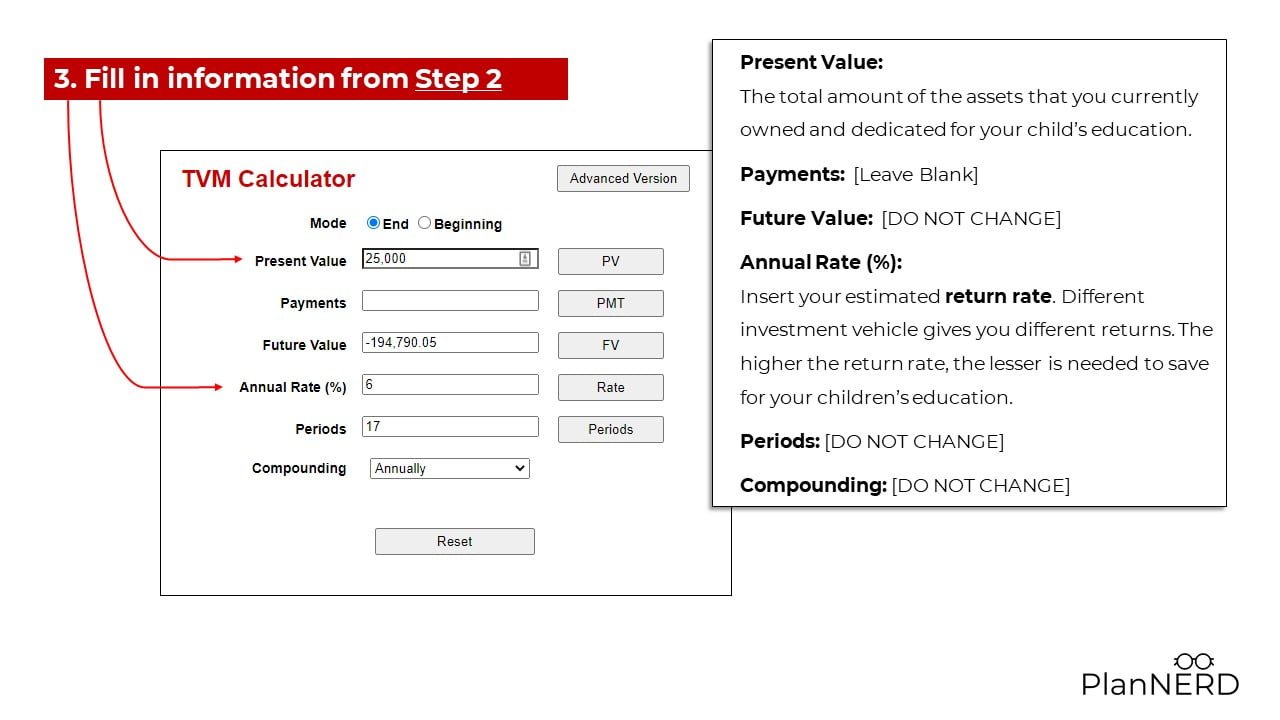
    (iii) Update the ‘Present Value’ and ‘Annual Rate’ field

    present value and annual fee table - children's education planning

    Next, you’ll need to calculate how much more is needed to cover the shortfall.

    Using the same example above, assume that you have RM25,000 now and you believe that you can achieve an average of 6% return rate for the next 17 years, update the Present Value and Annual Rate (%) column.

    (NOTE: do not refresh the website or change any other information.)

    (iv) Click on ‘PMT’

    pmt table to show the calculation flow under children's education planning

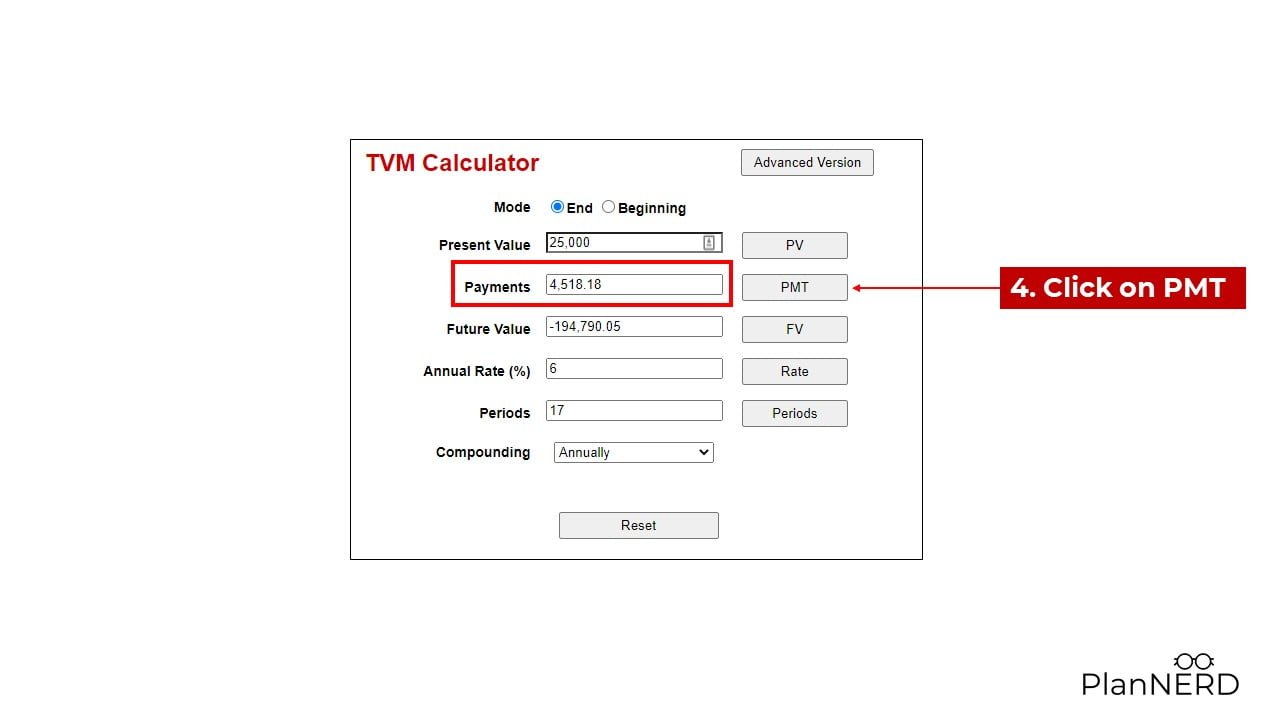
    The last step is to click on “PMT” to calculate the amount needed to save/invest every year to cover the shortfall in your children’s education fund.

    In this example, you will need to save RM4,518.18 every year, or roughly RM400 every month (with a return rate of 6%) to send your child to a private university in Malaysia in 17 years.

    4. Choosing the Correct Financial Vehicle

    There are plenty of choices when it comes to choosing an investment vehicle. However, we all know that most investment journeys aren’t going to be smooth sailing all the time, therefore it is very important to follow these three rules of investing:

    Preserve your investment capital

    One important rule that’s applicable in investing for children’s education is to preserve your investment capital. Sometimes, we can allocate a small portion of our portfolio to invest in high-risk investments. However, you don’t want to do that with your children’s education portfolio.

    For example, in order to recover from a 10% loss on an investment, you’ll need to have an 11% gain to return to the original capital position, a 25% loss would require a 33% gain to break even, and so on and so forth.

    There is no such thing as the best investment

    In short, what’s good for me may not necessarily be good for you. Having said that, when it comes to investing for your children’s education, you may want to pay some attention to PTPTN’s National Education Saving Scheme (SSPN). Parents saving money into SSPN-I can enjoy tax relief of up to RM8,000 per year.

    Keep your eyes on the prize

    Lastly, keep your eyes on the prize. Always remember your why. Constantly review your investment strategy to ensure that you don’t receive any unfavourable surprises when your children are approaching the age to register for tertiary education.

    5. Avoid Common Education Planning Pitfalls

    Ignoring retirement planning

    If you’re unable to cover the shortfall as calculated earlier, there are other ways to ensure that your children will receive a decent education, such as applying for an education loan from PTPTN or applying for a local public university.

    However, there are fewer options available if you can’t cover the shortfall in your retirement planning.

    Trusting the wrong ‘advisor’

    Many fraudulent “advisors” use the element of fear and greed in parents to convince them to invest in their unregulated investment products. Should you need the help of a third party in the education planning process, please ensure that you engage a licensed representative.

    Not reviewing savings and investments

    I may sound like a broken record by now but reviewing your investments and portfolio at least once a year is very important. If needed, you should also rebalance your portfolio to ensure they meet the objective of providing X amount of money Y years later.

    Conclusion

    Saving for your children’s education is a long-term goal that may seem like a huge commitment at first. With a carefully planned strategy, and making time your friend instead of your enemy eases the process significantly. No matter how much or little the amount is, start today. The earlier you start, the better the compounding effect will be, because:

    “Compound interest is the eighth wonder of the world. He who understands it, earns it; he who doesn’t, pays it.”

    This article was originally published at planNERD.

    About the author 

    Marshall Wong is a licensed financial planner, and can be contacted through his website or marshallwong@fa.my.

  • The Best Alternatives to Fixed Deposits

    The Best Alternatives to Fixed Deposits

    We’ve seen how the COVID-19 pandemic has hit us in many ways last year, and 2021 looks like it won’t be any different. Looking at the aspect of interest rates, it’s cheaper to borrow money now than ever before. However, the direct impact of cheaper loans will be the rate of return on your investments such as fixed deposits. What are the alternatives to fixed deposits?

    Gone are the days when one could earn a comfortable yield of 3 to 4% per annum; we’re looking at less than 2% right now!

    As an investor, should you maintain the status quo and let your funds float in fixed deposit, or should you re-strategise to see if there are any other products that could give you interest rates like before, or maybe even more?

    Here are some steps you could explore in order to bring your portfolio back to its glory days:

    Start the ‘New Normal’ in Investing

    Let’s face it, storing all of your hard-earned savings for emergency funds and future retirement in fixed deposits isn’t really a crisis-proof strategy.

    Your parents and grandparents may have taught you that fixed deposit is a safe haven, but with the banks’ overnight policy rate (OPR) currently sitting at interest rates of 1.75%, can it still be considered that?

    Imagine teaching the same investing values to the next generation – they’ll be forced to earn more just to keep up with inflation! Why not teach them something valuable such as financial literacy? This starts with you.

    There’s More to Life than Just Fixed Deposits

    Keep an amount that you’re comfortable with as your nest egg in fixed deposit, which could range from 6 to 12 months’ worth of expenses. Invest the excess in platforms that can meet your medium to long-term needs such as purchasing a home, getting married, children’s education as well as your retirement.

    The cost of basic life necessities such as home, food, clothing, and medical will continue to rise faster than your salary increments, which is much better than simply collecting poor returns from low-interest rates.

    Thus, it’s vital that you make your money work hard for you, or else you’ll need to work harder and longer for less pay!

    Decide Now and Adapt

    The COVID-19 pandemic has swept away what used to be comfortable safety nets, like fixed deposits for example.

    Businesses are shutting down, pay cuts are a norm and exploring additional income is more common now than ever for many. Investors who used to fear dividend-based and equity funds are now more open to exploring these asset classes. 

    That’s the beauty about human beings – we’re all survivors. When push comes to shove, we’ll do whatever it takes to survive.

    Do the same with your investment portfolio. You’ve worked hard all your life, so avoid letting these hard earned funds slowly slip away by not maximising your returns. How does investing in Tesla, Geely, Proton, Alibaba, Facebook and Microsoft sound like to you?

    Consider Investing in A Foreign Currency

    For investors who have specific goals such as migration or sending your children abroad for education, you can consider beginning your investment journey in foreign currencies such as GBP, USD, SGD and AUD.

    The benefits of doing this earlier could save you the cost of currency conversions later. Your funds will already be in foreign currency and when the time comes to execute your goal, you save yourself the conversion differences. Use these savings to boost your retirement instead. 

    Work with a Licensed Financial Planner

    The benefits of working with a professional such as Licensed Financial Planner is the unbiased advice you’ll get as well as recommendations on potential investment products that suit your risk tolerance.

    By tapping into their experience, you’re able to cut short your learning process and immediately hop onto the investing bandwagon that goes beyond just fixed deposits. What if there are ways to help you earn an average annual return of 5% to 10%? Would you be willing to give yourself the chance to learn and explore?

    The way forward in this current pandemic setting is to continue to be nimble in everything that you pursue.

    If you’ve always relied on your salary (otherwise known as active income), you ought to start somewhere in building your passive income.

    If your passive income is not growing at the rate that you want it to be, review what works, what doesn’t and explore other options that could take your portfolio further. Change is constant, and the decisions you make determine your destiny.

    Decide and choose what’s best for you. One simple change could drastically change the course of your future!

    About the author

    Suean Chung is a Financial Advisor, approved and licensed by Bank Negara Malaysia and the Securities Commission Malaysia. She can be contacted at sueanchung@harveston.com.my.

  • The Financial Happiness Formula: Applying DMAS to Life

    The Financial Happiness Formula: Applying DMAS to Life

    Life can be complicated if we choose to make it so. As adults, we should know what makes us happy. Yet, most of us adults have fewer happy moments now compared to when we were younger. Is there a financial happiness formula?

    After years of working experience, I’ve come to realise that the easiest way for us to achieve Financial Happiness is by going back to basics.

    Most of us started our experience in dealing with numbers during our kindergarten years. We learnt about numbers, how to count and perform mathematical operations, geometry, and other math concepts from young till high school and beyond.

    Due to not regularly practising these equations in everyday life, it’s not surprising that most adults develop misconceptions with the order of operations to be performed while solving a mathematical expression (BODMAS – acronym for Bracket, Order, Division, Multiplication, Addition, and Subtraction).

    How Does One Reach Financial Happiness?

    It is normal for us to begin practicing Addition from young, and by the time we joined the workforce, we would’ve become experts at this. Our environment trains us to view the Addition of new “wants” or “needs” positively; as something to be desired.

    However, it’s rare for young adults to be taught how to differentiate between wants versus needs. The perception that “more is better than less” leads us towards the trappings of the proverbial rat race.

    We fail to leverage our understanding of BODMAS in our financial life and furthermore, we aren’t aware of how it plays a vital role in our effort to pursue Financial Happiness.

    BODMAS is the golden rule for solving equations and guides us on how to solve mathematical problems by following the correct sequence, otherwise, our answers may be wrong if we fail to follow the rules. When we apply the BODMAS rule to solve equations, we must first solve the Bracket.

    Subsequently, we solve the Order (that mean powers, roots, etc), then we continue with Division, Multiplication, Addition, and Subtraction. The key point to note is that Division and Multiplication rank equally, and in fact take precedence over Addition and Subtraction.

    Applying DMAS to Life

    Taking a leaf out of the BODMAS system, I’d like to suggest that DMAS (Division, Multiplication, Addition and Subtraction) can be the core approach to solve our personal financial matters.

    Let’s go through an example to see how we can achieve Financial Happiness by applying DMAS in our daily life.

    By following the proper arrangement, we always start with either Division or Multiplication.

    Division is the action of separating or process of splitting things into equal parts. This action and process is so much more meaningful when we apply it to determine our life priorities, for example in areas such as health, relationships, career or how we deal with money.

    Obviously, we all understand that these priorities are equally important and deserve equal attention throughout our lifetime. 

    In fact, changes in life stages and socio-culture environments might lead or force us to make disproportionate choices.

    Common life problems such as financial or health, marriage and family, or career pressures often occur due to mistakes and failure to maintain the balance while fulfilling our needs.

    Hence, a proper and systematic rebalancing strategy (also an important strategy in investment management) will enable us to review our situation and ensure we reposition ourselves at the appropriate ratio.

    Multiplication gives the results of combining groups of equal sizes whereby we can consider it as repeated addition, creating a larger whole. Multiplication in finance is always related to the rule of compounding, and it amplifies our financial condition, either positively or negatively.

    If we start off on the wrong foot, we’ll most likely end up with a bigger mistake. This can be clearly seen in the increasing number of Malaysians declared bankrupt or affected by overwhelming debts, especially credit card debts.

    We should recognise that the rule of Multiplication is not limited to money but also other scarce resources such as our networks and knowledge.

    As long as we’re able to identify the appropriate resources we want to grow, by putting enough time and effort, we will reap what we sow.

    After applying both Division and Multiplication, you may now continue with Addition and Subtraction.

    Addition of two whole numbers results in the total amount. In life, we tend to add new compartments by fate or chance. Given the same 24 hours a day or 365 days a year, we never tire of being attracted to new things and adding them to our bucket list.

    All of us have a different threshold and we should know better the tipping point of fulfilling our own desires as we become older and more experienced.

    Always take into consideration the results you will likely get from Division and Multiplication mentioned above. When the time is right, consider adding a new skill to grow your career, a new asset class into your investment horizon, or a good hobby or habit that helps you to excel in life.

    Subtraction is the operation of removing objects from a collection. It’s not an easy task for us to practice even though more people are now attracted to the KonMari Method. With respect to financial matters, you may want to consider the two subtractions below:

    1. Get rid of negative financial thoughts
    2. Eliminate unwanted financial habits

    There are no shortcuts to Financial Happiness. It only seems impossible if we don’t act at all. Apply the basic rules of DMAS patiently and wisely, and you will have an easier journey to achieve Financial Happiness.

    About the author 

    Jess Hon is a Licensed Financial Planner and can be contacted at jesshon@finwealth.com.my.

  • 3 Tips to Building Your Emergency Fund

    3 Tips to Building Your Emergency Fund

    In the previous month, I talked about the importance of having an emergency fund. This will put us in a better place to deal with surprises and curveballs in life. 

    Sometimes, this sounds like a no-brainer as most of us are well aware of this. Yet, according to some statistics published in the media, we are constantly reminded of the dire situation among consumers.

    The most infamous one is the Bank Negara Malaysia study that showed 75% of Malaysians would struggle to come up with RM1,000 to deal with unexpected situations.  

    This is the kind of number that makes me feel frustrated, and sad at the same time.

    On one hand, people gladly use this revelation as a ‘sales tool’ to create a need for consumers to buy their financial products.

    On the other hand, it does highlight a serious scenario that needs attention. People are finding it hard to save, and worse, deal with any unexpected situation, which we’re almost ‘guaranteed’ to face in life. 

    As painful as it sounds, I really hope I can play my part to help people build up their savings.

    Here are some suggestions that you can use as a guide in your efforts to build up your own emergency fund.

    I hope this will help make it easier, and together, we’ll bring down that 75% to a much lower number! 

    A Ringgit Saved = A Ringgit Earned  

    Commonly, people tend to say “I will save what I have at the end of the month”.

    Just because most people adopt this mindset, it doesn’t mean this is an effective approach. In fact, based on experience, almost everyone that struggles to save money has told themselves this.

    The results show that this mindset will only get us limited results. 

    If you’re a salaried person, have you ever struggled to pay your income tax bill? The answer is most likely “No”. Why do you think this is?

    That’s because, before the money even reaches your hand, it’s already been ‘taken out’ and ‘paid’ to where it should go.  

    If you’re still not convinced, how do you think your EPF account continues to grow in size each year?

    While the dividend is a good reason, however, the main reason you see the amount grow is due to the regular contribution, which again, before you can ever touch it, has already been redirected towards your EPF account. 

    If you want to see a different outcome, from “I can’t save” to “I am saving”, you just have to change the sequence.

    Save first, spend the rest. It’s as easy as this! 

    Where Do You Keep This Money? 

    Keeping your savings in your salary-receiving account is never a good idea.

    A majority of people I’ve interacted with seemed to know this. Some of them who have trouble saving up their emergency fund tend to keep this money in a separate account.  

    However, this account also tends to be their ‘day-to-day’ account. Perhaps that’s another reason why your savings won’t sit there for long.

    We’re creatures of habit, and our basic instinct is wired to spend money.

    To build on this instinct, we’re also constantly bombarded by messages, advertisements, and opportunities that induce us to spend and part with our money. This eventually creates an inevitable outcome, which is helping us to spend.  

    For what it’s worth, do note that there’s nothing wrong with keeping your emergency savings in your day-to-day account. It’s just that it increases the likelihood for the money to leave you.

    For example, in the middle of last month, I saw my day-to-day account still had about RM4,000. 

    This immediately made me feel excited knowing I still have RM4,000 to spend for the next two weeks.

    However, when I checked my credit card used for the past 2 weeks, I noted that the balance has already built up to about RM2,000+.

    This instantly means my real spending amount is not RM4,000 (although the money is there), but just the leftover after paying off my credit card.  

    This is what is likely to happen to emergency savings if mixed with your day-to-day account. And since emergency savings are so important, you should avoid this possibility at all costs.  

    In general, an ideal place to keep this money will be a place where we don’t have to worry about the value of the money.

    This means it shouldn’t be placed in accounts or asset classes that tend to be volatile. The idea is for it to be easily accessible anytime we need it, and as soon as possible.  

    How Much Do I Need to Save? 

    While there are plenty of guides or rules of thumb offering answers to this question, please note that you can actually determine this.

    You don’t have to let existing guides tell you how much you need to save up.  

    Have you ever tried travelling to the moon? I can confidently ‘predict’ that most of you haven’t or even thought about doing this.

    For things that you don’t think is possible, chances are you’ll never even bother trying to do it. 

    Another common situation I tend to encounter often is that people ‘plan’ to save a huge amount, or when they apply the rule of thumb, the projected amount made them feel hopeless.

    This feeling ends up making them feel defeated, resulting in them giving up trying. To them, this amount is like travelling to the moon! 

    When it comes to emergencies, we can never predict what will happen, hence it’s impossible to predict how much we’ll need.

    Therefore, you can aim for emergency savings as low as RM1,000. Even RM50 can be crucial. Imagine someone without any savings, who one day needed to go to the clinic to get a consultation for a fever. To them, RM50 is a huge deal. 

    So, if you’re low on your emergency savings, don’t despair. Start saving up in small amounts. It’ll be better than when you haven’t set aside this small amount that doesn’t seem to matter now.

    When you’ve built enough momentum and have a small fund, start to make it a goal to save up for one month of your expenses, then three months, then six months, then a year or more.  

    Just like collecting water in a tank, you must ensure you store as much as possible and refill it to the maximum level each time you use it up when there’s a water disruption.

    If you have to dip your hand into this pot in between, make it a point to refill it.  

    About the author 

    Kevin Neoh is a NextGen Money Coach and can be contacted at kevin@nextgenadvisors.my and www.kevinneoh.my

  • Should I Pay Off My Car Loan Early?

    Should I Pay Off My Car Loan Early?

    Pre-payment of a loan is the payment of the outstanding loan amount before it becomes due. This usually comes in the form of a car loan.

    For example, if you have a house loan for 35 years, you can opt to pay off the remaining balance at year 10 and free yourself from the monthly repayment from year 11 onwards.

    The way I see it, loans when used correctly can be very powerful, but when abused / ignorant it will be destructive.

    Today, I want to take an objective angle on this – backed with numbers, of course. Before answering the question “Should I settle my loan early?”, I want to highlight a term.

    Opportunity Cost

    This often comes up in the subject of finance and economics. In truth, you experience this in our lives daily. Opportunity cost refers to the loss of something when you choose one option over the other.

    If you snooze your alarm, you lose 10 minutes of being awake for the benefit of 10 more minutes of sleep/rest.

    When you choose to drive to work, it takes 30 minutes of focus on the road vs paying RM10 for 30 minutes of free time in a cab. Spending RM5,000 on a new phone takes RM5,000 away from other things like investment, a holiday to Thailand, a laptop for work, etc.

    Investing in stock A means less/no cash to invest in other companies.

    You will always face the question of “what is the opportunity cost” when you make choices. And you make lots of choices every day, though some are more obvious than others.

    Loans and prepayments present a very relevant opportunity cost issue – interest rates.

    Interest Rates

    Fixed Rates

    Fixed interest rates are not affected by the changes in the market and will remain the same throughout the tenure of the loan.

    Variable/Floating Rates

    Variable interest rates are tied to and will change in accordance with the market reference rate – this usually means the change of the overnight policy rates (OPR) in Malaysia or “prime/base rates”.

    Structure – Flat

    A flat interest rate structure calculates the interest rates based on the original loan amount regardless of how much principal has been paid down.

    Structure – Reducing Balance

    Reducing balance calculates the interest rate payable based on the amount of principal outstanding.

    The interest portion of the loan instalment reduces (and the principal portion increases) every month because the principal is being paid down in each instalment.

    Structure (TRAP) Rule of 78

    This is commonly found in cars and personal loans. In short, you pay most of your interest rates at the start of the loan as opposed to evenly distributing across the loan tenure.

    Yes, this means that if you prepay at a later stage of the loan tenure, there are not much interest savings because you would have paid up most of our interest portion by then.

    You can read up about the rule of 78 by doing your own research, but be warned that you might get upset once you discover how some bank loans work!

    4 Horsemen of Loans for Individuals

    I’ll approach this section on four fronts – interest rate type, loan structure, interest rate and prepayment opportunity cost.

    1. House Loan

    Interest Rate Type: Commonly variable / floating

    Loan Structure: Reducing balance

    Interest Rate: Base Lending Rate minus 2.5% (Averages around 3.3% as of now)

    Opportunity Cost: A house loan is typically quite a big sum.

    Hence, to prepay it involves coughing out big money! This will forgo a lot of other purchases/investment opportunities that may generate income more than the 3% – 5% interest rate (floating rate) paid here.

    Verdict: Given the interest rate that we are paying and the reducing balance interest rate, it is better to use the capital to invest in assets that can generate returns beyond 5%, including ASB / ASM, REITS, etc.

    On top of that, if it’s an investment property that is generating rental income, then is the monthly instalment actually still an issue?

    2. Car Loan

    Interest Rate Type: Fixed

    Loan Structure: Flat + Rule of 78 Trap

    Interest Rate: 2.9% – 3.3% (Effective Interest Rate is 5.5% – 6.2%)

    Opportunity Cost: The amount of interest savings from prepayment depends on when we prepay. The earlier we prepay -> The more interest we save -> But the more capital we need.

    Prepaying early would require bigger capital, hence losing out on investment returns. Prepaying later would be sacrificing investment returns for not many savings in interest payment.

    Verdict: Given the nature of the Rule of 78 and the EIR of about 6%, we have screwed all ways.

    It’s highly likely not worth it to prepay since the interest savings would not be much a few years down the loan tenure.

    The capital can be better used to invest in assets that can generate higher returns than the interest rate and compound the returns from such investments.

    If you want to prepay very early in the loan, you might as well buy the car in cash!

    3. Personal Loan

    Interest Rate Type: Fixed

    Loan Structure: Flat + Rule of 78 Trap

    Interest Rate: 4% – 7% (Effective Interest Rate is 7.5% – 13.5%)

    Opportunity Cost: Forgo investment returns on the prepayment capital in exchange for saving effectively 7.5% – 13.5% interest charges annually. But again, this is subject to the Rule of 78 issues, similar to the car loan.

    Verdict: Given the high EIR, it’s highly likely that prepayment is a better choice to avoid serving an extended loan.

    I suggest using a loan settlement calculator to see how much you would save, before deciding whether your capital is better used to prepay or to invest and generate higher returns.

    4. Credit Card Loan

    Interest Rate Type: Fixed

    Loan Structure: Special as it is based on your last month’s outstanding amount but with an interest that is compounded daily – read more on iMoney for the exact details

    Interest Rate: 15% – 18% tiered and compounded daily effectively making it up to 20%

    Opportunity Cost: Forgo investment returns on the prepayment capital in exchange for saving up to 20% interest charges annually.

    Verdict: I’ve said before that I love using credit cards compared to other payment methods.

    However, as a loan, it’s ridiculous due to the way the interest is structured as well as the exorbitant interest rates.

    If you don’t pay your credit card loan ASAP, you’d incur the interest rate wrath of up to 20% effectively (due to the daily compounding).

    I don’t know any investments out there that provide more than 20% returns consistently, so I won’t hesitate to prepay this in full today. In my opinion, avoid getting into this loan in the first place!

    The Ultimate Opportunity Cost

    So, should I settle my loan early? To answer this question – it depends on what your opportunity cost is when you choose to prepay.

    In my choices above, I won’t prepay if I can use the capital to generate higher returns elsewhere compared to the interest rate that I am paying for.

    The ultimate opportunity cost here is this – getting a loan allows you to use less capital to acquire an asset in exchange for paying an “interest rate”.

    If I have RM100,000, I can use RM10,000 to pay for the downpayment of a house worth RM100,000.

    I could borrow RM90,000 with an interest rate of 3%, but use this RM90,000 to invest into a REIT that pays out 5% dividend yield. 

    From this 5% return, I pay the loan of 3% and I still have 2% in returns that I can reinvest to get more returns.

    Essentially, I own a house with RM10,000, and RM90,000 worth of REIT shares and generate a net return of 2% on the RM90,000, which will be compounded.

    And this is without renting out the property. It’s a simple example, but it showcases the power of using loans the right way.

    The other option is using RM100,000 to buy the house in cash. I now have a house and no cash or extra investments. Are you seeing what I see?

    About the Author

    This article was originally published at betweenthemoney.com, a personal finance website by Jason Loh that focuses on money matters and investment topics for Malaysians.

  • How To Check And Claim Unclaimed Money in Malaysia Online

    How To Check And Claim Unclaimed Money in Malaysia Online

    In 2019, the sum of money NOT being claimed by Malaysians was reportedly over RM10 billion, which is quite a sizeable amount! According to the news article, the Accountant-General’s Department (AGD) wanted to help Malaysians check the status of their unclaimed monies, leading to the development of an online system for this purpose.

    Previously, to check whether you have any unclaimed monies (eg. from tax relief), you’ll need to queue up without knowing if you even have any unclaimed money! However, earlier in 2020, the AGD’s eGUMIS portal went live and it was a significant improvement for people wanting to check whether they had any unclaimed monies.

    Despite this breakthrough, if you wanted to claim the money, you were still required to pay a visit to the AGD’s office to submit a physical form (Borang Permohonan Bayaran Balik WTD “UMA-7”).

    I remembered I had a small sum of money unclaimed, but due to the trouble and since the amount was not significant, I procrastinated and left the money unclaimed, on purpose. Towards the end of 2020, I read an article on The Star that stated the government could consider using unclaimed monies as a “source of revenue” – this triggered me to check my unclaimed money again.

    I was asked to create an account again as my account had expired after six months of inactivity. As I registered for another account, I realised that the user interface had changed and the more I explored, the more I realised that eGUMIS now allowed us to submit forms online.

    My step-by step experience of claiming my unclaimed monies is outlined below, and be sure to read till the end as I will also explain how to overcome a certain bug (as of 28 November 2020) in the system:

    Step 1: Register For a New Account

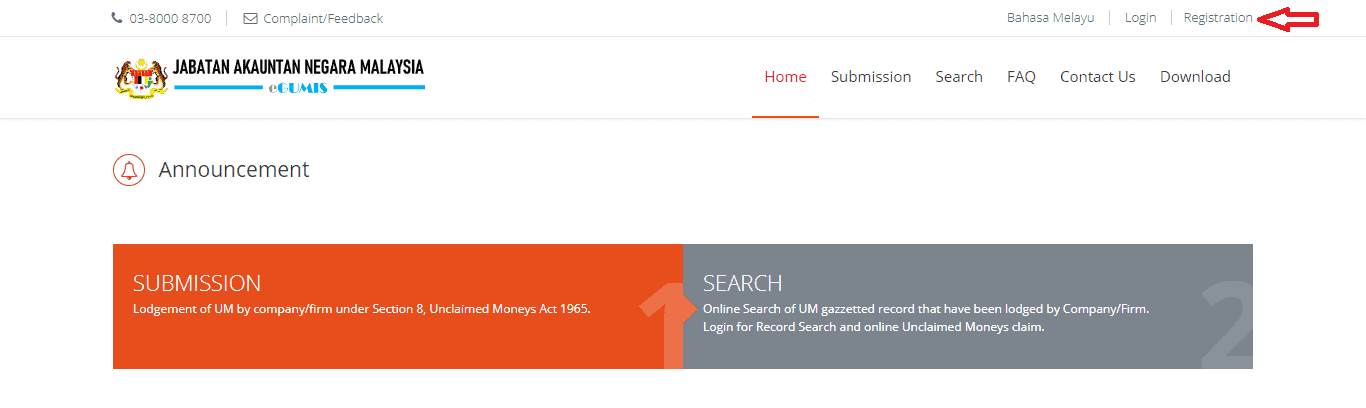
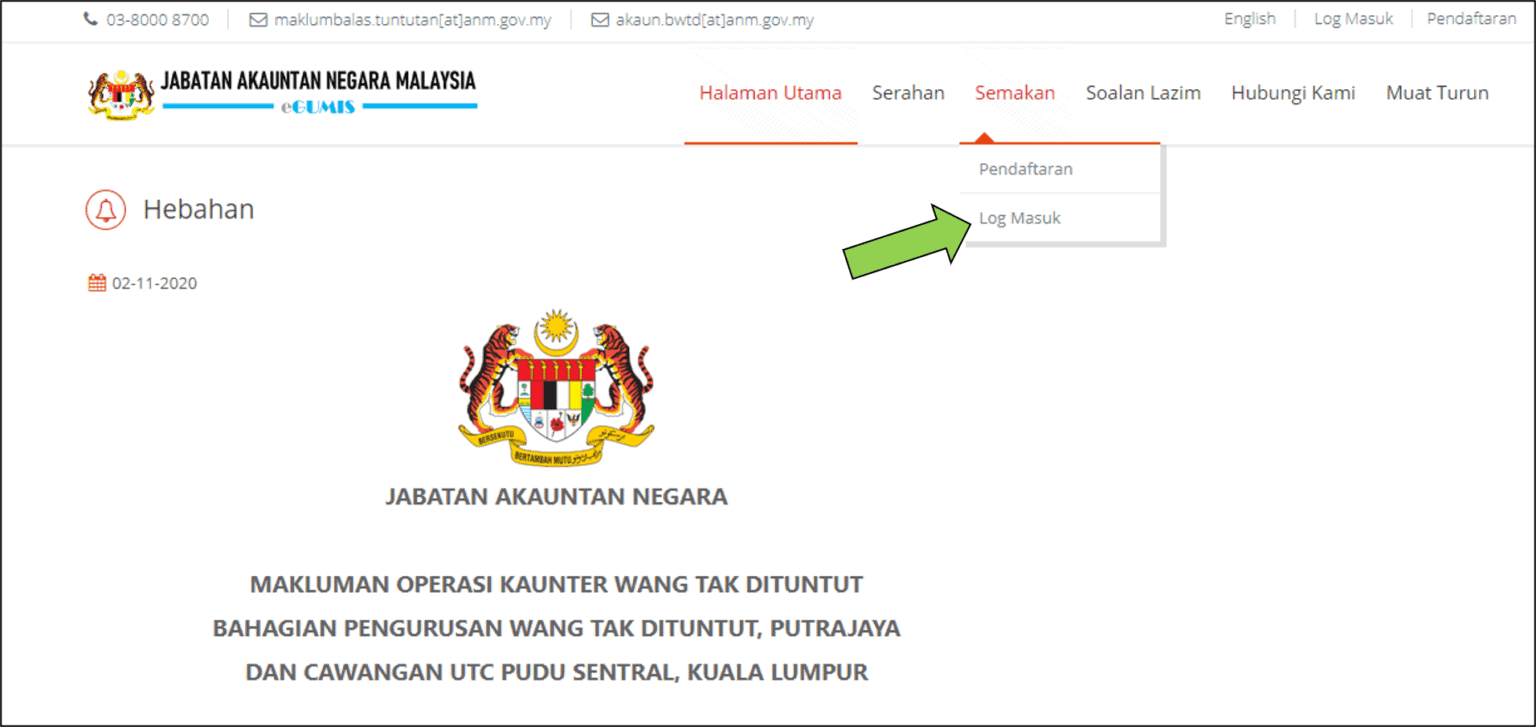
    First, head over to this link to register for a new account. Then click on ‘Registration’ in the top right corner as per the screenshot below to get started.

    Note: You may first need to change the default language to English, or you may proceed in Bahasa Melayu.

    egumis home

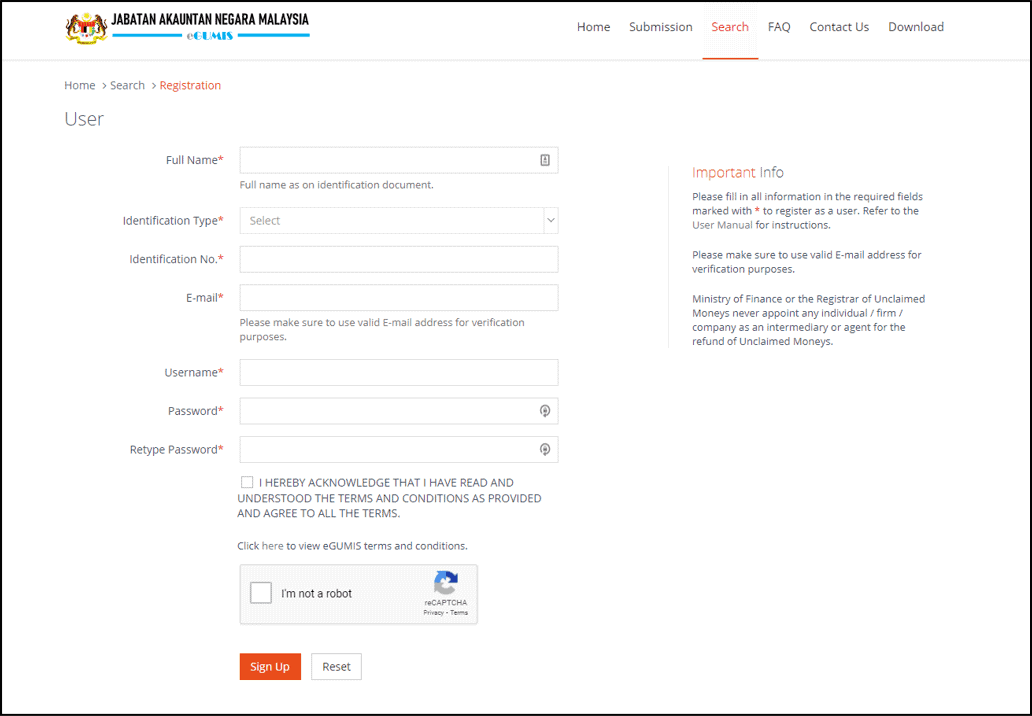
    You may then fill in the form to register your new account.

    Account Registration Form

    Your account will be deactivated after six months of inactivity, so if you have previously registered and have not logged in for the past six months, you’ll need to register for a new account.

    Step 2: Update your Profile

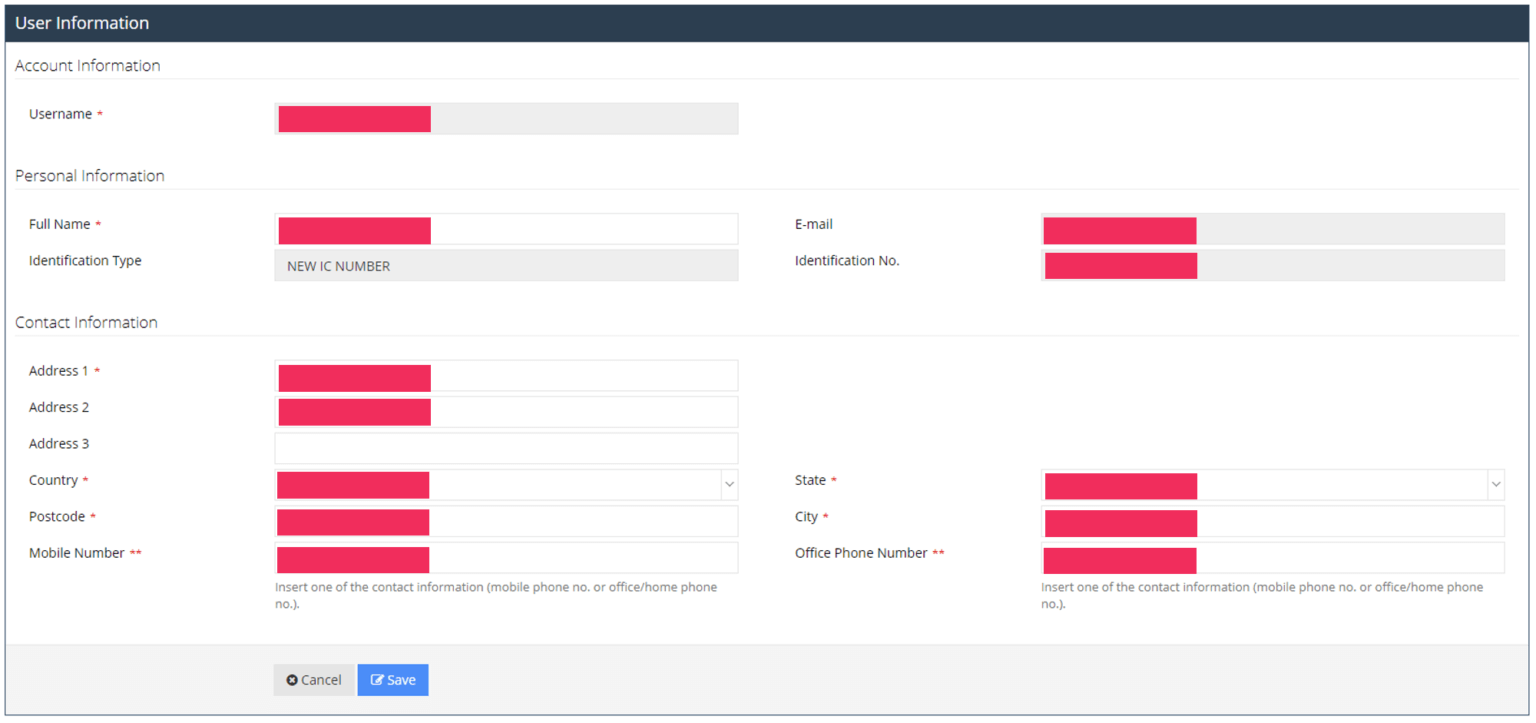
    Next, update your profile. Make sure to fill up all the boxes that is marked as compulsory (*).

    User Profile Information Form

    Step 3: Check for Unclaimed Monies

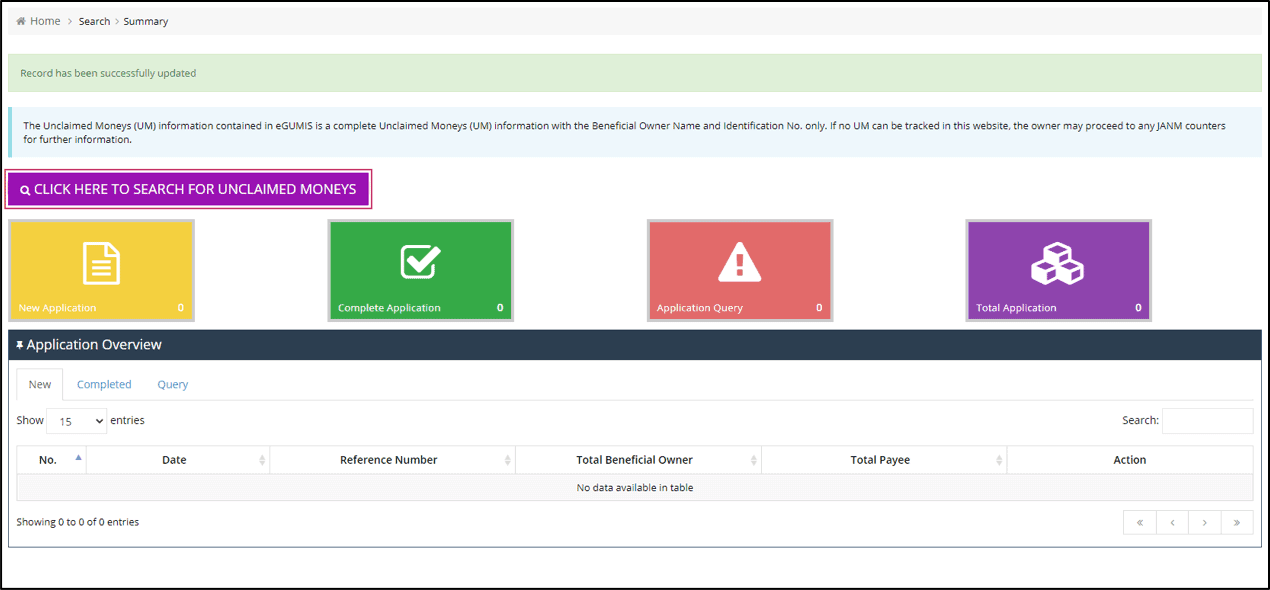
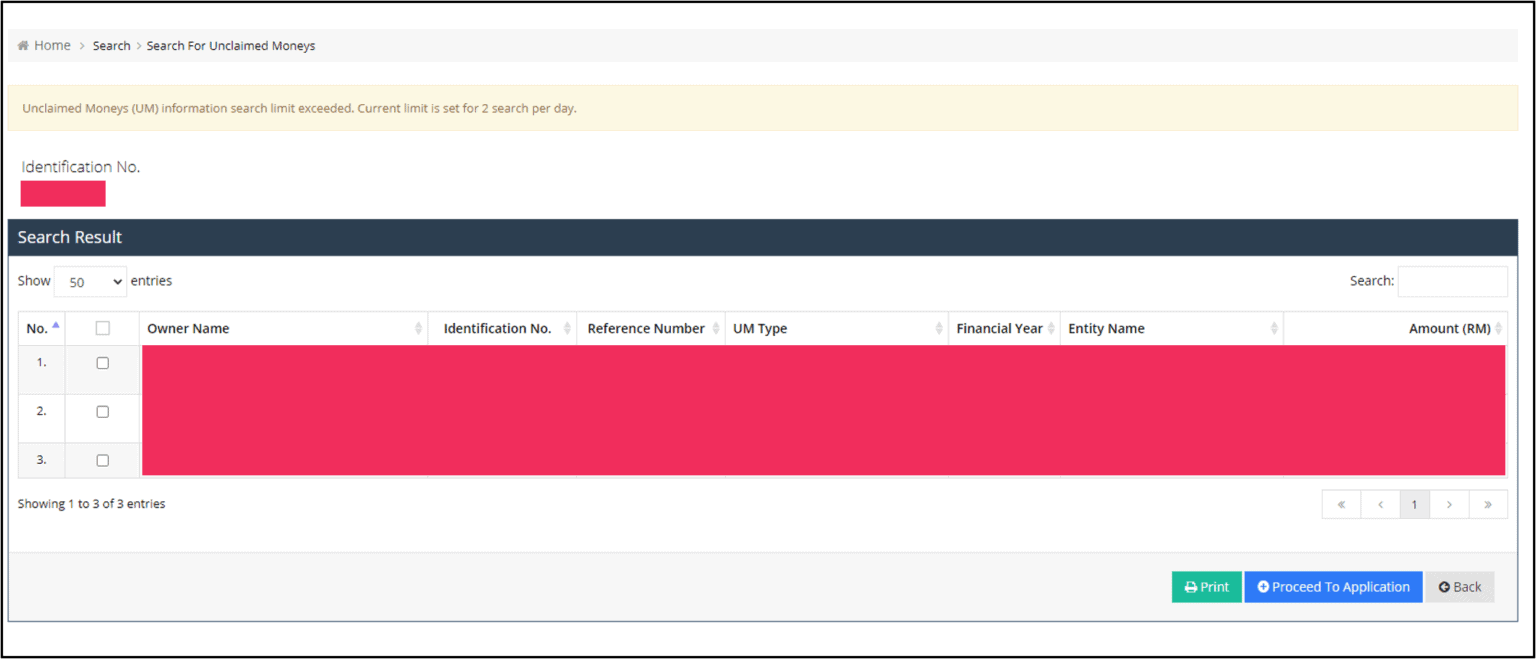
    Click on “Search for Unclaimed Moneys” and enter your Identification Number into the provided space. If you have any unclaimed money, it will show up in the search result.

    Unclaimed Monies Summary Search Result For Unclaimed Monies

    I also helped my parents check their unclaimed money through my account. However, I’m not sure if I can actually process the claims using my account, so to be on the safe side, I registered new accounts for them to help them claim their money.

    Do note that you can only check a maximum of two IDs per day.

    Step 4: Application Form

    If you have any unclaimed money, here is what you need to do to claim it:

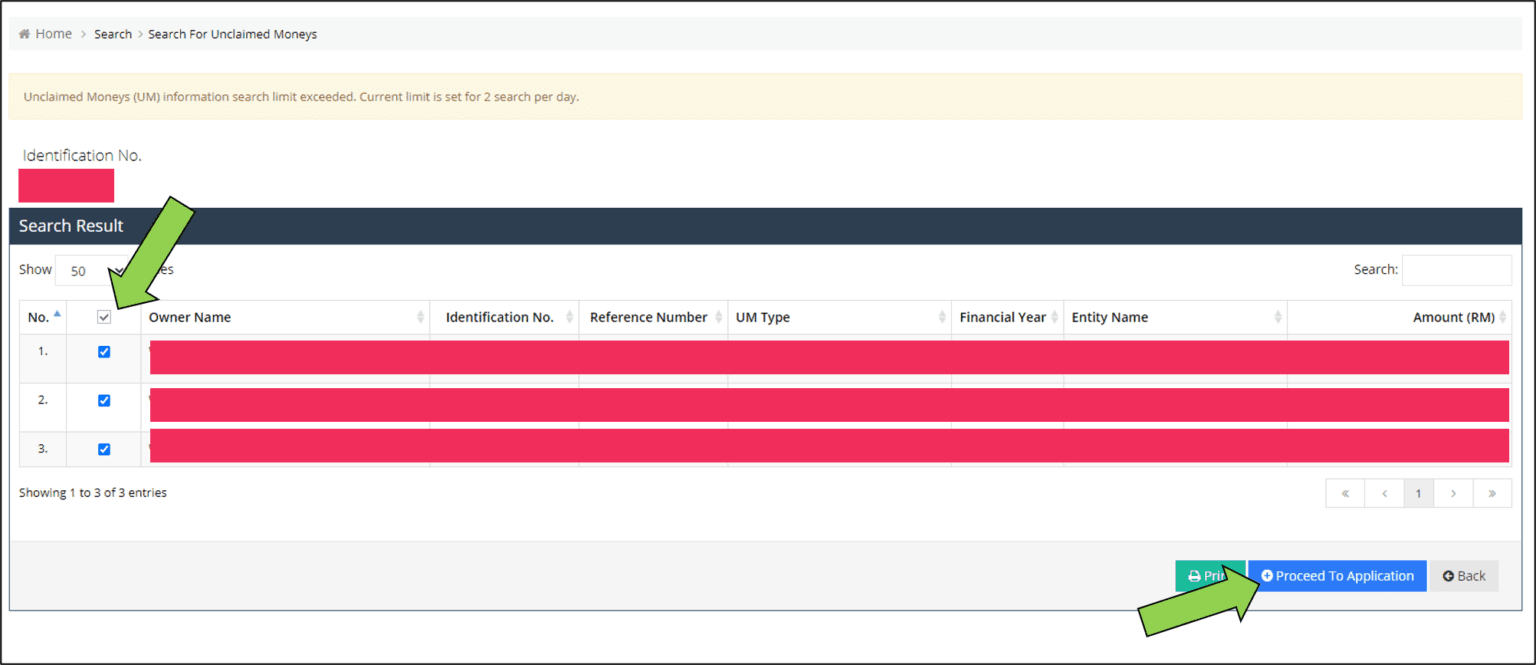
    Don’t click anything other than the following two steps. As the system doesn’t save your search results, if you use up your quota of two searches per day, you have to wait for the next day to proceed to the next step.

    Search Result For Unclaimed Monies

    Select the “check all” box, as I assume everyone wants to claim all their unclaimed monies.

    Select the “Proceed to Application” box.

    Step 4.5: (Workaround) Bug in the System

    In my experience, for some reason, there is a bug in the English version of eGUMIS which prevented me from proceeding to the next step. I’ll save your time without boring you with the details; here’s the work around:

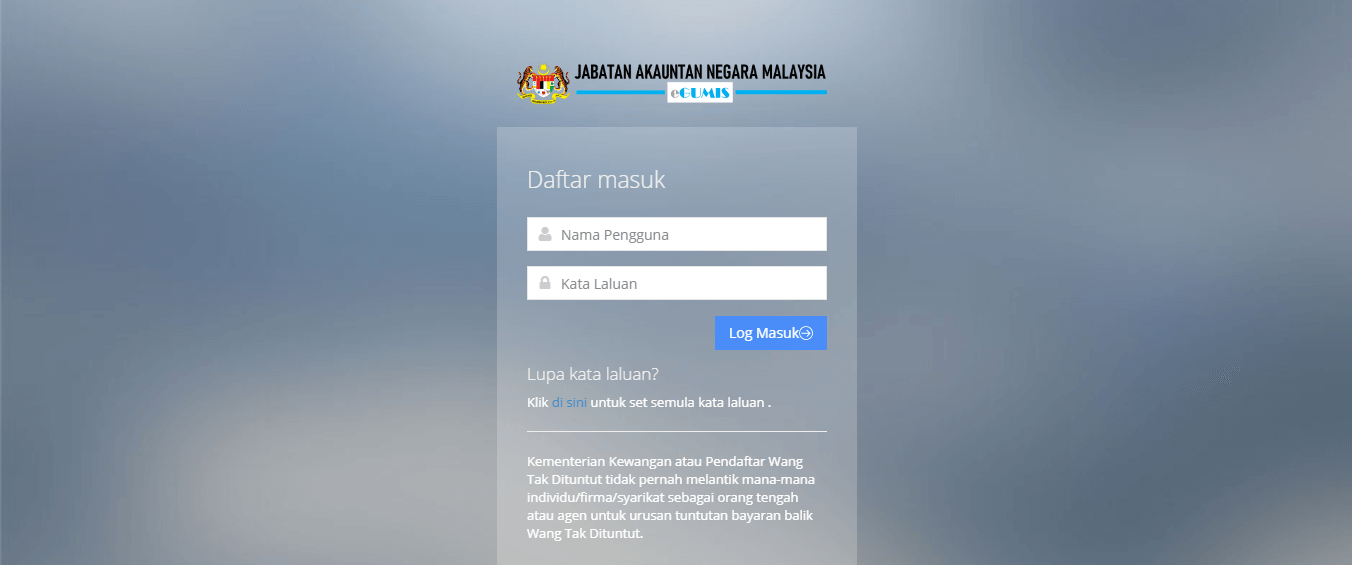
    English eGUMIS login JANM Login Page

    Visit this link and under “Semakan” click “Log Masuk”. This is the Bahasa Malaysia version of eGUMIS.

    Step 5: Enter Payee Information

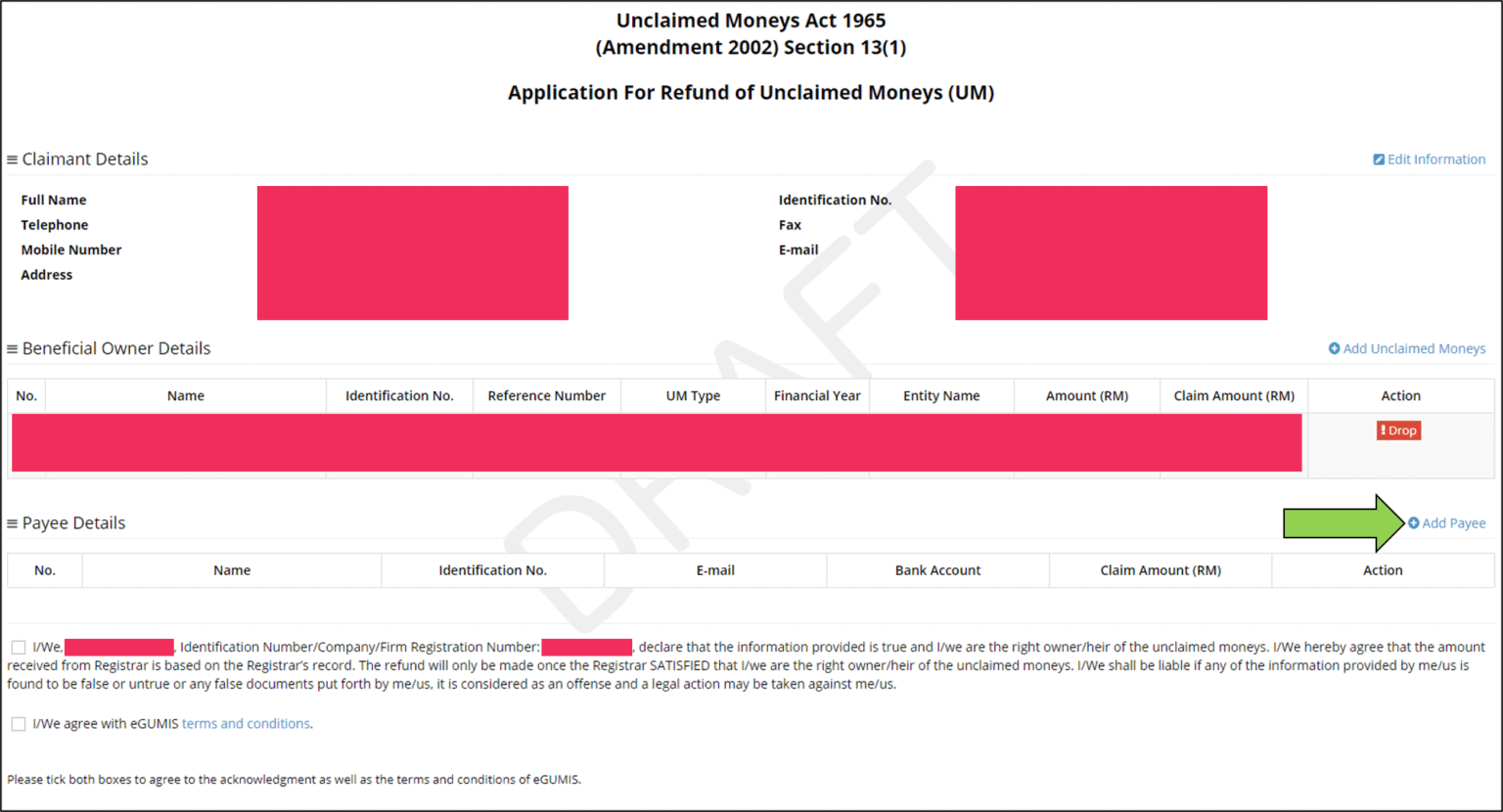
    This screenshot was taken in the English version. In the Bahasa Malaysia version, “Tambah Penerima” is also located in the same position.Enter Payee Information Screenshot

    Once you click on “Tambah Penerima” (Payee), a pop-up will appear and you’ll need to fill in your particulars and bank account number accordingly.

    After you’ve saved the Payee details, check the two boxes below and click on the “Hantar” button.

    Step 6: Almost there

    Once you’ve completed your application, you should receive an email by the AGD. To complete the claim, you are required to submit:

    • A copy of your ID (IC / passport / company certificate)
    • Bank statement (from the same bank that you entered in the Payee column).

    Submit the above document to permohonan_wtd@anm.gov.my with the application number as the email subject.

    (Please be reminded that each email cannot exceed 15MB.)

    Final Thoughts

    Even though there’s no time limit as to when you can claim your money, it’s better to claim it as soon as possible. This is because the Registrar of Unclaimed Money doesn’t pay any interest on the money claimed while your money can be invested elsewhere to generate a return.

    One common reason why money remains unclaimed is because the legal beneficiaries don’t know about the money after the owner passes away. This is especially true if the owner dies unexpectedly. Therefore, it’s good to have a simple will (at the very least) to avoid this scenario.

    Don’t stop at checking your own account; if you have elderly parents or family members, do help them to check as well.

    However, please be reminded that the Ministry of Finance or the Registrar of Unclaimed Money doesn’t appoint any individual/firm/company as agents for the refund of unclaimed monies. Be extra careful if anyone claims that they can help you claim the money.

    This article was originally published at planNERD.

    About the Author 

    Marshall Wong is a licensed financial planner and can be contacted through his website or marshallwong@fa.my.