Category: Cash Management

  • Buying A Car? Here’s Some Tips On How Best To Finance A Car

    Buying A Car? Here’s Some Tips On How Best To Finance A Car

    For many people, there’s nothing quite like taking delivery of your brand new car. However, taking on long-term loan to buy a car can have serious repercussions on your financial health.

    We’ll take a look at the key issues and the ramifications of buying a car.

    Question:

    Hi, I’m Denise. Some people say the one single monthly commitment which can make or break your wealth building is payment of car loans. Is every car loan an upside-down loan as most cars depreciate much faster than we can settle them off, especially if we take a 7 or 9-year loan? In your opinion, how best to finance a car purchase? Is it in cash or a car loan?

    First, what does Denise mean with “upside-down loan”?

    If your car value depreciates faster than you pay off your loan, you will need to come up with extra money out of your pocket to repay the bank.

    For example, when you sell your car at RM20,000, but your outstanding loan is higher, say RM25,000, you will need to fork out that difference of RM5,000.

    In other words, it is negative equity.

    That might happen in any of these situations:

    • If you have a long tenure hire-purchase loan like nine years;
    • You buy a car that depreciates too fast i.e. depreciates 50% in two years, versus some brands that only go down 50% after five years; and
    • You finance the vehicle up to a maximum of 90%, 100% or even more after the mark-up price.

    Or any combination of the above situations, you might end up with an upside-down loan.

    Back to the question:

    So, what is the best way to finance a car purchase? Should people only buy with cash, and only if they can afford to pay for the car in full?

    To understand this issue, you must separate the subjects into two parts:

    The Car And Its Value

    Let’s get this straight. The value of a car falls over time. It doesn’t matter if you finance it with cash or with a car loan.

    The higher price you pay for it, the more you lose. Whether you pay cash, or pay with a short three-year loan, or a long-term nine-year loan, or you only borrow 50%, regardless how you pay for the car, the car still goes down in value at the same rate.

    It doesn’t matter.

    The buyer of your used car won’t bother whether it the loan has been settled. They don’t pay you more because you don’t have a car loan. They might pay you more if the used car is well-maintained and looks good.

    So, can we agree with these?

    If you want to lose less money, just buy a cheaper car. Buy a better brand that depreciates less comparatively. Or the best choice, don’t get a car if you don’t need to. Buy the car that fits your needs now.

    Don’t make the mistake I made. I used to own a 12-seater Hyundai Starex, and it was too big for my small family. 

    So, if you wish to be prudent about it, you may consider having a lower-priced car that serves your daily needs, or not get one for a car is a liability and its value depreciates in the long run.

    How To Finance The Purchase

    buying a car

    Now the second part is the one you want to consider – how to finance the purchase?

    Short answer: That depends on the rate of return on your fund.

    After you decide what specific brand, model and specification of vehicle you are going to get, the next step is to find out the cost of financing the purchase.

    If you have 30,000 in a fixed deposit earning 2-3%, you might as well use that cash to pay for a car loan which will cost ~4%-5%.

    On the other hand, if you have a stock holding that yields 8% a year, you should take a very long term car loan (nine years). So you keep your stocks… and earn the difference (8% stock yields – 5% car loan interest)

    Does that make sense?

    In summary, if you are a good investor, and you make an investment return that is way better than 4-5% you pay the bank, it is no-brainer to decide. Take the most extended loan that can offer the cheapest financing cost.

    Debt Service Ratio (DSR)

    So, let’s say you made that car purchase and your car loan installment amounts to RM 1,100 a month. If you earn RM 5,500 a month, the car loan installment is equivalent to 20% of your monthly income. This works out to be a DSR of 20%, that is if you have no other outstanding debt.

    If you have other debt commitments such as a student loan (PTPTN), credit card debts, personal loans… etc, you may want to assess what your DSR is after you buy your car. For instance, if you are paying RM440 a month in PTPTN loan installments, you would increase your DSR from 8% to 28%.

    Before buying your car

    = (Existing loan commitment / Monthly income) x 100%

    = (RM 440 / RM 5,500) x 100%

    = 8%

    After buying your car

    = (Existing loan commitment + Car loan installment) / Monthly Income) x 100%

    = (RM 440 + RM 1,100) / RM 5,500) x 100%

    = 28%

    So, What’s The Significance?

    First, calculating your DSR will help you to determine if you can really afford the car purchase with a car loan. For instance, if you find that your DSR after buying the car is above 40%, you may want to reconsider because you could be over gearing. You could put yourself in financial distress if you lose your job, business or your sources of income.

    Second, do you plan to buy yourself a home or an investment property some two to three years down the road?

    Here is the thing. Little do people realise that the same RM1,100 monthly installment for a RM90,000 car loan is worth as much as RM220,000 in property mortgage.

    Essentially, you are committing RM1,100 a month to get a RM90,000 car loan to buy a car that depreciates in value over time while forgoing your opportunity to acquire a property worth RM240,000 that could generate rental income and appreciates in value over time.

    So, if you’re looking to buy a property in the near future, it would be helpful for you to refrain from getting a car loan and use your loan eligibility or quota for a piece of real estate.

    The Final Piece Of Advice: Don’t Do The Following!

    buying a car finance donts

    The above discussion is based on the assumption that you already have the money to buy the car. I strongly suggest that you put yourself in this position before considering to upgrade.

    A car loan can only break your finances if you are spending your future money to buy it. That means you don’t have the money ready for the car.

    So, you take up a loan to buy a car that is not affordable to you, perhaps to impress your colleague who just showed off his latest vehicle.

    That’s a big NO-NO. Please refrain from doing that.

    Don’t buy something you don’t need, with the money you don’t have, to impress the people you don’t like. That’s plain stupidity.

    About the Author

    This article is co-written by KC Lau and Ian Tai.

    Ian Tai is a Dividend Investor. Financial Content Machine. Producer of 200+ Articles, Weekly Host and Presenter at KCLau.com. Co-Founded DividendVault.com, an online educational membership site that empowers retail investors to build a stock portfolio that pays rising dividends in Malaysia and Singapore. 

    KCLau is a financial educator, having published seven books including the current bestseller Money Smart, and co-created a dozen online financial courses. He gives away his popular Money Tips e-book volumes free at his website: https://KCLau.com
  • Knowing Your Financial Ratio

    Knowing Your Financial Ratio

    Sometimes people tend to wonder what we can do with the surplus cash that we have at hand. Well, as a start, it is good that there is a surplus in cash, but if we are not careful this surplus may be gone before we even realize and by then it could be too late to think about “what-ifs” and “I-should-haves”.

    In financial management, there are parameters that can be used to gauge if one is “financially healthy”. Here are few basic financial ratios one can use to gain better understanding of their state of personal finance:

    • Liquidity Ratio: This measures one’s ability to cover unforeseen expenses such as emergencies, car repairs, job loss, etc.
    • Debt to Asset Ratio: If there is an solvency issue, you must have assets to cover your debt obligations. If your debt value is too high compared to asset values, then even if you sold off all assets, it may still lead to
 bankruptcy.
    • Liquid Asset to Net Worth Ratio: Consider how much of your assets are liquid or “moveable”?
    • Savings Ratio: You should be able to save at least 10% of your income each month to go towards your retirement. 

    Liquidity Ratio

    financial ringgit malaysia

    Should a person have a very low liquidity ratio, the first thing he or she needs to do is to start saving money for a rainy day (the amount of which is measured by one’s liquidity ratio). Don’t think about paying off debts (except to service scheduled repayment), and investing at this point should be the last thing on this person’s mind.  

    Debt to Asset Ratio

    If you have a good liquidity ratio (healthy savings) but also have high debt to asset ratio, then you are advised to pare down some of your debts.  For instance, a person may have a huge positive net worth, but most of this comes from immovable assets such as real properties. If this is the case, this person should consider increasing the proportion of movable assets by investing in other paper assets such as stocks or fixed incomes to diversify and also to provide some liquidity to the balance sheet.

    Savings Ratio

    financial savings

    Savings ratio is quite easy to measure, but if you cannot save any money you bring home, then obviously you have a lifestyle or income problem. You need to tackle that first before thinking about putting your money to work hard for you.

    See the Big Picture

    What I advocate as a financial planner is that no matter what we decide, we must see the bigger picture, the bigger picture being a person’s life, and what he wants out of it. It is important that our decision correlates and supports our aspirations, and if a decision does not derail our goals and dreams but brings us nearer to them, then this is the right thing to do.

    In financial terminology, financial planning is described as a systematic process to organize our finance to help achieve our life goals.  That being said, any amount on top of the threshold a person feels comfortable treating as their rainy-day fund should be put to work via investments.

    Depending on your marital status, income sensitivity or fragility, health condition, and so on, it is rather advisable to have emergency funds worth at least six months of your take-home income (some will say six months of monthly expenses but I would strongly suggest you look to your take-home income as it is more conservative).

    If you would like to strengthen your foundation, you may even create an emergency fund that is worth six months or more of your take-home income plus your loan repayment commitment for an additional 12 months. This will help make sure you avoid defaulting or failing to repay your loan obligations.

    Of course, it is rather impossible to save enough to help cover emergencies such as serious diseases and so on. This is why you need to be aware of risks and potential losses and take up insurance. After saving enough to feel comfortable and at peace, you must then invest the surplus and let it work for you. Be a master of your cash; not a servant to it.

    About the author

    kevin neohKevin Neoh is a NextGen Money Coach who works with people to help them transform their relationship with money to improve their lives with the money they have. Kevin can be contacted at kevin@nextgenadvisors.my and www.kevinneoh.my

  • Getting Financially Organised Is Your First Step Towards A Better Financial Future

    Getting Financially Organised Is Your First Step Towards A Better Financial Future

    This is a story about Andy and Amy (not their real names). Andy is an enthusiastic entrepreneur with a reputable position
    in his industry. A successful man and earning a good income, however, his expenses were high as well.

    After marrying Amy, he became stressed with his finances, which worsened with the birth of their first child. The pressure of the monthly deficit of approximately RM2,000 and worrying about the future expenses triggered the couple to engage our services. I was then able to we help them through with our holistic financial planning service.

    Andy and Amy have different attitudes towards managing their personal finances. Andy is a very positive person who anticipates that good things will happen in life as long as he strives for it. “Tell me what I need to do and I’ll make it happen!” is his
    favourite motto.

    He applied this attitude to his finances, which often resulted in him committing to things he cannot afford today, but with the conviction that he will be able to grow his income and pay for it in the future.

    financial

    Amy is almost the polar opposite when it comes to money. She’s cautious and prefers to plan ahead and be prepared for the worst situation. Indeed, the desire for a more secure future was amplified after having a child. A clear visual reality of their current
    family’s financial situation was provided to them through our holistic financial planning process.

    The hard facts and numbers seemed ruthless but it showed them the gap between their goals (purchasing a bigger home, tertiary education funding, retirement security, etc.) and their available resources.

    In addition to the risk of not being able to achieve their desired goals, as a single income family with a child, there were other potential risks that needed to be addressed, such as Andy’s insufficient insurance coverage for the family’s income needs (should something untoward happen to him) and the lack of estate planning tools in place to safeguard his family.

    We helped Andy and Amy tidy up their cashflow, focusing on their expenses as there were many loopholes and excesses that could be avoided or minimised with good budgeting. For example, we noticed the huge amount spent on dining out and impulse purchases. During the financial planning process, there were some unavoidable differences of opinions between the couple, but fortunately we were able to help them manage their expectations and bring them to work together towards their common goals.

    The role of a financial planner is unique. We not only provide clients with relevant and timely financial advice, but we also take on the responsibility of educating them to cultivate good financial habits. In this case, tracking their monthly family budget and inculcating a habit of saving before spending were their immediate priorities.

    personal financial

    Trust me when I say that financial planning is a long journey. We help clients understand their current financial situation and plan for their fi nancial future. But as circumstances change over the years, we also need to accompany them as they make major
    financial decisions in their life, and keep them updated on the latest happenings along the way.

    Although Andy and Amy are still striving to be more financially stable after their first year of engagement with our service, their progress have been remarkable as their finances are now more organised. They were able to address their immediate gaps and
    started adopting good fi nancial habits.

    These new habits will help them form a strong and healthy foundation as they work towards their goal of achieving financial freedom.

    About the Author

    Ocean Pon is a Licensed Financial Planner with Finwealth Management Sdn Bhd.

    We at Smart Investor and Finwealth is committed to help you better manage your financials. Get a free consultation from an expert by filling in your details here: https://www.smartinvestor.com.my/SIxFinwealth

  • 3 Alternative Ways To Teach Teenagers About Money Management

    3 Alternative Ways To Teach Teenagers About Money Management

    Are you worried about your teenage children’s safety, health, social life, future, and education? In addition, they are constantly bombarded by advertisements, online shopping, peer pressure and “Instagram culture”.

    Various surveys have shown that Malaysian millennials (aged from mid-20s to 40) have a tough time when it comes to money management:

    • 70% of Malaysian millennials do not live within their means – Asian Institute of Finance, 2015
    • 74% of millennials in Malaysia are struggling to meet day-to-day expenses during the Covid-19 pandemic
    • 53% of Malaysian millennials cannot survive with their savings beyond three months
    • Lower income millennials spend 48% on food, 27% on entertainment

    Looking at the situation above, we should plan forward and ensure that the next generation – our teenagers – will have a better start in money management. Here are three alternative ways parents can teach their teenagers about money management.

    1. Joining Them Instead Of Stopping Them

    Online shopping has enabled spending like never before, especially during the pandemic. Most teenagers will want to buy and own things if they have the means, although more often than not, such purchases are due to peer influences.

    Being the financial provider for teenage children, it is important that as parents, we instill the importance of self-control and wisdom about leisure shopping. Yet, this is the phase where teenagers become more rebellious, it is simply not enough to just tell or nag them. The old saying has never been truer – “If you cannot beat them, join them”.

    Go on Shopee or Lazada with them. Teach them about vouchers, free shipping and sales. Or maybe it will be them teaching you instead! Shopping online with them has its benefits, such as:

    • Bonding time and relationship building with your child
    • Slotting in some advice about quality vs quantity, self-control and impulsive buying behaviour
    • Monitor your teenagers’ shopping behaviour, what is in their shopping cart, wishlist and their shopping history
    • Share your experience and mistakes about shopping and spending

    2. Give Praise And Advice

    It is so true, that it must be repeated again. Teenagers are rebellious creatures!

    Nagging and telling them what to do just will not cut it. It did not work for teenagers during the 80s, 90s, and 2,000s and it certainly will not work today. However, they do seek your approval and appreciation, especially on things of importance to them. We often hear “my parents do not understand me” or “my parents are just not cool”. One way to avoid such comments are to acknowledge and sometimes praise what they are doing right (or vaguely right) financially.

    “Boy, it looks like you did not spend too much money at the mall today. Good job!”

    “Girl, you really found a real bargain with the dress you bought online. You certainly know how to shop.”

    After praise is given, teenagers will be more receptive towards advice. The acknowledgement that they did something right, gives them a sense of pride, and the urge to do it better.

    3. Let Them Make Mistakes

    If you recall how you sharpened your money management skills, more often than not, it was not taught or told by your own parents. You learnt them either by experience, hardships, or through mistakes that you have made. Depending on your generation, we grew up in a different time and culture than the teenagers of today.

    One way that we can teach our teenage children about money management is not by teaching or telling, but by letting them experience mistakes of their own. Here are ways you can set the stage for your teenagers to learn some money management:

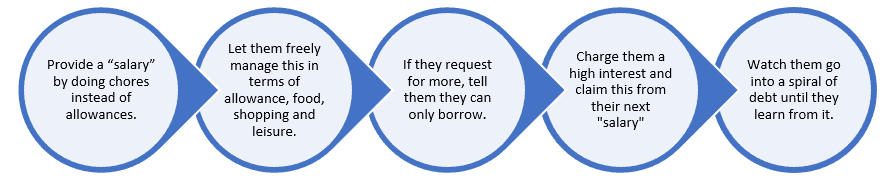
    The salary and lending method

    The delayed gratification lesson

    We are spoilt with instant gratification. What we want, we can get it very fast, if not, almost instantly. Think Netflix (movies), Grab (food/transport), Shopee/Lazada (shopping) and WhatsApp (communication). The Generation-Z of today are born into a life of instant gratification. However, the culture of savings and investments are more often than not, a slow and disciplined process.

    Thus, it is even more crucial that parents practice delayed gratification with teenagers and resist buying things they want versus what they really need. For example, if they ask you to buy something they want (big or small), try and ask them to wait for a few weeks or months. Suggest that if they want it sooner, they have to contribute part of the cost too. You may even notice a change that as time passes, they will realise that the purchase is not worth their allowance, and their desire may even fade.

    The compounding interest lesson

    Open a bank account for your teenager with some sort of interest element and allocate your teenager’s allowance in it. Alternatively, some e-wallets currently have an interest element as well. This allows them to learn about the compounding effect of interest on interest.

    With this method, you can teach them about saving their allowances, and watch their savings grow every month. Take this opportunity to teach them about inflation and other forms of investments that can make their savings grow even faster, such as fixed deposit or a bond fund. Although they are too young to invest into unit trusts themselves as a primary applicant, you can create a joint unit trust account with your teenager being the secondary account holder.

    As parents, we do our best to teach our child the important elements in life. Early money management is something that is important and should be deeply rooted into their young minds. However, this is easier said than done as there is only so much we can do as parents.

    Their personalities and spending patterns are an amalgamation of a variety of influences, from friends, to TV, to the internet and also by observing their parents’ money behaviour. That said, as parents, we should learn and practice what we preach about healthy money management.

    About the Author

    Alvin Kwan, CFP CERT TM is the executive director and head of financial planning at Redvest Wealth & Asset Management. He has over 12 years industrial experience in the financial industry, specifically in wealth advisory, private banking and stock broking. He was also a lecturer in areas of investment management, derivatives, and financial markets.

    We at Smart Investor and Redvest is committed to help you better manage your financials. Get a free consultation from an expert by filling in your details here: https://www.smartinvestor.com.my/SIxRedvest

  • 5 Different Types of Income

    5 Different Types of Income

    Since childhood, parents advise us to study hard, get good grades, go to college and graduate so that we can land a job with great benefits. It has been our only concrete financial plan until we faced the reality of adulthood. here are many types of income which easy.

    We became students of financial matters ever since and have begun to explore many types of income from books, workshops, online media, and casual chats over coffee. It has led us to build multiple streams of income, instead of relying solely on a single job for pay.

    In this article, let’s explore these income types. Each has its unique attributes, requirements, and usages to build wealth for the long term. We’ll examine five different types of income, discuss their pros and cons, and how they can contribute progression towards your financial life.

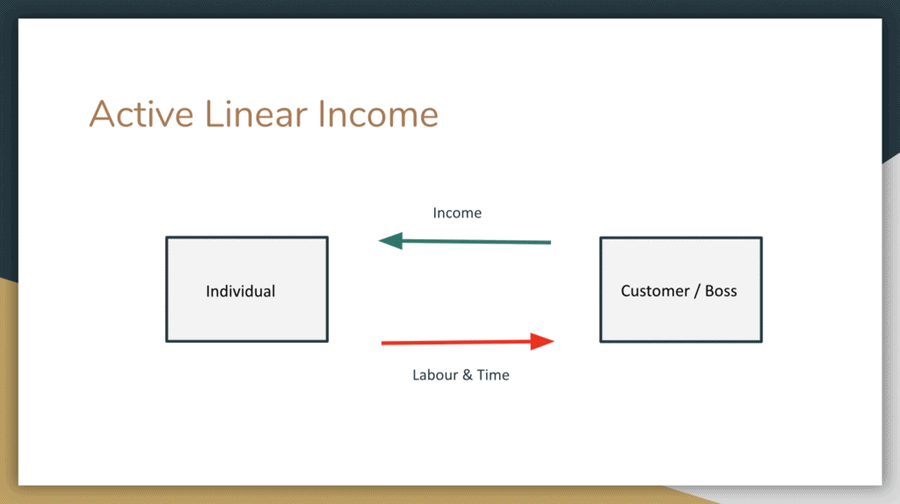
    1. Active Linear Income

    types of income

    It is income derived from an exchange of physical labour and time with a single paymaster. This type of income is most common for it is the fastest means that one uses to make money as it requires the least time, effort and investments to establish this source of income.

    For instance:

    • You are an employee working for $ xxx per period (hour, day, week, month, shift, etc.).
    • You are a freelancer who charges a fixed fee of $ xxx per project.

    This type of income is useful when one is starting off. After all, everyone has bills to pay. With that being said, this income is dependent solely on your effort physically.

    So, it may be limiting in terms of growth for all of us possess only one physical body, 24 hours a day, 365 days a year, and can only be at one place at a time. As such, this leads us to explore our next few sources of income.

    Maybe this worth your read : 4 Lessons I Learnt on Wealth And Life As I Enter My 30s

    2. Active Scalable Income

    types of income

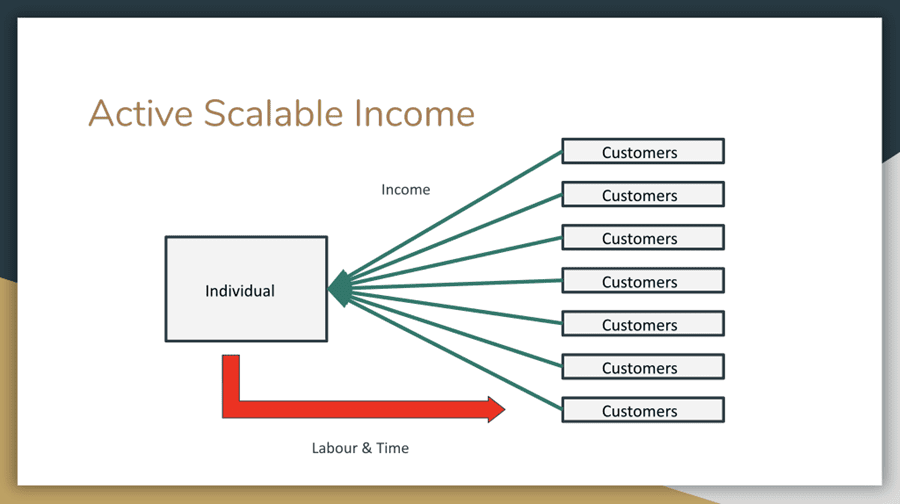
    Likewise, it is also income earned from an exchange of physical labour and time but to a network of paymasters. It involves one having built a system or a team or multiples of both to increase income exponentially via scale.

    It includes:

    • You earn x% in overriding commission from sales generated from your sales team.
    • You are a freelancer who makes x% profit share from project undertakings.
    • You sell products or services via a network of distributors and retailers.
    • You sell digital products to an online community consisting of xxx people.

    This type of income is expandable because the number of clients you serve can increase significantly without you substantially increasing your efforts at work. In other words, a 100% growth in your customer base may bring 100% more income without you increasing your workload by 100%.

    This is usually the type of income that propels one from earning 4-figures to 5, 6, or, 7-figures per month, hence, raising more significant capital faster for investments.

    But, if it is that good, why not more people earn this type of income?

    This is because it requires people to invest time, effort, and money to first learn about marketing, branding, leadership, and system building. Upon which, there might be no immediate payoffs.

    For instance, you may have a desire to make millions from pitching your products to a broad audience in a mega preview event. The money sounds enticing. But, you would need first to master effective public speaking and closing.

    3. Passive Income

    types of income

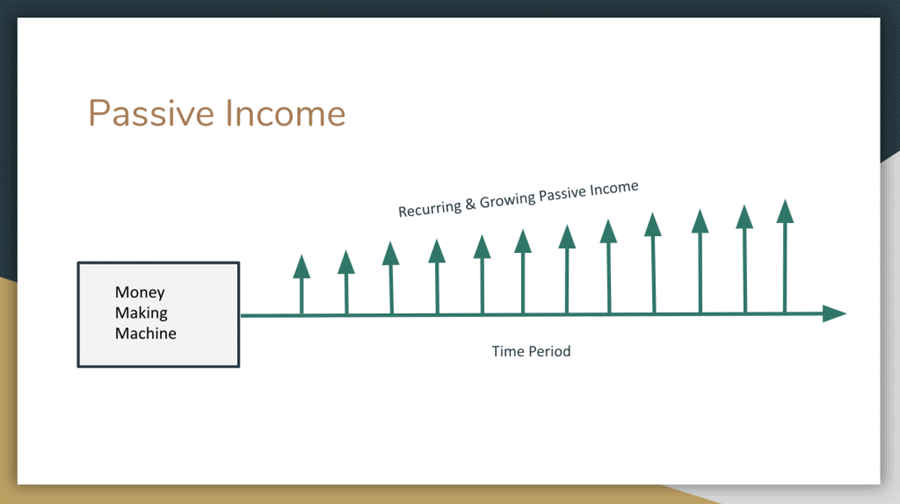
    It is recurring income derived from ownership of profitable assets. It includes:

    • Interest income from fixed deposits, P2P lending, and other forms of credits.
    • Coupons from bonds.
    • Dividend income from a portfolio of stocks that pay dividends.
    • Rental income from tenanted properties.
    • Royalty income from intellectual properties.
    • Passive income from owning businesses that you don’t physically manage.

    This type of income is awesome because cash is flowing into your bank account without physical labour. In essence, receiving passive income is earning time as it frees your time to pursue what you like. Besides, there are many tax benefits if you have any of the above sources of passive income.

    If you are earning $ 100,000 in active income, you will be paying more income tax on as compared to another person who makes $ 100,000 in passive income. He may even pay literally zero in income taxes in Malaysia.

    However, you need higher financial intelligence to create passive income effectively. One inevitably has to learn about investing and be a skillful investor with a great temperament.

    Therefore, although passive income doesn’t require much physical labour, you need to study a lot (mental labour) before being good at it. Besides, without huge capital, you can’t survive on meagre passive income to do it fulltime.

    4. Portfolio Income

    types of income

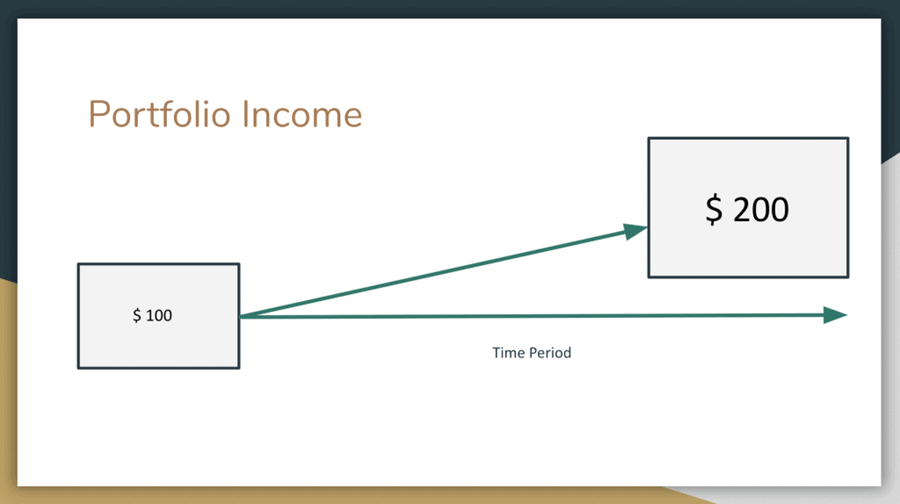
    It is income derived from market value appreciation of your assets, also known as a capital gain. Alternatively, you can earn this profit via investing in assets at prices below their market valuation. Some examples include:

    • Your stock has appreciated from $1.00 to $2.00 in x period of time.
    • You bought a property for $80,000. Now, it is worth $100,000.
    • The value of your home is $200,000. You bought it for $80,000 7 years ago.

    Many people find investing appealing because of the prospects of earning portfolio income or capital gains. It is even more attractive as compared to making passive income for the money is more significant. After all, eating steak immediately is more appealing than having milk every day.

    I find there are two types of people who want to earn portfolio income.

    First, it is people who are focused on money. They intend to make more money via selling assets at higher prices than their cost of purchasing them. This group of people are either traders if they can make money consistently or speculators and gamblers if they lose money consistently from their activities.

    Second, it is people who are focused on accumulating assets. They are not ones who will kill their golden goose as they treasure them. For instance, they would invest in stocks or properties and hold onto them for long-term capital growth. Their mindset is to keep them and not sell them for a profit. In most cases, they would build massive net worth from their investments over time.

    5. Phantom Income

    It is income derived through the leverage of tax benefits, corporate entities and debt. It is known as Phantom Income as the income is not receivable via cash. It is an income of the rich as it requires a higher degree of financial intelligence to grasp the concept and utilise it fully.

    We won’t list down its examples for its explanation is more technical. Here, suffice to say, the best way to use this income efficiently is to surround yourself with a team of advisors such as investors, consultants, accountants, lawyers, bankers and other related professionals.

    Looking for financial freedom? 8 Healthy Financial Habits To Build Your Financial Freedom Fund

    Conclusion

    There you go, the five different types of income that one could earn for himself to increase financial wealth.

    If you think about it, the five types of income is an income progression of most wealthy people who began with very little. You would begin with earning active linear income first to survive, expand your income through scale, invest your capital for passive income and portfolio income and roped in a team of advisors to make phantom income by setting up corporations to save on tax payments and use low interest rate debt to accumulate more assets that would build even more wealth.

    Now you know how it works. Go work on it!

    About the author

    This article is co-written by KCLau and Ian Tai

    Ian Tai is the founder of DividendVault.com, a platform that analyse and filter stocks that pay increasing dividends year after year.

    KCLau is a financial educator. He had published 6 books and co-created a dozen online financial courses. After conducting more than 461 hours of free webinar and 2000 articles published online, he gives away his popular Money Tips e-book volumes absolutely free at his website: https://KCLau.com

  • Don’t Worry, It’s Okay To Spend!

    Don’t Worry, It’s Okay To Spend!

    In order to become financially independent, the need to track your net worth is a crucial step. And for our net worth to grow, we need to have good cash flow management where part of our income is retained and converted into financial assets. Can we spend or can we not?

    However, when I say good cash flow management, this does not mean you have to track what you spend every day. Usually, people associate this with not spending money or cutting back on their lifestyle, which is inaccurate.

    Rather than doing that, I believe that we should not suppress our urge to live our life the way we want it. We work so hard every day, so why shouldn’t we live the lifestyle that we would like to have?

    Why it’s OK to spend?

    I’m not here to tell you not spend money, and I’m not here to tell you that you should save x% of your income either. With our lives surrounded by advertisements that promote consumerism, it’s not easy to resist the temptation to spend. Instead, I’m here to tell you that it’s okay to spend money.

    Generally, there are three types of spenders – which category do you belong to?

    Type 1: Spend More Than You Earn

    spend your money

    Despite enjoying and living on our own terms to the max as a Type 1 spender, it comes with consequences. Since the additional spending is funded by money that is not ours, there will be time when you will need to pay it back, and it will not be fun when that time comes.

    Immediate gratification is common for Type 1 spenders, as their wants and needs get fulfilled. Over time, however, this may become a habit and if you are trying to adjust or change this habit later, it may already be too difficult, and the process may not be easy.

    Type 2: Spend What You Earn

    Those in this category are usually smart enough to avoid the painful journey of paying back what they owe the bank, and so they spend within their means. If they bring home RM1, they spend RM1. This seems slightly more attractive than the first type, as this is living in the present without having to worry about payback.

    However, this has its downsides too.

    The downside comes from you having to continuously earn an income to pay for the food and services you need. It means that you cannot stop working. The day you stop working is the day you stop earning an income, and you’ll then no longer be able to pay for what you need.

    That said, this category isn’t entirely ideal either. On the flipside, if you are a salaried employee, you are automatically made to save at least 11% of your gross salary in anticipation of your golden age.

    Interested to invest for your old days. Worth a read, Selecting The Right Investment Funds For Your Retirement Portfolio.

    However, this can only be enjoyed after your retirement. What about the other life priorities and goals that you would like to pursue between now and when you retire? If we spend all that we take home now, we will never have the ability to pursue these life goals.

    Type 3: Spend Not More Than 90% Of What You Earn

    spend not more than 90%

    This type of spender acknowledges the irony of the need to spend and to save, and makes it a point to set aside part of their take-home income to prepare for their future.

    While living in the present, they also prepare for the future. This group of spenders understand that it is better to prepare than to repair. With the goal of spending not more than 90% of the take-home income, they practice what is referred to as ‘pay-yourself-first’.

    You can decide how to spend as you like, so long you keep the maximum available for spending at 90%. If you can lower that spending amount, you will have more control over your quest towards financial independence.

    By doing so, you have choices for your future. You are not just saving money; you are giving yourself more flexibility and options.

    Honest Self Review

    So, which type of spender are you now? If it’s up to you, which type of spender would you want to be? If you are not there yet, what is stopping you from getting there?

    Usually, people who have insufficient monies to spend every month would say that they have to spend all their monies because they are not making enough. For these people, their mantra is ‘I will start saving when my income increases”.

    Do you have these same thoughts too? My advice to you is to not wait – we can start making an effort to not spend all your take-home income today.

    Don’t forget your emergency funds!

    Read here : 3 Tips to Building Your Emergency Fund in Malaysia

    However, despite its benefits and advantages, just being a Type 3 spender is not going to promise you financial independence. Without managing the monies that you save in an efficient manner that supports your personal values, chances are you are not making full use of your financial muscles.

    If you are unsure about your current spending behaviors and how to manage your personal finance, let’s chat.

    kevin neohKevin Neoh is a NextGen Money Coach who works with people to help them transform their relationship with money to improve their lives with the money they have. Kevin can be contacted at kevin@nextgenadvisors.my and www.kevinneoh.my

  • Uplifting Women’s Role In Family Finances

    Uplifting Women’s Role In Family Finances

    C: Women have inherent qualities that enable them to plan their own and their family’s finances

    In my financial planning practice, I have observed that female clients, whether they be single career women or married with children, tend to face similar dilemmas and challenges when it comes to planning their personal finances.

    But why is that happening to them? They should and they must have their roles in family finances.

    Lack Of Time Due To Multiple Roles

    family finances

    There is no denying that the modern-day woman is highly adept at multi-tasking – from her job, her family, her children’s education to other social obligations and so forth. The downside of assuming so many roles and responsibilities is that it leaves hardly any time for herself at all.

    Any precious moments of “me-time” that ladies can manage to squeeze out of their packed schedule goes towards rest and de-stressing to rejuvenate themselves. Financial planning issues will hardly be on their minds after a long day.

    Tendency To Priorities Family Rather Than Themselves

    Being selfless and filial are undoubtedly noble characteristics that every parent, husband or sibling would want their daughter, spouse or sister to have. However, when putting the interests of family members ahead of your own, more often than not, your own needs may be neglected.

    A Senses Of Apprehension When It Comes To Managing Money

    This can be real, imagined or selective. Numbers and calculations can be intimidating to certain individuals regardless of gender or age. Others tend to shy away from money matters because they find it too complicated and confusing, preferring to let their spouse handle it so that they can focus on other responsibilities.

    My wife is happy to help our son with his algebra and trigonometry, but she claims to make no sense out of a financial spreadsheet.

    Worth A Read : Financial Literacy & Financial Accountability Are Life Changing

    Decision Making Guided By Sentiments And Emotion

    family finances sentiments and emotions

    Female clients sometimes base their decisions on how they “feel” about something. While having a keen financial gut instinct has made many billionaires, it is another thing when the heart overrides the mind in making investment decisions.

    Examples would be putting money in investment plans because a friend “strongly recommended” it, or out of sympathy for your banker whom you known for ages and needs to meet his/her sales target.

    Choosing To Save Rather Than Invest

    Some individuals consciously decide to continue saving in cash, preferring to keep the bulk of their money in fixed deposits despite the dismal returns. They are in fact aware and reasonably well informed of their options but due to their position in the family (for example, being the only daughter or the only unmarried sibling), they feel a sense of duty or responsibility to have funds on hand to assist other family members should they require it urgently.

    Read : How to Choose the Right Investment Vehicle for Yourself?

    Taking on the status of the family’s “standby banker” no matter how well-meaning, denies some women the opportunity to plan for their own financial future. Instead of viewing these challenges as barriers, turn them into catalysts for your personal financial growth instead. There are many ways to empower oneself to take control and own your financial destiny.

    Reprogramming The Mindset And Be Prepared

    While you may currently have the luxury of someone else handling the household’s financial matters for you, i.e. your spouse, there may come a time when you need to take over or assist in those duties. If you are already prepared, well and good. If not, take time to increase your own financial literacy so that assuming the role of the home’s financial manager will be a comfortable transition.

    Be Heard And Be More Involved

    Suppose money matters are not exactly your cup of tea. It may be tempting to leave all the family finances to someone else, especially if things are running smoothly and the party handling it has the necessary expertise and experience and doesn’t seem to mind doing it. However, you may have insights and suggestions for improvements, so share your thoughts rather than keep them to yourself.

    Make It A Learning Process

    If your financial matters are currently delegated or outsourced to other parties, there is the danger that you may one day find yourself in a situation where this party is unable or unwilling to continue the responsibility. Thus, it is important to get yourself educated on how to handle your own personal finances rather than leaving such a crucial task entirely to someone else.

    Leverage On Other People’s Time

    If you find yourself already overwhelmed with work and other obligations, learning to put your personal financial matters in order from ground zero may seem like a mammoth task. Under these circumstances, a licensed financial planner would be able to work together with you and assist you through the entire process while ensuring your involvement every step of the way.

    Individuals are not born with good personal financial skills, but everyone can learn how to be competent at it. Due to personal and family circumstances, women are often unable to take advantage of the opportunities present to improve their financial knowledge and be as hands-on in their personal financial matters as possible.

    Nevertheless, women already have a natural advantage in taking on the role, thanks to two critical attributes that play a huge part in successful financial planning.

    Firstly, regardless of age group, education level or social strata, almost all women are inclined toward a long-term mindset in whatever course of action is decided upon. This is usually more evident when it comes to buying a vehicle for example, or renovating a home or planning for the children’s education. Rarely are decisions made by women in the household without thinking two or more steps ahead about the effects and implications, contrasted with men like many of us who are more prone to “act first, think later”.

    Secondly, women tend to err on the conservative side of men by questioning downside risks before taking action, which is actually a good thing. While profit and returns are typically top on the list of male investors, having a woman jointly involved in the investment decision would help to temper any hasty actions and mitigate potential financial risks.

    As such, these inherent qualities in women make them suitable candidates to plan their own and their family’s finances. With guidance and financial education, they have the potential to surprise even themselves.

    A household may have mixed styles of financial management as both men and women are good in personal finances in their own ways, therefore by complementing one another and learning from one another, amazing results can be achieved.

    About the Author:

    Felix Neoh CFP CERT TM is the Director of Financial Planning at Finwealth Management Sdn Bhd and is a certified member of FPAM. He can be contacted at enquiry@finwealth.com.my

    We at Smart Investor and Finwealth is committed to help you better manage your financials. Get a free consultation from an expert by filling in your details here: https://www.smartinvestor.com.my/SIxFinwealth

  • Financial Literacy & Financial Accountability Are Life Changing

    Financial Literacy & Financial Accountability Are Life Changing

    For us to pursue our multiple life goals, we will need to have financial resources, which is like our ‘financial muscle’. We will need to have muscles to do the weight-lifting, which is to turn our life goals into reality. Therefore, we need to have the know how.

    This, essentially, is financial literacy.

    The Organization of Economic Co-operation and Development has defined financial literacy as a combination of awareness, knowledge, skill, attitude and behaviour necessary to make sound financial decisions and ultimately achieve individual financial wellbeing.

    Why Is Financial Literacy Important?

    financial literacy

    Obviously, the decision we make today has a long-term impact on our financial wellness in the future. Hence, a poorly made decision may have a very detrimental impact on our future.

    If a person is not financially literate, then this person may face multiple challenges in respect to managing his or her own wealth. Potential consequences can be:

    • Not protecting savings and assets adequately;
    • Not prudent in borrowings and ending up with too much debt;
    • Not investing to inflation-proof your purchasing power;
    • Not having a will; and
    • Not having financial safety net like an emergency fund and health insurance.

    The list can go on and on.

    When a person is in a situation as above, it’ll be rather difficult person to attain financial independence as well as pursue his or her life goals.

    How Financially Literate Are We?

    The following statistics from the National Strategy for Financial Literacy 2019-2023 Report gives us a picture of where we stand as a nation in terms of financial literacy.

    • 43% of Malaysians understand that growth of money is compounded over time, while 22% believe money grows on linear basis;
    • 75% of Malaysians understand that inflation means cost of living is rising, only 38% can relate the effect of inflation on their own purchasing power;
    • 84% of Malaysians who claim to save regularly typically withdraw it at month-end to cover daily subsistence expenses;
    • Three in 10 of working adults need to borrow money to buy essential goods;
    • 52% have difficulty raising RM1,000 as an emergency fund;
    • Only 24% are able to sustain their living expenses for at least three months if they lose their main source of income, and only 10% can sustain for more than six months;
    • Six in 10 adults are self-employed and hence not covered by a social security system or any formal retirement fund; and
    • About 60% of investors were found to have unrealistic expectations on potential annual return from investment in capital market products.

    A Financially Responsible Person

    financial literacy & financial accountability

    When a person is financially literate, he or she will be more capable in understanding how his or her decision can impact their financial future, hence becoming a responsible person financially.

    When we are financially responsible, we will be careful about adding financial responsibility to our finances. We will ensure that we do not spend all we make but make provision for our future, and for emergencies.

    In fact, most people are aware of this but somehow, fail to take action.

    What Is Missing?

    Since most of us who are working adults have not been taught about financial literacy in school, we need to learn it from somewhere.

    Learning is a passive thing – you can continue to read, learn, listen to podcasts or attend workshops for years. However, it is not the learning that matters but the doing that makes a difference.

    To ensure that we do what is in our best interests, not only do we need financial education, we also need financial accountability. I truly think this is the key missing piece of the puzzle.

    Perhaps you can read Unit Trusts, The ‘Safest’ Investments For Beginners In Malaysia?

    That is why we are unable to behave rationally and stick to our plans, fail to save what we plan to save every month, all because of a lack of accountability.

    I will define accountability as having a sense of ownership over your work and accepting consequences for your actions and behaviours.

    Many times, we are aware that if we don’t save, it will leave us in a worse shape compared to when we save. But we spend anyway.

    So to increase your financial accountability, it’s best if you work with someone interested to help you stay true to your own words, and be accountable for your own actions.

    Financial Accountability Partner

    An accountability partner is someone who coaches another person to keep a commitment. Getting a right accountability partner is known to be a highly effective strategy for goal-setting and achievement.

    The good news is that If we want to stick with our action plan, we just need an accountability partner. The bad news is that we cannot be our own accountability partner.

    And if you have selected a candidate who is not so suitable, your accountability partner may well turn into your partner in crime.

    What To Look For In Your Accountability Partner?

    Ideally, this person should be able to complement you in terms of knowledge, skills, expertise. Since this is a financial accountability need, your candidate should possess extensive knowledge on this subject matter. Otherwise, coaching you to do the wrong thing will eventually send you down a path that is cursed as well.

    However, you should look beyond things that are measurable such as knowledge. Will this person be willing to challenge you to out-grow your limit?

    Your main objective of getting an accountability partner is to outperform your own set objectives. Therefore, you need someone who has the courage and discipline to tell you what you need to hear, not what you want to hear.

    Your accountability partner should also be able to make sure you follow through on your commitments, monitor and review your action plans with you so that you can find ways to improve on it.

    When you are in doubt, he should also be able to provide you with independent feedback and show you the next step so that you will not be stuck at status quo.

    Who Can Be Your Ideal Financial Accountability Partner?

    financial literacy

    Most of us have friends, and family members who we care a lot for. Are we their financial accountability partner?

    Did any of our friends or family members volunteer to talk to us about our financial successes and planning? Has anyone have taken the time or initiative to tell us the importance of save-first, spend later, or the importance of having an emergency fund?

    I guess the common answer to these questions will be a string of “no’s”.

    That is also why I volunteer myself to be your financial accountability partner by devoting my lifework to be a licensed financial planner. I have a strong sense of fulfilment whenever people feedback to me that they are seeing progress and happy because they are sticking to their own plans and are seeing results.

    That sense of fulfilment is even stronger when I get credit for the success my client is having.

    Personally, I believe that it is important for us to work at something we love to do and are passionate about. I’m just glad I’m under this category.

    I think someone who is doing what they are doing when not motivated by monetary reward alone, will be the right person to do the best work.

    So, get an accountability partner to make sure you are accountable for your financial independence.

    About the author 

    kevin neohKevin Neoh is a NextGen Money Coach who works with people to help them transform their relationship with money to improve their lives with the money they have. Kevin can be contacted at kevin@nextgenadvisors.my and www.kevinneoh.my

  • How To Manage Your Quarter Life Crisis?

    How To Manage Your Quarter Life Crisis?

    As a counsellor, I have seen many young adults come in claiming that they are depressed.  From my perspective what they might actually be experiencing can be termed as ‘’quarter life crisis’’

    Then the question arises “What is quarter-life crisis?’’

    This is a new phenomenon that is happening to young adults who are in their twenties and thirties. Fresh graduates who are entering the ‘real world’, suddenly find themselves under a lot of pressure to succeed vocationally, relationally and financially even before hitting their thirties!

    Signs That Young Adults are Facing a Quarter Life Crisis

    quarter life crisis young adults
    • They are confused about what their next step in life should be – Questions like these would appear in their minds: Is this what I want in life? Will I be stuck here? What can I do next? There are tons of questions that they don’t seem to be able to answer.
    • They are overwhelmed by all the possibilities out there – The modern economy is fast and dynamic; it’s in a constant state of change. Adapting or succumbing to change is the only option. This creates high stress and anxiety effect on them.
    • They feel stuck in terms of their life choices and feel like not having control over their own future – Some may feel pressured to marry and have children before the age of 30 as some of their friends may already be married and have a high-paying job to accommodate their luxurious lifestyle whereas they are still questioning the decisions they made for their life.They keep jumping from one career to another. They spend a lot of time wondering if they should work for money or follow their passion and do what they love. They would second-guess their choice of career field and be probably wondering if they should go abroad to explore the opportunities or stay where their family and friends are. 

    Finding the Right Ways to Cope

    Become aware

    Identify which aspects of their life they struggle with and break them down into smaller segment. Look at it one by one; don’t mix relationship issues with career, and don’t compartmentalise them either.

    Don’t be hard on them

    Remember that they are a beginner and it takes time to adjust. Venturing into something new is a tough transition so be patient. 

    Don’t be afraid to let them try new things

    It is okay to make mistakes as they journey through this phase in their life. They will slowly gain experience as they go along and this will be their priceless assets. It is like learning how to ride a bicycle and once they master it, they will be able to do it without having to think of it much.

    Recognise their achievements

    quarter life crisis young adults

    Recognise their accomplishments. Take pride in them. Be grateful for them. It will provide them with the energy to keep moving forward. Take comfort in knowing that through hard work and determination, everything else will fall into place. 

    Seek help from a counsellor or a mentor

    Find a counsellor/career mentor to help them strategise what their next move should be. Counsellors/career mentors are trained to identify problems people face and will be able to empower a person who is facing difficulties find practical solutions to their problems.

    Lastly, quarter-life crisis is not a crisis! It is an expected development of personal growth and evolution of an individual. Young adults are growing, learning and noticing new talents as they grow. It is not a crisis if they have not achieved greatness by their late twenties and it is okay to make mistakes as it helps them become better human beings.

    As long as they continue to love themselves, discover their potentials, and evolve into their authentic self just remember that every step they take in life is helping them become something better.

    So, if at any point of time you come across a young adult who is facing a hurdle in their path, don’t let it overturn them, just encourage them to keep going as this is just a small dent in the road, to the beginning of the rest of their life. After all this is what is called LIFE.

    About the author

    Faith Foo (MA Counselling) is a Registered & Licensed Counsellor at Rekindle Therapy (www.rekindletherapy.com)

  • Housing Loan In Malaysia: What Is Debt Service Ratio (DSR) And How To Calculate DSR?

    Housing Loan In Malaysia: What Is Debt Service Ratio (DSR) And How To Calculate DSR?

    Most of us are now more concerned about the rising of housing prices in Malaysia. Sometimes, we fear that with the rise in the housing price Malaysia will affect our dream to own a house.

    Well, are you thinking of applying for a housing loan in Malaysia to buy the property you dream of? But, did you know whether your application will most likely be approved or not? It’s easy. You don’t have to worry. Before applying for a housing loan, you can do some self-checking of your loan eligibility based on the Debt Service Ratio.

    What Is Debt Service Ratio (DSR)?

    Simply put, DSR is a calculation made based on your income and your commitments. From here, the banks will calculate your DSR and see whether you can afford the loan you are applying for. It has its own formula and keeps in mind that each banks vary its DSR limit.

    In terms of a housing loan in Malaysia, this formula helps the bank to get to know your commitments which then will be considered whether you’re eligible for the loan you’re applying for.

    It’s based on your monthly net income and the total commitments that you have to pay every month. For instance, your car loan, student loan, personal loan, and any other loan that you need to commit monthly for payment. The bank will see and decide whether the loan you’re taking is within your financial limit.

    At the end of the day, the bank has to be very selective and careful. They’re not doing some charity work but a profitable institution. DSR is one of the main factors that banks use to determine your borrowing power.

    Your DSR is then compared to the bank’s maximum DSR limit. If your DSR is within the limit, then you’re one step closer to get your housing loan approval.

    Remember! Every bank has its own DSR limit. DSR is not the only criteria for a housing loan to be approved but it is one of the main factors that banks consider.

    How To Calculate DSR For A Housing Loan?

    As explained above, DSR is calculated based on an individual’s net income. Whatever income that you gained after the deduction of income tax and EPF, then it will be divided by your total monthly commitments such as car loan, personal loan, PTPTN (student loans), credit card bills, and the housing loan that you’re applying for. From there, it will be multiplied by 100 to obtain Debt Service Ratio in percentage.

    The formula is,

    DSR = (Debt / Net Income) x 100

    It’s very useful for you to calculate your DSR before applying for a housing loan in Malaysia. This will help you consider whether or not you’re pursuing a housing loan application.

    For a better picture, let’s take RM7,000 as your net income. Your monthly commitment in total is RM3,000 while you’re now applying for a housing loan with a monthly payment of RM1,200. Both will sum up to RM4,200.

    Divide the figure (RM4,200) by RM7,000, then multiply that by 100 and your DSR is 60%. Most of the banks in Malaysia has DSR limit at 60% to 75%.