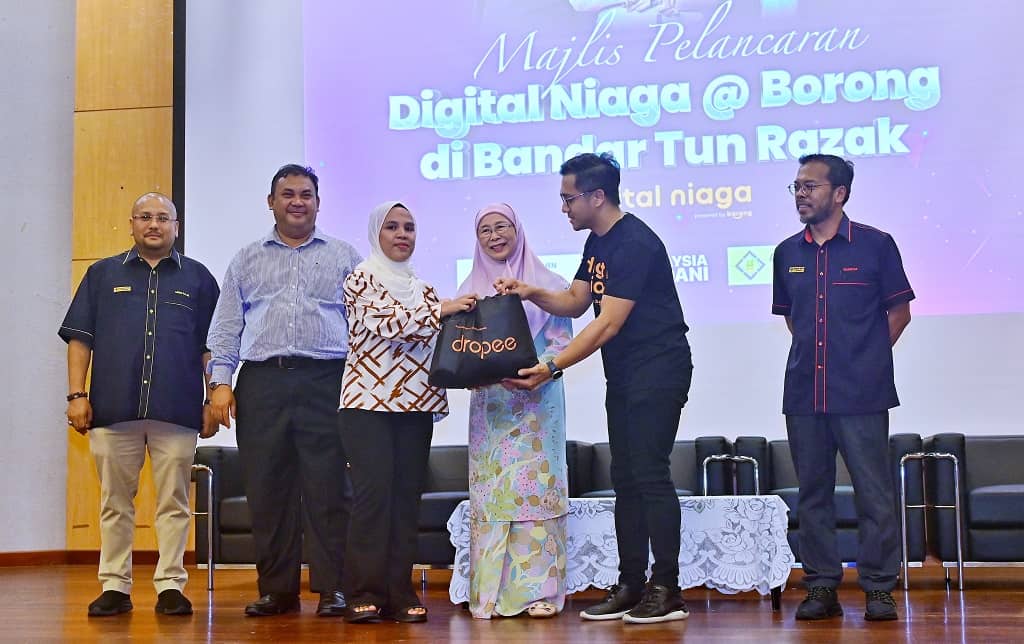
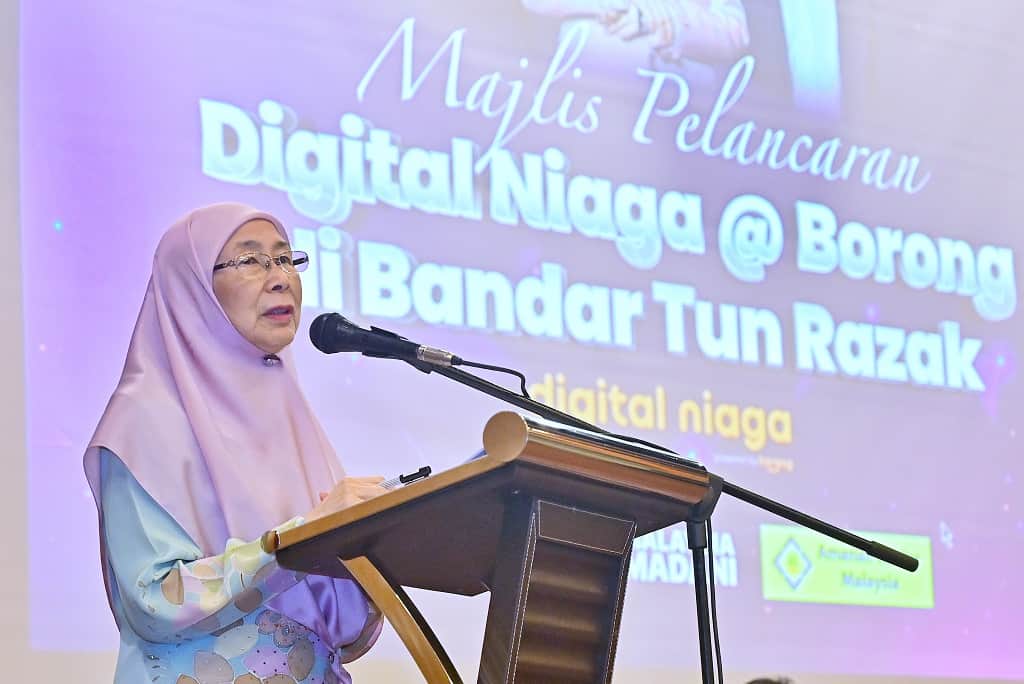
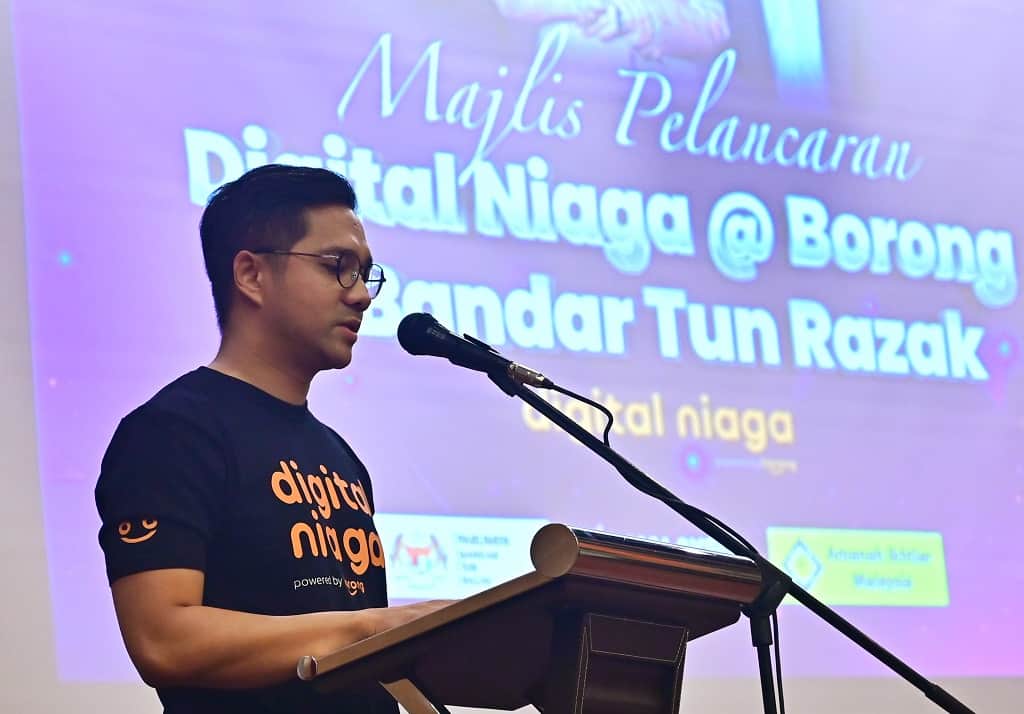
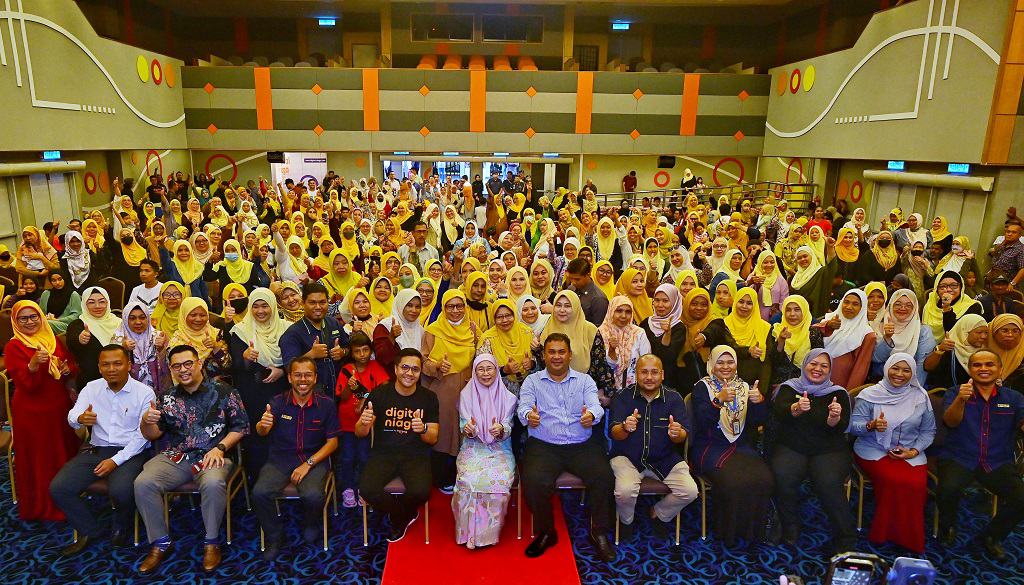
MP for Bandar Tun Razak, Datuk Seri Dr. Wan Azizah Wan Ismail, officiated the launch of the Digital Niaga Program with over 300 Micro Small Medium Enterprise (MSME) entrepreneurs and business owners in an official ceremony held at the International Youth Center in Bandar Tun Razak.
The Digital Niaga Program is built in collaboration with relevant government agencies and banking institutions in order to help local entrepreneurs have easy application to financing facilities and other training programs.
Digital Niaga supported by the Dropee platform is designed to empower local businesses to kickstart their growth. Dropee is Malaysia’s leading B2B e-commerce platform, which aims to simplify the supply chain process for businesses, enabling them to further grow their revenue, especially MSMEs.
Digital Niaga aims to address the challenges faced by small local businesses in obtaining credit from traditional banks to expand their operations, invest in innovation, and thrive in today’s competitive market. With the support of Dropee’s advanced technology and extensive network, Digital Niaga will provide a streamlined process that connects businesses with financial institutions, enabling them to access the funding they need to succeed.
“This program has been especially designed to assist MSME entrepreneurs to manage their business in a more efficient and systematic way”, said Datuk Seri Dr. Wan Azizah Wan Ismail during her opening speech. “This program will provide market access, credit financing and improved invoicing through digitisation. This will help entrepreneurs to keep up with the growing needs of a rapidly changing digital landscape.”
“Our mission is to empower local businesses and make them a key player in driving the economy’s growth. We believe that access to credit should not be a barrier to success. Dropee, soon to be rebranded as Borong, has developed an easy roadmap that will transform the credit landscape for businesses”, says Aizat Rahim, Managing Director of Dropee.
Dropee offer three key components to support businesses in their journey:
Dropee Direct: A dashboard that easily allows businesses to sell online, track orders and manage inventory in real time.
Dropee Marketplace: A curated marketplace where businesses can explore a range of products for their businesses. This marketplace will enhance supplier relationships, enabling businesses to make informed decisions based on their unique needs.
Dropee Credit: Applicable businesses are able to buy now and pay later with credit terms. This allows businesses to access a range of products without straining their existing budget.
Digital Niaga is set to innovate the way that local businesses have access to financing, paving the way for local businesses to be the heart of their communities.
Exclusive updates and information about the partnering financial institutions will be available to those who pre-register their interest at www.digital-niaga.com.
About Dropee
Dropee is a B2B e-commerce solution provider that helps brands, wholesalers, distributors, and retailers grow their wholesale business confidently by making it easy for their customers to order the right products from them, in-person and online. Founded in 2017, Dropee is headquartered in Malaysia and has an office in Singapore offering a wide range of e-commerce solutions for businesses. Visithttps://www.dropee.com/ to bring your wholesale business online.
In this day and age, we have come to depend greatly on air conditioner to cool down the environment, especially our offices and homes. Especially in this hot weather, it seems like we have to turn it on more often than not – the entire time we are working and while we are in the comfort of our homes.
This will ultimately cause our electricity bill to be on the high side, and it is also not good for the environment as well. Smart Investor interviewed Brice Degeyter, General Manager of Bizsu, to find out more about their mission to help company’s save energy and costs.
Brice Degeyter, General Manager of Bizsu
Smart Investor: What is Bizsu and what are you set out to do?
Brice Degeyter: I founded Bizsu in 2019 to help make decarbonization easy for businesses. We do this by helping companies cut down very simply what consumes 60% of a company’s energy and operating costs on electricity: Air Conditioning (AC).
The truth is AC units have become an essential part of modern life, but this simple refrigeration technology has remained relatively unchanged since its creation in the 1920s. As climate change effects like rising temperatures and heat waves encourage more AC use, the increase in energy needed to cool us down could easily accelerate climate change.
So therefore, any effort on cutting down air cond bills, can also help save the planet!
SI: How does your product work to reduce air conditioning bills?
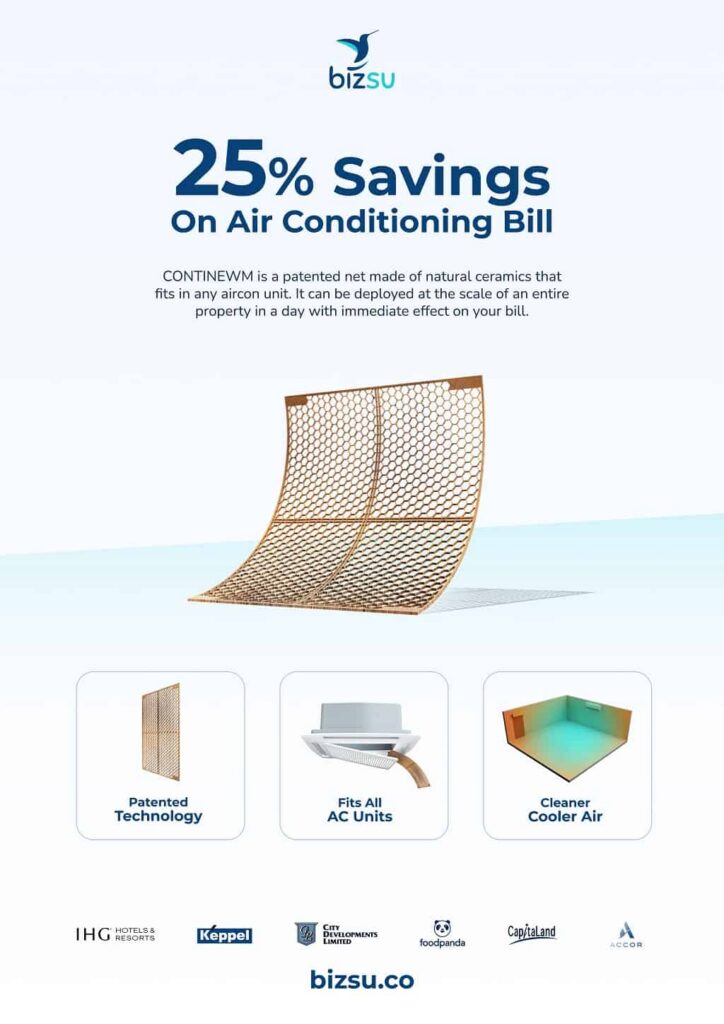
BD: Our product helps users save on average around 25% in energy consumption using a patented natural ceramic air conditioning filter technology.
It’s really based on physics and how air conditioning works. In the traditional air conditioner that we have at home, the air is sucked in at the top, goes through the aircon unit, and then comes back down to cool a room. The air that is sucked contains moisture. We then insert our Bizsu net inside the unit.
This breaks down the air water molecules going out of the aircon. This way, the surface area of the room is covered faster, so the AC stops faster. So you end up using less energy, and that means lower electricity bills.
We have done lab tests and recorded, on average, 25%, consistently. Variables include the type of air conditioning unit, the type of room, and how the thermostat is set up, as well as the function of the room. Data centres for example, may require higher cooling compared to an office or university lecture hall, and the savings, therefore, may be quite different – with savings of anything from 8% to 50%.
We’ve seen similar results from on-site installations at client sites as well.
SI: What is your customer base currently?
BD: We currently work with around 35 large companies. We have been securing between two to four new clients every month – and of late, it’s been more like two new clients every week.
Today, more companies come to us instead of us reaching out to them which was the case two years ago. Most of our business today has been through referrals – or word of mouth – as our clients see the savings in their energy consumption bills almost immediately.
SI: How has your revenue growth been since starting out?
BD: We’ve been growing by roughly 10X every year since the beginning, so 1,000% over the past 3 years. We are targeting to end 2023 at around RM7 million in revenue.
SI: Can this innovative product be installed only in new HVACs? Is there an optimum size for 25% energy efficiency to be realised?
Our solution can work on any type and any size of air conditioner. Variables include the type of air conditioning unit, the type of room, and how the thermostat is set up as well as the design and function of the room.
SI: Are there particular industries / building types that would easily benefit from this? Can they run a pilot?
BD: Absolutely! We now work with many large real estate companies. We joined the Capital Land Sustainability Challenge two years ago and from this we did a pilot of our solution in some of their buildings which gave them 51% savings in their electricity costs. They called us “magicians” and we have been implementing our nets in more buildings.
We hope to work with more real estate developers and real estate owners as well – particularly to run a proof of concept in Malaysia in the next few months. A pilot might start at around RM10,000 which is relatively cheap just to start with, and depending on the size of the floor or room that the company has, they can easily recognise savings in the millions.
We have the capacity to equip around 10 big buildings every month – from data centres, offices, hotels, warehouses, learning institutions and more. So the installation work is quite efficient as well without disruption to the business operations. We can complete a 30-floor office building in one day.
That said, gaining customer trust is very, very crucial. At the beginning there were just very few people who thought that something this simple could save 25% on energy bills and with a 20 year warranty sounded too good to be true. But our customers have proven that it is!
SI: How easy is it to install and maintain this new technology? What’s the warranty period?
BD: No modifications are required for the AC unit or for electricity to be switched off during installation. Bizsu’s CONTINEWM® Nets can be installed above the filter at the air return of the AC unit and it is ready for use.
We recommend dusting off the nets with a dry cloth whenever your AC servicing takes place. Best of all, CONTINEWM® has a 20-year warranty.
SI: How are you expanding into Malaysia and how is the Malaysian Research Accelerator for Technology and Innovation (MRANTI) assisting you in this regard?
BD: MRANTI has helped us raise product awareness and introduce us to prospective clients and bigger companies in Malaysia. Having a government agency supporting us through this programme helps open doors.
Right now we are present in Malaysia, we are present in Singapore and we are focused as well in Taiwan.
Main funding sources and funding rounds
In terms of funding, we mainly talk to angel investors or family offices who can really help us grow in a country or in various countries. We raised a pre-seed of RM1 million, now we’re raising seed of RM1.8 million by Q3 this year.
We are already profitable as of today, and the goal is to stay there. The goal is just to keep increasing the number of clients that we can serve and remain profitable.
SI: What are some key growth opportunities and challenges ahead?
BD: We have an objective to help our clients save 1,000,000 tonnes of CO2 within the next five years. We have just started acquiring customers and the potential is huge as we can serve many sectors – real estate, hospitals, schools, hotels, data centres, residential complexes, malls and more!
The transportation sector is an area we are potentially exploring. How cool would it be if we can have it in the metro trains, buses, cars, including in electric vehicles! I believe there will be more climate-friendly solutions in our hands that help us have a much bigger impact than what we can do today.
SI: Tell us about the Hummingbird in your logo?
BD: One day, there was a fire in the forest. And all of them but the hummingbird leave the forest. Instead, he goes and picks up a drop of water in the lake and drops it into the fire. All the animals look and ask: “What are you doing? You really think you’re going to stop the fire just on your own?” The Hummingbird says, “No, but at least I do my part.”
Bizsu’s goal is to do our part in decarbonising the economy and reducing the impact of climate change. What we will do in five years will be towards this, trying to do more. I believe there will be more solutions that help us have a much bigger impact than what we can do today.
What will that be, exactly? The future can only tell.
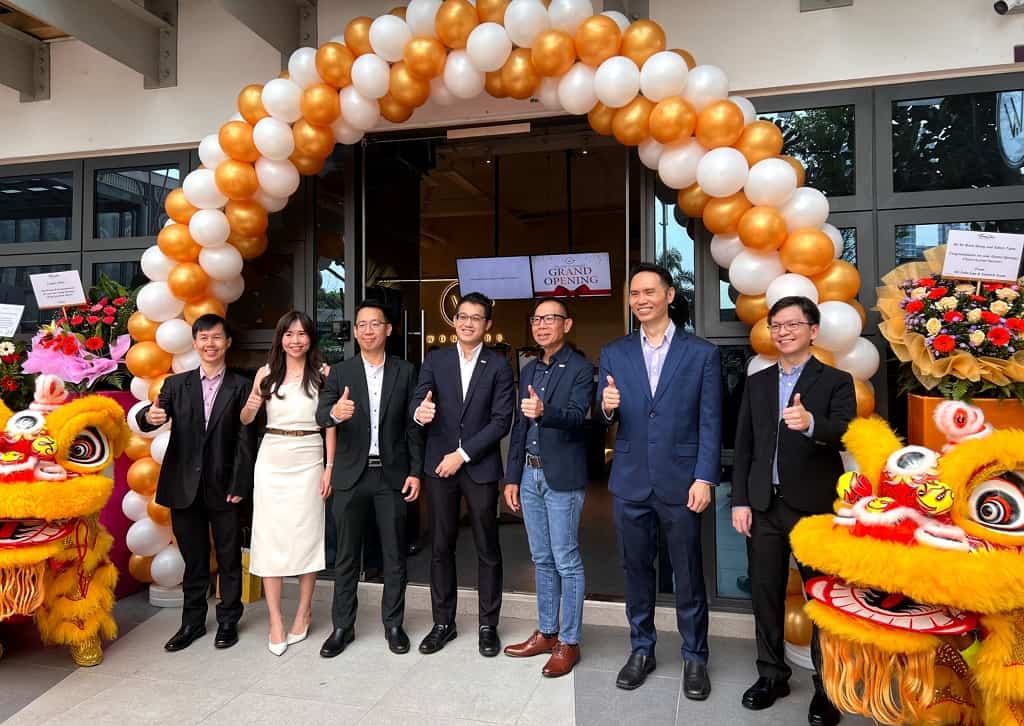
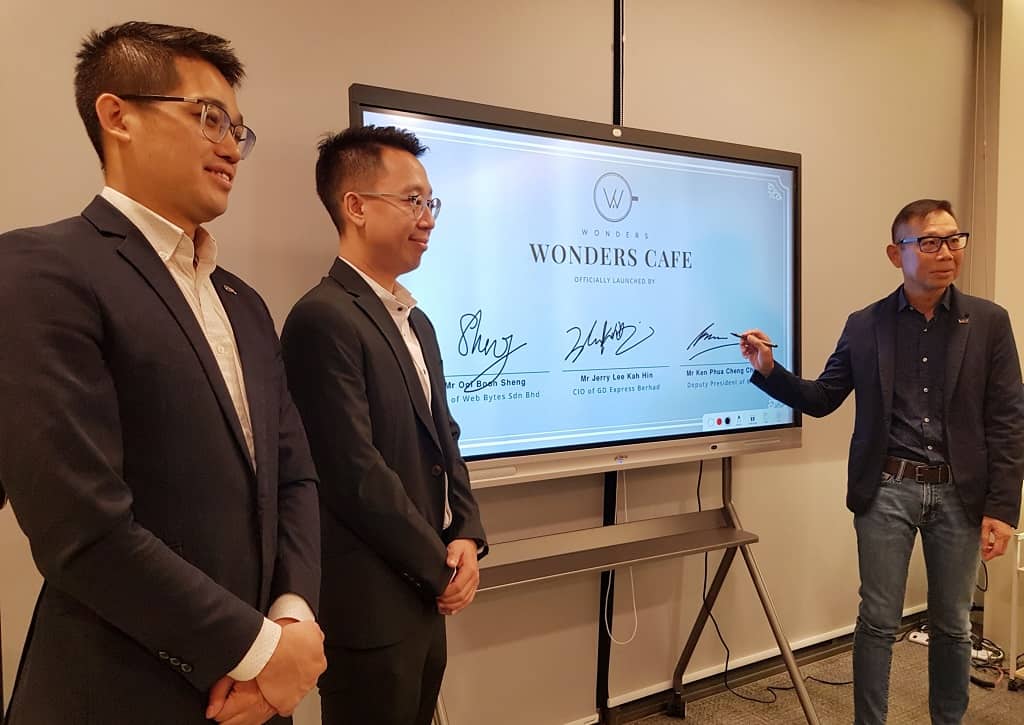
Cloud-based retail management software company, Web Bytes Sdn Bhd, today announced that it has launched the Xilnex Retail Tech Experience Center in Malaysia within its own café named ‘Wonders’. The Center showcases a comprehensive suite of Xilnex retail solutions for brick-and-mortar shops, while offering a fully functional café experience to visitors.
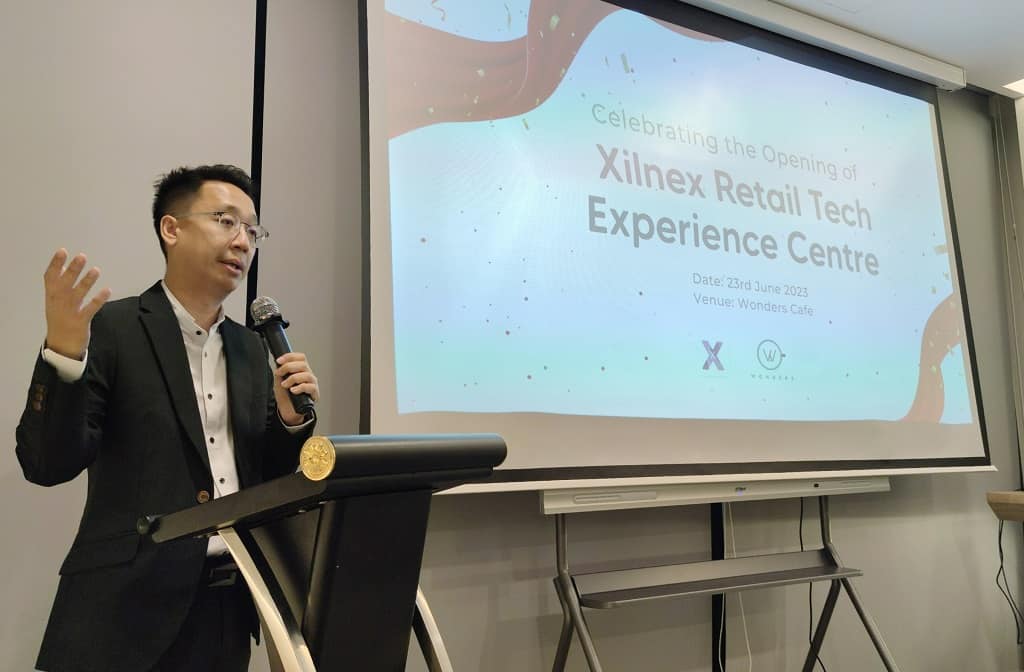
Ooi Boon Sheng, CEO of Web Bytes Sdn Bhd said, “By having a tech experience center installed within a real-life café and retail shop, retailers can witness the power of Xilnex’s retail solutions in action and this can provide them with the firsthand experience of leveraging the right technology towards transforming their retail business, also supporting the growing trend of hybrid stores that combine shopping and dining. In addition, we will use the Center to pilot and validate new customer experience (CX) models as well as use it as a testbed for our new retail technologies, to develop practical real-world applications and use cases”.
Ooi Boon Sheng, CEO of Web Bytes Sdn Bhd explaining how the Retail Tech Experience Center is the first of its kind in Malaysia
Located at PJ Midtown, the Retail Tech Experience Centre is designed to offer retailers an immersive experience where they can interact with Xilnex’s latest technologies in a real retail environment, beyond just simulations or mock demos. Deployed within Wonders Café are a range of Xilnex’s flagship solutions specifically for food and beverage (F&B) retailers such as the Xilnex Self-service Ordering Kiosk, Xilnex iPad POS, Xilnex Restaurant Queue Management System, Xilnex Kitchen Display System and the Xilnex Live Rack, which is an automated food pickup smart rack with built on sensors, to ensure a seamless prepare and serve experience from kitchen to customer.
Also showcased are retail tech innovations such as the Xilnex Self-checkout Kiosk and the Xilnex Live Display, a retail shelf with a built-in RFID reader that offers an interactive and informative experience, enabling shoppers to access detailed information about products on a hi-fidelity screen simply by scanning the RFID tags.
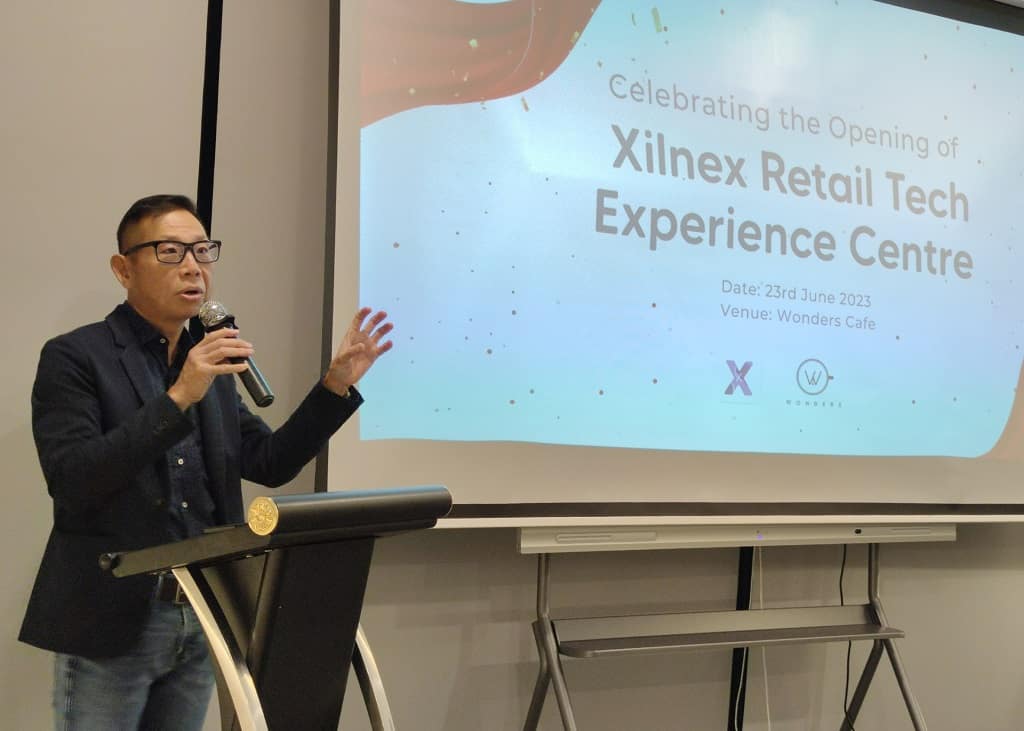
Ken Phua, Deputy President of Malaysia Retailer Chain Association sharing insights on the retail market in Malaysia
Malaysia Retail Chain Association Deputy President, Ken Phua commended Web Bytes for their innovative approach of having a tech experience center for retailers integrated with its own fully operational retail store and café, as this not only underscores Web Bytes’ commitment to understand the needs and challenges faced by retailers but also serves as a catalyst to empower retailers to embrace new technologies, enabling them to thrive in an ever-evolving and demanding retail landscape.
The Retail Tech Experience Center also houses a fully equipped conference room to facilitate training sessions, workshops, and seminars, to help Web Bytes’ retailer customers and partners enhance their understanding of Xilnex’s solutions and leverage the latest technologies of predictive analytics, artificial intelligence, innovative payment channels and more.
Ooi added, “Growing together with our customers is at the heart of our philosophy. We see ourselves as more than just a software and service provider; we strive to be a trusted advisor and strategic ally. We will continue to invest in enhancing our solutions and services, aligning them with the ever-evolving demands of the industry”.
Web Bytes’ retailer customers include food and beverage brands like ZUS Coffee, Gigi Coffee, Tacobell. Bubble Bee as well as retailers like The Body Shop, Eco-Shop and Sunway MultiCare Pharmacy. Xilnex’s POS solutions are also used in all international airports in Malaysia.
Officiating the launch of Xilnex Retail Tech Experience Center (from L-R): with Lee Kah Hin Jerry, Chief Investment Officer of GD Express Bhd; Ken Phua, Deputy President of MRCA and Ooi Boon Sheng, CEO of Web Bytes Sdn Bhd
About Xilnex and Web Bytes Sdn Bhd
Web Bytes Sdn Bhd, a software development company that is 38% owned by GD Express Carrier Bhd (GDeX), specializes in software solutions for retail and food and beverage industries. The company’s core product is Xilnex, a cloud-based, point-of-sales (POS) retail management solution. Since 2015, Xilnex has expanded its presence beyond Malaysia to Singapore, Indonesia, Cambodia, Vietnam, Canada and Australia.www.xilnex.com
About Wonders Café and Xilnex Retail Tech Experience Center
Wonders Café was first conceptualized more than ten years ago as an imaginary café to serve as a testbed for Xilnex POS solutions. Throughout the years, the imaginary retail shop has served as a valuable tool to enable hundreds of software engineers at Web Bytes to develop and test Xilnex software solutions. Today, Wonders Café has materialized to become a real brick-and-mortar café and retail store while functioning as a Retail Tech Experience Center, to showcase Xilnex latest technologies in a real retail environment. With a tagline of ‘Crafting Wonders’, the café and Retail Tech Experience Center will continue to serve as a sandbox for Xilnex new retail technologies including artificial intelligence, predictive analysis, advanced payment solutions and more. www.wonders.my
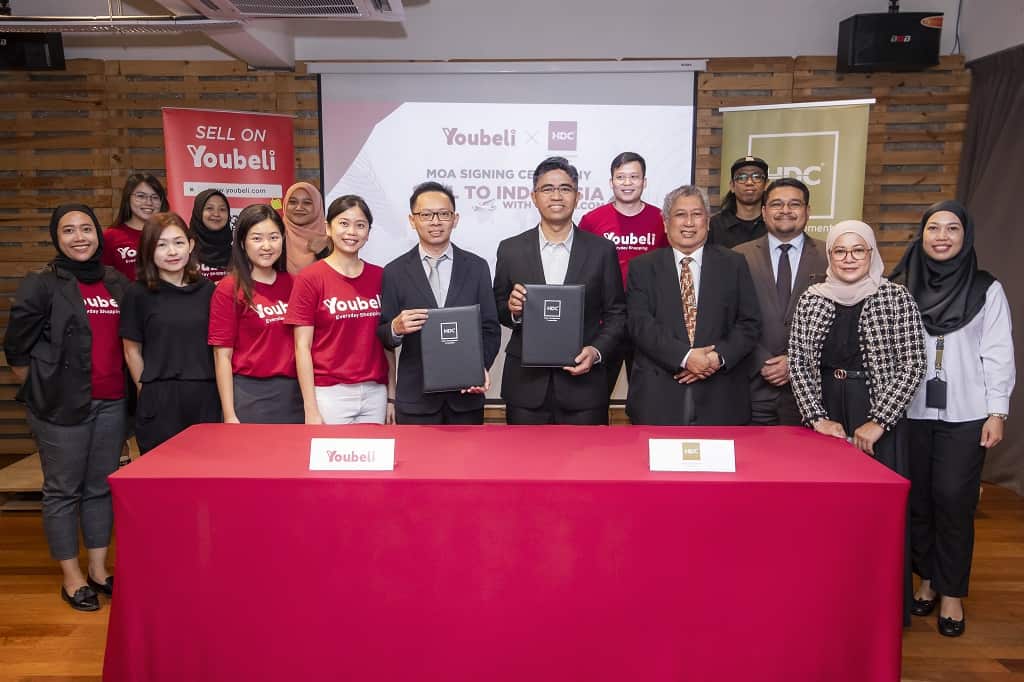
Youbuy Online Sdn Bhd (Youbeli) inked a Memorandum of Agreement (MoA) recently with the Halal Development Corporation Berhad (HDC) to promote the Sell to Indonesia via Blibli Package.
The collaboration between both parties presents a new opportunity for them to engage in joint cooperation and collaboration. They will contribute their respective knowledge, expertise, resources, and technical capabilities to promote and support the ‘Sell to Indonesia Cross Border package. The MOA also outlines their commitment to executing and undertaking this collaboration in accordance with this Agreement to promote the initiatives of HDC’s Halal Integrated Platform (HIP), Youbeli.com, and Youbeli Malaysia Official Store on Blibli.com.
The HIP will be the one-stop online platform to connect industry players in the Halal market. This platform aims to enhance business transactions within the ecosystem, fostering a thriving business environment and enhancing the Halal ecosystem better. It includes services such as Halal Parks, the Halal Training Institute, Halal Consultancy and Advisory, and the Halal Knowledge Centre.
Joint Endeavor for Market Expansion: Youbeli and HDC Establish MOA, Unlocking Potential in Indonesia
Through this partnership, Youbeli and HDC will facilitate suppliers to be onboarded as Youbeli Merchants and register as HIP members. Both parties will also provide an opportunity for Halal Industry players to have a brand presence in the Indonesian market through Cross Border eCommerce and with future expansion plans into B2C trade with the aid of sales and marketing channels.
Under the terms of the MOA, HDC among others, will develop a targeted marketing campaign for the program to HIP’s more than 10,000 members and other Halal Industry players including leveraging HDC ground activation with Halalpreneurs. To assist the efforts, HDC will identify and recommend any relevant HIP services offered by strategic partners and opportunities from both private and government sectors to support the initiatives.
Youbeli will provide technical, logistics, marketing, trade, and settlement support for all products and services provided by Youbeli and Blibli.com to more than 5,000 merchants with the aim to help local sellers in expanding their business to the Indonesian market. This cross-border package will enable merchants to gain transactions without a physical presence in Indonesia, with the help of marketing capabilities by Youbeli and Blibli.com. By availing of this package, merchants can list their products on Indonesia’s top general marketplace, Blibli.com, and seamlessly manage their operations through Youbeli Seller Center. Additionally, the package offered also includes a complimentary warehouse storage service up to 6 months and international logistics to Indonesia.
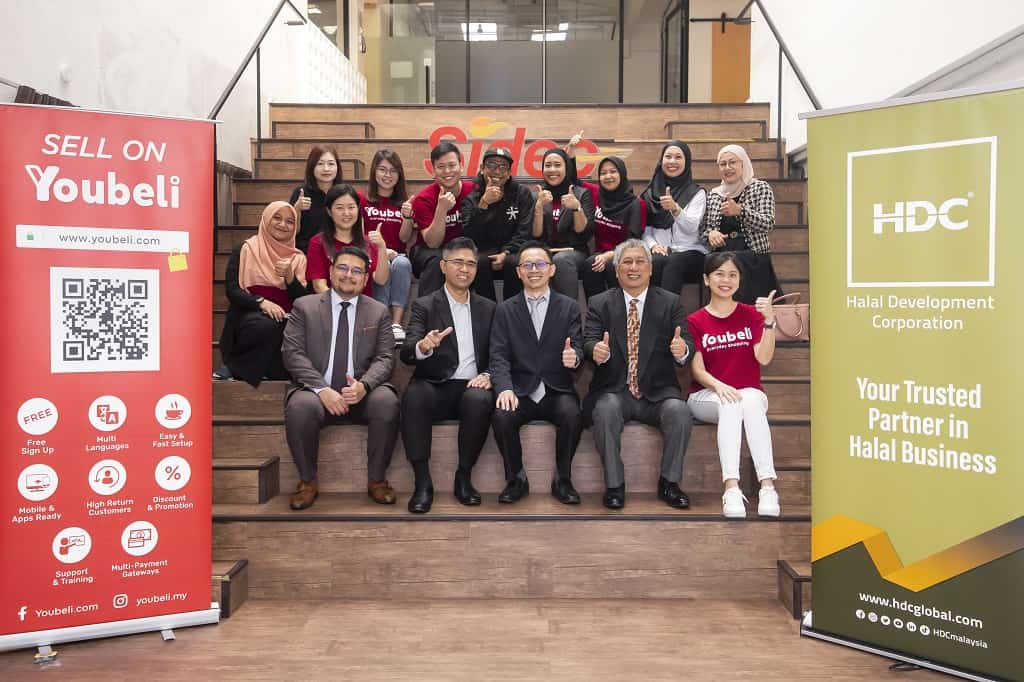
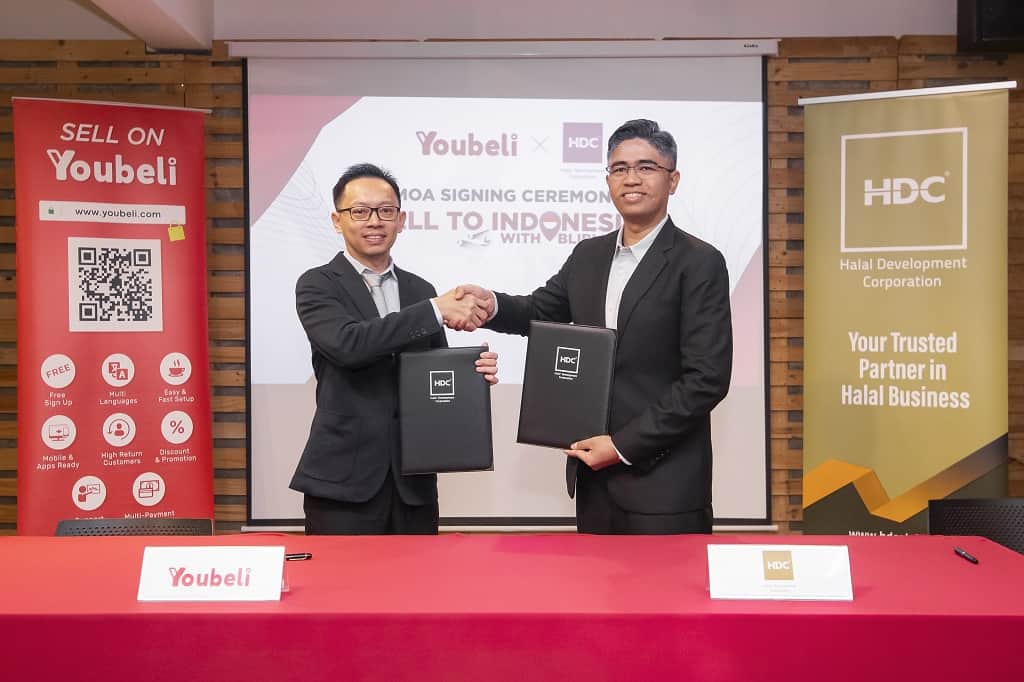
The MOA signing ceremony took place at SIDEC and was signed by Hairol Ariffein Sahari, Chief Executive Officer of HDC, and Youbeli Chief Executive Officer, Chua Khai Suan.
Unlocking Opportunities: Chua Khai Suan CEO of Youbeli and Hairol Ariffein Sahari CEO of HDC Foster Growth through MOA
QUOTE FOR HDC
“The collaboration aims to pave the way for its halal integrated platform (HIP) and micro, small and medium enterprises (MSME) to perform cross border e-commerce export such as Indonesia,” said HDC CEO, Hairol Ariffein Sahari.
“We hope through today’s MOA, there will be further increase in the amount of Malaysian halal products exported to Indonesia since it is one of the main export destinations of our local halal products,” he added.
QUOTE FOR YOUBELI
“This collaboration will create opportunities for Malaysian businesses to thrive in the ever-evolving digital landscape, leveraging the ‘Sell to Indonesia’ package, a strategic partnership between Youbeli.com and Blibli.com,” said Chua Khai Suan, Youbeli CEO.
“This collaboration represents a significant milestone for Youbeli as we continue to champion the growth and success of Malaysia e-commerce business,” he added.
About Halal Development Corporation Berhad (HDC)
HDC is a government agency that spearheads the development of Malaysia’s integrated and comprehensive halal ecosystem with a vision to make halal the first choice in business ventures.
About Youbuy Online Sdn Bhd
Youbuy Online Sdn Bhd (Youbeli) is a premier multi-category online marketplace in Malaysia, that aims to help local sellers to expand their business to the Indonesian market with hassle-free solutions.
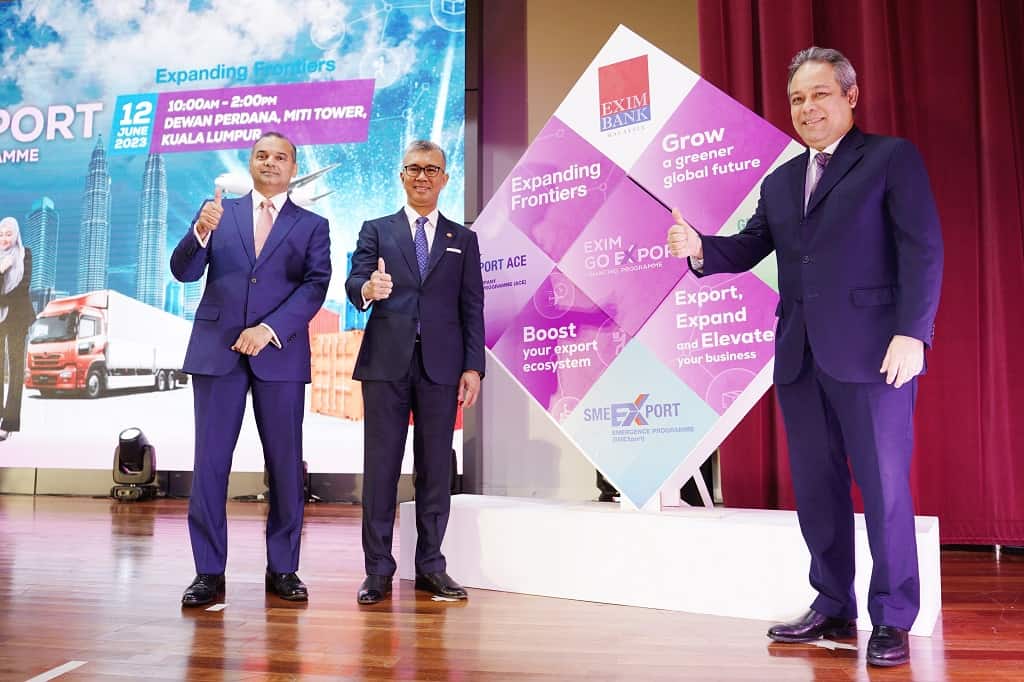
Export-Import Bank of Malaysia Berhad (“EXIM Bank”) today unveiled its EXIM Go-Export Financing programme (GEFP 2023) that provides financing to small and medium enterprises (SMEs) and corporate clients, enabling them to invest and grow in the areas of export development, green technology and supply chain ecosystem. GEFP comprises three (3) programmes known as EXIM Go-SMExport, Go-Export ACE, and Go-Export GreenTech.
Seen as a catalyst for businesses, these financing programmes will enable SMEs and corporate clients to grow their business, obtain funds for cashflow requirements, or expand in strategic green-tech and/or other tech sectors.
During the launch, the Minister of Investment, Trade and Industry (MITI) Malaysia, Tengku Datuk Seri Utama Zafrul Aziz said: “The fast-changing global landscape requires SMEs to be agile and responsive to key themes such as ESG and IR4.0. As SMEs form the backbone of our economy, they deserve all possible support to make them future-ready. EXIM’s financing for export development, green technology and supply chain ecosystem are welcome solutions to SMEs’ most common challenges. When our SMEs are better-equipped to take on challenges related to funding, tech adoption and ESG, they will not only secure their growth path, but also become more resilient for global supply and value chains.
EXIM Bank’s President and Chief Executive Officer, Arshad Ismail said: “Our aim is to support SMEs and corporate clients build a successful export business. The EXIM Go Export programme is a tailor-made banking solution that prioritises the needs of our customers and ensures our offerings align with their specific exporting business requirements. In supporting business communities develop the skills and confidence they need to succeed; we are helping them grow – and that fulfils our mandate.”
EXIM Go-SMExport is created to support and strengthen SMEs’ production capacity and capabilities to enter the global market, while Go-Export Anchor Company Ecosystem (ACE) is a supply chain solution to facilitate anchor companies in building and maintaining a resilient ecosystem and improve business continuity of their suppliers and vendors. Vendors get quick access to funds and anchor companies enjoy greater flexibility in credit terms. EXIM Go-SMExport and Go-Export ACE is open to all sectors, particularly electrical and electronics, digital economy, pharmaceutical, aerospace and chemicals, in line with Malaysia’s National Investment Aspirations and New Investment Policy.
EXIM Go-Export Green Technology (GreenTech), on the other hand, is a comprehensive, sustainability-driven financing programme designed to help exporters grow by investing in strategic sectors such as automation, digital tech, green tech and biotech.
EXIM Bank also offers a takaful protection scheme to help Bumiputra exporters expand their markets and protect them from the risk of unpaid credit. Through collaboration with TERAJU, the contribution for this takaful policy will be subsidised for eligible Bumiputra companies. This is yet another initiative by EXIM to encourage the global expansion of Bumiputra companies.
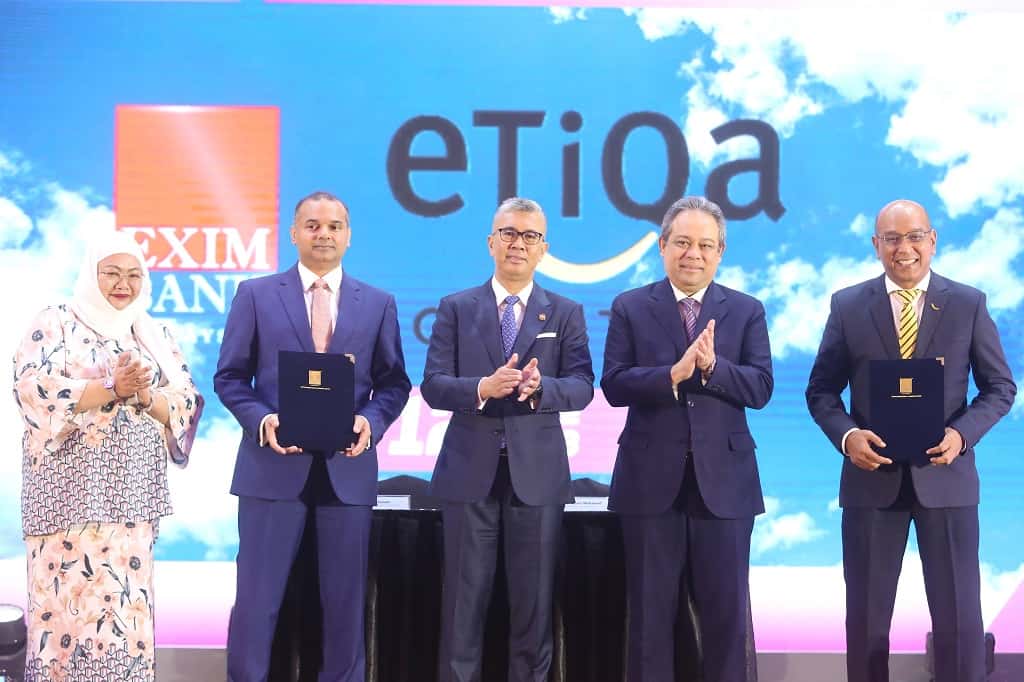
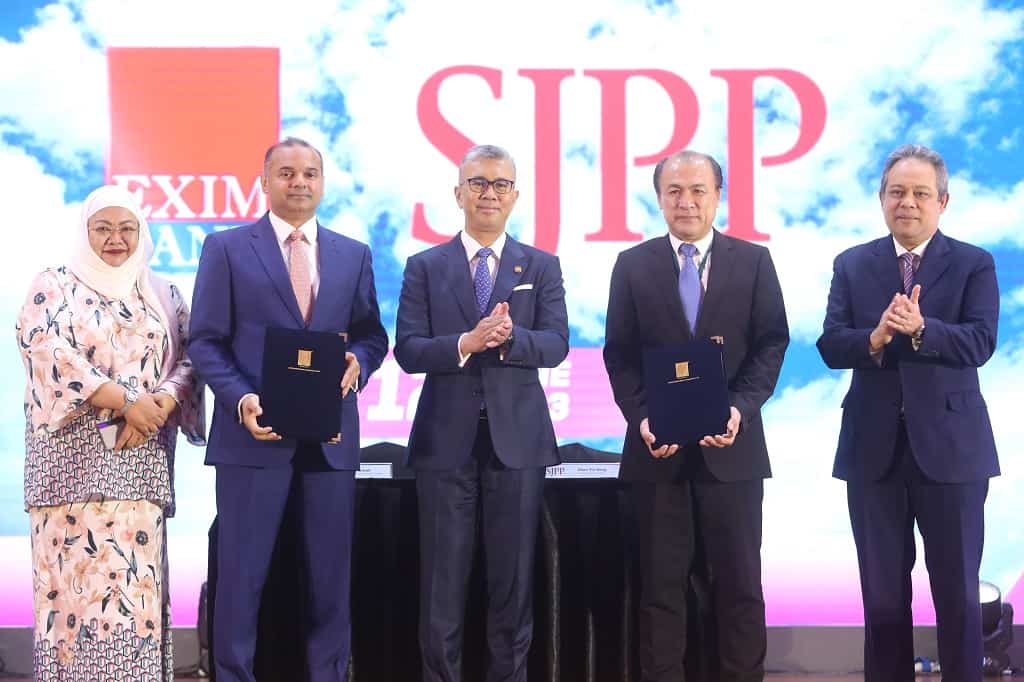
At the programme launch, EXIM Bank also formalised its collaboration with Etiqa General Takaful Berhad and Syarikat Jaminan Pembiayaan Perniagaan Berhad (SJPP) through the signing of two Memorandums of Understanding (MoU).
The first MoU with Etiqa General Takaful Berhad is to strengthen the cross-selling of general takaful products and financing facilities to promote domestic and export-oriented production.
The MoU with SJPP, on the other hand, is to strengthen their existing collaboration in implementing financing facilities, guarantee schemes on domestic and export-oriented propositions, including programmes related to financing, guarantees or advisory.
EXIM Bank was represented by its President and Chief Executive Officer, Arshad Ismail, witnessed by Tengku Datuk Seri Utama Zafrul Aziz and EXIM Bank’s Chairman Dato’ Azman Mahmud. Etiqa General Takaful Berhad was represented by its Chief Executive Officer, Shahrul Azuan Mohamed, who was witnessed by its Head of Enterprise Corporate, Asmah Daud; while for SJPP, the signatory was its Principal Officer, Chen Yin Heng, with its Senior General Manager, Azlan Mohd Agel, as witness.
Amongst the other entities present at the event were MIDA, MATRADE, SIRIM, MARii, HDC, TERAJU, Malaysian Exporter Academy and Dewan MyGerak Eksport Malaysia.
About EXIM Bank of Malaysia Berhad
The Export-Import Bank of Malaysia Berhad (EXIM Bank) was incorporated on 29 August 1995 and is wholly-owned by the Government of Malaysia. The Bank has assisted a diverse range of Malaysian business in various sectors in their global ventures. EXIM Bank takes pride in meeting its mandated role of stimulating and enhancing the competitiveness of Malaysian industries for exports and investments globally via the provisioning of internationally and domestically competitive banking and insurance products and advisory services. The Bank also offers Shariah-compliant financing and Takaful instruments. For more information, visit www.exim.com.my.
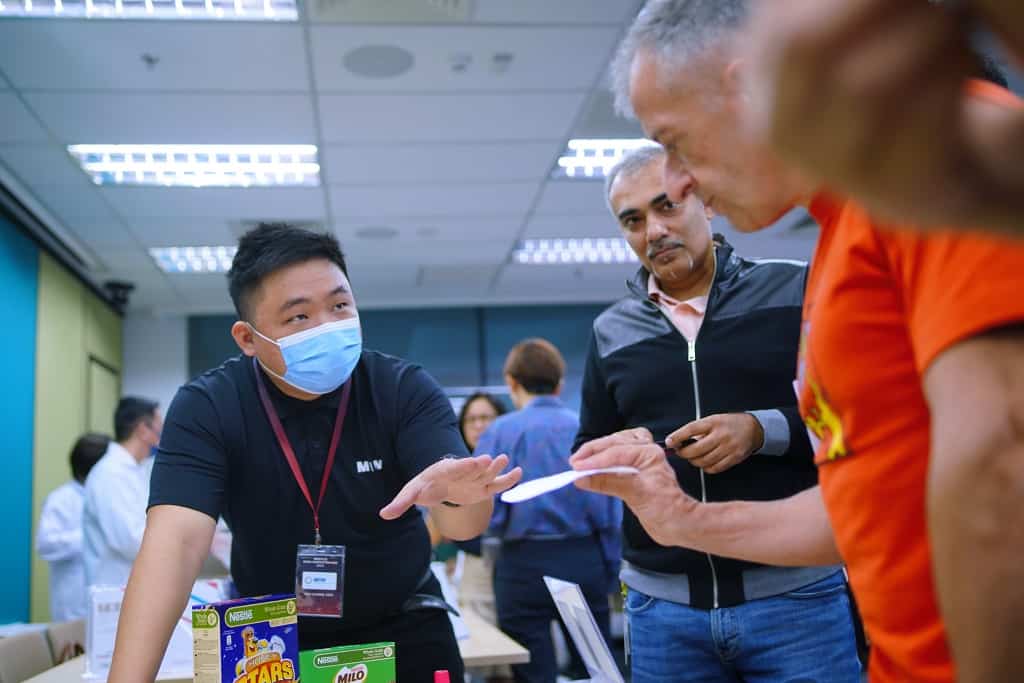
In Malaysia, 2.97-kilo tonne of paper waste is sent to landfills daily. This could fill Petronas Twin Towers, the Malaysian landmark skyscrapers, in 45 days! This has resulted in more greenhouse gas emissions (GHG), pollution and scarcity of land to accommodate an ever-increasing demand for space for landfill construction.
There’s a new force in town that is founded by a group of enthusiastic packaging material experts, that aims to tackle global warming and environmental pollution by reintroducing residual paper liner from the label packaging industry back into the value chain as recovered cellulose pulp.
This will prevent the valuable paper liner residues from ending up in landfills and focuses on recovering the cellulose pulp as raw material, which meets the need of local paper manufacturers. Materials In Works (MIW) has gained acknowledgement from the United Nations in achieving the Sustainable Development Goals, such as SDG 9 (Industry, Innovation and Infrastructure), SDG 12 (Responsible Production and Consumption), and SDG 13 (Climate Action).
Smart Investor got in touch with John Ooi, Technical Director & Co-Founder of Materials In Works (M) Sdn Bhd to learn more about them and their mission.
John Ooi, Technical Director & Co-Founder of Materials In Works (MIW)
Smart Investor: Could you provide an overview of Material In Works (MIW) and its mission in the ESG industry?
John Ooi: MIW executes several upcycling projects in the ASEAN region. With their innovative solution for paper liner wastes which aims to tackle major challenges of our time associated with landfills and greenhouse gases, the Malaysia-based start-up has gained acknowledgement from the United Nations in achieving the Sustainable Development Goals, such as SDG 9 (Industry, Innovation and Infrastructure), SDG 12 (Responsible Production and Consumption), and SDG 13 (Climate Action).
On top of that, MIW has followed the call from Ecothon, which is searching for entrepreneurs or startups that adopt SDG 12 aspects in their sustainable business model, reducing environmental impact and substitution of essential product ingredients hindering recycling into account. As a result, the start-up with a tech-based solution for paper liner wastes has been crowned as the Champion in Ecothon Malaysia 2021.
SI: What specific environmental, social, and governance challenges does your startup address?
JO: MIW addresses one of the 3 main pillars of ESG, Environmental.
MIW have an IP-backed treatment process that recovers cellulose back into raw material for paper manufacturers, it helps in diverting the valuable waste from ending up in landfill sites. This is mutually beneficial for the environment and the paper industry, as price and availability of raw material are key concerns for players.
By recovering 60% of paper liner wastes in Malaysia, MIW can save 54,600 Trees from being cut down, which is equivalent to offsetting 10,920t of CO2 emissions per year. As such, with the proprietary upcycling solution, MIW can reduce CO2 emissions by 79%, in comparison to conventional landfill disposal methods.
SI: How does your business model integrate sustainability and social responsibility?
JO: MIW adopts a sustainable business model whereby MIW’s core principle of Sustainable Consumption and Production (SCP) is to tackle climate change for the betterment of the 3Ps (People, Planet and Profit). The adoption involves decoupling economic growth from environmental degradations, increasing resource efficiency, and promoting sustainable lifestyles; do more and better with less – “Less is More”. In summary, with the involvement of SCP startups like MIW in the value chain, we catalyze business transformation, in which new products with lower environmental footprints are created for bigger profit, and the benefit would go to the consumers, as they can enjoy making sustainable choices during their purchase for an environmentally friendly product.
SI: Can you elaborate on the positive impact your startup aims to create in the ESG space?
JO: Here you go:
SI: What sets your startup apart from other players in the ESG industry?
JO: The label packaging industry is a mass market producing substantial paper liner waste. In Europe, it attracts many local recyclers / upcyclers to tackle the waste and generate profit from it. Among the recyclers / upcyclers the identical ones are: Reculiner, Cycle4green, Les Recyclades and they are only focused on Europe region. To date, there are no competitors present in the ASEAN region, and the wastes are handled mostly by conventional landfill disposers.
In ASEAN region, MIW position ourselves distinctively with proprietary upcycling technology and processes that produce high quality recovered cellulose pulp as a raw material for paper products manufacturers. The initiative is effectively diverting the valuable paper liner waste from ending up in landfills.
SI: How do you measure and track the ESG performance of your startup?
JO: At the start, the ESG data will be self-measured by MIW. This includes benchmarking with relevant industries, referring to ISO standards, etc. At a later stage, MIW will track and measure ESG performance with confidence via utilizing an independent 3rd party firm by effectively transforming ESG commitments and data into transparent reports for the stakeholders.
SI: What milestones have you achieved so far in terms of sustainability and social impact?
JO: In the year 2021, MIW won as the champion in Ecothon Malaysia SDG 12 Program organized by the Ministry of Entrepreneur Development and Cooperative, Korea Ministry of SME and Startup, ASEM SMEs Eco-Innovation Center (ASEIC), Hanns Seidel Foundation, Centre for Entrepreneur Development and Research (CEDAR).
Few more remarkable achievements made in year 2022:
Top 10 in Youth Co: Lab Malaysia Cohort Program, co-created by the United Nations Development Programme (UNDP) and the Citi Foundation
Top 5 in Environmental NGO Accelerator Programme, organized by Biji-biji Initiative and supported by Yayasan Hasanah
Top 5 in MYStartup Pre-accelerator Programme Cohort 1, a national project initiated by the Ministry of Science, Technology and Innovation (MOSTI) and developed by Cradle Fund
Best Regional Impact Startup in International ISC3 Innovation Challenge for an innovative solution to solving an issue that is particularly relevant to ASEAN region
SI: How much funds are you seeking to raise through this fundraising exercise in collaboration with Beyond4 Fund 1?
JO: RM2 million. The governance structure implemented by BEYOND4 ensures the funds are spent responsibly to give the most value to the investor. BEYOND4 Fund1 aims to invest in the top startups that have traversed this path and proven themselves. This ensures a deal pipeline of the best and brightest startups that have withstood the trials and tribulations over the previous 18 months from accelerator to seed funding to VC investment, thus increasing the probability of a better return on investments.
SI: What are your plans for utilising the funds raised through fundraising for business expansion?
JO: We are planning to raise RM 2,000,000 whereby 30% will be used for setting up our pilot plant at Johor Bahru, Johor while 18% on OPEX and factory rental, 7% for team hiring and employee welfare, 10% each on IP filling, License and Permit also for marketing expenditures. While the remaining 25% will be used as administration, which includes shared services and platform fees.
SI: How do you ensure transparency and accountability in your operations?
JO: MIW is aiming to secure the ISO standards for transparency and accountability purposes (ISO 9001, ISO 14001, etc.).
SI: Can you provide examples of partnerships or collaborations that have helped drive your startup’s growth?
JO: MIW is working with renown public research institutions and universities professionals in several projects that will bring greater value to the company’s growth
Universiti Sains Malaysia (USM)
– Piloting Upcycling Solution to Tackle on Label Packaging Waste, potentially to capture yearly volume of 3,600 tons of paper liner waste available in Malaysia which translates to MYR 5.0 Million worth of revenue
Universiti Teknologi Malaysia (UTM)
– Recovering Clean PET from Thermal Transfer Ribbon Packaging Waste which had received full payment of MYR 67 K from a Japanese MNC client to start a pre-pilot project (potential to grow into MYR 0.5 Million worth of revenue in a year)
– Recovering Calcium Carbonate (Calcite) from Paper Sludge Waste, a promotion on cradle-to-cradle service for paper products manufacturer
SI: How do you engage with stakeholders, including local communities and investors, in your ESG initiatives?
JO: Through MIW initiative, we ensure that all stakeholders in the ecosystem receive quality waste management service and solution products, most importantly helping them to achieve sustainability goals. The key activities are:
Collect waste
Pick up and handle the waste
Upcycling process
Create new materials as raw material
The benefits are:
Label packaging stakeholders who are contributing substantial paper liner wastes to Malaysia’s landfill sites which resulted in more GHG emissions, pollution and scarcity of land to accommodate an ever-increasing demand for space for landfill construction.
Local communities who is living near to the landfill site
The betterment of the environment for our future generation
SI: What challenges do you anticipate in scaling your business while maintaining a strong ESG focus?
JO: The ESG is the core of our business, we do not find any challenges executing the focus once we trained our people well. We strongly believe implementing ESG principles can provide impactful growth, better retention, loyalty, and performance to our company.
SI: How do you see the future of the ESG industry and the role your startup will play in it?
JO: By participating in ESG principles, we believe it gave our organization credibility and a competitive advantage. Consumers are shaping the future of what brands have to offer, and they want a product with a positive impact. The journey to reduce waste that is going to landfills is one that requires cooperation from all parties, even manufacturing industries. Lately, more companies are inclined to incorporate the circular economy model into their business. MIW is one of the companies that can help. Through our upcycling process, MIW is helping in the reduction of waste that is headed to the landfills as well as being able to become a supplier of green raw materials. This raw material will then be used to create A4 copier paper, tissue paper, food packaging, and more.
SI: Can you share any success stories or case studies that demonstrate the effectiveness of your ESG solutions?
JO: Label packaging stakeholders (manufacturers and brand owners) demand for a solution that can repurpose their waste and state they want the organization to be 95% landfill free by 2025. MIW plays an important role in the value chain by demonstrating the capability to upcycle the paper liner wastes into valuable resources such as raw material – Recovered Cellulose Pulp which then can be used to make premium products such as tissue papers, A4 copier paper, cereal box and more.
SI: How do you approach risk management and address potential negative impacts associated with your operations?
JO: MIW has been able to differentiate itself by having our high-quality products processed by IP-backed upcycling technology. We are earning by charging waste collection fees to the label packaging stakeholders at RM 308/ton and via selling recovered cellulose pulp as a raw material at RM 1672/ton. The high-value lignin-free recovered cellulose pulp is expected to fit for making premium products such as speciality papers, tissues and food packaging. The company initiative is supported by universities and research institutions to examine and benchmark the recovered cellulose pulp against virgin pulp with scientifically proven data. The aspiration is to grow with our partners to bring forward green upcycling programs to their clients based on our industrial know-how in the region. Our proven model ensures that all stakeholders in the ecosystem receive quality waste management services and solution products, most importantly helping them to achieve sustainability goals. The key activities are:
Collect waste
Pick up and handle the waste
Upcycling process
Create new materials as raw material
With funds raised from ECF, 30% will be invested into setting up paper liner waste upcycling plant, MIW is scaling the proprietary technology developed in the lab into pre-industrial scale which will attract the early adopters on board by Q3 2023.
The goal for the ECF round is to prove the technology is scalable and reproducible to upcycle paper liner waste into recovered cellulose pulp. Then, it can be sold as a raw material to make into paper products. The pilot plant is meant to upcycle 125 to 280 tons paper liner waste in a month and achieve financially self-sustaining afterwards.
SI: What strategies do you have in place to attract and retain talent that aligns with your ESG values?
JO: The key members on board have a long term, close relationship with the founder of the company, Mr. Ooi. There will be a financial and non-financial incentive. Financial (monetary) incentives are payments or rewards that are given in exchange for achieving certain goals or targets inclusive of Incentive Stock Option. Non-financial incentives are non-monetary rewards, such as awards, privileges, or recognition.
SI: How do you incorporate diversity, equity, and inclusion into your startup’s practices and decision-making?
JO: MIW will uphold the principles of diversity, equity, and inclusion during our hiring processes. After the ECF round, the company will expand the team by hiring a label packaging industry sales veteran for daily account handling and stakeholder engagement. On the USM side, the company has Dr Leh, who is not only working as a technical advisor but also knows the key personnel (some of them are Dr. students) in the paper industry and the machine supplier herself.
SI: What are your long-term sustainability goals and how do you plan to achieve them?
JO: The company is upcycling the hard-to-recycle item, paper liner waste which currently 100% landfill into recovered cellulose pulp. In return, it brought positive impact towards the environment.
(Output based):
Amount of recovered cellulose recovered and upcycled for commercial use in the last 12 months (e.g. 600 tons)
Number of trees saved from being cutting down (One ton of paper liner is made by 13 trees)
Amount of t of CO2-emission offset produced (One tree is absorbing average 200kg of carbon over its lifetime)
The company’s long-term goals are to remain financially sustainable in the beachhead market, followed by an expansion plan to the rest of ASEAN market which is broader than Malaysia, such as Indonesia and Thailand. The label packaging industry sales veteran will engage actively with the brand owners (such as Nestle and DHL) and label packaging stakeholders who already have footprint in the mentioned countries in ASEAN.
SI: How do you plan to leverage emerging technologies or innovation to further enhance your ESG offerings?
JO: The startup is working on fundraising to scale up its technology to a pilot scale, with a focus on label packaging stakeholders. They are also looking for collaboration opportunities with other paper product manufacturers such as tissues, food packaging, and speciality papers. MIW also works on further improving the paper liner treatment itself, e.g., by reclaiming the silicone used for the anti-adhesive coating on the paper liners. MIW operates mainly in the ASEAN region, with Malaysia as the beachhead market. MIW initiative is supported by industry experts, machinery suppliers and renowned Malaysian public universities. With their innovative solution for residual paper liner reducing the landfill and Green House Gases problems, MIW contributes to SDG 9 (Industry, Innovation and Infrastructure), SDG 12 (Responsible Production and Consumption), and SDG 13 (Climate Action).
SI: Lastly, what message would you like to convey to potential investors who are considering supporting your startup’s expansion?
JO: ‘Make A Positive Impact While Backing A Sustainable Mission’
MIW solution ♻️ repurposes paper liner waste into Recovered Cellulose Pulp, creating a valuable resource for paper product manufacturers while diverting waste from landfills.
Investing in MIW means supporting a sustainable business that benefits not only the label packaging stakeholders but also the local communities and the environment for future generations.
RAM Ratings has maintained a stable outlook on the Malaysian insurance and takaful sector, which we expect to stay resilient in the face of a changing landscape, market volatilities and the normalisation of claims towards pre-pandemic levels. Notwithstanding headwinds, the sector is still well-capitalised to absorb potential shocks.
Against this landscape, RAM’s key expectations for the sector this year are:
▪ New business (NB) expansion of 8% for the life and family sector (2022: +3% y-o-y; 2021: +18%). ▪ Earnings recovery in the life and family takaful sector as downside risks recede. ▪ Growth in the non-life sector will be flat at best as car sales are anticipated to decline from last year’s all-time high. ▪ Non-life sector’s claims and combined ratios will normalise to pre-pandemic levels. ▪ Capitalisation will remain sound despite still-elevated market risks (capital adequacy ratio as at end-December 2022: 226%; end-December 2021: 224%)
The slower NB growth of the life and family takaful sector is attributable to a pullback in demand for investment-linked products given challenging investment conditions last year and, to some extent, the expiry of the loan repayment moratorium as the resumption of loan instalments reduced the consumption capacity of individuals. We expect NB generation to pick up pace with growth of 8% this year as expansion of the ordinary life/family segment remains strong (2022: +19%), underpinned by an increased awareness of the need for life and health protection as well as the mortgage insurance/takaful business.
Higher claims and payouts of policy benefits, having climbed 13.5% y-o-y (2021: -0.5%; 2020: +0.8%), dented the sector’s underwriting income last year. This was in line with our earlier expectations that medical claims will rise in tandem with a normalisation in the volume of medical procedures to pre-pandemic levels and medical cost inflation. Coupled with outsized investment-related losses, driven primarily by the spike in Malaysian Government Securities yields amid an environment of steep interest rate hikes, the sector’s bottom line sank to a multi-year low of RM8.6 bil (2021: RM12.9 bil; 2020: RM22.3 bil).
“Some earnings recovery is expected this year even though financial markets could still be volatile in view of global uncertainties. Fluctuations should, however, moderate from levels seen last year,” said Sophia Lee, RAM’s Co-head of Financial Institution Ratings.
The claims ratio of the non-life sector also normalised upwards (2022: 57%; 2021: 51%), largely due to increased motor claims. The weaker claims performance and a heavier cost load culminated in a loftier combined ratio of 92% (2021: 87%). “We expect the combined ratio to stay on the higher end of the 85%-95% historical range moving forward, as the claims ratio nudges closer to pre-Covid levels and margins are compressed further amid rife competition,” Lee adds. The non-life sector charted stellar growth of 12% in 2022 (2021: +3.8%; 2020: -0.1%) on account of all-time high car sales – which would unlikely repeat this year – and improved economic conditions. The sector’s growth will be flat at best in 2023.
On a separate note, Malaysian Financial Reporting Standard (MFRS) 17 Insurance Contracts, which outlines new requirements on recognition and measurement of insurance revenue and liabilities, came into effect on 1 January 2023. The complex accounting standard has entailed a major overhaul of processes and systems and will remain burdensome, with players having to maintain two books – one based on the new standard and another on the previous standard for regulatory capital purposes. “However, the profitability of insurance contracts does not change with the new standard although the manner in which revenue and profits are recognised would differ,” said RAM rating specialist Loh Kit Yoong.
The revival of mergers and acquisitions (M&A) activity after a lull may also see shifts in market dynamics, particularly in the non-life industry where there has been some degree of market consolidation after the respective AmGeneral-Liberty and Generali corporate exercises. Following the completion of FWD Group’s acquisition of a 70% stake in Gilbraltar BSN Life and news of potential M&As (Berjaya-MCIS and Tokio Marine’s plan to dispose of Southeast Asian operations) in the last few months, there could be further activity on this front.
The evolving operating landscape with ongoing structural reforms, complex MFRS 17 implementation, and increased M&As mean that players will have to up their game to stay competitive, even while navigating these challenges. The push for digital and more innovative solutions through Bank Negara Malaysia’s (BNM) financial technology sandbox – together with better financial literacy, and efforts to simplify protection products and improve affordability and accessibility – would culminate in higher insurance/takaful penetration in the long run (measured by premiums to GDP; BNM’s Financial Sector Blueprint target of 4.8%-5.0% against RAM’s 2022 estimate of 4.6%).
About RAM Rating Services Berhad (RAM Ratings)
Established in 1990, RAM Ratings is a leading credit rating agency registered under the Securities Commission’s Guidelines on Credit Rating Agencies. In addition to the provision of credit ratings for corporate bonds and sukuk and their issuers, RAM Ratings also provides research and publications on Islamic finance, fixed income and macro-economic and industry analysis as well as data analytics relating to credit risk, counterparty assessments and other related domains.
YesHello (DIGITAL AUTOMATE SDN BHD) is a SaaS platform that gives small businesses total customer visibility—from first contact, to sales, to support. Making customer engagements more precise, contextual, and purposeful. They are powering the communication engine at Volvo Malaysia, Jaguar, Land Rover, BYD, TeaLive, SIRIM Bhd, Beam Mobility Scooter, Sustainable Energy Development Authority (SEDA), Asia e-University and many more.
Smart Investor spoke to Carliff Rizal Carleel, Founder & CEO of YesHello to learn more about them.
Carliff Rizal Carleel, Founder & CEO of YesHello
Smart Investor: Can you provide an overview of YesHello.chat and its mission in the industry?
Carliff Rizal Carleel: We help modern Small Businesses that are overwhelmed communicating with customers online, install a systematic way to offer Predictably Great Customer Engagement. We help them create Visibility and Precision for Remote Teams by implementing a clear strategy that makes it simple for team members to respond to customers faster.
Technology can be frustrating and we remove that (As Regular group chats are slowing down small businesses). By working with us, teams GET SUPPORT & TOOLS to manage their internal and external communication in a TRANSPARENT & ORGANISED way.
SI: What specific problem does YesHello.chat aim to solve or address?
CRC: Three main problems. 1. Multiple Conversations, Multiple People, on Multiple Channels. 2. Teams Lacking Full Context when replying to customers. 3. Working alone. As more and more teams are going remote, team members feel more isolated and alone than ever before.
SI: How does your platform differentiate itself from other customer engagement solutions?
CRC: Most other platforms focus on either just email, or just social media, or just WhatsApp. We understand that modern customer engagement needs to address all channels. Most other platforms focus on the communication between the business and the customer.
But we understand that it’s the internal communication between team members in a transparent and collaborative way that will transform a team from ordinary to extraordinary.
SI: Can you share some success stories or case studies of companies that have benefited from using YesHello.chat?
CRC: We helped Peche Empire (a cosmetics company) double their revenues from 200k to 400k in 6 weeks. We helped Carnival Internet (Broadband provider from Bangladesh) increase the number of clients they can support from 400,000 users to 800,000 users without increasing the number of support team members.
We helped Volvo Bukit Bintang increase sales by 30% ever since they started including YesHello for their sales process.
SI: How does YesHello.chat utilise technology to enhance customer interactions and experiences?
CRC: YesHello is a cloud software platform for small business that captures all customer interactions across WhatsApp, and all social media (email, Facebook Messenger, Instagram DMs, WeChat, Telegram, Viber, Line, SMS, Twitter, website live chat, and phone)—contextualises all customer interactions to help teams close more sales.
Integrating all channels into one seamless dashboard is no small feat. We are able to create a single customer story containing every message, email, web chat and internal discussion creating a platform for messaging across the entire customer life cycle.
SI: What are the key features or functionalities that make YesHello.chat stand out in the market?
CRC: 1. Utilising Promotional Messaging, we are able to target specific interests with Broadcasts, enroll new contacts in drip campaigns and trigger event-based promotions via API.
2. Conversational Sales is the future. Upgrade from personal messengers to business accounts, increase sales visibility, auto-qualify leads & sync with your CRM.
3. Conversational Support. Use automated messaging to identify customer issues, then route to team members according to skill, function, language, shift & more.
4. Automate Transactional Notifications. Trigger abandoned cart messages, payment confirmations, order updates and more from platforms like Shopify and other marketplaces..
SI: How much funds are you seeking to raise through this fundraising exercise in collaboration with Beyond4 Fund 1?
CRC: We are seeking to raise RM1 million
SI: How do you plan to use the funds raised through fundraising for business expansion?
CRC: We will be utilising the funds mainly for our marketing push to get our brand known in the market and to acquire customers. Our goal is to get from our current Annual Recurring Revenue of RM350,000 to RM2,000,000 by first quarter 2024.
And to do this we only need to increase our customer base from 75 small businesses to 300 businesses. The funds raised will also allow us to hire key support staff and growth specialists to support our growth.
SI: What are your target markets and customer segments for YesHello.chat?
CRC: YesHello best serves SMEs that prioritise customer relationships (Edu, Wellness, Auto, Professional Services). For SMEs that need to focus on their business and not focus on handling tech. For SMEs that want a proven system in place and not have to experiment with something that might or might not work.
For SMEs that requires an affordable solution so they don’t need to pay for software they might not even use. With YesHello, SMEs can grow, and we grow with them.
SI: Can you provide insights into the growth and traction that YesHello.chat has achieved so far?
CRC: YesHello started during the lockdown in 2020. Ever since we started, our total revenues have reached over RM1 million.
SI: What strategies do you have in place to acquire and retain customers in a competitive landscape?
CRC: We use our own solution. And because we have the tools to take advantage of social channels, we mainly focus on digital ads that are directly connected to the YesHello platform for seamless transition from ads to engagement to conversion and customer success. Also because of this, our retention rate is at 98%. Most SMEs that come on board and use our solution are so positively impacted that they never consider to stop using us.
Our total belief in what we can do to help SMEs, coupled with our extreme focus on customer success is the reason why our clients love us. This is proven by their testimonials and the fact they would never go to another platform.
SI: How does YesHello.chat ensure data privacy and security for its users and their customers?
CRC: YesHello takes security and privacy seriously. That is why we have created the safest possible processes available to ensure that our service is stable and that there are no security gaps. The integrity of your data is ensured. YesHello meets industry standards to protect you and your data.
1. Cloud Security. YesHello is a cloud-based solution, Amazon Web Services (AWS). All stored and transferred data is encrypted. All data is safely stored and backed up on servers that follow the latest SSAE reporting standards. Systems are DDoS protected and hardened with firewalls.
2. SSL Encryption. YesHello’ data is encrypted both when it is sent to and from our servers, as well as when it is at rest. To protect your content in transit, YesHello uses 256-bit SSL/TLS encryption. At rest, YesHello content is protected using 256-bit AES encryption.
3. Network Security. YesHello regularly updates its network architecture and data flows between systems. Firewall rules and access restrictions are reviewed for suitability on a regular basis. We constantly provide system improvements to prevent vulnerabilities.
4. Backup & Recovery. Our infrastructure is designed to provide stability and to minimize service interruption due to hardware failure, natural disaster, or other catastrophes. To help ensure availability in the event of a disaster, we replicate data across multiple data centres. Our system automatically backups the database daily.
5. Access Control. Administrative sharing controls let you decide who in your organization has access to the platform. Add multiple users with different roles to allow access without having to share your private login details. Under no circumstances is sensitive data shared with anyone outside of YesHello and the client.
SI: Can you share any partnerships or integrations that have contributed to the success of YesHello.chat?
CRC: Yes, we have partnered with TM, Yellow Pages, Sunway iLabs, WOMENTUM.
SI: How do you envision the future of customer engagement and the role that YesHello.chat will play in it?
CRC: We believe that Selling By Chat is the Future. YesHello makes selling by chat easier for small businesses by capturing all customer chats across WhatsApp, and all social media into one place. Teams now have real-time visibility into all sales conversations to help each other close deals faster. We make Selling By Chat More Collaborative, Contextual, and Precise.
YesHello records and tracks customer-facing interactions across WhatsApp, all social media channels, website live chat, phone, and email to bring you transparent activity data. YesHello’s cloud platform ties conversations to outcomes logged in your CRM to capture what sets top performers apart. This total Visibility and Precision for SMEs is what will be the norm for all businesses doing business online.
SI: What challenges do you anticipate in scaling your business and expanding into new markets?
CRC: There are many big players in this space and I foresee other companies raising large sums and outspending other competitors as the main challenge in the future.
SI: How do you measure the effectiveness and impact of customer engagement using YesHello.chat?
CRC: We believe having full context, from lead source, full customer history, past purchases, all conversations, and previous issues—empowers teams to make decisions based on the full-story instead of guess-work. This is the key to building long term meaningful customer connections.
Drive change with confidence. Know from day one why your initiative is succeeding or failing, and course correct in real-time to meet revenue goals. Create a culture of coaching. Coaching only drives revenue if managers provide it consistently across their teams. Keep managers accountable to providing valuable feedback with whisper support.
Unparalleled pipeline visibility. Integrate your entire tech stack so data goes from siloed to streamlined, ensuring that all customer interactions are unified and up-to-date.
SI: What are the key metrics or KPIs that you track to assess the performance of your platform?
CRC: Speed to first reply is one big metric we most often measure. This is key as customers always prioritise speed.
SI: How does YesHello.chat incorporate customer feedback and suggestions into its product development?
CRC: Our team communicates with our customers on a regular basis via messaging channels, Zoom and phone calls. All their input and feedback is noted down and is considered when we are developing new features for our platform. All this is transparent on our product roadmap.
SI: What are your long-term goals and vision for the growth of YesHello.chat?
CRC: By 2027 YesHello will expand to the majority of SEA and Europe with a customer base of 30,000 SMEs using our platform generating over $200Mil in Annual Recurring Revenues.
SI: How do you approach customer support and ensure a seamless experience for your users?
CRC: We use our own solution. And because of this, our retention rate is at 98%. Most SMEs that come on board and use our solution are so positively impacted that they never consider to stop using us. Our total belief in what we can do to help SMEs, coupled with our extreme focus on customer success is the reason why our clients love us.
This is proven by their testimonials and the fact they would never go to another platform.
SI: Lastly, what message would you like to convey to potential investors who are considering supporting the expansion of YesHello.chat?
CRC: Nothing meaningful came from being timid. We all know Selling by Chat is the future! YesHello makes selling by chat (SBC) more Collaborative, Contextual, and Precise. YesHello is a sales engagement/enablement/management platform for small business teams (who mainly close + sales via chat). YesHello helps sales close more deals by shining the light on everyone’s conversations with customers. It records all conversations from first contact, to sales, to support, creating total visibility so leaders can drive sales effectiveness across the entire organisation.
Soon all SMEs will be utilising this. Now is the time to get onboard and support a local Malaysia startup, and you can say you were there when it all started! You can say that you saw it when no one else did. And that you were courageous enough to take the leap, when others were afraid.
The Securities Commission Malaysia (SC) is encouraging wider adoption of financial technology (fintech) in agriculture in order to help in achieving the country’s food security agenda.
SC Chairman Dato’ Seri Dr. Awang Adek Hussin said access to finance is critical to agriculture’s future.
This is especially important for smallholders and agritech-preneurs seeking to modernise agriculture and strengthen research and development, he said in his opening address at the SCxSC Grow Fintech Conference.
This marks the 10th iteration of the SCxSC conference that is held in-person after the Covid-19 pandemic.
SCxSC GROW, is a new collaborative programme, under the SC’s fintech flagship initiative “Synergistic Collaboration by the SC” (SCxSC). The SCxSC GROW embodies a collaborative effort with partners in the fintech ecosystem to harness the potential of alternative financing digital platforms to meet the needs of micro, small, and medium-sized enterprises (MSME) in strategic sectors.
Recognising the challenges faced MSMEs in the agriculture sector, Dato’ Seri Dr. Awang Adek said that leveraging fintech solutions will help improve access to financing and increase efficiency in the sector.
Dato’ Seri Dr. Awang Adek Hussin, SC Chairman
To achieve this goal, the SC has been working closely with ecosystem players to develop innovative solutions that cater to the unique financing needs of farmers and agribusinesses. This is in tandem with the national agenda to support the agriculture sector’s transition into a dynamic and progressive sector. Dato’ Seri Dr. Awang Adek said that the capital market can be an enabler and accelerator to help Malaysia achieve its food security agenda.
“Alternative financing avenues such as equity crowdfunding (ECF) and peer-to-peer (P2P) financing allow investors with the right risk appetite to mobilise capital directly for agri-preneurs,” he said.
This provides more options for younger and high-growth companies to access capital relevant to their business risk profiles,” he added.
Over 7,000 MSMEs have benefited from SC-registered ECF and P2P financing since their introduction in 2015, raising more than RM4.4 billion, with only 600 agri-related MSMEs across the entire value chain raising close to RM300 million. This presents a significant opportunity for agricultural growth and investment.
Dato’ Seri Dr. Awang Adek said, “Malaysia was also the first country in this region to adopt a co-investment model, MyCIF specifically for alternative finance platforms.”
MyCIF was instrumental in providing MSMEs with financing during the Covid-19 pandemic.
“MyCIF implemented a special allocation ratio of 1:2 for the agriculture sector in 2022, which is more appealing than the normal ratio of 1:4. We’ve seen increased interest as four times as many agri-businesses have raised funds through ECF and P2P platforms,” he added.
The SCxSC GROW Fintech Conference, themed “Fostering Innovative Finance in Agriculture”, aims to be a game-changer for the agriculture industry. With the world facing increasingly complex challenges, the conference brings together agriculture and fintech players to explore innovative solutions to food security, sustainability and supply chain resilience.
New cutting-edge solutions were showcased at the conference, highlighting the latest advancements in these fields. The conference also featured local fintech players in the agriculture sector.
These fintech solutions have the potential to revolutionise the way farmers access financing and manage their operations, enabling them to make better use of resources and increase yields.
About the Securities Commission Malaysia:
The Securities Commission Malaysia (SC), a statutory body reporting to the Minister of Finance, was established under the Securities Commission Act 1993. It is the sole regulatory agency for the regulation and development of capital markets. The SC has direct responsibility for supervising and monitoring the activities of market institutions, including the exchanges and clearing houses, and regulating all persons licensed under the Capital Markets and Services Act 2007. More information about the SC is available on its website at www.sc.com.my. Follow the SC on twitter at @SecComMy for more updates.
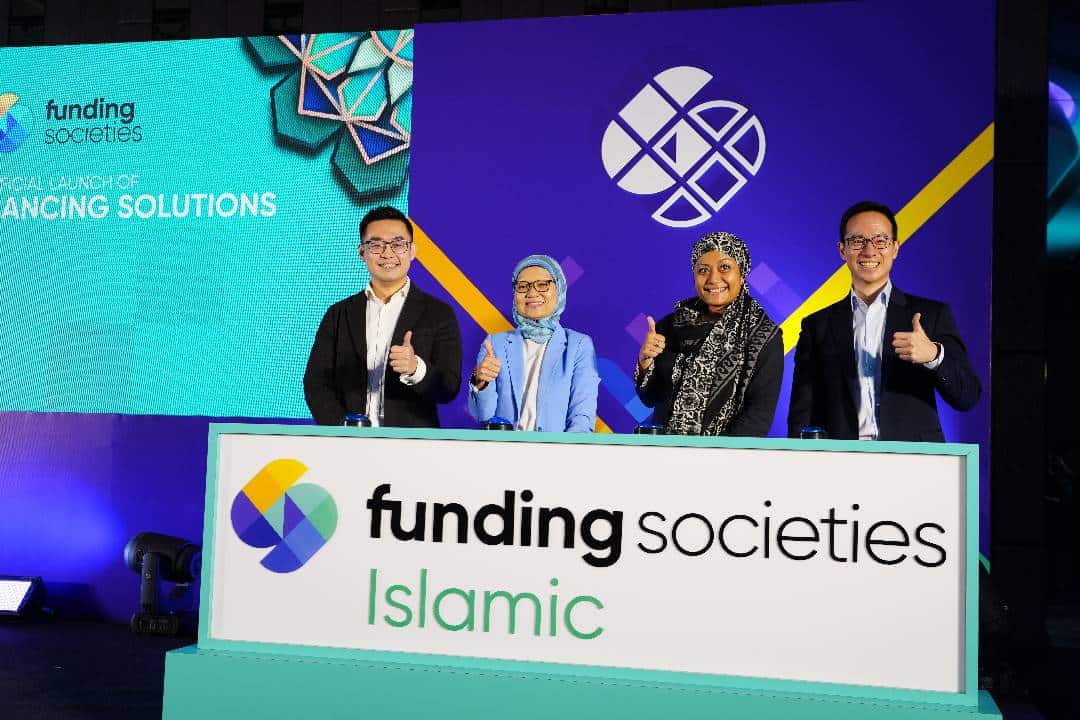
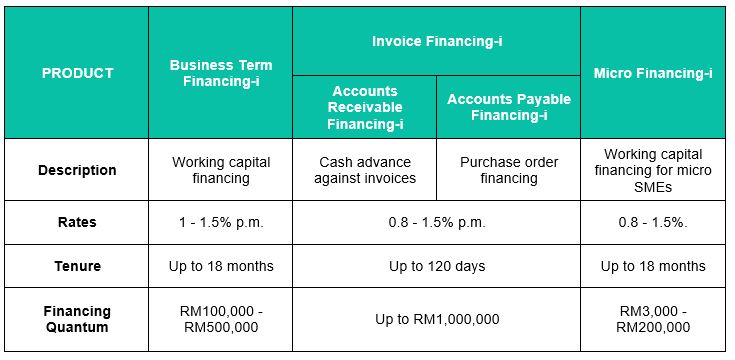
Funding Societies, the largest unified SME digital finance platform in Southeast Asia, has launched its comprehensive Islamic Financing product collection, a complete suite of Shariah-compliant financing solutions designed to meet the needs of creditworthy, underserved Malaysian micro, small and medium enterprises (MSMEs) seeking to grow their business. These Islamic financing solutions include Business Term Financing-i, Micro Financing-i, and Invoice Financing-i.
“Access to finance is mission critical for inclusive growth and MSME development. Case in point, there is a RM90 billion SME financing gap in Malaysia. To that end, SME digital finance platforms like Funding Societies play an important role in closing that gap. Given Malaysia’s leadership in Islamic finance, it is timely for us to scale our Shariah-compliant proposition to support creditworthy Malaysian SMEs of all sizes to thrive,” said Wong Kah Meng, Group Chief Operating Officer of Funding Societies | Modalku and Co-founder of Funding Societies Malaysia.
Chai Kien Poon, Country Head of Funding Societies Malaysia said, “Following market feedback, we observed demand for Islamic finance and Muslim entrepreneurs’ need for Shariah-compliant financing. Islamic finance is also appealing to non-Muslims given its emphasis on fairness and transparency in fees and charges. Besides that, the introduction of our Islamic Financing aligns with Malaysia’s aspirations to be the leader in Islamic finance as well as focus on the Islamic digital economy and FinTech.”
Interested SMEs can apply for these financing solutions online – seamlessly, anywhere and anytime. Through its simple and digital proposition, along with zero collateral requirements, Funding Societies can avail financing to MSMEs much quicker compared to traditional financial institutions.
“Besides launching our Islamic financing proposition, we have developed Shariah-compliant investment products for our investors. This allows investors to diversify their investments while joining us to support a critical segment of the Malaysian economy. We have seen very encouraging demand from investors (retail, high net worth individuals and institutions) and look forward to working with financial institutions to offer Shariah-compliant investments to their customers,” adds Chai.
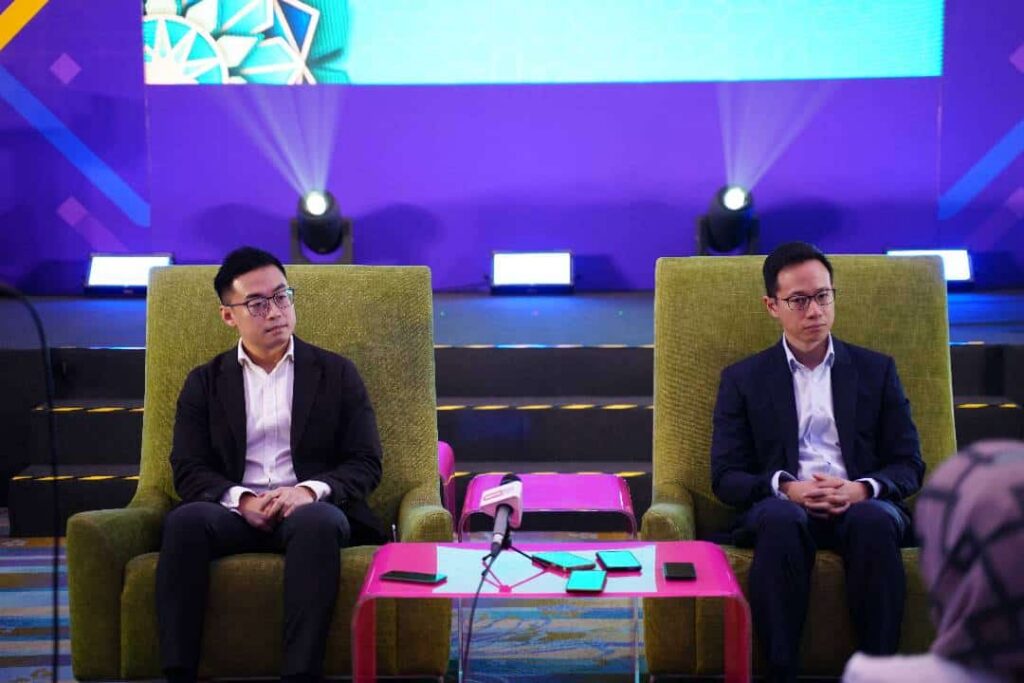
Khairil Anuar Mohd Noor, Principal, Masryef Advisory, who was present at the launch event in Kuala Lumpur, remarked, “We are delighted to be part of this initiative by Funding Societies that would further elevate the landscape of Islamic Finance in Malaysia. We believe Funding Societies’ cutting edge, a leading digital finance platform, offers ground-breaking Shariah-compliant financing solutions to Malaysian MSMEs that would enable MSMEs to have access to alternative funding to fund their business. Similarly, it allows investors an alternative Shariah-compliant asset class to invest their excess liquidity. This collaboration allows us to leverage Funding Societies’ technological prowess and our expertise in Shariah advisory. Together, we will drive inclusive growth and unlock the potential of Islamic finance for sustainable economic development in Malaysia.”
Funding Societies has been operating in Malaysia since 2016 and has provided financing to thousands of SMEs in the country. The FinTech platform has disbursed more than RM2 billion in financing in Malaysia since its inception. Across the region, more than RM13.74 billion has been disbursed through more than 5 million transactions as of 2022. After its soft launch in May 2022, the Shariah-compliant financing propositions have seen encouraging take-up from SMEs. The Fintech platform targets to have at least 50% of its disbursement from its Shariah-compliant financing portfolio by 2025.
Funding Societies | Modalku is the largest unified SME digital finance platform in Southeast Asia. It is registered with the Securities Commission Malaysia (SC), as well as licensed in Singapore, Indonesia, and Thailand, and operates in Vietnam. It is backed by SoftBank Vision Fund 2, SoftBank Ventures Asia, Sequoia Capital India, Alpha JWC Ventures, SMBC Bank, Samsung Ventures, BRI Ventures, Endeavor, SGInnovate, Qualgro, and Golden Gate Ventures amongst others. The FinTech company provides business financing to small and medium-sized enterprises (SMEs), which are funded by individual and institutional investors. In 6 years, it has helped finance over 5.1 million business deals close to RM13.74 billion in funding. It was given the Digitalizing Services for Retail Participations award by the Securities Commission Malaysia during the INVESTSMART® FEST 2019, the Monetary Authority of Singapore (MAS) FinTech Award in 2016, the Global SME Excellence Award at the United Nations’ ITU Telecom World in 2017, KPMG Fintech100 in 2018, Brands for Good in 2019, and ASEAN Startup of the Year by Global Startup Awards in 2020. In 2021, it was honourably mentioned as Responsible Digital Innovator of the Year by the World Bank IFC SME Finance Forum and won the MAS ASEAN Fintech award for the second time.