Azad Zangana, Senior European Economist & Strategist
While back-to-back cuts are unlikely, there is plenty of room for the European Central Bank to surprise cautious investors, according to Azad Zangana, Senior European Economist & Strategist at Schroders.
The European Central Bank (ECB) has announced that its three main policy interest rates will be lowered by 25 basis points – the first cut in rates in almost five years. The move was unanimously expected by economists and almost fully priced by financial markets following strong hints of imminent easing by members of the Governing Council.
Attention now turns to the future pace of easing which remains uncertain. An above-consensus rise in May’s Harmonised Index of Consumer Prices (HICP) inflation rate to 2.6% year-on-year had raised questions as to whether the ECB would cut at all. The unexpected print also clearly influenced the press conference communication following the decision.
ECB staff projections for the headline annual inflation rate were raised for this year from 2.3% to 2.5%, and from 2% to 2.2% for 2025. However, the projections for 2026 remained unchanged at 1.9%, suggesting ongoing confidence that policy will return inflation to target. Indeed, during the press conference, ECB president Christine Lagarde explained that staff expect inflation to fluctuate above target for the rest of this year and into next year, before returning to the 2% target in the second half of 2025.
Lagarde stated that while interest rates have been lowered, they remain restrictive, and will need to fall much further before they are considered to be neutral. This suggests that interest rates are likely to be lowered further over the rest of this year, even if inflation remains somewhat elevated.
Lagarde also explained that the main cause for the persistence in inflation was a catch-up effect of wages to past price increases. This catch-up is now causing services companies to increase their prices. We can see this in the higher rates of services inflation compared to goods and the headline measure (see chart 1, below). Lagarde also mentioned that early indicators suggest wage growth is now stabilising. Meanwhile, data showing that companies are not passing on the full cost of wage increases (at the detriment of profits), suggests that inflation is likely to moderate.
If the ECB is confident that the economy is on the right track, how fast can interest rates fall?
Polling conducted by Reuters before the decision shows that the consensus amongst economists is for the ECB to cut rates twice more (quarter-point cuts) by the end of this year, and three times in 2025. However, investors appear to be more cautious. Pricing based on forwards of overnight index swaps (OIS) show that less than one more cut is priced for the second half of this year, and only two cuts for next year (see chart 2, below).
By contrast, Schroders’ forecast is more optimistic, with three more cuts forecast this year, and two the next. This suggests some upside for both European fixed income markets (lower yields mean higher prices) and equity markets, which would be supported by higher economic growth, and lower discount rates.
Insurance is a means of protection from financial loss where a party agrees to compensate another party in the event of loss, damage, or injury; in exchange for a fee. In other words, insurance is a risk transfer mechanism where you transfer your risk to the insurance company to get coverage for any financial loss you may face due to unforeseen events. The emotional and psychological loss can never be compensated, but at least the financial loss can be compensated with insurance.
Smart Investor spoke to Fabrice Benard, CEO of Generali Insurance Malaysia Berhad and Country Head of Generali Entities in Malaysia to learn more about the current insurance landscape in Malaysia.
Fabrice Benard, CEO of Generali Insurance Malaysia Berhad and Country Head of Generali Entities in Malaysia
Smart Investor: Has the pandemic impacted the insurance industry? What’s the penetration rate for Malaysians?
Fabrice Benard: Definitely, the pandemic has impacted most economic sectors, with very few exceptions. But I would say there is an advantage in such adversity. It has presented new, emerging protection needs, and accelerated innovation, transformation and sustainability practices within the industry.
We also noticed a shifting landscape of insurance awareness during and post pandemic – where many Malaysians are becoming more informed, health conscious and aware of the importance of insurance protection. This has given us an opportunity to protect what matters, address the protection gap and actively reach out to a wider range of customers and communities.
SI: With high inflation, people have less disposable income and might have less to spend on insurance. How can they cope? And is there any help coming from the insurance industry?
FB: As a lifetime partner to our customers, part of our commitment is to bridge the protection gap and extend our protection far beyond our existing customer base. Financial inclusion is important to us, and we want to engage and educate the communities as much as possible and ensure that everyone can receive the protection they need. For example, providing instalment payment plans via our partner banks for selected products to ensure that our products remain affordable.
Besides that, it is also essential to create a value-added service ecosystem to address customer needs. This is deployed via our strong distribution network, strategic partnerships and other type of services: information, prevention, protection, assistance. We also continuously find ways to be more inclusive, yet innovative and personalised in our product offerings to target different customer segments.
For example:
We launched SmartTraveller Enhanced ― the first-in-market travel insurance in Malaysia with pandemic illness coverage up to RM350,000 in view of increasing travel protection needs due to reopening of borders.
Launched SmartMedi Outpatient ― the 1st standalone outpatient medical insurance in Malaysia that offers standalone outpatient coverage for General Practitioner / Simulated Patient clinic visits which does not require hospitalization. It is a complementary product to the In-patient coverage.
Launched Multi Medic – the 1st modular Individual Medical insurance that allows consumers to build the coverage to suit their life stages and financial needs.
The Multi Biz Protector Enhanced – a customisable and comprehensive insurance plan designed for owners of small and medium-sized businesses (SMEs) to cover their key business risks. It is a comprehensive product where most of the risk exposures are covered in this ‘one stop’ package. Customised to their needs, business owners can select their preferred protection needs.
SI: Post-Covid or Long Covid symptoms are considered chronic diseases that insurance might not cover; why is that so?
FB: Post-Covid or long Covid symptoms are common exclusions in the insurance industry. Usually, when it comes to health or medical claims, there needs to be objective medical proof to support the claim. It goes without saying that health insurance only covers conditions where medical attention is absolutely necessary. Long Covid symptoms usually develop after the original Covid infection has cleared, and they can be tricky to measure or assess, especially when it comes to the treatment duration and standards of care.
But beyond claim coverage, we are committed to extend our best support to our customers struggling with long-term Covid symptoms. It is important for us to provide our customers with the care they need, while ensuring our panel medical partners implement appropriate clinical guidelines and practices.
SI: Company insurance only covers you until the age of 60. Is there any insurance for those approaching retirement age and those with disease
FB: While company insurance typically covers up to 60, it is recommended to have a complementary individual comprehensive insurance plan that can keep you protected up to a higher age limit. For example, our comprehensive critical illness plan – CritiCover, do cover up to age 100 with protection against 194 critical illnesses and any future unknown illnesses. This plan will help to ease your financial burden while allowing you to focus on your recovery. Besides that, we also have various other products such as the SmartPA Enhanced and other Individual Health Plans such as SmartCare Optimum Plus that provides coverage up to age 100.
For individuals with health conditions, insurance companies may still offer insurance plans that have additional restrictions or exclusions for certain pre-existing conditions. The type of plans, coverage and premium offering may differs depending on the person’s health status.
SI: Any medical insurance for pregnant ladies and babies? Is it necessary to take such a policy?
FB: Complications such as cardiovascular disease, hypertension etc. may be contracted by pregnant or postpartum ladies, and such diseases may lead to unexpected medical expenses. Having an insurance plan is recommended to ensure you receive the necessary care and support on your recovery.
Though most individual insurance plan do not cover the cost of delivery or normal hospitalisation bill, there are several critical illness insurance plans that cover pregnancy complications.
Aside from the importance of a pregnant lady being insurance protected, having medical insurance for your child is equally important too. Children, especially infants, are susceptible to illnesses and accidents. Medical Insurance can provide peace of mind and security to the parent, knowing that their child will have access to the necessary medical attention when they need it most. For as young as 15 days old, your child can be covered under our comprehensive medical insurance plan – OneMedic Elite, which covers hospitalisation bills incurred should your child requires medical treatment.
SI: Education is getting more expensive. Is education insurance important?
FB: An education savings insurance plan is a type of insurance policy that provides a combination of insurance protection and savings elements, specially designed to help families to save aside for the future cost of education. Such plans allow you to save aside over a period of time, and such savings will be further invested to grow over time and, at the same time, provide regular bonuses to your insurance savings fund. You can access your savings fund to pay for your children’s education expenses. The amount required to set aside for such an insurance plan depends on your target education fund.
Such insurance plan also provide a lump sum payment to the beneficiaries in the event the insured person’s death, disability or diagnosed with critical illness, where such event may prevent your children from completing or paying for your children’s education. This will allow you to focus on their education goals without having to worry about the financial consequences of life’s unexpected events.
To help you to achieve your desired education for your child, our insurance savings plan – Wealth Saver, is designed to help you diversify your savings and achieve your financial goals. With just a short-term commitment of only 4 years, you can enjoy a guaranteed annual income of up to 18% of the sum insured. You will continue to be payable to you or your loved ones in the event of death or Total and Permanent Disability (TPD).
SI: What’s the reason people are not buying insurance? And what can be done to increase awareness of the importance of having insurance?
FB: Many think that insurance is expensive and an unnecessary expense. There are also some who merely see insurance as an investment rather than a form of protection. But insurance works on the principle of risk transfer and pooling – the whole intrinsic idea of insurance is to protect against uncertainties and unexpected risks.
Increasing awareness of this takes a collective effort from all insurers. While continuous educational campaigns are important, we are also looking at providing better insurance experiences as a whole by transforming our role beyond just selling products to providing more value-added, personalised services. Our guiding principle is to make the entire purchase, service, claims, assistance, and renewal effortless and care while ensuring that our customers receive personalised, phygital advice with a human touch for complex matters. We believe this will help bring a better experience and create more avenues for new protection.
A mortgage is one of a person’s largest debts or loans. Therefore, it is unsurprising that several types of takaful can help settle the loan if something undesirable happens to the borrower.
For example, the borrower’s death or permanent disability prevents them from working or generating further income to settle the remaining loan balance. Thus, takaful or insurance is the best protection for protecting you and your loved ones. How can it protect you and your loved ones?
Before we start comparing MRTT vs MRTA, you should know that there are 4 types of protection for your mortgage:
a. MRTT: Mortgage Reducing Term Takaful
b. MRTA: Mortgage Reducing Term Assurance
c. MLTT: Mortgage Level Term Takaful Assurance
d. MLTA: Mortgage Level Term
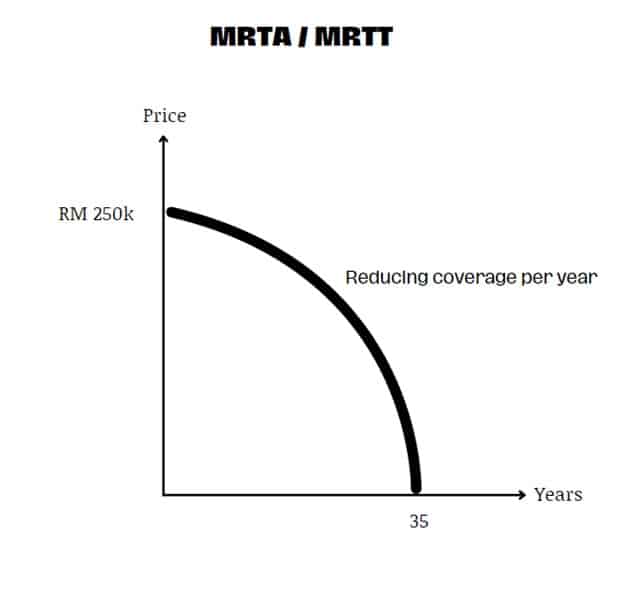
In this article, we will explore more on MRTT vs MRTA. To simplify understanding, MRTT and MRTA are a package that seems the same. The only difference is that MRTA is a form of conventional insurance while MRTT is takaful or Islamic.
The key phrase for MRTT and MRTA is R – Reducing. If your housing loan amount decreases, the protection MRTT and MRTA provide will also decrease.
MRTT, or Mortgage Reducing Term Takaful, is insurance based on Islamic finance principles. MRTT is a takaful (Islamic insurance) product that provides coverage for mortgage payments in the event of death or TPD of the policyholder.
This type of insurance operates on the principle of shared risk, where policyholders collectively pool their resources to protect one another. In the event of a claim, the takaful fund covers the mortgage payments of the policyholder’s family.
MRTT VS MRTA: What Is MRTA?
Conversely, MRTA is a type of insurance that operates on the principle of individual risk. MRTA provides coverage for mortgage payments in the event of the death or TPD of the policyholder.
Unlike MRTT, MRTA is not based on the principles of Islamic finance and operates as a traditional insurance product. In the event of a claim, the insurance company pays the mortgage payments to the policyholder’s family.
Operates on shared risk principle, coverage from takaful fund
Operates on the principle risk, coverage from the insurance company fund
Cost of coverage
Cheap
More expensive
Amount of coverage
Low
High
One of the key differences between MRTT and MRTA is how they are structured. MRTT operates on the principles of shared risk, while MRTA operates on the principle of individual risk.
This means that the cost of coverage is determined differently in each case. In MRTT, the cost of coverage is determined based on the collective pool of resources provided by policyholders.
In MRTA, the cost of coverage is determined based on the individual risk of the policyholder.
Another key difference between MRTT and MRTA is the way claims are handled. In MRTT, claims are handled by the takaful operator and are paid from the takaful fund. In MRTA, claims are handled by the insurance company and are paid from the insurance company’s funds.
It all looks the same, but structurally, MRTT is shariah-compliant.
Pros And Cons Of MRTT
One of the main benefits of MRTT is that it operates on the principles of shared risk, which helps to reduce the cost of coverage. Because policyholders collectively pool their resources, the coverage cost is lower than MRTA.
Additionally, MRTT is a takaful product, which means that it is based on the principles of Islamic finance and is therefore considered a more ethical and socially responsible option than MRTA.
However, one of the potential drawbacks of MRTT is that it may not provide as much coverage as MRTA. MRTT operates on the principles of shared risk, which means that the cost of coverage is lower. However, this also means that the coverage is typically lower than MRTA.
Pros And Cons of MRTA
One of the main benefits of MRTA is that it provides more coverage than MRTT. Because MRTA operates on the principle of individual risk, the coverage provided is typically higher than MRTT. Additionally, MRTA is a traditional insurance product that provides higher financial protection than MRTT.
However, one of the potential drawbacks of MRTA is that it is generally more expensive than MRTT. Because MRTA operates on the principle of individual risk, the cost of coverage is determined based on the individual risk of the policyholder, which can result in higher costs compared to MRTT.
Additionally, MRTA is not based on the principles of Islamic finance and may not be considered a socially responsible option for some Muslim consumers.
In conclusion, MRTT and MRTA are two popular insurance products in Malaysia that provide financial coverage for mortgage payments in the event of death or TPD of the policyholder.
Both MRTT and MRTA have their pros and cons. Consumers must consider their needs and circumstances before choosing between these two options.
Hope that you now have a better understanding of MRTT vs MRTA. You should also consider the level of coverage they require, the cost, and the level of financial protection they need before deciding.
Insurance is an essential aspect of financial planning. Think of insurance as a cushion. If tragedies or accidents occur, insurance acts as a financial cushion to protect what matters most to you – be it your loved ones, your assets, or your business.
Before the Covid-19 pandemic, insurance was considered a ‘nice-to-have’ instead of ‘must-have’. However, the pandemic shook up the general perception of insurance as people started to realise the importance of having a financial safety net to shoulder against life’s uncertainties.
Even so, many do not understand what insurance is, how it works and the types of insurance available.
Insurance is usually a financial cushion to protect you and your family. | Credit: fernandozhiminaicela
What is insurance and how does it work?
In a nutshell, insurance is a contract (deemed as a policy), whereby policyholders receive financial protection against losses resulting from an unforeseen event.
Policyholders pay a fixed premium on a monthly, quarterly, semi-annually or annual basis to an insurance company which pools risks to hedge against potential losses. Financial planners recommend setting aside 6% of your monthly income for insurance.
How do I know which insurance to purchase?
Some simple calculations like what you can afford and how much coverage you’d need would be what you would consider before buying a policy. | Credit: stevepb via Pixabay
Before you purchase an insurance policy, it is important to ask yourself:
Your financial commitments: What is your debt situation? How would you manage your financial risks if you were to lose your job, or for your family manage if you were to pass on?
Your dependents: If you were to lose your job or pass on, would your dependents be able to manage financially? How much would your dependents need to cover living costs?
Your medical history: Is there a history of critical illness such as cancer or stroke in your family? Do you smoke?
The nature of your job: Do you have a high-risk job, a physically demanding job or a job that requires frequent travelling?
Your assets: Is your property insured against potential theft, fire, flooding, burst pipes or earthquake risks? Are you able to sustain losses or damages to your vehicle in the event of accidents, theft or fire?
Based on your answers above, you would have a clearer idea as to the types of insurance as well as the policy limit (sum insured) that you would require.
What are the types of insurance?
Life Insurance or Takaful
People often confuse life insurance and health insurance. Life insurance is essential primarily if you have debt or a spouse/dependents relying on your income. Your life insurance company pays a lump sum benefit to your next of kin to serve as a financial relief in the event of your demise or total permanent disability.
Takaful is an Islamic financial product that is regulated through the Islamic Financial Services Act 2013 and is Shariah-compliant. Do note that it is not considered ‘Islamic insurance’, even though that’s what many seem to regard it as such. Unlike conventional life insurance, Takaful participants contribute or donate an amount to a tabarru fund, from which the mutual risk of losses is borne based on the Islamic principles of brotherhood.
Health or Medical Insurance
If you are diagnosed with an illness, there are both direct and indirect costs involved. On top of direct costs such as your medical expenses, your illness may affect your ability to work, pay off debts or afford living expenses.
According to Aon’s 2023 Global Medical Trend Rates Report, medical inflation in Malaysia stands at 12% and is expected to rise. Medical insurance or commonly known as a medical card is a policy that reimburses your medical expenses in the event of illness, hospitalisation or surgery.
There are many medical cards in the market, with some starting from as low as RM5-10 per month. It is not mandatory but some employers include medical insurance as a fringe benefit which only covers up to a certain limit.
Illness can strike at anytime changing the course of your life; so it’s better to always be prepared. | Credit: geralt via Pixabay
Critical Illness Insurance
Based on your family and medical history, consider purchasing critical illness insurance on top of a medical card. A critical illness policy offers a lump sum payout as an income replacement if you are diagnosed with cancer, stroke, heart attack and so forth.
Personal Accident Protection
If you are a frequent traveller or involved in a physically demanding job, personal accident insurance is ideal for you as it covers medical expenses incurred from an accident, travel inconveniences or sickness resulting from travelling.
Property Insurance
After spending your hard-earned money on your home or property, the last thing you would want is to leave it unprotected from potential risks such as fire, theft, flood and natural disasters. Though property insurance is not compulsory in Malaysia, it is worth purchasing as it is not too costly.
Motor Insurance
Car or motor insurance is mandated by the Road Transport Department (JPJ) Malaysia, as you will not be able to apply for road tax without having a policy. In case of an accident, fire or vehicle theft, a comprehensive motor insurance covers damages and losses associated with the third-party injury as well as you or your authorised drivers who are driving the vehicle.
Getting started with insurance may be an overwhelming process. Rest assured, it is not necessary to purchase all types of policies, only the ones you truly need.
A great way to start is with the essentials such as medical and life policies. Afterwards, you can schedule a regular policy review to assess your evolving protection needs.
By Mabel Yan
If you enjoyed this article, you might also want to check this out:
I approached one of my couple clients, Chris (the husband & not his real name) and I told them that I was helping my other clients plan financially, I ask them whether they would like me to help them. Here is how the conversation about saving on housing loan interest went.
“Would you like to buy an AUDI TT for free after you settle your housing loan?”
They were very curious and our conversation went on like this. (This is an article I wrote in 2015 and is re-posted & re-edited.)
How to buy an AUDI TT for free after you settle your housing loan?
Chris: “Are you trying to sell me insurance or unit trust?”
Me: “Neither”
Chris: “I’m itching to buy an Audi TT & I’m not sure if this is a good time”
Me: “I could help you buy your AUDI TT for free after I help you settled your housing loan”
How To Save 50% Of Your Housing Loan Interest In Half The Time
This was their situation:
Property purchase price RM2.5 Million (semi-D in Petaling Jaya area)
Loan Interest Rate was 4.4%
Loan Tenure (no of years to repay back the loan) was 35 years (420 months)
Loan Installment is RM10,471/month
Total Interest Paid for the whole duration was RM2,147,808
After implementing my advice:
Total Interest Paid is RM 1,068,815, which is a 50% reduction in interest paid.
They finish paying off their loan in 19 years and 2 months (230 months), which is 45% earlier (15 years and 10 months OR 190 months).
He could buy 3 new AUDI TT worth RM285,000 with the interest savings. (Of course, AUDI TT’s price would have gone up, but still, if he did not apply this strategy, imagine the 3 AUDI TTs the bank managers would have driven off with)
Can you guess what did I suggest to him to do?
Save an additional instalment of RM4,000/month into his housing loan
Ensure their Debt Payment Ratio is still on a Healthy Level (<35%)
Ensure their Total Saving Ratio is Healthy (>33%) & their net worth is still growing
This was what I suggested to him
Because they are ‘SAVERS’ (people who like to save money in their bank account), they could channel some of their monthly savings into paying off their housing loans.
But one has to take note to maintain a balanced lifestyle of not over-saving as you do not want to lose out on any investment opportunity. Here, it shows how big of a difference it makes over time.
1. Save an extra of RM4,000/month on their housing loan, making the instalment RM14,471/month. Here you can deposit the extra RM4,000 into a Current Account facility provided by most Malaysian banks by now, which can be used to withdraw later (in the event of emergency)
2. Currently their Debt Payment Ratio is only 27% & they can commit up to 35%. Debt Payment Ratio measures how much income is used to pay ALL Loans (housing loan + car loan + personal loan & etc) divided by your NET INCOME (Your Gross Salary net off EPF, Socso, EIS & PCB). Since they don’t have any car loan, personal loan or any other loan, then all their funds can be channeled to the housing loan.
3. By doing (1), they are able to save almost RM 56,551/year in housing loan interest (Total savings on housing loan interest = RM1,078,993)
4. The amazing thing of ‘Saving’ the extra RM 4,000/month actually improves their networth. You don’t actually ‘spend’ it, here is how it works
(Net worth is assumed that Current Market Value of the property grow at 4% per annum)
5. Interestingly, RM 3,731.25 of your RM 4,000 goes directly to pay off your principal. So it seems like you were force saving in your bank account, is just a different account call loan account
Save on housing loan interest, he calls off his purchase and postpones his booking
After I have shown them the above, he called off his purchase of his Audi TT & redirect his savings to clear off his housing loan interest. Postponing his purchase after he settled off his housing loan first, he is convinced the savings from the housing loan interest will be able to buy him a free Audi TT.
*Do take note that you should only do this for a property that you live in. For property investment, you may not want to use this strategy. Talk to your financial planner or a professional first before taking action.
*DISCLAIMER – All strategies listed here are not a recommendation nor advise. The article is written purely for the purpose of education and journaling only. The content of this article is an expression of my opinion and should not be taken as professional advise. If you are seeking professional advise, please consult me personally . You should do your own research and/or seek expert’s advice when overcoming your debt circumstances.
Ka Hoe is a Licensed Financial Planner having a “Financial Adviser Representative” (FAR) with Bank Negara and “Capital Market Service Representative License (CMSRL) – Financial Planner” with Securities Commission. He is also the Founder of J Advisory, a Personal Finance Academy that helps struggling Malaysians elevate their financial well-being with proven tools, systems and strategies. For more real-world case studies, you can reach me at my blog – https://jadvisory.asia/
When it comes to investing, you can either do it yourself (DIY) or you can rely on a professional.
The DIY approach requires you to take the time to study each investment asset and search for a brokerage firm or platform that will allow you to build your own portfolio.
However, the DIY approach can be very time-consuming. It also comes with increased responsibilities and worries. On your own, you will be more sensitive to shifts in the market and you may feel pressured into buying or selling the wrong asset at the wrong time, which can lead to heavy investment losses.
Additionally, certain investment products may be out of your reach. You may also be required to put up more capital than you are comfortable with.
The second option, relying on a professional, offers a safer investment experience. For investing in Unit Trusts, this means engaging the services of a Unit Trust Consultant, or a professional fund manager at a Unit Trust Management Company (UTMC) or at a funds distributor, such as at an Institutional Unit Trust Adviser (IUTA) or Corporate Unit Trust Adviser (CUTA).
What Can A Consultant Do For You?
Generally, Unit Trust Consultants are there to assist investor/client in establishing his/her investment objectives and to propose Unit Trusts products that are suitable to the investor/client based on his/her risk appetite. Additionally, Consultants are expected to provide prompt, efficient and continuous service to their investors/clients.
In short, Consultants have the necessary skills, relevant experience and dedicated resources to help you with your Unit Trust investments. They can help guide you towards your financial goals by helping you choose the right funds that suit your needs.
In addition, they can introduce investors to Unit Trusts that invests in assets/options that would otherwise not be accessible to an average DIY investor, vastly increasing your investment opportunities.
If you feel any hesitation about placing your trust – and your money – in the hands of another person, you can rest assured that legitimate Consultants are bound by FIMM’s Code of Ethics.
A good Consultant should have the following characteristics: honesty and integrity, professionalism, acting in the best interest of investors, deal with investors in good faith, comply with all requirements, avoid any conflicts of interest, provide accurate, timely and adequate information, and maintain investor confidentiality.
All these are meant to ensure that the Consultants’ ultimate duty is to help you reach your financial goals in the best way possible. Similar requirements are also applicable to the Private Retirement Scheme (PRS) Consultants.
The Benefits Of Choosing A Consultant
First-time investors, or those who have a particular financial goal in mind, would especially benefit from the advice that a Consultant can provide. The Consultant’s job is to educate you and help guide you along your investment journey.
A Consultant can also deliver a more personal touch, especially for investors that are new to or less familiar with Unit Trusts and Private Retirement Scheme (PRS).
Investors can engage a Consultant via the UTMC, IUTA, CUTA or even search for one themselves on the internet or through social media.
However, it is important to keep in mind that all Unit Trust and PRS Consultants are required to be registered with FIMM prior to them being able to market and distribute Unit Trusts and PRS. And it is easy to find out if your Consultant is legitimate.
By visiting FIMM’s website, anyone can check if a Consultant is authorised by FIMM or not. All he/she has to do is search the Consultant’s name or registration number. Additionally, anyone can reach out to FIMM – just send an email to info@fimm.com.my to make enquiries or to complaints@fimm.com.my to lodge a complaint.
This allows you to have a safety net while you embark on your investment journey. It also assures you that all your interests are safeguarded.
Bring Confidence To Investors
There are various channels to buy Unit Trusts, and investors who feel that they do not need advice may choose the DIY option without having to pay a sales charge or advisory fee.
One of the most common reasons for people not wanting to engage a Consultant has to do with the increasing amount of freely-available investment information over the internet.
Nonetheless, Consultants can provide a wealth of resources that investors doing DIY may lack. As investors become more aware of personal wealth management, continuous efforts in upskilling Consultants in advisory (goal-based investing) and client servicing (after-sales service) will add value and bring confidence to investors.
Regarding the issue of costs, in the form of consultant fees, it should be noted that all fees are clearly disclosed in the funds’ offering documents (i.e. prospectus), which is lodged with the Securities Commission Malaysia. Consultants cannot simply charge any fee that is not disclosed in the offering documents.
Furthermore, ongoing after-sales services from Consultants can also help investors achieve their financial goals by monitoring and keeping the investor informed of their progress, and reviewing the investment portfolio regularly and recommending changes where necessary.
The Final Word
Ultimately, the decision on how you wish to proceed with your investment is in your hands. Nonetheless, you must understand your investment objective and equip yourself with basic investment knowledge before you start investing.
Visit www.fimm.com.my for more information on Unit Trusts and Unit Trust Consultants.
Food for thought: If one day your friend wants to borrow RM1mil to replace mortgage from you to purchase a house and promises to pay you back via monthly instalments for the next 35 years, how would you react? Personally, my top priority would be to take stringent steps to ensure that I would be able to get my money back.
This applies to the banks too when one applies for a loan especially your mortgage. Here’s a quick summary of the process in three simple, sure-fire steps:
Step 1: Your Profile Matters
Ever wonder why the application forms have so many fields to fill, none of which are related to the property you want financing for? This is because each and every field in the forms give a score towards your eligibility. This scoring is called an “application score”.
The place you live, your marriage status, your occupation and so on will give you points. The higher the points, the better your score and the higher your chance of getting your loan approved. So, remember: do not ask someone to fill your forms for you or leave them blank because this will affect your score.
Step 2: Get your Income Recognized for Credit Rating
How much you earn matters to the bank. You need to make sure all your income can be recognised by the bank with proper documentation. On top of that, how much you earn and your income sources are important too.
Some banks will only recognise a certain percentage of your income especially when that income source is not fixed like commissions and incentives. For example, some banks will recognise only 80% of a commission and some banks will recognise only 50%. You will need to ask the banker how much will be recognised because each and every bank will have a different method of recognising income.
This income will be used to compute your debt service ratio (DSR). This is to check whether or not you can afford the loan. DSR is your existing commitment plus new commitment over your net income after deductions from EPF, PCB, SOSCO and EIS. Most banks will reject your loan if your DSR percentage is more than 70% of your net income and every bank will have a different cut-off for DSR. Do ask the banks what their cut-off rates are to ensure they approve your loan.
We need to be disciplined in keeping good records with the banks. When you borrow, you need to pay your loans on time. Bad records will be recorded in CCRIS and CTOS which banks will review. Once it has been deemed that you have a bad record, your application will be rejected.
Step 3: The Right One Will Get the Job Done
Bankers, lawyers, agents and sales representative are all key players in your property purchase journey. It is advisable that you engage the person who is committed and can guide you. A simple rule is that if they can explain to you all the terms and conditions about your property purchase agreements, then he is experienced and can help you make better decisions.
That being said, it is very important for you to equip yourself with the right knowledge by asking all the crucial questions about the loan.
A good financial plan creates a roadmap or a guiding light for your financial life journey. It’s more than money and gives you an overall picture of where you stand financially and where you’re heading to. It should include financial details about your cash flow, savings, debts, investments, insurance, and any other aspects of your finances.
Financial planning is an ongoing process that allows you to get your money and life under control so that you can reduce stress, fear, and worries about your future life. I think everyone should have one, and it can be done in your own style or with a financial planner. Remember, financial planning is not only for the wealthy or people earning a high income.
You don’t need sophisticated software or tools to draw up your own financial plan; instead a blank piece of paper will help you to kick start the process. Start by listing down what you have (assets eg. savings account, EPF, investment account, investment property, business, etc.) and what you owe (liabilities eg. mortgage loan, car loan, personal loan, credit card, study loan, etc.), income (cash inflow) and expenses (cash outflow). This will give you a snapshot of whether you’re at a financial surplus or deficit, making it easier to work out a financial plan – covered in the next step.
Setting goals for your financial plan
This is where you decide how to design your own life. When crafting your own financial plan from the viewpoint of what your money can do for you, you’ll make saving and investing feel more intentional than overspending it. Your goals should be inspirational, measurable, and realistic – ask yourself where do you see yourself in five years’, 10 years’ or even 20 years’ time? It’s important because it gives you direction to achieve your financial goals at different life stages and it also influences how you plan your career as well.
For example, there will be different needs when doing financial planning in your 20s, 30s, 40s and 50s. In your 20s, you might want to make sure you have sufficient emergency savings that lasts for at least three to six months so that in emergencies you won’t be running on credit. Don’t forget to factor in insurance and ensure you get adequate coverage for personal accidents and a medical plan.
In your 30s to 50s, you’ll likely be experiencing high commitments due to getting married, raising kids, preparing university tuition fees, and funding your retirement fund. As you progress from different life stages, you’ll need to regularly keep an eye on your allocations for investing and spending. If you know that these things will happen in your 30s to 50s, you may save and invest more in your 20s or prolong the retirement age from 55 to 60.
Monthly budgeting for your financial plan
The next step is to allocate your monthly budgeting – what is coming in and what is going out to understand your spending habits and only able to take a balance between spending and savings. It depends on where you live and how you spend – living in an urban area may result in spending more due to higher rent, eating out more etc. If you don’t spend more than half of your income, then you can start saving enough to fund your goals. Of course, you can’t own the whole world, but you can own the things that you value the most!
Executing your financial plan
This is all about allocating your resources or cash surplus to fund your goals. Saving and investing must come into play and you should consider the types of financial products, the risks, returns and liquidity, as well as understanding your risk tolerance. For example, if you set aside 15% of your gross income for long-term goals like retirement, you may consider investing in stocks or equity funds that aim for capital appreciation. For shorter goals like saving for an emergency fund, you wouldn’t put your money in a high-risk fund because you might need it quickly in an emergency. It’s best to have separate accounts for different funding purposes.
Review your financial plan
Lastly, review and monitor your financial plan regularly to ensure you exercise strict discipline with the flexibility to adjust accordingly in the future, especially when entering different life stages. It’s easy to talk and plan, but execution remains the most challenging task as we may not have the discipline to stay on track. So, reviewing, monitoring and fine-tuning acts as reminders of your goals all the time. It’s best if you can make it measurable so that you can reward yourself with small gift when you are on track!
A good financial plan is not a beautifully written document that is presented nicely to you. It’s a tool to track your progress and help you reevaluate plans after a life milestone such as getting married, raising a kid, buying your first property, upgrading to a new car, preparing for a kid’s college fee, or building your retirement fund. When everything is handled, you can enjoy living your life. The small steps you are taking now will definitely have a huge, positive impact on your future.
About the author
Eewen is a licensed financial planner and strongly upholds the belief that financial wellness is all about money bringing a positive impact into your life. She can be contacted at keaheewen@vka.com.my
Taking personal finance to another level by looking at it from a more holistic view.
How has the past year been for you? I’ve done a lot of reflection on myself and how I want to further evolve when things get a little more normal for the coming year (fingers crossed)!
One thing I personally learned is about life and recognising that money is just a tool. We must make sure we use it correctly in order to work towards financial wellness.
“People first, then money, then things.” – Suze Orman
Reflection on the path to financial wellness
The stoic path to wealth mentions that the fear of losing all our wealth is creating a monster inside us and therefore turning the chase for wealth into fear of losing it.
This eventually turns money into our master and we’re enslaved by fear until we almost lose touch with ourselves.
There is a saying “Money is the root of all evil”. But in actual fact, the full quote is “the love of money is the root of all evil.”
It’s the greed for wealth that is bad as it can corrupt minds, and the need to keep accumulating more and more is the real issue.
Money is not the end goal
Personal finance is not about the money we have or about creating more wealth. Its main purpose should be more holistic, ie. leading the life you were born to lead, no matter what your financial status is.
You’ll see money in a different light if you began your career with a student loan. Even before starting your career, you’ve already created a load of fear by accumulating a large amount of debt.
This results in your mind becoming clouded with thoughts of the repayment of loans first and pushing aside all other goals or dreams. I personally experienced it as a child; teachers kept telling me to finish school, get good grades, go to university, get a degree and get a good paying job.
As a child I thought that was the dream, but it didn’t turn out the way I imagined it would as a child.
We were repeatedly told this fairytale, and subconsciously I believed it. But now that’s not the case. How can we take a holistic approach around our personal finances and take back control of our life?
Believe me, we’re not meant to suffer through life constantly worrying about paying bills.
Reflecting on your childhood dreams
Have a goal in mind. You already knew what you wanted when you were a child. In fact, there’s a good chance you were so good at it.
Try asking your parents or other close family members what you were like when you were around the age of 9 to 12. It’ll give you some insights about your strengths and your childhood dreams.
I grew up observing how passionate my parents were and how they were willing to give their all to their career. At the end of the day, my parents still had time to spend with us and go on a little vacation once in a while. It was a nice balance.
That’s currently what I want to strive for – a balanced life between my career and family.
I’m not saying I don’t want to be rich (who doesn’t), but it’s not my main focus right now.
Between juggling two young kids, my husband works long hours because he enjoys the work he does. Even though in my opinion, he deserves to be paid better, it matters less.
There’s been a string of financial decisions we made that may be a sin in the personal finance community focused on accumulating wealth. But we needed to make those decisions to get to where we need to be in life.
Our goals were bigger than wealth accumulation.
Using my finances to find peace
We can never be free. I believe there’s no such thing as financial freedom. This is because I realised just when I thought we were “free”, something would suddenly hit us like a bomb and I would think “Here we go scrambling again”.
Getting married is expensive. Staying married is expensive. Having kids is expensive. I remind myself of my battles daily.
If my needs are covered, I am willing to forgo some of my wants. How precious and priceless is the laughter of a child?
Just do you
It‘s terribly hard to maintain a balance and I personally struggle with this on a regular basis. Turning off the work switch and being present was a difficult process.
Being frugal and being disciplined in managing our budgets has a big impact on our long term finances.
But this just makes me exhausted. There’s no point stressing about maximising my savings or the future so much that I forget to be present. The goal is not the money – it’s my life.
I’m not going to kill myself just to keep striving towards this illusion that my future will be far brighter if I continue maximising my savings and investments.
I choose to enjoy every step of the journey instead, without mentally burdening myself.
Use your wealth-building experience to create happiness for yourself and inspire others to do the same. Remember it’s not about the numbers and figures in your portfolios, but what you do with the money.
“Wealth consists not in having great possessions but in having few wants.” – Epictetus
Move from survival mode to thriving mode. Choose not to be trapped in the illusion of not having enough. You’re enough! If you’re in survival mode, you’ll trap yourself in the rat race.
Therefore, there’s no room for helping others and all you’ll think about is how to make yourself better instead of the community around you.
About the author
Nurul Yahi has a background in Business Administration majoring in Islamic Financial Planning. She’s a financial enthusiast and you can find her at dearduit.com. You can also find Nurul on Twitter, Instagram and Facebook.
When we talk about the concept of financial planning, many people may think that it’s very complex and comprehensive, and may require a lot of information such as total income, overall expenses, liabilities, value of personal assets, investment assets and so on. While this is undeniable, to help you achieve your financial goal, this data can’t be ignored. However, it can also be as simple as ABC – let’s use football as an analogy to relate it to your asset allocation.
What is asset allocation?
In layman’s terms, asset allocation is an investment strategy that diversifies money into different kinds of asset classes. It aims to balance the risks and optimise the returns. In order to have good asset allocation, a financial planner will distribute the capital into various asset classes with different levels of risk and return, so each will behave differently over time. Since each person has different kinds of goals, risk tolerance, and investment horizons, a financial planner will analyse his/her financial characteristics and apportion a portfolio’s assets that’s suitable for him/her.
How to allocate assets?
As mentioned earlier, we’ll use football as an analogy to break down the best way to allocate assets. There are 11 players that make up a team that plays the game, which consists of a goalkeeper, defenders, midfielders and strikers. All of them are unique and have their own role to play. The same analogy also can be applied to our financial planning. Each financial tool represents a football player with an important role to play in personal financial planning. As we always say, don’t put all your eggs into one basket, hence you must diversify the risk and purpose by using different financial tools.
Goalkeeper: Emergency funds
The goalkeeper is the one standing at the last line of defence to make sure that the team won’t lose. His main job is to block shots from the opposing team to avoid giving up a goal. In the context of financial planning, who are our goalkeepers? Insurance and emergency funds probably fit the criteria.
Insurance protects you from financial risks by transferring the risk to insurance companies, while emergency funds are used to overcome unpredictable events like unemployment or sudden loss of income. However, many people don’t pay serious attention to this and even procrastinate on insurance and emergency funds. This results in them being financially vulnerable to unpredictable crises ahead.
Defenders: Capital guarantees
Apart from goalkeepers, the next line of defence are the defenders. Their main purpose is to offer protection to the goalkeeper and goal, and also preventing the opposition team from creating goal-scoring opportunities.
In the context of financial planning, these financial instruments are designed to provide stability for your funds, with capital guarantee often the priority. Examples of these financial instruments include fixed deposits, money market funds, your Employment Provident Fund (EPF), and bonds, which provides you with a stable income and principal guarantees for your investment.
Midfielders: Collective investment vehicles
Midfielders are positioned between attack and defence. These players act as the road maps, determining the direction of the play. They have the flexibility to be either attackingly aggressive or more defensive when needed, depending on the situation. Collective investment vehicles make great midfielders because these financial tools possess a diverse set of characteristics thanks to interventions from professional fund managers.
Strikers: Profit-making machines
Lionel Messi, Cristiano Ronaldo, Harry Kane, Robert Lewandowski – these are examples of world-famous strikers. Their fame is thanks to the goals that they score, often resulting in their team going on to secure victory. In investments, the striker’s main goal is to score for profits!
Take your private businesses for example, which will generate income for you. You’re likely to spend a lot of time, capital, and energy on your business due to the potential it has to give you the best returns. However, if you fail to have a backup plan and blindly chase profits, when unpredictable events occur, it may be hard for you to rise again. Examples of investments or financial tools which play the role of a striker include equities, derivatives, and leveraged real properties.
In a football game, there are 11 players on each team, but aside from the players, there’s still another important role that can’t be ignored. Without a coach giving instructions, there is no game plan for the team.
Coach –Financial planners
This is the 12th man in the game. Although he’s on the sidelines, he also plays an important role. Without the coach, can you imagine how the players can win the game? In the same situation, without players, do you think that the coach can win the game? In financial planning, the role of coach is often played by a financial planner.
He/she will advise you based on your financial goals, risk tolerance, and investment horizon. This information is important as your financial planner will analyse and determine the best course of action based on your unique situation. This results in a very specific financial plan which is tailored just for you.
The way of allocating assets can make a huge difference when it comes to seeking financial freedom. In the long road of a financial journey, you are likely to undergo many challenges in life such as economic cycles of market expansions, peaks, contractions, and troughs from time to time. Going through the four stages of an economic cycle requires great emotional management and smart financial strategies. So, it’s highly recommended for you to engage a licensed financial planner and approved financial adviser to ensure your financial well-being ahead.
About the author
Teoh Shoon Yee (FAR CMSRL RFP BIBM) is a FA Manager, Licensed Financial Planner and Bank Negara Approved Financial Adviser Representative with approximately nine years of experience in financial services. She is well versed in holistic, independent and unbiased approach with a pleasant and friendly personality. She can be contacted at ShoonYee.Teoh@yesfinancial.co