According to KPMG’s latest report entitled , in a post-COVID-19 world, the financial services sector will be a key driver of economic recovery and growth. In particular, the stage is set for digital banking to thrive.
KPMG Malaysia Head of Financial Services Adrian Lee observed how the changing socio-economic landscape has altered customers’ money management and spending patterns as well as the way businesses are run. For both individuals and businesses, mode of payments and channels of financial management will also change.
“Recent customer behaviours in both retail and commercial sectors during the pandemic have evolved in support of digital banking services. As customers and businesses seek alternatives to safely run operations, the potential is great for digital banking to be the next success story for the financial services sector in Malaysia,” he said.
“Digital banking presents a value proposition poised to help companies and individuals get back into the economic saddle, and financial services providers that design its products around customer needs will stand out the most,” added Lee.
Bank Negara Malaysia (BNM) is due to announce its application guidance for the five digital banking licences following a public consultation of the updated exposure draft on the licensing framework for digital banks, which is due to conclude on 30 June 2020.
Interests have already been stirring among the bank and non-bank institutions, ranging from credit businesses, telecommunications, e-commerce platforms, advanced technology companies and local conglomerates.
Lee continued, “It is widely anticipated that BNM will see a large number of applicants for the five digital bank licenses in Malaysia due to the lower entry requirements in minimum capital and significant market opportunities locally and in the region.
“Given the emphasis BNM has placed on financial inclusion, the successful applicants will be the ones that demonstrate how their products and services will help the underserved and unserved segments rebuild themselves financially.”
According to KPMG’s Financial Services Advisory Partner and Head of Financial Risk Management Yeoh Xin Yi, a successful digital bank should incorporate three areas into its strategic blueprint:
Understand customer behaviours and expectations
KPMG in Malaysia conducted an online survey to understand customer appetite and concerns when it comes to digital banking.
The study revealed that 77% of the 1,220 respondents in Malaysia believe digital banking is the next evolution in financial services, and 82% are already using internet banking functions of their banking service providers. It is interesting to note that 82% indicated they would consider opening a bank account through online platforms only if they were regulated by BNM.
The survey also highlighted that 79% expressed interest in better accessibility to financing products, where 52% of respondents prefer to perform online application for these financing services.
With the conditioning of using mobile or internet services during the MCO period, it is expected that familiarity with online registrations and onboarding will increase. KPMG’s survey also indicates that consumers are most concerned about cyber security and convenience of information uploading, hence this is one area that digital banks need to pay attention to when designing a good customer experience for users.
On preferred features of digital banks, respondents appear to look forward to products and services that add value to their lifestyle (see chart below).
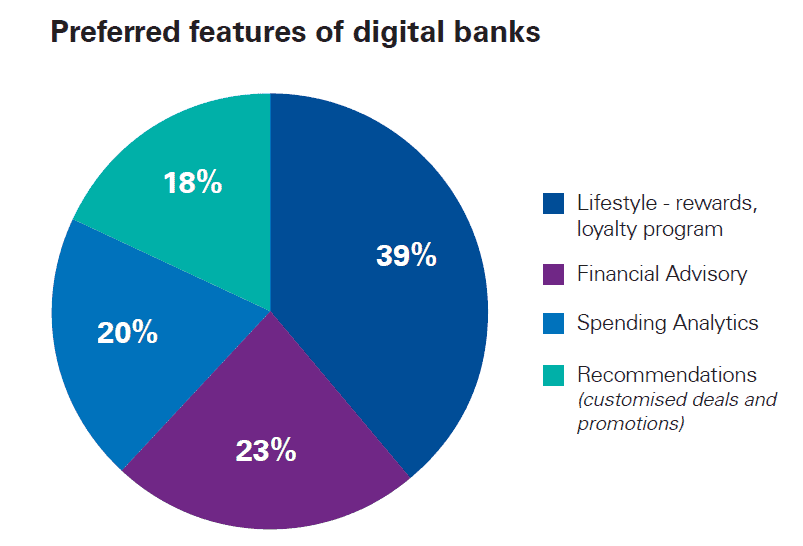
Source: Survey on digital/virtual banking in Malaysia by KPMG Management & Risk Consulting, conducted from September 2019 to February 2020, involving 1,220 respondents in Malaysia.
“Malaysian consumers are clearly ready and willing to embrace digital banking. It is up to the players to make the crucial step in establishing a customer-first model for digital banking,” said Yeoh.
Banks, she continued, need to incorporate advanced analytics into understanding customer preferences and behaviour, from a historical as well as a forward-looking point of view. Information and data are key to providing customers with better products and services, thereby translating to economic value for the digital bank.
Improve financial literacy and inclusion
Despite there being more than 1,823 bank branches in Malaysia as of December 2019 and more than 37 banking institutions covering commercial banks, Islamic banks, and development financial institutions, there is still a lack of coverage for the unserved and underserved segments of the B40 and M40 groups.
Yeoh commented, “Customers that fall into the unserved or underserved segments are more likely than others to have a profile that fall short of the conventional bank’s credit criteria when financing is sought.
“Digital banks can view this as an opportunity to expand its reach into untapped markets while also delivering on BNM’s aspirations for financial literacy and inclusion. Ideally, we would seek to have customers achieve higher financial literacy through the provider’s ability to advise, recommend and encourage positive financial behavior.”
For the unserved or underserved in retail and non-retail segments, micro-savings or deposits, micro-financing and micro-insurance are some of the basic products that is needed.
These “bite-sized” products enable consumers to access affordable financial enabling services in manageable quantum, and introduces those who are financially unaware to products that can gradually improve their financial literacy and economic livelihood.
The unserved and underserved of the B40 groups in Malaysia should be onboarded to financial service platforms that can help in cashflow management, enabling micro-savings or deposits, micro-insurance that safeguards their basic needs, and basic financing products to tide them over their financial trouble if the need arises.
The underserved M40 and T20 segment can also benefit from the convenience and value add that digital banks can offer from a lifestyle and advisory perspective, with a different set of customized targets to help achieve their financial needs.
Be an active platform
Digital banks should be an active platform in the economic lifecycle of the segments it serves. It can do so by forming an eco-system or be part of an eco-system that is relevant to their users, where the user will be immediately plugged into a host of services within the digital bank platform.
Yeoh explained, “For a micro-enterprise, for example, the platform would enable receiving payments digitally, purchasing materials via a marketplace, micro-savings and micro deposit auto functions, analytics for its business and personal finance, and basic micro-financing that commensurate with their financial behaviour and capacity as a micro-enterprise.”
In conclusion, by leveraging on advanced technology, digital banks can fill the void that is within our economic environment and address the pain points of the unserved and underserved in both retail and non-retail segments.