Category: Start Here

  • How to Calculate The Internal Rate of Return for Property Investments

    How to Calculate The Internal Rate of Return for Property Investments

    Let’s use the following example of a 1,500 sq ft fully furnished, two-bedroom, three-bathroom apartment in Mont Kiara valued at RM1 million, with rental at RM4,000 per month and a RM500 monthly management fee. We also assume that for 5 years, the property is perpetually rented. The rental yield is [(4000-500) x 12]/1,000,000 or 4.2%.

    While this is simple enough math, it doesn’t take into account appreciating (or depreciating!) property. Nor does it take into account the upfront costs you probably paid to renovate the home for it to be competitively rented out. And what about those annual taxes? Or that one-month agent fee you paid?

    Going over the variables for this exercise, we get:

    (A) Initial outlay – including legal fees, down payment and booking fees = -RM150,000

    (B) Monthly loan payments = -RM3,800

    (C) Upfront renovation works = -RM50,000

    (D) Monthly management fee =  -RM500

    (E) Monthly rental income = RM4000

    (F) Taxes and property insurance = -RM1000

    (G) Hypothetical net selling price of the property in year 5, minus RPGT and marketing/selling costs (eg. agency and lawyer fees) = RM1,100,000

    (H) Hypothetical remainder of loan outstanding on the property in year 5 = RM790,000

    Step 1: Calculate net inflow or outflow for each year

    Let’s put the values below in Column B, next to the corresponding years in Column A.

    Year 1 = A + (B x 12) + C + (D x 12) + (E x 11) + F (don’t forget the one month agency fee!)

    Year 2 = (B x 12) + (D x 12) + (E x 12) + F

    Year 3 = (B x 12) + (D x 12) + (E x 12) + F

    Year 4 = (B x 12) + (D x 12) + (E x 12) + F

    Year 5 = (B x 12) + (D x 12) + (E x 12) + F + G – H

    Step 2: Input the formula for IRR in Excel

    In cell B6, input =IRR(B1:B5) to select the values of the cash movements in Step 1 above.

    input rate formula table for internal rate of return irr property investment

    This should result in an IRR of 9.08%.

    Summary

    In short, the internal rate of return is an annualised investment return which is directly comparable to other asset class returns. For example, if a share at the end of one year gives you 14%, inclusive of capital gains of the stock as well as dividends, then this number becomes immediately comparable to the IRR of the property.

    The trick here is to be realistic and be honest with yourself. After all, there’s no point cheating in comforting yourself that these property investments are “paying for themselves”. Using ratios and numbers such as IRR enables astute property investors to make logical decisions on what represents a good or not-so-good investment decision.

    Click here to read the full article about how to spot property investment opportunities in Malaysia.

    About the author

    Rozanna Rashid is a Licensed Financial Planner (CFP, IFP) and holds an MSc in Real Estate Economics & Finance from the London School of Economics & Political Science. Her background is in corporate banking and Islamic finance and she can be contacted at rozanna@alpine-advisory.com.

  • The Most Common Financial Planning Myths

    The Most Common Financial Planning Myths

    Financial planning has been defined as a process of developing strategies to help people manage their financial affairs to meet life goals. However, many people tend to have misconceptions that can be described as financial planning myths.

    “The best time to invest was yesterday. The next best time is now.”

    Yesterday has passed, so now’s the time for you to plan for your future, which involves learning about money and financial planning. If you master your finances well, then you’ll likely live a great life in the future because delayed gratification helps you to reach your life goals faster.

    What this means for you is to overcome the most common financial planning myths that I’ll be sharing with you in this article.

    1. Financial Planning is Only for the Wealthy 

    It doesn’t matter whether you earn RM2,000 a month or RM20,000 a month. As long as your income is used to pay for expenses, you need to have a financial plan regardless of whether it’s a simple or comprehensive plan. You need to calculate your net worth statement, cash flow statement and well as other relevant financial ratios.

    Whether you are driving a luxury car or economical car, you’ll still need to send your car for regular servicing – the only difference is the cost of servicing. Similarly, regardless of income levels, all of us still need to manage our own daily expenses, loan expenses and other allocation into savings or investments.

    2. I’m Too Young for Financial Planning

    Financial planning is meant for everyone regardless of age. If you are a child or teenager, it would be great if your parents teach you the importance of savings and growing your money that you received from red or green packets during festive seasons and other celebrations. Parents with good financial beliefs should plan for their children by starting a high interest savings or investment account for them in order to reap the benefits of the long-term returns.

    If you’re a working adult, you probably should have a financial plan in place to set aside and build an emergency fund, start insurance planning, retirement planning, travelling fund and or savings for your first house or car, and / or a wedding.

    If you’re a new parent, you need to plan for your children’s education, on top of your retirement and insurance planning. Some may probably need to save and invest so that he or she can accumulate enough capital to start a dream business. It’s at this stage that you may want to consider estate planning.

    If you’re a retiree, you may review and plan the expenses required for your desired lifestyle, which could include travelling goals, or simply your medical expenses.

    3. I Will Start Financial Planning when I Earn More

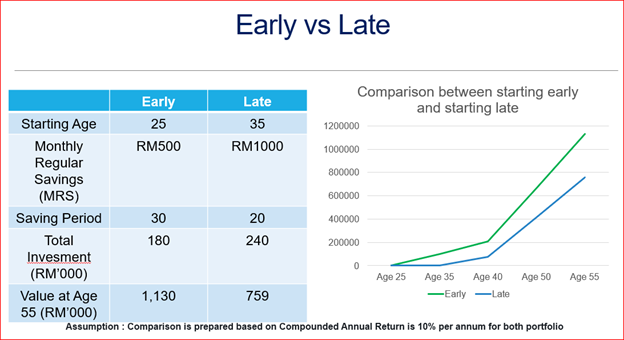
    Another common answer is, “I don’t have much income to plan financially and I will only start when I earn more”. Let me illustrate why this is a bad idea through this chart blow:

    financial planning early vs late

    These are two individuals, Mr. Early and Mr. Late. Assuming, both portfolios are growing with an annual compounded rate of 10% over the period of their investment horizon. Mr. Early who has learned the power of compounding from his dad and through reading investment books started saving regularly at age 25 with RM500 per month till age 55.

    However,  Mr. Late who believed that he should spend first and save later when he started working only realized the power of compounding and saving regularly after attended a wealth seminar recently. He started saving regularly at age 35 (10 years later than Mr. Early) with RM1,000 per month until age 55.

    When both reach age 55, Mr.Early would have accumulated RM1.13 million and Mr. Late with RM759,000 (even double the amount of Mr. Early monthly savings). The difference is around RM371,000 just by delaying it for another 10 years. Hence, do spend some time to learn and establish what your beliefs about money and financial planning are. Otherwise, it could have serious consequences on your financial goals or life goals. 

    “It’s not your salary that makes you rich, it’s your spending habit” – Charles A. Jaffe.

    What are you waiting for in your financial planning journey?

    About the Author

    Goh Chee Yong is a Licensed Financial Planner, and can be contacted at cygoh@imaxfinancial.com.my.

  • How to Set Financial Goals for Your Future

    How to Set Financial Goals for Your Future

    Much has been said and written about the sorry state general of financial literacy among people, both local and globally. According to financial literacy platform Multiply, almost 70% of Malaysians are in need of financial literacy support.

    “Financial planning” seems to be a popular catchphrase in recent years. The 7th of October is even recognised as “World Financial Planning Day”, which began four years ago. The purpose? To raise awareness about the importance of financial planning.

    If I used the term financial planning with my grandparents, they would say “Don’t worry so much, just work hard and be honest in your trade”. This shows how the concept of Financial Planning is fairly modern, with such an ideology being so foreign back in those days. Chances are, if you asked someone who is in their 60s or 70s today what financial planning means, there’s a high chance they’ll say it’s having insurance!

    However, financial planning is the process of developing strategies to help people manage their financial affairs to meet life goals. What constitutes a good financial plan? First and foremost, it involves taking stock of your assets, liabilities, investments, income, expenses and cash flow. The next part is important because it involves knowing the right strategies in order to achieve future goals. It also helps to break down goals according to priority and affordability. It then requires constant monitoring because we know circumstances in life will change – for both good or bad.

    Financial planning is clearly not as simple as signing up for a product. It’s a commitment to yourself and your family to ensure that your financial goals are achieved. In my observation and dealings with clients, I have found that the challenges in developing and sticking to a financial plan are summed up below (the list is not exhaustive):

    • Lack of priority – due to busyness at work and family commitments. The fear of the unknown future can be very daunting and it is easy to sweep this aside
    • Rising consumerism – shopping and spending is extremely easy. You can purchase literally anything in the world online and get it delivered to your doorstep. If left unchecked, would there be funds in the event of an emergency, let alone savings for the future?
    • Escalating prices of real estate – one of the social issues that the government is trying to tackle is the issue of affordable housing
    • Low interest rates – At the point of writing, the Overnight Policy Rate (OPR) rate is 1.75% which translates to Bank fixed deposits of 1.6% to 1.9% per annum
    • Salary vs inflation – not on par with rising cost of living

    All these seem to indicate that the younger generation is already at a disadvantage in achieving the same levels of success compared to their parents. For example, if your parents could afford to send you overseas when you were in university, can you confidently say you will be able to do the same for your children today?

    Having a financial plan is akin to being prepared for battle. You will know your limitations, ability to optimise your resources and your odds of winning.

    In the case of an investment portfolio, the more you spend time monitoring, the more invested you will be. For example, if you exercise daily, you’ll be much more conscious of your lifestyle, choice of food and calorie intake. The same can be said for a financial plan when you monitor it on a regular basis, which will lead to you becoming wired to make more informed financial decisions.

    Too much focus on any one area such as savings, investments, or insurance, may adversely affect the balance of your financial plan. The topic of investments alone is so vast, with plenty of choices available today, and is often confusing for consumers. Each platform has its pros and cons and it’s easy to get distracted by the whole process and only see things from that one perspective. Having a macro view is important and most consumers are not trained to do that.

    Let me give you an example. It’s highly possible to have false confidence knowing you invested in a portfolio that is performing at 15% per annum. However, if the amount invested was RM10,000, and even IF this portfolio could consistently perform for the next 10 years at 15%, the future value is only RM45,000. In the larger scheme of things, is that total of RM45,000 a meaningful solution in terms of the end goal to fund a child’s tertiary education and/or your retirement? Investment should be a means to an end, not the end in itself. Successful investment requires time, strategy and consistent positive returns to be favourable.

    There’s also the danger of neglecting risk management. An employee or an entrepreneur’s greatest asset is their ability to earn and also their potential future earnings. This asset can be severely affected due to a major health crisis. Have you considered income replacement in your financial plan? Most companies would have decent employment benefits that would cover you in the event of death and hospitalisation. However what happens if an employee is unable to contribute 100% to his/her job due to a health condition? Will your employer be happy to retain such an individual?

    In summary:

    • Work hard and smart in your trade
    • Manage potential risks that could happen in your working years
    • Look for opportunities to invest (in products/services registered with the Securities Commission Malaysia)
    • Monitor your financial plan and goals diligently
    • Seek out a Licensed Financial Planner to get a second opinion on your finances
    • Develop an estate plan as an act of love to your loved ones/charities

    With proper monitoring and guidance, you can be on the right track to achieve your financial goals.

    About the Author

    Kam Teik Guan is a Licensed Financial Planner, and can be contacted at kam.teik.guan@ipp.com.my.

  • How A Credit Card Works in Malaysia

    How A Credit Card Works in Malaysia

    2020 was a challenging year for many, but undoubtedly, it also sped up the transformation of people’s spending habits, pushing all of us towards online channels. Try to recall your last online shopping experience. How did you pay? It most likely would’ve been through online banking, e-wallet or credit card. Many of us choose to pay using credit cards because of a particular bank’s promotion or to collect points.

    In the mid-1970s, credit cards were first introduced in Malaysia. Since then, it has become one of the most common payment methods and the main source of short-term borrowing. With credit cards, we can buy the item now but pay for it later when it’s due. Today, with the government’s cashless society initiatives, credit cards are playing their role everywhere, and aren’t limited to just physical payments. It can be used for monthly auto-recurring bills, reloading e-wallets, signing up for an easy payment plan (EPP) and more.

    It’s a reality that credit cards are a major payment method in our daily lives. However, to play well in the “game of credit cards”, we need to know the rules to abide by first.

    1. What’s The Entry Fee?

    There are two kinds of fees involved here.

    a) Service Tax

    Effective from 1 September 2018, all cardholders are required to pay an annual service tax of RM25 for each active credit card (principal card and a supplementary card will be charged separately). This fee is unavoidable but some banks do offer rebates for this.

    b) Annual Fee

    From a personal finance perspective, you should only opt for a zero annual fee card! Unless you have strong and valid reasons, you should avoid a card that charges you hundreds or thousands of ringgit in annual fees.

    2. What You Need to Know?

    To avoid falling into traps, it’s better to know some jargon first.

    a) Credit Limit

    Treat it like a pre-agreed loan amount. This is the maximum amount that the bank grants to us for our spending. To determine the credit limit, banks usually look at two factors – our income and credit history. If we spend more than our limit (ie. breaking the rules of the game), be prepared to get a fine!

    b) Minimum Payment

    Ideally, you should endeavour to pay your outstanding balance in full. However, at the very least, you’re required to pay the minimum amount, which is 5% of the outstanding balance subject to a minimum of RM50. However, please take note for instalment payments like easy payment plans (EPP), the full instalment amount must be paid. If you can’t pay the minimum payment before the due date, be prepared to get a fine as well.

    c) Interest-Free Period

    This is the tricky part. We do enjoy an interest-free period of 20 days from the statement date provided all outstanding balance is fully paid. The last day of this interest-free period is usually referred to as the due date. Many people will have a wrong perception that they will always enjoy the interest-free feature for all new purchases, even when there’s an outstanding balance on their cards. However, this isn’t the case. If you have any outstanding balance on your credit card, the interest-free period won’t apply to the outstanding balance as well as any new purchase.

    For example, if someone has an outstanding due balance of RM1,000, and he/she makes another new purchase of RM1,000 with the same credit card, the finance charge will be calculated based on the RM2,000 balance (outstanding and new purchase) instead of the previous balance due of RM1,000.

    3. Are There Penalties?

    If you can’t play the game well, you might need to pay a penalty.

    Most people know that credit cards charge high-interest rates. However, between interest rate and convenience, people tend to opt for convenience first. A swipe of a card will always be the top choice compared to a loan application, which can take a few weeks to be approved!

    a) Late Charges

    Everyone knows credit cards work under the buy-now-pay-later mechanism. However, if we don’t make the minimum payment before the bill’s due date, a late payment will be charged. Usually, the amount will be 1% of your outstanding balance (subject to a minimum of RM10, or up to a maximum of RM100).

    b) Finance Charge

    If there is an outstanding balance that remains unpaid on the due date, a finance charge will be applied (usually people refer to it as interest). Bank Negara Malaysia implements a tiered interest rate system for credit cards, ranging between 15% to 18% depending on your repayment track record.

    c) Overlimit Fee

    If you spend more than your approved limit, an over limit fee will be charged. It varies across different banks, from RM25 to RM50 per month.

    These are some of the important things you must know before you apply for or start using a credit card. It’s important to take note because misusing credit cards can lead to financial ruin. Shifting your payment pattern to cashless can be rewarding. However, it can easily lead to overspending as well. According to the Department of Insolvency, Malaysia recorded 84,805 cases of bankruptcy between 2015 and 2019, with around 10% attributed to credit card debt!

    For credit card newbies, I have five important suggestions for you:

    1. Apply for only one card and get used to the full credit card payment cycle before applying for a second (if required).
    2. Limit your monthly credit card usage initially, then you can consider increasing later once you have proven to yourself that you can manage this well.
    3. If you can’t pay the full amount in cash now, don’t even think of making another purchase with your credit card.
    4. Check your credit card statement every month to review your “swiping pattern” and ensure there are no fraud / unauthorised transactions.
    5. Never pay the minimum amount for the month; full payment is a must by each due date.

    Financial literacy is not just about knowing about financial matters. Acquiring and consuming knowledge is easy in the internet era, but behaviour and habits are what counts. A credit card is a good financial tool if you use it wisely. Be responsible for your personal finance today as financial planning starts from small baby steps. If you need a professional to assist you along the journey, consider engaging a licensed financial planner to keep you on the straight and narrow path towards financial freedom.

    About the author

    Ocean Pon is a Licensed Financial Planner and can be contacted at oceanpon@finwealth.com.my

  • The Importance Of Building An Emergency Fund

    The Importance Of Building An Emergency Fund

    As we start this new year, there’s a lot of hope that 2021 will be a better year than 2020, and that our lives will resume some form of normalcy since the start of the Covid-19 pandemic. We’d all like to go around our daily lives in the way we were able to previously.

    Unfortunately, 2021 has started to unfold in a similar pattern to 2020, but we should remain optimistic and hope for the best. As with any new year, it’s a great time to set goals and have a fresh start. I believe many of us will have new year resolutions this season, some of which will revolve around finances.

    For many people, financial freedom, being debt free or cash rich is often on their goals or resolution list, but how many are able to achieve it? There’s a popular adage often attributed to Benjamin Franklin, the father of time management ” Failing to plan is planning to fail.” Many of us draft a new year resolution list but without proper planning, and setting goals, timeframe, and deadlines to meet, one will never achieve their plan.

    When Malaysia went into our first Movement Control Order (MCO) in March 2020, many Malaysians found themselves in financial difficulty as they were not prepared to face salary cuts, reduced working hours or even losing their jobs due to the economic shutdown. News has also been circulating of those who just managed to restart their businesses or get new jobs going back to square one as a result of MCO 2.0 due to the rising Covid-19 daily positive cases, currently at the four digit mark.

    Due to the uncertainty of such times, it’s important to reflect on where you are and where you want to be, as life altering events usually result in people taking a hard look at themselves to reform and transform. No doubt the pandemic has impacted many people in more ways than one, with saving habits being one of them. If you’ve planned your financials appropriately and have a sufficient emergency fund in place, you’d at least be able to support yourself and be less stressed in such times. One of the things that Covid-19 has taught us besides resilience and adaptability, is the importance of proper financial planning and having sufficient savings.

    The purpose of an emergency fund is to cushion the blow should unexpected events occur, such as medical bills, retrenchment, business closure, home emergencies home or car repairs. You’ll have peace of mind and less money worries if you know you have sufficient funds to tide you through difficult times. In addition, you’ll also have more confidence to save money for other financial goals such as retirement or your children’s education if you have an emergency fund in the first place.

    How Much is Sufficient for an Emergency Fund?

    Your emergency fund should cover at least 3-6 months’ worth of essential expenses. Of course, you can save for more than six months; some people have up to 12 months of savings or more! It depends on:

    • Family size – are you single, a breadwinner, or in a dual-earner family i.e. you or your husband/wife works?
    • How closely your job is tied to economic changes
    • Financial responsibility

    Essential expenses are bills that you can’t stop paying such as food, utilities, household essentials, rental or mortgage repayment, car repayment, insurance and medication. Gym passes, entertainment expenses, or Starbucks coffee aren’t essential expenses.

    Six months of fixed expenses is the guideline, but it’s acceptable to save more but be warned that keeping excessive funds in your bank account only is also not advisable as the money doesn’t generate additional returns for you and will be slowly eroded by inflation.

    How to Start an Emergency Fund?

    As with all other things in life, start with a small realistic goal. Determine an amount that you’re comfortable to set aside every month, for e.g. RM200. It doesn’t matter if you start small as long as it’s realistic and you can move forward. Once you have accomplished this, set a new savings goal that will require more effort e.g. RM500, slowly add to it until you have accumulated one month’s worth of expenses. Your ultimate goal will be to reach 3-6 months of your fixed expenses.

    Where Should I Keep My Emergency Fund?

    An emergency fund is all about keeping it safe. Hence, there’s no specific investment tool to keep your emergency fund, as long as it is safe, liquid and easy to access. Most people will prefer to save in a savings account or fixed deposit (FD).

    The reason for putting these funds into a safe investment tool is because if the money is in high-risk investments, there’s a risk that you could lose all the money. For example, saving an emergency fund of RM15,000 earning 2% interest in fixed deposits gives you RM300. If you were to invest in the stock market and can generate 8% annually, that’s RM1,200. While an extra RM900 may be significant to you, it isn’t guaranteed as you could lose all the capital you invested in the stock market if market conditions are unfavourable.

    Hence, don’t be greedy and just leave your emergency fund in a fixed deposit or savings account as the goal is liquidity, not high returns.

    Life can be unpredictable so it’s important to put aside a small amount of cash each month to cushion the blow of emergencies in difficult times. Many people strive for high-risk investments where they take on unnecessary risk to earn more money but are left with no basic savings. For those who don’t have this habit, start building your emergency fund from now. Learn from the past and don’t procrastinate. Once sufficient emergency funds are set up, it’s time to aim for your next financial goal, which can be for the short, medium or long term, depending on your life goals and/or values.

    About the author

    Yit Wei Yeing is a registered financial planner. She can be contacted at wyyit@genexus.com.my.

  • How to: Plan for Your Children’s Education Fund

    How to: Plan for Your Children’s Education Fund

    Among the Chinese, there is a saying: “再穷也不能穷教育”, which translates to: “Education shouldn’t be sacrificed even if we’re poor”.

    Parents believe that when their children are educated, they can secure a higher income and get better opportunities in life, allowing them to contribute back to the family and society in various aspects.

    Just like any investment, time can be your friend or your worst enemy. If you’re a parent with young children, why not start preparing the best angpao you can give your children now?

    To start planning for your children’s education fund, you should:

    1. Estimate the Cost of Education

    When estimating the cost of education, consider the following factors:

    • The type of studies your child may pursue.
    • Will you send your child to attend a local or an overseas university?
    • How much is the basic cost of living should your child attend an overseas university?

    Information on the fee structure and the overall cost of living are readily accessible on the internet. You can refer to this website to learn more about the fees and cost of education in Malaysia.

    However, bear in mind that these factors may change over time. Review the plan at least once a year to keep yourself updated on the latest developments and be sure to get the information from various sources to ensure that the cost of education and overall cost of living falls within a similar range.

    2. Understand Your Current Financial Position

    current financial position graphic - children's education planning

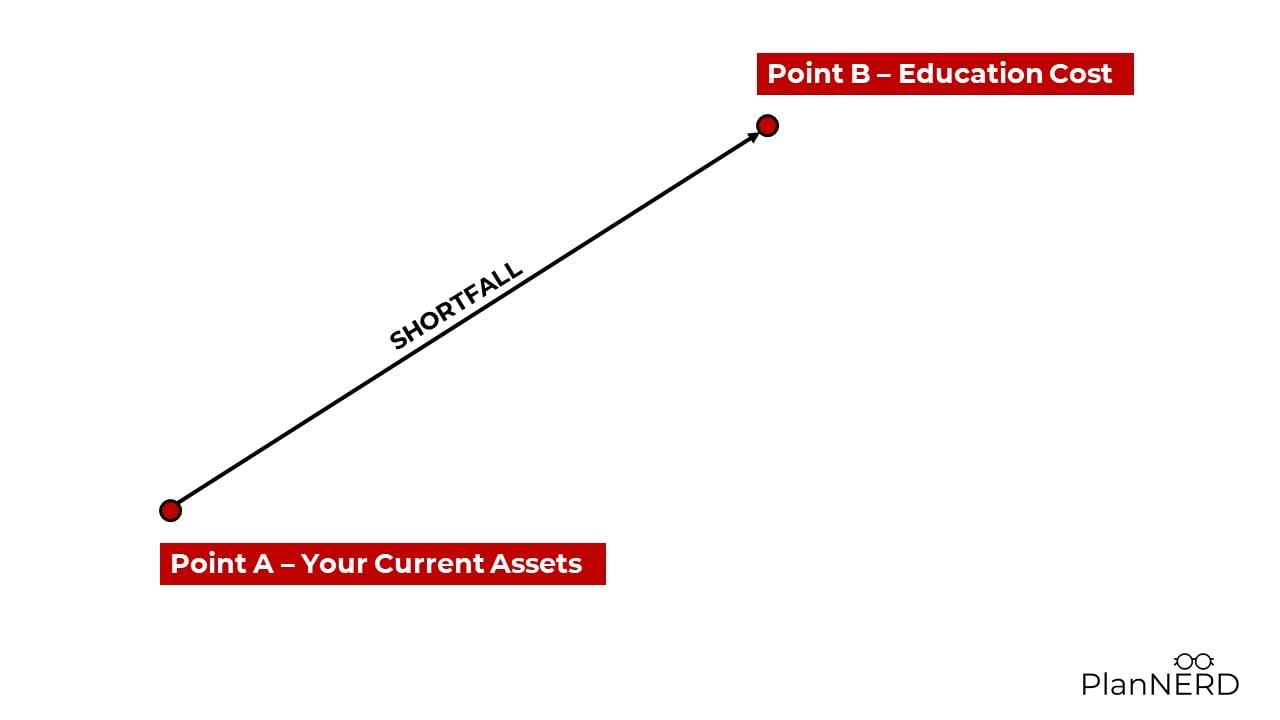
    Now you know how much is needed to reach point B (cost of education), to calculate how much you need to set aside every month to cover the shortfall, you’ll also need to know how much you currently have – point A.

    Most people store their wealth in cash, properties, and other types of investments. You should ask yourself; what portion of the above-mentioned assets can be allocated for your children’s education?

    For example, you may want to allocate 10% to 20% of your cash for the sole purpose of funding your children’s education. If you have investment properties, you may also designate a property to be sold once your child reaches 18 years old. Some may even have endowment policies with insurance companies that may mature in 20 years.

    The key is to write down a list of assets that you will dedicate to its sole purpose of being your children’s education fund.

    3. Determine the Amount to Cover the Shortfall for Your Children’s Education

    In this step, we’ll use a free financial calculator to easily calculate how much you need to save/invest for your children’s education. You can access the calculator here.

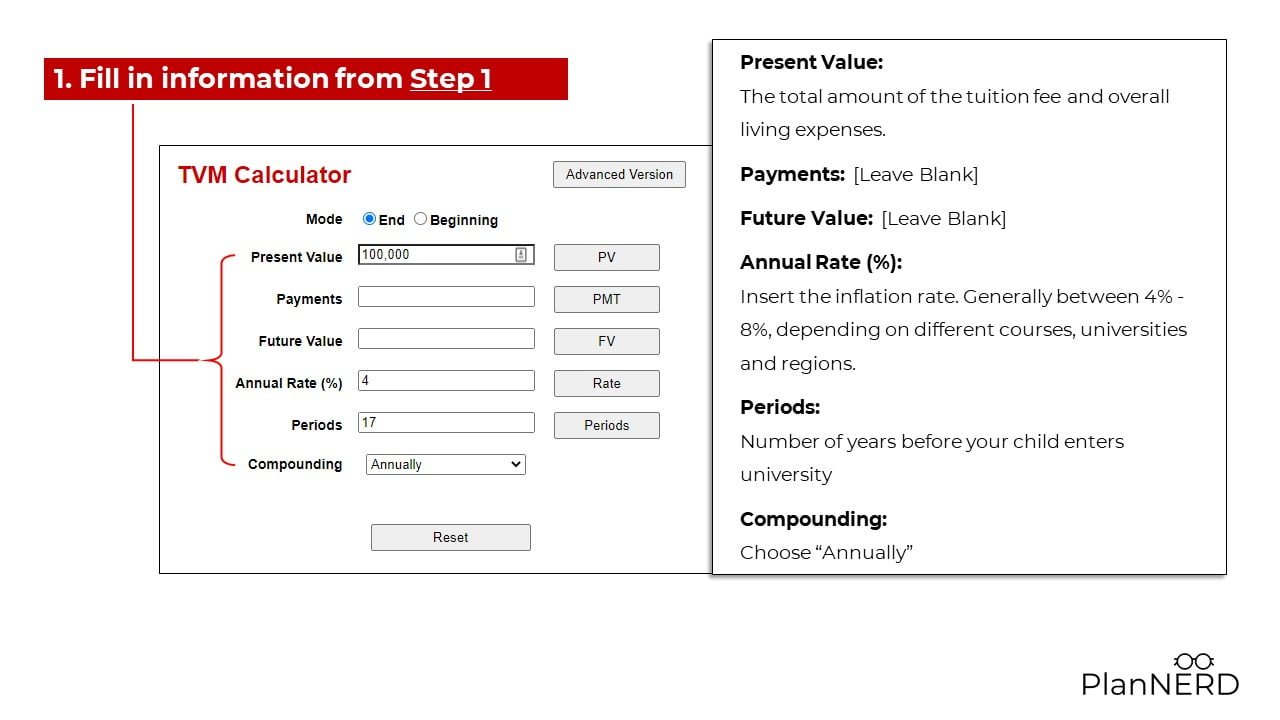
    (i) Enter the following field with the information you had prepared in Step 1 above.

    Step 2 for FV calculations - children's education planning

    (ii) Click on ‘FV’

    step 2 for FV calculation- children's education planning

    The amount in the FUTURE VALUE box is the future value of the education cost that you entered.

    In this case, the cost of education today is RM100,000. However, with an inflation of 4% for the next 17 years, the cost of education will increase to RM194,790.05 when your child is ready to enter university.

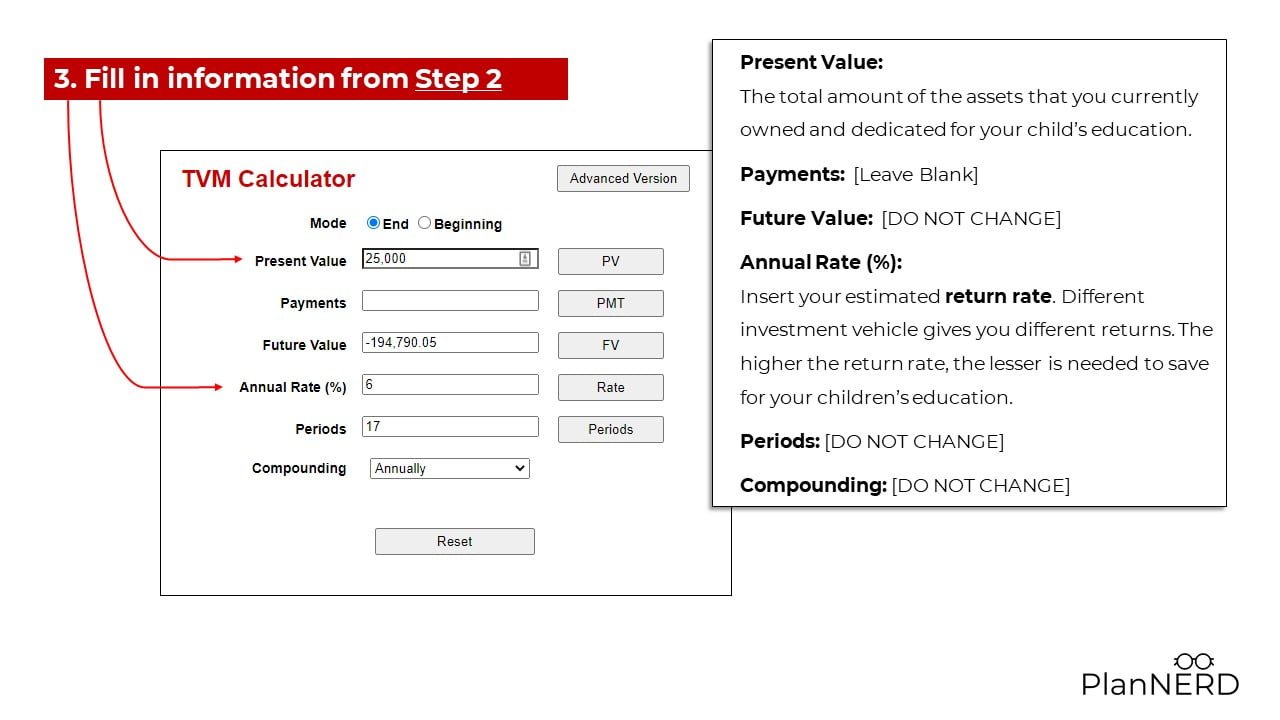
    (iii) Update the ‘Present Value’ and ‘Annual Rate’ field

    present value and annual fee table - children's education planning

    Next, you’ll need to calculate how much more is needed to cover the shortfall.

    Using the same example above, assume that you have RM25,000 now and you believe that you can achieve an average of 6% return rate for the next 17 years, update the Present Value and Annual Rate (%) column.

    (NOTE: do not refresh the website or change any other information.)

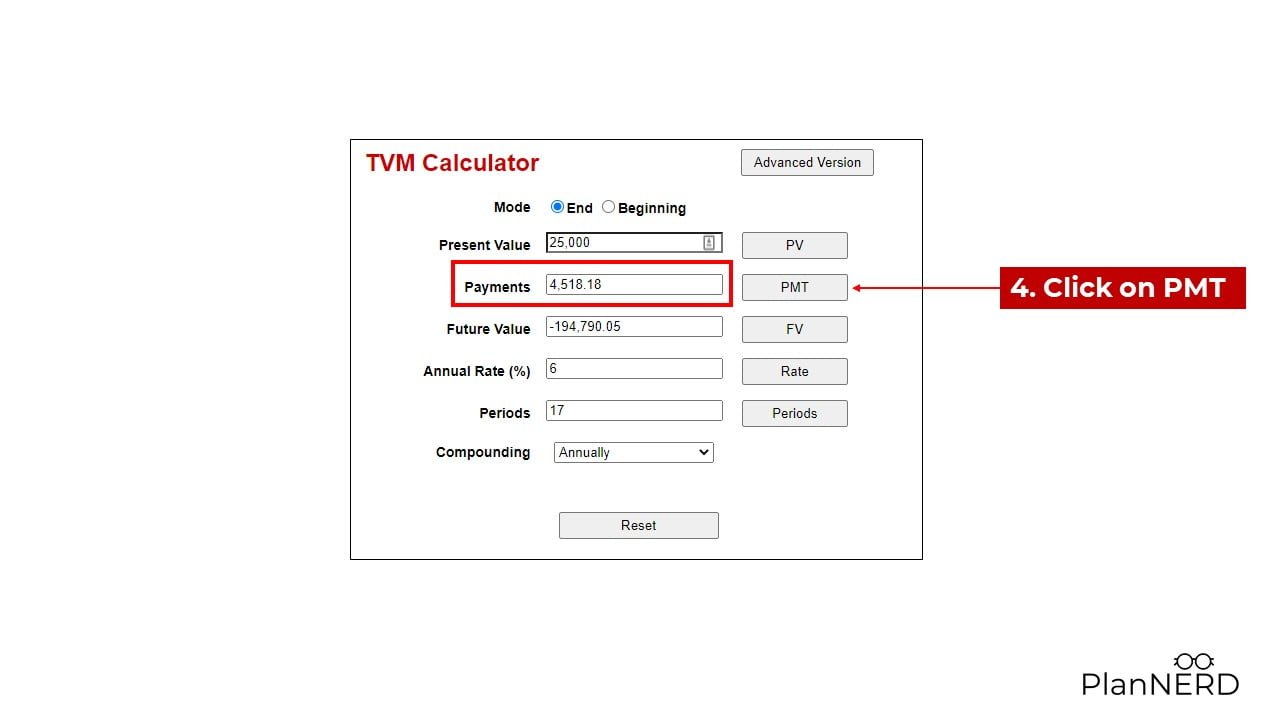
    (iv) Click on ‘PMT’

    pmt table to show the calculation flow under children's education planning

    The last step is to click on “PMT” to calculate the amount needed to save/invest every year to cover the shortfall in your children’s education fund.

    In this example, you will need to save RM4,518.18 every year, or roughly RM400 every month (with a return rate of 6%) to send your child to a private university in Malaysia in 17 years.

    4. Choosing the Correct Financial Vehicle

    There are plenty of choices when it comes to choosing an investment vehicle. However, we all know that most investment journeys aren’t going to be smooth sailing all the time, therefore it is very important to follow these three rules of investing:

    Preserve your investment capital

    One important rule that’s applicable in investing for children’s education is to preserve your investment capital. Sometimes, we can allocate a small portion of our portfolio to invest in high-risk investments. However, you don’t want to do that with your children’s education portfolio.

    For example, in order to recover from a 10% loss on an investment, you’ll need to have an 11% gain to return to the original capital position, a 25% loss would require a 33% gain to break even, and so on and so forth.

    There is no such thing as the best investment

    In short, what’s good for me may not necessarily be good for you. Having said that, when it comes to investing for your children’s education, you may want to pay some attention to PTPTN’s National Education Saving Scheme (SSPN). Parents saving money into SSPN-I can enjoy tax relief of up to RM8,000 per year.

    Keep your eyes on the prize

    Lastly, keep your eyes on the prize. Always remember your why. Constantly review your investment strategy to ensure that you don’t receive any unfavourable surprises when your children are approaching the age to register for tertiary education.

    5. Avoid Common Education Planning Pitfalls

    Ignoring retirement planning

    If you’re unable to cover the shortfall as calculated earlier, there are other ways to ensure that your children will receive a decent education, such as applying for an education loan from PTPTN or applying for a local public university.

    However, there are fewer options available if you can’t cover the shortfall in your retirement planning.

    Trusting the wrong ‘advisor’

    Many fraudulent “advisors” use the element of fear and greed in parents to convince them to invest in their unregulated investment products. Should you need the help of a third party in the education planning process, please ensure that you engage a licensed representative.

    Not reviewing savings and investments

    I may sound like a broken record by now but reviewing your investments and portfolio at least once a year is very important. If needed, you should also rebalance your portfolio to ensure they meet the objective of providing X amount of money Y years later.

    Conclusion

    Saving for your children’s education is a long-term goal that may seem like a huge commitment at first. With a carefully planned strategy, and making time your friend instead of your enemy eases the process significantly. No matter how much or little the amount is, start today. The earlier you start, the better the compounding effect will be, because:

    “Compound interest is the eighth wonder of the world. He who understands it, earns it; he who doesn’t, pays it.”

    This article was originally published at planNERD.

    About the author 

    Marshall Wong is a licensed financial planner, and can be contacted through his website or marshallwong@fa.my.

  • Should I Adopt Dollar Cost Averaging?

    Should I Adopt Dollar Cost Averaging?

    There are multiple ways to invest, with one of the more passive ways recommended by many is dollar cost averaging.

    “Dollar-cost averaging (DCA) is an investment strategy in which an investor divides up the total amount to be invested across periodic purchases of a target asset in an effort to reduce the impact of volatility on the overall purchase. The purchases occur regardless of the asset’s price and at regular intervals; in effect, this strategy removes much of the detailed work of attempting to time the market in order to make purchases of equities at the best prices.” – Investopedia

    At the core of the fancy lingo used above, it means you put a fixed amount daily/monthly/yearly into a certain investment so that you average out your buy-in price.

    Think of it like gardening where you need to tend to the plants regularly and conscientiously in hopes that it will grow well.

    Dollar-cost Averaging Illustration

    For example, let’s say you’re buying into a Real Estate Investment Trust (REIT) counter on any market in Malaysia. Why? Because in most cases, it gives you steady dividends and that’s why it’s a good place to exercise dollar cost averaging.

    Assume that you allocate RM500 per month to contribute to REIT 1. Every month you diligently buy up RM500 worth of shares in REIT 1.

    I want to present two scenarios here.

    If the prices go up monthly by 10 sen:

      Amount Invested Cumulative Investment Price Investment Value % Gain
    Month 1 500 500 1 500
    Month 2 500 1,000 1.10 1,050 5%
    Month 3 500 1,500 1.20 1,646 10%
    Month 4 500 2,000 1.30 2,283 14%
    Month 5 500 2,500 1.40 2,958 18%
    Month 6 500 3,000 1.50 3,670 22%

    If the prices go down monthly by 10 sen:

      Amount Invested Cumulative Investment Price Investment Value % Loss
    Month 1 500 500 1 500
    Month 2 500 1,000 0.90 950 5%
    Month 3 500 1,500 0.80 1,345 10%
    Month 4 500 2,000 0.70 1,677 16%
    Month 5 500 2,500 0.60 1,937 23%
    Month 6 500 3,000 0.50 2,114 30%

    Can you see the effect it has?

    Pros and Cons of Dollar Cost Averaging

    As you can see in the illustration above, with a 50% increase/decrease in the stock price by month six, the total returns/losses are reduced.

    Yes, it’s a double-edged sword. You minimise your potential losses and hopefully when it rebounds, you’ll get more returns. However, you also lose the full upside if the stock goes up in price.

    The other potential risk here is that in most dollar cost averaging mechanisms, you set a fixed time in a month to invest that sum, such as the start or end of the month, when your salary is in etc. The issue here is that you could also be unlucky in that every time it’s time to invest, it’s at the higher price point for the month. That’s not fantastic but luck does play a part.

    Then why do people recommend dollar cost averaging? If I were to guess, it’s because it gives people the “sense of calmness” that you don’t need to worry about the market’s ups and downs and just need to periodically invest a sum like clockwork.

    I must add on that this was also popularised by mutual funds. At least, that’s where I heard this method being used the most, but I’m sceptical as they’re partially motivated by the sales charge.

    Which brings me to… the case of commissions that we’re paying for any investments (depending on the amount). By doing a monthly dollar cost averaging investment, we’re technically paying 12 times a year at the highest commission rate (in most cases due to smaller investment size).

    With that said, I do think there are uses for dollar cost averaging.

    What Do I Use Dollar Cost Averaging On?

    My journey on dollar cost averaging began with mutual funds. I’ve tried dollar cost averaging via direct debit on mutual funds a long time ago. The market was going up monthly and hence my cost was averaging up. Then one fine day the market decided to take a dip. That’s when I realised that the amount I’ve invested thus far actually suffered a much bigger loss due to my average cost being higher. Hence, I stopped doing dollar cost averaging.

    Another asset that I’ve used dollar cost averaging on is bond funds via robo-advisors because their prices rarely fluctuate too much, but currently the only other investment asset that I practice dollar cost averaging on is gold.

    Averaging Down vs Dollar Cost Averaging

    What I prefer is to use the concept of “averaging down” in my investments.

    I can’t control how the market moves and whether the prices will go up or down after I invest. What I can control is how and when I invest.

    My approach is to always keep a basket of potential stocks in my watchlist. With this shortlist of stocks, I can then monitor where prices are heading. Rather than investing into a stock or any asset when the prices are up, I’d only invest when the prices fall to a target price.

    When investing in a stock or asset, it’s possible that the price will fall below the invested prices. This is where averaging down shines as it takes on the benefit of dollar cost averaging to minimise losses and amplifies the profits via more investment in the particular asset. This is on the assumption that you’re investing in a fundamentally strong asset whereby prices will eventually turn around. However, it could take years in some cases, so patience is needed.

    If prices are above my invested price, then I’d only think about when to realise that investment into profits. I’d seldom add on unless there is a particularly compelling reason to do so and would rather scour my watchlist for other stocks to invest in instead.

    This approach is obviously not too relevant for short term traders but can be beneficial to the long term investors.

    But how about non-stock related investments?

    Modified Dollar Cost Averaging

    For assets such as robo-advisors, bond funds and gold, I do recommend the use of some form of dollar cost averaging. However, I’d keep the monthly amount small.

    Upfront I will invest a lump sum amount and when prices fall substantially, I’ll average down again with a lump sum amount. Hence, I keep a close eye on the prices of these investments and have a ready cash pile to go in when prices are right.

    This is my take on dollar cost averaging. I don’t use a straight up dollar cost averaging strategy as I believe with some active management, I can reap more benefits from my investments.

    About the author

    This article was originally published at betweenthemoney.com, a personal finance website by Jason Loh that focuses on money matters and investment topics for Malaysians

  • Does Value Investing Work?

    Does Value Investing Work?

    For decades, value investing has been popular with financial luminaries like Ben Graham and Warren Buffett, who is arguably the most famous investor in the world. Buffett is renowned for his investing style which is “value investing”. Many are curious about what value investing is and whether the concept still works in an environment where the Covid-19 pandemic is plaguing the whole world.

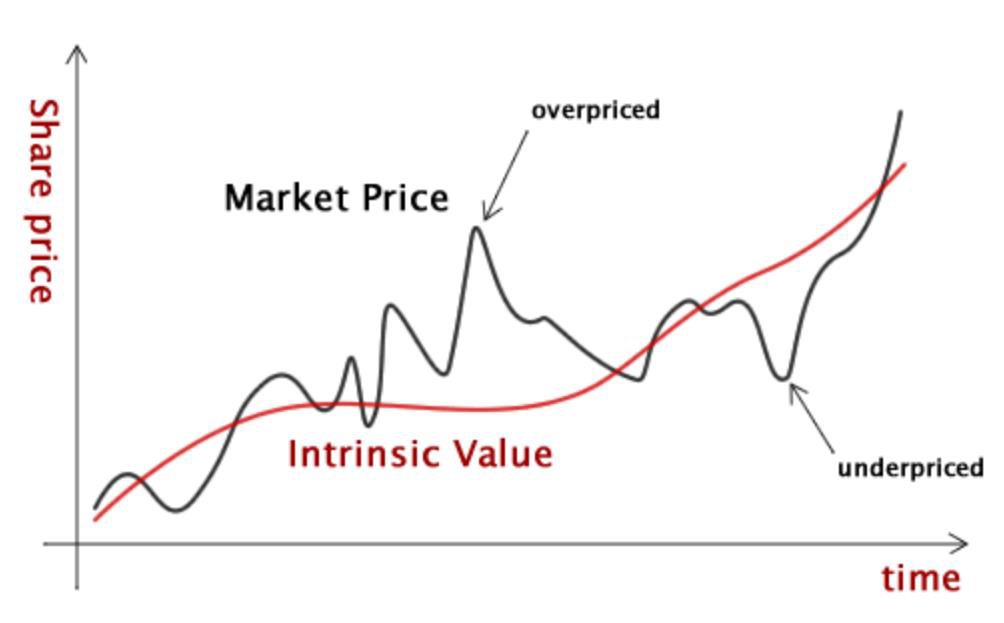
    Firstly, investors must understand how value investing works. In layman terms, value investing is a strategy for taking advantage of the market at the right moment. It’s based on the idea of “appraising” stocks, with value investing advocating hunting for stocks that are undervalued based on their “intrinsic value”, before buying them, holding them and weathering the volatility of the market. In theory, a company’s stock value should be the same as its market price but in many cases, this doesn’t hold true. It’s possible that stocks could be overvalued and at other times, it’s undervalued.

    To carry out this strategy, the investor will be required to analyse the company’s fundamentals and project the future profits that the business is going to generate in its lifetime and with that the investor is able to assess whether the company is underestimated in the market or not. If so, you get to buy its stocks at a bargain in the hopes that the market will turn in their favour over the long run. These value stocks are being sold below their intrinsic value and have huge potential to grow in the future when the price is adjusted accordingly.

    Although the concept seems simple, value investing is extremely difficult to implement properly and requires rigorous analysis to determine what the “underlying value” of a stock is. In today’s environment, investors must consider geopolitical factors, fiscal or monetary policies, currency, business model, supply and demand of the company’s services or products, and other underlying factors.

    stock analytic chart

    Understanding Value Investing is Vital before Making any Investments

    If you look at the chart above, the red line indicates the company’s potential or intrinsic value. In the beginning, due to its low value, the market misinterpreted the situation and quickly undervalued its stock. Value investors wait for this golden opportunity to buy the shares at a discounted price. They know the company has future growth potential. Then, they sell their stock when the market price is overvalued, earning them a nice, big profit. 

    For example, let’s take Microsoft whose product is widely used and accounts for 76.56% share of its industry as of December 2020 according to Statista.com and has about 1.5 billion active users worldwide. On average, its net income margin is about 25% per year and it consistently manages to turn over healthy profits. Despite the Covid-19 outbreak, its products were still massively used but during the pandemic selloff in March 2020, it lost about 25% of its share value. 

    Putting the factor of the COVID-19 outbreak aside, this company maintained good, continuous growth, and its share value grew about 23,000% in the last 30 years. Using the value investing strategy, one will see a huge opportunity in this company due to its nature of business, as well as the demand for its service and product continuing even during a pandemic. 

    (*Note: This should not be taken as financial advice or a buy recommendation.)

    Like all investment strategies, patience and diligence to stick to the investment philosophy is a requirement. There will be days when an investor may want to purchase some stocks because the fundamentals are sound, but he or she may have to wait if it’s overpriced at that time.

    If investors are unable to properly carry out this strategy themselves or commit to the time needed to invest themselves, it’s always advisable for them to seek for professional advice or seek a proper licensed financial planner or financial advisor to assist them. These professionals will be able to offer advice according to the investors’ risk appetite, goals and objectives. Other factors will also be used to evaluate the investors’ current financial condition before such advice is given.

    Conclusion

    Therefore, do buy the stock that is most attractively priced at that moment, and if there is none that meets the criteria, just sit and wait and let the cash sit idle until an opportunity arises. The bottom line is, value investing is a long-term strategy, it requires hard, there is no short cut and it works as Warren Buffett is still a devoted advocate of this strategy.

    About the author 

    Alex Ng Wern Ping is a licensed financial planner, and can be contacted at alexng.alpineadvisory@gmail.com.

  • A Guide on Applying for A Housing Loan in Malaysia

    A Guide on Applying for A Housing Loan in Malaysia

    “Your loan application has been rejected.” If you had this said to you when you applied for a housing loan in Malaysia, then read on.

    Getting this response to your mortgage loan may be daunting and make you feel like a lost cause but don’t give up hope! There are several ways to navigate the murky waters of mortgage loan application – here are some points to look into to maximise your odds of obtaining approval for future mortgage loan applications:

    1. Check Your Debt Service Ratio

    This is one of the preliminary checks for financial institutions, with your debt service ratio (DSR) used to determine whether you’re able to afford the loan repayments. If the DSR is within their threshold given a range of income, it passes one stage of the mortgage loan application.

    The formula to calculate DSR is:

    DSR = Total monthly liability commitments / total monthly nett income

    Monthly Net income = Gross Income – Total Deductions (EPF, SOCSO, tax etc)

    Monthly Commitments = new loan application amount + car loan + personal loan + credit cards + mortgage loan

    Once the DSR has been determined, each bank will have their respective guidelines for the maximum allowable DSR threshold given a range of incomes.

    It’s typically determined by income level, but it may also be affected by your net worth and even things as arbitrary as educational background, age and nature of employment and sector.

    For example, some banks may recognise 100% of investment property rental income, and some may only consider 50% of the rental income.

    The calculation may differ also when it comes to variable income earners and the nature of the job. For instance some banks may take 80% of the six-month average income of an insurance agent, while others may take only 60%.

    2. Get Your Documents in Order

    Banks always look for a clear and complete set of documents for assessment. For any bank to process any mortgage or loan application, they require supporting documents including proof to validate your income sources and employment.

    For a salaried employee, the banks would like to see that you contribute to EPF and your income taxes via your payslips and tax submissions.

    For variable income earners, do keep a record of at least six months’ worth of income/payout statements and supporting transactions into your bank account(s).

    For the self-employed or business owners, ensure that your business documentation and accounting of bank balances are up to date as this will assist the loan officer to get any loans approved. In most cases, the bank would like to see a business with at least two to three years of operations supported by audited profit and loss and bank statement transactions to evaluate the ability to service the loan.

    3. Don’t Apply for Loans Immediately

    If you are a fresh graduate looking to submit a bank loan application, don’t apply immediately for a mortgage or credit facility once you receive your first payslip.

    While it may be tempting to get on the credit ladder, banks typically want to see a minimum of three to six months of permanent employment supported by your salary payslip, along with EPF and tax deductions (if applicable). 

    In the case of the self-employed or commission earners, banks look for stability in income and usually need to see a minimum of six months of payments to be certain that you can service the loan.

    4. Don’t Go Bankrupt!

    It goes without saying but if you are declared bankrupt, you won’t be able to secure any loans or credit facilities with any financial institution. Your status of bankruptcy can be obtained by checking the Malaysian Department of Insolvency (MDI) or searching on CTOS.

    5. Issuing Bad Cheques

    If cheques that you issue bounce back three times, this is a huge red flag. A bad cheque is commonly referred to as a bounced cheque, and refers to a cheque issued by an account holder, dishonoured and returned by the drawee bank when it is issued from an account with insufficient balances or a blacklisted account under the Credit Bureau by Bank Negara Malaysia. 

    Banks usually view this as a precautionary signal and will reject the mortgage loan application and other pending loan applications.

    6. Maintain a Good Credit Score

    Maintaining a good record and positive status in CCRIS and CTOS is essential. Banks use CCRIS and CTOS as a reference to evaluate credit pattern behaviours and adverse reporting that will illustrate credit payment ability and servicing financial commitments.

    The Central Credit Reference Information System (CCRIS) is a system created by Bank Negara Malaysia that maintains the repayment track record for the last 12 months of all credit facilities of participating financial institutions in Malaysia.

    Any late payment or prolonged late payments of over six months will be flagged as a “Special Attention “ account in CCRIS. This indicates a red flag for banks.

    CTOS is a privately-owned credit reporting agency that provides credit reporting and also has access to information such as bankruptcy, legal action and case statuses, individual’s business ownerships, shareholding and directorships.

    They can also retrieve information from utility and telecommunication companies if you have outstanding bills (even if it’s only RM50!) and which can be a cause for banks to reject your loan application!

    7. Ensure your Quantitative Elements are Solid

    In this day and age, every bank has its own algorithm and software to calculate an individual’s score. This can be a subjective matter as software calculates the scoring according to quantitative and qualitative elements, which may not be the same as the algorithm and systems used by other banks.

    The quantitative elements include DSR calculation, the net worth of an individual or profit and loss of a company and also refers to CCRIS records. Qualitative elements include factors such as age and educational background.

    Your score will differ across each bank as they use different algorithms and systems. As a mortgage loan applicant, you can improve your profile by ensuring the quantitative aspects are covered and within their requirements.

    8. Not Having Any Credit History

    A poor credit score is not the only reason lenders reject mortgage loan applications. Having no credit history makes banks uncertain of your ability to pay.

    It’s advisable to build up a clean credit history, and it’s normally best to start this by applying for a credit card application or taking up a small loan. 

    With a smaller credit card facility or loan (that is consistently paid!), this may create a higher approval rate for your mortgage loan in the future because the perceived chances of defaulting on payment are lower.

    9. Late Payment of Instalments

    A poor track record of loan repayments gives a bad impression to potential lenders and might impact your future application. So try your best not to be late and settle your credit card bills, car loan instalments and other commitments on time.

    One way to do this is to set a payment reminder on your calendar or other forms of reminders on your mobile devices.

    10. Bank Risk Appetite

    Lastly, it is important to note that all banks have different risk appetites. There are instances where a bank has their own non-preferred segments; this could include people working in a niche industry, not meeting the minimum age, or not having a strong educational background requirement.

    You may get rejected for holding too many credit cards and you may also get rejected for not holding any credit card. In addition, a rejection could also be due to the mortgage financing not being within their particular area, developer, property type or market segment.

    Treat applying for any mortgage or loan like you’re going for a job interview. With a little financial planning help in money management, preparation of supporting documents and maintaining a clean profile in CCRIS and CTOS you stand a better chance of getting your mortgage loan approved by the right bank.

    About the Author

    Rozanna Rashid is a Licensed Financial Planner (CFP, IFP) that has an MSc in Real Estate Economics & Finance from the London School of Economics & Political Science. Her background is in corporate banking and Islamic finance and she can be contacted at rozanna@alpine-advisory.com


  • The Importance of Financial Planning

    The Importance of Financial Planning

    Have you ever thought about what would happen if Malaysia’s government re-implements the Movement Control Order (MCO)? With the upward trend of Covid-19 cases in Malaysia, this is a big possibility.

    Be honest for a second – are you well-prepared for the next MCO? Many seasoned working adults in Malaysia are struggling to manage their cash flow, let alone fresh graduates or youths.

    This highlights the importance of financial planning and being financially literate from an early age.

    A survey conducted by AKPK in 2019 shows that only 24% of Malaysians are able to survive on their savings for up to three months, while just 10% are able to sustain for six months or more!

    Are you among the 76% of Malaysians who won’t be able to cover expenses for more than three months? If so, what can you do to improve your cash flow?

    Differentiate between “needs” and “wants”

    Many Malaysians lack financial knowledge in general, especially in the area of financial planning. A study conducted by the Financial Education Network (FEN) showed that Malaysians are not confident about their own financial knowledge.

    Although 76% have set a personal budget, two out of five people were unable to stick to it. 

    In addition, one in every five Malaysian working adults couldn’t save any income in the last six months, while three in every 10 needed to borrow money to buy essential goods.

    In other words, these people had to rely on credit cards, government incentives or even loans just to buy food!

    To restructure your personal finances, you must learn how to differentiate between ‘needs’ and ‘wants’. For example, food, rent, petrol and insurance fall under needs.

    Conversely coffee, streaming services, the latest smartphones, and other luxury goods are not necessary to survive. If you are spending more on wants than needs, you should consider reviewing your cash flow and potentially cut down on luxury expenses.

    You could explore carpooling or taking public transport, or cooking at home to reduce spending on dining outside.

    Make saving a habit

    The rising cost of living in Malaysia, especially in cities, has forced many young working adults to become more frugal.

    Even with extra jobs, many are still unable to allocate any earnings to their savings, with a 2017 Bank Negara Malaysia survey revealing that 75% of the Malaysians are unable to raise RM1,000 in emergencies. 

    Due to poor saving habits, many youngsters rely heavily on credit cards to finance their needs and wants. As a result, they may fall deeper and deeper into credit card debt. When they fail to settle their balance, it becomes a debt that carries forward to the next month’s bill with compounded daily interest. In simple terms, they’re spending their future income in order to support their lifestyle.

    When planning your personal finances, I strongly encourage you to set a budget and always keep track of your expenses, and avoid using a credit card if possible. Below is a rough allocation budget I would recommend:

    30% Savings and investment
    50% Necessities
    10% Commitments
    10% Insurance and protection
    100% Total take home income

    It is advisable to allocate at least 10% to 30% of your income to savings and investments. These savings serve as emergency funds for you to cover the cost of getting sick, accidents and more.

    You should also look into exploring small investments that can help to grow their wealth. I highly recommend that you save or invest before spending so that you won’t spend all your income. 

    Do also allocate at least 10% of your income for commitments such as PTPTN loans to reduce the principal and compounded interest. Another 10% should be allocated for protection, as you are human and unable to foresee unfortunate incidents in your future.

    By purchasing insurance, this offers peace of mind and a reduction of your financial burden during times of sicknesses or unfortunate events.

    If it’s too good to be true, it probably is!

    High-return investments always sound good on paper, which is why it continues to attract many people, young and old alike. However, if you aren’t able to self-engage in comprehensive and thorough financial planning, you may lack a clear understanding of financial risks and returns.

    This makes you prone to errors of judgment, which leads to high-risk or unwise financial decisions. 

    It’s very easy to fall into investment traps and suffer huge losses. Many are also jumping into the deep end of trading in forex and bitcoin, or worse still – pyramid schemes and other scams.

    Without proper financial planning or knowledge and understanding, it’s easy to be misled by shiny numbers and figures without considering the risk or feasibility of such schemes.

    Don’t be susceptible to financial traps and irrational financial decisions – read and learn everything you can about investing before jumping in to avoid becoming another statistic.

    In a nutshell, it’s incredibly important for you to learn how to manage your cash flow and have your own simplified financial plan.

    By better understanding your cash flow analysis, you can re-allocate your income wisely.

    Always remember to save before you spend and understand the financial risks and returns before investing into anything. Be sure to avoid investing in platforms or schemes that aren’t legally recognised by the Securities Commission Malaysia

    Finally, remember that it’s never too early to start your financial planning journey!

    About the Author

    Edmond Tang Zhen Han is a certified financial planner that is passionate about helping people achieve financial literacy in order for them to reach financial freedom. He can be contacted at edmondtangzh@genexus.com.my