While a freehold land refers to a land title in perpetuity which, in most cases, is the most preferred type of land title to own, a leasehold land means that you just have a lease from the freeholder to use the land for a number of years, which can range from 30 years to even 999 years.
In most parts of Petaling Jaya, the authorities have extended leases for another term. The extension of leases for leasehold properties is governed under section 197 of the National Land Code (Act 56 of 1965) pertaining to the applications for approval of surrender of the whole of the land, as well as the land rules of the various states (for the state of Selangor, the extension of a lease is governed by the Selangor Land Rules 2003 and Selangor Quarry Rules 2003).
There is also another type of property built on private leases of similar tenures to that of government leasehold. This type of lease poses more challenges for buyers as the owners of the land are private parties and they do not have renewal or lease extension in the same manner as the government.
In addition, there is also the case of Malay Reserve Land (MRL) vs Bumi Lots. While it is quite common to think that both are the same, in reality, they are not. Properties developed on Malay Reserved Land can only be owned by Malays and are governed under the Malay Reservation Enactment. Malay owners are not allowed to sell the properties built on MRLs or the lands themselves to non-Malays. Businesses operated on MRLS must be owned by Malays.
Bumi Lots, meanwhile, are units of land or property which can only be purchased and owned by Bumiputeras. To some, this means a more restricted market whereby you can only resell your property to another Bumiputera. There are, however, incidences where a transfer can be made to a non-bumi, although this is subject to approval from the authority.
“Bumi Quota” is also another term commonly used when developers market new projects, and this is again not to be confused with Bumi Lots. Under the New Economic Policy (NEP), this was introduced to increase Bumiputera shares in real estate to at least 30%. However, depending on locality, this percentage differs. Bumi Quota can also be released and is subject to the fulfilment of conditions.
There is a prevailing misconception about how takaful is simply the Islamic version of conventional insurance, and is therefore only available for Muslims. This is, however, inaccurate.
Takaful provides similar protection products as conventional insurance, and is open to anyone regardless of religion or creed.
What is Takaful?
Takaful is essentially a Shariah-compliant insurance option that is grounded in Islamic Muamalat (Islamic transaction) principles, and share the same objective of providing protection against financial loss in the event of misfortune that occur from an accident, loss or damage to property, hospitalisation, critical illness, disablement or even death.
The term ‘takaful’ is derived from the Arabic word ‘kafala’ which simply means “to guarantee; to help; to take care of one’s needs”. The term also refers to the concept of Islamic insurance that is based on the Islamic principles of mutual assistance (ta’awun) and donation (tabarru’), where the takaful participants donate their money into a takaful fund that will be used to provide mutual financial benefits.
Similar to conventional insurance, there is an array of Shariah-compliant products under takaful which includes life, health, motor, home and travel insurance as well as many other types of protections.
While there are many similarities between Takaful and conventional insurance, a takaful company ensures that its products and operations are in accordance to Shariah principles. The key difference is in fact the underlying contractual relationship between the takaful operator and the customer.
An insurance contract mainly involves the purchase of a product or a service from the insurance company where the insurance risk is transferred to the insurance company.
Under a takaful contract, on the other hand, the customer undertakes a contract (aqad) to become one of the participants by agreeing to make a donation (tabarru’) to participate in the takaful risk pool fund for claims payment should any of the participants suffer from a defined loss, and appoints the takaful operator to manage the takaful fund.
An important feature of takaful is that the takaful risk fund is owned by participants, and therefore, the risk is shared among them and any surplus will also be retained within the fund or in some cases, distributed back to participants. The takaful operator, too, may be entitled to a share in the risk fund surplus.
The takaful operator is mainly remunerated based on wakalah (agency) fee. The tabarru’ amount and the wakalah fees are stipulated in the certificate contract, which promotes transparency to the customers.
As such, takaful funds are managed in accordance to Shariah, and invested in Shariah compliant assets, while the Shariah committee oversees the activities of the takaful operator to ensure that they are Shariah-compliant.
Takaful in Malaysia
Taking into account the current low penetration rate, rising standards of living, escalating medical costs and ageing population in addition to the robust growth in the Islamic banking and finance sectors, the long-term outlook for the takaful sector in Malaysia remains positive.
The development of the takaful industry is set to remain on a positive note in tandem with the government’s ongoing initiatives to spur the demand for protection among consumers.
The key component in driving growth in a competitive environment especially during the pandemic situation, is digitalisation. As such, takaful operators will continue to incorporate digital capabilities into their business models and marketing approaches to stay competitive in the market.
Within the Malaysian takaful industry sphere, the takaful operators continue with concerted efforts in enhancing awareness on takaful and in providing protection plans suitable for every segment of the society to increase the takaful penetration rate.
These initiatives include strengthening the professionalism of takaful agents, intensifying awareness and interactive programmes for the consumers as well as the introduction as well as the introduction of value propositions by embracing the concept of value-based intermediation.
Despite the cautious business sentiment, the Malaysian takaful industry is expected to remain resilient. The regulatory body, along with the takaful industry players, will continue to introduce and implement various initiatives to further promote the development of the takaful sector.
Sometimes people tend to wonder what we can do with the surplus cash that we have at hand. Well, as a start, it is good that there is a surplus in cash, but if we are not careful this surplus may be gone before we even realize and by then it could be too late to think about “what-ifs” and “I-should-haves”.
In financial management, there are parameters that can be used to gauge if one is “financially healthy”. Here are few basic financial ratios one can use to gain better understanding of their state of personal finance:
Liquidity Ratio: This measures one’s ability to cover unforeseen expenses such as emergencies, car repairs, job loss, etc.
Debt to Asset Ratio: If there is an solvency issue, you must have assets to cover your debt obligations. If your debt value is too high compared to asset values, then even if you sold off all assets, it may still lead to bankruptcy.
Liquid Asset to Net Worth Ratio: Consider how much of your assets are liquid or “moveable”?
Savings Ratio: You should be able to save at least 10% of your income each month to go towards your retirement.
Liquidity Ratio
Should a person have a very low liquidity ratio, the first thing he or she needs to do is to start saving money for a rainy day (the amount of which is measured by one’s liquidity ratio). Don’t think about paying off debts (except to service scheduled repayment), and investing at this point should be the last thing on this person’s mind.
Debt to Asset Ratio
If you have a good liquidity ratio (healthy savings) but also have high debt to asset ratio, then you are advised to pare down some of your debts. For instance, a person may have a huge positive net worth, but most of this comes from immovable assets such as real properties. If this is the case, this person should consider increasing the proportion of movable assets by investing in other paper assets such as stocks or fixed incomes to diversify and also to provide some liquidity to the balance sheet.
Savings Ratio
Savings ratio is quite easy to measure, but if you cannot save any money you bring home, then obviously you have a lifestyle or income problem. You need to tackle that first before thinking about putting your money to work hard for you.
See the Big Picture
What I advocate as a financial planner is that no matter what we decide, we must see the bigger picture, the bigger picture being a person’s life, and what he wants out of it. It is important that our decision correlates and supports our aspirations, and if a decision does not derail our goals and dreams but brings us nearer to them, then this is the right thing to do.
In financial terminology, financial planning is described as a systematic process to organize our finance to help achieve our life goals. That being said, any amount on top of the threshold a person feels comfortable treating as their rainy-day fund should be put to work via investments.
Depending on your marital status, income sensitivity or fragility, health condition, and so on, it is rather advisable to have emergency funds worth at least six months of your take-home income (some will say six months of monthly expenses but I would strongly suggest you look to your take-home income as it is more conservative).
If you would like to strengthen your foundation, you may even create an emergency fund that is worth six months or more of your take-home income plus your loan repayment commitment for an additional 12 months. This will help make sure you avoid defaulting or failing to repay your loan obligations.
Of course, it is rather impossible to save enough to help cover emergencies such as serious diseases and so on. This is why you need to be aware of risks and potential losses and take up insurance. After saving enough to feel comfortable and at peace, you must then invest the surplus and let it work for you. Be a master of your cash; not a servant to it.
About the author
Kevin Neoh is a NextGen Money Coach who works with people to help them transform their relationship with money to improve their lives with the money they have. Kevin can be contacted at kevin@nextgenadvisors.my and www.kevinneoh.my.
This is a story about Andy and Amy (not their real names). Andy is an enthusiastic entrepreneur with a reputable position in his industry. A successful man and earning a good income, however, his expenses were high as well.
After marrying Amy, he became stressed with his finances, which worsened with the birth of their first child. The pressure of the monthly deficit of approximately RM2,000 and worrying about the future expenses triggered the couple to engage our services. I was then able to we help them through with our holistic financial planning service.
Andy and Amy have different attitudes towards managing their personal finances. Andy is a very positive person who anticipates that good things will happen in life as long as he strives for it. “Tell me what I need to do and I’ll make it happen!” is his favourite motto.
He applied this attitude to his finances, which often resulted in him committing to things he cannot afford today, but with the conviction that he will be able to grow his income and pay for it in the future.
Amy is almost the polar opposite when it comes to money. She’s cautious and prefers to plan ahead and be prepared for the worst situation. Indeed, the desire for a more secure future was amplified after having a child. A clear visual reality of their current family’s financial situation was provided to them through our holistic financial planning process.
The hard facts and numbers seemed ruthless but it showed them the gap between their goals (purchasing a bigger home, tertiary education funding, retirement security, etc.) and their available resources.
In addition to the risk of not being able to achieve their desired goals, as a single income family with a child, there were other potential risks that needed to be addressed, such as Andy’s insufficient insurance coverage for the family’s income needs (should something untoward happen to him) and the lack of estate planning tools in place to safeguard his family.
We helped Andy and Amy tidy up their cashflow, focusing on their expenses as there were many loopholes and excesses that could be avoided or minimised with good budgeting. For example, we noticed the huge amount spent on dining out and impulse purchases. During the financial planning process, there were some unavoidable differences of opinions between the couple, but fortunately we were able to help them manage their expectations and bring them to work together towards their common goals.
The role of a financial planner is unique. We not only provide clients with relevant and timely financial advice, but we also take on the responsibility of educating them to cultivate good financial habits. In this case, tracking their monthly family budget and inculcating a habit of saving before spending were their immediate priorities.
Trust me when I say that financial planning is a long journey. We help clients understand their current financial situation and plan for their fi nancial future. But as circumstances change over the years, we also need to accompany them as they make major financial decisions in their life, and keep them updated on the latest happenings along the way.
Although Andy and Amy are still striving to be more financially stable after their first year of engagement with our service, their progress have been remarkable as their finances are now more organised. They were able to address their immediate gaps and started adopting good fi nancial habits.
These new habits will help them form a strong and healthy foundation as they work towards their goal of achieving financial freedom.
About the Author
Ocean Pon is a Licensed Financial Planner with Finwealth Management Sdn Bhd.
We at Smart Investor and Finwealth is committed to help you better manage your financials. Get a free consultation from an expert by filling in your details here: https://www.smartinvestor.com.my/SIxFinwealth
If the pandemic has taught us anything, it is to be prepared for everything. Many of us in the financial services sector rely heavily on physical meetings, physical workshops, and physical consultations. However, in less than three months of Movement Control Order (MCO), it has forced everyone to communicate through the internet.
Despite the limitations to video conferencing, the quick adoption of technology has allowed us as financial practitioners to reach out to our clients and prospects in a way that has never been done before.
Don’t get me wrong, I am not saying that we should ditch all our offline efforts and focus 100% online. We are still required to meet our clients offline for the physical connection and trust because it is harder to build trust among advisors and clients over the internet.
Having an online presence is very important especially during this time and age as we humans spend more and more time online. Therefore, it is important to start building your online profile, just like how you would do building your reputation through word of mouth.
Here, I am going to share my experience building my online presence.
Step 1: Building Your e-Office – The Website
I believe that the website is the most important element if you want to build your online presence for your business because this is the place where your clients will come to understand more about you.
Although the company I work with already has one, I created my own website to better control the description and provide more in-depth information about myself and the services that I offer in order to be more personal and approachable to my clients.
When I first started out, I thought that building a website is going to be very expensive. However, the more I researched, the more I realised that the cost of a simple website is only about RM300 a year (that’s less than RM1 a day). This includes the cost for the domain, hosting and also simple designs.
As you grow your online presence, you may want to add more advanced feature like an appointment system to automate your workload. However, as a start, a simple website is more than enough.
Step 2: (Optional) Create an Email Address with Your Domain
This is an optional step. If you are using your company’s email, that is great. However, if you are using free email address domains such as @gmail.com, @hotmail.com or @yahoo.com, you probably should start thinking about having your own email address.
Having your own email address gives the impression that you mean business. You can get this for free if you have your own domain, but personally, I am using Gsuite for business which cost me around RM25 a month.
Step 3: Creating Content
I started by setting up a blog as I feel more comfortable writing. However, you can replace articles with pictures, infographics, or videos. Contents are basically an opportunity for your potential clients to get a glimpse of your services and get to know you better.
Make sure that you are providing a fresh experience for your clients every time they visit your website by creating content regularly.
Step 4: Open the Doors of Social Media
As they say, go where your customers are. If you provide service to businesses, you may want to use LinkedIn. Meanwhile, retail customers usually hang out on Facebook, Instagram, or probably TikTok.
I used to believe that having a social media page is enough, but the downside of having a social media page without a website is that you need to be constantly creating contents in a very fast pace as you are competing with other content creators.
However, if you have your own website, it is easier for your visitors to search for a certain article/content. You can also set your own routine as no one else is competing with you on your website. Having a website is also like a repository system where you can repost old articles on social media during your downtime.
Step 5: Engage, Interact and Nurture Relationships
This is arguably the most important step. The good news is, this is no different than what you are already doing offline. Just like building trust between you and your clients, you also want to nurture the relationship with your audience.
You can do this by asking questions and running polls. You should also be answering your audience’s questions or responding to their comments. Make sure to toggle the right settings that will allow you to receive notifications if someone leaves you a message or comment on social media.
To Sum Up
Like it or not, building an online presence is more important now than ever. But it doesn’t have to be very complicated.
The setup of what is needed for your online presence is actually more affordable than what you would think. However, the tough part is actually Step 5, but hey, isn’t that part of your daily activity already?
The only difference is that you do not have waste one to two hours of your time to get dressed up, drive out and go around in circles look for a parking spot just to meet up with one client.
About the Author
Marshall Wong is a financial planner holding licenses from the Securities Commission Malaysia and Bank Negara Malaysia. He can be contacted via email at Marshall@plannerd.io
Having an early, secure retirement is a dream of many, and a small, but growing number of people are striving to turn this dream into reality. The FIRE movement, acronym for Financial Independence, Retire Early, is essentially about aggressively tightening belts, and finding multiple sources of income in order to achieve early financial freedom.
Milieu Insight released the results of their ‘Financial Independent, Retire Early’ study, which aimed to find out how common the FIRE movement is among Southeast Asians, and the steps they are taking to achieve their goal. The survey was conducted in May 2022 with N=1500 employed respondents, aged 18-49 years old, each from Thailand, Singapore, Malaysia, Indonesia, and the Philippines.
Do Southeast Asians want early retirement?
The bulk of respondents expect to retire in their 50s or 60s (62%); Indonesians tend to expect earlier retirement, with only 52% expecting to retire in their 50s or 60s
Retiring early (defined as retiring before 50s) is a possibility for 60% of respondents, but only 14% think that they are on track for early retirement – Singaporeans seem most pessimistic about being able to do so, with only 9% indicating that they are on track
Steps towards early retirement
Most common strategy towards early retirement is regular saving (71%), followed by ‘being careful with how I spend my money’ (63%) and ‘investing’ (63%).
Finding additional employment is much less common (37%) as part of strategy to retire early, but tends to skew towards Thais (54%)
Insurance – one way of investing – is also more common among Singaporeans (56%) and Filipinos (53%)
Perhaps due to vast amount of resources on the Internet, most people are hands-on for retirement planning, with only 31% of those who plan to retire early saying that they have a financial consultant to help plan for retirement
A look at the most common strategies for early retirement: Saving and investing
Among those who save regularly for early retirement, 43% save more than 20% of their incomes
Among those who invest, 36% indicated that more than 20% of their incomes go towards investments
The most common investment types are:
Investment funds (56%)
Stocks (53%)
Real estate (52%)
Cryptocurrency and NFTs, which are gaining momentum but have yet to enter mainstream investing due to their volatility, registers at 41%, and seem to be more popular in Thailand (57%) and the Philippines (54%)
How do people feel about FIRE?
57% feel very or somewhat positive about their journey towards achieving early retirement
Comparing those who are on track to early retirement, and those who are planning to retire early but don’t think they are able to, the former tends to feel more positive about it (83% vs 49% who selected very/somewhat positive)
Methodology
Based on Milieu Insight surveys with N=1500 employed respondents, aged 18-49 years old, each from Thailand, Singapore, Malaysia, Indonesia, and the Philippines, conducted in May 2022.
About Milieu Insight
Milieu Insight is a consumer data and analytics company that connects businesses directly with their target audience. Milieu’s platform offers businesses a wide range of tools for accessing, analyzing, and visualizing high-value and timely consumer opinion data to help power better decision-making and strategy. For more information about Milieu Insight visit: www.mili.eu
Are you worried about your teenage children’s safety, health, social life, future, and education? In addition, they are constantly bombarded by advertisements, online shopping, peer pressure and “Instagram culture”.
Various surveys have shown that Malaysian millennials (aged from mid-20s to 40) have a tough time when it comes to money management:
70% of Malaysian millennials do not live within their means – Asian Institute of Finance, 2015
74% of millennials in Malaysia are struggling to meet day-to-day expenses during the Covid-19 pandemic
53% of Malaysian millennials cannot survive with their savings beyond three months
Lower income millennials spend 48% on food, 27% on entertainment
Looking at the situation above, we should plan forward and ensure that the next generation – our teenagers – will have a better start in money management. Here are three alternative ways parents can teach their teenagers about money management.
1. Joining Them Instead Of Stopping Them
Online shopping has enabled spending like never before, especially during the pandemic. Most teenagers will want to buy and own things if they have the means, although more often than not, such purchases are due to peer influences.
Being the financial provider for teenage children, it is important that as parents, we instill the importance of self-control and wisdom about leisure shopping. Yet, this is the phase where teenagers become more rebellious, it is simply not enough to just tell or nag them. The old saying has never been truer – “If you cannot beat them, join them”.
Go on Shopee or Lazada with them. Teach them about vouchers, free shipping and sales. Or maybe it will be them teaching you instead! Shopping online with them has its benefits, such as:
Bonding time and relationship building with your child
Slotting in some advice about quality vs quantity, self-control and impulsive buying behaviour
Monitor your teenagers’ shopping behaviour, what is in their shopping cart, wishlist and their shopping history
Share your experience and mistakes about shopping and spending
2. Give Praise And Advice
It is so true, that it must be repeated again. Teenagers are rebellious creatures!
Nagging and telling them what to do just will not cut it. It did not work for teenagers during the 80s, 90s, and 2,000s and it certainly will not work today. However, they do seek your approval and appreciation, especially on things of importance to them. We often hear “my parents do not understand me” or “my parents are just not cool”. One way to avoid such comments are to acknowledge and sometimes praise what they are doing right (or vaguely right) financially.
“Boy, it looks like you did not spend too much money at the mall today. Good job!”
“Girl, you really found a real bargain with the dress you bought online. You certainly know how to shop.”
After praise is given, teenagers will be more receptive towards advice. The acknowledgement that they did something right, gives them a sense of pride, and the urge to do it better.
3. Let Them Make Mistakes
If you recall how you sharpened your money management skills, more often than not, it was not taught or told by your own parents. You learnt them either by experience, hardships, or through mistakes that you have made. Depending on your generation, we grew up in a different time and culture than the teenagers of today.
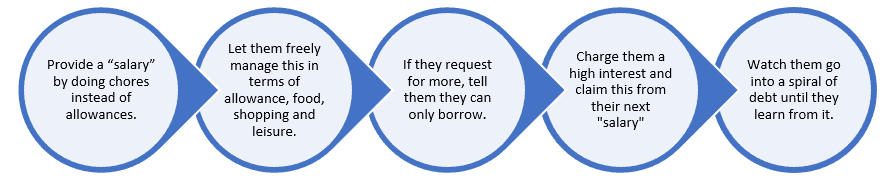
One way that we can teach our teenage children about money management is not by teaching or telling, but by letting them experience mistakes of their own. Here are ways you can set the stage for your teenagers to learn some money management:
The salary and lending method
The delayed gratification lesson
We are spoilt with instant gratification. What we want, we can get it very fast, if not, almost instantly. Think Netflix (movies), Grab (food/transport), Shopee/Lazada (shopping) and WhatsApp (communication). The Generation-Z of today are born into a life of instant gratification. However, the culture of savings and investments are more often than not, a slow and disciplined process.
Thus, it is even more crucial that parents practice delayed gratification with teenagers and resist buying things they want versus what they really need. For example, if they ask you to buy something they want (big or small), try and ask them to wait for a few weeks or months. Suggest that if they want it sooner, they have to contribute part of the cost too. You may even notice a change that as time passes, they will realise that the purchase is not worth their allowance, and their desire may even fade.
The compounding interest lesson
Open a bank account for your teenager with some sort of interest element and allocate your teenager’s allowance in it. Alternatively, some e-wallets currently have an interest element as well. This allows them to learn about the compounding effect of interest on interest.
With this method, you can teach them about saving their allowances, and watch their savings grow every month. Take this opportunity to teach them about inflation and other forms of investments that can make their savings grow even faster, such as fixed deposit or a bond fund. Although they are too young to invest into unit trusts themselves as a primary applicant, you can create a joint unit trust account with your teenager being the secondary account holder.
As parents, we do our best to teach our child the important elements in life. Early money management is something that is important and should be deeply rooted into their young minds. However, this is easier said than done as there is only so much we can do as parents.
Their personalities and spending patterns are an amalgamation of a variety of influences, from friends, to TV, to the internet and also by observing their parents’ money behaviour. That said, as parents, we should learn and practice what we preach about healthy money management.
About the Author
Alvin Kwan, CFP CERT TM is the executive director and head of financial planning at Redvest Wealth & Asset Management. He has over 12 years industrial experience in the financial industry, specifically in wealth advisory, private banking and stock broking. He was also a lecturer in areas of investment management, derivatives, and financial markets.
We at Smart Investor and Redvest is committed to help you better manage your financials. Get a free consultation from an expert by filling in your details here: https://www.smartinvestor.com.my/SIxRedvest
Wealth preservation is about managing your assets in such a way to make sure that it does not decrease in value. And after a lifetime of hard work, you want to ensure that as much of your wealth is protected.
Of course, optimising and growing your existing wealth is also a key task unless you plan to work for money all the time.
Wealth, just like your health, must be carefully preserved, and successful planning will help make your wealth last for you and your future generations – in case the unexpected happens.
One of the means that we can ensure our wealth is preserved in case something happens to us is insurance.
Demand for insurance as a low risk wealth management tool has seen a spike in recent years. The approach to insurance is also changing, with people from the middle-income group to wealthy families shifting perceptions on the need to protect their potential future income, as well as preserving their wealth for their next of kin.
When you read that insurance is a good instrument to preserve wealth, what exactly can it help you preserve?
Preserving Your Current And Future Income
The Covid-19 pandemic has made a strong case on the notion that nobody really knows what is coming around the corner.
Just imagine that if you pass away during your good earning years, your family could suffer a severe economic loss as a result of losing your current and future income to support them. In this unfortunate ‘fictional scenario’, your family would still have to pay their regular bills, including mortgage(s) and your outstanding debts.
They will also still have to continue accumulate funds for your family life goals, such as children’s education and retirement funds for your spouse. If you did not insure against this, you may leave your spouse or children in a very tight spot.
Preserving Your Dreams / Life Goals
For some people, this is also as good as preserving your family dreams. In this instance, insurance acts as a financial safety net that helps you financially protect your loved ones.
It also enables them to continue living with minimal worry, especially when large financial burdens like medical bills, mortgage, debts and others would easily change the financial status of your family.
Preserve Lifestyle During Difficult Times
We never know what life has in store for us especially while we are still feeling fit and healthy. No one likes to think that something bad will happen to us, and when something bad does happen, the first thing we usually say is “Oh no, he / she is so young”.
Illnesses and accidents are not age-specific. These are random events that could affect anyone.
But if you could not work due to a serious illness or accident, how would you manage financially? If the worst does happen, insurance helps you to minimise the financial impact on you and your family.
For example, if you need to give up work to recover from illness or if you are permanent disabled, the insurance could be used to help pay the household bills, mortgage, or even supplements, giving you and your family a peace of mind when you need it the most.
Recovery Takes Time
In a good ending, a person who is seriously ill may triumph in the fight against the illness, but, this person may not able to return to work immediately. All of these could incur many costs.
It is kind of heart-breaking to contemplate a situation where you survive a serious illness but fail to survive the financial hardship. This may be a time this person might have hoped he or she did not conquer the illness.
Obviously, you do not want an unexpected event that could easily change the financial status of you and your family. Preparing for the worst is not something we want to think about when we are feeling fit and healthy.
However, you will not suffer for thinking about it and preparing for it first. It is much better to be prepared, than to be in despair.
Preserve Your Legacy And Wealth
People are also promoting insurance as a tool to ‘create’ wealth, not just preserving it. Having adequate insurance that can help to repay your debt the moment you kick the bucket, can help ensure your assets get to pass down to the rightful beneficiaries.
Your family do not have to lose the assets such as your house due to their inability to redeem the loan from the financier. In time when the estate of the deceased is frozen pending the estate administration procedure, the proceed from insurance can help ensure life goes on for the surviving family.
If you are concerned your family may mis-handled the insurance claim, you can also have a proper legal structure to preserve this wealth. Through an insurance trust, you can decide the way how and when you distribute your wealth without actually physically transferring to your next of kin in a lump sum payment.
The trust assets are actually placed under trust to avoid your next of kin spending all of your wealth in few years when it took a lifetime to accumulate it.
Insurance And Your Life Stage
As you move on to different stages or wealth status in your life, the need for insurance will inevitably change.
One of the common questions people usually ask is “How much insurance I need?”
It really depends on your circumstances. There is no one size fits all solution and the amount of cover and how long it lasts for, all these will vary from person to person.
There are some events when you should consider reviewing your insurance needs:
Buying new house with your partner;
Building a family;
Having children;
Change of lifestyle i.e. salary increases;
Covering loans;
Reaching retirement;
Starting a new business;
Entering into a civil partnership;
Changes in business ownership;
Creating wealth to next generation;
Transferring wealth; and
Others
Clarify What Insurance You Need
Safeguard and preserve your wealth and then look at what types of insurance that you need to preserve your financial status.
It is important to manage your wealth and ensure you set aside a portion of your income to buy insurance, but don’t overcommit too.
It is advisable to seek for advice on how to optimally insure yourself and preserve your wealth against all the possible events that could disrupt your life.
About the Author
Keah EeWen is a licensed financial planner with VKA Wealth Planners Sdn Bhd
It is very easy to get financial advice nowadays, especially with the boom of the internet and social media. If you visit financial related Facebook groups or forums, everyone is eager to give their opinion on the best ways to manage your money.
However, one downside of these free online advice is bypassing of important safeguards such as ensuring the person seeking advice is subject to a detailed financial health check and understanding their current financial position.
So, choosing your personal financial planner can be one of the most important decisions you can make. Your financial planner is your partner to guide you through many decisions about handling major financial and life decisions.
To find the best financial planner who is right for you, here are five important factors to keep in mind:
1. Make A List Of Financial Planners
Start by creating a list of potential financial planners. Ask your friends or family if they have engaged with any financial planners. Take the time to check if the planners have the required license from Securities Commission Malaysia’s database (). Then, call each financial planner to see if he or she is accepting new clients and arrange a meeting with the planner.
2. Research The Financial Planner’s Credentials And Experience
In Malaysia, most financial planners do not start their career as a financial planner. Some are trained lawyers and accountants. Knowing the background of the financial planner allows you to understand whether the financial planner has the resources to help you in your financial decisions. The more experience a planner has, the better your results are likely to be.
If you need a specific form of planning, such as the involvement of business or family offices, ask the financial planner if he or she has any experience handling the matter.
3. Evaluate The Financial Planner’s Communication Style
Choose a financial planner with whom you are comfortable talking to. Do you feel that the financial planner understands your situation? Find a planner who shows an interest in getting to know you and will respect your decision-making process.
Also think of the convenience of meeting your financial planner. In the beginning of the financial planning process, you may need to meet your financial planner several times in a month. Can you reach your planner online, especially during the COVID-19 pandemic?
4. Evaluate The Financial Planner’s Company/Team
Take the time to research the company and team behind the financial planner. Is the financial planner working alone? What are the credentials of the team behind the financial planner?
As finance is a very broad topic, a good financial planner usually specialises in a particular field and works with another financial planner or other professionals (such as lawyers and accountants) to handle other parts of the planning and solution implementation. Think of it like the case of a hospital, where a patient may get treatment from different specialists.
5. Understand How The Financial Planner Is Getting Paid
There are 3 main types of fee-structure when it comes to financial planners:
Commission only;
Fee-based; and
Fee-only.
In Malaysia, we usually see commission only and fee-based planners. Fee-only financial planners are extremely rare.
A financial planner that receives commissions only works great with someone that wants a product that they already have some idea in mind. The relationship is usually transactional in nature and heavily focused on advice with a product-based solution.
A fee-based financial planner earns a fee for developing a financial plan for you, while also earning a commission if you require him or her to service your insurance policies or investment portfolios.
Make sure that your financial planner is transparent on the fee for their services.
Summary
Just like when making any major purchases, it is important to do your homework when it comes to choosing your financial adviser. Not every financial planner has the same level of training or offer the same range of services. It is important to talk to several financial planners and choose someone that meets all the above-mentioned criteria.
Finally, it is important to understand that financial planning takes a long process. Find a financial planner that you feel comfortable talking to and feel he or she is helping you work through your problems.
About the Author
Marshall Wong is a financial planner holding licenses from the Securities Commission Malaysia and Bank Negara Malaysia. He can be contacted via email at Marshall@plannerd.io
Since childhood, parents advise us to study hard, get good grades, go to college and graduate so that we can land a job with great benefits. It has been our only concrete financial plan until we faced the reality of adulthood. here are many types of income which easy.
We became students of financial matters ever since and have begun to explore many types of income from books, workshops, online media, and casual chats over coffee. It has led us to build multiple streams of income, instead of relying solely on a single job for pay.
In this article, let’s explore these income types. Each has its unique attributes, requirements, and usages to build wealth for the long term. We’ll examine five different types of income, discuss their pros and cons, and how they can contribute progression towards your financial life.
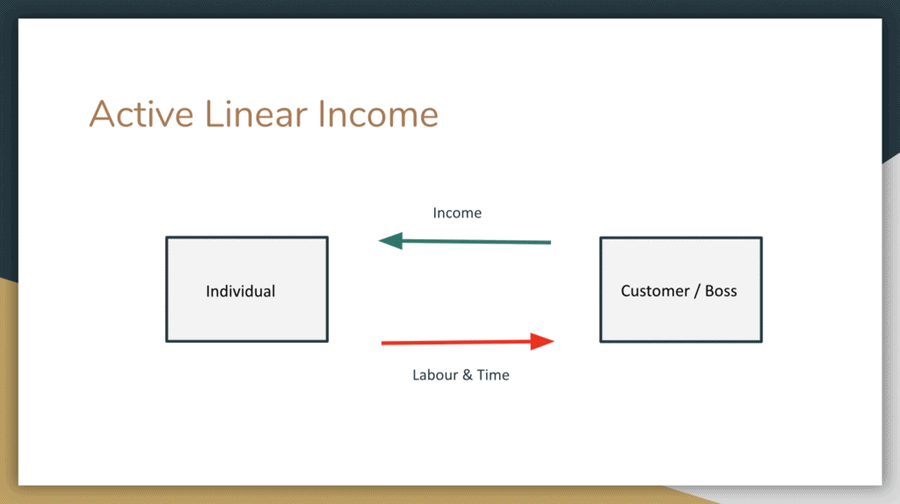
1. Active Linear Income
It is income derived from an exchange of physical labour and time with a single paymaster. This type of income is most common for it is the fastest means that one uses to make money as it requires the least time, effort and investments to establish this source of income.
For instance:
You are an employee working for $ xxx per period (hour, day, week, month, shift, etc.).
You are a freelancer who charges a fixed fee of $ xxx per project.
This type of income is useful when one is starting off. After all, everyone has bills to pay. With that being said, this income is dependent solely on your effort physically.
So, it may be limiting in terms of growth for all of us possess only one physical body, 24 hours a day, 365 days a year, and can only be at one place at a time. As such, this leads us to explore our next few sources of income.
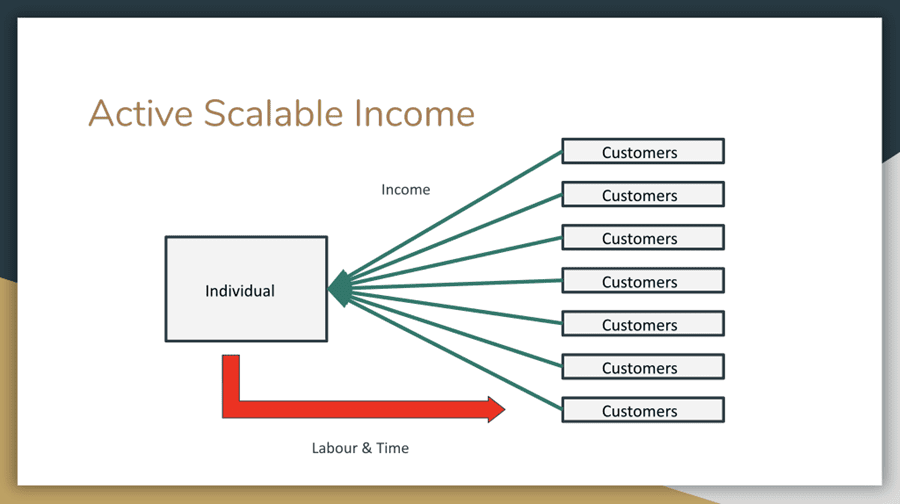
Likewise, it is also income earned from an exchange of physical labour and time but to a network of paymasters. It involves one having built a system or a team or multiples of both to increase income exponentially via scale.
It includes:
You earn x% in overriding commission from sales generated from your sales team.
You are a freelancer who makes x% profit share from project undertakings.
You sell products or services via a network of distributors and retailers.
You sell digital products to an online community consisting of xxx people.
This type of income is expandable because the number of clients you serve can increase significantly without you substantially increasing your efforts at work. In other words, a 100% growth in your customer base may bring 100% more income without you increasing your workload by 100%.
This is usually the type of income that propels one from earning 4-figures to 5, 6, or, 7-figures per month, hence, raising more significant capital faster for investments.
But, if it is that good, why not more people earn this type of income?
This is because it requires people to invest time, effort, and money to first learn about marketing, branding, leadership, and system building. Upon which, there might be no immediate payoffs.
For instance, you may have a desire to make millions from pitching your products to a broad audience in a mega preview event. The money sounds enticing. But, you would need first to master effective public speaking and closing.
3. Passive Income
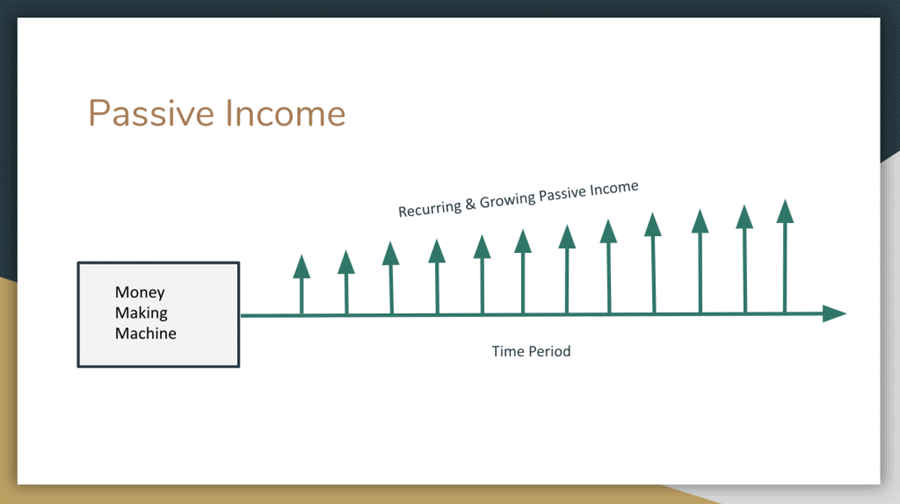
It is recurring income derived from ownership of profitable assets. It includes:
Interest income from fixed deposits, P2P lending, and other forms of credits.
Coupons from bonds.
Dividend income from a portfolio of stocks that pay dividends.
Rental income from tenanted properties.
Royalty income from intellectual properties.
Passive income from owning businesses that you don’t physically manage.
This type of income is awesome because cash is flowing into your bank account without physical labour. In essence, receiving passive income is earning time as it frees your time to pursue what you like. Besides, there are many tax benefits if you have any of the above sources of passive income.
If you are earning $ 100,000 in active income, you will be paying more income tax on as compared to another person who makes $ 100,000 in passive income. He may even pay literally zero in income taxes in Malaysia.
However, you need higher financial intelligence to create passive income effectively. One inevitably has to learn about investing and be a skillful investor with a great temperament.
Therefore, although passive income doesn’t require much physical labour, you need to study a lot (mental labour) before being good at it. Besides, without huge capital, you can’t survive on meagre passive income to do it fulltime.
4. Portfolio Income
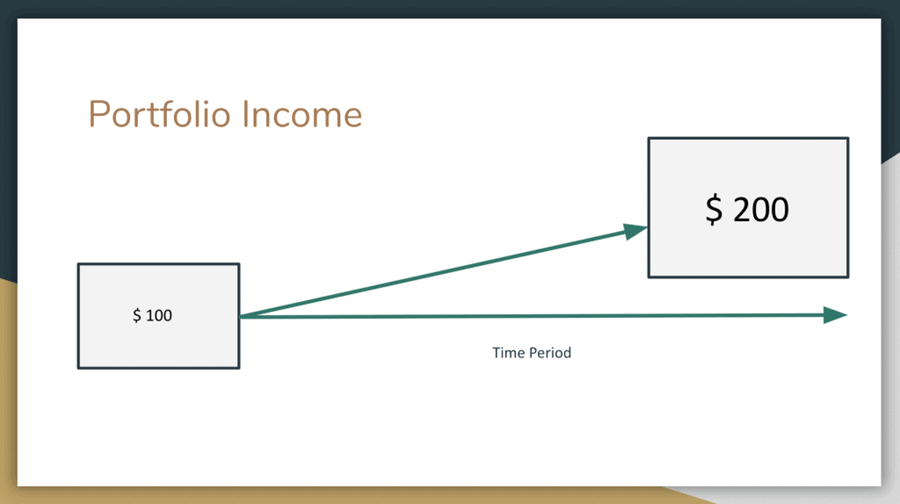
It is income derived from market value appreciation of your assets, also known as a capital gain. Alternatively, you can earn this profit via investing in assets at prices below their market valuation. Some examples include:
Your stock has appreciated from $1.00 to $2.00 in x period of time.
You bought a property for $80,000. Now, it is worth $100,000.
The value of your home is $200,000. You bought it for $80,000 7 years ago.
Many people find investing appealing because of the prospects of earning portfolio income or capital gains. It is even more attractive as compared to making passive income for the money is more significant. After all, eating steak immediately is more appealing than having milk every day.
I find there are two types of people who want to earn portfolio income.
First, it is people who are focused on money. They intend to make more money via selling assets at higher prices than their cost of purchasing them. This group of people are either traders if they can make money consistently or speculators and gamblers if they lose money consistently from their activities.
Second, it is people who are focused on accumulating assets. They are not ones who will kill their golden goose as they treasure them. For instance, they would invest in stocks or properties and hold onto them for long-term capital growth. Their mindset is to keep them and not sell them for a profit. In most cases, they would build massive net worth from their investments over time.
5. Phantom Income
It is income derived through the leverage of tax benefits, corporate entities and debt. It is known as Phantom Income as the income is not receivable via cash. It is an income of the rich as it requires a higher degree of financial intelligence to grasp the concept and utilise it fully.
We won’t list down its examples for its explanation is more technical. Here, suffice to say, the best way to use this income efficiently is to surround yourself with a team of advisors such as investors, consultants, accountants, lawyers, bankers and other related professionals.
There you go, the five different types of income that one could earn for himself to increase financial wealth.
If you think about it, the five types of income is an income progression of most wealthy people who began with very little. You would begin with earning active linear income first to survive, expand your income through scale, invest your capital for passive income and portfolio income and roped in a team of advisors to make phantom income by setting up corporations to save on tax payments and use low interest rate debt to accumulate more assets that would build even more wealth.
Now you know how it works. Go work on it!
About the author
This article is co-written by KCLau and Ian Tai
Ian Tai is the founder of DividendVault.com, a platform that analyse and filter stocks that pay increasing dividends year after year.
KCLau is a financial educator. He had published 6 books and co-created a dozen online financial courses. After conducting more than 461 hours of free webinar and 2000 articles published online, he gives away his popular Money Tips e-book volumes absolutely free at his website: https://KCLau.com








 Kevin Neoh is a NextGen Money Coach who works with people to help them transform their relationship with money to improve their lives with the money they have. Kevin can be contacted at