Category: Life & Others

  • A Real Life Investment Question Answered 

    A Real Life Investment Question Answered 

    Dear Mr Neoh, I was hoping that you can give me some advice on my situation, below is a bit about me:

    I am Malaysian, now 62 years old. I am currently single, and I am still working for a living. My take home income is about RM3,000. I do have two children who are now already working and in their late 20s/early 30s. I am feeling a bit insecure because currently, I only have about RM40K in savings with me, and this represents the only money (savings) that I have. What should I invest in order to get extra when I am no longer able to work for a living? Recently, I was approached by a Unit Trust person from a reputable unit trust company who invited me to take up a scheme with her in order to grow my wealth. Since I have never had any investment experiences in life, I honestly think that I lack knowledge about investments. I don’t feel confident about this investment. In fact, I feel a little confused. Can you please give me some advice? 

    Mr Ng

    Answer:

    Hi Mr Ng,

    Thank you for your email, I hope after reading this response, you will feel less confused but empowered to make a decision regarding the above.

    I understand that you are still working, and I am assuming that the take home pay of RM3,000 mentioned here is a net income, consistent month-to-month.

    While I agree that you should actively look for options to invest your money, it is very important for you to ensure that you make a good, quality decision.

    This is because, if you invested into something that is too risky for you, or into something that is not what it seems to be, your chances of losing your money will be higher. This will be very dangerous for you, considering that you are now in your sixties.

    Based on the illustration above, let us assume that you invest all RM40,000 but you suffer a loss of 50% in the first year. You will end up with just RM20,000. If this misfortune happens, you will then need a long time to get back to the original amount of RM40,000, assuming you are able to rebalance the remaining RM20,000 to an investment or portfolio that can grow at 10% pa.

    The above projection shows that if invest RM20,000 into something that can generate 10% a year for the next few years, you will need seven years and four months before you can get back to the original amount of RM40,000; and by that time, you will be 69 or 70 years old.

    Of course, if you can only feel comfortable investing into a “safer” investment generating 5% a year, you will need 14 years to get back to the original amount of RM 40,000 as can be seen in Illustration 3. By then, you would be 76 years.  

    The above example is why it is very important for us to ensure we don’t lose our money by investing into things that we do not understand, or are too risky to match our risk profile.

    At the age of 62, and with RM40,000 being your total savings at this point, you may want to be conservative with your money. Having said this, it does not mean that you should just keep all the money in a savings account or all of it in Fixed Deposit. Because this is also dangerous since our purchasing power will decrease every year due to inflation (where you need to pay more to buy the same or even lesser amount of the item you need).

    Therefore, you should consider investing not more than 20% of your money into equity (stocks or shares). But investing in shares requires knowledge, time, effort, and you will also need a bigger capital to have a reasonable holding of stocks that are properly diversified.

    I suggest you invest into stocks or shares through a Unit Trust fund. You can invest into a Unit Trust fund that invests in “Blue Chip” stocks as it is more stable and less volatile compared to other stock funds.  An alternative to a blue-chip stock fund, will be a Balanced or Moderate fund.  This type of fund typically invests 50% of the money into stock and 50% into fixed income instrument, so it will be quite safe, since we limit your exposure to not more than 20% of your wealth.

    I do not know the kind of fund or scheme the unit trust agent recommended that you invest into, therefore, I cannot comment on the suitability of the fund for you.  

    It is however very important for us to note that no matter what you will eventually invest in, the investment has to be one that suits your current needs, your capacity for risk-taking, and if things go south, will not put you into a position that will likely lose most if not all of your savings.

    About the author

    kevin neohKevin Neoh is a NextGen Money Coach who works with people to help them transform their relationship with money to improve their lives with the money they have. Kevin can be contacted at kevin@nextgenadvisors.my and www.kevinneoh.my

  • Managing Mental Health in the Workplace

    Managing Mental Health in the Workplace

    An average Malaysian typically spends one-third of his time a day at work notwithstanding the additional time spent on commuting to and fro from work, additional meetings, and overtime to complete projects.

    As the work environment plays a big role in shaping our experiences throughout the day, it is indeed time to start thinking about mental health initiatives in the workplace.

    As a developing country, the more organisations strive for development, the more that employees are pushed to perform, often times at the risk of their quality of life. Mental health-related issues are estimated to be experienced by at least 40% of the Malaysian population in their lifespan.

    The statistics mean that employers are now hard-pressed to acknowledge the burden of cost that mental illness can bring to their organisation and actively work to curb it.

    mental health

    To do that, organisations first need to understand the difference between mental health and mental illness. Simply put, mental health is a state of well-being where an individual is able to cope with common stressors in life, work productively and realize his or her potential and contribute back to the community.

    It is not just an absence of mental illness such as depression, anxiety, schizophrenia or so on and forth. Mental health occurs in a spectrum where wellbeing and disability are two opposing ends. The goal is then to increase practices that promote mental health and reduce those that hinder it.

    The relationship between work and mental health can’t be studied in isolation and has to be seen in the larger context of one’s life. For example, staying back late may be a norm that is perceived as a commitment to the organisation, which then influences promotion, perks and benefits.

    However, routinely staying back to complete work may be a sign of a lack of time management and an over-prioritisation of work. This then causes other aspects of one’s life, such as health, family, spiritual needs, and social life, to take a back seat and to be ignored or given less priority.

    mental health

    The cumulative effect of constantly neglecting these other aspects then creeps back into a person’s life in the form of health issues, relationship troubles, unhappy marriages, the feeling of leading a meaningless life and more, which then gnaws on the ability of one to be completely productive at work.

    Read : Buying A Car? Here’s Some Tips On How Best To Finance A Car

    Workplaces can help prevent this by changing their work cultures to be more balanced. Organisations are predominantly made of people and people have the potential to shape workplace cultures. This starts with cultivating the awareness that every aspect of life is important and needs to be paid attention to; for top management rights to the interns.

    Firstly, it is important to realize that everyone has only 24 hours a day, though we often wish we had more. As such, a conscious prioritisation of activities that enables one to fulfil their different needs is important.

    Workplaces can help by creating a healthy work-life balance by ensuring proper break times; reducing work-related communication during the weekend and after-work hours, avoiding lengthy meetings and ensure that time at work is efficiently used to achieve goals.

    Human resource policies can also reflect the priority of the organisation with regard to employees’ mental health. The rise of millennials in the workforce, for instance, creates a highly tech-savvy cohort at work that may prefer flexi-working hours that prioritizes output instead of physical presence in the office.

    mental health

    Organisations can maximize productivity by constantly studying new trends and catering to them. Gamification (the application of concept, skills and design of games and implementation in the workplace) efforts that can maximize output in a fun, engaging and mutually reinforcing way is one example of such trends.

    Open, honest and most importantly respectful communication within an organisation sets the tone for the relationships at work as well. The general workplace impression is that “everyone is replaceable.”

    However, when organisations create an idea that everyone is included in the team for their unique skillset and is valuable to the team, it changes the tone of the work environment.

    Another thing to consider while discussing wellness at work is that there could be many external stressors that are unrelated to work that could affect a person’s commitment. Caring for elderly parents, sick children, school meetings, accidents, chronic illnesses to name a few, are some of the stressors that employees may face over the course of their employment.

    When employers are sensitive to these needs that may crop up, sometimes unplanned and uncalled for, the way they respond to the employee can be a gauge of how much they care about the employee as a person.

    Finally, it is imperative to note that mental health at the workplace does not only apply to the wage earners but every stakeholder in the workplace. When top management understands the need to care for their own mental health, it brings about change in policies, formal and informal practices, and the overall work culture, which influences the employees as well.

    About the Author

    Puveshini Rao (M. Clin Psych) is a Clinical Psychologist and Employee Assistance Program specialist currently practicing in Rekindle Sdn. Bhd. She is a HRDF certified trainer and currently conducts trainings and provides EAP services for organisations while also seeing clients with mental health related issues. Previously she has experience providing counselling services in the university and hospital settings. She is also on the committee of Women’s Aid Organisation and volunteers her time to the cause.

  • Secrets To A Long Life

    Secrets To A Long Life

    The search for “the fountain of youth” has had a long history, from tracking down sacred, life-giving water sources in the days of antiquity, to the invention of “miracle pills” and stem cell research in the modern age.

    You are born with approximately 20,000 blood stem cells, which your body uses to replenish your blood. Over time, and depending on the “abuse” you put your body through, these cells become damaged and die. As your blood stem cells dwindle, your body becomes less efficient at repairing and regenerating itself.

    In essence, your blood stem cells may be the proverbial “clock” that eventually runs out, no matter how well you take care of yourself. In the meantime, however, you have a great deal of control over how quickly those cells perish.

    Is your personality geared for longevity?

    Personality for Long Life

    life, the longevity project

    According to results from The Longevity Project, a Stanford study spanning 80 years, your level of conscientiousness may have a great deal to do with how long you end up living. Having a personality that strives to do things well; being thorough and vigilant − this is a trait that most of the people who live the longest share.

    Sense of Purpose

    The Longevity Project also dismisses the idea that hard work will kill you early. On the contrary, those who stayed productive and worked hard all their lives tended to be happier, healthier, and more social compared to those who didn’t work as hard. That’s not to dismiss work stress as a factor that needs to be addressed and kept in check.

    Social Connection

    life socially happy

    But being productive can also lend a sense of purpose, which is very important for longevity. And working—especially in your later years—tends to keep you socially connected, which has repeatedly been shown to be an important factor for longevity.

    You Are What You Eat

    No discussion about longevity would be complete without addressing diet. A processed, high-sugar diet is undoubtedly the quickest route to an early death, barring a lethal accident. This is because consuming sugar and grains increases your insulin and leptin levels, which is the equivalent of slamming your foot on your ageing accelerator. Besides that, research by Professor Cynthia Kenyon shows that carbohydrates have a direct and detrimental effect on two key genes that govern longevity and youthfulness.

    Ideally, you’ll want to replace all forms of processed and refined sugars and grains with healthy fats such as butter, olive oil, coconut oil, avocado, grass-fed meats, and raw nuts. Many would benefit from getting as much as 50-85 percent of their daily calories from fats.

    Mindfulness and Perpetual Motion

    active life

    There’s compelling evidence suggesting that having a calm mind and active body are two important ingredients for longevity. The meditative technique known as “mindfulness” has even been shown to have a beneficial effect on genetic expression. Meditation has also been found to affect the enzyme telomerase, which some researchers believe is actively involved with the process of ageing. As for keeping your body active, avoiding sitting is perhaps of even greater importance than having a regular workout regimen.

    The science is very clear on this point: sitting too much is a surefire way to take years off your life! And that applies even if you exercise vigorously a few times a week. Basically, what the research is telling us is that getting too hung up on a once-a-day exercise routine is to put the cart before the horse. First, you need to make sure you’re engaging in more or less perpetual non-exercise movement, as this is an independent risk factor for chronic diseases like diabetes and heart disease.

    Life Long Learning

    Education is also strongly correlated with a longer life. If you think you know it all just because you went to high school or college, you might as well pack it up. It’s all downhill from there. My perspective is to be a lifelong student. If I lived for several hundred years, I don’t think there is enough time to learn all the topics I would like to. That said, merely getting an education can have a great impact, and perhaps it’s because it teaches you to be a student.

    Lifestyle Choices Today Impact Tomorrows

    good lifestyle choices impact your tomorrow.

    The takeaway message here is that you have a great deal of control over your life expectancy, based on the personal choices you make − from how you think to how you move, and what you choose to eat − and when.

    In the end, there is no quick fix when it comes to longevity. There is no magic pill and no fountain of youth. Although some people seem to be blessed with longevity in spite of their lifestyle choices, this is the exception and not the rule. For most of us, becoming healthy Centenarians will require effort and attention to the factors discussed above.

    This article was brought to you by Dr Mercola, a New York Times bestselling author. For more helpful articles, please visit Mercola.com

  • Is It Possible To Earn A Living With Play-to-Earn Games?

    Is It Possible To Earn A Living With Play-to-Earn Games?

    Most of us like to play games in our spare time. But did you know that there are also those who earn a living just by playing games? With the rise of digital games, we now have Play-to-Earn games that rewards its users well enough for those who stay invested in it.

    Smart Investor spoke to Mr. Lucaz Lee, Founder and CEO, Affyn to gain more insights on this interesting new concept. Affyn is a newly launched play-to-earn metaverse, that aims to bring people and communities together and allow them to play a mobile geolocation-based game (similar to that of Pokemon Go), and earn Fyn tokens to be used for transactions at the same time.

    Let’s find out more from him on this interesting topic.

    How Did You Started With Crypto Investment?

    I first heard of Bitcoin in 2016, which was worth around USD400. Many people in my immediate circle warned me not to get involved, claiming that it was a sham with no foundation. In my experience, I have learnt to recognise that the best kind of opportunities are those that most people do not understand, are uncertain about and are sceptical of; yet, it is obviously working and growing at a progressive rate. 

    Unlike today, buying cryptocurrency was a highly complex process back then. My friend and I would spend the whole day figuring out how to buy it. Even though it was complicated and we didn’t understand it, we decided to go for it anyway. Nonetheless, we took the leap of faith first and learned about it later.

    How Does Play-to-Earn Works?

    The gaming industry has thrived for years, with gaming companies reaping the benefits. While a large amount of money has been flowing into the industry, the players have largely been left out. I believe that the concept of Play-to-Earn will be able to rebalance things so that players can earn while playing games. 

    Play-to-Earn is a concept where players can earn financial rewards such as cryptocurrencies or NFTs, which can be traded or sold to other players in their games. Most Play-to-Earn games are still largely unsustainable because this is a relatively new concept that many Web 3.0 companies are still figuring out. However, I believe that Play-to-Earn games will eventually transform the gaming industry.

    What Do We Need To Get Started?

    Typically, an initial capital layout is required in most Play-to-Earn games. To get started, players must learn how to buy crypto and then use the token to buy the NFT. The barrier of entry is too complex for Play-to-Earn games to breakthrough into mainstream adoption.

    I think the future of Play-to-Earn is Free-to-Play games where players can download an app, sign up for an account as easily as signing up for a Tik Tok account, play for free, and earn without realising that the whole app is powered by blockchain or crypto.

    Can A Player Really Make Money And Turn It Into A Full-Time Job?

    Just like in any other industry, what you put into it is what you get out of it. You get part-time results if you put in the part-time effort. There are definitely opportunities for players to make gaming a full-time income, depending on how much effort and time they are willing to put into it.

    With The Recent Crash Of The Crypto Market, Is Play-to-Earn Affected?

    As someone who has been through the bull market of 2017 and the crash and bear market of 2018, I can say that no cryptocurrency is immune to a crash. The Play-to-Earn ecosystem will undoubtedly be impacted. When there is a crash or a bear market, it usually means that speculative money is leaving the ecosystem. Products with utility will thrive because, while speculative money is leaving, money will flow into games with utility and demand. 

    Play-to-Earn games have the potential to thrive in bear markets because people are looking for financial vehicles to generate income when the economy is bad. Despite the fact that it has yet to be proven, I believe Play-to-Earn games can thrive during bear markets.

    What Are Your Plans For The Future?

    We intend to become the largest and most successful platform that creates fascinating experiences for our users through gaming and lifestyle, where they can earn virtual rewards and spend them in the real world within our lifestyle ecosystem. It’s also free to play.

  • Buying A Car? Here’s Some Tips On How Best To Finance A Car

    Buying A Car? Here’s Some Tips On How Best To Finance A Car

    For many people, there’s nothing quite like taking delivery of your brand new car. However, taking on long-term loan to buy a car can have serious repercussions on your financial health.

    We’ll take a look at the key issues and the ramifications of buying a car.

    Question:

    Hi, I’m Denise. Some people say the one single monthly commitment which can make or break your wealth building is payment of car loans. Is every car loan an upside-down loan as most cars depreciate much faster than we can settle them off, especially if we take a 7 or 9-year loan? In your opinion, how best to finance a car purchase? Is it in cash or a car loan?

    First, what does Denise mean with “upside-down loan”?

    If your car value depreciates faster than you pay off your loan, you will need to come up with extra money out of your pocket to repay the bank.

    For example, when you sell your car at RM20,000, but your outstanding loan is higher, say RM25,000, you will need to fork out that difference of RM5,000.

    In other words, it is negative equity.

    That might happen in any of these situations:

    • If you have a long tenure hire-purchase loan like nine years;
    • You buy a car that depreciates too fast i.e. depreciates 50% in two years, versus some brands that only go down 50% after five years; and
    • You finance the vehicle up to a maximum of 90%, 100% or even more after the mark-up price.

    Or any combination of the above situations, you might end up with an upside-down loan.

    Back to the question:

    So, what is the best way to finance a car purchase? Should people only buy with cash, and only if they can afford to pay for the car in full?

    To understand this issue, you must separate the subjects into two parts:

    The Car And Its Value

    Let’s get this straight. The value of a car falls over time. It doesn’t matter if you finance it with cash or with a car loan.

    The higher price you pay for it, the more you lose. Whether you pay cash, or pay with a short three-year loan, or a long-term nine-year loan, or you only borrow 50%, regardless how you pay for the car, the car still goes down in value at the same rate.

    It doesn’t matter.

    The buyer of your used car won’t bother whether it the loan has been settled. They don’t pay you more because you don’t have a car loan. They might pay you more if the used car is well-maintained and looks good.

    So, can we agree with these?

    If you want to lose less money, just buy a cheaper car. Buy a better brand that depreciates less comparatively. Or the best choice, don’t get a car if you don’t need to. Buy the car that fits your needs now.

    Don’t make the mistake I made. I used to own a 12-seater Hyundai Starex, and it was too big for my small family. 

    So, if you wish to be prudent about it, you may consider having a lower-priced car that serves your daily needs, or not get one for a car is a liability and its value depreciates in the long run.

    How To Finance The Purchase

    buying a car

    Now the second part is the one you want to consider – how to finance the purchase?

    Short answer: That depends on the rate of return on your fund.

    After you decide what specific brand, model and specification of vehicle you are going to get, the next step is to find out the cost of financing the purchase.

    If you have 30,000 in a fixed deposit earning 2-3%, you might as well use that cash to pay for a car loan which will cost ~4%-5%.

    On the other hand, if you have a stock holding that yields 8% a year, you should take a very long term car loan (nine years). So you keep your stocks… and earn the difference (8% stock yields – 5% car loan interest)

    Does that make sense?

    In summary, if you are a good investor, and you make an investment return that is way better than 4-5% you pay the bank, it is no-brainer to decide. Take the most extended loan that can offer the cheapest financing cost.

    Debt Service Ratio (DSR)

    So, let’s say you made that car purchase and your car loan installment amounts to RM 1,100 a month. If you earn RM 5,500 a month, the car loan installment is equivalent to 20% of your monthly income. This works out to be a DSR of 20%, that is if you have no other outstanding debt.

    If you have other debt commitments such as a student loan (PTPTN), credit card debts, personal loans… etc, you may want to assess what your DSR is after you buy your car. For instance, if you are paying RM440 a month in PTPTN loan installments, you would increase your DSR from 8% to 28%.

    Before buying your car

    = (Existing loan commitment / Monthly income) x 100%

    = (RM 440 / RM 5,500) x 100%

    = 8%

    After buying your car

    = (Existing loan commitment + Car loan installment) / Monthly Income) x 100%

    = (RM 440 + RM 1,100) / RM 5,500) x 100%

    = 28%

    So, What’s The Significance?

    First, calculating your DSR will help you to determine if you can really afford the car purchase with a car loan. For instance, if you find that your DSR after buying the car is above 40%, you may want to reconsider because you could be over gearing. You could put yourself in financial distress if you lose your job, business or your sources of income.

    Second, do you plan to buy yourself a home or an investment property some two to three years down the road?

    Here is the thing. Little do people realise that the same RM1,100 monthly installment for a RM90,000 car loan is worth as much as RM220,000 in property mortgage.

    Essentially, you are committing RM1,100 a month to get a RM90,000 car loan to buy a car that depreciates in value over time while forgoing your opportunity to acquire a property worth RM240,000 that could generate rental income and appreciates in value over time.

    So, if you’re looking to buy a property in the near future, it would be helpful for you to refrain from getting a car loan and use your loan eligibility or quota for a piece of real estate.

    The Final Piece Of Advice: Don’t Do The Following!

    buying a car finance donts

    The above discussion is based on the assumption that you already have the money to buy the car. I strongly suggest that you put yourself in this position before considering to upgrade.

    A car loan can only break your finances if you are spending your future money to buy it. That means you don’t have the money ready for the car.

    So, you take up a loan to buy a car that is not affordable to you, perhaps to impress your colleague who just showed off his latest vehicle.

    That’s a big NO-NO. Please refrain from doing that.

    Don’t buy something you don’t need, with the money you don’t have, to impress the people you don’t like. That’s plain stupidity.

    About the Author

    This article is co-written by KC Lau and Ian Tai.

    Ian Tai is a Dividend Investor. Financial Content Machine. Producer of 200+ Articles, Weekly Host and Presenter at KCLau.com. Co-Founded DividendVault.com, an online educational membership site that empowers retail investors to build a stock portfolio that pays rising dividends in Malaysia and Singapore. 

    KCLau is a financial educator, having published seven books including the current bestseller Money Smart, and co-created a dozen online financial courses. He gives away his popular Money Tips e-book volumes free at his website: https://KCLau.com

  • How to Build your Online Presence as a Financial Services Representative

    If the pandemic has taught us anything, it is to be prepared for everything. Many of us in the financial services sector rely heavily on physical meetings, physical workshops, and physical consultations. However, in less than three months of Movement Control Order (MCO), it has forced everyone to communicate through the internet.

    Despite the limitations to video conferencing, the quick adoption of technology has allowed us as financial practitioners to reach out to our clients and prospects in a way that has never been done before.

    Don’t get me wrong, I am not saying that we should ditch all our offline efforts and focus 100% online. We are still required to meet our clients offline for the physical connection and trust because it is harder to build trust among advisors and clients over the internet.

    Having an online presence is very important especially during this time and age as we humans spend more and more time online. Therefore, it is important to start building your online profile, just like how you would do building your reputation through word of mouth.

    Here, I am going to share my experience building my online presence.

    Step 1: Building Your e-Office – The Website

    financial website

    I believe that the website is the most important element if you want to build your online presence for your business because this is the place where your clients will come to understand more about you.

    Although the company I work with already has one, I created my own website to better control the description and provide more in-depth information about myself and the services that I offer in order to be more personal and approachable to my clients.

    When I first started out, I thought that building a website is going to be very expensive. However, the more I researched, the more I realised that the cost of a simple website is only about RM300 a year (that’s less than RM1 a day). This includes the cost for the domain, hosting and also simple designs.

    As you grow your online presence, you may want to add more advanced feature like an appointment system to automate your workload. However, as a start, a simple website is more than enough.

    Step 2: (Optional) Create an Email Address with Your Domain

    This is an optional step. If you are using your company’s email, that is great. However, if you are using free email address domains such as @gmail.com, @hotmail.com or @yahoo.com, you probably should start thinking about having your own email address.

    Having your own email address gives the impression that you mean business. You can get this for free if you have your own domain, but personally, I am using Gsuite for business which cost me around RM25 a month.

    Step 3: Creating Content

    financial content

    I started by setting up a blog as I feel more comfortable writing. However, you can replace articles with pictures, infographics, or videos. Contents are basically an opportunity for your potential clients to get a glimpse of your services and get to know you better.

    Make sure that you are providing a fresh experience for your clients every time they visit your website by creating content regularly.

    Step 4: Open the Doors of Social Media

    As they say, go where your customers are. If you provide service to businesses, you may want to use LinkedIn. Meanwhile, retail customers usually hang out on Facebook, Instagram, or probably TikTok.

    I used to believe that having a social media page is enough, but the downside of having a social media page without a website is that you need to be constantly creating contents in a very fast pace as you are competing with other content creators.

    However, if you have your own website, it is easier for your visitors to search for a certain article/content. You can also set your own routine as no one else is competing with you on your website. Having a website is also like a repository system where you can repost old articles on social media during your downtime.

    Step 5: Engage, Interact and Nurture Relationships

    financial relationship

    This is arguably the most important step. The good news is, this is no different than what you are already doing offline. Just like building trust between you and your clients, you also want to nurture the relationship with your audience.

    You can do this by asking questions and running polls. You should also be answering your audience’s questions or responding to their comments. Make sure to toggle the right settings that will allow you to receive notifications if someone leaves you a message or comment on social media.

    To Sum Up

    Like it or not, building an online presence is more important now than ever. But it doesn’t have to be very complicated.

    The setup of what is needed for your online presence is actually more affordable than what you would think. However, the tough part is actually Step 5, but hey, isn’t that part of your daily activity already?

    The only difference is that you do not have waste one to two hours of your time to get dressed up, drive out and go around in circles look for a parking spot just to meet up with one client.

    About the Author

    marshall wong insurance

    Marshall Wong is a financial planner holding licenses from the Securities Commission Malaysia and Bank Negara Malaysia. He can be contacted via email at Marshall@plannerd.io

  • Fired Up: A Look At Southeast Asians Pursuing The Financial Independence, Retire Early (FIRE) Movement

    Fired Up: A Look At Southeast Asians Pursuing The Financial Independence, Retire Early (FIRE) Movement

    Having an early, secure retirement is a dream of many, and a small, but growing number of people are striving to turn this dream into reality. The FIRE movement, acronym for Financial Independence, Retire Early, is essentially about aggressively tightening belts, and finding multiple sources of income in order to achieve early financial freedom.

    Milieu Insight released the results of their ‘Financial Independent, Retire Early’ study, which aimed to find out how common the FIRE movement is among Southeast Asians, and the steps they are taking to achieve their goal. The survey was conducted in May 2022 with N=1500 employed respondents, aged 18-49 years old, each from Thailand, Singapore, Malaysia, Indonesia, and the Philippines.

    Do Southeast Asians want early retirement?

    • The bulk of respondents expect to retire in their 50s or 60s (62%); Indonesians tend to expect earlier retirement, with only 52% expecting to retire in their 50s or 60s
    • Retiring early (defined as retiring before 50s) is a possibility for 60% of respondents, but only 14% think that they are on track for early retirement – Singaporeans seem most pessimistic about being able to do so, with only 9% indicating that they are on track

    Steps towards early retirement

    • Most common strategy towards early retirement is regular saving (71%), followed by ‘being careful with how I spend my money’ (63%) and ‘investing’ (63%).
    • Finding additional employment is much less common (37%) as part of strategy to retire early, but tends to skew towards Thais (54%)
    • Insurance – one way of investing – is also more common among Singaporeans (56%) and Filipinos (53%)
    • Perhaps due to vast amount of resources on the Internet, most people are hands-on for retirement planning, with only 31% of those who plan to retire early saying that they have a financial consultant to help plan for retirement

    A look at the most common strategies for early retirement: Saving and investing

    • Among those who save regularly for early retirement, 43% save more than 20% of their incomes
    • Among those who invest, 36% indicated that more than 20% of their incomes go towards investments
    • The most common investment types are:
    • Investment funds (56%)
    • Stocks (53%)
    • Real estate (52%)
    • Cryptocurrency and NFTs, which are gaining momentum but have yet to enter mainstream investing due to their volatility, registers at 41%, and seem to be more popular in Thailand (57%) and the Philippines (54%)

    How do people feel about FIRE?

    • 57% feel very or somewhat positive about their journey towards achieving early retirement
    • Comparing those who are on track to early retirement, and those who are planning to retire early but don’t think they are able to, the former tends to feel more positive about it (83% vs 49% who selected very/somewhat positive)

    Methodology

    Based on Milieu Insight surveys with N=1500 employed respondents, aged 18-49 years old, each from Thailand, Singapore, Malaysia, Indonesia, and the Philippines, conducted in May 2022.

    About Milieu Insight

    Milieu Insight is a consumer data and analytics company that connects businesses directly with their target audience. Milieu’s platform offers businesses a wide range of tools for accessing, analyzing, and visualizing high-value and timely consumer opinion data to help power better decision-making and strategy. For more information about Milieu Insight visit: www.mili.eu

  • 3 Alternative Ways To Teach Teenagers About Money Management

    3 Alternative Ways To Teach Teenagers About Money Management

    Are you worried about your teenage children’s safety, health, social life, future, and education? In addition, they are constantly bombarded by advertisements, online shopping, peer pressure and “Instagram culture”.

    Various surveys have shown that Malaysian millennials (aged from mid-20s to 40) have a tough time when it comes to money management:

    • 70% of Malaysian millennials do not live within their means – Asian Institute of Finance, 2015
    • 74% of millennials in Malaysia are struggling to meet day-to-day expenses during the Covid-19 pandemic
    • 53% of Malaysian millennials cannot survive with their savings beyond three months
    • Lower income millennials spend 48% on food, 27% on entertainment

    Looking at the situation above, we should plan forward and ensure that the next generation – our teenagers – will have a better start in money management. Here are three alternative ways parents can teach their teenagers about money management.

    1. Joining Them Instead Of Stopping Them

    Online shopping has enabled spending like never before, especially during the pandemic. Most teenagers will want to buy and own things if they have the means, although more often than not, such purchases are due to peer influences.

    Being the financial provider for teenage children, it is important that as parents, we instill the importance of self-control and wisdom about leisure shopping. Yet, this is the phase where teenagers become more rebellious, it is simply not enough to just tell or nag them. The old saying has never been truer – “If you cannot beat them, join them”.

    Go on Shopee or Lazada with them. Teach them about vouchers, free shipping and sales. Or maybe it will be them teaching you instead! Shopping online with them has its benefits, such as:

    • Bonding time and relationship building with your child
    • Slotting in some advice about quality vs quantity, self-control and impulsive buying behaviour
    • Monitor your teenagers’ shopping behaviour, what is in their shopping cart, wishlist and their shopping history
    • Share your experience and mistakes about shopping and spending

    2. Give Praise And Advice

    It is so true, that it must be repeated again. Teenagers are rebellious creatures!

    Nagging and telling them what to do just will not cut it. It did not work for teenagers during the 80s, 90s, and 2,000s and it certainly will not work today. However, they do seek your approval and appreciation, especially on things of importance to them. We often hear “my parents do not understand me” or “my parents are just not cool”. One way to avoid such comments are to acknowledge and sometimes praise what they are doing right (or vaguely right) financially.

    “Boy, it looks like you did not spend too much money at the mall today. Good job!”

    “Girl, you really found a real bargain with the dress you bought online. You certainly know how to shop.”

    After praise is given, teenagers will be more receptive towards advice. The acknowledgement that they did something right, gives them a sense of pride, and the urge to do it better.

    3. Let Them Make Mistakes

    If you recall how you sharpened your money management skills, more often than not, it was not taught or told by your own parents. You learnt them either by experience, hardships, or through mistakes that you have made. Depending on your generation, we grew up in a different time and culture than the teenagers of today.

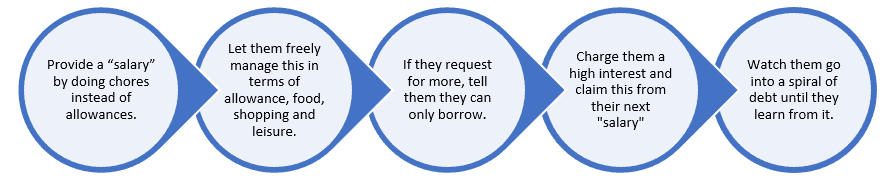
    One way that we can teach our teenage children about money management is not by teaching or telling, but by letting them experience mistakes of their own. Here are ways you can set the stage for your teenagers to learn some money management:

    The salary and lending method

    The delayed gratification lesson

    We are spoilt with instant gratification. What we want, we can get it very fast, if not, almost instantly. Think Netflix (movies), Grab (food/transport), Shopee/Lazada (shopping) and WhatsApp (communication). The Generation-Z of today are born into a life of instant gratification. However, the culture of savings and investments are more often than not, a slow and disciplined process.

    Thus, it is even more crucial that parents practice delayed gratification with teenagers and resist buying things they want versus what they really need. For example, if they ask you to buy something they want (big or small), try and ask them to wait for a few weeks or months. Suggest that if they want it sooner, they have to contribute part of the cost too. You may even notice a change that as time passes, they will realise that the purchase is not worth their allowance, and their desire may even fade.

    The compounding interest lesson

    Open a bank account for your teenager with some sort of interest element and allocate your teenager’s allowance in it. Alternatively, some e-wallets currently have an interest element as well. This allows them to learn about the compounding effect of interest on interest.

    With this method, you can teach them about saving their allowances, and watch their savings grow every month. Take this opportunity to teach them about inflation and other forms of investments that can make their savings grow even faster, such as fixed deposit or a bond fund. Although they are too young to invest into unit trusts themselves as a primary applicant, you can create a joint unit trust account with your teenager being the secondary account holder.

    As parents, we do our best to teach our child the important elements in life. Early money management is something that is important and should be deeply rooted into their young minds. However, this is easier said than done as there is only so much we can do as parents.

    Their personalities and spending patterns are an amalgamation of a variety of influences, from friends, to TV, to the internet and also by observing their parents’ money behaviour. That said, as parents, we should learn and practice what we preach about healthy money management.

    About the Author

    Alvin Kwan, CFP CERT TM is the executive director and head of financial planning at Redvest Wealth & Asset Management. He has over 12 years industrial experience in the financial industry, specifically in wealth advisory, private banking and stock broking. He was also a lecturer in areas of investment management, derivatives, and financial markets.

    We at Smart Investor and Redvest is committed to help you better manage your financials. Get a free consultation from an expert by filling in your details here: https://www.smartinvestor.com.my/SIxRedvest

  • 5 Factors To Consider When Choosing Your Financial Planner

    5 Factors To Consider When Choosing Your Financial Planner

    It is very easy to get financial advice nowadays, especially with the boom of the internet and social media. If you visit financial related Facebook groups or forums, everyone is eager to give their opinion on the best ways to manage your money.

    However, one downside of these free online advice is bypassing of important safeguards such as ensuring the person seeking advice is subject to a detailed financial health check and understanding their current financial position.

    So, choosing your personal financial planner can be one of the most important decisions you can make. Your financial planner is your partner to guide you through many decisions about handling major financial and life decisions.

    To find the best financial planner who is right for you, here are five important factors to keep in mind:

    1. Make A List Of Financial Planners

    Start by creating a list of potential financial planners. Ask your friends or family if they have engaged with any financial planners. Take the time to check if the planners have the required license from Securities Commission Malaysia’s database (). Then, call each financial planner to see if he or she is accepting new clients and arrange a meeting with the planner.

    2. Research The Financial Planner’s Credentials And Experience

    In Malaysia, most financial planners do not start their career as a financial planner. Some are trained lawyers and accountants. Knowing the background of the financial planner allows you to understand whether the financial planner has the resources to help you in your financial decisions. The more experience a planner has, the better your results are likely to be.

    If you need a specific form of planning, such as the involvement of business or family offices, ask the financial planner if he or she has any experience handling the matter.

    3. Evaluate The Financial Planner’s Communication Style

    Choose a financial planner with whom you are comfortable talking to. Do you feel that the financial planner understands your situation? Find a planner who shows an interest in getting to know you and will respect your decision-making process.

    Also think of the convenience of meeting your financial planner. In the beginning of the financial planning process, you may need to meet your financial planner several times in a month. Can you reach your planner online, especially during the COVID-19 pandemic?

    4. Evaluate The Financial Planner’s Company/Team

    Take the time to research the company and team behind the financial planner. Is the financial planner working alone? What are the credentials of the team behind the financial planner?

    As finance is a very broad topic, a good financial planner usually specialises in a particular field and works with another financial planner or other professionals (such as lawyers and accountants) to handle other parts of the planning and solution implementation. Think of it like the case of a hospital, where a patient may get treatment from different specialists.

    5. Understand How The Financial Planner Is Getting Paid

    There are 3 main types of fee-structure when it comes to financial planners:

    • Commission only;
    • Fee-based; and
    • Fee-only.

    In Malaysia, we usually see commission only and fee-based planners. Fee-only financial planners are extremely rare.

    A financial planner that receives commissions only works great with someone that wants a product that they already have some idea in mind. The relationship is usually transactional in nature and heavily focused on advice with a product-based solution.

    A fee-based financial planner earns a fee for developing a financial plan for you, while also earning a commission if you require him or her to service your insurance policies or investment portfolios.

    Make sure that your financial planner is transparent on the fee for their services.

    Summary

    Just like when making any major purchases, it is important to do your homework when it comes to choosing your financial adviser. Not every financial planner has the same level of training or offer the same range of services. It is important to talk to several financial planners and choose someone that meets all the above-mentioned criteria.

    Finally, it is important to understand that financial planning takes a long process. Find a financial planner that you feel comfortable talking to and feel he or she is helping you work through your problems.

    About the Author

    marshall wong insurance

    Marshall Wong is a financial planner holding licenses from the Securities Commission Malaysia and Bank Negara Malaysia. He can be contacted via email at Marshall@plannerd.io

  • Can You Be Athletic And A Vegetarian?

    Can You Be Athletic And A Vegetarian?

    A vegetarian diet excludes meat, poultry, and fish; some people also omit eggs and dairy products, while vegans exclude animal products altogether.

    You can take it a step further by going on a raw or gluten-free diet. Besides the obvious, which is that any diet built on exclusions is emotionally hard, a vegetarian diet can be a challenge when it comes to your nutrient intake and energy levels.

    On the plus side, however, a vegetarian diet usually involves a higher intake of antioxidants and phytonutrients which reduce free radical damage during intense exercise.

    Nutrient Concerns

    nutrients athletic and a vegetarian

    Protein also acts as a complement to carbs. They help regulate the rate at which carbs enter your bloodstream and prevent sugar spikes and crashes. In addition, strength athletes need protein to build muscle mass. A plant-based diet is also usually high in fibre which further inhibits protein absorption.

    Vegetarian diets are also generally low in B12, iron, and calcium. These are particularly important for endurance athletes as B12 helps produce red blood cells and prevents you from becoming anaemic. It’s also important for nerve and mental health – long-term deficiency can lead to cognitive impairment, while lack of iron and calcium can affect your immunity and bone health respectively.

    Salt and fats seem like bad things to want to put into your body as an athlete, but they are essential to your overall wellbeing. Poorly planned vegetarian diets lack both. Fats help your body absorb fat-soluble vitamins like A, D, E, and K and regulate carb absorption so that your sugar levels stay consistent.

    KFit Asia head of operations Shakira Shanaz, who is currently on a vegetarian diet as part of her yoga teacher training course, agrees. “My body craved more sugar, so I’d make myself Milo when I would usually just have water.” Low sodium levels, on the other hand, can lead to muscle cramps, especially if you are sweating a lot.

    So, can you still be athletic and a vegetarian?

    Read : What Happens To Your Body When You Stop Exercising?

    Supplementing A Vegetarian Diet

    athletic and a vegetarian

    Adequate protein intake on a plant-based diet is difficult but possible with proper planning. Opt for protein rich foods like beans, lentils, legumes, nuts, and seeds. Quinoa and soy are great protein solutions too, as they are complete sources of protein―tempeh is a firm favourite.

    It is important to remember that you will need to eat larger portions for the same amount of protein you would get from meat, and a handful of nuts in your salad is not going to cut it.

    Read: How To Manage Your Quarter Life Crisis?

    Increase iron absorption with the aid of vitamin C rich fruits and vegetables. B12 is not readily available in non-meat items but you can opt for fortified cereals or supplements. Give your body the good fats it needs with avocado, olive oil, or flaxseed oil.

    Avoid fibre-heavy meals right before a workout so that you have plenty of time to digest. You should also include a post-workout protein meal to help with muscle synthesis. Protein shakes are useful here too.

    Meals don’t need to be boring! You can also substitute your usual flour with soy protein powder or bean flour. Peanut butter is a great source of nutrients for vegetarians as well.

    Don’t forget to salt your food (within reason)!

    Yes or No?

    There are marginal benefits to being an athlete on a vegetarian diet. Over time you tend to feel less bloated and have a quicker recovery time, plus you will probably have a lower intake of bad fats and cholesterol.

    However, D. Enette Larson-Meyer, associate professor of human nutrition at the University of Wyoming, has a different opinion.

    Many people tell me after they start a vegetarian diet that they feel better, but then again many of them… were eating a pretty poor diet, so of course they feel better. They could have switched to a healthier meat-based diet and they would have probably felt better.

    Shakira concurs. “I mostly self-prepare my food as eating out while vegetarian is expensive. I also avoid greasy food since I’m already making an effort to be healthy. I feel like this, more than the vegetarian diet, contributed to my feeling lighter and less lethargic.

    “Would I continue to be a vegetarian once my course is over? Probably not. I will eat cleaner and healthier, but I don’t think being a vegetarian is necessary for health.”

    Still, there is no harm being an athlete on a vegetarian diet if you choose to do so. It requires greater care and planning than a meat-based diet to ensure you are getting all the nutrients you need, but it’s not impossible.