Category: Stocks

  • As An Investor, Here Are 3 Things To Look For In Financial Statements

    Making investment decisions as an investor requires having a solid understanding of a company’s financial statements. A company’s financial health is captured in its financial statements, giving important information on its profitability, liquidity, and overall financial performance.

    As an investor, here are the three things to look for in financial statements, so you know how to use them to make wise investment decisions.

    1. Income Statement/Statement Of Profit Or Loss
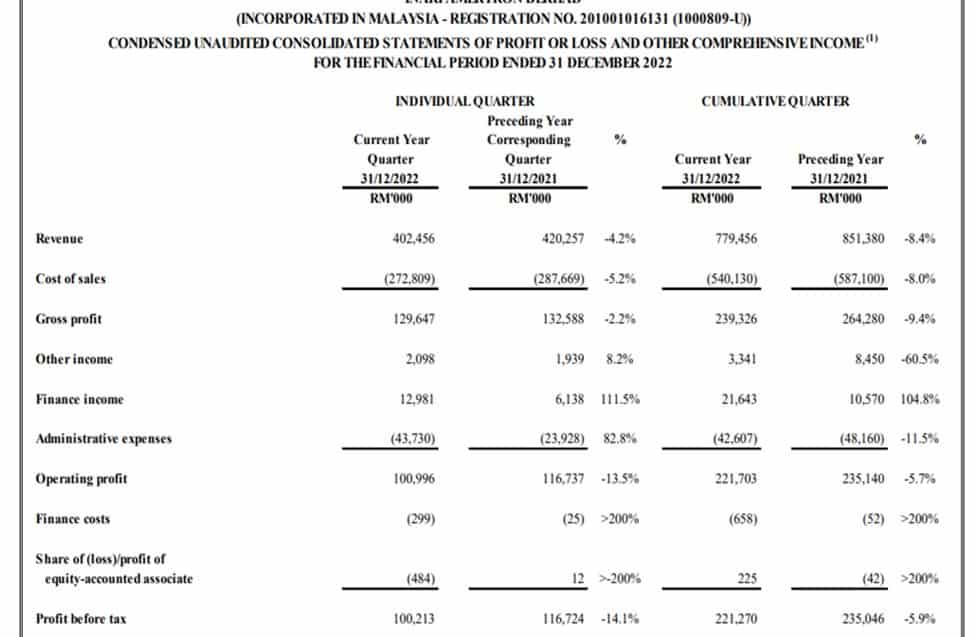
    One of the first things to look for in financial statements, is to look at income statement. It is the one of the most important things to look for in financial statements.

    The income statement provides an overview of a company’s revenues and expenses for a given time period. The financial statement details the company’s revenue and operational costs, taxes, and interest payments. Net income, a gauge of a company’s profitability, is the difference between sales and expenses.

    Investors should pay particular attention to the income statement’s revenue and net income data. A company’s revenue should be consistently rising as this shows that its goods and services are in high demand. A higher net income is also encouraging because it shows the business is making more money.

    Investors should, however, consider the margins, which reflect how much profit the company makes in relation to its revenue, such as the gross profit margin and net profit margin. A business with poor margins can have trouble controlling costs or face fierce competition.

    Read: Using The CANSLIM Formula To Choose Good Stocks

    2. Balance Sheet/ Statement OF Financial Position
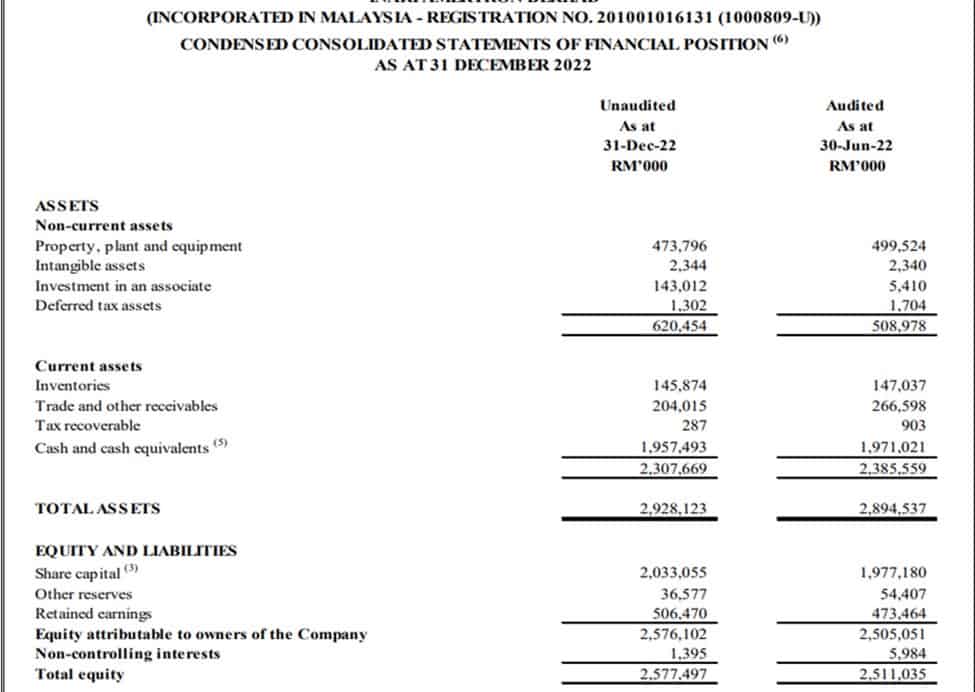
    The second in the number of things to look for in financial statements is the balance sheet. The balance sheet is the second financial statement that investors ought to study.

    A company’s assets, liabilities, and equity are shown on the balance sheet at a particular time. The financial statement reveals the firm’s assets and liabilities and the percentage of equity shareholders own in the business.

    The balance sheet’s sections for assets and liabilities should catch investors’ attention. The assets section lists the company’s possessions, including real estate, machinery, and cash. Along with their valuation, investors should consider the asset’s composition. For instance, a business with a lot of cash and liquid assets might be more financially stable than one with a lot of fixed assets that might be challenging to sell fast.

    The company’s debts are listed under the liabilities section, including loans, accounts payable, and taxes. Investors should take note of the liabilities’ makeup as well as their maturities. For instance, a business with a lot of short-term debt can be more susceptible to cash flow issues than one with long-term debt that can be repaid over time.

    Read: 3 Steps To Kickstart Your Stock Market Investment Journey

    3. Statement Of Cash Flow
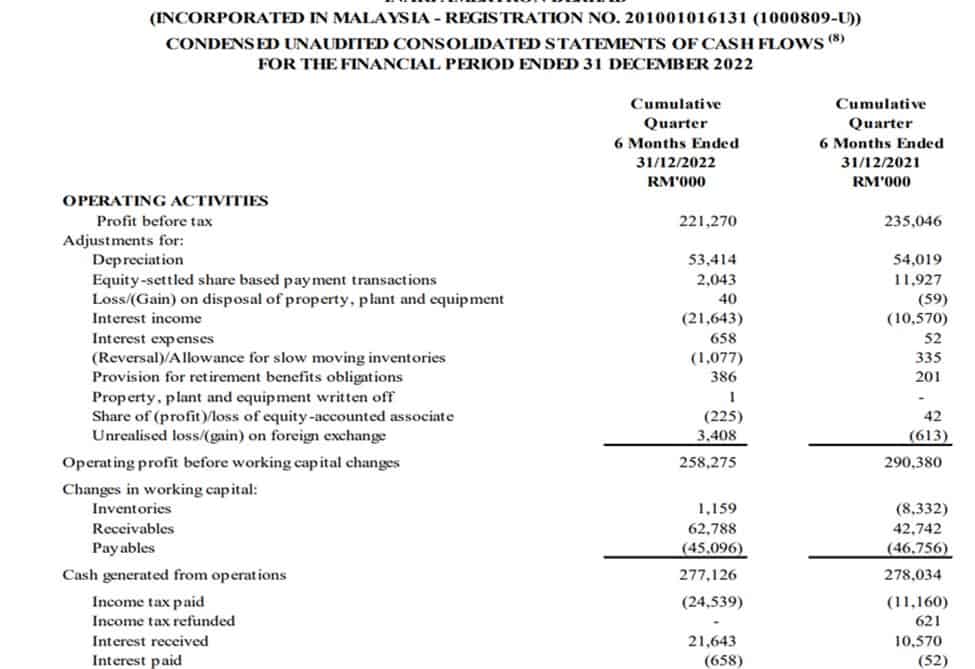
    The third on the list of things to look for in financial statements is the cash flow statement. The cash flow statement details how much money the business has made and spent during a given time period. Operating, investing, and financing operations are the three areas into which the cash flows are divided in the statement.

    Investors should concentrate their attention on the statement of cash flows’ operating operations section. The amount of cash the company has made from its core business operations is displayed in this section. A company’s operations produce cash when there is a positive cash flow from operating activities, which is a good sign. A corporation may burn cash to fund its operations if its cash flow is negative.

    The statement of cash flows’ sections on investing and financing operations deserve special attention from investors. The amount of money the company has spent on investments and capital expenses, such as buying property and equipment, is displayed under investing activities.

    The amount of money the company has acquired or paid back through debt and equity financing is displayed in the financing activities section. Investors should consider whether these actions align with the company’s overall strategy and financial objectives.

    In conclusion, it is critical to comprehend a company’s financial statements before making investing choices. In particular, those are the three things to look for in financial statements: Income Statement, Balance Sheet and Cash Flow Statement.

    It offers important information about a company’s profitability, liquidity, and overall financial performance. Investors should concentrate on the company’s revenue, net income, margins, assets, and liabilities.

    Make sure you also read:

  • Increase Your Chances Of Getting IPO Via MITI Application

    Increase Your Chances Of Getting IPO Via MITI Application

    Initial Public Offering (IPO) is the process of selling shares of a private company to the public for the first time. Companies usually go public to raise funds for their expansion or to provide an exit opportunity for their early investors.

    IPOs are highly sought after by investors because they can offer significant returns, especially if the company is successful. However, getting an allocation in an IPO can be a challenging task, but you can increase your chances of getting an IPO via MITI.

    But What Is MITI?

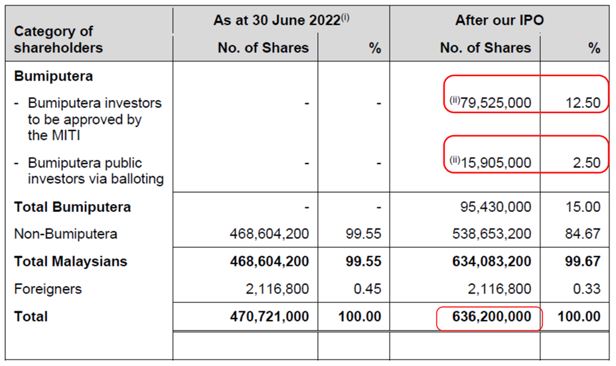
    The Malaysian government, through the Ministry of International Trade and Industry (MITI), provides a special avenue for Bumiputera investors to apply for IPOs. This special avenue is called the MITI Application, and it is only available to Bumiputera investors.

    Source: Oppstar Prospectus

    Bumiputera investors who apply for IPOs through MITI have a higher chance of getting the IPO via MITI application than through the normal public application process. The allocation of shares for Bumiputera investors through MITI is usually around 12% of the total shares allocated for all investors.

    In contrast, the allocation for public applications is typically around 2.5% to 5%.

    Read: Create Your Stock Watchlist With These Simple Steps

    Benefit Of Applying IPO Via MITI Application

    When applying for IPOs through MITI, Bumiputera investors can enjoy several benefits. Firstly, they can apply for IPOs first and pay later. This is because MITI allows investors to secure their allocation before making any payments, which is particularly advantageous if they do not have enough funds available at the time of application.

    Secondly, Bumiputera investors only compete among themselves, which reduces the level of competition for the shares. This increases their chances of getting an allocation, particularly for popular IPOs that tend to be oversubscribed.

    Thirdly, they can apply for IPOs earlier than through the normal application process, which means that they have a higher chance of securing shares at a lower price. Lastly, the higher allocation of shares for Bumiputera investors through MITI increases their chances of getting an allocation compared to applying through the public application process.

    Read: Using The CANSLIM Formula To Choose Good Stocks

    Disadvantages Of Applying IPO Via MITI Application

    However, there are also some disadvantages to applying for IPO via MITI application. Firstly, investors cannot read the final prospectus of the company before applying. This can be a disadvantage because the prospectus contains important information about the company’s financials, business strategy, and risks, which can be useful for making informed investment decisions. Investors may have to rely on the preliminary prospectus, which may not contain all the relevant information.

    Secondly, some IPO prices may not be available when applying for IPO via MITI application. This means that investors may not know the final price of the IPO until after they have applied. This can be a disadvantage if the final price significantly differs from the initial price range, affecting the investor’s investment decision.

    Thirdly, the waiting time for the IPO shares to be allocated is usually longer than the normal application process, which can be a disadvantage if the investor needs the funds for other purposes or if the market conditions change significantly during the waiting period.

    Lastly, investors who do not proceed with their application after being allocated shares may be subject to penalties, which can affect their creditworthiness and investment reputation.

    Read: 7 Signs Of Bad IPO, Avoid Them If You See These Red Flags

    Conclusion

    In conclusion, the IPO via MITI application is a special avenue for Bumiputera investors to apply for IPOs in Malaysia. Applying through MITI can increase their chances of getting an allocation compared to the normal public application process. However, there are some disadvantages to applying through MITI, such as not being able to read the company’s final prospectus before applying and longer waiting times for the IPO shares to be allocated.

    Investors should weigh the benefits and disadvantages before deciding to apply for IPO via MITI application or through the normal public application process.

    Read: Guide To Apply For IPO In Malaysia (Via Maybank2u And CIMB Clicks)

  • 5 Reasons Why We Lose Money In The Stock Market

    5 Reasons Why We Lose Money In The Stock Market

    A wonderful option to invest your money and increase your wealth is through the stock market. Success is not always simple to achieve, though. Despite their best efforts, many investors continue to lose money.

    Here’s five reasons why we lose money in the stock market.

    1. A Lack Of Study

    The primary reason why we lose money in the stock market, is because we don’t conduct enough research before making an investment. Without thorough study, it’s possible that we won’t fully comprehend the business in which we are investing in, the sector in which it works, or the risks associated with it.

    The more information you have about the business, the more prepared you will be to make wise investment choices.

    Spend time studying the companies and their financials before investing in any stocks. To determine how financially stable it is, look at its balance sheet, income statement, and cash flow statement. Get a sense of the company’s overall performance and prospects for the future by reading news articles, analyst reports, and industry publications.

    Read: Create Your Stock Watchlist With These Simple Steps

    2. Emotions And Snap Judgements

    The next reason why we lose money in the stock market is because we tend to make rash decisions and allow emotions to control them. It’s simple to get sucked into the hoopla around a hot stock or to freak out when the market declines.

    But making investment decisions based on feelings rather than logic can be disastrous. Instead, make conclusions based on study and analysis while maintaining composure. Create a long-term investing plan and adhere to it, even when the market is declining.

    Keep in mind that stock market investment is a marathon, not a sprint.

    3. A Lack Of Diversity

    Investing all of one’s capital in one or a small number of stocks is a common error made by novice investors. This technique has huge risks as well as high potential returns. You run the risk of suffering a substantial financial loss if the stock(s) you buy perform poorly.

    Reducing stock market risk requires diversification. Invest in a variety of stocks from various sectors and companies, as well as in other asset classes such as bonds and real estate. This way, you have backup investments in case one doesn’t do well.

    Read: Using The CANSLIM Formula To Choose Good Stocks

    4. Market Timing

    Another typical error that can contribute to why we lose money in the stock market, is by attempting to time the market. Investors may attempt to purchase low and sell high, but doing so is very challenging, if not impossible.

    Focus on the long term rather than trying to time the market. Invest in businesses you are confident in and that have a proven track record of expansion. If you’ve made investments in strong companies with sound fundamentals, they’re likely to recover over the long run even if the market declines temporarily.

    5. High Brokerage Fee

    The final reason why we lose money in the stock market, is due to the exorbitant fees that might reduce our investment returns and cause losses. For trading, account maintenance, and other services, some brokers and investing platforms charge a certain fees.

    Research costs are charged by various platforms and brokers before you invest. Look for inexpensive choices that lets you make investments with few costs but provide excellent services.

    Some brokers have different products with different fee structures, so make sure you choose the right product that is suitable to your trading strategies and style. Not all cheap brokerages are good and not all expensive brokerages are useful to you.

    In conclusion, investing in stocks can greatly increase your wealth, but you should proceed carefully and adopt a long-term perspective. To reap the rewards, do your homework, don’t make snap decisions, diversify your investments, keep an eye on the long term, and hunt for affordable options. You may improve your chances of making money and preventing losses in the stock market by paying attention to these suggestions.

    Now you know why we lose money in the stock market, let’s do our best to avoid it.

    Read: 7 Signs Of Bad IPO, Avoid Them If You See These Red Flags

  • Create Your Stock Watchlist With These Simple Steps

    Create Your Stock Watchlist With These Simple Steps

    Have you ever gone grocery shopping without a checklist? Most of the time, you have a hard time deciding which items to buy first, which results in buying things that are not your priority. It will be a waste when you purchase something, but you don’t need it then.

    It is similar to investing; you must know how to create your stock watchlist. Otherwise, you will be wasting time and money buying stocks that are not good.

    What Is A Watchlist?

    According to Investopedia, a watchlist is a set of securities an investor monitors for potential trading or investing opportunities.

    A watchlist will help you personalize your list with stocks you are interested in.

    How To Create Your Stock Watchlist?

    How to create a stock watchlist is not the main issue. But how to create your stock watchlist that is efficient is more important. You need to create your stock watchlist and make sure that it is an effective one.

    An effective watchlist will save you time when selecting which stocks to buy and helps investors select stocks easier. Below are a few ideas on how you can create your stock watchlist.

    Read: Using The CANSLIM Formula To Choose Good Stocks

    Watchlist By Sectors

    Different exchanges may have different numbers of sectors. A country with a bigger economy usually has more industries and thus has more sectors. It can be seen in big countries such as the United States, China, and the United Kingdom.

    In Bursa Malaysia, there are 13 sectors available. An easy way to build a watchlist is by sectors. When there is any sentiment play or theme play, investors can easily open their watchlist and select stocks based on the watchlist created.

    For example, an oil & gas sector watchlist may consist of companies that run businesses downstream, midstream, and upstream. A watchlist will make your life easier whenever a catalyst is related to sectors.

    Besides that, some investors may be interested in a particular sector. The technology sector is the sector that has been attracting a lot of investors. This is due to the growth potential in that sector. If you are one of them, you may consider building a watchlist with technology counters.

    Watchlist By Strategies

    Some investors might have a watchlist based on their trading or investment strategies. In this type of watchlist, your criteria for stocks might include the following:

    • Breakout 52-week high
    • Breakout All-Time high
    • In uptrend phase
    • Forming a pattern

    Read: 3 Steps To Kickstart Your Stock Market Investment Journey

    Watchlist Based On Investment Objective

    Traders with multiple investment objectives can create a few watchlists based on the period they will hold the stocks.

    1. Short-term watchlist

    List of stocks that you are monitoring closely every day.

    2. Mid-term watchlist

    List of stocks you monitor and wait for the right timing to enter. Once bought, these stocks will be kept in the portfolio for a few weeks or months.

    3. Long-term watchlist

    List of stocks you plan to buy and keep for a long time, for example, more than a year. This watchlist can be a list of stocks with strong fundamentals, consistently giving out dividends and blue-chip stocks.

    Read: Investing VS Trading, Which One Is Suitable For Me?

    How To Create Your Stock Watchlist In The CGS-CIMB iTrade Platform

    If you have an account with CGS-CIMB and are unsure how to create a watchlist, below are the steps to follow.

    1. Click on Watchlist. Next, click Create Watchlist.
    1. Enter your watchlist name in the box provided. You can set the watchlist according to sectors or businesses.
    1. Click on View Watchlist to view the watchlists that you have created.
    1. Type the stock that you wish to put in your watchlist.
    1. Right-click on the stock name and click on Add to Watchlist.
    1. Click on the downward arrow and select your watchlist. The stock can be viewed in the watchlist that you select, making it easier for you to search in the future.
    1. You can always rename your watchlist and delete your watchlist.

    In conclusion, it is a smart action if you have more than one watchlist. If you already have a trading account, create your stock watchlists to save time. If you are busy with work, that is not an excuse, as you can build your watchlist even after working hours when you are chilling and have some free time.

    Read: Guide To Apply For IPO In Malaysia (Via Maybank2u And CIMB Clicks)

  • Guide To Apply For IPO In Malaysia (Via Maybank2u And CIMB Clicks)

    Guide To Apply For IPO In Malaysia (Via Maybank2u And CIMB Clicks)

    IPO (Initial Public Offering) has recently been the latest stock market trend. But what is an IPO? Before we look at the guide to apply for IPO in Malaysia, we must first understand what an IPO is.

    IPO is the process of offering shares of a private corporation to the public by issuing new stocks for the first time.

    In other words, it is when a privately owned company first sells its shares to the public. That is the reason why it is called an initial public offering.

    Why Would A Private Company Go Public?

    When companies decide to go for an IPO, the companies can raise equity capital to aid the company’s business growth.

    Some other reasons are to pay off debts, raise their public profile, purchase new assets, and get funds for the company’s business operation.

    As a smart investor, you would probably know how to differentiate between a good and bad IPO.

    Always ask yourself, are you willing to invest your money into a company with growth potential or a lot of debt to settle?

    How to apply for an IPO in Malaysia?

    Read: Using The CANSLIM Formula To Choose Good Stocks

    Guide To Apply For IPO In Malaysia

    For the past two years, most IPOs were listed at a premium price on the first day. Some of the IPOs even managed to hit more than 100%. Sounds interesting to you? If it interests you, I believe most investors also feel the same.

    This created a trend in the local stock exchange where investors see IPO as a great opportunity. Do not worry if you never apply for any IPO out there. After reading this guide to apply for IPO in Malaysia, perhaps it will be the first time you apply for an IPO. Let’s get started.

    This article will share two methods for applying for an IPO. First of all, do you have either Maybank2u or CIMB Clicks?

    If not, you should register one now.

    Guide To Apply For IPO In Malaysia Via Maybank2u

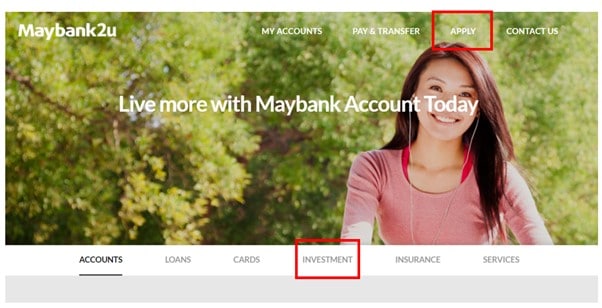
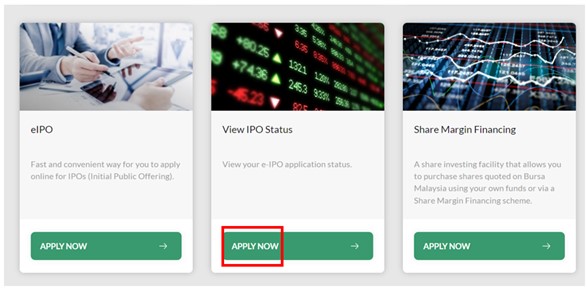
    1. Log in to your Maybank2u account. Click on Apply and next click Investment.


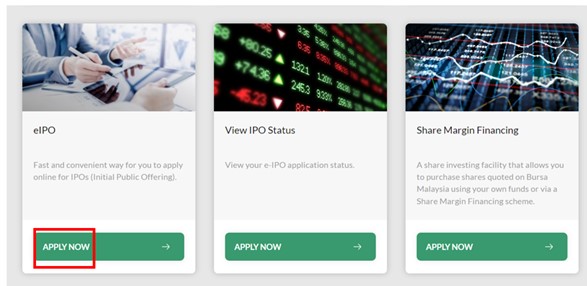
    1. Scroll down until you see eIPO. Click Apply Now.
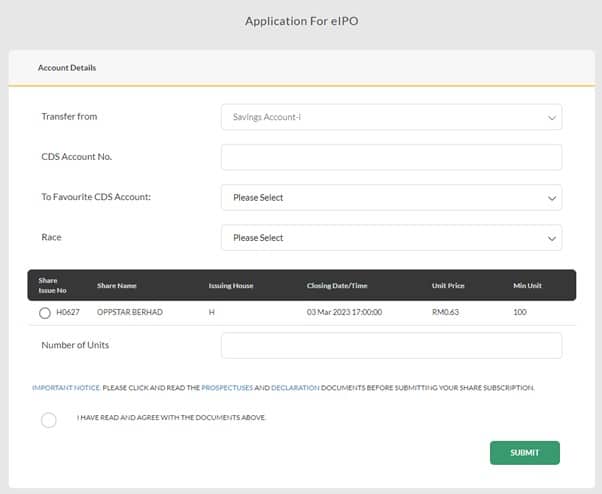
    1. Select the IPO that you wish to apply for. Complete your application and click Submit. You will redirect to the payment gateway to perform payment for your application.
    1. To view your e-IPO application status, go to View IPO Status.

    Guide To Apply For IPO In Malaysia Via CIMB Clicks

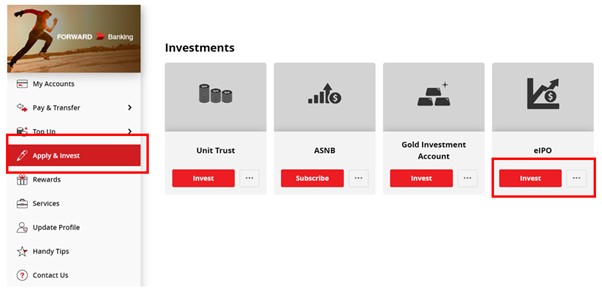
    1. Log in to your CIMB Clicks. Click on Apply & Invest. Scroll down to eIPO and click Invest.
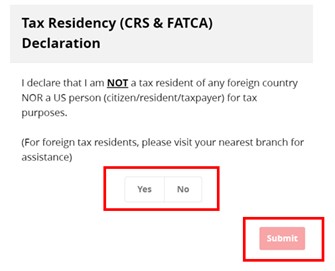
    1. Declare that you are not a tax resident of any foreign country NOR a US person (citizen/resident/taxpayer) for tax purposes. Then, click Submit.
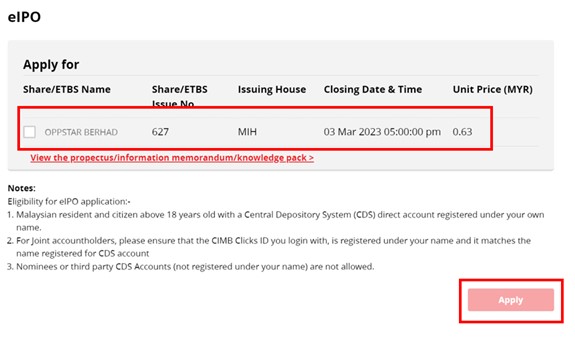
    1. Select on the IPO that you wish to apply and click Apply.
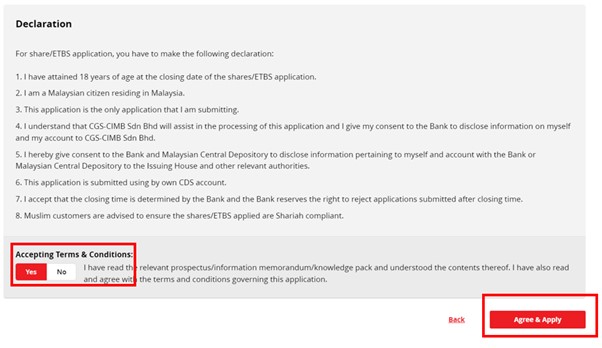
    1. Click Yes if you accept the Terms & Conditions. Next, click Agree & Apply.
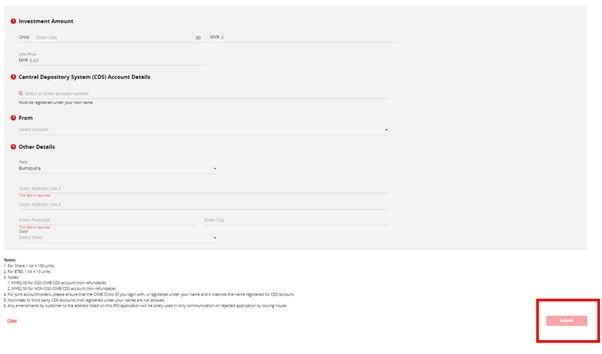
    1. Complete the application and click Submit. You will be redirected to the payment gateway to perform payment for your application.

    Apply Your IPO Now

    So, now do you still think IPO is difficult? We have shared two methods above on the platforms that you can apply for an IPO which are Maybank2u and CIMB Clicks.

    We hope you find the guide to apply for IPO in Malaysia useful. Wish you all the best in your IPO application!

    Read: 7 Signs Of Bad IPO, Avoid Them If You See These Red Flags

  • Bursa Malaysia Recognises Top Performing Brokers And Market Intermediaries At The Bursa Excellence Awards 2022

    Bursa Malaysia Recognises Top Performing Brokers And Market Intermediaries At The Bursa Excellence Awards 2022

    Bursa Malaysia Berhad (“Bursa Malaysia” or the “Exchange”) held its 10th annual Bursa Excellence Awards 2022 ceremony on 20 March 2023, to honour outstanding performance of brokers and market intermediaries in the Malaysian capital market. Themed “Recognising Excellence, Celebrating Success”, a total of 54 accolades spanning 24 categories in the Securities, Derivatives and Islamic markets were awarded.

    In 2022, the Exchange witnessed active trading of securities, at an Average Daily Trading Value (“ADV”) of RM2.1 billion. “Initial public offerings in 2022 were strong and vibrant,” said Tan Sri Abdul Wahid Omar, Chairman of Bursa Malaysia. “We welcomed 35 IPOs in 2022, the highest on the Exchange since 2007, which raised a total of RM3.5 billion and contributed RM11.15 billion to the overall market capitalisation of RM1.74 trillion.”

    Winner of the Bursa Excellence Awards 2022 for “Best Overall Equities Participating Organisation” category. From R-L: Datuk Muhamad Umar Swift, CEO of Bursa Malaysia; Ng Meng Wah, Affin Hwang Investment Bank Berhad; Lee Kok Khee, Kenanga Investment Bank Berhad; Azizah Mohd Yatim, CGS-CIMB Securities Sdn Bhd; Tan Sri Abdul Wahid Omar, Chairman of Bursa Malaysia

    “The derivatives market, on the other hand, recorded an all-time high in trading volume last year, achieving a record high of 19.1 million contracts traded in 2022, surpassing the previous high of 18.4 million contracts registered in 2021. Meanwhile, our Commodity Murabahah platform Bursa Suq Al-Sila performed similarly well in the Islamic Capital Market, with 22.3 percent higher ADV, up from RM37.3 billion in 2021 to RM45.6 billion in 2022,” he added.

    Winner of the Bursa Excellence Awards 2022 for “Best Overall Derivatives Trading Participant” category. From R-L: Datuk Muhamad Umar Swift, CEO of Bursa Malaysia; Khairul Azim, Kenanga Futures Sdn Bhd; Nor Asma, TA Futures Sdn Bhd; Lam Choon Jin, Phillip Capital Sdn Bhd; Tan Sri Abdul Wahid Omar, Chairman of Bursa Malaysia

    “Bursa Malaysia will continue to collaborate with all brokers and market intermediaries to strengthen our value proposition and attract more participation in the Exchange,” concluded Tan Sri Abdul Wahid Omar. “This will be achieved by facilitating innovations to revamp the investors’ trading experience, while driving market conversations with more targeted educational and marketing initiatives.”

    Datuk Muhamad Umar Swift, Chief Executive Officer of Bursa Malaysia added, “Given the rising global competition, it is imperative that we maintain our endeavours to promote our market and its various investment options, catering to the diverse risk appetites of investors. Working closely with our broker partners is essential in producing our collective desired outcomes, and we will continue to do so to raise public awareness about investing and make our market dynamic and appealing to investors.”

    Winner of the Bursa Excellence Awards 2022 for “Best Overall Bursa Malaysia-i Participating Organisation” category. From R-L: Datuk Muhamad Umar Swift, CEO of Bursa Malaysia; Dato’ Fad’l Mohamed, Maybank Investment Bank Berhad; Lim Chia Wei, Malacca Securities Sdn Bhd; Azizah Mohd Yatim, CGS-CIMB Securities Sdn Bhd; Tan Sri Abdul Wahid Omar, Chairman of Bursa Malaysia

    The complete list of winners of the Bursa Excellence Awards 2022 is as follows:

    About Bursa Malaysia

    Bursa Malaysia is an exchange holding company incorporated in 1976 and listed in 2005, and has grown to be one of the largest bourses in ASEAN today. Bursa Malaysia operates and regulates a fully-integrated exchange offering a comprehensive range of exchange-related facilities, and is committed to Creating Opportunities, Growing Value. Learn more at www.bursamalaysia.com.

  • 7 Signs Of Bad IPO, Avoid Them If You See These Red Flags

    7 Signs Of Bad IPO, Avoid Them If You See These Red Flags

    Initial Public Offerings (IPOs) have become increasingly popular recently, with many investors rushing to invest in newly listed companies. IPOs can be exciting opportunities for investors to get in on the ground floor of a new company and potentially earn a big return on their investment.

    However, IPOs can also be risky, and investors must be aware of potential red flags when considering an IPO investment. Here are 7 signs of bad IPO. Avoid them if you see these red flags.

    Signs Of Bad IPO#1 Lack Of Profitability

    A lack of profitability is one of the most important red flags to look out for. When a company is not profitable, it may not be able to provide a return on investment for its shareholders. Investors should carefully review the company’s financial statements to determine whether or not it is profitable. This can include reviewing the company’s revenue, expenses, and net income over time.

    If the company has a history of losses or cannot demonstrate a clear path to profitability, it can be a major red flag for investors.

    Read: 5 Investment Tips For Beginners That You Should Know

    Signs Of Bad IPO#2 High Debt Levels

    Another red flag to look out for is high debt levels. Companies with high levels of debt can be risky investments, as they may struggle to meet their financial obligations in the long term. Investors should review the company’s debt-to-equity ratio and debt-service coverage ratio to evaluate its debt levels.

    If the company has a high debt-to-equity ratio, this can indicate that it is relying heavily on debt financing to grow its business, which can be a risky strategy.

    Signs Of Bad IPO#3 Weak Financial Performance

    Weak financial performance is another red flag to watch out for when considering an IPO investment. A company with weak financial performance may struggle to grow its revenue or generate profits. Investors should carefully review the company’s financial statements to evaluate its financial performance and determine whether or not it has the potential for future growth.

    This can include analyzing the company’s revenue growth, gross margins, and operating expenses over time.

    Read: Investment Risk Management With 6 Simple Ways

    Signs Of Bad IPO#4 Poor Management

    Poor management is another potential red flag for IPO investors. A company with poor management can be a risky investment, as management is responsible for making strategic decisions that can impact the company’s success. Investors should review the company’s management team and board of directors to evaluate their experience and track record.

    This includes reviewing their accomplishments, education, and relevant industry experience.

    Signs Of Bad IPO#5 Having Legal Or Regulatory Issues

    Legal or regulatory issues can also be a red flag for IPO investors. Companies facing legal or regulatory issues can be risky investments, as these issues can lead to fines, penalties, or other legal consequences. Investors should review the company’s regulatory filings to determine whether or not it is facing any legal or regulatory issues.

    This can include reviewing pending lawsuits or investigations and regulatory compliance issues.

    Read: Fundamental Analysis vs Technical Analysis

    Signs Of Bad IPO#6 Competitive Threats

    Competitive threats can also be a red flag for IPO investors. Companies facing strong competition can be risky investments, as they may struggle to maintain their market share and profitability. Investors should review the company’s competitive landscape to evaluate its position in the market and the potential threats it may face from competitors.

    This can include analyzing the company’s market share, competitive advantages, and potential threats from new entrants or disruptive technologies.

    Signs Of Bad IPO#7 Overpriced

    Finally, investors should consider the company’s valuation when considering an IPO investment. Companies with high valuations may be overpriced, and investors may not see a sufficient return on their investment. Investors should carefully review the company’s valuation and compare it to its peers and the broader market to determine whether or not it is reasonable.

    In summary, IPO investments can be exciting opportunities for investors, but they can also be risky. Investors should carefully evaluate potential red flags when considering an IPO investment, including a lack of profitability, high debt levels, weak financial performance, poor management, legal or regulatory issues, competitive threats, and valuation. By conducting thorough due diligence and taking a careful and thoughtful approach, investors can minimize risk and increase their chances of success in the IPO market.

    Read: Using The CANSLIM Formula To Choose Good Stocks

  • Invest Malaysia Kuala Lumpur 2023: The Capital Market Conversation

    Invest Malaysia Kuala Lumpur 2023: The Capital Market Conversation

    Bursa Malaysia Berhad (“Bursa Malaysia” or the “Exchange”) and Maybank Berhad (“Maybank”) today co-hosted the 21st instalment of Invest Malaysia (“IMKL 2023”) in Kuala Lumpur. Themed “Reshaping Malaysia’s Narrative: Strengthening Resilience & Sustaining Growth”, IMKL 2023 was officiated by the Honourable Dato’ Seri Anwar Ibrahim, Prime Minister of Malaysia.

    To ensure that the Bursa Carbon Exchange (“BCX”) achieves its goal of greening our economy and to catalyse the voluntary carbon market, the Honourable Prime Minister announced the Government’s commitment to a RM10 million seed funding incentive to assure demand for Malaysian-generated carbon credits traded on the BCX. This commitment will encourage issuers and project developers to invest in the necessary efforts and processes to enable carbon credit issuance.

    Another announcement made by the Honourable Prime Minister at IMKL 2023 was the LEAP Market Transfer Framework, whereby Bursa Malaysia will be enhancing current regulations to facilitate LEAP Market PLCs to transfer to the ACE Market. Concurrently, Bursa Malaysia will share further enhancements to the Approved Adviser Framework to expand the pool of sponsors and corporate advisers for the ACE Market.

    The Honourable Prime Minister also announced that Bursa Malaysia will be working with the London Stock Exchange Group to launch a Centralised Sustainability Reporting Platform. This would enable companies − both publicly listed companies as well as non-listed SMEs − to calculate their carbon emission impact, and disclose common ESG datasets in a standardised manner that conforms to established global standards, such as the Task Force on Climate-Related Financial Disclosures (“TCFD”). Led by Bursa Malaysia, this pioneering initiative will include a consortium of two Malaysian conglomerates, their supply chain and a panel of banks.

    “Bursa Malaysia always listens and adapts to the demands of the investing community. Following public feedback from the consultation paper issued earlier, we will soon be announcing the LEAP Market Transfer Framework, as well as the development of the Centralised Sustainable Reporting Platform,” said Datuk Muhamad Umar Swift, Chief Executive Officer of Bursa Malaysia. “We believe these initiatives would increase the vibrancy and accessibility of our market, while better meeting the needs of market participants.”

    “We are also pleased with the Prime Minister’s announcement that the Securities Commission Malaysia will extend the Waqf-Featured Fund Framework to include Islamic Real Estate Investment Trusts (REITS) and Islamic Exchange Traded Funds (ETFs). By offering this Waqf asset class and solution on the Exchange, it will further diversify our suite of Shariah-compliant listed products and more importantly, will provide an effective instrument to support our nation’s social development,” added Datuk Muhamad Umar Swift.

    Dato’ Khairussaleh Ramli, Group President & Chief Executive Officer at Maybank, said, “A vibrant and robust capital market is a key component of Malaysia’s competitiveness that will help drive economic recovery. We welcome the measures announced by the Honourable Prime Minister at IMKL 2023 today and will continue to play our part in facilitating greater market participation and promoting Malaysia as an attractive investment destination.”

    “Maybank believes that sustainability is key to building resilience and ensuring long-term growth. We are working closely with both the government and the corporate sector to execute the national sustainability agenda, and we are pleased to be part of Bursa Malaysia’s sustainable supply chain initiative to support our companies in their decarbonisation journey.”

    Speakers at IMKL 2023 included the Honourable Mohd Rafizi Ramli, Minister of Economy who touched on measures to strengthen Malaysia’s economic resilience; the Honourable Senator Tengku Datuk Seri Utama Zafrul Tengku Abdul Aziz, Minister of International Trade & Industry who shared his views on enhancing Malaysia’s competitive edge; the Honourable Ahmad Fahmi Mohamed Fadzil, Minister of Communications & Digital spoke about developing a digital ecosystem; and the Honourable Anthony Loke, Minister of Transport who shared plans about national infrastructure development. Delegates also heard from newly appointed Treasury Secretary General, Datuk Johan Mahmood Merican on Budget 2023, especially pertaining to strengthening fiscal reform.

    “IMKL 2023 continues to be the capital market conversation for global fund managers and institutional investors to appreciate Malaysia’s competitive advantage as an attractive and sustainable investment destination,” concluded Datuk Muhamad Umar Swift. “We look forward to bringing the next instalment of IMKL, targeted to be held by the end of the first half 2023.”

    The IMKL forum attracted approximately 1,500 delegates attending in-person and virtually, comprising local and foreign fund managers that collectively manage an estimated total AUM of USD10 trillion (approximately RM44 trillion).

    The event was also live-streamed for public viewing on Bursa Malaysia’s Facebook page https://www.facebook.com/BursaMalaysia/.

    About Bursa Malaysia

    Bursa Malaysia is an exchange holding company incorporated in 1976 and listed in 2005, and has grown to be one of the largest bourses in ASEAN today. Bursa Malaysia operates and regulates a fully-integrated exchange offering a comprehensive range of exchange-related facilities, and is committed to Creating Opportunities, Growing Value. Learn more at www.bursamalaysia.com.

    About Maybank

    Maybank is among Asia’s leading banking groups and South East Asia’s fourth largest bank by asset. The Maybank Group has an international network of over 2,600 offices in Malaysia, Singapore, Indonesia, Philippines, Cambodia, Thailand, Vietnam, Myanmar, Brunei, Laos, India, China, UK, USA, Pakistan, Saudi Arabia, Uzbekistan, and Dubai. The Group offers an extensive range of products and services, which includes consumer and corporate banking, investment banking, Islamic banking, stock broking, insurance and takaful and asset management. It has over 42,000 employees worldwide. (www.maybank.com).

  • Using The CANSLIM Formula To Choose Good Stocks

    Using The CANSLIM Formula To Choose Good Stocks

    CANSLIM is an investment strategy popularized by William J. O’Neil, the founder of Investor’s Business Daily. He is an investor, stockbroker, and author.

    The CANSLIM formula is a systematic approach to stock picking and portfolio management that emphasizes the importance of following rules and guidelines.

    The CANSLIM Formula To Choose Good Stocks

    Now that we are done with the introduction let’s look at how we can use the CANSLIM formula to choose good stocks.

    C – Current Earnings and Earnings Growth

    This component of the CANSLIM formula emphasizes the importance of finding stocks with strong earnings growth. This means looking for companies that have consistently posted strong earnings reports and are expected to continue to do so.

    The emphasis is on finding companies that have been able to deliver consistent earnings growth and have a strong track record of delivering on their financial commitments.

    Read: Investing VS Trading, Which One Is Suitable For Me?

    A – Annual Earnings Increase

    The annual earnings increase component of the CANSLIM formula is all about finding stocks with a strong upward trend in earnings. This means looking for companies that have posted year-over-year increases in earnings and are expected to continue doing so in the future.

    N – New Products, Services or Management

    The new products, services or management component of the CANSLIM formula is all about finding companies that are innovating and introducing new products or services to the market. This component also emphasizes the importance of having a strong management team, as a well-run company is more likely to succeed in the long term.

    S – Supply and Demand

    This component of the CANSLIM formula is all about understanding the forces of supply and demand and how they impact the price of a stock. In general, stocks with strong demand and limited supply perform better than those with weak demand and abundant supply.

    Read: Fundamental Analysis vs Technical Analysis

    L – Leader or Laggard

    The leader or laggard component of the CANSLIM formula is all about finding stocks performing well compared to their peers. This means looking for companies outpacing their competitors in earnings growth, sales growth, and market share.

    I – Institutional Sponsorship

    The institutional sponsorship component of the CANSLIM formula is all about finding stocks backed by large institutional investors. This means looking for companies with a large base of institutional shareholders likely to receive continued support from these investors.

    Read: 5 Investing Lessons from Warren Buffett’s Letters

    M – Market Direction

    The market direction component of the CANSLIM formula emphasizes the importance of timing your investments based on the market’s overall direction. This means looking for opportunities to invest in the stock market in a long-term uptrend and avoiding investments in a downtrend.

    CANSLIM formula is designed to help investors identify stocks with strong earnings growth, solid management teams, and favorable market conditions. By following the guidelines of the CANSLIM formula to choose good stocks, investors can increase their chances of success and avoid common mistakes such as investing in stocks with poor earnings growth or investing in the stock market during a bear market.

    In conclusion, the CANSLIM formula to choose good stocks is a comprehensive investment strategy many investors have used to build successful portfolios. While it is not a guarantee of success, following the CANSLIM formula can help investors make informed decisions and minimize their risk of loss.

    Hope that you now know how to use the CANSLIM formula to choose good stocks. But as with any investment strategy, it is important to do your research and due diligence before making investment decisions.

    Read: Where Market Is Heading And Why I Should Not Care

  • Bursa Malaysia And Maybank To Co-Host Invest Malaysia Kuala Lumpur 2023

    Bursa Malaysia And Maybank To Co-Host Invest Malaysia Kuala Lumpur 2023

    Bursa Malaysia Berhad (“Bursa Malaysia” or the “Exchange”) and Maybank will co-host the 21st instalment of Invest Malaysia (“IMKL 2023”) on 8 March in Kuala Lumpur. The forum, which is Malaysia’s largest annual capital market gathering, is expected to attract an estimated 1,000 local and foreign fund managers, attending in person and online, with an estimated total AUM of USD10 trillion (approximately RM44 trillion).

    Themed “Reshaping Malaysia’s Narrative: Strengthening Resilience & Sustaining Growth”, IMKL 2023 will provide an in-depth look at the strategic approaches and measures introduced in the recent re-tabled Budget 2023, which will support Malaysia’s long-term efforts to achieve sustainable development and economic growth. The conference will be inaugurated by Prime Minister YAB Dato’ Seri Anwar Ibrahim, who will deliver the Keynote Address, which is expected to focus on the country’s efforts to achieve high-income nation status while adhering to the values espoused in the “Malaysia Madani” concept.

    “The recent budget reinforces Malaysia’s commitment to fiscal reform while addressing key concerns investors have when making investment decisions. The absence of a prosperity tax from this year’s budget also bodes well and encourages Malaysian companies to aim for higher earnings, thus raising their attractiveness to global investors,” said Datuk Muhamad Umar Swift, Chief Executive Officer of Bursa Malaysia.

    “Further, the tax incentives on listing fees for the ACE and LEAP markets, as well as for technology-based companies listed on the Main Market, will encourage the listing of more high-potential and innovative companies,” added Datuk Muhammad Umar Swift. “This would result in more investment opportunities and increased trading interest among investors while also helping us achieve our target of 39 listings for 2023.”

    Dato’ Khairussaleh Ramli, Group President & Chief Executive Officer at Maybank said, “We are honoured to partner with Bursa Malaysia once again to bring IMKL 2023 to the investing community. The conversations at Invest Malaysia will provide a better understanding of Malaysia’s medium-term fiscal and economic strategy in sustaining development, enhancing competitiveness and resuming its growth trajectory. We believe that a holistic approach that balances social and economic needs is pivotal for the nation to strengthen its resilience and to sustain growth. This is reflected in Maybank’s own mission of Humanising Financial Services, driven by our M25+ strategy.”

    IMKL 2023 will showcase the following conversations:

    • YB Tuan Mohd Rafizi Ramli, Minister of Economy will discuss “Strengthening Economic Resilience”,
    • YM Senator Tengku Datuk Seri Utama Zafrul Tengku Abdul Aziz, Minister of International Trade & Industry will share his thoughts on “Enhancing Malaysia’s Competitiveness”,
    • YB Ahmad Fahmi Mohamed Fadzil, Minister of Communications & Digital will talk about “Developing a Thriving Digital Ecosystem”,
    • YB Anthony Loke, Minister of Transport will discuss on “Infrastructure Development for Sustainable Growth”, and
    • YBhg Datuk Johan Mahmood Merican, Treasury Secretary General, Ministry of Finance will share further details on “Budget 2023 Highlights and Strengthening Fiscal Reform”.

    “IMKL 2023 will provide impetus to strengthen the key building blocks that will reinforce Malaysia’s reputation as an attractive investment destination in the region,” concluded Datuk Muhamad Umar Swift.

    IMKL 2023 will be live-streamed for public viewing on Bursa Malaysia’s Facebook page at https://www.facebook.com/BursaMalaysia/ on Wednesday, 8 March 2023 starting at 10.00am.

    About Bursa Malaysia

    Bursa Malaysia is an exchange holding company incorporated in 1976 and listed in 2005, and has grown to be one of the largest bourses in ASEAN today. Bursa Malaysia operates and regulates a fully-integrated exchange offering a comprehensive range of exchange-related facilities, and is committed to Creating Opportunities, Growing Value. Learn more at www.bursamalaysia.com.

    About Maybank

    Maybank is among Asia’s leading banking groups and South East Asia’s fourth largest bank by asset. The Maybank Group has an international network of over 2,600 offices in Malaysia, Singapore, Indonesia, Philippines, Cambodia, Thailand, Vietnam, Myanmar, Brunei, Laos, India, China, UK, USA, Pakistan, Saudi Arabia, Uzbekistan, and Dubai. The Group offers an extensive range of products and services, which includes consumer and corporate banking, investment banking, Islamic banking, stock broking, insurance and takaful and asset management. It has over 42,000 employees worldwide. (www.maybank.com).