Insurance is an important element of any sound financial plan, and a proper Risk Management plan should cover personal risk (Premature Death, Total Permanent Disability, Dreaded Diseases, Personal Accident and Hospitalisation), property risk (car, house and its contents) as well as liabilities insurance.
Having these insurance policies in place can protect your income, savings, retirement, and peace of mind if uneventful situations were to take place.
Without an insurance policy, the consequences of a tragedy can be much worse, especially with the rising cost of health care that can create a heavy financial burden on your family.
A proper life insurance can be used to pay off mortgages, car loans, and credit card debts, leaving other remaining assets intact for your family in the event of the breadwinner’s premature death.
Life insurance proceeds can also be used to pay for final rite expenses. Better still, life insurance can create an estate for your heirs.
Although insurance is a very important aspect of our lives, yet most people treat it as least important, or even strike it off from their financial budget list.
Spending hard-earned cash on vacations, shopping, movies, expensive data plans and dining is seen as more important than paying for a life insurance premium.
Before signing up for an insurance plan, you should first look at your Net Worth Statement to see how much debts you have incurred. Your insurance must be able to cover the debts so that it will not be passed down to your family in the event of a premature death, disability or critical illness that can result in a loss of income.
Therefore, you should either adjust your cash flow and expenses, or increase your earnings in order to find extra money to maintain the premium payments and excess money for savings.
Even if you have been retrenched, you must not stop paying your insurance premium, or worst surrender the policy. Make sure that your insurance is intact to cover you in this critical moment.
However, should there arise a situation when you are really tight for money, there are a few options that can be taken to make sure the insurance cover stays intact. Let’s have a closer look at them:
Car and Home Insurance
Car insurance premium is mandatory as it is required by the law; so, premium payment is a must.
Same goes for your house fire insurance premium as it is required by bank if your house is still under mortgage.
Life Insurance
You can consider a temporary term, investment-linked, or a whole life non-par insurance policy, which has an affordable premium but comes with big protection to address the problem of huge debts.
If you have an existing traditional whole life policy, you have the option of allowing the policy to exercise auto premium loans (APL) to make sure the protection is not affected due to temporary non-payment of premiums. However, this is only a temporary measure.
You cannot allow APL to exhaust all the accumulated cash values as your policy will then become lapse.
You may wish to convert the policy to an extended term assurance, where there is no further future premiums to be paid, and the sum covered will remain the same until the new revised term of coverage expires. You can even convert the policy to be a paid-up policy with the reduced sum assured.
Health Care Insurance
You’ll never know when you may fall sick or get injured. But you do have options when it happens if you continue to pay your health care insurance premium.
You can lower the premium by considering a standalone health care plan, which has a more affordable premium as compared to packaged plans. But this pretty much depends on your age, gender, health conditions and the coverage amount.
Also, if you are paying a high premium for a bigger coverage, you may want to consider reducing the coverage and get a deductible health care plan with a very low premium.
If you’re planning to do some changes to your existing health care plan, make sure you are aware of the exclusions, waiting period, pre-existing illnesses, as well as other terms and conditions of both the new and the old plan; otherwise you might lose your coverage.
Thus, with the above options, there is no excuse for not paying your insurance premiums.
In any case, before making any of the above decisions, it is best to seek professional advice so that you can make a more informed decision.
Sometimes, we check our portfolio and we gasp in shock at the horrid performance. The percentages are all in the red, and there seems to be no light at the end of the tunnel.
Young investors who invested into stocks and crypto are left holding the bag, seasoned investors are left shaking in their boots. What can we do to prepare for it?
The Anatomy of the Bear
Before we can figure out what our course of action is, it is prudent to analyze and understand the nature of the problem.
Panda-monium
One hundred dollars background.
Early 2020 we were greeted with the pandemic. The world went into a halt for two years, where supply dwindled and demand skyrocketed. To alleviate the pain, the US Federal reserve printed trillions of dollars.
Although the initial market reaction was of great fear, the money soon made it into the stock market, and we proceeded to have one of the greatest bull runs in the decade. The ride lasted for about a year, which brings us to the beginning of 2022.
The Ursa Awakens
March 2022 marks one of the darkest days of this year as equities dropped. War broke out in Ukraine following the invasion of the Russian army. The market was concerned with the effect the war will have on supply chain and the availability of commodities.
When the supply of the commodities dwindles, and the demand remains the same, prices skyrockets. Classic economics.
Inflation
Inflation is the kryptonite of investing (or the economy in general). The CPI numbers is the highest since the 1980s, and it is no wonder it has got everyone running around like headless chickens.
Companies will not be able to keep up with the input costs. Workers will not be able to get a livable wage since prices for basic necessities are soaring. Unchecked, this will create a cycle of hyper inflation that will instantly nuke an economy.
The Feds have been printing money and pumping it into the markets for the past two years. Although the Feds have been parroting that inflation is only transitory, now they have finally changed their tune as the bone chilling inflation numbers become available to the public. Kicking the can down the road has become a non-viable option, and the markets will suffer the consequences.
Although some of the inflation that is present today can be attributed to both the war and the Fed’s actions, one thing is for sure, everything is un-bear-ably expensive now.
Hawkish Feds
Since inflation is sky high currently, and the supply chain is impossible to fix, the Feds have only one option left. To destroy demand by increasing interest rates and reducing the money supply. That or risk runaway inflation.
As interest rates rise and money supply is actively being reduced, cash becomes more expensive, and investors demand more return for their investment, which drives down the value of investments. Complex models are used to determine asset prices, but for us simple investors, understanding this relationship is more than sufficient. In simpler terms, interest rates go up, investment go down.
Recession
With the threat of two consecutive quarters of negative GDP growth in the US, it is no wonder the markets are growing restless. The GDPNow real GDP growth, as of writing, is standing at 0.3%, it is probable that it will dip into the negative region once more information is available, which will signal to us that a true recession is here.
But can we time the recession and buy in at the bottom? Unlikely.
Recession comes and goes at its own pace, and the markets might reflect that information a lot earlier than expected. Trying to time the market might have the opposite effect of lowering long term returns, since missing just 10 best days of returns in a year will already cripple your portfolio.
Surviving the Rampage
Knowing all of the above, what can we do about it? Navigating the bear market requires understanding of the risk return profile of our portfolio and our specific goals.
Investing in a portfolio of investments that is fully diversified across all economies and geographical regions and taking on the market risk is still the simplest way one can invest without losing too much sleep, as recommended by John C. Bogle, the founder of Vanguard.
Beating the markets is nice, but trying to time derivative hedging strategies and complex long-short plays in a highly volatile market might not be suitable for the less sophisticated investor, and is a recipe for financial ruin. Beating the market is a tough racket, and almost all professionals will not be able to beat it consistently for a long period of time.
The markets have not failed (yet!), and if one believes in the markets, a monthly dollar cost averaging strategy into a diversified index fund is still the most prudent strategy for investors that can tolerate the volatility. Investors nearing retirement age might want to consult a licensed financial advisor to properly plan for retirement, as the market volatility might not be suitable for a retirement fund.
Crypto
Some experts have touted that crypto moves with the broader market, and offers no diversification benefit, which is hard to dispute, given the current state of crypto. Both institutional and retail investors have lost boatloads of money from being over leveraged and over invested in crypto as the overall crypto market tanked.
Wave after wave of projects that fail to prepare for the market downturn has left investors holding bags. Terra, Celsius and Voyager, are the 3 biggest names that have imploded into oblivion. Many projects, although not dead yet, have lost 90% or more of their peak values. Even Bitcoin and Ethereum have lost more than 60% of their peak values.
What can crypto investors do to survive the impending winter?
First, this is a lesson for young investors that they should only invest in crypto what they are willing to lose. It may sound harsh, but it needs to be said.
For some, it might be 5% of their portfolio, or maybe even less. One might not get rich quick, but at least they won’t be thrown into a roller coaster ride every time the market sneezes.
Second, investors should stay away from any projects promising unrealistic returns. Celsius, Terra, Voyager and many other projects promising extreme returns have gone belly up. If you’re a fish dead in the water, the bear will not hesitate to feast on you.
Stick to the “blue chips” and call it a day.
Summary
There is no sense in panicking in the face of the bear. The myth is that the best investors are dead! (Or forgot they have money invested).
Maybe that is the trick, to play dead, stay invested and wait for the bear to move on.
About the Author
Kevin Wong is the partner ofCelebrus Advisory, a bespoke and industry-acclaimed consulting firm for digital assets with focus on regulatory compliance, technical delivery, and project outcomes.
The issue of retirement is haunting everyone, especially now with the rise of inflation and interest rates. It is happening not only in Malaysia, but the rest of the world. This makes retirement planning harder and it makes us wonder, what does it take to retire comfortably?
According to Husaini Hussin, chief executive officer of Private Pension Administrator Malaysia (PPA), the reason why most Malaysians are not able to save is because they are poor with financial planning.
“We don’t normally live within our means and do not have a plan for the long term, such as building up our retirement funds,” said Husaini.
To overcome this, we must set aside one third of our monthly salary to have two thirds of our last drawn salary as income replacement in order to have adequate funds upon retirement. This fund will then need to last us throughout our golden years. With Malaysians living on average up to 77 years of age, it is definitely a challenge to have sufficient funds to retire comfortably. Therefore, it is always good to start planning for retirement as soon as possible.
Husaini Hussin
For those who contributed to the Employee Provident Funds (EPF), at least there is something for your retirement. But according to statistics, 6.1 million EPF members have less than RM10,000 in their savings. This amount is not enough to sustain even for a year.
Husaini suggested that all of us start saving for our retirement as early as possible.
“Start with a small amount, then gradually increase the saving once our salary increases. By building a regular saving habit and with the help of compounding growth, it helps to build up our retirement funds,” Husaini remarked.
What About Those with No EPF?
The younger generation these days prefer to have freedom and flexibility, which has given rise to a new generation of freelancers, small-time business owners or e-hailing drivers, with all of them not contributing to EPF, hence there is no retirement fund for them.
So how can they start planning for their retirement?
“It has to start with the right awareness, that they need to begin planning for their retirement as soon as possible,” mentioned Husaini.
It is important to start a saving habit and set aside some money each month and make contributions to a bona-fide scheme such as PRS which is a voluntary long-term saving and investment scheme to help people save for their retirement.
On the issue of scams, Husaini mentions that this is due to greed, negligence, carelessness and naivety. Even though there are a lot of legitimate investments out there, people still fall for scammers, which is now to the tune of billions of Ringgits. Based on Bank Negara Malaysia’s Financial Capability and Inclusion Demand Side Survey 2018 (FCI Survey 2018), most Malaysians are lacking in financial literacy with one out of three Malaysians rate themselves to be low in financial knowledge.
We can avoid scams by educating ourselves and getting credible information by visiting the official websites, such as the Securities Commission Malaysia (SC), Federation of Investment Managers Malaysia (FIMM), Financial Planning Association Malaysia (FPAM) and the likes, before making any investment. Also, we can seek investment advice from a licensed financial planner instead of online gurus with no evidence of qualification.
Malaysians from all walks of life are invited to visit PRS LIVE website, which is a one-stop learning centre on retirement and PRS. There are insights, articles, news and videos available for visitors to read and have a better understanding on retirement planning.
“At PPA, we advocate Private Retirement Schemes (PRS). It was launched by the government in 2012 as a voluntary long-term saving and investment scheme to help Malaysians save more for their retirement. With the regulatory framework developed by the SC, PRS forms the third pillar of Malaysia’s multi pillar pension framework,” added Husaini.
How Do We Cope with the Rising Inflation and Interest Rates?
We can do this by reassessing our spending habits and to clearly define our “needs” and “wants”. If inflation is making it difficult to stay within budget, take a moment to reassess your cash flow.
With the rise in interest rates, this will cause our spending to reduce and hopefully it can help us to save. But there is so much that we can do to reduce our expenditure, perhaps it is time that we earn additional income by getting a second job.
Other than saving regularly towards our retirement funds, we should also set aside some sum towards an emergency fund. We can then dip into when we need access to cash during a crunch period. Studies have shown that people having access to an emergency fund would not touch their retirement savings.
In order to achieve a happy retirement, we need to have the mindset of ‘saving before spending’. Allocate a certain amount of savings before deducting your expenses for the month.
“This ensures we will always set aside a sum for our retirement savings, rather than to wait until the end of the month to see if we have anything left to save after all expenses,” Husaini mentioned.
Because chances are, we might not have anything left to save if we did not allocate ahead. Another consideration is to save now and indulge later.
Start saving for the life you want with as low as RM100 to enrol in PRS via PPA’s PRS Online service today and stand to enjoy more PRS treats during the #ISaveinPRS Treats Contest period until 20 December 2022. For more information, visit https://www.ppa.my/isaveinprstreatscontest/
Property investment is a lucrative business even when market sentiments are not exactly encouraging. Many investors will tell you that they still make money and this is the best time to find the ‘hidden gems’ of properties, especially those below market price by understanding the market trend.
For those with a deep pocket, investing in property might be easy for them initially, but the challenge later on will be on how efficient they can strike a balance between monitoring their investment profitability at the same time invest in more properties.
Here are some rules that have helped property investors achieve their property investment objectives and may help you in your property investing journey as well.
Rule of 72
Dubbed as the eighth wonders of the world by renowned math genius Albert Einstein, who formulated the famous formula E=MC2, the rule of 72 is really worth understanding, especially in doing property investment as real estate is a business where you practically “double-up” your money invested.
The rule of 72 indicates how fast the money you invested can grow by 100%. It shows you the number of years to double up the original money invested into your property. For instance, if you have invested RM50,000 into a property promising an 8% return annually, you would double-up the money in just 9 years.
Say you get lucky and purchase a similar property at RM50,000 but with a 15% return annually, you would have doubled-up the money invested in less than 5 years.
The rule of 72 works because of inflation. Can you still remember how much a pack of nasi lemak costs 20 years ago and compare it to now? Moreover, your home mortgage should decrease over time, but at the same time, your rent increases.
Take the same example and you will know the amount of money according to your age. For instance, if you invested in a property with RM50,000 with an 8% return at age 31, the value will increase to RM800,000 by the time you reach 67 years old.
The rule of 72 essentially summarises one of the most powerful forces in the history of human’s economy – the power of compound interest.
If you know how to apply the rule of 72 in your property investment journey based on the annual rate of return, you can then plan your retirement almost more accurately; therefore the notion that people can retire before the retirement age of 60 by investing in the right property is one that is practical and possible to achieve.
Rule of 78
Did you know that making payments before they are due does not necessarily reduce the total interest owed to the lender? This is a misconception that sometimes makes investors confused.
The Rule of 78 is also known as the sum of digit. This rule will guide you to understand how the annual interest is calculated, as well as help in differentiating how much of your monthly instalment is actually going into paying the capital and interest respectively.
This rule is applicable based on an assumption that investors are looking to take a fixed interest rate with a fixed period loan.
Apply this rule when it comes to investing in property. Take the balance of your mortgage loan and multiply the balance of your annual interest rate. Then divide by 365. From the total amount multiply number of days per month. Quite a tricky calculation this is!
These days, a number of mortgage consultants are offering services where they can help you save on interest by splitting your repayments and paying them at different times.
Rule of 1%
This is the fastest method an experienced property investor will use before deciding to invest in a property.
Basically the rule of 1% states that any property you invest should be able to be rented out at 1% of the purchase price of the property.
So for a RM600,000 home, the rental at 1% will be RM6,000. Some investors will increase this percentage from 1% to 1.5% and even 2% for greater cash flow.
The rule actually helps investors do a quick estimation if the monthly rent recovered will be sufficient enough to cover or exceed the monthly mortgage payment.
Let’s say you put 20% down payment for a property worth RM600,000, you would have a mortgage of RM480,000; so according to the rule, the monthly rental cannot be less than 4,800.
Rule of 50%
Besides the rule of 1%, investors will also consider the rule of 50%. This rule basically states that 50% of your rental income will be used or allocated for the expenses incurred on your property.
For instance, let’s assume you have a property renting at RM1200. Thus, you should plan to pay RM600 (0.5 x RM1,200 =RM600) on your expenses not including the mortgage. Essentially, this indicates that you have RM600 left to pay mortgage before getting the profit.
The Cap Rate
Capitalisation rate or Cap Rate is a good method to calculate the rate of return if you buy or invest in a property because it measures the property’s value relative to your cash flow.
This is done by having the total amount of net income divided by the cost of the property or asset.
For instance, let’s say you buy a home at RM300,000 and your expenses such as property taxes, repairs, maintenance and insurance averages out to RM500 per month. If your rental is fetching you RM1,500 per month, then your net operating income is RM1,000 per month or RM12,000 per year.
So using the formula provided, you will get a return of 4%. But is 4% a good rate of return? It depends on many other factors such as location, security, opportunities for growth and so on.
There are many more rules that experienced investors will use other than those stated above. Share your thoughts and feedbacks by sending me an email at aicheng@skbrothers.com
Australians lost AU$158mil to investment scams in the first quarter of 2022. Malaysians have suffered the same fate with more than RM2bil lost through scams since 2017. The figure is potentially higher since there were many cases that have not been reported.
V. Thanga Velu @ VP Thanga, Executive Director and a Financial Planner at Blueprint Planning Sdn Bhd shares that most of the scam’s victims wanted to achieve their shortfall with the highest return. Besides, scammers are now getting smarter and more creative blending in with the people.
We seldom conduct our own research on whether the investment is legitimate. The other thing that Thanga emphasizes is that the government should impose severe punishments on the scammers. For example, longer jail terms and the seizure of their assets.
Normal people without a finance or investment background may not know how to classify or identify whether an investment is a scam.
“Legitimate investments tend to have lower returns and more paperwork such as Know Your Client (KYC) or fact findings to participate in the investment, which may not be attractive and troublesome to some people. If an investment is convenient, provides high returns and no questionnaires are needed, think hard, think long before making that decision as it might just be another scam,” Desmond Foo Wai Kheong, Practice Director of UOB Kay Hian Wealth Advisors Sdn Bhd explains.
As a rule of thumb, if it is too good to be true, you should consider getting a second opinion before investing your hard earned money.
With the rise of social media, a lot of financial gurus and influencers are now giving out tips. Some of them are legit, while some may take advantage of their followers. There were a few social media investment scam cases that were reported.
But how do the public filter all of the information given by the gurus or shared by the influencers so that they won’t fall in the trap?
Nick Lim, a Licensed Financial Planner at I-MAX Financial Sdn Bhd shares that we need to assess the person dispensing the financial advice whether they are qualified. Check this person’s track record and ensure that verifiable facts support everything being shared.
Senior Vulnerability
In a survey led by the International Organization for Securities Commissions (IOSCO) which represents more than 150 countries’ securities regulators including Malaysia, it found that the senior investors in particular face greater risk of becoming victims of fraud, being misled or taken advantage of.
The 2018 survey which focussed on seniors, defined as those in or nearing retirement, highlighted the rising financial fraud on the elderly across the globe.
As investors age, they may face new challenges such as cognitive impairment due to health and age reasons as well as mental health issues arising from greater social isolation. For some senior investors, these challenges are compounded by a background of limited education and financial literacy – all of which can affect their judgement and decision-making capacity when it comes to investments.
According to the Securities Commission, this is already apparent in Malaysia – senior citizens are often targets of various syndicates, ranging from phone scams and sweepstakes to more complex scams which involve impersonation of figures of authority. Most scams or fraud activities target the life savings of these senior citizens, regardless of net worth, and take advantage of their vulnerabilities.
The growth in digitisation has also exposed vulnerabilities among investors who lack the knowledge to protect themselves in the digital age.
Beware if It’s Too Good To Be True
The reason that most of us fall prey to scams is due to us being gullible to get rich quick and forget that investment is a long term game.
Some of the more popular scams are the ones that promote non-existent investment schemes that promise high returns with little or no risk within a short span of time. Have you seen an ad that says, “Invest RM1,000 and get RM10,000 within 24 hours”?
Ask yourself, is it too good to be true? If it is, then you should be very careful and avoid it at all costs.
Scammers have also been known to use fake certificates, invoices and payment receipts from authorities such as the Securities Commission Malaysia (SC), Companies Commission of Malaysia (CCM), Bank Negara Malaysia (BNM), and Inland Revenue Board of Malaysia (LHDN). We tend to feel safe if it is endorsed by the authorities, and wouldn’t question them on the legitimacy of the documents.
There is also a rise in clone firm scams, where clone firms pose as legitimate entities by using names, logos, credentials, website and other details of legitimate entities to promote bogus investment schemes. At a glance, it looks very similar between the two. If we are not careful, we will think that it’s the real deal.
Always take some time to research any financial tips, to evaluate if that tool applies to oneself. Keep this in mind, we are the decision-maker and there will be nobody else to blame but ourselves if things don’t turn out well. Ultimately it is always advisable to deal with a licensed personnel.
The quick answer is No. Why? Because if you buy travel insurance, you won’t be getting any returns once it expires, and therefore, not worth investing into.
Travel insurance, like any other insurance products, is meant for risk management. Generally, there are four ways to deal with risks:
Risk Acceptance;
Risk Avoidance;
Risk Reduction (Control); and
Risk Transfer
Risk acceptance simply means we accept that risks exist, and deal with the consequences on our own. It’s about being aware of the possibility that risks will arise from certain events in our lives, and not choosing to deal with it until it actually happens. And when it does, we are confident of shouldering it on our own.
Risk avoidance is about being aware of the existence of certain risks and taking necessary steps to avoid it. One classic example of avoiding risk is when people decide to keep their money in bank deposits instead of investing it because they want to avoid the risk of capital loss.
Risk Reduction or control is about taking calculated risks, instead of avoiding it altogether. It’s about taking reasonable measures to minimise losses or reduce the chances of a certain event from happening.
For instance, the cash deposit “investors” above may now decide to take 10% of their savings and invest in fixed income instruments, which is a safer bet; hence taking calculated risks.
Risk transfer might be the preferred approach for most people, because we are able to transfer the risk to a third-party. Therefore, we don’t “buy” insurance products to make a profit, but to transfer the risk of financial losses to a third-party called insurance company
Coming back to travel insurance, most of the time, we are willing to spend a substantial amount on hotels, transport, food and sight-seeing, but are very reluctant to pay for a travel insurance. This is Risk Acceptance at play.
Travel insurance covers us throughout a travel period to a specified destination country from a specified origin country.
These days, we can buy travel insurance together with flight tickets as most flight operators conveniently include a subscription for travel insurance into the purchasing process.
Sometimes, we would knowingly uncheck the travel insurance option because we want to save some money.
If we can splurge big bucks on a flight ticket, why not pay a little more (less than RM50) for travel insurance? If you decide otherwise, wait till you see the medical expenses in a foreign country!
Covered Area
Make sure you provide the correct destination because travel insurance is categorised based on a geographical area; unlike life or health insurance where it is based on your occupation, health and medical history.
Usually, countries are clustered into:
Area 1: Australia, Brunei, Cambodia, China (excluding Mongolia, Nepal & Tibet), Hong Kong, Macau, India, Indonesia, Japan, South Korea, Laos, Myanmar (Burma), New Zealand, Pakistan, Philippines, Singapore, Sri Lanka, Taiwan, Thailand, and Vietnam only.
Area 2: Overseas EXCLUDING USA, Canada, Iran, Syria, Belarus, Cuba, Democratic Republic of Congo, North Korea, Somalia, Sudan, South Sudan and Zimbabwe.
Area 3: Overseas EXCLUDING Iran, Syria, Belarus and Cuba.
Benefits
A comprehensive and reasonable travel insurance package should provide coverage for the following:
Personal accident
Medical expenses (sickness and accident)
Emergency medical repatriation and evacuation
Loss of personal items such as phone, passport, money etc.
Travel inconvenience such as flight delay or cancellation, missing baggage, etc.
Hijacking of flight
Smart Way to Buy Travel Insurance
Annual Insurance
If you are a frequent traveller, you may want to consider buying annual travel insurance, instead of buying one for each trip.
Basically, travel insurance is priced for the number of days one spends in a foreign country. If you travel at least 8 times a year for say 1-5 days, you can probably save a little by taking up an annual travel insurance product. Besides, the coverage is slightly better for an annual package.
More importantly, you do not have to repeat the process of buying travel insurance each time before your departure.
Family Package
Some insurers provide family packages, where premiums are cheaper with a slight discount. This is only suitable if you’re travelling with your spouse and child, as it does not cover your parents, in-laws and siblings.
However, if you’re travelling as a couple, it’s better to stick with individual insurance, as a family package may be slightly more expensive.
Direct Purchase from Insurer
This means we buy directly from an insurance company, instead of going through their distributors, namely flight operators, insurance agents, and banks.
When we buy through a distributor, the cost is higher since we will be paying the premium rate printed on the marketing material or brochures. However, if we purchase directly from an insurance company, the premium can be 25% cheaper.
Certain insurance companies have made it easier for us to directly purchase from a user-friendly website. You can complete the process within 10 minutes, and even nominate beneficiaries.
I had once bought travel insurance from an insurance company’s website when I was inside a taxi on the way to airport, just two hours before my flight. That is how we can fully utilise technology to help us.
Let’s not give excuses like “it’s expensive”, “I do not know how to buy”, or “I have forgotten to buy travel insurance” any more.
The world is getting dangerous as we speak, with act-of-war, illnesses, and tragedies. Our country may be safe and protected from natural disasters or disease, but when we leave home soil and set foot in other countries, nothing is certain!
About the author
Kevin Neoh is a NextGen Money Coach who works with people to help them transform their relationship with money to improve their lives with the money they have. Kevin can be contacted at kevin@nextgenadvisors.my and www.kevinneoh.my.
There are thousands of unit trust funds in Malaysia, making it very hard for an individual to choose to invest in which unit trust. There are many categories to choose from, ranging from equities (high risk) to bonds (low risk).
Let’s check out some of the top unit trust in Malaysia as per below:
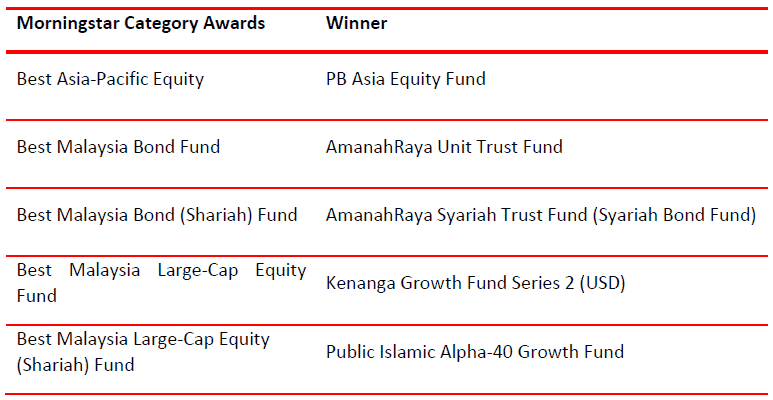
2022 Morningstar Fund Awards Malaysia
The above are the 2022 Morningstar Fund Awards winners in Malaysia.
For the category Best Asia-Pacific Equity, the winner is PB Asia Equity Fund by Public Mutual Berhad.
Best Malaysia Bond Fund category goes to AmanahRaya Unit Trust Fund by Amanahraya Investment Management Sdn Bhd.
Amanahraya Investment Management Sdn Bhd wins again in the Best Malaysia Bond (Shariah) Fund category with its Amanahraya Syariah Trust Fund (Syariah Bond Fund).
Kenanga Investors Berhad won the Best Malaysia Large-Cap Equity Fund with its Kenanga Growth Fund Series 2 (USD).
Finally, Public Mutual Berhad won again for the category Best Malaysia Large-Cap Equity (Shariah) Fund with its Public Islamic Alpha-40 Growth Fund.
How The Winners Are Selected?
The Morningstar fund category awards are based on Morningstar fund data as of 31 December 2021. The awards methodology emphasises the one-year period, but funds must also have delivered strong three- and five-year returns after adjusting for risk within the awards peer groups in order to obtain an award. In selecting winners, fund returns are adjusted for risk using the Morningstar Risk, a measure which imposes a higher penalty for downside variation in a fund’s return than it does for upside volatility. The full methodology for the awards is available here.
So there you go, those are some of the top unit trust in Malaysia. But before investing in any unit trust or any investment vehicle for that matter, do your own due diligence first. The unit trust might be suitable for me, but it might not be suitable for you or for everyone.
On the topic of retirement planning, there are a lot of things that comes into mind. Savings, investment and retirement funds are just some of the issues that we need to face. How much do we need to save every month? Where to invest? Is RM1 million enough to retire?
Smart Investor spoke to Ismitz Matthew De Alwis, executive director & chief executive officer, Kenanga Investors Berhad to get more insights on this issue.
Ismitz Matthew De Alwis
Smart Investor: It is reported that 75% of Malaysians don’t even have savings of RM1,000. Why do you think most of us are not able to save?
Ismitz Matthew De Alwis: With rising inflation and poor personal financial habits, most Malaysians would not be able to survive for more than three months if they were to unexpectedly lose their main source of income. Although the Employees Provident Fund (EPF) and Private Retirement Schemes (PRS) withdrawal policies were relaxed to assist those significantly impacted by recent events, this has led to many depleting their retirement savings faster than planned.
I believe that it all eventually boils down to their personal finance fundamentals. Many forget that the process of building up sufficient retirement funds is not brief, but a lifelong journey.
Everyone seems to be talking about that magic RM1 million. It is achievable and will it be enough to retire comfortably?
Everyone begins their journey from a different starting line and the decisions we make along the way will affect our destination in the end. RM1 million may seem a big amount for some, but a drop in the pool for others.
Investors should focus on saving for a sufficient amount that is achievable and enough to retire (according to their desired lifestyle) without worry. The major factor is to plan early for their retirement.
6.1 million EPF members have less than RM10,000 in their savings, it doesn’t look too good. What can these people do to ensure they can retire well and not continue working until old age?
Make it a habit to review and evaluate your financial portfolio periodically and make the necessary changes when needed. This can reduce the chances of panicking and making rash decisions when difficult situations present themselves. I tend to link retirement planning towards building a well-rounded ship.
By actively evaluating their portfolios, they can ensure that their ship is well-fuelled and constructed with high-quality materials, to protect their growing cargo from rough waters and strong winds.
The younger generation these days seems to like working as a freelancer, running their own small business or becoming an e-hailing driver but with no EPF, how can they start planning for their retirement?
Proper research and planning are required before diving into any form of investment as there exists many products and options which all serve the same purpose: providing additional income. They can then set aside this additional income and park it under voluntary long-term saving schemes.
For example, here in Kenanga Investors, we offer OnePRS by Kenanga as a voluntary retirement scheme to assist investors to supplement their current savings for their golden years. With an increasing life expectancy and the rising costs of living, many are finding that their retirement funds are not enough to solve any potential financial difficulties during their retirement.
What are some of the investment vehicles that you would suggest for retirement planning?
There are usually two main factors when it comes to discussing preference, an investor’s investment horizon and risk tolerance. When planning for retirement, investors can opt for short, mid or long-term investment periods, while their risk tolerance depends on the person itself. Investors who are willing to take on higher amounts of risk to achieve higher returns or growth are categorised as growth or aggressive investors.
Moderate risk investors are those that are in-between and are willing to take some percentage of losses to achieve a steady growth rate. Also, low-risk or conservative investors are those that do not participate in high-risk investments, they often seek a steady stream of income with very low risk.
There is no one-size-fits-all option for retirement planning, as there exists a wide variety of investment products in the market that cater to various risk tolerance and investment goals. Some examples of these are unit trusts, real estate, bonds, deposits, stock trading, and exchange-traded funds. In short, be sure to first determine your risk tolerance and retirement goal before committing to any investment vehicles.
Malaysia’s mandatory retirement age is now at 60 years old. It can either be a good thing or worrying, depending on whether a proper planning has been done prior to retirement.
For most of us, the main savings for retirement would be our contributions to the Employee’s Provident Fund (EPF) or other equivalent retirement fund. But as statistics have shown, it is inadequate to maintain the quality of life we were used to before retirement.
Many would take a step further and seek advice from a Financial Planner to see how they can enhance their planning by growing their wealth through investments. With so many options available in the market, many have been blind-sided about one particular issue.
Retirement planning is more than just saving enough money to generate a passive income that covers your post-retirement living expenses and healthcare.
Regardless of how you save or how much you save; you need to think about a situation where you or your family members may not be able to access your savings. What if you are comatose or is suffering from dementia, and are not able to take care of yourself during old age? Or perhaps another pandemic like COVID-19 happens?
You may have a family to take care of, but they will need access to your savings. They would not be able to do so if they are not authorised to operate your account.
Planning for retirement is not just about making sure you have enough to live, but also about providing for contingencies that can happen.
A well-planned retirement covers planning in many aspects, from financial to healthcare arrangements to estate planning and even bereavement care. Proper planning could save your family from a lot of heartaches and financial pitfalls. Rather than just merely saving for retirement, you can further enhance your retirement planning by using a Trust.
A trust is like a water tank that you have installed in your house. Your house’s water supply come from the main pipe. Although the supply is supposed to be continuous, it is only a matter of time before a shortage can happen. This is where your water tank comes into use by continuing your water needs in such an emergency.
This is how an investment or insurance trust from Rockwills can help in your retirement planning.
This type of trust provides liquidity in times of need during your retirement. In the trust structure provided, you need not transfer the asset yet until the events that were predetermined by you happens. Such events could be Total Permanent Disability (TPD) such as being comatose for a period of time, critical illness, and mental disability.
Rockwills as your appointed Trustee will then utilise the trust funds to take care of your financial needs, such as medical expenses and even your living expenses while you are under nursing care. This is very useful especially for those whose children have migrated overseas and are no longer around to help.
In summary, you need to build a safe where you can keep piling up your life treasures; and when the need arises, your dependants are able to access it. You will then need someone who can act as your trustee with a backup key to access your funds and carry out the distribution instructions. By setting up a trust, you will be protected in case of unforeseen events and that will only mean a safer future for you and your family.
Rockwills can help you plan to ensure that your retirement planning objectives can be achieved. Established in 1995, Rockwills is the specialist in providing comprehensive Will Writing, Will Custody & Trust services. We are one of the largest estate planning groups in the region, having written more than 280,000 Wills, 12,000 Trusts and holding over RM25 billion assets under Trust.
There will be an increase of senior citizens in Malaysia as the life expectancy of Malaysians increases. Undoubtedly, decreasing fertility rates and increasing life expectancy is fast forwarding Malaysia to the status of an ageing society.
Based on the Department of Statistics Malaysia, the total population of the country was recorded at 32.4 million in 2020, with a total 2.2 million of the population or 7.4% aged 65 years old and above. The World Bank defines a country as ‘ageing’ when the percentage of people aged 65+ is above 7%, thus, categorising Malaysia as one of the ‘ageing’ nations.
The 2020 report by the World Bank, titled: A Silver Lining: Productive and Inclusive Aging for Malaysia, estimated that Malaysia will be an ‘aged’ nation by 2044 and ‘super-aged’ nation by 2056 with at least 14% and 20% of the population aged 65 and above respectively.
Whether it is for ourselves or for our parents, are we prepared for aged care?
Dr Carol Yip
Responding to Smart Investor, Aged Care Group Sdn Bhd (ACG) chief executive officer, Dr Carol Yip says that many are still struggling and worry if there will be enough money to retire, especially when medical costs continue to rise.
“Have you ever spoken to your parents or your family members about this? Most of us have not talked about or planned on retirement with our parents or families,” Dr Carol points out.
She notes that it will be difficult when adults in their 40s and 50s need to take care of their aged parents’ medical and living expenses, in addition to what they may have to spend on their own medical and living expenses. The situation may worsen with sibling rivalry and unwillingness to share the financial burden of caring for aged parents.
Increasing Needs for Aged Care Service
Group chief executive officer of Seterra Group of Companies, Rashidi Yahaya said that more and more people are now looking for aged care for their parents. Seterra is a Syariah-compliant aged care company located in Bukit Damansara, with the goal to revolutionise the standard of Islamic aged care in Malaysia by setting a new world class standards in aged healthcare facilities.
“Inevitably parents will grow old. When they are no longer mobile or become bedridden, their children will find themselves inadequately ready to provide the necessary care,” he informs.
He explains that there is also a shift in the thinking of the elder community today. They do not want to burden their children when they grow old, and can accept living out their older age in a place that can fulfill both their medical/physical and spiritual needs.
Society at large has moved away from traditional family values where the elderly are mostly at home under the care of their family members, shares Angela Francis, a project coordinator for Ipoh-based Ozanam Retirement Village (ORV).
“Hence, it is becoming more necessary for people nowadays to start planning on how to secure and support themselves in their twilight years,” she says.
ORV provides an essential community living environment for seniors. It is an initiative by The National Society of St Vincent De Paul (SSVP) and the Titular Roman Catholic Bishop of Penang where Angela is the vice president of SSVP.
There are some critical perspectives regarding retirement living and aged care. In the old days, the responsibility to care for the parents lies on the children. Even today, some are still stuck with this perspective.
“You are not neglecting your duty as a son or daughter by sending your mother or father to a home as these homes could perhaps take even better care of them for you,” Rashidi explains. “We still have a duty to provide emotional, physical and spiritual support to the best of our ability.”
“For Muslims especially, there are special considerations and concerns. These concerns need to be balanced with providing the best aged care for our parents according to our means and the seeking of Husnul Khotimah, of finding peace and contentment in their final years,” he points out.
Are There Enough?
As Malaysia moves closer towards becoming a ‘super-aged’ country in less than 35 years, are there enough aged care facilities that can cope with the demands?
“Elderly people have multi-types of illness and will need a qualified multi-disciplinary team of trained staff.”
“We don’t have enough purpose-built licensed aged care facilities with professional managers and trained staff to provide quality care according to the define-specific old age illness like dementia, Parkinson’s disease, stroke, kidney failure, cancer, heart problems and frailty – just to name the common problems,” says Dr Carol.
Rashidi agrees with Dr Carol that the facilities for aged care needs are not enough, noting that the aged care sector is very under-served, especially for Muslims. That is why Seterra is pioneering a structured approach to retirement and elderly care for Muslims.
Rashidi Yahaya
“We sincerely hope there will be more Muslim players in the industry. New standards of caregiving and infrastructure, nutritious halal food and food for the spirit are needed to ensure a dignified ageing experience, and adequate medical care are just some of the factors that needs to be put in place,” he says.
In Malaysia, developers are already noticing the potential of this market segment and have invested in building retirement villages to cater to the anticipated growing market. In the last ten years, residential property developers have begun developing aged people-friendly residences. However, this is still not enough.
Current townships have more residential apartments, commercial buildings and shopping malls as compared to aged care related facilities which is not the main attraction for buyers. But the awareness is increasing. Will an aged care friendly ecosystem in the residential building be a game-changer?
“There’s no statistic to back the claim that it will be a game-changer. But I’ve worked with developers to build aged care facilities in their township development. It’s satisfying to see that most residents can easily get the help they need anytime as the aged care operates 24/7 in such development,” Dr Carol informs.
According to her, in Singapore, every township development or common area is required to have childcare and senior citizen centers among other community facilities. It is for the convenience of those who are staying in that particular housing area.
She strongly recommends that the elderly live their old age in a neighbourhood familiar to them. Even better if it is within the same neighbourhood that is within a 5 to 10 km radius, and there is a licensed aged care facility for them.
“We need to start engaging the stakeholders that are building smart cities for sustainable living. It would be to encourage them to include aged care support infrastructure, facilities and support services.
“The government has access to all the data and surveys from MyCensus; as well as health and medical conditions of Malaysians via public hospitals and clinics from the Ministry of Health. They should be able to predict the ageing needs based on that data. That’s where all the data comes in for a better projection, planning and execution,” she notes.
Lack of professional caregivers, affordable care, elderly-friendly accommodation and other related problems would require urgent attention before the silver tsunami overwhelms the country.
Is Aged Care Exclusive?
Who has access to aged care? Is aged care only exclusive to those in the wealth hierarchy (aka the one who can afford it)? Dr Carol insists that aged care should be inclusive to help those, and all in need.
“We have low-cost airlines, low-cost hotels, so the same should go for aged care. We need low-cost aged care facilities with proper care for the elderly. There is a need for more affordable aged care that people in need can access,” Dr Carol explains.
Aged care should be inclusive but are they affordable especially to those in B40 or M40?
“Today, I don’t think that the B40 segment can afford aged care, while the M40 can only afford to provide aged care amongst the family if the family comes together to take care of each other and their aged parents,” Dr Carol shares.
According to her, it has to be a shared effort and shared financial responsibility depending on how each adult child plans their retirement. If the M40 does not have family, they will need help from the community such as friends and neighbours.
She emphasises on the government’s role in providing support and incentives to make aged care affordable by categorising the population data by area or township, enforcing and implementing a continuum of care services that are easily accessible.
Non-Governmental Organisations (NGOs) have been playing an active role in many segments, especially in helping those in need.
Angela Francis
“As part of an NGO that serves the weakest and marginalised within society, we regularly encounter many of the elderlies who are abandoned and left to fend for themselves,” Angela says.
She adds that the growing need to provide care, better living standards and security to this vulnerable group in society has inspired and driven them towards the development and management of ORV.
“We want an eco-friendly environment. Hence ORV is being built in Taiping, Perak – a land surrounded by lush green foliage to harness the tranquility and peacefulness from nature,” she says.
“We would also want to ensure that we are giving the opportunity to the right target group, namely the elderly, to reside in the retirement village,” Angela explains adding that the majority of those using their services are in their 60s and 70s.
Islamic Aged Care
Aged care is needed across the board. It should be inclusive without any label, be it from a religious point of view or race.
“Out of the 1,400 aged care homes in Malaysia, none are registered as an ‘Islamic Aged Care’ home,” Rashidi informs.
On the hesitance of aged care in Malaysia especially for the Muslim community, Rashidi comments: “If one cannot take care of one’s parents because they are bedridden or seriously ill, it is the children’s responsibility to seek solutions to care for them. Letting others take care of their parents does not mean they are neglecting their duty. They are still providing for them to the best of their ability.”
The Muslim mindset about aged care or retirement homes needs to change. They must see that it is a natural progression of their own life and of their parents to undergo a new phase – to seek spiritual fulfillment, to handle all worldly issues and to have a dignified and peaceful ending with the best of care.
With the world evolving, aged care is not as typical as we think. The way we view things needs to change and come from different perspectives.
Placing your parents in an aged care facility does not mean you are abandoning your elderly parents. However, it must be followed by strict compliance as enshrined in the Quran and the Hadiths. “You still owe a very heavy duty to them and keeping your parents happy and fulfilled is still your responsibility which you cannot abdicate to a Rumah Orang Tua,” he emphasises.
Never Too Late to Start
Have we planned on how to survive our golden years? If you are to retire, how much money do you need? Would it be sufficient to cover for the rainy days?
RM2,500 per month looks to be sufficient for retirement. But depending on one’s lifestyle during retirement, it may not be enough. “With rising inflation, this amount will not be sufficient,” says Angela.
Sadly, according to the Employees Provident Funds (EPF), around 6.1 million contributors aged below 55 or 50% of total contributors only have RM10,000 or less, which means this group of contributors may only have RM42 per month to live for another 20 years after retirement.
“It is estimated that 39.2% of our population have ZERO savings for aged care (World Bank calculations based on the Department of Statistics Malaysia, EPF and KWAP). In addition to that, almost 50% of the ageing population in Malaysia falls into the B40 category. At Seterra, it is our objective to cater to all walks of society regardless of their faith, beliefs and ethnicity,” Rashidi informs.
According to a survey on ageing conducted by Ipsos in 2018: when asked what’s the worst thing about growing old is, globally 30% of those polled responded that they personally worry about not having enough money to live on in their later years,
So, how can we prepare for our ageing needs? It is never too late to start planning for your retirement. The rising cost of living, medical expenses and inflation should be factored into our retirement planning.
“Age is just a number. Choosing to work part-time during retirement can maintain a good mental health and earn an income,” says Dr Carol.
She also suggests the need to increase the retirement age to 65 and beyond, so that people can continue working for as long as they can. “It’s not that bad. It helps you to be physically, mentally and socially active.”
As for the younger generation, here’s a piece of advice from Dr Carol.
“Save more money than what is required by EPF. This is because when you retire, you may need your savings to help your aged parents, especially when your parents’ retirement income is insufficient to take care of their health and medical care. Get ready before the storm,” she advises.
















 Kevin Neoh is a NextGen Money Coach who works with people to help them transform their relationship with money to improve their lives with the money they have. Kevin can be contacted at