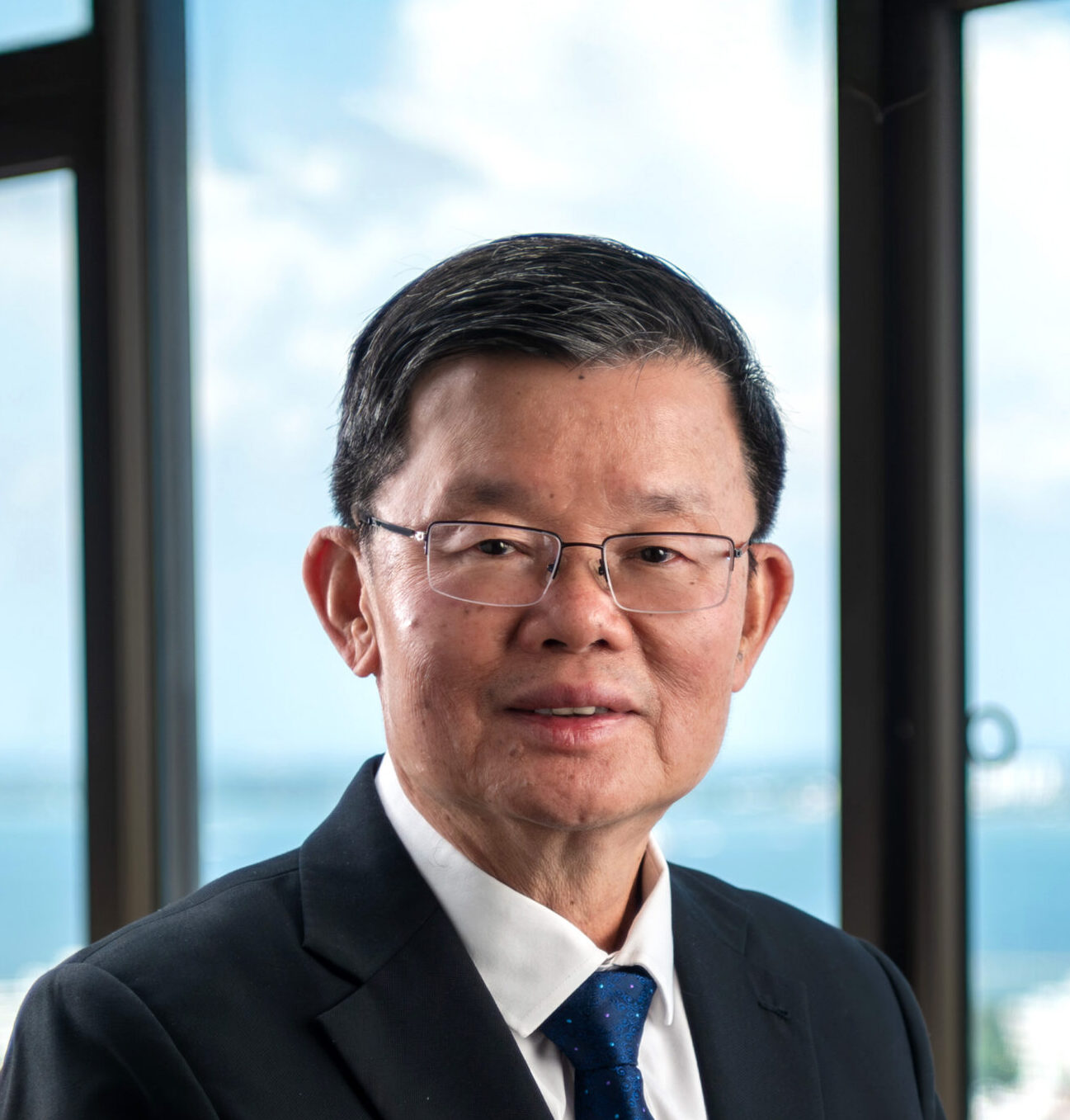
Politics is a public trust that demands objectivity and the courage to put the interests of society above personal ambition. True leadership is measured not only by the ability to take office, but also by the wisdom to chart the path for successors. TSI speaks to YB Tuan Chow Kon Yeow, the 5th Chief Minister of Penang (since 2018). Serving his last term, he unpeels his political past, weighs the present and looks ahead for Penang’s next chapter.
What inspired your transition from a journalist to a politician?
Journalism was my first training ground in public service—it gave me a direct understanding of people’s reality. It also taught me that public policy is never abstract as it affects different society strata in very real and immediate ways.
Over time, I felt that (my work) was not enough and I wanted to be part of the solutions by shaping it. The turning point was Suara Tanjong, the 1986 general election campaign newsletter for Lim Kit Siang. Inspired by his commitment, I accepted the role of political secretary, as it was the perfect opportunity to move from reporting to driving change.
Journalism has never left me—it inculcated lifelong values and habits. From the way I listen carefully, verify facts, question assumptions to weighing different perspectives before reaching conclusions. More importantly, journalism taught me to appreciate humility and that leadership is not just about headlines or statements but whether people genuinely experience improvements.
Penang2030 and my administration was built on that underpinning belief system. The public trust is difficult to earn and easy to lose, and that is why governance must always remain transparent, accountable and focused on delivering tangible results for the people.
What is the progress of Penang2030?
| A 12-year strategic development vision, Penang2030 envisions Penang to be a family-focused, green and smart state that inspires the nation.
Progress Dashboard
|
There is no end point for Penang2030—it is a long-term framework to ensure that the state’s growth remains inclusive, sustainable and future-oriented, so that the next generation inherits a Penang that is more resilient, innovative and prosperous than the one we know today.
When I launched it in 2018 as a guide for future planning, I recognised that this vision required sustained commitment and consistent execution over many years. Penang2030 is not something achievable by a single term government.
Penang2030 reflects an important principle: development is not a destination but a continuous process of improvement.
With global supply chains shifting, how will Penang sustain its manufacturing edge, and what industries will drive its next phase of growth?
Penang’s success as a manufacturing and semiconductor hub is not the result of a single investment cycle or policy decision—it is a product spanning over five decades of industrial development, continuous upgrading and a strong collaboration with stakeholders.
We have one of Asia’s most integrated ecosystems for semiconductors, advanced manufacturing, medical technology, automation and precision engineering and this remains to be one of our greatest strengths. We also host more than 350 MNCs, over 6,500 manufacturing-related SMEs.
In 2025, Penang recorded:
- 96 billion in approved investments, comprising RM22.38 billion in manufacturing and RM41.22 billion in services.
- Total trade reached RM956.37 billion, including RM573.91 billion in exports (approx. 35.7% of Malaysia’s total exports)
The challenge moving forward is remaining competitive in a world shaped by geopolitical shifts, supply chain realignments and rapid technological change. Our competitive advantage needs to move beyond costs, but built on talent, innovation and reliability of our ecosystem.
Moving further up the value chain is necessary and via the Penang Silicon Design @5km+ initiative, we strengthen our capabilities in integrated circuit design, R&D and high-value engineering. Together with the IC Design & Digital Park, the Penang Chip Design Academy and the Silicon Research & Incubation Space, a semiconductor ecosystem is built to extend into innovation and intellectual property creation. The ATE Campus will further strengthens Penang’s position in automation, testing and equipment technologies, which will play an increasingly important role in next-generation semiconductor production.
Manufacturing will continue to be the backbone of Penang’s economy, but long-term resilience requires a broader growth base. Therefore, diversification is a strategic priority as we expand complementing sectors such as digital economy, AI, healthcare and medical technology, logistics, global business services, green technology, higher education and sustainable tourism.
Under the Penang Digital Economy Master Plan 2025–2030, we aim for the digital economy to contribute 35% of state GDP by 2030, attract RM20 billion in digital investments and create 50,000 high-skilled jobs.
Critics argue that economic progress is uneven in Penang, what do you think fell short?
Rapid economic growth can produce uneven outcomes. This is not unique to Penang; it is a challenge in many successful cities and regions. Some families still feel the pressure of higher living costs, housing affordability, traffic congestion and unequal access to opportunities, even when the broader economy is performing strongly.
For a land-constrained state like Penang, housing affordability remains a key priority. At the same time, demand for healthcare, public transport, flood mitigation and other public infrastructure continues to rise alongside development. These are not side issues; they are central to whether growth remains sustainable and inclusive.
Under Penang2030, we have deliberately pursued a balance between economic competitiveness, liveability, social inclusiveness and family wellbeing. The State’s latest RM1.088 billion budget reflects that commitment through investment in affordable housing, transport connectivity, education and skills development, healthcare, SME support and targeted assistance programmes.
You introduced a two-term limit early in your tenure. In hindsight, did it work in favour or against you in leading Penang amid limited resources and high public expectations?
The two-term limit was introduced on a simple principle: leadership should strengthen institutions, not create dependence on individuals. In any democracy, the longer a leader stays in office, the greater the risk that governance becomes personalised. This term limit helps guard against that—public office is a responsibility, not an entitlement.
This discipline is especially important for a state like Penang, therefore our development agenda is long-term in nature.
A term limit means no leader can assume they will personally see every project through to completion. That is a challenge, but it is also a healthy reminder that progress must not depend on one individual, but institutional continuity matters. The real test is whether policies are supported by strong governance frameworks, sustainable financing and capable implementation agencies that continue seamlessly even when leadership changes. If that is done properly, a term limit is not a weakness; it becomes a safeguard that pushes the state to think beyond personalities but long-term resilience.
For two administrations, Penang’s water tariff review and land tax hike remained but you’ve proceeded with an adjustment despite political sensitivity. What drove you to push through this unpopular decision?
The easiest thing in politics is to postpone difficult decisions. In the case of both the water tariff review and the land tax adjustment, I was fully aware of the political risks. But leadership is not about choosing what is popular today; it is about ensuring that future generations do not inherit bigger problems because we lacked the courage to act.
Water security was the clearest example, Penang has long enjoyed among the lowest water tariffs in Malaysia, but low tariffs do not guarantee sustainable water services. More than 85% of our treated water depends on a single raw water source, but population growth, industrial expansion, economic growth and climate change continue to place increasing pressure on demand raising it to 1.5 billion litres per day by 2030.
Meeting that demand requires major investment. The Water Contingency Plan 2030 by PBAPP is implementing approximately RM2.15 billion worth of projects. These are not optional expenditures; they are essential investment to safeguard water security, supporting lives and livelihood of Penangites for a longer term beyond 2030. Do you know that even after the tariff adjustments, Penang is still among the lowest domestic and non-domestic water tariffs in the country while programmes such as Rebat Mutiara and Rebat Mesra Keluarga remain available to support lower-income households?
The same principle guided the land tax review. Over the past three decades, Penang has transformed significantly. Areas once classified as rural or semi-rural have evolved into major residential, commercial and industrial centres, yet arts of the tax structure remained largely unchanged. This system that no longer reflects current realities is neither equitable nor sustainable.
What ultimately guided both decisions was not revenue maximisation but responsible governance. We introduced mitigating measures, including rebates, flexible payment arrangements, waiver of late-payment penalties and appeal mechanisms. More importantly, additional revenue generated will be reinvested into critical infrastructure, water security, social assistance programmes, disaster preparedness, SME development and other services that directly benefit the people.
At the end of the day, leadership is about stewardship. Political capital can be rebuilt. Water security, infrastructure capacity and fiscal sustainability are far more difficult to restore once they have been neglected. The question I asked myself was not whether these decisions would help me politically, but whether they would leave Penang stronger, more resilient and better prepared ten or twenty years from now. On that basis, the decision was clear.
A legacy for Penangites?
Personally, legacy is not measured by physical projects or individual achievements. Instead, it is whether Penang is prepared for its next growth phase as its institutions are stronger, economy is more diversified and Penangites have broader and more meaningful opportunities to succeed.
Throughout my tenure, we have been guided by four principles: good governance, economic competitiveness, social inclusivity and fiscal responsibility. The lineup of major projects in Penang now is long but projects can only take us so far. Ultimately, the enduring foundation is institutional strength: a transparent and accountable government, a capable and professional public service, and deep collaboration between government, industry, academia and the community. If these are in place, Penang can continue to flourish regardless of leadership transitions.
Looking ahead, my hope is that Penang remains a place where ambition is matched by opportunity. My concern, however, is complacency. The global landscape is shifting rapidly, and past success offers no guarantees. We must continue to invest in talent, embrace innovation, strengthen resilience and stay open to new ideas and global partnerships. If the next generation inherits a Penang with higher prospects than the one we inherited, my office would have fulfilled our responsibility. In that sense, the legacy will not belong to any one leader—it will belong to Penang and to the people who continue to shape its future.
Full interview available at The SmartInvestor’s Sept/Oct 2026 issue.
Leave a Reply