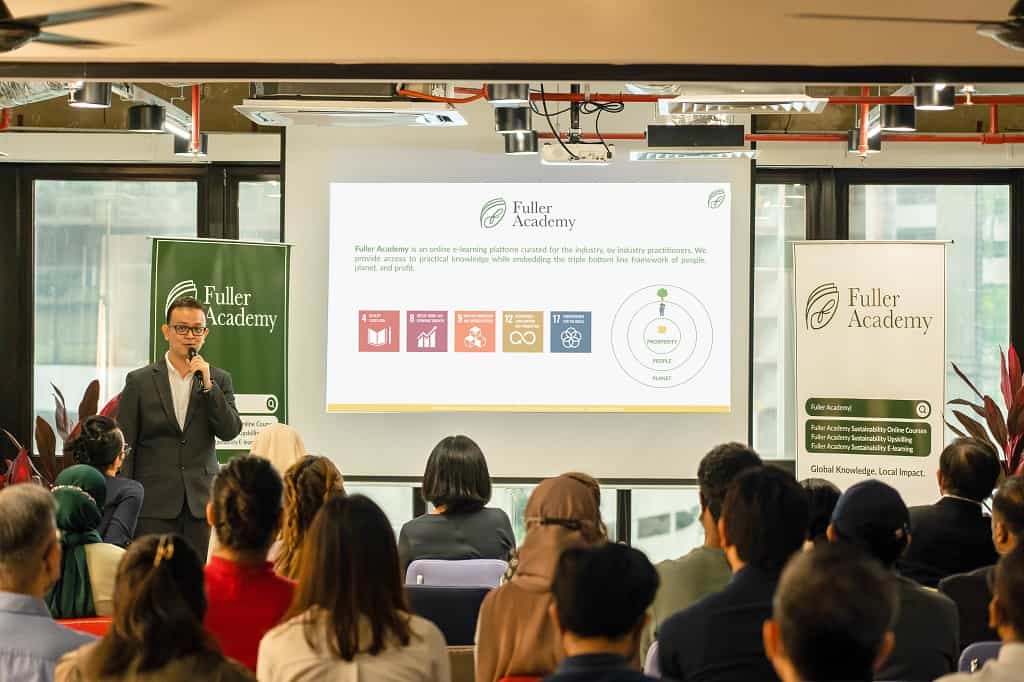
Kuala Lumpur-based Fuller Academy is poised to enrol to 30,000 learners across ASEAN through its 12 sustainability short courses, designed and curated by the industry, for the industry, to enhance talents’ knowledge and skills in sustainability.
Chief Executive Officer Wan Imran said all programmes certified by Human Resource Development Corporation (HRDCorp) are part of micro-credential short courses, which aim to provide knowledge solutions for talents, in line with the global demand for talent upskilling in sustainability.
“Based on a recent analysis by Bloomberg, global ESG assets are on track to exceed $53 trillion by 2025, representing more than a third of the $140.5 trillion in projected total assets under management. This is a strong driving force encouraging the industry to shift towards a more sustainable approach. Hence, now is a critical time for organisations to start enabling their talents with knowledge and purpose in the areas of sustainability. This is also aligned with our national agenda of creating 200,000 green jobs by 2030.” he said during the launch of Fuller Academy.
Wan Imran, Co Founder and CEO of Fuller Academy & Michelle, Co Founder and COO of Fuller Academy
To date, more than 1,600 participants from various industries have signed up across various of our programs from within the country and abroad.
“Our learners come from different industries and backgrounds, as we offer a range of courses targeting different skill sets from sustainability communications to the introduction of carbon emissions. We have been getting a lot of learners from ASEAN and other regions, with many learners hailing from Europe. The courses which were curated with our global instructors have set a new standard in sustainability learning, which is effective, practical and engaging.” he added.
Breaking it down further, Imran said the courses are all designed and created by industry experts and practitioners thus providing insights into the practical industry knowledge.
“We have made it accessible geographically and financially. Being an online platform, anyone from across the region and beyond can sign up as a learner. For Malaysia-based companies, they can benefit from the financial support HRDCorp can provide, and for outside of Malaysia, they can also take advantage of our entry-level pricing.”
“The courses are designed to be short and bite-sized, with the flexibility for the learners to complete the course in their own time within the monthly cohorts. This on-demand format is
ideal for busy professionals, allowing them to learn around their working schedule through a structured yet flexible course.”
In conjunction with the launch, Fuller Academy also hosted a series of dialogue sessions on sustainability, attended by experts in the field such as Elina Jani from Malaysian Green Technology And Climate Change Corporation (MGTC), Wan Dazriq from Ethis Malaysia, Karina Cady from Nandina Partners, Yasmin Rasyid from EcoKnights, and Yasir Qureshi from Kantar Malaysia.
About Fuller Academy:
Fuller Academy is the trusted strategic partner in the business sustainability journey, providing industry-driven sustainability education through online courses. Current open enrollment includes Fundamentals of Business Sustainability, Introduction to Carbon Emissions, Internal Communications for Sustainability, and Shaping Consumer-Centric Sustainable Strategy.
An innovative legal tech developed by lawyers is changing the divorce landscape in Malaysia while simultaneously supporting the Malaysian government’s goal of increasing the adaptation and use of technology across as many industries as possible.
Launched early this July, Klik Divorce is the country’s first digital divorce platform and was created with the primary intent to ease the pathway of those seeking legal avenues for the dissolution of marriage.
It was developed by lawyers Dato Fion Wong and Dato Chris Chin, both strong advocates for the adoption of technology in Malaysia’s legal industry and also the founders of Malaysia’s First A.I. legal assistant Askaila, that was launched last year.
Dato Chris Chin and Dato Fion Wong
Through Klik Divorce users can build divorce terms i.e. spouse maintenance, child custody, maintenance and visitation rights as well as the division of matrimonial assets. With just one click, divorce papers are immediately generated for printing and signing. If the divorcing couple mutually agree on the terms, the whole process takes only about 5 minutes. The law firm can then review the papers and prepare them for filing in the Court the next working day.
Meanwhile, those who encounter challenges or need help to facilitate settlement agreements, can engage the service of a lawyer; online or in-person.
That, in a nutshell, is divorce in the digital age.
Klik Divorce offers two key positives amidst the pains of divorce proceedings, namely time and cost savings.
“Many people are unable to afford the legal fees for divorce, especially with today’s increasing costs of living. Additionally it can take anywhere between 6-12 months for terms to be discussed back and forth before the divorce is filed in court,” says Dato Fion.
“Adopting legal technology to execute simple manual tasks can save a lot of time and reduce costs which make legal fees affordable to more people. This also enables lawyers to dedicate more time and effort to develop the law.”
Klik Divorce is especially beneficial for uncontested divorce cases. Not only does it make the process faster and smoother, it also leads to quicker settlements, freeing up judiciary workload and court time. As the first legal online service in Malaysia, it also sets an example and paves the way for more digitalised services.
Dato Fion said that despite receiving encouraging and positive feedback from users, there are unfortunately lawyers who continue to openly resist the adoption of this platform.
“Nevertheless, despite the obstacles that lie ahead, we are determined to drive Malaysia’s legal industry towards adopting technology to offer efficiency and value to the public. We are also confident that in the near future Malaysia’s legal industry can catch up and compete with other nations whose legal technologies are already ahead of us,” added Dato Chris.
Whether we are business owners or in employment oftentimes we neglect our legal well-being. The general notion is ‘what isn’t broken need not be fixed’.
What we fail to recognise is that most of the time, a lot of our legal problems, which may at the material time appear small or insignificant, can with time and neglect, multiply and become costly to rectify.
Most times these legal crises and complications can be averted or reduced if the right steps are taken at the appropriate time.
Why is a Legal Health Check Important?
It is important to remember that if your financial and legal matters are badly managed, you are directly exposing yourself personally as well as your company and clients to various legal implications.
These risks can cause unnecessary cost, loss of business relationships, knowledge and possible statutory or regulatory breaches. The effect of a badly managed business is far- reaching and can in some situations take years to rectify/remedy.
The advice here is to be constantly aware and apply your mind to a couple of key areas when you are performing your own legal health check. Here are some of them:
1. Have You Complied with the Relevant Statutory Regulations & Laws?
Often, as business owners, you may not be aware of the changes in law that may have taken place, and as such need to be advised by your legal advisers on the latest legislation or amendments to any current legislation that concerns the industry you are in and the services you render.
There are currently more than 20 new Acts that have been made and countless new regulations and amendments to the current laws.
If you are not keeping abreast with the changes, you will be exposing yourself and your business to risk. What you do not can hurt you!
2. Partnerships and Shareholding
Make it a yearly affair where you have a formal discussion with your partners/directors on their roles, scope of work, performance and entitlements.
Have these discussions minuted and served on them officially. This makes it easier to address partnership or business issues and enables you to make any necessary changes to your business structure, revising targets, scope of work etc.
It is also of utmost importance to have written partnership and/or shareholders agreement to cover all terms of your partnerships and shareholding.
Ensure that your agreements adequately deal with matters such as buyouts, raising capitals, succession, put & call options and exit clauses. Your partners/directors must also be fully aware of their duties and obligations under the new Companies Act 2016.
3. Trade Creditors and Debtors
By this time of the year, you must know who owes your company money and how you intend to recover those unpaid debts. Have a list of creditors prepared and send out the necessary reminders and letters of demand.
Start the process of recovering monies before the New Year. The longer you wait, the harder it will be to collect these debts.
For those creditors who, for whatever reason cannot pay you in full, it would be advisable to speak to them about an instalment plan and get a settlement agreement drafted to confirm the instalment terms. If possible collect post-dated cheques.
4. Employment Contracts
It is pivotal for you to know what your exposure as a company or business in an employment dispute. It is also important for you to know the processes and procedures that you need to carry out before you terminate a belligerent employee.
It is prudent that you have an Employment Handbook prepared and served on all your employees.
This year alone there have been a lot of discussion on the need for change to our employment laws in particular, to laws covering sexual harassment at work, maternity and paternity leave, data protection and personal information.
5. Intellectual Property
Whatever industry you’re in, it is prudent to consider registering your trademark and tradename. As your business gains popularity and people start recognising your brand and name, it is inevitable that a competitor may want to benefit from your goodwill to gain some traction.
You do not want a competitor to proceed to use your name and logo in a similar industry and reap the benefits and goodwill off your hard work.
Please do consider securing your intellectual property rights. It makes it easier for you to enforce your rights when you have the requisite trademarks being registered.
6. Written Contracts and Agreements
Always have your written contracts and agreements revised and up to date. Review the terms of your Purchase Orders, Invoices, Supplier Contracts, Equipment/ Machinery Leases, Rental Agreements.
It is important that at all material times, you are aware of your key suppliers and key customers. Review these contracts and agreement as there may be renewal clauses in those contracts that may have slipped your mind, which could cause you undue losses.
7. Train Your Staff
Always train your staff to be aware of what type of legal documents to look out for. For example, a Winding up Notice that is served on your registered address needs to be brought to the immediate attention of the Board of Directors, as there are dire repercussions of not responding to the said Notice within the statutory imposed period of time.
Conclusion
There is no such thing as a ‘one size fits all’ when it comes to legal matters. You will need to design your own Legal Health Check which is suitable for your own business or company.
Like a well-tended garden, you will need to constantly prune, remove and regrow your legal structures to ensure that it is in perfect order.
Always remember that a detailed examination of these key areas will help you identify any danger or grey areas which will then enable you to circumvent or reduce any potential risks and liabilities to your business.
About the author
SHARMILA RAVENDRAN is the founder of the law firm, Messrs Ravindran located in Mont Kiara, Kuala Lumpur. She has more than 14 years of experience in the legal industry servicing clients that include local and foreign companies. She is now actively involved in corporate advisory work and commercial litigation and is a Panel Adjudicator with the Kuala Lumpur Regional Centre for Arbitration. She also sits on the Bar Council Child Rights Committee and is the Legal Director for Lean in Malaysia. She can be contacted at sharm@ravindran.com.my.
Lately, after Sri Lanka became bankrupt, numerous messages have been circulating on social media claiming that Malaysia will go bankrupt next.
You might have seen them on FB, Insta, and Tik Tok or forwarded WhatsApp messages that we are doomed next.
But do these claims hold? Let’s examine the numbers.
How Does A Country Go Bankrupt?
A country’s economy collapses when it has no or zero cash reserve, exports and economic activities.
In Sri Lanka’s case, rampant corruption, economic mismanagement and meddling with the constitution by the ruling elite have led Sri Lanka to bankruptcy, affecting millions of citizens in the island nation.
They are now facing fuel and food shortages, high inflation and endless political turmoil. Sri Lanka is now drowning in its worst-ever economic crisis and pleading for other nations’ help to keep its economy afloat.
Following a 70% drop in foreign exchange reserves since January 2020, Sri Lanka has struggled to pay for essential imports such as food and fuel. Its foreign currency reserves fell to US$2.31 billion in February, a fall of US$779 million from December 2021 through January 2022.
What led to these dire situations was a series of unfortunate events.
Here Are Some YouTube Videos Which Explain The Crisis In Detail:
To summarise the videos, some key factors diagnose the health of a nation’s economy. Let’s have a look.
Foreign Exchange Reserve
Sri Lanka’s Foreign Exchange Reserve
Malaysia’s Foreign Exchange Reserve
Foreign reserves are the foreign currencies a country’s central bank holds as backup funds in an emergency, such as a rapid devaluation of its currency.
It is good practice to hold foreign exchange reserves in a currency that is not directly connected to the country’s currency. Therefore, most reserves are held in U.S. dollars, the most traded currency in the world.
Countries use foreign currency reserves to keep a fixed rate value of their currency, maintain competitively priced exports, remain liquid in case of crisis, pay external debts and provide confidence for investors. Therefore, an increasing foreign exchange reserve is ideal. Malaysia, in comparison to Sri Lanka, has a strong foreign reserve which has been increasing while Sri Lanka’s foreign reserve has been declining.
Balance Of Trade
Sri Lanka’s Balance of Trade
Malaysia’s Balance of Trade
Balance of trade (BOT) is measured as the difference between the value of a country’s exports and the value of a country’s imports for a given period.
A positive trade balance (surplus) is when exports exceed imports, while a negative trade balance (deficit) is when exports are less than imports. A trade surplus does not necessarily indicate a healthy economy, nor does a trade deficit necessarily indicate a weak economy.
While a trade surplus helps in creating employment and economic growth, it may also lead to higher prices and interest rates within an economy. When based solely on trade effects, a trade surplus means high demand for a country’s goods in the global market, which pushes the price of those goods higher and leads to a direct strengthening of the domestic currency. On the other hand, a trade deficit can be beneficial to countries that import heavily and simultaneously invest in economic development.
Malaysia, an export nation, has a consistent trade surplus, while Sri Lanka has had a trade deficit for the past years. Unfortunately, Sri Lanka did not invest heavily in economic development activities.
Malaysia’s Export Category
Sri Lanka’s Export Category
Moreover, Malaysia’s exports are varied, well diversified and highly valued, mainly contributed by the Electric and Electronics industry, Oil and Gas and palm oil. Sri Lanka’s exports, on the other hand, are highly dependent on the low-value clothing and agriculture industry, and their GDP heavily relies on tourism.
Government Debt To GDP
Sri Lanka’s Government Debt to GDP in Percentage
Malaysia’s Government Debt to GDP in Percentage
The debt-to-GDP ratio compares a country’s debt to its gross domestic product (GDP). The ratio indicates a country’s ability to pay back its debts by comparing what it owes with its production.
The higher the debt-to-GDP ratio, the higher its risk of default and the less likely the country will pay back its debt.
Even though Malaysia has gone through a series of economic and financial recession crises before, it has never failed to pay interest and mature debts, proving Malaysia’s reputation and capability as a debtor with a good repayment record.
Article 98 (1) (b) of the Federal Constitution stipulates that the Government must prioritise debt charges over other operating expenses. The External Borrowing Act 1963 provides that offshore borrowings cannot exceed RM35 billion. As of the end -of June 2022, this debt amounted to RM29.4 billion.
The Provisional Measures for Government Financing (Coronavirus Disease 2019 (COVID-19)) (Amendment) Act 2021 stipulates that the statutory limit of Government debt cannot exceed 65% of GDP. At the end of June 2022, statutory debt accounted for 60.4% of GDP.
In addition, 97% of the Federal Government’s total debt is in the Ringgit denomination. This reflects prudent debt management as exposure to foreign exchange risk is minimal.
Is Malaysia Going To Go Bankrupt?
Based on Malaysia’s economy, the big answer is NO.
However, as I explored more about the circumstance which led to the Sri Lanka crisis, I couldn’t help noticing parallels between the political and economic situation in Sri Lanka and Malaysia. The situation in Sri Lanka warns us about where we could be headed if we don’t address similar structural problems in Malaysia.
We can avert the crisis Sri Lanka faces if we are willing to learn the lessons the island nation offers.
The problem in Malaysia is social economics, which is stagnant. To elaborate more on social economics problems, here is the list:
Lack of proper economic policy and implementation of the policy
Lack of policies to control fake demand induced inflation, especially in the property market
Lack of technological innovation and skills appreciation in STEM
Lack of policies to ensure proper business ethics and transparencies in the business industry
Lack of law enforcement leading to rampant corruption
Lack of political stability
Therefore, we, the Rakyat should exercise our rights by electing competent leaders at the next general elections to ensure Malaysia does not go down the path taken by Sri Lanka.
Investment scams involve promises of big payouts, quick money or guaranteed high returns. In this part of the world where I live and work, investment scams in the forms of Ponzi and pyramid schemes are getting increasingly common.
Ladies and gentlemen, investment scammers are so convincing. You know who they are actually targeting. Have you lost your job because of COVID-19? Are you desperate for money? Are you a victim of one scam and looking to recover your lost money? With so much debt, what are you going to do?
According to Investopedia, with Ponzi schemes, investors give money to a portfolio manager. Then, when they want their money back, they are paid out with the incoming funds contributed by later investors. With a pyramid scheme, the initial schemer recruits other investors who in turn recruit other investors and so on. Late-joining investors pay the person who recruited them for the right to participate or perhaps sell a certain product.
Over the years, even highly intelligent and educated people who do not understand how things work have been ruined by investment schemes that turned out to be fraudulent. Unbelievable?
All investment scams will eventually collapse. There were cases where the company disappeared with investor funds, or scammers claiming to be “fund managers”, advertising in the social media, collecting money from people, without any proper fund structures. This is all very concerning, because it creates a poor image for the industry in general.
Some of these pitches are so convincing that even I take a look from time to time and the entry cost levels are so low. It is time to give myself a slap. What have I been smoking all these years? I must have been one of the biggest idiots in the world not knowing that making money can be that easy.
Sweet! Some people know what they are doing. Over the years, I have come across people who do not mind investing in any investment scams as long as they are giving them high returns. I have heard before of people quitting their proper jobs or businesses to focus on their investment scams. They took the “bait”, got their capital back and recruited others to join the gravy train. There is no feeling of guilt, no responsibility involved whatsoever for them.
They will compromise moral values and ethics for money. They always look for loopholes to overcome the rules and regulations that have been put into place to protect the system. This is how terribly low our modern society has become. Yeah, not everyone can be rich. Why should not everyone be able to earn money so, so, and so easily?
As long as any investment scams which claims to invest or trade in anything from forex to cryptos are expanding at a healthy rate, their “fund managers” are able to keep the fraud going. Once investments begin to contract, then the house of cards collapses.
A fake investment can go on for months or even years as long as it is able to suck in more investors or suckers. You will be able to see the profits you have made on a webpage or an app.
According to Dr. Stephen Greenspan, the University of Connecticut psychology professor who is also an internationally known authority on Ponzi schemes, the basic mechanism explaining the success of Ponzi schemes is the tendency of humans to model their actions (especially when dealing with matters they do not fully understand) on the behavior of other humans.
This mechanism has been termed “irrational exuberance,” a phrase attributed to former Federal Reserve’s chairman Alan Greenspan (no relation), but actually coined by another economist, Robert J. Schiller. Schiller employs a social psychological explanation that he terms the “feedback loop theory of investor bubbles.”
The fact that so many people seem to be making big profits on the investment, and telling others about their good fortune, makes the investment seem safe and too good to pass up. In Schiller’s words, the fact “that others have made a lot of money appears to many people as the most persuasive evidence in support of the investment story associated with the Ponzi scheme.
While social feedback loops are an obvious contributor to understanding the success of Ponzi and other mass financial manias, there are four factors which can be used to understand acts of gullibility and also other forms of what Dr. Stephen terms as “foolish action.” The factors are situation, cognition, personality and emotion. Obviously, individuals differ in the weights affecting any given gullible act.
Situations. Assuming that the decision to proceed would be a very risky and thus foolish act, a gullible behavior is more likely to occur if the social and other situational pressures are strong and less likely to occur if the social and other situational pressures are weak, or balanced by countervailing pressures (such as having wise heads to warn you).
Cognition. Gullibility can be considered as a form of stupidity, so it is safe to assume that deficiencies in knowledge and/or clear thinking often are implicated in a gullible act. By terming this factor “cognition” rather than intelligence, one can have a high IQ and still prove gullible.
Personality. Gullibility is sometimes equated with trust and niceness leading to impulsive decision-making, but the late psychologist Julian Rotter showed that not all highly trusting people are gullible.
Emotion. Emotion enters into virtually every gullible act. In the case of investment in a Ponzi scheme, the emotion that motivates gullible behavior is a strong wish to increase and protect one’s wealth.
About the author
YH Wong has over two decades of experience in the financial services industry. His clients include high net worth investors and boutique institutions such as family offices and investment partnerships in the region. He is currently a senior partner with Satori Consultancy Ltd, a financial services company regulated by the Mauritian Financial Services Commission. He can be reached at yhwong@satoriconsultancy.com.
RFI Global’s 2022 Post-Pandemic Consumer Banking Expectations Report, prepared for FICO, confirmed that the pandemic has aggravated financial hardship for retail banking consumers in Malaysia, with 1 in 2 experiencing a drop in income. It has also revealed that many are motivated to search for better banking offers, and that the inclination to switch lenders has increased year over year.
Disruptive impacts from the pandemic differed across the region
While a considerable 23-30% of Australian and New Zealand respondents experienced a negative impact, 50% of Malaysians, 40% of Singaporeans and 63% of Indonesians saw a decline. Respondents in Thailand suffered the biggest blow, with 70% saying their income had been reduced.
The report uncovered that more than 1 out of 4 consumers across the region (27%) and nearly half (49%) of Malaysian respondents have deferred loan repayments. While nearly 1 in 3 (31%) in India and nearly half in Thailand (47%) deferred loan repayments as a result of COVID-19, this was much less common in Singapore (12%), Australia (9%) and New Zealand (7%).
Despite the uncertain financial climate, the majority of Malaysian retail banking customers plan to maintain or boost their investments (77%). Most are looking to maintain or increase savings (82%), and many will consider changing banking providers this year.
Increase in customers’ intention to switch banking providers
Surprisingly, while the report indicates that most customers were highly satisfied with their main banking providers, up to 20% of APAC banking customers who responded said they plan to change banks in 2021. In contrast, only 10% said they changed banks in 2021.
This increased propensity to switch lenders is highest among the mass affluent (defined as the high end of the mass market or those with at least MYR200,000 total investable asset holdings).
In Malaysia, 5% of retail banking customers and 5% of mass affluent customers switched in 2021. That is set to at least double this year, with 10% of retail customers and 14% of the mass affluent saying they are very likely to switch.
Top reasons cited by Malaysian respondents include a change in personal circumstances (31%), consolidation of accounts to where they now have a deposit account (25%), a desire for access to better investment and wealth management products and services (24%), as well as a change in where payroll is deposited (21%).
Financial impacts felt by even the wealthiest of Malaysians
Amongst mass affluent banking customers in Malaysia, 43% experienced a decrease in income due to the pandemic, with half of overall retail customers negatively impacted. Nearly half of the mass affluent (46%) deferred loan repayments as a result, just 3% lower than the wider retail banking market in Malaysia.
This disruption to income has left 2 in 5 affluent Malaysians saying they intend to reduce spending (40%), just as 39% of Malaysia’s retail banking customers plan to do.
Across APAC, the mass affluent are more likely to step up their borrowing compared to the wider market (16% vs 8% ). In Malaysia, specifically, more of the mass affluent plan to increase borrowing (19%) than retail banking customers (6%).
The report further revealed that 80% of the mass affluent are opting to maintain or boost their investment levels with banks, versus 77% of Malaysia’s overall retail banking market.
Impacts of the Pandemic on banking intentions
Consumers are changing their banking behaviors, in response to the financial impact of the pandemic. More than 4 in 5 of Malaysia’s retail banking customers will either increase or maintain their savings (82%). Across the region, the sentiment to maintain or increase savings was highest in New Zealand (94%) and in Indonesia (87%).
Despite a dip in borrowing plans year over year, the level of borrowing for APAC retail banking customers still remains higher than pre-pandemic times as consumers deal with the lasting effects of the disruption. “The pandemic has clearly exacerbated financial hardship for customers regardless of income class,” said Aashish Sharma, Senior Director of Decision Management Solutions for FICO in Asia Pacific. “As borrowing and spending habits contract, customers will be on the lookout for avenues to grow their wealth and boost their savings. Banks must be able to proactively identify customers’ needs, and pivot their approach to alleviate financial anxieties while ensuring their products suit customers’ affordability and funding requirements.”
Gravitating towards Digital
Many Malaysian respondents (47%) still consider the proximity of branches and ATMs as a top determinant for a main banking provider; however, the report highlighted the importance of providing digital services. As many as 72% of APAC retail banking customers chose a fintech product over the option to use their banks’ main services. This was highest in Malaysia (94%) where customers did so as they wanted ease-of-use, time savings and easier application processes.
Comparing 2021 to 2019, APAC consumers are increasingly gravitating towards digital channels at every stage of their application journey: initial enquiries and research (up 14%), follow-up enquiries (up 15%), and banking applications (up 15%).
How Banks can Ensure the Customer is at the Center of Actions and Decisions
Transform operations and data silos through the use of sophisticated analytics technology and centralized management platforms.
Make data-driven decisions by predicting, analyzing and optimizing customer interactions in real time for an event-based, profile-driven approach to relationship management.
Develop precise insights into optimal interactions and offers that would work best for customers
Create a digital twin (a type of virtual model used for simulation purposes) to leverage this continuous learning and test out radical new approaches and strategies in a low-cost, low-risk environment
Deliver hyper-personalized offers and customer actions in a scalable way
“Banks must understand their customers’ needs on a deeper and more granular level, or risk losing them to competitors and alternative providers,” said Sharma. “Maintaining customer satisfaction alone will no longer suffice; customer experiences must be radically enhanced. Customer-centricity will be key to consistently delivering hyper-personalized experiences and retaining customers.”
Survey Methodology
This survey was conducted in 2021 by an independent research company adhering to research industry standards. 1003 Malaysian adults were surveyed, along with 12,885 consumers in Australia, New Zealand, Singapore, Indonesia, India and Thailand.
FICO (NYSE: FICO) powers decisions that help people and businesses around the world prosper. Founded in 1956, the company is a pioneer in the use of predictive analytics and data science to improve operational decisions. FICO holds more than 200 US and foreign patents on technologies that increase profitability, customer satisfaction and growth for businesses in financial services, manufacturing, telecommunications, health care, retail and many other industries. Using FICO solutions, businesses in more than 120 countries do everything from protecting 2.6 billion payment cards from fraud, to helping people get credit, to ensuring that millions of airplanes and rental cars are in the right place at the right time.
When it comes to success in personal finance, investors oftentimes relate their personal wealth to a measuring performance index. We are immersed in our busy schedules primarily to create more wealth.
It is fair to say that when it comes to wealth creation, everyone will be interested, but not everyone will know how to achieve it. Some may end up getting a less desirable outcome from their wealth creation attempt.
Creating More for the Future
Generally speaking, the goal in mind in wealth creation is so that our future wealth will be more than the wealth we presently have.
If you are not careful, however, you can get wealth reduction as an entirely opposite outcome instead. This will be unfortunate as we will not be able to turn back time, which eventually means we will have to either delay our plan, or make drastic adjustments to the new reality of the future.
Invest to Create Wealth
A simple way to wealth creation is to increase income while keeping expenses at status quo, or spend less while income remains status quo, or we achieve additional wealth via investing.
However, chasing more income requires trade-offs like having less time for other aspects of life such as family time, hobby or leisure. Likewise, to spend lesser also requires compromise in not living the most desired lifestyle or you may have to forgo changing to the next new smartphone, or fashion trend. Investing our hard-earned money also has a trade-off. It needs the investor to take a risk and accept that “cash is king” is not always right.
Throughout my experience and the many cases I have seen, it is common to observe that people have their primary focus on growing their wealth so much that they at times overlook some factors. Avoiding wealth reduction or reducing the extent of wealth reduction is perceived to be one step closer to greater future wealth.
In sport, sometimes people say that the best defence is the best offence, because you are more likely to be in a position of not being defeated. Thus, we should try to train ourselves to consciously pay attention to minimising the leakages or waste in our financial system while we attempt to invest to grow our wealth. At least when we do this simultaneously, we will have more than “one engine” running our wealth creation process.
In the worst case scenario, investment outcome may be capital loss and wealth reduction due to certain vagaries such as paying medical bills from our own hard-earned savings, penalty on income tax bills, or under-estimating inflation, overlooking on currency hedging, children’s education expenses, and so on.
Wider View of Personal Finance
As a financial planner who believes in comprehensive financial planning, I would suggest that a person look at personal finance from a comprehensive angle that includes:
Cashflow and debt management
Retirement planning
Education fund planning
Asset protection planning
Tax planning
Estate planning
Insurance planning
Investment planning
It is not difficult to hear real life stories where a person has set forth to invest their money hoping to see a positive return on investment (ROI) in a few years’ time, only to find that their capital was lost. In fact, it could be that only a handful of investors are well aware of what they are investing in. Many of us may not know that we are paying excessive fees for the investment, or some may not even know that such fees exist. Ultimately, fees are always a factor that will eat into our return.
Risky Ventures
I have also seen investors who disregard the need to have health insurance, but they are very focused in making risky investment such as penny stocks, or leveraged investing. Wealth creation strategy like this generally assumes that life will move in a straight line and the anticipated investment return will be positive and without much volatility that may hurt their standing.
But in real life, anything could happen, and we may have sudden need of cash and fund, if we are not careful and do not have a decent financial foundation, we may then be forced to put our hand into our investment and make unplanned withdrawal, if at the point of withdrawal, the investment is making a loss, we will then be realising those losses. This is a sure way to lose your money, and if you are sane you will not be interested to do this.
Apparently, “cash is not king” but cashflow is king. Therefore, when we set out to take adventurous ventures with our money, or to create a new business start-up, it is best we ensure that our cashflow position is within our control and is stable, and that we have a safety net to cushion us should there be an unexpected fall. This is what people usually call an emergency fund or buffer.
When our cashflow situation is healthy and we also prepare a safety net to weather challenges and unexpected events, then our wealth creation process will become less risky. An entrepreneur personal financial management will very likely impact the financial success of their business, and vice versa. So, it is also important for business owners to separate their personal financial affairs from their businesses. As we embark on the journey of wealth creation, perhaps it is in our best interest to recognize that there are things that are well within our control to reduce or increase wealth creation process will become less risky.
An entrepreneur personal financial management will very likely impact the financial success of their business, and vice versa. So, it is also important for business owners to separate their personal financial affairs from their businesses. As we embark on the journey of wealth creation, perhaps it is in our best interest to recognise that there are things that are well within our control to reduce or increase wealth.
About the author
Kevin Neoh is a NextGen Money Coach who works with people to help them transform their relationship with money to improve their lives with the money they have. Kevin can be contacted at kevin@nextgenadvisors.my and www.kevinneoh.my.
With prices of landed properties being way beyond what an average home buyer can afford in city areas like Kuala Lumpur and Penang, living in apartments or strata homes will be the norm for the future generation of urban homeowners.
‘Pay thy maintenance bills’. This is mentioned in one of the ‘sacred text’ better known as “Strata Management Act”, where it decrees that all strata home owners have to pay their maintenance fee.
So, what’s a maintenance fee, you ask? It is the fee that would be collected from the owners within the strata development to be used for repair, maintenances, security and upkeep work of the common property.
Consider this scenario: You have not paid your maintenance fees for the past six months and the management has been calling you day and night but they have not taken any action against you. You would think that you are invincible since all they can do is to annoy you with phone calls or email reminders.
You thought that the Joint Management Body (JMB) or Management Corporation (MC) (collectively known as the Management) is toothless and unable to do anything to you or your property.
Think again! Let me shed some lights on what can happen to you if you continue to ignore the payment of your maintenance bills.
1. Block Your Access to Shared Facilities
The Management is legally able to restrict your rights to using the shared facilities such as gyms, swimming pools and clubhouses. Not only that, they are also allowed to evict you from said facilities if you’re ever caught using them.
But for some, this may not be a problem as you don’t use these facilities anyway. So what else can they do to you?
2. Send You Legal Letter of Demand
There is no minimum amount of outstanding fees needed to send a lawyer’s letter of demand. As long as the legal notice remains unpaid after 14 days, the Management can proceed to bring the matter to court which may cost you even more money or may even land you in jail.
3. Disable Your Access Pass Card
While they may not be able to chase you out of your dwelling in the interim of any court order, they do however have the right to disable your access pass. This may compel you to enter the compound as a visitor and the inconvenience of registering as a visitor each time you come home.
4. Blacklist Your Name on the CCRIS and CTOS
Although you can bear some of the inconveniences, it may hurt you financially when your name appeared as a defaulter in your CCRIS and CTOS credit reports.
Both CCRIS and CTOS show your credit payment ability and all of your financial commitments, which are used by financial institutions to determine your credit worthiness. This would affect your opportunity of getting better financial deals in terms of the quantum and interest rates when applying for a loan or a credit card.
5. Having Guards Following You to Your Doorstep
Still not convinced? If you still have not paid for your maintenance fee, the Management has the right to have a security guard follow you around, that is, to your doorstep when you arrive and to your designated car park when you leave the place. This is to prevent you from using any of the shared facilities when you are in the compound.
6. Auction Your Personal Belongings
I bet you weren’t expecting this. You haven’t paid your maintenance fee in the past 10 months, and they cannot force you out of your house, and despite making matters difficult for you, you were able to live with the hassle.
Now what if I tell you that by law, they are able to get a warrant to go into your house to take your personal belongings such as your laptop, computer, furniture and even clothes to be auctioned off to pay off your maintenance debt!
In a bid to get defaulters to pay their maintenance fees, the Management can get a warrant to raid and seize the moveable items from their properties with the help from the Commissioner of Building (COB) and the government.
The message is clear – pay your maintenance bills. While some JMB/MC may be quite forgiving and take a more passive approach on delinquent tenants, there are the more aggressive ones who would not hesitate to take such actions.
Living in a community requires each one to play their role to ensure that the whole community benefits. Remember, maintenance fee will always be part of the deal when buying into a stratified development to take care of the development’s common property and services.
Delays in paying your maintenance bills in timely manner will cost you more with interest charges and late payment fee. Therefore, as part of your financial plan, take into consideration this monthly obligation once you have committed to purchasing a strata title home.
Food for thought: If one day your friend wants to borrow RM1mil to replace mortgage from you to purchase a house and promises to pay you back via monthly instalments for the next 35 years, how would you react? Personally, my top priority would be to take stringent steps to ensure that I would be able to get my money back.
This applies to the banks too when one applies for a loan especially your mortgage. Here’s a quick summary of the process in three simple, sure-fire steps:
Step 1: Your Profile Matters
Ever wonder why the application forms have so many fields to fill, none of which are related to the property you want financing for? This is because each and every field in the forms give a score towards your eligibility. This scoring is called an “application score”.
The place you live, your marriage status, your occupation and so on will give you points. The higher the points, the better your score and the higher your chance of getting your loan approved. So, remember: do not ask someone to fill your forms for you or leave them blank because this will affect your score.
Step 2: Get your Income Recognized for Credit Rating
How much you earn matters to the bank. You need to make sure all your income can be recognised by the bank with proper documentation. On top of that, how much you earn and your income sources are important too.
Some banks will only recognise a certain percentage of your income especially when that income source is not fixed like commissions and incentives. For example, some banks will recognise only 80% of a commission and some banks will recognise only 50%. You will need to ask the banker how much will be recognised because each and every bank will have a different method of recognising income.
This income will be used to compute your debt service ratio (DSR). This is to check whether or not you can afford the loan. DSR is your existing commitment plus new commitment over your net income after deductions from EPF, PCB, SOSCO and EIS. Most banks will reject your loan if your DSR percentage is more than 70% of your net income and every bank will have a different cut-off for DSR. Do ask the banks what their cut-off rates are to ensure they approve your loan.
We need to be disciplined in keeping good records with the banks. When you borrow, you need to pay your loans on time. Bad records will be recorded in CCRIS and CTOS which banks will review. Once it has been deemed that you have a bad record, your application will be rejected.
Step 3: The Right One Will Get the Job Done
Bankers, lawyers, agents and sales representative are all key players in your property purchase journey. It is advisable that you engage the person who is committed and can guide you. A simple rule is that if they can explain to you all the terms and conditions about your property purchase agreements, then he is experienced and can help you make better decisions.
That being said, it is very important for you to equip yourself with the right knowledge by asking all the crucial questions about the loan.
As a lawyer who has had the opportunity to represent and defend different types of clientele; from medium to large scale businesses, corporations and high net worth individuals, I am occasionally confronted with the odd client who would retort, “This is a pretty standard contract, right? So why do we need to review it? Just sign!” or “Why do we need to take so long to look into this joint venture agreement? Isn’t this pretty much a standard contract?” or worst still “Can you give me a discount since it’s a standard contract!”
In my 15 years of legal experience, I have never come across two contracts that are exactly the same. I have never given any of my clients “standard” contracts because no such thing exists in my books.
Contracts should be crafted according to the particular and specific requirements, needs and requests of the parties involved.
It is always good to remember that contracts once entered into and signed are binding on the signatories. You can’t plead ignorance nor can you say that you did not understand the terms of the contract or that you did not foresee the consequences of breach or non-compliance.
Unless of course you were coerced, forced or unduly influenced into signing the said contract. However, do take note that the threshold of proof for coercion and undue influence is one that is high and onerous.
Oftentimes clients, in a bid to save on legal cost, use “standard” contract templates that they obtain from the Internet. You are forewarned here that doing so and not reviewing the specific terms can lead to devastating legal repercussions.
Let me give you some examples of matters that are not covered in these template contracts that you find on the Internet.
“Jurisdiction” Clauses
The laws applicable in any other country will not be applicable here in Malaysia. This clause is extremely important if you are contracting with a foreign party.
For example, if you are entering into a contract with a party from Singapore but the subject matter of the contract, for example the sale of a factory in Malaysia and the governing laws are Singapore, you will be faced with difficulty in the event litigation arises.
If you have an incompatible or inconsistent clause in your agreement, it will make the litigation process rather cumbersome and costly for you. The issue of jurisdiction will have to be dealt with before the substantive issues of fact and law can be addressed.
This is an unduly protracted and costly affair.
The Appropriate “Governing Laws”
Oftentimes when you use a standard contract, no one looks at the ‘Governing Laws’ clause.
There is a huge difference between the arbitration process and laws as compared to the Court process. Arbitration is an excellent alternative to litigation but if the value of your contract is small and the subject matter of the dispute is straightforward, then the cost of the arbitration process may exceed the value of your claim in itself.
Do not attempt to deal with governing laws and jurisdiction in the same wording. The two concepts are different and the contract should address them separately.
Conflicting Clauses
Let’s assume two people enter into a contract which contains Clause (1) and Clause (2). Further let’s suppose that the two clauses do not contradict one another yet come into conflict with each other. For example:
This contract shall only be terminated upon mutual agreement by both parties
Clause (1)
This contract may be terminated at any time upon written notice to the other party
Clause (2)
Clearly both these clauses can be in conflict with one another. Conflicting clauses are one of the most commonly litigated contractual disputes in Malaysia.
Once there are conflicting clauses, the Courts will then have to resolve the conflict by interpreting and “making sense” of the contract by reading all of the contractual documents in context and also consider parties’ commercial intentions by way of oral evidence in Court.
It is worthy to remember that not all standard contracts are advantageous. A standard contract may not capture the specific needs and circumstances of your business, and therefore not protect you from risks. On the contrary a badly drafted standard contract that you glean off the internet can cause more damage than benefit to you.
Always remember that there is no such thing as a standard contract. You are entitled to negotiate the terms of a contract you wish to enter into based on your own circumstances and facts. Investing in good legal and professional advice will reduce risk and save you a lot of legal cost in the long run.
Lawyer’s fees may seem expensive when you voluntarily decide to hire them initially but it is wise to remember that lawyers become more expensive when you have no choice but to hire them just because you decided not to in the first place.

















 Kevin Neoh is a NextGen Money Coach who works with people to help them transform their relationship with money to improve their lives with the money they have. Kevin can be contacted at