Category: lifestyle

  • Why Digital Transformation Is Important For Companies?

    Why Digital Transformation Is Important For Companies?

    The impact of the pandemic on organisations has been uneven, both in Malaysia and elsewhere. While some adapted well and thrived, others were less fortunate, often at no fault of their own, and had to restructure or shut down their business.

    Regarding the trend of digitisation, it is not new given the well known benefits of cost savings and increased customer engagement. However due to lockdowns and business disruptions, this trend became less of an option and more a matter of survival.

    We recently got in touch with Inter-City MPC (M) Sdn. Bhd, a homegrown company with over 30 years of experience that focuses on clients’ digital transformation. This includes data document processing, record management services, and many more that can help us embrace the changes caused by the pandemic.

    How Has The Pandemic Affected Organisations All Over Malaysia?

    “As a service provider of physical and digital end consumers statements, Intercity recognized the opportunity and expanded into digital transformation – that being we work with clients to solve the challenging task of transitioning statements and end consumers from print to digital, including data transition, process improvement across all modes (paper or digital), and omnichannel sending (mail or emails)”, said Nick Liew, Chief Executive Officer of Intercity.

    What It Requires To Go Digital?

    As a business owner, you will need help to go digital because the transition itself is challenging. There are three things that you need to look at:

    Data transition: Going from print to digital requires high-quality data. You need to run a series of campaigns to collect end consumers’ data on behalf of clients, from web links to on-ground surveys.

    Record transition: From physical records to digital records. You can do this by scanning, digital archiving and secure destruction of physical records for data privacy.

    Process transition: From physical forms to online registration. You will need to run processes such as data entry and call centers to further support end consumers who are not fully digital.

    Are The Organisations Now More Open To Go Digital?

    This image has an empty alt attribute; its file name is Brandon-Smith-Option-2-200x300.jpeg

    According to Brandon Smith, Chief Commercial Officer of Intercity, “Organisations continue to identify specific business processes or operating segments that can shift towards adopting digital methods, especially where there is potential for revenue gains, cost savings, or efficiency improvements.”

    Intercity understands these business objectives and tailors our offerings to ensure our digitisation offerings are impactful and deliver real value.

    How Does Organizations Transform Themselves?

    For example with Majlis Bandaraya Shah Alam, they managed to increase the collection rates of quit rent (cukai pintu) by 30% in 2021. The increased revenue to the local council was crucial to support ongoing frontline services like waste collection and local infrastructure maintenance, especially at a time when many were working from home.

    In the case of Majlis Perbandaran Klang, they are able to optimise their mailing of local resident statements and bills, resulting in a 25% cost reduction in 2021, in preparation for further digitisation efforts. These cost savings were then quickly allocated to other crucial services during the pandemic.

    “Besides cost savings, digitisation supports the broader goals of environmental sustainability. Given our clients’ focus on impactful ESG actions, from 2020 to 2021 Intercity worked with their clients to save approximately 140,000kg of paper which is the equivalent of saving 3,400 trees,” said Nick Liew.

    With The Rise Of Inflation And Interest Rates, How Does Intercity Help Its Clients To Weather The Storm?

    As organisations review their operations to adjust to rising costs from inflation and interest rate changes, there is a trend to focus on their core businesses while delegating non-core processes to specialist external service providers to save costs.

    In an inflationary environment, Intercity is not immune to supply chain disruptions and rising raw material costs. However as a specialist service provider, Intercity has sufficient scale and ability to manage input costs thus ensuring minimal cost increases for our clients.

    To take it one step further and exploit cost savings from digitisation, clients work with Intercity to transform their end consumers’ communication from physical to digital.

    Brandon Smith says, “To do this, Intercity runs a digital BPO service on behalf of clients to ensure full communication via print and/or digital channels. The BPO service includes multi-stage data collection, a step-by-step physical-to-digital shift by customer segments, and hands-on technical development & support.”

  • Why The Best Investment On Earth Is Earth Itself?

    Why The Best Investment On Earth Is Earth Itself?

    Raw land is a “Hands-off” investment. In fact, land is the ‘raw material’ for just about every property development. As a budding investor, you need to know just what kind of land is needed for an upcoming project:

    Is it the right size? The project may not be big enough to meet demand around the area. The individual unit size may or may not meet the demands of the demographic it is attempting to serve.

    Is it the right type? Is the land fit for agricultural projects, or is it better suited for industrial ones? Are there any environmental factors that may hinder project growth? If it’s a residential project, does it connect well with surrounding facilities (public transport, hospitals, etc)?

    Buying land is usually significantly cheaper while it is underdeveloped than land that has a useable structure constructed on it. It is clear that land is the raw material of any property development. Thus, the saying “the best investment on earth is earth (land)”.

    Might be a good read : 4 Tips To Invest For Long Term

    Land is always a scarce resource as it is non-produceable. Hence, developers are constantly on the lookout to increase their land banks.

    Acquiring the right type of land (agriculture, industrial, residential, commercial, etc) and the right size (density, plot ratio, type of usage and development, individual unit size, etc) will ultimately help decide the potential value of the land.

    Right Location?

    investment

    Is it at the right location? The area could already be matured, which could lead to a steady interest. If it’s an upcoming developing location, there may be a spike in valuation over time.

    Our strategy includes land acquisition for property development in Hong Kong (HK), probably one of the most challenging markets in the world. Population density, land scarcity, and off-the-charts growth make it an extremely complex one.

    However, we have managed to gain a foothold with a strategy of land bank acquisition, i.e., acquiring small tracts of land with an eye to future development, taking into consideration the political, social, environmental and cultural realities of HK. 

    When we were first introduced to land acquisition opportunity in HK, we felt excited to explore more and eventually got involved due to HK properties which are ranked among the most expensive in the world. And with land scarcity, it all boils down to capitalising on demand and supply.

    Below are some key indicators that will be used to decide if the stipulated land will be suitable for this strategy.

    As a rule of thumb: Islands with scarce build-able land and high population density with high PPP or FDI will never go wrong.

    Please keep in mind the information below is an example to help you understand details on a new level and I would like to remind you that every opportunity is different. You must always do your own research before you commit anything.

    Location, Political System And Economy

    investment

    With a landmass of 1,104km2 and a population of over seven million people, HK is one of the most densely populated areas in the world. As of 2018, HK’s gross national income (GNI) per capita is US$67,810 Purchasing Power Parity (PPP) dollars and its gross domestic product (GDP) per capita is US$64,597 PPP, according to the World Bank.

    Under the principle of “One Country, Two Systems”, HK has a different political system from mainland China. The law of HK is based on the rule of law and the independence of the judiciary where the constitutional framework is provided by the HK Basic Law. 

    The Lands Department in HK is practicing the British system, which is common law and familiar to us when we invest.

    Hong Kong has a free market economy and it is highly dependent on international trade and finance.

    Alternative To Land Acquisition

    investment

    One of the alternative proposals to land acquisition is leasing the land from landowners for a certain lease period. Leasing land may also support sustainable project development since the lands need to be returned to the landowners at the end of the lease period in a condition similar to its original form without considerable environmental degradation.

    When the land is leased then anybody who has to otherwise give up land or livelihood will be compensated for its growing valuation over time. In this model, the landowner lends her land to the government for a steadily-increasing rent, or through an annuity-based system.

    In any case, how do we contrast this with what we are doing in Malaysia?

    Despite having already established viable businesses in more than 10 countries, and being able to show healthy profits in most of them, I am still bullish about the place I call as home. I believe there are many areas where both local and foreign investors can invest their funds for very healthy returns on investment.

    We tend to believe that we need a lot of money to invest, but it’s not always true. But it can be done.

    You have to be able to make different kinds of investment, like investing time in doing proper research and learning about markets, that will help you make well-informed decisions and taking a calculated risk. Be consistent. Your attitude towards small things should be the same as your attitude towards big ones.

    Some “good” and “bad” qualities vary from one community to another. If the investor knows the local community, they could know better which parts of the land or town are less or more desirable.

    It is always smart to rent in a new community before committing to purchase a land for investment. Sometimes, renting allows the investor to become familiar with the location.

    “Location, Location, Location” Makes All The Difference

    “If you are avalanched by adversity, hold on. Don’t give up; rebuild. Make decisions and stick to them.”

    About the Author

    Max Shangkar is group CEO of Max Capital Management Holding Ltd and an expert in global project management consultancy. He is also the author of the best-selling book Investment Strategies for Global Real Estate.

    He propounded the market-proven investment strategies of Property Investment Life Cycle and Business Investment Life Cycle that educated over 6,000 Global Investment Community members to invest in property projects and businesses in over 10 countries.

  • How to Build your Online Presence as a Financial Services Representative

    If the pandemic has taught us anything, it is to be prepared for everything. Many of us in the financial services sector rely heavily on physical meetings, physical workshops, and physical consultations. However, in less than three months of Movement Control Order (MCO), it has forced everyone to communicate through the internet.

    Despite the limitations to video conferencing, the quick adoption of technology has allowed us as financial practitioners to reach out to our clients and prospects in a way that has never been done before.

    Don’t get me wrong, I am not saying that we should ditch all our offline efforts and focus 100% online. We are still required to meet our clients offline for the physical connection and trust because it is harder to build trust among advisors and clients over the internet.

    Having an online presence is very important especially during this time and age as we humans spend more and more time online. Therefore, it is important to start building your online profile, just like how you would do building your reputation through word of mouth.

    Here, I am going to share my experience building my online presence.

    Step 1: Building Your e-Office – The Website

    financial website

    I believe that the website is the most important element if you want to build your online presence for your business because this is the place where your clients will come to understand more about you.

    Although the company I work with already has one, I created my own website to better control the description and provide more in-depth information about myself and the services that I offer in order to be more personal and approachable to my clients.

    When I first started out, I thought that building a website is going to be very expensive. However, the more I researched, the more I realised that the cost of a simple website is only about RM300 a year (that’s less than RM1 a day). This includes the cost for the domain, hosting and also simple designs.

    As you grow your online presence, you may want to add more advanced feature like an appointment system to automate your workload. However, as a start, a simple website is more than enough.

    Step 2: (Optional) Create an Email Address with Your Domain

    This is an optional step. If you are using your company’s email, that is great. However, if you are using free email address domains such as @gmail.com, @hotmail.com or @yahoo.com, you probably should start thinking about having your own email address.

    Having your own email address gives the impression that you mean business. You can get this for free if you have your own domain, but personally, I am using Gsuite for business which cost me around RM25 a month.

    Step 3: Creating Content

    financial content

    I started by setting up a blog as I feel more comfortable writing. However, you can replace articles with pictures, infographics, or videos. Contents are basically an opportunity for your potential clients to get a glimpse of your services and get to know you better.

    Make sure that you are providing a fresh experience for your clients every time they visit your website by creating content regularly.

    Step 4: Open the Doors of Social Media

    As they say, go where your customers are. If you provide service to businesses, you may want to use LinkedIn. Meanwhile, retail customers usually hang out on Facebook, Instagram, or probably TikTok.

    I used to believe that having a social media page is enough, but the downside of having a social media page without a website is that you need to be constantly creating contents in a very fast pace as you are competing with other content creators.

    However, if you have your own website, it is easier for your visitors to search for a certain article/content. You can also set your own routine as no one else is competing with you on your website. Having a website is also like a repository system where you can repost old articles on social media during your downtime.

    Step 5: Engage, Interact and Nurture Relationships

    financial relationship

    This is arguably the most important step. The good news is, this is no different than what you are already doing offline. Just like building trust between you and your clients, you also want to nurture the relationship with your audience.

    You can do this by asking questions and running polls. You should also be answering your audience’s questions or responding to their comments. Make sure to toggle the right settings that will allow you to receive notifications if someone leaves you a message or comment on social media.

    To Sum Up

    Like it or not, building an online presence is more important now than ever. But it doesn’t have to be very complicated.

    The setup of what is needed for your online presence is actually more affordable than what you would think. However, the tough part is actually Step 5, but hey, isn’t that part of your daily activity already?

    The only difference is that you do not have waste one to two hours of your time to get dressed up, drive out and go around in circles look for a parking spot just to meet up with one client.

    About the Author

    marshall wong insurance

    Marshall Wong is a financial planner holding licenses from the Securities Commission Malaysia and Bank Negara Malaysia. He can be contacted via email at Marshall@plannerd.io

  • From Almost Being Murdered To Setting Up A Digital Marketing Agency, To Branding And NFT

    From Almost Being Murdered To Setting Up A Digital Marketing Agency, To Branding And NFT

    The story that we are about to share with you is truly an interesting one. It is about an individual who bounces back after a tragic event to reach greater heights.

    Let’s meet Mr. Sanz Teoh, Chief Executive Officer and Founder of Jumix and his inspiring story below.

    Smart Investor: Thanks for taking the time to talk to Smart Investor. Can you tell us a little bit about yourself, about Jumix, and what makes you started the company?

    Sanz Teoh: Hi, I’m founder and CEO of Jumix. In 2014, I was almost murdered by a local gangster group. That inexperienced me was trying to work a side hustle while having a full-time digital marketing job.

    It was at that moment, I decided that I have to fully commit my time, effort, and energy to my own business. I promised myself that no one else in this world should go through the same experience as I did, and I set out to make this my business mission.

    Combining my educational knowledge in marketing and my personal passion in creating digital products, I founded Jumix. It started off as a web design & digital marketing agency, now we also do Branding and NFTs for businesses.

    nft

    Smart Investor: We heard about your recent foray into the NFT scene with BeU, care to elaborate on that?

    Sanz Teoh: Yes, and I’m very excited about this. There’s a story behind why we are doing NFT. Previously during the MCO, we have a long discussion with a creative agency to come out with a ‘Virtual Influencer’ that is set for a launch in late 2020.

    My entire team put a lot of effort and commitment into that project. But due to some contractual dispute, the plan didn’t work out. It is then we decide to take things into our own hands, and is determined that we are going to create something new all by our own instead of working with another agency.

    This is why we decided to dive into the NFT scene. Being a seasonal cryptocurrency investor and familiar with blockchain technology myself, I proposed to my team that we can use utilize our creativity to create characters, which will then be a set of collectibles on the blockchain.

    Starting from scratch, my team brainstorm, sketch, draw, produce and code the entire BeU NFT project. Throughout the entire journey, we learnt a lot more about NFTs and how NFTs can really help brands and creators to bring a lot more to the table.

    People who are interested in an NFT project can ‘own’ it and enjoy the benefits or utilities that the NFT project gives.

    For example, people who own BeU NFT will get another NFT for free, which is the ‘egg’ of the original character, which will ‘hatch’ and revealed later on. It would remain a mystery for now.

    All owners will also get to involve in the roadmap of BeU project, which include deciding on which charity foundation that we will donate our money to, getting access to exclusive BeU merchandise, stand a chance to win life-size BeU figurine, and ultimately, be the first to access the virtual world that BeU created – BeUtopia.

    Smart Investor: How big is the NFT industry in Malaysia and are Malaysians ready to get on board the NFT phenomena?

    Sanz Teoh: I would say that the NFT industry in Malaysia is still pretty new. But so far I’ve already seen quite a number of artists, creators and brands that have dived into NFTs.

    Things are just going to get more interesting for Malaysians, but just like any other market, there’s always a stigma when it comes to adopting or investing into something new.

    I believe with more brands and creators embracing NFT with more following suit, this is why Jumix is going to bring more both brands and creators into this industry, and drive the growth of Malaysia’s market together.

    Smart Investor: With the recent crash of the crypto market, does it have an effect on the NFT market?

    Sanz Teoh: Crypto market has its ups and downs over the years. While I’m not talking about cryptocurrencies trading, the price crash of crypto does affect the NFT market as well.

    When prices of crypto drops, it actually makes NFTs more appealing, as you can now purchase NFTs at a much lower price. This makes collecting or investing in NFTs much more approachable to the public.

    Smart Investor: Can you share with us your plans for the future?

    Sanz Teoh: BeU is only the first NFT project that Jumix pushes out, we’ll have more NFT projects in collaboration with other brands, which would include more utilities, features and more creative concepts.

    For the next 6-12 months, other than growing the BeU community, I’m also looking to work with brands who are interested in NFT to build new projects with them.

    Smart Investor: What is your advice to Malaysians out there who wants to get involved with NFT?

    Sanz Teoh: There will be two groups of people here. The first ones are the brands and creators.

    For brands and creators, my advice is to get involved as soon as possible, as the trend is rising rapidly and the attention in this space is high. But please do not take this opportunity as a money grab, NFT is still very community-driven and it should be created for the community, not for your own profit’s sake.

    The second group of people are the owners and investors. For investors, don’t take this as a get-rich-quick investment, but something more like a long-term investment. But before putting in your hard-earned money, make sure that you believe in a particular NFT project and do your own due diligence.

    For smaller NFT owners, go ahead and support your favourite creators and brands while enjoying the benefits that the NFTs provides, experience how blockchain and cryptocurrency work, and have fun at the same time.

    nft

    Smart Investor: Can we really make money from NFT, is NFT a good investment to venture into?

    Sanz Teoh: I’m not one to tell people that we can ‘earn money’ from NFT. I would tell them to first, truly understand as to what, why and how cryptocurrency, blockchain and NFT exists.

    Once you fully understand the benefits of blockchain and NFT, then, like any venture or business, you have to be creative, committed, and create something that people want, or of interest, to be able to ‘make money’ from it.

    For the general public, some NFTs project are really good, and has good utilities, visionary founders, responsible project team and for a good cause. These are NFT projects that you can invest into.

    For brand and business owners, investing in creating NFTs is a good way to differentiate your brand and business, raise funds, or to offer additional utilities and benefits to your fans or loyal customers.

    The potential of NFT is vast. With proper strategy and ethical purpose, NFT is definitely the way to go.

  • Wisdom Of Investing In Passive Environmental Design

    Wisdom Of Investing In Passive Environmental Design

    Our KL Petronas Towers do not even feature in the top 10 tallest buildings in the world today (Well, maybe Merdeka 118 is on the list now). The Burj Khalifa, at 828m, which sits in the 2 sq km Downtown Dubai Development holds the current highest record.

    Most of these ultra modern glistening towers comes with a massive urban township development. The Jeddah Tower, which is on hold currently, is threatening to be the next tallest surpassing 1km in height. 

    These large developments hundreds of acres in size involves high finances, entrepreneurship and high technology. All of it carries a heavy physical demand on the land it sits on to cater to the desired lifestyle. High technology is then sold as the solution to meet these modern lifestyles boasting of innovation where there is a control for everything from climate to commode.

    This is a sign of the times we live in – where there is a headlong rush into this technological frenzy which is then touted as being green and environmentally friendly. There are even brownie points given for technology promoted in green buildings.

    However, there has not been enough consideration of the impact of producing these man-made products. Some of these materials are potentially hazardous and unwittingly, we are increasing the consumption of these resources. So the costs of making green buildings may not be so green after all. 

    We are unfamiliar with substances like tetrachloride, cadmium telluride, or flourinated hydrocarbon. Some of these toxic materials used in building technology products are yet to be fully ascertained on its long term environmental impact.

    Also, all technology products have a lifespan and it is getting shorter as the technology itself changes. In many instances, the reliance on technology demands active energy to maintain a comfortable living environment.

    These are the running costs involved, not to mention replacement costs which is all great for the tech business but not so for a sustainable lifestyle. We need to revisit our senses and sensibility on the possible over reliance on technology. 

    Harnesting The Earth’s Energy

    Investing passive enviromental design

    Alternatively, consider this, we can draw from nature by responding to reproduce the natural passive environment by harnessing the earth’s energy for an urban solution. For instance, mimic nature and create a green canopy cover to provide shade.

    Shading under a tree provides protection to shield against the harsh tropical sun and how remarkably comfortable and safe it feels like a sensation.  These shading over the exposed hard road and structural surface areas will minimize and reduce heat gain, which reduces further warming in the tropical heat.      

    The ancient Chinese practice of practical Feng Shui, not the mystical one, has a lot of environmental wisdom in carefully positioning the built form on the land as a response to nature. Orientate the built form to be sensitive to the microclimate to draw the prevailing wind into the created spaces. The system relies on the wind to force exterior air already cool under the green canopies into the building.

    It uses the differential air pressures to be directed as cross ventilation. This wind cooled form harnesses the dynamics of natural air flow to mimic a condition similar to resting below a tree canopy. The practical significance is to replace air conditioned spaces with natural ventilation and less energy is required to cool the ones that has less heat gain.

    Natural lighting is another fundamental consideration in passive environmental design. The shading must not be misunderstood as the omission of sunlight but the direct light and glare redirection.  Natural light has an emotional and therapeutic feel-good effect on human beings. Designs that allow natural light to permeate the spaces create a desirable habitable environment.  It will eliminate the need for artificial lighting.

    The default mode of reliance on technology has allowed too many deep sterile and practical spaces to exist—many of these spaces house working people who psychologically do not know if it’s night or day.  

    Do Not Idolise Technology

    investing technology

    The natural environment is a greater ally if you harness its natural potential.  Do not idolize technology to dominate your mindset. There is a place where technology does matter when it does more good than bad.  Technology is there to supplement and facilitate. No greenhouse gas emissions are released into the atmosphere when solar power is used to create electricity. 

    Converting waste into power generation is another worthy technological advancement which will reduce the by product of the urban lifestyles. Electric transport systems supplanting fuel cars within urban developments also reduce fuel consumption and carbon emission.

    The passive environmental design prioritizes the optimization of nature’s forces over our human determination to compel the physical environment to bend to our will.  When we learn to work with nature, we run faster because the background can look after itself better.

    Empty your mind, be formless, shapeless – be like water.

    The legendary Bruce Lee had quoted with the wisdom of the oriental martial arts.

    It is a philosophy to borrow someone else’s energy to work in your favor. It would help if you took your mind to understand how to yield to the forces of the natural environment to work for you. If you invest wisely, you create a living environment that draws from nature to cost you less.

    About the author

    Ng Wai Keong is the principal director of NWKA Architects Sdn Bhd, a boutique architectural design house which focuses on his passion to conceptualise the idea that success is a process of design excellence.

  • Malaysia’s Employer-Sponsored Medical Benefit Costs Expected To Increase 12% In 2022

    Malaysia’s Employer-Sponsored Medical Benefit Costs Expected To Increase 12% In 2022

    Insurers in Asia are experiencing above inflation rises in the cost of employer-sponsored medical benefits programs over pre-pandemic levels, according to a report by Mercer Marsh Benefits (MMB). According to findings in MMB Health Trends, costs in Malaysia decreased by 3% in 2020, but increased by 8% in 2021. Insurers are expecting medical costs to further rise by 12% in 2022 – six times the predicted general inflation rate for Malaysia, the third highest increase in Asia, the report noted.

    The MMB Health Trends report surveys 210 insurers globally, including 74 in Asia, and identifies key trends influencing the future of employer-provided medical benefits. The results show that five countries in Asia experienced higher medical trend rates than the regional average (8.8%) in 2021, namely India with the highest medical inflation rate of 14%, followed by China (12%), Indonesia (10%), Vietnam (10%), and the Philippines (9%). Overall, 81% of insurers in Asia indicated an upward trend in medical claims activity in 2021, even though 53% of insurers reported lower medical claims than pre-pandemic levels.

    Malaysia’s Ministry of Health has estimated that non-communicable diseases (NCDs) cost the Malaysian economy RM 12.88 billion in terms of productivity losses arising from absenteeism, presenteeism or premature death in persons of working age per year.[i]

    The MMB Health Trend report reveals that cancer (55%), diseases of the circulatory system (43%), and COVID-19 (36%) were the top cost drivers of medical claims in Asia in 2021, while respiratory diseases (47%), gastrointestinal diseases (36%) and COVID-19 (34%) are healthcare conditions that experienced the most frequent claims.

    Joan Collar, Asia Regional Leader, Mercer Marsh Benefits, commented: “Costs have soared despite lower levels of medical treatment than before the pandemic, a trend exacerbated by deferred healthcare treatments that for many have resulted in more adverse outcomes, leading to higher costs. Reducing NCDs remains a key priority for employers for the health of their employees and their business. More than ever, employer-sponsored medical benefits should be viewed as an investment in employees’ well-being. Employees who feel their employer cares about their health and well-being are more motivated, productive, committed, and loyal.”

    Gaps remain in mental health coverage though inclusive benefits increase

    Of all global regions, the report identified Asia as having the most inadequate coverage in relation to mental health, with only 34% of insurers providing coverage for outpatient treatments in mental health, and just 21% providing coverage for preventive mental health measures. Moreover, 32% do not offer any coverage for mental health services, reflecting a huge protection gap between access to benefits against the burden of mental health risks.

    However, the study shows that 33% of insurers are making changes to facilitate more inclusive medical plan designs by allowing coverage for the non-permanent or full-time workforce with 54% either adding or considering extending eligible expenses that are more inclusive for women.

    “Employers need to develop a mental health strategy to enhance the overall well-being of their employees and refine their benefits strategy accordingly to align it to their diversity, equity, and inclusion goals and the different needs of their employees. With a sharp rise in the number of employees experiencing burnout and fatigue, this has become a workplace imperative. Employers need to deploy investments and resources to ensure they maintain a mentally resilient workforce,” Ms. Collar added.

    The Mercer Marsh Benefits (MMB) is the service value proposition that Marsh brings to its clients. MMB is not an insurance product. In India, an insurance product can be provided only by a registered insurance company. Insurance is a subject matter of solicitation.

    About Marsh

    Marsh is the world’s leading insurance broker and risk advisor. With over 45,000 colleagues operating in 130 countries, Marsh serves commercial and individual clients with data-driven risk solutions and advisory services. Marsh is a business of Marsh McLennan (NYSE: MMC), the world’s leading professional services firm in the areas of risk, strategy and people. With annual revenue nearly $20 billion, Marsh McLennan helps clients navigate an increasingly dynamic and complex environment through four market-leading businesses: Marsh, Guy Carpenter, Mercer and Oliver Wyman. For more information, visit mmc.com, follow us on LinkedIn and Twitter or subscribe to BRINK.

    [1] The Impact of Noncommunicable Diseases and Their Risk Factors on Malaysia’s Gross Domestic Product (2020). Putrajaya, Malaysia: Ministry of Health Malaysia.

  • 4 Tips For Millennial On Accumulating Wealth

    4 Tips For Millennial On Accumulating Wealth

    For many millennials striving for success in their careers, starting their own family and seeking to build up a nest egg for a comfortable retirement, the journey of wealth accumulation can often be fraught with challenges and pitfalls.

    Many think that wealth accumulation is just having lots of money. In fact, “having money” and “wealth accumulation” are two different things.

    Having money allows you to pay for your expenses but it is typically spent shortly after it comes in. The latter goes a step further – it is taking disciplined steps over a period of time to achieve wealth accumulation. Here are some tips for the millennial on how they can accumulate wealth.

    Saving, Saving, Saving!

    For wealth accumulation, you need cashflow. The very first step is to set a financial goal and stick to it! Once you are clear about your objective, the next step is to be disciplined enough to achieve your money goal.

    A good suggestion is to use “automation”. Automation adds built-in discipline to your financial life and reduces the likelihood that you will forget your objective or spend money on things you do not need.

    You can set up automatic deductions from your paycheck bank account to send money directly to another savings account, unit trust or investment account. By automating these payments, you are making sure that you are paying yourself first.

    Cut Expenses

    Cutting unnecessary expenses is the key to living below your means, so you can reach your financial dreams. Challenge yourself by resisting expenses that are most tempting. For example, you might:

    • Cook at home every day for a month instead of eating out;
    • Refrain yourself from buying any new clothes or handbags for six months;
    • Avoid window shopping as that will cause unnecessary spending;
    • Say no to cinema and other entertainment places for six months; and
    • Cancel or delay your annual trip to another year.

    Imagine how much money you could save if you are successful in overcoming the above challenges. You could easily have an additional RM10,000 to RM20,000 to add up to your savings.

    Multiple Streams of Income

    You need cashflow to build wealth, and the best way to generate that extra cashflow is to earn more money. In Robert Kiyosaki’s book ‘Rich Dad, Poor Dad’, he mentions four types of income streams: Employee, Self-employed, Business Owner and Investor.

    For the first three sources of income, you are exchanging your time for money. It is a form of active income whereby you need to be “actively” working for money.  However, please do not underestimate these sources of income, as it can be useful when you want to utilise this as a leverage power to accumulate your wealth.

    You may buy your first property with this financial leverage. And if your investment is a positive cashflow, you would probably end up owning the property for free as your rental income is able to pay down your mortgage loan.

    The last source of income –  Investor – is the status that people most closely associate with wealth. This is where “money works for you”. As an investor, you earn the best kind of income possible – passive income by investing in assets such as stocks and properties.

    Why is it the best? Because you earn money while you were sleeping! If you can generate enough passive income, you may never need to work again in your life. In short, you can retire early.

    Get Rid of Your Bad Debt

    In the journey of wealth accumulation, we also want to identify the obstacles preventing us from achieving our financial goals. One big obstacle could be having too much debt. However, not all debts are bad – there are good debts and bad debts.

    Good debt is money you borrow at a low interest, with which you could make a higher rate of return, such as your mortgage rate. Bad debt, in contrast, is consumer debt. For example, money you borrow at a high interest rate to buy things that do not produce income or grow in value such as cars, electrical appliances, furniture and even luxury trips.

    The price of bad debt is the impact of compounding rates of return working against you instead of for you. If you have credit cards or bank loans costing you 18% or more a year, that’s 18% compounding against your retirement.

    The Bottom Line

    In summary, wealth accumulation does not happen overnight, it is a gradual and a disciplined process that requires proper planning and execution.

    Nevertheless, It is always good to have a licensed financial planner to guide you in setting up a blue print for your financial journey. They are generally able to help you to make better investment decisions and make sure your money is being deployed in the best manner.

    About the Author

    Pauline Yong is the CEO of Sigma Wealth Sdn Bhd. She is a CFP® (Certified Financial Planner), a licensed financial planner with a Securities Commission license (CMSRL) and a Financial Advisor Representative (FAR) licensed by Bank Negara.

    She has published five investment and financial planning books and writes regularly for various publications. Pauline is also a regular commentator on stock market outlook for City Plus FM radio station.

  • Housing Loan In Malaysia: What Is Debt Service Ratio (DSR) And How To Calculate DSR?

    Housing Loan In Malaysia: What Is Debt Service Ratio (DSR) And How To Calculate DSR?

    Most of us are now more concerned about the rising of housing prices in Malaysia. Sometimes, we fear that with the rise in the housing price Malaysia will affect our dream to own a house.

    Well, are you thinking of applying for a housing loan in Malaysia to buy the property you dream of? But, did you know whether your application will most likely be approved or not? It’s easy. You don’t have to worry. Before applying for a housing loan, you can do some self-checking of your loan eligibility based on the Debt Service Ratio.

    What Is Debt Service Ratio (DSR)?

    Simply put, DSR is a calculation made based on your income and your commitments. From here, the banks will calculate your DSR and see whether you can afford the loan you are applying for. It has its own formula and keeps in mind that each banks vary its DSR limit.

    In terms of a housing loan in Malaysia, this formula helps the bank to get to know your commitments which then will be considered whether you’re eligible for the loan you’re applying for.

    It’s based on your monthly net income and the total commitments that you have to pay every month. For instance, your car loan, student loan, personal loan, and any other loan that you need to commit monthly for payment. The bank will see and decide whether the loan you’re taking is within your financial limit.

    At the end of the day, the bank has to be very selective and careful. They’re not doing some charity work but a profitable institution. DSR is one of the main factors that banks use to determine your borrowing power.

    Your DSR is then compared to the bank’s maximum DSR limit. If your DSR is within the limit, then you’re one step closer to get your housing loan approval.

    Remember! Every bank has its own DSR limit. DSR is not the only criteria for a housing loan to be approved but it is one of the main factors that banks consider.

    How To Calculate DSR For A Housing Loan?

    As explained above, DSR is calculated based on an individual’s net income. Whatever income that you gained after the deduction of income tax and EPF, then it will be divided by your total monthly commitments such as car loan, personal loan, PTPTN (student loans), credit card bills, and the housing loan that you’re applying for. From there, it will be multiplied by 100 to obtain Debt Service Ratio in percentage.

    The formula is,

    DSR = (Debt / Net Income) x 100

    It’s very useful for you to calculate your DSR before applying for a housing loan in Malaysia. This will help you consider whether or not you’re pursuing a housing loan application.

    For a better picture, let’s take RM7,000 as your net income. Your monthly commitment in total is RM3,000 while you’re now applying for a housing loan with a monthly payment of RM1,200. Both will sum up to RM4,200.

    Divide the figure (RM4,200) by RM7,000, then multiply that by 100 and your DSR is 60%. Most of the banks in Malaysia has DSR limit at 60% to 75%.


  • Making Sense of Alternative Assets in Your Investment Portfolio

    Making Sense of Alternative Assets in Your Investment Portfolio

    “Given the nature of these alternative investments at this juncture – where price discovery remains a challenge, volatility is high, and long-term values remain uncertain – it would be more appropriate to classify them as part of your high-risk investment bucket.”

    It is almost impossible to miss the headlines these days about the next new investment idea. Chances are those new ideas are likely related to digital assets (e.g. cryptocurrencies) or online funding intermediation (e.g. peer-to-peer lending or equity crowd funding) and the like.

    These options seem to be the most attention-grabbing ones, attracting both seasoned and novice investors alike. This begs the all-important question – are these investments suitable for you?

    To help us get a grip on this question, let us briefly take a look at what each of these alternative investments are, how it works and how can you benefit from it.

    1. Digital Currencies (a.k.a. Crypto Currencies)

    Digital currencies as the name suggests are an alternative means of a financial exchange in a non-physical format. This is unlike fiat currencies that are government issued and regulated such as the US dollar, British pounds or our own local currency – the Malaysian ringgit. Among digital currencies, bitcoin remains the most well-known and sought after.

    The rise (and fall) in value of digital currencies has been nothing short of phenomenal. However, apart from scarcity, it would seem that speculation (partly fueled by celebrity tweets) and regulatory risks seem to be main drivers of price movements for now. This could change as digital currencies start to gain a foothold as a medium of exchange, potentially replacing fiat money in the future.

    For now, an investor will monetise any returns by selling the investment, hopefully at a profit.  

    2. Peer-to-Peer (P2P) Lending

    As the term suggests, this involved the lending of funds between individuals, supported by a platform as an intermediary to facilitate the process. It is effectively a way of cutting off the middleman’s role which has long been played by financial institutions.

    In P2P lending, also known as “social lending”, investors are offered a socially attractive value proposition by borrowers who might otherwise find it challenging to fund their enterprise via traditional channels. Investors receive returns in the form of interest payments at the end of the loan period.

    Given that these often represent higher risk lending, the interest payment will likely be higher than bank fixed deposit rates.   

    3. Equity Crowdfunding (ECF)

    ECF works similarly to P2P lending in that it provides an alternative source of funding for budding companies. However, the main difference is that ECF investors will receive a stake in the business instead of an interest payment. This might be an attractive proposition for those looking to discover the next unicorn investment.

    However, investors should also be aware of their exit strategy before committing their hard-earned money.

    What’s Your Risk Profile?

    Now that we have some high-level idea about these alternative investments – are they right for you? Instead of limiting your analysis to the investment idea itself, I would suggest that the question is better answered by firstly determining your investment risk profile, followed by your ideal strategic asset allocation. Only then should one take the plunge to invest.

    Investopedia defines risk profile as “an evaluation of an individual’s willingness and ability to take risks”. Are you a risk taker by nature, fully aware of how investment values fluctuate depending on market condition and are ready to ride out any storm that come your way?

    Or are you the more conservative type – preferring to err on the side of caution by placing your hard-earned money in risk-free assets?

    Secondly, how long can you remain invested? If you need to use the fund in the next one to two years, then investments should not be on your mind. However, if your investment duration is between three to five years, perhaps you can consider moderate risk rated investments.

    If your funds can remain invested for over five years, then you are in a better position to weather the ups and downs associated with higher risk assets.

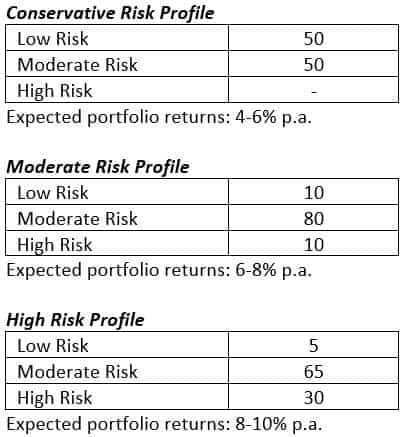
    Answering these two questions will give you an idea of your risk profile – conservative, balanced or aggressive. Next, you should determine your ideal asset allocation. The strategic asset allocation is a breakdown of your investment allocation into three simple investment asset classes – low risk, moderate risk and high risk.

    Low risk assets would comprise of risk-free assets that hold their values and likely have a pre-determined rate of return. Examples would include deposits place in financial institutions and government issued bonds like Malaysian government securities (MGS).

    Other fixed value assets with variable expected returns or those with minimal price fluctuations that fit this category include our Employees Provident Fund (EPF) savings, certain fixed priced Amanah Saham funds and low risk fixed income securities like money market funds or capital protected products.

    Moderate risk assets on the other hand have the potential of generating a higher variable return (e.g. between 4-6% p.a. above the risk free rate) and could comprise of assets such as blue chip dividend stocks or a balanced diversified portfolio consisting of shares and bonds. Property assets and REITs that offer both regular income and potential long-term capital appreciation can be categorised here as well.

    Lastly, we have growth or high-risk assets that are made up of stocks in a diversified portfolio of expansion-focused companies, small to mid-sized businesses in developing countries, commodities and perhaps alternative assets such as private equity investments or collectibles like wine, luxury watches and paintings.

    These may fluctuate a lot more in value but offer potentially better long-term returns.  

    Let us look at a simple approach to asset allocation for one’s investable assets:

    A moderate risk investor would probably place the bulk of his investable assets in moderate risk assets and only around 10% in the high-risk space. From this allocation, he should expect a blended overall return of around 6-8% p.a. As such, the strategic asset allocation gives you an idea on how you can select a combination of different assets classes and the corresponding expected returns on your overall portfolio.  

    Given the nature of these alternative investments at this juncture – where price discovery remains a challenge, volatility is high, and long-term values remain uncertain – it would be more appropriate to classify them as part of your high-risk investment bucket.

    Back to the question of whether investing in those alternative assets in the examples given are suitable for you, firstly consider where it fits in based on the suggested strategic asset allocation.

    Perhaps a 10% allocation in each of these strategies would be sufficient for most. In simple terms, this means roughly 1-3% allocation of one’s investable assets would be about right for the balanced to aggressive profile investor.

    In conclusion, the next time you encounter an innovative investment option that comes across as the best invention since sliced bread, the first thing you need to do is to increase your knowledge and understanding of that product instead of signing the dotted line simply based on a herd mentality or the fear of missing out.

    Should you decide to proceed thereafter, then invest based on your ideal strategic asset allocation in line with your risk profile. This golden rule should keep you in good stead for a long time to come.

    About the Author:

    Felix Neoh CFP CERT TM is the Director of Financial Planning at Finwealth Management Sdn Bhd and is a certified member of FPAM. He can be contacted at enquiry@finwealth.com.my

    We at Smart Investor and Finwealth is committed to help you better manage your financials. Get a free consultation from an expert by filling in your details here: https://www.smartinvestor.com.my/SIxFinwealth

  • Investing In Property With A Holistic Perspective Using This 3-Step Process

    Investing In Property With A Holistic Perspective Using This 3-Step Process


    “17 years ago, I missed the opportunity to invest in Desa Park City. 5 years ago, I missed Sunway Velocity. I regret it. I don’t want to miss the boat this time”.

    “Too many new projects available now and developer offers good incentives and rewards, I don’t know which to choose.”

    “I heard many unpleasant experiences from friends and family, I worry the property I invested would be abandoned or the quality is bad when I gain vacant possession.”

    These are typical comments you might hear when Malaysians share their perspective on property investing. Like other developing countries, economic growth and continuous urbanisation in major cities have made real estate investing one of the more attractive investment vehicles for Malaysians to grow their wealth.

    There are loads of property investing books and “property gurus” on hand to offer pointers to those looking to embark on the property investment journey, imparting their strategies and experiences in this field. Some share their seemingly unbelievable profit-making experiences through property flipping (buy-to-sell) or property management (buy-to-rent).

    The outbreak of Covid-19 in 2020 put a dampener on an already sluggish real estate market, resulting in property players having to transform their business model to weather the storm. Industry players responded with various digital innovations to allow most of the transaction process to be conducted without physical interaction.

    Supported by a low interest rate environment, these efforts seem to be paying off, as property demand at certain areas remained fairly stable despite the depressing health and economic backdrop.

    Just like any other investment asset class, the real estate investment journey has its ups and downs. Some of us may make money from it, others should learn from the mistakes made so as not to repeat them to our own detriment.

    An opportunity often arises from a threat, so it is important to be able to separate the wheat from the chaff. In order to have a higher probability of success, we will need to apply a structured approach to address these potential opportunities.

    Plan-Check-Monitor

    A structured opportunity management approach for investing involves a simple three-step process: Plan-Check-Monitor.

    Plan refers to having a clear purpose and objective for the investment – do you know what you want to achieve and when you want to achieve that? The answer will determine your direction in investing and know what information is required to build a solid investment portfolio.

    Check involves activities to survey and collect information about the respective investment to ensure it is compatible with your plan.

    Monitor is about keeping track of any changes on investment and being sensitive to the important indicators that your investment returns can potentially sustain and improve, or otherwise. This also requires one to be nimble and responsive according to changing market conditions. Adopting the PCM approach will enable investors to differentiate whether it is a real opportunity, and to know how to ensure the compatibility of the opportunity to one’s current situation.

    As property investing is possibly the single largest financial commitment in one’s lifetime, it can have a different impact on various aspects of our personal and family life. As such, merely asking what property to buy or where to buy is not enough.

    So how we can apply the PCM model in a property purchase scenario?

    You should start with questioning. What is your primary purpose for this property investment? What is your goal for this investment? The answer is crucial to determine the appropriate strategy to follow.

    Say you are looking for an own stay property. You will need to identify a property that caters to your current and future family needs. Start by consolidating information about the targeted property (for example, understand the potential of the upcoming neighbourhood, the demographics, nearby amenities, etc.).

    Then identify and assess the saleable area of the property, number of rooms, potential renovation costs due to expansion or layout restructuring and suitability for future expansion to determine its compatibility to your needs. For newlyweds, do not forget to consider the extra rooms for your future children.

    If you are looking for investing or a rental property, you need a clear approach with cost-effective solutions and a well-planned property rental management strategy to optimise your rental yield. If you want to save the cost of engaging agents or a property management company, you need to determine if you have the capability to do it on your own.

    Again, start with gathering information about the property types that are popular for rent, the targeted potential tenants, their preferred rental price range, etc. Then continue to identify and assess the property based on the needs of your targeted tenants. 

    In addition to this, you should continuously monitor the progress around the targeted property area. Are there any growth plans and projects to spur the development of that area, such as  upcoming MRT lines, connection to highways and other developments that might affect your investment return direct and indirectly?

    You should also be prepared for vacant tenancy periods without rental income as this will represent an opportunity cost to you. Hence, your sensitivity towards the growth around the property area will assist you to seize the opportunity in pricing the rental accordingly.     

    Potential capital appreciation and positive rental income is a property investor’s ultimate goal. Nevertheless, few can accurately predict their actual investment return as this will depend on the overall development and progress of property location – actual versus expected.

    Given this uncertainty, it is important for you to have a practical plan to secure the rental yield and a well-planned exit strategy prior to investing in any property. As such, one can apply the PCM model prior to the investment instead of blindly following what is recommended by people around you.

    Impact On Your Financial Health

    Malaysia currency of Malaysian ringgit banknotes background. Paper money of one, five, ten, twenty, fifty and hundred ringgit notes. Financial concept.

    The above examples should give you a fair idea on how you should approach a property purchase in the future. But is this sufficient for you to make the right property-related financial decisions? Will the purchase have a positive or negative impact on your overall financial well-being? To answer this, we will need to overlay the decision-making process with a holistic financial planning perspective.

    Broadly speaking, holistic financial planning provides you a 360-degree view of your financial situation, taking your current and future financial expectations into consideration to empower you to make more informed investment decisions. A holistic financial planning empowers you to constantly be on guard against possible investment risks and potential financial costs as you expand your property portfolio holdings.

    Working on strategic asset allocation helps you manage your investment risk while stabilising your overall investment returns. For example, strategic asset allocation will remind you to invest less than 40-50% of your funds in properties.

    Understanding key financial ratios provide valuable information to help you monitor your debt ratio to avoid over-gearing and keep track of your emergency funds in the event of a scenario without rental income. Cash flow management will help you ensure that you have sufficient cash for down payment without using up your emergency funds, and give you clarity on how you can continue to save and invest for other goals once the property loan repayment starts.

    In conclusion, there is no doubt that property investing has a big role to play in growing one’s net worth. However, there are pitfalls in investing in this asset class so the practice of opportunity management approach utilising the PCM model, coupled with holistic financial planning, will help to minimise.

    About the Author

    Jess Hon is a Licensed Financial Planner with Finwealth Management Sdn Bhd and would like to assist millennials to take control of their own finances and achieve financial happiness. She can be contacted at jesshon@finwealth.com.my

    We at Smart Investor and Finwealth is committed to help you better manage your financials. Get a free consultation from an expert by filling in your details here: https://www.smartinvestor.com.my/SIxFinwealth

    Do you know how much is your Home Loan eligibility? Not sure how much you can borrow from the bank? 

    Get your TechRevo credit report + Home Loan Eligibility which includes:
    • Credit history up to the past 12 months [CCRIS] 
    • Bankruptcy, Legal Suits, Legal action from banks, SAA, and Trade Bureau (Section E)  
    • Max home loan eligibility calculation up to 12 mortgage favorable banks in Malaysia 
    • CCRIS + Credit report + Calculator 

    It only takes 5 minutes. Click here now to get 50% off -> https://www.smartinvestor.com.my/techrevo