Category: lifestyle

  • Corruption And The Weakening Of Ringgit

    Corruption And The Weakening Of Ringgit

    Malaysian Ringgit (Ringgit) is now hovering around the RM4.40 mark against the US Dollar (USD) after hitting a low of RM4.74 in early November 2022. The pressure eased slightly after Pakatan Harapan won the 15th General Election and Dato’ Seri Anwar bin Ibrahim was sworn in as Malaysia’s 10th Prime Minister.

    Today we will be taking a closer look at corruption and the weakening of Ringgit has affected the nation as a whole.

    A quick throwback, we had a similar experience during the Asian Financial Crisis back in 1998, where Ringgit fell to its lowest at RM4.71 against the USD and this had caused a massive impact to Malaysia as foreign investors pulled out their investments from our country.

    Malaysia subsequently pegged the Ringgit at RM3.8 to the USD and it was eventually removed in 2005 when we were under Tun Dr Mahathir bin Mohamad’s leadership. Today, as the cost of goods, prices and business costs continue to soar due to the continued depreciation of Ringgit, Tun Dr Mahathir had suggested that the Ringgit should once again be pegged to the USD.

    Currency pegging due to devaluation is a nightmare for investors in the country as well as those who intend to invest in Malaysia. It causes Malaysia to lose its monetary sovereignty in managing our own monetary policy based on our economic situation, instead of the economic situation of the country which the Ringgit is pegged to.

    One way to regain the Ringgit’s strength is through Foreign Direct Investments (FDI), plus it is the most desirable form of country capital inflows because it is less susceptible to crises and sudden stops. However, there are many factors that could affect FDI inflows and outflows.

    Malaysia had experienced a major fall with regards to FDI. Malaysia went from being one of the preferred ASEAN countries to invest in, to being behind the Philippines, Singapore, Indonesia, and Vietnam. In the year 2020, Malaysia had posted a drop of 68% in FDI according to Malaysian Investment Development Authority (MIDA).

    Read: Is Malaysia Going To Go Bankrupt?

    The Story Of Corruption And The Weakening Of Ringgit

    One of the main reasons why investors choose to stop investing in our country is due to corruption. Malaysia had scored 48 points out of 100 in the 2021 Corruption Perception Index (CPI) as reported by Transparency International. The level of corruption in the host economies is regarded as one of the most important factors that determines which country will benefit from FDI.

    This is where you can see the link between corruption and the weakening of Ringgit.
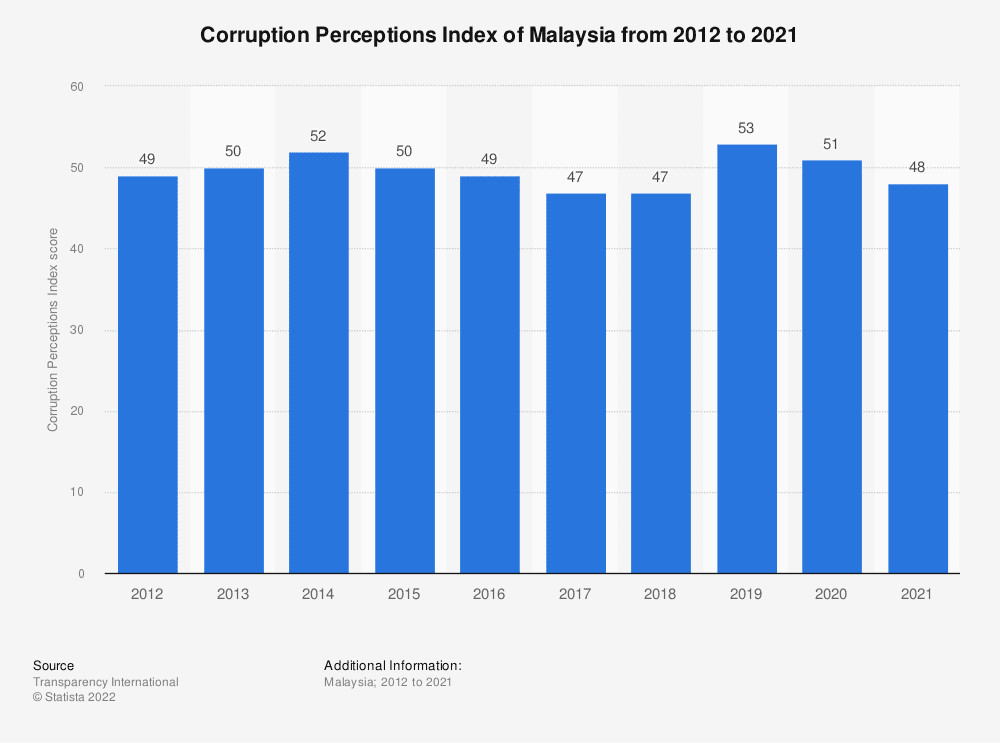
    Source: Statista

    In relation to this, Department of Statistics Malaysia (DOSM) revealed that although Malaysia’s FDI dropped in 2020, the accumulated investment increased to almost RM700 billion during the pandemic.
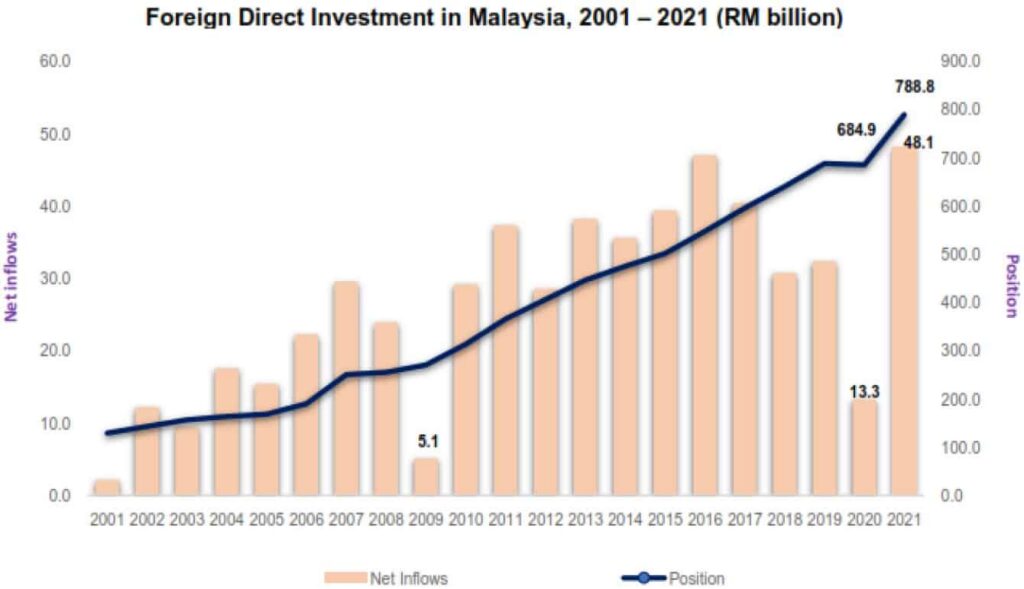
    Source: DOSM

    The 1Malaysia Development Berhad (1MDB) scandal has dampened investor’s sentiment towards Malaysia amidst growing concerns over the extent of corruption, levels of impunity, and overall erosion of the rule of law. Another reason that caused foreign investors to exit the local stock market is due to the uncertainty of Malaysian politics.

    In May 2022, researcher David Seth Jones published a research paper which contains his analysis regarding Malaysian corruption. He mentioned that the public and private sector corruption are rampant in Malaysia, and is reflected in the prevalent cases of bribery, embezzlement, and fraud.

    Furthermore, it was specified that bid rigging in procurement, money laundering at the highest levels in major investment such as logging, infrastructure, and procurement projects are the main causes of corruption. His research findings were backed by data gathered from the Malaysian Anti-Corruption Commission (MACC) and Malaysian government reports combined with the reports provided by international organisations such as Transparency International, the World Bank, PricewaterhouseCoopers, media reports, and various academic publications.

    He further stated his findings that corruption remains widespread in Malaysia due to the weak enforcement of anti-corruption measures, political interference within investigation and prosecution of corruption cases, the politics-business nexus, and the issue of money politics as well as limited impact of anti-corruption measures and bodies.

    Read: Fraud Awareness Week 2022: Find Out More About Fraud, The Common Frauds And Its Impact On Investment

    FDI, Corruption And The Weakening Of Ringgit

    It is proven that FDI inflow is positively correlated to the convenience of the entrance of the market, economic stability, political consistency as well as free from corruption. Thus, with the FDI inflows, it can help strengthen our Ringgit once again.

    Government has a crucial role to play in keeping the country clean of corruption by taking up the necessary control measures. Strict law enforcement and governing without fear or favour, severe punishment from the courts and effective government administration are pivotal. Only through this, the goal to reduce corruption can be achieved.

    As corruption decreases, we can expect FDI to increase, and ultimately Malaysia will prosper and is able to realise its potential as the Tiger of Asia. Let us pray that the new government can make a positive impact in eradicating corruption from our beloved country.

    It is clear that there’s a strong link between corruption and the weakening of Ringgit.

    About the Author

    Azah Atikah Binti Anwar Batcha has an Accounting, Finance, Auditing, and Islamic Finance background. She has worked with two of the Big four firms prior to pursuing her postgraduate studies at University of Technology Malaysia (UTM), Kuala Lumpur. She can be contacted at aaabwrite@gmail.com


  • How To Save 50% Of Your Housing Loan Interest In Half The Time, And Get Your Dream Car For Free

    How To Save 50% Of Your Housing Loan Interest In Half The Time, And Get Your Dream Car For Free

    I approached one of my couple clients, Chris (the husband & not his real name) and I told them that I was helping my other clients plan financially, I ask them whether they would like me to help them. Here is how the conversation about saving on housing loan interest went.

    “Would you like to buy an AUDI TT for free after you settle your housing loan?”

    They were very curious and our conversation went on like this. (This is an article I wrote in 2015 and is re-posted & re-edited.)

    How to buy an AUDI TT for free after you settle your housing loan?

    Chris: “Are you trying to sell me insurance or unit trust?”

    Me: “Neither”

    Chris: “I’m itching to buy an Audi TT & I’m not sure if this is a good time”

    Me: “I could help you buy your AUDI TT for free after I help you settled your housing loan”

    Chris: “How is it possible?”

    Me: “Let me show you”

    Chris: ‘Sure or not? I’m quite skeptical’

    Read: Save RM1 Million On Your Own Or Do It By Buying A Property?

    How To Save 50% Of Your Housing Loan Interest In Half The Time

    This was their situation:

    1. Property purchase price RM2.5 Million (semi-D in Petaling Jaya area)
    2. Loan Interest Rate was 4.4%
    3. Loan Tenure (no of years to repay back the loan) was 35 years (420 months)
    4. Loan Installment is RM10,471/month
    5. Total Interest Paid for the whole duration was RM2,147,808

    After implementing my advice:

    1. Total Interest Paid is RM 1,068,815, which is a 50% reduction in interest paid.
    2. They finish paying off their loan in 19 years and 2 months (230 months), which is 45% earlier (15 years and 10 months OR 190 months).
    3. He could buy 3 new AUDI TT worth RM285,000 with the interest savings. (Of course, AUDI TT’s price would have gone up, but still, if he did not apply this strategy, imagine the 3 AUDI TTs the bank managers would have driven off with)

    Can you guess what did I suggest to him to do?

    1. Save an additional instalment of RM4,000/month into his housing loan
    2. Ensure their Debt Payment Ratio is still on a Healthy Level (<35%)
    3. Ensure their Total Saving Ratio is Healthy (>33%) & their net worth is still growing

    This was what I suggested to him

    Because they are ‘SAVERS’ (people who like to save money in their bank account), they could channel some of their monthly savings into paying off their housing loans.

    But one has to take note to maintain a balanced lifestyle of not over-saving as you do not want to lose out on any investment opportunity.  Here, it shows how big of a difference it makes over time.

    1. Save an extra of RM4,000/month on their housing loan, making the instalment RM14,471/month. Here you can deposit the extra RM4,000 into a Current Account facility provided by most Malaysian banks by now, which can be used to withdraw later (in the event of emergency)

    2. Currently their Debt Payment Ratio is only 27% & they can commit up to 35%. Debt Payment Ratio measures how much income is used to pay ALL Loans (housing loan + car loan + personal loan & etc) divided by your NET INCOME (Your Gross Salary net off EPF, Socso, EIS & PCB). Since they don’t have any car loan, personal loan or any other loan, then all their funds can be channeled to the housing loan.

    3. By doing (1), they are able to save  almost RM 56,551/year in housing loan interest (Total savings on housing loan interest = RM1,078,993)

    4. The amazing thing of ‘Saving’ the extra RM 4,000/month actually improves their networth. You don’t actually ‘spend’ it, here is how it works

    (Net worth is assumed that Current Market Value of the property grow at 4% per annum)

    5. Interestingly, RM 3,731.25 of your RM 4,000 goes directly to pay off your principal. So it seems like you were force saving in your bank account, is just a different account call loan account

    Read: Double-Up Your Property Investment With These Rules!

    Save on housing loan interest, he calls off his purchase and postpones his booking

    After I have shown them the above, he called off his purchase of his Audi TT & redirect his savings to clear off his housing loan interest. Postponing his purchase after he settled off his housing loan first, he is convinced the savings from the housing loan interest will be able to buy him a free Audi TT.

    *Do take note that you should only do this for a property that you live in. For property investment, you may not want to use this strategy. Talk to your financial planner or a professional first before taking action.

    *DISCLAIMER – All strategies listed here are not a recommendation nor advise. The article is written purely for the purpose of education and journaling only. The content of this article is an expression of my opinion and should not be taken as professional advise. If you are seeking professional advise, please consult me personally . You should do your own research and/or seek expert’s advice when overcoming your debt circumstances.

    Read: 10 Ways to Spot Property Investment in Malaysia – A Property Investment Guide

    About the Author

    Ka Hoe is a Licensed Financial Planner having a “Financial Adviser Representative” (FAR) with Bank Negara and “Capital Market Service Representative License (CMSRL) – Financial Planner” with Securities Commission. He is also the Founder of J Advisory, a Personal Finance Academy that helps struggling Malaysians elevate their financial well-being with proven tools, systems and strategies. For more real-world case studies, you can reach me at my blog – https://jadvisory.asia/

  • Memorandum of Understanding Signed By Sijil Teknologi Sdn Bhd And The Digital Internet Association Of Malaysia

    Memorandum of Understanding Signed By Sijil Teknologi Sdn Bhd And The Digital Internet Association Of Malaysia

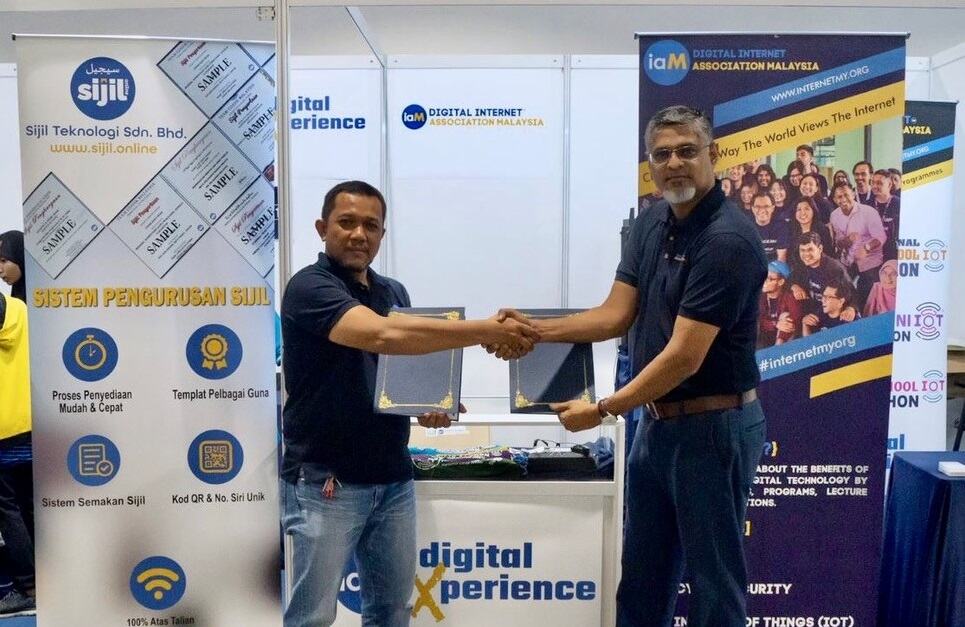
    Sijil Teknologi Sdn. Bhd. (Sijil) has successfully inked a Memorandum of Understand (MOU) with the Digital Internet Association of Malaysia (iaM) to use its Certificate Management System in iaMs’ national as well as international training programs and hackathons. Sijil was represented by its Chief Operating Officer, Mazlan Abu Bakar while iaM was represented by its Chairman, Ts. K Nantha.

    Established in early 2022, Sijil was invested in developing a one stop solution in effectively managing the certification system in Malaysia. To achieve this, the solution had to take into account numerous stakeholders of the system such as government agencies, institutions, training providers, students as well as prospective employers.

    This Certificate Management System helps alleviate common problems faced by both students and training providers such as lost certificates, fake certificates, lost training records as well as participants data mismanagement. On top of that, this eco-friendly, integrated solution eliminates most tedious and repetitive tasks by being able to automatically display the participants details with unique QR and serial numbers on each certificate.

    The QR can be used to scan and verify its legitimacy and henceforth prevent duplicate certificates. In addition, the system incorporates end-to-end solution by being able to generate thousands of individual certificates from an uploaded template, store participants and training providers data, and finally is also able to retrieve the aforementioned certificates with a click of a button from virtually anywhere in the world. This system would also be able to handle multiple templates for different types of attendees for the same event such as volunteers, advisors, judges, sponsors, technicians and not forgetting the participants themselves.

    Aptly, the MOU was exchanged during the Malaysia Techlympics event at Axiata Arena Bukit Jalil, where iaM set up their iaM Digital Xperience booth showcasing numerous Augmented Reality and Virtual Reality solutions for the modern classroom. Participants to this booth were presented with a digital certificate of participation generated autonomously by Sijil upon successful visit to 3 stations within the booth itself. This certificate was said to be a significant reason for the record number of visitors to the booth as the students visiting the booth would be awarded 17 PAJSK points for participating in a national level event and that aforementioned certificate would be proof of attending such an event.

    A serial user of the system, Fatin Amirah, the program coordinator for iaM stands by the efficiency of the system as she has now fully transitioned to automated certificate generation for thousands of her hackathon participants. She says that she is now able to automate and complete days of dull and time-consuming task of creating individual certificates within a few minutes of uploading the participants list, saving her precious time to be utilised productively elsewhere, such as preparing better training materials.

    Sijil has also been providing certificates to Incepsion Group of companies since it’s early days to automate certificates for their company wide usage. Ir. Selvem Raman, owner of the Incepsion Group of companies, including the offices in Malaysia and Singapore, has adopted the solution for its’ internal as well as external training and certification purposes. He has confirmed that Sijil has helped save hours of manpower in preparation and distribution of certificates, all while doing it in a sustainable manner using this intervention.

    For more information regarding the certificate management system or to book a demo, Sijil can be contacted via email at info@sijil.online while their website can be accessed at www.sijil.online.

    About Sijil Teknologi Sdn Bhd (Sijil)

    Sijil was established in 2022 for the sole purpose of creating a one stop, fully online, certification management system for all stakeholders including participants, training providers, and government agencies. This green, paperless initiative is able to easily generate certificates with unique serial number and QR codes within minutes while assisting in eliminating duplicate certificates as well as fake training programs.

  • Save RM1 Million On Your Own Or Do It By Buying A Property?

    Save RM1 Million On Your Own Or Do It By Buying A Property?

    What could a single RM50 note could buy today is often used to demonstrate how ‘small’ money has become versus having the same RM50, 10 years, 20 years and 30 years ago. This is also known as inflation and no one could run away from it no matter which country one is living today.

    Today we will be taking a closer look at whether we can save RM1 million on our own, or we can save that much by buying a property?

    Read: Is Malaysia Property Still Worth To Invest In?

    The Goal Is To Save RM1 Million

    A point to ponder is this. Are we doing something about it? Are we doing our best to counter the inflation and ensure that our money continue to rise so that the value we could buy does not reduce?

    Please remember that if we want to buy the same number of things today versus many years ago, we could not do it with the same RM50. We need to have RM100 or maybe more.

    This is the same as property price. The price of RM500,000 today may just be equivalent to RM300,000 value 10 years ago, maybe. Meanwhile, RM800,000 10 years later may just be equivalent to the value of RM500,000 today.

    The next question is this one. ‘Could we buy a RM300,000 property 10 years ago or RM500,000 today so that 10 years later, that same property becomes a hedge against inflation?’

    Read: Double-Up Your Property Investment With These Rules!

    Think And Decide About That RM500,000 Savings

    In 2003, I bought my first property, an apartment for RM123,000. I sold it for RM238,000 many years later. I checked and the price is closer to RM300,000 today. When inflation continue to push up prices of everything, the price would continue to rise.

    Source: propertyguru.com.my dated 18th October 2022

    Could we save instead of buying a property then?

    My question is a simple one. Could you save RM200,000 during that 10 years that property prices rose from RM300,000 to RM500,000?

    If you could, then there is no need to buy the property. Save the time, effort and the potential to buy the wrong one. Just save up the money. Save diligently, save consistently to achieve the RM200,000 without needing to buy the RM300,000 property.

    It’s the same question to those who say to save RM1 million in the future is just like RM500,000 today. Well, could we start saving now and reach RM500,000 in maybe 20 years followed by it becoming RM1,000,000 when we retire?

    The inflation would have eaten up the value of that RM1,000,000 property to be closer to RM500,000 instead. Could we save RM500,000 without buying a property and having it appreciate simply due to inflation? If you could, then you can forget about property investment.

    Read: 10 Ways to Spot Property Investment in Malaysia – A Property Investment Guide

    Why Need To Save RM1 Million?

    Malaysians live up to the age of 75 or even 80 based on the latest life expectancy for Malaysians. Life expectancy is going higher because of access to better healthcare, more awareness etc. We could choose to retire anytime but let’s assume we retire at 60.

    Assuming we are very healthy and the company wants us to continue until 65? Before 60, because we have a job, we can pay rental if we did not own a property. After 60… when salary stops… we STILL HAVE to pay rental.

    As a home owner who’s renting out my property, I have no wish to tell my tenant to stop paying me rental after the tenant has paid me consistent rental for the last 30 years yeah.

    How much would rental actually be in the future? (we assume conservatively)

    Rental for a small apartment could be RM2,000. (In the future, this RM2,000 is more like RM1,200 of today)

    Living from 60 to 75 years old is 15 years and 15 years x 12 months is a total of 180 months.

    180 months x RM2,000 is RM360,000. By the way, this is just for the rental and this also assumes that the owner is a very nice person and does not increase the rental at all for the next 15 years.

    Sorry, I will increase the rental every other year. Will not increase a lot but will increase a little every other year. 

    What if we have RM500,000 savings by then? (I assume we did not buy a property…)

    So, if we have RM500,000 by then we need to save RM360,000 for rental as per above calculation. After allocating RM360,000 for rental, we still have RM140,000 for food. (RM500,000 minus RM360,000 for rental)

    How much is RM140,000 for 15 years? That’s RM25 per day… Oops…It means that every day, we have RM25 for three meals.

    That’s RM8+/- per meal. I am very sure we could still afford roti canai and the tarik at that time with RM8 right?

    This is why the title of this article says RM1,000,000.

    With RM1,000,000 savings, after allocating RM360,000 for rental (which is very conservative), one would have RM640,000 left for food and whatever other things which you like to do. What if we allocate RM50 for meals every day?

    That is RM50 x 30 (days) x 12 (months) x 15 (years) equal to RM270,000.

    RM640,000 (leftover after rental) minus RM270,000 (for meals) means we still have RM370,000 for our spending on things we love from the time when we celebrate our 60th birthday to the time when we celebrate our 75th birthday yeah.

    Let’s not debate on whether RM370,000 is enough or not enough by then. Heck, even you managed to save RM1 million, who would know whether it would be enough by then.

    Read: Property Investing In A Post-Pandemic World, 4 Things To Consider

    Conclusion

    Let’s take note that if we decided NOT to buy and pay for a RM500,000 home today, we will need to save RM1 million so that our life will be more secure when we retire. Would you rather buy a property today and forced to pay mortgages or being forced to save RM1 million when we retire at 60?

    There you have it, either you can save RM1 million on your own. Or you can save RM1 million by buying a property.

    About the Author

    Charles is the Founder of kopiandproperty.com (a leading independent property blog in Malaysia). His articles and views have appeared in national newspapers, magazines and property listing portals. He is also a judge for property awards including for iProperty.com Agents Advertising Awards and PropertyGuru Asia Property Awards (Malaysia). 

  • Energy Efficiency Is The Best Way For Industry To Cut Costs And Reduce Emissions Right Now

    Energy Efficiency Is The Best Way For Industry To Cut Costs And Reduce Emissions Right Now

    With businesses around the world facing unprecedented pressure from the cost of energy and the urgency of climate change, a new report from the Energy Efficiency Movement shows that improving industrial energy efficiency is the fastest and most effective way for a business to cut energy costs and greenhouse gas emissions. The Energy Efficiency Movement is a global forum of around 200 organizations sharing ideas, best practices and commitments to create a more energy-efficient world.

    Published recently, the “Industrial energy efficiency playbook” includes 10 actions that a business can take to improve its energy efficiency, reduce energy costs and lower emissions right now. It focuses on mature, widely available technology solutions that will deliver rapid results and ROI – and are capable of being deployed at scale.

    “Energy efficiency is a win-win for companies and the climate,” said Kevin Lane, senior program manager, energy efficiency, with the International Energy Agency (IEA). “While industry needs to address climate change on all fronts – such as increasing use of renewable energy, investing in low-carbon processes and developing circular business models – energy efficiency stands out as the business-focused opportunity with the best near-term prospects for emission reductions. The 10 actions contained in this report are known, cost-effective resources, and can be employed at scale rapidly to help companies convert climate ambition into action.”

    Industry is the world’s largest consumer of electricity, natural gas and coal, according to the IEA, accounting for 42 percent of total electricity demand, equal to more than 34 exajoules of energy.[1] The iron, steel, chemical and petrochemical industries are the largest consumers of energy among the world’s top-five energy-consuming countries – China, United States, India, Russia and Japan. This energy consumption carries high costs in the current inflationary environment. It was also responsible for nine gigatons of CO2, equal to 45 percent of total direct emissions from end-use sectors in 2021, according to the IEA.

    Organizations interviewed for the report include ABB, Alfa Laval, DHL Group, the IEA, Microsoft and ETH Zürich, the Swiss federal institute of technology. The contributors’ recommendations range from carrying out energyaudits to right-sizing industrial machines that are often too big for the job at hand, which wastes energy. Movingdata from on-site servers and into the cloud could help save around 90 percent of the energy consumed by IT systems.[2] Speeding up the transition from fossil fuels, by electrifying industrial fleets, switching gas boilers to heat pumps or using well-maintained heat exchangers will also offer efficiencies.

    Further actions involve installing sensors and real-time digital energy monitoring to reveal the presence of so-called “ghost assets” that use power when on stand-by, unlike a digital twin that can simulate efficiency actions without interrupting production. Using smart building solutions to control power systems, lighting, blinds and heating, ventilation and air conditioning (HVAC) will also save energy in industrial facilities.

    Other recommendations include installing variable speed drives which can improve the energy efficiency of a motor-driven system by up to 30 percent, yielding immediate cost and emissions benefits. If the more than 300 million industrial electric motor-driven systems currently in operation were replaced with optimized, high-efficiency motors, global electricity consumption could be reduced by up to 10 percent.

    “There are energy efficiency solutions available that can help industry mitigate climate change and drive down energy costs, without compromising performance and productivity,” said Tarak Mehta, president, Motion business area at ABB. “With recent technology advances in energy efficiency, the improvement potential in industry is significant and readily available. So, rather than turning the lights off and halting production to save money, this important new report explains practical steps executives can take to reduce energy use and their bills while maintaining current operations. “

    Business leaders and experts wanting to learn more about reducing their energy costs and carbon emissions are invited to join a special panel event that dives deep on the opportunities presented in the report and how to capitalize on them. The event will take place at 4pm Central European Time / 10am Eastern on Tuesday, December 13, and will be available afterward as video on demand. Register here.

    ABB is a technology leader in electrification and automation, enabling a more sustainable and resource-efficient future. The company’s solutions connect engineering know-how and software to optimize how things are manufactured, moved, powered and operated. Building on more than 130 years of excellence, ABB’s ~105,000 employees are committed to driving innovations that accelerate industrial transformation. www.abb.com

    The Energy Efficiency Movement is an initiative that brings together like-minded stakeholders to innovate and act for a more energy-efficient world. The Movement was launched by ABB in 2021 and it has received a positive reaction from throughout industry, with around 200 companies joining as of November 2022.

    https://join.energyefficiencymovement.com/ #energyefficiencymovement

    [1] https://www.iea.org/reports/electricity-market-report-december-2020/outlook-2021

    [2] https://www.microsoft.com/en-us/download/details.aspx?id=56950

  • AKPK Introduces Accounting and Financial Diagnostic Application

    Agensi Kaunseling dan Pengurusan Kredit (AKPK) has officially launched its new accounting diagnostic application for the micro, small and medium-sized enterprise (MSME) market named MyBijakNiaga.

    MyBijakNiaga is a digital accounting diagnostic application that can be used by micro and small business owners to record their business transactions and prepare financial statements. It can also keep supporting documents for future reference for the business, as these documents are important for the business to expand or obtain financing. Besides that, users can perform health checks on their business performance and get advice on their current business position—all from one simple tool at any time and anywhere.

    Dato’ Suriani binti Dato’ Ahmad, the Secretary General of the Ministry of Entrepreneur and Cooperatives Development (KUSKOP), commended AKPK’s efforts during the launch. AKPK’s work in coming up with a practical application not only helps MSME entrepreneurs manage their business finances and grow their profitability, but also provides an avenue to increase their knowledge in business financial management on the go.

    Dato’ Suriani said, “Entrepreneurship is now fast-moving towards digitalisation. Successful entrepreneurship, however, still lies in the basics, such as proper tracking of business records and producing financial statements.

    It is especially important that micro and small businesses adopt this entrepreneurial best practice, business digitalisation and knowledge building, especially in financial management. And, MyBijakNiaga is making it all available for these business owners.”

    During the launch, AKPK’s CEO, Azaddin Ngah Tasir also highlighted that financial literacy is the way forward for micro and small businesses.

    Alongside the household sector in 2020, AKPK’s mandate has expanded to also include MSMEs. Today, AKPK is an integral part of the ecosystem in the country which elevates the financial well-being of households and businesses. Being a new mandate for AKPK and their significance in the economy, AKPK is vigorously looking at ways to enhance MSME’s financial resilience and performance.

    Azaddin explained, “On top of repayment assistance, financial advisory and learning modules for MSMEs, we wanted to provide something useful and practical that micro and small business owners to use on a daily basis to empower them in managing their business. And, that idea is translated into MyBijakNiaga.”

    This digital business accounting application will offer convenience, confidence and peace of mind to thousands of MSME entrepreneurs as they record their business transactions, learn the back-office of financial management, manage financial data and assess their business performance, and as they are able to forecast their business in three years to come.”

    MyBijakNiaga provides an alternative to off-the-shelf accounting software that can be expensive and complex. In contrast, MyBijakNiaga is freely accessible and simple to use with a clear explanation in Malay. Despite its simplicity, MyBijakNiaga is a secured platform with a proper sign-in procedure, and importantly, it is outcome-driven which helps micro and small entrepreneurs increase their financial literacy, financial control and business acumen along the way.

    As of today, nearly 2,000 MSMEs have registered with AKPK to access MyBijakNiaga, and the feedback received by users has been very positive and encouraging. Opportunities abound but it takes courage, initiative and commitment to new ways of managing business finances to build strong enterprises.

    For free access to MyBijakNiaga, proceed for account sign-up at this link: https://mybijakniaga.akpk.org.my

  • The 7 Habits Of High-Net-Worth Individuals In Malaysia

    The 7 Habits Of High-Net-Worth Individuals In Malaysia

    According to the Securities Commission Malaysia, high-net-worth individuals (HNWIs) is defined as an individual whose:

    a) Gross annual income exceeding 300,000 ringgit or its equivalent in foreign currencies in the preceeding twelve months
    b) Who jointly with his or her spouse has a gross annual income exceeding 400,000 ringgit or its equivalent in foreign currencies
    c) Total net personal assets or total net joint asset with his or her spouse, exceeding 3 million ringgit or its equivalent in foreign currencies, excluding the value of individual’s primary residence
    d) Total net investment portfolio (whether personally, or jointly with his or her spouse), in any capital market products exceeds RM1 million or its equivalent in foreign currencies.

    This would make us wonder who these people are, what do they do and what are their belief systems? More importantly, how did they get to where
    they are today and how can we embark on the same journey?

    With years of experience in managing high-net-worth individuals in Malaysia where 80% of them are self-made millionaires, I have identified seven successful habits that most of them have.

    1. They Are Good Active Listeners

    They are not as arrogant as others think they might be. They leave their cup empty every time they meet someone, helping them strengthen their
    perspectives on different issues. They’re not just actively seeking feedback from others; they would also listen to understand the other party.

    Active listening helps them build strong relationships, as well as gain a deeper understanding of their friends, staff and colleagues. This would
    greatly help in developing their own sense of empathy and improving their communication skills.

    2. They Leverage

    Most high-net-worth individuals in Malaysia are fully aware of their own weaknesses. Therefore, they know the importance of leverage and why they would never work alone. They work on their strengths while leveraging their weaknesses on others.

    For example, they know they can make money in the stock market but might not have the time to manage it themselves. They prefer to have a trusted and reputable fund manager to manage their investments and to have a financial planner advise and monitor it for them.

    In my observation, many of them succeed because they focused on their strengths and figured out a way to outsource their weaknesses. If they do not possess a particular skill, they would delegate it to someone who is great at doing it, so they could focus on the bigger picture and have more time and mental energy to execute it.

    3. They Create Their Own Future

    A lot of high-net-worth individuals in Malaysia would not take no for an answer and are willing to go the extra mile to achieve what they want. They are persistent which enables them to create their own luck and opportunities in order to reach their lives’ objectives and financial goals.

    For example, they would love to see what kind of financial mistakes they can possibly make, and will look up creative plans and solutions to protect
    and preserve their wealth. They are also always on the lookout for alternate routes to be financially successful.

    4. They Make Full Use Of Their Time

    Time is very valuable. The high-net-worth individuals in Malaysia know how to prioritise matters and would not simply waste their time engaging in useless conversation or mindless activities. All their activities will be related to creating value, even though while having fun.

    For example, choosing to spend time listening to audiobooks during work commutes. When they tune in, they will choose a channel that is insightful for their mind and soul. Most of them will wake up early in the morning and find time to exercise regularly and keep themselves healthy.

    HNWIs are always looking to develop new skills to empower themselves. For example, they will go for activities like swimming, diving, and shooting to equip themselves with life skills.

    5. They Are Constantly Learning

    Constant learning and self-improvement are top priorities for most high-net-worth individuals in Malaysia. They love to read and choose economics, finance, technology and self-help books that can add value to their lives. They would also develop and commit to a routine, even when they don’t feel like doing it. This is because they understand the importance of sticking with their routines and habits to keep on growing.

    “They commit to themselves in doing rather than daydreaming.”

    Read: A Book Review: You Too Can Excel

    6. They Network

    It is very important to surround yourself with people who share the same vision and are capable of making their dreams come true. They will commit their energy, focus and drive to succeed in life.

    “Your network is your net worth.”

    A great team is needed and networking helps them reach their dreams and goals in life.

    7. They Are Financially Prudent

    Having a high income does not necessarily mean having high savings and investments. Lots of high-net-worth individuals in Malaysia are financially prudent. They do not simply spend money and live a luxurious life.

    They enjoy using the return from their investments to further grow their net worth. They are in command of their money flowing in and out. Being prudent is one of the important traits in financial management and they have targets to achieve based on a clearly defined financial roadmap.

    Read: Where To Invest In 2023: Amidst The Recession

    So there you have it with the 7 habits of high-net-worth individuals in Malaysia.

    About the Author

    Dr Inaz Hashim is an experienced holistic financial planner focused on managing high-net-worth individuals in Malaysia. She is a licensed Financial Planner with Expanded Scope & Islamic Financial Adviser (IFAR) with Phillip Wealth Planners. She graduated from RCSI-UCD Medical College and holds Shariah Registered Financial Planner (ShRFP) from MFPC. She has completed her Certificate of Shariah in Banking & Finance from International Islamic University College Selangor. Currently, she is pursuing her Masters of Science in Islamic Banking & Finance at International Islamic University of Malaysia (IIUM).

  • Do You Have The Patience To Make Money In Property?

    Do You Have The Patience To Make Money In Property?

    Everyone wants to make a quick buck here and there, but property investment is a long-term game. Let’s hear a real-life case study on how you can make money in property.

    In the early 1990s, a client bought a condominium unit that is 1,396 square feet, comprising three bedrooms and two bathrooms at Taman Tun Dr Ismail. The price after the Bumiputera discount was RM190,000. The condominium was completed in 1993.

    The condominium’s latest transacted price last year was averaging RM600 to RM620 per square feet. Taking the conservative average of RM600 per square feet, it is valued around RM837,000 today.

    Resident real estate negotiators advise that owners are not going to sell anything lower than RM860,000 now. It is a wait and see strategy adopted by owners with no urgency to sell, anticipating higher values post pandemic.

    A simple arithmetic of the numbers brings the capital appreciation to 341%, bringing the Compounded Annual Growth Rate (CAGR) to arrive at about 5.1%

    Does this sound impressive? Is is that easy to make money in property?

    Read: Double-Up Your Property Investment With These Rules!

    Make Money In Property, But…

    Maybe, and if you are using the property for own stay, you will be experiencing comfortable paper gains. However, if this property has been acquired for investment purposes, you will need to take into account these factors to calculate your return on investment:

    • Vacancy costs
    • Agency costs
    • Legal fees (for exiting or selling off the property)
    • Repair & modernisation costs (it is 30 years old!)
    • Building maintenance service fees
    • Mortgage borrowing costs
    • Yearly assessment & council taxes
    • Tax (on rental income & exit cost for future capital gains)

    Due to limited data on the actual Internal Rate of Return (IRR) of this property, I do not have the rental income data as this property was bought over by my cousin for his own stay a few years after this condo was completed.

    But let’s give some hypotheticals:

    – Rental income during the 1990’s was RM650 and it increased by 10% each year (working out to RM2,400 today, which is conservative for a fully-furnished unit today transacting at an average of about RM2,700 to RM2,900).

    – Annual council and assessment taxes at RM300, service charges at RM300 per month and assuming full tenancy. (This is considered on the upside already.)

    – 90% margin on mortgage financing, a 4% interest rate, real property gains tax at 5%, agency selling fees at 3%, selling at RM600 per square feet
    (RM837,000) at the 30th year.

    – Assume a one-off major modernisation cost for kitchen and bathrooms amounting to RM100,000.

    7.16% Return Good Enough?

    With that the computed annualised IRR is 7.16%. This is comparable to returns of a moderate aggressive asset portfolio.

    Read: How to Calculate Internal Rate of Return – Property Investment

    Is this a good way to make money in property? A standard economist answer would be, it depends…

    If you are the original owner, you will likely be enjoying a nice cash flow monthly as a landlord or liquidating with a net gain of capital (after deducting taxes), that could be partially funding retirement. Then you can say that by buying and holding, it is a sure way to make money in property.

    But do bear in mind, it took thirty years for real estate values to reach to these levels, so it is not quite straight forward to make money in property. Having said that, it is also worth highlighting that cash flows enjoyed monthly is subjected to LHDN taxation.

    Read: 10 Ways to Spot Property Investment in Malaysia – A Property Investment Guide

    The Tax Man Is Here

    PERMAI Assistance Package 2021
    Image from boundless.com

    According to Section 4d of the Income Tax Act 1967 LHDN, “the letting of real property is treated as a non-business source and income received from it is charged to tax under paragraph 4(d) of the Income tax act 1967 if a person lets out the real property without providing maintenance services or support services (such as cleaning services and repairs) comprehensively and actively”.

    In layman terms, this means that you are letting out the residential property and deriving passive income from it. If you own one or multiple properties (bought or inherited) that is not used for business purposes, you are required to pay income tax.

    Net rental income is subjected to a progressive income tax rate from 0-30%. These are tax deductible items permitted by LHDN that can be used to derive net rental income for an investment property on residential properties:

    • Assessment and quit rent is the annual assessment paid to the local authority and quit rent to be paid to the land office.
    • Interest portion on the mortgage to finance the purchase of real property which is rented out. (Do note that it is only the interest portion of the mortgage that is deductible and not the total monthly mortgage amount).
    • Fire insurance premium paid in relation to the insurance policy taken on the real property which is rented out.
    • Expenses on rent collection such as rent collection fees and legal expenses incurred to enforce rent collection.
    • Expenses on rent renewals to renew tenancy or change tenant.
    • Expenses on ordinary repair to maintain the property in its existing state.

    Read: Property Investing In A Post-Pandemic World, 4 Things To Consider

    Other things to consider whilst keeping real estate as an investment in your overall portfolio are:

    • Do you have the holding power?
    • Is there a maximum ceiling price to this condo?
    • Can you stomach vacancies or deal with (troublesome) tenants?
    • Do you have the willpower to deal with perpetual repairs, refurbishments and maintenance related to the upkeep of the property?

    To some, these are hidden costs that can’t be quantified and are not worth the time and the headache. They would rather put their capital elsewhere in an asset like a mutual fund that takes minimal effort and see it grow annually at the rate 6-7%.

    The question also would be, can we expect these kind of returns for newer residential projects 20 to 30 years down the road? Is it still going to be easy to make money in property?

    Now I wish I had a magical crystal ball to look in the future, so I can make money in property.

    Read: Is Malaysia Property Still Worth To Invest In?

    About the Author

    Rozanna Rashid is a Director at Alpine Advisory, a financial planning firm. A former corporate banking relationship manager, Rozanna is currently a Licensed Financial Planner (CFP, IFP). She holds an MSc in Real Estate, Economics & Finance from the London School of Economics & Political Science. She can be contacted at rozanna@alpine-advisory.com

  • Investing And ESG

    Investing And ESG

    Environmental, Social, and Governance (ESG) is becoming a very hot topic recently, and today we will be taking a look at how ESG and investing go hand-in-hand. Smart Investor spoke with Datuk Wira Ismitz Matthew De Alwis, Executive Director & Chief Executive Officer, Kenanga Investors Berhad to find out more about investing and ESG.

    He is also one of the speakers at the prestigious ESG Evolve 2022 conference that Kexxel Group is organizing in KL on 6-8 December. We will talk more about the conference at the end. For now, let’s find out more about how Kenanga Investors is pioneering ESG in Malaysia.

    Datuk Wira Ismitz Matthew De Alwis, Executive Director & Chief Executive Officer, Kenanga Investors Berhad

    Smart Investor: What does ESG mean to Kenanga Investors? Why is it important to your business and how does it impact your industry?

    Datuk Wira Ismitz Matthew De Alwis: The impact of ESG on the financial markets has been significant. Investors and businesses alike are beginning to acknowledge that an ESG-driven perspective promises stronger and more resilient economies and businesses. As a result, this awareness has changed the way individuals and institutions invest. Many are now are focusing on mitigating their portfolio exposures to carbon risk for example.

    As a partner to the sustainability agenda, we are dedicated to the goal of developing Malaysia’s impact investing landscape. Currently, we believe that the local environment faces issues in capacity building to address sustainability issues such as lack of competencies, skills and technical awareness on ways to adopt a sustainability-driven top-down model at each level of the organisation. Recognising this, Kenanga Investors, as an established financial institution, must actively seek out and collaborate with regulators and corporates finding its footing within the local green economy.

    To ensure sustainable performance for our stakeholders, we are confident that the integration of carbon exposures, ESG ratings, financial quality metrics and active engagements, amongst other factors, in a diversified and risk-controlled portfolio has historically resulted in better risk adjusted returns for investors than just plainly investing in a broad market index.

    esg environmental social and governance
    Image from internationalinvestment.net

    SI: What are the key factors for successful ESG deployment?

    DWIMDA: We believe that there a few critical factors required for a successful ESG implementation. To begin, a supportive and knowledgeable board is critical in steering the company’s ESG agenda as well as building the appropriate corporate culture, which leads to effective ESG implementation. Furthermore, the ESG goals must not only be specified, but also time-bound and practical during the implementation process. Policies, plans, and oversight mechanisms must address these issues both qualitatively and quantitatively.

    At Kenanga Investors, we believe that the continuous delivery of consistent top performance stems from the premise of an effective stewardship and active ownership approach throughout the investment value chain. In search of long-term value accretive investments, we aim to influence investee companies as shareholders through the promotion of responsible and sustainable practices.

    SI: What are the challenges that you faced in deployment?

    DWIMDA: The lack of knowledge and comprehension of ESG among our retail investors in Malaysia was one of the hurdles we faced in implementing our ESG objectives. Businesses also lacked transparency and reliability when it came to ESG data and disclosure. Furthermore, when it comes to ESG practises, there is a lack of consistent standards, measurements, and focus as some may focus on climate change, whilst others may focus and emphasise human rights issues.

    Environmental, social, and governance (ESG) investment Organizational growth. Wooden cube with symbol of esg concept

    SI: What are the key trends you see gaining traction for ESG?  What are the areas of growth amongst the pillars to look at in 2023?

    DWIMDA: During the Covid-19 pandemic, there was a significant increase in ESG awareness. During this period, many firms suffered financially, whilst others with ESG policies were more protected from the pandemic’s consequences and were able to outperform their peers and competitors.

    As ESG awareness continue to grow, trends within the ESG economy increase in tandem as well, most notably is impact investing. This was apparent in the deployment of financial firepower to investments and causes that could provide quantifiable benefits and allowed investors to see and measure the beneficial effects of their investment.

    There is currently a significant trend in assuring the interconnectedness of human and developmental needs. Assuring that these needs are fulfilled in a way that benefits society while being environmentally and ecologically sustainable is a delicate balance. The blue economy and nature-based infrastructure are two examples of this.

    “It is becoming increasingly critical that sustainable development continues strengthening its foothold in a way that is consistent with future focused values. Regulators and key players must work towards actionable policies that will produce value for stakeholders, investors and our communities. Let us invest in a tomorrow that is prosperous and principled.”

    Datuk Wira Ismitz Matthew De Alwis, Executive Director & Chief Executive Officer, Kenanga Investors Berhad

    ESG EVOLVE 2022: Driving Catalytic Change For Business Sustainability

    Kenanga Investors will share more insights at the ESG Evolve 2022 Driving Catalytic Change for Business Sustainability organized by Kexxel Group  which will be held on 6-8 December in EQ Kuala Lumpur. Come and join us, see you there!

  • Telco Infrastructure And ESG, Things That You Should Know

    Telco Infrastructure And ESG, Things That You Should Know

    When we talk about Environmental, Social, and Governance (ESG), it has an impact on just about any industry. Have you ever wondered how does a telecommunications company implement ESG in their organisation?

    Smart Investor talks to Azzahraa Annuar, FCA, Director of Governance Risk & Compliance, edotco Group. She is also one of the speakers at the prestigious ESG Evolve 2022 conference that Kexxel Group is organizing in KL on 6-8 December. We will talk more about the conference at the end. For now, let’s find out more about how edotco is pioneering ESG in terms of telco infrastructure in Malaysia.

    edotco Group is the first and leading regional integrated telecommunications infrastructure services company in Asia. They specialise in end-to-end solutions in the tower services sector including co-locations, build-to-suit, energy, transmission and operations and maintenance (O&M).

    Azzahraa Annuar, FCA, Director of Governance Risk & Compliance, edotco Group

    Smart Investor: What does ESG mean to you? Why is important to your business and how does it impact your industry?

    Azzahraa Annuar: It is not about what ESG means to me, but it is about what ESG means to us.

    At edotco, ESG is central to how we do our business from planning to execution. To be a sustainable business, we believe that a strong governance is key to ensure our business is run in the most equitable manner.

    We also believe that internet connectivity should be viewed as part of human right in today’s world. As such, we are passionate when it comes to taking care of the communities around our towers and even more passionate when it comes to our greatest asset, that is our people. We continue to innovate as investing in innovation is they key to net zero emissions.

    Each component of ESG i.e. the E, the S and the G are equally important and must be addressed together as 1, and not separately.

    SI: What are the key factors for successful ESG deployment?

    AA: Culture culture culture.

    At edotco, we believe in the mind, the heart and the hands. This means, we inculcate the culture of a sustainable world for the future, for the next generation in the minds of our people.

    We hire passionate individuals who fit within edotco’s culture and core values to ensure our people have the heart of edotco.

    And finally, when we build our towers, our products, we continue to innovate for best possible output.

    Image by torstensimon from Pixabay

    SI: What are the challenges that you faced?

    AA: In summary, we have two key challenges:

    Firstly, macroeconomic challenges mean cost pressure continue to be central. We need to ensure we deliver a strong return for our shareholders amidst such challenging environment. Our supply chain is struggling, the communities around our towers are struggling. This impacts our operation tremendously.

    Nevertheless, our engineers continue to innovate, and we manage to come up with LCS i.e., low cost structure in country like Bangladesh.

    Secondly, whilst we are certain with our Scope 1 and Scope 2, we are still struggling with Scope 3. This will be an area of focus for edotco in 2023 to ensure our carbon emission calculations is based on international standard and continue to be validated independently. We will also be reviewing our supply chain as part of this initiative.

    SI: What are the key trends you see gaining traction for ESG?  What are the areas of growth amongst the pillars to look at in 2023?

    Azzahraa Annuar: It depends on the side of the world you are in.

    • In developed market, focus is more on governance
    • In developing market, focus is more on environment
    • And in underdeveloped market, focus is more on social

    For edotco, we have done independent review to see what the areas are we need to focus on including materiality assessment. We will continue to focus on strengthening every pillar because we believe that all 3 are equally important.

    “Our mind, our heart and our hands shape the sustainable world which we all dreamed of for our next generation”.

    Azzahraa Annuar, FCA, Director of Governance Risk & Compliance, edotco Group

    ESG EVOLVE 2022: Driving Catalytic Change For Business Sustainability

    edotco Group will share more insights at the ESG Evolve 2022 Driving Catalytic Change for Business Sustainability organized by Kexxel Group which will be held on 6-8 December in EQ Kuala Lumpur. Come and join us, see you there!